




Abstract
While the effects of political stigma on populist radical right parties have been extensively investigated, we know little about the impact of societal stigma on populist radical right sympathisers. To examine this, I focus on a key group of populist radical right supporters, party members, and ask: How does perceived societal stigma affect the participation of populist radical right party members? Drawing on stigma research from social psychology and sociology, I develop the following three hypotheses: that stigma will work as a deterrent, as a stimulus, or that it will depend on where populist radical right rank-and-file live. I test these on the League in Italy and the Sweden Democrats, using original membership surveys of over 7800 grassroots members and interviews with 56 of them. The survey shows that perceived societal stigma has a consistent negative correlation with members’ participation. Furthermore, the interviews reveal that this negative relationship is due to stigma deterring participation, rather than participation reducing stigma.
Over the past two decades, the populist radical right (PRR) has passed from being a marginal force to constituting an established feature of our political systems. PRR actors have been in power in some of the world’s major democracies, including India, Italy and the United States. Even a PRR party like the Sweden Democrats (SD), which had been a pariah due to its extremist roots, now provides essential parliamentary support for a centre-right minority government. However, while mainstream parties have increasingly accepted the PRR as legitimate coalition partners, thus reducing the political stigma of these parties, the societal stigma of supporting the PRR remains (Bolin et al., 2023). Local party branches of PRR parties are routinely attacked (see El Mundo Agencias, 2019; Sarra, 2022), and PRR supporters can face discrimination because of their political views (Ammassari, 2023; Favero and Zulianello, 2023). PRR societal stigma, that is, the stigma faced by PRR supporters, is thus much more pervasive than the political stigma faced by PRR parties and their elites. Yet, scholars studying PRR stigma rarely acknowledge both dimensions, and while the effects of political stigma on PRR parties have been extensively investigated (Akkerman and Rooduijn, 2015; Art, 2011; Van Spanje and Van der Brug, 2009), we know much less about the impact that societal stigma can have on PRR sympathisers. Does it lead them to support their party even more ardently, or does it discourage them from doing so? In this article, I investigate this by focusing on a key group of PRR supporters: party members. Specifically, I ask: How does perceived societal stigma affect the participation of PRR party members?
Joining a party per se does not imply that one does not feel stigma – after all, it is perfectly possible to sign up for a party online and for none of your family or acquaintances to ever know about it. Where stigma might play a bigger role is in how it affects members’ participation, since the latter risks exposing the fact that they have joined the party. Drawing on stigma research from the fields of social psychology and sociology, I develop three expectations on the relationship between perceived societal stigma and the participation of PRR party members. The first hypothesis considers stigma as a deterrent. According to this, members who feel stigmatised will be deterred from getting involved in party activities to avoid or minimise stigmatisation, out of fear of the social sanctions they might incur (Goffman, 1963; Herman, 1993). As such, they will opt for being ‘silent’ supporters, and will participate less than those who do not find their membership discrediting. The second hypothesis treats stigma as a stimulus. In this view, stigma can reinforce members’ collective identity and intra-group solidarity, inducing them to fight even harder for their political views (Anspach, 1979; Crocker and Major, 1989). As a consequence, PRR party members who are sensitive to the stigma will participate more than those who are not. The third hypothesis contends that stigma is contextual. In contexts where the costs of revealing the stigmatised trait are substantial – for instance, when the stigma is not shared by many others – stigma may work as a deterrent; but if the costs of doing so are not so high, stigma may constitute a stimulus (Becker and Arnold, 1986; Siegel et al., 1998). Therefore, the participation of PRR party members who feel stigmatised might depend on whether they are based in a locality where their party is electorally popular or not.
I test these hypotheses on the memberships of two PRR parties which differ considerably in terms of the political stigma they face: the League in Italy and the SD. Given that party activities vary in terms of their visibility and are thus not equally affected by stigma, I focus on three dimensions of members’ participation which are characterised by different levels of exposure. From the least to the most public, these are: (1) the contact dimension, which refers to those activities aimed at ‘keeping the party in existence at the local level on a day-to-day basis’, for example organising and attending party meetings (Seyd and Whiteley, 1992: 87); (2) the campaign dimension, which relates to activities in preparation for elections, and include tasks such as distributing flyers and canvassing; and (3) the representation dimension, which concerns the extent to which members are willing to represent their party in elected public and/or party offices (Seyd and Whiteley, 1992). Adopting a mixed-methods research design, first, I draw on original membership surveys conducted between 2021 and 2022 with over 7800 rank-and-file in the League and the SD to investigate the relationship between perceived societal stigma and the three dimensions of participation; and second, I use interviews with 56 grassroots members to gain insights into the mechanisms underpinning the relationship, to assess its causal direction, and to qualitatively validate the survey findings.
The survey shows that perceived societal stigma has a strong and consistent negative correlation with the participation of PRR grassroots members across all three dimensions. Members who feel stigmatised are less likely to attend party meetings, to have distributed flyers in the last election campaign they took part in, and to want to stand as candidates in the future. The only exception to this trend concerns the contact dimension in regions where the PRR does not perform well electorally: in these instances, they are as likely to attend party meetings as their counterparts who do not feel stigmatised. Overall, these findings provide extensive support for the ‘stigma as deterrent’ hypothesis, suggesting that rank-and-file seek to ‘manage stigma’ (Goffman, 1963) by avoiding getting involved in party activities. Furthermore, the interviews reveal that the negative relationship between perceived societal stigma and participation of PRR grassroots is due to stigma deterring participation, rather than participation reducing stigma. If anything, the interviewees’ sensitiveness to the PRR stigma was weakened by other individual and contextual factors, such as critical events or the increasing normalisation of their PRR party.
This article makes several contributions to our knowledge of PRR politics. Theoretically, it argues for distinguishing between political and societal stigma, and develops a framework to understand how the latter affects PRR activism (and thus PRR party organisation development). By testing the relationship between perceived societal stigma and PRR members’ participation, it provides new insights into the fortunes of the PRR. Empirically, this study is based on the first ever comparative survey of PRR grassroots members. These are a ‘hard-to-reach population’ (Ellinas, 2023) not only because parties generally are reluctant to disclose membership data, but also because PRR parties in particular are wary of cooperating with scholars to a larger extent than others (Art, 2011; Gauja and Kosiara-Pedersen, 2021). Accordingly, despite the surge in literature on PRR parties, their memberships remain an overlooked topic in the field (Castelli Gattinara, 2020; Mudde, 2019). Finally, the findings of this article speak to the debate on whether stigmatisation actually hinders these parties’ success, by demonstrating that perceived societal stigma significantly weakens their mobilisation potential.
The Stigma of PRR Politics
Stigma is an attribute conveying a social identity which is deemed unacceptable based on the social norms existing in a society (Becker and Arnold, 1986; Crocker et al., 1998). In the case of political activists (like PRR party members), it is a set of political beliefs which constitutes the stigma, rather than an ascribed characteristic like race (Blee, 2009). This specific type of stigma is therefore ‘voluntary’, in that the individual possessing it can decide whether or not to reveal it to others (Blee, 2009; Linden and Klandermans, 2006). If the stigma is made public, the individual can incur in social sanctions such as status loss and discrimination (Link and Phelan, 2001). In this sense, social sanctions are best understood as a consequence of the stigma being revealed, rather constituting the stigma itself (Goffman, 1963; Siegel et al., 1998; cfr. Link and Phelan, 2001). To give an illustration relevant to this study, the stigma felt by a PRR party member about their membership exists regardless of whether the PRR party member is actually sanctioned for it. Therefore, it is important to distinguish between perceived stigma and actual stigma (see Dinos et al., 2004; Scambler and Hopkins, 1986). Actual stigma refers to the social sanctions enacted against people possessing a stigmatised trait ‘on the ground of their perceived unacceptability’ (Scambler and Hopkins, 1986: 33). Perceived stigma encompasses a feeling of discredit associated with the stigmatising trait, which may or may not be accompanied by the fear of actual stigma (Scambler and Hopkins, 1986: 33).
Based on the definition of stigma discussed above, the stigma of the PRR can be conceptualised as follows. The set of political beliefs which constitute the stigma are PRR beliefs and especially nativism, that is, a form of xenophobic nationalism at the core of the PRR ideology (Mudde, 2007). The social identity deemed unacceptable is thus that of an individual who subscribes to the PRR ideology, be that a PRR voter, party member or elected representative. The social norm which ensures this identity is discredited is the norm of not discriminating against outgroups on the basis of their race, ethnicity and religion (Blinder et al., 2013). This norm was developed in the aftermath of the Second World War in Western countries (Rydgren, 2005), which represent the societal context where holding PRR views is socially unacceptable. While stigma characterises the whole PRR party family, it is especially strong in parties with an extreme right ideological and organisational legacy, like the French National Rally and the SD (Art, 2011). 1
The PRR stigma exists at two levels: that of PRR parties and their elites (what I call PRR political stigma) and that of PRR voters and members (what I call PRR societal stigma). These two levels are closely intertwined, but are nonetheless worth distinguishing (see also Bolin et al., 2023). As Favero and Zulianello (2023) observed in their interviews with grassroots members of the League in Italy and the Swiss People’s Party (SVP), the identity of being a League or an SVP supporter is stigmatised, despite both PRR parties having always been treated as legitimate actors in their respective party systems (Albertazzi and McDonnell, 2015). Conversely, not all members of pariah PRR parties feel stigmatised, depending on their pathways into activism and personal networks (Ammassari, 2023; Klandermans and Mayer, 2006). Therefore, to understand how PRR stigma works, it is important to differentiate between its political and societal dimensions.
The PRR political stigma is the one that has received most scholarly attention. By definition, this stigma can only be actual, since PRR party elites cannot hide their belief in the PRR ideology. Therefore, the political stigma of the PRR always entails social sanctions. In the public discourse, these sanctions translate into mainstream party politicians portraying their PRR opponents as close to Nazism, fascism and extremism (Schwörer and Fernández-García, 2021). In the electoral and parliamentary arena, mainstream parties can stigmatise the PRR in many ways, for example by refusing to participate in joint press releases with PRR party officials, denying them positions in the government, and rejecting electoral alliances with PRR parties (Van Spanje and Van der Brug, 2007: 1028). In the most extreme case, political stigma involves other parties ruling out all forms of cooperation with the PRR party by erecting a cordon sanitaire around it.
Studies have investigated the effects of political stigma (or its absence) on PRR parties’ electoral support and policy positions. This research has shown that, as regards electoral support, a cordon sanitaire does not always hurt the PRR party electorally (Van Spanje and Van der Brug, 2009; Van Spanje and Weber, 2019). The SD and the National Rally in France are revealing examples in this regard: despite both having been subject to long-standing cordon sanitaires in their respective countries, their national vote shares have steadily increased over the past decades. Furthermore, in terms of policy agendas, a cordon sanitaire can at best freeze (but not moderate) PRR parties’ policy positions; at the same time, PRR parties which are not politically marginalised tend to radicalise over time (Akkerman and Rooduijn, 2015; Van Spanje and Van der Brug, 2007). Where political stigma might have a more consistent impact is in hindering PRR parties’ organisational development, by attracting in the party ranks extremists and people with a low socio-economic status (Art, 2011). Yet, although cordons sanitaires have been widely used in the past to exclude the PRR from power, in recent times many of these have been lifted, either at the national or sub-national level. The most striking case is Sweden, where in 2022 three centre-right parties formed a minority government with the parliamentary support of the SD. Until then, the SD had been politically marginalised due to its origins in Sweden’s extreme right milieu (Widfeldt, 2008). That same year in Spain – a country where the fascist dictatorship was brought to an end only about 50 years ago – the PRR party Vox was invited by the centre-right Popular Party to form a sub-national government in the region of Castilla y León. Hence, in their pursuit of votes, offices and policies, mainstream parties have considerably weakened the political stigma surrounding the PRR, and legitimised these actors as acceptable coalition partners.
As Van Spanje and Van der Brug (2007: 1027) wrote, however, this political stigma ‘is often part of a broader set of responses in society’, which is where the PRR societal stigma comes into play. As mentioned, this stigma occurs at the level of PRR supporters. Differently from party elites, supporters can opt for concealing their PRR beliefs. If they do so, they can still be subject to perceived societal stigma and feel discredited because of their political views. If they do not, they can incur actual societal stigma. The latter may consist of exclusion from family and friends, troubles with one’s business, and loss of jobs or employment opportunities (Ammassari, 2023; Art, 2011; Klandermans and Mayer, 2006). Moreover, for PRR party members specifically, it may include disruption of party activities by, and clashes with, antifascist organisations (Art, 2011; Pirro and Castelli Gattinara, 2018). Notably, the PRR societal stigma appears to be more resilient than the political one, since it can characterise supporters of PRR parties which have been legitimated in the electoral arena (see Bolin et al., 2023; Favero and Zulianello, 2023). Despite being more pervasive, however, societal stigma (both perceived and actual) has received much less attention than political stigma in the literature. Beyond some work observing that it may dissuade PRR party members from being active (Art, 2011) or encourage them to do so (Klandermans and Mayer, 2006), we lack systematic evidence on the effects it can have on the participation of PRR party members.
Perceived Societal Stigma and PRR Party Members’ Participation
As explained in the ‘Introduction’ section, there are reasons to believe that people who take the formal step of joining a PRR party may nonetheless feel sensitive to the societal stigma surrounding this. Members of political parties have no obligation to participate in party activities; in most cases, their only duty is to pay a membership fee (Scarrow, 2015). Moreover, to make membership more attractive, over the past decades parties have considerably lowered the procedural costs of joining and renewing one’s membership. This means that people can be members and support their party by doing nothing more than transferring their dues into the party bank account once a year. It also means that people can join and remain in parties without anyone from their family, friends or colleagues ever needing to know about it. Perceived societal stigma, however, is likely to be a key factor that people consider when deciding whether they want to be ‘silent’ members – whose sole support consists of paying their membership dues – or whether they should get involved in party activities, since the latter involves the risk of their PRR party membership being revealed and may trigger actual stigma. In this study, I thus investigate the relationship between perceived societal stigma and the participation of PRR party members by drawing on two fields which have extensively researched stigma and its implications for the stigmatised individual: social psychology and sociology. In particular, I develop three hypotheses explaining how perceived societal stigma and members’ activism in the PRR might relate.
The first hypothesis posits that stigma will work as a deterrent to participation in PRR parties. Early research on stigma argued that individuals whose stigmatised trait is not visible (as in the case of PRR party members) will do what they can to conceal the trait to others and to avoid or reduce the experience of being stigmatised. In his seminal book, Goffman (1963) defines this behaviour as ‘passing’, and writes that ‘because of the great rewards in being considered normal, almost all persons who are in a position to pass will do so’ (Goffman, 1963: 74). If the rewards for acting ‘normal’ are great, so are the ‘anticipated liabilities’ that these individuals would incur if their stigma is made public, including social exclusion, status loss and discrimination (Blee, 2009; Siegel et al., 1998: 4). Accordingly, these people will embark onto strategies of ‘information management’ to make sure that their stigmatised trait remains a secret to others (Goffman, 1963; Herman, 1993).
When translated into the context of PRR politics, the above literature suggests that those grassroots who find their party membership discrediting will limit themselves to being ‘silent’ supporters, and will avoid participating in any activity organised by the party out of fear of being socially sanctioned. Moreover, it seems likely that the negative relationship between perceived societal stigma and participation of party members will hold across all three dimensions of participation (contact, campaign and representation). Clearly, the three differ considerably in terms of the exposure they entail, with contact and representation activities being the least and the most public, respectively. For instance, PRR grassroots who attend party meetings in a private building are not as visible as those who distribute leaflets in the city centre, and those who run for public office are evidently most exposed to potential harassments and intimidation. Nonetheless, even an ‘internal’ activity such as attending party meetings (Heidar and Kosiara-Pedersen, 2020), which does not involve having direct contact with people outside the PRR party, does still require members to leave their house and go to the local branch, whose location is public knowledge. Therefore, according to the ‘stigma as deterrent’ hypothesis, I expect perceived societal stigma and members’ participation to be negatively correlated. In particular, I predict that PRR rank-and-file who feel stigmatised because of their membership will participate less than those who do not.
The second hypothesis contends that stigma will work as a stimulus. This expectation is based on work arguing that stigmatised people are not passive victims who merely try to hide themselves from society. On the contrary, individuals whose identity is discredited or discreditable can decide to mobilise collectively to confront and challenge the stigma (Anspach, 1979). By engaging in political activism, these people aim, first, to alter public perceptions and beliefs on their group, and second, to improve how they are treated in society – even at the cost of getting socially rejected (Anspach, 1979; Siegel et al., 1998). In addition to the potential rewards of normalisation, confronting the stigma and associating with other people who share it can reinforce one’s self-esteem, and turn the stigmatised trait into something to be proud of (Becker and Arnold, 1986; Crocker and Major, 1998). In this process, that same stigma for which the group is discredited may become a source of solidarity and collective identification (Klandermans and Mayer, 2006; Meadowcroft and Morrow, 2017; Siegel et al., 1998).
According to this body of work, PRR rank-and-file who feel stigmatised because of their membership should be strongly motivated to get involved in party activities. In fact, the PRR societal stigma can strengthen and politicise their collective identity, for instance, by fostering camaraderie and a sense of shared grievances. By participating in contact, campaign and representation activities, these members can act as ‘ambassadors to the community’ (Scarrow, 1994), normalising PRR support within their personal networks and beyond. In doing so, the sanctions for revealing their PRR party membership could be outweighed by the pursuit of collective goods and selective benefits. Hence, in line with the ‘stigma as stimulus’ hypothesis, I expect perceived societal stigma and members’ participation to be positively correlated. Specifically, I predict that PRR grassroots who consider their membership a stigmatising trait will participate more than those who do not treat it as such, since the latter will feel less the need to improve the situation of their group.
The third hypothesis postulates that stigma can work as either deterrent or stimulus based on the political environment in which stigmatised individuals are embedded, and more specifically on how successful the PRR is in their local context. This argument stems from the observation that whether a certain collective identity is discredited depends also on the reaction of others in a determined social context (Crocker and Major, 1989). The degree to which the stigma is shared with others in society and can be ‘normalised’, therefore, is key to understanding whether individuals will consider their stigmatised trait as something to conceal from others or as a source of mobilisation (Becker and Arnold, 1986). In social contexts where public exposure of the trait is likely to be met with strong social sanctions, members of a stigmatised group will be incentivised to engage in ‘information management’ strategies to hide the discredited attribute (Crocker and Major, 1989; Siegel et al., 1998). In contexts where instead the costs for revealing it are not very high, individuals will be more likely to confront and challenge the stigma (Crocker and Major, 1989; Siegel et al., 1998).
Drawing on the above considerations, one would expect that the influence of perceived societal stigma on the participation of PRR party members will differ depending on where they are based. The experience of being a member of the United Kingdom Independent Party (UKIP) in a rural town of the English Midlands should be dramatically different from that of being a UKIP member in London, with the latter providing a much more hostile environment. In this sense, the regional vote share obtained by a PRR party can work as a proxy for the extent to which the stigma (i.e. PRR beliefs) is shared by others in a certain context. The higher is the PRR vote share, the more widespread are PRR beliefs, and the less the stigma will deter members from participating (and vice versa). According to the ‘stigma as contextual’ hypothesis, I thus predict that perceived societal stigma will have a negative relationship with members’ participation in regions where the PRR does not perform well electorally, and a positive relationship in regions where the PRR is more popular. In other words, stigmatised members will participate more than their non-stigmatised counterparts where the PRR party has a relatively high vote share; while the opposite will be true where the vote share of the PRR party is relatively low. There is one plausible exception to this trend, however, which regards the ‘contact’ dimension of participation. The latter is peculiar in that it is about socialising with like-minded people and does not require interaction with non-members. It could be the case that, in regions where the PRR is not electorally successful and PRR beliefs are not widespread, PRR grassroots members are especially keen on attending party meetings to meet others who share their political ideas.
Research Design
To test the above hypotheses, I selected two cases of PRR parties which differ considerably in terms of the political stigma they are subject to: the League in Italy and the SD. The League entered the Italian government for the first time in 1994 (only 2 years after its electoral breakthrough), joining a right-wing coalition led by Silvio Berlusconi and composed of Forza Italia (Berlusconi’s personal party) and National Alliance, the heir of the post-Fascist party Italian Social Movement. This ‘blurred the distinction between the “liberal,” “conservative” and “populist” components of the political right’ in Italy (Castelli Gattinara and Froio, 2021: 171), legitimising PRR politics in the country. Since then, the League has been essential to the creation of any right-wing coalition in Italy, and has been in government four more times during the 2000s, including at the moment of writing. 2
By contrast, the SD was formed at the end of the 1980s from Sweden’s extreme right milieu, and for almost two decades this compromising legacy limited the electoral impact of the party (Widfeldt, 2008). Between its electoral breakthrough in 2010 and the 2022 general election, the SD had been subject to a cordon sanitaire and was refused a place in the right-wing coalition composed by Moderates (M), the Centre Party, the Liberals and the Christian Democrats (KD) due to its extreme right history (McDonnell et al., 2021). However, the sustained efforts of the current party leader Jimmie Åkesson to clean up the party’s image, most notably ‘by moving toward ideological moderation and enforcing greater party discipline’ (Jungar, 2016: 210), appear to have paid off. In fact, between 2019 and 2020, the leaders of M and KD announced that they were open to cooperating with the SD, de facto lifting the cordon sanitaire (Leander, 2022). Following the 2022 Swedish general election, then, the SD became even more legitimised, as the right-wing coalition formed a minority government with the SD support.
To sum up, the League had never had any ideological nor organisational roots in the extreme right, and was thus accepted as a viable coalition partner by the Italian mainstream right just a few years after its formation. On the contrary, because of its extreme right legacy, it took the SD more than 30 years to be involved in some sort of cooperation with mainstream right parties in Sweden – and still, in the current government, the SD has not been given any ministerial office, despite being the largest party of the right-wing coalition. If we understand political stigma as ‘a spectrum across which parties can move’ (Moffitt, 2022: 391), therefore, until very recently the two parties would have been situated at the opposite sides of the spectrum. This ‘diverse’ research design is well suited to account for the disparate contexts in which PRR party members get involved, and provides a strong basis for generalisation within the whole PRR party family (Gerring, 2006).
The first part of my empirical analysis is based on original membership surveys of over 7800 rank-and-file in the League and the SD. The surveys were fielded online between 2021 and 2022. Since the League does not keep a central record with the contact details of all its grassroots, the League survey was distributed at the regional level through mailing lists and official party WhatsApp groups. Ten out of 20 Italian regions participated, which led to 1225 responses. The average response rate among the regions which sent the survey through mail was 16%, which is in line with membership surveys of other Italian parties (Sandri et al., 2015). By contrast, the SD survey was distributed through mail by the party central secretariat to the whole membership. In total, 9177 grassroots members did the survey, which resulted in a high response rate (25%) in comparison to other studies of party membership, including in Sweden (see Kölln and Polk, 2017). 3
As is the norm in party membership research, my study is based on a non-random sample of PRR grassroots members, meaning that I cannot exclude there are systematic differences between the rank-and-file who participated and those who did not. This is especially the case for the League, since I could not target the whole population of party members. These limitations imply that a certain degree of caution is necessary when generalising my findings. At the same time, the descriptive statistics of the sample are representative of what we know about party members in general in terms of their socio-demographic characteristics, reasons for joining and levels of activism. 4 Moreover, they are also in line with what we would expect from PRR party members in particular, in that the proportion of women members was especially low and respondents tended to be less educated than members of other parties in Italy and Sweden (Heidar et al., 2020; Sandri et al., 2015). Finally, I obtained good geographical coverage of both countries, and most importantly for the League survey, with an adequate representation of both the north of Italy, which is the traditional stronghold of the party, and the centre-south, where the party organisation is weaker (Zulianello, 2021).
Another way in which selection bias could affect my sample is in relation to members’ perceived societal stigma. It is possible that those who find their membership particularly burdening have decided not to take part in my survey, despite it being anonymous. This possibility is based on the premise that stigma is felt as a source of discredit, rather than a source of pride. If that was the case, therefore, and I were to find a negative relationship between stigma and participation, that would mean that, if anything, I would be underestimating this relationship. Moreover, the sizable proportions of respondents in my survey who ‘strongly’ agreed that they felt stigmatised (see Figure 1 in the results section) increases my confidence that the sample encompasses at least some of those members who consider their membership very discrediting.
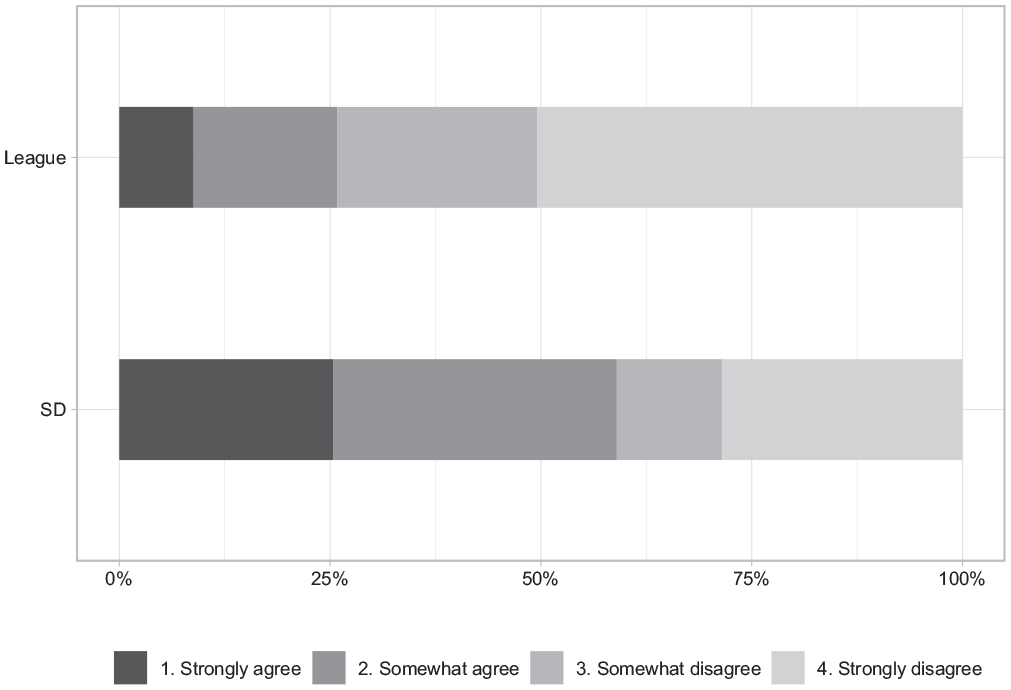
Extent to Which Respondents Agreed With the Statement: ‘It is not easy to publicly admit that I am a member of the [name of the party]’.
I will now proceed with describing the variables used in the analysis. The dependent variable of interest is participation. This has been operationalised in three ways, according to the three dimensions discussed earlier – contact, campaign and representation. The contact dimension was gauged with a question asking respondents how often they participated in party meetings outside election campaigns (monthly, rarely, never). The campaign dimension was measured by asking those respondents who had ever worked in an election campaign how often they distributed flyers during the last campaign in which they participated (weekly, monthly, rarely). The representation dimension was ascertained with a question asking PRR party members whether they would like to stand as candidates for their party (yes, no/don’t know). The main independent variable, perceived societal stigma, was created by asking the extent to which respondents agreed with the following survey item: ‘It is not easy to publicly admit that I am a member of the [name of the party]’. 5 Their answers were grouped into two categories: those who agreed or strongly agreed with the statement, and those who disagreed or strongly disagreed. 6 To test the hypotheses on stigma being contextual, the main independent variable was interacted with a variable gauging the PRR party regional vote share in the region where respondents were based, taking as a reference the last regional election held prior to the data collection. 7
To assess the statistical effects of perceived societal stigma on the participation of PRR grassroots members, I performed a series of logistic regressions – ordinal for the contact and the campaign dimension, and binomial for the representation dimension. The regressions included variables drawn from the party membership literature to control for the resources and the motivations for joining of party members (Brady et al., 1995; Seyd and Whiteley, 1992). 8 To account for the non-independence of observations within the same region, I computed robust standard errors clustered at the region/county level. Finally, given the imbalance between the number of respondents in the League and in the SD, I used sampling weights in my survey analysis, in order for the two membership bases to weigh the same.
The second part of my empirical analysis is based on qualitative data from 56 online semi-structured interviews I conducted between January 2021 and January 2022 with League and SD grassroots members. Due to the COVID-19 pandemic, all interviews were done by phone or online. Interviewees were recruited through a mix of purposive and snowball sampling to account for variation in terms of their gender, age and geographical region. Regarding the latter, I chose two regions in Italy (Veneto and Tuscany) and two counties in Sweden (Skåne and Stockholm) that differed according to the PRR party electoral strength, in order to get a fine-grained picture of the diverse contexts in which League and SD grassroots members can participate. 9 Given the fact that PRR party members are a ‘hard-to-reach population’ (Ellinas, 2023), and the difficulties of gaining access were further exacerbated by the COVID-19 pandemic, I relied on the PRR parties themselves to locate their grassroots members and invite them to participate in my project. Specifically, I contacted party officials from the regions/counties mentioned earlier and asked them to help organise the interviews. The interviews were conducted in English and Italian and were divided into three main parts: the reasons why members joined the party, why they remained in it (if applicable) and the kind of party activities they undertook. 10
Perceived Societal Stigma: A Deterrent to Participation
Before presenting the results of the statistical analyses, it is useful to understand how widespread the phenomenon of perceived societal stigma is among PRR party members. To do so, Figure 1 illustrates the extent to which respondents feel stigmatised in the League and in the SD, according to the survey. 11 As one would expect, this percentage is much lower in the former than in the latter: overall, while about 26% of League rank-and-file are uneasy about revealing their membership in public, this proportion is more than double in the SD, reaching around 59%. Moreover, only 9% of League respondents say they feel ‘strongly’ stigmatised, as opposed to 25% of SD ones. On one hand, these results suggest that perceived societal stigma is a reflection of the political one, and that the latter is related to the extent to which PRR grassroots feel subject to stigmatisation. On the other hand, it is noteworthy that despite the League having long been considered a legitimate political actor by other Italian parties, a quarter of its members still feel stigmatised. Furthermore, while we would expect these people to be based mostly in regions where the party is not successful electorally (see Harteveld et al., 2022), they were similarly spread among members living in the north of Italy and those living in the rest of the country (20% vs 29%, respectively). These findings reiterate the importance, argued earlier, of distinguishing between societal and political stigma in order to better understand this defining feature of PRR politics.
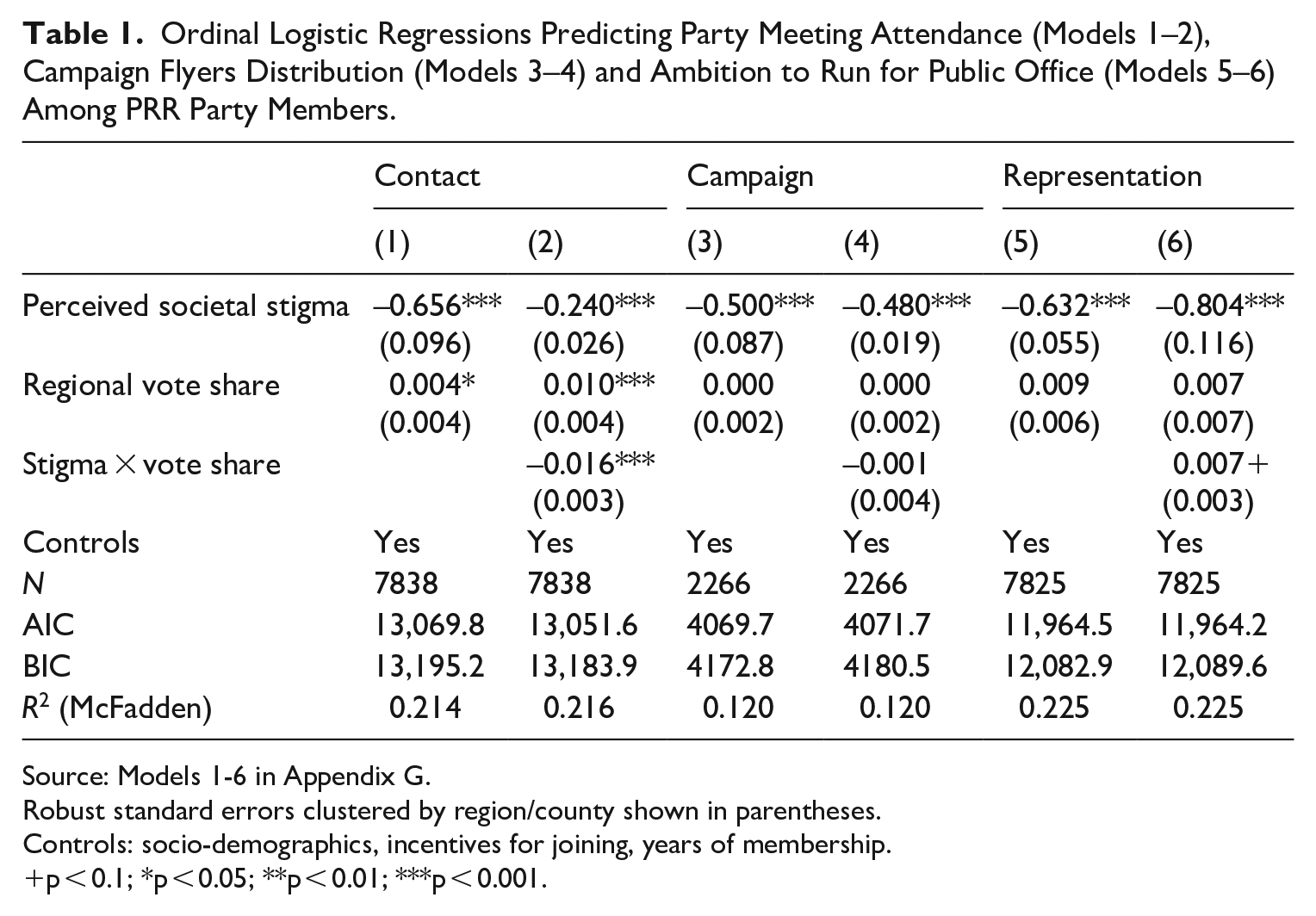
In the remainder of this section, I will examine whether perceived societal stigma works as a deterrent for members’ participation, as a stimulus, or both depending on where respondents are based. Table 1 reports the estimated effects of perceived societal stigma, as well as its interaction with regional vote share, on the participation of PRR party members across the three dimensions – contact, campaign, and representation. I will now turn to each of these.
Ordinal Logistic Regressions Predicting Party Meeting Attendance (Models 1–2), Campaign Flyers Distribution (Models 3–4) and Ambition to Run for Public Office (Models 5–6) Among PRR Party Members.
Source: Models 1-6 in Appendix G.
Robust standard errors clustered by region/county shown in parentheses.
Controls: socio-demographics, incentives for joining, years of membership.
p < 0.1; *p < 0.05; **p < 0.01; ***p < 0.001.
As Table 1 shows, members’ participation in the contact dimension varied considerably according to whether they felt subject to stigmatisation. The coefficient for perceived societal stigma in Model 1 is strongly and negatively correlated with attending party meetings, and the relationship between the two variables is significant at the 95% level even when controlling for members’ socio-demographic characteristics, incentives for joining, and years of membership. To facilitate interpretation of the findings of Model 1, Figure 2 displays the expected probabilities of attending party meetings by perceived societal stigma. As the left-hand panel in the figure illustrates, the likelihood of never participating in party meetings is higher among members feeling stigmatised than among those not feeling stigmatised (59% vs 43%, respectively). By contrast, members who do not perceive stigma are 6% more likely to attend meetings rarely, and 11% more likely to attend them on a monthly basis, than those who find their membership discrediting.
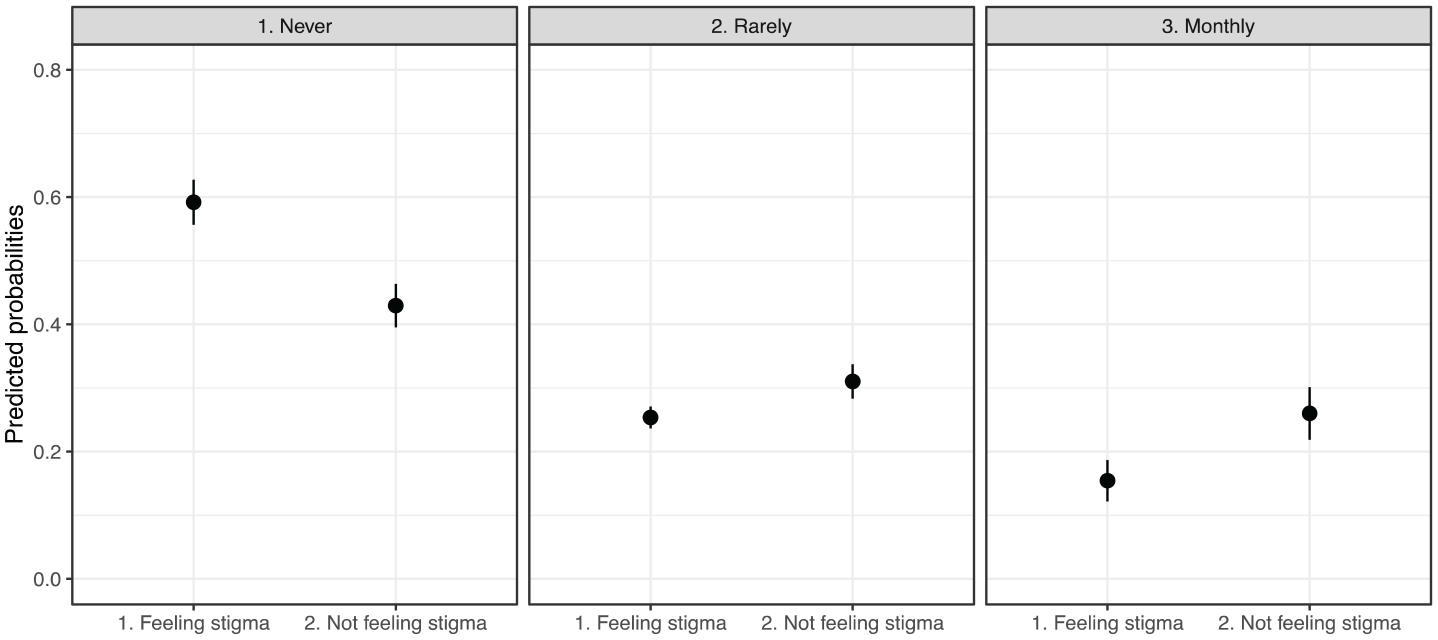
Predicted Probabilities of Attending Party Meetings by Perceived Societal Stigma, With 95% Confidence Intervals.
While this finding provides preliminary support for the ‘stigma as deterrent’ hypothesis, Model 2 in Table 1 shows that the interaction between perceived societal stigma and regional vote share is significant, suggesting that the relationship between stigma and party meeting attendance depends on where respondents are based. Figure 3, which presents the expected probabilities of participating in this contact activity by perceived societal stigma and regional vote share, shows that this is the case but in a different direction to the one hypothesised. In fact, the figure illustrates that in regions where the PRR party vote share is relatively low, there are no significant differences in party meetings attendance between members feeling stigmatised and members not feeling stigmatised. By contrast, the higher the vote share, the greater the divergence in participation between the two groups of rank-and-file, with members not feeling stigmatised being more involved. In other words, stigma works as a deterrent to this contact activity in regions where the PRR party is relatively successful, but not in those where it does not perform well. In the latter, there is no relationship between stigma and party meeting attendance.
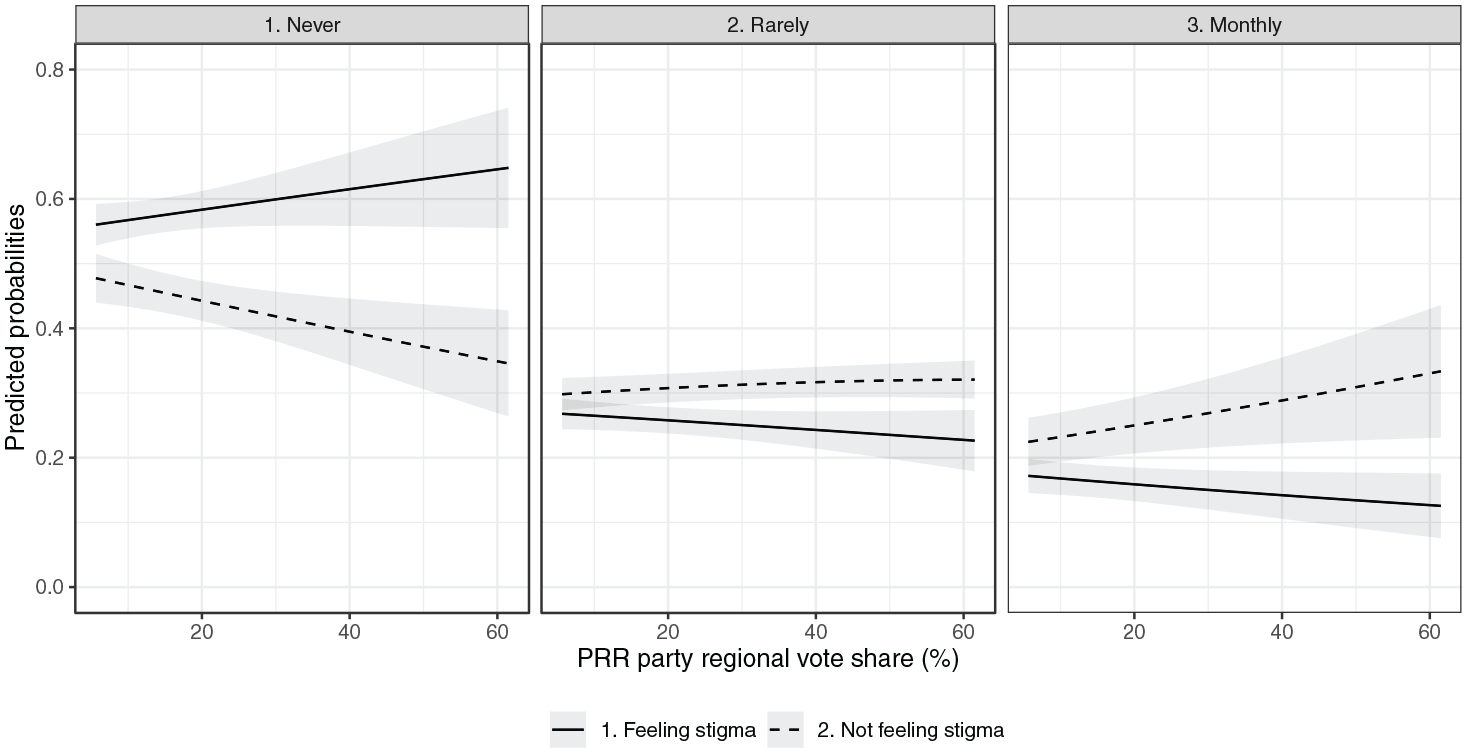
Predicted Probabilities of Attending Party Meetings by Perceived Societal Stigma and Regional Vote Share, With 95% Confidence Intervals.
Notably, this means that rank-and-file who feel stigmatised in regions where the PRR party does not do well electorally participate in meetings more often than their counterparts in party strongholds. For example, in regions where the PRR party got less than 6% of the votes in the last regional election, the likelihood of a rank-and-file attending meetings monthly stands at 17%. That same likelihood, however, drops to 13% in regions where the party got over 60%. This finding could be explained by the inherently social nature of the contact dimension mentioned in the theory section. Party meetings are a moment of camaraderie, in which members interact and discuss politics with like-minded people without having any direct contact with outsiders. It seems the case that in regions where the PRR party is less popular, individuals who join the party but are wary of revealing their membership are more willing to reach out to the local organisation and interact with fellow PRR sympathisers.
As with the contact dimension, perceived societal stigma also influences the campaign participation of PRR grassroots. As Model 3 in Table 1 illustrates, perceived societal stigma has a negative and statistically significant relationship with distributing flyers during election campaigns, and this relationship holds once again when controlling for socio-demographics, incentives for participating and years of membership. 12 Furthermore, the interaction between perceived societal stigma and regional vote share is not significant, indicating that the influence of stigma on this dimension of members’ participation does not depend on where respondents are based. Figure 4, which shows the predicted probabilities of distributing flyers during campaigns by perceived societal stigma, provides further insights on this finding. PRR rank-and-file who feel stigmatised are 7% more likely than those who do not feel stigmatised to report never having participated in this campaign activity during the last election campaign they took part in, and 4% more likely to report having done so only a few times a month. At the same time, the probability of having distributed flyers on a weekly basis is higher among respondents who do not find their membership discrediting than among those who do (41% vs 30%, respectively). Overall, this evidence provide support for the ‘stigma as deterrent’ hypothesis and suggests that perceived societal stigma discourages PRR party members from taking part in this relatively exposing activity.
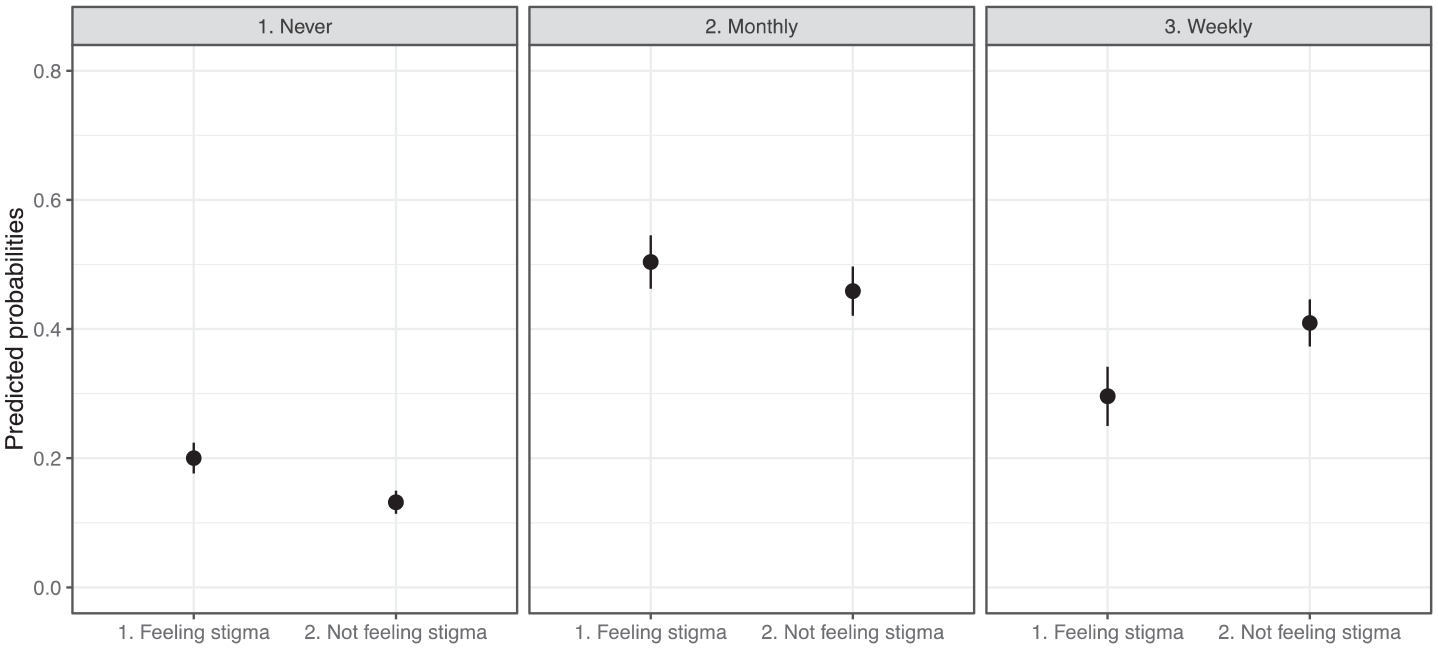
Predicted Probabilities of Distributing Flyers During Election Campaigns by Perceived Societal Stigma, With 95% Confidence Intervals.
Nonetheless, it is noteworthy that the association between perceived societal stigma and the campaign dimension (Model 3) is not as strong as the one observed as regards the contact dimension (Model 1). At first sight, this finding may sound counter-intuitive, given that attending party meetings is a less public activity than distributing flyers. At the same time, campaigns represent ‘the Christmas eve of party politics’ (Heidar and Kosiara-Pedersen, 2020: 138), in which party members are encouraged and expected to act as ‘footsoldiers’ and help parties fight elections (Bale et al., 2020; Scarrow, 1994). Given how the participation stakes during election campaigns are higher than usual, therefore, perceived societal stigma in this context appears to be less of a disincentive than it is for contact activities.
The final dimension of participation analysed is representation. Model 5 in Table 1 shows that perceived societal stigma is a strong predictor of this dimension too. In particular, rank-and-file with public office ambitions tend to be people who are not concerned about the stigma surrounding their membership. Model 5 points to a strong and negative correlation between perceived societal stigma and the desire to run for office, even when including all the relevant control variables. As illustrated in Figure 5, which displays the expected probabilities of having public office ambition by perceived societal stigma, PRR party members who feel stigmatised are 12% less likely than other members to report that they would like to stand as candidates in the future. Furthermore, Table 1 indicates that the interaction between societal stigma and regional vote share fails to reach the 95% confidence interval, albeit narrowly. This evidence provides further support for the ‘stigma as deterrent’ hypothesis, suggesting that those who find their party membership discrediting will steer away from this highly exposing activity.
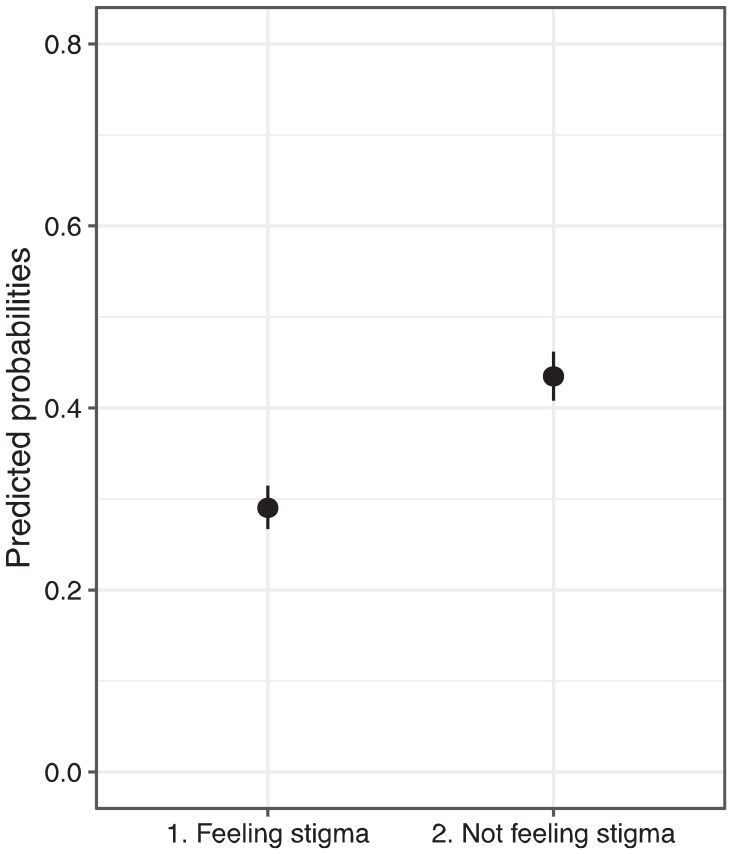
Predicted Probabilities of Aspiring to Public Office by Perceived Societal Stigma, With 95% Confidence Intervals.
To corroborate the robustness of my survey findings, I performed several checks under different variable specifications and for distinct sample subsets. These are all reported in Appendix H. Overall, the main results are further supported by these tests, in that perceived societal stigma remains negatively correlated with the three dimensions of participation, and is significant at the 95% level, in all 52 models.
‘The Stigma Was the Reason Why I Did Not Become Active Immediately’
The survey results provide extensive evidence for the ‘stigma as deterrent’ hypothesis across all dimensions of participation, except for the contact dimension in regions with a low PRR vote share. The negative relationship between perceived societal stigma and participation has been explained by positing that stigma deters participation. This is in line with research in the fields of social psychology and sociology, which shows that people whose stigmatised trait is a matter of concern will engage in ‘information control’ strategies to conceal the trait to others (Goffman, 1963; Herman, 1993). Nonetheless, the negative relationship between the two variables might be interpreted with the inverse mechanism: it could be the case that getting involved in party activities reduces the perceived societal stigma. Rather than joining and opting for being ‘silent supporters’ out of fear of social sanctions, therefore, members who feel stigmatised might decide to participate soon after joining the PRR party, and involvement in the party life might reduce the burden of the stigmatised trait.
While this mechanism is plausible, in my interviews with PRR grassroots members I found little support for it. By contrast, there were plenty of members who were inactive for a long time due to the perceived stigma. Unsurprisingly, more SD than League rank-and-file reported feeling stigmatised because of their membership, in line with Figure 1. Moreover, in the League case, these individuals tended to be based in Tuscany – a region with a strong leftist political tradition where the League has long been treated as a pariah. Nonetheless, the ‘stigma as deterrent’ mechanism was very common in the membership journeys of the people I interviewed. Member 27 (SD) was a good example of this: First I joined as a member just to show support, just as a silent way of showing my support. [. . .] There is and there’s been for a long time a huge stigma in Sweden. So first I did so [joined ‘silently’] because I was working as an entrepreneur. I could not become active in the party because it would kill my business.
In his case, he decided to get involved in party activities 5 years after joining, when he changed job. A similar story was that of Member 21 (League), this time due to her job in the public sector. She joined the party in 2016 but she initially did so as a silent supporter because ‘I work in the health sector, and the health sector in Tuscany is red [meaning left-wing]. In Tuscany there is this problem that many professionals are afraid of exposing themselves’. The trend of public employees being particularly wary of revealing their PRR party membership was present in both parties and included professional sectors such as health, education, and social welfare. Nonetheless, stigma worked as a deterrent for people with the most disparate occupations. As Member 54 put it: ‘There are a lot of people that join them [the SD], but nobody says it openly. It’s a shame – they are all among us, but they’re like ghosts, they don’t say it’. This opinion was echoed by Member 17 (League): ‘In Florence, it’s hard to recognise them [League members]. We all know how it’s like in Florence! Who is a member is afraid of saying it!’.
If not by participating in party activities, then, what factors could reduce the burden of the stigma, if any? Interviewees pointed to a number of mechanisms in this regard. In a few instances, it was a matter of critical events. For example, this was the case of Member 27 (SD) mentioned above, who started being active in the party once he changed job and was less at risk of professional sanctions. Another example is Member 35, who joined the SD in 2009 but was not active until 2016 (the year of the refugee crisis) due to the stigma: ‘I started to get active when we had a huge migration flow to Sweden of more or less Arabs. That’s when I decided to really get involved’. This was a landmark event for many SD interviewees, either as a trigger for joining or for becoming active. In most cases, however, the perceived societal stigma became less burdensome over a period of time, rather than following a specific event. A few explained that they were not sensitive to the stigma as they were in the past thanks to a process of self-development. Member 19 (League), another school teacher, well exemplified this trend. When asked why she decided to become active in the party after concealing her membership for some time, she replied, ‘Well, you know, I must have processed something, given my age. I processed that I should not feel inferior to other people, to these “intellectuals”’. A similar mechanism was highlighted by Member 3, a 23-year-old League rank-and-file: ‘I’m not a teenager anymore, who fears being judged by others’. In other instances, the decision to get involved was more related to an increased awareness that things were wrong and someone had to intervene. Member 34, a member of the SD since 2018, started participating in the life of her local branch around the time of our interview. She explained: I have been troubled about getting actively involved because I know that many people that got involved in this party have been attacked at home. [. . .] I thought that I would not engage and be public about it, but then I chose to do it because people must take this risk if we want to change things, otherwise it will just continue being worse.
Furthermore, among the SD grassroots, there was the perception that, as the political stigma surrounding their party was weakening, so was the societal one. Member 39 (SD) observed, In 2014 there was a stigma attached. My wife didn’t like it [me joining the party] one bit. She was still pursuing her career, and that could have a detrimental impact. So I was very low key in my involvement.
When asked how he came to participate more actively, he answered, ‘Overall, as we [SD] grew [electorally], it became normalised. [. . .] It cannot be a stigma to be a Sweden Democrat. It is normalised, if nothing else, by growth’. Relatedly, some interviewees pointed to 2010 – the year the SD entered national parliament – as a key moment in the process of normalisation that the party is undergoing. This is in line with studies showing that increased vote share and parliamentary representation help reduce the political stigma these parties are subject to (Harteveld et al., 2022; Valentim, 2021). Therefore, even though the stigma initially worked as a deterrent to participation for these PRR party members, both individual-level and contextual factors encouraged them to get more involved in their parties.
The interviews also presented a few instances which were in line with the ‘stigma as stimulus’ hypothesis. In these cases, the discredit surrounding PRR party membership led rank-and-file to become even more active within their party. Member 12 (League) was one of them: All these gestures, like the insults that I receive on social media and to which I always reply – I see them as badges of honour! [. . .] I take all these as badges of honour, and they actually stimulate me to do even more.
This view was echoed by Member 29 (SD), when asked whether the perceived societal stigma ever deterred him from participating: ‘Never. It only triggers me to do more’. Furthermore, some interviewees were aware that it was important to be active in the party in order to challenge the stigma. For instance, Member 9 explained, ‘According to some, being a League party member means being against immigrants, but that’s absolutely not true! [. . .] We [party members] need to be a concrete example to make people understand this is not true’. Similarly, reflecting on the backlash she faced when her colleagues found out she had joined the SD, Member 55, a school teacher, observed, ‘My college’s reaction was like . . . I didn’t know it would be as strong and hard as it was, but I know that they would react, of course. But it was like, “This is the reason I have to do this”’. In these instances, members were convinced that by confronting and challenging the stigma they could improve public perceptions of their in-group (Anspach, 1979). Notably, among the interviewees just mentioned, only Member 55 was a woman, reflecting how men tend to be less sensitive to PRR stigma (Ammassari, 2023; Harteveld et al., 2017). Overall, however, cases in which stigma worked as a stimulus were rare. As discussed, my interviews with PRR party members provided extensive evidence for, first, the ‘stigma as deterrent’ hypothesis, and second, the posited mechanism: it is stigma that deters participation, rather than participation that weakens the stigma. Clearly, there are strong social norms in place around PRR support which discourage people from becoming active in their PRR party.
Discussion and Conclusion
In this study, I investigated how perceived societal stigma affects the participation of PRR party members. Building on stigma research from the fields of social psychology and sociology, I developed three hypotheses in this regard. I tested these on the membership bases of two PRR parties which differ considerably in terms of the political stigma they are subject to: the League in Italy and the SD. Drawing on the first ever comparative survey of PRR grassroots members, I showed that perceived societal stigma has a negative relationship with participation in PRR parties, regardless of the different exposure that party activities entail. Moreover, qualitative evidence from interviews with 56 members of the League and the SD illustrated that this negative relationship is largely due to stigma deterring participation, rather than participation reducing stigma. This research has a number of implications for our understanding of PRR politics which I discuss below.
First, my findings speak to the debate on whether stigmatisation does actually hinder the success of PRR parties. While research on political stigma, most notably in the form of a cordon sanitaire, has reached mixed conclusions in this regard (Akkerman and Rooduijn, 2015; Van Spanje and Van der Brug, 2009; Van Spanje and Weber, 2019), my study has provided solid evidence that perceived societal stigma can damage these parties’ success by reducing considerably their mobilisation potential. For instance, the fact that, according to my survey, about 6 out of 10 SD rank-and-file feel stigmatised means that party elites will have a hard time in recruiting them, not only to help the party fight elections during campaigns, but also for those contact activities which sustain the party organisation between elections. In this regard, while this article has examined the issue of perceived societal stigma by looking at the supply-side of PRR party membership, that is, the grassroots, future work could investigate it by exploring the demand-side, namely party elites, to see whether and how these deal with stigma in their recruitment and retention strategies. Moreover, it should be emphasised that the detrimental effects of perceived societal stigma on PRR parties’ organisation and mobilisation are likely to be even stronger than those uncovered in my study. Based on the premise that joining a party does not imply that one does not feel stigma, my research focused on a key group of PRR supporters: PRR party members. However, it is also true that if there was no stigma surrounding PRR support, there would be much more PRR sympathisers willing to formally join the party. Looking at how perceived societal stigma affects the behaviour of the broader universe of PRR supporters would be useful to further understand the extent to which stigma inhibits the mobilisation potential of PRR parties.
Second, my results illustrate the theoretical and analytical value of treating societal and political stigma as two distinct, albeit linked, phenomena. Further research is needed in order to examine whether and how these two interact, and what the consequences are on different forms of PRR support. As regards party membership, we have seen that just because a PRR party like the League has always been a legitimate and respectable coalition partner, it does not follow that its grassroots are exempted from feeling stigma. In this sense, the fact that in my survey over a quarter of League respondents (including in the party’s historical stronghold, the north of Italy) reported being uneasy about revealing their membership to other people is particularly telling. Despite the fact that PRR parties are becoming more mainstreamed and normalised (Mudde, 2019), therefore, this finding can be interpreted as a further sign of the ‘democratic resilience’ that Western societies maintain against this type of politics (Meléndez and Kaltwasser, 2021). In other words, while in their pursuit of votes, offices and policies some mainstream parties, in particular on the centre-right, are increasingly open to cooperation with illiberal forces, civil society continues to enforce strong negative social norms against PRR support.
Finally, there remains the question of whether my results can be generalised to other political parties. As mentioned in the theory section, while PRR stigma is unique because of its historical roots, stigma is not something distinctive to the PRR. Rather, it seems to characterise party families which are located at the two extremes of the political spectrum. For example, radical left parties like Syriza in Greece and Podemos in Spain have been tainted with the stigma of extremism due to their ‘anti-system’ nature (Aslanidis, 2021; Petithomme, 2021). Similarly, radical left parties in Central and Eastern Europe suffer from stigmatisation because they are ‘tarred [. . .] with the “totalitarian” [Communist] brush’ (March, 2023: 574). Future work could expand the scope of my study by looking at perceived societal stigma among members of these parties. Overall, I would expect the negative relationship between stigma and participation uncovered in this article to hold in all radical party memberships. What needs to be seen is whether this relationship is as strong and consistent across all forms of participation as it is in PRR parties. This research would be revealing of the extent to which publics are perceived to uphold social norms against any form of radicalism, in defence of liberal democracy; or whether it is the nativism of the PRR which is first and foremost rejected, in defence of the rights of minorities.
Supplemental Material
sj-docx-1-psx-10.1177_00323217241234527 – Supplemental material for Deterrent or Stimulus? How Perceived Societal Stigma Affects Participation in Populist Radical Right Parties
Supplemental material, sj-docx-1-psx-10.1177_00323217241234527 for Deterrent or Stimulus? How Perceived Societal Stigma Affects Participation in Populist Radical Right Parties by Sofia Ammassari in Political Studies
Footnotes
Acknowledgements
The author would like to thank the anonymous reviewers, the members of the ‘People, Elections and Parties’ research group of the Centre for Governance and Public Policy (CGPP) at Griffith University – Max Grömping, Ferran Martinez i Coma, Duncan McDonnell and Lee Morgenbesser – as well as Léonie de Jonge and Robert A. Huber for their extensive feedback on previous drafts of this article. She is also particularly grateful to the participants of the 2022 ECPR General Conference and the 2022 AusPSA Annual Conference for their helpful comments, questions and suggestions. Finally, she would like to express her gratitude to the Griffith Asia Institute for providing funding for her interview transcriptions.
Declaration of Conflicting Interests
The author(s) declared no potential conflicts of interest with respect to the research, authorship, and/or publication of this article.
Funding
The author(s) received no financial support for the research, authorship, and/or publication of this article.

Supplemental Material
Additional Supplementary Information may be found with the online version of this article.
Contents
Appendix A: Further information on two selected cases. Table A1. Election results of the League and SD in the 2000s. Table A2. List of regional elections that occurred prior to the survey distribution. Table A3. League vote share in Veneto and Tuscany in the five general elections prior to the study. Table A4. SD vote share in Skåne and Stockholm in the five general elections prior to the study. Appendix B: Online membership surveys. Appendix C: Regional breakdown of respondents. Table C1. Regional breakdown of League respondents. Table C2. Regional breakdown of SD respondents. Appendix D: Questions and variables. Table D1. Overview of the variables included in the statistical analyses. Appendix E: Descriptive statistics. Table E1. Descriptive statistics of PRR grassroots members, weighted by party. Table E2. Descriptive statistics of PRR grassroots members, unweighted. Appendix F: Interviews with PRR party members. Table F1. List of 56 PRR party members interviewed for the study. Appendix G: Full models. Table G1. Logistic regressions predicting participation of PRR party members. Appendix H: Robustness checks. Table H1. Logistic regressions predicting participation of PRR party members, with perceived societal stigma as an ordinal variable. Table H2. Logistic regressions predicting participation of PRR party members including missing values (‘don’t know’) among members feeling stigmatised. Table H3. Logistic regressions predicting participation of PRR party members including missing values (‘don’t know’) among members not feeling stigmatised. Table H4. Logistic regressions predicting the representation dimension of participation of PRR party members, looking at those who stood as candidates (Models 25–26) and held an internal party office (Models 27–28). Table H5. Logistic regressions predicting participation of PRR party members, including only respondents who received survey by email. Table H6. Logistic regressions predicting participation of League party members. Table H7. Logistic regressions predicting participation of SD party members. Table H8. Logistic regressions predicting the contact dimension of participation of SD party members, excluding Skåne (Model 47), Stockholm (Model 48), Västra Götaland (Model 49), and the three of them (Model 50). Table H9. Logistic regressions predicting the campaign dimension of participation of SD party members, excluding Skåne (Model 51), Stockholm (Model 52), Västra Götaland (Model 53), and the three of them (Model 54). Table H10. Logistic regressions predicting the representation dimension of participation of SD party members, excluding Skåne (Model 61), Stockholm (Model 62), Västra Götaland (Model 63), and the three of them (Model 64).
Notes
Author Biography
References
Supplementary Material
Please find the following supplemental material available below.
For Open Access articles published under a Creative Commons License, all supplemental material carries the same license as the article it is associated with.
For non-Open Access articles published, all supplemental material carries a non-exclusive license, and permission requests for re-use of supplemental material or any part of supplemental material shall be sent directly to the copyright owner as specified in the copyright notice associated with the article.
