



Abstract
Most parliamentary democracies have seen a rise of populist radical parties during the past decades. Many countries have also experienced severely delayed government formation processes, with caretaker governments in office for extended periods of time. Are these delays related to the rise of radical parties? We argue that the rise of populist radical parties may prolong the bargaining process, due to the fact that these parties are often treated as pariahs by other parties during election campaigns, which creates a complex bargaining situation after the election. We evaluate this claim by studying 121 government formation processes in the German States from 1990 until 2021, using original data which includes statements made by parties during election campaigns. The findings show that a higher share of seats allocated to parties from the radical right and radical left results in an increasing amount of days until a new government is voted into office. We also find that when a party that has been characterized as being ‘non-coalitionable’ during the election campaign ends up among the negotiating parties, the government formation process is severely delayed. These findings suggest that the rise of populist radical parties may create severe challenges for parliamentary democracy.
Keywords
Introduction
Most parliamentary democracies have seen the rise of populist radical parties during the past decades, especially so called far right parties. These parties typically take extreme political stands on some policy issues, for example on immigration, and they are often, at least initially, treated as ‘pariahs’ by the other more established parties (see, e.g., De Lange, 2012). Many countries have also experienced severely delayed government formation processes, with caretaker governments in office for extended periods of time (see, e.g., Ecker and Meyer, 2020). Are these bargaining delays related to the rise of radical parties?
We here draw on the literature on bargaining delays, where some authors have argued that the presence of large extreme parties reduces complexity of the negotiation process and thereby shorten it, whereas others have argued that their presence and growth should increase complexity and cause bargaining delays (see, e.g., De Winter and Dumont, 2008). We also draw on the literature on political polarization and its consequences, where some scholars have suggested that polarization may cause a parliamentary ‘gridlock’ which may result in severe difficulties in forming governments (Bäck and Carroll, 2018).
Our main expectation is that the rise of populist radical parties in parliament will increase the length of bargaining during government formation, mainly because these parties are treated as ‘pariahs’, or as being ‘non-coalitionable’ by other parties. This creates a complex bargaining situation, where some parties may have issued clear statements about their non-willingness to cooperate with specific parties during their election campaigns – electoral promises which are difficult to break after an election. Hence, we hypothesize that government formation will take longer the larger the share of radical parties in parliament. We also hypothesize that the presence of a party that has been characterized as ‘non-coalitionable’ by at least one of the negotiating parties will prolong the bargaining process.
We evaluate our hypotheses by studying 121 government formation processes in the German States during the time period from 1990 until 2021, using original data which includes pre-electoral commitments made by parties during election campaigns, allowing us to measure the ‘pariah’ status of parties. The focus on the 16 German States minimizes potential confounding effects that could emerge from the variation in the institutional structure of political systems in studies that adopt a cross-country research design.
The findings show that a higher share of seats among populist radical parties results in an increasing number of days until a new government is voted into office. We also find that when some parties have made a pre-electoral commitment against cooperating with one or more parties, and such parties nevertheless end up among the negotiating parties, the government formation process is severely delayed. These findings imply that current changes of many party systems, with the rise of populist radical parties, may result in a gridlock situation where caretaker governments are unable to act swiftly and/or to implement necessary reforms, creating severe challenges for parliamentary democracy.
Theory and hypotheses
Research on bargaining duration and delays
The previous literature on bargaining duration has suggested that delays can be explained by mechanisms related to preference uncertainty or bargaining complexity. Early research on bargaining delays was based on bargaining-theoretical models building on the assumption that actors have incomplete information, focusing on the role of preference uncertainty in causing delays. According to such work, extended negotiations fulfil the need of the actors to obtain information about their potential coalition partners’ goals and where they stand on different issues (see, e.g., Diermeier and Roozendaal, 1998).
In empirical studies aiming at investigating the role of uncertainty in causing bargaining delays, scholars have often relied on crude measures, for example gauging if the government negotiations took place immediately after an election (see, e.g., De Winter and Dumont, 2008; Diermeier and Roozendaal, 1998; Ecker and Meyer, 2015). Ecker and Meyer (2020) include measures of familiarity to get at the uncertainty among the negotiating parties, drawing on the literature on coalition formation which focuses on how previous collaboration fosters mutual trust and knowledge about potential partners’ preferences (see, e.g., Martin and Stevenson, 2010). Ecker and Meyer (2020) show that familiarity decreases the risk of bargaining delays (see also Bäck et al., forthcoming).
Most empirical work on the duration of government formation processes has focused on the role of complexity in the bargaining situation. The main argument in such work is that it is more difficult to negotiate and reach an agreement if there are many potential alternative governments and if there are major conflicts among the political parties. For example, De Winter and Dumont (2008) show that ideological polarization among the parties in parliament is decisive for how long it takes to form a government. Similarly, Golder (2010) shows that it takes longer to form governments when the number of parliamentary parties is large and when the degree of ideological polarization is high.
Other scholars have focused on the role of ‘extreme’ parties. Here, some have argued that large extremist parties may both decrease and increase bargaining complexity. Some authors argue that since these parties are not seen as ‘coalitionable’ by other parties, their presence restricts the number of possible government alternatives, thereby reducing bargaining complexity (e.g., De Winter and Dumont, 2008). This suggests that their presence should make government formation a swift process. However, when these parties grow significantly in size, some new collaborations between parties that have diverging policy preferences may be needed to keep these parties out of cabinet (e.g., Warwick, 1992). This type of argument suggests that their presence will increase complexity and the risk of delays. In line with these differing expectations, results in empirical studies analysing the impact of extreme party size on bargaining duration in Western Europe are mixed (De Winter and Dumont, 2008; Diermeier and Roozendaal, 1998).
Pariah parties, pre-electoral commitments and parliamentary gridlock
One branch of literature important for our argument concentrates on the impact of populist radical right parties on government formation. This literature has focused on the fact that radical right parties are often characterized by the mainstream parties as ‘pariahs’, with questionable democratic standards that diverge from the general current policy consensus (Downs, 2001). Previous research has shown that the mainstream parties’ responses towards right-wing populists vary significantly across countries, ranging from ignorance, isolation, co-optation to collaboration (e.g. Downs, 2001). Stressing that such responses may change over time, De Lange (2012) shows that mainstream right parties have turned to such radical parties as partners when these parties gained in electoral support. For instance, the right-wing populist party Vox in Spain was considered a ‘pariah’ by all major parties, but the conservative People’s Party changed its course in March 2022 and formed a coalition with Vox in the autonomous region of Castile and León. 1
Even when populist radical parties remain pariahs, and thus remain excluded from power, they may influence government formation. For example, the likelihood of minority governments increases when such parties hold the balance of power (Loxbo, 2010). The presence of right-wing populist parties that are characterized as pariah parties may also result in the formation of ‘grand’ coalitions, consisting of parties that have rarely collaborated before, in order to neutralize their potential power (e.g., Rydgren, 2007).
A related literature focuses on the impact of pre-electoral commitments on government formation (e.g., Debus, 2009; Golder, 2006). Scholars have shown that the probability of a parties’ ruling together after an election increases if these parties entered into a pre-electoral coalition beforehand (Debus, 2009; Martin and Stevenson, 2001). Debus (2009) argues for the importance of analysing the impact of ‘positive’ and ‘negative’ pre-electoral commitments. Positive pre-electoral commitments include statements or joint policy programs where some parties present a promise to the voters that they will collaborate after the election. Negative pre-electoral commitments or ‘coalition rejections’ instead entail election promises where some parties are characterized as ‘unthinkable’ as collaboration partners.
Drawing on such work and focusing on the role of pre-electoral alliances, Bäck et al. (forthcoming) argue that there are several ways in which such alliances could influence bargaining duration. For example, if parties spend a lot of time before the election bargaining over policy issues, this should reduce uncertainty about potential coalition partners’ policy preferences. The authors also argue that government formation processes may be swiftly concluded since pre-electoral alliances tie “the hands of the included parties, as breaking electoral promises can come with significant costs in future elections”, which means that parties are less likely to negotiate with other potential partners.
A further field of research that is relevant for our theoretical argument about bargaining delays is the literature on polarization among political elites, mainly originating in the US (e.g., McCarty et al., 2006). Here, scholars have stressed that deepening divisions among members of Congress cause challenges for the functioning of Congress, arguing that there is an increased risk of “gridlock”, or an “inability to enact policy change despite elite or mass demands” (Bäck and Carroll, 2018: 2; Barber and McCarty, 2015).
Discussing the consequences of polarization in parliamentary systems, Bäck and Carroll (2018: 3) argue that “severe forms of gridlock are possible, with governments not being able to change policy, even when demands from within or outside government to implement reforms are present”. Drawing on the literature of bargaining delays described above, they suggest that polarization may result in complex bargaining situations with several unsuccessful bargaining rounds and long periods of caretaker governments unable to implement any ‘real’ policy reforms. Bäck and Carroll (2018) argue that underlying all forms of parliamentary gridlock, which includes, in addition to bargaining delays, policy deadlock and government fragility, is parties’ willingness to cooperate, stressing the importance of polarization among party representatives.
Most scholarly work on political polarization focusing on political elites assumes that polarization is based on ideological differences between parties and representatives. However, there is a growing literature suggesting that divisions between party supporters are not only based on ideological or policy differences, but may also be social identity based (e.g., Mason, 2018). Such divisions among groups have been described as ‘affective polarization’ and are a phenomenon that has mainly been analysed at the mass-level (see, e.g., Iyengar et al., 2019; Reiljan, 2020; Wagner, 2021).
However, some scholars have tried to measure affective polarization at the elite level. Baumann et al. (2019) measure negative emotions in parliamentary speeches in the Swedish Riksdag and the Dutch Tweede Kamer and find that opposition parties tend to be increasingly more negative in Sweden while government-opposition differences were weak in the Netherlands. Baumann et al. (2019) suggest that this may indicate a higher degree of affective polarization in Sweden, which can be related to the clear bloc patterns, with associated pre-electoral coalitions, in government formation during the past decades.
Calvo et al. (2021) measure affective polarization among political representatives by focusing on mainstream party responses to right-wing populist parties. They argue that when mainstream parties clearly distance themselves from right-wing populist parties and treat such parties as pariahs, affective polarization is likely to be high. Empirically, they measure the degree of affective polarization by analysing negative rhetoric in legislative debates used by mainstream party representatives toward right-wing populist parties and candidates. Calvo et al. (2021) show that there is clearly a higher degree of negativity when speeches mention the Sweden Democrats or their candidates, indicating some degree of affective polarization in the Swedish parliament related to the populist radical right.
Hypotheses on pariah parties and bargaining delays
We assume that parties are policy-seeking, office-seeking and vote-seeking, that is, they care about implementing a policy program, they care about being in office, so that they can better implement their policy goals, and they care about the electoral consequences of their decisions and behaviour (e.g., Müller and Strøm, 1999). Important for our argument is that political parties should avoid breaking electoral promises and making compromises, since such behaviour is likely to come with electoral costs (e.g., Fortunato, 2019).
Our main interest lies in analysing how the rise of populist radical parties influence government formation in parliamentary democracies. Drawing on the previous literature, we centre on two features related to such parties, focusing on the share of seats held by populist radical parties, and on pre-electoral statements about parties that are seen as being ‘non-coalitionable’ by at least one other party. Following the previous literature, we argue that when such parties increase their representation in parliament, it is likely to become more difficult for other parties to find majority support for a viable majority government, which may result in collaborations between parties that have not cooperated before and are ‘forced’ to liaise due to a lack of coalition options (see Sartori, 1976; Warwick, 1992). Since parties should try to avoid making compromises due to the increased risk of electoral losses, this may result in a longer bargaining duration process, increasing the risk of delays.
We should here note that in some previous work, the share of seats held by ‘extreme’ parties has been suggested to determine the degree of ideological polarization in a political system (e.g., De Winter and Dumont, 2008). We cannot disregard this, since the ideological polarization in the system may increase with the entry of populist parties in parliament that hold more extreme positions on some issues, for example on immigration. However, if there is an effect of the extreme party size on bargaining duration when we control for ideological polarization, we may be capturing a mechanism that is related to some other form of distancing, connecting to the social identity divisions identified in the literature on affective polarization, where some scholars have suggested that the pariah status of some parties is a form of affective polarization (see e.g. Calvo et al., 2021).
So far, we have discussed the ‘indirect’ effects of populist radical parties on government formation, that is, how their increasing presence in parliament and status as pariahs may influence how other parties negotiate when forming a government, but what happens when these parties are invited to take a seat at the bargaining table? This may sound counter-intuitive since pariah status would preclude any kind of invitation to collaborate, but we suggest, following the previous literature, that radical parties may lose their pariah status when mainstream parties realize that they need these parties’ support to form a government (e.g., De Lange, 2012). Such realizations among party leaders may come after the election when there is a new parliamentary situation, and may force some parties to negotiate with a party that they had portrayed as being ‘non-coalitionable’ and thus rejected as a potential coalition partner during the election campaign.
We suggest that there are two main reasons for why the presence of such a party among the negotiating parties should result in severe bargaining delays. First, having to negotiate with a party that was described as being non-coalitionable during the election campaign implies that an electoral promise is broken when you start negotiating with this party. The mainstream parties may simply take time justifying these negotiations among the party supporters, making it clear that it is a ‘necessary evil’ to join forces with a previously excluded party (see, e.g., Teorell et al., 2020). Second, negotiating with parties that have not participated in any important policy discussions before clearly lowers the degree of familiarity among the negotiating parties. Such unfamiliarity may result in a high degree of uncertainty, which parties may only solve by lengthy negotiations between the parties that eventually form a government (Ecker and Meyer, 2020).
All in all, we derive two hypotheses from this discussion:
The larger the share of seats held by populist radical parties in parliament, the longer the government formation process.
The presence of a ‘pariah’ party among the bargaining parties prolongs the government formation process. To be clear, we expect that there are two main mechanisms at work here. The first one is indirect and suggests that bargaining complexity and uncertainty should increase when populist radical parties become significant in the sense that it gets difficult for the other parties to find alternative majority constellations without them. This situation means that parties may have to find new coalition partners they have rarely (or never) collaborated with, which should result in a higher degree of bargaining complexity and uncertainty. Evidence in favour of hypothesis 1 should mainly support such an indirect mechanism. However, support for hypothesis 1 could also capture a more direct effect – in cases where populist radical parties have grown significantly in size, other parties may become more or less forced to negotiate with them, and when doing so, bargaining delays are likely to occur. Support for hypothesis 2 would also suggest such a direct effect since it focuses on the fact that parties that have been portrayed as ‘non-coalitionable’ during the election campaign by one or more competing parties are taking part in coalition negotiations. In such cases, bargaining complexity and uncertainty should increase, since electoral promises have to be broken, and familiarity among the negotiating parties should be low, which may cause bargaining delays.
Methods and data
A study of bargaining delays in the German Federal States
We evaluate our hypotheses using original data on the duration of coalition negotiations in the German Federal States between 1990 and 2021, covering 121 attempts of forming a (multiparty) cabinet. Each of the 121 cases under study is a government formation attempt of which 119 cases were successful and two failed when electing a Prime Minister, but agreed on a coalition policy agreement. 2
Focusing on the regional level has significant advantages (Jeffery and Wincott, 2010; Snyder, 2001). The institutional context and the basic structure of party competition and coalition formation are more or less the same across the Länder and have followed similar trends over time (see Bowler et al., 2016; Bräuninger et al., 2020). The institutional structure is therefore held constant, thereby minimizing potential confounding effects that are likely to arise from a cross-country comparative analysis where the institutional context varies significantly across countries (e.g., Ecker and Meyer, 2020; Golder, 2010).
One prevalent problem of studies on the duration of coalition negotiations is the non-random nature of the selection process (see also Ecker and Meyer, 2020), as a number of different factors affect which parties enter coalition negotiations. If unobserved variables influence both which parties engage in coalition talks and the duration of these talks, the observed sample of formation attempts is biased which, if not considered, might lead to biased coefficient estimates when modelling bargaining duration (Chiba et al., 2015). We therefore follow the approach introduced by Chiba et al. (2015) and, similar to Ecker and Meyer (2020), model government formation attempts as a two-stage process. The two stages – selection and duration – are linked by a joint likelihood function, which accounts for the potential dependence between them.
In a first step, the selection of parties entering coalition negotiations is modelled as a multinomial conditional logit model. We model each formation attempt as a choice out of all combinations of legislative parties. The dependent variable is a binary indicator whether this combination was chosen (1) or not (0). We include four explanatory variables in the selection stage of the statistical model. These four variables – inclusion of the largest parliamentary party in the coalition, intra-coalition programmatic heterogeneity, incumbency status of the coalition, and missing congruence of the coalition with the partisan composition of the government and opposition camp on the national level (“cross-cutting coalitions”) – reflect not only standard theoretical accounts on government formation, but are also very good predictors of the outcome of the coalition formation process in the German states (see Bräuninger et al., 2019b, 2020; Debus, 2022).
We model the second stage, that is, the duration of the bargaining attempt, as a Weibull accelerated failure time competing risks model, differentiating between successful and unsuccessful attempts. Our dependent variable is the number of days it took between election day and the (successful or unsuccessful) election of the Prime Minister. In cases where negotiations started after an unsuccessful election to the office of Prime Minister, we select the date of the unsuccessful prime ministerial election as the starting point of the new negotiation process.
Figure 1 shows that in most of the 121 cases under study, the government formation process took less than 50 days; in about 10 cases, the negotiation talks lasted for 100 days or more; the negotiation process between the parties in Hesse 2008 is – with 281 days – the longest we observe in the covered time period. On average, the government formation process in the German Federal States lasted for 51 days with a standard deviation of 32. The fastest government formation processes took place in Saxony in 1990 (13 days) and in Mecklenburg-Western Pomerania in 1990 (14 days). Distribution of the government formation duration (in days) in the German States, 1990–2021.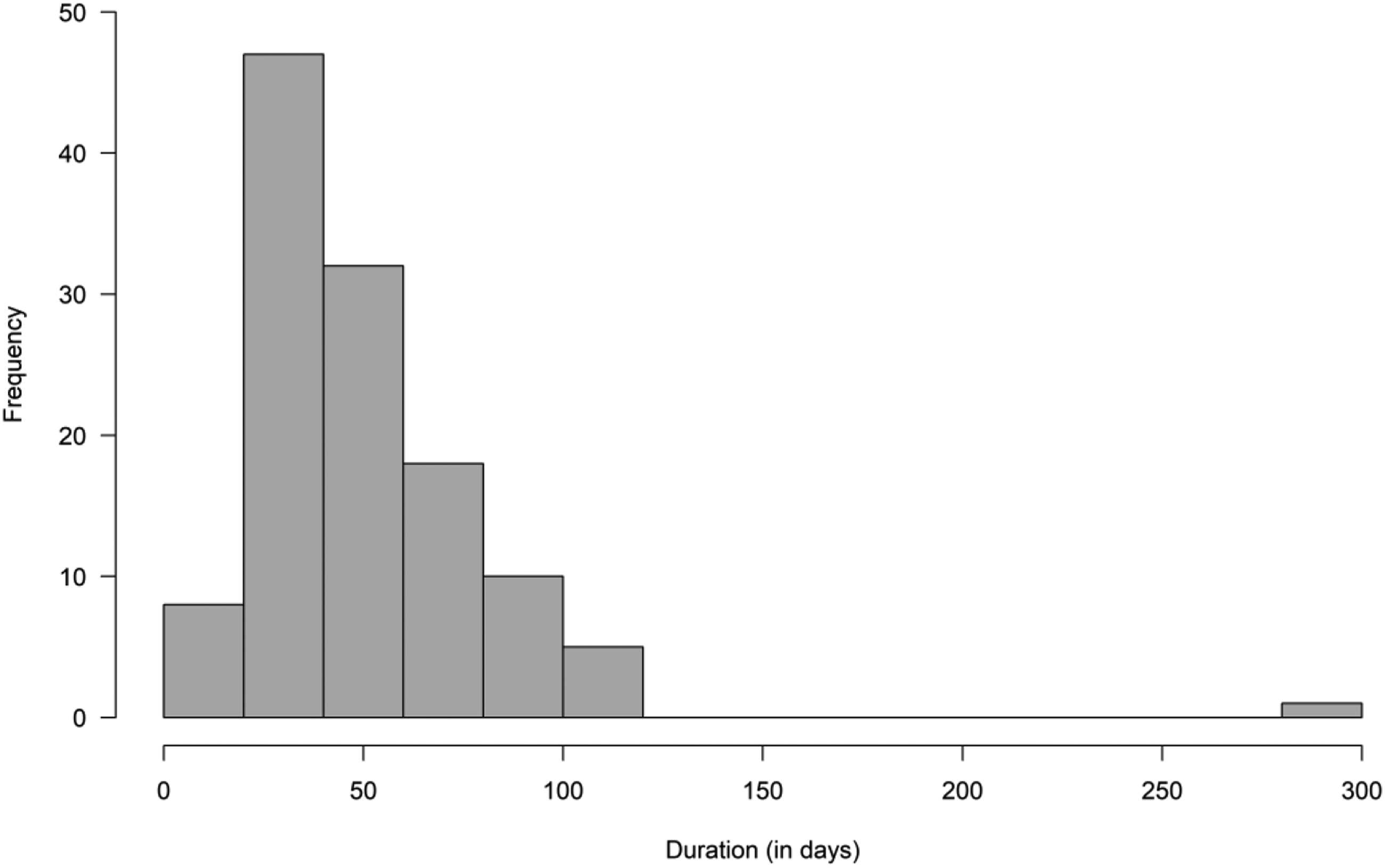
To evaluate our expectations, we need data on the partisan composition of the coalition governments, and information on whether some parties are considered as ‘pariahs’ by one or more other parliamentary parties. The dataset on party competition in the German Federal States (Bräuninger et al., 2020) provides data for testing our expectations, including information on the pre-electoral commitments of parties and numerous features of the governments formed in each state and on the federal level (see also Bräuninger et al., 2019b). This information was collected from state election reports, published regularly in the Zeitschrift für Parlamentsfragen (https://zparl.de/). It also covers information on the programmatic profile of state parties, measured on the basis of a Wordscores content analysis of the full text of state parties’ election manifestos. 3
Our first hypothesis (H1) focuses on the seat share of ‘populist radical’ parties in the state parliament. The measurement of this feature is straightforward: we add up the seat share of parties that belong to the far right of the political spectrum – the Republikaner (REP), the National Democrats (NPD), the German People’s Union (DVU), the Party for the Rule of Law Offensive (PRO, “Schill-Partei”) and the Alternative for Germany (AfD) – to create a variable that measures the seat share of populist radical right parties and a variable that provides information on the seat share of populist radical left parties, covering the Socialist Party (PDS) and its successor organization The Left.
To evaluate the impact of a pariah party among the negotiating parties (H2), we identify – successful and unsuccessful – government formation processes that included a party either as a formal member of a coalition or as a supporting party that was rejected by at least one other coalition party as a future partner during the election campaign. This variable – “pariah party among bargaining parties” – covers the government formation processes in Hamburg 2001 (coalition between CDU, PRO and FDP), in North Rhine-Westphalia 2010 (SPD/Greens minority government with the support of The Left), in Thuringia 2020 (FDP minority government, indirectly supported by the AfD and CDU), and in Hesse 2008 (SPD/Greens minority government supported by Die Linke).
Importantly, we control for the degree of ideological polarization in parliament. We estimate the ideological polarization in a state parliament by following the logic of Esteban and Ray (1994), adding up the pairwise ideological distances between the positions of parliamentary parties, weighted by their parliamentary seat share, on a left-right dimension, measured by a Wordscores analysis of the parties’ election manifestos (Indridason, 2011).
Figure 2 shows that the ideological polarisation within parliaments clearly varies across states and also within states. For instance, polarisation in Saxony-Anhalt and Saxony, two East German states in which parties from the far right have often won parliamentary representation and the socialist Left has continuously been represented in parliament, show higher degrees of polarisation in parliament compared to West German states like Hamburg, Bavaria or Lower Saxony, where neither parties from the far left nor from the far right won parliamentary representation that often in the time period under study. Ideological polarisation in the German state parliaments, 1990–2021. Source: Updated dataset of Bräuninger et al. (2020); own calculations.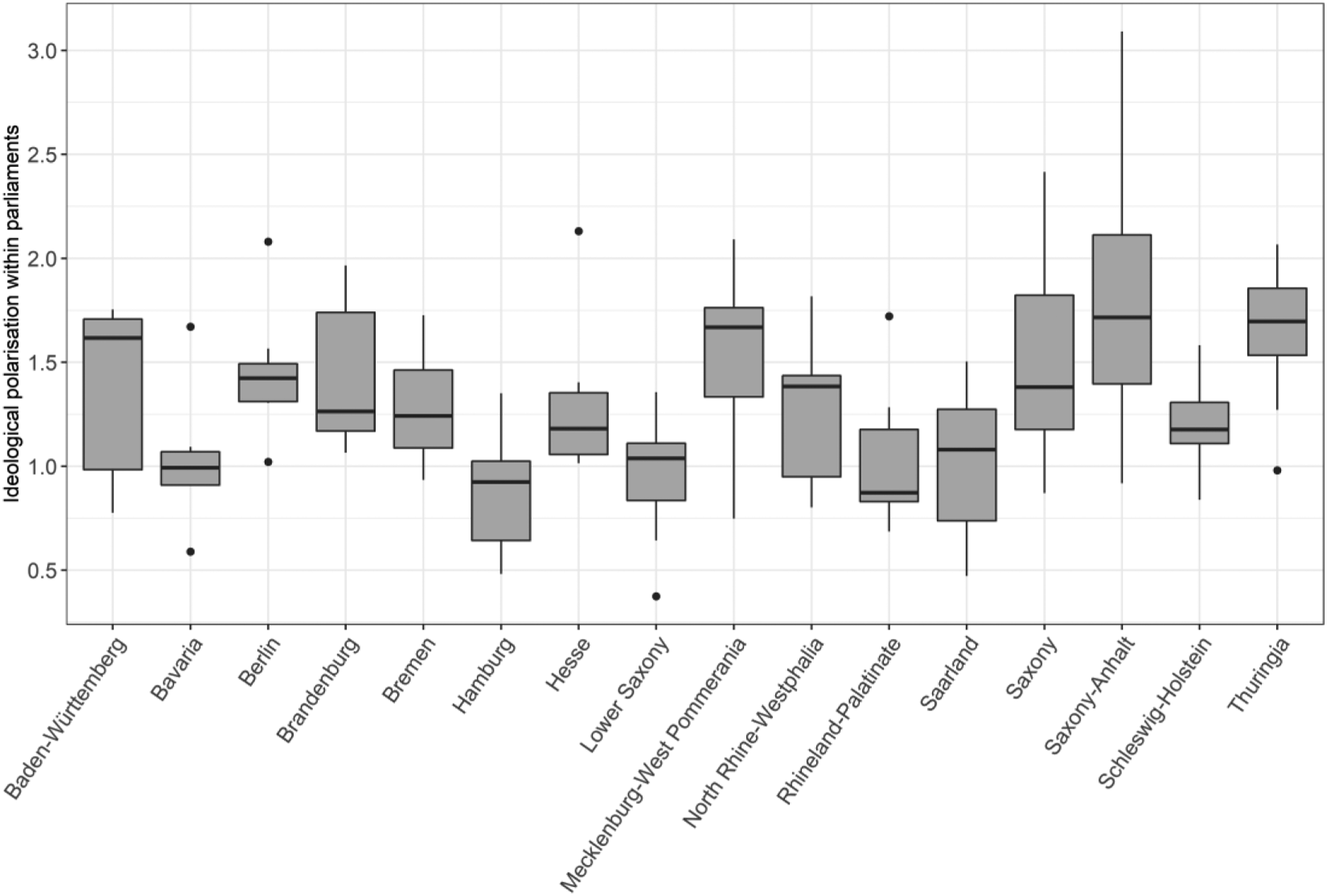
While the selection stage already covers important variables that should also influence coalition negotiation duration, we additionally control in the duration stage of the statistical model for the effective number of parliamentary parties since a more fragmented parliament should result in a more complex government formation process. Furthermore, we add a variable that provides information on the question if the envisaged government consists of one party only. Finally, we control for a time trend by means of decade fixed-effects, and include dummy variables for each state into the regression models.
Analysis
We estimate three regression models to evaluate our hypotheses. The first two models include – besides the control variables – only those main variables in the duration stage of the estimation that reflect the causal mechanisms mentioned in the two hypotheses, whereas the third model covers all main explanatory factors. All models are estimated in R, using likelihood functions defined by Chiba et al. (2015) and adapted by Ecker and Meyer (2020).
Determinants of the duration of the government formation process (in days) in the German States, 1990–2021.
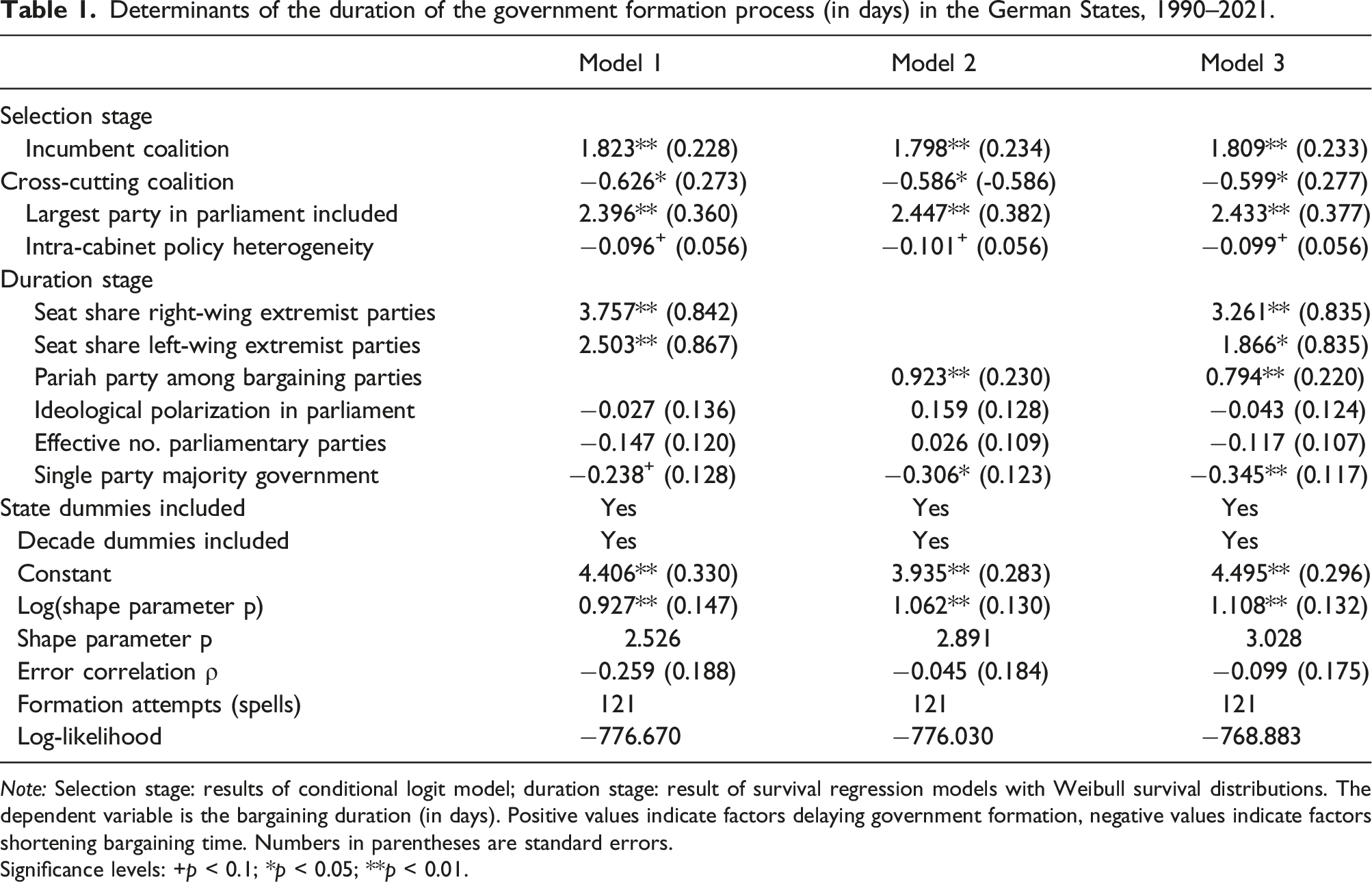
Note: Selection stage: results of conditional logit model; duration stage: result of survival regression models with Weibull survival distributions. The dependent variable is the bargaining duration (in days). Positive values indicate factors delaying government formation, negative values indicate factors shortening bargaining time. Numbers in parentheses are standard errors.
Significance levels: +p < 0.1; *p < 0.05; **p < 0.01.
Turning to the duration stage, we find support for both hypothesis 1 and 2. Note that positive coefficients in Table 1 indicate that the duration increases until the election day of a new Prime Minister, whereas negative coefficients show that the respective independent variable results in a faster negotiation process. Model 1 shows that the variable measuring the seat share of parties that we identify as populist radical right-wing or left-wing has the expected statistically significant and positive effect: the larger the seat share of parties from the far right and the far left in a state parliament, the longer it takes until parties agree on a coalition and elect a (new) Prime Minister. This result remains stable in the full model that covers all explanatory variables (model 3). 4
In line with our expectation, we find that the process of forming a government takes significantly more time if a pariah party participates in the coalition negotiation talks, that is, if a party is included in the negotiations that was rejected as a cooperation partner by at least one of the other bargaining parties during the election campaign (model 2). This effect remains positive and statistically significant in the full model (model 3), as does the effect of the seat share of radical parties from the left and right in the parliament.
However, the results of model 3 also demonstrate that an increasing size of ideologically extremist parties makes it more difficult for the parties to agree on a new government, so that the coalition parties need more time to formulate a compromise in terms of office and policy payoffs. While our results mostly are mostly consistent with our expectations, the selection and bargaining duration stages are not significantly correlated for any of the models (as indicated in the error correlation ρ in Table 1). 5
The control variables show some interesting results. According to the regression models, neither the degree of ideological polarization nor the numerical fractionalization of the state parliament matters for bargaining duration. 6 Less surprisingly, majority governments that consist of one party only need significantly less time to agree on a new cabinet. It seems that solving intra-party conflicts and satisfying intra-party factions in terms of office and policy payoffs is less time-consuming than finding compromises with other political parties, at least in the German states.
To sum up, deviating from pre-electoral commitments regarding the partisan composition of the next government as well as an increasing parliamentary representation of parties from the far right and far left makes government formation more difficult: parties need more time to agree on a new cabinet in such situations. All in all, the results are in line with the idea that there is a direct effect of populist radical parties where they create a complex bargaining situation when other parties in parliament are more or less forced to negotiate with parties that were rejected as coalition partners during the election campaign when other viable government alternatives are absent.
Figures 3–5 show the substantive effect of the main explanatory variables that reflect the causal mechanisms outlined in hypotheses 1 and 2. The substantive effects of an increasing parliamentary presence of parties from the radical right and radical left are presented in Figures 3 and 4. In particular, a higher seat share for parties from the far right increases the share of coalitions that need more time to agree on a compromise. This suggests that the government formation process becomes significantly more complex when right-wing populist parties become larger. This may be due to the urgency of searching new alliances by the mainstream parties in order to exclude such parties from the government formation process, which is likely to cause delays. The effect of the seat share of radical right parties in a state parliament on government formation duration (in days). Estimates are based on model 3 in Table 1. The effect of the seat share of radical left parties in a state parliament on government formation duration (in days). Estimates are based on model 3 in Table 1. The effect of the presence of a pariah party among the negotiating parties on government formation duration (in days). Estimates are based on model 3 in Table 1.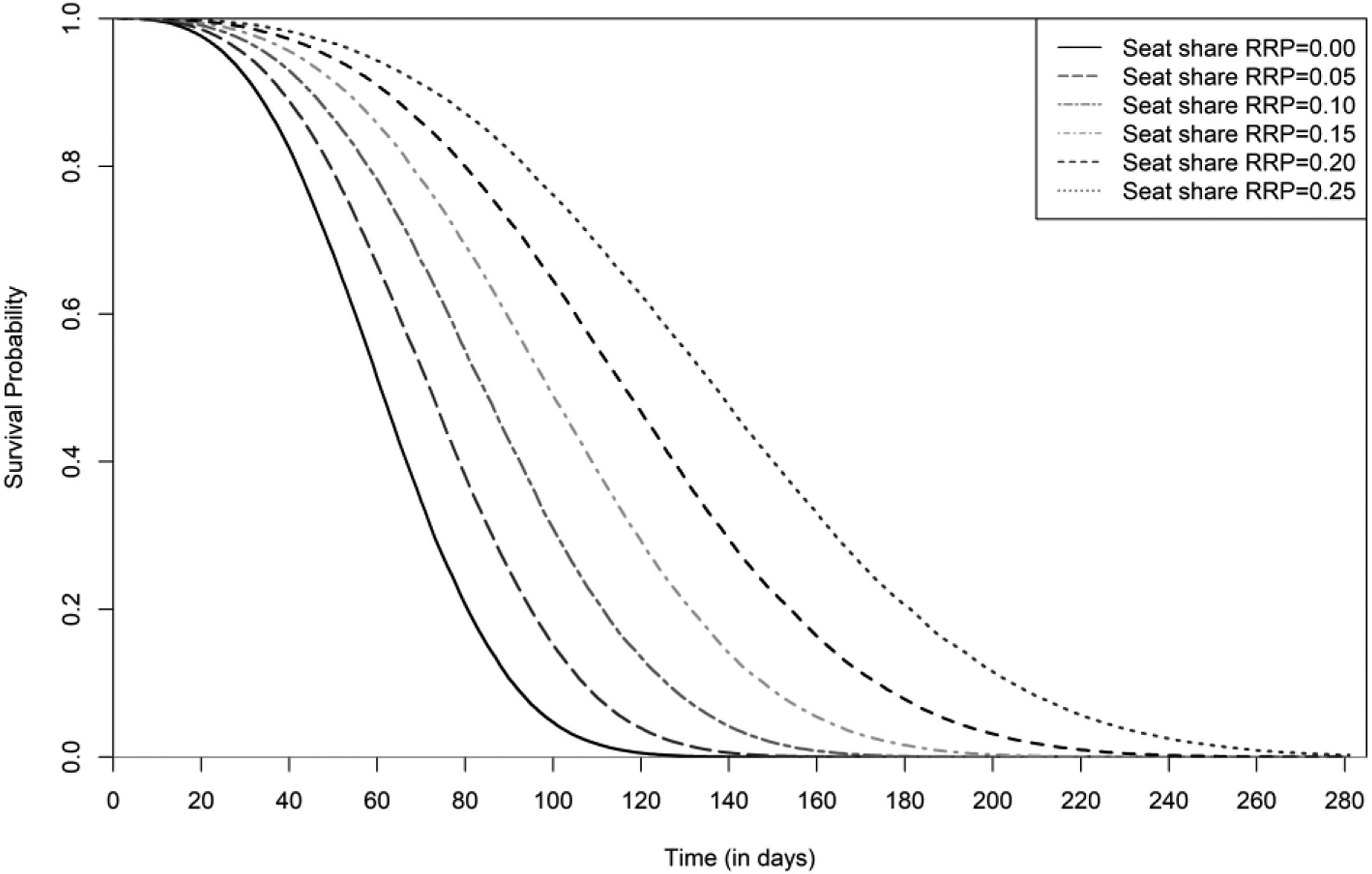
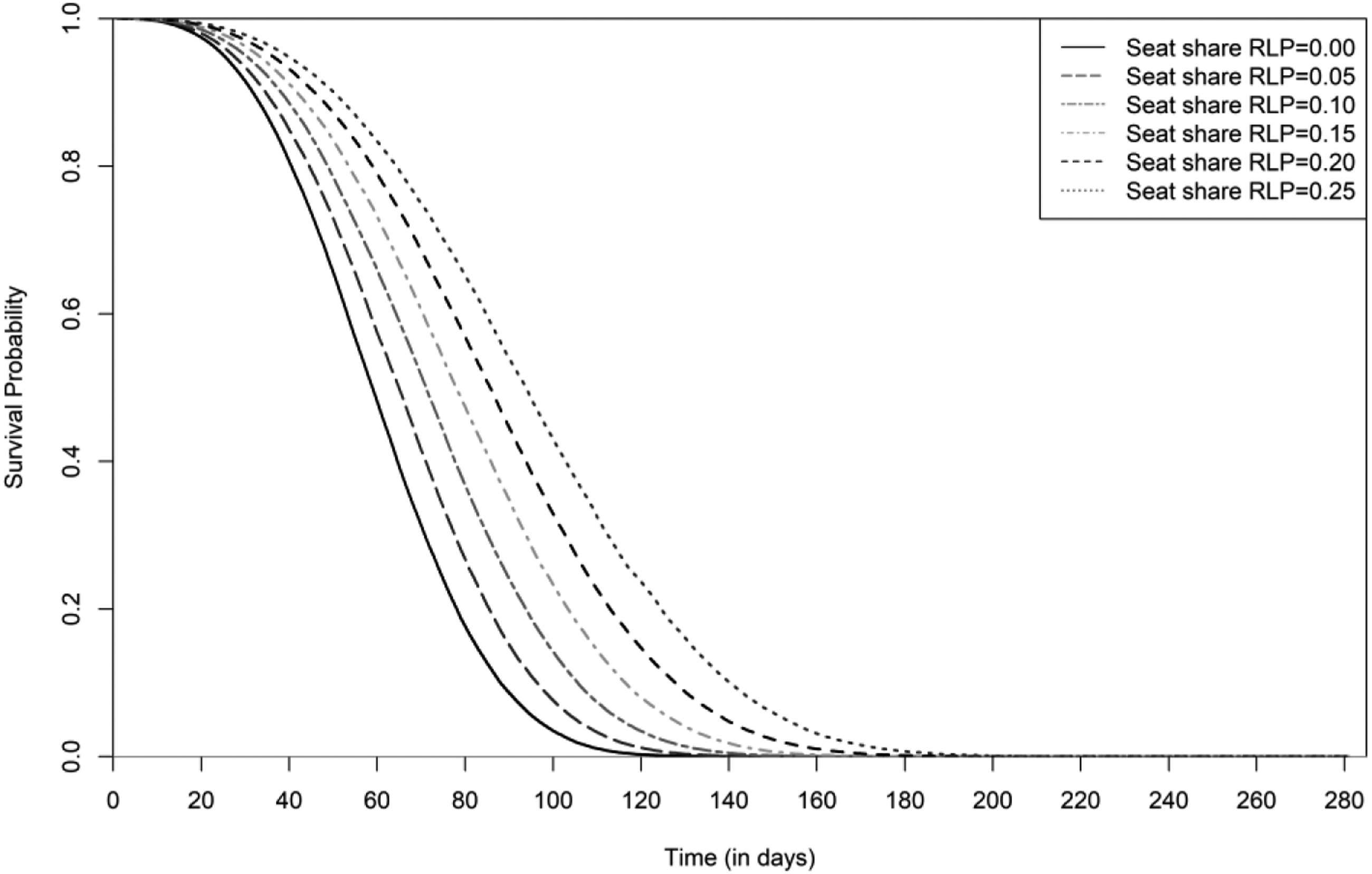
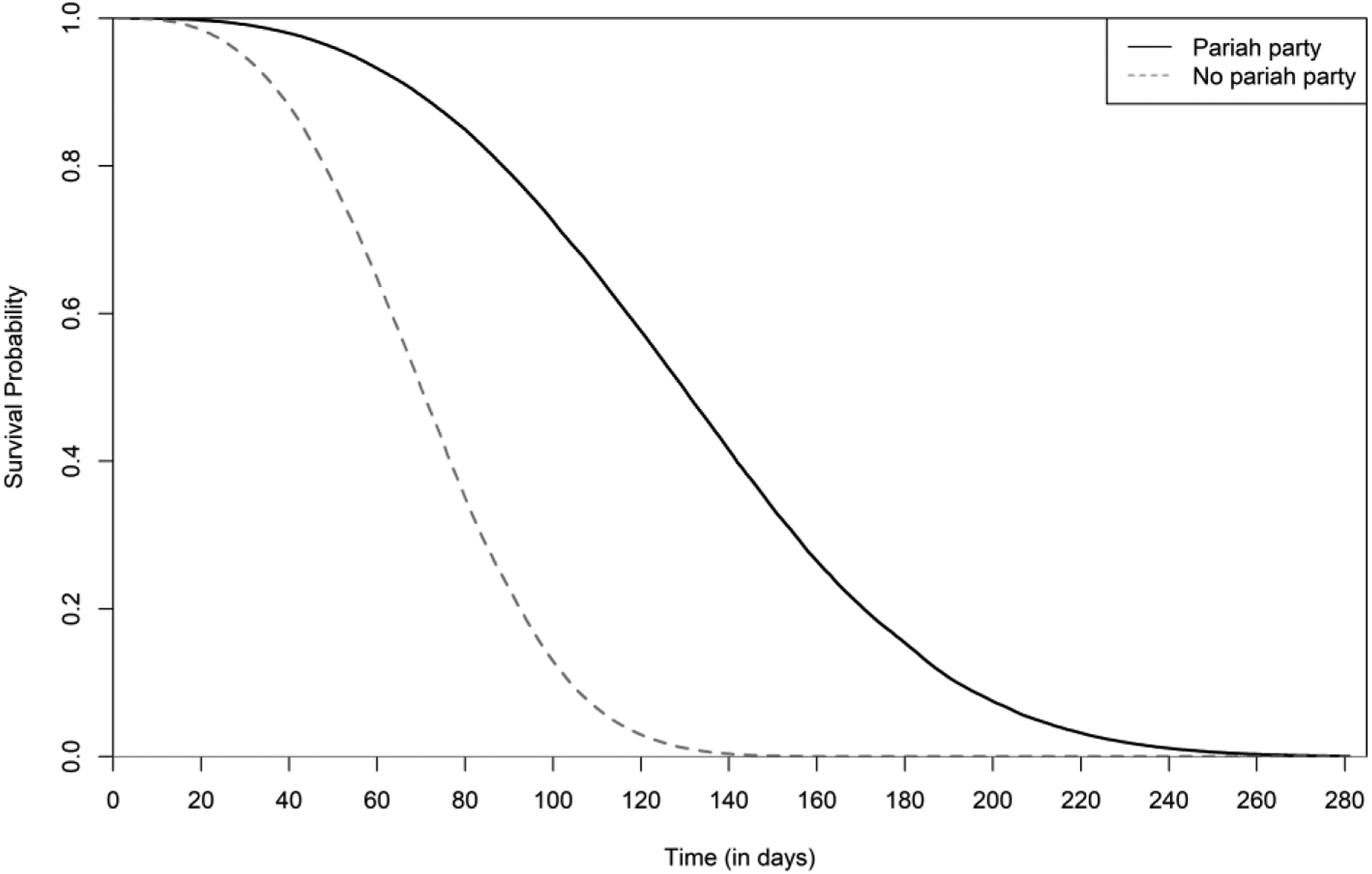
Figure 5 demonstrates the clear difference in the duration of the government formation process between coalitions that include a party that was rejected as a cooperation partner by at least one party during the state election campaign and those that do not include such a party. The figure shows that the presence of a pariah party among the negotiating parties causes severe bargaining delays, which may be due to that some parties have to break their electoral promises when including such a party at the bargaining table. In case no pariah is included among the negotiating parties, then no coalition needs more that 100 days to agree on a compromise, whereas the inclusion of a previously rejected party in the negotiations increases the share of coalitions that need more than 100 days to elect a new Prime Minister: about 50 percent of those coalitions need more than 100 days to agree on a new cabinet.
Concluding discussion
Several countries in Western Europe have experienced serious delays in their government formation processes during the past decades. Even countries that have historically rarely seen any drawn-out government formation processes have experienced a situation where no new government has been sworn in even after months of bargaining. For example, the government formation process in Sweden after the 2018 election took over 130 days – in a country where governments have typically formed after just a few weeks (Teorell et al., 2020). Another example is Germany after the 2017 Bundestag election, when it took almost six months to form a government. If such delays happen during times of crisis, for instance during a pandemic like Covid-19 or during an international conflict like the war between Russia and Ukraine, a caretaker government is not only less legitimate to make important and far-reaching decisions, but also less able to act swiftly in critical situations.
The question we have asked in this paper is whether bargaining delays are related to the rise of populist radical parties. We have chosen to analyse government formation processes at the German state level to answer this question. This allows us to perform analyses where we control for potential confounding factors related to the electoral system and institutional setting. This analysis is unique in the sense that we have access to data on the statements made by parties during electoral campaigns about the anti-system or pariah status of their competitors. Our results show that a higher share of parliamentary seats for populist radical parties, in particular parties from the far right, clearly produces bargaining delays. We also find that when some parties have made a pre-electoral commitment against cooperating with a party, and such a pariah nevertheless ends up among the negotiating parties, government formation is severely delayed. Hence, the rise of populist radical parties is likely to be part of the reason why many political systems experience bargaining delays.
All in all, we believe that these results can be connected to the growing literature on affective polarization (see e.g. Iyengar et al., 2019), supporting the idea that a high degree of affective polarization among political representatives is especially problematic when parties have to make compromises, forcing them to break promises that they have made to their voters who identify themselves closely with the party, and who see other parties and their supporters as hated ‘enemies’. Our finding that including a (former) pariah party at the bargaining table significantly increases the number of days that it takes to form a government especially supports this interpretation. Making statements where a party distances itself from a competing party, calling this party ‘anti-democratic’ and as a party that you will, at no costs, associate yourself with, can be seen as an indicator of a high degree of affective polarization (see also Calvo et al., 2021).
This type of distancing, or intergroup differentiation, between the mainstream parties and populist or ‘challenger’ parties, is, however, only one type of affective polarization, and there may clearly be situations where mainstream parties distance themselves from each other, for example in a clear ‘bloc’ situation like in the Swedish case before the 2018 election. In this case, the mainstream parties had formed clear blocs, with associated pre-electoral alliances that had been stable during the past decades, and there were indications that the blocs were distancing themselves from each other in an affective manner (see, e.g. Bäck and Carroll, 2018; Baumann et al., 2019). The combination of a high degree of separation between the blocs, and a high degree of distancing toward the right-wing populist Sweden Democrat party which had grown significantly in size, created an especially complex bargaining situation which is most likely part of the reason why it took so long to form a government (see Teorell et al., 2020).
Even though affective polarization has mainly been in focus of mass-level studies, concentrating on how voters are biased and express anger against another party’s supporters, we believe that this is a feature that should also be considered in elite-level studies. A high degree of affective polarization is likely to create situations where political representatives are not able to make compromises with other parties without risking the ‘wrath’ of their highly identified voters. Hence, even in cases where political representatives themselves may not be affectively polarized, their vote-seeking goals may force them to avoid any kind of cooperation with a party that they have during the election campaign portrayed as an ‘enemy’. Clearly, such intergroup distancing may cause serious challenges for parliamentary democracy, creating a situation of gridlock, where important policy reforms are delayed, since caretaker governments are left in charge for longer periods of time.
Supplemental Material
Supplemental Material - Populist radical parties, pariahs, and coalition bargaining delays
Supplemental Material for Populist radical parties, pariahs, and coalition bargaining delays by Hanna Bäck, Marc Debus, Michael Imre, in Party Politics
Footnotes
Declaration of conflicting interests
The author(s) declared no potential conflicts of interest with respect to the research, authorship, and/or publication of this article.
Funding
The author(s) disclosed receipt of the following financial support for the research, authorship, and/or publication of this article: Deutsche Forschungsgemeinschaft, DE 1667/4-3.

Supplemental Material
Supplemental material for this article is available online.
Notes
Author biographies
References
Supplementary Material
Please find the following supplemental material available below.
For Open Access articles published under a Creative Commons License, all supplemental material carries the same license as the article it is associated with.
For non-Open Access articles published, all supplemental material carries a non-exclusive license, and permission requests for re-use of supplemental material or any part of supplemental material shall be sent directly to the copyright owner as specified in the copyright notice associated with the article.
