



Abstract
Radical right populist parties have often been treated as “pariahs,” being excluded from coalition politics in parliamentary democracies. We argue that negative rhetoric targeted at radical right populist parties in legislative debates is used by the established parties to distance themselves from such parties and that the incentives to do so depend on the political context. Using sentiment analysis of speeches in the Swedish Riksdag from 2010 to 2022, we find that rhetoric targeted toward the radical right Sweden Democrats is more negative than speech concerning other parties on average. We also find that this negative rhetoric declined over time, particularly from the center-right parties, as the formerly marginal Sweden Democrats gained more seats and became a potential partner for cooperation. Our analysis demonstrates how tracking parliamentary discourse provides insights into changing party dynamics. Our findings suggest that, as the prospects for populists' pariah status change, rhetoric from established parties reflects this shifting role in party politics, with enduring negativity accompanied by reduced hostility among the center-right parties with the greatest potential for cooperation.
Keywords
Introduction
The rise of radical right populism has emerged as a salient challenge to European party systems. At the mass level in Europe, the emergence of radical right parties has been associated with growing social divides, particularly surrounding views on cultural issues (Akkerman and Rooduijn, 2014). While established parties’ 1 responses toward radical right-wing populist parties have varied, many have initially treated such parties as “pariahs,” emphasizing divergence from the consensus among major parties on basic democratic norms (Downs, 2001). When radical right parties enter parliament, the established parties that typically form governing coalitions often rule out cooperation with them (see e.g., Backlund, 2020; De Lange, 2012; Leander, 2022). However, as some radical right parties have steadily expanded their parliamentary representation over time, established parties have faced shifting incentives surrounding their treatment of these ostracized parties (De Lange, 2012).
While existing theories of party system change anticipate the dynamics of initial exclusion followed by potential incorporation, less is known about the elite discourse that emerges as these shifts play out. Elite rhetoric represents a distinct sphere of party positioning vis-a-vis competitors, beyond policy stances and coalition bargaining. Legislative speech offers a venue for parties to establish boundaries and define the legitimacy of opponents and potential collaborators.
Building on this perspective, we examine how the changing status of a radical right populist party is reflected in the rhetoric employed by established parties in parliamentary debates. We posit that parliamentary rhetoric offers a window into how mainstream parties marginalize and delegitimize pariah parties and how changing dynamics between established parties and the radical right are reflected in the rhetoric of legislative elites. We argue that parties use parliamentary speech to distance themselves from radical right parties to reinforce their pariah status through the use of negative rhetoric in debates. As radical right parties grow in political importance through greater parliamentary representation, however, the incentive to use negative rhetoric toward a populist party decreases as prospects for cooperation grow.
Empirically, we examine the targeted negative rhetoric in legislative debates to capture the sentiment of speech used by members of established political parties toward right-wing populists. We use speech data from the Swedish parliament (Riksdag) and focus on the response toward the right-wing populist party, the Sweden Democrats (SD). In this context, all parties refused to cooperate with the SD when they first gained seats in the Riksdag in 2010. However, as the SD steadily expanded its parliamentary representation between 2010 and 2018, established parties faced shifting incentives surrounding their engagement with the formerly ostracized party. This study examines how the changing power dynamics between established and radical right parties in Sweden are reflected in the rhetoric of legislative elites. We examine whether, as the SD grew in importance, rhetoric toward the populist party decreased in negativity compared to the earlier period when they were treated as pariahs.
We analyze parliamentary debates from all complete parliamentary terms in which the SD has been represented, from 2010 until the 2022 election, using a sentiment-based text analysis approach that captures the tone and affective qualities of legislative speech. By identifying the contexts in which members of parliament (MPs) refer to other parties and their members, particularly the Sweden Democrats, we assess the style of speech used and how this varies by party and across the periods under study. Our results show that MPs from established parties employ more negative language when speaking about the Sweden Democrats or their representatives compared to speech about established parties and their representatives. We also show that this negativity has decreased over time, specifically among the center-right parties, in line with the expectation that right-wing populist parties may lose their pariah status as they increase in parliamentary size and are incorporated into the core of political competition.
Theory
Pariah Status and Radical Right Populist Parties
The literature on established party responses to extremist or populist parties identifies a pattern that some of these parties are treated as “pariahs” (Downs 2001), a status of “systematic exclusion of certain parties from coalition bargaining” (Strom, Budge, and Laver, 1994, 317) that historically targeted Communists and neofascist parties. More recently, because radical right parties are often seen as having anti-system elements incompatible with mainstream democratic values, they have frequently been ostracized by the established parties (van Spanje and de Graaf, 2018), and also face particular hostility from moderate voters (Meléndez and Kaltwasser, 2021). This refusal to be associated with radical right parties has characterized a mainstream-vs-extreme divide distinct from traditional left-right policy divides (; Helbling and Jungkunz, 2020; Reiljan and Ryan, 2021) that has often been the basis for rhetoric about the legitimacy of the pariah parties (Downs, 2001).
Salient divides associated with the radical right fall along the fault lines of identity-based divisions over authoritarian and nationalist values (MacWilliams, 2016), in particular surrounding the politics of immigration. As some radical right parties have successfully increased their electoral presence, they have consequently altered the party system dynamics. Some have argued that radical right parties’ entrance to representative institutions exacerbates cleavages at the mass level (Akkerman and Rooduijn, 2014; Bischof and Wagner, 2019; van Spanje and van der Brug, 2009). Valentim (2021) argues that radical right parties entering parliament emboldens voters with anti-immigration attitudes, while Bischof and Wagner (2019) contend that the polarization is increased by the combined effects of legitimacy and backlash accompanying the parliamentary entry of right-wing populist parties.
At the elite level, mainstream parties, particularly the center-right, have often attempted to co-opt the policies of radical right parties in response to their growing electoral strength (Abou-Chadi, 2016; Abou-Chadi and Krause, 2020; Bale, 2003; Han, 2015; Schain, 2006). The adoption of issues traditionally associated with the radical right parties by mainstream parties may coincide with a withering of the marginalized status of the pariah party. Right-wing populist parties may also lose their pariah status as mainstream right parties have turned to them as coalition partners when such parties have increased their electoral support (De Lange, 2012).
While center-left parties can also face pressure to co-opt some stances of right-wing populist parties (Bale et al., 2010; Hjorth and Larsen, 2022; Krause, Cohen, and Abou-Chadi, 2023), it is the mainstream right that faces the question of legitimizing and normalizing radical right populists as acceptable governing partners (Bichay, 2023). While the strategic electoral calculus of adjusting issue stances may coincide with distancing from right-wing populists, openness to cooperating in parliament means overcoming the stigma against sharing power with populists. Thus, the tone of rhetoric used by established parties in the context of addressing the radical right may also provide insight into changes in these broader political alignments.
Parliamentary Rhetoric and Elite Intergroup Distancing
Scholars working on legislative speeches have measured the policy positions of representatives and tracked political polarization via overlap in the language used by members of the US Congress (Gentzkow, Shapiro, and Taddy, 2019; Jensen et al., 2012; Lauderdale and Herzog, 2016), the UK House of Commons, Norway (Søyland, 2020), and Sweden (Bäck and Carroll, 2018). Speech in these legislative arenas may communicate a party’s or individual politician’s message to voters. Proksch and Slapin (2014, 1) argue that legislative debates can be forums for “public communication which parties and their MPs exploit for electoral purposes.” Maltzman and Sigelman (1996, 821) have shown how legislative speech-making is used as a form of “position-taking, advertising, and credit-claiming” by US representatives. Similarly, Bäck and Debus (2016) and Martin and Vanberg (2008) demonstrate how policy positions and justifications for policy compromises by coalition parties in government can be communicated through legislative debates and speeches to the electorate.
We argue that the sentiment of rhetoric used by party elites in legislative speeches can serve as a signal for inter-party distancing and demonstrate more or less acceptance. Legislators may use debates as part of intergroup distancing by employing rhetoric that accentuates group differences. By using negative language when referring to radical right politicians in legislative settings, MPs can distance from these parties and reinforce their rejection of them. Conversely, a neutral or relatively positive tone when speaking about or addressing radical right opponents may indicate greater acceptance and could reflect shifting elite dynamics toward a less hostile and more cooperative stance.
While mainstream parties can also co-opt issues salient to right-wing populist parties (Bale et al. 2010; Han 2015)—for example, taking a more restrictive immigration policy stance—this is distinct from employing negative rhetoric. Elites can moderate their rhetoric toward radical right parties without adopting these parties’ issue positions. The tone of rhetoric used by mainstream parties to address right-wing populist opponents can therefore provide insights into distinct dynamics of inter-party conflict and cooperation.
Some evidence at the elite level suggests that parties engage in differentiation via parliamentary rhetoric along these lines. For example, in the case of Germany, Valentim and Widmann (2023) find that mainstream parties, particularly the center-left, distinguished themselves with more positive rhetoric overall when the populist AfD (“Alternative für Deutschland”) entered state parliaments. Røed, Bäck, and Carroll (2023) find that, in Norway , MPs from the Labor Party, Socialist Left Party, and Center Party use negative rhetoric mainly toward the right-wing Progress Party.
Building on this literature, we argue that the tone of legislative speeches can reinforce parties’ and MPs’ positioning goals vis-à-vis political opponents. Where established parties face a right-wing populist party in the legislative arena that is considered a pariah, this ostracism should be reflected in the way these parties’ MPs speak about the radical right and its legislators. Hence, speeches targeting the radical right should contain more negative language than speeches relating to the other parties, on average.
However, when the radical right party grows larger in size and becomes more important to coalition politics and the formation of governments, it may be strategically beneficial for at least some mainstream parties—particularly those of the center-right—to engage in less distancing over time. This suggests that the negativity in speeches referring to radical right parties and their members should decrease among center-right parties when radical right parties increase their parliamentary representation—when their potential relevance for mainstream parties' fulfillment of their office-seeking goals increases. In the following section, we develop our expectations for the Swedish context.
Expectations About Negative Rhetoric in the Swedish Riksdag
Swedish party politics has traditionally revolved around the dominant left-right socioeconomic dimension (Aylott, 2016), with parties typically ordered from left to right, reflected in surveys of MPs and voters, as follows: Left party (V)—Social Democrats (S)—Greens (MP)—Center party (C)—Liberals (L)—Christian Democrats (KD)—Moderates (M) (Oscarsson et al., 2021). However, the entrance of the populist Sweden Democrats complicates this traditional alignment, as the SD is positioned more centrist economically but rightmost on immigration (Lindvall et al., 2017; Oscarsson and Holmberg, 2013). While the left-right divide remains the primary cleavage structuring Swedish politics, the SD introduces a cultural dimension that cross-cuts this divide to some extent (Aylott, 2016; Lindvall et al., 2017).
Having roots in right-wing nationalism, the Sweden Democrats were initially political outsiders that the established parties sought to delegitimize. The political context changed after 2010, with SD entering parliament with 5.7% of the vote. By 2014, they had doubled their vote share to 12.9%, establishing themselves as the third largest party. The European migrant crisis that followed also brought the SD’s signature issue to the forefront, allowing the party to capitalize on anti-immigration sentiment. Swedish government formation continued to follow its two-bloc political pattern 2010–2018, with the Social Democrats governing with the Greens and the support of the Left party, forming the “center-left” bloc, versus governments comprised of parties belonging to the “center-right” bloc (Bäck and Bergman, 2015).
The entry of the Sweden Democrats into the parliamentary arena in 2010, and growth in 2014, has prevented the formation of majorities from either the socialist or non-socialist blocs as both blocs initially refused to coalesce with the radical right party. Motivated by both policy and reputational constraints, the established parties forged anti-pacts to ensure the exclusion of the Sweden Democrats in coalition politics (Backlund, 2020). While most parties maintained the cordon sanitaire through the 2018–2022 term, the Moderate and Christian Democrat parties signaled openness to some, albeit limited, cooperation with the Sweden Democrats following the 2018 election, reflecting normalization of the party’s role despite enduring stigma.
The entrance of the Sweden Democrats introduced new complexity into Swedish parliamentary politics. Despite increased party system fragmentation, Lindvall et al. (2020) describe Swedish democracy as remarkably stable from 2010 to 2018, with functioning minority governments. However, there were recurring conflicts over procedures influenced by the Sweden Democrats’ growing representation. While a deal between blocs excluded the Sweden Democrats temporarily, SD repeatedly exploited their pivotal position, preventing either side from easily forming majorities (Aylott and Bolin, 2019; Lindvall et al., 2020). For example, 2 months after the 2014 election, the Sweden Democrats rejected the proposed budget by the Social Democrat-Green government, emboldened by their 14% seat share. This almost triggered an early election, which is rare in Swedish politics. Weeks later, the governing parties struck the short-lived “December Agreement” with the center-right opposition to exclude SD influence and maintain minority rule (Aylott and Bolin, 2019; Lindvall et al., 2020).
As argued above, we expect that parliamentary rhetoric provides a venue for established parties to distance from populist pariah parties. That is, the depth of the divide between the radical right and the non-radical right parties is likely to result in negative sentiment targeted toward right-wing populist parties. Accordingly, in the Swedish context, we would expect established parties in Sweden to react to the Sweden Democrats with a strategy of distancing, making use of negative rhetoric in speech targeting the party and its MPs in the Riksdag. This leads us to the following hypothesis:
Speeches by MPs from established parties relating to the Sweden Democrats will contain more negative rhetoric than those relating to other parties.
As noted above, as the Sweden Democrats solidified as a major political force, marginalization became less tenable for parts of the center-right bloc and some parties reconsidered limited cooperation given the party’s growing political importance. For instance, the leader of the conservative Moderate Party in 2017 attempted to persuade the Alliance to relax the cordon sanitaire against SD at the level of committees (Aylott and Bolin, 2019). However, clear statements about a potential coalition collaboration with SD only emerged after the 2018 election, when the Moderates and Christian Democrats demonstrated willingness to form a government with the support of SD. This created a conflict within the center-right bloc, the “Alliance,” as both the Center and Liberal parties made explicit in their campaign statements their opposition to any form of cooperation with the Sweden Democrats (Teorell et al., 2020).
Right-wing populist parties may lose their pariah status over time, especially when their electoral support increases. In such cases, mainstream right parties in some Western European countries have turned to right-wing populist parties as coalition partners (De Lange, 2012). Such shifts in party responses reflect the strategic incentives facing mainstream parties to adopt a more cooperative posture with regard to a party they have previously ostracized, with center-right parties especially sensitive to the strategic need to shift away from treating right-wing parties as pariahs (e.g., De Lange, 2012; Teorell et al., 2020). In this context, we expect center-right party rhetoric toward the SD to become less negative over time. SD’s growing size created incentives for mainstream parties to soften their opposition, particularly center-right parties, reflecting the SD’s declining pariah status. While the earlier period saw SD continuing as outsiders, by 2018 they had achieved much greater prominence due to increased representation. Thus, our second hypothesis is as follows:
Speeches by MPs from the center-right parties relating to the Sweden Democrats will exhibit less negative rhetoric over time.
Empirical Strategy
To examine rhetorical distancing in parliamentary discourse, we utilize sentiment analysis of legislative speeches in the Swedish Riksdag from 2010 to 2022. This allows us to quantify the negative emotional content when mainstream parties reference the radical right Sweden Democrats, compared to speeches that refer to other parties and their MPs. We obtain speech data from 2010 to 2018 from the ParlSpeech dataset (Rauh and Schwalbach, 2020), which contains the full text of plenary speeches. The rest of the speech data were obtained from the Riksdag’s Open Data website. Because the Sweden Democrats gained representation in parliament in 2010, we limit the temporal scope of our analysis to three legislative terms: 2010–2014, 2014–2018, and 2018–2022. After pre-processing the corpus and isolating speeches directed at specific parties using a dictionary approach, we estimate sentiment scores reflecting relative positivity and negativity (Lowe et al., 2011; Schwalbach, 2022).
2
More negative sentiment in speeches targeting the SD provides a means to measure negative rhetoric. Figure 1 presents the number of speeches delivered by each party that target other parties. Number of speeches by party.Note. The total corpus consists of 33,388 speeches. Abbreviation: The order of the parties in the figure corresponds to their placement according to Oscarsson et al. (2021). C = Center Party, KD = Christian Democratic Party, L = Liberal Party, M = Conservative Party, MP = Green Party, S = Social Democratic Party, SD = Sweden Democrat Party, and V = Left Party.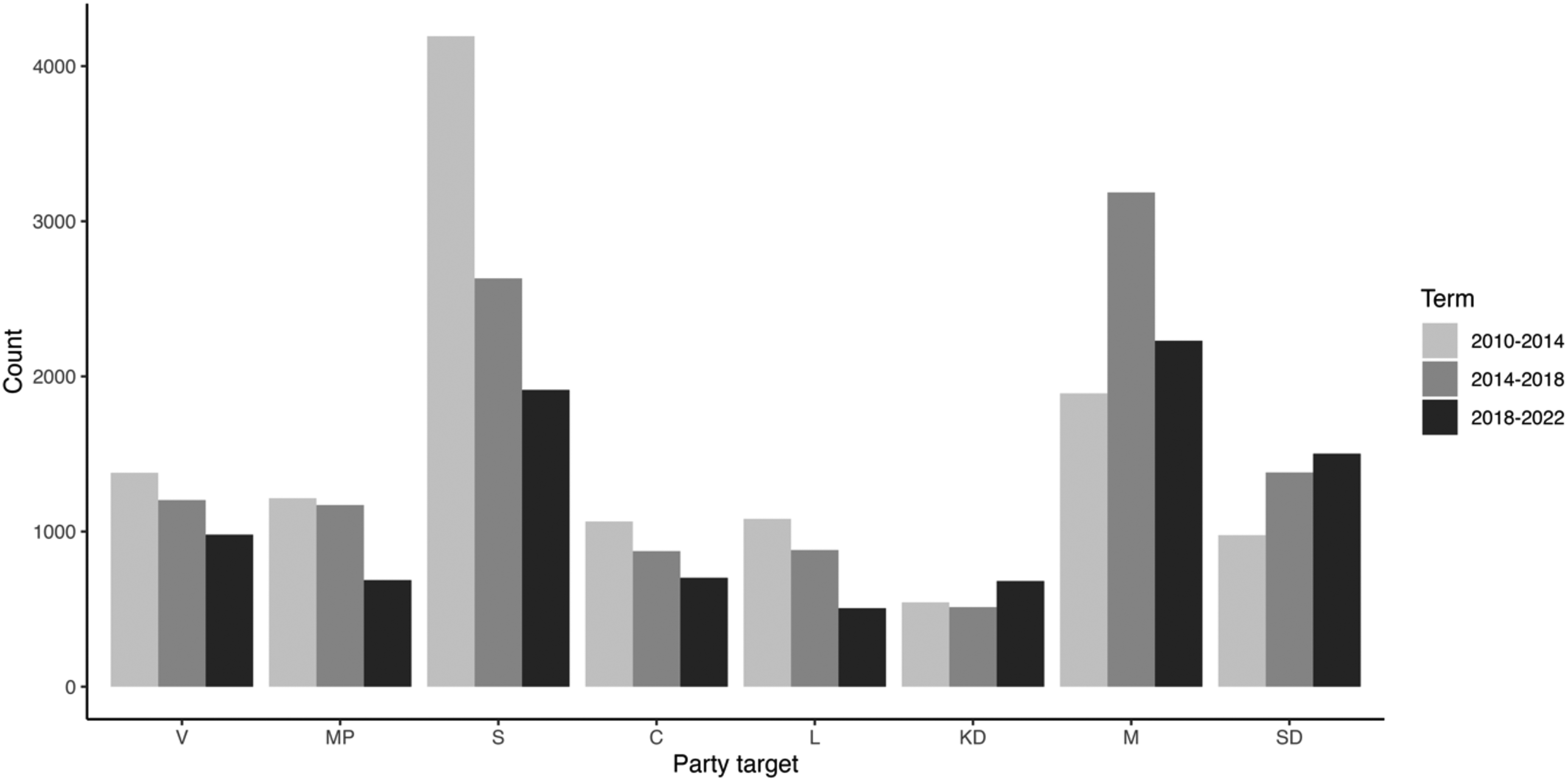
Our approach classifies the tone of speeches as positive or negative based on the relative frequency of sentiment-coded words using an automated dictionary method (Marchal, 2022; Proksch et al., 2019). For this, we pre-process the speech corpus (e.g., setting letters to lower case, removing punctuation marks, numbers, symbols, URLs, and stop words). 3
The sentiment lexicon we employ is the Swedish Lexicoder Sentiment Dictionary (LSD) that was translated by Proksch et al. (2019). The LSD was created primarily for political texts by Young and Soroka (2012) and has been widely used as a sentiment lexicon for detecting negativity expressed in speeches. Its Swedish version includes 2640 positive and 5260 negative words and was previously used by Proksch et al. (2019) in their multi-lingual sentiment analysis, where it yielded similar results to their hand-coding estimates and demonstrates predictable patterns with regard to government-opposition sentiment. 4
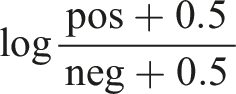
Following Lowe et al.’s (2011) approach, we measure expressed sentiment as the log-ratio of positive over negative terms in a speech, defined as:
To give an example of negative rhetoric from established parties aimed at the Sweden Democrats, one speech from a Social Democratic MP states that “the Sweden Democrats have Nazi roots” and cited a SD representative’s statements as proof that the party embraces racist ideologies “here and now.” Another speech excerpt from a Center Party MP dismissed SD’s economic proposals as “hobby calculations” rejected by experts, leading the MP to denounce their budget as “pure brown populism.” As these examples show, the sentiment analysis reveals instances where established parties can mark rhetorical boundaries with negative rhetoric beyond mere policy disagreement. 6
Empirical Results
We expect that speeches that are directed at SD and its members will be more negative, and that their expressed sentiment should become less negative in more recent periods, especially among the center-right parties. To examine these hypotheses, we make use of the assigned party targets of the speeches and the legislative term they were delivered. Our primary independent variable, Party Target, is a categorical variable for each party in the Riksdag where “SD” serves as the reference category. We also create dichotomous variables for 2014–2018 and 2018–2022 to denote whether the speech was delivered during a specific term or not, with the 2010–2014 legislative period serving as the reference category. Information on which legislative term the speech was delivered was obtained from the ParlSpeech database (Rauh and Schwalbach, 2020).
In addition to these variables, we also consider if the party of the MP giving the speech was part of the governing coalition or not. For this purpose, we create a dichotomous variable, Government, which equals to 1 if the party of the MP giving the speech belonged to the governing coalition for a particular legislative term, and 0 otherwise. Finally, we create the categorical variable, Party, to control for the party of the speaker.
For this part of our analysis, we make use of the complete speech data and perform linear regressions to examine the relationship between party target and expressed sentiment. We cluster standard errors at the speaker level to account for that speeches delivered by the same speaker are not independent of each other. We also include debate fixed effects to ensure that change in expressed sentiment is not an artifact of the nature of different debate types.
7
The results of Model 1 are illustrated in Figure 2. The effect of party target on expressed sentiment of speeches.Note. Model 1 (R2 = 0.021, N = 33,388). The dots represent coefficient estimates which are based on an OLS regression model with clustered standard errors at the speaker level and debate fixed effects. The OLS model includes party source controls. The horizontal lines depict 95% confidence intervals.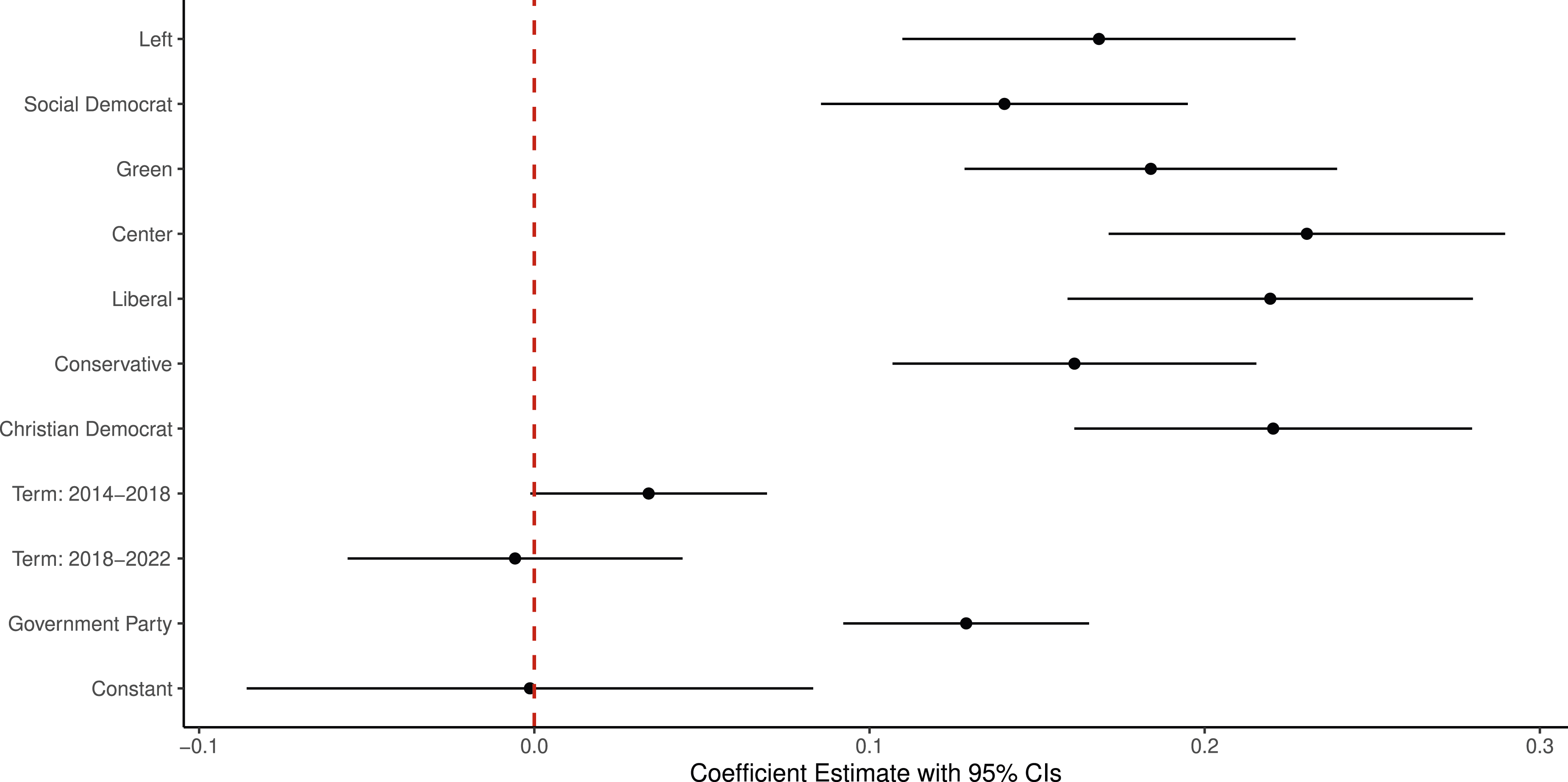
The results in Figure 2 show that the coefficients for all target parties are positive and statistically significant, meaning that speeches targeting all parties have more positive sentiment on average, relative to speeches targeting SD. Hence, consistent with our first hypothesis, speeches that refer to SD and its representatives are consistently more negative in expressed sentiment relative to those targeting the other parties represented in parliament.
To test whether speeches targeting SD have become positive over time, Model 2 includes an interaction between Party Target and the two dichotomous variables for the 2014–2018 and 2018–2022 legislative terms.
8
Figure 3 plots the predicted expressed sentiment of speeches based on the model including interactions with each term. Predicted expressed sentiment of speeches by party target and by term.Note. The predictions are based on Model 2 Figure A2. The lines represent 95% confidence intervals.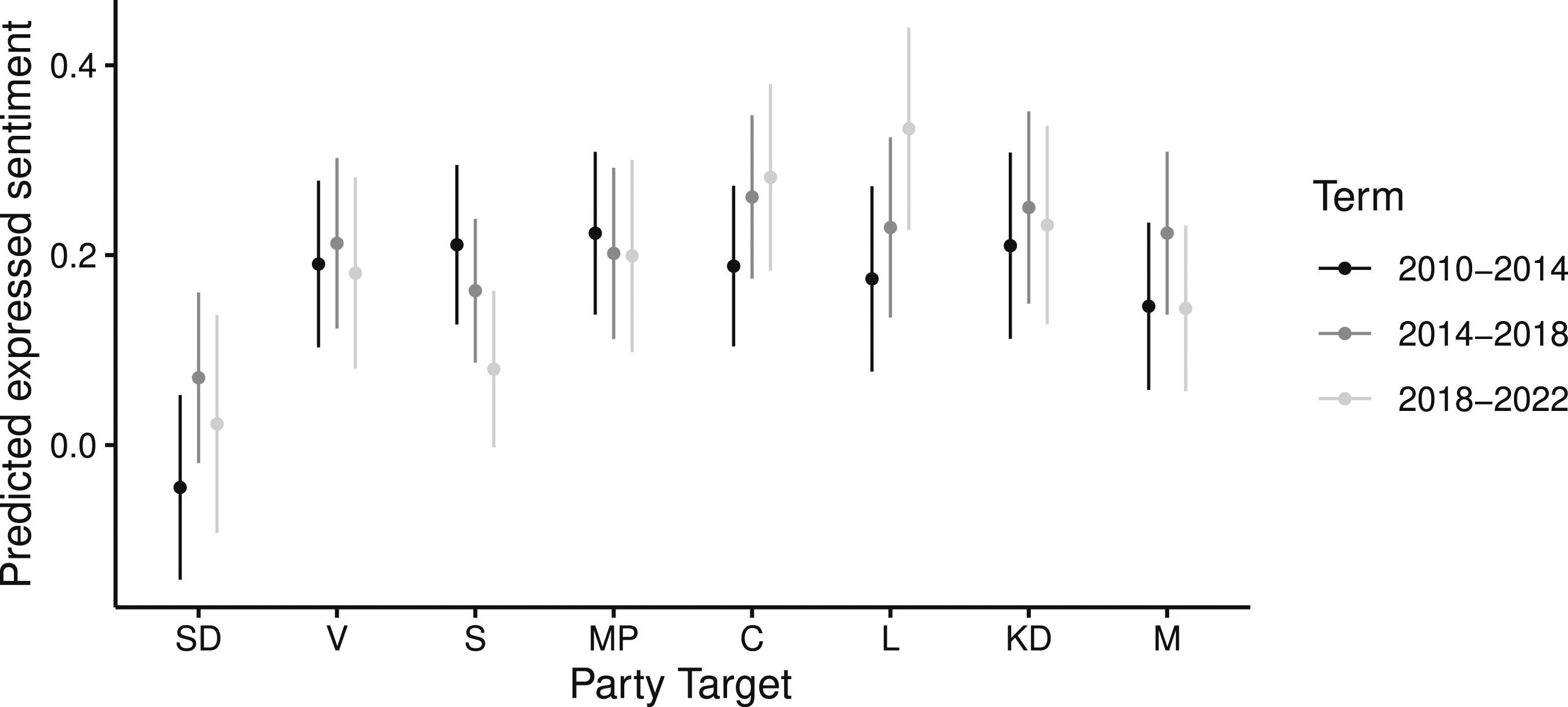
First, we can observe that speeches concerned with SD and its representatives are overall less positive in predicted value relative to those that are devoted to mainstream parties. Second, the expressed sentiment for speeches concerned with SD and its representatives in their second term is, on average, 17% more positive than the statements that were delivered during the time of their entry into the Riksdag.
Overall, although SD remains the party receiving the most negativity in the second legislative term, the sentiment of speeches directed toward them becomes less negative over time. However, the overall trend of a reduction in negativity toward SD does not continue to the third legislative term. To fully examine H2, which suggests that we should see a reduction in negativity among center-right parties over time, we next examine which parties are driving the reduced negativity toward the Sweden Democrats. We subset our data by selecting only speeches that refer to SD or its representatives, which consist of 3860 speeches in total. We first present a distribution of average expressed sentiment of speeches toward SD by the speaking party and by legislative term, shown in Figure 4. Here we can see that speeches targeting SD during its first term in the Riksdag exhibit a more negative sentiment in comparison to the succeeding terms for most parties.
9
Average expressed sentiment of speeches targeted toward SD, by party and legislative period.Note. The figure only includes speeches mentioning SD or their representatives. The lines represent 95% confidence intervals. Higher values indicate more positive sentiment toward SD.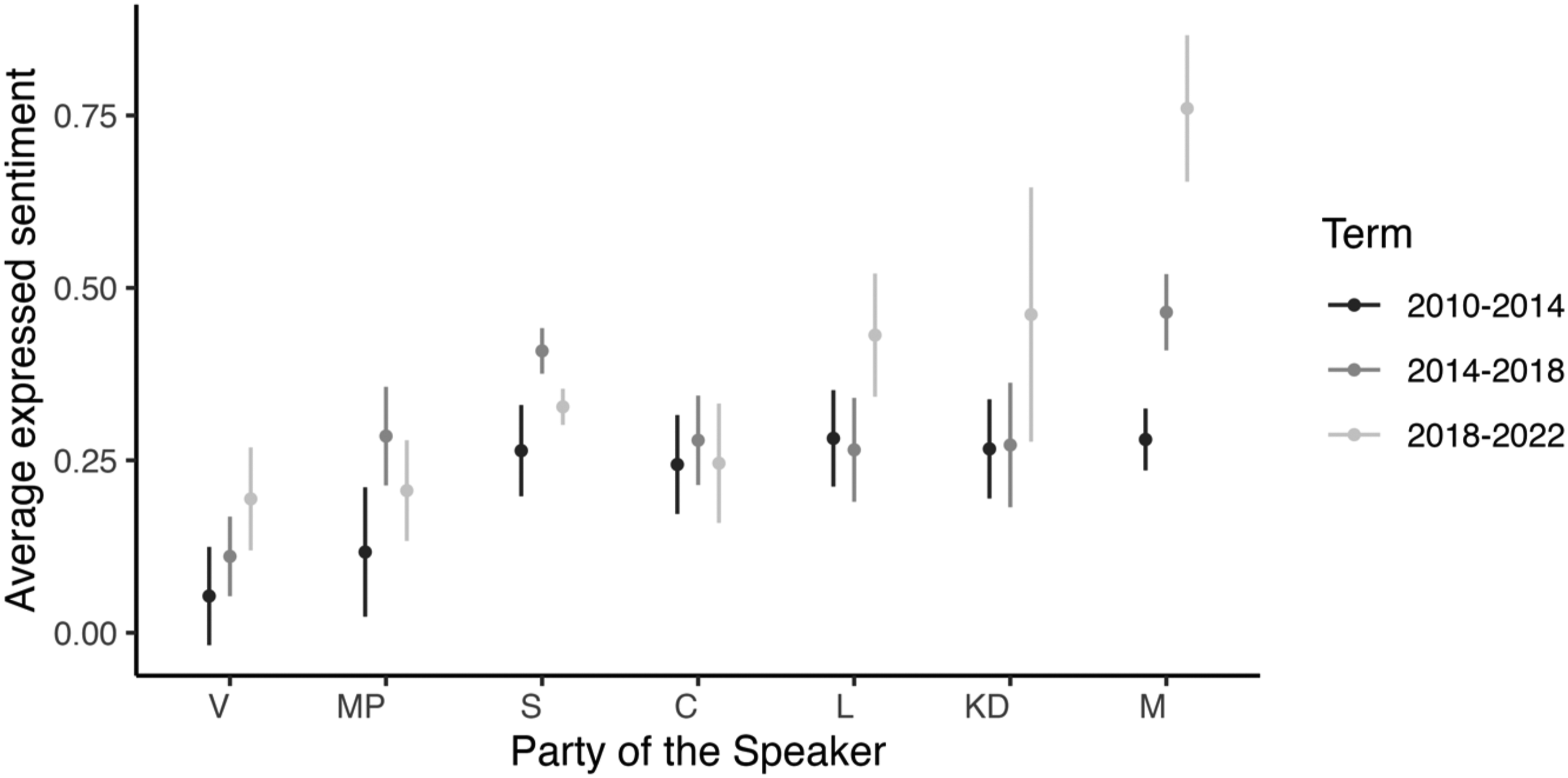
Over time, however, the tone of speeches directed at SD become more positive for the parties of the center-right and particularly the Conservative Party (Moderates), who exhibit a very large and monotonic increase in positive sentiment. The exception is the Center Party, which had coalesced with the center-right parties in the earlier terms (as part of the non-socialist “Alliance”) but also consistently refused cooperation with the Sweden Democrats.
To clarify the differences between the center-left and center-right parties over time with regard to speech rhetoric targeting SD, we next estimate an OLS model wherein we regress the expressed sentiment of a speech on center-left, a dichotomous variable which denotes if the party of the speaker belongs to the center-left (1) or to the center-right parties (0). Additionally, we include variables indicating the legislative period the speech was delivered and whether the speaker’s party belonged to the governing coalition. We interact center-left and the two legislative period dummy variables for 2014–2018 and 2018–2022 to explore how the effect of the time period varies between speeches from parties belonging to the center-left or the center-right. The complete results of these regression models with debate fixed effects and clustered standard errors are shown in Table A2 (see online appendix).
Figure 5 presents predicted values of speech sentiment targeting SD by bloc, which displays how change over time differs if the speaker is from the center-left or the center-right parties. In line with expectations, we observe that the sentiment of speeches from the center-right parties that refer to SD have become less negative in tone over time, whereas no change can be seen among the center-left parties. Hence, the results provide support for Hypothesis 2 that the center-right parties will become less negative toward SD over time. Predicted expressed sentiment of speeches directed at SD (center-left and center-right).Note: The predictions are based on Model 2 in Table A2. The lines represent 95% confidence intervals.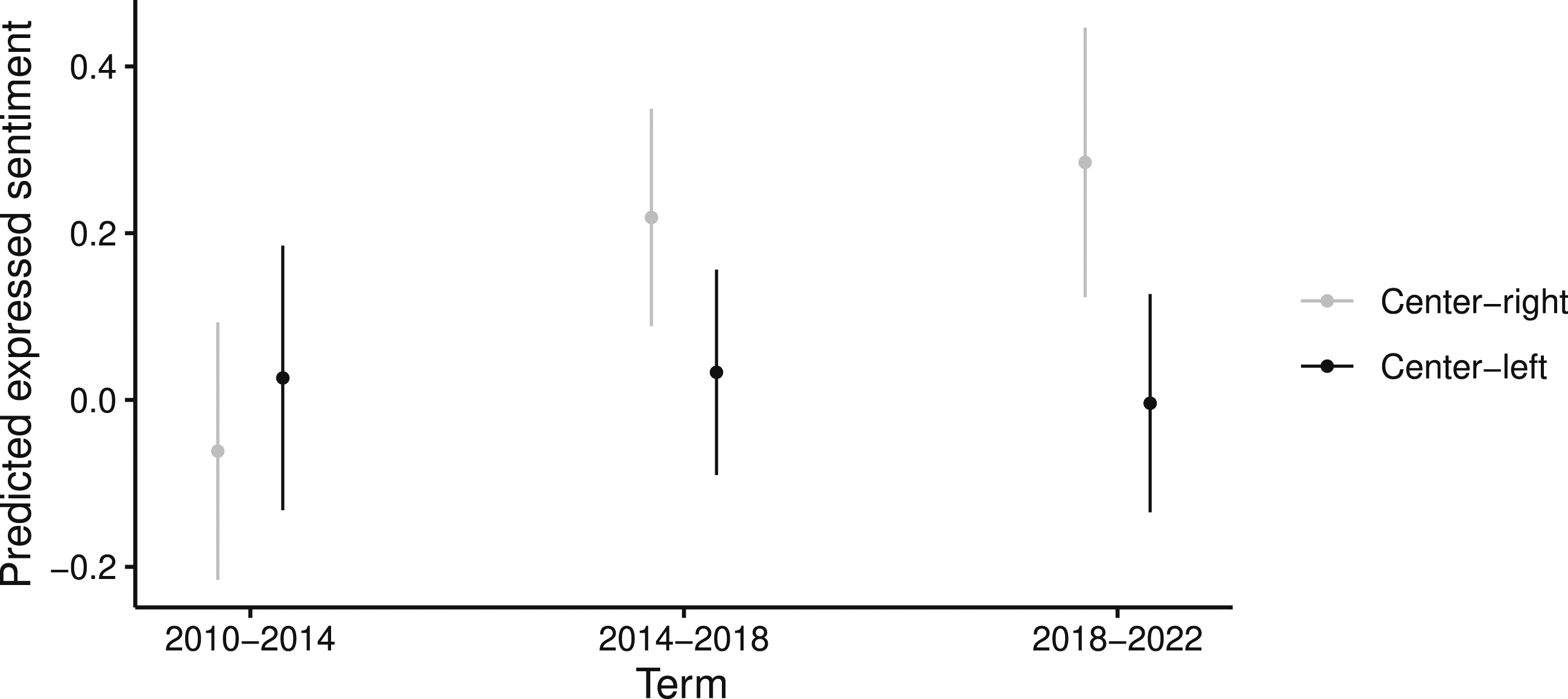
This result is consistent with qualitative accounts of the changing party dynamics in the Riksdag. For instance, around January 2017, the Conservative Party (M), under the leadership of Anna Kinberg Batra, began to entertain the idea of collaborating with SD at the parliamentary committee level (Leander 2022). However, this initiative by Kinberg Batra was deemed still controversial at that time, culminating in her resignation and the temporary reinstatement of the cordon sanitaire by her successor Ulf Kristersson. Nevertheless, the decision to reach out to SD shows the dynamics of the party’s posture toward the pariah party, consistent with the further steps toward cooperation observed after the subsequent election.
Concluding Discussion
This paper has examined negative rhetoric in legislative debates targeted toward radical right populists. Specifically, we argue that speeches referring to the populist radical right that exhibit negative sentiment can be seen as a signal of distancing between the established parties and a “pariah” party. We make use of the case of Sweden, where there was a collective agreement among established parties to reject any form of collaboration with the Sweden Democrats at the national level (Heinze, 2018). Our empirical analysis applying sentiment analysis to legislative speeches targeted toward each party from 2010 to 2022 in the Swedish Riksdag reveals a rhetorical distancing with the Sweden Democrats by other parties. Speeches that target the Sweden Democrats are more negative in tone relative to those targeting other parties. This is consistent with the results from elite level (Bäck and Kokkonen, 2022) and mass level surveys (Reiljan and Ryan, 2021) that show that both MPs from mainstream parties and their supporters have been especially biased against and negative toward the Sweden Democrats.
However, our evidence documents the gradual change in how some mainstream parties have related to the Sweden Democrats, and the withering of the pariah status of this party. We show that negative speech targeting the Sweden Democrats has declined among MPs from the center-right parties over time. The decline in negative rhetoric toward the SD in speeches aligns with Leander’s (2022) evidence of their shift from complete pariah status to their partial acceptance by these parties as a legislative cooperation partner. This also relates to patterns observed at the mass level, wherein “voters of the Moderate and Christian Democrats have significantly become more favorable toward the Sweden Democrats” (Reiljan and Ryan, 2021, 216).
While we were able to empirically demonstrate these patterns in negative rhetoric targeting Sweden Democrats, we note several limitations to our study. First, while the sentiment analysis methodology provides a useful indicator of speech negativity, definitively attributing the sources of this rhetoric, such as from affective or policy-based disagreement using text analysis alone is difficult. The observed negativity likely stems from both policy disagreements and affective hostility toward populists based on group identities and legitimacy conflicts. Still, mapping changes in legislative speech offers insights into shifting elite relationships and responses to right-wing populist parties that formal cooperation patterns may not readily capture. However, caution is warranted in interpreting the causes of the speech patterns without a means to more directly measure the motivations of political elites. Despite these limitations, the study demonstrates the utility of analyzing parliamentary rhetoric to capture party distancing between elites via speech.
Our results also raise some interesting questions about the politics of responses to radical right parties. Mainstream parties have been shown to sometimes accommodate radical right policy stances in an effort to reduce their electoral support (Abou-Chadi and Krause, 2020; van Spanje and de Graaf, 2018), often ineffectively (Krause, Cohen, and Abou-Chadi, 2023). However, while policy co-optation may accompany greater rhetorical acceptance, a reduction in negative speech can occur as a distinct pattern from policy changes and may itself contribute to or reflect a normalization of the radical right, possibly at the expense of mainstream center-right parties.
Normalization through rhetoric in legislative debates could therefore potentially contribute to legitimate radical right populists' policy positions within political systems, even if divisions over democratic values and minority rights persist. While the findings here do not speak directly to longer-term consequences, a shift toward less overtly hostile rhetoric by mainstream parties raises the possibility of further entrenchment of populists within political systems and incorporating the polarizing divides that initially motivated populists’ pariah status into the core of mainstream party competition. Future research assessing the impact of elite rhetorical adaptation can help to illuminate the complex relationships between discourse, cooperation, and the integration of populist parties into electoral and parliamentary politics.
Supplemental Material
Supplemental Material - Debating the Populist Pariah: Changing Party Dynamics and Elite Rhetoric in the Swedish Riksdag
Supplemental Material for Debating the Populist Pariah: Changing Party Dynamics and Elite Rhetoric in the Swedish Riksdag by Esther Mary L. Calvo, Hanna Bäck, and Royce Carroll in Political Research Quarterly
Footnotes
Acknowledgments
The first author would like to express her gratitude to Kiko Dee and Gab Pavico for their statistical and R guidance. We would also like to thank Jonathan Polk for his invaluable comments on the earlier version of this manuscript.
Declaration of Conflicting Interests
The author(s) declared no potential conflicts of interest with respect to the research, authorship, and/or publication of this article.
Funding
The author(s) disclosed receipt of the following financial support for the research, authorship, and/or publication of this article: We acknowledge funding from Vetenskapsrådet (Swedish research council, DNR 2020-01396), and the British Academy (MD\170055).

Supplemental Material
Supplemental material for this article is available online.
Notes
References
Supplementary Material
Please find the following supplemental material available below.
For Open Access articles published under a Creative Commons License, all supplemental material carries the same license as the article it is associated with.
For non-Open Access articles published, all supplemental material carries a non-exclusive license, and permission requests for re-use of supplemental material or any part of supplemental material shall be sent directly to the copyright owner as specified in the copyright notice associated with the article.
