




Abstract
This study compares members of political youth organisations and explains variations in material incentives for enrolment using both organisation-level and individual-level factors. Empirically, it is based on a web survey of about 3,000 members of eight Swedish youth organisations. The analysis shows that young people have a complex combination of concerns, with the main dividing line being whether or not material incentives are important. At the organisational level, the prevalence of material incentives among members is positively related to the size of the mother party and whether it has government experience. Further, we find a positive association between material incentives and economic dependence on the part of the youth organisation on its mother party. At the individual level, we find that members who see the main role of the youth organisation as being to provide support for the mother party and for those politically aligned with it are more likely to have material motives for their enrolment.
Introduction
While some studies indicate that youth organisations linked to political parties are losing members (Hooghe et al., 2004), there are several examples of an opposite trend. In the wake of the 22 July attacks in 2011, for instance, Norwegian youth organisations gained new members (Ødegård, 2014). And while there are within-country variations, Danish (Kosiara-Pedersen and Harre, 2015), Dutch (De Roon, 2020), and Swedish (Bolin and Backlund, 2021) youth organisations are also generally bucking the trend. Clearly, youth organisations are still attractive to some young citizens.
Given the crucial roles that youth organisations play in society – in developing policies, representing the political views of young people, and serving as the main channel of recruitment for political parties (De Roon, 2020; Hooghe et al., 2004; Mycock and Tonge, 2012) – it is important to understand what motivates young people to become members. Although the question of why people join parties ‘is just about the most commonly asked’ (Bale et al., 2020: 15), we know little about the members of youth organisations. Recent research, however, has made some progress in this regard and suggests that most members have a complex set of motives – political, social, and material – for joining youth organisations (Bruter and Harrison, 2009). Moreover, while most members find both political and social incentives important, case studies have shown that members diverge on whether or not their membership was driven by material incentives (Fjellman and Rosén Sundström, 2021; Weber, 2020). We do not know, however, why material incentives are important to some members but not to others. Against this background, this paper has a twofold objective. First, it sets out to map the presence of material incentives among members of political youth organisations. Second, we theorise and empirically assess why some members find these important. This study is based on a web survey of about 3000 members of eight Swedish youth organisations, and it subjects both organisation-level and individual-level explanations to analysis.
Our analysis largely corroborates the findings of earlier studies (Weber, 2020) to the effect that the motivations of most young people in seeking membership cannot be easily portrayed as falling into just one of the three categories mentioned (material, social, or political). Instead, they involve a complex combination of concerns, with the main dividing line being whether or not material incentives are important. We find that the prevalence of material incentives among members is positively related to the size of the mother party and whether it has government experience. Furthermore, we find a positive association between material incentives and economic dependence on the part of the youth organisation on its mother party. At the individual level, we find that members who see the main role of the youth organisation as being to provide support for the mother party and for those politically aligned with it are more likely to have material motives for their enrolment.
In times of shrinking levels of political party membership, increased knowledge about why young people join youth organisations is of great value. As the most important provider of future politicians and party workers, it is highly necessary that youth organisations attract young people who have material motives and are prepared to take on political assignments in the future. Establishing to what extent material incentives are present among current political youth organisation members is one important step to this end.
In the next section, we discuss the various motives young people have for enrolling in political youth organisations. We then present our hypotheses on what accounts for having material incentives for joining youth organisations, followed thereafter by a section where we present our case, data and method. In the penultimate section, we display the results of our empirical analysis. We conclude the paper with a summary of our results and a discussion of their wider implications.
Why do young people join political youth organisations?
Based on the widely used General Incentives model (e.g. Whiteley and Seyd, 1998), Bruter and Harrison (2009) devise a trichotomous typology that differentiates between the motives of different members for joining. According to their comparative study of youth organisation members, ‘moral-minded’ individuals make up the greatest share of members. This echoes the extensive earlier research which finds that citizens primarily have political motives for joining parties (Bale et al., 2020; Gauja and Van Haute, 2015; Heidar and Kosiara-Pedersen, 2019). The main motivation among young citizens, then, is political in nature: ‘to express and assert their newly crystallized moral beliefs’ (Bruter and Harrison, 2009: 1264) and to influence their party and change society (Weber, 2020). Rather than being loyal to the party, they see their youth organisation as a pressure group for exerting political influence.
The second largest group comprises socially minded members, who see their membership mainly as a way to engage in discussions and to meet new friends or like-minded people (Bruter and Harrison, 2009; Weber, 2020). The smallest group, finally, is made up of professionally minded members who join with an eye to furthering their individual ambitions. Members of this last type are thus motivated mainly by material incentives. They are likely to see party membership as a springboard to a future career within the mother party: their aim is to become elected politicians or paid party workers (Bruter and Harrison, 2009; Fjellman and Rosén Sundström, 2021; Weber, 2020). As such they are ‘happy to be foot soldiers’ in the electoral machine (Russell, 2005: 565).
Most young members, however, engage in party politics for multiple reasons, and so cannot be placed easily in just one of the above-mentioned groups. To explain why young people join, therefore, we need to identify different sets of motivations for their engagement. To this end, Weber (2020) elaborates on the trichotomous typology in a study of the German Social Democratic Party, in which she finds that the largest group consists of ‘take-all’ members, who state that political, social, and material incentives are all important for them. For the second largest group, the ‘ideologists’, political and social incentives are important, but not material ones. The smallest group, the ‘reluctants’, make up just 13% of the respondents: for them, none of the motivations mentioned in the survey is important. Weber’s results problematise the simplistic view of members as motivated by clearly defined and mutually exclusive incentive structures. As a result, a more complex and intuitively reasonable picture emerges, in which members join youth organisations for a multitude of reasons. Importantly, she finds that the main dividing line is between those who consider material incentives important for their engagement, and those who do not. In the next section, we discuss what factors can explain variations in material motives.
What explains variation in material motivations?
We approach the question of variations in motivations for enrolling in youth organisations at two levels: the organisational and the individual. The organisational level is important because we expect the role of a youth organisation vis-à-vis its mother party to have consequences for the type of members that enrol in it. The individual level highlights young people’s resources and political attitudes as important factors, together with their perceptions of their youth organisation. We build on the work of Weber (2020), who finds that while members have a multitude of reasons for joining youth organisations, they can be differentiated according to whether or not their enrolment was motivated by material factors. Consequently, we derive our hypotheses from the factors which can be expected to drive material incentives.
Organisation-level factors
While recent research suggests that membership numbers (De Roon, 2020) as well as individual motivations for enrolling in youth organisations (Weber, 2020: 508) are associated with the characteristics of both youth organisations and mother parties, the study by Bruter and Harrison (2009) is to the best of our knowledge the only one hitherto which has examined how enrolment motivations vary across organisations in a systematic fashion. They show that, while political incentives are generally the most common, social-mindedness tends to be more prominent among the members of Liberal youth organisations. However, the fact that organisations vary tells us little about what causes such variation. We need to break down the organisational characteristics if we are to understand why variation exists. Our study is the first, as far as we know, to identify factors explaining such variation at both the individual and the organisational level.
The literature is dominated by an ideal-typical understanding of youth organisations as support teams for their mother party. Hence, most research suggests that youth organisations are primarily important as resources for their mother party. They are the main recruitment channel for future politicians and party workers (Ødegård, 2014: 135, Russell, 2005: 565, Hooghe et al., 2004). Moreover, they educate members in campaigning, fund-raising, communication, and party organisation (Mycock and Tonge, 2012: 144). Recent research also suggests that younger party members have stronger career ambitions than older party members (Scarrow, 2015; Van Biezen et al., 2012) and that youth organisations can be an effective path to a future career as a politician. In a study of city councillors in Flanders, for example, about 40% had experience as a member of a youth organisation (Hooghe et al., 2004).
These findings generate a number of expectations about what the factors are that influence the importance attached to material incentives. Prospects for a future career in the party as an elected politician or a party worker are greater in youth organisations of large parties that are regularly in government. In contrast, there are relatively few such opportunities for members of youth organisations of small parties without government experience. We would also expect the leaders of government parties to be less willing to involve party members in important decisions, as this would affect their autonomy in negotiations with other parties. As a consequence, youth organisations of large and established parties that regularly serve in government should attract more members who ‘pledge their allegiance to the party’ (Bruter and Harrison, 2009: 1279) and who have material motivations (Weber, 2020). Based on this, we can formulate the following hypotheses:
Material incentives are more prevalent in the youth organisations of large parties
Material incentives are more prevalent in the youth organisations of parties with government experience However, youth organisations are not just support teams at the disposal of their mother party. They are also independent actors, and they are important for representing young people and for developing policies (Ødegård, 2014). In this role, akin to that of a pressure group, they are expected to mobilise young people and to provide an arena in which young people can voice their opinions (Berry, 2008). In organisations in which members are given limited influence over important decisions, it can thus be expected that they engage to a greater extent for material reasons. While it has been claimed that youth organisations potentially can have a significant ideological impact on their mother party (Hooghe et al., 2004: 197), they generally have limited impact and their opinions are increasingly ignored by their mother parties (Pickard, 2019: 212). Importantly, the mother party also sets the boundaries for the dependence and influence of the youth organisation. In varying degrees, that is, it determines the former’s funding, its representation, and the extent to which it can influence party policy (Rainsford, 2018: 786). As the dependence on the mother party may vary across youth organisations, so should the prevalence of materially motivated members do. Based on this reasoning, we formulate the following hypothesis:
Material incentives are more prevalent in youth organisations that are more dependent on their mother party
Individual-level factors
It is well-known from previous research on political participation that individual resources are important factors for understanding why citizens engage in politics. ‘The more time, money, and civic skills someone has, the more likely they are to participate in politics’, as Weber (2020: 497) succinctly puts it. In her analysis, furthermore, she finds a number of resource-based factors that distinguish take-all members from ideologists, who disregard material incentives. Ideologists tend to be more highly educated, to be union members, and to have approached the party actively. Weber also finds a positive correlation between number of years as a member and likelihood of being an ideologist (Weber, 2020: 504). Individual resources, then, appear to be important, so we include them in our analysis. However, our main focus at the individual level is on other individual-level factors, which have not featured previously in studies.
First, membership incentives are likely to differ in terms of how the role of the youth organisation vis-à-vis the mother party is viewed. Youth organisations are commonly thought of as being more radical than their mother party (Bruter and Harrison, 2009: 1263), and some have a history of serving as the vanguard in staking out radical policy positions and activist approaches. Still, we would expect members with career ambitions – those who find material incentives important – to be more likely to be loyalists, for whom the function of the youth organisation is primarily to serve as a support team for the mother party. For this reason, we hypothesise the following:
Material incentives are more prevalent among individuals who regard the youth organisation’s most important role as being to support the mother party Second, the ideological position of members vis-à-vis the mother party should play a significant role in how they justify their membership. One might expect a member whose ideological position aligns with that of the mother party to be less inclined to demand significant influence than a member who experiences a substantial distance between himself and the mother party. Bruter and Harrison (2009: 1266), indeed, argue that professional-minded members are both more moderate and less policy-seeking than other members. In a similar vein, Weber (2020: 498) suggests that the ‘ideological orientation is weak’ among members that have material motivations.
1
Hence, we expect the following:
Material incentives are more prevalent among members who are ideologically close to the mother party
Data and method
Survey populations and response rates by organisation.
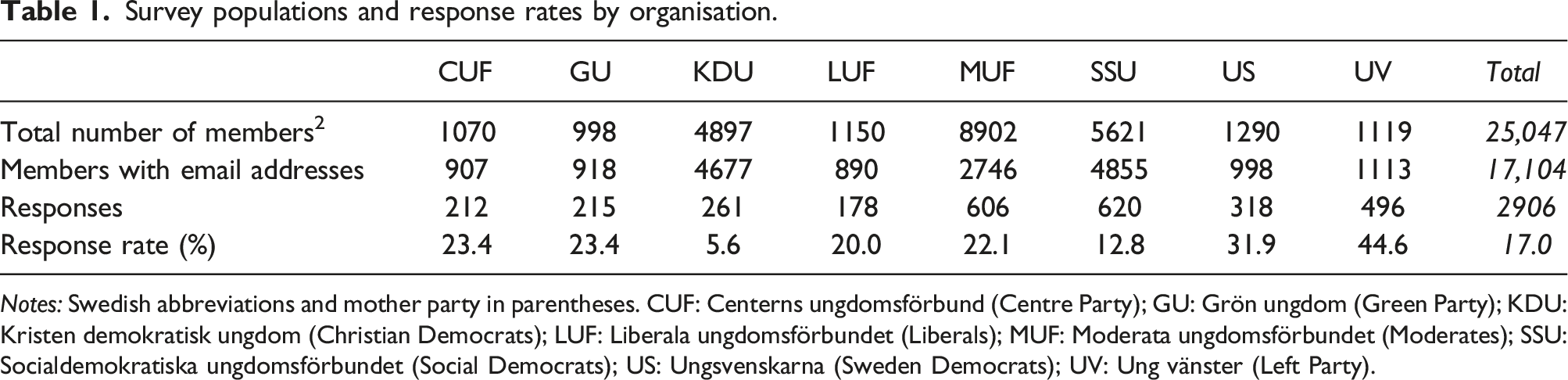
Notes: Swedish abbreviations and mother party in parentheses. CUF: Centerns ungdomsförbund (Centre Party); GU: Grön ungdom (Green Party); KDU: Kristen demokratisk ungdom (Christian Democrats); LUF: Liberala ungdomsförbundet (Liberals); MUF: Moderata ungdomsförbundet (Moderates); SSU: Socialdemokratiska ungdomsförbundet (Social Democrats); US: Ungsvenskarna (Sweden Democrats); UV: Ung vänster (Left Party).
We test our hypotheses using data from a web survey, conducted in 2020, of members of the youth organisations of all Swedish parliamentary parties. Members were invited to take part who were at least 15 years old and who had provided their youth organisation with an email address. Out of 17,104 members invited to take part, 2906 responded to the survey (see Table 1). The overall response rate of 17% is in line with that in comparable previous studies (e.g. Kölln and Polk, 2017; Evertsson et al., 2019). There are, however, differences in response rates between different organisations.
As not all youth organisations have been able to provide information on the distribution of key background factors such as gender and age in their respective memberships, we have not been able to weigh the data. For the six organisations who provided information, however, we found that respondents are largely representative in terms of gender and age. We cannot rule out the possible existence of systematic differences between respondents and non-respondents in other respects, so we still need to be cautious about generalising our findings too far. Note, however, that the variation in response rates is largely uncorrelated with our hypothesised factors – a point to which we return in the analysis.
Previous studies have used two different methods for analysing the motivations underlying members’ decision to join party organisations: factor analysis (Bruter and Harrison, 2009) and latent class analysis (Weber, 2020). The two approaches are similar in that both can be used to identify latent structures in survey data (Hagenaars and Halman, 1989). However, whereas factor analysis identifies latent continuous dimensions in the data, latent class analysis (LCA) identifies latent categories (or classes). Rather than assigning to each respondent a value on a certain dimension, then, LCA is used to assign to each respondent a predicted probability of belonging to a certain latent class. Stated otherwise, factor analysis groups similar variables together; LCA groups similar observations together (Nylund-Gibson and Choi, 2018).
Following Weber (2020), we use LCA to identify unobserved groups of members based on a set of observed incentives to join these organisations. This approach allows us to test not only whether members are motivated by different kinds of incentives, but also how the importance attached to these incentives is affected by the factors hypothesised in the previous section. 3
In order to identify the latent class structure, we make use in the first part of our analysis of a number of survey items relating to different incentives for joining. We decide on the number of latent classes based both on statistical criteria and on considerations about interpretability and parsimony (cf. Masyn, 2013; Nylund-Gibson and Choi, 2018). Once the latent classes are identified, we can predict the probability that any given respondent will belong to each latent class. We then proceed to introduce a number of covariates related to the hypotheses we set out to test. These covariates constitute the independent variables in a number of logistic regression models where the latent class structure serves as the dependent variable. Due to the nature of our hypotheses, we focus on the distinction between classes where material incentives are important and classes where they are not. Note that these latent class regression models differ from standard logit models in that the observations are probabilistically assigned to each class because the dependent variable is latent rather than observed. The effect of each covariate can be interpreted in terms of how it affects the latent class structure. Stated otherwise, as the values of the independent variables change, we can observe changes in the predicted probabilities associated with belonging to each class.
Indicator variables and covariates
Indicator variables.
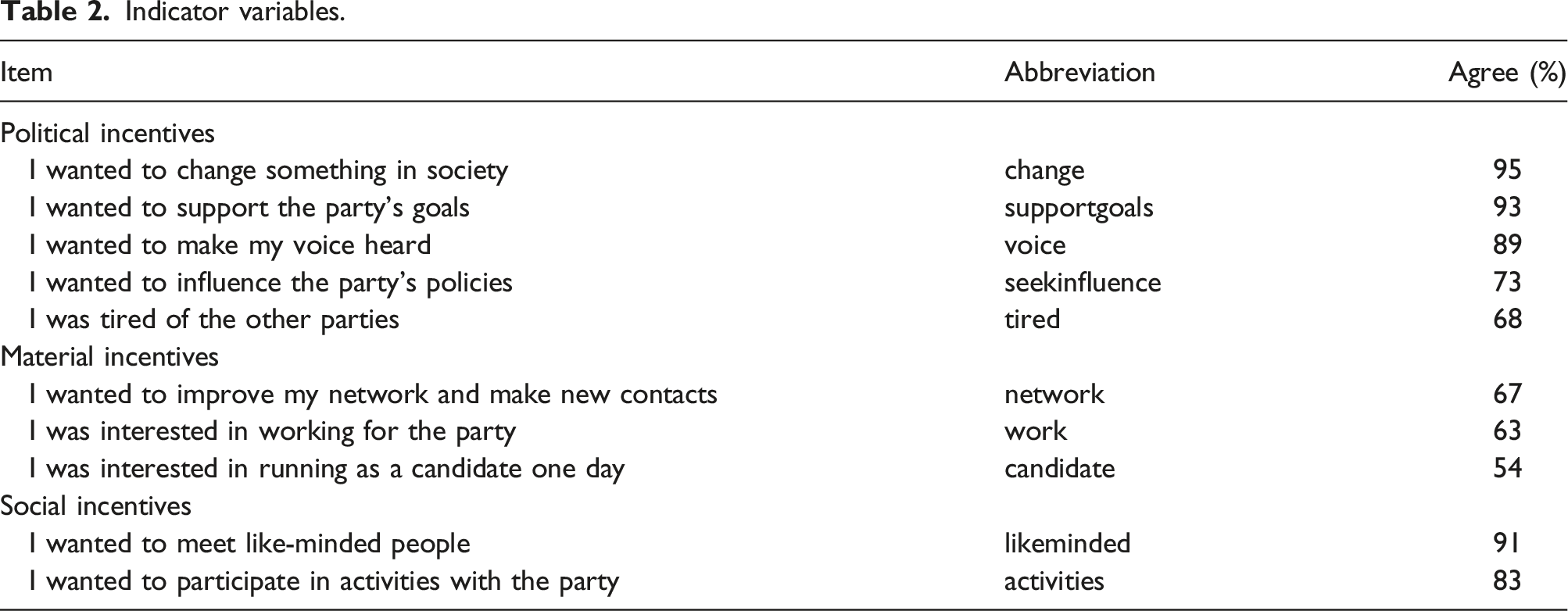
Following earlier research, we have classified the incentives as political, material, or social (Bruter and Harrison, 2009; Weber, 2020). Table 2 shows – also in line with this research – that material incentives, which are the main focus of this study, are less important for joining youth organisations than political and social ones. However, given that ‘ambition makes you look pretty ugly’ (Ødegård, 2009: 144), it may be less socially acceptable to be explicit about one’s material ambitions. In view of this, it is noteworthy that a majority of respondents nonetheless describe material incentives as important.
Covariates used in the analysis.
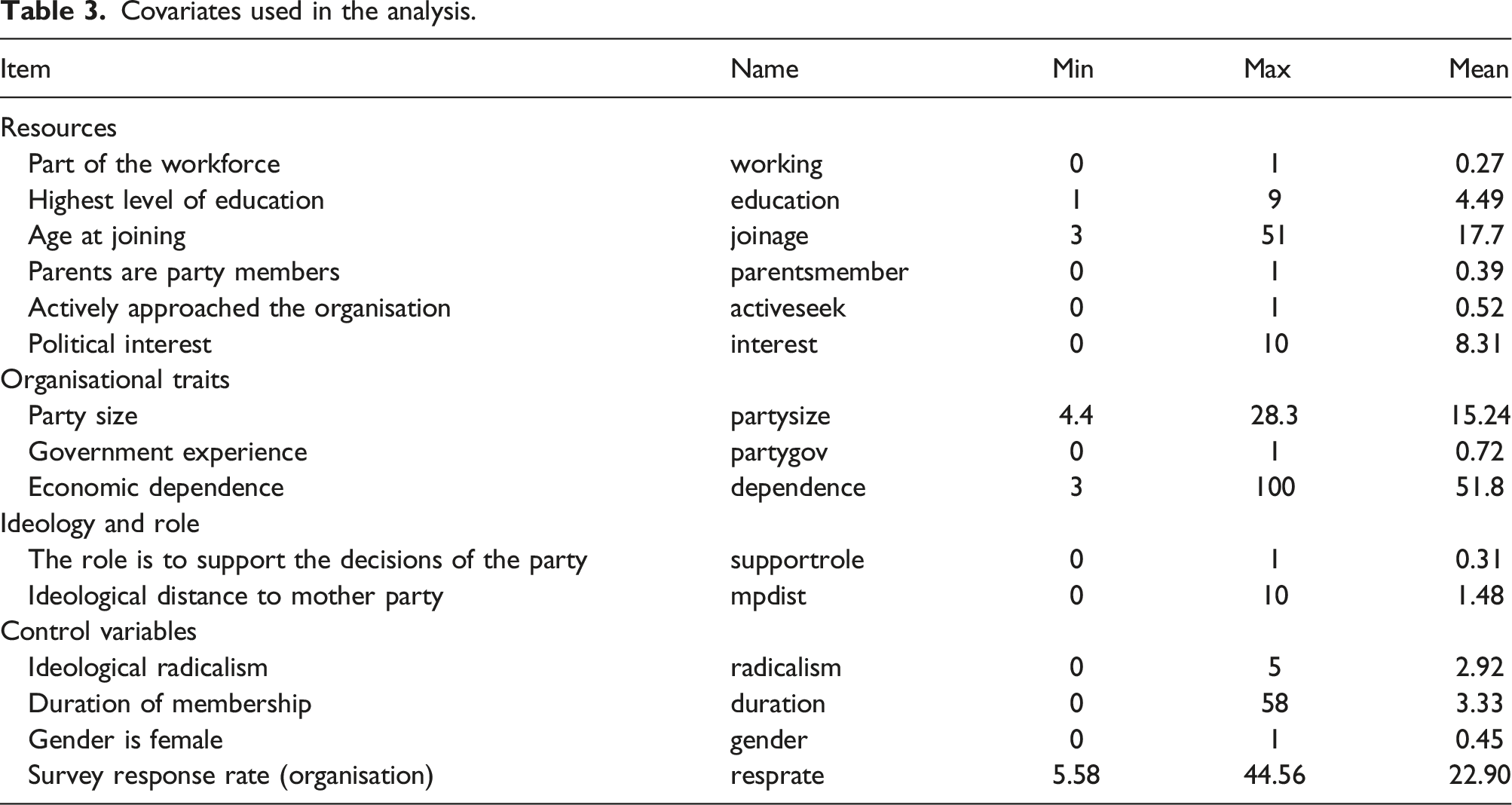
The second block contains organisational-level variables relating to the youth organisation or its mother party; these correspond to hypotheses 1a/b and 2. Partysize is a variable measuring the size of the mother party in terms of the vote share won in the 2018 parliamentary election. Partygov is a dummy variable indicating whether the mother party has ever been in government. It is accordingly coded 1 for all youth organisations, save for those of the Sweden Democrats and the Left Party. Dependence is a variable indicating the degree to which the youth organisations are economically dependent on their mother party. It is measured as the share of their funds that come directly from the mother party; it ranges from 3% for the Social Democrats’ youth organisation to 100% for the Sweden Democrats’ youth organisation. 6
The third block contains individual-level variables relating to the perceived ideological distance between members of the youth organisation and the mother party, as well as the view of the persons in question regarding the role of the youth organisation vis-à-vis the mother party. These variables correspond to hypotheses 3 and 4. Supportrole is a dummy variable indicating whether the respondent agrees with the following statement: ‘The most important role of the youth organisation is to support the decisions made by the mother party’. The original response item is measured on a four-grade scale (agree completely, agree somewhat, disagree somewhat, disagree completely), and it has been recoded into a binary agree/disagree dummy. Mpdist measures the absolute distance between a respondent’s self-placement on a 0 to 10 left/right scale on the one hand, and the position of the mother party as estimated by the same respondent on the other.
Finally, the fourth block includes a number of control variables. Radicalism measures the absolute distance from a respondent’s self-placement on the left/right scale to the mid-point of this scale (5). Duration is a variable measuring the duration of membership in years, which is included to account for the fact that the respondents’ view of their motives may change between the time of joining and the time of answering the survey (Weber, 2020: 501). Gender is a dummy variable coded 0 for male and 1 for female. Resprate, finally, is a variable indicating the response rate for each organisation. It is included as a robustness check for testing whether or not the results are affected by response-rate differences between the youth organisations.
Empirical analysis
Identifying the number of classes
Since we are attempting to find latent rather than observed groups of members, there is no ‘true’ number of classes to be found in the data. In deciding on the number of classes to extract, we rely on three things. First, we use the Bayesian information criterion (BIC), which is a measurement of how well the model fits the data. Because a better fit between model and data can always be obtained by introducing more parameters, the BIC makes use of a penalty term that weighs improvement in fit against model parsimony (Schwarz, 1978). While several different information criteria can be used, the BIC has been shown to perform the best for latent class model selection (Nylund et al., 2007). Second, we look at the relative improvement of the log-likelihood value as compared to the null model (i.e. a one-class solution), and as compared to a model with one less class. Third, we take into consideration the substantive interpretability and theoretical relevance of the class structure in relation to our research problem.
Latent class model selection statistics.
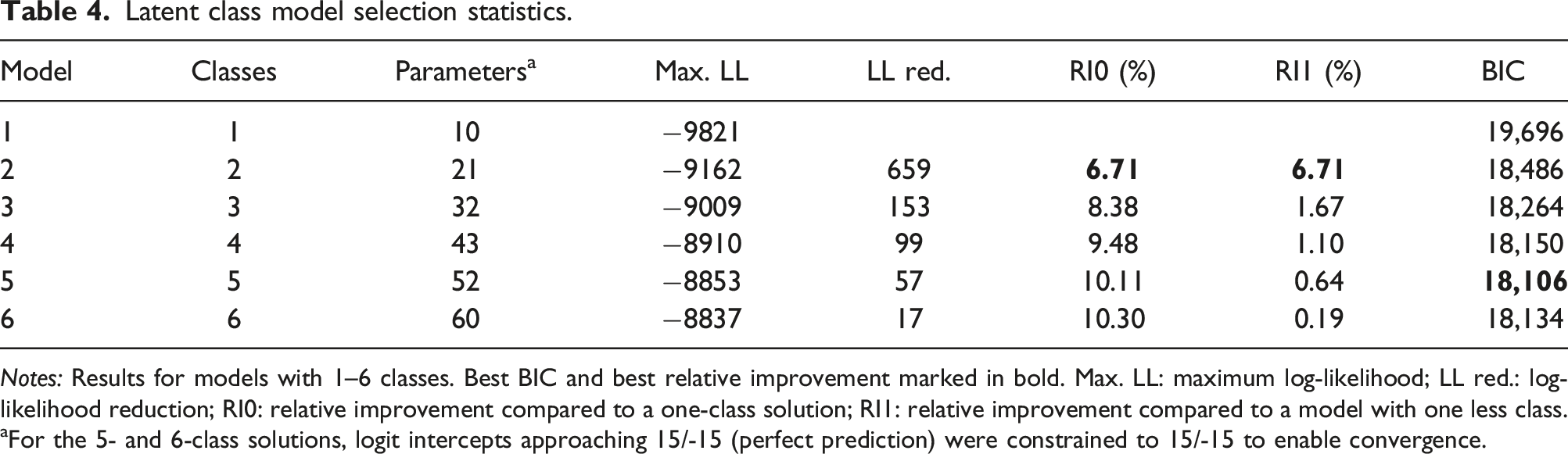
Notes: Results for models with 1–6 classes. Best BIC and best relative improvement marked in bold. Max. LL: maximum log-likelihood; LL red.: log-likelihood reduction; RI0: relative improvement compared to a one-class solution; RI1: relative improvement compared to a model with one less class.
aFor the 5- and 6-class solutions, logit intercepts approaching 15/-15 (perfect prediction) were constrained to 15/-15 to enable convergence.
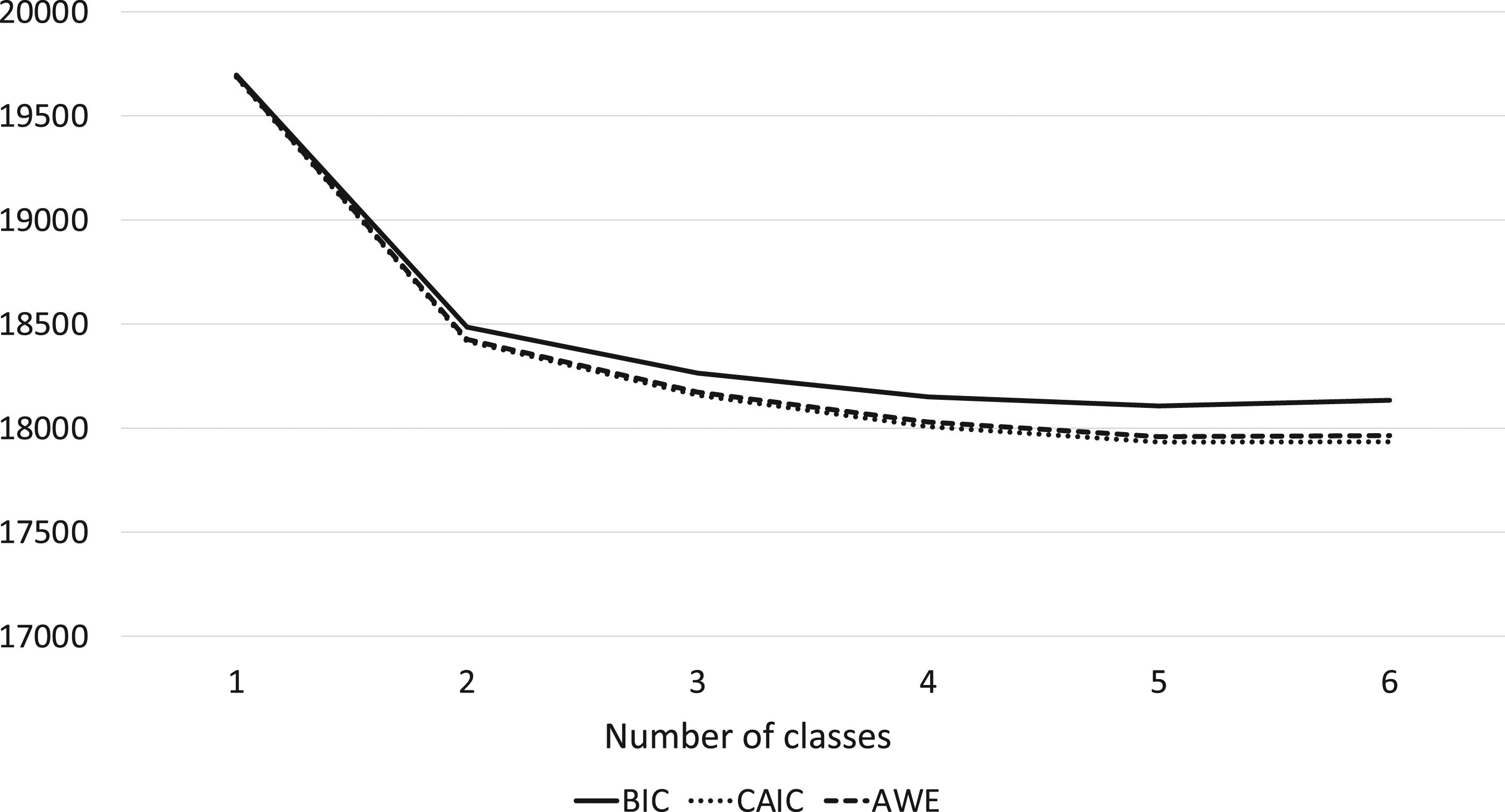
Plot of information criterion values.
Our two classes, comprising about 37% and 63% of the sample respectively, are shown in Figure 2. A good latent class model should consist of classes that are characterised by high item homogeneity and a high degree of separation (Masyn, 2013). For item homogeneity, the probability of each of the incentives being important for members of a given class should be either very high (>0.7) or very low (<0.3). As can be seen in Figure 2, class 2 consists of members for whom all incentives are highly important. For class 1 the homogeneity is lower, but it is similar to that for class 2 in terms of the political and social incentives. Following Weber (2020), we refer to these two classes as ‘take all’ and ‘ideologists’, respectively.
8
The greatest distinction between the two classes is in terms of material incentives, which are much more important for the take-all class. In terms of class separation, each individual should ideally have a high probability of belonging to one class, and a low probability of belonging to any other. The mean probability of membership is very high for our two classes (0.88–0.90), indicating good separation (see Supplemental Appendix Table A3 in Appendix A for details). Two-class probability profile plot (class-specific item probabilities with 95% CI). Notes: See Supplemental Appendix Table A3 in Appendix A for full results.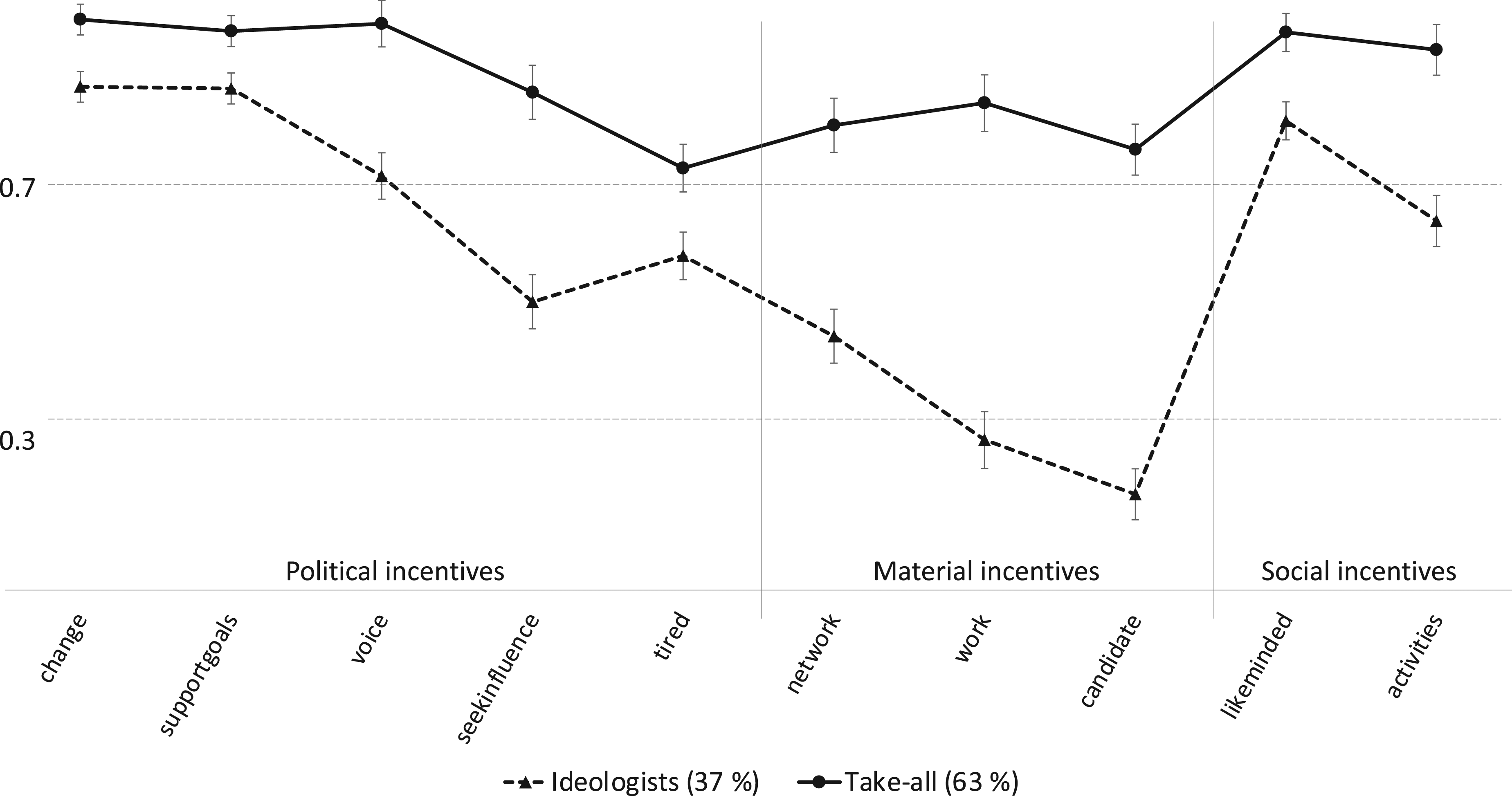
Multivariate analysis
Average marginal effects for latent class regression models.
Notes: Significant at * the 0.1 level, ** the 0.05 level, *** the 0.01 level. Full logit results shown in Supplemental Appendix Table A4 in Appendix A. Null BIC (equal sample) = 15,707. BF = Bayes Factor in comparison with the null BIC.
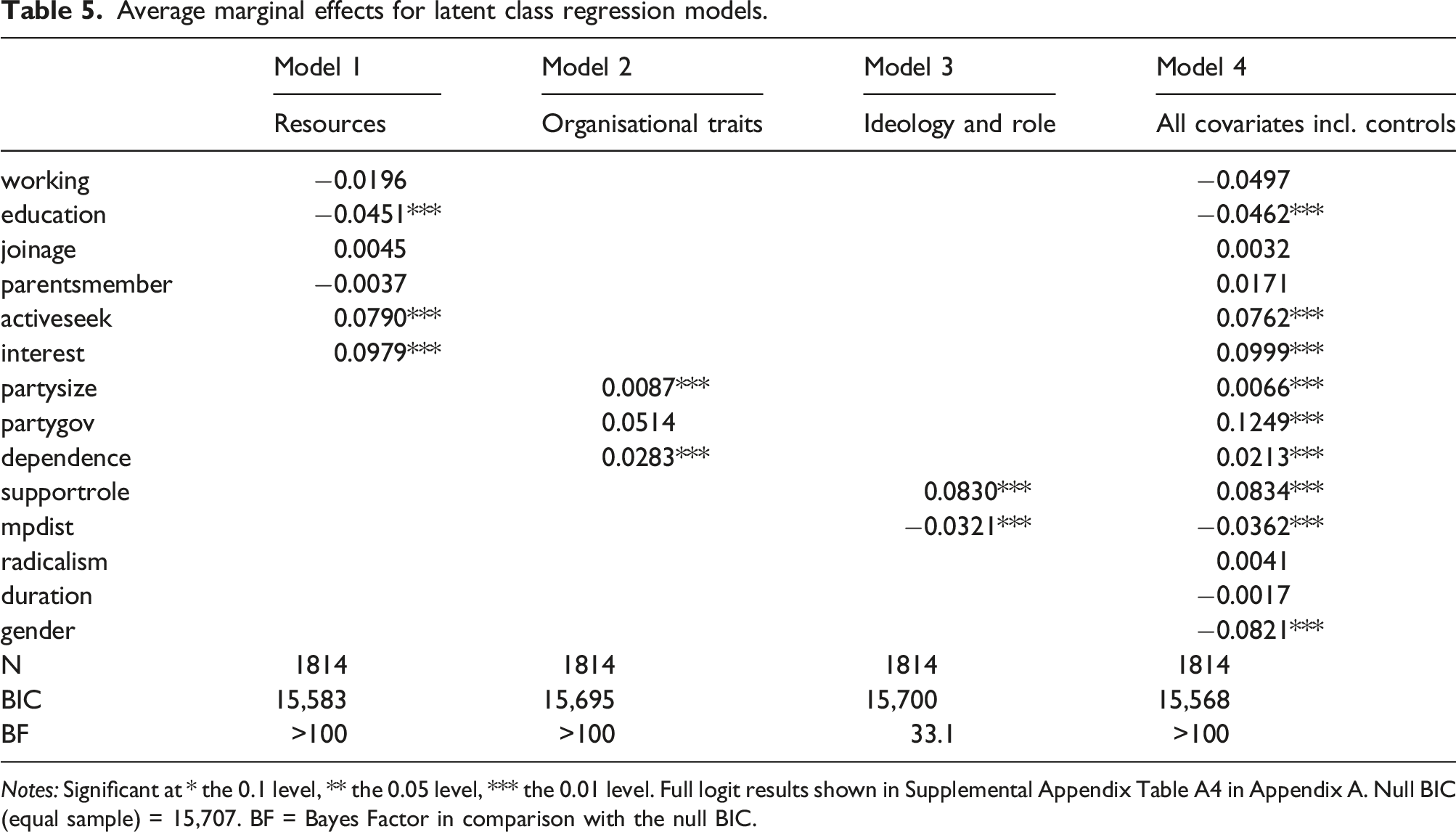
For continuous variables the AME is the average derivative, which for practical purposes can be interpreted here as the change in the predicted probability of belonging to the take-all class given a one-unit change in the independent variable. For example, each one-unit increase in education (Model 1) corresponds to just under a five percentage point decrease in the predicted probability of belonging to the take-all class. In terms of resources, we find the strongest effect for political interest: each additional level of political interest generates close to a 10 percentage point increase in the predicted probability of belonging to the take-all class. Table 5 shows that not just resources but also additional member characteristics and organisational traits affect the latent class structure. 10 Although the overall effect of the variables in Model 1 is stronger, Models 2 and 3 are also strongly preferable to a null model excluding covariates, as judged by the relative reduction in BIC (cf. Andraszewicz et al., 2015). The full Model 4, which includes all covariates and control variables, is the best-fitting one.
To facilitate interpretation of the results pertaining to our hypotheses, we have used Model 4 to compute the probability of belonging to the take-all class across different values of the independent variables. Results for the effect of organisational traits are plotted in Figure 3. When we go from the minimum to the maximum observed value of party size (0–30), the predicted probability of belonging to the take-all class increases from about 51% to 71% This means, in line with hypothesis 1a, that material interests are more important for membership in youth organisations belonging to larger mother parties. The effects of government experience (hypothesis 1b) are also positive, as expected. For parties with government experience, the probability of belonging to the take-all class is roughly 13 percentage points higher. Note, however, that this is the only effect which does not retain its significance when the response rate is controlled for; this results from the fact that the two parties without government experience correspond to the two youth organisations with the highest response rate. Although the estimated effect remains substantively large (a difference of 5 percentage points), this indicates that our conclusions about the hypothesised relationship should remain tentative until they are corroborated by additional findings. For economic dependence, finally, the positive effect is in line with hypothesis 2. The predicted probability of belonging to either class is identical at the lowest level of dependence (0). At the maximum level (10), however, the probabilities differ by over 40 percentage points. Effect of organisational traits on class membership. Notes: Predicted class size across different values of the independent variable, with all other variables set to their observed values (based on Model 4 in Table 5).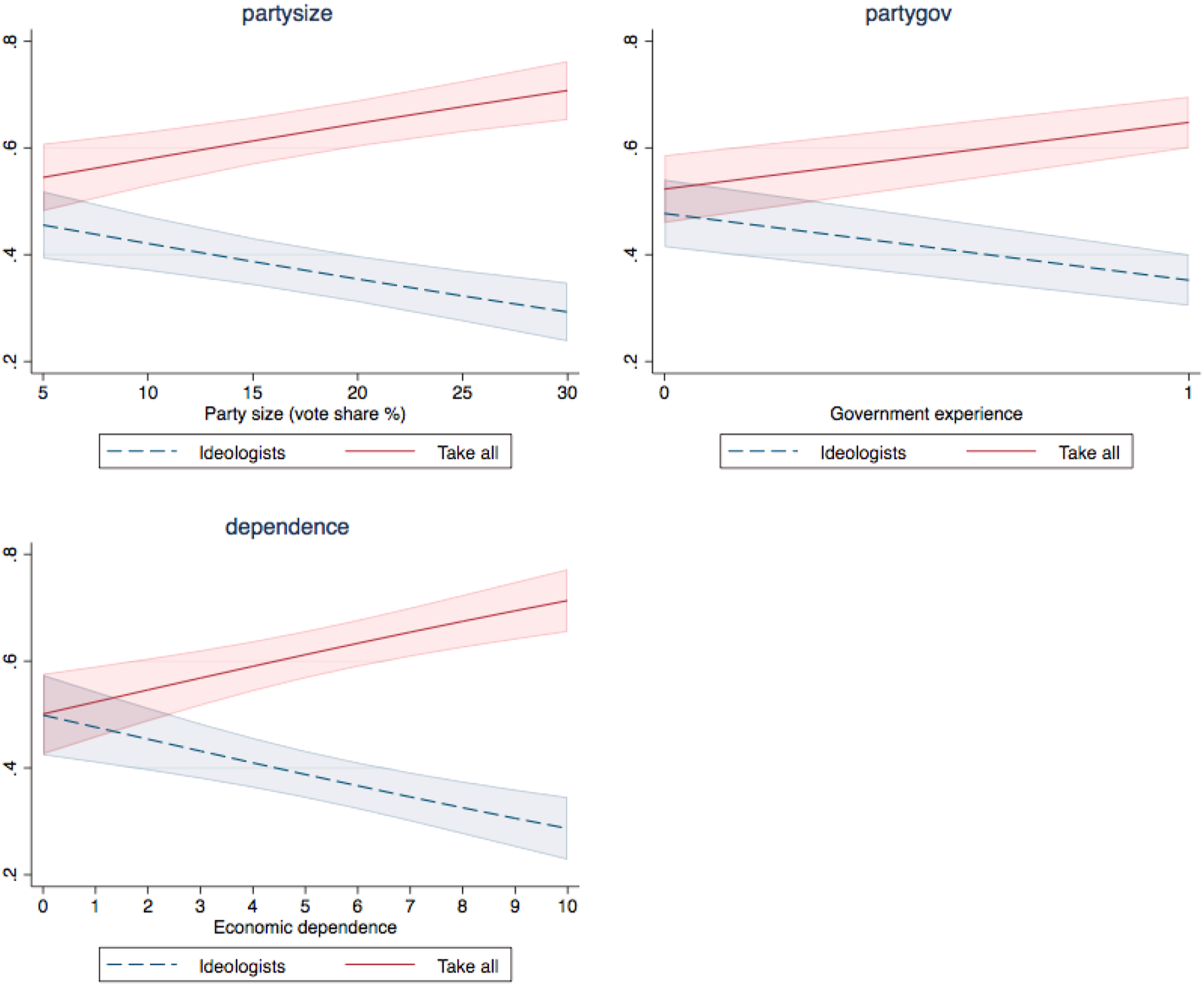
Probabilities pertaining to the effect of ideological distance and view of the youth organisation’s role are shown in Figure 4. In line with hypothesis 3, we find that material incentives are more prevalent among individuals who think the youth organisation’s most important role is to support the mother party. This variable has a positive effect corresponding to an increase in the predicted size of the take-all class of around 8 percentage points. We also find the expected effect for hypothesis 4: with increasing ideological distance between member and youth organisation, the probability of belonging to the take-all class decreases rapidly. Going from a distance of 0 to 4 (a range that contains the vast majority of the observations) reduces this probability by almost 15 percentage points. In line with hypothesis 4, then, material incentives are less prevalent among ‘ideological misfits’. Effect of ideology and view of the youth organisation’s role on class membership. Notes: Predicted class size across different values of the independent variable, with all other variables set to their observed values (based on Model 4 in Table 5).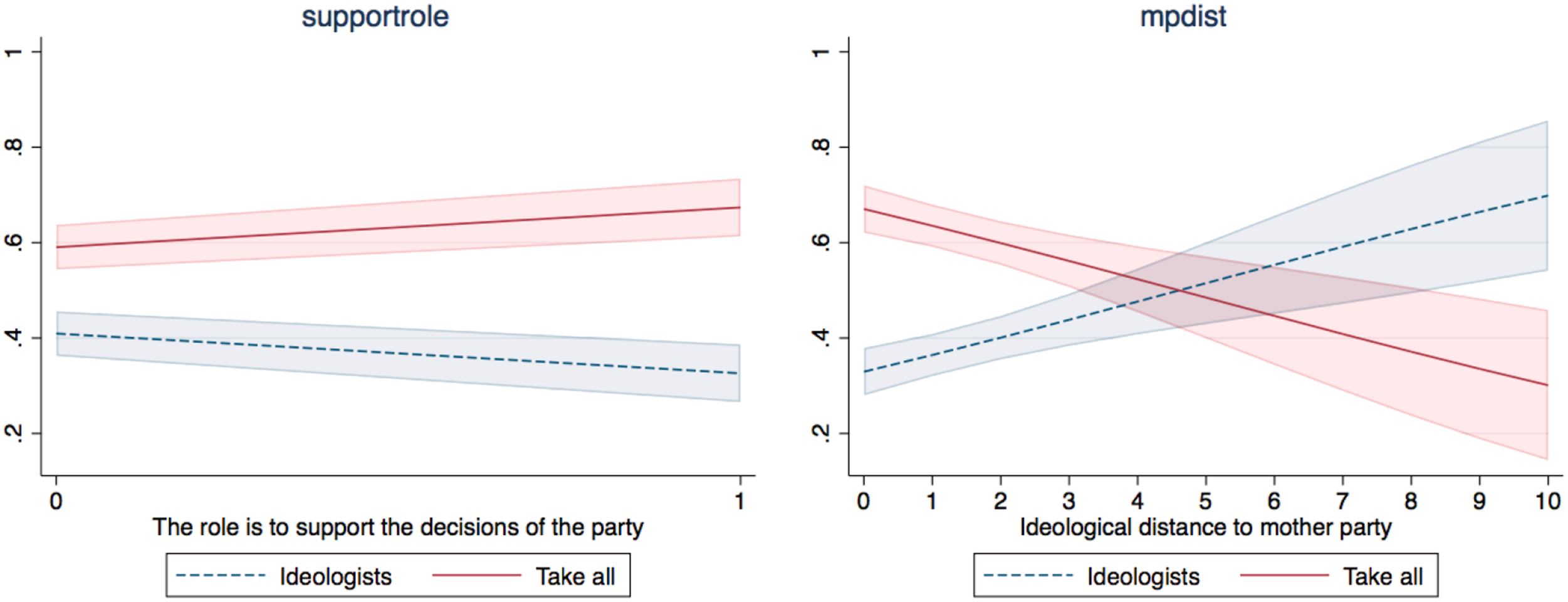
Concluding remarks
Despite the important role played by political youth organisations both as the main recruiter for future politicians and party workers, and as channels for young people’s attitudes and demands, they have largely escaped extensive scholarly scrutiny. While research on members’ motives for joining political parties is abundant, similar knowledge about their youth wings is limited to less than a handful of studies. Against this background, this study contributes to a still underdeveloped but burgeoning body of research. Unlike earlier studies, moreover, this one systematically compares members from several different youth organisations, and it explains variations in enrolment motives using both organisation-level and individual-level factors.
Our results suggest, in line with Weber’s (2020) but in contrast to those in earlier studies, that young people have complex motives for joining youth organisations. While almost all members have both political and social motives, the main dividing line is whether they also find material incentives to be important. Still, it is worth noting that many young people are explicit about their interest in standing for election one day, or in seeking employment as a party worker. Since it is seen as less socially acceptable to acknowledge personal ambitions than to highlight political and social motives (Ødegård, 2009), the share of respondents who became members due in part to material motives is probably underestimated. We can therefore conclude that, in addition to providing an arena for political influence and socialisation, youth organisations likely attract young people to take part in organised politics due to the material rewards accruing to membership in them. This can be seen as good news. In times of shrinking party membership, it is important that youth organisations attract young people who can eventually strengthen and rejuvenate the mother party. Importantly, however, we must be cautious about equating enrolment motivations with future actions. Even though one might become a member partly with a political job in mind, the choice of pursuing a political career is also dependent on the experiences gained from politics. Young people leave their political assignments prematurely to a greater extent compared with older elected representatives (MUCF, 2021). Research on why people join, therefore, needs to be complemented with research on why they (do not) stay.
Our data support all of our hypotheses about which factors affect the importance of material incentives. At the organisational level, we find that the prevalence of material incentives among members is positively related to the size of the mother party and whether it has government experience. Moreover, we find an association between material incentives and economic dependence on the part of the youth organisation vis-à-vis its mother party. Based on these findings, we can conclude that youth organisations which resemble the ideal-typical support team for their mother party correspondingly attract more materially motived young citizens than do youth organisations which lean more to performing a pressure group role. This logic is also found at the individual level: members who think the main role of the youth organisation is to support the mother party are more inclined to have material incentives for their enrolment. The result that so-called ideological misfits are less likely to think that material incentives are important also fits well with this general idea. Young people who join youth organisations despite deviating somewhat from the mother party ideologically tend to do so, reasonably enough, with the ambition of trying to bring about change. Conversely, it is conceivable that individuals whose political position is similar to that of their party do not consider it necessary to gain greater influence (Bolin and Kosiara-Pedersen, 2019), and as such are correspondingly more inclined to join for material reasons.
Of course, the study also has limitations. Unlike some previous studies (Cross and Young, 2008), it does not compare young party members with non-members, so it cannot answer the question of why young people do not become members of political youth organisations. Furthermore, we must be careful when generalising our results, since it can be assumed that members who did not answer the survey are less active and have other motives for their engagement. Finally, there is reason to be careful about generalising our conclusions to other national contexts. In this study, we have linked young people’s motives for membership to the role of youth organisations vis-à-vis their mother party. Given the lack of comparative studies on the roles played by youth organisations, we cannot automatically conclude that our results are valid for other countries.
Notwithstanding these limitations, however, our results should serve reasonably well as a basis for future studies of members of youth organisations in similar Western political systems.
Supplemental Material
Supplemental Material - Attracting tomorrow’s leaders: Who joins political youth organisations for material reasons?
Supplemental Material for Attracting tomorrow’s leaders: Who joins political youth organisations for material reasons? by Niklas Bolin, Anders Backlund, and Ann-Cathrine Jungar in Party Politics
Supplemental Material
Supplemental Material - Attracting tomorrow’s leaders: Who joins political youth organisations for material reasons?
Supplemental Material for Attracting tomorrow’s leaders: Who joins political youth organisations for material reasons? by Niklas Bolin, Anders Backlund, and Ann-Cathrine Jungar in Party Politics
Footnotes
Acknowledgements
Earlier versions of this paper were presented at the 2021 ECPR General Conference and at the 2021 annual congress of the Swedish Political Science Association. The authors thank all commentators for helpful suggestions. The authors are also grateful to Marcus Österman, Malena Rosén Sundström and Elin Fjellman as well as the annonymous reviewers of Party Politics for their helpful and constructive comments on this manuscript.
Declaration of Conflicting Interests
The author(s) declared no potential conflicts of interest with respect to the research, authorship, and/or publication of this article.
Funding
The author(s) disclosed receipt of the following financial support for the research, authorship, and/or publication of this article: This work was supported by the Swedish Agency for Youth and Civil Society grant number dnr: 0671/19

Supplemental Material
Supplemental material for this article is available online.
Notes
Author Biographies
References
Supplementary Material
Please find the following supplemental material available below.
For Open Access articles published under a Creative Commons License, all supplemental material carries the same license as the article it is associated with.
For non-Open Access articles published, all supplemental material carries a non-exclusive license, and permission requests for re-use of supplemental material or any part of supplemental material shall be sent directly to the copyright owner as specified in the copyright notice associated with the article.
