




Abstract
This article investigates the remarkable surge in individual membership of the Labour Party after the general election of May 2015, particularly after Jeremy Corbyn was officially nominated as a candidate for the leadership in June of that year. Using both British Election Study and Party Members Project data, we explain the surge by focussing on the attitudinal, ideological and demographic characteristics of the members themselves. Findings suggest that, along with support for the leader and yearning for a new style of politics, feelings of relative deprivation played a significant part: many ‘left-behind’ voters (some well-educated, some less so) joined Labour for the first time when a candidate with a clearly radical profile appeared on the leadership ballot. Anti-capitalist and left-wing values mattered too, particularly for those former members who decided to return to the party.
Introduction
Researchers have been documenting the decline of grassroots political parties across advanced democracies for nearly three decades (Dalton, 2005; Heidar, 2006; Katz et al., 1992; Mair, 1994; Mair and Van Biezen, 2001; Scarrow, 2000; Van Biezen et al., 2012). This trend, variously attributed both to supply and demand side factors (Van Haute and Gauja, 2015: 4–6), is important because political parties, even if they are seen by many as little better than ‘necessary evils’ (see Ignazi, 2017), continue to play a central role in the effectiveness of democracy. Notwithstanding the greater participatory rights of party members (Faucher, 2015; Fisher et al., 2014; Scarrow, 2015; Webb et al., 2017), a decline in their numbers has important implications for the future of democracy (Dalton and Wattenberg, 2000; Gauja, 2015; Scarrow, 1996; Webb et al., 2002).
In Britain, however, things have changed. Whether temporary or permanent, all of the major political parties, with the exception of the Conservatives, have seen a recent reversal of this decline. Trends in membership for all the major parties over the period 2002 to 2016 appear in Figure 1 and show that in the case of the SNP, UKIP and the Greens, the revival started in the midterm of the 2010–2015 Coalition Government, while in the case of Labour and the Liberal Democrats, it followed the 2015 general election. The most striking development is undoubtedly the rapid growth in Labour’s membership during the leadership campaign of 2015 that ended with the election of veteran left-winger, Jeremy Corbyn.
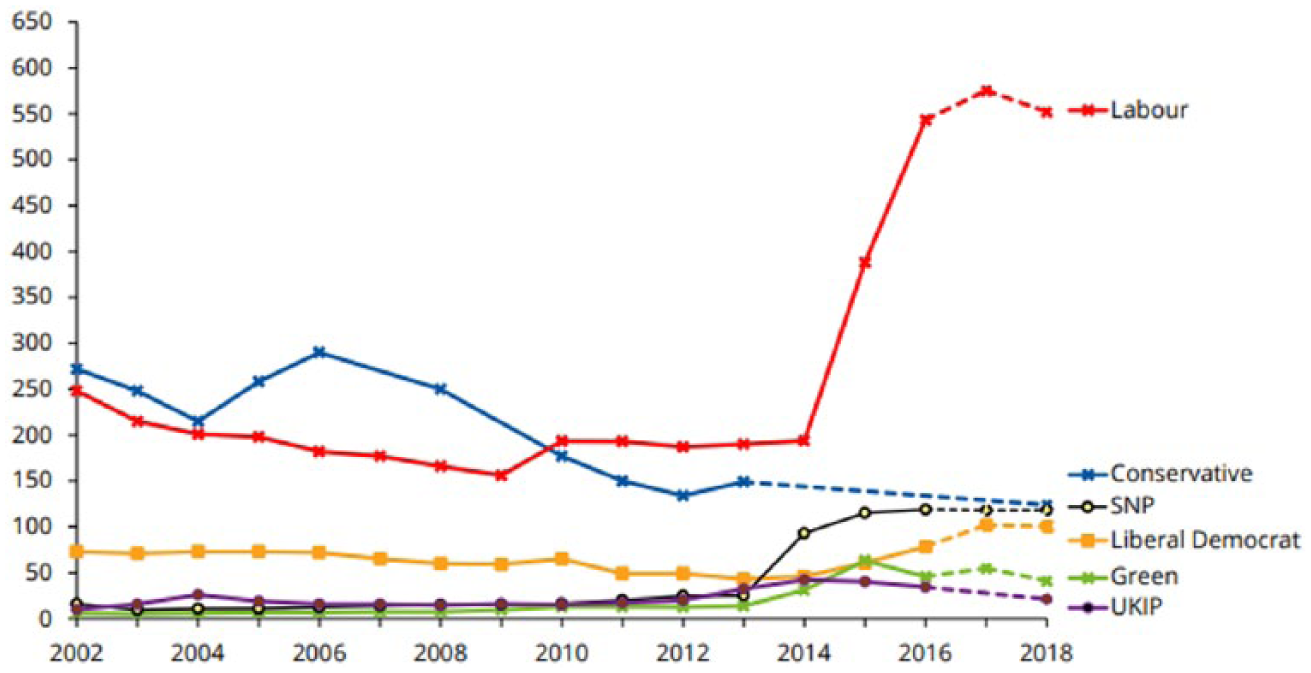
Membership of UK political parties, 2002 to 2018.
The study of factors that lead people to join parties is certainly not new (see Van Haute and Gauja, 2015: 8). In this article, however, we try specifically to explain the nature of the resurgence in Labour Party membership. As of January 2018, Labour had 552,000 members, a massive increase on the 198,000 recorded prior to the 2015 election (see Audickas et al., 2018).
Such a reversal of Labour’s membership decline has happened before, even if it eventually turned out to be short-lived, most obviously following Tony Blair’s successful leadership bid in 1994 (Seyd and Whiteley, 2002). The Blair blip, however, did not approach anything like that seen since 2015. However, while media coverage can give the impression that those who joined are one homogeneous, predominantly youthful mass, not all of them share the same profile, as we show below. Most obviously, some have joined the party for the first time, while others have returned to it after a prolonged absence.
This study comprises two parts. In the first, we use British Election Study (BES) 1 data to look at the factors driving the surge in these two types of membership. We test six related hypotheses examining differences between long-established and returning members on one hand and new joiners on the other. We then develop two additional hypotheses, using Party Members Project (PMP) 2 data, on the determinants of support for Jeremy Corbyn who, the findings generated by BES data suggest, played a crucial role in driving the rapid growth of membership after he became a leadership candidate.
The BES data allow us to compare different types of party member, while the PMP data permit us to probe the views of party members more closely, particularly in relation to their attitudes to Jeremy Corbyn and the timing of their decision to join or rejoin the party. We begin by reviewing the literature on why people join (or rejoin) political parties before focussing on Labour’s recent revival.
Why do people join political parties?
There are a number of models of political participation (Parry et al., 1992; Verba et al., 1995), several of which have been applied to the task of explaining why people join parties (Gauja, 2015; Scarrow, 2015; Whiteley and Seyd, 2002).
Some of these models relate to long-term social processes and rely on variables such as social class, education and community cohesion which change slowly over time – for instance, the Civic Voluntarism (Verba et al., 1995) and Social Capital models (Putnam, 2000). The former stresses the importance of individual resources and the latter community resources as drivers of participation. Clearly, the rise in Labour’s membership after the 2015 general election cannot be fully explained by these relatively slow moving social processes, as membership more than doubled within just a few months.
That said, two theoretical models would seem to be particularly relevant to understanding the surge in Labour’s membership. One, the General Incentives Model (GIM) was developed at the time of the first surveys of party members in Britain (Seyd and Whiteley, 1992). This model is based on the idea that actors respond to a variety of incentives when they participate in politics. It combines variables associated with rational choice theories, which focus on the costs and benefits of participation, with social-psychological measures, such as social norms and ideological beliefs which help to motivate individuals to get involved. Unfortunately, the model includes many variables which are not available in BES surveys. In addition, some of the variables in the model, such as perceptions of benefits and costs, are unlikely to change in a matter of months. For these reasons, we do not directly test the theory in the present article, although it has been discussed in other research (Poletti et al., 2018).
The second model of interest here is based on relative deprivation theory originally introduced by Stouffer et al. (1949) and subsequently developed by Runciman (1966). This theory is based on the idea that individuals develop expectations as to how economic, political and social systems should treat them in relation to issues of equity and fairness. At the same time, they also develop judgements about how they are actually treated in practice. The greater the gap between expectations and evaluations, and the more negative the comparisons, the more likely they are to experience frustration and anger (Walker and Smith, 2002). This theory can be tested using BES data.
These emotional responses are a ‘potent, volatile, instigator of action’ (Marcus et al., 2000: 26) and a stimulus to obtaining and processing information in order to try to explain and, if possible, change these negative comparisons (Conover and Feldman, 1986; Marcus, 1988): ‘If the evaluation proves to be negative, the individual experiences relative deprivation and is motivated to one of several possible behaviours, ranging from changing membership in the negatively evaluated group to changing the dimensions of comparison’ (Walker and Pettigrew, 1984: 302).
The context in which comparisons are made is a key factor in understanding how relative deprivation works to stimulate political action (Runciman, 1966: 9) since it depends on people’s attributions of responsibility. Blaming negative comparisons on oneself can lead to withdrawal and apathy, whereas attributing them to the organisation of society and the political system can stimulate participation. Such attributions motivate people to participate in political parties, social movements and politics more generally (Walker and Smith, 2002; see also Sniderman et al., 1991). Blaming the political system is likely to have become particularly salient after the Great Recession, and recent research suggests that relative deprivation played an important role in explaining the rise in party membership and electoral support for UKIP after the 2010 general election (Clarke et al., 2017).
Accordingly, we examine the surge in Labour Party membership, particularly after Jeremy Corbyn became the party leader, with the assistance of relative deprivation theory. The central argument is that relative deprivation drove Labour’s membership revival but that its effects were conditional on two additional interrelated variables, namely, ideology and attitudes to Jeremy Corbyn himself. The shift to the left associated with his leadership and the promise of a new style of politics ensured that feelings of relative deprivation mobilised new members to join the party who otherwise might have remained apathetic and uninvolved. We now move on to a close examination of the changes in Labour Party membership after the 2015 general election and how these related to relative deprivation and other measures.
Labour’s membership surge
We start with the ‘Relative Deprivation’ hypothesis:
H1: People who joined the Labour Party for the first time after the 2015 election were more likely to feel a sense of relative deprivation than those who were already members or who were rejoining the party.
This hypothesis implies that different types of recruits will compare themselves with different reference groups. Low-income, low-status and poorly educated recruits are likely to compare themselves with other working class people in similar situations to themselves. In contrast, graduate recruits are likely to compare themselves with other graduates and, if this comparison makes them feel ‘left behind’ by their peers, it will act as a spur to political action, not least because education gives individuals a greater sense of political efficacy and provides skills which are valuable for stimulating political participation (see Verba et al., 1995). In other words, they are less likely to become apathetic by blaming themselves for their circumstances. This logic leads the ‘Educated Left-Behind’ hypothesis:
H2: Graduates who joined the Labour Party for the first time after the 2015 election were more likely to feel a sense of relative deprivation than graduates who were already members or who were rejoining the party.
While it is widely recognised that the spread of socially liberal, cosmopolitan and post-materialist values in Western societies since the 1960s (Inglehart, 1997) has generated a ‘silent counter-revolution’ of authoritarian attitudes (Haidt, 2013; Ignazi, 1992; Stenner, 2005), those on the left who feel ‘left behind’ and deprived may share this suspicion of cosmopolitan values but frame things differently from those on the right. They are more likely to see the danger as coming not from immigration but from predatory international capitalism and social inequality caused by globalisation – an analysis characteristic of, for instance, those involved with the ‘Occupy Movement’ which grew up following the Great Recession (Gitlin, 2012). As previous studies have shown, anti-capitalist values are not necessarily correlated with where people place themselves on the left–right spectrum. UKIP members, for instance, are on the right of British politics but are also strongly anti-capitalist in their beliefs where their focus is on corporate capitalism (see Clarke et al., 2017: 101–102). This logic suggests a third hypothesis:
H3: People who joined the Labour Party for the first time after the 2015 election were more likely to be influenced by anti-capitalist values than were returning and existing members.
We next consider the relationship between relative deprivation and attitudes to Jeremy Corbyn and also the role of ideology. When he became a leadership candidate in 2015, Corbyn was an outsider who had been associated with the far left for many years. He had little support in the parliamentary party and was only able to enter the membership ballot because of nominations provided by Labour MPs who wanted a wide range of views to be represented in the contest but made it clear they would not vote for him. In the event, and with the help of a highly sophisticated social media-savvy campaign spearheaded by grassroots activists – an organisation which then rebranded itself as Momentum and became in effect Corbyn’s praetorian guard – he won the leadership contest by taking 59.5% of the votes among party members and registered supporters in the first preference ballot in September 2015. This victory was repeated when he was challenged for the leadership by Owen Smith MP in the summer of 2016. These events almost certainly inspired new members to join and former members to return to the party to support and effectively protect the new leader. We therefore offer the fourth hypothesis as follows:
H4: People who joined the Labour Party for the first time or returned to the party after the 2015 election were more likely to support Jeremy Corbyn than those who were already members at the time of the 2015 election.
Was there, though, any difference between those who returned to the Labour Party and those who joined the party for the first time? Our fifth hypothesis addresses this question. During Tony Blair’s ‘Third Way’ years, the party arguably swung significantly to the right (Driver and Martell, 1998; Gould, 1998; Seyd and Whiteley, 2002; Shaw, 1996); indeed, by 1997, the party was positioned to the right of the Liberal Democrats on the left–right ideology scale constructed from party manifesto data (Budge and Bara, 2001). We hypothesise that many people who rejoined the Labour Party after the 2015 election were returning members who had left the Party during the Blair/Brown era because they were disillusioned by the ‘centre ground’ politics typified by New Labour. They rejoined Labour because they were attracted by radical left-wing policies proposed by Jeremy Corbyn as an answer to the challenges of modern society. Although some of the first-time joiners might have been attracted by those policies as well, ideology was more likely to be a driver for returning members, given their well-established radical positions. This possibility gives rise to what we shall call the ‘Left-Wing Ideology’ hypothesis:
H5: Members who returned to the Labour Party after the 2015 elections were likely to be significantly more left wing than existing members or first-time joiners.
If radical left-wing ideology is what attracted returning members, we suggest that new members tended to come from a slightly different position: one of political cynicism and disillusion with ‘politics as usual’. Corbyn offered not only a sharp swing to the left but the rhetoric of a new style of politics that would encourage members to work for the selection of left-wing candidates for party offices and Parliament, and actively to participate in policy-making. In other words, Corbyn aimed at turning Labour’s grassroots into a new social movement (Bush, 2017). We argue that these developments are likely to have addressed the belief that politicians do not care about ordinary people and attracted a new kind of member to the party. These developments give rise to a sixth hypothesis:
H6: People who joined the Labour Party for the first time after 2015 were more likely to be disillusioned with ‘politics as usual’ and to want a new style of politics, compared with returning and existing members.
How are H4, H5 and H6 related to relative deprivation theory? Liking Jeremy Corbyn, being on the left of the party and being disillusioned with politics as usual can be motivated by a variety of things, but relative deprivation plays an important role in all of them. The implementation of austerity measures by the Coalition government and the resultant stagnation in real wages combined with the ongoing rise of the so-called ‘gig economy’ and the increased shortage of affordable housing are all background factors. In particular, it has been shown that a growing gap between people’s evaluations of their own economic circumstances (improving very slowly) and that of the country as a whole (supposedly improving faster) was a key driver in the rise in support for UKIP in the run-up to the 2015 general election (Clarke et al., 2017: 125). Thus, relative deprivation triggered political action among people with positive attitudes to Jeremy Corbyn, who think of themselves as left wing and who feel disillusioned with politics as usual. These factors all working together helped to trigger changes in party membership during this period.
BES data and membership type
We can test these six hypotheses about the types of party member – those with existing membership dating from before the 2015 general election and those who joined as part of the post-election surge, whether returning to the party or as first-time joiners – using data from waves 6 and 8 of the 2015 BES Internet panel. These two waves asked questions about party membership. Wave 6 was conducted immediately after the general election of 2015 and wave 8 was in the field a year later in May and June 2016, so they are ideally timed to identify the new members recruited by Labour during this period. The questions asked addressed the respondent’s current and previous membership.
The large samples make it possible to identify a total of 651 Labour Party members in the 2015 wave of the survey and 860 members in the 2016 wave. 3 Some 58% of Labour’s usable sample of 2016 (n = 457) members were also members in 2015. In addition, 25% (n = 194) had never been a member of a party before, but joined during the period between the two waves of the survey. Finally, 18% (n = 140) had been a member prior to 2015 but had left the party only to rejoin it by 2016. So, we can identify existing, first-time joiners and returning members of the party in the 2016 wave of the survey. 4
Results: Explaining Labour’s membership surge
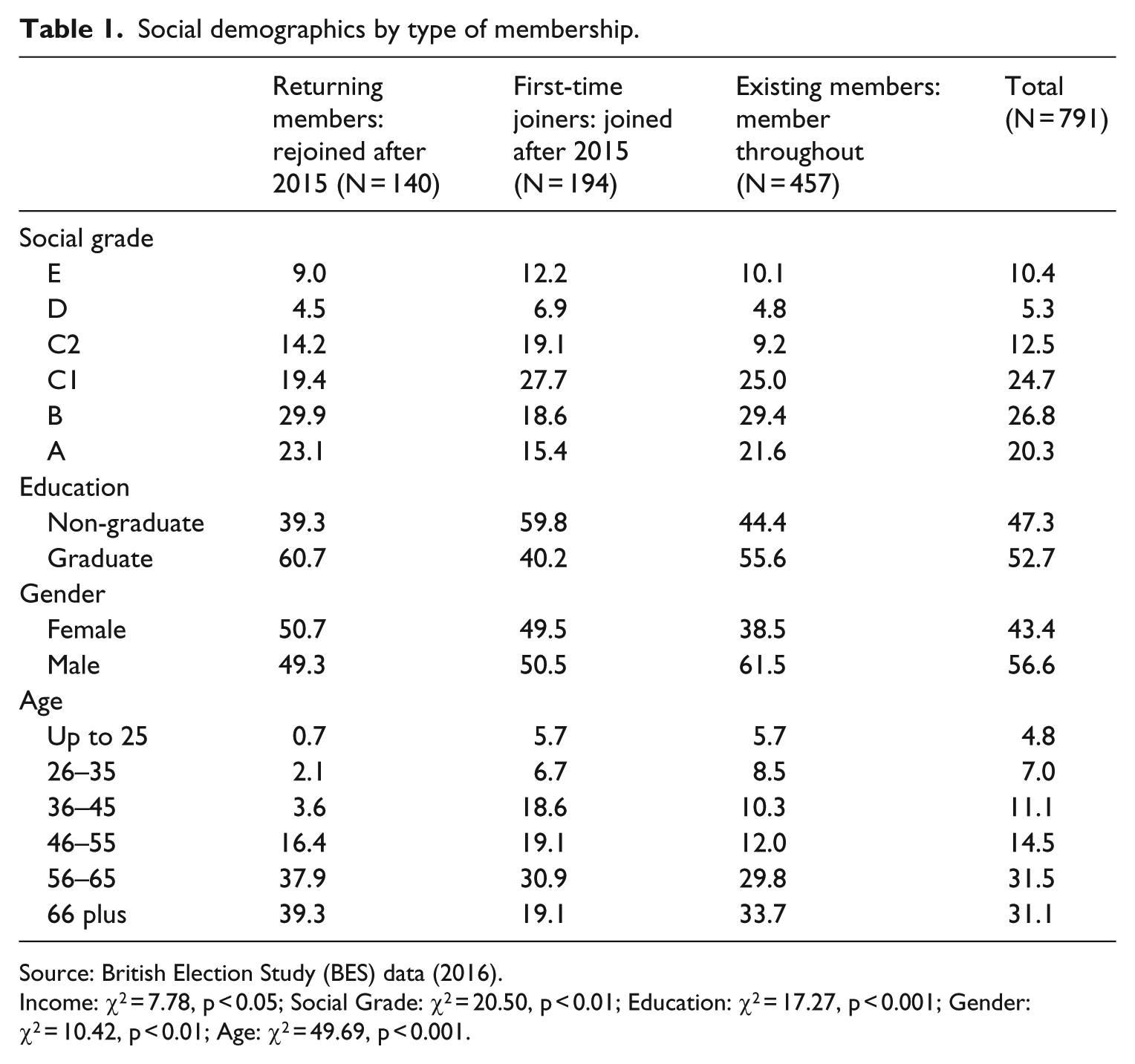
We start by exploring the relationship between the type of party member in the 2016 survey and their social background characteristics, looking for evidence of ‘relative deprivation’ impacting first-time joiners. Table 1 examines social grade, educational status, gender and age, whereas Table 2 looks at income and fear of poverty. The pattern which emerges suggests that, with some exceptions, existing and returning members were more like each other than those joining the party for the first time. Just under a quarter of the returning members were middle-class professionals (social grade A), which is similar to the 22% of existing members. In contrast, only 15% of the first-time joiners were in this category. At the other end of the scale, about 14% of returning members were in the ‘working class’ DE category – again about the same as the existing members, but nearly a fifth of the first-time joiners were in these categories.
Social demographics by type of membership.
Source: British Election Study (BES) data (2016).
Income: χ2 = 7.78, p < 0.05; Social Grade: χ2 = 20.50, p < 0.01; Education: χ2 = 17.27, p < 0.001; Gender: χ2 = 10.42, p < 0.01; Age: χ2 = 49.69, p < 0.001.
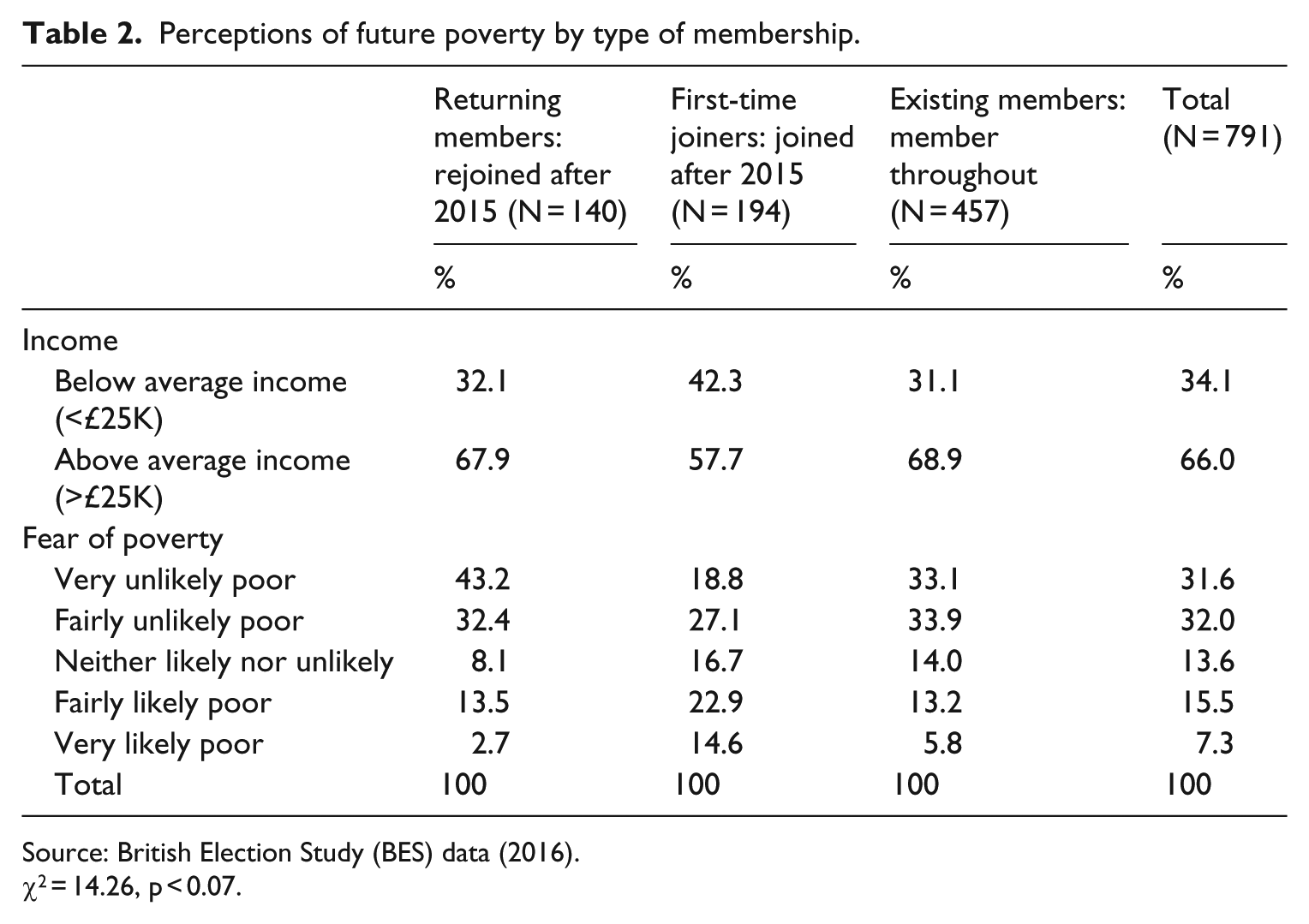
Perceptions of future poverty by type of membership.
Source: British Election Study (BES) data (2016).
χ2 = 14.26, p < 0.07.
The same pattern emerges in relation to education, with 56% of the existing members and 61% of the returning members being graduates, compared with only 40% of the new members. Gender is an exception to this pattern since 61% of existing members were male compared with only 49% of returning members and 51% of new members. Finally, not surprisingly, returning members were older on average (at 61) than the new joiners (52) and existing members (56).
The income data in Table 2 show a similar pattern and they particularly suggest that the new members may be more susceptible to feelings of relative deprivation than the existing or returning members. In April 2016, the average salary in Britain was £26,400 per annum (Office of National Statistics, 2016). Some 31% of existing Labour Party members had household income below £25,000, as did 32% of returning members. By contrast, a striking 42% of the first-time joiners were in this group. Overall, these new recruits were less educated, less likely to work in high-status occupations and had incomes well below those of existing members or those who returned to the party after the general election. In other words, the ‘objective’ conditions for creating a sense of relative deprivation were more apparent among the new members than they were among members in general.
However, poverty and low incomes do not automatically generate feelings of relative deprivation: the context in which people make judgements also matters. Such feelings are tapped in the survey by the question, ‘During the next 12 months, how likely or unlikely is it that there will be times when you don’t have enough money to cover your day to day living costs?’ 5 Even though it does not ask respondents to make direct comparisons with other groups, this is a reasonable proxy measure since it goes some way to capturing the psychological dimension of feeling deprived or left behind. 6
The second sub-table of Table 2 shows that ‘fear of poverty’ was significantly greater among the first-time joiners than among existing and returning members. Some 37% of the first-time joiners reported that lack of money is fairly or very likely to be a problem in the future, compared with just 16% of returning members and 19% of existing members – a very striking difference. Not surprisingly, low income is likely to trigger a greater fear of poverty in the future for the first-time joiners, thereby supporting H1, namely, that Labour’s new recruits were more likely to feel a sense of relative deprivation about their position in society than party members in general.
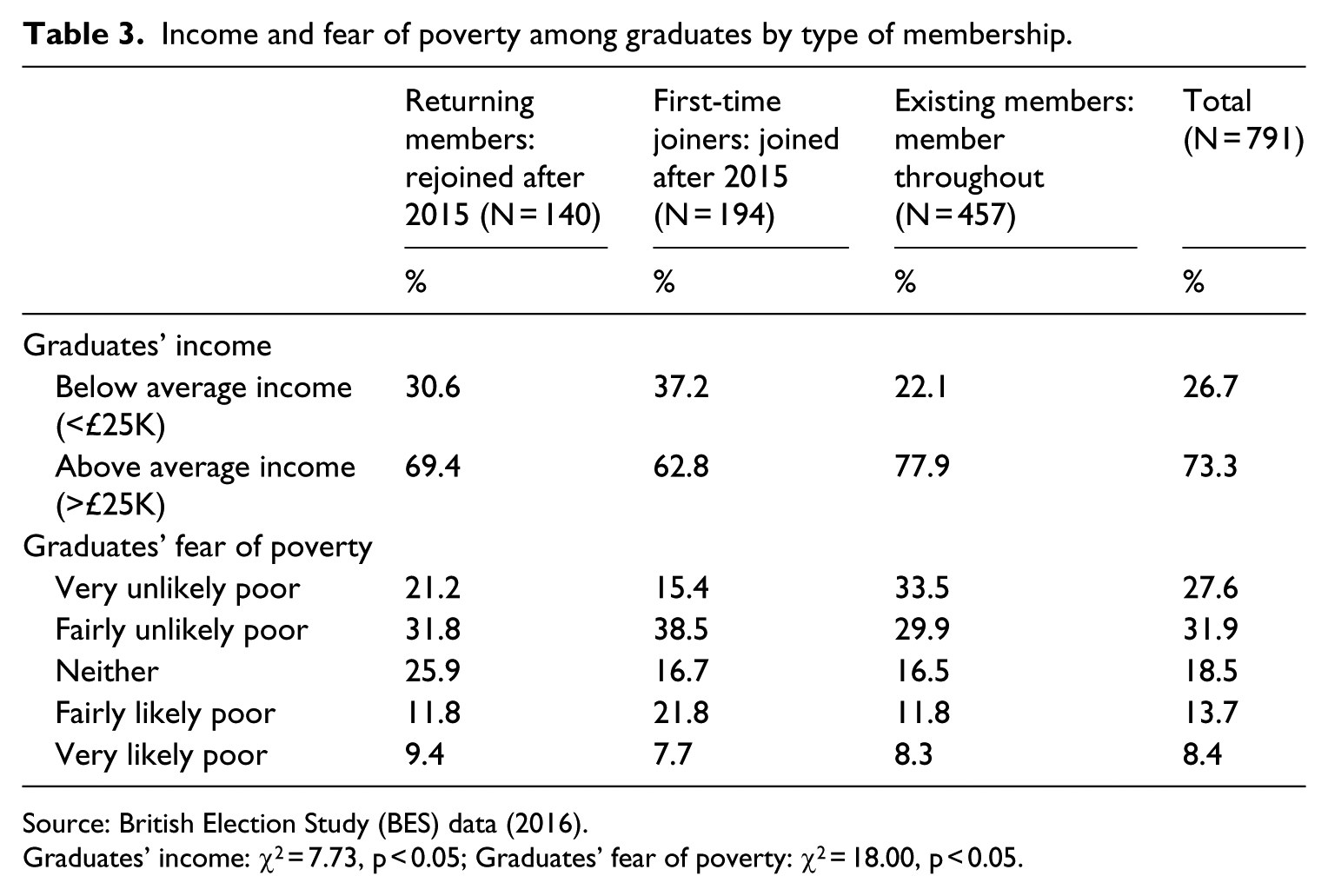
The second hypothesis spins off the first but narrows the focus to graduates: Graduates who joined the Labour Party for the first time after the 2015 election were more likely to feel a sense of relative deprivation than graduates who were already members or who were rejoining the party. Table 3 shows that the graduate new recruits and returning members are rather similar to each other with around 37% of the former and 31% of the latter on below average incomes as opposed to less than a quarter of existing members. These findings are largely consistent with H3 and indicate that the objective conditions for creating a sense of relative deprivation were more apparent among Labour’s new graduate recruits and its returning members than among the existing graduate members. Table 3 also shows that the pattern seen in the first hypothesis extends to the subjective measure of relative deprivation, fear of poverty. Only about a fifth of the existing graduate and returning graduate members thought that they would have difficulty making ends meet in the future, compared with a third of the first-time graduate joiners. This finding is also consistent with H2.
Income and fear of poverty among graduates by type of membership.
Source: British Election Study (BES) data (2016).
Graduates’ income: χ2 = 7.73, p < 0.05; Graduates’ fear of poverty: χ2 = 18.00, p < 0.05.
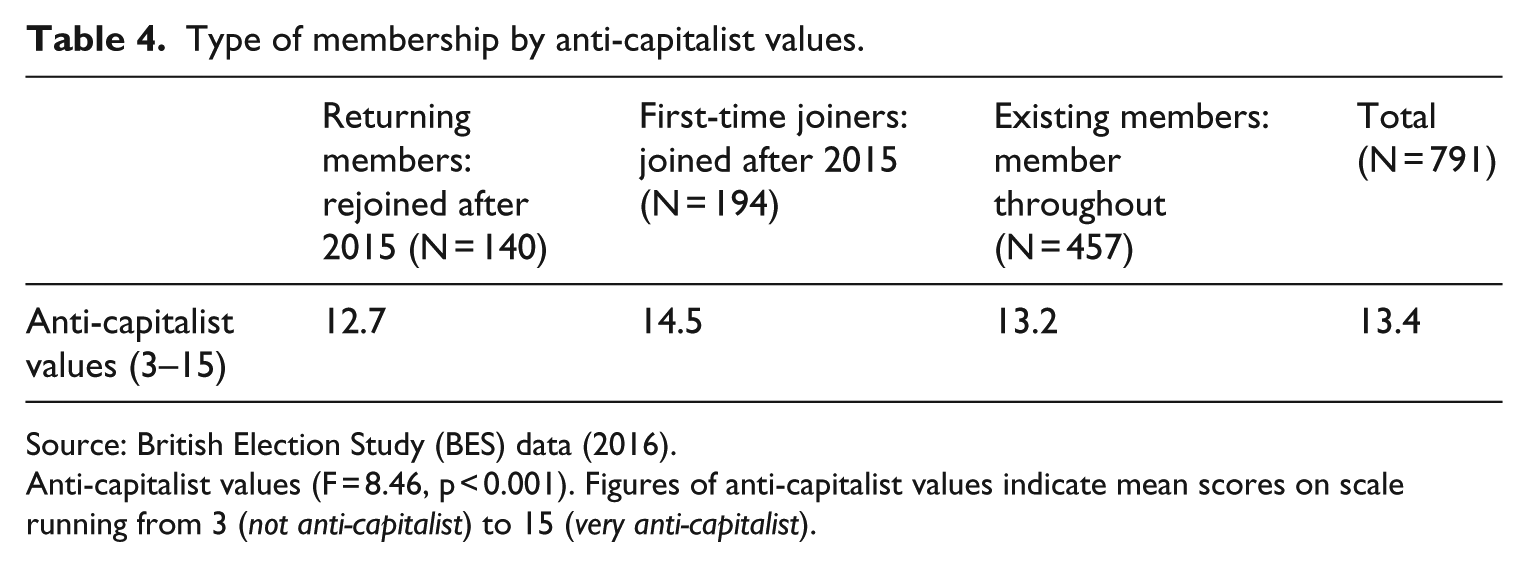
The third hypothesis concerns the idea that first-time joiners were more likely than other members to have anti-capitalist values. An anti-capitalist values scale was created by summing the responses to three Likert-type scale items in the survey (α = 0.75). Respondents were asked if they agreed or disagreed with the following statements: ‘Big business takes advantage of ordinary people’; ‘There is one law for the rich and another for the poor’; ‘Management will always try to get the better of employees if it gets the chance’. The correlation between left–right self-placement and anti-capitalist attitudes is modest (r = –0.30) and so these values are not plainly identical to ideological self-placement. Table 4 examines the mean scores for different categories of party member on the scale where a high score denotes strong agreement with the statements. As expected, the first-time joiners were considerably more anti-capitalist than existing and returning members, confirming H3.
Type of membership by anti-capitalist values.
Source: British Election Study (BES) data (2016).
Anti-capitalist values (F = 8.46, p < 0.001). Figures of anti-capitalist values indicate mean scores on scale running from 3 (not anti-capitalist) to 15 (very anti-capitalist).
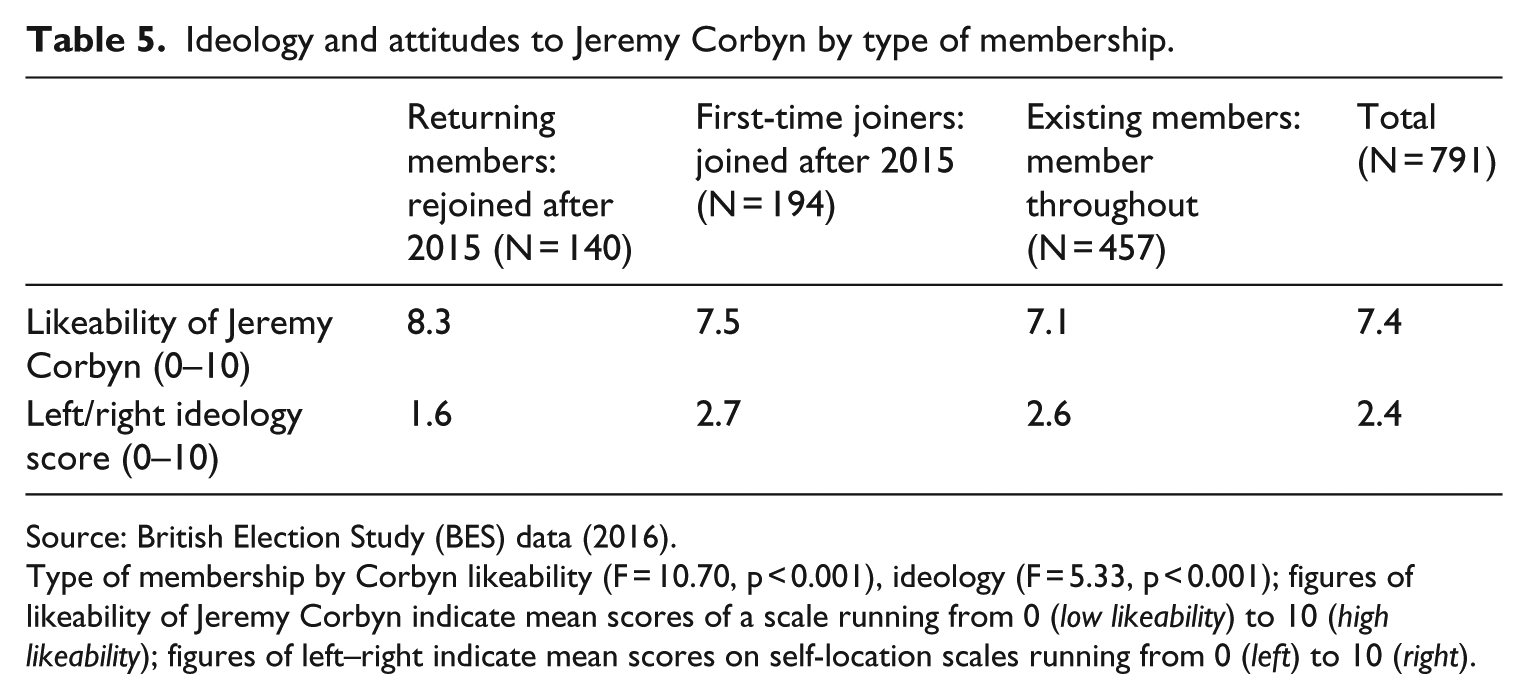
Turning to the relationship between membership type and the popularity of Jeremy Corbyn, H4 states that people who joined the Labour Party for the first time or returned to the party after the 2015 election were more likely to support Corbyn than those who were already members at the time of the 2015 election. Support for Corbyn is measured by an 11-point ‘likeability’ scale, where 0 means ‘strongly dislike’ and 10 means ‘strongly like’. The results in Table 5 show that the returning members were most enthusiastic about Corbyn, followed by the first-time joiners, who in turn were more supportive of him than the existing members, all of which supports H4.
Ideology and attitudes to Jeremy Corbyn by type of membership.
Source: British Election Study (BES) data (2016).
Type of membership by Corbyn likeability (F = 10.70, p < 0.001), ideology (F = 5.33, p < 0.001); figures of likeability of Jeremy Corbyn indicate mean scores of a scale running from 0 (low likeability) to 10 (high likeability); figures of left–right indicate mean scores on self-location scales running from 0 (left) to 10 (right).
In relation to ideology, the surveys include a question asking respondents to locate themselves on an 11-point left–right ideological scale, where 0 means ‘very left wing’ and 10 means ‘very right wing’. Thus, it is possible to calculate the mean scores for the different types of member on the scale; results appear in Table 5. It is apparent that the first-time joiners and existing members have rather similar scores on this scale, whereas the returning members are significantly more left wing than their counterparts. This finding lends credence to the idea that the shift to the left by Labour under Corbyn has brought back a number of people who abandoned the party during the Blair/Brown era, confirming H5 (members who returned to the Labour Party after the 2015 election were likely to be significantly more left wing than existing members or first-time joiners). 7
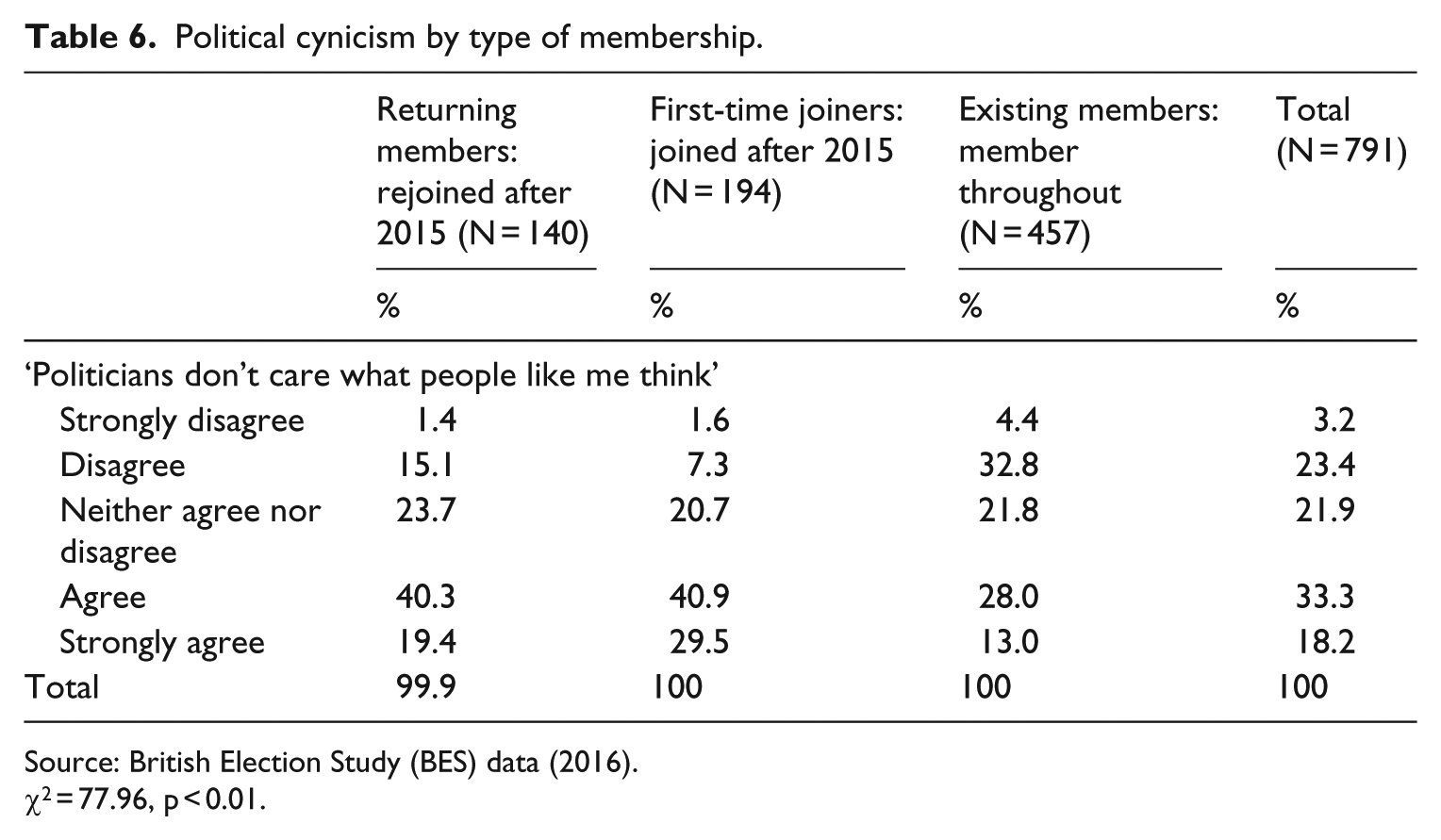
H6 states that people who joined the Labour Party for the first time after 2015 were more likely to be disillusioned with ‘politics as usual’ and want a new style of politics, as advocated by Jeremy Corbyn, compared with returning and existing members. This hypothesis is tested by reference to a Likert-type scale asking people if they agreed or disagreed with the following statement: ‘Politicians don’t care what people like me think’ – a measure of political cynicism which carries the implication that respondents would like this state of affairs to change. The relationship between type of member and this indicator appears in Table 6. It confirms H6 since the first-time joiners were much more likely to agree with that statement than were existing or returning members. Altogether, just over 40% of existing members agreed with the proposition, as did 60% of returning members and no less than 80% of the first-time joiners. The latter, in other words, had a much more jaundiced view of ‘politics as usual’ than the other party members.
Political cynicism by type of membership.
Source: British Election Study (BES) data (2016).
χ2 = 77.96, p < 0.01.
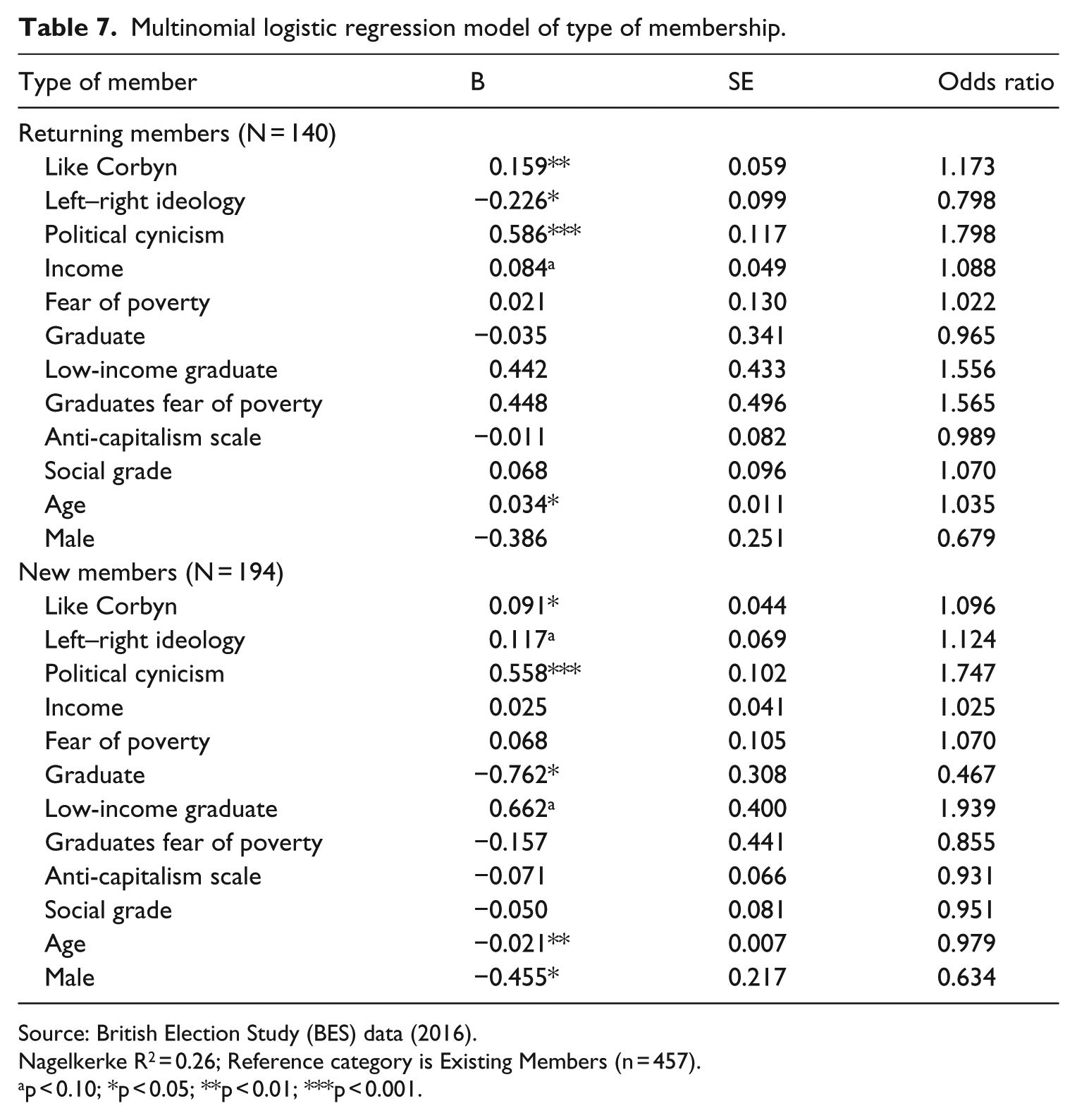
Having examined each hypothesis separately, we now bring them together in Table 7 by estimating a multinomial logistic model of membership which compares the first-time joiners and the returning members with existing members as the reference category. The model contains the predictors associated with the six hypotheses examined earlier, together with controls for social background characteristics. It is clear that four variables are statistically significant predictors of the two types of new member who joined after the 2015 election (returning members and first-time joiners) compared to existing members – namely, perceptions that politicians do not care; attitudes to Jeremy Corbyn; the left–right ideology scale; and age.
Multinomial logistic regression model of type of membership.
Source: British Election Study (BES) data (2016).
Nagelkerke R2 = 0.26; Reference category is Existing Members (n = 457).
p < 0.10; *p < 0.05; **p < 0.01; ***p < 0.001.
The evidence on political cynicism confirms that discontent with ‘politics as usual’ was, indeed, one of the key drivers of recruitment to the Labour Party during this period. First-time joiners, and also returning members, were both more cynical about conventional politics and liked Jeremy Corbyn more than the existing members. In contrast, the returning members were ideologically to the left of existing members and first-time joiners. Not surprisingly, returning members were older than existing members and first-time joiners were younger. The first-time joiners differed from the existing members and returning members in that they were less likely to be graduates, but more likely to be low-income graduates and also more likely to be female than the other types of members.
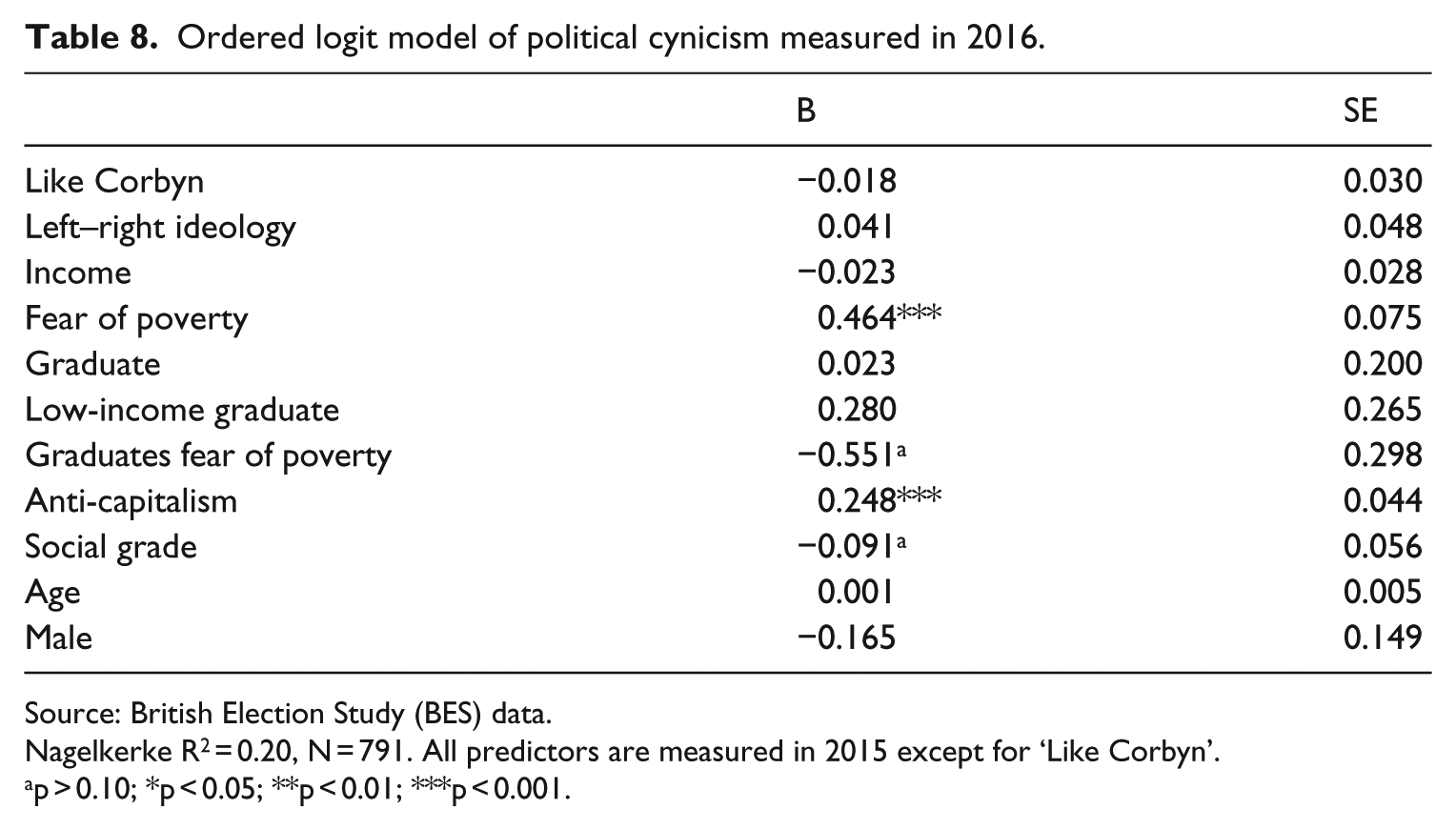
It is noteworthy that neither of the direct indicators of relative deprivation, fear of poverty and graduates fear of poverty, nor anti-capitalist values, are statistically significant predictors in Table 7, and so have no direct influence on membership in the model. Yet they do have a powerful indirect influence on membership, as shown in Table 8. The latter presents the results of an ordered logit regression model of the political cynicism variable, which is a powerful predictor in Table 7. To avoid problems of endogeneity in the estimates, political cynicism is measured in the 2016 wave of the survey and the predictor variables are measured in the 2015 wave. The results show that fear of poverty, graduates’ fear of poverty and anti-capitalist values all had significant influences on political cynicism. Social grade also had a marginally statistically significant impact, with low-status individuals being more cynical than high-status individuals. Fear of poverty increased political cynicism, although graduates who shared this fear were less likely to be cynical. It is, however, particularly noteworthy that anti-capitalist values were strong predictors of political cynicism – so much so that they eclipsed ideology in the model.
Ordered logit model of political cynicism measured in 2016.
Source: British Election Study (BES) data.
Nagelkerke R2 = 0.20, N = 791. All predictors are measured in 2015 except for ‘Like Corbyn’.
p > 0.10; *p < 0.05; **p < 0.01; ***p < 0.001.
Overall, the evidence in Tables 7 and 8 suggests that relative deprivation, including graduates who were ‘left behind’, political cynicism and anti-capitalist sentiments all played a role, either directly or indirectly, in recruiting new members to the Labour Party during this period, particularly when it came to first-time joiners. At the same time, it is clear that support for Jeremy Corbyn played a key role in triggering these effects since many of them may not have come into play had he not won the leadership. For that reason, in the next section, we look more closely at the determinants of his support.
Jeremy Corbyn’s leadership and the surge in membership
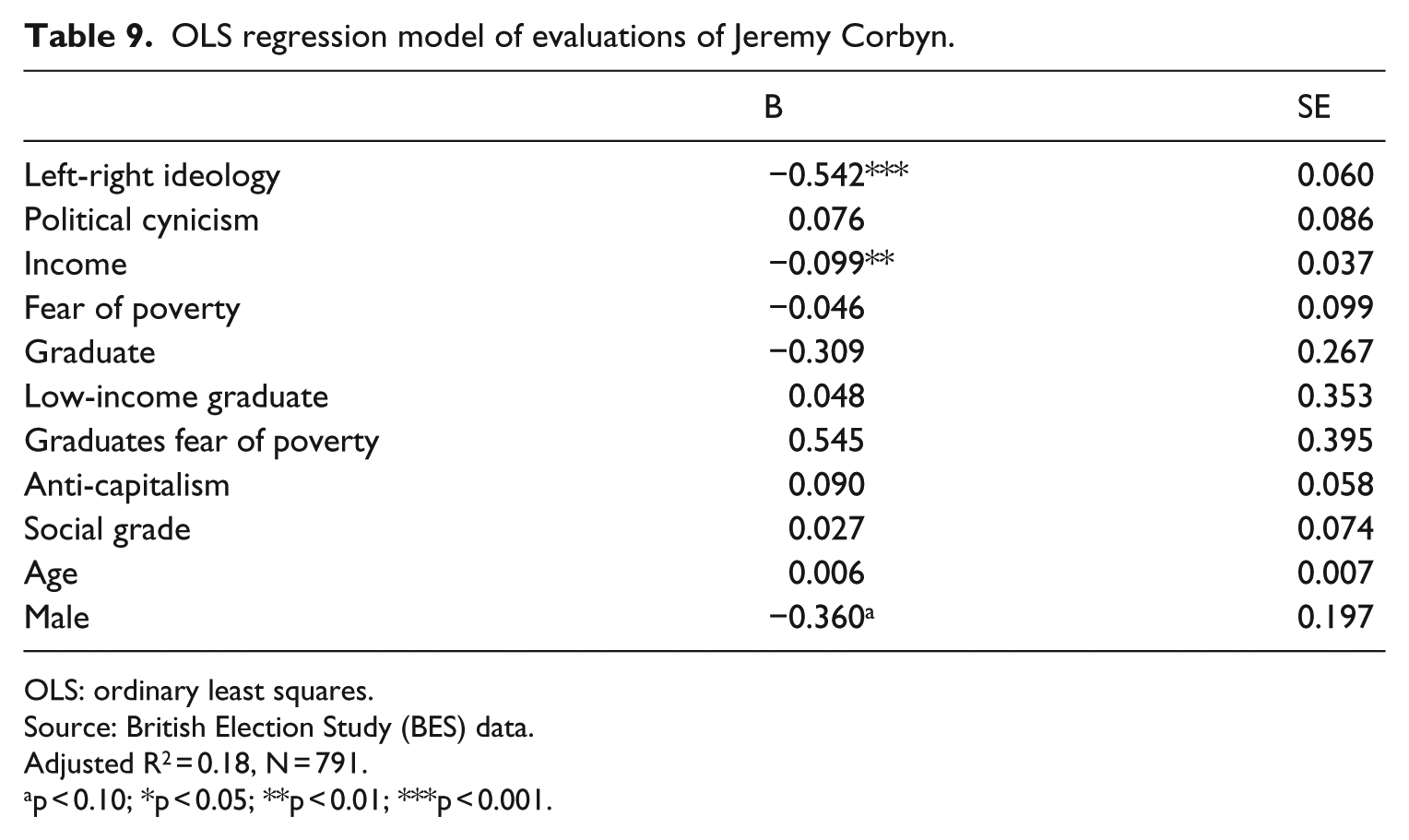
In order to look at what helped determine the role played by Jeremy Corbyn’s leadership in the Labour surge, we first rerun the models reported in Tables 7 and 8 using support for Jeremy Corbyn (measured with a scale running from 0 to 10, where 0 means strongly oppose and 10 means strongly support) as the dependent variable in an ordinary least squares (OLS) regression with the BES data. We have already shown that support for Jeremy Corbyn has been crucial in the decision to join Labour in the previous analysis. Table 9 shows that, consistent with our previous hypotheses, being left wing and having anti-capitalist values were important factors in explaining support for Jeremy Corbyn, although the latter falls just below the level of statistical significance (p=.12). In line with earlier results, we can also see that those who supported Jeremy Corbyn tended to have lower incomes. Thus, it seems that it is the ‘objective’ conditions creating a sense of relative deprivation that are more important in influencing positive feelings towards Jeremy Corbyn than any subjective fear of poverty. Finally, as we have already seen for first-time joiners in the previous model, Corbyn supporters are more likely to be female than male.
OLS regression model of evaluations of Jeremy Corbyn.
OLS: ordinary least squares.
Source: British Election Study (BES) data.
Adjusted R2 = 0.18, N = 791.
p < 0.10; *p < 0.05; **p < 0.01; ***p < 0.001.
Further light can be shed by using the PMP survey fielded in June 2016 which captures Labour’s new members, including both first-time joiners and returning members. 8 This dataset makes it possible to gauge in more detail how far those who joined after the previous year’s general election expressed support for Corbyn. A total of 1156 Labour Party members who had joined after the 2015 general election were surveyed in June 2016. Of these, 13.8% had initially joined as registered supporters before subsequently deciding to become full members, and 65.4% joined after Corbyn’s candidacy for the leadership was confirmed in June 2015. 9 Among other things, respondents were asked a number of questions relating to their support for his leadership, including how much of a role it played in their decision to join the party. The 2016 data therefore allow us to investigate the earlier hypotheses with a particular focus on Corbyn as the new party leader.
Logically, we would expect those inspired by the prospect of Corbyn’s leadership to have joined the party after his nomination in June 2015. The BES data cannot investigate this issue since wave 6 of the survey was already completed by the time Corbyn joined the leadership race. By contrast, with PMP data, we can track respondents who joined before and after his official nomination in what amounts to a quasi-experiment (Campbell and Stanley, 2015). Thus, we can test the following additional hypothesis:
H7: Those who joined the party from June 2015 onwards were more likely to express their support for Jeremy Corbyn than those who joined in May 2015.
A final possibility is that a left-wing candidate like Jeremy Corbyn who argues for greater action against inequality and material insecurity might be successful in attracting support from members from less well-heeled backgrounds. If this is correct, we would expect that those who opted to join Labour after June 2015 to have been motivated by economic concerns relating to short-term contracts, job insecurity, lower pay and so on. Thus, we expect the following hypothesis:
H8: The lower a new member’s income, the more likely they were to express their support for Jeremy Corbyn.
Results: Explaining support for Jeremy Corbyn
Using the PMP data, we explain support for Jeremy Corbyn by looking at the relationship between the predictors specified in H7 and H8 (timing of membership and income) and three different indicators of leadership support, namely, (1) how important belief in the leadership of Jeremy Corbyn was for members’ decisions to join the party, (2) how likely they were to vote for Jeremy Corbyn if another Labour MP challenged him for the leadership and (3) how likely they thought it was that Labour would win the next general election if Corbyn were to remain leader.
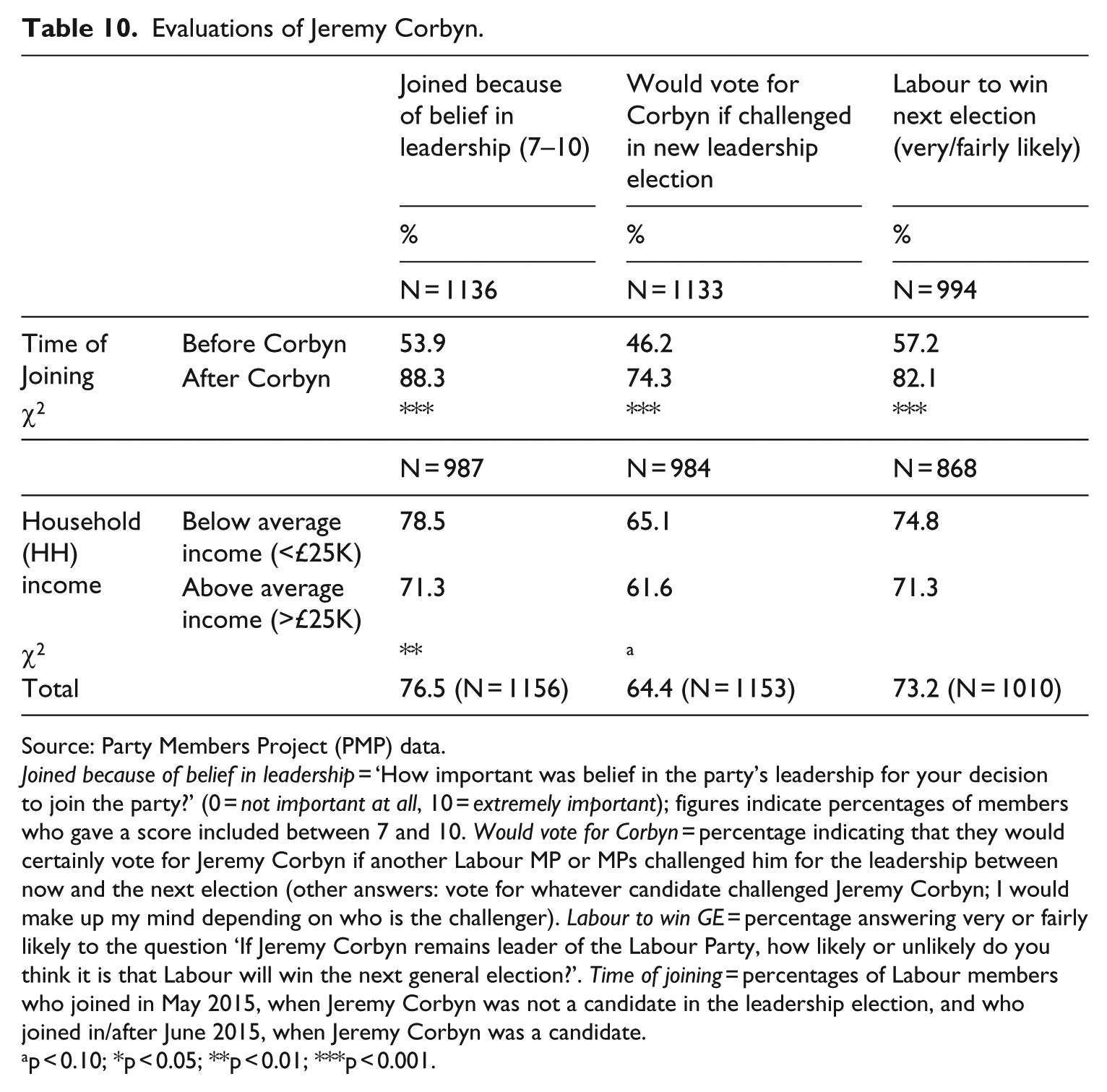
With some differences among the three measures of support, the pattern which emerges in Table 10 is that the strongest supporters of Jeremy Corbyn tended to have joined after he decided to run in the 2015 leadership election and have household incomes below average. Thus, the findings lend support to both H7 and H8.
Evaluations of Jeremy Corbyn.
Source: Party Members Project (PMP) data.
Joined because of belief in leadership = ‘How important was belief in the party’s leadership for your decision to join the party?’ (0 = not important at all, 10 = extremely important); figures indicate percentages of members who gave a score included between 7 and 10. Would vote for Corbyn = percentage indicating that they would certainly vote for Jeremy Corbyn if another Labour MP or MPs challenged him for the leadership between now and the next election (other answers: vote for whatever candidate challenged Jeremy Corbyn; I would make up my mind depending on who is the challenger). Labour to win GE = percentage answering very or fairly likely to the question ‘If Jeremy Corbyn remains leader of the Labour Party, how likely or unlikely do you think it is that Labour will win the next general election?’. Time of joining = percentages of Labour members who joined in May 2015, when Jeremy Corbyn was not a candidate in the leadership election, and who joined in/after June 2015, when Jeremy Corbyn was a candidate.
p < 0.10; *p < 0.05; **p < 0.01; ***p < 0.001.
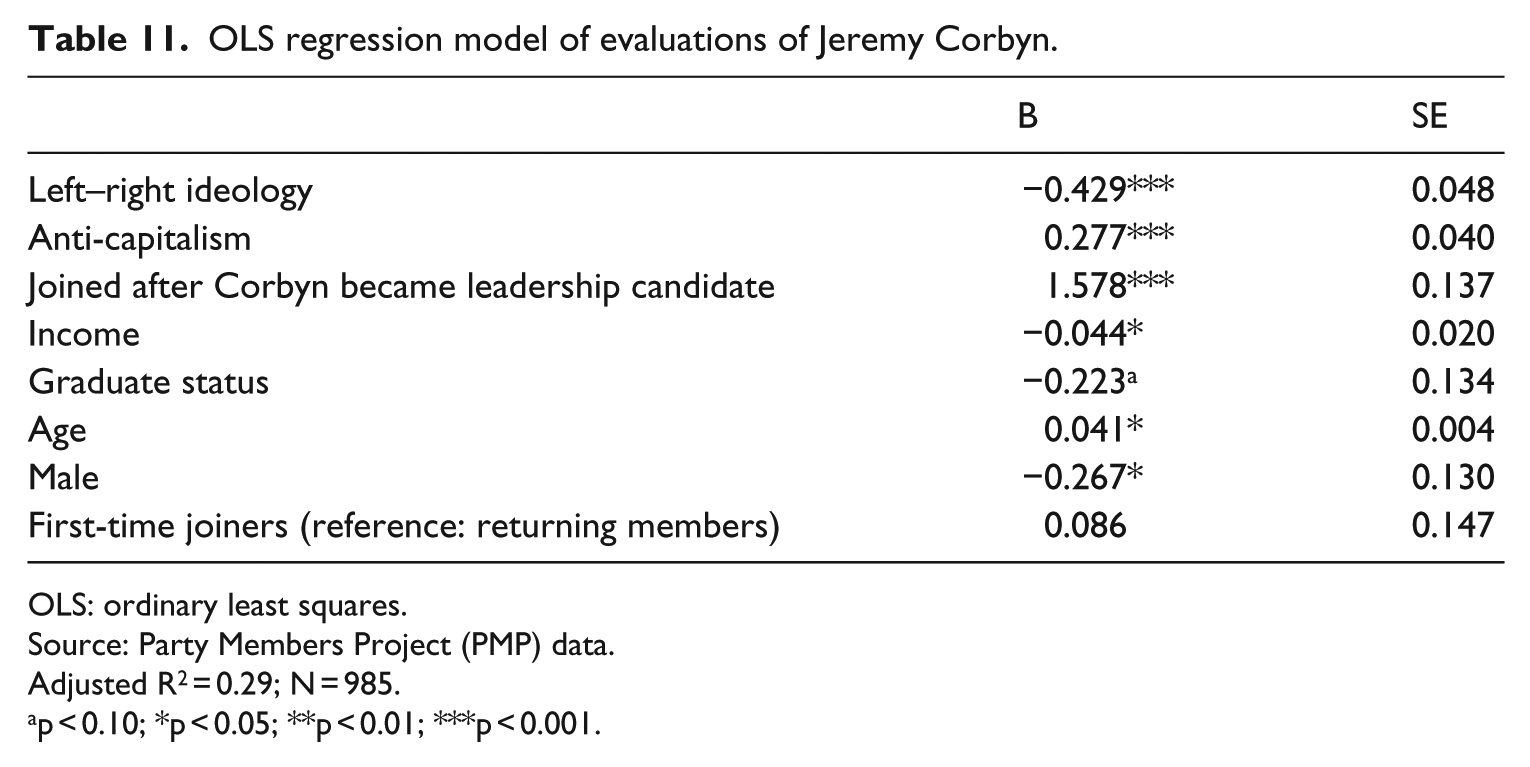
With the aim of creating a more thorough test of these hypotheses, we bring the three indicators of support for Jeremy Corbyn together into a single 10 highly reliable scale (α = 0.80), which we use as a dependent variable in an OLS model. Table 9 showed that, in the BES data, left-wing ideology and (albeit less significantly) anti-capitalist values played key roles in explaining support for Jeremy Corbyn. With those results in mind, in Table 11 we specify and test these two variables with PMP data, together with additional indicators arising from H7 and H8 (that is, left–right ideology, anti-capitalist values, time of joining the party, household income, plus controls for demographic factors and type of membership).
OLS regression model of evaluations of Jeremy Corbyn.
OLS: ordinary least squares.
Source: Party Members Project (PMP) data.
Adjusted R2 = 0.29; N = 985.
p < 0.10; *p < 0.05; **p < 0.01; ***p < 0.001.
The results confirm the patterns that emerged in Table 10. Those who joined after June 2015 were more likely to support Corbyn and generally had lower incomes than other members, confirming H7 and H8 in the multivariate model. Not surprisingly, given our previous findings, we can also see that Corbyn supporters were more likely to be left wing, anti-capitalist and older – and less likely to be graduates and male – than other members. We can also see that there is no significant difference between first-time joiners and returning members in their support for Jeremy Corbyn.
Discussion and conclusion
In this article, we have investigated a number of related hypotheses pertaining to the surge in Labour Party membership after May 2015, focussing on two key dependent variables: the type of member (existing, returning or first-time joiner) and support for Jeremy Corbyn as a motivation for joining.
Relative deprivation was plainly a significant factor that drove people, and particularly first-time joiners, to join Labour once a candidate with a clear radical profile was on the leadership ballot: those who might be labelled ‘left behind’ flocked to Jeremy Corbyn’s colours, including graduates earning less than the average income. Anti-capitalist values also appeared to be a feature of the new members, as was disenchantment with politics as usual and a yearning for a new style of politics. However, incentives like ideology mattered too. Post-2015 recruits who had previously belonged to the Labour Party and who rejoined it were more left wing. Demographic factors played only a limited part in understanding Labour’s membership surge, although it looks as if those in lower social grades seemed to be more likely than others to be attracted to the party. First-time joiners were not, on the whole, university graduates or high-income middle-class radicals; rather, they looked a little more like the party’s ‘traditional’ grassroots, being less educated and in lower status occupations than existing members. In addition, although first-time joiners were younger than returning members, the average post-2015 recruit is still middle aged. There were also more women among the new recruits, which is interesting and requires further investigation. How all these developments affect the party’s policy platform – theoretically responsive to its grassroots – is well worth watching.
We do not examine the role of mobilising organisations such as Momentum in this analysis, although it is likely to be an important part of the story about how the surge in membership was sustained after Corbyn’s first victory in September 2015. Neither can this research tell us whether the remarkable surge in Labour’s membership after 2015 will turn out to be a one-time, contingent, never-to-be repeated event, but it affords an important insight into its nature and wider debates. One such debate, within the framework of the GIM (Seyd and Whiteley, 1992), emphasises the importance of ideological, expressive and collective policy incentives in motivating members to (re-)join a party. The findings of this study reconfirm the importance of all such incentives, among other things.
More generally, our findings may resonate with what some see as a left-wing populism that has grown in other established democracies, most notably Podemos in Spain and Syriza in Greece, and Bernie Sanders in the United States (Kriesi and Pappas, 2015; Mudde and Kaltwasser, 2012; Rooduijn and Akkerman, 2017; Stavrakakis and Katsambekis, 2014). While Corbynism does not necessarily fit accepted definitions of populism, the Labour surge constitutes a powerful case study of the part played by the ‘left behind’ in explaining the growth of left-wing as well as right-wing populism. Both variants appeal to those who have been and/or feel ‘left behind’, tapping into widespread distrust of existing political elites and articulating anti-corporate and anti-globalisation sentiments. Where the two differ most obviously is in their analysis of immigration. Both regard it as a byproduct of neoliberal globalisation but to right-wingers it is unnecessary, damaging and unwanted, whereas to left-wingers it requires a generous, progressive and internationalist response. Either way, it is apparent that social, economic and cultural change since the Great Recession has changed politics in Britain as elsewhere; one of the consequences of this, at least on the left, is to create a resurgence of grassroots political activism – one which may well have contributed to Labour’s better-than-expected performance at the 2017 general election. Whether or not it will help Labour win next time round is an open question, but it is a development which has potential consequences well beyond Britain.
Footnotes
Funding
The authors are grateful for Economic & Social Research Council Standard Grant number ES/M007537/1 for enabling the Party Members Project data on which this article partly depends.