




Abstract
Are party members more radical than voters and party elites? This is the expectation according to May’s Law, which has faced significant challenges from recent scholarship. Utilizing several survey sources covering four levels of all Swedish parliamentary parties between 1985 and 2018, this paper shows that the Swedish case follows May’s propositions with some qualifications. The parties organized along the left-right dimension follow the pattern of the mid-level being more radical in this respect, while on a secondary GAL-TAN dimension the parties that organize along this dimension rather exhibit a pattern of elite polarization. Additionally, the relative order of groups within parties is stable over the considered time period, when party membership is sharply declining. This suggests that party members are not becoming less ideologically representative over time, while they are consistently more radical than respective parties’ voters and elites.
Introduction
Social science is an example of a science which is not a science. They follow the forms. You gather data, you do so and so and so forth, but they don’t get any laws, they haven’t found out anything.
Since political scientists admittedly rarely “get any laws,” it is no surprise that John May’s (1973) proposed set of laws—simply put, that the mid-levels of the political parties are the substantial extremists, compared to elites and voters—has faced considerable resistance. May’s proposition has spurred a research tradition of its own, and May’s law (commonly conceptualized in the singular) has been challenged and tested more or less since the original publication. In recent years, scholars have gone as far as claiming that it is well past time to go “beyond May’s law” (Baras et al., 2007; Weldon, 2007), or even that “May’s Law appears to be May’s Myth” (Van Holsteyn et al., 2017). However, the studies that supposedly repudiate May’s law suffer from one or more of three shortcomings that will be addressed in this paper. Firstly, that the concept of the ideological measurement is underspecified, which leads to the inclusion of cases as tests of May’s law which cannot be admitted as evidence for or against it. Secondly, the empirical material used is often highly limited to either small surveys or singular points in time. Thirdly, the opinion space of the parties is conceptualized as unidimensional in virtually all previous studies (with some notable exceptions, e.g. Baras et al., 2007; Norris, 1995), despite the rise of a second axis separate from the left-right dimension. This paper will therefore extend the framework of May’s law to not only cover the left-right dimension, but also to a cultural dimension concerning immigration and environmental issues. Since this is nearly uncharted territory in the literature, both theoretical and empirical contributions are made by this extension. This paper utilizes a large number of respondents from a combination of surveys, covering all Swedish parties in parliament over 33 years (1985–2018), which takes the temporal dimension into account and allows for a more comprehensive analysis than previous studies.
The Swedish case is suitable to reexamine May’s law for several reasons. Firstly, the data available is extensive. It covers eight time points where at least three levels within each party are surveyed, with data for all parties in the Swedish parliament. This results in a total of 62 distinct opinion structures concerning left-right self-placement, and 21 on a GAL-TAN index, based on over 45 000 individual observations. 1 Secondly, one should naturally be hesitant to generalize results concerning one particular country to a broad range of cases, but the results for the Swedish case make for a relevant comparison to several other cases. The Swedish parties have seen a sharp decline in party membership, from over 1 500 000 members in the mid-80’s to just above 250 000 in 2010 (Kölln, 2015). This is true for most comparable cases, and when it comes to membership decline, Sweden is found roughly in the middle of the distribution (Van Biezen et al., 2012). The Swedish party system is characterized by being a parliamentary, proportional-representation multiparty system (e.g. Aylott, 2016). During the time period considered, the party system has undergone some changes. In 1985, the parties in the Swedish Parliament were the five of the “frozen” party system inherited since universal suffrage in the 1920’s, namely the Social Democrats (S), the Moderates (M), the Left Party (V), the Center Party (C, agrarian) and the Liberal Party (L). Four parties have entered Parliament since then: The Green Party (MP, 1985–1988, 1991–current), the Christian Democrats (KD, 1991–current), New Democracy (NyD, 1991–1994), and the Sweden Democrats (2010–current). All of these parties have had the ambition to organize on other dimensions than left-right, with varying success, but they can to some extent be associated with the rise of a secondary cultural dimension in Swedish politics. As Oscarsson (2017) describes it, the importance of the cultural dimension “has risen dramatically in Sweden [while] the traditional left-right dimension show few signs of weakening.” This emphasizes the importance of extending the analysis of the opinion structure to a secondary dimension. A third reason for revisiting the topic of May’s law with the Swedish case is that it addresses recent results from other studies that also focus on singular countries (e.g. the Dutch case (Van Holsteyn et al., 2017), the Portuguese case (Belchior and Freire, 2011), the Irish case (Kennedy et al., 2006)). As will be seen below, the conclusions for the Swedish case are different from those mentioned here. Investigating why this is the case would certainly be fruitful, but lies beyond the scope of this paper.
May’s law: Theory and empirics
Building upon the idea that individuals on different levels in the parties have distinctly different positions, resulting in different aims and incentives, John May (1973: 139) proposed a set of “laws” concerning the opinion structure of the political parties. Firstly, that the top and bottom levels of party organizations are more nearly congruent with one another than “sub-leaders” on “substantive issues” (the “General Law of Curvilinear Disparity”). Secondly, that “sub-leaders” are “substantive extremists,” i.e. that “in a generally left-of-centre party they are the most leftist cohort.” Thirdly, May proposes, the leaders of a party “occupy an intermediate position” as a top stratum, between the positions of the middle and lower levels of a party’s constituents. These two last propositions are called “the Special Law of Curvilinear Disparity,” which has been the central focus of following research (see Figure 1). The theoretical argument is that in accordance with Downs’ (1957) general theory, party leaders will adapt policies to attract as many voters as possible, moderating their ideological stance, while the “sub-leaders,” or virtually all non-elite rank and file members of a party have no such incentive for moderation. Rather, on the contrary, this group is to a large extent the one that gains the least clear benefits from their political engagement (compared to the elite officeholders), and can thus be expected to rely more on the “selective incentives” of expressing support for a (more pronouncedly) preferred position or party (Olson, 1971). Inasmuch as May’s (1973: 141) original theory is based on empirical evidence, it is done so only on “respectable testimony.”
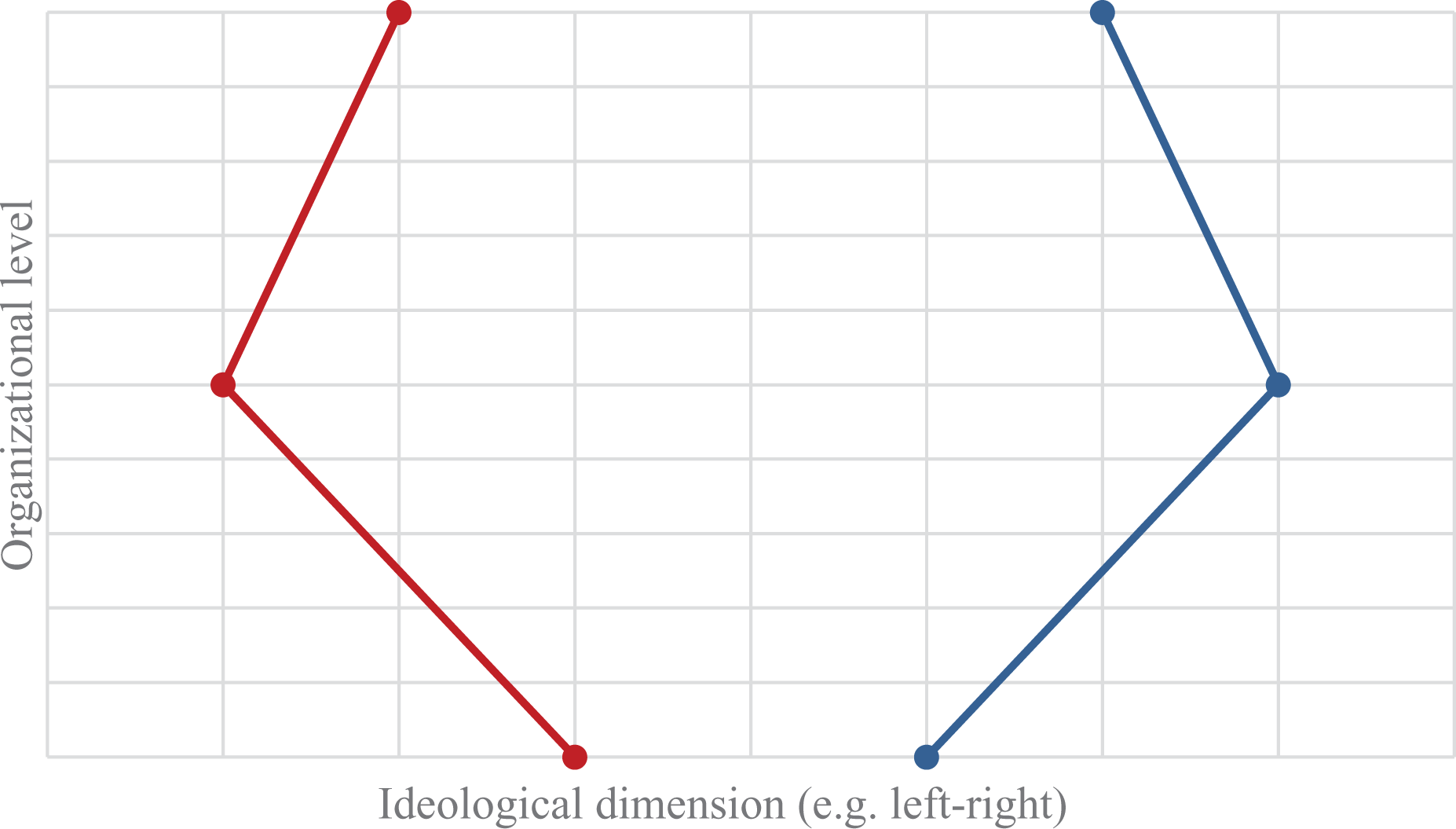
Illustration of curvilinear disparity, the pattern predicted according to May’s law(s).
The concept of echelons in a party is a compelling construct, in the sense that it provides a tool to consider the different incentives that come with different positions. May (1973: 135) suggests a “rough” taxonomy of the levels of the parties, with three strata: Those of high status, intermediate status, and low status—also called top leaders, sub-leaders and non-leaders, in vocabulary inherited from Duverger (1954). May’s conceptualizations are not immediately useful for designing empirical studies, as has been noted before (e.g. Kitschelt, 1989; Van Holsteyn et al., 2017). Firstly, the lowest level is too narrowly specified given its supposed use—the straightforward (and widely used) solution is to conceptualize this level to capture the position of voters in general, who have little or no formal influence in the party. Secondly, the positions enumerated by May do not capture the systematic differences within some of these broad groups that might have immensely different incentives to favor more or less moderate positions (see Kitschelt (1989) for several critical points of this conceptualization). What remains clear from May’s rather parsimonious theorization about the strata of parties is that the theory requires at least three distinct party echelons; the party elite, the mid-level activists/members, and the (non-activist) voters (Norris, 1995).
Similarly, the variable concerning ideological (in)congruence is not clearly defined by May (1973), who presents this as a matter of “policy positions” on a continuum. A measure that is commonly used is the average left-right self-placement of individuals in each group respectively (Baras et al., 2007; Narud and Skare, 1999; Van Holsteyn et al., 2017; Weldon, 2007; Widfeldt, 1999). This measure naturally has some strengths, given that one can plausibly assess extremeness on the scale, it is widely used in several surveys and thus facilitates comparable estimates, and it is to some extent “neutral” to changes in its meaning (Widfeldt, 1999). Several other methods of estimating policy positions are also used in the literature, e.g. by Norris (1995) who uses factor analysis to construct scales in two dimensions from the data available, on a wide array of political attitudes. Additionally, policy positions on singular attitudinal items are used by e.g. Narud and Skare (1999).
Regardless, what is clear is that for May’s law to hold, the party must reasonably be clearly mobilized along the continuum under consideration (Kitschelt, 1989: 407). If one considers e.g. the Swedish Green Party during the late 1980’s, it expressly did not align along the left-right spectrum, and thus, one would not expect a “radical” Green Party member of this time to be more or less radical on this particular scale. This theoretical argument is relatively straightforward, and limits the amount of cases on which one can “test” May’s law quite significantly. The simple example of a centrist party challenges the logic of extremism, since the most extreme echelon might be considered to be the one closest to the center on the dimension, just as well as it could be conceptualized as the echelon that takes the most extreme position. 2 If different echelons place themselves on different sides of the midpoint, extremism is similarly hard to assess, at least as a matter of comparison between groups. However, this aspect is not widely recognized in previous research—the piece that goes furthest in its conclusions regarding May’s law (“another law bites the dust,” Van Holsteyn et al., 2017) does so based on evidence partly from centrist parties (on the considered dimension). As the authors note: “is it radical or extreme for a center party such as the CDA to deviate to the center, to the left or to the right? This question is extremely hard or even impossible to answer from a theoretical perspective; for this reason we opt for an analysis of opinions in terms of differences” (Van Holsteyn et al., 2017: 483). However, this results in a flawed test of May’s law, which hypothesizes differences in extremism, and not that particular levels are further apart in terms of distributions of opinions. Narud and Skare (1999) attempt to overcome this shortcoming for the Norwegian case, using particular attitudinal items for particular parties, with mixed results.
It is more or less tacitly assumed in the literature that the opinion structure is analyzed on a single dimension, namely regarding some form of economic left-right scale (following May, 1973). In this paper, the analysis is extended to cover a secondary cultural/GAL-TAN dimension (e.g. Hooghe et al., 2002), in addition to the left-right continuum. The ideological content of this secondary dimension is not unanimously defined in the literature, but some agreement on its substance can be found. On the Green-Alternative-Libertarian endpoint, parties that “favor expanded personal freedoms, for example, access to abortion, active euthanasia, same-sex marriage, or greater democratic participation” are found according to Bakker et al. (2015), whereas the Traditional-Authoritarian-Nationalist parties “value order, tradition, and stability, and believe that the government should be a firm moral authority on social and cultural issues” (Bakker et al., 2015: 144). Hooghe et al. (2002: 966), on the other hand, summarizes this dimension as “tapping communal, environmental and cultural issues.” The cultural dimension in Sweden is linked mainly to “refugee reception, immigration and multiculturalism” according to Oscarsson (2017: 411), or to “immigration, social integration of newcomers and, not least, law and order” according to Aylott and Bolin (2019). As is apparent, the Swedish GAL-TAN dimension is strongly connected to questions concerning immigration and integration, but it also contains other elements that make this an ideological dimension, and not only a single political issue (Oscarsson and Holmberg, 2016).
To outline theoretical expectations on this cultural dimension, the baseline hypothesis is that the mid-level of the parties will be the most extreme on this dimension as well, and that the lowest level will be the most moderate (and the elite taking a position in between). Simply put, that the opinion structure follows May’s law, for the same general reasons as for the left-right dimension. However, there are some reasons why an alternative hypothesis of elite polarization (i.e. linear disparity) might be expected. Firstly, a secondary dimension may function differently in terms of what incentives it provides party elites with. For parties that organize on this dimension primarily (and they need at least to be non-centrist on this dimension to plausibly be subject to May’s law, in accordance with the argument above), party leadership is incentivized to signal their position strongly to voters on the secondary dimension, partly as a way to increase dimension salience. The signal needs to be stronger to reach beyond the “noise” of the primary dimension of the party system. Secondly, the GAL-TAN dimension itself may provide different incentives than the left-right dimension. When it comes to questions regarding immigration, multiculturalism, environmentalism and the identity-connected contents of the dimension, there is plausibly less room for compromise (Gutmann, 2003). Thus, party elites cannot be expected to take the more moderate stance between voters and members, which is a theoretical requirement for May’s law to hold. Additionally, to the extent that this argument is valid, party leadership does not necessarily maximize votes by taking a position close to the average (where few individual voters are found), but might capture more voters by taking a more extreme stance—and the relationship to the mid-level echelon position is more or less severed.
Given the endurance of May’s law in the literature, from the original proposition in the early 1970’s to recent empirical tests of it (e.g. Kennedy et al., 2006; Van Holsteyn et al., 2017), there is remarkably little empirical support for the hypothesized patterns. Hence, it is no surprise that Van Holsteyn et al. (2017) suggests that it’s time to go “from May’s laws to May’s legacy.” A straightforward expectation would be that the law is most applicable to a two-party system—according to Kitschelt (1989: 420), the two-party systems of the UK and US are “among the few western democracies where there is some likelihood that the law will be confirmed.” However, both Seyd and Whiteley (1992), and Norris (1995) find scant support for May’s law in the UK, and similarly Herrera and Taylor (1994: 686) conclude that US “Republicans and Democrats do not display opinions that conform with the predictions of the special law.” In multiparty systems, the evidence for May’s proposed laws is mixed. Belchior and Freire (2011) find that May’s law is applicable in self-placement on the left-right scale for two Portuguese parties, while it holds in composite left-right attitudinal aspects only for one of the two studied parties. Similarly, evidence from the Irish case suggests “limited support” for May’s law (Kennedy et al., 2006), and as mentioned, Van Holsteyn et al. (2017) conclude that “May’s Law appears to be May’s Myth” in a study of the Dutch parties.
A number of studies of the opinion structure of the Swedish parties have been carried out. Initially, Holmberg (1989) found evidence that members of parliament in the 1960’s were more leftist than voters of respective party across all parties, while the pattern had changed in 1985 to a more well-known “fan” (elite polarization) of more extreme positioning along the left-right scale of MP’s compared with voters. Picking up in the 1980’s, Widfeldt (1999) finds some support for May’s law, for the Moderates and Social Democrats in 1985, 1988 and 1994, using the left-right self-placement scale. More recently, Kölln (2015) finds that the party member population as a whole is significantly more likely to identify as either left or right (in comparison to neither), compared to the general population. This measure, however, says little about in what direction party members differ from the general population. In terms of incongruence among (only) party members Polk and Kölln’s (2016) findings provide “no support for May’s law.” In a recent cross-sectional study, the same authors find some support for May’s law in Nordic democracies, but generally only on the right (Polk and Kölln, 2019). For the Swedish case, as for the Nordic case generally, the results “could at most be read as mixed support for ‘May’s law’” (Polk and Kölln, 2019: 106). This study provides the most recent and most thorough examination of the opinion structure of the Swedish parties, and makes for a suitable point of comparison. It is based on a rich material, but from one point in time, with a slightly different operationalization of the elite level (candidates for parliamentary office), assessing only left-right self-placement.
Data and design
As Van Holsteyn et al. (2017: 474) suggest (based on Norris, 1995), a study that purports to test May’s law should clear four hurdles: The analysis should include at least three strata—top leaders, non-leaders and sub-leaders Substantive attitudes should be compared for more than one party Radicalism or extremism should be clearly conceptualized, preferably in ideological terms Groups of activists within the party should be specified
The first two are relatively uncontroversial, although, as described above, there are considerable differences in how one defines echelons, in particular the top-leader stratum. On the third criterion, the main shortcoming is not that studies fail to use a scale where radicalism or extremism is conceptualized—arguably, both left-right self-placement and various composite scales can fulfill this satisfactorily. However, the notion that the parties need to take a non-centrist position for the opinion structures to plausibly be subject to May’s law is rarely thoroughly addressed. Finally, the fourth criterion is met occasionally in the literature, to a large extent depending on data availability. In this paper, the first three criteria are met, but the fourth only marginally, for reasons discussed below.
In this paper, the lowest stratum of the parties is simply operationalized as respective party’s voters. This comprises the weakest possible affiliation with a party in available data, while still amounting to the bulk of the party composition in terms of numbers. The secondary level (“sub-leaders”) is operationalized as respective party’s members. Data for both of these levels comes from the series of Swedish National Election Studies, where questions about party vote and membership are asked for all considered years (Ekengren Oscarsson and Holmberg, 2017). In accordance with May’s (1973) original designation, all members naturally belong to a mid-level of the political parties. However, expansions of the model have suggested that one should consider the rather stark differences in positions within the group of members (e.g. Kitschelt, 1989; Norris, 1995). In this paper, the members are used as a singular group for several reasons. Firstly, any parsimonious model of party strata will in its simplification of reality bundle together individuals with rather different positions and incentives, which is not unique for the mid-level operationalization of members. Just as the voters share a position of being the group that the party supposedly attempts to tailor to in elections, the members share some characteristics—they are more affiliated with the party, they have some formal rights and duties vis-à-vis the party, and they share a basic identification as members of the same party. Secondly, the members are considered a single stratum in this paper for practical reasons—the data does not allow for more fine-grained divisions (see Online Appendix A for sample sizes). 3 To nuance the mid-level of the party, another stratum of sub-leaders are added for comparison in two time points only, from the survey of municipal and regional politicians (KOLFU; Karlsson and Gilljam, 2018) which has been carried out in 2008 and 2012. 4 Municipal politicians are clearly on average in a different position within a party than the average party member, but are arguably part of a level of “sub-leadership.” For the top stratum, the Members of Parliament for respective party are used, and the data comes from the Swedish Parliamentary Studies (Karlsson and Gilljam, 2014), which cover the time period from 1985 to 2014. Members of Parliament shape party policy directly in parliament, they belong to the leadership within each party, and they represent the party centrally to their respective districts, especially in connection to election campaigns. With the availability of this material, the first two criteria mentioned above are cleared by design.
The parties that are the focus of this study are the Swedish parliamentary parties in general, and the Social Democrats and Moderates in particular. The limitation to parties represented in parliament is a natural limitation of using surveys directed to elected politicians, but given the low barrier of entry to the Swedish Riksdag, no parties that gather more than 4% of the vote are excluded. There are several reasons to focus in particular on the Social Democrats and Moderates. Firstly, these two parties are the major power brokers in Swedish politics, and have been so for at least the last 40 years (e.g. Aylott, 2016). Secondly, the Social Democrats and the Moderates are the parties that most clearly organize both the conflict cleavage in Swedish politics in general, but along the left-right scale in particular, which makes them suitable candidates for testing the predictions of May’s law on this dimension. Thirdly, these two parties are (by far) the biggest parties in terms of both voters and members during the considered time period, which allows for more precise analysis than for the smaller parties.
As referenced above, there are different approaches to assess the opinion structure of parties. One requirement is that the measurement has to be feasible for all considered levels of the party organization (and available in the data material). The main measurement used is the self-placement on the left-right scale, which is ubiquitously used in the literature (Baras et al., 2007; Narud and Skare, 1999; Van Holsteyn et al., 2017; Weldon, 2007; Widfeldt, 1999). The left-right scale is known to be a “super issue” that structures party competition in most party systems, even multiparty systems and those who are to be considered multidimensional (Dalton et al., 2011: 26). The structuring of the Swedish political system along the left-right scale is even more conspicuous—it is “one of the most unidimensional political systems there are” (Oscarsson, 2017). This measurement is also available for all considered years and strata of the parties. 5
Analysis of the GAL-TAN dimension is limited to finding attitudinal items that are repeated over time in several of the surveys. There would ideally have been a battery of questions available measuring attitudes regarding immigration, multiculturalism, environmentalism, nationalism and other issues that are plausibly part of this dimension. One particular issue that has risen to prominence in Swedish public opinion in recent years regards one’s attitude toward refugee immigration, which is the single most important component of the secondary dimension in Swedish politics (e.g. Aylott and Bolin, 2019). For this measure, the survey item used is worded as “Here are a number of propositions relating to Swedish politics. What is your opinion on [item]?” where the item in this case is “Sweden should receive fewer refugees.” The answer alternatives range from “very good proposition,” “somewhat good proposition,” “neither good/bad proposition,” “somewhat bad proposition” to “very bad proposition.” This is recoded to range from 0 (very good proposition) to 1 (very bad proposition), with 0.25 intervals. This question is available for all three main strata considered from 1994–2014, and will be used to capture part of this additional dimension of the opinion structure of the Swedish parties. Furthermore, a composite measure of the GAL-TAN dimension is constructed, using an array of items found in all surveys. The refugee item above is included, as well as propositions formulated as “Sweden should join NATO,” “Private driving should be banned in city centers” and “Sweden should decrease military expenditure,” with wording of answers as above. The scale is recoded to range from 0 (GAL) to 1 (TAN). While capturing the secondary scale imperfectly, the composite item fits the purpose of covering a cultural conflict line distinct from the left-right dimension. This composite measurement is available for the three considered strata in 1996–2018, but for all three only in 1998–2006. The included measurements correlate relatively weakly with the left-right self-placement scale (r < 0.3), compared to similarly worded attitudinal items on left-right issues (e.g. increasing the size of the public sector, r = 0.51). While this composite scale is not ideal, it is arguably the best available one in the material, and it includes some of the components that are the most important of the GAL-TAN dimension in Sweden (Oscarsson, 2017).
The empirical analysis of these respective measurements of the opinion structure of the political parties is structured similarly: To begin with, the positions of the different levels of the political parties are presented graphically, pooled over the time period available, starting with the main parties of interest (Social Democrats and the Moderates) and continuing with all parties. 6 The pooling of data over the whole available time period for respective measurement is done to present the average results for the considered time period, but also to attain reasonable sample sizes by temporal aggregation. 7 From this presentation, one can draw preliminary conclusions of what patterns the opinion structures exhibit. Furthermore, graphical presentations of the development over time of the positioning of the different levels within the Social Democrats and Moderates are presented, to analyze whether results are sensitive to specific temporal intervals. In addition to the graphical presentation of the results, the relative extremeness of respective echelon is estimated statistically on the left-right and GAL-TAN dimensions, using simple OLS models. To estimate this, the distance from a zero- or midpoint needs to be measured. For the left-right scale, this midpoint is provided by design in the surveys—respondents are faced with a scale with a clear center point of neither left/right. For the composite GAL-TAN scale, it is not as straightforward to find a given point from which to measure distance as more radical ideological positions. To measure this, the average yearly placement of the general population sample is used. 8 The models are estimated according to the following equation:

where y is the individual respondent’s placement on respective scale, y is the yearly average (or 0 for the first left-right measurement), α the parameters of interest for different levels, and vectors of dummies added for years (γ) and parties (δ). To estimate whether the pattern is different for different groups of parties, different samples are used, based on the findings of which parties that organize on the dimensions respectively. These regression models should be seen as a comparison of means for the respective groups, while controlling for party and year effects, rather than a model with an explanatory ambition. Hence, no control variables are added, and the coefficients of interest (α) should be interpreted as the expected difference in ideological extremism of belonging to either level (compared to party members, which is the baseline), while holding party and year constant.
Results
To begin with, the left-right placement of the two major parties in Sweden during the time period of 1985 to 2018 aligns well with the predictions of May’s law (cf. Figure 1). As can be seen in Figure 2, it is clear that the Social Democrats is a left-wing party, and the Moderates a right-wing party, with the two mid-level strata both more radical than voters and MPs of their respective parties. If one considers the left-right opinion structure of all Swedish parties (Figure 3), the parties furthest to the left and right follow the pattern of most extreme sub-leader level, with the elite level taking an intermediate position between sub- and non-leaders. This pattern is especially clear for the mentioned Social Democrats and Moderates, in addition to the Left Party (V). The differences between echelons within these parties are statistically significant at the 95% level, except for the one between members and municipal politicians of the Moderates. Additionally, the differences are generally not substantially very large within these parties (e.g. a 1.5 point difference at most in the Social Democrats). The parties closer to the center do not exhibit the same pattern: A weakly curvilinear pattern can be seen for the Green Party (MP), the Center Party (C) and the Liberal Party (L), where the party elites are most centrist. No such pattern can be found for the Sweden Democrats (SD) or the Christian Democrats (KD). Altogether, only three parties show results that follow the predictions of May’s law, but the parties that do so are the ones that are most clearly organized along this dimension, which makes them the most suitable candidates for testing May’s law as argued above.
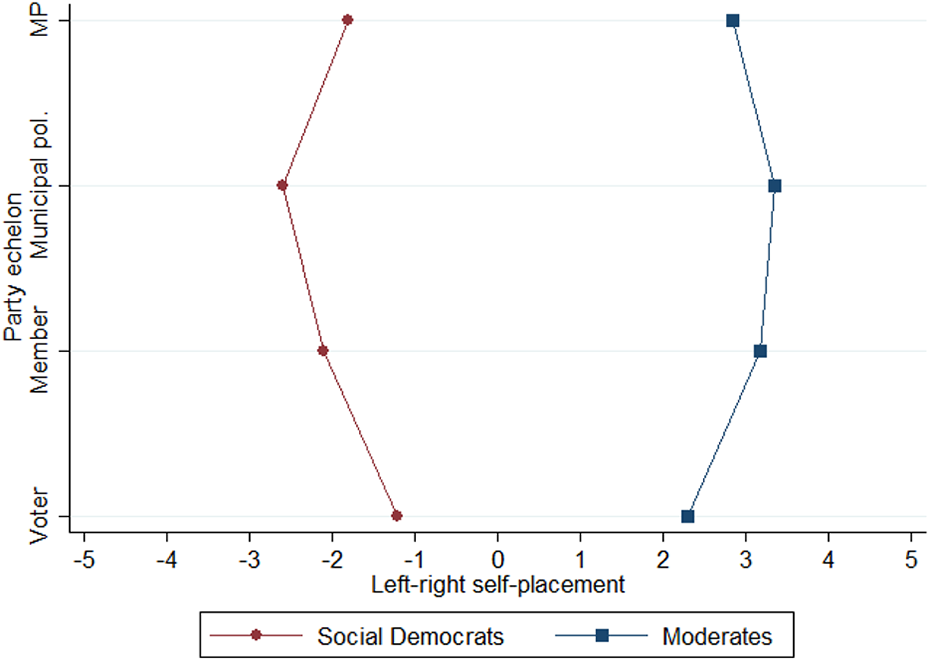
Left-right self-placement, Social Democrats and Moderates, 1985–2018 pooled.
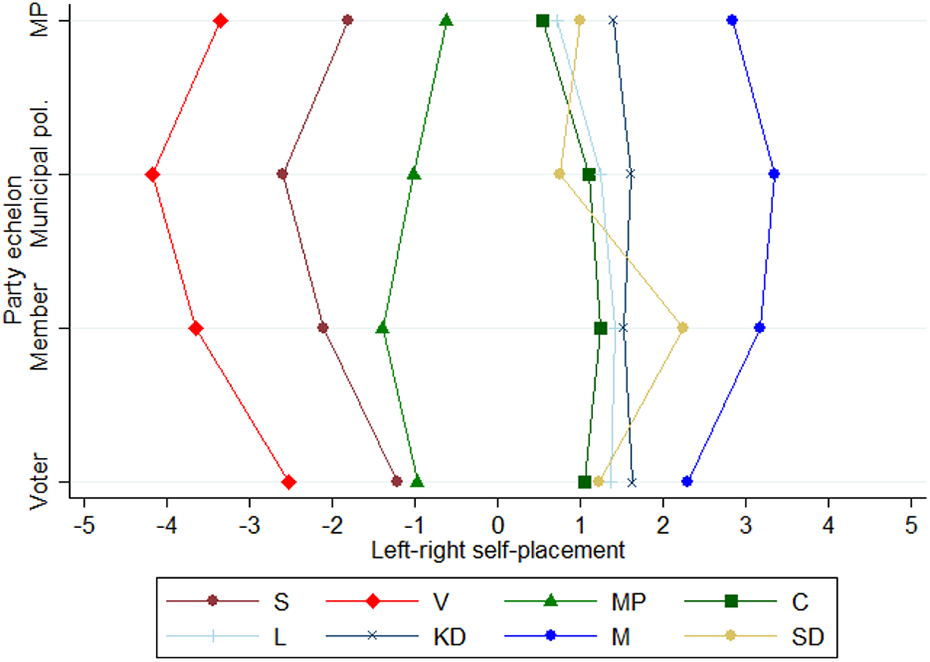
Left-right self-placement, all parties, pooled 1985–2018.
Turning to Figure 4, the pattern over time for the Social Democrats and Moderates follows the predictions of May’s law. Starting with the Social Democrats, the voters are the least radical group in all years but 2010, when their left-right position is identical to that of the Members of Parliament. In all years since 1994, party members are more radical than Members of Parliament. These differences are also statistically significant at conventional levels for all but singular years (i.e. the differences between members and Members of Parliament in 1988 and 2006). 9 The pattern for the Moderates is similar, but unequivocal: The opinion structure follows the predictions of May’s law for every considered year, with party members to the right of Members of Parliament, and voters closest to the center. However, it should be noted that the difference between party members and Members of Parliament is generally not statistically significant (from 1994) for individual years. It should also be noted that for both parties, the substantial difference is generally larger between party voters and members, compared to the difference between party members and Members of Parliament.
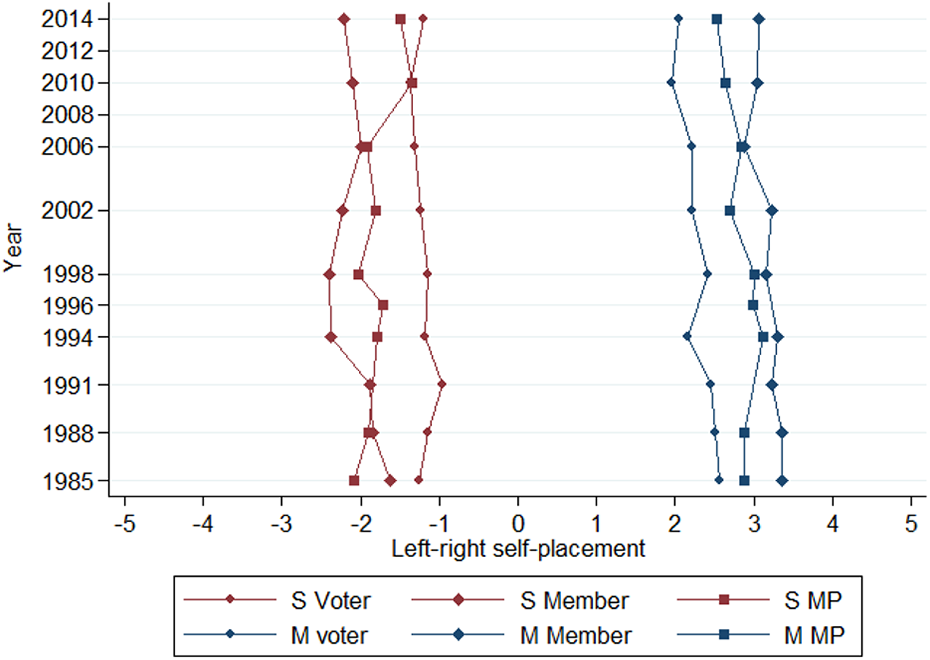
Left-right self-placement, Social Democrats and Moderates. Development over time, 1985–2014.
The statistical analysis of party opinion structure during the whole time period shows similar results as the graphical presentation. In general, both voters and members of parliament tend to deviate less from the mid-position than members do. In the first model of Table 1, the results show that voters on average have a position closer to the center point of about 0.6 units, and MP’s an intermediate position of about 0.4 units lower than the members. The difference between members and voters grows in magnitude as one limits the sample to the parties that organize most clearly along the left-right dimension (Models 2 and 3), while the difference between MP’s and members stays roughly the same. For the parties closer to the center, voters and members take a stronger absolute position on the left-right scale than MP’s, but the difference between the two lower levels is smaller (Model 4). Taken together, the regression results show that in general, party members make up the most extreme echelon on the left-right scale (holding year and party constant), where voters are the most moderate group, in accordance with May’s law.
Regression estimates, left-right absolute deviation from midpoint.
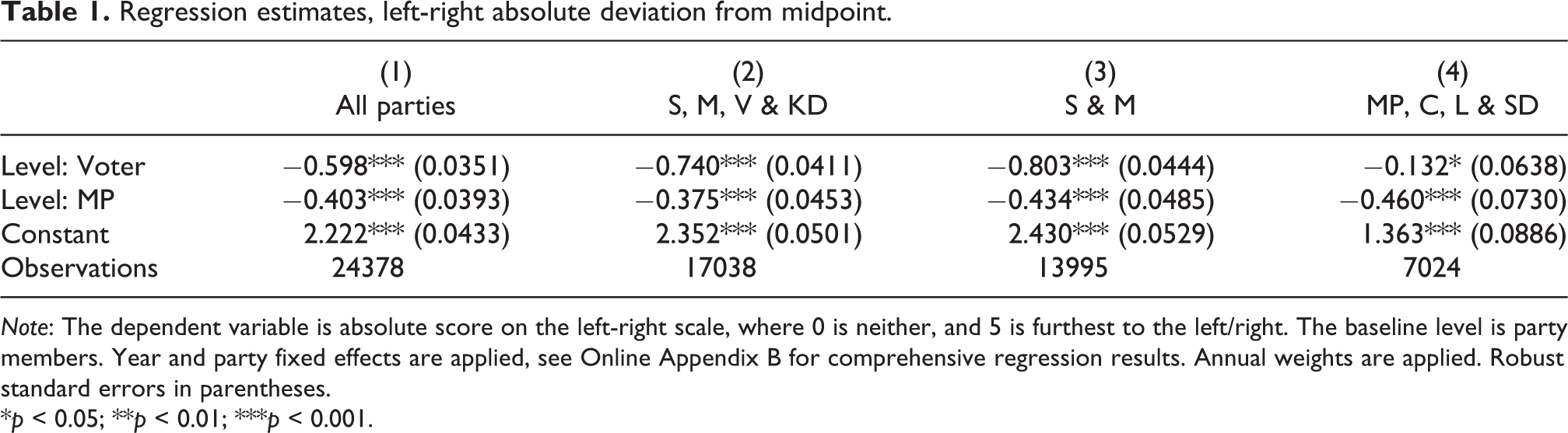
Note: The dependent variable is absolute score on the left-right scale, where 0 is neither, and 5 is furthest to the left/right. The baseline level is party members. Year and party fixed effects are applied, see Online Appendix B for comprehensive regression results. Annual weights are applied. Robust standard errors in parentheses.
*p < 0.05; **p < 0.01; ***p < 0.001.
Turning to the opinion structure of the parties concerning refugee immigration, a starkly different pattern is exhibited. Moving up the party echelons, the attitudes change toward becoming more positive to refugee immigration, for both the Social Democrats and the Moderates (Figure 5). In the full picture of the opinion structure of the parties on this matter, the Moderates stand out as one of two parties that are most clearly on the side wanting to limit refugee immigration (Figure 6, where 0 is most positive to the proposal to accept fewer refugees, and 1 is most negative). Additionally, the Sweden Democrats occupy an otherwise almost empty space of being strongly negative toward refugee immigration. The most striking pattern is the clear slant of the lines, which can be found in all other parties. As one moves up the hierarchy in the political parties, the attitude toward refugee immigration becomes more positive. Furthermore, for the most part, the parties show at least as big internal differences as they exhibit between one another.
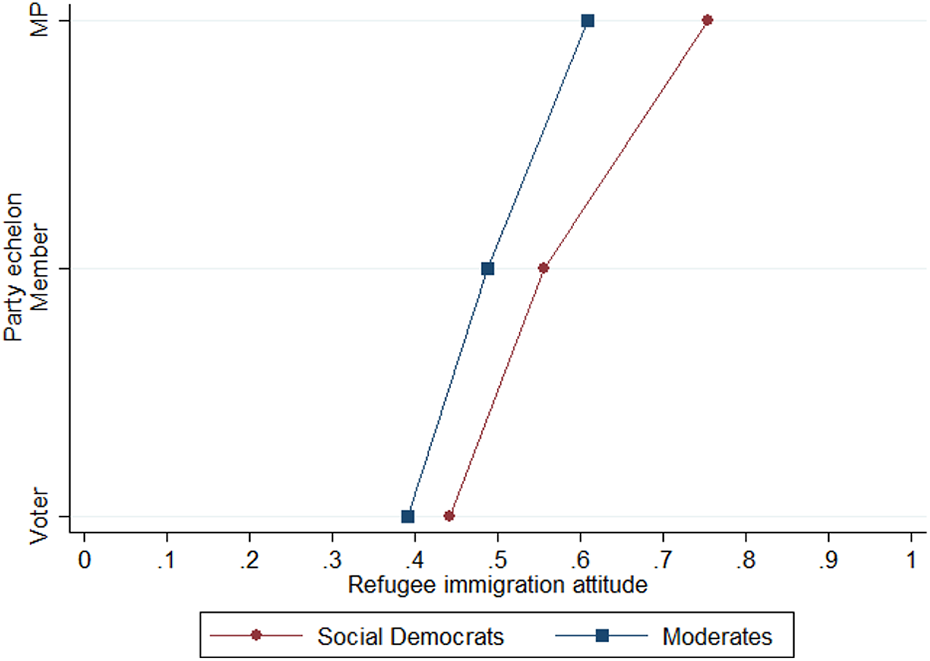
Refugee immigration attitudes, Social Democrats and Moderates, 1994–2014.
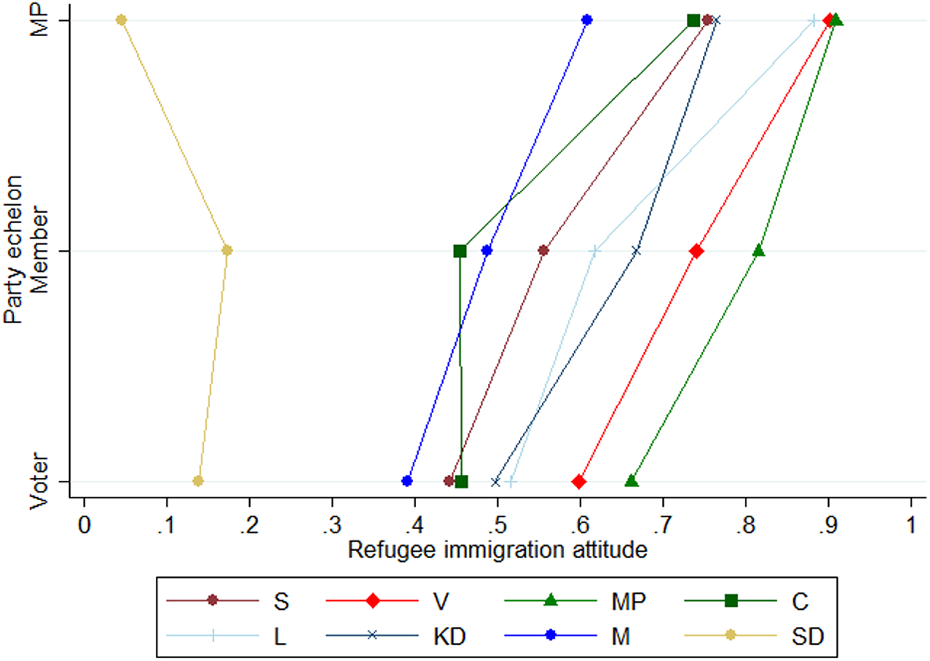
Refugee immigration attitudes, all parties, 1994–2014.
Turning to the opinion structure of the Social Democrats and Moderates concerning the composite secondary GAL-TAN scale, a third pattern is found, of elite polarization—the one described as a “fan” by Holmberg (1989), with more radical positions higher in the hierarchy of the parties (Figure 7). It is clear that no parties, regardless of their position on the secondary scale exhibit a pattern in accordance with May’s law (Figure 8). Generally, the parties follow the linear disparity of more radical members than voters, and Members of Parliament the most radical group. The composite scale is measured from 0 (the most positive to refugee immigration, environmental measures, limiting military expenditure, against Sweden joining NATO) to 1 (opposite scores). The pattern of elite polarization is found on both sides of the center, although more distinctly on the “GAL” side. This pattern means that the voters are both generally relatively close to one another across parties, and that the party elites (Members of Parliament) are relatively far apart on this attitude scale.
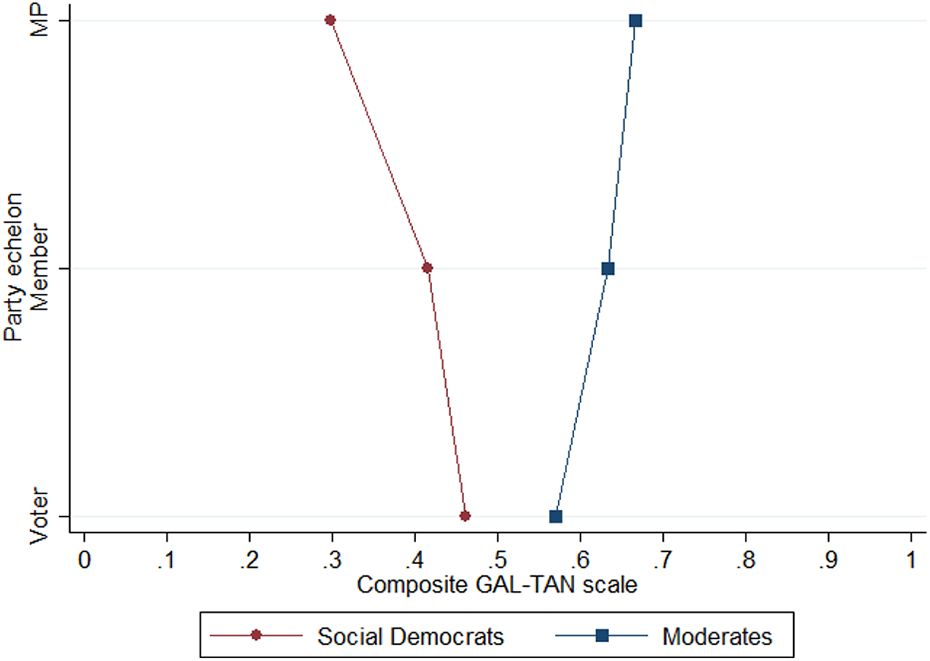
Composite GAL-TAN scale, Social Democrats and Moderates. Pooled 1996–2018.
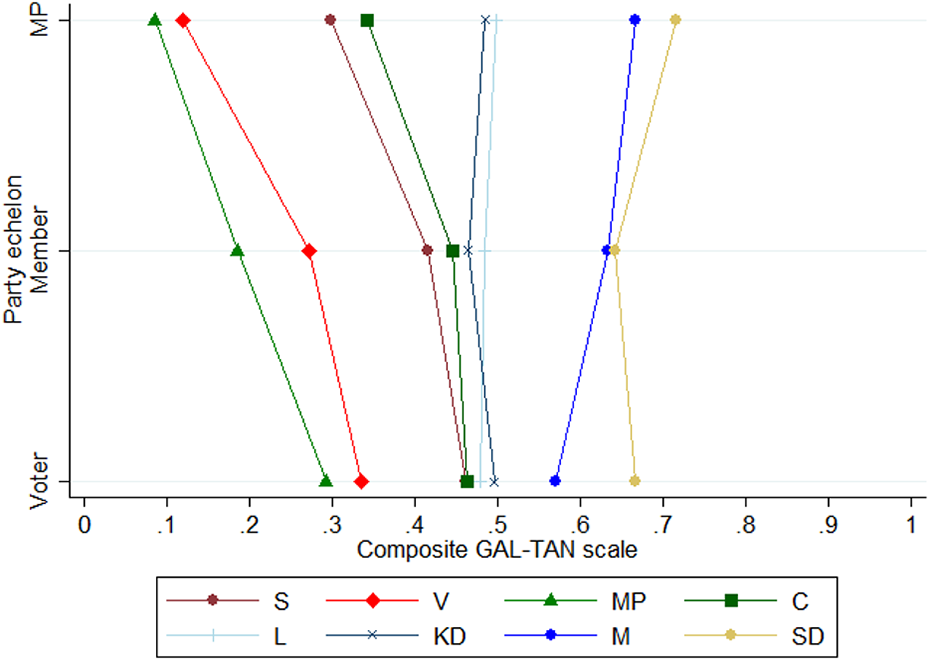
Composite GAL-TAN scale, all parties, pooled 1996–2018.
The development over time for the opinion structure of the Social Democrats and the Moderates on this dimension shows a relatively stable pattern over the limited time period it is measured (Figure 9). For all considered years, the Members of Parliament are more radical than their voter and member counterparts within each of the parties, and the voters are the closest to the center. This relative order is stable, with no changes of order taking place within the Social Democrats and Moderates during the considered time period.
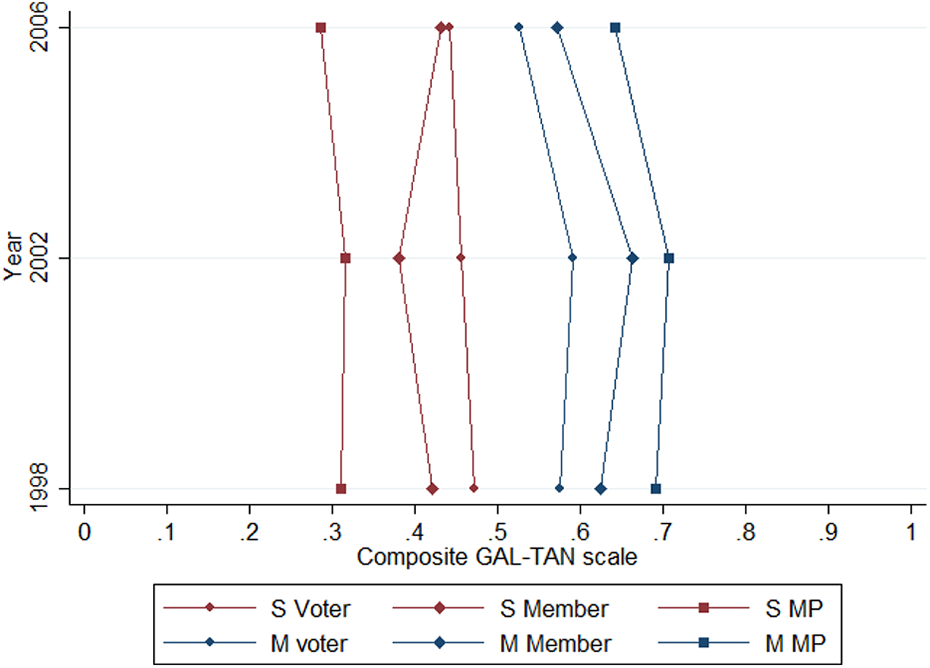
Composite GAL-TAN scale, Social Democrats and Moderates, 1998-2006.
The regressions for the composite GAL-TAN scale show results that are generally in line with what can be seen in the figures above (Table 2). The first model, including the whole sample of all parties, shows that voters deviate from the yearly average to a lesser extent than members do, while Members of Parliament tend to deviate more. If one limits the sample to parties that are organized strongly on the left-right dimension (models 2–3), the estimates do not change considerably. In model 4, the estimated difference between members and MPs is no longer statistically significant, but this has more to do with a reduction in sample size than a change in the estimated coefficients. Turning to the last model, the sample is limited to the four parties that take the most clear non-center positions on the alternative scale as it is measured here (see Figure 8). Here, the estimates change: The difference between voters and members is roughly doubled, and the difference between members and Members of Parliament tripled. The parties that are organized along the GAL-TAN scale do not show an opinion structure that follows the pattern predicted by May’s law, but they do exhibit a distinct linear disparity of elite polarization, and while it seems to be driven by the parties on the left, it is more pronounced than for the sample of all parties. The conclusion to draw from the regression results for all samples is that the Members of Parliament tend to be the most radical group on the GAL-TAN scale, while voters make up the most moderate group (with party members in between).
Regression estimates, GAL-TAN absolute deviation from yearly general population average.
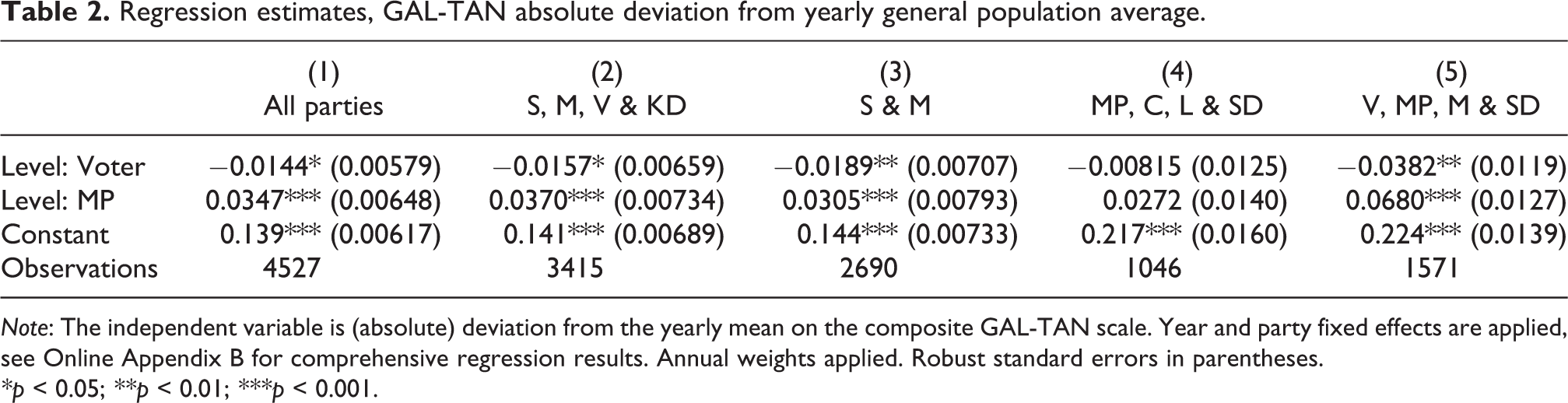
Note: The independent variable is (absolute) deviation from the yearly mean on the composite GAL-TAN scale. Year and party fixed effects are applied, see Online Appendix B for comprehensive regression results. Annual weights applied. Robust standard errors in parentheses.
*p < 0.05; **p < 0.01; ***p < 0.001.
Conclusion
The results of this paper show that the patterns of the opinion structures of the parties are markedly different for different measurements and dimensions. On the left-right dimension, the parties that take the most clear non-center positions have members that are significantly more radical than both the voters and the Members of Parliament. As can be seen from the regression results, the opinion structures of the Swedish parties on the left-right dimension generally follow the predictions of May’s law. However, given that only three out of eight parties precisely exhibit the pattern that May (1973) theorized as a law, the results are only in line with this law with some qualifications. As argued in this paper, parties that take a centrist position should not be considered to be admissible as cases to test May’s law, neither in the affirmative or negative. However, where to draw the line for a party to become “centrist” runs the risk of becoming arbitrary, and some of the Swedish parties that are closer to the center are still clearly more to the right (e.g. the Christian Democrats) or to the left (the Green Party). Thus, the results show qualified support for May’s law on the left-right dimension in the sense that it seems to apply only to those parties that are relatively far from the center position on this dimension. Nonetheless, even this conclusion casts some doubt over the recent repudiations of May’s law (Baras et al., 2007; Van Holsteyn et al., 2017).
Turning to the attitudes toward immigration, a highly consistent different pattern is found for all parties but the Sweden Democrats, of a linear slant toward more support for refugee immigration the higher up the party hierarchy one moves. This corroborates the notion that the party elites are generally more positive to immigration than the population at large, within each party. Finally, the composite GAL-TAN dimension exhibits a third pattern that is well known to the Swedish case—that of linear disparity, or of a “fan.” This is the pattern that Holmberg (1989) found for the opinion structure of the Swedish political parties in general in the 80’s and early 90’s, referred to as the “elite conflict model” (Widfeldt, 1998). Apparently, this pattern is no longer present in the left-right opinion structure, but it is all the more prevalent for the GAL-TAN dimension, where the Members of Parliament take the most radical positions for the parties that are positioned further away from the center. This could possibly be explained by the GAL-TAN scale being of a different nature than the left-right, and does not incentivize party elites to moderate their stance between that of the voters and members. However, the mechanisms explaining this pattern cannot be assessed by the design in this paper, but it suggests a fruitful topic for further research.
Finally, Richard Feynman might have been right—social scientists do not get any laws in general, and neither in the case of the opinion structure of the political parties. The results in this paper suggest that the opinion structure of the Swedish political parties follows May’s law only with some qualifications: When one considers the left-right dimension, and then only for parties that are organized along that dimension. However, given the predominance of the left-right dimension in Swedish politics, and that it holds for the parties that arguably shape the Swedish political landscape, the predictions of May’s (1973) set of laws still seem to hold some bearing on reality. If one adapts Norris’ (1995) habit of speaking of May’s rule rather than May’s law, it might be all the more evident that it would be too hasty to bury it all together. Rather, May’s rule of curvilinear disparity captures a pattern that is clearly prevalent in the Swedish political system, and continues to shape political competition along the primary left-right dimension, even during a period of immense party membership decline. Thus, Feynman was only partly right—something has been found out about the opinion structure of the parties, but it is too contingent to be subject to the invariability of a general law.
Supplemental material
Supplemental Material, sj-pdf-1-ppq-10.1177_1354068821997398 - May’s law may prevail: Evidence from Sweden
Supplemental Material, sj-pdf-1-ppq-10.1177_1354068821997398 for May’s law may prevail: Evidence from Sweden by Oskar Hultin Bäckersten in Party Politics
Footnotes
Acknowledgements
The author wishes to thank Ann-Kristin Kölln, and the three anonymous reviewers for their helpful feedback and comments.
Declaration of conflicting interests
The author(s) declared no potential conflicts of interest with respect to the research, authorship, and/or publication of this article.
Funding
The author(s) received no financial support for the research, authorship, and/or publication of this article.

Supplemental material
Supplemental material for this article is available online.
Notes
References
Supplementary Material
Please find the following supplemental material available below.
For Open Access articles published under a Creative Commons License, all supplemental material carries the same license as the article it is associated with.
For non-Open Access articles published, all supplemental material carries a non-exclusive license, and permission requests for re-use of supplemental material or any part of supplemental material shall be sent directly to the copyright owner as specified in the copyright notice associated with the article.
