




Abstract
Representative democracy presents politicians with an information problem: How to find out what voters want? While party elites used to rely on their membership or mass surveys, social media enables them to learn about voters’ issue priorities in real time and adapt their campaign messages accordingly. Yet, we know next to nothing about how campaigns make use of these new possibilities. To narrow this gap, we use a unique data set covering every Facebook post by party leaders and party organizations in the run-up to the 2017 Austrian parliamentary election. We test the hypothesis that party actors are more likely to double down on issues that have previously generated higher levels of user engagement. We also theorize that responsiveness is conditional on major/minor party status and pre-campaign issue salience. The analysis shows that parties’ issue strategies respond to user engagement, especially major parties on low-salience issues. This represents some of the first empirical evidence on how social media can enhance parties’ issue responsiveness.
Introduction
In contemporary elections, digital communication tools enable politicians to gather instant and dynamic information about the preferences of their constituents. User engagement further provides real-time assessments of parties’ communication strategies. Tracking user feedback on their social network sites enables parties to adapt their electoral strategy. Responsiveness could provide electoral benefits if politicians signal their commitment to tackle issues of current voter concern. Moreover, it enables politicians to approximate the “continued responsiveness” of delegates, which Dahl (1971: 1) coined a key feature of democracy.
To be sure, social media are beset with a host of problems. Yet for all the—real and significant—troubles with trolling, online harassment, disinformation, or the undue influence of foreign powers, there is still the question whether the possibility of communicating directly with voters could produce greater responsiveness from political elites.
This paper therefore seeks to understand whether political actors adapt their issue strategies in election campaigns based on user engagement on Facebook. Are parties and candidates more likely to address an issue if that same issue has previously generated high levels of user engagement? Do they use the immediate feedback available on Facebook to reinforce their own issue agenda or to learn about previously neglected issues?
We tackle these questions with data on around 1,500 Facebook messages posted on party and lead candidate pages during the Austrian election campaign 2017. Using hand-coded information on issue content, we find evidence for party issue responsiveness. This finding is mostly driven by major parties’ responsiveness to issues that were not high on their agenda prior to the (short) campaign. These parties thus learn about the issue preferences of their users and respond to them by stressing topics that they may initially have neglected. Our results therefore show that social network sites are not just one-way communication channels through which political actors can try to influence voters. Rather, strategic political operators can (and do) use the short-term feedback they obtain on social media to tailor their issue strategies to their online audience.
Theoretical argument
Dynamic representation and issue responsiveness
“Democracy is not a single event, but an ongoing process” (Dalton et al., 2011: 24). In representative democracies, this process revolves around the relationship between voters and their representatives. This paper focuses on substantive representation, that is, whether the interests and priorities of voters are reflected in the behavior of politicians (Powell, 2000). Crucially, however, substantive representation is not a static arrangement. It involves voters continuously sending signals about their preferences to political elites, and political elites continuously receiving information about the electorate’s policy priorities (Dalton et al., 2011; Stimson et al., 1995). In an ideal world, signals from voters to politicians are channeled into the political process and thus shape policy outcomes.
When shifts in public opinion trigger changes in party rhetoric or policy, we can speak of dynamic representation (Stimson et al., 1995). Of course, political competition typically forces rational political actors to respond to shifts in voter preferences. A party that refuses to even listen to voter demands may soon find its electoral support crumble. Parties are therefore constantly seeking information on voter preferences in order to evaluate whether their communication with the public is hitting the right notes (Schmitt-Beck and Farrell, 2002).
To be sure, parties are constrained by the fact that shifting one’s position can be costly (Adams, 2012; Adams et al., 2009; Meyer, 2013; Schumacher et al., 2013). This is especially true in the short term, which is why during electoral campaigns, parties rather rely on modifying the salience of issues (Sides, 2006: 407). By emphasizing issues that are currently important to the electorate, parties try to adapt to public opinion without having to shift their substantive position. Spoon and Klüver (2014), for instance, find evidence that parties are responsive to the issue priorities of their voters, especially in first-order national elections. Similarly, Klüver and Spoon (2014) and Wagner and Meyer (2014) report that—at least under certain circumstances—parties devote more manifesto space to issues that are more important to voters. This type of responsive behavior can occur in the very short term, even though parties’ preferred issues may be relatively stable over the long term (Budge and Farlie, 1983; Petrocik, 1996). Klüver and Sagarzazu (2016), for example, find that German parties in their press releases respond to monthly changes in the public’s issue priorities.
In order to execute these short-term changes, timely feedback from target audiences must be available. In the days of pre-modern campaigning, parties’ mass membership served as a transmission belt that would deliver information about voters' demands to party elites. Later, mass surveys and focus groups became the standard tools for political operatives to gather information about voter preferences (Müller, 1997; Schmitt-Beck and Farrell, 2002). While all of these tools remain useful today, they can be costly, biased, and slow. Yet, the development of online communication platforms has created new ways to obtain information about voter preferences in real-time. On the one hand, political actors can track the issues citizens’ talk about on social network sites (SNS) to learn about their preferences. As Barberá et al. (2019) have shown, US legislators’ issue agenda on Twitter follows that of Twitter users, especially party supporters. On the other hand, SNS provide parties with immediate, direct feedback (i.e. user engagement) on their own messages, which is the focus of this paper.
Both options allow political actors to respond to voter demands extremely quickly. Social network sites such as Facebook, Twitter, or Instagram have a much faster speed of production than traditional channels of communication (Bode et al., 2016: 582), and thus allow for campaign messages to be distributed almost instantaneously. The combination of a fast production mode and the possibility of receiving immediate feedback should make SNS an ideal arena for parties to engage in short-term responsiveness.
To be sure, parties can draw on various types of information beyond Facebook interactions in order to adjust their issue strategy during a campaign. Yet, interactions indicate the success of campaign messages based on user interest and engagement (Gerodimos and Justinussen, 2015; Porten-Cheé et al., 2018) and campaign managers are well aware that they are important when it comes to distributing their messages to a broader audience (Kreiss et al., 2018). Thus, interactions are particularly relevant for party responsiveness on Facebook. If parties were using additional sources of information, this should bias the results against our expectations and thus provide a harder test for our theoretical arguments.
We therefore expect that parties will use the real-time feedback they receive on SNS to tailor their campaign messages to their audience. Parties should be more likely to address issues that have previously generated high levels of user engagement.
Party responses to user engagement: Reinforcement or learning?
While we expect parties to adapt their issue strategies to new information about voters’ preferences, they certainly do not start from scratch in their campaigns. Rather, most parties have an established policy profile and long-standing preferences about which issues they view as electorally beneficial and hence worth emphasizing. Typically, a party will put greater emphasis on issues on which it is perceived as competent by voters, thus moving the political debate onto as favorable terrain as possible. By talking about its “best” issues, it seeks to prime voters to base their decision on concerns that the party is well-equipped to address. Issue ownership should therefore predict a party’s issue emphasis (Budge and Farlie, 1983; Petrocik, 1996; Petrocik et al., 2003). The “growing importance of issue competition” (Green-Pedersen, 2007; see also Dalton et al., 2000) means that parties need to be increasingly careful in crafting their issue strategies in order to be electorally successful (Meguid, 2005; Nadeau et al., 2010; Vavreck, 2009).
Parties thus typically define their preferred issue agenda before the onset of an election campaign (or, at least, before the short campaign). This a priori strategy is outlined in parties’ manifesto agenda, a tool in which parties usually invest considerable time and resources. From this “ideal” agenda (Norris et al., 1999: 62), parties then distill their messages for other communication means like direct mail, leaflets, campaign posters, TV ads, press releases, or social media content (Dolezal et al., 2012; Norris et al., 1999: 62; Tresch et al., 2018). Once parties receive information about how voters react to their campaign messages, they can update their issue strategies as theorized in H1. While some parties may be equally responsive to voter feedback across all issues, we theorize that party responses should be conditional on a party’s pre-campaign issue priorities. Two scenarios are plausible here.
Reinforcement
On the one hand, parties may be more likely to be responsive if the reactions from voters reinforce their own issue priorities. If parties receive strong feedback on issues that they already consider highly salient, they may feel encouraged to have chosen a beneficial strategy in the first place. As a consequence, they may double down on these issues. Another way to put the same expectation is that the threshold for returning to an issue in response to voter feedback is lower for issues that a party already prioritizes. It should thus take less user engagement to make a party return to its core issues.
Learning
On the other hand, parties may take voter engagement more into account when they realize that voters care about issues that they neglected in their initial campaign agenda. Ignoring issues that are high on the public’s agenda is dangerous as parties may appear “indifferent” (Sides, 2006: 412). In this scenario a party will use engagement on social network sites to learn about issues that it does not already consider highly important, thus trying to cover the “blind spots” in its pre-campaign issue profile. As a result, parties should be more responsive to user engagement on issues that they consider less important.
Major vs. minor parties
Beyond the expectations outlined above, incentives and resources to be responsive to voters’ priorities may vary across parties. Most importantly, we expect differences between major and minor parties. First and foremost, larger parties have greater incentives to be responsive, simply because they are more likely to pursue a catch-all strategy that targets broad segments of the electorate. By contrast, smaller parties tend to have niche audiences that are fixated on very specific issues—often the parties’ core concerns (Adams et al., 2006). We therefore expect larger parties to be more responsive than smaller ones to user engagement on their SNS profiles.
In addition, major parties have greater resources in terms of personnel and money. They will thus be better equipped to address a broad range of issues, which makes it easier for them to respond to issues of concern to voters (Greene, 2002; Meguid, 2005; Wagner and Meyer, 2014). This expectation applies particularly well to online campaigning, where greater resources may be used to create and maintain professional content (Norris, 2001: Ch. 8; see also Resnick, 1998). Basic online presences are easily established at low cost. However, professional campaign managers communicate highly strategically via social media (Kreiss et al., 2018), an endeavor that certainly is cost-intensive. Likewise, immediate responsiveness to voters’ issue priorities (as one aspect of strategic social media campaigning) requires more extensive resources to constantly monitor and analyze incoming user feedback and derive useful strategies from this information (Kruschinski and Haller, 2017; Zuiderveen Borgesius et al., 2018). Clearly, larger parties with more extensive financial resources will be in a better position to hire the social media professionals, data analysts, and communication experts required to produce short-term responsiveness.
The distinction between major parties with a broader target electorate and minor parties with a more niche audience is also consequential for the allocation of attention to specific issues. Major parties seek to represent larger voter segments with more heterogeneous issue priorities. To address these voters during a campaign, major parties need to emphasize a broader range of issues (Kirchheimer, 1966)—even those that the party may previously have overlooked. Conversely, minor parties represent smaller issue publics that strongly care about a very specific set of policies (Converse, 1964; Krosnick, 1990). Therefore, addressing and responding to their core issues is of greater importance for minor parties, whereas major parties will display responsiveness also on issues outside their core policy concerns. We therefore expect the reinforcement logic—parties responding more strongly to feedback on issues that are already high on their agenda—to be more prevalent among minor parties than among their larger competitors. Conversely, learning—parties responding more strongly to feedback on issues outside their core agenda—should be more prevalent among major than among minor parties.
The same implications arise from a resource perspective. Parties with greater resources can devote attention and develop expertise across a broader range of issues. By contrast, if resources are scarce, parties are better served allocating the lion’s share of their attention to their core issues. Major parties will therefore find it easier to address both, issues of concern to voters and their own issue priorities (Meyer and Wagner, 2016; Wagner and Meyer, 2014).
The role of Facebook in campaigns
Facebook has become an important communication tool in modern campaigns (see e.g. Fowler et al., forthcoming; Kreiss et al., 2018), as it reaches a broad audience at low costs. Yet how representative of the general campaign is what happens on Facebook?
On the one hand, “the characteristics of each medium will create certain distinctive opportunities and constraints” (Norris, 2003: 26). As parties have incentives to adapt their campaign strategies to the communication means they use, some differences between Facebook and other communication means will emerge (Fowler et al., forthcoming; Kreiss et al., 2018; Stier et al., 2018). In this paper, we take advantage of one of these “distinctive opportunities” offered by Facebook: the possibility to collect immediate user feedback and to respond accordingly. Due to this (and other) channel-specific characteristic(s), party issue strategies on Facebook may differ somewhat from other means—not unlike other differences between communication channels that scholars have documented (Bode et al., 2016; Druckman et al., 2009b; Norris et al., 1999; Tresch et al., 2018).
On the other hand, parties have incentives to “stay on message” (Norris et al., 1999) during campaigns, that is, to streamline their communication across channels. Parties are more likely to succeed in this task when control over communication is centralized—as is certainly the case for the Facebook accounts in our analysis (Kreiss et al., 2018). In addition, the media agenda regularly spills over onto Facebook, as parties often include links to media reports on Facebook (in about a fifth of all postings in a study by Heiss et al. (2018: 1505)). The same happens vice versa, as media outlets pick up on politicians’ social media statements for their own reporting, which then reach a broader audience (McGregor, 2019). Lastly, followers of political actors on social media are often “local opinion leaders” (Lazarsfeld et al., 1944), who regularly and actively talk about the issues they see on social media both online and offline, and thus spread the messages to a wider audience (Miller et al., 2015; Weeks et al., 2017). The issue agenda on Facebook should therefore be reasonably related to, if not perfectly representative of, the overall campaign issue agenda.
This is why parties need to be selective when deciding which issues they want to address on Facebook. One can argue that parties could post an infinite number of postings about different issues every day to be responsive to everyone. Yet, parties would water down their messages if they did so. Furthermore, there are diminishing returns to posting frequently, as user engagement declines in the number of daily postings (Xenos et al., 2015). Hence, parties need to decide which issues to emphasize in their Facebook campaign and can thus use the feedback they get from users to choose the “right” issues.
Case selection, data, and method
We test our hypotheses with data from the Austrian parliamentary election campaign in 2017. Austria’s commonalities with other European democracies such as a proportional electoral system and a moderately polarized multiparty system that produces coalition government (Haselmayer and Jenny, 2018) make it an interesting case to study the effects of social media engagement on party competition. We focus on party communication on Facebook as it is the preferred social media platform for marketing purposes (Enli and Skogerbø, 2013; Kreiss et al., 2018) and was the most used social media application in Austria in 2017 with a market share of 76% (Statista, 2018 as cited in Parlamentsbibliothek, 2018). Moreover, a considerable number of voters used Facebook to follow the election: one in five survey respondents visited or followed a party or candidate Facebook page during the campaign (Kritzinger et al., 2018). The proportions are around 10 percent for the three larger parties (SPÖ, ÖVP, and FPÖ), and between three and five percent for the smaller parties (Neos, Greens, LP).
To get a sense of the political leanings of parties’ Facebook followers, Figure 1 displays the average party sympathy scores for the six parties among party voters, Facebook followers, and other voters (including non-voters). For all parties, Facebook followers are an intermediate group: not quite as favorable as party voters, but considerably more so than other voters. This suggests that the audience parties reach on Facebook extends beyond die-hard party loyalists into the ranks of potential, but by no means certain, supporters. This is not exactly surprising, given the substantial numbers of followers for some party leaders. During the 2017 campaign, Heinz-Christian Strache (FPÖ) and Sebastian Kurz (ÖVP) boasted more than 700,000 Facebook followers (representing roughly 11 percent of all eligible voters), whereas Christian Kern (SPÖ) counted a “mere” 200,000. Previous research has shown that parties are more responsive to their own supporters and to highly attentive audiences than to the general public (Barberá et al., 2019). To the extent that this pattern applies to the Austrian case, it should bias our analysis in favor of finding responsive behavior.
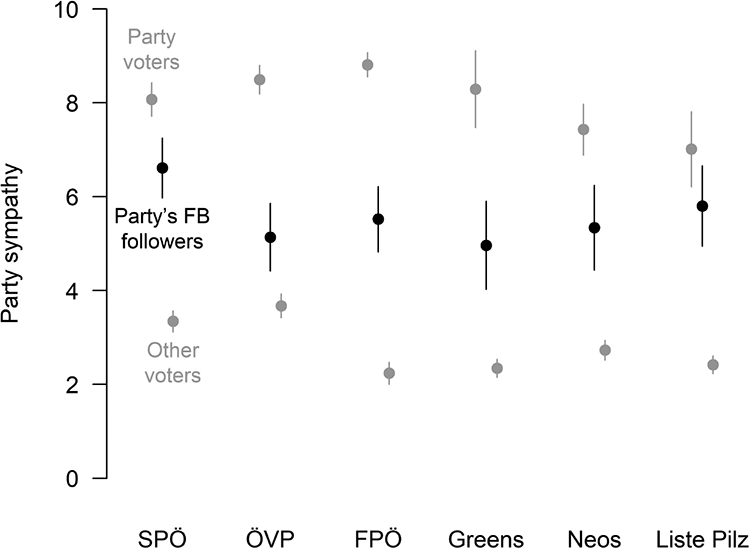
Party sympathy scores of party voters, parties’ Facebook followers, and other voters.
The survey data also confirm that parties’ Facebook followers are more politically interested than non-followers (85% vs. 68% who are very/somewhat interested). However, crucially for the purpose of this paper, their issue priorities are not that distinct. With the exception of welfare state issues (named most important by 17% of party followers and 25% of non-followers), we find only very small divergences (≤3 ppts) in the issue priorities of these two groups (Kritzinger et al., 2018).
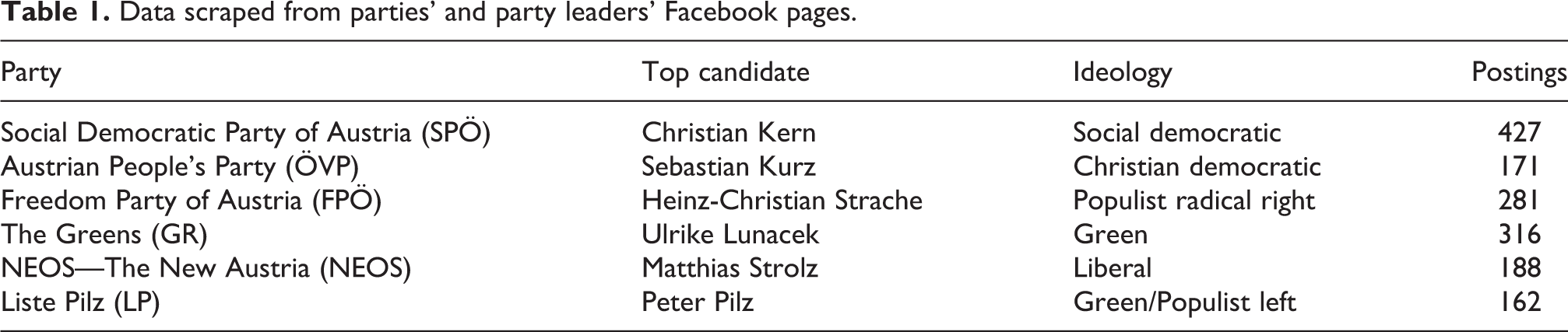
To obtain our data (Müller et al. forthcoming), we scraped all postings published on the Facebook accounts of the six most relevant parties (those polling close to or above the electoral threshold of four percent) and their top candidates (see Table 1) during the final six weeks of the campaign using the API provided by Facebook. In addition to the information provided on the content (text, links to pictures, the URL), we also collect data on user engagement (likes, shares, comments, love, haha, wow, sad, angry) for each posting (Eberl et al., 2020). Over the campaign period, we obtained this information daily for all postings. This allows us to track the measures of user engagement over time. All these postings were manually coded already during the campaign to capture issues and actors addressed. The aim of the coding scheme was to capture the content as it appeared to users as closely as possible including the text, pictures or previews to external links (e.g. news reports).
Data scraped from parties’ and party leaders’ Facebook pages.
Trained student coders categorized all Facebook postings into the Autnes coding scheme that contains more than 700 policy categories. We used these data to build 35 narrowly defined issue categories. After all, our hypotheses assume that parties observe how their issue messages resonate and then decide whether to come back to the issue or not. This mechanism requires a rather narrow understanding of what constitutes an issue. For instance, rather than grouping all social policy categories into one “welfare state” bucket, we split them up into nine different categories (care, families, health, housing, labor market, pensions, poverty relief, redistribution, and generic welfare state references). Similarly, there are multiple categories capturing issues of multiculturalism and immigration (extremism, integration, Islam, migration & asylum, and patriotism). 1
Among the 2,769 Facebook postings retrieved from the party and top candidate pages, 1,545 were coded with a policy issue (as opposed to campaign events, private information on candidates, and other non-policy content). Since we are interested in party issue behavior, we exclude all postings without substantive policy issues. For each of these 1,545 postings with policy issues, we then model in a conditional logit framework which of the 35 issue alternatives a party selects. The dependent variable is thus a dummy (0/1) that indicates which of 35 issues a party chooses to talk about in a posting.
Table 2 displays the percentage of postings devoted to each issue by party. All parties cover a wide range of issues, yet issue ownership strongly influences what parties emphasize. The SPÖ has a clear focus on social policy, employment, and gender equality, the FPÖ emphasizes immigration and integration, and the ÖVP devotes much attention to foreign policy matters (likely due to the fact that its top candidate, Sebastian Kurz, was the sitting foreign minister during the campaign). Similarly, the Greens push environmental issues, whereas the liberal Neos pay much attention to education (a core issue since the party’s founding in 2012), and the new Liste Pilz (LP) focuses on corruption (due to its top candidate, Peter Pilz, having built a reputation for fighting political corruption since the 1980s).
Distribution of issues across postings per party (column percentages).
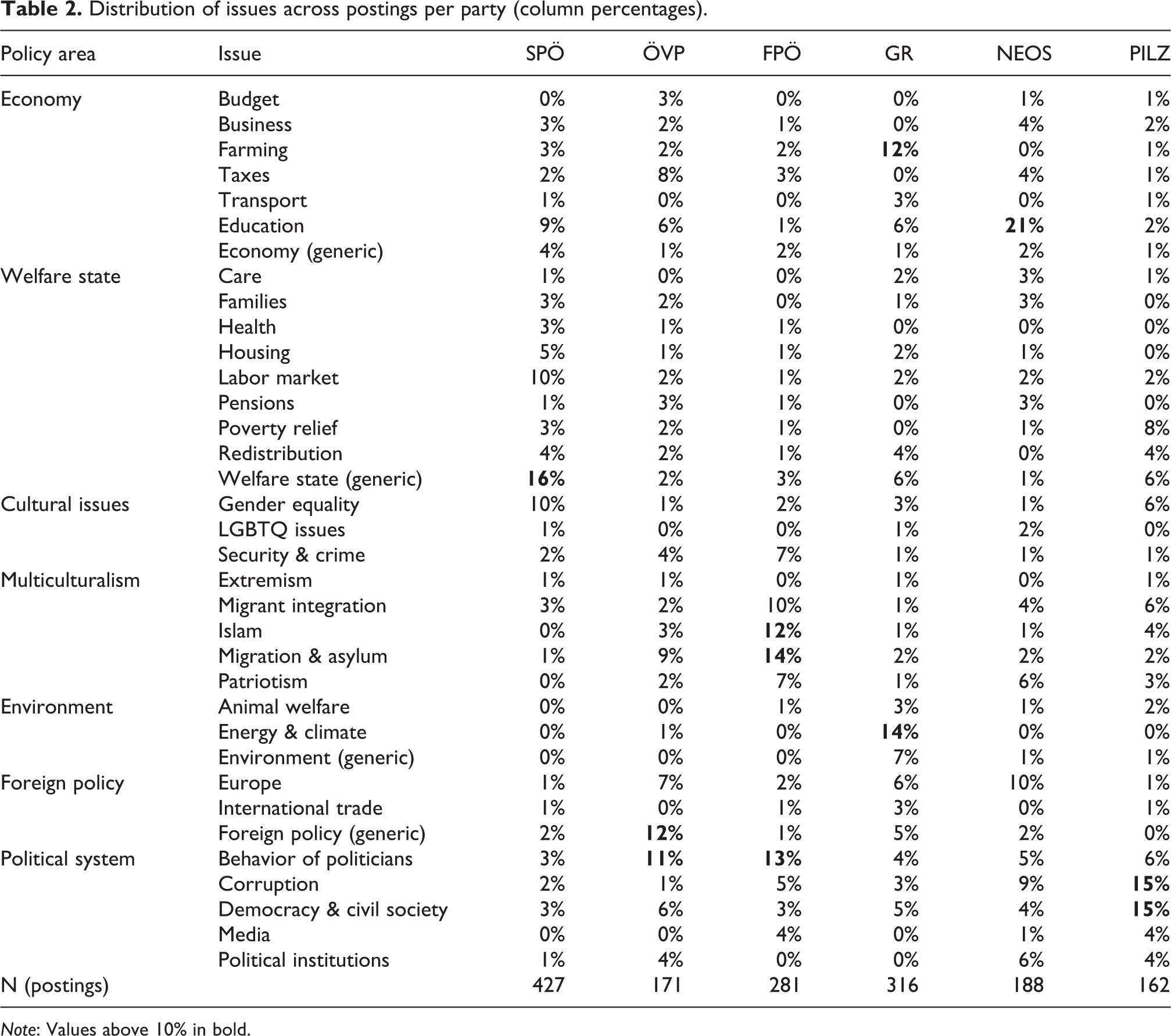
Note: Values above 10% in bold.
Independent variables
Our main independent variable, “high-performing issue”, mimics the feedback that Facebook page administrators (but not ordinary users) receive. Facebook provides page owners with detailed information about the performance of each posting. In addition, it highlights messages that attracted more user engagement than x% of a page’s previous postings. Our hypotheses assume that parties will use this information to refine their issue strategies. While we cannot exactly reproduce the information that parties receive from Facebook, our main independent variable is designed to capture a very similar logic.
The dichotomous “high-performing issue” variable thus indicates whether the respective issue alternative was one of the issues addressed in the highest-performing 20% (in terms of the overall number user interactions) of the party’s last 50 postings, counting the last 50 postings from the previous day backward. Since different forms of user engagement are highly correlated (see Table 4 in the Online Appendix), we sum the counts of all measures of user engagement. 2 Note that this approach does not exploit the content or sentiment of user comments. Reading, evaluating, and aggregating their content is quite resource-intensive and would make it hard for parties to provide timely responses to user engagement. Therefore, we focus on the sheer volume of interactions.
To give every posting the same time to attract user engagement, we measure user engagement 5 days after a posting was posted (t + 5). This measurement correlates highly with the even more short-term measurement at t + 1 (r = 0.96).
For instance, to determine the value of this variable for an ÖVP posting on the education issue for 5 October 2017, we examine whether a posting coded into the education category was in the highest 20% in user engagement (top 10 out of 50) of the ÖVP’s last 50 postings prior to 5 October 2017. 3 We apply the same procedure to all other observations. The five most high-performing issues per party can be seen in Table 5 in the Online Appendix.
Our second central independent variable is taken from the Autnes manifesto data (Müller et al., 2020). It is simply the logged percentage of statements in a party’s manifesto devoted to each of the 35 issue categories (for details on the manifesto coding procedure, see Dolezal et al., 2016). Manifestos are the most comprehensive source of policy information prior to an election, and Austrian parties typically draft their manifestos well in advance of the short campaign (Dolezal et al., 2012). The manifesto emphasis variable thus captures the pre-campaign importance of an issue for a party (Norris et al., 1999: 62; Tresch et al., 2018).
Our third independent variable accounts for differences between major (SPÖ, ÖVP, and FPÖ) and minor parties (Greens, Neos, LP). We assign parties to these categories to account for different electoral incentives and campaign resources. Major parties target a larger and therefore more heterogeneous set of voters than minor ones (Adams et al., 2006). Given that public party financing in Austria is proportional to party strength, larger parties also have more money to spend than minor ones. This enables them to be more responsive to voter issue priorities (Meyer and Wagner, 2016; Wagner and Meyer, 2014). We use pre-election polls and the number of Facebook followers as proxies for the catch-all status of parties. Averaging all publicly available polls for the 2 months preceding the period of observation exhibits strong differences between these groups: major parties account for 24 to 33 percent of the intended votes (SPÖ 24.8, ÖVP 33.1, FPÖ 23.7), whereas minor parties cluster in the mid-single digits (Greens 6.7, Neos 4.9, Pilz 4.9). 4 There is also a sizeable gap with respect to Facebook audiences: as shown by survey data (Kritzinger et al., 2018), major parties reach about 10 percent of the electorate, minor parties reach three to five percent (user interactions are therefore considerably higher for the three major parties, see Figure 2). A similar pattern emerges for campaign expenditures even though the Greens stand out a bit among minor parties (SPÖ €7.4 m, ÖVP €13 m, FPÖ €10.7 m, Greens €5.2 m, Neos €1.8 m, Pilz €0.2 m). 5 To be sure, the FPÖ has previously been classified as a niche party—mostly based on its ideological profile. Yet the party’s continued electoral support, its repeated government participation at the national and regional level, its strong local presence (over 1,200 local units across the country), and its turn toward vote-maximization (Luther, 2008) all distinguish it as a major player during the 2017 campaign.
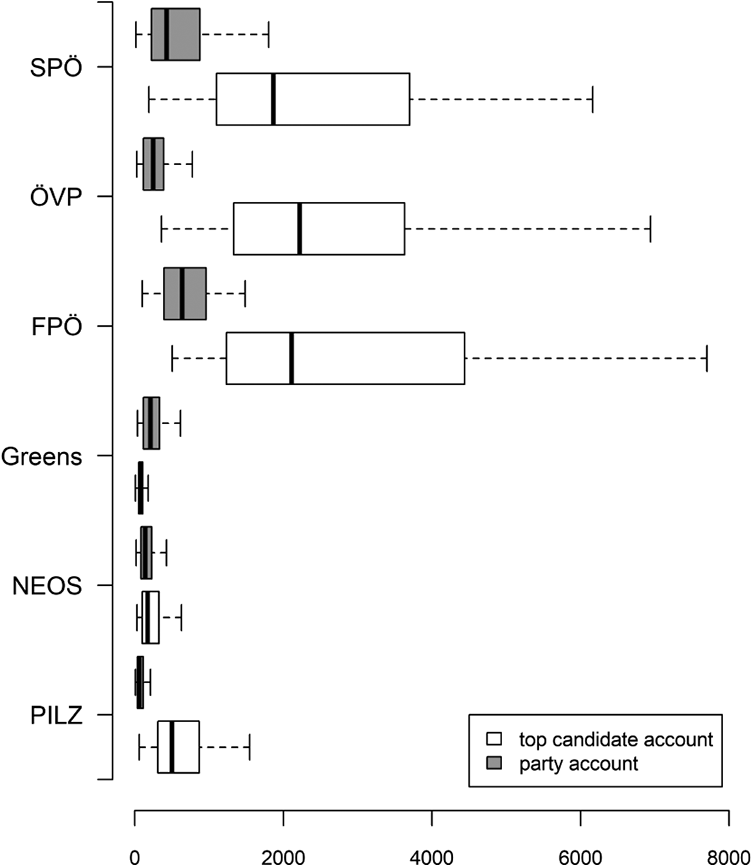
Number of Facebook interactions per account.
In addition, a number of control variables need to be specified. First, we control for negative campaigning and personalization, both of which are likely to trigger more user engagement. Hence, we introduce two dummy variables indicating if at least one of the 50 most recent postings contained an attack (criticism of a political opponent) or a picture of the top candidate (as a proxy for personalization) in combination with the respective issue.
To account for party-specific issue priorities, we further count how often a party addressed an issue in its 50 most recent postings. If parties address some issues more often than others (as Table 2 shows), this increases the likelihood that postings on these topics figure among the best-performing postings. By introducing this control variable, we exclude the possibility that our effects are merely determined by the variation in parties’ issue attention.
We also introduce controls for the issue agenda of the media and parties to account for the fact that responsiveness should be higher on issues that are salient in the news or in the party system (Hopmann et al., 2012; Meyer et al., 2020). Moreover, we control for a potential feedback loop of parties responding to salient issues because they know that these topics are more likely to get media attention (Meyer et al., 2020).
The media agenda is the circulation-weighted percentage of newspaper articles covering an issue on the previous day. Data are from the Autnes manual coding of the eight most important daily papers in Austria (Der Standard, Die Presse, Heute, Kleine Zeitung, Kronen Zeitung, Kurier, Salzburger Nachrichten, Österreich) (Litvyak et al. forthcoming). The party system agenda (on Facebook) is a dichotomous variable that captures whether any other party addressed a given issue on the previous day—a phenomenon that has been documented by the literature on issue engagement (Druckman et al., 2009a; Kaplan et al., 2006). This variable accounts for the possibility that parties not only react to their users, but to other parties posting about the same issues.
Analysis
Table 3 presents estimates from four conditional logit regression models with issue selection among 35 alternatives as the dependent variable (models with alternative specifications of our key independent variable are provided in Online Appendix B). The first model includes the “high-performing issue” variable plus the control variables. The second model interacts “high-performing issue” with the manifesto emphasis predictor. The third model examines the impact of high-performing issues separately for major (ÖVP, SPÖ, FPÖ) and minor (GR, Neos, LP) parties. The fourth model includes a three-way interaction between high-performing issues, manifesto emphasis, and major/minor party. Note that the major-party dummy is dropped from all models, since conditional logit models can only include predictors that vary across the choice alternatives (the 35 issues in our case).
Party issue responsiveness to user engagement.
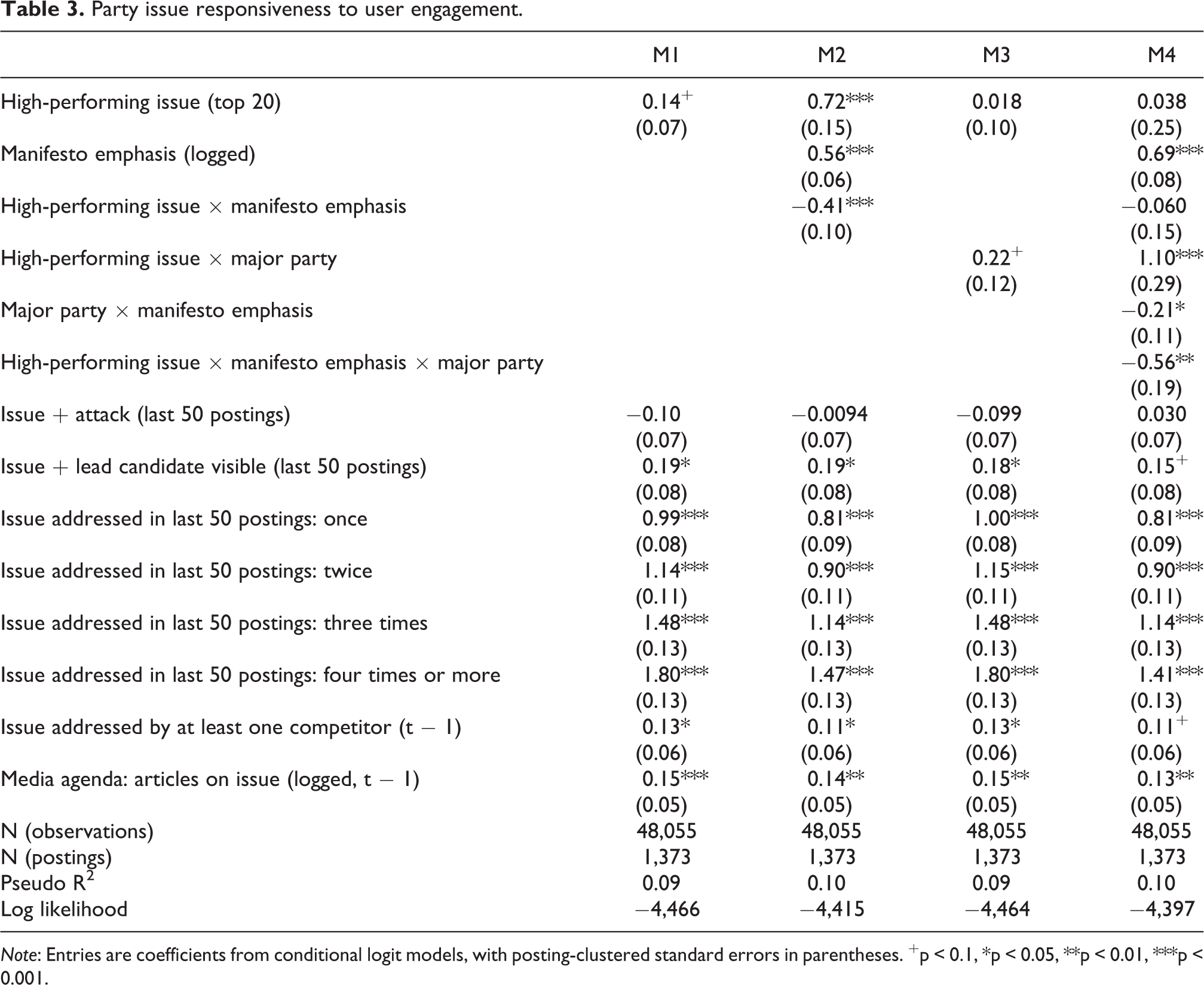
Note: Entries are coefficients from conditional logit models, with posting-clustered standard errors in parentheses. +p < 0.1, *p < 0.05, **p < 0.01, ***p < 0.001.
The effect of high-performing issues in Model 1 is positive and comes with a p-value of 0.07. The average marginal effect of this predictor is 3.1 percentage points, suggesting a positive, but relatively small and noisy, effect of prior user engagement on parties’ likelihood to re-address an issue. Thus, as theorized in H1, parties are somewhat more likely to talk about an issue on Facebook if that issue has recently generated more user engagement. To the best of our knowledge, this is the first evidence of issue responsiveness by parties to social media engagement.
To examine the interaction effects in Models 2, 3, and 4, we plot the average marginal effects (AME) of the high-performing issues variable as a function of the major party indicator and the manifesto emphasis variable (log-transformed).
Figure 3 depicts the average marginal effect of “high-performing issue” by an issue’s salience in the party manifesto. Across the empirical range of the manifesto emphasis variable, the AME slopes downward as issue salience increases, with the lower bound of the 95-percent confidence interval hitting zero somewhere around three percent. The effect of the “high-performing issue” variable is thus much stronger for low-salience issues (around 15 percentage points or more), whereas it equals zero for issues with higher levels of pre-campaign salience. This is clear evidence in favor of H2b. Parties are not responding to user engagement by reinforcing their own issue agenda, but use them to cover their blind spots. They are thus able to devote attention to matters where there was a mismatch between their own priorities and voter demand.
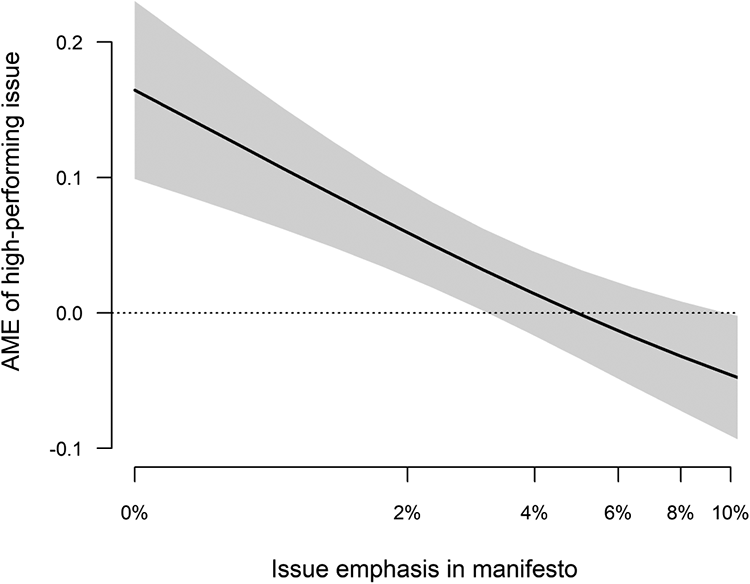
Average marginal effect of “high-performing issue” by manifesto emphasis (95-percent confidence intervals). Note: Based on Model 2 of Table 3.
Based on Model 3, Figure 4 shows that the “high-performing issue” effect is significant only for major parties, but not for minor parties. Whereas high user engagement does not make minor parties more likely to address an issue, the average marginal effect for major parties is 5.4 percentage points. Since the difference between these two effects is statistically significant at the 10-percent level (p = 0.06), the analysis suggests that major parties display greater issue responsiveness than minor parties, thus supporting H3. Re-running these analyses to check if these patterns apply to all major and minor parties largely corroborates these results (Figure 6 in the Online Appendix presents marginal effect plots for the interaction of high performing issues and parties).
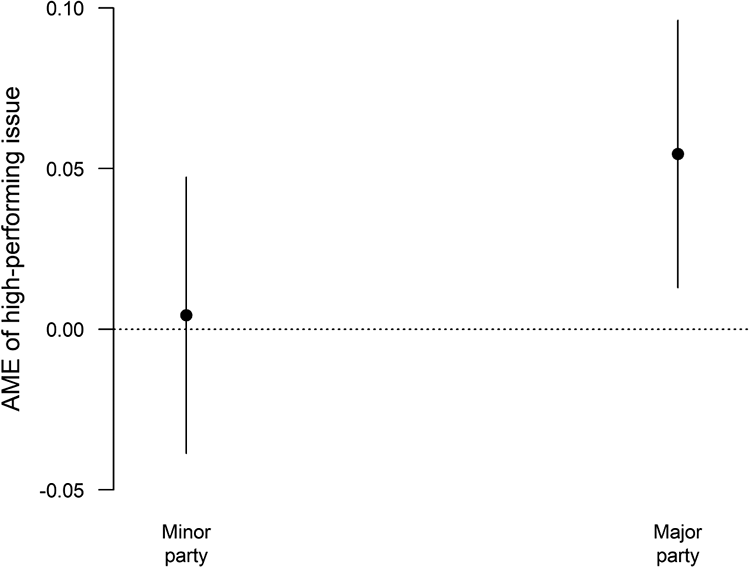
Average marginal effect of “high-performing issue” by minor/major party (95-percent confidence intervals). Note: Based on Model 3 of Table 3.
Figure 5 finally shows that there is strong support for H4b. Major parties are very responsive on low-salience issues, whereas minor parties are not responsive across all levels of pre-campaign issue salience. This result aligns with the expectation that major parties have the incentives and resources to respond to user engagement, yet they only do so when the issue in question has not had a high level of pre-campaign salience already. While this finding holds when effects are calculated individually for each party (see Figure 7 in the Online Appendix), it is clear that the small number of parties in the analysis limits the extent to which we can generalize from it or speak about the drivers of this relationship (e.g. incentives to appeal broadly versus resources to analyze and strategically use information on user reactions).
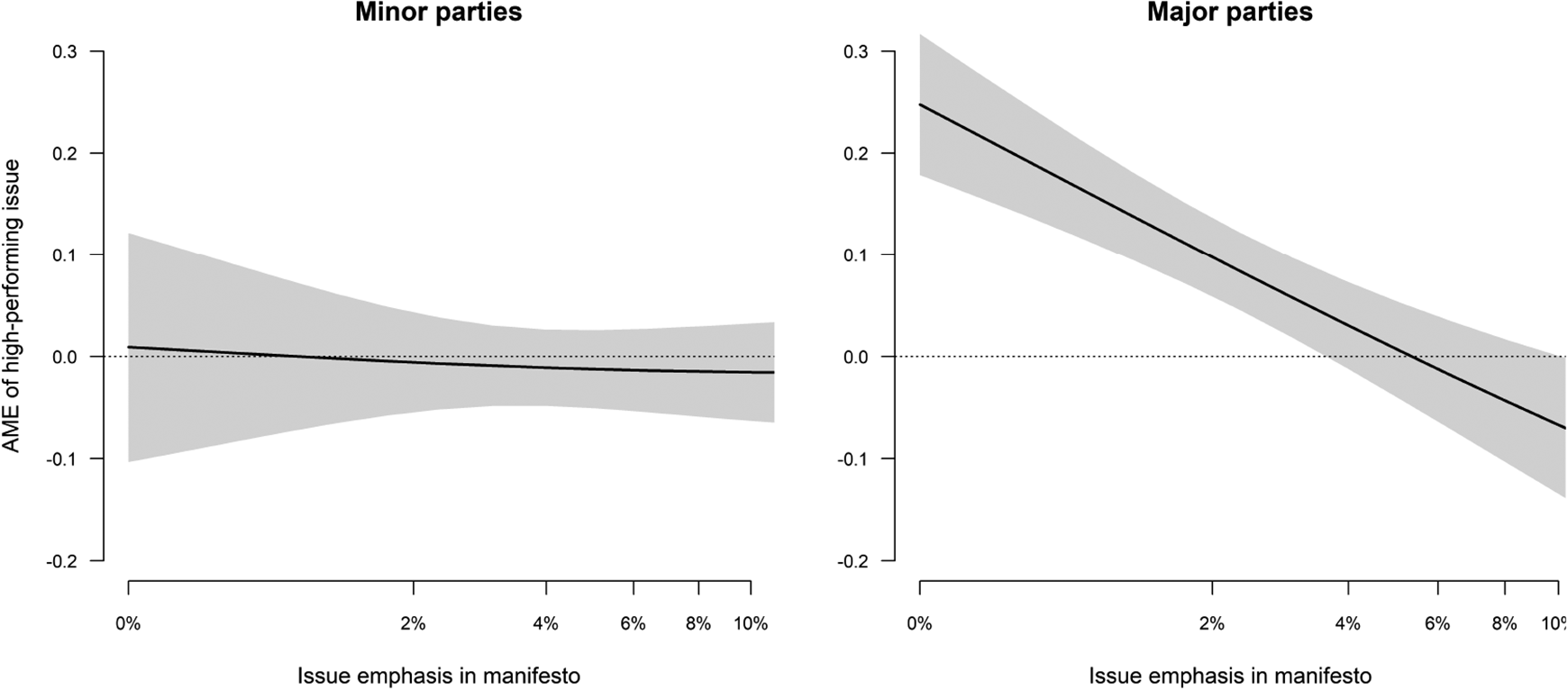
Average marginal effect of “high-performing issue” by manifesto emphasis for major and minor parties. Major parties: ÖVP, SPÖ, and FPÖ, minor parties: Greens, Neos, and LP (95-percent confidence intervals). Note: Based on Model 4 of Table 3.
To some extent, however, the findings regarding H4b qualify our earlier results. The effects for H1, H2b, and H3 are clearly driven by major parties’ responsiveness on issues with low pre-campaign salience. Still, the strong results for H4b (low-salience issues becoming around 25 percentage points more likely to be addressed) suggest that major parties use social media engagement to learn about the issue priorities of their online followers and feed this information back into their campaign strategies.
Conclusion
To the best of our knowledge, this paper presents the first evidence that parties respond to direct user feedback on social network sites by adapting their issue strategies. Our analysis shows that parties are more likely to return to an issue if it has previously generated more user engagement on Facebook. However, we also show that this aggregate effect is largely driven by major parties responding to user engagement on low-salience issues. These results contribute to other findings of issue responsiveness on social network sites (Barberá et al., 2019).
To be sure, our analysis covers only one campaign in one country. All generalizations thus come with significant caveats. Still, as Barberá et al. (2019) have also shown issue responsiveness from political actors on Twitter in the US, these results may travel across contexts. Importantly, the two platforms have different audiences: while Twitter is important to reach journalists and users that want the latest news about live events, Facebook is mostly used to reach a broader audience with “classic” campaign messages (Kreiss et al., 2018). In addition, political actors seem to be responsive to SNS users both in the US two-party-system and in European multi-party democracies.
Another limitation of the paper is that there is no data on sponsored posts available for the period of observation. Sponsored posts allow parties to promote their messages beyond a post’s organic reach. Since these posts are viewed by more users, they will likely produce more user engagement. The crucial question is whether this could mean that our findings are spurious. Yet, given that we find much greater responsiveness on non-core issues, and assuming that parties are more likely to sponsor posts devoted to their “best” issues, 6 we believe that sponsored posts bias the analysis against detecting responsiveness. After all, parties know that user responses to sponsored posts are inflated and will therefore discount high levels of user engagement with such posts.
More generally, one possible conclusion from our findings is genuinely positive: Social network sites create a novel communication channel through which feedback from voters (and party supporters) feeds into parties’ campaign strategies and thus renders issues important that parties would otherwise neglect. Yet it is also important to note that the responsiveness we observe happens in the very short term. High-performing issues are operationalized as those reaching the top quintile in terms of user engagement among the party’s last 50 postings, thus covering a time horizon of a few days at best. Parties are therefore adapting the issue content of their messages extremely quickly—much quicker than would be possible with conventional methods of information gathering (e.g. surveys, party membership).
A related implication is that social network sites have the potential to increase issue engagement (Druckman et al., 2009a; Kaplan et al., 2006; Meyer and Wagner, 2016). In our analysis, the strongest effects occur for issues that are low on parties’ campaign agenda—typically issues on which they have little or no ownership. User engagement thus nudges parties toward talking more about issues outside their comfort zone. This should increase the proportion of “shared” issues in the campaign and therefore reduce the risk of parties simply talking past one another.
Future research could expand on this argument and investigate whether parties learn not only from the user reactions they receive, but also from those that their competitors’ messages generate (although monitoring those is much less convenient). Such research could further exploit variation in positive and negative user reactions or explore the content and sentiment of user comments, which seems particularly relevant for studies of political polarization. In addition, it would be important to know whether the learning effects uncovered here happen outside campaigns, too. Another question that goes beyond the scope of this paper is whether short-term changes in issue attention as observed in this study affect voter perceptions of a party’s issue priorities. If voters value parties that take their concerns seriously, responsiveness may ultimately affect party popularity and thereby constitute an electoral asset (Ansolabehere and Iyengar, 1994; Stimson et al., 1995).
Our findings make an original contribution to the literature on party competition as they provide first insights on how parties and candidates use instant user reactions on Facebook to adjust their issue strategies during election campaigns. However, we also find that responsiveness is contingent on party characteristics. Specifically, smaller parties with fewer resources are less responsive than their larger counterparts. These minor parties stick to their “best” issues and thus their pre-campaign issue agenda. Whereas this may be a deliberate strategy, it could also indicate that short-term responsiveness is easier to enact for political actors with greater resources.
Studying how parties and candidates use social media to learn about voters’ issue priorities tackles important questions of political responsiveness and democratic representation. Whereas digital communication tools certainly pose challenges to the democratic process (e.g. misinformation, potential for manipulation), our findings highlight their role in fostering voter–elite linkages. By providing a direct and immediate link between voter preferences and political actors, social media can promote elite learning, responsiveness and dynamic representation.
Supplemental material
Supplemental Material, sj-do-1-ppq-10.1177_1354068820985334 - Does social media enhance party responsiveness? How user engagement shapes parties’ issue attention on Facebook
Supplemental Material, sj-do-1-ppq-10.1177_1354068820985334 for Does social media enhance party responsiveness? How user engagement shapes parties’ issue attention on Facebook by Laurenz Ennser-Jedenastik, Christina Gahn, Anita Bodlos and Martin Haselmayer in Party Politics
Supplemental material
Supplemental Material, sj-dta-2-ppq-10.1177_1354068820985334 - Does social media enhance party responsiveness? How user engagement shapes parties’ issue attention on Facebook
Supplemental Material, sj-dta-2-ppq-10.1177_1354068820985334 for Does social media enhance party responsiveness? How user engagement shapes parties’ issue attention on Facebook by Laurenz Ennser-Jedenastik, Christina Gahn, Anita Bodlos and Martin Haselmayer in Party Politics
Supplemental material
Supplemental Material, sj-pdf-3-ppq-10.1177_1354068820985334 - Does social media enhance party responsiveness? How user engagement shapes parties’ issue attention on Facebook
Supplemental Material, sj-pdf-3-ppq-10.1177_1354068820985334 for Does social media enhance party responsiveness? How user engagement shapes parties’ issue attention on Facebook by Laurenz Ennser-Jedenastik, Christina Gahn, Anita Bodlos and Martin Haselmayer in Party Politics
Footnotes
Acknowledgments
We are grateful for comments and input provided by Thomas M. Meyer, the participants of the research seminar at the Department of Government at the University of Vienna, contributors to the discussion of an earlier version of this paper at EPSA 2019 and the Comparative Research on Political Elites workshop in Berlin 2019, as well as two anonymous reviewers.
Declaration of conflicting interests
The author(s) declared no potential conflicts of interest with respect to the research, authorship, and/or publication of this article.
Funding
The author(s) disclosed receipt of the following financial support for the research, authorship, and/or publication of this article: This research has been conducted as part of the Austrian National Election Study (Autnes) within the framework of ACIER, the Austrian Cooperative Infrastructure for Electoral Research, financed by the Austrian Federal Ministry for Education, Science and Research (BMBWF).

Supplemental material
Supplemental material for this article is available online.
Notes
References
Supplementary Material
Please find the following supplemental material available below.
For Open Access articles published under a Creative Commons License, all supplemental material carries the same license as the article it is associated with.
For non-Open Access articles published, all supplemental material carries a non-exclusive license, and permission requests for re-use of supplemental material or any part of supplemental material shall be sent directly to the copyright owner as specified in the copyright notice associated with the article.
