




Abstract
In democracies with multi-party competition, government parties face a dual challenge in election campaigns: on the one hand, they have to compete against and criticize their coalition partners. On the other hand, they should avoid virulent attacks on their partners to preserve their chances of future collaboration in government. Going beyond a dichotomous operationalization of negative campaigning, this manuscript analyses the tonality and volume of negative campaigning. Studying 3030 party press releases in four national Austrian election campaigns, different patterns for the tonality and frequency of negative campaigning reflect the electoral dilemma of government parties. Coalition parties criticize each other abundantly but refrain from ‘burning bridges’ with their partners through virulent attacks. These findings have implications for studying negative campaigning and coalition politics.
Keywords
Introduction
Studies on negative campaigning in multi-party systems argue that government parties should not ‘go negative’ (Nai and Walter, 2015; Walter, 2014; Walter et al., 2014; Walter and Van der Brug 2013; Elmelund-Praestekaer, 2010; Hansen and Tue Pedersen, 2008). These parties may emphasize their record in government and have less to gain from attacking their opponents than opposition parties. Yet some studies find a puzzling pattern where coalition parties criticize each other abundantly in election campaigns (De Nooy and Kleinnijenhuis, 2015; Dolezal et al., 2015).
Coalition parties face the dilemma of governing together while emphasizing their own policy profile (Sagarzazu and Klüver, 2017). This is particularly relevant in election campaigns as parties have to stress their differences and sell their achievements to appeal to voters. Accordingly, government parties may criticize each other quite frequently in election campaigns. However, as we argue in this contribution, they should do so in a more civil tone.
To shed light on the puzzle of intra-coalition criticism in election campaigns, we study the tonality, or sentiment strength, 1 of campaign statements. This enables us to distinguish between mild and strongly worded criticism in Austrian elections. We argue that ‘friendly fire’ – negative campaigning among coalition partners – is less virulent than attacks among parties across the government-opposition divide. To achieve government alternation, we also expect opposition parties to be more lenient with each other and concentrate attacks on the ruling coalition parties.
We measure the tonality of campaign statements through crowdcoding, the use of lay coders recruited via the internet (Haselmayer and Jenny, 2017; Benoit et al., 2016). Comparing our finer-grained measure with a dichotomous classification into positive and negative messages (Geer, 2006), we find that coalition parties indeed released numerous negative statements about each other to stress policy divergences and mobilize respective supporters. Yet the tonality of these messages indicates that the same parties refrained from ‘burning bridges’ with potential future partners. Similarly, opposition parties exhibit rhetorical restraint against each other, resulting in a pattern of bloc competition between the government and opposition parties. We discuss implications for negative campaigning in multi-party systems and coalition research in the conclusions.
Negative campaigning among coalition parties
A standard definition of negative campaigning identifies it as ‘criticism level[l]ed by one candidate against another’ (Geer, 2006: 22). In this dichotomous understanding, anything else is in the ‘positive’ campaigning category, which covers campaign statements emphasizing a party’s own policy positions or its record in government office and neutral or positive comments about a competitor. The lack of discriminating power of this dichotomous classification in the face of large intra-class variation of campaign statements has been repeatedly discussed by scholars investigating the variety of negative messages that extends from comparative statements to ‘dirty’ or uncivil attacks on competitors (e.g. Fridkin and Kenney, 2011; Mutz and Reeves, 2005; Kahn and Kenney, 1999). Some argue that campaign sentiment is an entirely different dimension of campaigns that supplements the available set of party strategies (emphasizing issues or valence, self-centred versus opponent-centred, Crabtree et al., n.d.).
We concur with that critique of a dichotomous classification of campaign statements. To improve the current state, we propose a graded conceptualization of negative campaigning and use crowdcoding to operationalize it (Haselmayer and Jenny, 2017). Taking the tonality of negative messages into account sheds light on patterns of party competition and government formation in multi-party systems. Low levels of negativity, such as emphasizing disagreements over specific policies, will likely occur even among coalition partners, which have to signal their different positions to appeal to their core voters (Sagarzazu and Klüver, 2017). However, we expect that political actors seeking to renew a coalition after the election will not compromise future collaboration by firing broadsides against each other in the election campaign.
In general, a party in government should be keen to defend its policy achievements and use positive messages rather than attack others in the campaign (Benoit, 1999). In several multi-party systems, government parties indeed issue fewer negative messages than opposition parties (Walter and Van der Brug, 2013; Elmelund-Praestekaer, 2010; Hansen and Tue Pedersen, 2008). However, some government parties frequently resort to negative campaigning (Walter et al., 2014) or even criticize their coalition partners abundantly during election campaigns (De Nooy and Kleinnijenhuis, 2015; Dolezal et al., 2015).
We argue that studying the tonality of campaign messages may address this problem. Parties in a coalition government have to signal their distinct positions and stress their own achievements by emphasizing differences with their coalition partner(s) to appeal to voters and partisans (Sagarzazu and Klüver, 2017). Large volumes of negative campaigning exchanged between coalition partners is consistent with that explanation. Yet, if coalition partners intend to renew the coalition after the election, they should avoid virulent attacks that endanger post-electoral cooperation. Mutual distrust fuelled by a heated campaign may also increase post-electoral bargaining costs or the duration of coalition negotiations (Golder, 2010). Therefore, we should expect a rather mild tonality of negative campaigning between coalition partners.
The incumbency advantage in government formation demonstrates that these parties prefer to continue their coalition after an election (Martin and Stevenson, 2001; 2010). Parties that shared government office have a stock of mutual trust and understanding, which facilitates future cooperation (Franklin and Mackie, 1983). Re-negotiating the formation of the incumbent coalition is also less costly than bargaining with new partners (Martin and Stevenson, 2010; Warwick, 1996).
Finally, preserving their joint record in office provides another reason why coalition parties should exert restraint in criticizing each other. The last argument applies even to parties that have no intention to renew their cooperation after the election.
For these reasons, our first hypothesis states:
Hypothesis 1a: The tonality of negative campaigning among coalition parties is less negative than among parties situated across the government-opposition divide.
Although we expect government parties to tread carefully with each other during campaigns, we expect opposition parties should concentrate their rhetorical fire on the current coalition parties. An important electoral goal of an office-seeking opposition party is to break the current government’s parliamentary majority. This is a precondition for the formation of an alternative coalition that includes a previous opposition party through complete or partial alternation (Mair, 1996). In addition, a vote-seeking opposition party has more to gain from attacking government parties as they represent the largest group of voters (Walter, 2014). Winning votes from a rival opposition party could maintain the parliamentary majority of the current coalition. Based on these arguments, negative campaigning should follow a pattern of ‘bloc competition’ opposing government to opposition parties.
We therefore expect:
Hypothesis 1b: The tonality of negative campaigning among opposition parties is less negative than among parties situated across the government-opposition divide.
Case selection, data and methods
We study the tonality of negative campaigning in four national Austrian election campaigns (2002, 2006, 2008 and 2013). The country shares many commonalities with other European parliamentary democracies, such as a proportional electoral system and a party system characterized by moderate pluralism (Sartori, 1976). The tradition of grand coalition governments of the Social Democratic Party (SPÖ) and Christian-Democratic People’s Party (ÖVP) makes it an interesting case to study negative campaigning strategies of government and opposition parties. Previous research revealed abundant negative campaigning among coalition partners (Dolezal et al., 2015), which also makes it an interesting case to demonstrate the added value of studying campaign tonality.
During the period of study, Austria was ruled by three different two-party coalitions. The right-wing coalition of ÖVP and Freedom Party (FPÖ; 2000–2003) was followed by a joint government of ÖVP and the Alliance for the Future of Austria (BZÖ, 2003–2006). That government was replaced by grand coalitions of SPÖ and ÖVP, formed following the 2006 election and renewed in 2008. Apart from the four parties that held government office during this period (SPÖ, ÖVP, FPÖ and BZÖ), our study also includes the Greens and Team Stronach as opposition parties.
Data and methods
We analyse party press releases published in the last 6 weeks of four legislative election campaigns (2002, 2006, 2008 and 2013). During campaigns, media frequently use press releases as sources for their news reports (Meyer et al., forthcoming), which makes them attractive targets for party communication and valuable sources for studying issue strategies and negative campaigning (Sagarzazu and Klüver, 2017; Haselmayer et al., forthcoming; Dolezal et al., 2015).
The press releases are first processed by trained coders who identify subject actors and up to three object actors in their headlines. A press release addressing several parties, for example, the Greens criticizing the SPÖ and the ÖVP, is multiplied by the number of targeted parties (see Online Appendix B for examples) and each relational statement is coded separately as conveying a positive, negative or neutral statement about an object actor (Müller et al., 2014). 2 The six parliamentary parties issued a total of 7409 press releases, of which 3030 included criticism of other parties, leading to a dataset with 3461 negative statements. At this stage we can already study frequency patterns of negative campaigning and the share of attacks directed at a particular opponent. In our data, there is a strong relationship between these two variables (Pearson’s r of 0.76). In this paper, we analyse the frequency of negative campaigning. A robustness test using the share of negative messages as dependent variable (Online Appendix C) provides almost identical results.
To see the tonality patterns we collect a sentiment strength score for each negative statement via crowdcoding, a term coined for the crowdsourcing of coding tasks (Haselmayer and Jenny, 2017; Benoit et al., 2016). Briefly, 10 coders rate each statement on a five-point scale ranging from not negative (0) to very strongly negative (4). We aggregate the 10 codings per statement according to the Dawid-Skene (1979) algorithm, which preserves the five-point scale, but apart from that is similar to the arithmetic mean. Comparing the aggregate crowdcoded scores for a subset of statements (n=615) coded by the authors gives an ordinal Krippendorff’s alpha of 0.73.
We argue that a graded measure of campaign tonality enhances our understanding of negative campaigning in the multi-party context. To provide empirical evidence for our argument, we compare the frequency and tonality patterns of negative campaigning. To determine how often and how strongly a party criticized its competitors in each election campaign we calculate the number and average tonality of all statements from a sender party (A) to all targeted parties (A→B, A→C, A→D) in a campaign. The dyadic frequency of negative statements and their mean tonality constitute the dependent variables in subsequent analyses.
Our independent variable measures government incumbency for a party dyad. There are three options: (1) both the author and its target are government parties at the time of the election campaign, (2) both are opposition parties or (3) the two parties sit on different sides of the government-opposition divide.
As control variables we include the intensity of electoral competition and the ideological distance between a pair of parties. The intensity of electoral competition derives from the relative standing of the two parties in pre-election polls. Leaning on Skaperdas and Grofman (1995), we identify the frontrunner party leading in the polls, challenger parties that are within a winning margin and the trailing parties in each election campaign. Combining the relative position of sender and target party of a statement gives an ordinal five-point indicator of competition intensity. It is highest between two parties vying for the position of largest party (4) and lowest between two trailing parties (0) (Online Appendix A gives coding details). We control for the left-right distance between sender and target party because ideological distance may increase negative campaigning (Walter, 2014). We use party position estimates from the Chapel Hill expert survey (Bakker et al., 2015) and compute the absolute distance between the two parties.
Model specification
For the dyadic frequency of negative statements in an election campaign we employ a negative binominal multiple regression model, 3 for the mean tonality of these statements we use an ordinary least squares regression setup. Variation of our independent and control variables is at the level of party dyads per election. Therefore, the unit of analysis is the aggregate directed party dyad per campaign; for example, all SPÖ statements criticizing the FPÖ in an election (see Table 1). The aggregate-level dataset (n=76) 4 provides enough cases for multiple regression models with three variables and the election years as fixed effects.
Negative campaigning in press releases, 2002–2013. a
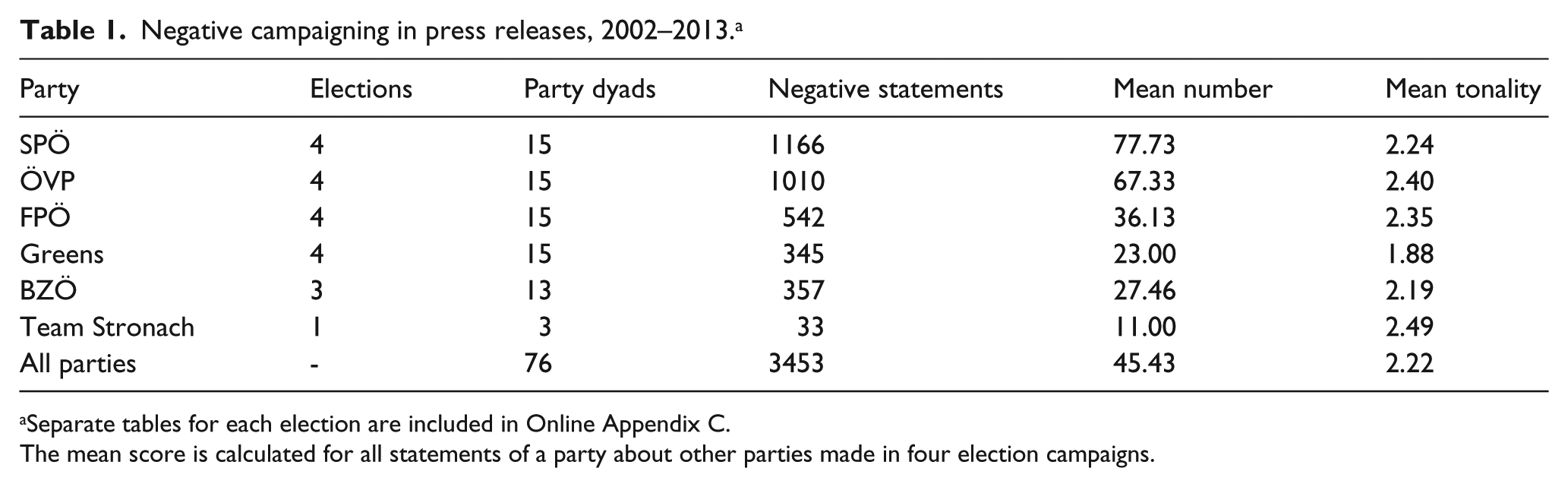
Separate tables for each election are included in Online Appendix C.
The mean score is calculated for all statements of a party about other parties made in four election campaigns.
Results
Figure 1 displays the tonality and frequency of negative campaigning. Each panel shows whom a party addressed, how often and how negatively. For both the SPÖ and ÖVP, their frequent coalition partner was always the most targeted party. 5 However, the tonality between them is slightly lower in campaigns following a coalition government of these two parties (2008 and 2013). The pattern is more evident for the SPÖ than for its junior coalition partner (ÖVP). The ÖVP prematurely ended the ‘grand coalition’ with the SPÖ in 2008, which translates into numerous, quite strongly worded statements directed at the SPÖ. In 2013 the ÖVP campaign was quite negative, with its strongest criticism hitting the opposition parties FPÖ and BZÖ. A clear pattern characterizes how the FPÖ dealt with the ÖVP. In 2002 the FPÖ was still a government party and its rhetorical attacks against the ÖVP were bland. Even though the ÖVP poached its voters and even ministers (the ÖVP presented Karl-Heinz Grasser, the FPÖ’s most popular cabinet member, as an ‘independent’ candidate for the Ministry of Finance), the FPÖ was still hopeful the coalition would be renewed, which in fact happened. After the FPÖ dropped out of government (due to its ministers and almost all MPs joining the party split-off BZÖ in 2005), it criticized the ÖVP in subsequent campaigns more strongly than other parties. On average, opposition parties issued more virulent attacks against government parties than at other opposition parties.

Mean tonality and number of press release statements on rival parties in Austrian parliamentary election campaigns.
Figure 2 provides bivariate evidence that again reveals differences between the frequency and tonality of negative campaigning. The average number of negative statements exchanged between coalition partners is twice (about 103) the number of statements traded between government and opposition parties (about 52). Opposition parties rarely targeted each other in the four campaigns studied (11). However, campaign tonality shows something different. Opposition parties addressing government parties and vice versa issued the most negative statements, with a mean tonality score of 2.36. Statements between government parties were less negative (mean tonality of 2.05) as were statements between opposition parties (mean tonality of 2).

Mean number and mean tonality of negative messages by type of party dyad.
Concluding with multiple regression models, we employ a negative binomial regression model for the count variable frequency and an multiple ordinary least squares regression model for tonality. The reference case in each model is the aggregate party dyad for statements that cross the government-opposition divide. To directly compare effect sizes and to facilitate their interpretation, we provide marginal effects plots (Figure 3). Model specification includes election years as fixed effects and bootstrapped standard errors. Table 2 shows the regression coefficients and Figure 3 plots the marginal effects (robustness tests in Online Appendix D confirm the results reported below).

Marginal effects plots from the negative binominal regression model for the frequency and the ordinary least squares regression model for the tonality of campaign statements.
Explaining negative campaigning: negative binomial regression (frequency) and ordinal least squares regression (tonality).

BIC: Bayesian information criterion; Gov: government; Ln: Natural logarithm; Opp: opposition.
Bootstrapped standard errors in parentheses (200 replications); *p < 0.05, ***p < 0.001
The hypotheses expect a lower tonality of negative campaigning involving two coalition parties or two opposition parties than negative campaigning between parties crossing the government-opposition divide. Table 2 and Figure 3 show that based on the number of negative statements, there is no restraint between coalition partners (they trade, on average, 38 negative messages more than the control group but the effect is not significant at conventional levels). However, these parties refrain from virulently attacking each other. On average, statements targeting a coalition partner are 0.38 units less negative than statements crossing the government-opposition divide. We illustrate the difference with an example from the 2013 election. SPÖ statements on its coalition partner, ÖVP, in this campaign have a mean tonality of 2.06, compared to a mean tonality of 2.46 for its statements addressing the FPÖ as the main challenger party from the opposition. At the level of individual messages, 11% of the SPÖ statements about the ÖVP were very strongly negative, compared to 26% of its messages targeting the FPÖ. Thus, about one in 10 negative campaign statements of the SPÖ targeting its coalition partner were very strongly negative. To the contrary, more than a quarter of its attacks on the main opposition challenger, the FPÖ, were very strongly negative.
Similarly, opposition parties address each other with lower tonality compared to attacks crossing the government-opposition divide (0.27). The most virulent attacks in four election campaigns oppose opposition parties to government parties and vice versa. Opposition parties also attack each other less often compared to negative campaigning that crosses the government-opposition divide (on average, 29 fewer negative messages). Turning to the control variables we find that the intensity of competition increases the frequency and tonality of negative campaigning (on average 23 attacks more, or a 0.35 increase in campaign tonality). Left–right distance between parties neither affects the frequency nor the tonality of negative campaigning.
Conclusions
Studying negative campaigning, this manuscript investigates the electoral dilemma of coalition parties. These parties have to govern together, but at the same time emphasize differences with their coalition partner(s) to appeal to voters and partisans (Sagarzazu and Klüver, 2017). Presenting a graded measurement of negative campaigning, our findings reflect this dilemma: whereas coalition parties direct large volumes of ‘friendly fire’ against their coalition partners (De Nooy and Kleinnijenhuis, 2015; Dolezal et al., 2015), the tonality of these messages was restrained. Opposition parties tend to spare their peers and focus on attacking the ruling coalition to achieve (partial) alternation. Hence, the tonality of negative campaigning follows a pattern of bloc competition opposing government to opposition parties.
Understanding why coalition parties ‘go negative’ is important, because negative campaigning could (pre)determine the formation of future government coalitions. If a party burns bridges with potential coalition partners, this may seriously compromise its chances in post-electoral coalition negotiations, either because no other partner is willing to form a government with that party, or because it minimizes the set of viable options and thus limits the party’s bargaining power. Heated electoral campaigns and virulent attacks among coalition partners may also delay coalition negotiations and the formation of a new government. This could be problematic as caretaker governments typically lack the capacity to implement major policy reforms and are less able to respond to external shocks, such as an economic crisis (Golder, 2010).
Beyond that, our measure of campaign tonality reveals substantive differences with dichotomous measures of negative campaigning. These definitions have been criticized for their lack of discriminatory power (Fridkin and Kenney, 2011; Kahn and Kenney, 1999), but concerns prevailed that a refined measurement may not travel well to large-scale content analyses of party communication (Lau and Brown Rovner, 2009). This manuscript shows that crowdcoding (Haselmayer and Jenny, 2017; Benoit et al., 2016) enables efficient and reliable analyses of campaign tonality.
This manuscript analyses four election campaigns in one country. Studying the tonality of negative campaigning in a cross-country design offers the potential for several topics at the intersection of electoral competition and government formation. Such studies would gain leverage through variation in institutional rules or by exploring various predictors of a party’s government potential (Martin and Stevenson, 2001). Studying campaign tonality could further extend our understanding of bargaining duration and delays (Golder, 2010) caused by mutual distrust due to virulent attacks among potential coalition partners.
The relationship between government termination (Laver, 2003; Lupia and Strøm, 1995) and negative campaigning likewise appears worthy of study. Intra-coalition conflict ending with premature government termination reduces the probability of a coalition’s renewal after the election (Tavits, 2008), which could already be reflected in the tonality of party statements during the campaign. Campaign tonality could thus improve models that aim at studying the life-cycle of coalitions (Müller et al., 2008).
We also see rewards in extending research on the dynamics of negative campaigning (Dolezal et al., 2016) to study the tonality of campaign messages or investigate patterns of retaliation among government and opposition parties. Similarly, future research could devote more attention to variation in the tonality of the campaign messages government parties direct at the opposition and vice versa. Exploring whether a junior coalition partner issues more strongly negative messages against challenger parties that might replace it in government and testing whether opposition parties are in general more likely to use strongly worded attack messages seems particularly worthwhile. Finally, exploring the wealth of negative campaign messages may contribute to studies on its effects. Scholars examining differences between weak expressions of criticism and virulent attacks or uncivil messages find that exposure to the latter may produce negative feelings about politics and democracy (Mattes and Redlawsk, 2015; Fridkin and Kenney, 2011; Mutz and Reeves, 2005). This suggests different effects for mild and strongly worded criticisms. Understanding which negative messages convince voters, produce lower turnout or turn voters away from politics would have broad implications for society and voter perceptions of democratic quality.
Supplemental Material
Friendly_fire_Appendix_R2 – Supplemental material for Friendly fire? Negative campaigning among coalition partners
Supplemental material, Friendly_fire_Appendix_R2 for Friendly fire? Negative campaigning among coalition partners by Martin Haselmayer and Marcelo Jenny in Research & Politics
Footnotes
Acknowledgements
We thank Wolfgang C. Müller, Susumu Shikano, Thomas M. Meyer, Markus Wagner, panellists at the 2014 IPSA General Congress and participants of the 2015 Austrian National Election Study (AUTNES) Workshop on Dynamics in Party Communication for valuable comments and suggestions. We are thankful for comments and suggestions of our anonymous reviewers and the assigned editor, Indridi H. Indridason. We further thank Maximilian Böck for research assistance and our anonymous crowdcoders.
Declaration of conflicting interest
The author(s) declared no potential conflicts of interest with respect to the research, authorship, and/or publication of this article.
Funding
The author(s) disclosed receipt of the following financial support for the research, authorship, and/or publication of this article: Research for this paper was conducted under the auspices of the AUTNES, a National Research Network funded by the Austrian Science Fund (S10903-G11, S10908-G11).
Supplemental materials

Notes
Carnegie Corporation of New York Grant
This publication was made possible (in part) by a grant from the Carnegie Corporation of New York. The statements made and views expressed are solely the responsibility of the author.
References
Supplementary Material
Please find the following supplemental material available below.
For Open Access articles published under a Creative Commons License, all supplemental material carries the same license as the article it is associated with.
For non-Open Access articles published, all supplemental material carries a non-exclusive license, and permission requests for re-use of supplemental material or any part of supplemental material shall be sent directly to the copyright owner as specified in the copyright notice associated with the article.
