




Abstract
Mainstream television scarcely features Deaf persons. When they do, they are usually cameo, secondary, and rarely multidimensional characters. This paper examines Deaf identity of a main character, Daphne Vasquez, on the popular show Switched at Birth. We analyze moments where Daphne’s identity, a constructed Deaf identity, is showcased. We map how her identity is salient across seasons and then examine key moments of identity formation as Daphne negotiates her Deafness. We find a strong display of Deaf identity salience and impactful moments in the show that resulted in more positive, holistic representations of Deafness. In recent years, the media has come under increased scrutiny for limited representations of minority identities; this case study seeks to contribute to that conversation by studying a show explicitly focused on increased representation. This work is important as it not only examines a show which successfully features a character with a traditionally stigmatized identity but simultaneously quantifies how that identity is invoked as a message to viewers. This paper bridges cultural sociology with social psychology to gain a deeper understanding of the importance of identity representation in entertainment media and comments directly on the social impact of Daphne’s character on Deaf presence in 21st century media.
Introduction
Media representation of Deaf identities and culture is rare (Ellcessor, 2015). The lack of representation is particularly problematic as many prejudices about Deafness and Deaf culture come from a lack of understanding about the Deaf experience in the US (An et al., 2014; Holcomb, 2012). Deaf people are often stigmatized and experience ableism based on hearing status and disability (Holcomb, 2012; Leigh et al., 2016). Ableism is a socially constructed form of institutional oppression. It is historically and culturally determined by those in power, and then reinforced through processes that place distinct value and preference on non-disabled persons (Campbell, 2009; Friedman & Owen, 2017; Chapman, 2021). Due to ableism, media representations that show complex and culturally accurate depictions of Deaf persons are limited. We therefore present a case study of how a complex representation of Deaf identity was shown in mainstream media and has consequently increased pathways of representing Deaf identities in mainstream media.
Switched at Birth aired in 2011 on ABC family, a subsidiary of the Walt Disney Company, designed to offer contemporary, family-oriented programming targeting a wide audience (Farris, 2018). Switched at Birth aired with 3.3 million household viewing, making it the largest ABC family series debut at the time. Average viewership across seasons 1–3 was 2.08 million (S1), 1.72 (S2), and 1.42 (S3); it remains one of the most successful ABC family television shows produced, bringing in numerous awards (Switched at Birth season 1, 2012; Switched at Birth season 2; 2013; Switched at Birth season 3, 2014; IMDB, 2017). Switched at Birth was one of the first mainstream TV shows to feature a Deaf person as a main character and has multiple Deaf characters and scenes that were entirely in American Sign Language (An et al., 2014). Switched at Birth was created with some consultation from Deaf individuals, and the level of consultation increased as the show progressed; however, much of the production team approached the story from a hearing perspective, attempting to use the Deaf example as a broader example of difference (Ng, 2012). The fictional dynamic is crucial because it offers insight into the way the identity was understood by the creators of the show and the direction Deaf representation has gone since the show concluded.
We examine the identity salience of the main Deaf character Daphne Vasquez, the presentation of her Deaf identity in the show and its trajectory throughout the key moments in the first three seasons. Identity is situational; therefore, one way of tracing identity salience is measuring how often a specific identity is invoked within life in relation to other identities held by a given person (Stryker, 1968). We argue, by exploring moments of identity formation and identity salience of Deafness, we are able to examine a case study for the representation of stigmatized identities in media. Switched at Birth provides a concrete example of the way Deaf identity can be shown in mainstream media. The show attempts to center language, community, and culture; it explores the Deaf Gain, rather than depicting the traditional paradigm of hearing loss (Bauman & Murray, 2014). Deaf Gain is a theoretical perspective that highlights Deafness as a positive example of human diversity that benefits society, it is a way of understanding Deafness as something to be celebrated when gained (Bauman & Murray, 2014).
Daphne is a member of the big “D” Deaf community. She embraces Deaf Gain and consistently explores her Deafness throughout much of the show. Daphne was born hearing and grew up with a hearing mother, who learned to sign with Daphne after Daphne became Deaf in her early youth. Daphne is a balanced bicultural Deaf person, meaning she is comfortable in hearing and Deaf communities (Holcomb, 2012; Chapman, 2021). 1 We note that Daphne represents one Deaf person, and her story is a single fictional story amongst a large spectrum of real stories and experiences in the US Deaf, deaf, and Hard of Hearing communities.
By tracking identity across a show, such as Switched at Birth, key identity concepts are operationalized. Though people will possess and enact multiple identities, these will exist in a hierarchical fashion where some identities will hold more importance to the character and their respective storylines, resulting in various levels of salience to track (Stryker & Serpe, 1994). Stigmatized identities in society can require more identity work to present them in a non-stigmatized and diverse way on screen. Stereotypes and biases held about identities influence the writing that takes place; in addition, the lack of diversity in media has led to errors in representation of disability (Darrow, 2015; Chapman, 2021). Deaf persons are often presented as less capable than hearing persons or are made to be abstract because their representation is conceptualized from an ableist and hearing perspective, not a Deaf one (Holcomb, 2012). To present the Deaf identity as different, not less than, and maintain a commitment to improving the construction of diverse storytelling, more attention to the process of identity salience is required (Goffman, 2009; Snow & Anderson, 1987). Identity work is the process people engage in “to create, present, and sustain personal identities that are congruent with and supportive of the self-concept” (Snow & Anderson, 1987, p. 1348); it requires constant reaffirmation of an identity in different roles and social spaces as well as targeted cultural snapshots into the processes behind identity formation.
Literature Review
What Do We Mean When We Talk About Identity?
Identities are the self-meanings oneself and others attribute to that person in a role (Burke & Reitzes, 1981). Identities are constructed both internally and externally as they find significance in their social and relational contact with others (Gergen & Gergen, 2006; Fiani & Han, 2019; Stryker & Burke, 2000; Taylor, 2006). Identities are, therefore, an individual’s internalized role designations (Stryker & Serpe, 1994; Stryker & Burke, 2000), which are expressed outwardly in processes of identity questioning and navigation (Lawler, 2008). Cooley (1968) argues that we only understand ourselves in relation to society’s given social norms and values; this concept is important for grounding identity research in cultural contexts. McGann (2014) argues that individual and social identities do not always align; a person may see themselves differently from how they portray themselves in the social world. For example, someone who knows that they are LGBTQ+ may not be out to friends and family; they may portray a different identity in the social world. McGann (2014) asserts that identity is not something individuals have per say; rather, it is a process that materializes from versatile interplay with the social world; in this way identity is not fixed, it is constantly negotiated.
We primarily utilize the Model of Multiple Dimensions of Identity that recognizes that identity exists and changes across time, space, and social surroundings, enabling us to look at the cross sections of identity experienced by Daphne and see the salience of her Deafness as it interacts with other aspects of her storylines (Jones & McEwen, 2000). This model centers identity formation as complex due to the interdependent nature of identities. It also emphasizes the individual in navigating their identities, with aid from outside sources, a process that is artificially created with Daphne’s interactions with hearing and Deaf individuals within her life.
In this process, a key, sometimes minimized aspect of identity arises, the aspect of embodiment. Embodiment focuses on the way that interactionally, socially determined identities are grounded by the body and the state of a person’s physical being (Meier et al., 2012; Siebers, 2019). Daphne’s identity as Deaf is socially created and understood, but it is also embodied in her relationship with sound and the movement of her hands as she uses ASL. She physically shows the audience her Deafness as she navigates the multiple dimensions of who she is and what that means on screen.
What is Deaf Identity?
Deaf identity is personal and intrinsic (Carter, 2015; Holcomb, 2012). While someone chooses to identify as Deaf or as a person who has deafness/hearing difference, much of what forms potential affiliation with Deaf identity comes from Deaf culture (Bat-Chava, 2000; Chapman, 2021; Holcomb, 2012; Walzlawik, 2012). Many individuals are acculturated into the Deaf community through the sharing of cultural knowledge and language. Identifying as Deaf with a capital D is a culturally driven identity formation showcasing an identity shaped by community, language, and social position (Bauman & Murray, 2014; Chapman, 2021; Holcomb, 2012; Ladd, 2003). A large part of Deaf identity is the Deaf community’s embraced status as a linguistic minority rather than a group with a debilitating impairment (Holcomb, 2012). Within the Deaf community, hearing loss is reframed as Deaf Gain. Deaf Gain embraces the diversity model of disability, explaining that physical hearing difference does not create the status of deaf or disabled, but rather the environment and hearing society does (Hole, 2007; Shakespeare, 2006). This body of scholarship frames Deafness as a different, not a lessened, way of experiencing the world based on unique language, community, and values (Holcomb, 2012; Hole, 2007). Part of understanding the Deafness is understanding the prejudice and discrimination the Deaf community have faced both as a part of the larger disabled communities of the US and as their own community (Carter, 2015; Chapman, 2021; Ladd, 2003; Leigh et al., 2016).
By understanding Deafness not as a pathologized disability but as an embodied culture and identity, it enables a deeper understanding of the community and their experiences (Bienvenu, 2008; Carter, 2015; Chapman, 2021; Siebers, 2019; Watzlawik, 2012). Recognizing the place of subjectivity and agentic selves within larger collectives is uniquely important to understand how individuals are both brought together by external happenings and may choose to stay together to better understand their communal state of being (Fiorito, 2019; Walkerdine, 2016). There is a “we-ness” in identity; a Deaf identity is collective in nature. Collective identities are common for stigmatized groups who share experiences and social locations (Beckner & Helme, 2018; Fiorito, 2019; Taylor & Whittier, 1992), yet at the same time, danger arises if the collective identity is relegated to a single portrayal, rather than a diverse set of examples within larger collective conceptualization; it is crucial to show varying intersections of identities and the consequences of those identities across distinct social situations to accurately represent diversity within a particular identity group (Chapman, 2021).
The majority of Deaf identity research focuses on the identity development of Deaf persons (Glickman, 1993; Glickman & Carey, 1993; Hole, 2007; Kunnen, 2014; McIlroy & Storbeck, 2011; Mauldin & Fannon, 2021). Deafness actively shapes Deaf person’s life (Hole, 2007) and influences identity formation much earlier than other identities (Kunnen, 2014). More research is needed to examine not only how Deaf identity forms in youth but how it continues to develop throughout life, its impact on Deaf culture, representation, and pride, as well as the nuances and hierarchies of Deaf identity in the context of other identities.
What is Identity Salience?
Understanding that Deaf identity is not the only identity people hold is important to advancing research on Deaf identity. People hold multiple identities with varying levels of salience (Thoits, 2012). Identity salience is the probability of invoking a role or identity in situations not relating to a given identity; the more salient identities are, the higher in the hierarchy of identities they will be (Stryker & Burke, 2000; Stryker & Serpe, 1994). There are two facets to identity salience, the interactional commitment to identity as listed above and the emotional attachment or affective attachment to the identity, meaning how invested someone is in maintaining the identity as well as emotional commitment and attachment to it (Owens et al., 2010; Stryker & Burke, 2000; Stryker & Serpe, 1994). Big “D” Deaf is when one is culturally Deaf and proud of that position. A Deaf individual often utilizes their deafness as a part of their broader personal identity, such as one does with sexual orientation, race, and gender identity (Mauldin & Fannon, 2021). Through studying Deaf individuals with multiple stigmatized identities, researchers have found that a Deaf identity has comparable importance to other stigmatized identities (Chapman, 2021; Mauldin & Fannon, 2021).
What Exactly is Representation in the Media and Why is it Important?
Representation of marginalized groups in the media is a key issue on the path to social equality. Media is something we interact with every day; when particular groups of people are not represented or underrepresented, it can devalue their existence and identities (Howarth, 2002). When people are exposed to familiar or self-reflective characters, they often identify positively with them (Mastro & Kopacz, 2006); however, when differences or stereotypes of marginalized groups are highlighted in a negative way, the audience tends to internalize those views (Jaspal & Cinnirella, 2010; Schmitz et al., 2003). Accurate representations of marginalized groups in the media can act as a catalyst towards mainstream acceptance of marginalized communities (Signorielli, 2009).
Garnham (2000), Johnson and Dunlap (2011), and Moses et al. (2018) highlight how the perceptions of all viewers, especially in many minority and marginalized sectors, are highly influenced and emancipated through the media. Studies have shown that the self-esteem of a child is higher when they see people like themselves in the media (Martins & Harrison, 2011; Woolley, 2012). This is important, especially for Deaf children’s development. A reported 95% of Deaf individuals come from hearing families, leaving them without a strong deaf/Deaf role model in their home lives (Moses et al., 2018). Researchers have found that feelings of inferiority can appear when children do not seem themselves, or how they identify, at school, in their home lives, literature, or in media (Derman-Sparks & Edwards, 2010; Hurley, 2009; Moses et al., 2018). By including Deaf individuals in media, particularly in meaningful ways, Deaf individuals can gain a sense of identity and self. Instances as simple as seeing another Deaf individual in the media can substantiate and assert the existence of a Deaf child (Moses et al., 2018; Nilsson, 2005). Children’s motivation and learning skills can also be strengthened by mirrored representation (Moses et al., 2018).
Media representation can also positively influence the ideas surrounding the culture of a group as a whole and identity cannot be understood without culture (Watzlawick, 2012). Increased exposure to positive representations will lead to less implicit biases across various minority groups (Morehead & Andrade, 2020). Through positive representation, less cultural stereotypes will exist (Morehead & Andrade, 2020). The effect of positive representation has been demonstrated across other marginalized populations; positive depictions of gay men in media has led to reduced homophobia (Madzarevic & Stot-Sanfiel, 2018). Media representation of various groups, including Deaf individuals, allows people to understand that there is not just a single stereotype for a group of people, and that people are not limited by their social identity (Chapman, 2021; Sreberny, 2005).
However, not all representations are good representations. Negative representation can have damaging consequences not just for individuals but for groups’ identity pride and community strength (Jaspal & Cinnirella, 2010). Negative representation can also be particularly damaging for those with already stigmatized identities (Gauntlett, 2008; Sreberny, 2005). Research has shown that negative depictions of marginalized populations has led to negative interpretations of their collective actions (Mastro & Kopacz, 2006). These stereotyped depictions have an adverse effect on policy decisions and voting behavior, further disempowering minority groups (Kidd, 2016). Thus, crucial policy decisions can be swayed based on representation.
Switched at Birth shows Deaf people as intelligent agents of their own lives, but media that depicts the expression of Deaf Identities this way are rare. Historically, Deaf characters tend to be stereotyped as being lonely, isolated, angry, broken, and rarely use American Sign Language (Moses et al., 2018). The show is credited as the largest example of a Deaf ensemble cast on television; a community driven project generated by the growing Deaf Hollywood community (Farris, 2018).
Methods and Data
This paper focuses on the first three seasons of Switched at Birth, 73 episodes, entirely produced by ABC Family, before the channel began to rebrand as Freeform and potentially impact the trajectories of characters on screen (Farris, 2018). These initial seasons focused on finding out about the alternative cultures, identities, and experiences each child may have had, had they not been switched at birth. This context in tandem with normative identity development in highschool makes the first three seasons an ideal site for this study. The quantitative and qualitative data for this project comes from scenes featuring the main character Daphne Vasquez as she navigates her Deaf identity; the scenes were selected as key points within each respective season and the show in entirety. Quantitative data was collected by tracking whether or not Daphne enacted her Deaf identity and the social-cultural context of the scene. Our general counting method was then mapped with a simple linear regression to show identity salience trends across seasons. We also gathered and analyzed qualitative data on (1) the broad narratives Daphne’s character has about her identity across seasons to better conceptualize how her character serves as a media representative of Deaf identity and (2) moments where her identity is actively shaped or challenged by her relationship with her Deafness and her place within the Deaf community.
Quantitative data was collected from each of the 73 episodes of Switched at Birth. Episodes were viewed by undergraduate research assistants and evaluated for situations in which Deaf identity was displayed in interactions between Daphne and her surroundings. RAs were instructed to code each episode for when Deaf and non-deaf identity was invoked by Daphne. Deaf identity was counted anytime Daphne referred to being Deaf explicitly or implicitly. Non-deaf identity was counted anytime Daphne referred to being a part of an identity category or group with a shared experience and/or culture (i.e., basketball player, cook, and Latina). When a Deaf or non-deaf identity was counted, RAs were also instructed to record whether the situation was Deaf or non-deaf. A Deaf situation was largely classified through linguistic and cultural indicators; Deaf situations within the show included scenes where ASL was the default language in use such as a scene where the conversation was conducted only or predominantly in ASL, typically this occurred within a character’s home, at the local Deaf school, or at an event designed for the Deaf community. Situations that did not meet these criteria were categorized as non-deaf situations.
In review of the show, the research team identified 4 situational categories to describe and track how Daphne’s Deaf identity salience was written. The four categories were based on the actions of when Daphne invoked her: (1) Deaf identity in Deaf situations (at Carlton School for the Deaf or with her Deaf friends), (2) Deaf identity in non-deaf situations (e.g., with hearing friends, at work with hearing co-workers, or doing extracurricular activities beyond her Deaf school), (3) non-deaf identities in Deaf situations (at Carlton School for the Deaf or with her Deaf friends), and (4) non-deaf identities (cook, basketball player, and Latina) in non-Deaf situations (including bi-cultural spaces), for example, in public places, work, or family. The initial viewing served as the basis for or quantitative tracking of identity salience. A second viewing of Switched at Birth served as the basis for our qualitative data analysis. Broader, overarching storylines, beyond individual episodes, were recorded as well as the key moments of identity shaping and identity challenges embedded within these larger storylines.
In our investigation of Daphne’s character, we ask (1) how salient is Daphne’s Deaf identity within constructed bicultural storylines, as well as (2) what do the moments of exploring her Deaf identity in the story showcase about Deafness? Tracking how Daphne invokes identities across these seasons, shows the trajectory of her Deaf identity as imagined by the writers and played out on screen. To test the salience of Daphne’s identity, we have three hypotheses: (1) Daphne’s Deaf identity will be the most salient identity invoked by her during the series, (2) as Daphne develops as a character, her Deaf identity salience will decrease as other aspects of her intersectionality are highlighted, and (3) Deafness will remain the most prominent in Daphne’s self-concept. In addition to tracking and mapping the salience of identity through the invocation of her Deafness, we offer a close analysis of key moments in which her Deaf identity is showcased and how those moments impact the representation of Deaf identity Daphne embodies.
As hearing researchers, we recognize our limitations engaging with topics related to the complexities of Deaf identity and community and rely on the expertise and knowledge of Deaf scholars to guide our thought and analysis, positioning it within the larger study of media and society. Our approach aims to provide a clear and accessible analysis of Deaf identity representation with the study of media. Scripted media is not a direct reflection of everyday life; it is more accurately a reflection of what writers or content creators imagine it to be.
Findings and Discussion
Daphne Vasquez’s Journey: An Overview
Over the course of the television show, Daphne’s Deaf identity, embodied in her use of language and her hearing status, is shown to viewers as a window into the Deaf community; she is shown as a bridge between two worlds—Deaf and the hearing. In season 1, Daphne learns she was switched at birth and upon reconnecting with her hearing, wealthy, and white biological family, she experiences cultural tensions with her own identities of Deaf, working class, and Puerto Rican. Over the season, we see her Deaf identity challenged and invoked, tested externally by family, new friends, and in extracurriculars. In season 2, we see Daphne’s Deaf identity solidified in situations with family, friends, and schooling; however, we get intense moments of outside conflicts where Daphne must invoke her Deaf identity in the form of advocacy and when processing trauma. In season 3, Daphne revisits tensions around how her Deafness will impact her education and career. In addition, she explores how her other identities, such as being raised Latina, are a part of who she is, but do not impact her the same way her Deafness.
Daphne’s Journey: Defining Moments
The Beginning
When Daphne is introduced to audiences, she invoked her Deaf identity on the highest frequency of occasions, explaining to other characters and the audience her positionality. Soon after meeting her biological family, while playing basketball with her biological brother, she says: “you can talk as much trash as you want, I can’t see your lips, I can’t hear you!” (Daphne, S1, EP1). She then throws a ball into a hoop after faking out her brother; this is an establishment of her Deaf identity and renegotiation of common misconceptions of Deafness based on ableism. Though her status may cause her drawbacks or hazards in a hearing privileged world, it also gives her advantages where others would not expect. Later in the episode, on a tour of a school, Daphne meets a hearing student and states she is Deaf before even giving her name; this gives subtle insight into her awareness that her Deafness is always relevant and is a primary part of her identity overall. Daphne also invokes other identities that further layer her position as uniquely herself; she is Puerto Rican from East Riverside, a vegetarian, a cook, a basketball player, a good student, and a teenage girl; these additional identities create parallel and intersecting storylines around how these identities, lower on her hierarchy of identities, impact her life compared to or in connection to her Deafness (Jones & McEwen, 2000).
Deafness, Accessibility, and Agency
In season 1, Daphne joins a cooking class at a private, hearing school. At first, Daphne wants to avoid highlighting her Deafness by using an interpreter and attempts to take the course by herself, relying on her lip reading skills; however, the lack of accessibility in the classroom causes social stigma for Daphne from peers, and leads to an accidental fire in the class when Daphne does not hear a timer go off. In response, Daphne is forced to take the class with an interpreter and receives pressure from her biological family to consider getting a cochlear implant to change her engagement with sound. Daphne asks her mother Regina, who raised her, “Why didn’t you get me the cochlear” (Daphne, S1, EP6). Regina explains she considered it before they found their way into the Deaf community and “learned better” about the controversial aspects of it (Leigh et al., 2016). Regina tells Daphne that if she wants to get one, they will consider it again. Regina goes on to advise Daphne that she must bring a timer with lights to the class and work twice as hard as others because the world is made for hearing people. Daphne struggles with the idea that she must always work twice as hard and the constant social stigma present in the hearing, ableist environments around her. Regina combats her worries by reasserting core aspects of what it means to be Deaf, stating “You are a part of an amazing community, you have your own language and history” and warning her that a cochlear implant may take parts of that away (Regina, S1, EP6).
The cooking class is presented as inaccessible to Daphne, designed to highlight challenges faced by Deaf/deaf/hard of hearing individuals in hearing spaces.
The inaccessibility of the cooking class serves as a catalyst for Daphne to consider ways to fix her impairment, to fix her deafness. This represents common ideas about ableism and the deficit model of disability, which claims Daphne’s inability to hear is a personal deficit which should be fixed or compensated to gain access to the space (Shakespeare, 2006). This is in conflict with the diversity model of disability which explains the issue lies not with Daphne, but the class being designed for only a certain type of body, in this case a hearing one (Shakespeare, 2006). In response to the barriers faced and pressure, we see Daphne begin to navigate more explicitly the tension of a bicultural person, when cultural identities are at odds. She wonders if an implant would alleviate the social barriers she faces. In her considerations, she is reminded of pillars of Deaf identity; her Deafness is shown to be defined by her connection to community, history, and language. In other words, she embodies Deafness as something fundamentally rooted in culture and lived experiences, tied to her physical body and form of communication, but not limited by it (Leigh et al., 2016; Siebers, 2019). Daphne’s agency as a Deaf young adult is shown as she contemplates not only the cochlear implant but how best to navigate hearing spaces when ableism positions Deafness as a barrier and a deficit, rather than a different way of experiencing the world (Holcomb, 2012; Leigh et al., 2016).
Bicultural Position
In Season 1, episode 20, Daphne’s basketball coach addresses the importance of Deaf community and Daphne’s collective identity as a Deaf, explaining, “Hundreds of Deaf people came from all over to see these girls play, Daphne is a role model to them, there’s a whole community out there rooting for this team, do you understand that?” (Melody, S1, EP20)
In response to the pressure, Daphne struggles with being a balanced bicultural Deaf person. She is more than Deaf; though being Deaf is clearly an important part of her identity and self-concept, she is living between two worlds, both of which she belongs to in different ways; she says: I’m telling you; you don’t understand… I don’t want this for me...Emmett's deafness defines him, Melody, too, but I'm just Daphne. If I were hearing I'd still be me, just a hearing Daphne, but like it or not I represent, we all do...I represent every parent at our school, and every little sister and brother and their uncle that teaches at Gallaudet and their Deaf brother-in-law who lives in Japan and heard about the game and emailed me. When you’re part of a small community it's fantastic. You have all these benefits, you go anywhere and see someone Deaf you have instant friends, but also means that everything you do means something, sometimes I just wish I could be Daphne, not Deaf not hearing just a girl playing basketball (Daphne, S1, EP 20).
Daphne’s monologue demonstrates that her self-concept is complicated as she navigates pressure to represent Deaf culture and defy negative stereotypes, but at the same time find her individuality within a collective identity.
Deaf Gain
In season 2, episode 5, “The Acquired Inability to Escape”, Daphne operates a food truck with her friend Travis; Travis is also Deaf. Daphne and Travis are targeted because of their Deafness and robbed. The trauma of the robbery and hate crime leaves Daphne feeling shaken and confused about how her Deafness may have contributed to the situation. In the following episode (S2, EP6), her teacher, Melody gives a lecture on hearing loss reframed as Deaf Gain, a perspective which celebrates Deafness and explains away any negativity or feelings of failure associated with being Deaf because of the community, culture, and experiences that come with it. She explains that children who are born deaf are immediately considered by society as less than right after birth because hearing is the default and to be born differently is wrong. She asks if any of the students would change their Deaf experience if they could, to which no-one would. They go on to explain that as a Deaf person they have a community, perspective, and identity. Mathew, a student in the class, states powerfully, “We’re deaf: first, last, always” (Mathew, S2, EP5).
Daphne struggles to consider this idea when weighing how much easier aspects of her life would be if she was hearing, considering her family, her bicultural situation, and most immediately the attack she faced. When Daphne tells Melody about the attack, she explains, “I was just listening to you tell us today how great it is to be Deaf, about all the privileges we have. Sometimes I believe it, and sometimes I just…don’t” (Daphne, S2, EP6). Melody advises Daphne that one cannot pick and choose what comes with a certain identity, and that she needs to remind herself of what being Deaf means to those in the community and can mean for her. The collective identity shared as a Deaf person is partly shaped by the collective stigma and discrimination faced. “But you can’t pick and choose. You can’t say I want one part of being Deaf but not the whole thing. This is the downside of being Deaf. People will make fun of you. People will target you. You will have to fight twice as hard to be taken seriously. You get a deeper, richer life from being Deaf” (Melody, S2, EP6).
In season 3, Daphne considers applying for the Kansas Latina Merit Award to help pay for college. Daphne’s character was raised Puerto Rican, yet presents as White. In the interview, Daphne focuses on talking first and foremost about her Deafness, despite the scholarship being aimed around her identity as a Latina. “Carlton was great for me, I never felt different or limited by my Deafness, because everyone was Deaf” (Daphne, S3, EP14). Outside of Carlton, she says “People see hearing aids or see you signing and they think something’s wrong with you. Or they feel sorry for you” (Daphne, S3, EP14). The interviewer notices how deeply Deafness has impacted Daphne’s embodied experiences and asks “Can you think of a time where you felt similar discrimination because you’re Latina?” (Interviewer, S3, EP14). Daphne is unable to answer because she realizes that in her life, her Deafness has occupied a different, more salient position than her position as a Latina.
Identity Salience Mapping
Daphne invoked Deaf identity with decreasing frequency across episodes from season 1 to season 3. Daphne invoked non-deaf identities relatively consistently across seasons, although there was a notable shift in season 3 as Daphne contends with her future and associated growing pains (money, college admissions, etc.) (Figure 1). Identity Salience Across Seasons.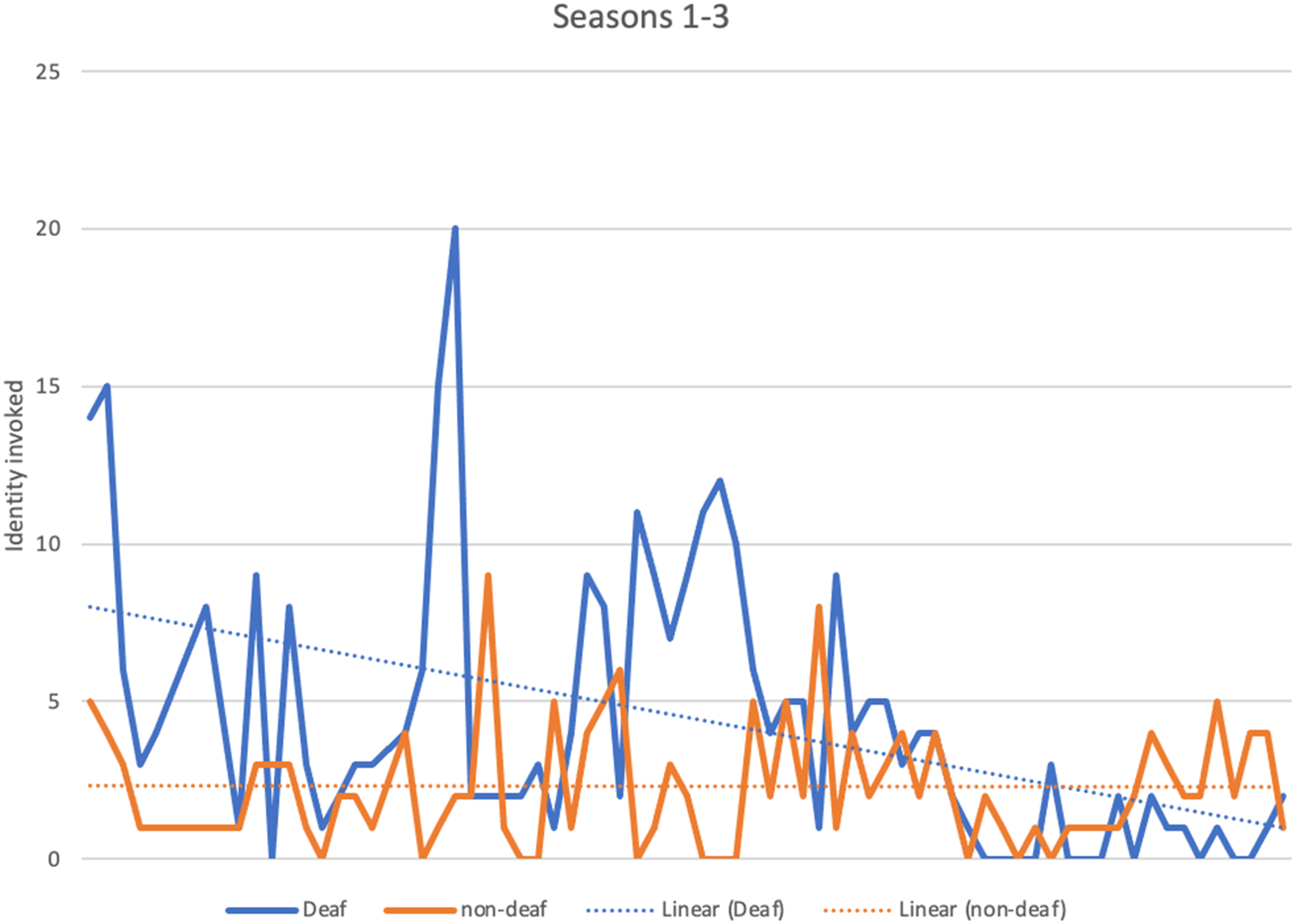
Daphne invoked Deaf identity with decreasing frequency from the first to the last episode of Season 1, with high frequency at the beginning of the season (and series) and lower frequency towards the end, with the exception of a notable spike ¾ of the way through the season when she negotiates a potential new romance and then a new job. Daphne invoked non-deaf identity relatively consistently throughout the season (Figure 2). Identity Salience Season 1.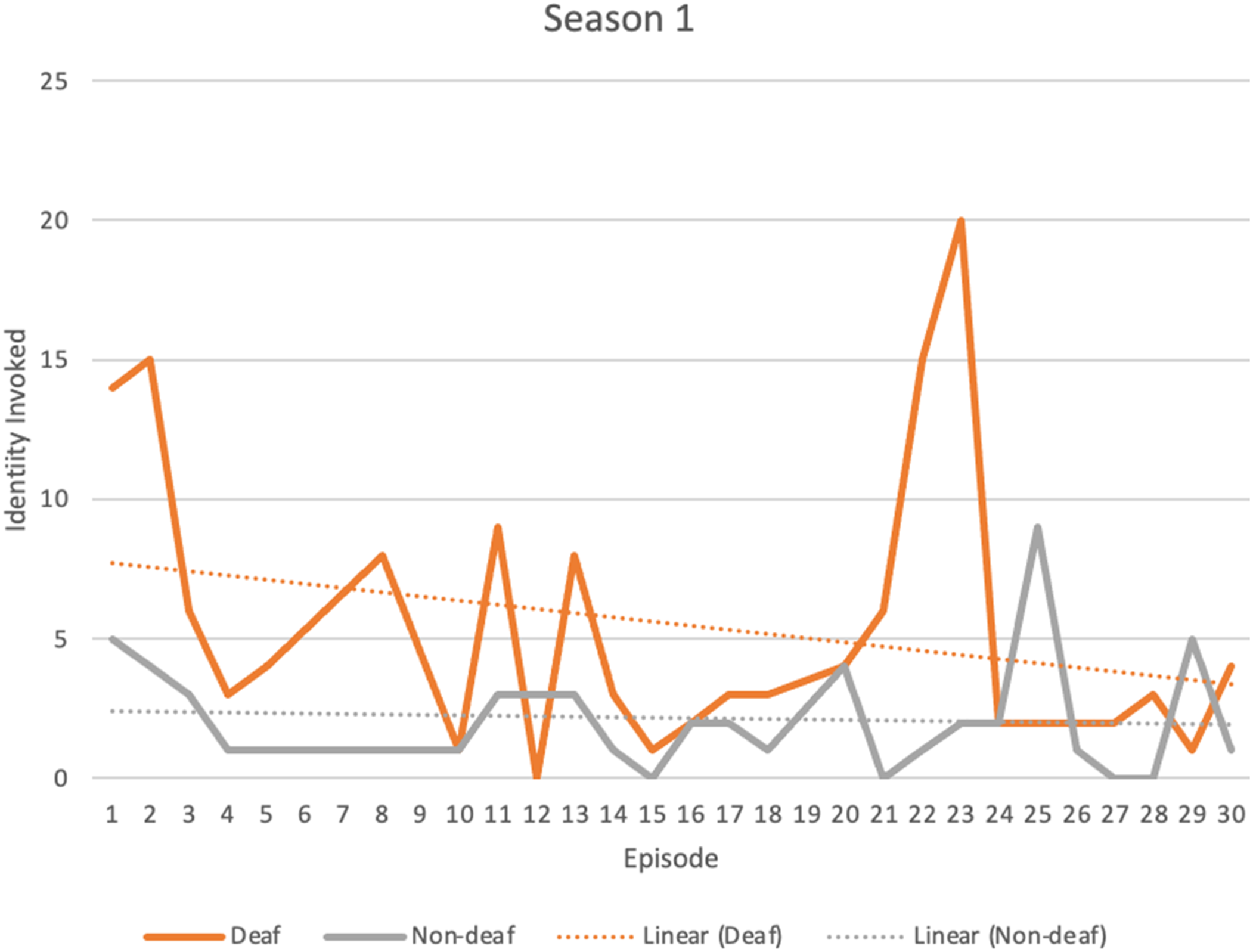
Daphne invoked Deaf identity with decreasing frequency from the first to the last episode of Season 2. Similar to season 1, there was a high frequency of Deaf identity invoked at the beginning of the season and lower frequency towards the end of the season, with the exception of a notable spike ¾ of the way through the season when Daphne grapples with who she is within her family and who she is outside of her family. Daphne invoked non-deaf identity relatively consistently throughout the season (Figure 3). Identity Salience Season 2.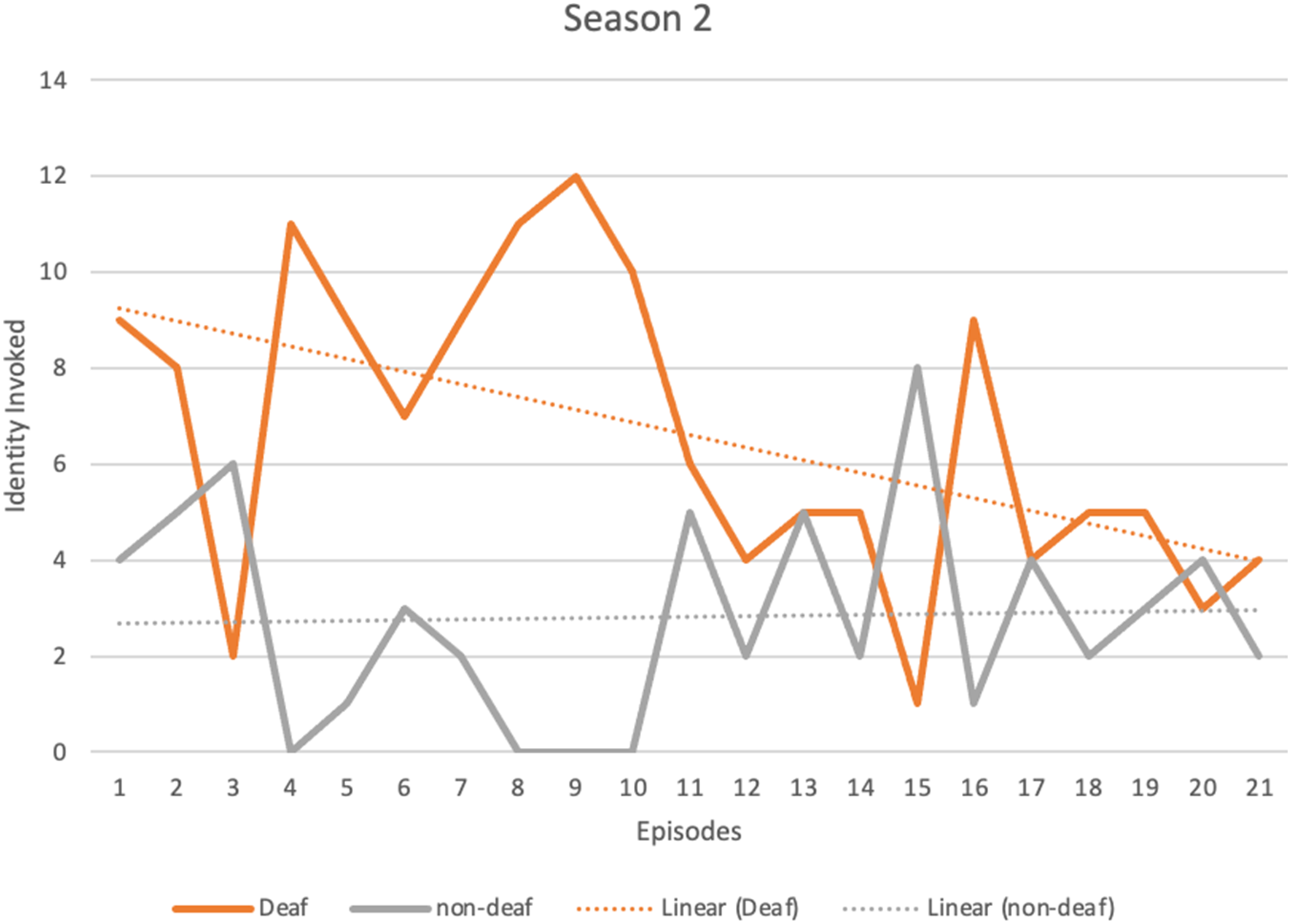
Daphne invoked Deaf identity with decreasing frequency from the first to the last episode of Season 3. Unlike Seasons 1 and 2, Deaf identity was invoked consistently, and gradually decreased across the season. Also unlike Season 1 and 2, Daphne invoked non-deaf identity with increasing frequency across the season (Figure 4). Identity Salience Season 3.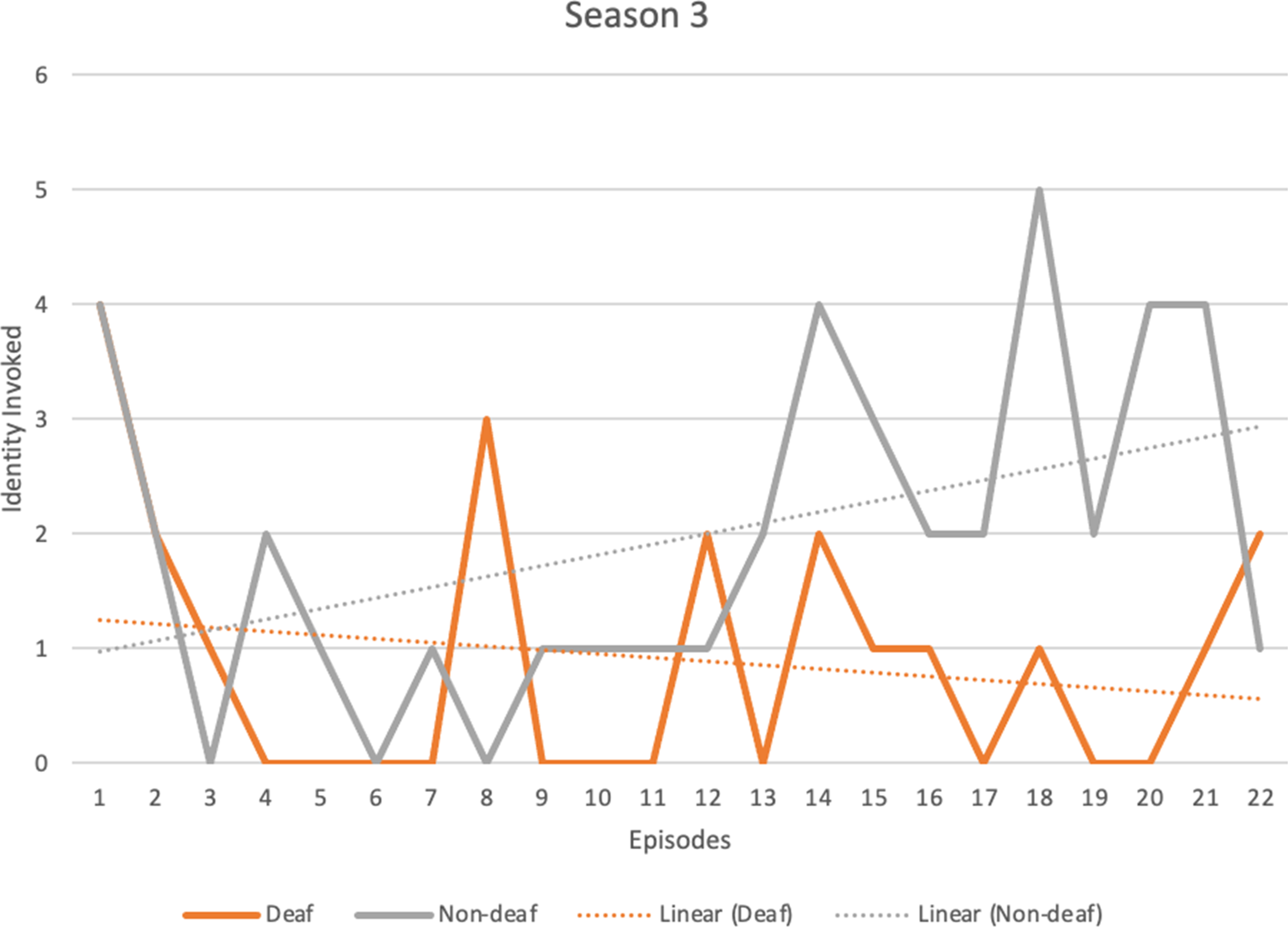
Daphne invoked Deaf identity with decreasing frequency from the first to the last episode of Season 1 in Deaf situations. While less significant, Daphne also invoked Deaf identity with decreasing frequency from the first to the last episode of Season 1 in non-deaf situations (Figure 5a). (a) Deaf Identity Salience Season 1 (Situational). (b) Non-Deaf Identity Salience Season 1 (Situational).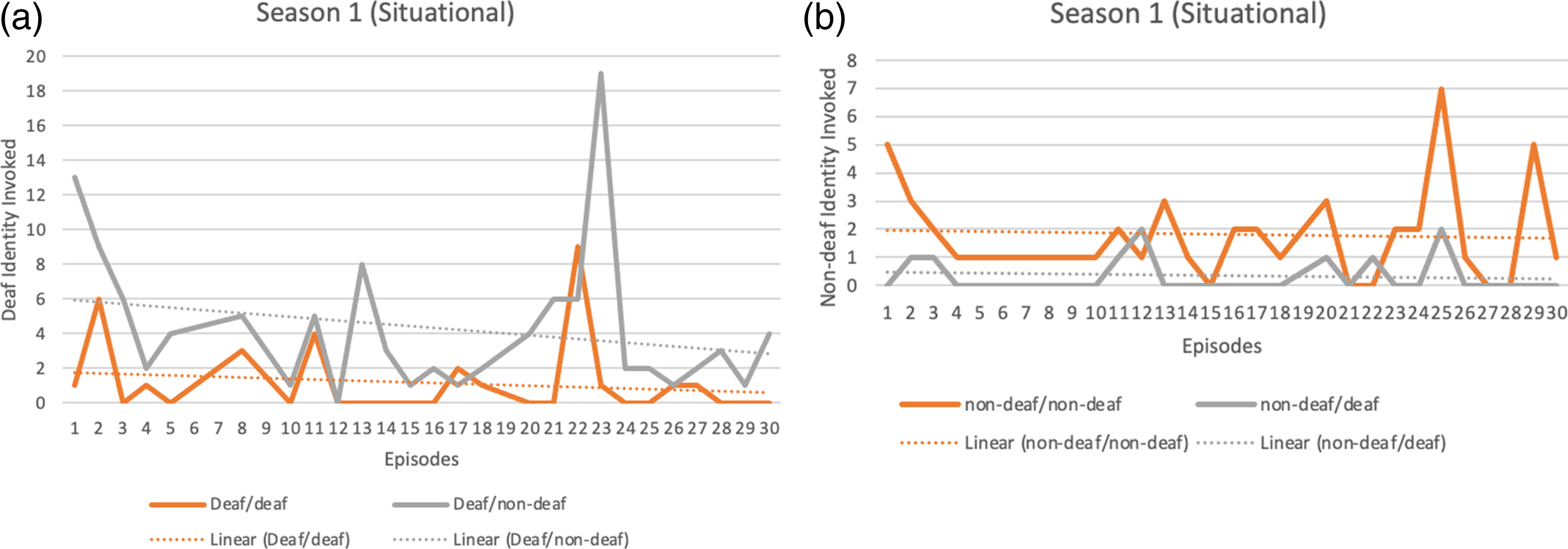
Daphne invoked non-deaf identity with relative consistency from the first to the last episode of Season 1 in non-deaf situations. With the exception of spikes towards the end of the Season when she negotiates her identity as a cook in her new job. While the counts were very low, Daphne also invoked non-deaf identity with relative consistency from the first to the last episode of Season 1 in deaf situations (Figure 5b).
Daphne invoked Deaf identity with decreasing frequency from the first to the last episode of Season 2 in deaf situations. While the counts were very low, Daphne invoked Deaf identity with relative consistency from the first to the last episode of Season 2 in non-deaf situations (Figure 6a). (a) Deaf Identity Salience Season 2 (Situational). (b) Non-Deaf Identity Salience Season 2 (Situational).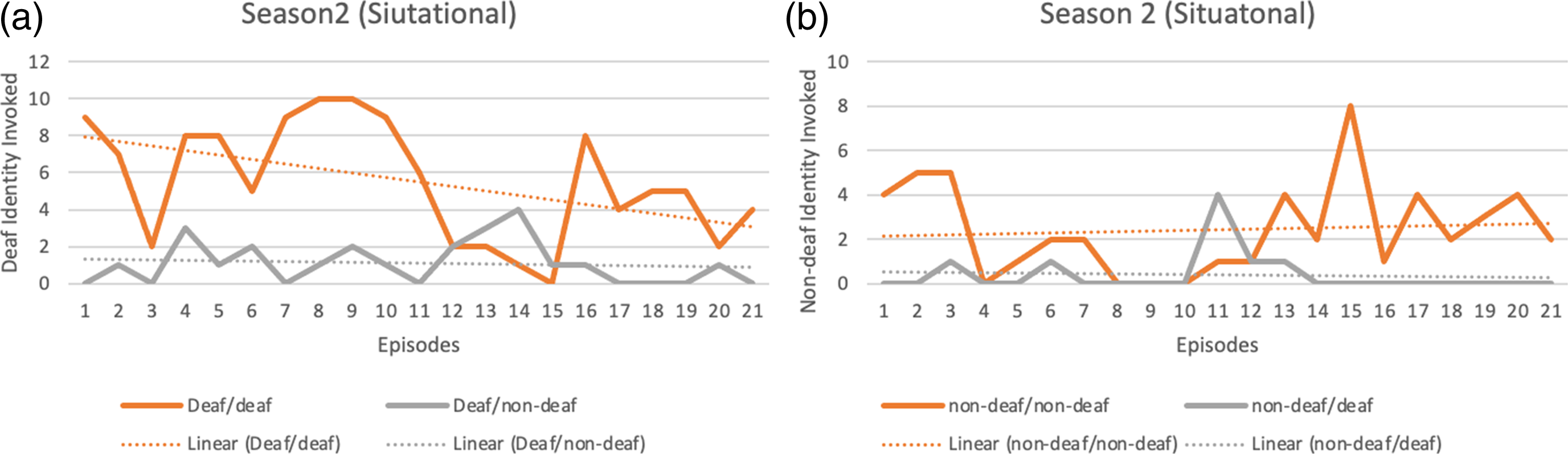
Daphne invoked non-deaf identity with relative consistency from the first to the last episode of Season 2 in deaf situations. While the counts were very low, Daphne also invoked non-deaf identity with relative consistency from the first to the last episode of Season 2 in non-deaf situations, with the exception of a notable spike ¾ of the way through the season when Daphne grapples with who she is within her family and who she is outside of her family (Figure 6b).
Daphne invoked Deaf identity with increasing frequency from the first to the last episode of Season 3 in Deaf situations. In contrast, Daphne invoked Deaf identity with decreasing frequency from the first to the last episode of Season 3 in non-deaf situations (Figure 7a). Deaf Identity Salience Season 3 (Situational). (b) Non-Deaf Identity Salience Season 3 (Situational).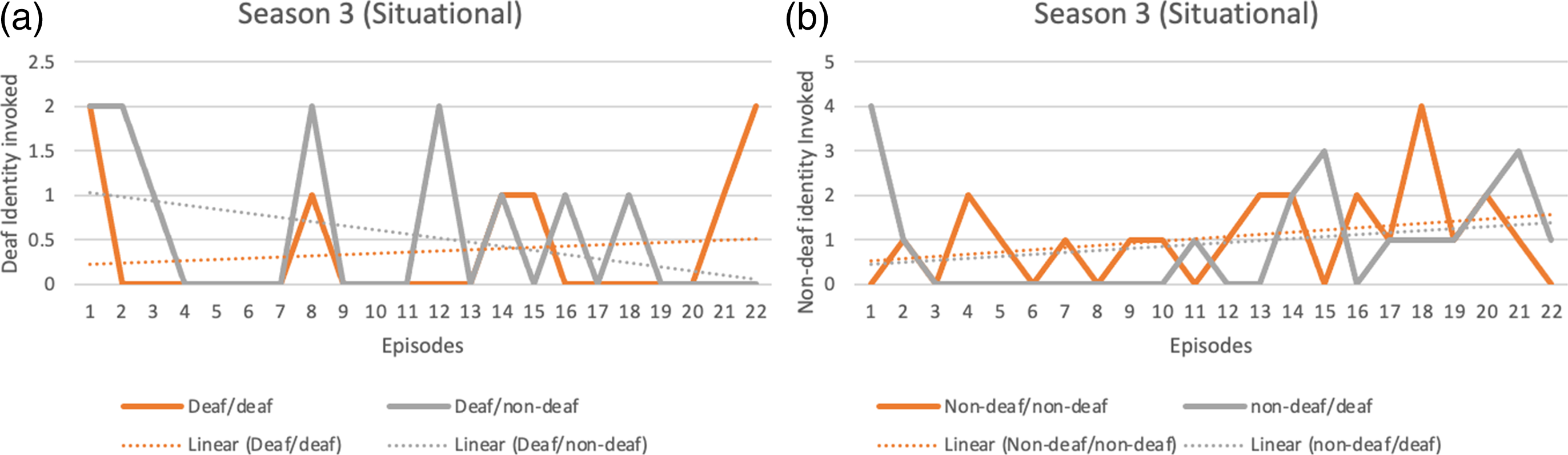
Daphne invoked non-deaf identity with increasing frequency across Season 3 in both deaf and non-deaf situations. There was a notable spike at the beginning of the season in which Daphne invoked non-deaf identity in Deaf situations (Figure 7b).
Daphne invoked Deaf identity in Deaf situations with decreasing frequency across episodes from season 1 to season 3. More significantly, Daphne also invoked Deaf identity in non-deaf situations with decreasing frequency across episodes from season 1 to season 3 (Figure 8a). Deaf Identity Salience Across Seasons (Situational). (b) Non-Deaf Identity Salience Across Seasons (Situational).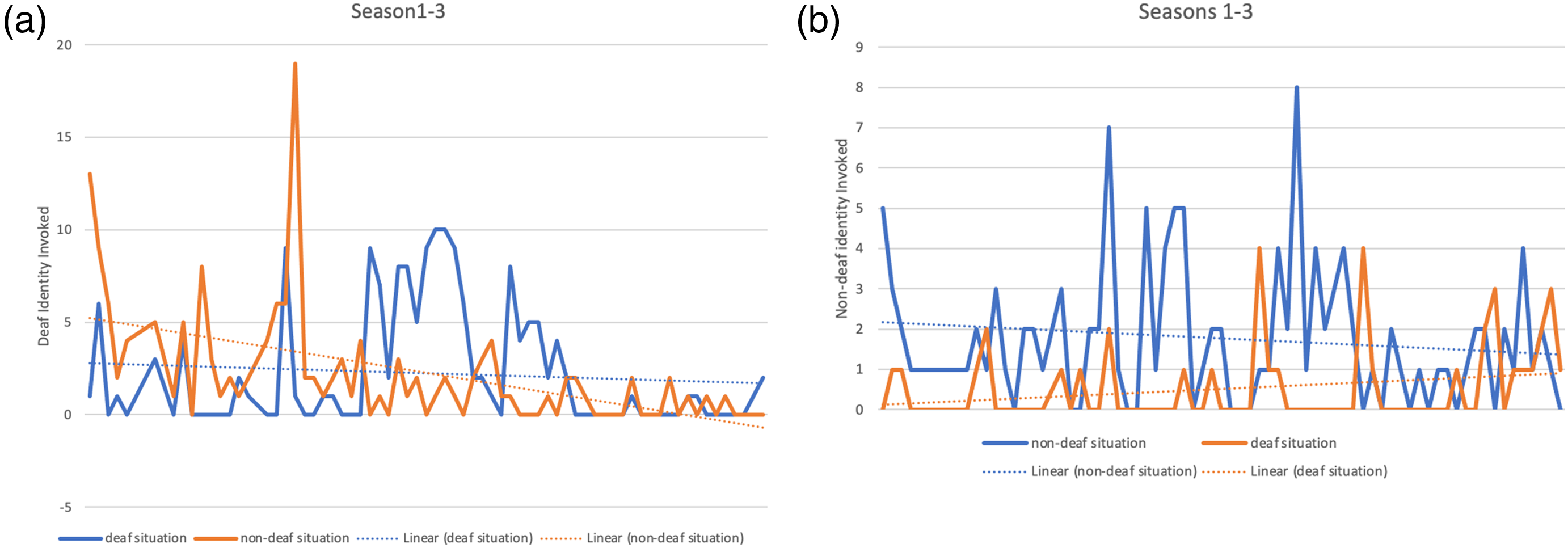
Daphne invoked non-deaf identity in non-deaf situations with decreasing frequency across episodes from season 1 to season 3. In contrast, Daphne invoked non-deaf identity in Deaf situations with increasing frequency across episodes from season 1 to season 3 (Figure 8b).
Daphne invoked Deaf identity more than non-deaf identity in Season 1 and 2. In Season 3, Daphne invoked non-deaf identity more than Deaf identity (Figure 9). Identity Salience by Season.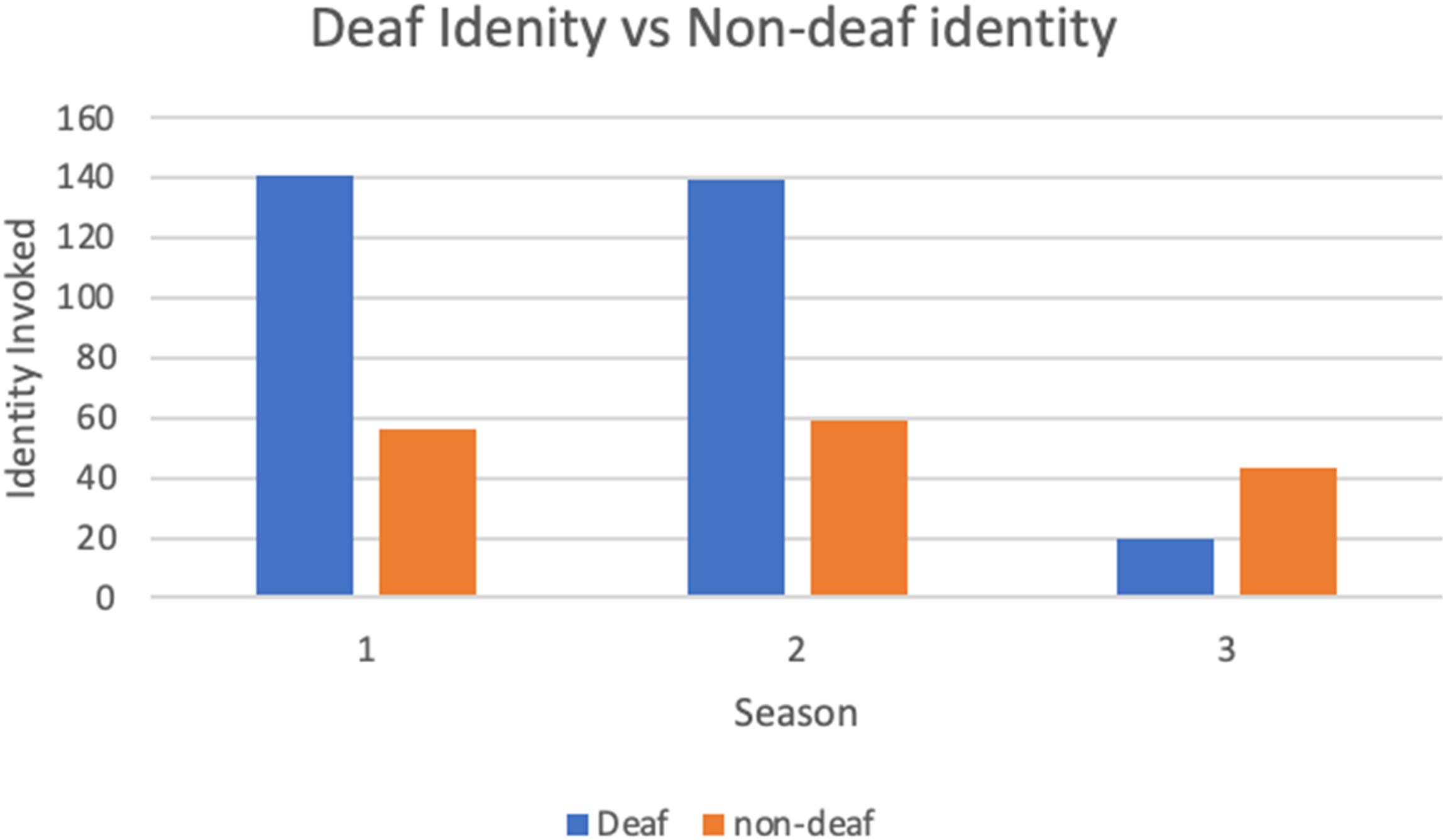
Hypothesis 1: Daphne’s Deaf identity will be the most salient identity invoked by her. Daphne’s Deaf identity was invoked more often and more consistently across the first 2 seasons than her other non-deaf identities. This demonstrates the importance of the Deaf identity for her character. Though the show is not solely about her Deafness, it remained central to the show and her character, and was positioned as the most salient, primary identity held. In addition, these high frequencies demonstrate the cultural significance of Deaf identity compared to other identities; when one identifies as big “D” Deaf, as Daphne’s character does, rooted in the community, language, and culture, the identity seems to move to a forward position. The show is the first of its kind to feature a Deaf ensemble, which allowed for the creation of many Deaf situations to explore cultural knowledge of Deaf communities in the United States. By Season 3, as Daphne’s character and the show developed, Daphne’s non-deaf identity in the storylines invoked more than Deaf identity. This demonstrates that while Deaf identity may be a central theme and central part of Daphne’s identity, it became less central and visible as Daphne’s character design shifted to showcase other stages of identity formation.
Hypothesis 2: The salience of Daphne’s Deaf identity will decrease throughout the season as her character is developed. Though the frequency of Daphne’s Deaf identity declined throughout the show, Daphne’s Deaf identity salience spiked in situations where the identity became crucial for a storyline, or character development. This showcases the natural fluidity of identity, as something that is very much measured situationally and then recreated in television representation. Television representation has a unique ability here to create situations that would invoke the given identity. Identities are mutually constructed by personal exploration and socio-cultural logics that seek to define identities. In representation, we see the definitions of identities as starting points for writers to structure a character around, providing situational moments to showcase and explore identities on screen. As Daphne is a fictitious character, our analysis does not offer significant insight into the way identities operate in the real world, but how identities are imagined to operate by the media, and then by extension influences the way viewers understand the identities shown on screen. Watching a character’s identities evolve is typically exciting, the question is what story the evolution of her Deaf identity is telling. Daphne’s expression of Deaf identity over the course of the seasons decreased as the seasons progressed, but this decrease can be understood as the storytellers focusing on other aspects of who she is. Although the writers decrease her Deafness on screen, in the moments where her Deafness is invoked, we are reminded how central it is to her self-concept despite its position in the story.
Hypothesis 3: Deafness will remain the most prominent in Daphne’s self-concept. Daphne deals with issues relating to her Deaf identity by the end of the 3rd season; however, the way in which she positions and navigates her Deafness evolves. In earlier episodes, she is proud of being Deaf, being part of the Deaf community is central to her life and who she is, yet she does not grapple with why that is beyond the fact that she says it. The show challenges Daphne in distinct moments to further conceptualize her identity, to understand the multiple dimensions of herself and why her Deafness is central to it. Multidimensional and bicultural storytelling allows for writers to construct moments of tension with identity that can be used to offer insight into the diverse experiences which make up who one is; the intersectional aspects of Daphne’s character design gives unique experiences that give insight into how the salience of her Deafness in a balanced bicultural setting is further complicated through her lived experiences and other identities, most notably her connection to hearing culture through her biological family (Holcomb, 2012; Jones & McEwen, 2000; Leigh et al., 2016). As a young adult, Daphne’s Deafness is shown as her most salient identity which she explores, defends, and questions.
Conclusion
In this paper, we mapped out Daphne’s Deaf identity salience across the first three seasons of Switched at Birth and utilized key moments of identity formation in Daphne’ self-conceptualization of her Deafness that provided key insights into representation of Deaf persons on television. We see Daphne as a key example of a multidimensional, bicultural Deaf individual, navigating the collective identity of Deafness amidst other aspects of identity and life. The unique position that Deaf identity holds in the lives of Deaf individuals is explained by the cultural values tied to language, history, community, and by extension collective identity in Deaf communities of the United States. As a case study into diversifying representation of Deafness, disability, and diversity, Switched at Birth took concrete steps forward. Showcasing diversity in media is not solely about writing stories where the characters are viewed as diverse due to their gender, race, class, sexuality, body, etc.; diversity in film and television is about telling stories that present the multidimensional, intersectional realities faced by real people, with diverse positionalities. Author and activist, Chimamanda Ngozi Adichie (2009) teaches us not to tell single stories, to not limit how we see others, and to not over simplify the lived realities of people. Switched At Birth attempted to address false assumptions through intimate storytelling of a young girl’s journey with her Deafness amidst family and community conflict. Switched at Birth premiered over a decade ago and since its premiere, a noticeable shift in the way Deaf characters are written, cast, and understood has occurred (An et al., 2014; Farris, 2018).
Part of the reason Daphne’s character has such high identity salience is the need to show that her Deafness does not limit her. She highlights the Deaf experience in a positive way. It is not to say she is not aware of negative views or “hazards” of being Deaf, yet she does not want the hazards of Deafness to define her (Holcomb, 2012). Moreover, identity prominence and embodiment are clearly vital to understanding why Daphne enacts her identity in certain ways. When Daphne performs her Deaf identity in hearing spaces, audiences experience the space from her perspective; her character and storyline engages in identity work, showcasing the embodied nature of Deafness as she reshapes the reality of the hearing characters and hearing audiences at home. Her character works against notions of ableism and undoes false perceptions of Deafness which, in turn, benefits Deaf and hearing communities alike. Daphne does this on several occasions, where her identity almost becomes political. By performing her identity as a Deaf person in a way that calls into question common assumptions of Deafness, Daphne can begin to modify the way that Deafness is seen by others; As Fields (2014, p. 163) asserts, “Through the performance of identity, individuals can change culture.” Daphne’s character as Deaf is especially important for Deaf audiences because it works to carve out space in an industry dominated by hearing norms; and puts at the center a multi-layered young woman who is grounded by her Deafness.
For future projects, we would like to compare these findings to new shows where a main character is Deaf; however, no other shows exist which feature a Deaf character and sign language at this level. This show’s premise hinged on identity work and processes. Therefore, this show could become a good ground for research on the hierarchy of multiple identities. The strength of this show lies in the enactment of multidimensional characters with stigmatized identities. If more shows such as this exist then they could become a useful tool for not only identity research but the promotion of the positive representation of Deaf identities. The impact of this show demonstrates its value, it needs to not be the only show of its kind (An et al., 2014). Daphne’s Deaf bicultural identity was an earlier example of intentional intersectional identities on mainstream networks; intersectional characters have always existed, but few explored identity as explicitly or had such a great impact of Deaf character representation.
Audiences of Switched at Birth are meant to take away distinct lessons about Deaf Gain, as a positive, culturally driven, way of understanding why individuals within the Deaf community, such as the characters of Melody and Daphne, do not see their Deafness as limiting, but something to be celebrated and cherished. Hearing viewers and society at large are challenged to reconceptualize how Deafness is understood by hearing society at large.
Footnotes
Acknowledgements
We want to thank our undergraduate RA’s at Emory University, Georgia Southern University, and Georgia State University—notably Donovan Pitts, Alyssa R. Torres, and Olivia Wojtowicz, who supported this project in the various stages. We would also like to thank our reviewers for their careful reading and the insightful comments and suggestions they provided for our manuscript.
Declaration of conflicting interests
The author(s) declared no potential conflicts of interest with respect to the research, authorship, and/or publication of this article.
Funding
The author(s) received no financial support for the research, authorship, and/or publication of this article.
Availability of data and material (data transparency)
The authors confirm that the data supporting the findings of this study are available within the article’s supplementary materials.

Note
Author Biographies
Appendix
Daphne is a member of the big “D” Deaf community. She embraces Deaf Gain and consistently explores her Deafness throughout much of the show. Daphne was born hearing and grew up with a hearing mother, who learned to sign with Daphne after Daphne became Deaf in her early youth. Daphne is a balanced bicultural Deaf person, meaning she is comfortable in hearing and Deaf communities (Holcomb, 2012; Chapman, 2021). She is bilingual, using American Sign Language (ASL) when in Deaf spaces, using spoken English and lip reading when in hearing spaces, and often a combination of ASL and English when in bicultural spaces. Her linguistic abilities and bicultural upbringing allows her to move between these two communities with some ease (Holcomb, 2012). Holcomb (2012) suggests that it is rare for an Deaf person (like Daphne) to be a balanced bicultural Deaf person as there is a strong cultural value of having full access to communication within the Deaf community; she posits Deaf identity is powerful as many Deaf people have had to fight to carve space as a linguistic and cultural minority amongst the broader disabled community; therefore, many Deaf people have a strong attachment to and are proud of their Deaf identity.
Switched at Birth deals with constant identity questioning, change, and growth as Daphne and her sister Bay discover they were switched at birth. Daphne grew up Deaf in a working class, multicultural neighborhood, while Bay grew up hearing in a white upper class neighborhood across town; these core differences are revisited throughout the course of the show as both teenage main characters question what life would have been without the switch. Both main characters serve as cultural ambassadors to the other, as we watch each slowly gain cultural knowledge and understanding about their respective social locations and identities.