



Abstract
There is significant and growing interest in better understanding hierarchy in the international system, especially in relation to intergovernmental organizations (IGOs). Acknowledging the existence of hierarchy in a system implies that there are different social positions (higher/lower), but not why or how a specific differentiation came to be used, nor how it is structured, contested or resolved. This article is interested in contributing to these questions, particularly in the context of heterarchical settings (where more than one hierarchy is present), which is also not fully understood. It uses the first years of the International Labour Organization (ILO) as a springboard to reflect upon hierarchy within the so-called ‘civilized’ group of countries in the immediate aftermath of World War I. This IGO was the first to (1) introduce statistical data to rank countries, with criteria designed to ‘objectively’ gauge industrial power and (2) establish a geographic allocation of countries in its main decision-making body’s structure. Non-European countries and non-great powers had critical roles in establishing these novel ways of dealing with hierarchies and their institutional design in IGOs. One hundred years later, these discussions still resonate with several ongoing cases of contestation in IGOs over ‘fair’ hierarchical structures.
Introduction
Hierarchies—both formal and informal—are a common feature of the international system, particularly in the context of intergovernmental organizations (IGOs). Such vertical relations of super- and subordination can determine which countries have power and over what, how much power each country (or group of countries) has, and when they can exert it. Therefore, it is not surprising to affirm that hierarchies are an object of significant interest and contestation in the field of International Relations (IR), as they express power relations: superior and inferior, haves and have-nots, leaders and laggards and so on.
Theoretical analyses and empirical studies of hierarchies in IR literature are commonly explored focussing upon a single hierarchical lens (e.g. great/small powers, East/West, developed/developing, civilized/uncivilized). A less explored route looks at situations when more than one hierarchy – that is, a heterarchy – 1 are at play. 2 This paper explores challenges with and contestations over different hierarchies within the so-called ‘civilized’ system during the early 20th century. It is during this period that non-European 3 countries – almost all of which were also ‘small’ powers – start to become the numerical majority in international negotiations. This new setting brought about different understandings of and questions over hierarchy. These included discussions regarding equality (especially legal) among members of the ‘[civilized] Family of Nations’; whether military power was the best – or even only – barometer for power distribution in non-military-related settings, and if not, what should be put in its place; and questions over if, how or how much the distribution of power based on geographic regions should matter. Some of these issues were first raised in the 2nd Hague Conference (1907), yet all of them would be at the core of the International Labour Organization’s (ILO) early years (1919–1922). The analysis of this case makes a fundamental contribution to Fehl and Freistein’s (2020) call for more research on formal hierarchies in international organizations, particularly before World War Two (pp. 287–288).
I take on a detailed analysis of the ILO in its initial period as a springboard for reflecting on the design of formal hierarchical structures in a nascent IGO, exploring heterarchical tensions and challenges. I focus on the agency of the non-European countries and small(er) powers during negotiations pertaining to the structure of the ILO’s main decision-making body: the Executive Council. More specifically, I analyse the negotiations regarding the process of determining the allocation of seats 4 in this Council to answer what kind of discussions over hierarchy took place during the creation of the ILO, how non-European and small(er) powers engaged in them, and why, in the end, certain hierarchies prevailed over others. This critical (yet overlooked) case is important because it introduced two new ideas pertaining to the internal design of hierarchy(ies) in IGOs.
First, the ILO created a decision-making body whose power hierarchy distribution was detached from military-based power criteria, and, in its place, was based upon statistical data. That is, industrial might would be gauged according to industry-related indicators. Countries would then be ranked, and the top eight would be guaranteed a seat at the table, with no allocated seats for specific countries. In doing so, this case sheds light on the ‘birth’ of the long-standing and unresolved challenge of finding common ground for determining ‘appropriate’ criteria when ranking and classifying countries (and distributing power) in IGOs. As the empirical analysis will demonstrate, the discussions held at the time directly resonate with the questions prompted by Lake (2017b) almost a century later: ‘How is stratification determined? Who adjusts the rankings when technological or environmental changes intrude? What are the rightful powers of a ruler?’ (p. 17).
Second, the ILO innovated by introducing a formal mechanism to guarantee some level of geographic distribution in votes to prevent European countries from being (too) over-represented. The case study traces key elements that prompted the ILO to move in this, then novel, direction, paying particular attention to the important role of countries that were not European nor considered ‘great’ powers in the negotiations. 5 The last couple of decades have witnessed a growth in research attentive to the agency of non-European/non-great powers in crafting the international system in the late 19th century and first half of the 20th century. This includes work by Howland (2015) and Ravndal (2020) on the early decades of the International Telecommunications Union (ITU) and Universal Postal Union (UPU); Finnemore and Jurkovich (2014) and Schulz (2014, 2017); on the 2nd Hague Conference; Müller (2019, 2020); on the League of Nations; Helleiner’s (2014) extensive research on the ‘forgotten foundations’ of the Bretton Woods conference, and Lorca (2014) and Rajagopal’s (2003) works on international law’s links to the global ‘periphery’. Notwithstanding the rich academic literature focussed on the ILO’s creation and first years (e.g. Alcock, 1971; Cobble, 2018; Maul, 2019; Rodgers et al., 2009; Shotwell, 1934; Sinclair, 2018; Tosstorff, 2005; Van Daele, 2005, 2008; Van Daele et al., 2010), there is a lack of deeper analytical engagement with the role of non-European and ‘non/less-powerful’ countries during the period of its institutional design, notably in setting internal power hierarchies – a gap this paper helps to fill. As I will show, despite the role of powerful states (e.g. as raised by Grigorescu, 2015: 65–66), these were not the only relevant players in the ILO’s case, something the literature has not yet properly explored.
To conduct this analysis, this paper is divided into four sections. Following this Introduction, the first substantive section provides the theoretical framework, outlining the main points of focus in the context of IR-related studies on hierarchy and presenting the contribution of this paper. The third section provides contextual background on the changes taking place in the ‘civilized’ world at the end of the 19th and beginning of the 20th century, particularly the emergence of the concept of ‘civilization’ and how it would intersect with sovereign equality in the 2nd Hague Conference. This matters because it sets the stage for understanding some of the incentives and limitations countries needed to consider when the ILO was proposed. The fourth section is dedicated to the detailed presentation and analysis of the empirical case and is divided into two main areas. First, it introduces the broad contours of the Committee in charge of creating the ILO, and the power dynamics informing the former’s composition from a state-centric angle. Then, it looks at hierarchy-related contestations over how countries would be chosen as the ones ‘of the chief industrial importance’ in the ILO’s Executive Council. This last analysis is undertaken in four steps, outlining: the initial proposal for allocating countries in the Council, the backlash, the discussion of possible options and the final arrangement. Therefore, it focusses primarily on ILO history between 1919 and 1922 while drawing heavily from primary documents (e.g. ILO’s Official Bulletins, 6 reports, memorandums). The fifth and last section concludes the paper and summarizes some of its key take-away points.
Hierarchies and/in the international system
A growing body of research interested in hierarchies in the international system has developed in the last decade (Bukovansky et al., 2012; Donnelly, 2006, 2016, 2017; Duque, 2018; Fehl and Freistein, 2020; Lake, 1996, 2011, 2017a, 2017b; Mattern and Zarakol, 2016; Naylor, 2018, 2022; Pouliot, 2016; Viola, 2020; Zarakol, 2017). IGOs play a pivotal role in this context, through the ‘production, reproduction, and transformation of global stratification patterns’ (Fehl and Freistein, 2020: 288).
This paper deals with hierarchy in both narrow and broad senses (Mattern and Zarakol, 2016: 627–631). The first relates to hierarchy as a formalized and legitimate authority. Studies under this conception are ‘interested primarily in how and why hierarchies are deliberately erected by specific actors as solutions to problems of anarchy, that is, in the origins of hierarchies’ (Zarakol, 2017: 6). However, the broad conception understands hierarchy as intersubjectively organized, deep structures of inequality ‘neither designed nor particularly open to renegotiation’ (Zarakol, 2017: 7). In this piece, I use narrow hierarchy to refer to written country differentiation, where the goal is to define the contours of formal rules, and which has legal impact. Broad hierarchy relates to intersubjective views of hierarchies that have significant political and symbolic impact but are not legally binding. As I will soon detail, I assume a causal link between the two: narrow hierarchies derive from the acceptance or rejection of a broad hierarchy as legitimate (in the context of an IGO).
Whether narrow or broad, acknowledging hierarchy in a setting tells us that a system is stratified – that is, there is a differentiation of social positions and actors as higher or lower – not how the stratification emerged or how it is structured (Donnelly, 2017: 245). This raises questions over the power dynamics in place when establishing a narrow hierarchy in an international negotiation, and where countries draw their reasoning from when they choose this path. Discussions over this matter can be particularly sensitive when an organization is being created, that is, when its rules are being written. To use the language of Historical Institutionalism, this moment tends to be a critical juncture, when ‘institutional fluidity [. . .] expands the range of possible decisions for key actors and increases their potential impact’ (Capoccia and Kelemen, 2007: 343). At the same time, ‘IOs continuously and actively reproduce and change – rather than just “freeze” – global inequalities in their daily operations, not only at major historical junctures but also in between them’ (Fehl and Freistein, 2020: 288). That is: junctures matter but they are not the only moment when hierarchy-related changes can occur, as it will be detailed in the empirical section.
In their theoretical discussions over hierarchies, Mattern and Zarakol (2016) give great importance to better understanding countries’ incentives vis-à-vis different hierarchical logics. In particular, they highlight the shortcomings of studies on both narrow and broad hierarchies: in the former, the origins of incentives are undertheorized, whereas in the latter, it is the mechanisms of change. Figure 1 adds to a better understanding of the origins of incentives in narrow hierarchies.
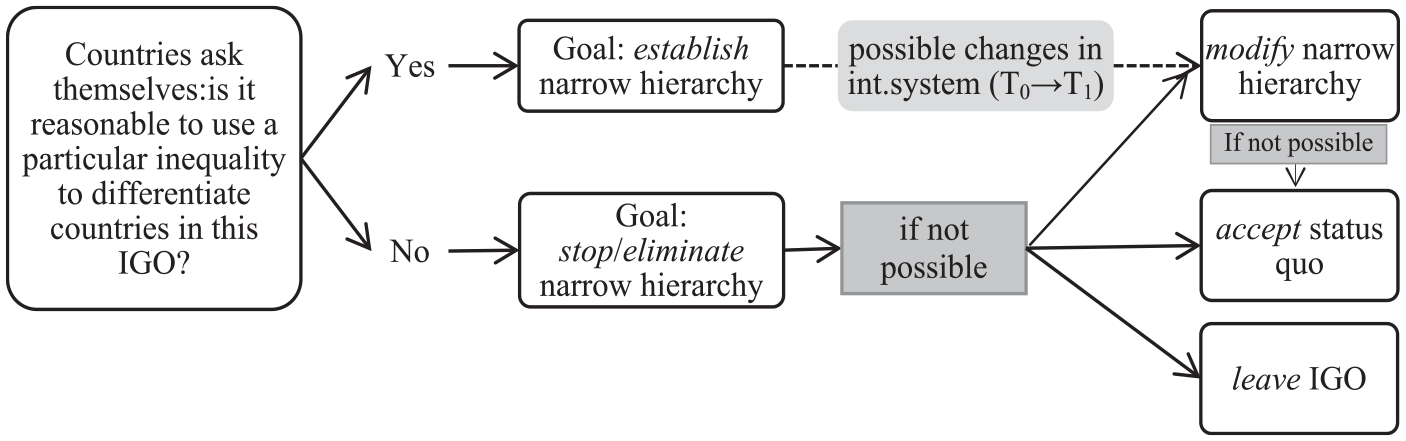
Interactions between narrow and broad hierarchies.
I argue that different types of hierarchy—narrow and broad—are linked to different kinds of contestations, which, in their turn, lead to different possible solutions. As illustrated in Figure 1, the process starts with the consideration of a broad hierarchy: do countries think it is justifiable that some members have differentiated decision-making power in an IGO based on one/some differences (more or less military power, financial capabilities, responsibility, etc.)? Using Müller’s (2019) work on stratificatory interlinkages, this first step is the decision to ‘couple’ or ‘decouple’ (pp. 673–676) the institution to patterns of stratification: the former related to embracing differentiation of countries’ rights and duties; the latter, to the principle of sovereign equality (no differentiation).
If the answer to stratification is yes (i.e. to ‘couple’), the next step is defining a ‘fair’ narrow hierarchy. That is, translate hierarchy from an abstract concept to a concrete reality, defining its legal contours, including who and how the point of reference for equal/different is defined (see Lamp, 2015; MacKinnon, 1991). Here, contestation is over the details of the said narrow hierarchy: clarity in the meaning of concepts, cut-off points, number of seats, data sources, ranking updates and so on. This overlaps with Müller’s (2019) second step: the challenge of deciding how/what to couple, that is, which pattern(s) of stratification will be linked to countries and determine who is in the group with more or less rights/obligations (p. 675).
It should also be noted that over time, changes in the international system might make what was once an acceptable narrow hierarchy be increasingly seen as outdated, raising calls for its adjustment, even if the broad hierarchy is still seen as legitimate for the IGO. Thus, contestation over the contents of a narrow hierarchy (what is being coupled) does not imply contestation of the broad hierarchy underpinning it (the ‘coupling’ itself). Such plurality of hierarchies illustrates Viola’s (2020) argument on the persistent ‘coexistence of institutionalized equality and inequality in the international system’ (p. 4). One strategy for managing (political) diversity in light of inequality is ‘hierarchical multilateralism’ (Viola, 2020: 85): authority is distributed asymmetrically, and some members end up with more power than others. Viola’s argument is that this is expected to be easier when differentiation is normatively justified and legitimate, and harder when normative justification and legitimacy is absent. The ILO example will show how this can play out empirically.
If country(ies) do not – or no longer – accept a narrow hierarchy in an IGO (Müller’s ‘decoupling’), contestation prompts four basic solutions: (1) eliminate the narrow hierarchy from the IGO; if this is not viable, (2) modify said hierarchy to mitigate its negative impact, (3) accept the status quo or (4) reject membership to the IGO. These settings relate to current contestation over classification of countries as ‘developing’ that yield legal rights, such as benefitting from special and differentiated treatment in the World Trade Organization (WTO) or bearing less responsibilities over climate change under the UN Convention on Climate Change. In both cases, self-identifying ‘developing’ countries believe a broad hierarchical differentiation exists: some countries have more power because they have been able to take more advantage of the economic system than others. Because of this, it is ‘fair’ to formalize a (narrow) hierarchy with different rules: countries with more power have to do more. While acceptable when the negotiations were taking place, not all ‘developed’ countries still agree that this is the case, as exemplified by Pres. Trump’s attempts to change established WTO rules, threat to leave the UPU, and decision to step out of the Paris Agreement.
I argue that the theoretical framework of gradual institutional change (Mahoney and Thelen, 2010; Streeck and Thelen, 2005; Thelen, 2003) is a helpful tool for observing contestation once a narrow hierarchy has been proposed or implemented. As the empirical section will outline, ILO members debated the details of its narrow hierarchical arrangement – that is, exactly how power should be distributed in its main decision-making body – for approximately 4 years beginning soon after what was meant to be an initial working draft was introduced in 1919. Mahoney and Thelen (2010) posit that political context and institutional form can shape (1) ‘the type of dominant change agent likely to emerge and flourish in a specific institutional context’ and (2) ‘the kinds of strategies this agent is likely to purse to effect change’ (p. 15). For them, differences in the character of existing institutional rules as well as in the prevailing political context affect the likelihood of specific types of change. The key issue is how to conceptualize the dimensions of institutions and of political context that matter the most for explaining variations in modes of institutional change (Mahoney and Thelen, 2010: 18).
They subsequently ask two questions: (1) if the political context ‘affords defenders of the status quo strong or weak veto possibilities’ and (2) if the institution ‘affords actors opportunities for exercising discretion in interpretation or enforcement’ (Mahoney and Thelen, 2010). Their answers reveal four strategies of change (Table 1).
Mahoney and Thelen’s contextual and institutional sources of institutional change.
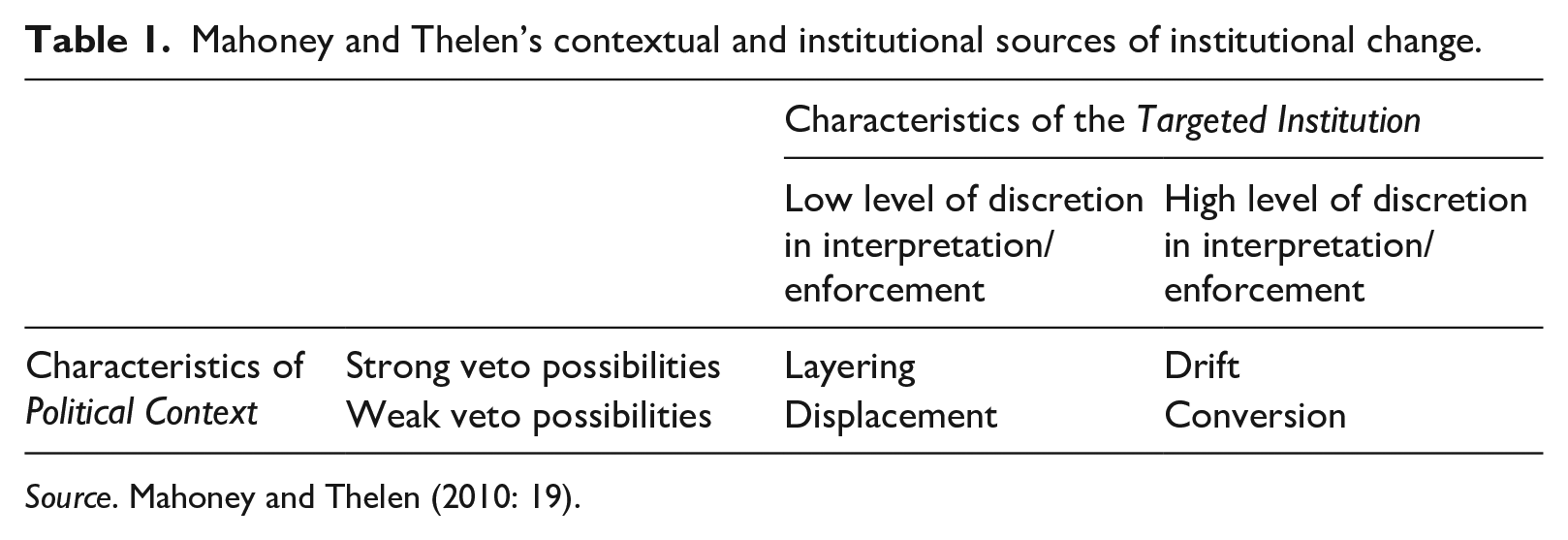
Source. Mahoney and Thelen (2010: 19).
Mahoney and Thelen (2010: 15–18) set the stage ‘for explaining why and how one type [of change] rather than another typically occurs’ (p. 16). As they outline, layering is when new rules are introduced on top of or alongside existing ones; displacement is the removal of existing rules and introduction of new ones; drift takes place when the impact of existing rules changes due to shifts in the environment, and conversion refers to the changed enactment of existing rules due to their strategic redeployment. In the ‘“Countries of the chief industrial importance”: creation, contestation and change’, these changes will be applied to the proposals surrounding the definition of countries of the chief industrial importance and the allocation of eight seats.
Precedents: changes within the ‘civilized society’
The 50 years prior to the 1919 Treaty of Paris (which established the ILO) were marked by the consolidation of the idea of a world divided into civilized and uncivilized (savages and barbarians) peoples/nations. Legal scholars and anthropologists—for example, Lorimer, 1883; Morgan, [1887] 2007; Powell, 1885; Westlake, 1894—were among major proponents of this hierarchical world division. The ‘standard of civilization’ emerged in this context. This concept held that entry into the ‘Family of Nations’ hinged on a nation’s civilizational status (e.g. Anghie, 1999, 2007; Bowden, 2009; Buzan, 2014; Gong, 1984; Keene, 2014; Kingsbury, 1998). Simply put, only those who had reached the civilized stage were entitled to be recognized as sovereign nations.
The 19th-century understanding of international law was underpinned by a positivist logic. This reasoning focussed on states’ and sought a ‘scientific’ approach to law guided by (supposedly) ‘clear, distinct, bright-line classifications of legal phenomena’ (Horwitz, 1992: 17). But the same legal positivism that supported ‘civilization’ status would paradoxically contribute to its demise. The growing importance of the concept of ‘sovereign equality’ (one country, one vote), which had begun with the ITU and UPU in the late 19th century, served as the main switch. The Hague Conference of 1907 and the Peace Treaties of 1919 (particularly the ILO) were crucial loci for solidifying this change.
The principle of sovereign equality can be traced back to Hugo Grotius’ De Jure Belli ac Pacis, from the early 17th century, following arguments anchored in natural law. By the 19th century, legal scholars rearticulated the same idea based on positivism: all civilized nations were sovereign nations (and vice versa) and equal in the context of international law (Hicks, 1908: 535). When only European nations belonged to the ‘civilized’ group, sovereign equality was not an issue. But as the number of ‘outsiders’ grew, the principle became an object of debate. At the dawn of the 20th century, Oppenheim (1905 [1912]: 167) argued that when a country entered the Family of Nations, it came ‘as an equal to equals’. Such equality before International Law, valid only for countries within the ‘Family’, was ‘an invariable quality derived from their International Personality’ (Oppenheim, 1905 [1912]). His view represented a significant departure from what was professed earlier by European legal scholars, such as Lawrence (1885), for whom ‘primacy of the Great Powers [was] a fixed idea’ and who staunchly defended the legal inequality of nations (Scott, 1920: 225), and Lorimer (1883), who posited ‘All states are equally entitled to be recognized as states, on the simple ground that they are states; but all states are not entitled to be recognized as equal states, simply because they are not equal states’ (p. 260, emphasis in the original). Until roughly the 1860s, only Christian European nations were deemed ‘worthy’ of belonging to the family of civilized nations, with two important exceptions: the United States and Ottoman Empire. 7 As the century progressed, the number of non-European nations formally joining the ‘civilized’ society increased. The emergence of the first international organizations – such as the ITU in 1865 and UPU in 1874 – 8 illustrate this process. 9
By the early 1900s, countries geographically outside Europe were becoming the numerical majority group within ‘civilized society’. The 2nd Hague Conference of 1907 represents a concrete milestone in this shifting landscape (see De Lapradelle and Stowell, 1907–1908; Finnemore and Jurkovich, 2014; Hicks, 1908; Lorca, 2014; Westlake, 1908). It was marked by debates over hierarchy in the creation of a new international organization, more specifically, the question of power distribution vis-à-vis formal legal equality of sovereign states. Of the 44 attending countries, about half were from outside of Europe. For the 18 Latin American attendees, sovereign equality was not new. It could be traced to the 1826 Congress of Panama, then reinforced after the 1880s, reflecting Latin Americans’ concern over US dominance in Pan-American discussions (Finnemore and Jurkovich, 2014). The Latin American-led coalition – supported by small(er) powers like Bulgaria, China, Greece, and Persia – was able to block the US proposal (supported by the United Kingdom and Germany) to establish a permanent court of arbitral justice. The rejection reflected the deep disagreement over a single but crucial provision: the allocation of judges to the court, skewed towards great powers. 10 The coalition’s main voice against the US proposal was Brazilian diplomat Rui Barbosa. John Westlake, at the time deemed by many as ‘England’s greatest international scholar’ (apud Lauterpacht, 1925: 308), dismissed Barbosa’s speech in defence of sovereign equality, stating that ‘perhaps [the speech] might have been less fierce if the conception [of sovereign equality] had not been pampered’ (Westlake, 1908; emphasis added). 11 Here, the numerical majority of negotiators rejected a broad hierarchy (‘great/small’ powers) be used to establish a narrow hierarchy (differentiated distribution of judges).
The 2nd Hague Conference revealed that the interests of non-European countries and small(er) powers (whether in or outside of Europe) should not be overlooked in political calculations for emerging IGOs. Sovereign equality could no longer be dismissed or treated as an afterthought. Under the right conditions, small(er) powers – already the numerical majority of the ‘civilized’ world – could effectively veto powerful countries’ ideal institutional designs vis-à-vis hierarchy. This failure to reach consensus in 1907 is part of the sequence of events that would inform the ILO’s decision-making structure in the following decade. By then, ‘Great Powers’ (here, the winners of World War I (WWI)), could no longer simply assume to be ‘system determining’, to use Keohane’s (1969) language, in universal multilateral negotiations. Great Powers’ power remained necessary but was no longer guaranteed as sufficient for establishing formal hierarchical rules in international organizations. The same was valid for European countries, which could no longer count on their numerical majority in the legally equal ‘civilized’ world. These understandings would be at the forefront of ILO discussions over who should sit in its Governing Body, including clarity on why and how countries had been chosen.
Very importantly, the 2nd Hague Conference and the ILO cases also reveal that the ‘newcomers’ to the Family of Nations’ did not question the civilization-based hierarchical division of the world, but rather the fairness of hierarchical divisions within the ‘civilized’ group. Simply put, the broad hierarchy dividing the world into civilized/uncivilized was not an object of contention, rather only the details of the narrow hierarchy inside the civilized group.
Establishing (and contesting) hierarchies in the ILO (1919–1922)
The birth of the ILO
The creation of the ILO is intrinsically connected to the League of Nations, as both derived from the same set of negotiations undertaken in the aftermath of WWI. Yet each was designed and discussed by different commissions with distinct backgrounds and goals. The ILO Commission was one of five commissions established by the Paris Conference, whose work started 2 months after the end of the war. Like most Commissions, it was designed to have representatives from each of the five main WWI victors – a.k.a. the ‘Belligerent Powers with general interests’, a.k.a. ‘Great Powers’ – and five others elected from almost 20 countries considered ‘Belligerent Powers with special interests’. The former group was entitled to two representatives per country, while the latter was only entitled to one per elected country, totalling 15 representatives.
Since the beginning, the Commission’s composition was contested by a broad range of non-Great Powers (e.g. Belgium, Brazil, Canada, China, Portugal) as by the ‘liberal and radical press of Great Britain and the United States’ (Fenwick, 1919: 204; see Finch, 1919). French representative George Clemenceau replied to this contestation: the Great Powers would have been justified, on account of their more important contributions and sacrifices in the war, to consult only themselves in the peace settlement, but, actuated by the idea of the League of Nations, they had invited the cooperation of all the nations interested in the settlement (apud Finch, 1919: 173–174; emphasis added).
Essentially, Clemenceau argued that the peace settlements could have been dealt with in a club-like arrangement, with restricted participation and exclusivity in agenda-setting (see Buchanan, 1965; Kahler, 1992; Keohane and Nye, 2002) reminding ‘smaller’ powers of their status as ‘invitees’. The decision to unapologetically call for an unequal power setting drew from tradition, but it also represented a reaction to a specific prior event: the Great Powers did not want the Peace Conference to undergo the same challenges as they had in the Hague in 1907 (see Finnemore and Jurkovich, 2014: 367–368). Ultimately, Clemenceau’s status quo reasoning was accepted by all participants, even if with reservations.
Ten days after the Peace Conference began, the Commission in charge of the new labour organization was set up: two representatives from each of the Great Powers, two from Belgium (after negotiations), and one each from Cuba, Poland and the Czecho-Slovak Republic. The representatives from these nine countries were put in charge of drafting the basic text for structuring the new organization. Unlike the one in charge of the League, the Commission responsible for the ILO attracted relatively little attention or interest and, mostly comprised civil servants and trade union representatives (Walters, 1952: 59–60). But these were no ordinary civil servants or representatives. The British, who had significant power in this Commission, explicitly stipulated that the delegates should be recruited from politics, academe or the highest levels of national labour administration (Van Daele, 2005: 449). In practice, this reinforced a particular direction for the selected individuals: almost all delegates had been linked in some way to the International Association for Labour Legislation (IALL) (Maul, 2019: 25–26). Founded in 1901, the IALL was a European-centred organization with a mix of private and government involvement, akin to the Red Cross movement (Maul, 2019: 17–24). As such, the ILO did not start with a blank slate, nor from a great-power hierarchical logic. Its gestation drew from normative structures with ‘a clear European and industrial bias’ (Maul, 2019: 33). It is in this context that the ILO’s structure was designed, including its concept of a hierarchy based on industrial importance.
‘Countries of the chief industrial importance’: creation, contestation and change
First steps
The ILO set a precedent as the first IGO to introduce a formal power-based hierarchy that was not connected to military might. Its design was mainly pushed by norm entrepreneurs from (Western) Europe, who focussed on industrial labour issues (less attentive to agricultural matters). Hence, it is not surprising that these actors wanted to ensure that countries with strong industrial sectors secured proper representation in the new organization. These actors’ vision for the organization followed the ideas developed in the IALL. Unlike in the League, the broad hierarchy for the new labour organization was to be tethered to industrial power – that is, an inequality that countries considered legitimate for that organization (and acceptable ‘coupling’).
12
Yet, the most powerful voices at the negotiations were those whose military power determined the end of the war. The dissonance (and resolution) over which power dynamic—military or industrial —should prevail in setting the base for stratification was recorded in an official report of the committee’s early negotiations: it was the intention at the outset to stipulate that the Great Powers should be permanently represented, but that it was considered that the object of the Governing Body would be better attained if it were decided that the States represented should be those of chief industrial importance. (International Labour Organization (ILO), 1921a; emphasis added).
Among the major war powers, the British were by far the most advanced in planning for the new labour organization. Its delegation became the decisive force behind the creation of the International Labour Commission and of many of the ILO’s major features, and the British draft gained weight in the negotiations (Maul, 2019: 23–24). Delegations from the United States, France, Italy and Belgium presented their plans during the Commission’s first meeting. Yet, the British suggestions were treated by Commission’s members as the basic text for negotiations (Van Daele, 2005: 452), and adopted, in the end of February 1919, as the ILO’s first draft proposal.
13
The Governing Body, the new organization’s decision-making core, was suggested to have the following composition: Of the twelve members representing the Governments, eight shall be nominated by the High Contracting Parties which are of the chief industrial importance, and four shall be by the Government Delegates to the Conference. The question as to which are the High Contracting Parties of the chief industrial importance shall be decided by the Executive Council of the League of Nations (ILO, 1919a).
Thus, of the 40-ish countries ( ‘High Contracting Parties’) negotiating the ILO, only 12 would sit on the Governing Body as government representatives. 14 Those not designated as being among the eight ‘of the chief industrial importance’ would have to compete with all others for the four remaining positions (Figure 2). According to the meeting’s minutes, the British representative pointed out that the second paragraph ‘left the Executive Council quite free as to the method of ascertaining this industrial importance [and the] States signing the Convention were not therefore bound to any special interpretation’ (ILO, 1919a). Simply put, the details over the exact process of designating the eight countries of the chief industrial importance (i.e. which stratification pattern would be adopted) were purposefully absent in the original draft and when formally introduced (Art. 393) in the Peace Treaty (signed 28 June 1919).
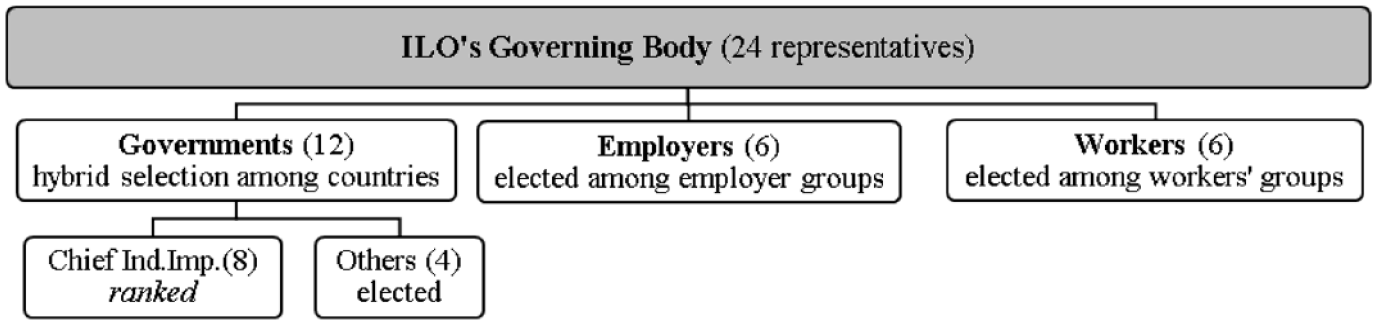
Original structure of ILO’s Governing Body.
In early May 1919, the Peace Conference approved the establishment of the ILO. The new organization had 42 founding members, 15 with European countries in the minority (Table 2). This decision prompted preparations for the ILO’s first conference, which was scheduled for October 1919 in Washington DC. The organizers were not intent on waiting for the official establishment of the League of Nations to have the ILO’s first meeting (Maul, 2019: 35), as progressive scholars and organized labour wanted to see their ideas implemented quickly (Van Daele, 2005: 458).
ILO’s founding members, by status and region.
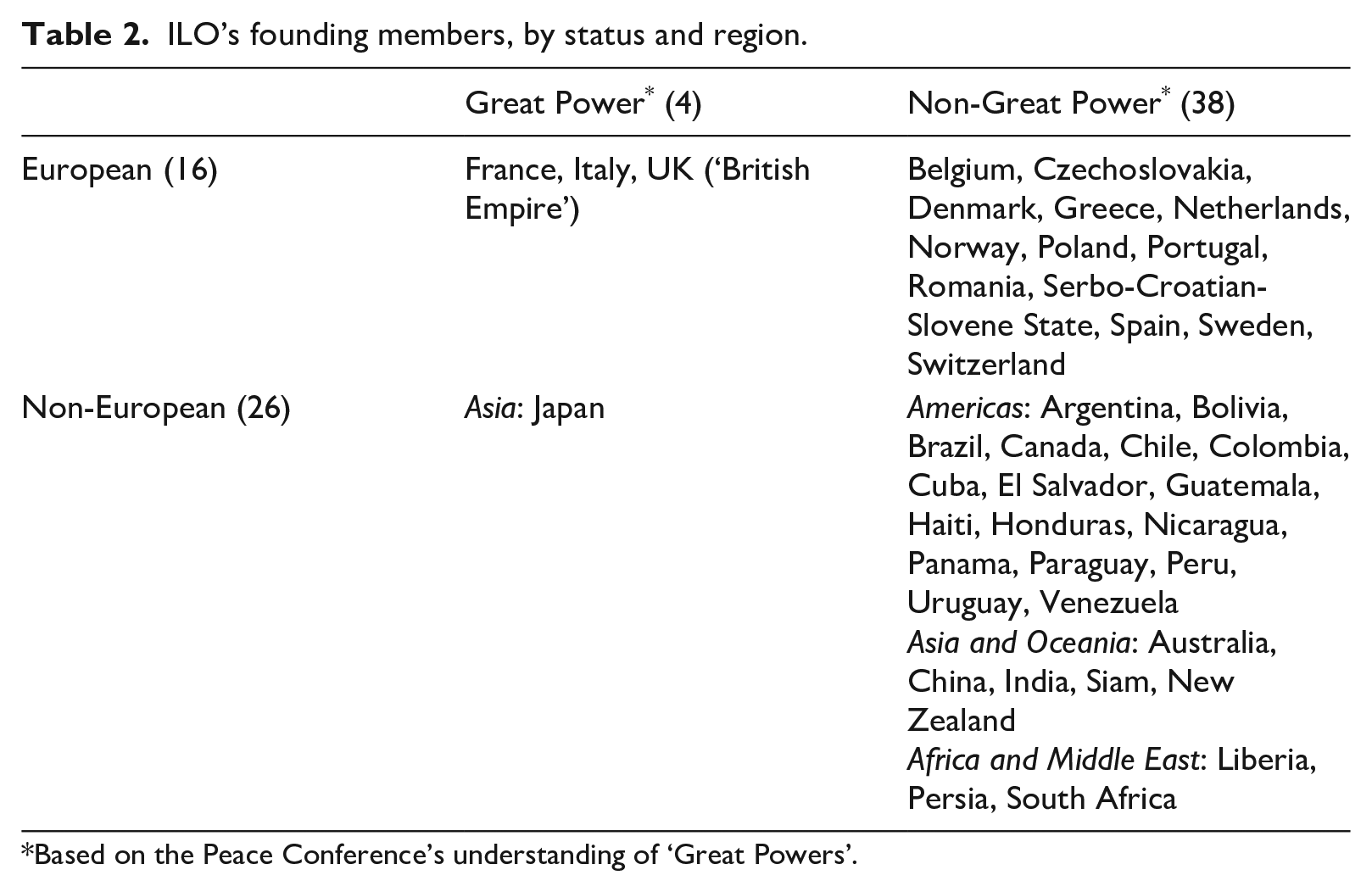
Based on the Peace Conference’s understanding of ‘Great Powers’.
The Committee in charge of the Washington event had a different composition than the League of Nation’s original Commission for setting up the ILO. The former included all five Great Powers, but only Belgium and Switzerland as the invited ‘small’ powers. When this Committee met in London (May 1919), the Secretary General of the League of Nations was reportedly ‘anxious to have the list of the States of chief industrial importance’, and the Committee determined these appointments ‘must be carried out into effect immediately’ (ILO, 1919b). In the immediate aftermath of determining this list, Canada was alone in formally voicing its concern over the decision. 16 In late June 1919, the Committee decided that ‘the question of chief industrial importance was one of fact and determinable only through statistical information’ (ILO, 1919b). The British representatives proposed a set of criteria—with no ‘outside’ input from experts nor non-Committee member countries—that were approved by the Committee members. In early July, the British representative sent a telegram to 18 selected countries, requesting statistical information on seven items (see Annex 1a).
The Committee acknowledged the challenge for many countries in obtaining data, since the war and the formation of new States made statistics ‘very uncertain and compilation of [the] list very difficult’. 17 The criteria were not proposed because they were the best, but because ‘as a rule [they were] easily available in the statistical returns of the different countries’ (ILO, 1922a). As such, this pragmatic solution consciously relied on suboptimal (yet viable) proxies to design the IGO’s narrow hierarchy. A provisional list of countries was elaborated using a hybrid approach. First, based on statistical data: countries that ‘figured among the first eight in each of the seven tables which had been drawn up must necessarily fall among the eight leading industrial States’ (ILO, 1922a). Four countries fulfilled these conditions: the United States, Great Britain, France and Germany. Italy appeared in six out of seven lists, and Belgium in five. This left three slots to be determined. In this second phase, a vote was taken, where Japan, Switzerland and Spain were selected (in the order). The provisional list was then circulated to all members of the ILO, accompanied by a note requesting that any objections to the selection be lodged with the Committee before 10 September 1919.
Backlash
Pushback to the provisional list had two main moments. The first wave came from Canada, Poland, Sweden, and India, who wrote letters formally expressing their discontentment with the list. All four raised the challenge of obtaining proper statistics given the war and specifically questioned the designation of the two lowest ranking countries on the list. Canada and India raised questions over the criteria, with the latter asking for an expanded interpretation of industry and industrial workers to include figures from agriculture. 18 Sweden mentioned a lack of Scandinavian countries on the list, but neither Canada nor India expressed deep discontent over its European-centric character. The fact that this was only a provisional list, and the full composition of the Governing Body was only going to be formally decided by the League of Nation’s Executive Council, probably explains the limited engagement of other small powers with the July telegram.
These initial responses reveal that none of the 40-ish countries involved in the creation of the ILO questioned the underlying inequality at hand, a different outcome than witnessed at the Hague in 1907. 19 The hierarchy itself was considered ‘fair’: all participants agreed that countries of chief industrial importance should have a stronger voice in the organization. The contention was over the criteria for determining this classification, and the only area of major concern was the designation of the list’s bottom slots, that is, the lowest tier of ‘big’ industrial powers. In some ways, this challenge is the precursor for disagreements over further cut-off lines for participation in other IGOs, such as in the UN Security Council and WTO.
The 1st International Labour Conference took place in Washington DC between October and November of 1919, where approximately half of the 40 countries sending representatives were non-European. The Constitution of the ILO’s Governing Body was a high priority on the agenda. As the Conference began, the Organizing Committee was well aware that the ‘difficulties experienced in the nomination of eight representatives in accordance with the scale of industrial importance have not yet been solved’, and that the only purpose in drawing up the above list has been to facilitate as much as possible the drawing up of a final list and the decision of the League of Nations, so as to make possible the appointment of the Governing Body (ILO, 1919c; emphasis added).
However, as the end of the Conference drew near, the Committee faced a major challenge: the delay in the League of Nations’ ratification of the Peace Treaty. This created a unique conundrum. The International Labour Office—the ILO’s permanent Secretariat—could not be constituted until the Governing Body had been appointed. But under the ILO’s own rule, the Executive Council of the League of Nations was the body in charge of deciding which countries were of chief industrial importance. Because the League of Nations’ Executive Council did not exist it could not decide over the ILO’s Governing Body’s composition.
The Organizing Committee decided that it was impossible to postpone any longer the formation of the Governing Body, stating: ‘It is of the greatest importance that the permanent labour organization should be definitely set up and the constitution of the Governing Body is the first essential step’ (ILO, 1919d). As such, a few days later it was determined that the initial list would be maintained. The only change was that Denmark would provisionally occupy the United States’s place, a point that was openly contested (to no avail) by delegates from China and India. The four remaining slots for government representatives—Spain, Argentina, Canada and Poland—were elected. 20
Once the full list of government, employer and workers’ representatives was complete, the Governing Body was visibly unbalanced: Europeans held 19 of the total 24 seats. Of the remaining five non-European seats, Japan was granted a government slot, Argentina and Canada were elected to government slots and Canada also provisionally sat a workers’ representative (in the absence of the United States).
The backlash was swift. Three days after results were formalized, all Latin American delegates signed a resolution stating: ‘equity demanded that more than one [Argentina] out of 24 seats should be allotted to the twenty States of Latin America’. As an Ecuadorian delegate remarked, the conference was meant to be an international conference, not a European one. Soon after, another resolution was put forward to all delegates by a South African representative, stating: ‘The Conference expresses its disapproval of the composition of the Body of the International Labour Office, inasmuch as no less than 20 of the 24 members of that Body are representatives of European countries’ (ILO, 1920). Before it was voted, some argued that misrepresentation was antithetical to the ILO itself. If representatives from European countries wanted the organization to be international, making its conventions universally applicable, they had ‘to win the trust and confidence of other than European countries’ (ILO, 1920), by demonstrating their support for a better distribution of members of the Governing Body. 21 The motion was approved by 44–39 votes. 22
Interestingly, the votes were not a straightforward split between representatives from European and non-European countries. While all delegates that rejected the motion were European (aside from one Canadian), a reasonable number of European delegates supported the South African resolution, with affirmative votes from all three British and Spanish delegates, and one each from Norway, Portugal and Switzerland. 23 Nonetheless, the decisions taken in Washington over the ILO Governing Body’s membership were maintained, at least for the immediate future (3 years tenure). Here, Latin American and South African-led complaints were not over the existence of a ranking system to (partially) decide which countries would have a seat as government representatives nor about criteria used to determine countries of chief industrial importance. Rather, the sharp disagreement was about the geographical distribution of the Governing Body’s total (24) seats, and a broad hierarchy many did not see as fair: a ‘subjective’ superiority of Europe. This highlights well Müller’s (2019) point about ‘the multidimensionality and complexity of patterns of stratification in international society’ (p. 673). Industrial power was an acceptable basis for differentiation and ranking of countries of chief industrial importance but not acceptable for determining the ILO’s entire Governing Body.
In addition, the ILO’s international dimension had to be acknowledged. The ILO was the first international organization to witness explicit negotiations over designing fair regional/geographic representation and voting power. The ILO’s discussion on the equitable regional distribution of power predates the ones held in the League of Nations in the early 1920s (see Grigorescu, 2016; Müller, 2020) and taken up once again two decades later in the UN Security Council (Daws, 1999; Gould and Rablen, 2016). The issue of (unbalanced) representation in the decision-making process remains an ongoing point of contention of some universal IGOs in the 21st century, particularly in the Security Council and the International Monetary Fund.
Possible options
The League of Nations became effective 6 weeks after the end of the ILO’s first conference. When the League’s Council met for the first time (16 January 1920), it did not have the powers to unilaterally rescind the decisions previously undertaken in Washington DC. In the first half of 1920, many non-Great powers (in and outside of Europe) formally expressed their disapproval over the list of countries of chief industrial importance, leading the ILO and the League’s Council to take important measures.
The ILO had no direct power to address claims over the list. Its Governing Body referred the issues to the ILO’s Committee on Standing Orders (CSO), comprising four representatives from each group (government, employer and workers). This Committee oversaw the establishment of rules regarding finer points, such as the appointment of substitute representatives and filling vacancies. It was asked to present its findings to the ILO’s Assembly in 1921 over three issues. Two are of interest to this paper: (1) a broad overview of the determination of the eight States of chief industrial importance and (2) the representation of non-European countries. In its report, the CSO noted that they discussed the possibility of solving the problem of defining which countries were ‘of the chief industrial importance’ by proposing a revision of the Peace Treaty (ILO, 1921b). Given the challenges of amending the document, this approach was unsurprisingly left aside. As per the Peace Treaty’s Art 422, successful amendments would require 2/3 of the votes of delegates and would take effect only when ratified by the States who composed the Council of the League of Nations and 3/4 of its members. Due to the ‘newness’ of the ILO, the Committee ‘felt that it would be both wiser and fairer to seek solutions within the existing provisions of the Treaty’ (ILO, 1921b). Using the framework on types of gradual institutional change, this meant change through displacement (removal of existing rules and introduction of new ones) was not deemed viable.
The CSO also assessed a suggestion made by its chairman that ‘larger representation on the Governing Body might be given to extra-European countries by the specification that certain seats should be allotted to extra-European countries’ (ILO, 1921a). The idea of increasing the number of representatives within the Governing Body was raised but quickly dismissed, as Committee members anticipated ‘grave objection’ to the idea of a larger body (ILO, 1922b). On this topic, only the following Committee proposal was adopted (unanimously) by the Governing Body: the recommendation to the three Groups that, on the expiration of the present mandate of the Governing Body, i.e., at the time of the 1922 election of the Governing Body, they take into account the importance of a reasonable representation as between the European and the extra-European countries (ILO, 1921b; emphasis added).
It should not be surprising that the spirit of regional equality and calls for a non-European focus were addressed so timidly: all Committee members were part of the overwhelmingly European Governing Body established at the end of 1919.
In the context of this debate, the Council of the League of Nation – dominated by Great powers – made two important decisions of its own, both in the middle of 1920. First, it formally ‘locked in’ the composition established in Washington, unanimously ruling that any change to ILO’s Governing Body should not take effect until the completion of the 3-year tenure of office of the present holders. Second, it decided to create a Special Committee, which it instructed to report on the criteria that should be employed in the determination of industrial importance. Therefore, the solution to the Governing Body’s composition (narrow hierarchy) was to engage in a process of institutional change through layering: new rules introduced on top of (or alongside) existing ones. This choice reflected a context marked by two overlapping characteristics. First, strong veto possibilities, as actors with access to institutional or extra-institutional means could block change (Mahoney and Thelen, 2010: 18–19). As seen in the Hague, non-Great Powers (if acting in unison) could veto changes. Second, low levels of discretion in interpretation: there was some space for defining what made a country one of chief industrial importance, but the scope was relatively narrow.
The League of Nation’s Special Committee was composed of six representatives: four members from the ILO’s Governing Body and two appointees from the Secretariat of the League of Nations, one of whom was Italian statistician Corrado Gini, whose name later became reference for assessing income inequality. In October 1921, Gini submitted his memorandum to the Committee. The proposed solution explicitly acknowledged its epistemological and methodological weaknesses, stating: ‘We do not claim that it is the only logical system, but we have not succeeded in finding an alternative’ (ILO, 1921b). Drawing on his expertise, Gini suggested the ranking of countries based on their industrial importance be drawn from a system of four absolute and four relative indices (see Annex 1b). Gini’s distinction between absolute and relative values reflected his impressive, long-term perspective on the matter. The 1921 report was eerily correct in its prediction on what would take place a century later regarding power hierarchies and the representation of so-called ‘emerging powers’. It read: If absolute importance be taken, it is the large State such as China and Brazil, and in the future Russia, which, even if they are not of great importance at the present moment from the point of view of the organisation of labour, might obtain representation on the Governing Body. If, on the contrary, relative figures are alone taken into consideration, the result would be that a quite disproportionate importance would be attributed to some small States, such as Luxemburg (ILO, 1921a).
An annex to the Memorandum provided a lengthy and detailed analysis of the criteria and the statistics used by the Organizing Committee in London. This included reflections on countries’ different minimum age for industrial work, boundaries between agriculture and agricultural industry, inclusion of workers in colonial possessions, and whether wind and hydropower should be included in ‘horsepower’ measurements. The kinds of questions posed mirror contemporary challenges facing international organizations when designing quantitative measures for, and applying them to, complex social phenomena, such as determining what counts as ‘poverty reduction’ (Cammack, 2004), ‘environmental goods’ (Vikhlyaev, 2004), or good national ‘school performance’ (Grek, 2009).
At the same time, the memorandum was firm in its disagreement with the objections raised by some countries (India in particular), that ‘the interests of non-European countries were not sufficiently recognised’ when drawing the criteria in Washington (ILO, 1921a). For Gini, there was nothing ‘either in the letter or the spirit of the Treaty which justifies applying regional criteria to determine the industrial importance of the various countries’ (ILO, 1921a). He did not reject, but reinterpreted sovereign equality (‘decoupling’), proposing that no country should be pre-emptively favoured or hindered. The same was valid for an industrial-based hierarchy: it should only be decided via sound statistical assessment, with no predetermined winners or losers.
Final arrangement
The League of Nations’ Special Committee to evaluate the criteria for determining ‘countries of the chief industrial importance’ met twice more after Gini’s memorandum. The Committee’s final report was issued on 31 May 1922. The report shows the immense challenge of deciding which criteria to use to rank countries, particularly as the first term of the Governing Body’s representatives was in its final month, and decisions regarding a new composition needed to be made by the end of the year.
Gini’s proposed system was ‘from a scientific point of view more satisfactory and more logical in principle than the system chosen by the Organising Committee [in 1919]’ (ILO, 1922a). However, ‘on practical grounds the system would appear not to be applicable’ to the ILO’s Governing Body nominations of 1922 (ILO, 1922a). In fact, exchange rates were singled out as an obstacle: how could countries’ productions, measured in different currencies, be adequately compared? Such question has remained the subject of enquiry since, as witnessed by The World Bank’s internal discussions over the methodological challenges of comparing countries’ wealth, prompting the creation of its International Comparison Programme in 1967 (see The World Bank, 1989, 2020), and the embrace of gross domestic product measured by purchasing power parity alongside the ‘traditional’ Atlas method.
The report concluded that there was a group of countries which, given their numbers, were certain to figure in any list (Great Britain, France, Germany, Italy and Japan), though there was less of a degree of certainty regarding other countries. 24 Examination of Gini’s system proposed in his memorandum was to be continued, but ‘as a provisional arrangement, the criteria established in London by the Organising Committee should be applied’ in 1922 (idem), albeit with slight modifications to the criteria and a full update of the data. A later report (September 1922) explained that statistical evidence ‘was not conclusive’ for determining which country should take the last slot. Depending on the method used, it could go to India, Sweden and Poland, or remain with Switzerland. In October, the new country list was presented as (ranked): Great Britain, Germany, France, Canada, Italy, Belgium, Japan and India, noting ‘so far as we can judge, India has the best claim to the remaining place on our list’ (ILO, 1922b).
The May 1922 report also put forward a proposal for an amendment to the Treaty of Versailles, with ‘an enumeration in the statute of the International Labour Office of the Powers which have a representative as of right on the Governing Body, leaving the other places open to election’ (ILO, 1922a). If implemented, it would grant seats for the five Great Powers and Germany. That is, akin to the League of Nations, the Governing Body would have two sets of countries: predetermined (permanent) and elected (temporary). This proposal of change via displacement of rules was overwhelmingly rejected: eight in favour versus 68 against (apud ILO, 1935). Still, in October 1922 two important amendments were made. 25 First, the number of total representatives was increased from 24 to 32 (Figure 3), with eight (instead of four) elected Government representatives and eight (instead of six) employers and workers’ representatives each. Second, it guaranteed a set number of seats for non-European States: six of the 16 government representatives, and two of the employers and workers’ representatives each.
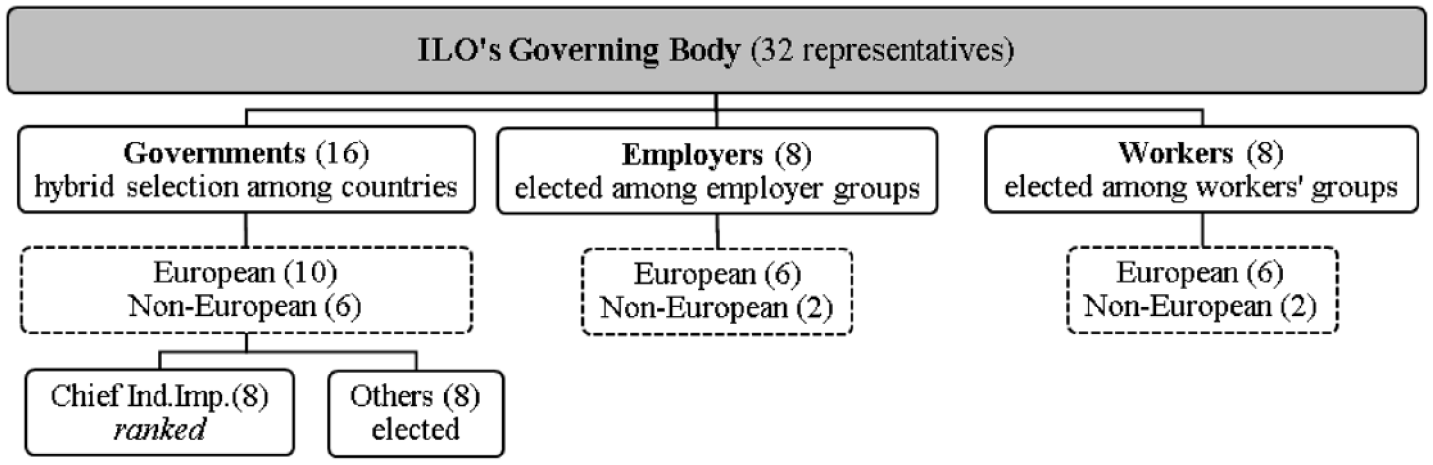
The 1922 amended structure of ILO’s Governing Body.
Ultimately, each country ‘group’ had different ideals over what the narrow hierarchy should look like while facing specific constrains. For WWI’s Great Powers, an individualized and permanent position in the Body would have been ideal. However, too much power-grabbing in the very start could have led the budding ILO to face the same destiny as seen in the Hague, and after the organization was up, they were outnumbered. For (most) European countries, fairness meant that seats should not be limited by region, but rather allocated based only upon the importance of industrial labour. At the same time, they mostly accepted that for the organization to succeed in its international labour goals, it needed the uptake of countries outside of Europe. This reflected the key concern of non-Europeans over the encroachment of broad hierarchical inequalities (such as Europe’s ‘superiority’): an international organization should secure an international decision-making structure, which could only be adequately achieved with some level of regional equity. And non-Great powers, especially those who saw themselves as potentially one of the eight countries of chief industrial importance, favoured a path with objective criteria that could reflect changes in industrial power over time.
Notwithstanding these differences, no proposal to eliminate the ranking system gained traction. The change in the institutional structure of the ILO’s Governing Body was done through layering. Most likely, this is because the existence of a (broad) hierarchy among the government representatives was not the core problem. Rather, the main issues were the formal rules of the narrow hierarchy and the desire by many to supress a specific (and additional) broad hierarchy biased towards Europe. In this scenario, not all layering proposals moved forward, such as setting aside only four (as opposed to six) non-European government representatives or pre-determining seats. Regarding this latter point, positions cut across the European/non-European divide (as per Table 2): the replacement of the original eight country ranking for an ‘enumeration’ of six countries (with other seats being elected) would impact all non-Great powers who could see themselves as (eventually) ‘rightfully entitled’ to the seventh or eighth seat in the original ranking system. Such a change would especially hamper the opportunity of ‘Great’-ish powers, European or not, to cross the threshold and secure their seat in the great industrial powers’ group.
As expected by Viola (2020), it was easier to veto proposals for differentiation considered normatively unjust/illegitimate by most members. Yet, the empirical case prompts a partial rethinking of the argument that greater inclusiveness creates incentives for dominant actors to pursue institutional strategies to minimize actor heterogeneity, such as conditional inclusion based on an idea of [. . .] hierarchical multilateralism [. . .]. The effect is to gradate political rights across members, making some less equal than others. (Viola, 2020: 44).
The argument is not wrong but incomplete: non-dominant actors can also be the ones pushing for differentiation to minimize power heterogeneity and/or to establish different obligations, as exemplified by ongoing debates over different financial burdens for mitigating climate change.
The debates held over different hierarchies the ILO’s Governing Body – industrial, military, regional and so on – reaffirm stratification’s multidimensionality. The final wording underscored how ‘hierarchies, broad and narrow, intersect with each other such that most actors are positioned within many overlapping hierarchies at the same time’ (Mattern and Zarakol, 2016: 644). The contours of ILO’s narrow hierarchical structure did not simply ‘appear’ nor were they immobile afterwards. They were a product of social interactions over time (see Pouliot, 2016) involving different differences which countries selectively bring to the surface when they considered pertinent to the hierarchy being discussed.
Conclusion
This paper looked at hierarchy in IGOs by focussing on a heterarchical setting, that is, when more than one hierarchy is present. It paid attention to contestations and resolution processes involving different kinds of both broad and narrow hierarchies taking place within a negotiation process. With the goal of helping to better understand tension and interaction between these two types of hierarchy, I proposed a sequence that details countries’ decision-making logic. I argued that the first step is to understand if a country (or group) understands a particular broad hierarchy to be ‘fair’, that is, whether it mirrors a ‘real-world’ difference. This response leads to different dynamics vis-à-vis the establishment, modification, acceptance or rejection of a narrow hierarchy. And to provide additional nuance to this analysis, I brought in a framework for understanding different paths of institutional change.
An understudied case of was used for the paper’s empirical analysis: the discussions over the ILO’s decision-making body undertaken between 1919 and 1922. The first step was to provide historical context, in this case, the expansion of the so-called ‘Family of [civilized] Nations’ at the turn of the 19th–20th centuries and the growing role of non-European and non-great countries in international negotiations. Then, the next step was looking specifically at the ILO and its challenge to establish the ‘right’ way of allocating power in its main body, the Executive Council. In doing so, the paper provided a thick description of the negotiations that countries held over the designation of which countries should be ‘of chief industrial importance’ and have the right to be on the Council.
The change from the 1919 ‘temporary’ arrangement to the 1922 wording was achieved through layering, reflecting a context with strong veto possibilities and low-level discretion in interpretation. The solution established a ranking system based on comparable statistical data, drawn primarily from industry-related indicators. Such system represents the first time an IGO implemented a set of ‘objective’ measurements to compare and rank countries, establishing a formal hierarchy detached from military capabilities. Therefore, the 1919 Peace Treaty involved different sets of formal hierarchical structures, as in the League of Nations the primary logic guiding the broad hierarchical structure was based on military power. Still, in both ILO and League cases, members argued over similar matters: who gets the (last) seats at the table, how many chairs should there be, and if non-European countries were ‘fairly’ represented.
The analysis shows that in the design of formal, legally-binding hierarchical structures, determining which and how many countries should have special responsibilities (and powers) is anything but simple. The use of statistics to rank countries in the ILO was recognized as an imperfect solution by its members, yet given the possible options, it was deemed as the best available way of operationalizing the distribution of power. At its core, many problems identified then have (re)appeared in a number of IR’ settings in the last 100 years. In particular, the difficulty of translating multidimensional statistical rankings into unidimensional rankings that compare countries’ overall power, but also applicable to rankings over levels of democracy, quality of life, development, economic freedom, effectiveness in responding to coronavirus disease-19 and so on. As such, it is naïve to assume that statistics lead to an inherently simple or ‘objective’ way to establish hierarchies. The most important contestations are mostly not over whether statistics should be used to define narrow hierarchies, but over its deeper underpinnings, where the key question is cui bono? – who benefits?
Supplemental Material
sj-docx-1-ejt-10.1177_13540661231168773 – Supplemental material for Multiple hierarchies within the ‘civilized’ world: country ranking and regional power in the International Labour Organization (1919–1922)
Supplemental material, sj-docx-1-ejt-10.1177_13540661231168773 for Multiple hierarchies within the ‘civilized’ world: country ranking and regional power in the International Labour Organization (1919–1922) by Deborah Barros Leal Farias in European Journal of International Relations
Footnotes
Funding
The author(s) received no financial support for the research, authorship and/or publication of this article.
Notes

Supplemental material
Supplemental material for this article is available online.
Author biography
References
Supplementary Material
Please find the following supplemental material available below.
For Open Access articles published under a Creative Commons License, all supplemental material carries the same license as the article it is associated with.
For non-Open Access articles published, all supplemental material carries a non-exclusive license, and permission requests for re-use of supplemental material or any part of supplemental material shall be sent directly to the copyright owner as specified in the copyright notice associated with the article.
