



Abstract
This article undertakes an empirical investigation of the relationship between structural inequalities and legitimacy beliefs in global governance. Normative theory often emphasises inequality as a major source of injustice in global politics, but we lack empirical research that examines the implications of inequality for legitimacy in concrete situations of global governance. This paper draws on large mixed-method survey evidence regarding inequality perceptions and legitimacy beliefs at the Internet Corporation for Assigned Names and Numbers (ICANN), a key site of global Internet governance that has given particular priority to issues of diversity and inclusion. Our analysis arrives at four main findings. First, participants in ICANN do perceive substantial structural power asymmetries and often find them to be problematic. Second, persons on the perceived subordinate side of these power stratifications tend to observe larger inequalities and to find them more problematic than persons on the perceived dominant side. However, third, these perceptions and concerns about inequality almost never associate with legitimacy beliefs towards ICANN, even among people in structurally subordinated positions and among people who express the greatest worries regarding power inequalities. Fourth, in forming legitimacy perceptions, participants at ICANN generally prioritise other aspects of institutional purpose, procedure and performance, unconnected with inequality. This lack of a relationship between perceptions of inequality and legitimacy beliefs suggests that, however sympathetic policy elites at ICANN might be towards greater equality in principle, they are unlikely to give it precedence in practice.
Introduction
Many critics of the existing world order decry that global inequalities generate major injustice (Caney, 2015; Milanovic, 2016; Therborn, 2013). Various theories of world politics highlight and censure such structurally embedded discriminations, inter alia in respect of countries, cultures, classes, genders, races, sexualities and so on (Anievas et al., 2015; Lake, 2009; Peterson, 2014; Runyan, 2019; Sklair, 2001; Zarakol, 2017). More specifically, many detractors of established global governance arrangements have argued that these world-scale rules and regulatory institutions are illegitimate for incorporating and perpetuating unfair power asymmetries (Pogge, 2002; Scholte et al., 2016).
This contestation has a long history. Already in 1919, the Paris Peace Conference saw a (rejected) Racial Equality Proposal for the emergent League of Nations (Lauren, 1978). Subsequent resistance to inequality in global governance has included decolonisation struggles of the mid-20th century, calls for a New International Economic Order during the 1970s, World Conferences on Women between 1975 and 1995, alter-globalisation activism around the turn of the millennium, Occupy! protests in 2011–2012, and present-day movements for climate justice (Della Porta and Tarrow, 2005; Murphy, 1984; Smith et al., 2015). Such campaigns have certainly borne some results, including the widespread removal of direct colonial administration and the development of a substantial global human rights regime. Recent decades have also seen global governance institutions ‘open up’ to wider participation, especially from civil society organisations (Hanegraaff et al., 2011; Scholte, 2011; Steffek et al., 2008; Tallberg et al., 2013). Nevertheless, overall, power in today’s global governance remains skewed towards certain geopolitical sites, social groups and cultural life-worlds.
How do structural inequalities in global governance persist in spite of long and insistent normative opposition? Perhaps we should turn from theorists and activists to the people who conduct the actual global governing. How, empirically, do these ruling elites connect matters of structural hierarchy with legitimacy beliefs?
This question could have various answers. Perhaps, in contrast to critical observers, most insiders do not perceive inequalities in global governance and so do not bring this issue into their legitimacy beliefs. Or perhaps people at the heart of global governance do perceive structural inequalities in their midst, but do not find these hierarchies problematic, such that their legitimacy beliefs remain unaffected. Or perhaps these circles do perceive embedded stratifications in global governance, and find them problematic, but give priority in forming their legitimacy beliefs to other considerations. Or perhaps perceptions of unjust inequalities in global governance do undermine legitimacy beliefs among global governors, but little change follows. Which of these dynamics is actually in play?
Little scholarship is available to assess this issue. Although much normative theory has elaborated principled arguments about inequality, injustice and illegitimacy in world order, few empirical studies have examined how people assess this relationship in concrete global governance settings. Two works have explored how perceptions of unfair dominance of certain countries at the United Nations can detract from legitimacy beliefs towards that institution (Hurd, 2007; Johnson, 2011). Another study shows that many African governments accord low legitimacy to the International Criminal Court owing to their perception that this institution imposes double standards between African and other leaders (Helfer and Showalter, 2017). One survey has compared the relative priorities that elites assign to democracy, effectiveness and fairness when they evaluate global governance institutions (Scholte et al., 2021). Yet we thus far lack any systematic empirical examination of links between perceptions of structural inequality and legitimacy beliefs vis-à-vis global governance.
To undertake a first such study, this article investigates inequality and legitimacy at the Internet Corporation for Assigned Names and Numbers (ICANN). This case is particularly apt. Established in 1998, ICANN oversees several key technical functions that make possible a single worldwide Internet (Antonova, 2008; Flyverbom, 2011; Mahler, 2019). Digital access crucially shapes inequality in contemporary society (so-called ‘digital divides’) (Antonio and Tuffley, 2014; Uy-Tioco, 2019), and ICANN’s rules on domain names and Internet numbers substantially shape who gets online and on what terms, as well as who reaps the large financial proceeds from Internet industries. Sensitive to these implications, and possible consequences for its legitimacy, ICANN has given painstaking attention to cultivating ‘inclusion’ (Koppell, 2005; Mueller, 2010; Palfrey, 2004). Particularly since 2012, multiple ICANN initiatives have focused on ‘underserved regions’, ‘multilingual strategy’, ‘the next generation’, ‘gender diversity and participation’, and so on. ICANN has thereby directed significant self-legitimation at addressing structural inequalities in its own operations and impacts. Indeed, ICANN is a major instance of so-called ‘multistakeholder’ global governance, an institutional design that assembles representatives of different sectors who ‘have a stake’ in (i.e. affect and are affected by) the issue at hand (Jongen and Scholte, 2021; Scholte, 2020). For its champions, multistakeholderism provides a more horizontal, inclusive and fair way of conducting global politics (Dodds, 2019; Doria, 2014; Khagram, 2006; Strickling and Hill, 2017). In contrast, detractors criticise multistakeholder schemes such as ICANN for structurally favouring powerful interests and marginalising disadvantaged circles (Carr, 2015; Cheyns and Riisgaard, 2014; Gleckman, 2018; Hofmann, 2016).
Our study examines perceptions of inequalities and their relationship to legitimacy beliefs among 467 carefully sampled participants in global governance at ICANN. More specifically, we ask: (a) how far participants in ICANN perceive structural inequalities to operate in this global governance institution; (b) how far these insiders regard such geopolitical, social and cultural stratifications to be problematic for ICANN; and (c) how far these perceptions of power asymmetries associate with actors’ legitimacy beliefs towards ICANN. This analysis thereby reveals how participants in a particular global governance institution regard inequalities and how those views relate to their underlying faith in that global regulatory arrangement.
The study has four main findings. First, large majorities of participants at ICANN do detect substantial inequalities of influence in this global governance arrangement, especially in respect of geopolitics and language. Moreover, many of these actors regard these power asymmetries to be problematic for ICANN: structural inequality troubles them. Second, persons on the (perceived) subordinate ends of various power stratifications – for example, women and Global South participants – tend to see larger inequalities and to consider them more problematic compared with persons on the (perceived) dominant ends. However, third, participants at ICANN do not in general associate concerns about structural inequality with legitimacy beliefs towards the institution (except for geopolitical hierarchies). Strikingly, this lack of relationship between inequality perceptions and legitimacy beliefs holds across the board: thus also among people who regard inequality to be especially problematic for ICANN and also among actors who are themselves situated in structurally subordinated positions. Fourth, our findings suggest that, in forming legitimacy beliefs, participants at ICANN generally prioritise other aspects of institutional purpose, procedure and performance, unconnected with inequality, such as accountability and problem-solving effectiveness.
These findings suggest that, at least at ICANN, global governance insiders will not relentlessly promote institutional reforms towards greater equality. It is not that these policy circles are oblivious to structural inequalities in global governance or insensitive to related justice issues. On the contrary, many are aware and concerned. However, when perceptions of inequality do not impact policymakers’ foundational confidence in the institution, these insiders are unlikely to insist on achieving greater equality. When push comes to shove, the institution will probably focus its agenda, resources and implementation on other matters than reducing inequalities.
Theorising inequality and legitimacy in global governance
In this section, we first set out our conceptions of inequality and legitimacy. Then we explore, theoretically, how perceptions of structural power asymmetries could affect legitimacy beliefs towards global governance. We develop expectations that people will perceive inequalities in global governance and find these asymmetries problematic, and also that these perceptions will be more acute among persons in structurally subordinated positions. However, the impact of perceptions of inequality on legitimacy beliefs is theoretically less predictable, given that other institutional considerations could come into play.
Inequality
Global governance invariably involves questions of power: who is (more) able to shape global rules and regulatory processes? In particular, do some circles in world politics typically have greater influence than others in global governance arrangements (such as ICANN)? Partly, power results from actor attributes, such as energy, vision, knowledge and skill. However, power also flows substantially from structural positions, such as geopolitical, socioeconomic and/or cultural location. Where structural circumstances involve consistent patterns of dominance and subordination, there is embedded inequality (alternatively ‘hierarchy’, ‘asymmetry’, ‘stratification’) in global governance.
Inequality matters, empirically as well as normatively. Structurally dominant circles generally have larger access in society to economic resources, political participation, legal protection and cultural recognition. Structurally subordinated circles generally face greater bodily and psychological violence, more exposure to ecological harm, and less visibility in statistics and history. Liberal economic theory often suggests that (certain levels of) unequal distribution can spur greater innovation, efficiency and prosperity for the society as a whole (Okun, 1975). In contrast, sociological theory often maintains that (large) inequality undermines individual and collective well-being (Therborn, 2013; Wilkinson and Pickett, 2010). Much political philosophy holds that structural discrimination erodes the moral fabric of society (Gosepath, 2011). Whatever one’s position in these debates, it is clear that (in)equality is a major and contentious theme in modern politics.
Structural inequality can occur on multiple geopolitical, social and cultural lines. Regarding geopolitics, for example, many International Relations scholars have highlighted hierarchies between dominant and subordinated countries or regions (Kang, 2010; Lake, 2009; Pouliot, 2016). Regarding stratifications along social categories, political sociologists have long studied structural inequalities related to age, caste, class, (dis)ability, ethnicity, gender, race, sexuality and more (Duggan, 1994; Mills, 1956; Pateman, 1989). As noted earlier, various theorists of world politics have more recently underlined that social inequalities transcend territorial borders to operate transnationally (Bially Mattern and Zarakol, 2016; Therborn, 2006; Weiss, 2005; Zarakol, 2017). Thus, one might encounter global class inequalities, global gender hierarchies, global racial stratifications and so on (Anievas et al., 2015; Lake, 2009; Peterson, 2014; Runyan, 2019; Sklair, 2001; Zarakol, 2017). Regarding cultural inequalities, research notes epistemic stratifications between languages, faiths and other aspects of life-worlds, on global as well as national and local scales (De Sousa Santos, 2016; Icaza and Vázquez, 2013). Finally, the concept of intersectionality emphasises how convergences of several hierarchies (e.g. in a white middle-aged man or a black young woman) can intensify power inequalities in society (Hill Collins and Bilge, 2020).
Whatever their manifestations, structural inequalities readily become enveloped in legitimacy debates. Much normative theory has censured embedded hierarchies, also in global arenas (Caney, 2015; Nagel, 2005). To this extent, a global governance institution can be put on the defensive – with its legitimacy placed under critical scrutiny – whenever the regime might appear to show structural bias for or against certain constituencies. However, to date, no systematic empirical research has examined how actual participants in global governance perceive structural inequality and how that awareness relates to their legitimacy beliefs about these regimes.
Legitimacy
As understood here, legitimacy is the belief that a governor has a right to rule and exercises that right appropriately (Suchman, 1995; Weber, 1992). Here ‘governor’ encompasses any actor (including a global governance institution like ICANN) that engages in the regulation of society. Notions of the right to rule and its appropriate exercise point to the key quality in legitimacy of authorisation: when people hold legitimacy beliefs, they endorse the ruler. Legitimacy thereby entails diffuse, foundational and generally stable support for a governance arrangement, as distinct from contingent approval that depends on certain officeholders or particular policies (Easton, 1975; Hetherington, 1998; Norris, 2011).
Our concern in this study lies with sociological legitimacy found in concrete situations, rather than normative legitimacy resting with philosophical reflection. In other words, we empirically examine how observed audiences evaluate a governor (in this case, how participants at ICANN assess this regulatory arrangement). We do not normatively develop and apply our own philosophical criteria for judging the rightness and appropriateness of ICANN. We thus build on a line of behavioural research about legitimacy in global governance (Reus-Smit, 2007; Tallberg et al., 2018; Zürn, 2018), as distinct from philosophical enquiries into the nature of global justice (Archibugi et al., 2012; Buchanan and Keohane, 2006).
Sociological legitimacy is important. To the extent that such beliefs prevail, a governing arrangement (whether local, national, regional or global, whether public or private) tends to have greater viability and power. When people have underlying faith in a ruling apparatus, they generally are more ready to participate in its processes, to supply its resources, to follow its policies and so on (Mayntz, 2010; Sommerer and Agné, 2018). In contrast, to the extent that legitimacy is missing, a governance apparatus tends to face greater volatility and dysfunction – or relies more heavily on manipulation and coercion in order to retain power. When people lack foundational endorsement for a regulatory arrangement, they sooner opt out, break rules or even dismantle the governing organisations. To be sure, legitimacy is not the only force that shapes how global institutions (fail to) handle policy challenges; nor are the consequences of legitimacy always straightforward (Bes et al., 2019; Sommerer et al., 2022). For example, a governor with high legitimacy could become complacent, while a legitimacy crisis could spur productive governance innovation. Yet, however intricate the dynamics, legitimacy shapes the amounts, types and directions of (global) governance that do and do not transpire. It is therefore crucial to determine levels and patterns of legitimacy beliefs towards global governance, as well as to identify the forces that generate and shape these perceptions. More particularly for this study, how do perceptions of structural inequality impact legitimacy beliefs towards global governance at ICANN?
Linking inequality to legitimacy
In explaining connections of inequality perceptions to legitimacy beliefs, we consider factors at societal, individual and organisational levels. Societal-level explanations locate the drivers of legitimacy beliefs in the norms of a given socio-historical context (Scholte, 2018). Individual-level explanations trace legitimacy perceptions to characteristics of the persons who do the perceiving (Dellmuth, 2018). Organisational-level explanations relate legitimacy beliefs to features of the governing institution in question (Scholte and Tallberg, 2018). Given that substantial research has found all three levels to be relevant for explaining legitimacy in global governance, we theorise the links of inequality perceptions to legitimacy beliefs in terms of social structures, personal attributes and organisational arrangements.
Starting with societal-level sources, the social order shapes legitimacy perceptions by way of pressures to conform to prevailing norms of the day (Barnett, 2013; Bernstein, 2001; Clark, 2007). Thus, for example, the principle of national self-determination has fuelled many legitimacy beliefs in modern governance, but was irrelevant in pre-modern contexts. Other prominent norms in contemporary (global) governance include human rights, state sovereignty and sustainable development. Given the significance of these precepts, both proponents and opponents regularly deploy such notions in their efforts to (de)legitimise global governance.
Societal-level conditions can be expected to generate concerns about (in)equality in global governance inasmuch as the principle of equality figures prominently in contemporary conceptions of the good society. Modern politics constantly scrutinises structural stratifications that limit possibilities and outcomes for a given person or group based on geographical location, social category or cultural orientation. Debates around age discrimination, class stratification, colonial imposition, gender inequality, LGBT+ repression, linguistic privilege, racial hierarchy, religious prejudice and so on generate enormous political energies and passions, both within and between countries. In global governance, the contemporary liberal international order has championed the norm of equality, at least discursively, including through a now elaborate legal apparatus around human rights (Føllesdal et al., 2013). Likewise, ubiquitous talk in contemporary global governance (including at ICANN) of ‘diversity’ and ‘inclusion’ reflects an embedded societal norm of non-discrimination.
In this societal environment, we can expect that questions of inequality will draw concern from participants in global governance. Thus, people around ICANN could hardly be oblivious of, and indifferent to, inequalities in their midst, since so much of contemporary politics involves pointed discussion of these issues. Only actors utterly detached from their time could today completely disregard geopolitical, social and cultural inequalities in global governance. Hence, societal-level conditions generate the following hypothesised logics:
H1(a). People will generally perceive structural inequalities in global governance.
H1(b). People will generally find structural inequalities in global governance to be problematic.
H1(c). People who perceive structural inequalities in global governance and find them problematic will hold lower legitimacy perceptions towards that global governance.
Shifting to the individual level, perceptions of societal conditions are always filtered through the minds of individuals, and particular qualities of those persons can affect how they interpret the social order. Thus, we can expect conditions at the individual level also to matter for perceptions of inequality and legitimacy. Indeed, earlier studies have highlighted the impact on legitimacy in global governance of individual circumstances such as utilitarian calculation, identity construction, political knowledge and levels of social trust (Caldeira and Gibson, 1995; Dellmuth, 2018; Dellmuth and Tallberg, 2020; Gabel and Scheve, 2007; Hooghe et al., 2018).
For the present study, we focus individual-level considerations on the question of where a person sits on the various axes of inequality. Hence, as found in several earlier studies on domestic politics (Davis and Robinson, 1991; Robinson, 1983), we expect that it matters for perceptions of hierarchy in global governance whether a subject identifies with a group that is presumed to be dominant or with a group that is presumed to be subordinated. On this logic, for example, a woman would tend to perceive larger gender inequalities than a man and find those power asymmetries more problematic. Similarly, this individual-level logic expects different perceptions of age inequality between younger and older persons, different views of geopolitical inequality between persons from the Global South and persons from the Global North, and so on.
This difference in perspective could arise for several reasons. For one thing, persons in subordinated positions directly experience disadvantages of inequality in their own lives and therefore can be more likely to see such hierarchies and be troubled by them. In addition, persons in dominant positions could be more likely to view system processes that produce unequal outcomes as being fair (Trump, 2020). More generally, persons in dominant positions could engage in motivated reasoning that rationalises their structural privilege and acquits them from a need to change their situation (Kunda, 1990). Yet whatever the precise mechanisms, individual-level considerations yield our second hypothesised logics:
H2(a). Individuals on the (perceived) subordinate side of a hierarchy will observe larger inequalities of influence in global governance than individuals on the (perceived) dominant side.
H2(b). Individuals on the (perceived) subordinate side of a hierarchy will find inequalities of influence in global governance more problematic than individuals on the (perceived) dominant side.
H2(c). Individuals on the (perceived) subordinate side of an inequality will have lower legitimacy perceptions towards the global governance arrangement than individuals on the (perceived) dominant side.
Turning to the organisational level, it is not theoretically given that societally and individually generated perceptions of (problematic) inequality will affect legitimacy beliefs towards a given global governance institution. After all, when evaluating that regime, people – including structurally subordinated people – could conceivably give higher priority to other values besides equality, such as accountability and problem solving. While people might espouse the equality norm taken in isolation, the dynamics of legitimacy can become more complex when other values enter the equation.
The premise of organisational-level sources says that legitimacy beliefs in global governance are shaped by the purpose, procedure and performance of the regulatory institution in question. Substantial research of the past two decades has shown that organisational features have great bearing on legitimacy beliefs towards global governance (Bernauer et al., 2020; Scharpf, 1999; Tallberg and Zürn, 2019). Some of those institutional qualities can relate to inequality and non-discrimination, but others may not. For example, people could perceive that a global governance organisation has other main purposes besides the promotion of equality and therefore will evaluate its legitimacy more against other institutional criteria. In this case, it could happen that people – including people in subordinated groups – perceive inequalities in global governance and find them problematic, but without consequence for their legitimacy beliefs.
Research design
To explore these theoretical matters empirically, we conduct a case study of ICANN. As indicated earlier, ICANN provides an instance where global governance addresses a major contemporary issue of inequality (in terms of the distribution of digital access and benefits) with an institutional design (multistakeholderism) that foregrounds questions of inclusive participation. In addition, ICANN has long-standing preoccupations with securing its legitimacy and has pursued major initiatives around diversity and inclusion that explicitly link equality and legitimacy.
Our study focuses on five types of structural inequality at ICANN, namely, related to age, ethnicity/race, gender, geopolitics and language. This selection derives from preliminary research in 2014–2017 that comprised attendance of 20 ICANN meetings, perusal of associated documentation and 121 semi-structured interviews with ICANN participants from a full range of stakeholder groups and world regions. In these settings, we observed that people consistently most discussed stratifications of age, gender, language and region. In addition, multiple persons raised concerns in the confidential interviews about ethnic/racial hierarchies. Since this study examines perceptions of inequality, we have highlighted the five forms of stratification that subjects themselves mentioned most.
We collected evidence about inequality and legitimacy at ICANN through a mixed-methods survey interview that yielded both qualitative and quantitative data. The survey sampled regular participants in ICANN, defined as persons who attended at least three of the nine main ICANN meetings between October 2015 and June 2018. These participants hail from the board of directors, the staff and the so-called ‘community’ of stakeholder representatives. We interviewed all 30 board members from the 2015–2018 period, 132 staff members and 305 community participants. The overall response rate across these 467 interviews was 49.0 percent. Moreover, the sample of community interviewees is broadly representative, as it includes respondents from all geographical regions and all social groups – and in proportions that largely reflect the composition of attendance at ICANN meetings (according to ICANN’s published statistics). 1
Already the composition of our sample reveals substantial inequalities of participation in ICANN. No less than 120 survey respondents (25.7% of the total) hold dominant positions in respect of all five of the studied inequalities: that is, as older-aged (>40 years) white males from the Global North with advanced English language. In contrast, only five survey respondents (1.1%) hold subordinated positions on all five axes: that is, as younger-aged (⩽40 years) females of colour from the Global South who have no, limited or moderate English. This highly skewed distribution suggests that power asymmetries already shape our interview population. Perceptions of structural inequalities and their problematic character could quite possibly have been still greater than our evidence presented below, if our pool had extended beyond regular participants in ICANN to include persons who would like to join but lack the necessary resources, or persons who attended one or two meetings and did not return out of frustration with power inequalities. For example, several respondents affirmed that ‘people who don’t have English skills don’t show up’. 2 Another respondent discontinued her participation at ICANN following an experience of sexual intimidation. 3
Concerning each of the five axes of inequality, the survey asked respondents to indicate who has more influence in ICANN on a spectrum that we measured from 0 to 6. In relation to gender, for example, the scale runs from 0 (influence is highly skewed towards women) to 6 (influence is highly skewed towards men), with a score of 3 indicating no perceived gender inequality. When answering these closed-ended questions, many respondents also articulated the reasoning behind their scores, which we recorded and transcribed as qualitative data. A further open-ended question asked respondents whether they perceive any additional groups to have greater or lesser influence in ICANN.
Having established how far interviewees perceive the five power asymmetries to exist at ICANN, we further asked how far respondents regard these inequalities to be problematic. The range of answers comprises: (0) not at all problematic, (1) a little problematic, (2) moderately problematic, (3) quite problematic and (4) highly problematic. Again, audio recordings registered any elaborating comments.
In order to obtain relevant individual-level data, we asked respondents to indicate their age, English language skills, ethnicity/race, gender and regional background. Supplemental Appendix 2 details how we recoded their answers to these questions into binary variables that distinguish between perceived dominant and subordinated groups. Of course such binaries oversimplify matters. For example, the division white/colour neglects many complexities regarding ethnicity/race. We have drawn the line between ‘younger’ and ‘older’ at age 40, whereas our respondents may have had a different threshold in mind. Yet without such simplified binaries, it is not possible to conduct large-n quantitative analysis, and we add more nuance with the qualitative evidence.
Regarding legitimacy, the survey operationalized this perception in terms of ‘confidence’, in line with an established political science literature (Bühlmann and Kunz, 2011; Johnson, 2011; Norris, 2009). 4 Specifically, we asked respondents, ‘How much confidence do you personally have in the current workings of ICANN overall?’ The scale of answers comprises (0) very low, (1) low, (2) moderate, (3) high and (4) very high. A follow-up open-ended question asked respondents to indicate their reasons for selecting a particular score, thereby providing qualitative material to complement the quantitative data.
To assess the relationship between perceptions of inequality and levels of legitimacy beliefs, we treat scores relating to perceptions of unequal influence as independent variables and confidence scores as the dependent variable. As supplementary evidence, our qualitative data indicate how often and how pointedly respondents raise structural inequalities when discussing their confidence in ICANN. Specifically, we asked respondents to explain (a) why they hold a certain level of confidence in ICANN overall and (b) why they approve or disapprove of the current workings of ICANN overall. To avoid survey priming, we asked these open-ended questions before we probed respondents about structural inequalities in ICANN.
Other survey questions provide evidence for control variables. For example, as noted before, institutional-level factors around purpose, procedure and performance might shape legitimacy perceptions towards ICANN. In addition, individual-level factors could figure besides a person’s position in respect of structural inequalities, such as identity orientations, cost-benefit calculations and a person’s role at ICANN (e.g. as a board, staff or community member).
Data analysis
We now present four main findings from the survey. First, confirming H1(a), regular participants at ICANN generally perceive substantial power inequalities at ICANN on lines of geography, language, ethnicity/race, age and gender. Verifying H1(b), many respondents also find these inequalities to be ‘moderately’ or ‘quite’ problematic for ICANN. Second, confirming H2(a), respondents in positions seen as subordinate generally perceive greater asymmetries than respondents in positions seen as dominant. Also, confirming H2(b), subordinated individuals generally find these inequalities to be more problematic. Yet third, and confounding H1(c) and H2(c), perceptions of and concerns about unequal influence usually have no significant association with lower legitimacy beliefs towards ICANN (except in respect of geopolitical stratification). Other institutional- and individual-level factors have stronger associations with variation in legitimacy perceptions. Fourth, one reason why perceptions of inequality do not generally seem to affect legitimacy in ICANN is the higher priority that regime participants generally assign to other criteria when assessing ICANN’s purpose, procedure and performance.
Finding 1: substantial concern about structural inequalities
Our survey reveals that ICANN participants generally perceive notable inequalities in the workings of this global governance regime. Moreover, survey respondents hold a broad consensus about which categories are dominant in ICANN (white, older-aged, male, Global North, advanced English) and which categories are in a subordinated position (people of colour, younger-aged, female, Global South, limited English). Very few respondents (less than 2 percent) report scores between 0 and 2 for any of the five examined stratifications: that is, perceiving more influence for people with no or little English, the Global South, participants of colour, younger persons and women. We exclude these minimal 0–2 scores from the rest of our analysis and transform the 3–6 scale into a 0–3 scale, where a score of 0 indicates no perceived inequality, while a score of 3 denotes the perceived greatest hierarchy.
As Table 1 and Figure 1 indicate, respondents perceive very substantial power inequalities at ICANN in respect of English skills (mean of 2.21) and geopolitics (mean of 2.18). Almost half of the respondents (48.4%) report the largest possible asymmetry (i.e. score of 3) between people with advanced English skills and those with no or limited English skills. Regarding geopolitical inequality, 40.3 percent of respondents give the extreme score of 3. Very few respondents indicate to observe no inequalities based on language skills (6.9%) and geopolitics (5.3%).
Perceptions of inequalities at ICANN.
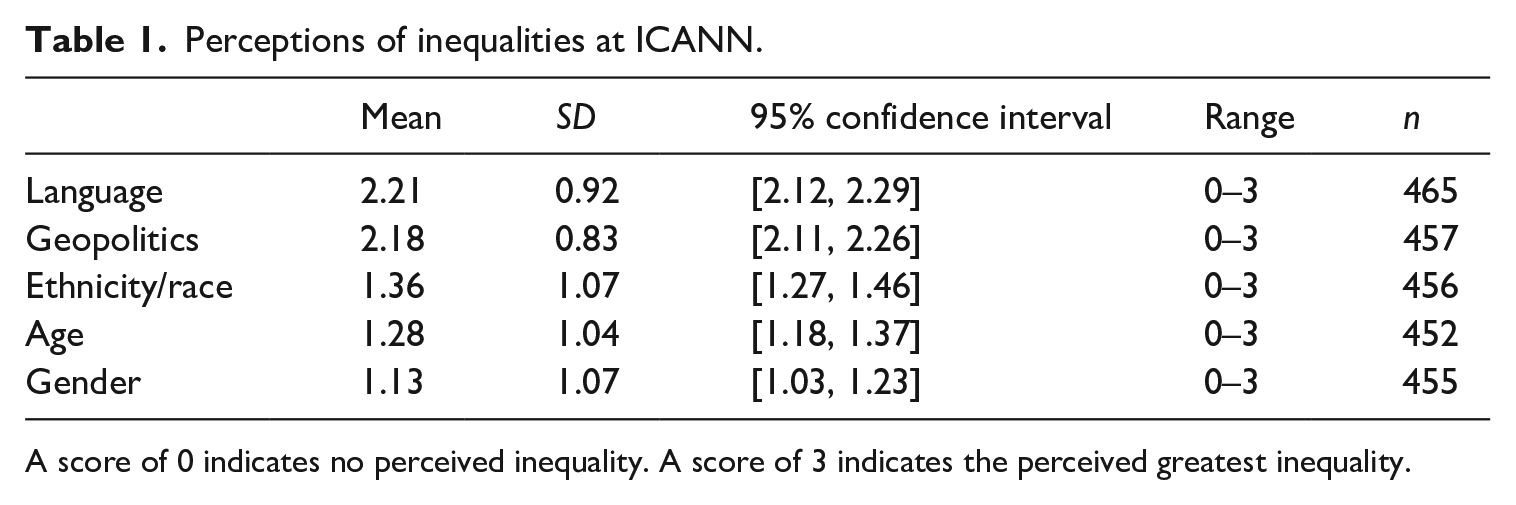
A score of 0 indicates no perceived inequality. A score of 3 indicates the perceived greatest inequality.
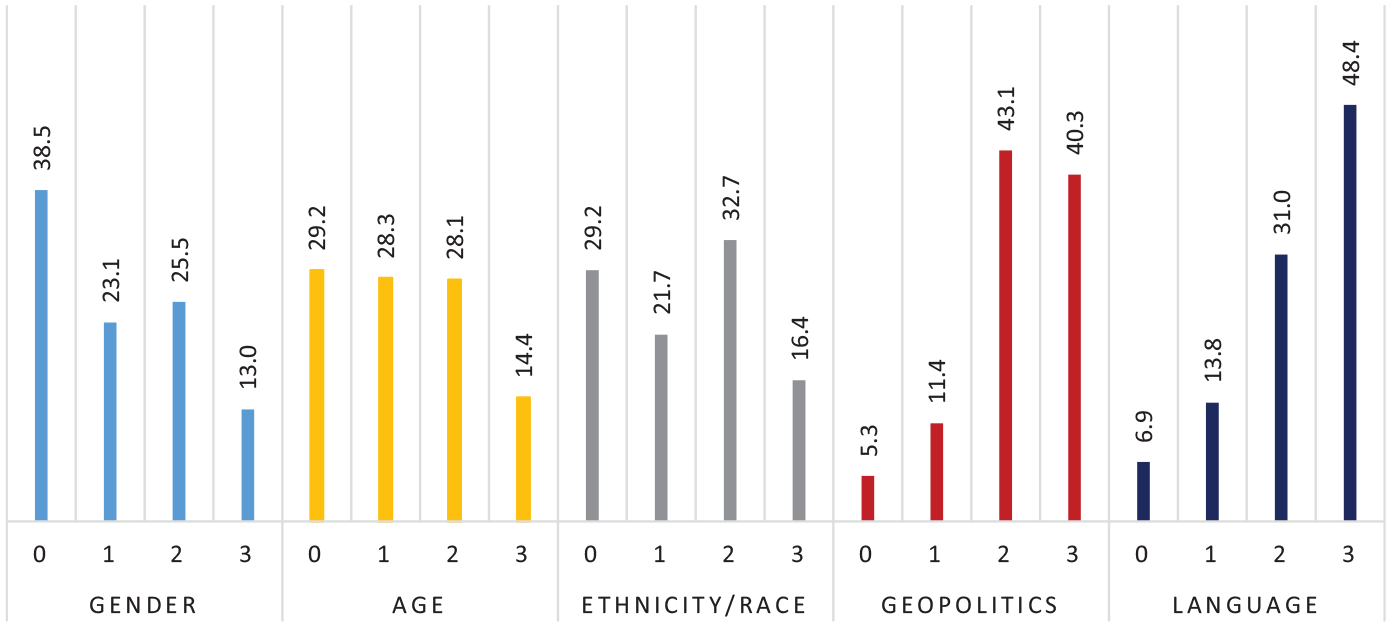
Perceptions of inequalities at ICANN as percent of total respondents.
ICANN participants also on average perceive notable power inequalities based on ethnicity/race (mean of 1.36), age (mean of 1.28) and gender (mean of 1.13). That said, on these three axes, a considerable proportion of respondents perceive no inequalities: 29.2 percent for age, 29.2 percent for ethnicity/race and 38.5 percent for gender. The numbers of respondents assigning the highest inequality score of 3 (13%–16%) are also much lower for these categories than for geopolitics and language. Paired-samples t-tests show that perceptions of geopolitical and language inequalities are significantly stronger than those related to ethnicity/race, age and gender (p ⩽ 0.001).
Although quantitative data give lower scores to perceptions of age, ethnic/racial and gender inequalities, qualitative evidence from the survey suggests that some respondents do strongly consider that older-aged, white and male participants yield more influence in ICANN than younger participants, people of colour and women. Multiple interviewees underline the dominance at ICANN of ‘men of older age’, ‘white male privilege’ and ‘white males who speak English’. 5 Another respondent asserts, ‘Everybody who is essentially not a white dude has less influence’. 6
Such remarks also indicate awareness among some respondents of intersectionality: that is, where inequalities are accentuated to the extent that a person falls simultaneously in several positions of structural advantage or on several positions of structural disadvantage. In addition to the intersections of age, ethnicity/race and gender, significant interplay occurs at ICANN between geopolitics and language, with 90.9 percent of respondents from the Global North reporting to have advanced English skills, as compared with 68.9 percent of Global South respondents. Ethnicity/race and geopolitics also often intersect, as a large majority of respondents of colour (77.0%) and a small minority of white respondents (10.0%) reside in the Global South.
Next, we examine how problematic respondents regard these inequalities at ICANN. This question was only put to interviewees who perceive a power asymmetry to exist (i.e. who give a score other than 0). After all, it would be odd to ask someone how problematic they find a certain inequality if they do not actually see this inequality. Yet calculations that include only those respondents who perceive a specific stratification would exaggerate how problematic ICANN participants consider these inequalities, given that a notable proportion do not see any asymmetry, especially regarding age, ethnicity/race and gender.
Thus, we have made two calculations in Table 2. For the first, we assign all respondents who do not observe a specific inequality in ICANN a score of 0 on the question of problematic-ness, so that they consider this inequality ‘not problematic at all’. On this formula, respondents regard power asymmetries based on language skills to be the most problematic for ICANN (mean of 2.13), followed by geopolitics (2.09), ethnicity/race (1.61), gender (1.48) and age (1.28). However, if we focus only on interviewees who perceive a specific inequality to exist, then gender inequalities rank as the most problematic for ICANN (mean of 2.42), followed by inequalities in language (2.28), ethnicity/race (2.28), geopolitics (2.20) and age (1.82). So respondents who perceive gender, ethnicity/race and age inequalities find them notably more problematic than the overall population.
Perceptions of problematic inequalities.
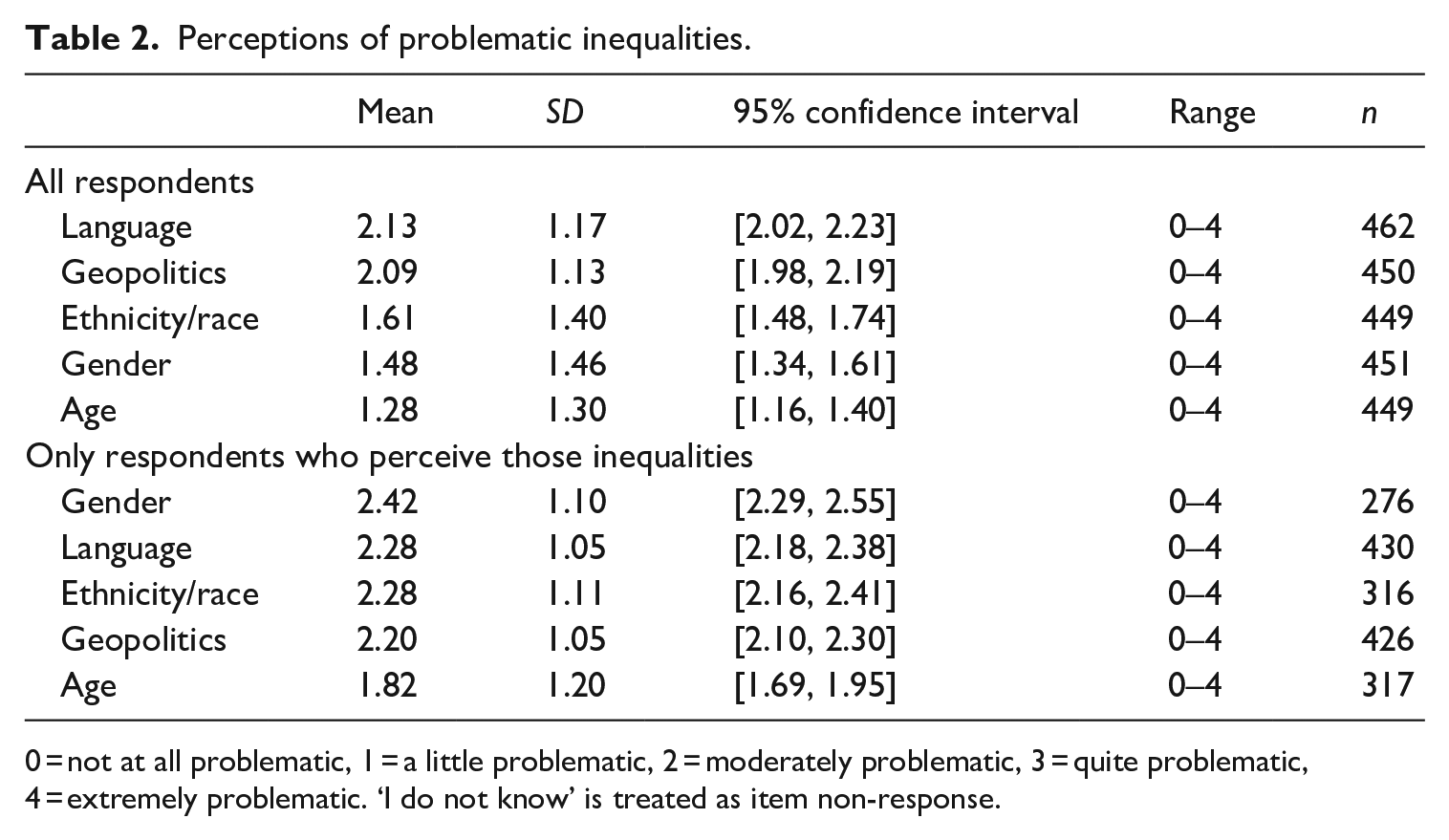
0 = not at all problematic, 1 = a little problematic, 2 = moderately problematic, 3 = quite problematic, 4 = extremely problematic. ‘I do not know’ is treated as item non-response.
In summary, confirming H1(a/b), participants in ICANN, on average, perceive notable structural inequalities in their midst. On the whole, respondents see larger asymmetries of power by language and geopolitics – and generally find these inequalities to be ‘moderately’ problematic. Respondents on average see intermediate power inequalities by ethnicity/race, age and gender – and generally view these stratifications to be between ‘a little’ and ‘moderately’ problematic. Meanwhile, those participants who perceive structural inequalities at ICANN generally find them to be between ‘moderately’ and ‘quite’ (albeit not ‘extremely’) problematic. These findings are the more striking given that our sample population consists of insider elites who mostly lie on the dominant side of the hierarchies in question.
Finding 2: greater perceptions of inequalities from subordinated positions
We now examine each of the five inequalities more closely, comparing perceptions held by persons in the dominant position and those in the subordinated position vis-à-vis a given inequality at ICANN. For example, in respect of language, we compare the views found among participants with advanced English skills (dominant group) with the views of participants with weak English skills (subordinated group). For gender inequality, we compare the perceptions held by men with those of women. And so on for age, ethnicity/race and geopolitics.
Table 3 summarises the results of independent-samples t-tests regarding this issue. In three cases, we find a statistically significant difference in average views between respondents who identify with a subordinated group and those who affiliate with a dominant group. So ICANN participants from the Global South perceive significantly larger geopolitical inequalities than participants from the Global North (p ⩽ 0.05). Young participants see significantly bigger age inequalities at ICANN than older participants (p ⩽ 0.01). Women at ICANN perceive significantly greater gender inequalities than men (p ⩽ 0.001). However, while findings regarding language and ethnicity/race show some variation in average perceptions of inequality between participants in dominant and subordinated positions, these differences are not statistically significant.
Perceptions of inequality and perceptions of problematic inequality: Independent-samples t-tests (two-tailed).
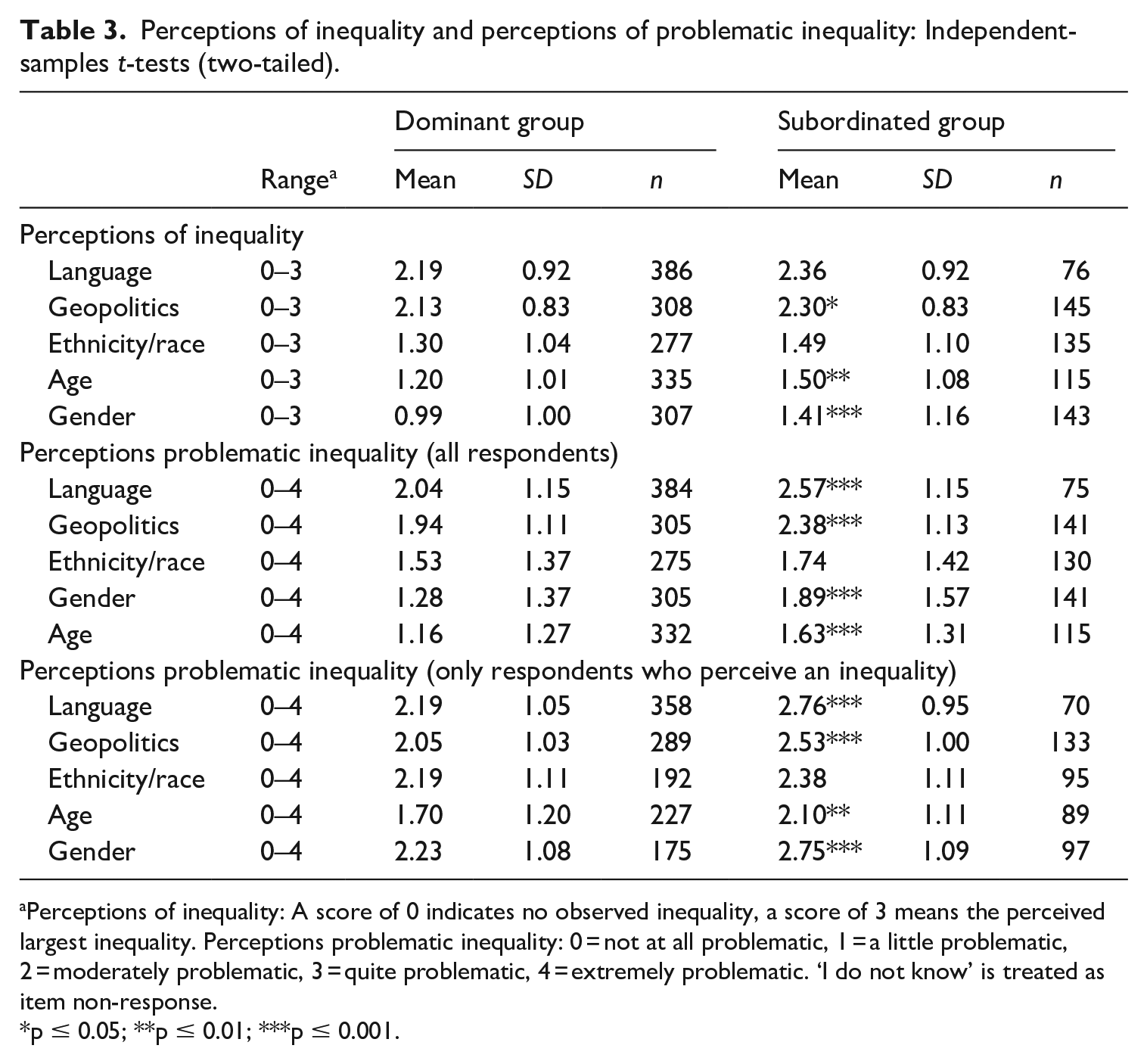
Perceptions of inequality: A score of 0 indicates no observed inequality, a score of 3 means the perceived largest inequality. Perceptions problematic inequality: 0 = not at all problematic, 1 = a little problematic, 2 = moderately problematic, 3 = quite problematic, 4 = extremely problematic. ‘I do not know’ is treated as item non-response.
p ≤ 0.05; **p ≤ 0.01; ***p ≤ 0.001.
Turning to the problematic nature of inequalities, participants in dominant and subordinated positions regarding language have significantly different assessments of how problematic this inequality is for ICANN. Respondents with little or no English skills find this structural inequality more problematic (mean of 2.57, halfway between ‘moderately’ and ‘quite’) compared to respondents with advanced English (mean of 2.04, ‘moderately’, p ⩽ 0.001). Several respondents indicate that weaker English speakers hesitate to join discussions or take the microphone. 7 Others feel that limited English skills reduce their chances to become working group leaders. 8 In contrast, various respondents with strong English skills downplay the repercussions of language inequalities. For example, one suggests that ‘we can’t all learn twenty languages’. 9 Another opines that ‘anybody can learn English anywhere’. 10 A number of other English speakers shrug that their language advantage ‘is just the way it is’. 11
As regards geopolitical inequality, Global South respondents find this situation significantly more problematic than Global North respondents, with respective means of 2.38 and 1.94 (p ⩽ 0.001). In interview comments, several Global South respondents criticise ICANN for lacking a full regional office in Africa. 12 Participants from the Global South regularly call for increased efforts to represent underserved regions at ICANN. 13 In contrast, various participants from the Global North attribute the larger influence of their regions at ICANN to the larger presence of the Internet and Internet business in Europe and North America. 14 Global North respondents are also more likely to question the concept of a North–South divide. 15
Although survey respondents overall consider gender inequalities at ICANN to be the smallest in extent and next to least problematic, the data reveal significant differences in perspective between women and men. Women generally consider power inequality by gender to be much more problematic for ICANN than men, with respective means of 1.89 (close to ‘moderately problematic’) and 1.28 (leaning towards ‘a little problematic’; p ⩽ 0.001). In their oral commentary, many respondents, both men and women, urge increased efforts for gender diversity at ICANN, 16 although they (especially men) also commend ICANN for improving women’s involvement in recent years. 17 Meanwhile, men respondents often invoke ‘numbers game’ arguments that attribute gender hierarchy at ICANN to the greater prevalence of men in the Internet sphere, especially its business and technical sectors. 18 In the words of one respondent, ‘Men have more influence because there are more of them, but not because they are men’. 19
As for age inequality, our survey evidence reveals some significant differences in perspective between younger people (⩽40 years old) and older generations (>40 years old). Younger generations on average consider power asymmetry by age to be significantly more problematic for ICANN than older generations (respective means of 1.63 and 1.16, p ⩽ 0.001). Interestingly, however, many older-aged participants highlight age inequalities in their oral commentary, 20 remarking at the ‘ICANN dinosaurs’ 21 and pensioners who have more time and money to participate. 22
Finally, in contrast to the pattern for the other four power asymmetries, the survey results show no notable differences between white respondents and respondents of colour regarding perceptions of problematic ethnic/racial inequalities. Participants of colour on average find these power asymmetries to be somewhat more problematic for ICANN compared to white participants, with respective means of 1.74 and 1.53; however, this difference is not statistically significant, as both scores lie a bit more towards ‘moderately’ than ‘a little’ problematic. Moreover, oral commentary in the interviews includes relatively few specific remarks highlighting ethnic/racial inequalities at ICANN. When respondents raise the issue at all, they tend merely to remark that more white participants attend ICANN meetings than people of colour, without linking the contrasting numbers to a power inequality. 23
Summarising these findings in relation to our hypotheses, evidence is substantially but not wholly supportive. Regarding H2(a), in three of the five cases (age, gender and geopolitics), individuals on the (perceived) subordinate side of an inequality observe significantly larger hierarchies of influence at ICANN than individuals on the (perceived) dominant side. However, no such significant differences appear in respect of ethnicity/race and language. Regarding H2(b), in four of the five cases (the exception being ethnicity/race), individuals on the (perceived) subordinate side of an inequality axis find asymmetries of influence at ICANN more problematic than individuals on the (perceived) dominant side. So, in most, but not all, cases, a person’s position on an axis of power is associated with the degree to which they perceive such a stratification to exist at, and to be problematic for, ICANN. Thus, average scores for the overall population of ICANN participants can give a skewed picture, particularly since people in structurally dominant positions make up a large share of the respondents.
Finding 3: almost no association of inequality perceptions and legitimacy beliefs
Next, we examine the relationship between perceptions of (problematic) inequalities at ICANN and legitimacy beliefs towards this global governance institution. How far do perceptions of, and concerns about, embedded power asymmetries associate with levels of confidence in a global authority? In sociological terms, does awareness of (problematic) structural inequalities matter for the legitimacy of a global governance organisation, at least among participants in the regime?
To study this issue, we use ordinal logistic regression analysis in two models. 24 Model 1 looks at the association between perceptions of inequality and confidence in ICANN. Model 2 considers the relationship between perceptions of problematic inequalities and confidence in ICANN. Model 2 includes only respondents who reported to observe an inequality of influence. Since few respondents selected ‘very low’ when asked about their confidence in ICANN (n = 9), we merge this response category with ‘low’ confidence in ICANN (n = 23). We keep the other three confidence response categories unchanged.
Strikingly, the results defy our theoretically derived hypotheses and show almost no significant relationship between inequality perceptions and legitimacy beliefs. As Table 4 indicates, only perceptions of geopolitical power inequality between the Global North and the Global South have a statistically significant association with confidence in ICANN (Model 1). The odds ratio is 0.630 (i.e. below 1), meaning that a one unit increase in perceptions of geopolitical hierarchy decreases the odds of having higher confidence in ICANN by 37.0 percent (p ⩽ 0.01). In other words, the more a respondent perceives geopolitical inequality at ICANN, the more likely that they will have lower confidence in this global governance arrangement. However, perceptions of the other four inequalities (related to language, age, gender and ethnicity/race) yield no such connection. On the whole, then, H1(c) obtains little support.
Ordinal logistic regression of confidence in ICANN overall. a .
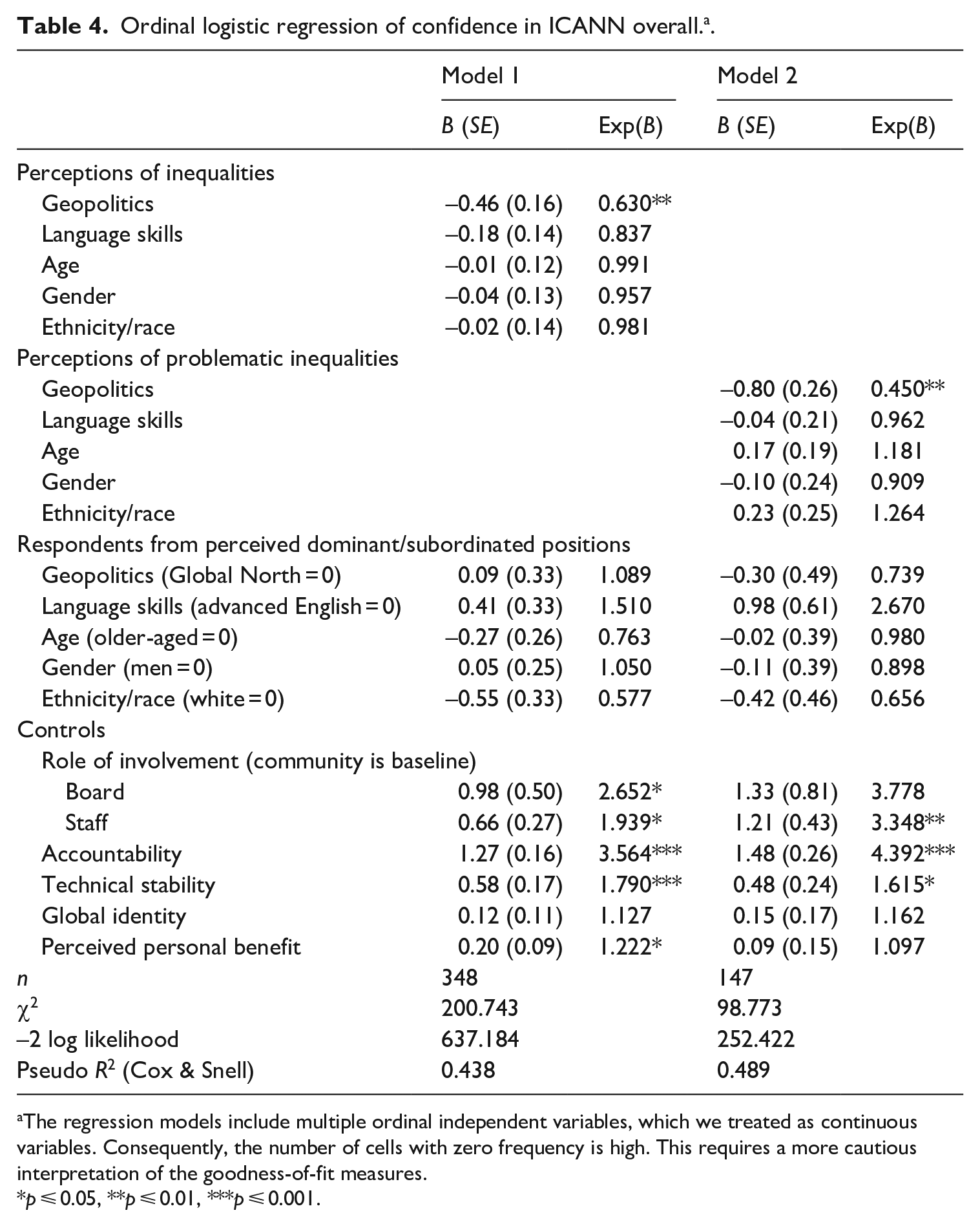
The regression models include multiple ordinal independent variables, which we treated as continuous variables. Consequently, the number of cells with zero frequency is high. This requires a more cautious interpretation of the goodness-of-fit measures.
p ⩽ 0.05, **p ⩽ 0.01, ***p ⩽ 0.001.
This lack of association persists when we look separately at respondents from (perceived) dominant and subordinated categories. We expected in H2(c) that participants at ICANN from subordinated positions in respect of age, ethnicity/race, gender, geopolitics and language would have lower confidence in the regime. However, the analysis shows no such relationship for any of the five inequalities, including the North–South hierarchy. In no case do the upper and the lower sides of the respective power stratifications show statistically significant differences in their legitimacy perceptions towards ICANN.
As Table 5 (Model 1) shows, also confounded is our theoretical expectation that perceptions of a particular power inequality would more strongly relate to confidence levels for respondents who are positioned on the subordinate side of that hierarchy. Thus, for example, perceptions of gender inequality would have greater effects on the legitimacy perceptions of women as compared to men, and perceptions of age inequality would have greater effects on the legitimacy perceptions of younger as compared with older people. Yet examination of interaction effects between perceptions of inequality and respondents’ position on the axes (subordinated vs dominant) also yields no significant relationships with their legitimacy beliefs.
Interaction effects. a
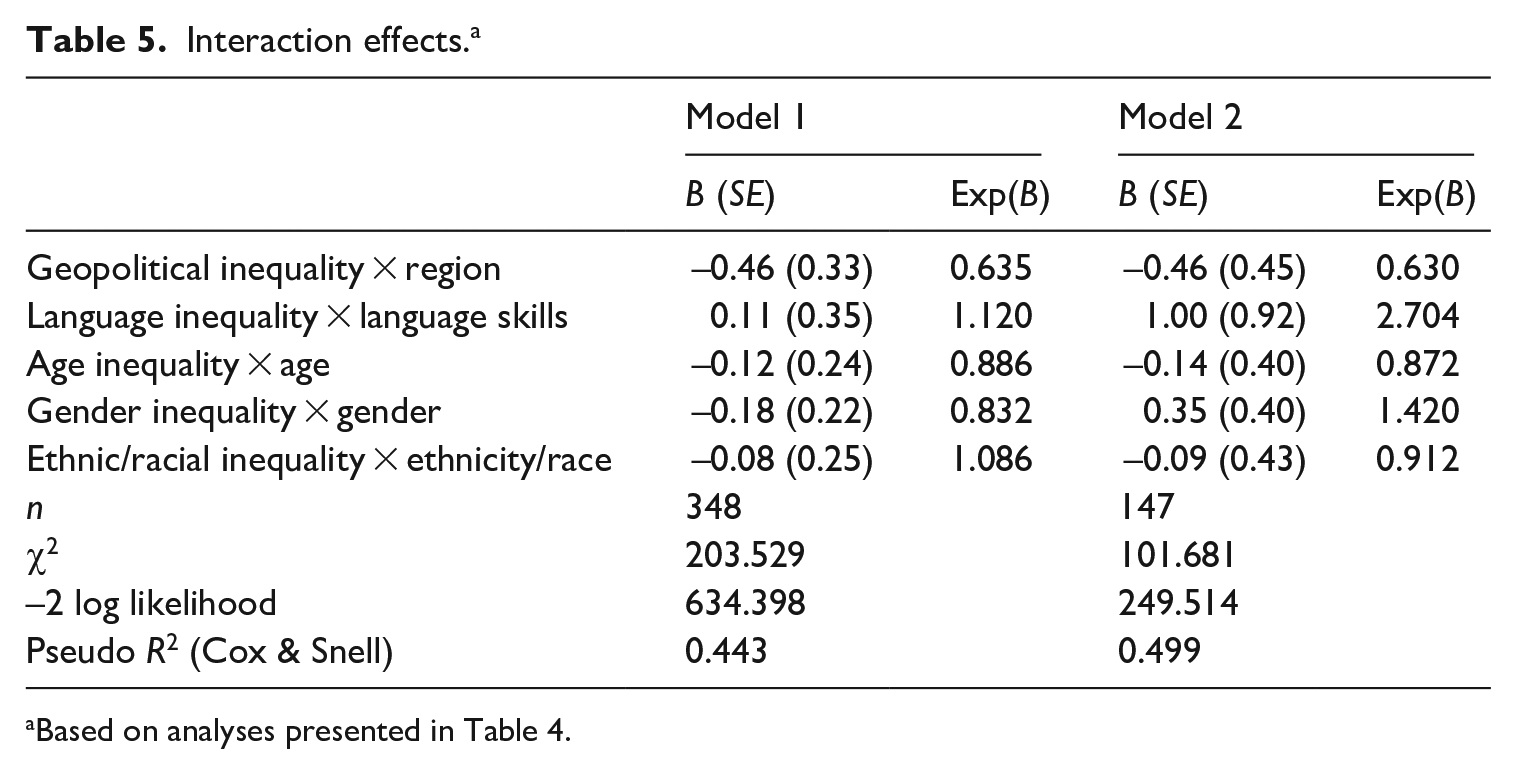
Based on analyses presented in Table 4.
Still more surprising, Table 4 (Model 2) also shows a general lack of association between inequality and legitimacy when we consider how problematic a respondent finds these power asymmetries. The only exception again involves perceptions of problematic geopolitical inequality, where a significant relationship does prevail (odds ratio of 0.450; p ⩽ 0.01). 25 Hence, when respondents consider geopolitical inequalities to be more problematic for ICANN, this decreases the odds that they have stronger legitimacy perceptions towards ICANN by 55.0 percent. Likewise, looking at interaction effects, we find no statistically significant relationship between perceptions of problematic inequalities and respondents’ position on the inequality axes, on one hand, and their legitimacy beliefs, on the other (Table 5, Model 2). Hence, for example, persons with lower English competence who perceive language inequalities and find them problematic do not on average have reduced legitimacy beliefs vis-à-vis ICANN. So even when we look at situations where an impact of inequality perceptions on legitimacy beliefs would seem most plausible, we still find no significant association. Thus, H1(c) obtains little support: individuals who find power inequalities at ICANN more problematic usually do not hold lower legitimacy beliefs towards the regime.
Qualitative evidence from the survey also tends to confirm the lack of relationship for participants at ICANN between perceptions of power inequalities and legitimacy beliefs. When we asked respondents to explain their level of confidence in and approval of ICANN overall, less than 5 percent of the answers mentioned any of the five power asymmetries. Thus, as long as we did not probe respondents with specific survey questions about structural inequalities, these matters rarely came to mind when interviewees discussed their legitimacy perceptions towards ICANN.
As noteworthy exceptions, 20 of the 467 respondents did discuss one or more of the five power inequalities when explaining their confidence and approval towards ICANN. In line with our quantitative findings, these respondents most often (in 11 cases) referred to disparities in influence between the Global North and the Global South. 26 Next came comments related to inequalities around language (six times), 27 gender (four times) 28 and age (two times). 29 Only one interviewee mentioned power inequalities around ethnicity/race to explain their strong disapproval of ICANN, asserting that Indigenous populations ‘are side-lined intentionally from the process’. 30 In addition, four respondents linked their lower confidence and approval assessments to power asymmetries related to time and money. 31 One interviewee connected their lower confidence in ICANN with the need to increase involvement by people with disabilities. 32 Thus, concerns with power inequalities constitute an important consideration in the legitimacy beliefs of certain ICANN participants, but these outliers form a small minority.
In sum, we find – against our expectations from societal-level and individual-level hypotheses – almost no relationship between inequality perceptions and legitimacy beliefs among participants in global governance at ICANN. Even though the multistakeholder principle champions horizontality and inclusivity, and even though ICANN has so highlighted diversity concerns, when the rubber hits the road inequality apparently does not matter for legitimacy in global governance in this setting.
Finding 4: respondents prioritise values other than equality
If participants at ICANN generally perceive asymmetries of power in ICANN and generally find these inequalities to be problematic, then why do their legitimacy beliefs towards ICANN not correspondingly decline, in line with the expected pressures of social norms and (especially in the case of subordinated groups) individual circumstances? As suggested in our theory discussion, the answer might lie with organisational features as well as other individual-level conditions.
Indeed, our control variables bear out such logics (Table 4). Regarding institutional qualities, for example, Model 1 shows that satisfaction with accountability procedures and with promoting technical stability of the Internet increases the odds of having higher confidence in ICANN by 256.4 percent and 79.0 percent, respectively (odds ratios of 3.564 and 1.790; p ⩽ 0.001). Regarding individual factors, utilitarian calculation (i.e. the perception to benefit personally from ICANN) increases the odds that respondents have higher confidence in ICANN by 22.2 percent (odds ratio of 1.222, p ⩽ 0.05). Furthermore, we find that both ICANN board members (odds ratio of 2.652; p ⩽ 0.05) and staff members (odds ratio of 1.939; p ⩽ 0.05) are more likely to have higher confidence in ICANN than community members. However, identity construction (in particular, whether an individual has a global-cosmopolitan sense of self) does not associate with confidence in ICANN.
Further evidence from our survey suggests that ICANN participants give less priority to inequality relative to other values when they assess institutional aspects of the regime. Concerning institutional purpose, for instance, we asked respondents how far they endorse ICANN’s role of promoting the global spread of the Internet (an equality indicator) as well as its role in fulfilling certain technical functions (a problem-solving indicator). Concerning institutional procedure, the survey asked respondents how far ICANN should give all stakeholders the opportunity to participate in policymaking (an equality indicator) and be transparent in its decision making (an accountability indicator). Concerning institutional performance, survey items asked respondents how far ICANN should promote human rights in the DNS (an equality indicator), democracy in the management of the DNS and technical stability of the Internet (a problem-solving indicator).
Figure 2 indicates how much value respondents attach to several technocratic purposes, procedures and performance in ICANN (marked in black); fair purposes, procedures and performance (marked in white); and democratic procedures and performance (marked in grey). We see that respondents on average consider it more appropriate that ICANN fulfils several key technical functions in respect of Internet infrastructure (mean of 3.45) than that it promotes the global spread of the Internet (mean of 2.86; p < 0.001 33 ). Thus, when it comes to institutional purpose, participants in ICANN prioritise technocratic values over equality. The same holds regarding institutional procedure, where respondents find it more important that ICANN is transparent in its decision-making procedures (mean of 3.86) and that it bases decisions on the best available knowledge and expertise (mean of 3.81) than that it gives all stakeholders the opportunity to participate in its policy-making activities (mean of 3.67; p < 0.001). 34 Likewise, for institutional performance, we find that respondents attach more importance to technical stability (mean of 3.89) and ICANN’s promotion of democracy in management of the DNS (mean of 2.89, p < 0.001) than the inequality-related measure of human rights promotion in the DNS (mean of 2.53, p < 0.001). 35 Hence values associated with inequality appear to figure secondarily relative to technocratic and democratic features.
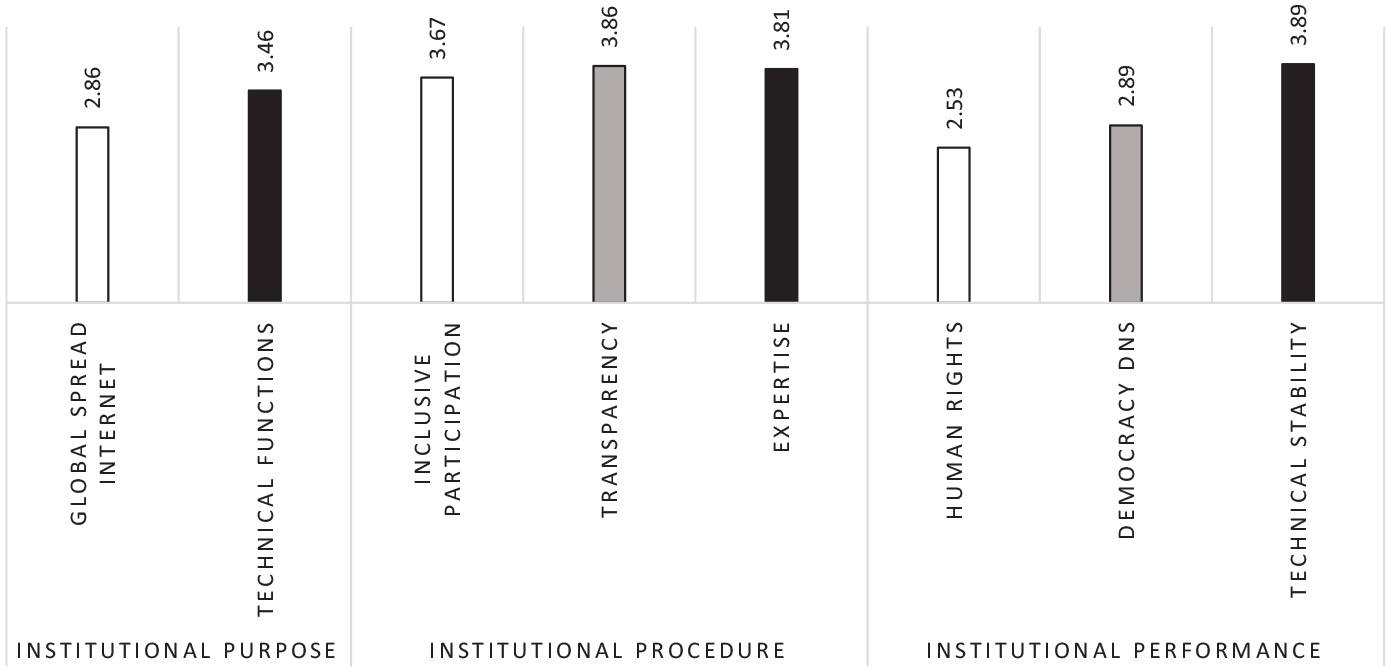
Respondents’ priorities regarding institutional values (0–4 scale).
Moreover, it could be that participants at ICANN appreciate the organisation’s intensified efforts of the past decade at more inclusion and diversity in decision making, as documented earlier. Indeed, many survey respondents in their oral commentary referred sympathetically to ICANN’s initiatives for the ‘next generation’, ‘underserved regions’, translation and women’s leadership. To this extent, actors might fault the wider social order for structural inequality and credit ICANN for doing its best in an unfair world.
As for the absent link between inequality and legitimacy in the subordinated groups at ICANN, critical theories of hegemony might provide some insight. Contrary to our hypotheses, these approaches anticipate that structurally subordinated persons generally accord legitimacy to the very order that subordinates them (Cox, 1983; Katz, 2006). Thus, a Gramscian would not be surprised that ‘co-opted’ ICANN participants from structurally disadvantaged positions appreciate the organisation’s measures to ‘include’ them and furthermore internalise the organisation’s higher priorities for technical purposes and problem solving.
Conclusion
This article has explored how far participants in global governance perceive structural inequalities in their midst and how far such perceptions relate to their legitimacy beliefs towards global authority. Do arbitrary power asymmetries – often decried as a major injustice by critics of existing global governance – affect the legitimacy beliefs of those who operate the regimes? We have examined this question in detail with respect to ICANN, a leading instance of so-called ‘multistakeholder’ arrangements, which specifically aim to create a global governance that is inclusive of all affected parties.
To recapitulate our main results, participants in ICANN do perceive substantial structural power asymmetries, especially in respect of English language and North–South geopolitics, as well as regarding age, ethnicity/race and gender. Moreover, regime insiders on average consider these structural power asymmetries to be ‘moderately’ problematic for ICANN. ICANN participants positioned on the subordinated sides of the power asymmetries tend to perceive larger inequalities and to find these hierarchies more problematic (i.e. more towards the ‘quite’ level) than persons on the dominant sides. Yet perceptions of considerable and problematic inequalities of influence at ICANN do not significantly relate to participants’ legitimacy beliefs towards this global governance arrangement. This lack of association holds whether one looks at the ICANN population as a whole, or at the subordinated groups more specifically, or even at the respondents who express the greatest concerns with power inequalities. Only in one case – namely, North–South stratification – do we find a statistically significant relationship between perceptions of inequality on one hand and confidence in ICANN on the other. Instead, as confirmed by several of our control variables, it appears that ICANN participants tend to base their legitimacy beliefs towards the regime more on other considerations, such as accountable procedures, effective technical performance and personal benefits.
Our investigation has broken new ground on several fronts. Methodologically, the study offers an unprecedented endeavour to obtain qualitative and quantitative evidence from a large-n survey on inequality and legitimacy in global governance. The exercise has involved pre-tests, systematic random sampling, and high coverage and response rates. The data analysis has combined macro-statistical calculations with micro-attention to comprehensively transcribed interviews. We show that such an ambitious research design can work and produce interesting results, thereby hopefully encouraging further investigations on these lines.
Empirically, our field research has generated a novel database covering 467 participants in one of the most developed and important instances of multistakeholder global governance. The evidence covers the views of ICANN insiders regarding inequalities of age, ethnicity/race, gender, geopolitics and language, as well as systematically collected data on the respondents’ positions on these power axes, along with evidence for a range of other circumstances that are incorporated as control variables. Moreover, the qualitative and quantitative evidence from our mixed-methods approach strongly corroborate each other.
More cautiously, we might suggest the seeds of a theoretical contribution. The by-now extensive research on sociological legitimacy in global governance has nearly always developed either an individual-level or an organisational-level or a societal-level explanation. Several theoretical writings have affirmed the principle that these levels interrelate in forming legitimacy beliefs (Scholte, 2019; Tallberg et al., 2018), but previous research has not developed the premise in an empirical analysis. While this article has by no means fully worked out the actor–structure interplay, it has laid some groundwork for combining levels of analysis, by positing that subjects form legitimacy beliefs towards global governance in the light of prevailing social norms, as filtered through personal circumstances and as conditioned by organisational features. Perhaps our example can encourage future further development of this more complex mode of explanation.
Finally, what of wider implications of the findings presented here? We must immediately caution that our study covers only one context. ICANN offers a good case study, but more investigations are wanted of the relationship between inequality and legitimacy in global governance. Possibly, the significance could be greater in global regimes for, say, gender equity and human rights, where equality issues lie at the heart of the organisational mandate. Still, if a significant association between inequality and legitimacy is generally absent at ICANN, in spite of its important distributional consequences and the high priority that it has assigned to diversity and inclusion, then it seems less probable that such significance would operate in most other global governance contexts.
We must also again underline that our analysis only covers participants in the ICANN regime, and insider views could deviate from outsider opinion. Indeed, other research has demonstrated that substantial gaps exist in legitimacy beliefs towards global governance between elites and citizens at large (Dellmuth et al., 2022). It could well be that external observers perceive larger and more problematic power inequalities at ICANN and lower their legitimacy assessments as a result. A complementary survey that we conducted with 61 participants in wider Internet governance (i.e. who do not take part in ICANN) suggests that outsiders observe somewhat greater power asymmetries in ICANN than insiders, especially regarding ethnicity/race and gender. 36 Future research with a larger sample could examine whether significant associations between inequality and legitimacy in global governance exist for public opinion. Given that citizens at large are, in contrast to policy insiders, less aware of the institutional features of global governance, perhaps our hypothesised societal-level and individual-level logics would operate more strongly in public opinion.
Already, though, our present study offers insight into the challenges of promoting increased equality in global governance: for example, with voting reforms, gender balance and voice for youth. Our findings from ICANN indicate that participants in global governance can genuinely support principles of inclusion and diversity, yet prioritise other considerations when forming their legitimacy beliefs. To this extent, campaigners for greater equality in global politics face an uphill struggle.
Supplemental Material
sj-pdf-1-ejt-10.1177_13540661221098218 – Supplemental material for Inequality and legitimacy in global governance: an empirical study
Supplemental material, sj-pdf-1-ejt-10.1177_13540661221098218 for Inequality and legitimacy in global governance: an empirical study by Hortense Jongen and Jan Aart Scholte in European Journal of International Relations
Supplemental Material
sj-pdf-2-ejt-10.1177_13540661221098218 – Supplemental material for Inequality and legitimacy in global governance: an empirical study
Supplemental material, sj-pdf-2-ejt-10.1177_13540661221098218 for Inequality and legitimacy in global governance: an empirical study by Hortense Jongen and Jan Aart Scholte in European Journal of International Relations
Supplemental Material
sj-pdf-3-ejt-10.1177_13540661221098218 – Supplemental material for Inequality and legitimacy in global governance: an empirical study
Supplemental material, sj-pdf-3-ejt-10.1177_13540661221098218 for Inequality and legitimacy in global governance: an empirical study by Hortense Jongen and Jan Aart Scholte in European Journal of International Relations
Research Data
sj-sav-4-ejt-10.1177_13540661221098218 – Inequality and legitimacy in global governance: an empirical study
sj-sav-4-ejt-10.1177_13540661221098218 for Inequality and legitimacy in global governance: an empirical study by Hortense Jongen and Jan Aart Scholte in European Journal of International Relations
Research Data
sj-sps-5-ejt-10.1177_13540661221098218 – Inequality and legitimacy in global governance: an empirical study
sj-sps-5-ejt-10.1177_13540661221098218 for Inequality and legitimacy in global governance: an empirical study by Hortense Jongen and Jan Aart Scholte in European Journal of International Relations
Research Data
sj-sps-6-ejt-10.1177_13540661221098218 – Inequality and legitimacy in global governance: an empirical study
sj-sps-6-ejt-10.1177_13540661221098218 for Inequality and legitimacy in global governance: an empirical study by Hortense Jongen and Jan Aart Scholte in European Journal of International Relations
Footnotes
Acknowledgements
We give major thanks to Alexandra Bousiou and Evie Papada for their inputs to constructing the ICANN survey questionnaire and for between them conducting around 40 percent of the interviews. We further thank student interns Elvina Borombaeva, Natalie Dinham, Linn Lundquist, Aaron Mannis and Maria Verkhovtseva at the School of Global Studies, University of Gothenburg, for assistance with various survey preparations. For feedback on earlier versions of the paper, we thank colleagues in the Legitimacy in Global Governance (LegGov) programme; seminars at the University of Gothenburg, the Vrije Universiteit Amsterdam and the Centre for Global Cooperation Research; audiences at the Digital Inclusion and Policy and Research Conference (September, 2021), the 14th edition of the United Nations Internet Governance Forum and the 13th Pan-European Conference on International Relations; and reviewers for the European Journal of International Relations.
Funding
The author(s) disclosed receipt of the following financial support for the research, authorship and/or publication of this article: Research for this article was carried out within the project ‘Legitimacy outside the State: Governing the Global Internet’, with generous funding from the Swedish Research Council (Grant no. 2017–03076_3).

Supplemental material
Supplemental material for this article is available online.
Notes
Author biographies
References
Supplementary Material
Please find the following supplemental material available below.
For Open Access articles published under a Creative Commons License, all supplemental material carries the same license as the article it is associated with.
For non-Open Access articles published, all supplemental material carries a non-exclusive license, and permission requests for re-use of supplemental material or any part of supplemental material shall be sent directly to the copyright owner as specified in the copyright notice associated with the article.
