




Abstract
Consistent with the call for papers, this study adds to the body of work on processes of precaritization using a micro-historical/biographical approach to examine the subjective, embodied experiences of two female authors who lived through a dramatic transformation in institutionalized conditions, i.e., the partial dismantling of institutionalized patriarchy in the UK in the early 20th century precipitated by first wave feminists. By moving beyond the focus on the “standard employment model” to include institutional structures that affect marriage, women’s control over their bodies and care and guardianship of children, this study examines how this transformation of the male breadwinner model precaritized middle class women who had previously been actively discouraged, both legally and culturally, from working. While Agatha Christie and Dorothy L. Sayers were two women born into the same conditions of legal patriarchy in Britain in the 1890s, differences in their embodied correspondence with patriarchal notions of female attractiveness produced very different expectations and life experiences. The availability of letters and autobiography offers a rare window into the subjective, embodied experiences of these two women as they struggled to navigate this sudden “emancipation” and the new expectation that they should be economically independent as it unfolded over their lifetimes. Finally, the body of writing they left as authors of detective fiction offers some insight into how, even though they distanced themselves from the feminist movement of the time, they also subtly resisted by ventriloquizing alternatives to patriarchal gender regimes in their fiction.
Keywords
Scholars across disciplines have developed a significant body of critical work tracking how policies shape relations of production in uneven ways, making some workers precarious (e.g. Kalleberg and Vallas, 2018; Vosko, 2010). More recently, qualitative researchers have examined the lived experience of people subjected to these conditions (e.g. Carreri, 2020; Peticca-Harris et al., 2020; Thomson and Jones, 2017) to better appreciate how subjectivity is “situated and incorporated in power relations and dominant discourses” (Armano et al., 2022: 32) of a specific time and place. This study adds to this body of work using a micro-historical/ biographical approach (Hargadon and Wadhwani, 2023; Meister, 2018) to examine processes of precaritization through the subjective accounts of two female authors who lived through a dramatic transformation in institutionalized conditions, that is, the partial dismantling of patriarchy in the UK in the early 20th century precipitated by first wave feminists.
Scholars have convincingly argued that precarity and precariousness are better conceptualized as processes of precaritization (Alberti et al., 2018; Betti, 2018; Betti and Boris, 2022; De Coster and Zanoni, 2023; Butler in, Puar, 2012; Meliou et al., 2024; Segarra and Prasad, 2020; Valenzuela et al., 2024) and a significant body of empirical research has shown how changing conditions of work in the “post-Fordist, post-capitalist” context have induced precariousness for people in specific occupations (e.g. Morris et al., 2024; Norbäck, 2021; Peticca-Harris et al., 2020) or life situations (e.g. Carreri, 2022; Segarra and Prasad, 2020). These studies have generally focused on providing a rich, in-depth analysis of the connections between structures such as employer or state policies and subjective experiences at a specific point in time, however, as Gill and Pratt (2008) note “the relationship between the transformations in working life and workers’ subjectivities is relatively underexplored.” (p. 2).
It is not surprising that studies of precarity, precariousness and precaritization within management and organizational studies have focused on neoliberalism and the experiences of those with uneven access to “good jobs.” This emphasis, however, has tended to occlude the ways in which legal and culturally institutionalized forms of patriarchy, and specifically the male breadwinner model, have historically impeded large swathes of women, particularly middle-class women, from accessing paid work in any form. Betti (2018) draws our attention to the gendered nature of precaritization: “By analyzing the relationship between precarious work and changing legal norms. . .[we can see how] national laws and policies had historically reinforced gender roles, according to which women, when they worked, were usually employed temporarily in more unstable and precarious jobs” (p. 292, italics added). While attention to exploitative working conditions is critically important, I would suggest that to date, organizational theorists have paid relatively little attention to the ways in which women have been deprived of recognition as “persons” both legally and culturally, and how this has often excluded women from accessing paid work at all. There has been a corollary absence of empirical work examining how this exclusion from paid work affects women’s subjective experiences of precariousness.
In this study, I focus on the experiences of two women: Agatha Christie and Dorothy L. Sayers who were born into legal patriarchy in Britain in the 1890s and who lived through the “emancipation” of women achieved by first wave feminists in the early decades of the 20th century. While Christie and Sayers became exceptionally successful authors and wealthy women, they both began their lives as women who had no right to political or economic independence and their struggles through a period of tumultuous institutional change offer insights that I believe continue to resonate. I draw on Christie’s autobiography, the letters of Sayers as well as biographies of both women to examine the subjective, embodied experiences of precaritization they initially faced within the male breadwinner model and their struggle through the turbulent transformation of legal and cultural patriarchy that removed the “security” of paternalism while continuing to impede women’s independence through legal discrimination in accessing work, by largely excluding women from social security through the state and preventing women from controlling their bodies until, eventually, both women gained a subjective sense of security associated with economic independence.
By comparing the distinct experiences of these two women, it is also possible to appreciate the differential ways in which precaritization is socially distributed. While white women have often been treated as an undifferentiated group, as this analysis illustrates, embodied differences, understood in the context of societal gender structures have significant impacts on subjective experiences and expectations as well as life chances; superficially protecting some women while exposing others to greater risk.
Further, these two cases offer insight into the apparent complicity of marginalized actors and the subtle ways in which those with little power may resist (Benali and Villesèche, 2024; Kjærgaard et al., 2024; Norbäck, 2021; Segarra and Prasad, 2020; Valenzuela et al., 2024). Through an analysis of Christie and Sayers’ body of fictional work, I suggest that both women opted for a safe form of resistance, ventriloquizing alternatives to patriarchal gender regimes in their fiction (Wilhoit and Kisselburgh, 2019) while refusing the label feminist in their personal lives. Drawing on theorization of how fiction can contribute to social change (Rhodes, 2000; Thexton et al., 2019; Weatherall, 2023), I argue that this resistance, while subtle, may nonetheless have had significant cultural impacts encouraging questioning of patriarchy, particularly among readers of detective fiction who were, at the time, primarily middle- and upper-class men (Thomson, 2023).
By examining the life/work trajectories of two well-known women writers through a period of dramatic change in the socio-legal context, this study explores the gendered processes of precaritization and also how cultural objects such as novels may act as forms of resistance to oppressive social structures. In the next section, I situate this study within the existing literature, then outline the methods used before presenting the analysis and concluding with a discussion of how this study contributes to our appreciation of processes of precaritization through a period of institutional transformation, the differential distribution of precaritization and finally, how subtle forms of resistance may co-exist with apparent complicity by marginalized actors.
Feminist historiography, precaritization, and patriarchy
While interest in precarious work, precarity and precariousness is relatively recent, scholars have increasingly highlighted that the phenomenon is by no means “new” (Betti, 2018; Neilson and Rossiter, 2008). Researchers have often focused on either “objective” characterizations of precarious work such as specific employer or state policies or subjective experiences of precariousness (Norbäck and Styhre, 2021), however, more recently scholars have argued that the phenomenon is better conceptualized as a process, that is, precaritization. As Butler argued, “Our precarity is to a large extent dependent upon the organization of economic and social relationships, the presence or absence of sustaining infrastructures and social and political institutions” (in Puar, 2012: 170). Any attempt to appreciate the experiences of two women in the early 20th century then, must situate their subjective accounts within the patriarchal infrastructure of the society they confronted, including their position in it as “non-persons” as well as the dynamic and turbulent process of transformation in social, economic and political institutions that occurred over their lifetimes. By making these institutional frameworks visible we are able to appreciate how precaritization and social diversity are intertwined, manifesting contemporary legal and social norms that created security for some members of a society while “stripping others of recognition and protection” (Meliou et al., 2024: 927).
In this section, I begin by outlining the theoretical framing of precaritization, focusing particularly on the contribution of feminist historiography in appreciating how conceptualizations of precarity and precariousness have often reflected androcentric biases by focusing exclusively on working conditions and the “standard employment relationship” that obscures the experiences of women generally, and middle-class women particularly. I then turn to the concept of patriarchy, arguing that to appreciate processes of precaritization, we need to make visible the gendered institutional framework of the period, a framework that organized society, legally and culturally, around a heterosexual male breadwinner based on essentialist notions of gender. While patriarchy is crucial for understanding the life/work trajectories of women (men and gender non-conforming people) in this period, I also outline how a poststructuralist, intersectional conceptualization of patriarchy is required to appreciate the specific ways in which it shapes the lives of different participants in society. Finally, while feminist historians and researchers examining processes of precaritization have highlighted the importance of institutional frameworks including laws and policies, there have been few studies examining how changes to laws or cultural contexts have affected subjective experiences of precaritization as they shift over time (see Morris et al., 2024; Segarra and Prasad, 2020 for exceptions) including whether institutional changes affect precaritized actors’ subjectivities, particularly their compliance or resistance.
As Betti (2018) concluded in her wide-ranging, historical examination of precarious work, “women’s history and feminist scholarship have provided a crucial contribution to understanding precarization as a continuous process and precariousness as a defining condition of women’s employment in the long run.” (p. 292). Conceptualizing precaritization as a process makes visible the way in which laws and social norms both reflect inequalities in a particular social context (Meliou et al., 2024) but also materialize these inequalities in durable objective disparities in terms of access to stable sources of income (precarity), as well as producing a subjective sense of insecurity (precariousness).
Feminist historiography makes visible how historical patterns of precaritization of women become comprehensible when one recognizes that while legal and social infrastructures have varied in different historical moments and geographical spaces, for women, what they have often had in common is that they are organized around the heteropatriarchal “household” with a male breadwinner and female homemaker (Betti and Boris, 2022). Studies of precaritization have tended to focus on the “standard employment model,” implicitly centering the experience of the “typical” (male) worker. This focus, however, makes it difficult to understand non- (heterosexual) male experiences as access to wage earning as well as income and social supports are structured around male needs, often excluding or impeding women’s access, making them dependent on a male breadwinner for survival (Ivancheva and Keating, 2021; Lovey, in Puar, 2012; Millar, 2017). Within these social systems, often only the male breadwinner is legally recognized as a person and he governs the lives of his “dependants” who have few rights as individuals; they only become legally visible in their relation to him, for example, as wives or daughters. A feminist approach, therefore, highlights the importance of attending to the life/work nexus and how precaritization is inscribed not only in institutional structures that govern work but also in those that affect marriage, women’s control over their bodies and care and guardianship of children.
Patriarchy has been a contested concept (Bennett, 2006; Benschop and Lewis, 2024), critiqued as a totalizing concept (Gill et al., 2017); a deterministic “male oppressor/female victim binary” (Morgan, 2006: 6). Early conceptualizations of patriarchy presented it as relatively static and monolithic, affecting the experiences of all women in a given society in similar ways. This approach has been critiqued by intersectional feminists for universalism, ignoring how patriarchy intersects with other axes of marginalization, creating distinct experiences for women who are also racialized for example (Crenshaw, 1991). It has also been critiqued by poststructuralist scholars for failing to account for the agency of women (Bennett, 2006) and how patriarchy can be understood as a “fluid and malleable” set of practices that morph over time (Gill et al., 2017: 227).
Recent feminist historians approach patriarchy from poststructuralist, intersectional premises, seeing patriarchy as a system of relations, a “kind of society” (Johnson, 2014: 5) that centers male experience, locating women in/through their relationship to men and promoting male privilege. Patriarchal societies, therefore, produce an “unequal distribution of precarity” depending on a given persons’ relation to the hegemonic male actor, affecting “whose life is grievable. . .and whose is ungrievable. . .” (Butler in Puar, 2012: 170). By centering male experience, according men differential visibility and rights, patriarchal societies can de-humanize and marginalize women, precaritizing them by impeding their access to secure sources of income, invisibilizing care responsibilities and exposing them to violence.
While Butler argued that all living things share a condition of precarity, as Lorey pointed out, “we are different in our common precarity” (in Puar, 2012: 172). Conceptualizing patriarchy as a system of relations rather than a binary has enabled scholars to appreciate how women’s experience of patriarchy varies. As intersectional feminist scholars have shown, much of the early work failed to appreciate how processes of social categorization did not just focus on gender but intersected with other “differences” such as race, sexuality, national origins that manifest in distinct but overlapping processes of precaritization. Nazzal, Stringfellow, and Maclean’s recent study of Palestinian protesters shows how by making patriarchal structures visible, it is possible to see the nuanced effects of patriarchy on all women in a society, highlighting intersectional inequalities without excluding any classes of women from the analysis. As their study illustrates “women . . . were not all subordinated in an identical fashion” (Nazzal et al., 2024: 282), some women enjoyed “contextual privilege” (Nazzal et al., 2024: 279) through “modes of expression, appearance and domestic situation. . . affording them some protection” (Nazzal et al., 2024: 278).
Studies that move beyond the oppressor/victim binary also show that “women themselves were part of the diverse historical operations of patriarchy”; rather than simply being “passive victims of patriarchy” they show how women “have also colluded in, undermined and survived patriarchy” (Bennett, 2006: 10). Consistent with all institutionalized social systems, people who are marginalized are often either not reflexively aware of the sources of their marginalization or refrain from articulating it to others and sometimes even to themselves (Durepos et al., 2021; Morris et al., 2024; Norbäck, 2021; Segarra and Prasad, 2020). As Alexander and Taylor argued: “Women have dwelled in this oppression. . .but it is only occasionally that some have become sharply aware of it. Our analysis of women’s consciousness must. . .explain the periods of quiescence as well as the times of anger” (Alexander and Taylor, 2006: 57). As there have been relatively few studies of subjective experiences of precaritization over time, our understanding of how stable or variable subjective experiences are, is quite limited.
Finally, while scholars have highlighted the importance of laws, policies and other forms of rules (e.g. algorithms) in precaritizing people, there have been relatively few studies of how changes to institutional frameworks impact subjectivity and, particularly, whether precarious actors’ engagement in efforts to change the institutional arrangements that marginalize them are affected. Segarra and Prasad (2020) is a recent exception that shows how Trump’s demonization of undocumented immigrants shifted the subjectivity of one woman, making her hypervigilant, stressed and anxious. Consistent with previous studies (Norbäck, 2021), however, the woman’s reflexivity and resistance were not dramatically transformed.
This study offers an opportunity to explore how a period of dramatic change in patriarchal institutional frameworks affected women’s subjectivities. It was inspired by a course in detective fiction I took for interest during the pandemic and my reaction to the critiques of Christie and Sayers as conservative, anti-feminist upholders of the status quo. I was struck by how these retrospective critiques totally ignored the deeply patriarchal context in which they were situated. The study was also motivated by my own experiences as a relatively privileged white, western, middle-class woman with grandmothers who, like Christie and Sayers, were born before women acquired the status of “persons” in Canada and who must have lived through a similarly dramatic transition, one they never discussed. I am reminded by students each time I teach the course “Gender at Work” of the ubiquity and varied manifestations of patriarchy across time and space and that, as a recent review of women’s suffrage shows, some women remain without basic political rights and for those women who enjoy these rights, they have only been achieved relatively recently, have often been limited to certain groups of women and occasionally reversed. (Schaeffer, 2020). I hope, therefore, that this study reminds us, as postfeminist scholars (Gill et al., 2017) have, that the fight for the rights of women to economic independence is not over. More practically, I hope this study contributes to recognition of the ubiquity and enduring quality of patriarchies that may facilitate building “new collective subjectivities” (Ivancheva and Keating, 2021: 255), alliances and political mobilization, particularly among middle- and working-class women globally.
Method
This study uses a micro-historical/biographical approach, combining autobiography, letters and biographical material to describe the lived experiences of Agatha Christie and Dorothy L. Sayers, with historical material documenting the institutionalized, patriarchal conditions in Britain between 1890 and 1950. As Hargadon and Wadhwani (2023) outline: “microhistory links the individual-level lived experience of subjects at their particular point in time” (2022:32) and “the macroscopic view of [their] context . . ..” (p. 5). Microhistory “focusses on historically situated lives of subjects in their specific moment in the past and on interpreting actions from the subject’s point of view” (Hargadon and Wadhwani, 2023: 7). As Meister (2018) has argued, “biographical approaches can benefit from the methods of microhistory” as biography often “has not adequately dealt with the broader historical context of its subjects” (p. 3).
These two authors serve as excellent cases for a study of precaritization due to the availability of extensive subjective accounts that span their lifetimes. In addition, both women were born into middle-class families before women had secured any political or economic recognition as “persons” and their subjective accounts provide a window into one of the most significant periods in women’s history, i.e., the fight by first wave feminists to secure the vote for women, in this case in the UK. Further, while both women share a broad historical context, they also share a more specific context: both chose to become authors of detective fiction at a time when the genre was male dominated. Finally, while there are many broad similarities between the two women, there are also some important differences, specifically, their embodied correspondence with contemporary ideals of femininity that I suggest, offer nuanced insights into the distinct ways in which women experience and navigate patriarchy. Feminist historians have recommended “case studies to analyze the many mechanisms of patriarchy in specific historical contexts” (Bennett, 2006: 68) and suggest that “biographies are a powerful way to understand subjective experiences of gender” (Scott, 2018: 44).
In this study, the lived experiences of Christie and Sayers are constructed from a combination of autobiography (Christie), letters (Sayers) and multiple biographies that have been published of each of the authors’ lives (see Table 1) including a recent biography of Christie that members of her family consider “the best” (Worsley, 2022). As Decker (2013) argues, sources that are close in time to the events described, such as memoirs and correspondence, are considered the most valuable archival sources. “Personal letters can be the most revealing of all . . . especially when, as in this case, they were not intended for publication” (Reynolds in Sayers, 1996: xii).
Sources. 1
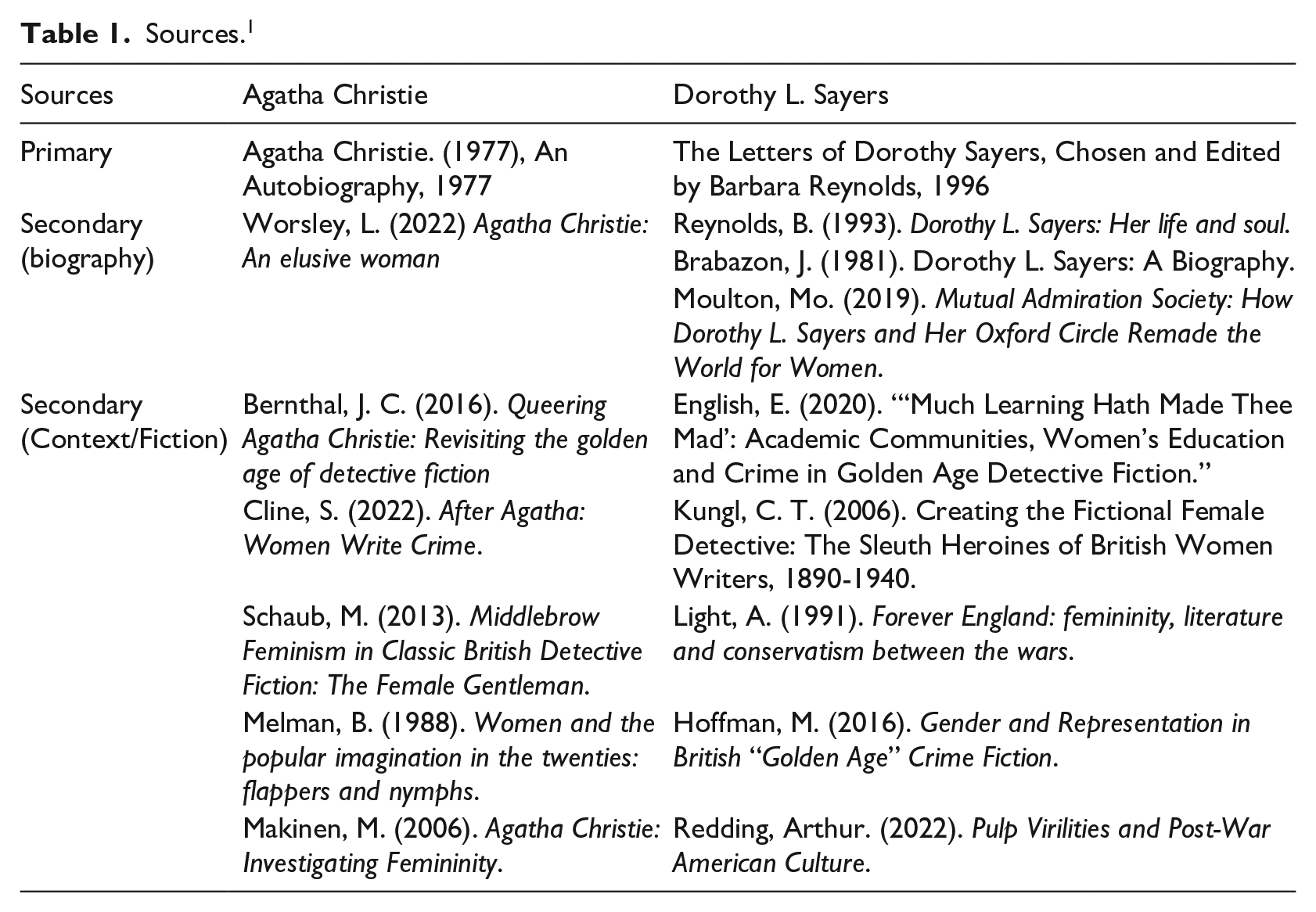
To situate the lived experience of these two women, a range of historical material drawn from secondary sources that describe the institutionalized patriarchal context of Britain generally, and the literary world, specifically are used (See Table 1). While there is a degree of consensus about the broader institutional context, it is only relatively recently that feminist literary scholars have begun to develop a more critical sense of how the patriarchal context of the UK in the early 20th century may have shaped the writing of Christie and Sayers. Finally, I draw on their novels and literary criticism of their work (see Table 1) to consider how, despite refusing the label of feminists, both authors’ novels can be interpreted as forms of resistance to oppressive patriarchal structures. By closely reading their novels through a gender lens and in the context of the intense societal debate known as the Woman Question during their early lives, I examined both plots and characters in all of Sayers’ (12) and Christie’s detective novels to 1935 (17).
Analysis
Throughout the analysis I worked iteratively to situate the subjective experiences and fictional work of each woman in the context of broader societal structures and debates to see connections between the micro experiences and writing and the macro structural context. To analyze the biographical material, I focused on identifying passages where they discussed their subjective experiences including socialization in their families, at school (in the case of Sayers, Christie had no “formal” general education) and eventually at work and where they described key features of the context such as social etiquette and norms. I focused on how they discussed the choices they made as well as their accounts of emotionally salient moments, including disappointments, frustrations, humiliations as well as senses of accomplishment, satisfaction and joy. I reflexively located these experiences in historical context to consider how their specific social locations as white middle-class women may have shaped the choices they saw as feasible as well as those that were not feasible for people “like them.” I also compared their views with my own sense of what was possible for me as a middle-class white woman to notice similarities as well as differences. I sought out references to how they thought others saw them as well as how they saw themselves and compared themselves to others in their accounts. I paid close attention to their concerns about money and subsistence as well as to social acceptance and their relationships with potential marriage partners which were salient issues in both women’s accounts. Gradually, the connection between their subjective experiences and the institutional patriarchal context became visible and I could link their subjective expressions of precariousness to legal and cultural structures that excluded them from economic independence.
As Rowlinson et al. (2014) argued, “It is generally accepted that experiences are recreated or reconstructed rather than retrieved” (p. 442) and therefore, in reviewing their subjective accounts I did not simply accept them at face value. I kept in mind the audience for whom they were writing as well as the circumstances in which they were writing. Christie (1977) is seen as reluctant autobiographer although in the foreword to her autobiography she claims, “I long quite unexpectedly to write my autobiography” (p. 11). After she “disappeared” in 1926 during a period of emotional trauma, Christie actively avoided publicity and had turned down many requests by potential biographers. She was consciously then, writing for the public. Sayers’ letters, on the other hand, were written assuming they would never be made public. While her letters reveal what I interpret as her subjective experience of precariousness, they likely understate this experience as P.D. James noted: “. . .it was probably also a matter of pride. To admit to unhappiness might suggest she was less successful and less popular than she wanted her parents [and friends] to believe. . .” (in Sayers, 1996: xii). It was only due to her sudden death that her son discovered Sayers was his mother and gained access to her letters. He subsequently agreed to share them with Sayers’ friend and scholar, Barbara Reynolds for the purposes of writing a biography. Due to Sayers death at 64, it was possible for her biographers to interview friends and family who were still alive. Christie’s family and friends, on the other hand rarely made themselves available for interviews and it is only very recently that her grandson has published some of his own quite general recollections (Christie, 2012).
In analyzing their fiction, I reviewed the plots of their novels as well as the characters to consider whether the plots engaged with contemporary “women’s issues” as well as “men’s issues” (e.g. Shell Shock was widespread between the wars but was often hidden by men as it was seen as a failure of masculinity) as well as how the characters performed their gender and sexuality. I worked iteratively, comparing my interpretations with those of literary scholars and, for reasons of space, I present the conclusions of recent literary scholars that are consistent with my own analysis. Through this analysis, I suggest that both women portrayed their male and female characters in quite diverse and often counter-cultural ways that were unusual in the genre where female characters were typically minor characters portrayed as “femmes fatales” or “damsels in distress.” In addition, my analysis suggested that their plots made visible the patriarchal context that women encountered, focusing on how women could be driven to self-sabotaging or risky actions in efforts to evade patriarchal control for example. Rather than repeating and presenting an exhaustive analysis of their fiction, I focus on theorizing how their writing may constitute a form of “subtle resistance.”
Living institutionalized patriarchy
Drawing on the accounts by the two authors, I illustrate in this section the process of precaritization. Patriarchy created an infrastructure of marginalization that effectively legalized discrimination, making it extremely difficult for women to be economically independent. In addition to the legal framework, the cultural norms and values were similarly deeply patriarchal, constructing women who sought independence as deviant, and often in the case of first wave feminists, incarcerating them as criminals. While both Christie and Sayers eventually became some of the bestselling authors of the period, known as two of the five “Queens of Crime,” they were socialized as other women of the period were, to accept their positions in society as subordinate to men. For different reasons, both women were forced to pursue careers, yet they did so while experiencing very pronounced periods of embodied precariousness. Ultimately, while they pursued similar careers in the same field and historical moment, their ways of taking up independence differed significantly; while Christie continued to place her husband, family and a “good life” ahead of work, Sayers adopted a more “masculine” approach, making her career her life.
Precaritization and the male breadwinner model
While both Christie and Sayers began their lives in the early 1890s in the relative comfort of the middle class, like all British women of the time, their privilege was tied to their father’s position and income. Their prospects for future, however, were contingent on their success in securing a husband, as middle-class women were strongly discouraged from working by an array of policies that effectively constituted legal discrimination, limiting their access to education, excluding them from professions and prohibiting them from working after they had married, among other things. As Cline (2022) notes: “The women writers of the Golden Age would have grown up knowing that women could not vote [and if married, had only recently gained the right to own property]. . . Along with women in all parts of the population, they could not often or successfully query or fight the benign or coercive social control husbands and fathers had over wives and daughters.” (p. 39).
Christie and Sayers’ prospects for marriage were, however, dramatically different based on their physical attractiveness to men. Christie was described as: “enviably slim, tall and golden-haired” (Worsley, 2022: 37), while Sayers was remembered as “. . . ungainly, pale-faced, hair crimped back into a bun, pince-nez dangling around her neck, wearing a shapeless black dress.” (Reynolds, 1993: 100). Given the patriarchal context, a woman’s appearance, central as it was to her marriage prospects, was a key factor in her future economic position and the source of much discussion, personal reflection and according to both women’s subjective accounts, anxiety. While Christie’s correspondence with the standards for feminine beauty of the time made her more secure, Sayers was seen by herself and others as “not beautiful,” as she stated in a letter to a friend (Sayers, 1996 2 : 45), pushing her toward a life of independence whether she wanted one or not.
Christie
Christie’s father had inherited wealth, however, he lost most of it and when he died when Christie was 11, left her mother with a son, two daughters and a much-reduced income. Christie (1977) described the male breadwinner model, and the impact her father’s death had on her sense of security: Life took on a completely different complexion after my father’s death. I stepped out of my . . .world of security and thoughtlessness. . .I think there is no doubt that from the man of the family comes the stability of the home. . .‘Father knows best’. . . represent[s]. . .[a] marked feature of later Victorian life. . .Father likes meals punctually. . .Father would like you to play duets with him. You accept it all unquestioningly. Father provides meals; Father sees that the house works to rule. (p. 114)
As Christie described, the man of the family earns the income and therefore, it is his preferences that dictate how the women in his household live. This recollection also illustrates the processes of precaritization of women within the male breadwinner model. With the death of her breadwinner, Agatha lost her “world of security” as there were no social supports available to women outside of “familialism” (Carreri, 2022).
Like most women of her era, Christie’s future economic security lay in securing a husband who would support her and despite their diminished financial circumstances, her mother invested in engineering a successful match. While Christie received no formal education, she was sent to “finishing school” and then taken to Egypt for her debut year to ensure she was able to meet young British men. Christie characterized this period of her life as one fraught with excitement but also anxiety. As a debutante Christie remembers wearing: “A most beautiful yellow satin. . .five years that frock was with me, always giving me confidence in myself (badly needed as I was a shy girl)” (Worsley, 2022: 37). This strategy was successful and after her “debut season,” Agatha was “inundated with offers of marriage” (Worsley, 2022: 41). This passage illustrates the emotionally fraught search for a breadwinner and the connection between women’s appearance and their confidence as it affected their chances of attracting a breadwinner.
Instead of choosing a safe, wealthy husband, Agatha married Archie Christie, a young RAF pilot who had little to offer in terms of financial security. Her description of their early marriage is replete with reference to their precarious financial circumstances for example, “we needed every penny we had to live on” (Christie, 1977: 279). Despite financial concerns, her depiction is optimistic: a “young married couple who are happy, in love with each other, rather badly off, but not too much hampered by that fact” (Christie, 1977: 278).
While Christie suggests that she was not too concerned with their relative poverty, she did take steps to earn money. She submitted the manuscript for a detective novel she had written while Archie was away at war to five publishers, however, she received no offers until, after a period of 2 years with the manuscript, the sixth, Bodley Head offered to publish it. This was the first of over 60 novels she would publish over the next 50 years. In the interim she sought to develop skills she could use to earn money: “. . .I started a book-keeping course to occupy my days. . .newly married wives are generally lonely. . .” (Christie, 1977: 263). She described being too poor to socialize with many of her old friends and missing the camaraderie of working at the hospital which she had done during the war, noting that new wives were expected to completely re-organize their lives around their husbands. So, while she claimed to be “happily married,” she also recalls “And yet there was a certain lack” (Christie, 1977: 336) as Valenzuela et al. (2024) also found.
While Christie did seek to earn money, according to her account, she never regarded this work as anything other than a temporary way to enhance her husband’s income and stave off boredom. In this way, her subjective experience of work was not as a career or a way of seeking independence, instead, she reproduced the patriarchal breadwinner model, a position she maintained through much of her life, even after becoming one of the bestselling authors of the period and primary breadwinner for her family.
I had a request from the Income Tax about this time. They wanted to know the details of my literary earnings. I was astonished. I had never considered my literary earnings as income. . .I explained. . .I had just happened to write these three books. . .I wasn’t an author. I wasn’t going to go on writing all my life (Christie, 1977: 318).
Even later, married for a second time, she continued to list her occupation as “married woman.” I don’t think, even then, that I considered myself a bona fide author. . .I was beginning to accustom myself to the fact that I could count upon them [her novels] as a definite source of income. But never, when I was filling in a form and came to the line asking for Occupation, would it have occurred to me to fill it in with anything but the time-honoured ‘Married woman’. I was a married woman, that was my status, and that was my occupation. As a sideline I wrote books. I never approached my writing by dubbing it with the grand name of ‘career’. I would have thought it ridiculous. (Christie, 1977: 430, italics in original)
And, as she described it at least, she was happy with this state of affairs. As I outline below, her expectation of her position in the world was as subordinate to the breadwinner in her life, whether it was her father or her husband. This period of security and contentment ended abruptly with her first husband’s request for a divorce, a catastrophe for a married woman of the time as it both exposed her to life with no economic support as well as the shame of having failed in her duty as a wife. She linked the divorce directly to her subjective experience of losing her sense of confidence: “. . .with those words, that part of my life-my happy, successful, confident life-ended” (Christie, 1977: 351).
Her subjective experience of the divorce is not just a rational calculation of the challenge of being a sole parent with no source of income but instead she suffered a nervous breakdown, disappearing for 11 days and claiming to have no memory of the period. As she recovered and attempted to come to terms with her new circumstances, she described struggling to concentrate sufficiently to write. She credited her brother-in-law with helping her, suggesting that she combine some short stories into a novel “that would be a stop-gap. He helped me with the work—I was still unable to tackle anything of the kind. . .. I thought now that once I . . . calmed down I could perhaps. . . write another book” (Christie, 1977: 354).
According to Christie then, it was only with great reluctance that she embarked on her journey to economic independence and to becoming the bestselling novelist of all time. She struggled like any single parent, to write while also caring for her child. She described an early episode: ‘Look here, Rosalind’, I said, ‘you must not interrupt. I’ve got some work to do. I’ve got to write another book’. . . .Presently Rosalind was there again. . .Really, how that wretched book came to be written, I don’t know! . . . I was driven desperately on by the desire, indeed the necessity, to write another book and make some money. That was the moment when I changed from an amateur to a professional. I assumed the burden of a profession, which is to write even when you don’t want to, don’t much like what you’re writing, and aren’t writing it particularly well. (Christie, 1977: 357–358, italics in original)
While Christie (1977) portrays her divorce as catastrophic, within a couple of years she claimed to find the prospect of independence a thrilling new challenge: It’s now or never. Either I cling to everything that’s safe and that I know, or else I develop more initiative, do things on my own. . .now I was going [traveling] by myself. I should find out now what kind of person I was—whether I had become entirely dependent on other people as I feared. I could indulge my passion. . .change my mind at a moment’s notice. . .I would have no one to consider but myself. I would see how I liked that. (pp. 361–362, italics in original)
She describes this post-divorce period as a complete transformation: “Now that I was starting life again, I had to take stock . . .. [when an old friend proposed she turned him down]. I did not wish to be comforted, I was scared of marriage. . .Never again, I decided would I put myself at anyone’s mercy.” (Christie, 1977: 410–411, italics in original). Nonetheless, within 3 years she remarried and remained “happily married” until her death.
While Christie and Sayers were born 3 years apart, in 1890 and 1893 respectively, and shared the same broader legal and cultural patriarchal context, I suggest that Sayers’ experience of precaritization derives from the fact that, unlike Christie, she did not fit the ideal of femininity for the period and was less able to pursue economic security through marriage. Instead, from an early age, she was supported by her parents to pursue a university education and while she did express a desire to marry, she was initially unsuccessful in securing a husband and, according to her accounts, set her sights on earning sufficient income through work to live independently.
She was not alone. During the 1920s the UK experienced an economic depression and high levels of unemployment which meant that the brief period of access to work that women had experienced during the First World War was followed by significant pressure for women to return to their “natural place” in the home. The war had a second significant impact on the lives of women such as Sayers as the opportunities for women to marry were dramatically reduced by the lack of young men due to the enormous death toll of the war. As a result, there were 2 million “surplus women” in the UK and marriage prospects for women who were not viewed as “attractive” were much reduced. These women, within the patriarchal breadwinner model, remained dependent on their fathers for economic support unless they could secure some form of employment.
Sayers
Sayers’ father, an Anglican minister, while middle class was not wealthy. She began learning Latin in lessons with father “while she was still six” (Reynolds, 1993: 14). She was able to attend Oxford, one of the first women to do so, by winning a prestigious scholarship; however, her father still “had a fair amount to pay. . .Dorothy often expressed concern about this; her father was far from wealthy” (Reynolds, 1993 3 : 63). As is evident in even this brief account, Sayers appeared to feel a sense of guilt as a financial burden to her father, taking responsibility for her poverty rather than attributing it to patriarchal structures that excluded women from economic independence.
Sayers’ letters from her teens into her late twenties describe several intense “crushes,” but she was ultimately disappointed in each case, writing to a friend “my loves are always unsatisfactory as you know” (Sayers in Reynolds, 1993: 56). Her inability to establish economic security through marriage meant she had no choice but to either live with her parents or find some way to earn a living. Unlike Christie who focused on securing a breadwinner through marriage, Sayers’ accounts suggest that while she sought a husband, she also actively pursued a career as a writer.
She was one of the first women to graduate from Oxford with a degree, however, even as a highly educated woman, she was frustrated in her search for work over a 5-year period. She was able to secure teaching positions, which were considered the “natural” occupation for educated women, however, she resisted this path as unappealing. As she says in a letter to her mother, “I don’t know what I’m going to do. I seem to have a lot of irons in the fire” she hopes might generate income but “all these things depend on other people” and “I haven’t quite enough confidence in myself to ask Tootles [her father] to risk money” making her “feel unsettled” (Sayers, 1996: 165). She described her subjective experience of precariousness as a woman without a source of economic support vividly in a letter to her parents where she attempted to negotiate an agreement with them about her future: “Nobody can feel more acutely than I do the unsatisfactoriness of my financial position. I wish I could get a reasonable job, or that I could know one way or another whether I will be able to make money by writing. I applied as you wished, for the [teaching] job. . .I daresay another temporary [job] will turn up. . .If not. . . I can live this term, if [father] can let me have the rent. . ..Will you think over this suggestion?-I hope it mayn’t come to that.-One reason why I am so keen about Lord Peter [her fictional detective] is that writing keeps my mind thoroughly occupied, and prevents me from wanting too badly the kind of life I do want, and see no way of getting. . .Yours ever with love, and apologies for being such a failure. Ever your grateful Dorothy” (Sayers, 1996: 184, italics in original).
During this period, her father continued to support her, paying her rent and providing an allowance to supplement the earnings she was able to make through temporary work as a translator, teacher and proof-reader; work that she was able to secure largely through her father’s network of contacts.
As we can see from the above letter, Sayers does not attribute her subjective experience of precariousness to patriarchal legal structures and culture but instead, I suggest the institutional changes created a sense of personal responsibility among some women for “failing” to find ways to become economically independent, akin to what Norbäck (2021) has described as “radical responsibilization” (p. 427). As the letter shows, despite being 28-years-old, she had to negotiate with her father about possible career directions in order to extract the support she needed to live independently as an unmarried woman. Her biographer contrasts her demeanor after five frustrating years trying to find a job and/or marriage partner with her joyful demeanor during her time at Oxford: “The merry, self-confident young Oxford graduate with the dimpled smile was gone.” (Reynolds, 1993: 101).
Sayers described experiencing a period of confidence and satisfaction as her first novel was published and she was able to secure a full-time job as a copywriter, however, this period was short-lived. She wrote to her parents at the age of 29: “all is gas and gaiters. Benson’s wants me to stay on. . .So, I’m actually settled in a job and quite a nice job with prospects too. I feel so surprised I hardly know myself, but it’s a tremendous relief” (Sayers, 1996: 194). Within a year, however, she finds herself pregnant and unmarried. Sayers described the shame and isolation associated with the perceived moral lapse and a sense of panic at the prospect of losing her source of income. She hid the pregnancy and wrote to a cousin who she hoped would take the baby, pretending to be seeking help for a “friend”: “At present everything depends on . . .not losing her job. Everything has been most discreetly managed-her retirement from public life is accounted for by ‘illness’- but naturally she can’t turn up at work plus a baby” (Sayers in Reynolds, 1993: 125). After her cousin accepted the child, she did admit she was the mother but explained in a letter she could not tell her parents because: “It would be a great worry and embarrassment to them” (Sayers in Reynolds, 1993: 146).
Sayers managed to take time off to have the baby and returned to work, however, as she described in letters to a man with whom she had an unconsummated romantic relationship, the stress was severe: “I’ve tried hard to be merry and bright. . .I know it’s very unattractive to be miserable. . .I hope [John Anthony, her baby] and I don’t come to the workhouse! But its so hard to work. It frightens me to be so unhappy. . .I’m afraid my nerve’s gone a bit.” (Sayers in Reynolds, 1993: 135). This stress also caused her to worry about losing her job due to being unable to concentrate: “I think everyday is worse than the last, and I’m always afraid they’ll chuck me out of the office because I’m working so badly” (Sayers in Reynolds, 1993: 135, to the same man); she thought she may be on the verge of nervous breakdown. However, once again, as Christie did in the case of her divorce, she took personal responsibility for her precarious position and did not attribute any responsibility to the patriarchal social context, stating in a letter to her cousin: “J’s [her baby] my look-out entirely, and its feeble if I can’t manage without help” (Sayers in Reynolds, 1993: 150) despite the fact that abortion, birth control, and adoption were all illegal.
While Sayers’ letters suggest she suffered extreme distress during this period, she, unlike Christie, did claim her professional identity quite publicly, listing her occupation on her son’s birth certificate as: “Dorothy L. Sayers, authoress” (Reynolds, 1993: 124) although her primary source of income at the time was her copywriting job.
While Sayers did eventually marry, unlike Christie who saw her novels as financing a good life, Sayers adopted a quite masculine work style.
She was earning over six pounds a week at Benson’s. In her spare time she slaved at writing short stories, which brought in fees when magazines accepted them. She also worked continuously on her novels and negotiated serial rights which were lucrative. She lived economically and saved as much as possible for John Anthony’s future and her own. . .. (Reynolds, 1993: 144)
Not surprisingly, she also described “feeling rundown. . . hair is falling out again” in a letter to her parents (Sayers in Reynolds, 1993: 144).
Despite eventually becoming very financially comfortable, she was never able and may not have wanted to have her son live with her. She approached her work as a professional saying: “writing books is not a hobby; it is a job, a trade like any other” (Sayers in Reynolds, 1993: 225). “She was business-like in her relations with publishers, she honored her contracts, she met her deadlines and she gave good value for money” (Reynolds, 1993: 225). Eventually, this work paid off, at least professionally: “Dorothy L. Sayers had now arrived. . . [she] became a best-seller and was hugely admired” (Reynolds, 1993: 242). Unfortunately, her marriage was not a source of satisfaction to her. According to a lifelong friend interviewed by Reynolds after Sayers’ death: “In 1933 the doctor ordered. . .complete rest. . .Dorothy seemed very depressed—an effect, partly, of a long period of over-work. . .. she was trying to decide to separate from Mac [her husband]” (Reynolds, 1993: 244).
Grooming
While it may seem surprising that neither Christie nor Sayers attributed the precarious nature of their lives to the patriarchal barriers placed in their way, a review of their reflections illustrates how patriarchal institutions were so thoroughly entrenched that alternatives were barely imaginable for most women of the period. In this section, drawing on accounts particularly by Christie, I outline how I argue women were “groomed” to see their lives within the narrow confines of patriarchal structures; how their bodies shaped their fates and how their early experiences reinforced their status as subordinate to men.
Christie (1977) described envisioning her future as a girl: I only contemplated one thing-a happy marriage. . . .as all my friends did. We were conscious of all the happiness that awaited us; we looked forward to being loved, to being looked after. . . while at the same time putting our husbands’ life, career and success before all. . .[that was] what made being a woman so exciting. No worry about what you should be or do—Biology would decide. You were waiting for The Man, and when the man came, he would change your entire life. . . (p. 128)
According to Christie, she and “all her friends” shared this romantic view, suggesting how thoroughly patriarchy dominated how women thought of themselves and their life opportunities.
Once married and shortly after the birth of their child, the Christies were offered an opportunity to embark on a tour of the empire. While Christie was certain she wanted to go, she was uncertain whether she and her husband could both afford to go. When she suggested staying behind to her mother, according to her account she was strongly encouraged to go to avoid losing her husband and therefore, her economic security. She remembered her mother’s advice: A wife’s duty is to go with her husband. . .A husband must come first, even before your children. . .Remember, if you’re not with your husband. . . you’ll lose him. . . ..’You never know with any man’, said my mother now speaking in a true Victorian spirit. ‘A wife ought to be with her husband-and if she isn’t, then he feels he has a right to forget her’. (Christie, 1977: 288, italics in original).
This statement I interpret as an example of “grooming” of young women to assume their subordinate place in the social order under patriarchy. Her socialization in her family, community and even workplace all made it clear that men took priority over women. During the war, while she waited for her fiancé then husband, Agatha trained as a nurse. She described vividly how the patriarchal regime governed the workplace, enacted by male doctors and vigorously reinforced and policed by more senior female nurses.
On entering the nursing world we had to revise our opinions of our status in life. . .nothing had prepared me for the need to fall down and worship [doctors]. . .I soon learned to spring to attention, to stand, a human towel-rail waiting meekly while the doctor bathed his hands, wiped them with the towel, and, not bothering to return it to me, flung it scornfully on the floor. . ..Actually to speak to a doctor. . .was horribly presumptuous. (Christie, 1977: 230).
When Christie attempted to point out an error to a doctor she recalls being reprimanded by a more senior nurse: “really, Nurse, pushing yourself forward that way. . ..” (Christie, 1977: 230) illustrating how women as well as men participated in this process of grooming.
According to Christie, opportunities for women to work were so limited that when she was plagued by seasickness on the empire tour and proposed to leave the ship and work where she landed, her husband laughed at the proposal. “’What work?’ asked Archie disbelievingly. It was true that in those days employment for women was in short supply. Women were daughters to be supported, or wives to be supported” (Christie, 1977: 290).
While Christie never uses the term patriarchy, I interpret these statements as descriptions of the patriarchal order into which women were socialized. I use the term grooming to suggest how this process of iterative socialization may have encouraged women to not only accept their fates as subordinate and dependant on men for economic support, but for those women who were regarded as marriageable, to look forward to it. As Christie’s statements suggest, alternatives were so limited, by law, by discrimination and by tradition that women who sought independence could expect a life of frustration and poverty, as Sayers’ experience illustrates. Nonetheless, the lack of control meant that women, even women such as Christie with embodied privilege, may have experienced a sense of precariousness when the structural impediments were manifest in a situation where they became reflexively aware of just how limited their options really were. When Christie did ultimately confront this reality when Archie insisted on a divorce, her experience of precariousness appeared to manifest as an embodied shock resulting in a loss of memory of 11 days of her life, followed by a year or more of panic as she came to terms with the need to generate income to support herself and her daughter and to try to earn a living while also caring for her daughter.
While Sayers ultimately embraced her profession as a novelist, like a masculine career, her work literally became her life, Christie instead questioned why women should want to adopt this “all work, no play” lifestyle and was nostalgic for the patriarchy, even at the end of her long and wildly successful career: You’ve got to hand it to Victorian women; they got their menfolk where they wanted them. . .. They were tough, self-willed, and remarkably well-read and well-informed. . .In daily life a woman got her own way whilst paying due lip service to male superiority, so that her husband would not lose face. (Christie, 1977: 131).
Christie in fact challenged the very notion of work as being in some way more important than living a good life. As Millar (2017) noted, the emphasis of much work on precarity “reinforces forms of masculinity. . .” and a social order that “valorizes waged work as an economic necessity, social duty and moral practice” (p. 7). Similarly, in her autobiography Christie (1977) wonders why work should be valorized: “. . .there seems to me to be an odd assumption that there is something meritorious about working. Why?. . .He [works] to feed himself and have a roof over his head. . .It’s economic and necessary. But why is it meritorious?” (p. 131, italics in original).
While Christie’s accounts suggest she continued to primarily identify herself as a “married woman” rather than through her career, her descriptions of her subjective experience once she had remarried and gained financial security as an author suggests a dramatic shift in her subjective sense of precariousness. “Those years were particularly satisfying. . . these were the carefree years . . .filled with a good deal of work, yes, but not . . . all-absorbing. I wrote detective stories, Max [her second husband] wrote archeological books. . .We were busy but we were not under intense strain” (Christie, 1977: 466).
While Sayers, in contrast, near the end of her life stated: “I do not know of any success worth having except the ability to do a job in which one is interested and to obtain a living sufficient to enable one to go on doing one’s work” (Sayers in Reynolds, 1993: 371).
Ventriloquizing the “New Woman”
While both Sayers and Christie acquired a degree of financial security and independence, neither reflexively linked their early experiences of precariousness to patriarchy. While both women refused the label of feminists, I argue, that a review of their novels illustrates how they both, in different ways ventriloquized resistance to patriarchy and the heterosexual matrix, subverting ideals of femininity and masculinity in their characters and plots.
A close reading of Sayers’ body of detective fiction reveals that virtually all of her novels examine the damaging impacts of patriarchy by directly illustrating both physical and emotional violence in intimate partner relationships, for example, but also by showing how patriarchy manifests in intragender violence between women and between men (Thomson, 2023). The literary scholar, English (2020) provides an illustration, arguing that Sayers’ novel Gaudy Night: “forces the reader to confront the reality of women’s exciting but fraught relationship with higher education, acknowledging unpalatable contemporary attitudes toward the educated woman” (p. 30). Another scholar suggests the novel “self-consciously and probingly represents a wide array of expanded and alternative social roles for women” (Redding, 2022: 90). The characters in the novel range from unmarried career women to women who revel in their subordinate roles as wives. The central character, Harriet Vane struggles with where she fits throughout the novel, ultimately, she “vocalizes the liberal feminist idea of a liberated woman, who is equal to the male role but still retains her femininity” (Schoenfeld, 2008: 840). What is potentially even more interesting is to read the novel as a member of the main audience for the genre: middle-class men. By framing her novel around women’s education, for a largely male audience, we may see Sayers ventriloquizing a key debate during the period through the plot and characters, potentially encouraging her readers to imagine alternatives to traditional ways of performing gender.
Similarly, there is an emerging consensus among literary scholars that Christie’s fiction also consistently challenged the status quo by presenting male and female characters who did not conform to contemporary ideals. In a comprehensive study of Christie’s oeuvre, Makinen (2006), noted: “Christie’s female characters are diverse, dominant, swash-buckling and violently active at a time when women were still seen as second-class citizens, Christie’s portrayals are determinedly and deliberately egalitarian in relation to gender” (p. 1).
Tommy and Tuppence Beresford are perhaps the most obvious in their renegotiation of heterosexual relationships away from . . ..Victorian/Edwardian sentimentality. . . Ariadne Oliver and Miss Marple, in their different ways, raise the issue of the ‘surplus woman’ (Makinen, 2006: 62).
Christie did not confine her challenge to patriarchy to performances of femininity but instead her most famous detective, Poirot is also a quite feminized male character. “Christie’s manipulation, parodic innovation and ultimate exploitation of male-coded detective fiction conventions. . .in The Murder of Roger Ackroyd (1926) delivers a decisive blow to pre-First World War masculine security by identifying the traditional heroic. . .[male] narrator as the culprit.” (Bernthal, 2016: 27).
While neither Sayers nor Christie were politically engaged with feminism, I suggest that through their writing, both were engaged in sustained resistance to patriarchy and the heterosexual matrix and by ventriloquizing alternative gender performances and relations between men and women, they engaged their readers in imagining new ways of being and a more egalitarian social order. In addition to stimulating readers’ awareness of the violence of patriarchy and presenting alternatives, their novels may have also encouraged debate among friends and family as well as more broadly at the societal level where their novels were discussed in newspapers and on radio. As Kungl (2006) argued: “creating fictional female detectives was also a way of entering into the Woman Question debate about women’s roles in their society” (p. 13). Organizational theorists have suggested that “fiction. . .[can] contribute to organizational change” by encouraging readers to empathize with characters through “a kind of role-taking” (Thexton et al., 2019: 84). Similarly, Weatherall (2023) suggests “the reader comes to know themselves and other possible versions of themselves through the text” (p. 524).
Discussion
This study seeks to contribute to literature on processes of precaritization in several ways. First, while researchers in organizational and management studies have developed a rich body of empirical research on precarity, precariousness and precaritization, the vast majority has focused on neoliberal policies in post-Fordist contexts, inadvertently implying that precaritization is “new” (Betti, 2018; Neilson and Rossiter, 2008). This research has for the most part focused on precaritization in a given moment and to date, there has been less attention to subjective experiences of precaritization as they unfold over time. This study, drawing on letters and autobiography offers a rare window into the subjective, embodied experiences of two women, initially “groomed” to take their subordinate position in a patriarchal society and how they struggled to navigate the sudden “emancipation” that accompanied the dramatic changes to the status of women in the first decades of the 20th century, including the new expectation that they should be economically independent. Secondly, as feminist scholars have convincingly argued, much of the research on precaritization reflects androcentric biases by focusing on the “standard employment model” rather than looking more broadly at the life/work nexus and how laws and policies have systematically precaritized women, impeding their access to economic independence. This study shows how the male breadwinner model and life experiences such as divorce and pregnancy shaped the subjective experiences of precaritization of two women. This analysis also adds to recent work that shows how an intersectional approach can reveal the different ways in which institutions can precaritize people, making some oppressed actors relatively more secure (Nazzal et al., 2024). Finally, while neither Christie nor Sayers identified as feminists, by extending the analysis beyond their subjective accounts to include their fictional work, this study adds to research that shows how marginalized actors may engage in subtle forms of resistance (Benali and Villesèche, 2024; Kjærgaard et al., 2024; Norbäck, 2021; Valenzuela et al., 2024), in this case suggesting they may have ventriloquized (Wilhoit and Kisselburgh, 2019) their resistance to patriarchy and the heterosexual matrix through their fiction.
This analysis of the subjective experiences of two women through a period of institutional transformation resonates with Armano et al.’s (2022) argument that: it is worth dwelling on the difference between condition and experience. . . condition does not pay justice to the . . . multi-layered map of precarious subjectivity and its transformations, since it neither evokes nor represents . . . the passing of time in relation to the different positions in work but also . . . phases of life and relationships (p. 31)
By taking a longitudinal view over the lifetimes of two women during a period of intense societal debate about the status of women, this study contributes to calls by feminist scholars for attention to the gendered nature of precaritization and the need to incorporate a gender lens into studies to fully appreciate the connection not just between policies related to the “standard employment model” or organizational policies and systems but to the ways in which broader social policies and institutions are implicated in precaritization of all people, but particularly women. Specifically, this study brings into view the effect of a heteronormative logic of social security based on the male breadwinner, reinforcing Betti and Boris’s (2022) argument that appreciating the gendered nature of precaritization forces scholars to look beyond “the standard employment model” to appreciate the impact of policies based on the “male breadwinner/female homemaker heteronormative family” (p. 131). As the analysis illustrated, both Christie and Sayers’ lives were significantly shaped by the male breadwinner model. Initially, both women’s relationship to middle class fathers accorded them privilege, however, this privilege was contingent on accepting their subordinate positions within this relationship. As Durepos et al. (2017) argued, privilege, for women, often comes with a price: “acceptance of . . . subordination” (p. 1269).
The analysis also showed how Christie’s embodied conformity with contemporary norms of feminine attractiveness conferred on her additional privilege as laws, policies and cultural scripts organized society around the heteropatriarchal family whereby women’s livelihoods were dependent on securing and maintaining a relationship with a male breadwinner/husband. Sayers, on the other hand, despite becoming one of the first women to graduate from Oxford, was initially unable to find a husband and remained dependant on her father throughout her twenties as she struggled to find work in a context where discrimination against women was both legal and socially accepted.
This analysis is consistent with Nazzal et al.’s (2024) study that also found: “some [women’s]. . .accounts were made from ‘relatively privileged’ positions where modes of expression, appearance and domestic situations meant they enjoyed ‘better’ positions within the patriarchal system” (p. 278). I join Nazzal et al. (2024) in: “challenging the singular monolithic analysis of patriarchy, revealing how different patriarchal positions. . . expose different modes of oppression, while serving at times as a protective, supportive system” (p. 267). So, while both Christie and Sayers were certainly privileged by their whiteness and their class, this study suggests that treating white women as an undifferentiated category obscures the variety of ways in which women are positioned within patriarchy. As this analysis showed, attention to embodied conformity with societal norms of femininity and beauty can make visible the distinct ways in which women are oppressed and privileged, contributing to intersectional understanding of precaritization.
The findings of this analysis resonate with Lovey’s observation that “precaritization is a process of normalization, not only in working and living conditions but also in ways of subjectivation, embodiment and therefore agency” (in Puar, 2012: 164). The analysis showed how women were “groomed” to accept their subordinate positions within patriarchy, how “precariousness was a generalized condition” of women’s lives “woven into [their] bodily folds” shaping their life expectations and experiences (Peticca-Harris et al., 2023: 2). While both women’s subjective accounts show how they were forced to recognize their economic dependence on male breadwinners when they contemplated/attempted to find work, I suggest that it was only through the traumatic experiences of divorce and an unexpected pregnancy outside of marriage that they became “sharply aware” (Alexander and Taylor, 2006: 57) of their precaritization. Both women described these events as pivotal, causing a dramatic loss of confidence as well as acute economic insecurity. I suggest, this “awareness” was also experienced as an embodied shock that precipitated a period of intense physical and psychological stress that prevented both women, initially, from continuing their work. While neither woman attributed their precaritization to patriarchy, they both ultimately responded by becoming more consciously self-reliant and focused on earning sufficient money to support themselves and their children through their writing. As Christie (1977) said, “this was the moment I changed from an amateur to a professional” (p. 358). These crises appeared to be inflection points in their life/work trajectories, transforming their subjectivities as Sayers said, “I’m afraid my nerve’s gone” (Sayers in Reynolds, 1993:135).
While both Sayers’ and Christie’s subjective accounts reflect noticeable changes in their desire for independence after their respective crises; they did not link their insecurity to patriarchy. So, while Christie asserted after her divorce “Never again, . . .would I put myself at anyone’s mercy.” she did not reflexively connect her precaritization to her institutionalized dependence on a male breadwinner. Similarly, Sayers, was grateful to return to her job, and despite the fact that she had to forego the opportunity to raise her child, she did not overtly challenge the legal constraints that prevented women from controlling their bodies or the absence of supports for working mothers. These findings are consistent with other studies that have found that, despite clear evidence of systemic discrimination, individuals deny or minimize the structural sources of their oppression (Morris et al., 2024; Norbäck, 2021; Peticca-Harris et al., 2020; Segarra and Prasad, 2020). While studies have consistently found this pattern, the reason for these denials have been less clear. This study, with access to subjective accounts over time, contributes to this literature, suggesting how the iterative process of “grooming” may encourage internalization of oppressive structures and limit reflexivity.
This analysis resonates with postfeminist scholars who have argued that to appreciate women’s denial of oppression within patriarchy we need to think about “sexism not as a single, unchanging thing, but as a fluid and malleable set of practices. . .: its forms change, mutate, adapt and are reinvented” (Gill et al., 2017: 227). So, while women were granted the right to vote, to be granted university degrees they had earned, and other new rights during Christie and Sayers’ lifetimes, women’s lives were also scrutinized in the popular press which “manifested an obsession with any topic related to women” (Melman, 1988: 16–17). “The pages of [newspapers] overflow[ed] with features on the modern female’s dancing and smoking; . . . her hairstyles and the length of her skirts. . .on the new morality, the decline of marriage, birth control” which they describe as a “welter of misogyny” (Melman, 1988: 17). In fact, “the term postfeminism was first used in the 1920’s to describe the reaction against women’s activism in the early part of the 20th century” (Gill et al., 2017:227). The intense and often contradictory societal debate, combined with the flurry of legal and policy changes may have made it difficult for women to track these shifting mutations of patriarchy. As Gill (2008) argued in looking at current postfeminist culture, women’s denials of their oppression may result from both shame, internalized through socialization, as well as continuous pressures from media that encourage self-surveillance and act as a form of on-going discipline. In response to these contradictory messages about the free “New Woman,” Christie and Sayers appeared to just “muddle through,” leveraging their privilege to change their individual circumstances rather than systematically searching for underlying structures or engaging in collective political action. Like the project workers interviewed by De Coster and Zanoni (2023), Christie and Sayers appeared to “reap the benefits from the broader strife without. . . personally engaging in it” (p. 952). Regular access to “prefigurative practices” may be necessary for those who have been groomed to accept their subordination to become able to reflexively connect institutional frameworks to barriers they face in daily life. However, it is also possible that actors may recognize the source of their oppression but due to grooming are aware that they should refrain from “noticing” them publicly to avoid misogynist attacks or exclusion from economic opportunities controlled by men.
According to Fenton and Tinkler (2023) “memory is. . .not just recall of past events and experiences. . .rather it is a process of remembering: the calling up of images, stories, experiences and emotions from our past life, ordering them, placing them within a narrative or a story and then telling them in a way that is shaped as least in part by our social and cultural context” (p. 343). These subjective accounts therefore may not fully reflect Christie and Sayers’ consciousness of the barriers they faced. While their fiction appears to challenge patriarchal oppression, it is difficult to know how reflexive these challenges were.
While I have argued that Sayers and Christie were precaritized as women, they were likely more secure than other women who were not able to rely on the support of husbands or fathers as they transitioned to the new expectations that women should become economically self-sufficient. This study, therefore, also illustrates how the failures of privileged women to overtly challenge patriarchy contributed to perpetuating oppressive institutional conditions for women who were not white or middle class, paving the way for the damning critique of first wave feminism by intersectional feminists.
As historians have noted, archival records are not “innocent” and in doing “intersectional history” it is crucial to be reflexive, particularly in recognizing “who is present and who is absent” (Shaffner et al., 2019: 452). Feminist business historians have highlighted how “silences can enter historical production” (Decker, 2013: 158) as women are often left out of histories as “agentic choices entail the selection of certain traces of the past over others” (Durepos et al., 2017: 1265). Christie and Sayers became famous authors and therefore left significant “traces,” their subjective accounts are preserved in archives, and they have each been the subject of multiple biographies whereas women experiencing multiple forms of marginalization have likely left fewer traces. This study therefore makes no claims to being representative of the women who lived through this period of dramatic institutional transformation. I agree with Bennett (2006), we need many histories of many patriarchies, particularly histories of women who were less privileged and how these changes affected their experiences of precaritization. I believe however, that by situating these privileged women within patriarchal relations, it is possible to recognize that while some women were more secure than others, all women experienced oppression as they lacked recognition as persons and were precaritized through their dependence on securing and maintaining a relationship with a male breadwinner.
Finally, this analysis suggests that while neither Christie nor Sayers highlighted oppressive patriarchal relations in their subjective accounts, and refused the label of feminists, by including their fictional work, this study adds to recent studies illustrating how marginalized actors may engage in subtle resistance (Benali and Villesèche, 2024; Kjærgaard et al., 2024; Norbäck, 2021; Valenzuela et al., 2024). By highlighting in their fiction the challenges faced by women, men and gender non-conforming people in navigating the violence associated with patriarchy as well as portraying a range of characters who performed gender in ways that often challenged contemporary ideals of masculinity and femininity, I suggest that both Christie and Sayers may have encouraged social change by promoting empathy among their readers and enabling their readers to experiment with alternate ways of performing gender and constructing more egalitarian heterosexual relationships (Rhodes, 2000; Thexton et al., 2019; Weatherall, 2023).
Conclusion
In conclusion, in this study I combined microhistory with biography to theorize the subjective experiences of precaritization of two middle-class women who lived through one of the most significant periods of transformation in institutionalized patriarchy. Through this analysis of precaritization I hope to “forge bonds against this grid of power that differentially allocates recognizability” to some people while excluding others (Butler in Puar, 2012: 174). In keeping with the insights of postfeminist scholars, I hope this study helps middle-class white women in particular, to see the ways in which competition and division among women is promoted by the male breadwinner model and how this has impeded both recognition of oppressive structures as well as collective action that could benefit all women, men and non-gender conforming people.
I agree with feminist scholars who suggest that collective political mobilization is required to realize meaningful change to hetero-patriarchal capitalist structures that precaritize the majority of the global population. However, I concur with recent suggestions that broad-based political mobilization is more likely if it is preceded and complemented by “prefigurative strategies” (De Coster and Zanoni, 2023) and horizontal discussions (Benschop and Lewis, 2024) that foster awareness of connections between oppressive structures and subjective experiences of precaritization. As Crenshaw (1991) argued “ignoring differences within groups contributes to tensions among groups” (p. 1242) therefore, I believe it is critical for these discussions to both build greater mutual recognition and empathy about our common humanity across gender, neocolonial, class, citizenship and other social divisions while at the same time making visible the varied forms oppressive patriarchal structures take in societies around the world, not just in the west.
An important first step is recognizing that patriarchy is not another way of saying “men” (Johnson, 2014) and feminism is not just for women. A valuable lesson I learned through my study of this period was the crucial role men played in not only using their access to power to sponsor specific legal changes but to also articulate how patriarchy taints relationships, negatively affecting men as well as women. While postfeminist scholars’ emphasis on the need for women to become aware of how their complicity sustains patriarchy is critically important, I believe it is equally important for men to recognize how their complicity sustains a violent system that harms men as well as women and gender non-conforming people, and to become aware of how renouncing their own privileges within patriarchal relations (Prasad et al., 2021) will benefit everyone, including themselves.
Footnotes
Acknowledgements
I would like to thank the editors of the Special Issue, particularly Amanda Peticca-Harris and the reviewers for their very helpful comments, I would also like to thank The Christie Archive Trust, the Marion E. Wade Centre at Wheaton College, Agatha Christie Ltd., David Higham Associates Ltd and Art Redding at York University for starting me on this journey.
Funding
The author received no financial support for the research, authorship, and/or publication of this article.
