




Abstract
Despite many interventions designed to change the gender demographics of positional leadership roles in organizations and professions, women continue to be under-represented in most arenas. Here we explore gender equality (GE) interventions through the example of positive discrimination quotas in politics to develop an understanding of resistance to them. Our case is the British Labour Party, analysing interviews with the people who designed, implemented and resisted the system of all-women shortlists. We develop the notion of ‘oblique resistance’ to describe an indirect form of resistance to the erosion of patriarchal power, which never directly confronts the issue of GE, yet actively undermines it. Oblique resistance is practised in three key ways: through appeals to ethics, by marking territory and in appeals to convention. We conclude by considering the conceptual and practical implications of oblique resistance, when direct and more overt resistance to GE is increasingly socially unacceptable.
Keywords
Introduction: The emergence of oblique resistance
Despite decades of legislative and organizational effort in promoting workplace gender equality (GE), ‘glass walls, ceilings and cliffs continue to disadvantage working women’ (Beirne and Wilson, 2016: 221). The number of women in the workforce is at its highest in the UK since 1971; however, there is still over-representation in lower earning spheres such as health, social work or retail. Only 8% of women occupy positions of ‘managers, directors or senior officials . . . in high-skilled professional occupations’ (Powell, 2019: 7) compared to 13% of men. In politics, women currently comprise 27% of the membership of the House of Lords, 32% of the House of Commons, 30% of the Cabinet and 36% of local councillors in England.
Given the stubborn nature of these inequalities, it is reasonable to continue to ask: ‘what is the problem about gender?’ (Acker, 1988: 308). Efforts to enact change are routinely resisted, technically and normatively (Powell et al., 2018); it is therefore especially important to continue exploring resistance. Here we analyse resistance to a specific GE initiative in politics. The British Labour Party has implemented formal gender quotas favouring women through ‘all-women shortlists’ (AWSs) in electoral candidate selection since 1993. We situate our analysis within studies that explore the overlap between resistance and power (Fleming and Spicer, 2007; Peterie et al., 2019) by analysing acts of resistance that defend a powerful patriarchal order. Normative social frameworks have developed to the point where GE and freedom from gendered oppression are difficult to challenge (Powell et al., 2018), at least in formal public fora. For this reason, we argue, resistance to GE interventions has become more hidden, indirect and sophisticated.
This contextual change requires a different way of understanding resistance to GE in relation to patriarchal power. Manne (2018) argues convincingly that contemporary patriarchy is sustained by misogynistic acts manifest precisely because of women’s increasingly visible achievements. Manne observes this primarily in politics as governance; we treat politics here slightly differently, as working context, but observe similar dynamics of sexism, misogyny and patriarchal reproduction. To explain the paradox of these practices being accepted in the context of strong social norms of equality, we develop the notion of oblique resistance. Oblique resistance operates at an angle to the object of resistance (in this case GE), and diverts attention from the central aim of initiatives, replacing a simple achievable purpose with a complex set of impossible ideals that stubbornly resist straightforward engagement, interrogation and critique.
We propose that oblique resistance is manifest in three discursive practices – appeals to ethics, territory and convention – each of which shows tangential resistance to GE while defending patriarchal power structures. Ethics-based resistance diverts attention to idealistic notions of absolute meritocracy (Noon, 2010), claiming that the ‘most qualified’ succeed regardless of gender. This shifts ethical priorities to economic or class inequalities, positioning gender as relatively insignificant. Territory-based resistance challenges GE initiatives by defending localized decision-making autonomy; favoured, usually male, candidates are constructed as defenders of established local practices, while ‘outsiders’ are positioned as not understanding local norms. Finally, convention-based resistance is practised through unreflexive enactment of long-established norms of what a valid recruit looks and sounds like. Again, this repositions gender as an inappropriate issue, representing the community as happy with current norms and practices.
Each of these practices of resistance repositions gender as a minority issue. Paying attention to gender is represented as obstructing attempts to address more consequential forms of discrimination. As we argue in the rest of this article, oblique resistance to GE initiatives has been overlooked as a specific phenomenon that significantly affects further progress towards GE outcomes. We begin by reviewing perspectives on the purpose and use of gender quotas, combining insights from organization studies and political science. Next, we summarize accounts of resistance to GE initiatives. We then detail our research methods and present the analysis, leading to a discussion of implications for understanding and challenging resistance to GE interventions.
Gender quotas: Insights from organization studies and political science
Quotas are best understood as a form of radical determinist collectivist discrimination (Jewson and Mason, 1986), designed specifically to achieve demographically representative organizations and professions. They are usually presented as positive discrimination interventions that challenge selection processes based on particularism and patronage (Jewson and Mason, 1986), provoking dramatic change where incrementalist agentic approaches have failed. As Noon (2010) observes, equality is unlikely to be achieved without such structural interventions to redress embedded historical inequality.
Corporate boardrooms are the key organizational site for quota implementation, with Norway leading in enforcement of 40% quotas for women on all corporate boards (Wang and Kelan, 2013). Unsurprisingly, mandatory quotas provoke action; however, resistance continues during and after demographic change (Forstenlechner et al., 2012; Wang and Kelan, 2013). Brandth and Bjørkhaug (2015) also analyse implementation of a quota system in Norway, this time voluntary, for agricultural co-operatives. Women’s representation changed from 17% in 2003 to 39% in 2009, in line with how representation changed in organizations subject to the 40% mandatory board quota. This initiative was, however, also strongly resisted, with protests based on neoliberal market discourse and ideals of meritocracy or democracy.
On quotas in elected politics, Drude Dahlerup’s research offers a comprehensive gateway to understanding key debates in political science. Her three-part categorization of quotas for elected political positions (constitutional – very strong, legislatively mandatory; legislated – strong, legally mandated; party-specific – weaker, legislatively voluntary) underpins her analysis of elected represented quotas in more than 40 countries, while noting that another 50 countries have enacted legislation requiring quota-based equality of representation for candidates (Dahlerup and Freidenvall, 2005). This means that over 50% of countries in the world operate a quota system for positions of political leadership (Dahlerup, 2008). Dahlerup also notes the need for a more detailed qualitative empirical exploration of women’s dilemmas and choices, observing that quota introduction is discussed much more than implementation, an observation that is also relevant to organization studies.
Resistance to gender equality initiatives
As noted above, resistance is prevalent in accounts of quota implementation. Resistance is a ubiquitous but notoriously slippery concept, which has grown from analysis of management to understandings of ‘many individual and collective actions of dissent, opposition, protest and disengagement’ (Sinha et al., 2019: 3) at work, within political movements, large and small-scale, connected physically and digitally (Vachhani and Pullen, 2019).
Resistance manifests in heterogeneous ways, as a means of people ‘expressing discontent . . . exercis[ing] a degree of control over work processes and/or . . . construct[ing] alternative, more positive identities’ (Collinson, 2005: 1428). The boundaries between resistance and power are liquid (Fleming and Spicer, 2008; Mumby, 2005; Rydzik and Anitha, 2019), such that ‘power and resistance are inherently connected’ (Peterie et al., 2019: 797) in mutually relational enactments. Fleming and Spicer (2007: 184) depict the relationship between resistance and power as a ‘knot of struggle . . . a multidimensional dance of political engagement in which spaces for achieving justice . . . [are] forged and occupied’. Resisting groups can manifest different structures, forms of leadership and ethics, or reproduce practices they purport to resist (Collinson et al., 2018). These issues are important to our study, where questions of who is in power and who is resisting seem fluid and contestable. Such a point indicates that through studying resistance we are ‘also inevitably examining its important conditions of power and control’ (Gagnon and Collinson, 2017: 1255).
Research shows that resistance to GE initiatives is common across organizations such as the police (Dick, 2004), universities (Van den Brink et al., 2010), or development and finance institutions (McCarthy and Moon, 2018). It also shows that resistance is ubiquitous – practised by managers, workers and trade unions (Collinson and Collinson, 1996). Resistance continues despite national and supra-national legislative interventions, such as the UK Equality Act 2010, the Council of Europe Istanbul Convention, the UN Convention on the Elimination of All Forms of Discrimination against Women, and countless smaller scale programmes.
There are two main forms of resistance represented in this literature, overt and covert. Overt resistance is openly directed against women perceived as a threat to the status quo (Dick, 2004), enacted by defenders of patriarchal power. It is usually exhibited by dominant groups within organizations because of a threat to the privileged group and its occupational conventions. For example, Danbold and Huo (2017) note that implementation of GE initiatives in Science, Technology, Engineering & Medicine (STEM) academic communities was resisted through invocation of occupational ‘prototypicality’ – the belief that men are the group that ‘best represents . . . the STEM community’ (p. 57). This is rooted in the positivist naturalist tradition that men are simply ‘more naturally gifted’ (Danbold and Huo, 2017: 58) for certain occupations.
Curiously, women also overtly resist GE interventions. This may be a consequence of ‘internalized oppression’ instilled through ‘generations of historical and intergenerational baggage’ (Alleyne, 2005: 294). However, resistance may also stem from reluctance to be labelled as ‘special’ and therefore needing ‘differential treatment’ (Dick, 2004: 55) in comparison to male colleagues (Noon, 2010). In addition, women may subscribe to masculine norms of organizational practice because they are widely perceived as neutral (Van den Brink et al., 2010), they carry a promise of career advancement (Powell et al., 2018), or because of potential adverse consequences following gender order disruption (McCarthy and Moon, 2018).
Covert resistance – evasive, hidden and ‘distanced’ (Collinson, 1994) forms of opposition to GE – also demonstrates women’s reluctance to support initiatives that would in principle benefit them. Collinson and Collinson’s (1996: 241) labour process study highlights how many women resist discriminatory norms in indirect ways, through strategies of ‘withdrawal, resignation, indifference, and distancing’, thus avoiding being stigmatized by colleagues and friends. Similarly, Vachhani and Pullen’s (2019) analysis of the Everyday Sexism Project highlights the operation of covert ‘infrapolitics’ in resistance to sexism, as women voice, share and plan in ways and forms hidden from the dominant patriarchal gaze.
Covert resistance also manifests in organizations that claim to embrace GE principles and initiatives, yet allow equality to be undermined through hidden acts, eliding the potential for structural change (Lee-Gosselin et al., 2013). This results in tokenism; women are added to formal committees, giving an illusion of increasing equality, while continuing to be excluded from decision-making. As a result, discrimination does not diminish but becomes obfuscated and more difficult to tackle.
Covert resistance to GE initiatives often operates from the claim that the idea of meritocracy is the best solution to all inequalities (Noon, 2010; Powell et al., 2018). This ignores meritocracy’s problematic nature, as a measure against achievements, talents and abilities that are intrinsically gendered (Noon, 2010). Bias is embedded in job descriptions that favour typically masculine social traits usually embodied in the social category of men, ignoring the ‘prevalence of gender in everyday actions’ (Sattari and Sandefur, 2019: 160); exaggerating a job’s physical demands in masculinized terms is common (Collinson and Collinson, 1996). Covert forms of resistance are also present in office settings and occupational equipment, such as British police force stab-vests’ initial design fitting male physiques only. Merit can also be constructed as associated with working long hours and permitting career to dominate life to exclude any labour (e.g. reproductive) outside the workplace (Sattari and Sandefur, 2019). Finally, as Beirne and Wilson (2016: 224) note, ‘merit-arguments are often used to conceal privilege and disadvantage and deflect attention from prejudicial views’.
In summary, our reading of research on quotas and determinist GE interventions, from organization studies and political science, suggests two key issues. First, a lack of detailed qualitative analysis, and second, limited theorization of resistance. The remainder of this article responds to these lacunae.
Research setting and methodology
Parliamentary demographics since women gained the legal right to seek election in 1918 tell a simple but interesting story (Keen, 2015). At the time of our data collection, 2015, 450 women had been elected in total, fewer than the number of men sitting in that single parliament (459); until 1997, women had never constituted more than 10% of any elected cohort. The UK has a mediocre comparative standing in terms of progression towards balance, currently sitting 39th in national league tables. Our case organization in this context, the British Labour Party, was formally founded in 1906, bringing together existing left-leaning and trade union sponsored MPs. From inception, the party committed to equality, including gender equality. However, early social and organizational practices within the trade union movement and the party were known to systematically exclude women and tolerate male resistance to women’s participation (Walby, 1986).
Labour’s AWS GE policy intervention developed during the 1990s, recognized that ‘soft’ voluntarist systems to increase women’s representation had been largely ineffectual. AWSs provide a means whereby local party members in winnable and safer seats are forced to choose from a shortlist of female candidates only. They have been widely criticized but have proven durable and effective. The 1997 election saw the largest ever number of women elected, 120 (18.2%, compared to the previous 1992 high of 9.2%), 84% of whom represented Labour. Legislation was passed in 2002 to exempt political party shortlisting processes from sex discrimination legislation until 2015; the 2010 Equality Act extended the exemption until 2030. The practice continues, with obvious effects – following the 2017 general election, 45% of Labour’s MPs (119 from 262) were women, compared to only 21% within the Conservative Party.
Our analysis of this GE intervention is based on qualitative data. We recorded more than 30 hours of semi-structured interviews with a purposive sample of 21 people, eight men and 13 women, who designed, implemented and resisted AWSs. Of our respondents, 11 were parliamentarians: MPs, Welsh Assembly Members, House of Lords peers. Parliamentarians may be involved in decisions to implement an AWS if they sit on the party’s main National Executive Committee or on the UK’s devolved nations’ executive committees; some advocate for and some oppose quota measures through internal lobbying or publicly, via the media. Within our respondent group, two parliamentarians were former members of party staff instrumental in implementing AWSs. We also interviewed six current or former party staff members. They provide recommendations for the party’s executive committees on assigning an AWS, and are responsible for administering selection processes. Finally, four active party members were interviewed, on the basis of their strong public support for, or opposition to, AWSs. Members select candidates through a vote, and sit on decision-making committees; all interviewees had experience on local party committees. Broadly, members of staff were supportive of AWSs; parliamentarians articulated a mix of support and resistance; and resistance was articulated most often by party members. Access was enabled by one author’s experience working for the Labour Party. This provided scope for in-depth questioning concerning specific events but also presented a danger of assumed knowledge. All interviews were therefore conducted with another author to encourage more ‘naïve’ questions.
Analytically, we position AWSs as a social practice that permits an explanation of how and why positive discrimination GE initiatives are resisted. We reason from the case to develop understanding of the continuing under-representation of women in positions of institutional power abductively, oriented towards theorization (Mantere and Ketokivi, 2013). This involves coming to the most convincing account of events to support the credibility of theoretical interpretation presented to explain empirical tendencies, being as transparent as possible about why we reject alternative explanations (Mantere and Ketokivi, 2013). This involved repeated readings of interview transcripts in relation to theory by all authors, first reading data individually, bracketing off quotes and noting provisional themes. We then exchanged ‘raw’ documents to compare insights. Finally, we embarked on a detailed discussion of notes to form a co-constructive consensus (Koller, 2012), weaving insights with the literature, always remaining open to surprises.
A political party is a complex organization with unique structures and customs. Beliefs as to the nature of society and gender can be ‘deeply ingrained’ (man, party employee) and are often skilfully argued. We therefore took time for multiple iterative movements between data and theory, reading transcripts in two main ways. First, we paid attention to respondent argumentation, the strategies interviewees used to support arguments. This surfaced the normative work in justifications, and the discursive resources drawn on to defend stances. Second, we conducted close textual analysis to pay attention to speech units (verbs, nouns, pronouns, adjectives, prepositions, conjunctions and interjections) and how they supported argumentation (Lirola and Chovanec, 2012). This allows analysis of talk’s role in complementing and embedding symbolic power to ‘manipulate the agenda and marginalize women’s contributions’ (Bradley, 1999: 35).
Analysis: Resisting gender equality interventions
Ethical resistance
This form of oblique resistance accepts the principle of tackling gender inequality – ‘I’ve got no problem with that [equality], but . . .’ (man, former politician and local activist) – and indeed highlights and objects to discrimination. There is still, however, a clear resistance, objecting to positive discrimination on the grounds of ethics. This usually manifested as a claim for the importance of meritocracy, often under the guise of care for women selected via AWSs, suggesting protection from hostility responsibility. Ethics-based resistance also adopted an anti-welfare articulation associated with the political right, expressing suspicion of the notion of a ‘hand-out’ to people marginalized by current systems.
Meritocracy is well-recognized as a means of objecting to GE interventions. However, our participants framed this justification obliquely not as resistance to GE in principle, but because it prevents ‘excellent’ (man, local activist) male candidates from gaining selection (Table 1).
Ethical resistance – meritocracy.
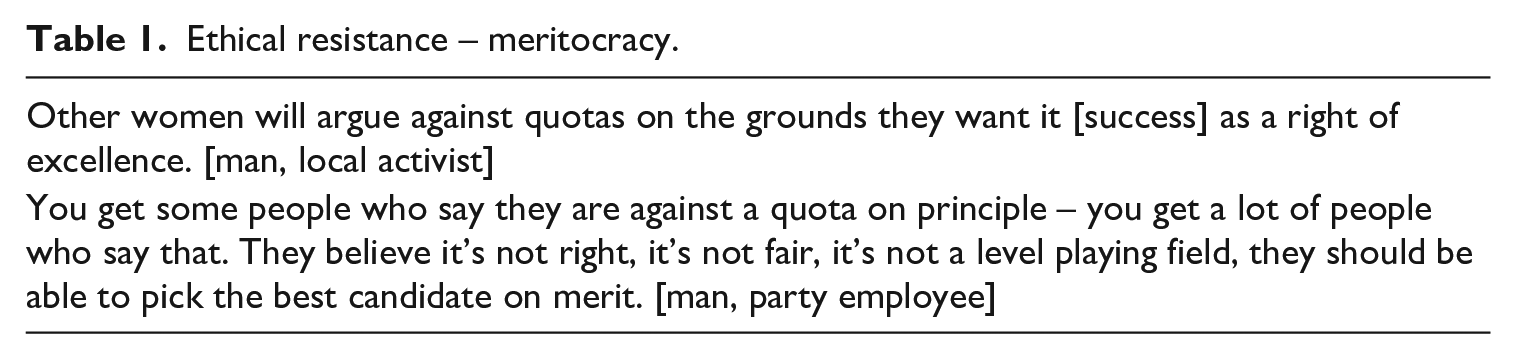
The meritocratic argument is particularly curious in an organization rooted in theories of justice, deeply sceptical – even hostile – to notions of meritocracy as capable of engendering equality. Meritocracy is uncritically presented as an obvious good, either because respondents are unaware of its critique, or because they agree with it as a suitable model of justice. A naturalness was articulated here, where ‘excellence’ produces a ‘right’, signalling recourse to a foundational natural order. Patriarchal overtones are also strong, with male party activists adopting a speaking position for women, explaining to us what women ‘want’.
Respondents were also hostile to the idea that GE be associated with a duty of welfare to support women who have experienced systemic forms of discrimination (Table 2).
Ethical resistance – anti-welfare.
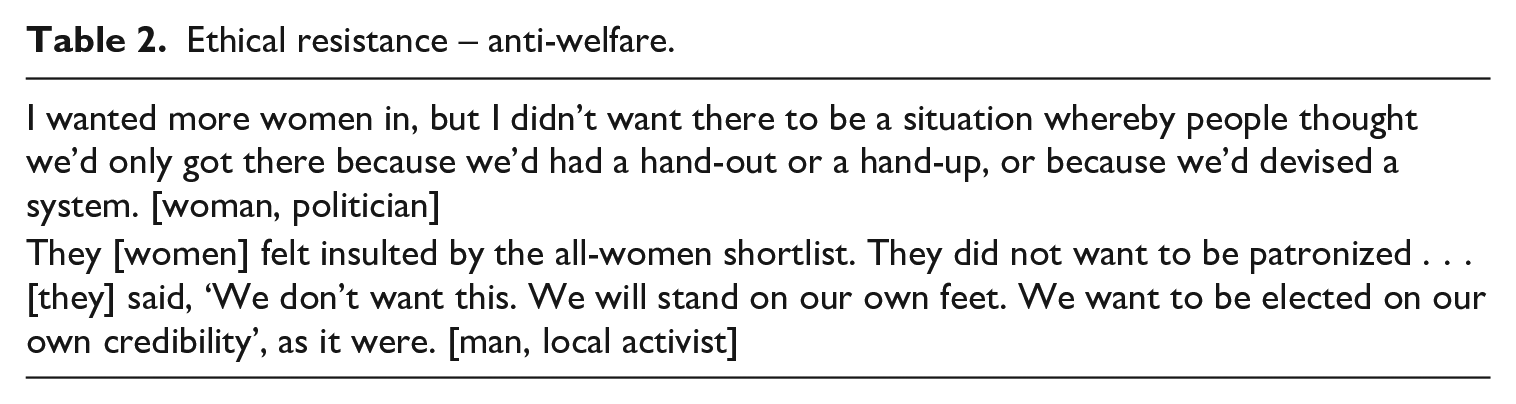
Anti-welfare language used here is redolent of formulations normally associated with conservative positions. Oblique resistance is articulated as a moving target: for example, in the statement ‘I wanted more women in, but . . .’, the conjunction ‘but’ signals a move to a specific, ethically framed objection. The term ‘hand-out’ is pejorative, often used by critics of the welfare state to evoke associations of parasitical behaviour. Likewise, reported speech from another male employee evokes another conservative trope, ‘stand on our own two feet’, extolling the virtues of self-sufficiency over systemic social support. The male local activist, positioning himself as a channel for women’s voices, strengthens this frame in positioning AWSs as something ‘insulting’, associating GE initiatives with stigma.
Ethical resistance was often articulated as a paradoxical form of care ethics, claiming a duty to protect women from hostility that would accompany selection via AWSs. This resistance was not aimed at GE but at the notion of unfairness, as seen in Table 3.
Ethical resistance – care.
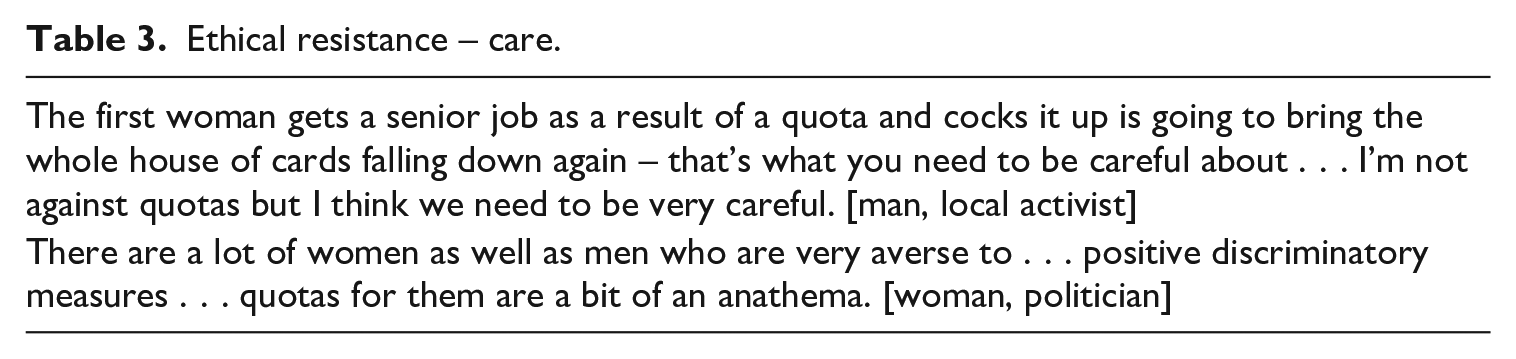
The patriarchal subject is strongly present here, as the male activist positions himself as a guardian for the larger project of GE. GE is implied to be a fragile process, a ‘house of cards’, that can collapse with a single small slip. There is a tacit assumption that women will fail, and that a failure will cause damage to the wider cause. The woman politician quoted gained office through a gender quota system; however, she also articulates opposition to GE initiatives as ‘anathema’. The term ‘positive discriminatory measures’ also suggests that AWSs should be placed in the same category as forms of discrimination with negative connotations.
Territorial resistance
Territorial resistance is our second category. Practitioners pushed back on social principles of equality by defending localized decision-making autonomy, reacting against a perceived external elite rather than against the principle of GE. This form of resistance is what led one respondent to note that ‘barriers come from local activists’ (woman, politician). This form of oblique resistance was constituted through denigrating outsiders, especially women candidates, portraying them as inauthentic and displaced, incapable of understanding local needs. Localized forms of affirming status were enacted, suggesting that any woman is less significant than local male party figures. Finally, instrumentalizing justifications were offered to create a hierarchy of priorities, where winning elections was deemed more important than GE.
Importantly, outsiders were treated with suspicion and actively denigrated. Antagonisms were magnified by the socio-economic position of many of the constituencies identified for AWS selections; safe Labour seats are often in relatively poor former industrial areas. ‘Outsiders’ were said to be exercising top-down control of local party members; it is this that was being resisted, rather than GE initiatives, as seen in Table 4.
Territorial resistance – outsiders.
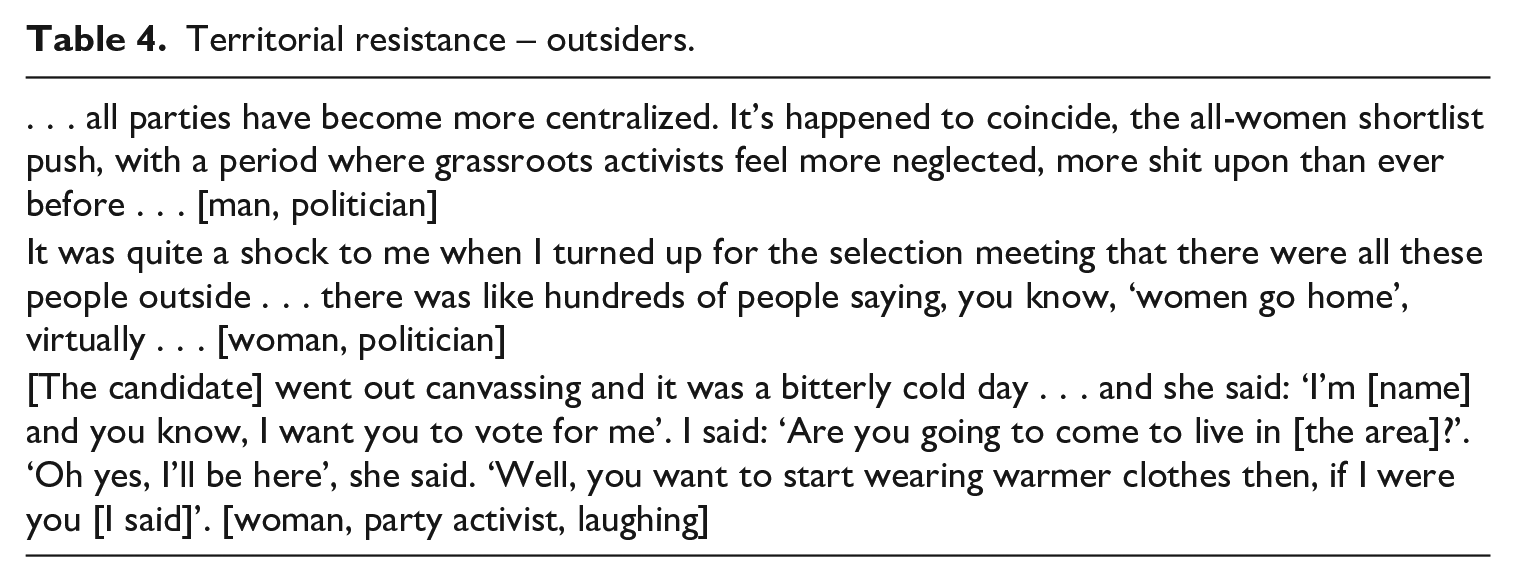
Objecting to outsiders emphasizes the particularities of local context rather than GE, based on circumstantial justification that rationalizes resistance. A dark picture is painted through terms such as ‘shit upon’ and ‘neglected’. ‘Outside’ status is conferred on women who do not belong – they should ‘go home’, sometimes literally to the private sphere as well as geographically. This resistance is also evident at the micro-level, as a woman candidate is depicted as ‘foreign’, ill-clad and unaware of local weather.
Even when women were selected via AWSs and elected as MPs, they faced further resistance. Enactments of status where local men asserted positional power in constituencies were especially common. Respondents noted how this kind of behaviour was unlikely were the candidate or MP a man, as shown in Table 5.
Territorial resistance – status.
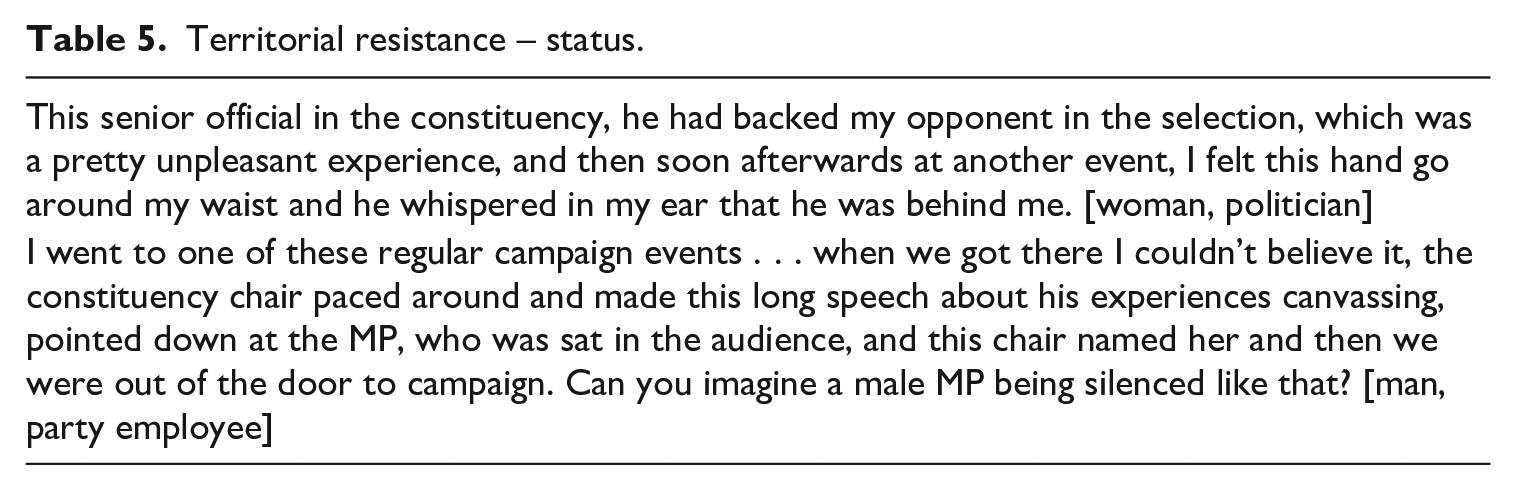
Again, this resistance is not directed at GE per se, but at maintaining purportedly gender-neutral practices within a unique local setting. Senior males assert status, territory and positional power through embodied acts. This manifests in unwanted touching (‘I felt this hand’) and in intimate verbal communication, as the senior male who had opposed the candidate instigates an intimate, whispering affirmation of support, experienced by the woman as an assertion of gendered power. Men staking territorial claims with their bodies are vividly described in terms of ‘pacing’ and ‘pointing down’; the woman MP, in contrast, is passive, ‘sitting’ and ‘silenced’.
Finally, this resistance manifests as instrumentalizing. Again, the objection is not GE but, at least notionally, fear of losing to opposing candidates and parties in an election, as seen in Table 6.
Territorial resistance – instrumentality.
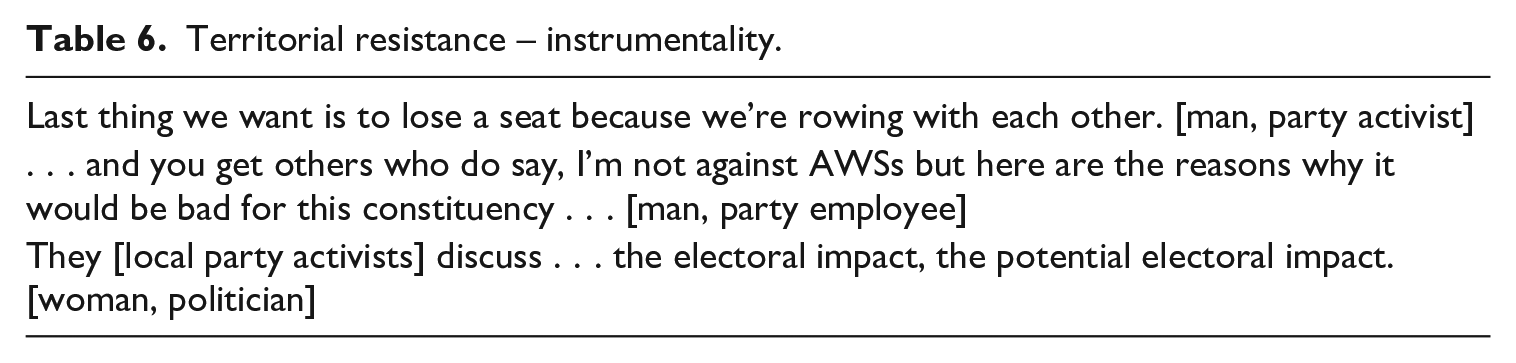
Resistance is expressed in the tacit assumption that public disagreement about AWSs or a woman will lead to loss of votes (‘it would be bad for this constituency’). This shows a discursive hierarchy, with GE subservient to electoral victory. The routine internalized nature of this resistance is revealed by the female politician, who seems to take for granted that these are valid concerns and priorities. These territorial forms of oblique resistance employ a range of practices to mark local space as problematic or hostile to women candidates, without openly resisting the principle of GE.
Conventional resistance
Oblique resistance to quotas was also based on arguments founded on convention, or traditions of ‘how things are done around here’. AWSs were often implemented in constituencies that had never elected a woman, and frequently in places that had been reliant on ‘dirty’ industries with an attendant gendered division of labour. These conventions operated in an automated way that reproduced gendered norms of who looked and sounded like an MP, who was expected to gain from being an elected politician, and who activist subalterns should be. Women candidates were subjected to (illegal) questions about their domestic situation, assumed to have more reproductive responsibilities, with the justification always oblique, that it was targeted at a particular candidate rather than women in general.
Women reported multiple instances of casual ‘everyday’ sexism based on biological sex role norms, such as being asked who the MP was at functions (when, of course, they were), being questioned as to where a husband was, or being interrogated about plans to have children. These instances of resistance come from people who would otherwise be regarded, and regard themselves, as proponents of social equality, as is seen in Table 7.
Conventional resistance – automating.
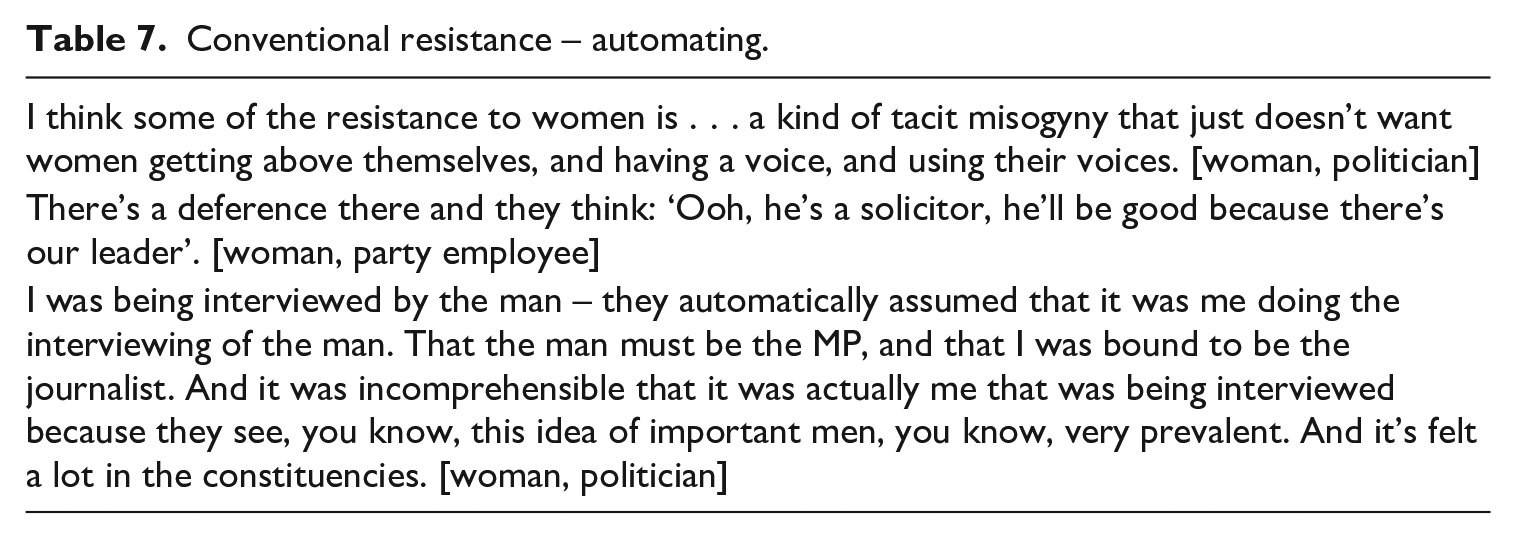
During selection processes, questions often ranged into domestic areas with gendered implications, but never directly challenged the principle of GE. Respondents argued that if the sex balance was different in the other direction, or if similar questions were asked of men, it would be accepted that there was a democratic deficit and a real structural problem (Table 8).
Conventional resistance – domesticating.
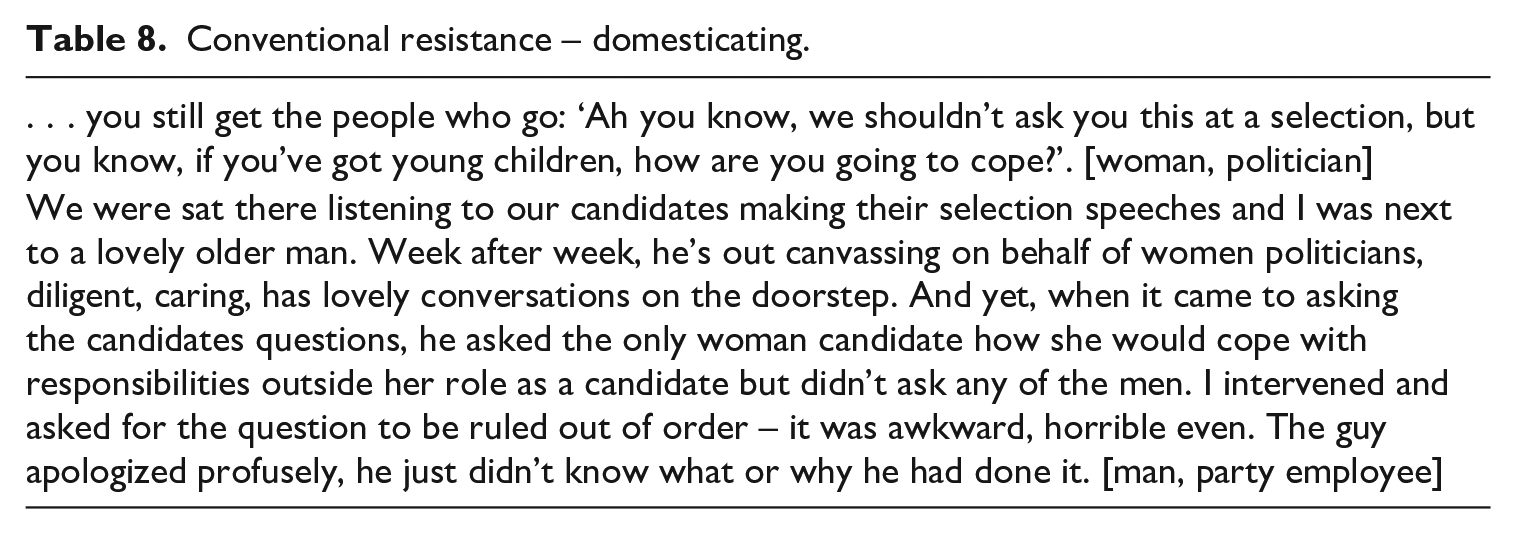
The oblique resistance evidenced here is shown by an activist who knows they ‘shouldn’t ask’ domestic questions but does so anyway. The questioner again cloaks queries in terms of care, yet with no organizational infrastructure available to support parents of any gender, it is always a loaded question. This is emphasized by the questioner appearing to have understood the mistake immediately, ‘apologizing profusely’.
In this area, respondents told us at length of women resisting AWSs, particularly from 1999 to the late 2000s, re-iterating gendered norms about who should or should not occupy leadership roles. These were justified as family-defending justifications rather than resistance to GE, with women defending the patriarchal family unit by acting as ‘patriarchy soldiers’, enforcing norms, as shown in Table 9.
Conventional resistance – family-defending.
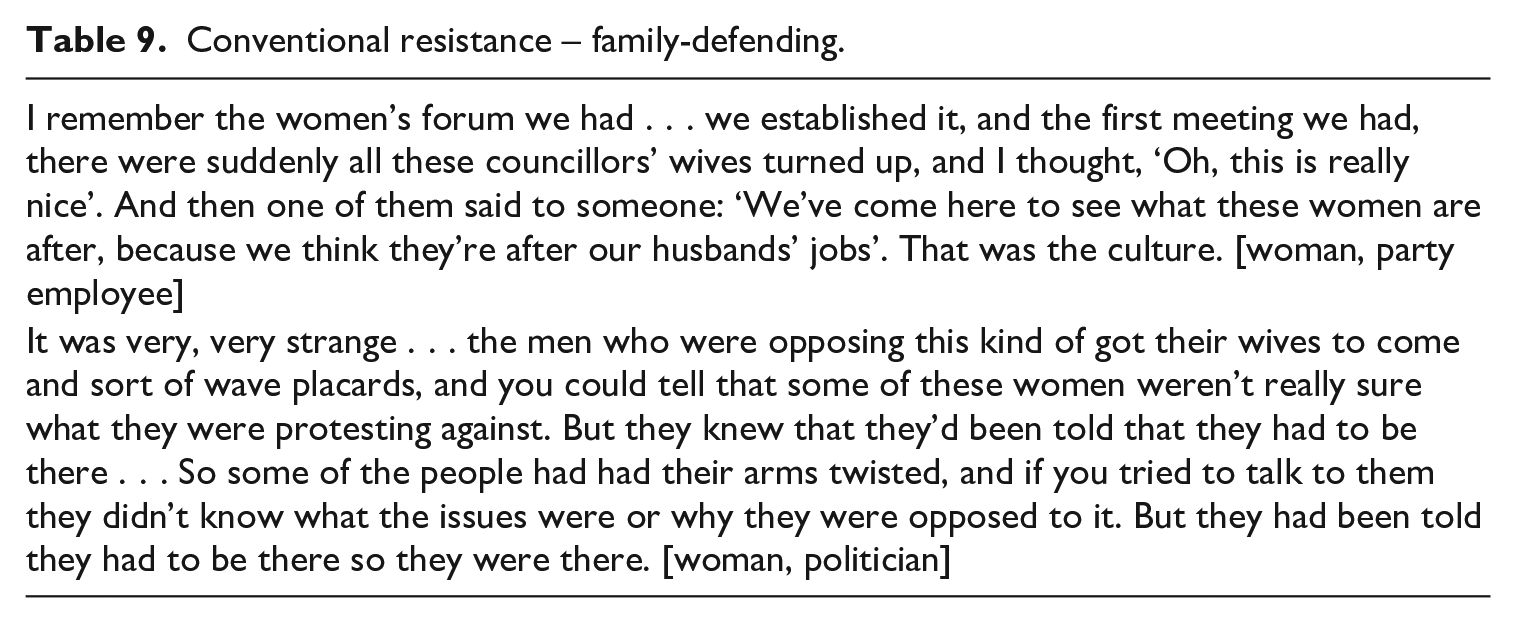
Women resisting AWSs appeared to do so on the basis of defending the material and power interests of family units, not because they opposed GE initiatives. Careful use of nouns is significant, separating out ‘women’ from ‘wives’. This suggests that women who attended the meeting as ‘spies’ did so as agents of a family-based patriarchy, and did not see themselves as belonging to the more general category of ‘women’. Coercion also appears to be present, evoked in the verb ‘arms twisted’. Resisting women are portrayed as passive receivers of orders, as men ‘got’ their wives to attend a protest; the women ‘weren’t really sure’ what this was about; they ‘didn’t know what the issues were’. Conventional forms of resistance encapsulate a wide range of practices and spheres, from formal processes of party selections to family units, but never directly oppose GE in principle.
Discussion: Oblique resistance in theory and practice
In summary, we argue that oblique resistance seeks to remove the goal of gender equality from debate – it resists gender by not resisting gender, as summarized in Table 10.
Oblique resistance – summary of types and dimensions.
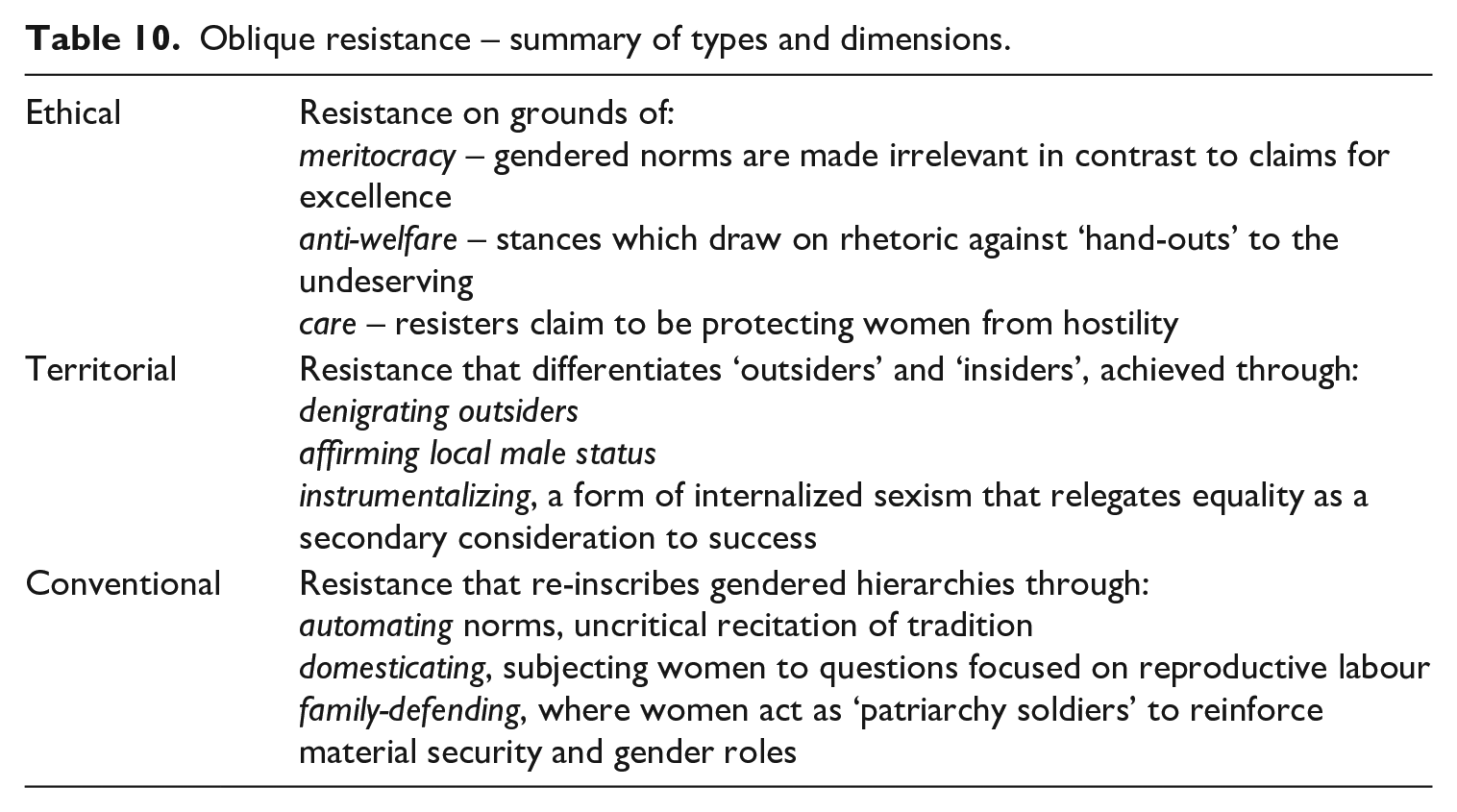
Our case study shows how a certain group in formal power (party leadership and staff) was resisted by a counter-group (some parliamentarians and party members), a common scenario. However, prevailing patriarchal practices were also defended, obliquely, by the formally less powerful group. Our analysis shows how oblique resistance is indirect and slippery, a practice that maintains a resistant stance while never opposing issues of GE on their own terms. The manifestations and modifications of oblique resistance are indicative of the ambiguity present at the heart of the relationship between power and resistance (Fleming and Spicer, 2007), shown especially clearly in a context where patriarchal power holders find themselves likely to lose control and status. As power ebbs away from a formerly dominant patriarchal group, so its forms of resistance become less direct and more oblique: distinctions between what constitutes power and resistance become blurred.
Our overarching purpose has been to show the pervasive and ubiquitous nature of oblique resistance as it seeks to defend patriarchal power, a power that itself seeps into most aspects of social and organizational life – tying together spaces, bodies and language (Butler, 1999) with the aim of maintaining a discriminatory and oppressive gender order (Manne, 2018). The second practice in particular, territorial resistance, is the most obvious assertion of power by resisting actors, showing how adeptly issues relating to GE are substituted with discourses relating to defending territory. Priorities shift from gender to territory through denigrating outsiders, and affirming the status of local males. Such ‘othering’ serves to turn subjects into objects, ‘abject beings . . . who form the constitutive outside to the domain of the subject’ (Butler, 1993: 3) – the subject being a local trustworthy man who belongs and understands the needs of the population. Spaces are staked out in ways that relegate the status of women, unlikely to occur were a man the candidate or MP. The male body is utilized to claim territory, through pacing and occupying spaces, enunciating experience and expertise, and through acts of touching and whispering. Women’s bodies become the site of scrutiny and intrusion.
Previous research on quotas as GE initiatives, notes that they are positioned as controversial precisely because they challenge established power blocs and seek to reduce obvious inequalities (Forstenlechner et al., 2012). Analytically we also note the converse here – it is difficult to separate understanding of resistances to GE from other, broader resistances to social injustice. Our analysis also signals the vital importance of engendering more widespread and systemic norms of collective practice, to point to ways in which a wider struggle for justice can be harnessed and channelled, so that equality can become a collective method rather than an end goal. In addition, we suggest that the insights of the inseparability of resistance to GE from other, broader inequalities issues can easily be extended to analysis of similar dynamics in other, non-political organizations. The tangential issues used to resist may be superficially different from those we have identified here. For example, we would expect that oblique resistance to GE would surface in relation to more generalized complaints, such as dissatisfaction with an organization’s leadership, human resource management policies, or reward systems.
Our second key analytical contribution, showing the indirectness and slipperiness of oblique resistance, highlights ways in which patriarchal power deflects in order to defend precisely when it is under threat (Manne, 2018). Oblique resistance ‘dances’ (Fleming and Spicer, 2007: 184) adaptively between overt and covert exercises of power. Overt resistance to GE shows where sex and gender are naturalized and clear lines are drawn between what constitutes men’s and women’s occupational roles. Yet our findings lack such explicit objections to GE; respondents did not offer normative justifications for their resistance. Arguments against interventions were made overtly, acknowledging the need to support GE in the abstract, but never supporting a specific mechanism in particular. At an organizational level, covert resistance can be seen as commitment to equality in corporate policy accompanied by failure to address systemic practices and issues. Oblique resistance is covert in the sense of never addressing directly the issue of GE. However, in contrast to covert resistance, our analysis shows openly voiced opposition to GE interventions, which allows a clearer view of resisting logics.
From this, it is clear that oblique resistance spans overt and covert forms, never openly oppositional and continuously shifting, or changing focus, to render questions of gender invisible and irrelevant. The final key method of practising oblique resistance is through the replacement of GE as an aim with a manufactured concern to achieve meritocracy. Previous research on resistance to GE covers meritocracy in depth, highlighting how organizations can simultaneously advocate GE and reward typically masculine norms such as over-work (Sattari and Sandefur, 2019). Even within a centre-left political organization, the discourse of meritocracy was widely invoked, normalized and deemed devoid of bias. We offered further evidence of how meritocratic norms have seeped into common sense, becoming an overriding ethical concern and deflecting away from notions of GE (Brandth and Bjørkhaug, 2015). This suggests the co-option of rhetoric typically associated with the political right, positing a ‘deserving’ population against the ‘undeserving’, who require ‘hand-outs’ and should learn to ‘stand on [their] own two feet’. Given the purpose of our case study organization, we might expect such forms of resistance to manifest to an even greater degree in profit-orientated organizations. Related to this, we have shown how resisting obliquely by invoking a need to protect women from hostility and harm as a practice of care draws on stereotypical views of women as weak and vulnerable, positioned as more ‘suited’ to the domestic than the public (Dick, 2004).
Finally, we have enriched understanding of the phenomenon of women resisting GE initiatives. This has been explained as ‘internalized oppression’ (Alleyne, 2005: 294), women reproducing prescribed identities within organizations and societies, reaffirming and sometimes vigorously defending them. This speaks back to the social construction of meritocracy, in that women often regarded ‘the way things are’ as neutral (Brumley, 2014). Our most significant finding, however, relates to expanding understanding of the material dimensions of women obliquely resisting GE. While Powell et al. (2018) illustrate the phenomenon of women who have achieved career advancement through masculine norms resisting change, and McCarthy and Moon (2018) report resistance as fear of the consequences of disrupting a gendered order, we found some women defending the status quo in order to preserve domestic status and security. They resisted material change rather than GE per se. Such passionate claims, from those often seen as victims of patriarchy, may therefore carry stronger legitimacy claims – they not only help preserve an order but also validate it. Such forms of resistance may be harder to overcome, not only because they only touch upon GE initiatives obliquely, but also because they are a real and material manifestation of a competing claim.
Conclusion: Behind the mask of oblique resistance to gender equality
Quotas, understood as a determinist formalization of equality of outcome (Jewson and Mason, 1986), are a demonstrably reliable means of challenging the patronage and particularism that characterizes selection into, and exclusion from, positions of power and authority in professions and organizations. Here we have analysed the UK’s only positive discrimination intervention, AWSs in the Labour Party, a form of quota implementation at the parliamentary candidate selection stage for elections. The current situation in the political profession in Britain might be described as ‘as good as it has ever been’ for women in terms of numerical representation, policy formation and profile, in large part because of the AWS implementation in our case study organization. Notwithstanding, our analysis offers strong evidence of persistent resistance to GE in practice, a full century after the election of Britain’s first woman MP.
Returning to the purpose of GE interventions, we observe that it seems unlikely male dominance of elite groupings will diminish ‘naturally’, or that the sexism, misogyny, and toxic masculinities associated with skewed professional demographics will cease, unless a more determinist, outcome-oriented approach is taken in more settings. In order for change to be achieved more quickly, more and better understanding of the nature, nuances and scope of resistance to GE interventions and their aims is clearly necessary. This task is all the more salient when patriarchal power remains a key social dynamic, overlapping with co-constituting through sexism and misogyny (Manne, 2018). Gendered exclusion is demonstrating remarkable longevity and resurgent social acceptability. Part of that longevity, we have argued here, is in the ability of resistance to GE to ‘self-mask’ (Manne, 2018) through oblique articulations that defy moral critique. Resistance is articulated both covertly and overtly, yet never speaks its name. Naming it and beginning the process of identifying its dimensions, manifestations and clandestine nature seems paramount if we are to break patriarchal patterns of exclusion.
Footnotes
Acknowledgements
We are very grateful to research seminar audiences at Bath, Edinburgh, Newcastle, Royal Holloway and Copenhagen Business School for comments on this work; we are also grateful to David Collinson for advice and feedback at a key moment in the paper development.
Funding
The authors disclosed receipt of the following financial support for the research, authorship, and/or publication of this article: the data collection for this research was funded by the Open University Business School.
