




Abstract
Drawing on interviews with women and men who serve on the supervisory boards of German stock-listed companies, this qualitative study examines why some female directors seek to augment gender equality in their organizations while others do not. Those who take action do so both in formal board processes and in informal settings. A sense of belonging to women as a social group and a sense of responsibility for women in the organization are key factors in explaining why some female directors contribute to gender equality. In addition, the study highlights the relevance of a board culture supportive of gender equality and positive expectations by other organizational members about female directors’ role in advancing gender equality. Board chairs influence how supportive female directors perceive the organizational context to be. Where the organizational context is not seen as supportive, those who take equality-related action anyway are experienced directors. Surprisingly, the presence of other women on the board does not appear to be related to whether or not female directors take action. Examining female directors’ actions and paying close attention to both their identities and their specific organizational settings shows how the interplay between social identity and situational opportunities and constraints affects board behavior.
In the past decade, research on the gender composition of corporate boards has rapidly expanded. Scholars have focused particularly strongly on uncovering the effects of board gender diversity on organizational outcomes (Kirsch, 2018). For example, past research has examined the association between board gender diversity and firm financial performance (Galbreath, 2018; Loy & Rupertus, 2022), social responsibility (Post et al., 2011), philanthropy (Jia & Zhang, 2013), reputation (Bernardi et al., 2006) and innovativeness (Torchia et al., 2011).
Scholars have also examined the effect of board gender diversity on gender equality outcomes within organizations, defined as any outcomes that increase the well-being and the careers of women in organizations. They have demonstrated that organizations with women on their boards have more women among their CEOs, top executives, and managers (Bilimoria, 2006; Cook & Glass, 2015; Gould et al., 2018; Matsa & Miller, 2011; Skaggs et al., 2012). Furthermore, they have shown that in such organizations, there is less workplace gender segregation (Stainback et al., 2016) and a lower gender gap in executive compensation (Elkinawy & Stater, 2011; Shin, 2012).
The assumption underlying this ostensible link between board gender diversity and gender equality outcomes in organizations is that female directors represent women’s interests. Yet, although political scientists have tackled this assumption directly by studying whether and under what conditions women in political office represent women’s interests (which they term “substantive representation”; Childs & Krook, 2009; Dolan & Ford, 1995; Höhmann, 2020; Wängnerud, 2009), this issue is largely unexplored in research on female directors of business organizations.
In this article, I address this assumption by presenting an in-depth qualitative inquiry that focuses on female directors’ actions to promote gender equality. Focusing on female directors’ actions recognizes that actions may not immediately lead to measurable outcomes (such as an increase in women’s share of management positions or a decrease in the gender pay gap in an organization). Distinguishing between actions and outcomes further recognizes that some actions will not be successful in achieving the intended outcomes at all. Finally, it recognizes that improvements in gender equality outcomes may be attributable to men’s actions. Increased contact with female directors could reduce intergroup prejudice among male directors and reduce their doubts about women’s leadership abilities (Guldiken et al., 2019; Oliver et al., 2018; Pettigrew & Tropp, 2006; Zhang & Qu, 2016). In that scenario, gender equality outcomes increase through women’s presence on boards and intergroup contact, but not due to female directors’ equality-related actions. 1
I analyze interviews with 60 women and men who serve on supervisory boards of German stock-listed companies, and documentary data about these directors and their boards. I establish that some female directors take equality-related action both in formal board processes such as board meetings and in informal settings, for example, by advocating gender equality in conversations with other organizational actors. Others, however, do not.
I examine why some female directors seek to augment gender equality in their organizations while others do not. In doing so, I draw on past theory and research on social identity (Hogg & Terry, 2000; Tajfel & Turner, 1979; Turner et al., 1987) and organizational contexts (Ashforth & Mael, 1989; Deaux & Major, 1987; Ely & Padavic, 2007). This theoretical perspective enables the discovery of three conditions under which female directors promoted gender equality in organizations: a salient gender identity, a board culture supportive of gender equality, and positive expectations by other organizational members about female directors’ role in advancing gender equality. By contrast, female directors did not take equality-related action if gender was an insignificant aspect of their identity or if the board culture was unsupportive and they lacked experience as directors. Different from previous research, this study highlights the relevance of other organizational members’ expectations and suggests that the presence of other women on the board is not related to whether or not a female director takes equality-related action.
Examining female directors’ actions and paying close attention to both their identities and their specific organizational settings provides new theoretical insights into how the interplay between identity and situational opportunities and constraints affects board behavior and thereby shapes organizational outcomes (Bamberger, 2008; Johns, 2006). This allows us to progress in theorizing on when and why women’s presence on boards contributes to greater gender equality in organizations.
Theoretical Background
Directors serve two key functions in organizations—monitoring and resource provision (Hillman & Dalziel, 2003). Monitoring activities include auditing financial statements, approving important financial and strategic decisions, ensuring an organization’s compliance with the law, and selecting, evaluating, rewarding, and dismissing the CEO and other top managers. Resource provision activities include providing expertise and advice in the formulation of strategy, and providing legitimacy, reputation, and network ties that link an organization to stakeholders and facilitate its access to resources. The governance literature emphasizes that within these functions, directors have varying conceptions of their duties (Lorsch & MacIver, 1989; Mace, 1971). Some directors will view behavior aimed toward the enhancement of gender equality in their organizations as within their remit as monitors and resource providers, whereas others will reject this notion. Social identity theory and the concepts of board culture and demography are discussed next and provide the basis for theorizing about when female directors act in support of gender equality in their organizations.
Director Identities: In-Groups and Favoritism
Social identity theory and, its extension, self-categorization theory (Hogg & Terry, 2000; Tajfel & Turner, 1979; Turner et al., 1987) help us understand why female directors would support gender equality in organizations. Identity theories view an individual’s self-concept as constituted by society and as consisting of multiple identities. Furthermore, they posit that an individual behaves in ways that are consistent with these identities (Hogg et al., 1995; Stets & Burke, 2000). Social identity theorists see social groups such as gender, race, and ethnicity as particularly significant for explaining behavior. When people view themselves as members of the same social group, for example, the group of men or the group of women, a process called self-categorization takes place: They begin to perceive similarities between themselves and other members of their in-group. Such gender identification has been shown to exist in work organizations (Fajak & Haslam, 1998). Through a process of depersonalization, people then come to view themselves and other members of their in-group as embodiments of an in-group prototype rather than as individuals. This leads to in-group favoritism and group phenomena such as group cohesion, cooperation, altruism, empathy, and collective action (Fiske, 1998; Turner et al., 1987). According to this theoretical perspective, female directors will see themselves as similar to women in the organization and act in ways that benefit other members of their in-group.
Yet, social identity theorists also recognize that members of low-status social groups—such as women in the higher ranks of organizations—may disassociate themselves from that group and identify instead with the high-status comparison group. In this process, women in an organization who use such an individual social mobility strategy adopt the norms, values, and attributes that characterize men (Chattopadhyay et al., 2004). Female directors are not typical women and some of them may be more similar to male directors than to women in general. A survey of Swedish directors found that female directors differed markedly from women in the general population in their values. For example, female directors were much more achievement-oriented and self-directed, and much less tradition-oriented than women in the population. They were more similar to male directors than to women regarding these values (Adams, 2016; Adams & Funk, 2012). These differences in values between female directors and women in the population may reduce the salience of female directors’ gender identity and their perception of other women as their in-group, thus reducing their propensity to take action on behalf of women.
Organizational Context: Board Culture and Demography
Social identity theory recognizes that the salience of a group identity is not a fixed attribute of an individual. Rather, group identities are developed and maintained in social processes. Depending on the situational context people find themselves in, their group identities may or may not be activated and played out (Stets & Burke, 2000). Such situations include organizational settings (Ashforth & Johnson, 2001; Ashforth & Mael, 1989). This also applies to gender identity: It is not an essential property of the self; instead, social interactions in an organizational context affect how salient gender identity is to a woman and how it affects her behavior (Deaux & Major, 1987; Ely & Padavic, 2007). As outlined above, social identity theory posits that some women in high-status work groups such as boards will identify with men and therefore be unlikely to undertake efforts to augment gender equality in organizations. Organizational research examines in which organizational contexts such self-group distancing is likely to take place, considering aspects of organizational culture and demography.
Studies of the behavior of women in leadership positions have examined situations in which female leaders have not taken responsibility for increasing gender equality in organizations and have not taken action to support women, but rather distanced themselves from other women. In leadership positions, women may perceive that negative stereotypes about women as leaders could impact on the way they are judged and treated in the organization (“stereotype threat”) and this affects their behavior (Hoyt & Murphy, 2016). Specifically, they could distance themselves from the stereotyped group and actively engage in counter-stereotypical behavior. Studies have found that such self-group distancing behavior (“queen bee behavior”) is a response to gender inequality in an organization (Derks et al., 2016). When women work in an organizational culture that they perceive to be conservative, traditional or paternalistic, they are unlikely to promote gender equality issues (Ashford et al., 1998; Dutton et al., 2002). Regarding boards, a growing literature points to the relevance of social context for individual directors’ actions (Westphal & Zajac, 2013). For example, some topic areas are undiscussable on some boards and openly debated on others (Demb & Neubauer, 1992; Lorsch & MacIver, 1989). This leads us to expect that whether or not a board’s culture is amenable to gender equality will influence female directors’ equality-related actions.
When women work in organizations numerically dominated by men, they are unlikely to help other women, according to tokenism theory. It posits that low numerical representation of women in leadership positions renders them highly visible and increases performance pressures (Kanter, 1977). Being a token negatively affects women’s propensity to help other women (Ely, 1994, 1995). Especially in high prestige work groups, women’s concern about being accepted as a valued member of the work group may undermine their propensity to support other women (Duguid et al., 2012). Sometimes, women are penalized with worse performance ratings if they engage in diversity-valuing behavior, so that supporting women can even pose a personal danger to senior women’s careers (Hekman et al., 2017). These studies strengthen the expectation that female directors will not take action in support of gender equality in organizations because boards are almost always skewed groups in which women do not reach a “critical mass” (Kanter, 1977).
However, social identity theory also provides the theoretical basis for the contrasting expectation. The theory posits that perceiving gender inequality in an organization may increase the salience of a woman’s gender identity, especially if she views gender inequality as illegitimate and alterable. Women with this perception respond by engaging in collective behavior aimed at reducing gender inequality (Schmitt et al., 2003). According to this perspective, female directors’ gender identity could become activated when they become aware of gender inequality in their organizations. They could even be supportive of gender equality in particularly male-dominated organizations. Indeed, interview studies of female directors in the United States found that whether or not female directors took action was not dependent upon them being part of a “critical mass” of female directors: One study found that “multiple women on a board seemed no more prone to raise gender-related issues than a single woman” and that female directors “resist[ed] the idea that a critical mass was necessary for them to raise gender-related issues” (Broome et al., 2011, p. 1060), whereas another stated that “most of the women—even when they were the only one or one of two women on a board—paid attention to the status of women employees” (Konrad et al., 2008, p. 154). Possibly, overcoming a token status is less important for female directors’ equality-related actions than for women in leadership positions more generally.
In summary, social identity theory and extant literature on female leaders’ support for gender equality in organizations lead us to expect that female directors’ gender identity in combination with the organizational context will affect whether or not they take equality-related action. However, we do not yet understand the interplay of these factors on corporate boards. This qualitative study of female directors in German stock-listed companies illuminates the significance of identity and organizational factors and explores whether further factors affect when and why female directors take action to advance gender equality. It thereby generates new insights into how female directors affect the spread of gender equality throughout organizations.
Empirical Setting and Methods
I set out to answer the research question, “When and why do female directors contribute to gender equality in their organizations?” by interviewing female directors on the supervisory boards of German stock-listed companies. During the research process, it emerged that answering the research question required interviewing both women and men. In this section, I describe the empirical study upon which this article is based. I discuss the research setting, the data collection process, and the steps in the data analysis.
Research Setting
The supervisory boards of German stock-listed companies represent a rather typical case by international comparison on two counts: First, the representation of women on boards in German companies is in the mid-field, well behind the front-runners Norway, Iceland, and France. In the companies listed in Germany’s prime indices (DAX, MDAX, and SDAX), the proportion of women on supervisory boards was 31% in 2019 (Kirsch & Wrohlich, 2020). Second, like many other European countries, Germany has introduced regulation on the representation of women on boards. Here also, Germany was not a pioneer but followed the example set by Norway, Spain, Italy, France, and others (Seierstad et al., 2017). A binding gender quota of 30% for supervisory boards was introduced for around 100 large, stock-listed companies in 2015 and around 1,750 companies were obliged to set and disclose their own targets for women’s representation on supervisory boards, management boards, and the top two management levels. Preceding this, a provision requiring an “appropriate consideration” of women when appointing board members was added to the corporate governance code in 2010. Numerous failed policy initiatives seeking to increase the all but stagnating share of women in management positions more generally (which was around 30% in 2018, Federal Statistical Office, 2019) preceded these regulatory changes (Kirsch, 2017).
The boards of German companies are distinctive in two ways, as prescribed by German corporate law. This concerns, first, the two-tier board structure and, second, the co-determination system (Schulz & Wasmeier, 2012; Werder & Talaulicar, 2011). German stock-listed companies are governed by a supervisory board and a management board. The supervisory board is comprised of nonexecutive directors. It appoints, oversees, advises, and dismisses the members of the management board, who are executive directors. An individual cannot be a member of both bodies simultaneously. The supervisory board examines company records and assets, issues audit assignments to the auditor, and receives reports from the management board on intended business policy, profitability, the state of business, and transactions of considerable impact on the conditions of the company. The management board is responsible for the operative management of the company, and the supervisory board does not issue instructions to the management board regarding operative issues. The size of a supervisory board ranges from three to 21 members depending on the amount of the company’s share capital, and large boards have a committee structure.
In large companies, the supervisory board is co-determined. Depending on company size, one third or one half of the supervisory board directors are employee representatives. While the shareholder representatives on the supervisory board are elected by the shareholders’ general meeting, the employee representatives are elected either directly by the employees of the company or, in larger companies, via delegates. On large boards, two or three of the employee representatives are union officials.
I chose to focus on supervisory boards because they are comprised of nonexecutive directors. In many countries, including Germany, women are particularly likely to serve on boards as nonexecutive directors (and rarely as executive directors). Thus, when contributing to gender equality in organizations, female directors around the world are most likely do so as nonexecutive directors. Furthermore, not least due to the co-determination regulation, supervisory board directors have a broader range of professional backgrounds that they bring to their directorship than management board directors do. The former work or have worked in many different types of organizations and occupations, whereas the latter are likely to have built their business careers by climbing internal job ladders within the company or in other private-sector companies (Freye, 2015). The greater variation in directors’ backgrounds on supervisory boards compared with management boards leads me to expect greater variation in directors’ social identities and in their equality-related behavior, which is beneficial for theory development.
Data Collection
I collected interview data and documentary data about 60 supervisory board directors and their boards. To select interviewees, I used a purposive sampling strategy and created a sampling guide that served as a broad orienting framework (Schreier, 2018). I began by considering that there are different types of directors (Hillman et al., 2000), and distinguished between the different types of shareholder representatives and employee representatives present on German supervisory boards. Shareholder representatives may be owners (members of an owner family, representatives of a parent company, institutional investors, or other blockholders), representatives of shareholders’ associations, senior executives of other companies (often members of a management board), politicians and other public officials, former senior executives of the focal company, or experts such as lawyers, auditors, academics, or consultants. Employee representatives may be union officials or company employees. The company employees are often members of other representative bodies in the company, in particular the works council, which represents nonmanagerial staff, and the committee of managerial staff (Gerum, 2007). Reasoning that different types of directors may be more or less likely to engage in equality-related action, I included these director types in my sampling guide.
I also considered that directors’ propensity to take equality-related action may be affected by board size, and included this factor in the sampling guide. Furthermore, I considered that directors’ experience on supervisory boards could play a role. I reasoned that a minimum of 2 years’ experience would account for the socialization process, during which newcomers to a board establish their roles (Ashforth et al., 2018). During 2 years, directors would have attended at least eight board meetings and thus had opportunities to take equality-related action. One of the first interviewees confirmed this rationale: When asked about her role on the board, she said, At the beginning of course, when you join a committee like this, and there are some top-notch people on it, you have respect. In the first three or four meetings I was like: “Ok, I’ll just watch,” because you don’t want to say anything stupid, right? And over the years, you just grow into it. (FD-17-E)
The next step was the assembly of a list of all 622 female directors on the supervisory boards of German stock-listed companies in 2015 using the reference book “Hoppenstedt Aktienführer,” which registers every stock-listed company in Germany on a yearly basis and contains the names of all supervisory board members. I restricted my sample to directors of stock-listed companies because information about the boards of these companies is publicly available.
Using the sampling guide, I contacted 84 female directors from the list with the aim of capturing a wide variety of views. They were contacted via letter or e-mail requesting an interview and describing the research project about men and women on boards and the role of supervisory boards regarding gender equality in organizations. In total, 29 female directors agreed to an interview in 2017 and 2018. In addition, to explore the role of men in the promotion of gender equality in organizations (Radke et al., 2020), six male directors of stock-listed companies were interviewed during this time period.
During the initial stages of data analysis, an analytic lead emerged: It appeared that male directors’ beliefs about women on boards and the expectations they hold of them would likely influence these women’s equality-related actions. Such expectations could include, for example, a responsibility of female directors for gender equality issues. Following this analytic lead, I conducted a second round of data collection (Corbin & Strauss, 2008). I realized that to develop explanations for when and why female directors contribute to gender equality in their organizations, I needed to interview more male directors. Using the same sampling guide and the same reference book, I interviewed a further 24 male directors in 2019, reaching a total of 30.
Six of these directors were board chair, and during the initial analysis of their interviews, it emerged that they played an important role in determining whether issues surrounding gender equality became active and dynamic. This analytic lead resonates with the governance literature on the relevance of social context for individual directors’ actions (Westphal & Zajac, 2013) and findings that issues that are undiscussable on some boards are openly debated on others (Demb & Neubauer, 1992; Lorsch & MacIver, 1989). As I had been unsuccessful in obtaining an interview with a female supervisory board chair in my initial data collection round, I tried again and was able to interview one of the nine female supervisory board chairs in German stock-listed companies in 2020, reaching a total of 30 female directors.
As is frequently the case when interviewing “important people in big companies” (Thomas, 1993), potential participants were easily identifiable, but not easily accessible. Considerable time and effort were involved in obtaining contact details and securing an opportunity to collect the data. This involved searching for contact details online and in company databases, as well as inquiring at investor relations departments, at organizations where the directors held honorary positions such as charities or business associations, directly approaching directors at events hosted by directors’ associations, and directing requests through directors’ personal ties. In many cases, a follow-up e-mail or phone call was necessary. The interview request included a declaration that involvement in the study would be confidential and that information about the interviewees would not be used in any way that revealed their identities. Of the 60 interviews, 39 were conducted in person and 21 over the phone. A total of 3,244 min of interview data were recorded and transcribed.
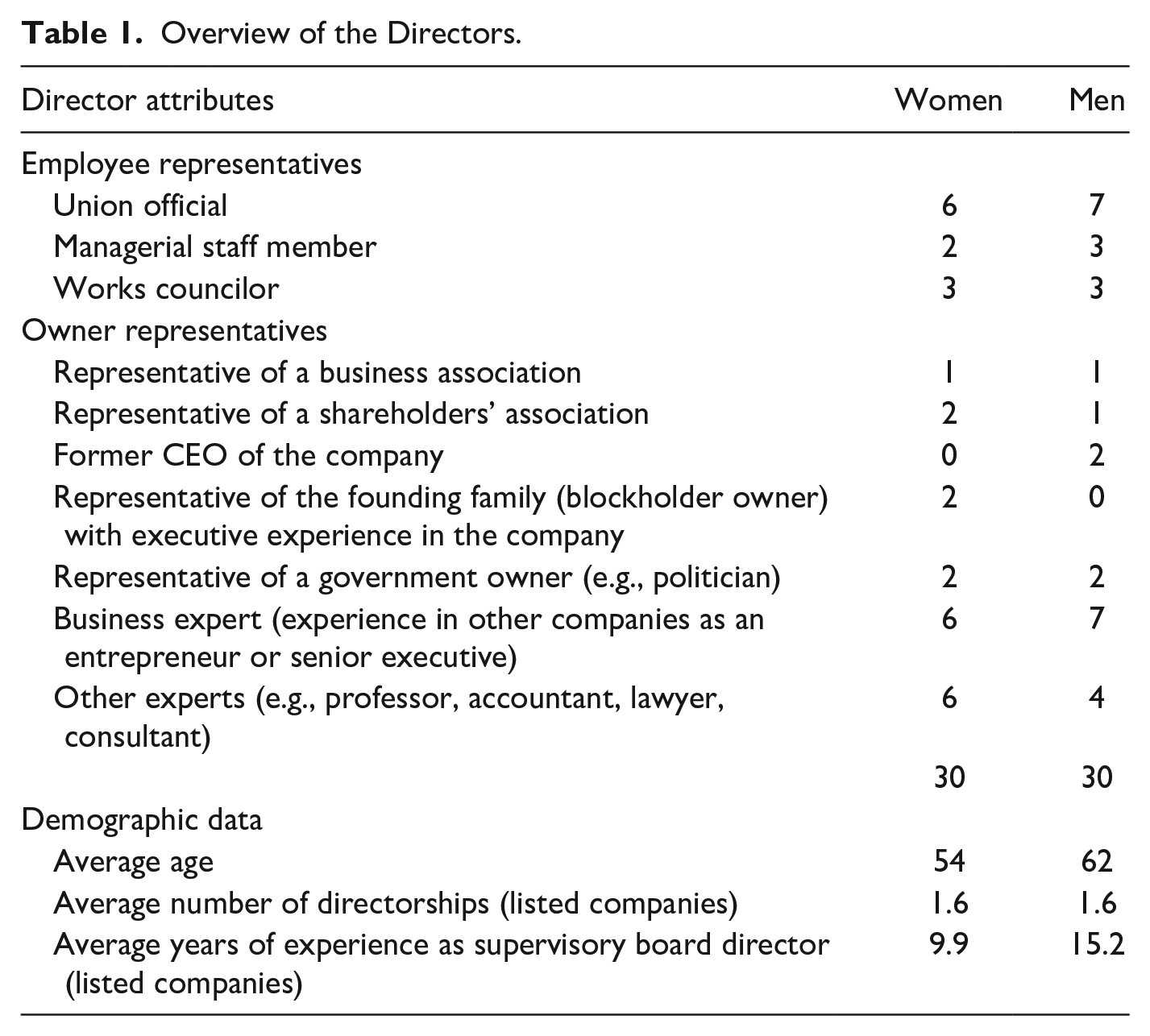
Tables 1 and 2 summarize the documentary data collected about the interviewees and their boards and show that the aim to interview many different types of directors from a broad range of companies was accomplished. Table 1 provides an overview of the 60 interviewees. The female directors were between 40 and 71 years of age at the time of the interview, and the average age was 54 years. They had served on between one and six boards of 46 different stock-listed companies. One director was board chair. On average, they served on 1.6 boards and had 9.9 years of experience as directors of listed companies. However, many also held directorships in nonlisted companies, so that their experience as directors was even greater.
Overview of the Directors.
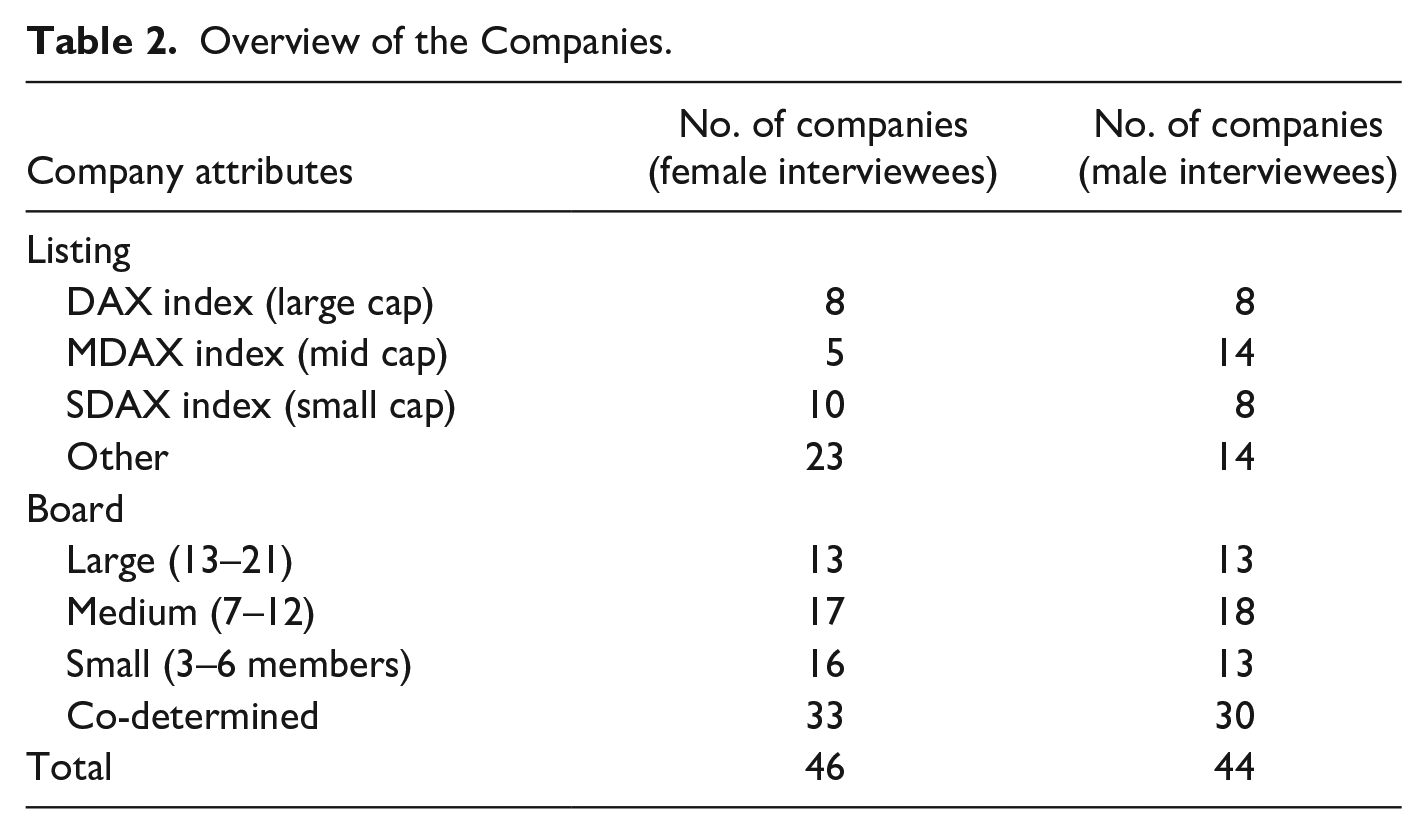
Overview of the Companies.
The 30 male directors were between 46 and 78 years of age at the time of the interview, and the average age was 62 years. They had served on between one and four boards of 44 different stock-listed companies. Six were board chair. On average, they served on 1.6 boards and had 15.2 years of experience as directors of listed companies. Many also held directorships in nonlisted companies.
Table 2 provides an overview of the companies and their boards, showing that the directors served on the boards of some of Germany’s largest companies listed in the prime index DAX, and on medium and small sized companies, whose boards were comprised of fewer members and sometimes did not include any employee representatives.
The episodic interviewing method (Flick, 2000) was used because it enables researchers to elicit interviewees’ episodic knowledge of specific events and situations as well as their more abstract and generalized knowledge about an issue. Episodes are particular events or situations that the interviewee remembers, and the interviewer seeks to obtain many rich and detailed narratives, not only about what happened but also about the interviewees’ point of view. I wanted to hear about any type of situation in which directors were concerned with gender equality in organizations, such as board discussions and decisions, but also situations outside of the boardroom. Therefore, the interview guide needed to be open enough for the unexpected, contain invitations to recollect specific situations, and include questions directed toward the interviewees’ definitions and argumentations surrounding gender equality in organizations and the role of the board.
To familiarize the interviewees with this type of interviewing, I began as follows: In this interview, please tell me in detail about your experiences of specific situations and events and what they mean to you. The opening question was, “How would you describe your role on the board?” This question yielded spontaneous and rich descriptions of how the interviewees positioned themselves and their definitions of the role of a director. It was followed by the question, “How do you experience discussions and interactions among men and women on the board?” This question led the interviewees to the topic under study, gender equality in organizations, and yielded first responses about what and how men and women contribute to board processes. A further prompt on this theme was whether they felt connected to the women on the board and in the organization in any way. An invitation to remember and recount specific episodes and situations relating to gender equality ensued: Have you experienced anyone taking action for a gender equality issue in the board context? I then mentioned situations in which interviewees may have had experiences to aid their recollection. For example, Have you experienced that the supervisory board was concerned with leadership development and succession planning in the organization? or Can you tell me about how the supervisory board recruited and selected candidates for a position on the management board? Some interviewees narrated situations in which they themselves had acted, whereas others spoke of actions taken by a different individual. Some interviewees narrated situations in a way that the initiator of the action remained unclear or seemed to be the board as a whole. I responded to the interviewees’ answers with deepening enquiries. In particular, I clarified who acted. If the interviewees had not spoken of their own actions, I asked them whether they had ever personally taken action. If the interviewees narrated a situation where they had taken equality-related action, I asked them about their motivation. Finally, I asked questions that were decontextualized from specific situations: How would you describe the significance of gender equality in the organization? and What do you think of the new legal requirement that the supervisory board sets targets for the representation of women on the management board and in senior management levels? These questions aimed at eliciting interviewees’ general and abstract knowledge about the issue and gave them the opportunity to relate it to their episodic knowledge of the specific situations they had previously recounted. The interview ended with the question, “Is there anything else about this topic that you find important but that we haven’t yet discussed?” This allowed the interviewees to add relevant topics or summarize their opinions.
Data Analysis
I coded the transcribed interview data employing NVivo qualitative data analysis software. In the first round of coding, I identified all data fragments in which female directors relayed an instance where they had engaged in some form of equality-related action. I then conceived of each female director as a case of either “took action to promote gender equality” or “took no action”—this broke down the participant sample into two groups.
I then compared these two groups of female directors by searching for patterns and seeking to isolate a causal stream that led to the outcome (Miles et al., 2014). I began by examining the documentary data I had collected about the female directors’ attributes and the composition of their boards. As will be shown in the next section, interviewee attributes and board composition appeared to be related to female directors’ propensity to act, but they did not deliver a clear explanation for why they did so.
Therefore, I returned to the interviews and coded female directors’ narratives about the reasons they acted, the conditions that led to the action and what came before and led up to the action. Then, I clustered the first-order codes that had emerged from the data into more abstract second-order themes. For example, “Perceiving expectations by men on the board” and “Perceiving expectations by female employees” were combined in the more abstract theme of “Others’ expectations about a role in advancing gender equality.” Next, I explored whether the two groups of directors differed in their narratives about these themes. I discovered divergent patterns for three themes: “gender identity,” “board culture,” and “others’ expectations.” These themes were aggregated into two theoretical dimensions: first, the dispositional factor “gender identity” and, second, the situational factor “organizational context.” Finally, a return to the documentary data revealed why some female directors with a salient gender identity took equality-related action in an unwelcoming organizational context and others did not. In this process, four groups of female directors were brought to light.
I analyzed the interviews with male directors by identifying all data fragments in which they relayed an instance where someone had engaged in some form of equality-related action. I counted how often they spoke of a female director taking action. This confirmed that on many boards, women were taking equality-related action. The interviews with male directors also illuminated the expectations that men on boards hold of female directors. They confirmed that the expectation exists that female directors are responsible for gender equality issues. Overall, the triangulation of three data sources—interviews with women, documentary data, and interviews with men—enhanced the trustworthiness of the analysis.
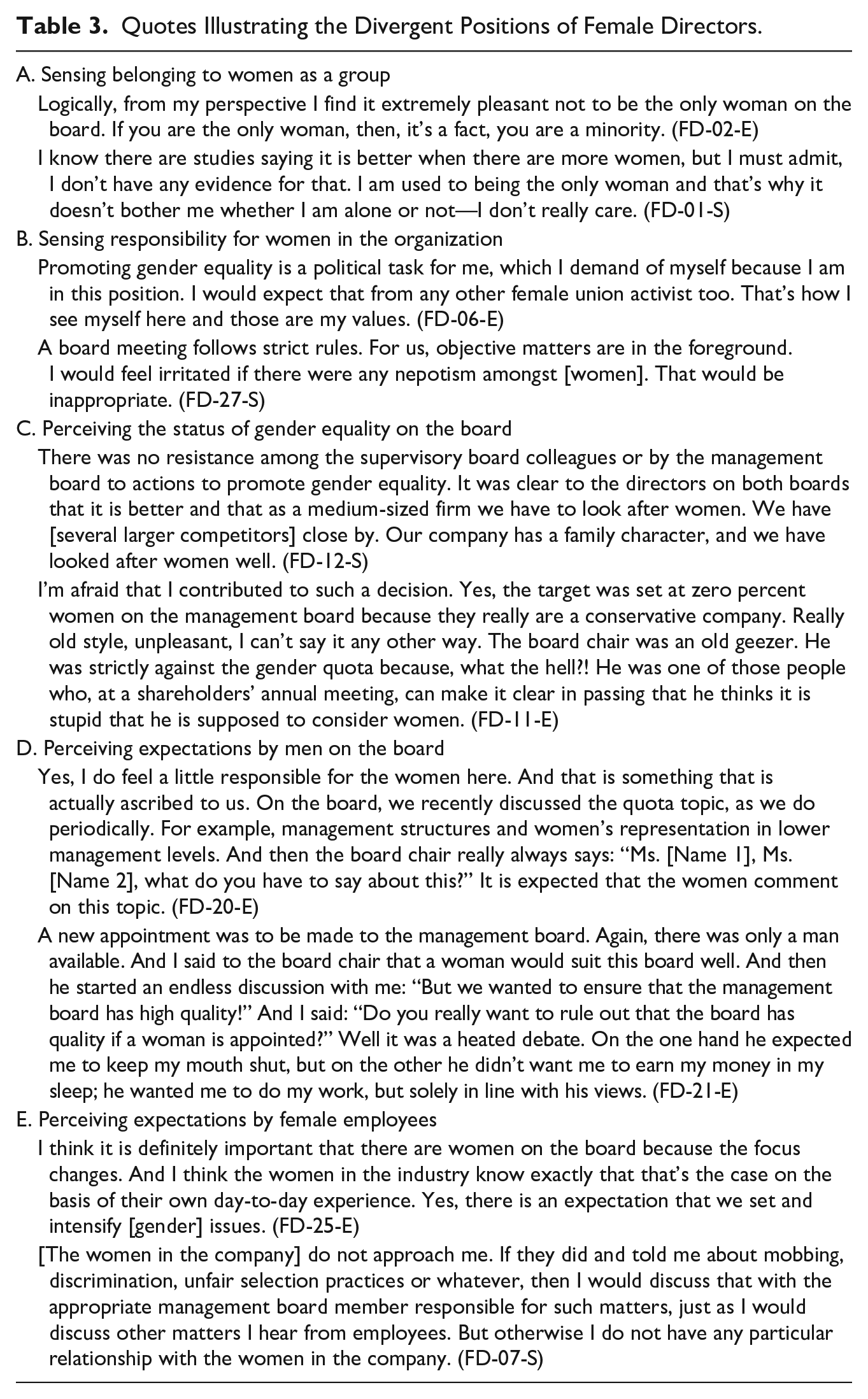
The codes, themes, and theoretical dimensions were assembled into a data structure, which is shown in Figure 1 (Gioia et al., 2013). For each code, two quotes that illustrate the divergent positions of those directors who acted and those who did not are shown in Table 3, and further quotes for each code are in the body of the article. Quotes from female directors are labeled as FD, and from male directors as MD. Employee representatives are labeled E and shareholder representatives are labeled S. The interviews were conducted in German, and I have translated the quotes.
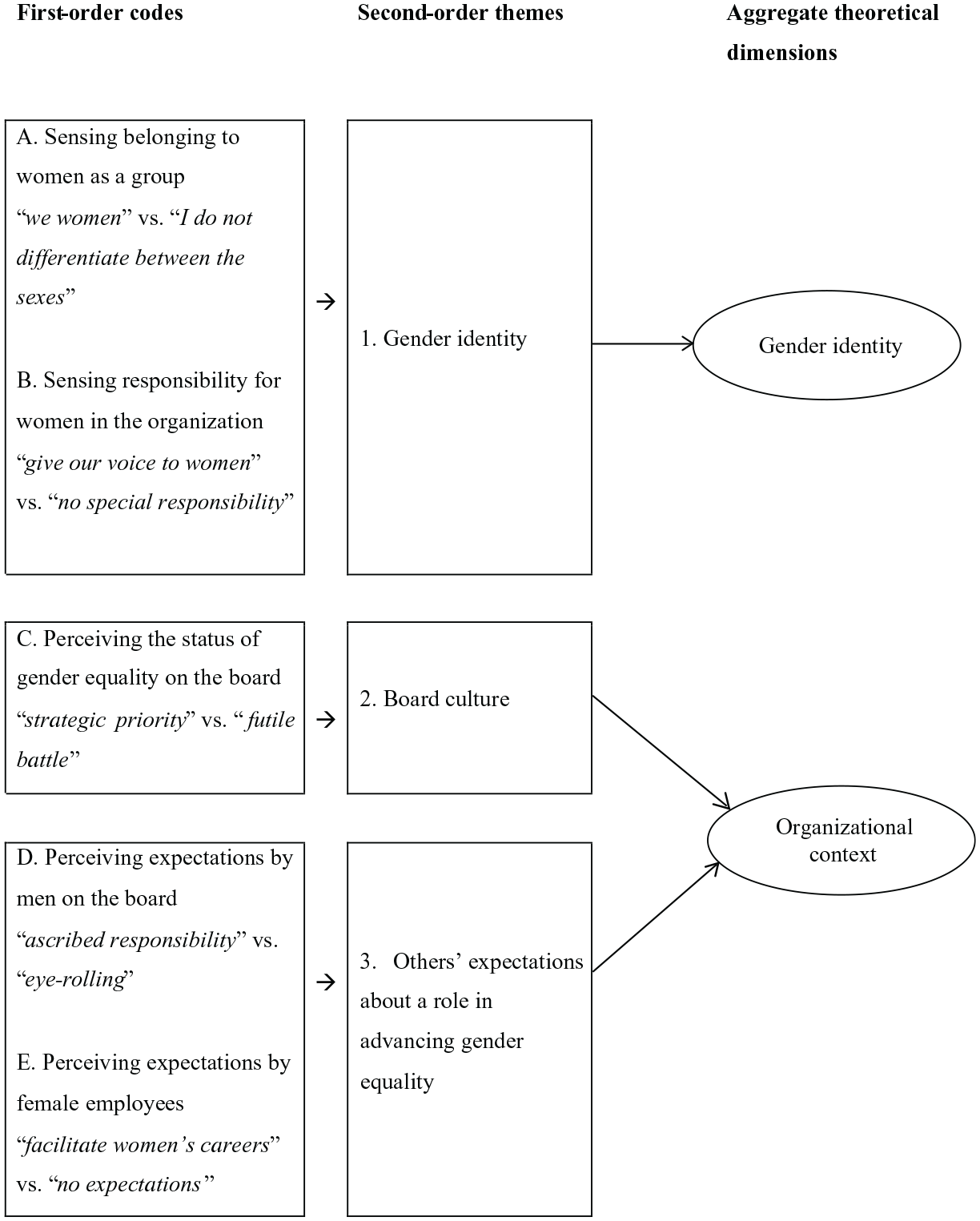
Data structure.
Quotes Illustrating the Divergent Positions of Female Directors.
Findings
Equality-Related Action by Female Directors
About 60% of the women I interviewed reported that they had taken some form of action related to gender equality. They had acted in myriads of ways through formal board processes and outside of them. In board processes, some women influenced director selection by joining nominating committees and seeking female candidates. Others required that the organization’s reports to the board on employee statistics were broken down by gender. They also requested that the organization provide the board with information on how women’s careers are supported and on the company-specific gender pay gap. They critically discussed these data in board meetings. Others again saw to it that the supervisory board set company-specific targets for the representation of women on management boards—although this was required by the quota legislation, many companies did not comply. These women argued for the setting of stretch targets, and against putting the status quo in writing.
The finding that the majority, but by far not all female directors took equality-related action was confirmed through the interviews with male directors. Again, 60% recounted how female directors advocated for gender equality, whereas 40% did not make any such statements. The following episode is an example of women’s advocacy during a board meeting as perceived by a male director: When the [HR director] presented the first draft of his gender and diversity policy [to the supervisory board], all the female directors on the employee representative side declared it absolutely insufficient. And now the female directors who represent the shareholders do that very intensively too. They have spoken out in favor of specific programs, specific courses of action, and for tangible and measurable goals. (MD-06-E)
Furthermore, female directors discussed the underrepresentation of women in management and the merits of the gender quota with male directors and managers outside of board meetings, for example, in breaks and at board dinners and company social events. Others sought to foster relations with women in the organization and exchanged information about gender issues. They heightened their visibility to female employees, underlining their status as role models. They did this by speaking at company events for young leaders or for female managers or by being portrayed in the company newsletter.
Female Directors’ Attributes, Board Composition, and Equality-Related Action
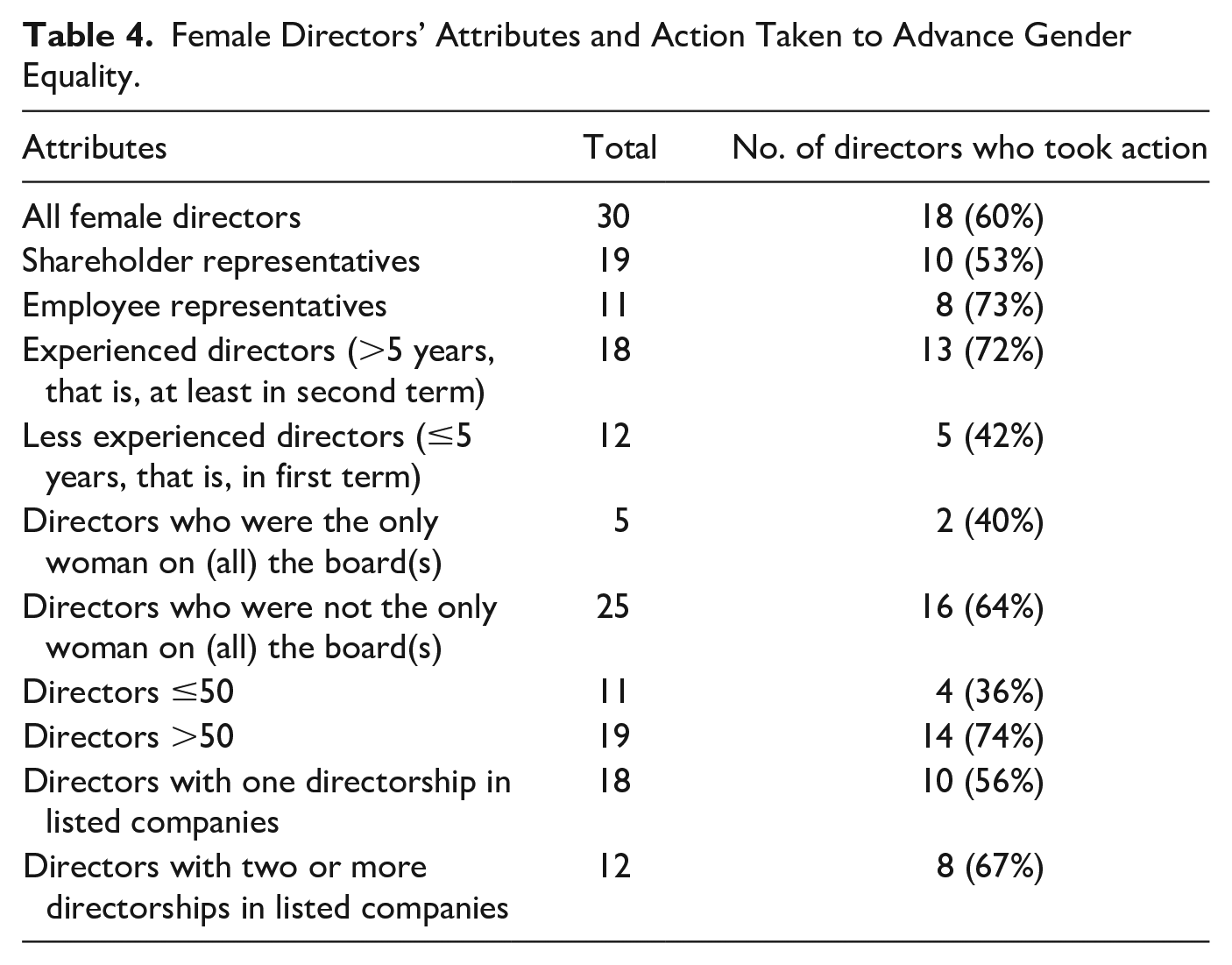
I sought to uncover in what circumstances and why some female directors took such action, whereas others did not. As shown in Table 4, I examined female directors’ age, board experience, whether they held multiple directorships in listed companies, whether they were the only female director on their board(s), and whether they represented employees or shareholders. I found that among the interviewees who were employee representatives, experienced directors, older than 50 years of age, or held multiple directorships, over two thirds had taken some type of action to advance gender equality in their organizations. Among the interviewees who were the only female director on all the boards they served on, who were in their first term, or who were below 50, less than half had taken action. These findings are in line with expectations, but did not fully explain why some female directors took action and others did not. A richer and more encompassing explanation for female directors’ behavior emerged from the interview data. The next sections examine how gender identity and organizational contexts influenced female directors’ equality-related action.
Female Directors’ Attributes and Action Taken to Advance Gender Equality.
Gender Identity
There were great differences in the salience of gender identity among female directors. Some directors did not have a sense of belonging to women as a social group and their gender was not particularly relevant for the way they perceived themselves and their actions as directors. For others, the opposite was true. Some found it important that there were other women on the board besides themselves, but for others, it was entirely irrelevant. For example, one director (FD-26-E) said, “It has no meaning at all [that there are three other women on the board], because I do not differentiate between the sexes.”
When asked about any sense of being connected with the women in the organization, the answers ranged from “not at all” (FD-01-S) to statements underlining a strong connection. For example, another director (FD-13-S) said, “Naturally, as a woman of my age and seniority I always feel a connection to the women in leadership positions.” Many directors expressed some sense of a connection with women in the organization, describing this as having a “good rapport” (FD-25-E), “sensing affection” (FD-06-E), “being allied” with one another (FD-05-S, FD-21-E), or feeling “a sense of solidarity” (FD-18-S), even if they personally knew only very few employees.
A male director’s musings about whether the woman on the board he served on would take equality-related action shows that he thinks her identities as an athlete and as a senior executive would guide her actions more than her gender: On [board] we have [name of female director]. Would SHE raise the gender topic? No. She is a marathon runner, a triathlete. She is the CEO of [company]. She was the chair of the supervisory board of [company]. I believe it would be hard for her to say “we need a non-white person or we need a woman!” Everyone else, including myself, would be more likely to do that than she is. She is so focused on merit and measuring good performance that I would not expect such an initiative from her. (MD-15-S)
Female directors’ sense of responsibility for women in the organization was also divergent. Some of them denied that female directors had any special responsibility for women employees, for example, I am aware that personnel is an important resource and I am happy to deal with it. But I don’t see any special requirement or responsibility for the two women [on the supervisory board, including myself] to attend to this topic in any particular way. (FD-07-S)
By contrast, others clearly viewed this to be the case: Of course it has to be our concern [that women are appointed to the management board]. Because if we don’t do it, who will? If we don’t give our voice to strong women, who will? . . . We have to make a contribution. That’s why I coach women in leadership positions and things like that, you have to do it. (FD-13-S)
In line with social identity theory, I found that a sense of belonging to women as a social group and responsibility for women in the organization was expressed by all female directors who engaged in behavior to advance gender equality. By contrast, none of the nine directors who felt little sense of belonging to or responsibility for women sought to promote gender equality. But some directors did not make any equality-related contributions despite a salient gender identity. As we will see next, this was due to their experiences in a specific organizational context.
Organizational Context
Experiences in the organizational context greatly affected whether directors took action for gender equality. Female directors’ perceptions of the board culture in relation to gender equality and of others’ expectations about their role in advancing gender equality emerged as key factors.
Board culture
Female directors made different assessments of the board culture in relation to gender equality. Some directors said that making contributions related to equality goals was “socially acceptable” (FD-08-E) and that they perceived no resistance from male directors for their contributions. They related how the board as a whole and the chair in particular were committed to gender equality. For example, The other female employee representative and I have a diversity management background, but we don’t need to fight hard for these issues to be included in the meeting agenda because our HR Director sees diversity as a strategic priority. We don’t sit there [in the board meetings] thinking “all these ignorant people around us have no idea how important diversity is for the company, and we have to keep putting it on the agenda and explain how important it is.” That’s not necessary because the HR Director, some other executive directors and the supervisory board chair are all in agreement with us. The other shareholder representatives, sometimes I have the impression they think “why this topic again?” but it is seen as an important topic by the key decision makers, so it’s no problem to put it on the agenda and make progress. (FD-08-E)
The key role of the board chair in fostering a culture that values gender equality is highlighted by a male board chair: Any board member can have an interest in an issue, including the issue of interest in this interview, women and men . . . Then it is up to me as the board chair to take it up. What do I instruct the company to do? Who do I summon from the company [to the board meeting]? I can launch a small inquiry or a large inquiry, I can invite a consultant. The board chair decides whether an issue becomes active and dynamic. (MD-28-S)
In other cases, female directors labeled the board’s consideration of gender equality issues as “pseudo” discussions (FD-24-S) without material consequences. They perceived the organization, and often particularly the board, to be a men’s world where change was not likely to happen. A male director remembered an extreme example of such a board culture that had existed during the tenure of the previous CEO. He recounted that neither men nor women promoted gender equality during that time: The CEO was a misogynist. He didn’t make a secret of it. You can read about it in the newspaper . . . He was patriarchal . . . He attended the supervisory board meetings and he dominated them. He didn’t really care what the board decided, he did his thing . . . Board members [did not take action for gender equality], we kept our mouths shut. Because he personally held things against you, and he was well connected. (MD-08-S)
Several directors recounted their experiences in meetings where the supervisory board formulated its target for the representation of women on the management board, as required by the new legislation. The lowest allowable target is the status quo of women’s representation, which for many management boards amounts to zero. By and by, as companies have reported their targets, it has emerged that many supervisory boards have set the target for women’s representation on their management boards at 0%. One director, drawing on her experience on three supervisory boards, had the following perception of board discussions regarding targets for the representation of women on the management board: They set themselves a target of zero women on the management board with the reasoning “well, we only have four management board members and then one of them would have to be a woman, that won’t work, we can’t organize that.” Then they die laughing internally or out loud. (FD-26-E)
She thought any efforts on her part to improve gender equality in those organizations would be pointless, saying, “it depends on my mood on the day whether I feel like expending my efforts on this futile battle.” A second director remembered heated debates about target-setting: We had very fierce discussions on the supervisory board about how to implement the new regulations [regarding setting firm-specific targets for the representation of women on the management board]. I have never experienced such discussions on this supervisory board before, hugely conflictual, . . . absolutely unbelievable. It was not possible to discuss how to change the gender composition of the management board over time in a dispassionate and reasonable way. (FD-25-E)
A third director, who felt strongly that she should support gender equality in the organization, described herself as too “cowardly” to speak up: [The setting of targets for women’s representation on the management board] is always a tiresome discussion. One promises to reach a status quo of zero percent . . . I must admit, I always go along with that. I am not the one to say “no, I don’t approve” . . . I must admit, as a young woman who is new to the board I am cowardly and keep my mouth shut and think “let it pass,” because I am just here due to the quota. In that situation, you feel totally uneasy. I clearly see this as our [women’s] role, but I personally don’t fulfil it yet. (FD-24-S)
Indeed, several women mentioned that courage and confidence were required to make equality-related contributions. For example, one director said, I think it is up to the women to put [gender equality] issues on the agenda. To have the courage to open their mouths and express themselves. Sometimes it is really hard because you get rejected. They can really spurn you. (FD-16-E)
Besides their perception of the board culture as supportive or unsupportive of gender equality, female directors were aware of expectations that organizational members held of them. This issue is examined next.
Others’ expectations about a role in advancing gender equality
Female directors noticed whether others expected them to promote gender equality in the organization or not, and whether positive or negative connotations were attached to such expectations. Some female directors experienced the expectation from men, and in particular the board chair, that they should take responsibility for gender issues and for personnel issues more generally because they were assumed either to naturally be experts or to have a particular interest in or affinity to the topic. One director explained that “women are always expected to deal with personnel matters” (FD-13-S) and another recounted how her appointment to the nominating committee was not her own initiative: I noticed right away that expectations are held of me. For example, I was appointed to the nominating committee because somebody said: We need a woman in there, they are better at personnel issues. (FD-05-S)
This perception was confirmed by several of the men I interviewed. They emphasized that female directors were responsible for gender issues on their boards. For example, a director who strongly supported gender equality said: If you consider that everyone has their role on the board, then women absolutely fulfil their roles, I think, especially those who have recently joined. Including their role as WOMEN. I think that it is EXPECTED of them to attend to this [gender] topic, that’s how I perceive it. Not in the sense that one rolls one’s eyes as if to say “sure, she is a woman so now she’s saying something about women,” but rather coming from her role as a woman who has made her way to get where she is. (MD-24-S)
Another director who had expressed his disinterest in gender issues also held this—albeit less enthusiastic—expectation of female directors: When you are on a board for so long, then there are certain structures. And when there are things that MUST be discussed on the board [such as gender issues], then there is one person who HAS THE FLOOR. And the others know, “oh well, it is necessary” and then after a short time the topic is over and done with. Just like in a family or a circle of friends, there are structures and everyone knows who is required to tackle which issue and who is less interested. (MD-26-S)
On some boards, female directors experienced men rolling their eyes when they raised gender issues or were actively discouraged from doing so by the board chair. There, the expectation was that they refrain from raising gender issues, as shown in the following example: There is a certain baseline expectation that, with a rolling of the eyes, goes like this: “Yeah, yeah, there come the usual remarks.” That bothers me of course, because I am not a fundamentally feminist woman at all, but there are topics [women in leadership positions and equal opportunity policies] that are on the agenda for objective and factual reasons. And because men evidently table them rarely, we have to do it. (FD-25-E)
In addition, some directors felt that the women in the organization expected them to promote gender equality. They spoke of how female employees approached them to congratulate them on their board position, to express their encouragement, and to establish a personal rapport, in the expectation “that we further their careers” (FD-05-S). They felt that women in the organization expected that through their presence “careers would become easier for women” (FD-06-E) and that they would “rap the management board’s knuckles to remind it of its responsibility to achieve gender parity” (FD-14-E). Other directors did not perceive these kinds of expectations at all.
Ten directors with a salient gender identity experienced an organizational context in which they felt that equality-related contributions on their part were welcomed or even expected. They all engaged in behavior to advance gender equality. However, eight took action despite an unsupportive organizational context, whereas three did not. In seeking to understand why some women did so, I returned to the documentary data to examine differences in board composition and director attributes.
Female Directors’ Attributes and Board Composition in an Unsupportive Organizational Context
In seeking to determine what distinguishes those directors who took action despite an unsupportive organizational context from those who did not, I returned to the differences in director attributes and board composition. It emerged that those directors who took action in an unsupportive context had extensive board experience, whereas those who took no action were in their first term as directors and served on boards where they were much younger than the men. Other attributes did not differ across the two groups of directors: Both groups included shareholder representatives and employee representatives.
The age difference in comparison with men on the board, who oftentimes were in their seventies, contributed to a feeling of not being valued and respected. One director (FD-24-S) said, “I feel uneasy sometimes because initially of course I am denied authority.” She described herself as a “trainee” and a “junior partner,” and said she did not have enough “experience.” Another young director did not engage in equality-related action because she feared being associated with gender topics. She said: “Personally, I am rather cautious, because I think it is tricky. Women are quickly reduced to stand for the gender topics. So frankly, that’s why it’s not the key issue that I would champion” (FD-11-E).
A third director said she felt “patted on the head” and “treated like a little girl” when she contributed to board discussions (FD-19-S). She and the other two women on the board were “newcomers.” whereas the men had been working together for over 25 years.
Arguments that a critical mass of female directors in the composition of the board is necessary for women to take action were not confirmed in this analysis. The three directors who did not take action were not the only woman on their boards, and they experienced their interaction with the other female directors as positive. For example, the director who felt treated like a little girl spoke of the marginalization of all three female directors on her board: “They don’t trust in our abilities. All three of us feel the same. [One of the other female directors] is a real power-woman. She recently said to me: ‘I always feel as if I don’t really count around here’” (FD-19-S).
Being one of several women did not allow these women to take equality-related action as an inexperienced director in an unsupportive organizational context.
Summary
Overall, I discerned four groups of directors, two of whom took equality-related action and two who did not. The first group consisted of nine directors (FD-01-S, FD-07-S, FD-09-S, FD-10-S, FD-15-S, FD-17-E, FD-22-S, FD-26-E, FD-27-S) for whom gender was not a salient aspect of their identities. Their belonging to women as a social group had little meaning for them in their role as directors, and they did not report any sense of responsibility for women in the organization. They did not engage in behavior to advance gender equality.
The second group was made up of 10 directors (FD-02-E, FD-04-S, FD-05-S, FD-06-E, FD-08-E, FD-12-S, FD-23-S, FD-28-S, FD-29-S, FD-30-S) who had a pronounced sense of belonging to women as a group and a sense of responsibility for women in the organization. In addition, these directors experienced an organizational context in which they felt that equality-related contributions on their part were welcomed or even expected. These directors engaged in behavior to advance gender equality.
The third group comprised eight directors (FD-03-S, FD-13-S, FD-14-E, FD-16-E, FD-18-S, FD-20-E, FD-21-E, FD-25-E) who also expressed a strong sense of belonging to women as a group and a sense of responsibility for women in the organization. They differed from the second group in that they did not experience an organizational context supportive of equality-related action. Nevertheless, as these directors had extensive experience on boards, they were committed to change and engaged in action despite the lack of organizational support.
The fourth group consisted of three directors (FD-11-E, FD-19-S, FD-24-S) for whom their gender identity was very salient. However, their perception of an organizational context hostile to gender equality in combination with their inexperience (all were in their first term as directors) and their encounters of marginalization on the board suppressed any actions in relation to gender equality on their part.
Discussion
Contributions to Research
Quantitative research has detected a link between gender diversity on boards and gender equality outcomes in organizations (Cook & Glass, 2015; Gould et al., 2018; Matsa & Miller, 2011; Skaggs et al., 2012). However, it has assumed, rather than shown, that female directors play an active role in this process. My empirical motivation was to show when and why female directors contribute to greater gender equality in organizations by interviewing male and female directors. I found that not all female directors act for women in all situations. Those who take equality-related action do so in myriads of ways, both through formal board processes and informally. For example, female directors who joined nominating committees influenced director selection by searching for female candidates. Informally, they generated awareness for gender equality issues among male directors and were role models for women in their organizations.
The study contributes to social identity theory by showing how social identity affects action in the upper echelons of organizations. It demonstrates that phenomena foretold by social identity theory—identification with men as the dominant group on boards and self-group distancing behavior (Chattopadhyay et al., 2004; Derks et al., 2016)—exist among female directors, but that they are not ubiquitous. Many female directors self-identified with women as their in-group. This was the basic condition for all female directors who took action to promote gender equality in their organization. However, it was not a sufficient condition for such action. If the organizational context was perceived as unsupportive, female directors only took action if they were experienced directors. The findings show that only if a board culture was supportive of gender equality and organizational members expected female directors to advance gender equality did inexperienced directors take action. The presence of other women on the board, however, did not appear to affect whether or not female directors took equality-related action.
These findings can inform corporate governance research on the effects of board gender composition on organizational outcomes more generally. It is difficult to link the characteristics of directors to organizational outcomes (Adams et al., 2010), yet many studies assume that female directors will affect organizational outcomes such as financial and social performance in gender stereotypical ways by making risk averse, ethical, and stakeholder-oriented contributions (Kirsch, 2018). By highlighting the variability in female directors’ behavior, this study suggests that when analyzing board composition in search of an explanation for organizational outcomes, scholars should seek to capture constructs such as risk aversion without using gender as a proxy (Priem et al., 1999). Furthermore, this study shows that board culture and expectations concerning directors’ roles can affect the relationship between board composition and organizational outcomes.
Extending these findings to social groups in organizations more generally, the analysis suggests that the interplay of identity based on membership in a social category such as gender, class or race, and organizational context affects when and why people take action aimed at alleviating different types of social inequality in organizations. Not only do identities and organizational context combine to affect people’s actions, but also, as developments in social identity theory emphasize, the relative salience of different social identities varies for individuals across different organizational contexts (Ashforth & Johnson, 2001). Such insights into identity mechanisms are highly relevant for advancing our understanding of how social equality can progress in organizations.
Limitations and Future Research Directions
Three limitations of this study offer starting points for future research. First, this study relied on female directors’ own accounts of their behavior to advance gender equality. While male directors’ accounts corroborated that many female directors take action to promote gender equality in organizations, ethnographic work—especially participant observation—is needed to overcome the limitations of interview data. Although participation in board meetings is rarely possible, ethnographic work at the managerial level of an organization can illuminate how female managers perceive the actions of female directors in relation to gender equality. Such an approach can show in what circumstances female managers are aware of female directors’ actions and whether there is a symbolic effect, whereby female managers view female directors as role models (Adamson & Kelan, 2019; Gibson & Lawrence, 2010; Sealy & Singh, 2010).
Second, this study did not examine contributions to gender equality made by male directors. The notion that identity affects whether a person chooses to act on gender equality issues in organizations suggests expanding our view of directors’ contributions to gender equality to include both women and men. I venture that, in making equality-related contributions, male directors will similarly observe how contributions to gender equality are taken up in their organization. They differ from female directors in that they belong to the dominant social group on boards and their awareness of themselves as gendered subjects is likely to be lower (Whitehead, 2014). Furthermore, because they do not take action for gender equality on behalf of their own social group, they cannot be seen as self-serving, and the reactions they receive from others may differ (de Vries, 2015).
Third, each director was interviewed only once, and therefore, I could not observe identity work processes (Caza et al., 2018). Yet, in line with theorizing about women’s perceptions of gender inequality and the salience of their gender identity (Schmitt et al., 2003), interviewees indicated that their gendered experiences on boards and in organizations not only affected their propensity to take action for gender equality but also influenced the salience of their gender identities. For example, one director said, “I became a feminist after joining [this organization]. I wasn’t before, because I didn’t believe gender inequality was still an issue” (FD-14-E). Greater insights into female directors’ identity work would require interviewing them on several occasions over time.
Practical Insights
For organizations intending to improve gender equality in their workforce by appointing women to their board, this research highlights that a trickle-down effect can be strengthened through a favorable organizational environment in which equality-related actions by female directors are welcomed and expected. Hence, in recruiting female directors, selectors can communicate an expectation that they concern themselves with gender equality in the organization. Organizational actors seeking to leverage the presence of female directors to augment gender equality within their organization can seek to make the organizational context more favorable for female directors to take action, for example, by communicating expectations that directors attend to gender equality. Finally, this research contributes to the policy debate about the value of regulatory interventions to increase women’s representation in economic decision-making positions. It shows that a trickle-down effect is possible and uncovers the contingencies associated with that process.
Conclusion
This study explores how gender equality can spread throughout organizations from the top down. It theorizes that whether gender diversity on boards trickles down the organizational hierarchy to create greater gender equality within organizations is contingent on female directors’ actions. Their gender identities, a board culture supportive of gender equality, and positive expectations by other organizational members about their role in advancing gender equality affect whether or not female directors engage in behavior aimed toward the advancement of gender equality in their organizations. This study extends work on the effect of board gender composition on organizational outcomes by highlighting both the variability of female directors’ contributions to boards and the relevance of identity and organizational context.
Footnotes
Declaration of Conflicting Interests
The author declared no potential conflicts of interest with respect to the research, authorship, and/or publication of this article.
Funding
The authors disclosed receipt of the following financial support for the research, authorship, and/or publication of this article: The research leading to these results was funded by the European Union’s Seventh Framework Programme (FP7/2007-2013) under grant agreement no. 303571 and by the Margherita von Brentano Center of the Freie Universität Berlin.
