



Abstract
Local actors can defend public value by mobilizing resistance coalitions against threats from higher spatial scales. Drawing on existing scholarship on resistance movements and public value creation, this paper proposes a theoretical framework for understanding how local actors can protect public value from threats of rescaling driven solely by hegemonic discourses and presents a strategy that we call “playing the scales.” Our case study analyzes a Local Action Group’s resistance to a state-imposed and EU-framed regulation that threatened local forms of value creation on the Croatian peninsula of Pelješac. Employing a longitudinal participatory approach, our findings outline the strategy of playing the scales, which involved three key tactics: gathering relevant knowledge from various scales; crafting an alternative narrative; and leveraging this narrative across scales to reshape the dominant organizational logic. The study contributes to the understanding of public value creation by showing how it can be defended by resistance coalitions that are capable of playing the scales. It also sheds light on alternative dynamics of rescaling that, rather than oppositional resistance to higher scales or attempts to scale up micro-practices can also be driven by trans-scalar alliances that inscribe the interests of local communities into dominant discourses.
Keywords
Introduction
Ana has spent years preparing to apply for Measure 6 of the European Union (EU) Rural Development Programme. This subsidy would allow her to purchase adjacent land for cultivating olive trees, medicinal herbs, and establishing beehives. The investment would provide a stable income despite fluctuating yields and protect her property from forest fire risks on the surrounding abandoned agricultural land. Unfortunately, when Ana is ready to submit her application, the national government changes the rules, preventing her from proceeding. Frustrated, she reaches out to various politicians, accusing them of discrimination against the Pelješac peninsula. To her dismay, they all explain that it is the EU, not local politics, that dictates these rules, leaving Ana feeling furious, powerless, and broke. She turns to a Local Action Group as her last resort.
Local Action Groups (henceforth, LAGs) are public multi-stakeholder organizations regulated by the national state, funded by the EU LEADER (Links Between Actions for the Development of the Rural Economy) program. They have been deployed as part of a broader Europeanization process throughout the EU. Given that LAGs are EU organizations embedded locally, Ana feels that they should be able to do something. Although LAGs have been viewed as a “top-down process of EU policy downloading by Member States” (Bache, 2008 in Augustyn and Nemes, 2014: 114), in many places they have also been repurposed by local actors. They represent a multi-actor and a multi-level setting where, arguably, public value can be created and protected by linking actors from different levels of government to work on the development of the territory.
Meynhardt (2021) argues that while we can link the concept of public value to attitudes and behaviors of people, the process of creating value is not knowable; ultimately, he urges us not to unconditionally embrace socio-technological processes at the expense of what public value is about: “flourish[ing] in community” (ibid. p. 1640). We build on this inspiration to highlight that public value creation is a collective process, and while the role of public managers in creating public value has been extensively researched (Andrews, 2019; Hartley et al., 2017; Parker et al., 2023), the role of other actors working together to create public value remains underexplored. In particular, while public value can be seen as the result of co-creation and collaboration across sectors and different stakeholders (Sancino et al., 2018, 2023), we turn our attention here to local actors who defend public value creation against threats unfolding from higher scales.
We draw on Jessop et al. (2008) who see scale as a principle of socio-spatial structuration that involves understanding how social processes and interactions operate from the local to the global. Scale is thus an important dimension of socio-spatial relations, and refers to the spatial levels at which social relations and phenomena occur. It is important to recognize that scale is not the only dimension of sociospatial relations—which may also involve concepts of place, territory, or space—, but it remains significant to understand the connections and interactions between different scales. Scale is not just a fixed attribute, but rather a dynamic process that involves connections and interactions between different scales (Chatterjee et al., 2022) whereby moving between scales can have important implications for understanding sociospatial relations.
In organization studies, the process of “rescaling” has helped to explain, for example, how organizational logics are repositioned on lower spatial scales and articulated with shifting patterns of accumulation that trigger their resistance through contestation (Spicer, 2006). In contrast, from a bottom-up perspective, Tello-Rozas et al. (2015) show how micro-practices can be scaled up to refine social movement agendas and achieve more purposeful collective action. Thus, these and other similar studies focus on the effects that one scale has on another. In this paper, we explore how a local coalition defended public value creation against encroaching threats from larger scales. Rather than seeing oppositional resistance as a challenge to higher scales or an attempt to scale up micro-practices, we argue that they “play the scales,” using national and European policies and discourses for the benefit of the local. Hence, this is a trans-scalar approach.
To explain the resulting alliance, we also draw on the literature on resistance movements, with a particular interest in resistance to and negotiation with the state (Banerjee, 2018; Banerjee et al., 2023; Leglise, 2021; Vitel et al., 2015), to explore how local public value creation can be preserved. While local coalitions operate within a specific territory, they may transcend territorial locality to influence regional, national, or global spaces (see Banerjee, 2018). They arguably build a governance to underpin new sources of agency for communities when choosing not to accept the hegemonic model unfolding from international and national scales and, hence, defend the public value creation enacted at the local scale. This perspective allows us to theorize the strategic action that local actors engage in across spatial scales in order to protect local public value, answering the question: how do actors mobilize to defend local processes of public value creation against rescaling driven by hegemonic discourses?
Drawing on a longitudinal participatory approach focused on a LAG based in the Croatian peninsula of Pelješac, this article makes two contributions. First, it introduces a particular kind of rescaling that does not involve only opposing resistance or scaling up, but rather a trans-scalar action that we called “playing the scales.” We show this by demonstrating the three tactics mobilized: (i) gathering relevant knowledge from various scales; (ii) crafting an alternative narrative; and (iii) leveraging this narrative across scales to reshape the dominant organizational logic. Second, it advances our understanding of public value creation by showing how it can be threatened and defended by resistance coalitions that operate across scales. To make our case, we proceed as follows. In the next section, we conduct a literature review on Local Action Groups and the role of actors in creating public value at the local level. We then introduce a theoretical framework derived from resistance literature, which illustrates how agency can be expressed through local coalitions operating at different scales. This is followed by a description of our methodology and a presentation of the findings of the study, which are divided into three main phases. Lastly, we discuss the implications of our findings for the spatial aspects of scaling and their impact on the understanding of public value creation.
Rescaling initiatives and their limits for public value creation
The public sector engages in various types of cross-sector collaborations aimed at promoting a more deliberative co-construction of public value (Sancino et al., 2023). However, these collaborations may remain framed within pre-existing structures that prevent the public sector from effectively and democratically governing the ways in which public value is created (Sancino et al., 2018). In effect, the organizations involved in such initiatives of collaboration aim not necessarily to dismantle these structures, but to force the state to consider and socialize the micro-level interests in public value creation (Meynhardt, 2021). In the context of Europeanization, this is achieved through programs that connect ‘“policy downloading” (Bache et al., 2011) with the interests of local actors. One such example are the aforementioned LAGs, which are multi-stakeholder initiatives funded by the EU. They are multi-stakeholder because they have been set up primarily as local partnerships that gather local actors from various organizations in the public and private sectors (Bosworth et al., 2016). LAGs aim to create networks and develop strategies based on collaboration, co-partnerships, and stakeholder consultation with actors on their local scale.
Two main critiques of LAGs’ work exist in the literature. First, the formation of LAGs has been shown to promote a new political elite without a political mandate and has shifted the pre-established power relations between the state and individuals (Chrobot, 2012; Lukić and Obad, 2016). Participation tends to be monopolized by consultancy offices, development agencies (Maurel, 2008), or LAG managers (Augustyn and Nemes, 2014; Kovách, 2000), and these actors endorse changes that neglect local complexities. Second, LAGs face increasing difficulties in identifying local needs and opportunities (Marquardt et al., 2010). Research has revealed that the participation and engagement of local actors has often only occurred in “invited spaces of rural governance, defined and conceptualized by the state and into which communities are invited” (Shucksmith, 2012: 15). The involvement of local actors thus tends to be framed within the hegemonic discourse of Europeanization and state regulation, which creates challenges for the participation of local actors (Dargan and Shucksmith, 2008).
Therefore, from a public value perspective, LAGs have found it difficult to implement their participatory approach to public value creation in local communities. However, existing research is highly focused on the local scale, so we know little about the dynamics of the challenges imposed on LAGs in dealing with external threats across scales. Such limitations prompt a deeper examination of how local actors can benefit from the trans-scalar features of such multi-stakeholder initiatives. LAGs are trans-scalar entities, not just because they are local groups interacting with national state bureaucrats (who regulate them) and with the larger European framework consisting of national and EU organizations that support the program (Zajda et al., 2017). They are trans-scalar in the way they navigate across scales, which has theoretical implications for how scale is mobilized.
The initial theoretical developments on the concept of “scale” in human geography have shifted its conceptualization from a level of representation to a relational view. Consequently, the production of scale is viewed as a social constructionist approach, wherein the state, capital, labor and non-state political actors assume critical roles in the complex processes of social reproduction and consumption (Marston, 2000). However, as Brenner (2001) points out, the social constructionist view of scale has led to the concept of geographical scale being conflated without proper reflection with other core geographical concepts such as place, locality, territory and space—for a more systematic assimilation of this multidimensional character of socio-spatial relations, see Jessop et al. (2008). Mindful of other intertwined spatial imaginaries but focusing on one of these dimensions, we draw on Jessop et al. (2008) defining scale as a principle of sociospatial structuration. This involves understanding how social processes and interactions operate from the local to the global level while also being attentive to other sociospatial dimensions, such as the interconnectivity and interdependence of built networks.
In Organization Studies, the common view of spatial scales is that they are socially produced through a process of rescaling that mediates changes in patterns of capital accumulation, regulation and mobilization of discourses (Spicer, 2006). For instance, the state role in allocating EU subsidies for regional and agricultural development can be seen as an EU imposition onto the state scale, since the EU demands the integration of its policies into state regulations and frames the conditions for access to subsidies (Steurer, 2010). Consequently, the national discourse transforms to a more Europeanized one (Maleković et al., 2011). The rescaling of this policy further cascades down to local actors when EU policies and rules are implemented. In our case, LAGs would emerge as new territorial organizations for rural development that utilize EU funding and are established in compliance with EU regulations, thus constrained by them. Nonetheless, we are particularly interested in the movements of resistance to this top-down rescaling that reconfigures the process of public value creation. We therefore propose a framework for examining the trans-scalar alliances that emerge from this resistance.
The response to rescaling by resistance coalitions
Despite the prevailing perspective on value that focuses on the utility of economic individualism, there is a substantial critique in the literature that emphasizes how public value is achieved collectively (Bozeman, 2007). In this regard, governments do not create public value “but [it is] determined by citizens' preferences, expressed by a variety of means and retracted through the decisions of elected politicians” (Mazzucato and Ryan-Collins, 2019: 5). This growing awareness also reveals that public value creation is characterized by unequal power relations and can be the product of struggle. As such, the literature on resistance movements offers insights into the importance of the coalitions of local actors who reposition their claims across dominant discourses (Banerjee, 2018; Leglise, 2021; Spicer and Sewell, 2010).
For example, a translocal governance framework that connects different sites can provide an alternative view of stakeholders who are affected by corporate extractive projects that seek to make them invisible (Banerjee, 2018; Banerjee et al., 2023). Therefore, it is important to examine the potential of strategic actions of actors intervening concertedly on broader scales through ad-hoc alliances. Creating alliances allows local actors to reposition their claims within the dominant discourse on broader scales (Leglise, 2021), provides local actors with the knowledge they need to fund their projects (Vitel et al., 2015), and can help indigenous communities to understand the impacts of new extractive projects and strengthen the legitimacy of their concerns (Ehrnström-Fuentes, 2022).
These alliances can be contextualized as the resistance of local actors to top-down rescaling processes, which render organizations embedded in overlapping organizational logics. Organizational logics refer to the interpretive frameworks that shape individuals’ understandings of what is considered legitimate or reasonable, encompassing both the symbolic systems that inform cognition and the enacted material practices (cf. Spicer, 2006; Spicer and Sewell, 2010). Logics can be appropriated in different ways depending on the interests of actors, for example by being manipulated or adopted by actors from different scales. This can be a top-down movement, such as the rescaling from the European to the national and local scales, as well as being part of political resistance from the local actors.
The adoption of logics in the literature helped to unpack the process of rescaling, which Spicer (2006) argues “occurs through articulating an organizational logic with shifting patterns of accumulation or flows of funding, linking a logic into different regimes of regulation and mobilizing new spatial discourses.” (Spicer, 2006: 1476). From this perspective, globalization would involve a complex transformation of organizational logics that can be resisted by local actors challenging its discourses (Spicer and Fleming, 2007). Accordingly, the resistance of local actors to hegemony has been described as reconfiguring organizational logics (Ashraf and Uddin, 2015; Spicer and Sewell, 2010). However, we still know little about the strategic and tactical moves behind rescaling that enable them to embed their interests within higher scales to create public value. More specifically, while it has been established that “rescaling involves ongoing political conflict” (Spicer, 2006: 1477) and that weaker actors can “sometimes outmaneuver their rivals with clever strategy, good timing, and some luck” (Levy and Egan, 2003: 813), how this “clever strategy” emerges across scales is particularly important for locating public value creation.
We therefore propose to illuminate the appropriation of rescaling by political resistance when acting concertedly on the various scales involved in policy making and implementation, with the objective of defending public value creation from the threat of rescaling driven by hegemonic interests and discourses. We call this strategic move “playing the scales” and as represented in Figure 1, we will analyze in this paper the tactics mobilized by a trans-scalar alliance that shares knowledge across scales to enable negotiation and deploy change. Following Mithani and O’Brien’s (2021) denomination, we suggest that this mobilization is initiated with a local coalition (overlapping goals, ad hoc communications, and tactical-political approach) and unfolds into an alliance (shared goals, periodic communication, and operational political approach).
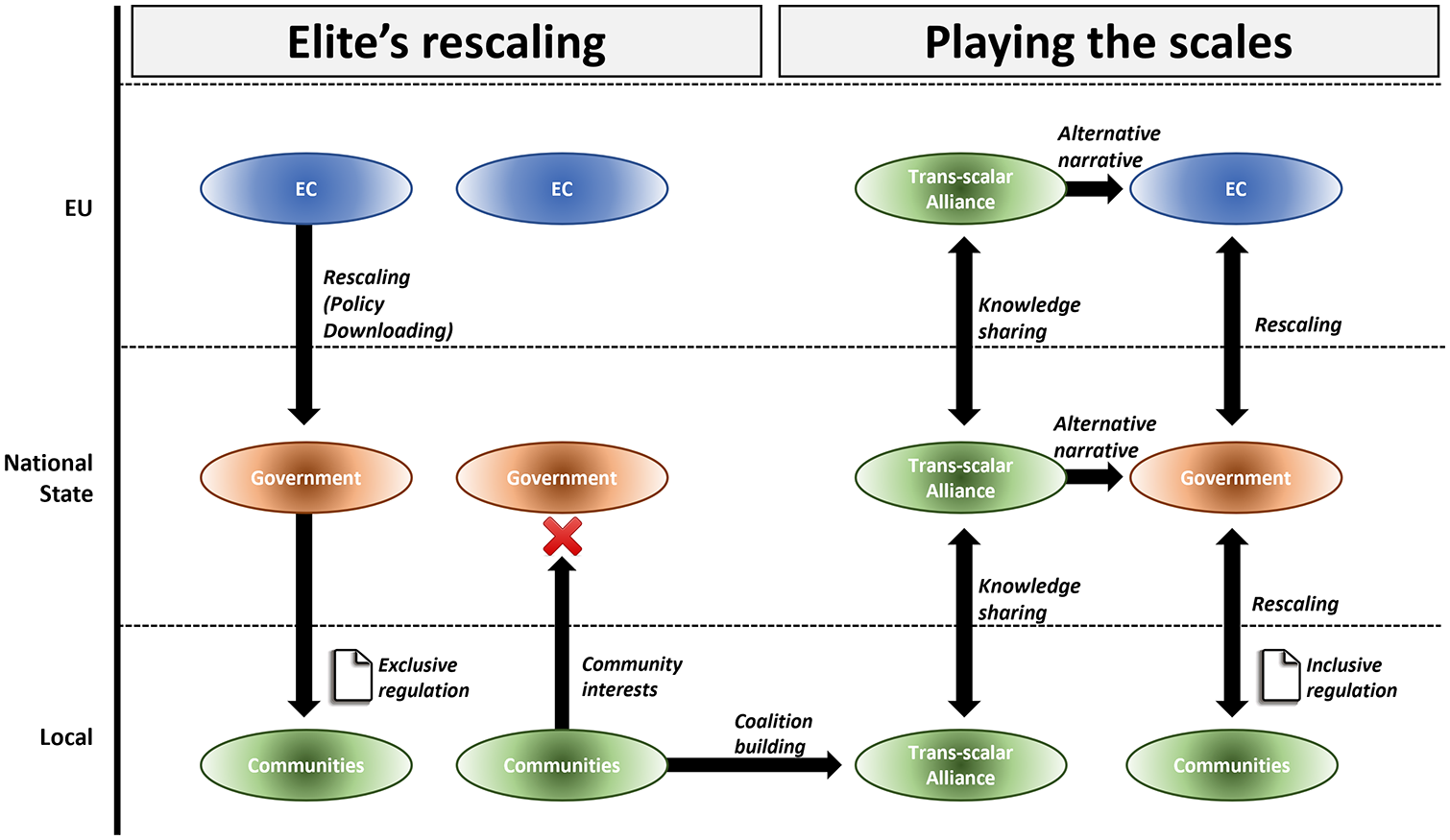
The playing the scales framework.
Methods and data context
We have employed in our research a lived experience case study (Honey et al., 2020; Pitard, 2017; Yin, 2003). We now present how the case was chosen, its political context, and the procedures for data collection and analysis.
Case selection: The LEADER initiative on the Pelješac peninsula
Our study focuses on an initiative that developed around a LAG (named LAG 5) established on the Croatian peninsula of Pelješac. LAG 5 aimed to “build a community with a competitive economy, high quality of life and preserved natural and cultural heritage that directs its development toward a sustainable future” (L-MEMO4:6) (see the covered territory in Figure 2).
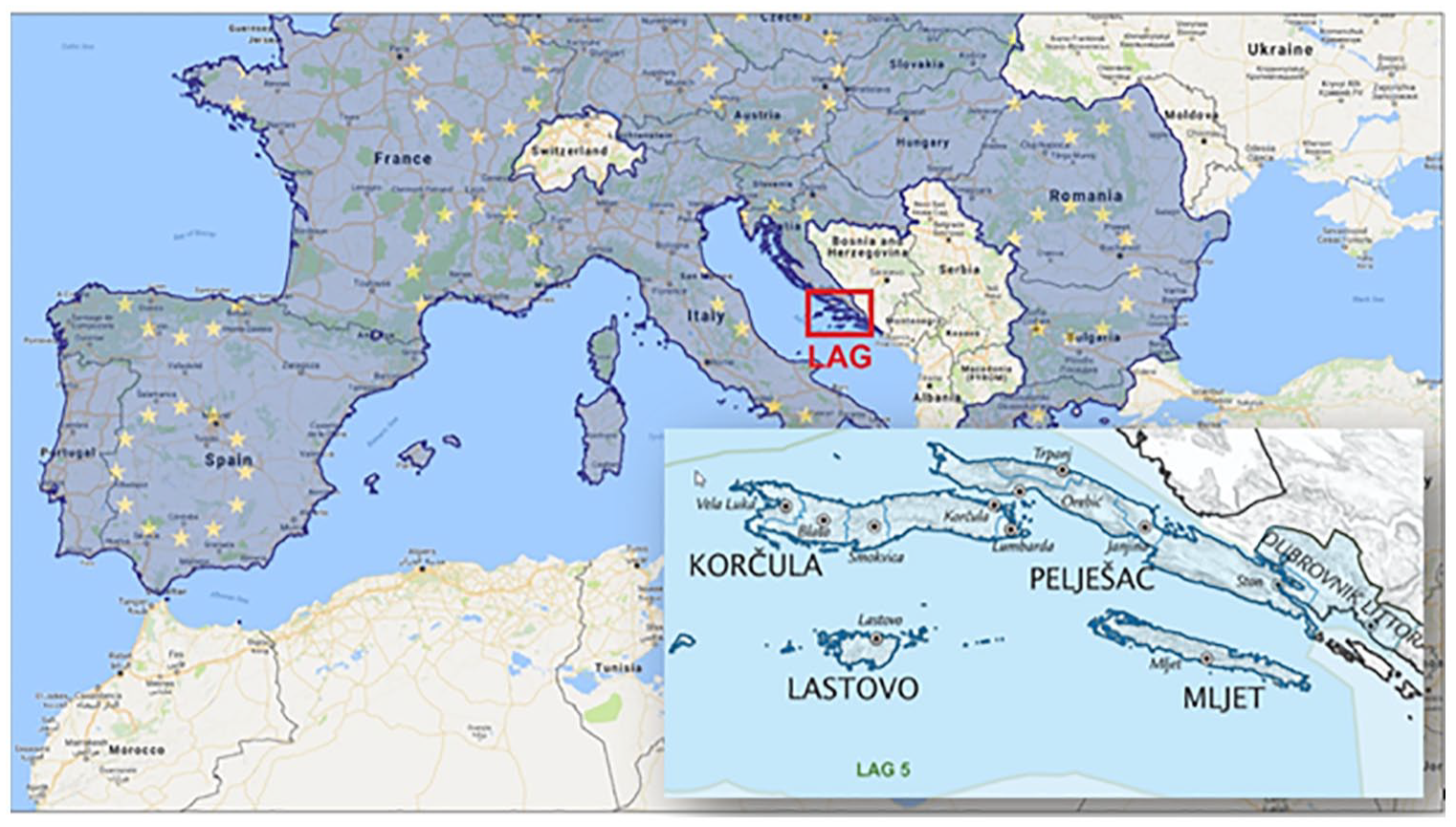
The territory of LAG 5. (L-MEMO5).
In the story that opened this article, Ana’s failure to receive subsidies from Measure 6 of the EU Rural Development Programme is illustrative of “policy downloading,” and it is commonplace in the former communist countries of the European Union. In this case, territories such as Pelješac first had to be classified as areas with specific or natural constraints in order to have access to European subsidies. However, this classification involved a methodology for the application of points that was obscure to the local farmers. The interpretation of this methodology by the national state resulted in excluding small farming areas such as Pelješac from access to EU agricultural subsidies, despite it having important biophysical constraints.
Local actors then organized around LAG 5. They appropriated this initiative to resist the policy implementation driven by the national state, a result of Croatia’s “Europeanization” steered by national elites. This is a broader pattern of state capture that has occurred in Eastern European countries which have recently joined the EU, including Croatia.
We chose this case study for several reasons. First, LAGs are the smallest territorial development organizations defined by EU regulations. They therefore represent the rescaling of EU organizational logic at the local level. Second, in many cases, LAGs have been instrumentalized by the state. The LAGs are therefore excellent sites for investigating the conditions of rescaling that relate to elite state-captured Europeanization. Finally, we chose this case study because of the deep insider knowledge we had at our disposal, as the first author has worked in LAG 5 and coordinated the trans-scalar alliance.
Research design
This study adopts a qualitative case study approach, building on the lived experience of the first author. During the initiative, the first author acted as the LAG manager and performed as an “insider researcher” (Dwyer and Buckle, 2009), which provided direct insight into the micro processes underlying strategic mobilization (Adler and Adler, 1987). This participatory design allowed us to leverage the first author’s position with privileged access to forums embedded at multiple levels of analysis, providing a comprehensive understanding of the strategic actions of both individual actors and coalitions.
Similar methodological approaches that draw on an author’s own experience have been used in other fields to ensure methodological sensitivity, data accuracy, validity, and relevance (Honey et al., 2020: 1). To alleviate any potential bias that may have resulted from the first author’s deep involvement (Berkovic et al., 2020; Dwyer and Buckle, 2009), we conducted interviews with key actors at the European, national, and local levels, 2 years after the initiative’s conclusion in 2018, when the author was no longer affiliated with the LAG.
In addition, to ensure a fair representation of accounts, we complemented the interviews with official memos from actors representing the European, national, and local governmental levels, as explained next. We also analyzed the discourse present in local and national media regarding the success of the initiative. This distancing facilitated a bracketing exercise (Langley, 2012) to identify, examine, and mitigate any preconceptions that might influence the research process.
Data generation
Data was collected mainly from personal correspondence, field notes, and interviews between 2016 and 2021. It was also complemented by documentary data, namely EU and national records, and academic studies. We refer to the process as data “generation” to reflect the co-creation, since the first author had a key role in the organization. She was responsible for managing the communication with state actors and the media, and for shaping the discourse of local actors to incorporate European norms and practices. Additionally, she participated in over 10 in-person meetings and 20 official phone calls over a period of 2 years to build the dataset for our research.
Semi-structured interviews with key actors on the European, national, and local scales were conducted in person, by telephone, and via Zoom. The interviews lasted between 15 minutes and 3 hours. They began with fixed questions about the interviewee’s knowledge of the EU and national regulations, the initiative, the actors involved, and the overall process of the national state adoption of EU regulations. All interviews were conducted in Croatian except for the EU officer, who was interviewed in English; they were recorded and transcribed, with two exceptions—one interview with a resident and one with a mayor, who agreed to answer our questions but refused to be recorded. The transcripts were emailed to the individual interviewees for possible correction and remarks. For the interviews with no transcripts, we wrote notes based on memory. The transcripts were then coded, and the verbatim texts were translated into English.
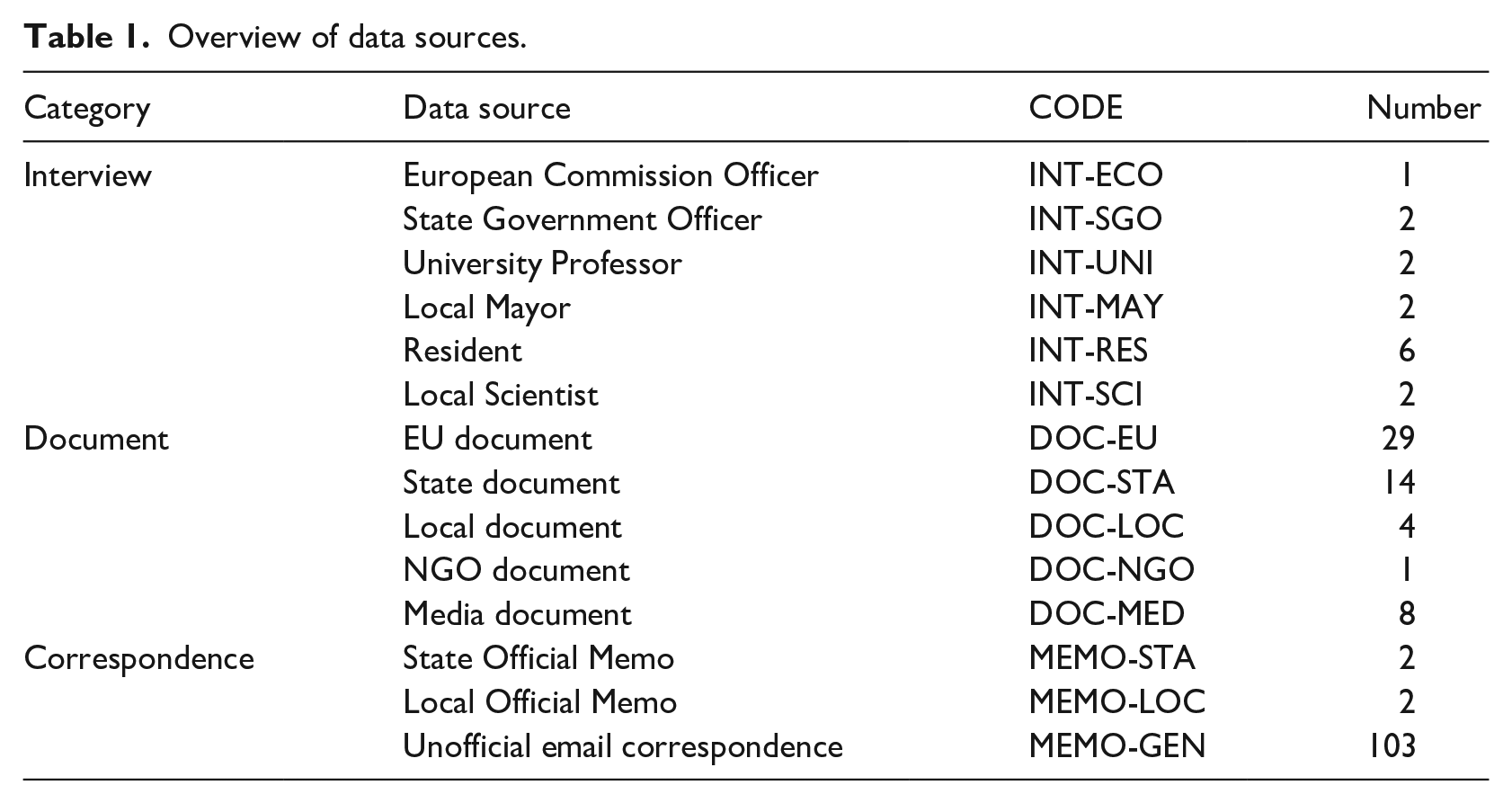
To complement the interviews and the memos, we collected a wide range of relevant documentary data that focused on implementing EU Regulation 1305/2013 Art. 32 on areas with natural and specific constraints and Common Agricultural Policy (CAP) payments in the EU, especially in Croatia. The collected data included over 150 publicly available documents. We proceeded to summarize, categorize, and code the data, as presented in Table 1.
Overview of data sources.
Data analysis
Overall strategy
The first step toward making sense of the role of spatial scales was to build a timeline of events delineating the main actors operating at each scale. We identified and temporally bracketed off the key phases of the case, which led to manually coding the transcripts related to those events to understand what the key actions were. Our analytical moves were aimed at finding patterns and identifying the tactics that configured the strategy of resistance mobilized by the resistance coalition. While actors mostly carried out actions on a given spatial scale (e.g. state actors operating on a national scale), we realized that the coalition building led to the strategy of playing the scales. Therefore, the second stage of data analysis focused on the actions and events directly related to the actions of the trans-scalar alliance, through which we identified the mobilized tactics that allowed them to operate simultaneously on different scales.
The main actors and their scales of operation
Actors were classified according to their institutional affiliation. For example, a person working within the state bureaucracy in the capital of Croatia was classified as a state actor because of the context of their actions, although they may have previously worked and lived in the region. The Croatian state and subcontractors hired through a public procurement process operated mostly at the national scale. These would be elected official from the Ministry and their administration as well as the scientists hired through the public procurement process. Following the same logic, the actions of EU actors, such as the European Commission or the EU member states, which negotiated the methodology found in the Rulebook with regulations, are located on the EU scale. Actions performed at the local scale mainly concerned the LAG and the local actors forming the local alliance, such as farmers and the mayors. However, the geographical notion of a local scale also includes large agricultural holdings and their associated businesses that share the same territory and have successfully included their areas in the Rulebook through their links with the state. They represent the national elite.
Actions and temporal bracketing
We used “temporal bracketing” (Langley, 2012; also used by Berkovic et al., 2020; Levy et al., 2016) to structure the main phases of playing the scales, as presented in Figure 3, where each action is associated with a leading actor. Actions were placed on the x-axis, and the scales at which each action occurred was noted on the y-axis. The different scales at which actions take place are expected to correspond to the socio-spatial levels where the actors originally come from, for example, a partnership signed between the EU and national states takes place at these scales. However, the main action that mobilized the coalition’s resistance cut across scales, as highlighted in the figure.
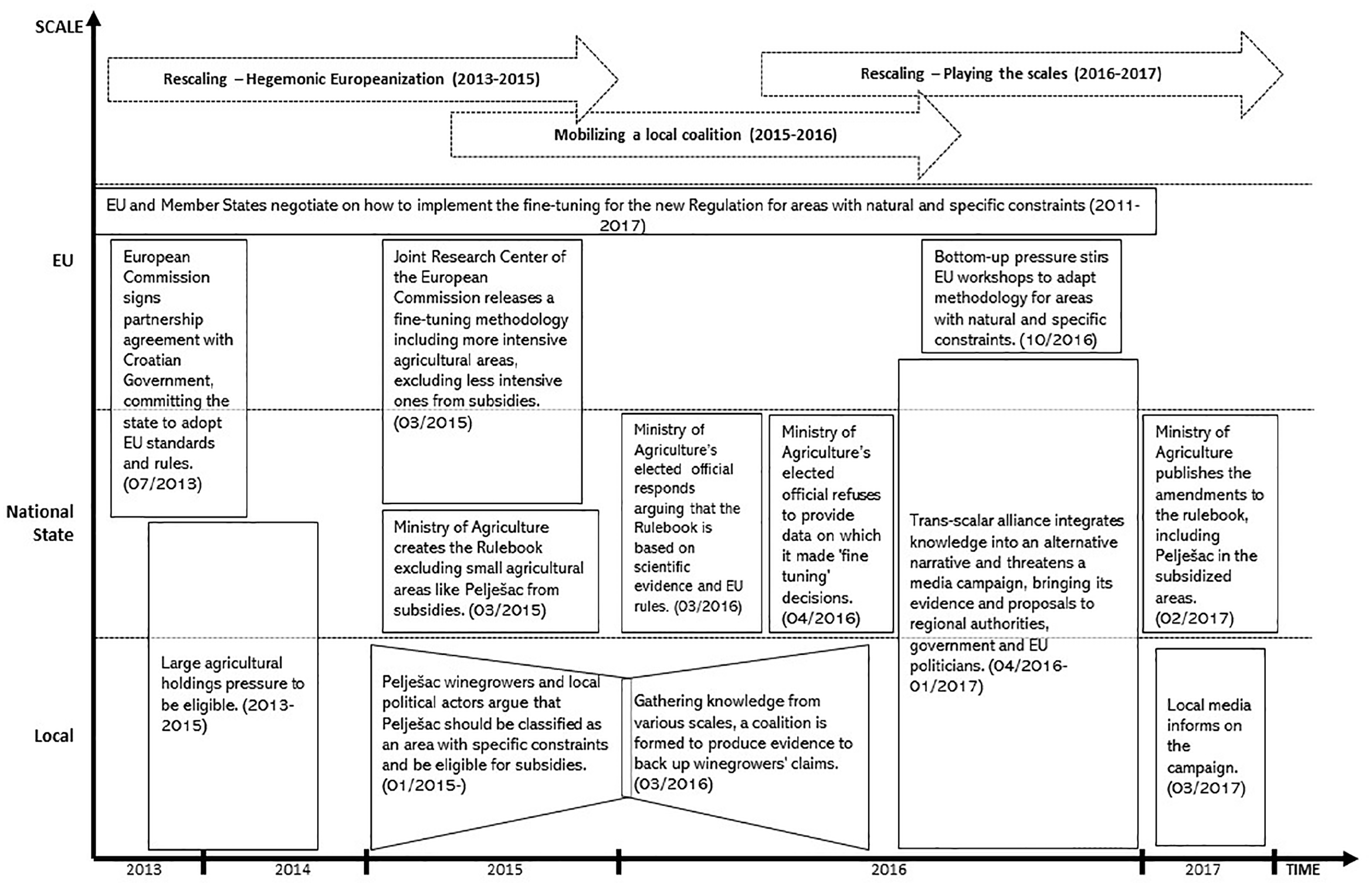
The process of playing the scales in the LEADER initiative on the Pelješac peninsula. (Developed by the authors based on primary and secondary data).
Findings
Our findings are presented in three phases. The first phase, Rescaling via hegemonic Europeanization (2013–2015), is a top-down rescaling form of “policy downloading” by the national state that incorporates European policies into the state’s political discourse. The EU impacts the national state process of public policy construction, and the national state responds by capturing the Europeanization process. The second phase, Mobilizing a local coalition (2015–2016), is a reaction to the first phase. Here, local actors mobilize to influence the process of public policy construction. They form a local coalition of actors from various local fields and expand this alliance to other levels to gather a range of knowledge pertinent to their cause. The third phase, Rescaling via Playing the scales (2016–2017), involves changing the organizational logic through the integration of the different strands of knowledge gathered in the different scales, and leveraging this narrative via a trans-scalar strategy that repurposes public policy by playing the EU and the state scales. Figure 3 visually represents these overlapping phases and highlights their key events. The rest of this section provides a more detailed analysis.
PHASE ONE: Rescaling as hegemonic Europeanization (2013–2015)
By signing a partnership agreement with the EU in 2013, Croatia embarked on a Europeanization process that promised two important outcomes for the benefit of local communities. First, the process of Europeanization imposed new territorialities such as the delimitation of the borders of LAGs that do not coincide with the national political organization. These LAG territories are enacted through the work of a multi-stakeholder organization. As Havlík (2020: 1293) argues, these territories are characterized by a reduced level of state sovereignty, as local actors are empowered to oversee the distribution of modest European funds for local growth and development. Therefore, in theory, local actors no longer depend exclusively on national state decisions regarding subsidies and development plans (Maleković et al., 2011).
The second rescaling outcome was that the state was obliged to follow EU procedures for distributing subsidies. Consequently, “the process of ensuring financial rents for well-connected corporate agents, whereby elected politicians serve as a linchpin between state institutions and corporate agents” (Kotarski and Petak, 2021: 743) was obstructed. Following this second rescaling, related to the policies of rural development, Croatia had to adopt the EU methodology for determining areas with specific or natural constraints that did not overcome their biophysical constraints and were therefore eligible for additional payments under the Common Agricultural Policy.
The Croatian government thus hired a team of experts, university professors, with the necessary scientific credentials accepted by the European Commission to develop a study that would serve as the basis for the “Rulebook on Areas with Natural or Specific Constraints” (DOC-STA 13). The European Commission required the study to follow the two-step EU methodology (DOC-EU 1-2, 4-8). First, national experts had to designate areas “facing natural constraints, namely low soil productivity and poor climate conditions affecting agricultural activity” (DOC-EU11: 11). Second, they had to make fine-tuning calculations that aimed to exclude territories where the calculated income was high enough to offset the biophysical constraints of agricultural production (DOC-STA 2).
This team of experts, the national scientists in our case, faced difficulties in determining the areas with constraints because although they adhered to EU logics fully, they did not have enough data from the required independent body: “[T]he data from the National Bureau of Statistics is deemed less reliable [so] final calculations are done using the data from the authorities responsible for the program implementation” (DOC-STA 7). As a result, the scientists used data from the Ministry of Agriculture, which was said to be more reliable but was also largely inaccessible to the public, despite in principle being part of a publicly available document (DOC-STA 7-8). The complex calculations carried out based on non-transparent data made the centralized Europeanization of state policies and practices for subsidy allocation an opaque process performed with EU logics through a national state-led rescaling.
The transparency of the fine-tuning calculations, which determined the eligibility for subsidies, decreased further after the state adopted the initial study, as a local scientist explained: After this study, which was done in a correct, professional manner, was approved, it fell into the hands of [omitted, a national academic actor] who started attributing points [doing fine-tuning]. Furthermore, this is when they started sharing the cake. Some municipalities are under HDZ, SDP, IDS [political parties] rule [. . .] and that is when lobbying and clientelism, something that has nothing to do with rural development, starts. Moreover, that is when it all starts falling apart. (INT-SCI2)
These inconsistencies in state regulation were manifest in changes made to the Rulebook only 2 months after the document came into force (DOC-STA 9). This resulted in the allocation of subsidies to a municipality where the majority of the available agricultural land was owned by a large-scale corporate agent that regularly declared profits in their annual financial reports (DOC-MED 8). In contrast, three municipalities on the Pelješac peninsula, consisting mainly of small agricultural holdings and marked by depopulation and a low economic development index (Perisic and Wagner, 2015), were excluded from the Rulebook, despite numerous requests from local winegrowers’ associations (MEMO-GEN 16). The national state thus rescaled Europeanization in favor of national elites.
This implementation contradicted the results which could arguably be expected from the process of Europeanization. The allocation of subsidies followed logics unfolding from larger scales but was driven by national political actors, which preserved the discretion of the national state at the expense of lower scales. In practice, thus, the application of the methodology was largely controlled by the national government and excluded many potential beneficiaries. In contrast, previous practices of obtaining subsidies were seen as accessible to individuals, as the owner of a large agricultural holding explained: “[My] father and I went to the agency [the state] countless times. In the end we managed to get what we wanted” (INT-RES 6).
PHASE TWO: Mobilizing a local coalition (2015–2016)
Pelješac winegrowers protested to local mayors and the county’s local government representatives. The county officials went as far as to request a public consultation on the Rulebook (DOC-LOC 1-2) and asked for official meetings with the state. However, all the interactions with local mayors, winegrowers’ associations, and county officials resulted in the same response from the state officials. State officials who worked in the Ministry of agriculture and were responsible for putting in place this new EU legislation insisted that the Rulebook was based on a study completed in line with EU methodology and that not all areas could be defined as areas with specific constraints (MEMO-STA 1): “It was science and not politics so nothing could be done” (INT-MAY 2).
The local farmers initially knew very little about the technicalities of why they had been cut out of the agricultural subsidies for areas with specific constraints. They knew that doing agriculture had become harder, “as if it was not hard enough” (INT-RES 4). They felt frustrated and discouraged: Our problem is that these rulebooks are passed by people who do not get us. (INT-RES 2) We try to point out our problems, but we are not important enough. Our electorate does not have sufficient weight. (INT-MAY2)
However, this mobilization of local farmers eventually created a network of support for their cause. The manager of the local multi-stakeholder—and EU-funded—LAG was approached by a local state administrator who drew attention to the problems with the new Rulebook, asking that the interests of the local actors be defended (MEMO-LOC 3). In parallel, the local state administrator was approached by the local scientist to provide more detailed information on the process of excluding Peljesac from the new Rulebook. Steered by common interests, a coalition was formed, mobilizing local scientists and collective organizations of local winegrowers, who were among the LAG’s members, to develop expertise on the topic. The coalition reached out internationally to NGOs focused on advocacy in rural development to obtain more information on how this was done in other member states (MEMO-GEN 2; MEMO-GEN 5).
In a trans-scalar strategy, they also involved LAG’s national partners at the state level such was a national organization that gathered other LAGs, or European parliamentarians with whom working relationships had already been established through the European LEADER initiative (MEMO-LOC 5). This support from other scales allowed them to draw on expertise regarding how the Rulebook for Areas with Natural or Specific Constraints had been applied in other European member states. The various members of LAG 5 thus reached out to its European partners, that is, to Croatian political representatives in the European Parliament, to university professors, and to researchers working in different European universities specialized in this topic. As all EU member states received subsidies for areas with natural or specific constraints, they learned how this was done in other countries and uncovered whether the procedures for designating such areas could be applied in Croatia to benefit the Pelješac farmers (DOC-EU 1; MEMO-LOC 7). As a result, they were able to appropriate the prevailing organizational logic to engage in public value creation differently.
PHASE THREE: Rescaling via “playing the scales” (2016–2017)
In this section, we trace the local actors along a two-step process of rescaling. First, they devised a trans-scalar strategy that allowed them to exert pressure on the state from multiple scales. Second, they reappropriated and performatively transformed the dominant organizational logic in their favor. This was manifested in changes to the Rulebook, which once again defined Pelješac agricultural regions as areas with specific constraints.
Rescaling step one: Integrating multi-scalar knowledge
A trans-scalar alliance emerged from the local coalition (MEMO-LOC 1; MEMO-LOC 3). This alliance was not a formal initiative but an informal network of actors operating on different spatial scales to share relevant knowledge and devise a strategy that would allow them to impose their view on the hegemonic scale (MEMO-LOC 20-21). Naturally, the alliance was not homogeneous and represented actors with different perspectives and levels of influence. However, they shared common goals in designing a strategy for playing the scales, which aimed to provide the knowledge and skills necessary to reframe the claims of local actors according to the dominant logic and to create a network that would ensure that actions could be taken across scales (MEMO-LOC 19; MEMO-LOC 23).
Through this alliance, the knowledge gap between the local and upper scales was narrowed, which allowed for a new collective strategy. The alliance thus aimed to inscribe the Pelješac winegrowers’ interests into the dominant discourses established at the European and national state scales by mobilizing the same hegemonic logic. On this basis, local scientists worked with local actors to analyze national studies and regulations, which they compared with the EU texts and guidelines. They sought to embed the local actors’ advocacy work in a formal discourse that could be incorporated into EU practices and regulations (DOC-LOC 4). The methodological calculations for defining the areas eligible for subsidies were researched and compared across various areas of Croatia. It became clear that the rules were implemented differently in the various regions as part of an unstable and opaque process: [We] could mathematically prove that this [fine-tuning] was garbage. That somebody had written the numbers manually [without doing any calculations]. (INT-SCI 1)
Relevant EU legislation and regulations were analyzed to determine potential best practices that would be acceptable to the EU as possible solutions. Finally, a five-page scientific analysis was drafted that demonstrated that Pelješac was an area with specific constraints eligible for subsidies by following the “given EU methodology and regulations” (DOC-LOC 1-2). A memo explicitly stated what actions were needed on behalf of the state to help Pelješac winegrowers, all “in line” with EU regulations and methodology (DOC-LOC 2-3).
The narrative produced followed the same logic as the European policy, with rhetorically strong arguments that one participant deemed as “lethal but acceptable” (INT-SCI 2). The objective was to frame it in such a way that “you bring a person to say ‘yes, there really is a problem’” (INT-SCI 2). This approach made it difficult for state representatives managing agricultural subsidies policy to ignore the situation. As a state official recalled: “I especially remember the analytics, Excel tables and the serious approach” (INT-SGO 1).
In agreement with the prevailing informal communication culture of the state apparatus—as one participant noted, “90% of things work at the informal level of agreement in our country” (INT-SCI 2)—the memo and the analysis were informally distributed by various members of the coalition to a set of actors from the European scale and the state scale throughout April and May 2016 (MEMO-GEN 9-10). This informal way of distributing the memo to and through actors across spatial scales opened a window of opportunity for a dialog with the national state: Thanks to some connections, [local civil society actor – winegrower] met with the minister. [. . .] I came with a sealed document from [local academic actor] and stated that we have this problem and that this is something I would like him and his associates to investigate. (INT-RES 4)
However, there was initially little success: I talked to the minister, and we tried everything – but he [the minister] would lower it to the level of bureaucrats, as he was unaware of all the details and the regulations. However, it became hard to change anything when this was handed over to the bureaucrats. (INT-MAY 2)
Despite the urgency of changing the Rulebook so that local actors could submit their projects to the Rural Development Programme, the situation was deadlocked (MEMO-GEN 14). A plan B was necessary (MEMO-GEN 24). A media campaign was designed as a threat and a last resort: After RES4 delivered [the memo and the analysis] to the state, we started threatening to contact the media. It was one of those crucial moments because we had a true media story. Anyone could publish it as it was well argued. It was not a pure fabrication, e.g., “the politicians did this to us,” and this made it dangerous. This is how we negotiated with them in the final stage. (INT-SCI 1)
In the meantime, there was a snap parliamentary election in Croatia in September 2016. As a result, a majority HDZ government (the Croatian Democratic Party) was elected. In this government, a former regional politician from the HDZ, who was familiar with the problem, became a state secretary. The national discourse changed.
We did not go to the media because SGO1 [the regional politician now part of the national government] said that they [the Ministry of Agriculture] should not mess around. She said to stop giving stupid answers because their blank explanations seemed even more stupid. (INT-SCI 1)
Things started moving and the requests of LAG, representing the alliance, were incorporated.
Rescaling step two: changing the dominant organizational logic
The state scale was not the only one being pushed. The EU adjusted its methodology based on pressures from other member states in the form of requests from administration from other ministries of agriculture (DOC-EU 7), and Croatia served as an example of what could be changed “for the better” (DOC-EU 8); this shift was secured through the new Croatian government, which engaged with local actors’ requests and involved the national state bureaucracy in a new set of negotiations with the EU to incorporate the Pelješac municipalities in the Rulebook.
Finally, the initiative’s success was celebrated in the local media. For some, it was seen as a victory against the national state: The Ministry of Agriculture has finally rectified the injustice of equating Pelješac farmers with those, for example, from the flat and fertile region of Slavonia. After the Pelješac locals gathered around the LAG (Local Action Group), spent a year conducting a study and launching a public negotiation campaign [. . .]. (DOC-MED 1)
For others, as a victory of the national state: The Ministry of Agriculture has announced the Regulation on Amendments and Supplements to the Regulation on the Determination of Areas with Natural or Other Special Restrictions, thereby restoring the provision on the difficult management conditions for Pelješac farmers. (DOC-MED 7)
In fact, this dual interpretation is an indication of the multi-scalar alliance that cut across imagined levels, while the state was not only pushed itself, but also helped to push for a change in the logic on subsidies, with actors navigating across scales: In agreement with the Minister of Regional Development and EU funds, we conveyed specific initiatives on what I dare say was the evident need to include Pelješac in areas with natural or specific constraints [. . .]. This initiative was finally implemented when he became the Minister of Agriculture, and I [the former regional politician elected into government in 2016] became his secretary of state. (INT-SGO 1)
State bureaucrats in the Ministry of Agriculture who were in charge of implementing the EU regulation seized the opportunity afforded by the new government to respond to the needs of local actors from Pelješac. Their October 2016 demands were delivered by high-ranking state officials in order to relaunch the complex technical negotiations at the EU level: Later, in the negotiations, I noticed that the regulations say that [the concerned] agricultural areas should not exceed 10% of the territory. Yet not 10% of the overall territory but 10% of the agricultural territory. The EU always used to tell us that it could be a maximum of 10% of the overall territory. [. . .] We found an opportunity to remove non-agricultural areas from Pelješac, and that is how we managed to get Pelješac agricultural land back into the Rulebook. (INT-SGO 2)
In March 2017, the Ministry published changes to the Rulebook and, as a result, included Pelješac in its “areas with specific constraints” (DOC-STA 11). As one interlocutor put it, “the negotiations lasted a long time, and they were always about finding nuances in the regulations you could use to get something through” (INT-SGO 2).
This initiative was not like bringing water to the Sahara Desert, but for the first time, somebody from Pelješac presented them with something serious that contradicted them [the national state], which was 100% supported by facts. (INT-RES 4)
Although more powerful local actors of the same territory also benefited from the new regulations, they were enacted mainly to the advantage of the communities that initiated the coalition. Local winegrowers recognized the importance of the achieved results, which made their interests visible: Today, I was pleasantly surprised with the new Rulebook on the Amendments to the Rulebook on Areas with Natural or Other Specific Constraints, where they finally corrected the Pelješac injustice. I know this was preceded by much work. Therefore, congratulations to all of you whose cleverness and persistence have forced the ones responsible to make this happen! (MEMO-GEN 102)
The rescaling effort was thus discursively reabsorbed into the national scale, framed in such a way that the EU appeared as the outside hegemonic power, while the national state embodied “our people” in Croatia (INT-RES 4; INT-RES 5).
Discussion
Our research shows that globalization and Europeanization processes enact a form of downward rescaling, imposing norms that are in most cases incomprehensible to local actors or irreconcilable with their interests. Imposed regulations may also threaten the preservation of public value nurtured within local communities, such as small-scale agriculture in Pelješac. This article advances our understanding of how public value creation can be safeguarded when rescaling is led by resistance coalitions that operate across scales to protect the local community. Therefore, it offers a fresh organizational perspective on the alliances needed to defend public value (Mazzucato, 2015) through the strategy we call “playing the scales.” We will now discuss the spatiality and tactics of this strategy for public value creation in relation to the existing literature.
The spatiality of “Playing the scales” as a trans-scalar alliance
We argue that building a coalition is instrumental for the success of such local resistance and for public value to be preserved at the local scale. Once a local coalition is established, and trans-scalar support from other scales is secured, the local actors can mobilize resources from several scales to produce an alternative narrative and leverage it through a strategy that will allow them to influence the dominant organizational logic in their favor. This is much more difficult to achieve when local actors cannot overcome their scales. A discursive strategy tailored to that scale cannot penetrate the coercive and bureaucratic authority of the national state operating at a higher-level scale (Levy and Scully, 2007). Our research shows actors engaging in a trans-scalar strategy that simultaneously influences key actors’ operations on various scales. Success is more achievable when diverse stakeholders within and beyond the region come together (Rosen and Olsson, 2013) and hegemonic positions are challenged across scales.
A similar strategy is known in the literature on social movements, which refers to the dynamic identified by Keck and Sikkink (1998) as the “boomerang pattern,” in which local actors receive support from international actors and institutions to achieve their goals. This strategy has been demonstrated to be particularly effective when (predominantly) Third World NGOs work with international NGOs to address human rights violations in their own countries (Bassano, 2014). While in these cases local NGOs mandate international NGOs to pressure their national states, we see the strategy of playing the scales as a concerted effort to forge alliances from within with actors on other scales. Unlike the boomerang effect, “playing the scales” incorporates the logics of higher scales pushing for their adaptation, rather than transformation.
Previous research on translocal assemblages (McFarlane, 2009) has shown how coalitions across different sites can mobilize resistance, including through the exchange of knowledge and resources. In the management literature, this spatial pattern has been explored as a powerful form of subaltern resistance, for example by linking different territories that share the same irreconcilable differences to higher-scale projects of resource extraction (Banerjee, 2018; Banerjee et al., 2023). In these cases, the conflict with the state generally takes the form of “resistance as negation” in order to overturn the initial project altogether, while in a few cases, it manifests through “resistance as negotiation” (Banerjee et al., 2023). It is in the latter sense that the strategy of playing the scales that we present here can be fruitfully mobilized to reconcile public policy with local interests. The main difference is that, although the coalition is grounded in the interests of one locality, it operates across scales and is able to generate an alternative narrative which can leverage the dominant logic and allow its appropriation by the resisting actors.
In the same vein, our findings resonate with those of Lacerda (2021) in that the dialectical process of incorporating and responding to “verticalities” can harness territorial solidarities to fragment the intent of hegemonic power. In this study, we extend these findings by showing how local actors can build trans-scalar counter-hegemonic actions and inscribe their interests in them, with implications beyond their own territory. One way to achieve this transformation is by changing the organizational logics through the actors’ discursive agency (Spicer and Sewell, 2010)—in other words, through their ability to influence dominant discourses to redefine what is legitimate, reasonable, and effective. The strategy of playing the scales, therefore, shows how the political conflict around rescaling takes place and how the “various types of scalar contestation” (Spicer, 2006: 1477) can be mobilized as value-creating processes in which the local scale is inscribed into the hegemony of the higher scales.
The tactics of a trans-scalar strategy for public value creation
The literature on public value creation approaches collaborative cross-sector relationships with particular attention to the managerial processes of public value co-creation (Andrews, 2019; Parker et al., 2023; Sancino et al., 2023). Drawing on the literature on resistance, especially on the impact of its disruption and adaptation for value creation (Levy et al., 2016), we wanted to examine the strategy of playing the scales as one that is primarily underpinned by resistance. While this negotiated resistance does not overturn the hegemony established across scales by the historical bloc that stabilizes power (Levy and Egan, 2003), it is nonetheless an important strategy for protecting public value from the potentially destructive effects of policy making on hegemonic terms.
Our data illuminates three main tactics adopted by the trans-scalar alliance: (i) gathering relevant knowledge; (ii) producing an alternative narrative; and (iii) leveraging this narrative across scales. The first tactic is enabled by the nature of the established coalition, gathering expertise from a variety of actors experienced in political action on various scales. By sharing knowledge, these actors can appropriate it for the alliance the dominant organizational logic. The second tactic involves crafting an alternative narrative that is grounded in the collective interests of the community, and is presented according to the framing of the appropriated logic. Finally, the third tactic mobilizes the double legitimation of the collective interests and the appropriated hegemonic discourses. Through negotiation and threatening, it can (re-)rescale the community demands, performatively reshaping the dominant organizational logic in favor of local actors.
Spicer and Sewell (2010) have described similar processes of resistance across scales by looking at coherent discursive strategies that can transform the dominant organizational logic by creating a discursive bricolage. In our study, we focus on the collective response as a deliberate and concerted strategy that has implications for public value creation because of its trans-scalar nature. We see as critical to “playing the scales” the capacity to adapt a strategic action to organizational logics established in the distinct spatial scales being targeted, while staying attuned to the possibility of alliances and big shifts within these scales. The combination of both offensive and collaborative moves allows elements that protect local public value to be inscribed in the dominant organizational logic and doing so change it to reach other territories. By appropriating knowledge from the dominant scale (Vitel et al., 2015), local actors can inscribe their interests within the state scale and protect public value by challenging the logics of downward rescaling. This involves the capacity to strategically innovate, adapt, and coordinate people and knowledge across scales.
Furthermore, similar to translocal governance (Banerjee, 2018), the formation of such trans-scalar alliances requires local actors to share interests and values beyond their own communities in order to mobilize political support. The alliance can thus be theorized as itself generative of public value, as it helps to bridge local communities and connect them to the broader “collective macro-level” (Meynhardt, 2021) where public value is established. Thus, given that spatial scales are socially produced (Spicer, 2006), countering rescaling driven by hegemonic discourses requires the capacity of local actors to develop a trans-scalar strategy that both crafts an alternative narrative that protects the local public value and is open to engaging allies at different spatial scales.
Conclusion
This study offers a fresh organizational and critical perspective on public value creation by focusing on the resistance movements that create public value and protect the already-existing processes through which such value is sustained. An advantage of our approach in describing the strategy of “playing the scales” is that it focuses on the stakeholders across spatial scales and within translocal governance mechanisms. Our longitudinal participatory approach revealed how the concerted action of local actors with other members of the coalition led to the key tactics of: (i) gathering relevant knowledge; (ii) crafting an alternative narrative; and (iii) leveraging narratives across scales to reshape the organizational logic.
This concept can be applied to public value creation, resistance movements, and the growing literature on wicked problems. Bringing together the literature on resistance movements and public value creation, we propose that the strategy of playing the scales is innovative in two ways. First, it counters the rescaling driven by hegemonic discourses by leveraging support at different spatial scales, thus effectively protecting existing processes of public value creation in the local scale. Second, it involves changing organizational logics to redefine legitimacy, inscribing the local scale into higher-scale hegemony, and extending its effects beyond the territory.
In this study, we have made the theoretical choice to downplay the institutional imagination of these concerted actions in order to highlight the spatiality and collective nature of resistance. This naturally raises new questions that can be explored in future work, particularly related to institutional logics and the entrepreneurship of individuals embedded in multiple fields. For example, the strategy of “playing the scales” can shed light on how institutional entrepreneurs who spark changes and actively participate in their implementation (Hoogstraaten et al., 2020; Levy and Scully, 2007; Sotarauta and Mustikkamäki, 2015), can promote and sustain these changes to preserve public value. Exploring institutional entrepreneurship as an agent of translocal and/or trans-scalar resistance may, for example, have implications for how the process of public value creation is defended.
Footnotes
Acknowledgements
We are indebted to all the participants in LAG 5 and those working with LAG 5 for their meaningful work, which also made this research possible. We would also like to acknowledge the special issue editors, anonymous reviewers, and colleagues for their time and effort in reviewing our paper. The reviews we received from them greatly helped us in the development of our work. Marija Roglic and Florence Palpacuer are also grateful for the contributions received during 38th EGOS Colloquium in Vienna and honored by the Paper Impact Award granted to this research.
Funding
The author(s) disclosed receipt of the following financial support for the research, authorship, and/or publication of this article: This research received financial support from the French National Research Agency through the program “Investments for the Future” under reference number ANR-10-LabX-11-01.
