



Abstract
This study theoretically and empirically tests a Publicness Perceptions Scale (PPS). Our goal is to understand the dimensions of publicness as interpreted by individuals working within different types of organizations, and the extent to which these perceptions vary across sectors. A two-study design with independent samples is used. Based on a literature review supported by an expert’s survey and original empirical data, the PPS is constructed and validated. In Study 1, exploratory factor analysis (EFA) indicated the PPS is composed of five reliable factors: (1) perceived ownership, funding, and political control; (2) perceived market control; (3) perceived legality and equity; (4) perceived accountability, and (5) perceived transparency. In Study 2, confirmatory factor analysis (CFA) suggests a second-order single PPS factor. Study 2 also demonstrates the scale’s convergent, discriminant, and incremental validities. The paper concludes with theoretical, empirical, and practical advantages of the new PPS scale.
Keywords
Introduction
The concept of publicness within organizations has undergone a significant transformation. It has moved from a seemingly straightforward notion of “public” being distinct from “private” based on ownership, funding, and control (e.g., Andrews et al., 2011; Bozeman, 1987; Goodsell, 2017), to a multifaceted construct including values and societal impact (e.g., Andrews et al., 2011; Boyne, 2002; Bozeman, 2007; Fukumoto and Bozeman, 2019; Min and Yang, 2023; Moulton, 2009). This transition, incorporating complex notions of publicness, has left significant theoretical, methodological, and empirical gaps in studies on publicness at the individual and organizational levels.
This study tries to contribute to the development and understanding of this concept through the unexplored territory of individual perceptions. We suggest the Publicness Perceptions Scale (PPS) as a useful tool that may illuminate how individuals experience and interpret the publicness of their organizations. By examining this perceptual dimension of publicness, our study has two major goals. First, to illuminate the multifaceted nature of publicness based on wide literature accumulated over the years (e.g., Bozeman and Moulton, 2011; Feeney and Welch, 2012; Goodsell, 2017; Meynhardt and Jasinenko, 2021; Min and Yang, 2023; Oberfield and Incantalupo, 2021; Ritz et al., 2023, to name only few). In addition, we will try to suggest a new scale for the measurement of this multifaceted concept and validate it in several ways.
In building the Public Perception Scale (PPS) we use the Neo-Institutional Theory (Scott, 2001) which, according to Scott (2001) defines institutions as “social structures that have attained a high degree of resilience. They are composed of cultural-cognitive, normative and regulative elements that, together with associated activities and resources, provide stability and meaning to social life” (p. 48). We argue that publicness functions as an informal institution, influencing behavior through norms and expectations (normative element) (Moulton, 2009). This perspective contrasts with prior research that heavily relied on formal rules (regulative element) to measure publicness, such as ownership status or government funding (Andrews et al., 2011; Bozeman and Bretschneider, 1994). We will maintain that the PPS offers a more comprehensive approach by capturing employees’ values and perceptions regarding public service (cultural-cognitive element) (Moulton, 2009; Walker et al., 2013). This alignment with the cultural-cognitive dimension of institutions allows for a deeper understanding of how publicness may shape employee attitudes and outcomes within organizations (Moulton, 2009).
The PPS which will be developed and detailed later in this paper, has the potential to serve as a valuable tool for researchers to explore how legal ownership, funding, control, and public values are perceived by individuals (e.g., employees, citizens, and policymakers), beyond objective constraints, and influences their attitudes and behaviors. More specifically, we will argue that decisions, behaviors, and attitudes related to the public interest (i.e., the communal good; Bozeman, 2007) are likely shaped by unique perceptual sets (i.e., ownership, funding, control, and public values), distinct from those driven by non-public values and considerations (e.g., profitability). This aligns with existing research emphasizing the importance of a perceptual approach (e.g., Bright, 2021; Min and Yang, 2023; Ritz et al., 2023; Tuna et al., 2016). The paper proceeds as follows. First, we will set the theoretical ground for better understanding publicness based on a variety of approaches. Next, we will focus on the perceptual approach and on its contributions. These will be followed by a detailed explanation of our two-study design and the presentation of the PPS. Finally, a discussion and summary are suggested to demonstrate the advantages of our study, alongside limitations and recommendations for future studies.
The elusive nature of publicness
The concept of organizational publicness (i.e., whether organizations are attentive to the public, Goodsell, 2017) has been extensively explored across diverse disciplines, often employing a tripartite typology categorizing organizations as public, private, or non-profit (Bozeman, 1987): (1) public organizations which are owned and funded by the government; (2) private organizations which are business firms owned by private individuals and funded through sales; and (3) hybrid/not-for-profit organizations which include service-oriented professional organizations that deliver quasi-public goods and exist under both public and/or private ownership. Yet the conventional writing on publicness is usually in relation to the first category of public organizations and much less in relation to the other categories (e.g., Lan and Rainey, 1992).
Publicness has thus been studied by a variety of scopes and approaches. Among them are the generic approach (Murray, 1975), the legal-core approach (Rainey, Backoff, and Levine, 2000), the dimensional approach (Bozeman, 1987), and the realized publicness approach (Moulton, 2009). Along these lines, studies compared public and private organizations, mainly based on ownership and/or funding dimensions, exploring the differences in goal setting (Bozeman and Bretschneider, 1994), goal complexity and ambiguity, organizational structure, personnel, procurement, budgeting and accounting, and work-related attitudes (e.g., satisfaction and motivation) (Andrews et al., 2011).
Studies also point to discrepancies in the actual manner public and private organizations are compared (e.g., Rainy and Bozeman, 2000). These discrepancies may stem from misinterpretations of the situations involved (contextual factors) and from inherent limitations within the models used for comparison (e.g., biases inherent in model specifications). These biases can stem from cultural elements, organizational levels of respondents, and other intervening factors. Moreover, scholars utilizing neo-liberal principles (e.g., deregulation, privatization, etc.) have challenged earlier understandings of publicness (Clarke, 2004), advocating for their replacement with business-oriented values like profitability, efficiency, and competitiveness (Haque, 2001). Consequently, the definition of publicness has increasingly been framed as an antidote to the influence of neo-liberalism and market forces across sectors, by emphasizing the role of normative dimensions (Bozeman, 2007; Moulton, 2009). Yet it seems that such studies suffer from either theoretical shortcomings or methodological weaknesses (e.g., Rainy and Bozeman, 2000), leading some scholars to ponder whether it is time to call a halt to publicness studies altogether (e.g., Anderson, 2013).
However, some remedies to difficulties in the study of publicness in modern societies may be found by shifting the focus to the perceptual level. The perceived publicness approach reflects the blurring of boundaries between public and private organizations and may enable answering fundamental questions such as: (1) Is publicness a fixed-generic term or can it be viewed as a subjective concept with multiple meanings in the eyes of individuals? (2) What does publicness mean in the eyes of different stakeholders? (3) Can perceived publicness contribute to existing knowledge about the borders between the public and the private and in what way? (4) Can we find a tipping point where the employee publicness perceptions move the entire organization towards publicness? These are only few questions that deserve consideration.
The public values theory (Fukumoto and Bozeman, 2019) may help in better understanding these questions. Public values (e.g., equity, transparency, and accountability) are emerging as a crucial but complex dimension in understanding publicness (Moulton and Feeney, 2010). Defined as normative consensuses based on emotions and cognition (Lippmann, 1955), public values offer an ethical compass beyond market-oriented perspectives (Bozeman, 2007). Moreover, neo-institutional theory (Scott, 2001) suggests that employees interpret their organization’s public service mission through the lens of institutional pressures driven by societal norms and expectations. Hence, a normative approach may contribute both a theoretical mechanism to explain publicness effects and balance the dominance of economic theory in publicness studies, traditionally focused on legal ownership or funding sources (Andrews et al., 2011).
As such, it may be useful to view publicness as a continuum, shaped by employee perceptions of both their organization’s values and its legal structure (ownership, funding, control). Yet this approach does not specify which public values fully capture the normative dimension (Fukumoto and Bozeman, 2019; Jørgensen and Bozeman, 2007; Min and Yang, 2023; Moulton and Feeney, 2010). No consensus has been reached on which public values are most important for more accurately assessing publicness (Meynhardt and Jasinenko, 2021; Min and Yang, 2023; Ritz et al., 2023). To overcome such disagreements our study takes an integrative approach, acknowledging potential differences in how individuals perceive publicness (Moulton, 2009), and using these to construct a comprehensive scale to measure perceived publicness.
Shifting the focus to perception: Theoretical and empirical advantages
Given the challenges of defining publicness objectively, we propose an alternative subjective perceptual approach. This approach emphasizes how individuals (e.g., employees, customers, citizens, politicians, etc.), interpret and experience publicness within their specific organizational context (Lewin, 1936). This subjectivity acknowledges the diverse interpretations individuals hold regarding the organization’s relationship with different spheres (e.g., political, social, and economic) and its commitment to public values (Min and Yang, 2023).
Based on Scott (2001), perceived publicness reflects an employee’s interpretation of the institutions, processes, and outcomes embedded in their workplace. Employees are expected to internalize the organization’s values and attitudes, not just due to their duties or roles, but also because the workplace shapes the meaning they assign to their work activities. Therefore, perceived publicness provides an interpretation of life within the organization, offering insights into how employees understand their organization’s relationship with the political, social, and economic arenas, as well as with communities and other organizations. Furthermore, higher levels of perceived publicness can enhance individuals’ sense of self-confidence about the meaning of their jobs and motivate them to invest in the organization’s growth and progress. By subscribing to the values embedded in perceived publicness, individuals may attach greater meaning to their roles, justifying their responsibilities, existence, and significance as contributors to a larger societal good. This, in turn, likely translates into a sense of value and significance, potentially impacting their prosocial behavior and performance.
Moreover, individual perceptions of the organization’s publicness extend beyond explicit pronouncements, encompassing subtle cues embedded within organizational symbols and artifacts (Scott, 2001). These include branding elements like logos, work environments, uniforms, or dress codes, as well as operational processes like service models, procurement procedures, performance evaluations, and training programs (e.g., Andrews et al., 2011; Moulton, 2009). These elements can indirectly influence how employees perceive various aspects of the organization’s publicness, including its legal status (i.e., whether the organization is public, private, or non-profit), its funding sources (i.e., whether it receives funding from the government, private investors, or a combination of both), its level of control (i.e., whether it operates under political influence, market forces, or a combination of both) and its commitment to public values (i.e., the extent to which the organization prioritizes values like equity, transparency, and accountability). For instance, a non-profit healthcare organization’s use of uniforms and ranking structures can subtly suggest a sense of public service and hierarchy, influencing how employees perceive its publicness. Conversely, a private airline incorporating the national flag into its logo might lead employees to perceive a broader societal impact, despite its private ownership. These diverse elements, often operating implicitly, highlight the multifaceted nature of publicness perception within organizations.
Studies suggest that employees hold diverse views of publicness, regardless of their organization’s type (e.g., Bullock et al., 2015). For example, within the same organization, employees might perceive the transparency and accountability of mechanisms distributing public goods and services differently. Publicness perceptions also differ across organizations due to the increasing complexity of organizational structures, leading to diverse interpretations of even classical attributes like legal ownership or funding (Bullock et al., 2015). Building upon Bozeman’s (1987) definition of empirical publicness, we propose perceived publicness as the way organizational stakeholders perceive the organization’s constraints arising from a mix of political authority, market authority, and public funding, while reflecting a set of specific public values.
Several studies clearly support the perceptual approach to publicness. For example, Amirkhanyan (2010) and Walker et al. (2013) identify sectoral differences in publicness perceptions. Yeo et al. (2018) examined subway employee perceptions of organizational and service characteristics as indicators of publicness, finding that publicness perceptions influence employee attitudes and performance. More recently, Min and Yang, 2023 explored the meaning of “public” organizations from the perspective of public officials, revealing connections to cultural/ethical and external environment issues. Similarly, Ritz et al., 2023 found positive correlations between public value perceptions and employer attractiveness. Meynhardt and Jasinenko (2021) developed a scale to measure public value perceptions for publicness evaluation, distinguishing it form adjacent constructs such as Corporate Social Responsibility or reputation. Finally, Hafer & Bing (2022) adopted a citizen perspective of willingness to pay taxes to shift public administration towards public-value-driven governance.
Thus, the perceptual approach to publicness becomes more prevalent in recent years and offers a promising avenue for advancing our understanding of this concept. First, as mentioned above, it accounts for why individuals across various sectors hold diverse views on their organization’s publicness, even within the same legal classification (Van der Wal et al., 2008). Second, it suggests new explanations for why employees from diverse backgrounds (e.g., educational, professional, socio-economic, and functional) may share a common set of public values within their organizational context (Moulton, 2009). This suggests that regardless of individual differences, employees may find common ground in their understanding and commitment to the organization’s public values, fostering a sense of collective purpose. Third, it adds to better understanding on seemingly contradictory employee behavior. It suggests that employees may prioritize actions aligned with their perception of the organization’s public values, even if those actions appear to conflict with personal interests. For instance, an employee might dedicate extra time due to the perceived publicness, sacrificing personal convenience.
In the next sections we will move from the theoretical discussion to the empirical stage of developing an alternative scale for publicness perceptions, Study 1 will set the ground for the theoretical formation and construction of the scale while study 2 will test the new scale validity and reliability in various ways.
Study 1: Conceptual formation of the Publicness Perceptions Scale (PPS)
Method
The theoretical foundation of the new scale was developed in three-step: (1) initial item development, (2) expert review, and (3) a pilot study. This process is described in detail in the following sections.
Our initial item development resulted in a pool of 29 items encompassing six dimensions of publicness: ownership, funding, market control, public control, legality, and equity (sources for these items are detailed in Appendix B). Each dimension was captured by 3–6 items. To ensure clarity, five independent reviewers with expertise in public administration (two professors and three doctoral students) evaluated the initial pool. Their review identified ambiguous wording, double-barreled items (referring to two concepts in one question), and redundancies. Based on their feedback, 8 items were rephrased and 2 were removed entirely, resulting in a refined pool of 27 items for the subsequent external survey stage, which will be discussed in more detail below.
Interestingly, all 10 experts confirmed and validated our initial six-dimension structure for publicness. However, they also suggested adding transparency and accountability as crucial public values. This recommendation aligns with the public values inventory developed by Jørgensen and Bozeman (2007). We incorporated this feedback by adding three new items for transparency and three new items for accountability, resulting in a final scale of 26 items.
Accountability regards the responsible use of authority and privilege within organizations delivering public services (Haque, 2001). Transparency regards fostering a “culture of openness” (Grimmelikhuijsen and Meijer, 2014). Transparency allows stakeholders to gain insights into an organization’s internal dynamics, its openness towards its environment, and the ability for public oversight of activities and decisions (Evans and Campos, 2013). An open organization allows stakeholders to form informed opinions about its effectiveness and fosters a fair and just culture (Vigoda-Gadot and Mizrahi, 2008). Consequently, both transparency and accountability are recognized as key public values influencing trust and legitimacy (Hood and Heald, 2006; Perry and Vandenabeele, 2015).
Given their importance, we incorporated these dimensions into the scale, each represented by three items. Sample items include “The organization I work for is responsive to the freedom of information law” (perceived transparency) and “The public expects my organization to manage its services responsibly” (perceived accountability). Following the expert review, the final scale comprised of 26 Perceived Publicness Scale (PPS) items representing eight dimensions of publicness. These dimensions included perceived ownership, funding, market control, public control, legality, equity, transparency, and accountability. Respondents indicated their agreement with each statement on a five-point Likert scale, ranging from “1 = not at all like my organization” to “5 = completely like my organization” (see Appendix A for the scale and Appendix B for the item sources).
The sample comprised of individuals working 2 in government (n = 105), hybrid (non-profit) (n = 84), and private (for-profit) (n = 110) organizations. We aimed for a sample size sufficient to allow for robust exploratory factor analysis (EFA) of the PPS. Participants were geographically distributed across the USA (n = 147) and UK (n = 152). Demographic characteristics included gender (148 men and 151 women), age (M = 36.4 years, SD = 10.7 years, range 18–63 years), organizational size (17% employed by organizations with 35–50 employees, 9.5% with 50–100 employees, 22% with 100–500 employees, and 52% in larger organizations), tenure (19% with 1–2 years, 29% with 2–5 years, 28% with 5–10 years, and 24% with over 10 years), and professional level (53% qualified professionals and 30% junior/mid-level managers). Educational attainment included 49% holding a bachelor’s degree and 19% holding a master’s degree. Notably, no significant demographic differences were found in the mean item scores.
PPS loadings for the exploratory factor analysis item pool in Study 1.
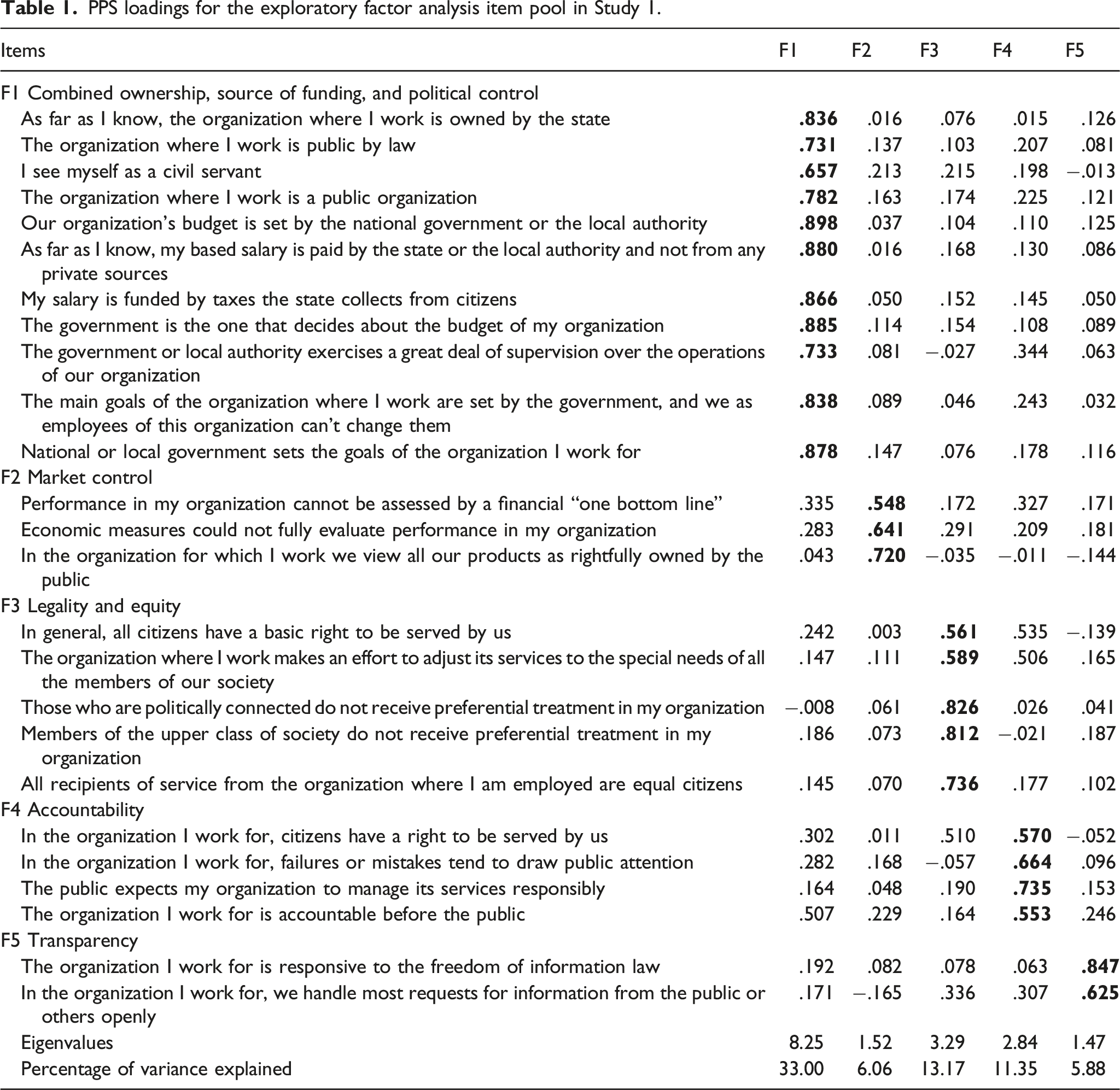
One item, “In the organization I work for, we owe answers to the public about our performance levels,” displayed negative factor loadings, indicating participants did not interpret it as a transparency item like the others. This item was subsequently removed. All of the remaining items loaded substantially on one of five factors. The five-factor solution was supported by the Scree plot, the Kaiser–Guttman criterion (eigenvalues exceeding 1), and the factors’ theoretical meaningfulness and explained 69% of the variance. Interestingly, items intended to measure the three dimensions of publicness proposed by Bozeman (1987)—ownership, funding, and political control—loaded onto a single factor rather than the three separate factors anticipated. Similarly, equity and legality loaded onto a single factor as these concepts were interpreted similarly by participants.
The first factor, explaining 11.44% of the variance, comprised 11 items: ownership, funding, and political control. These dimensions were interpreted as a single construct by participants. The second factor, explaining 1.16% of the variance, contained three items related to market control. This factor captured the perceived extent to which the organization is driven by market forces and financial objectives. The remaining three factors focused on normative aspects of publicness. Factor 3 (eigenvalue = 1.42) included three items related to the combined concepts of perceived legality and equity. Factor 4 (eigenvalue = 2.95) comprised six items measuring perceived accountability, and Factor 5 (eigenvalue = 1.03) contained 2 items capturing perceived transparency.
Means, Standard Deviations, Reliabilities, and Correlations among variables in Study 1.
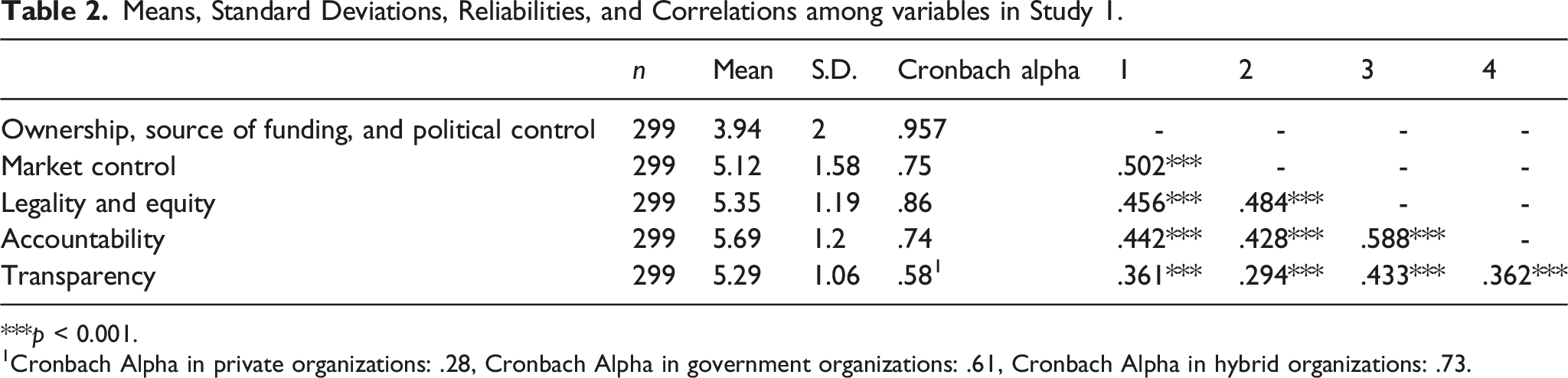
***p < 0.001.
1Cronbach Alpha in private organizations: .28, Cronbach Alpha in government organizations: .61, Cronbach Alpha in hybrid organizations: .73.
Mean, Standard Deviations, and ANOVA results of PPS Sub-factors across Sectors in Study 1.
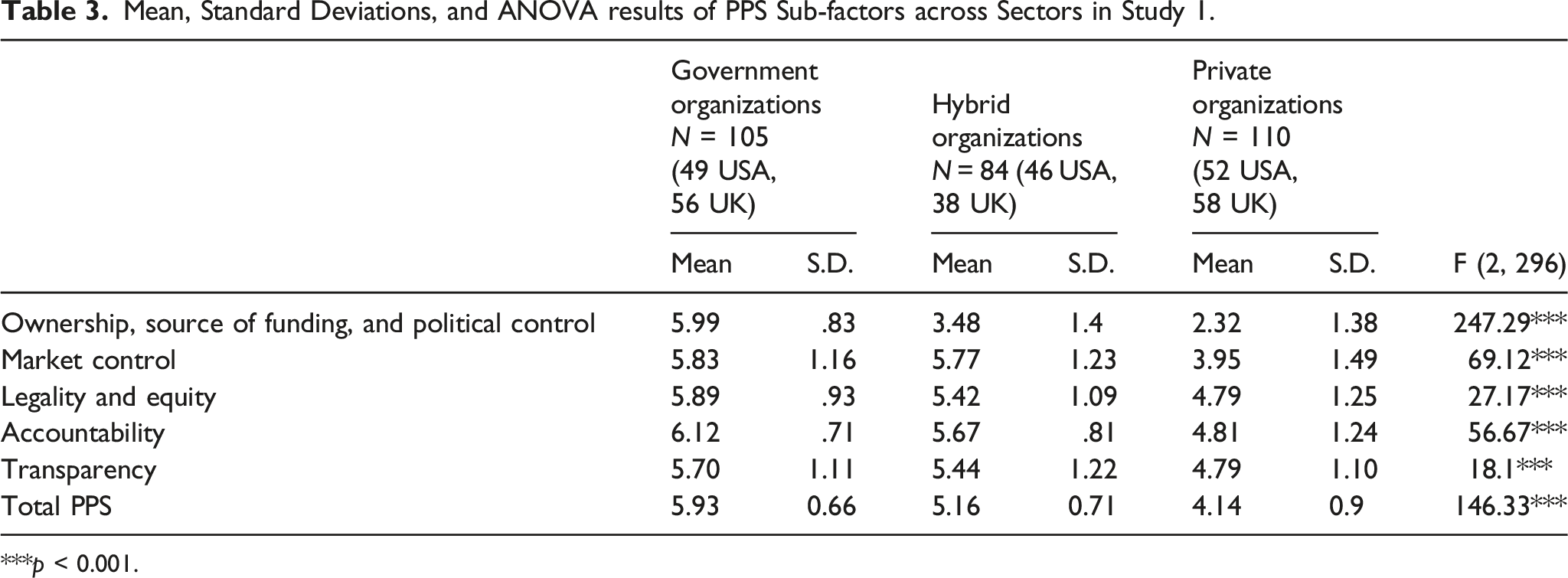
***p < 0.001.
Study 2: Quantitative examination of the PPS and its validity
Method
To further assess the scale’s validity, we conducted a field study involving 346 employees across four organizations in Israel. 3 This sample size was constrained by the number of volunteer participants within the organizations we collaborated with (the response rate was 54%). Participants were either radiology technicians (n = 65) working in two hospitals (one public, one non-profit) or highly skilled security personnel (n = 281) working for a government agency and an energy firm. These professions are both regulated, 4 and employees across the sectors are expected to operate according to similar professional protocols when serving the public. In addition, each profession is trained according to similar skill requirements regardless of organizational affiliation.
Participants completed a paper questionnaire after providing informed consent. The questionnaire included: The 26-item PPS scale, with a revised transparency item replacing the one with negative loading in Study 1. Responses were recorded on a 5-point Likert scale (1 = not at all like my organization, 5 = completely like my organization). Several additional measures were relevant to the study hypotheses, and control variables including gender, age, and tenure.
The participant demographics distribution revealed that 76% of the sample was male (reflecting the predominance of males in security professions), 82% held academic degrees, mean age in the radiology technicians sample was 32.7 years (SD = 10.26), and in the security personnel sample was 27.7 years (SD = 5.6). Mean tenure in the in the radiology technicians sample was 6.45 years (SD = 7.53), and in the security personnel sample was 3.53 years (SD = 5.02). No significant differences in mean item scores were found based on gender, age, or tenure. 5
Analysis and Findings
Final Publicness Perception Sub-Scale Item structure based on Study 2.
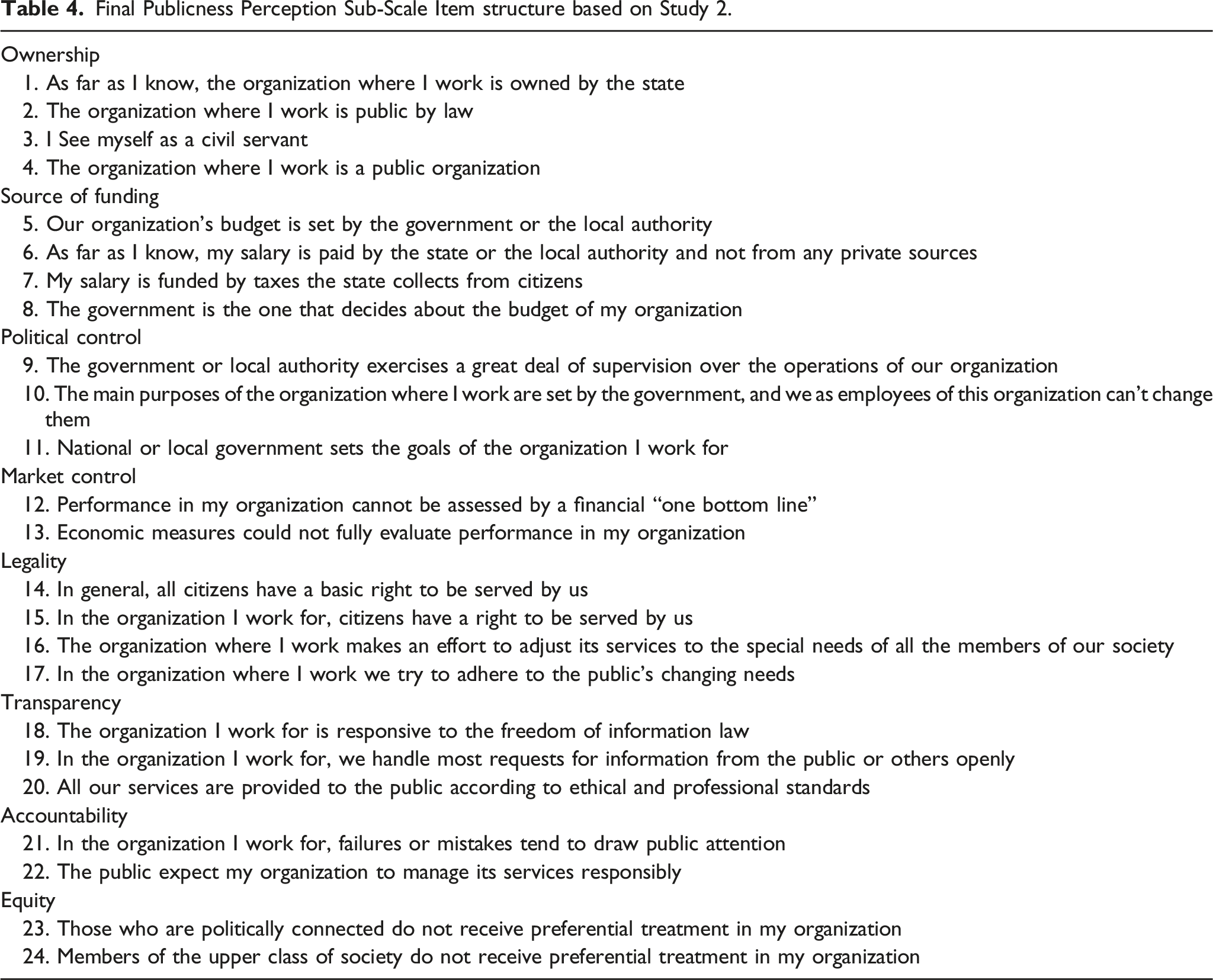
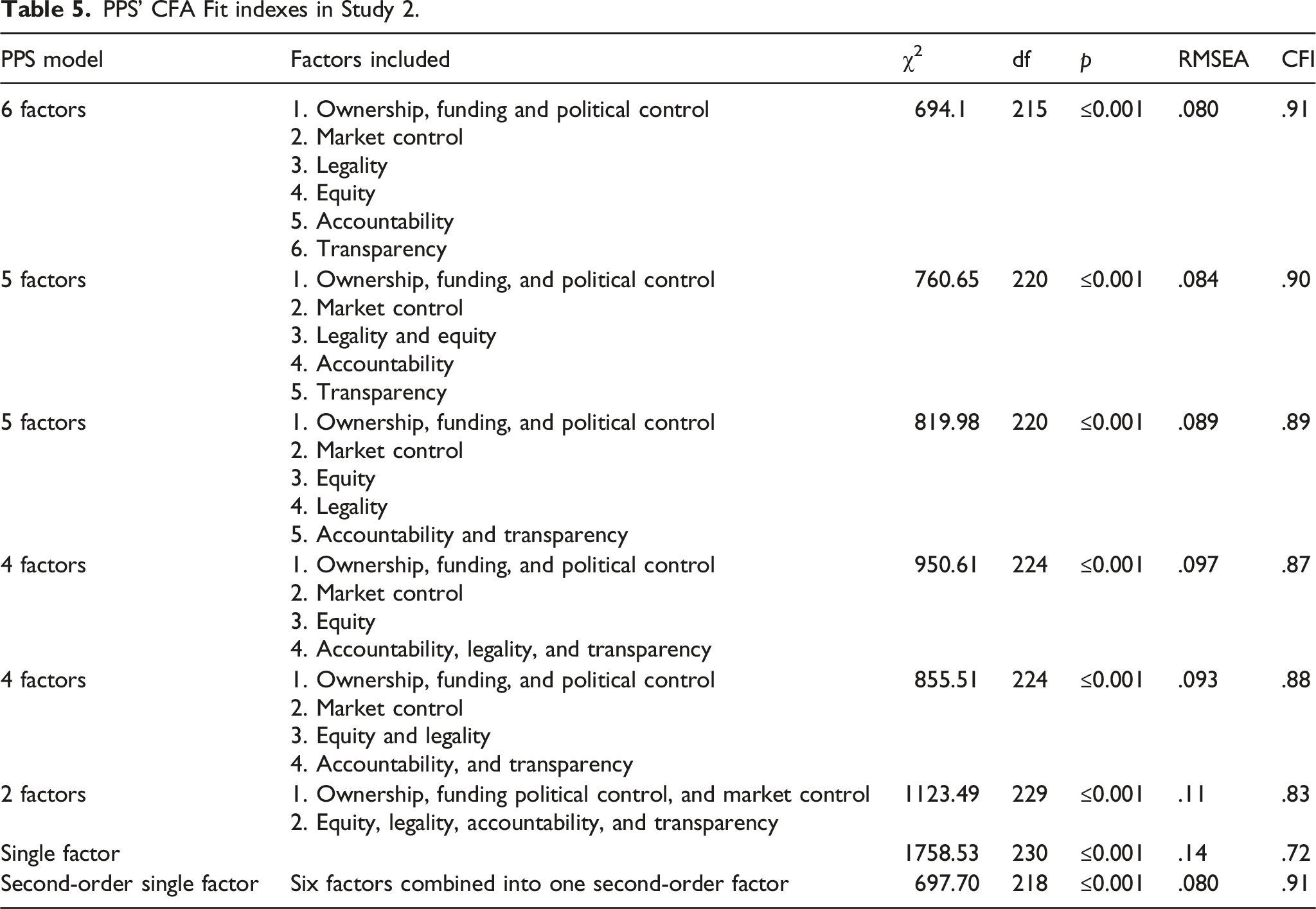
We then conducted several CFAs on the revised scale. The initial five-factor model again showed modest fit (χ2 (220) = 760.65, p ≤ .001; CFI = 0.90; RMSEA = 0.084), with the RMSEA exceeding the 0.08 threshold for acceptable fit. We subsequently tested alternative models combining the normative factors in various ways. Among these, a six-factor model emerged as the best fit, where: One factor combined perceived ownership, funding, and political control; One factor included the two market control items; and the remaining four factors represented distinct normative dimensions: perceived equity, legality, accountability, and transparency. This six-factor model exhibited good fit (χ2 (215) = 694, p ≤ .001; CFI = 0.91; RMSEA = 0.08) with all factor loadings exceeding 0.50 (Hair et al., 2019). This model is presented in Appendix C. We compared this six-factor model to alternative models, including a two-factor model distinguishing ownership/funding/political control/market control from all normative dimensions (χ2 (229) = 1123.49, p ≤ .001; CFI = 0.83; RMSEA = 0.11) and a one-factor model representing the entire PPS as a single construct (χ2 (230) = 1758.53, p ≤ .001; CFI = 0.72; RMSEA = 0.14). The six-factor model demonstrated significantly better fit than these alternatives, supporting its validity.
PPS’ CFA Fit indexes in Study 2.
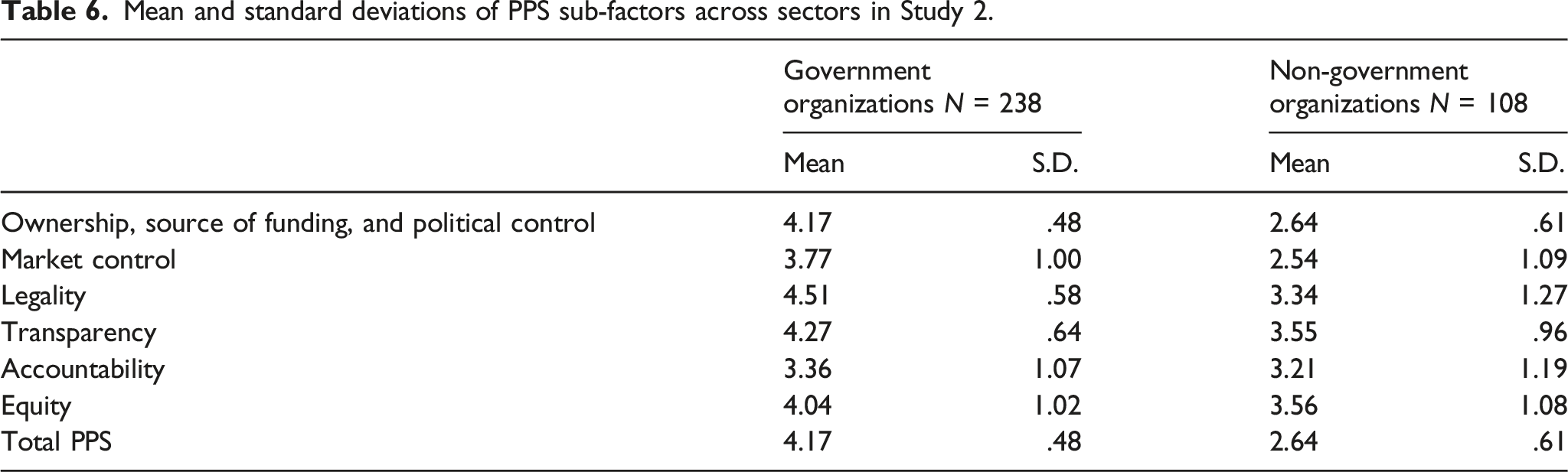
Mean and standard deviations of PPS sub-factors across sectors in Study 2.
Reliability, AVEs, CRs, and correlations among variables in Study 2.
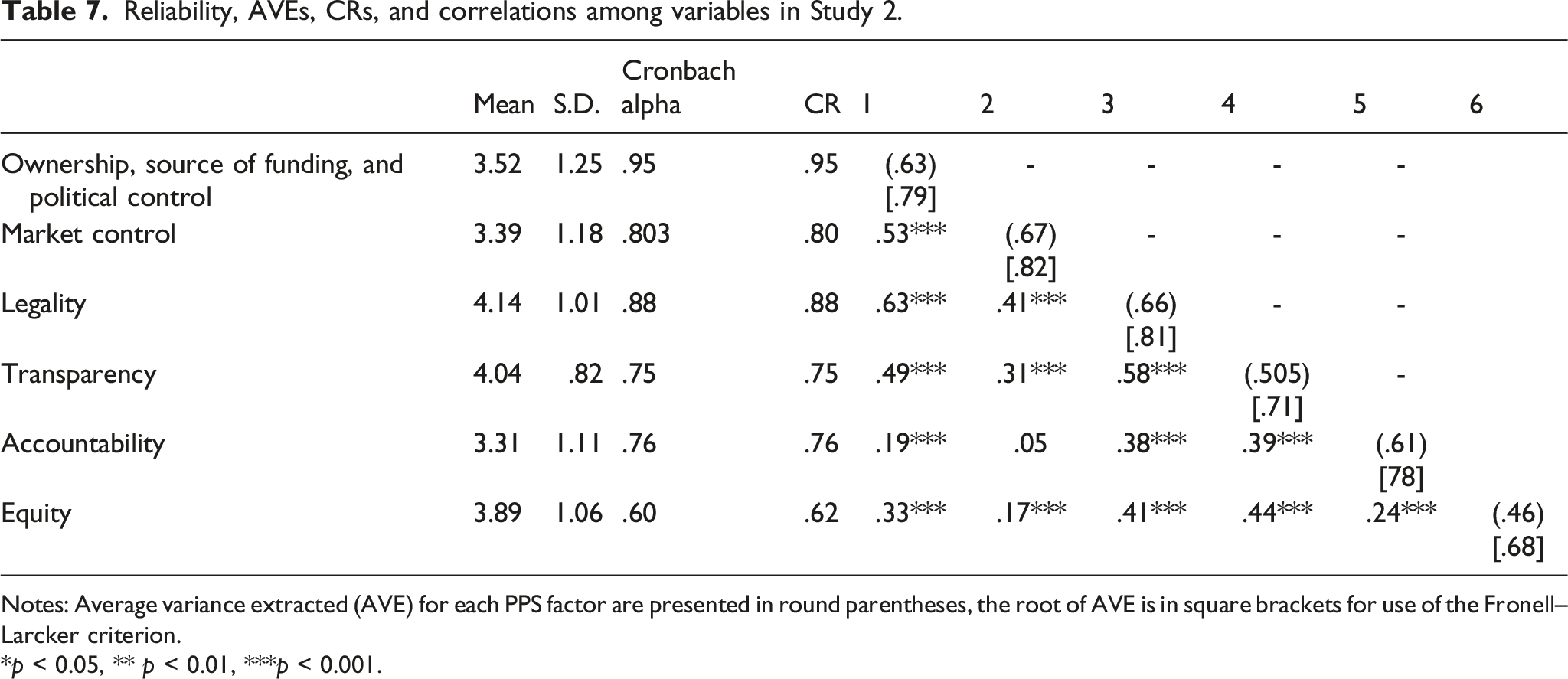
Notes: Average variance extracted (AVE) for each PPS factor are presented in round parentheses, the root of AVE is in square brackets for use of the Fronell–Larcker criterion.
*p < 0.05, ** p < 0.01, ***p < 0.001.
Finally, the Cronbach Alpha for women was 0.89 and for men was 0.95, for the radiology technicians 0.84 and for the security personnel .95. In all cases, these are high reliability indicators and differences result from the small sample sizes for women and radiology technicians. Hence, this study refines the PPS by establishing a six-factor model with good construct validity and reliability (Zinbarg et al., 2005). The six factors represent distinct yet interrelated dimensions of perceived publicness, providing a nuanced understanding of how employees perceive their organizations’ publicness orientation.
In the next section we examine the convergent and discriminant validity of the PPS scale, assessing its relationships with theoretically relevant and unrelated constructs.
Convergent validity
Convergent validity demonstrates that the PPS relates positively to constructs expected to be similar in meaning. Three such constructs were examined: 1. Universalism: This value reflects a desire to understand, appreciate, and protect the welfare of all people and nature. We measured universalism using the PVQ-RR Value Scale (Schwartz et al., 2017) (α = 0.86). As expected, a positive correlation (r = 0.26, p ≤ .001) was found between PPS and universalism. 2. Public Service Motivation (PSM): This refers to an individual’s desire to serve the public. We used the shortened PSM Scale (Perry et al., 2008) (α = 0.70) and found a positive correlation with PPS (r = 0.24, p ≤ .001). This correlation was slightly stronger in government organizations (r = 0.30, p ≤ .002), supporting the notion that PSM is a characteristic feature of public administration. 3. Organization Type: Legal ownership often serves as a measure of publicness. We found a strong positive correlation (r = .80, p ≤ .001) between PPS and organization type (public/governmental = 1, non-governmental/hybrid = 0). Additionally, an independent samples t test confirmed significantly higher PPS scores in government organizations (t [168.60] = 22.85, p ≤ .001), suggesting public organizations are perceived as more public.
Discriminant validity
Discriminant validity establishes that the PPS is distinct from theoretically unrelated constructs. The constructs examined were as follows: 1. Perceptions of Organizational Politics (POP): This reflects the perceived extent of self-interested behaviors within organizations. We used the shortened POPS scale (Kacmar and Carlson, 1997) (α = 0.85). As expected, the correlation between POP and PPS was not significant (r = −0.07), indicating these constructs are distinct. 2. Stress: This refers to job-related pressures. We operationalized stress as emotional exhaustion and measured it using the MBI-ES (Maslach et al., 1996) (α = 0.85). The correlation between emotional exhaustion and PPS was also not significant (r = 0.01), supporting the discriminant validity of the PPS. 3. Extraversion/Introversion: These personality traits are not theoretically linked to organizational publicness. We used the Big-Five Inventory (John et al., 1991) to measure these traits. Neither extraversion (α = 0.70, r = 0.08) nor introversion (α = 0.62, r = −0.06) showed significant correlations with PPS, further supporting its distinction from these traits.
Discussion
This study aims to extend our understanding of the meaning of publicness by both enriching its theoretical discussion and methodological tools for use in future studies. By using a perceptual approach to publicness we develop and validate a new scale titled the Publicness Perceptions Scale (PPS). Our study follows Scott’s (2001) view of organizations as multifaceted institutions with diverse public meanings (i.e., ownership, funding, control, and public values). Thus, the PPS reflects this view by focusing on employees’ perceptions, and demonstrates how the scale integrates various publicness dimensions (legal ownership, funding, and control) with public values (legality, equity, transparency, and accountability) into a single construct based on individual perceptions. We believe that this line of study sets the ground for future research who may be interested in exploring the meaning of publicness in other contexts, and also in establishing firmer relationships between publicness and performance at the individual level.
Our two studies support the proposed multidimensional structure of publicness, enabling a nuanced understanding across organizations. Notably, “objective” dimensions like ownership, funding, and political control were combined in a single factor in our sample, while market control stood as a distinct factor. These findings largely challenge past findings about the separate and independent standing of theses dimensions (e.g., Andrews et al., 2011; Boyne, 2002; Bozeman, 2007; Moulton, 2009).
Furthermore, our study underscores the significance of integrating normative aspects (public values) within the construct of publicness (e.g., Moulton, 2009), alongside formal aspects (ownership, funding, and control; Bozeman and Moulton, 2011). This approach recognizes public values as a fundamental dimension of the PPS, on par with its traditional components. We believe that this approach is likely to explain employee behavior beyond formal duties, including “going above and beyond” (Organ, 1988) within and outside the workplace. It also aligns with existing research linking the PPS to employees’ engagement and their prosocial behaviors (Dryzin-Amit et al., 2022). Hence, we propose that the PPS scale may contribute to publicness theory by suggesting new avenues for understanding both informal and formal performance in diverse organizational settings.
Variations in PPS scores across sectors demonstrate publicness’ relevance beyond government organizations and highlight the importance of publicness in non-public and hybrid organizations. The PPS may thus offer a valuable tool for understanding publicness’ antecedents and consequences in diverse contexts. Interestingly, we observed higher standard deviations among non-governmental organizations, pointing towards a greater diversity in publicness perceptions within hybrid and private sectors (Van der Wal et al., 2008). Furthermore, the positive correlation between the PPS and legal ownership type in both studies supports the scale’s face and content validity, aligning with its theoretical grounding (Min and Yang, 2023; Scott, 2001). As expected, employees in government organizations generally reported higher publicness perceptions. However, ownership type only explained 53% of the variance in PPS, suggesting significant influence from other factors beyond objective ownership (e.g., Boyne, 2002). This reinforces the conclusion that publicness is highly relevant across all organizational types, not just the public sector.
Theoretical and managerial implications
This study tried to rationalize the need to use a more perceptual approach to the study of publicness. The distinction between public and private organizations was in the heart of our theoretical concern, methodological design and empirical effort. We have built on substantial differences between the sectors (e.g., ownership, funding, and control), and further argued that publicness is important as it impacts performance (Bozeman, 1987, 2007).
The suggested PPS captures perceptions of publicness dimensions (ownership, funding, and control) and public values (legality, equity, etc.) as a single construct. Building on neo-institutional theory (Scott, 2001), we argued that individual perceptions of publicness are shaped by the institutional pressures organizations face. These pressures, driven by societal norms and expectations (i.e., normative and cultural-cognitive elements) lead to variations in how employees interpret their organization’s publicness.
We maintained that publicness perception may act as a mediator between objective characteristics of individuals and organizations, and a variety of outcomes and performance indicators. While both objective and subjective measures of publicness have considerable limitations, they may be included together in future studies of the field.
Another implication of our study is that expanding definitions of publicness to include public values and perceptions are increasingly relevant (Wise, 2010) due to the growth of complexity in organizations (e.g., hybrid sector) and the generational gap. For example, Ertas’ (2016) research on Millennials' volunteerism across sectors suggests a rising generation with a strong prosocial orientation, potentially influencing organizations towards publicness.
Our findings also support the assumption that publicness is not just about objective characteristics (ownership, funding) but also shaped by subjective interpretations (e.g., Min and Yang, 2023). Understanding how employees’ perceptions of publicness influence their commitment, motivation, and job satisfaction can equip researchers and leaders with valuable insights. While publicness inherently extends beyond individual perceptions (Bozeman, 2007), the PPS may serve as a useful tool to explore the collective impact of publicness. It could potentially identify a “tipping point” where shared employee preferences regarding publicness influence a shift towards a more or less public-oriented organizational mission.
Beyond theoretical contributions, this study also suggests some practical implications for organizational leaders. The PPS can serve as a tool to measure employee perceptions of publicness within organizations to examine their alignment with the organization’s intended values (i.e., legality, equity, transparency, and accountability). Furthermore, exploring the potential link between the PPS and indicators of efficiency, effectiveness, and public policy evaluations can shed light on whether organizations prioritizing publicness reap tangible benefits. The PPS could also be incorporated into employee performance evaluations, allowing for the recognition and assignment of employees who align with public values and hence may be more suitable for leading high-public-impact projects.
Practitioners can utilize the PPS in interventions (e.g., surveys and workshops), both as a measurement tool and discussion points based on its dimensions. Such interventions may want to include educating managers and employees on publicness theory (Merritt et al., 2018), and its connection to public outcomes, improve internal collaboration between organizational units to better public service provision, mapping actions to strengthening organizational reputation and public trust. Similarly, the PPS can further be utilized in interventions within non-governmental organizations (e.g., corporates and NGOs) to increase societal impact, foster Shared Values (Porter and Kramer, 2019), and enhance Corporate Social Responsibility (Matten and Moon, 2008), raising awareness of jobs’ societal impact (Vogel and Willems, 2020). Consequently, such practical actions cultivate prosocial behaviors and publicness orientation (Merritt, 2019; Merritt et al., 2018).
By addressing these future research and practical avenues, this study tried to contribute to a broader and deeper understanding of publicness perception and its implications for various stakeholders. It empowers researchers, managers, and practitioners with actionable insights for fostering a more meaningful and impactful organizational landscape by harnessing the power of publicness.
Limitations and future research
This study entails several limitations that should be addressed in future research. First, the sample in Study 1, drawn solely from the USA and UK, limits generalizability to other nations and non-Western cultures. Replication with diverse populations and conducting Measurement Invariance Testing (MIT) across groups would strengthen the understanding of the PPS’s consistency across cultures. Future studies should also employ larger and more diverse samples across sectors, demographics, and sampling methods (e.g., random sampling and broader populations) to further confirm the scale’s generalizability and robustness. Alternative data collection methods (e.g., face-to-face and MTurk) might address some limitations but have their own drawbacks. Therefore, future studies should explore alternative approaches to overcome the limitations of Prolific.co.
Second, Study 2 lacked private sector employee participation from professions identical to those in the hybrid or public sectors. Future studies should aim for broader samples encompassing all three sectors. Additionally, Study 2’s focus on only two professions (radiology technicians and security personnel) limits the PPS’s predictive power. Future research should utilize more diverse samples, particularly professions where public servants hold authority over citizens (e.g., police officers vs private security, tax collectors vs private tax advisors). In such contexts, publicness perceptions might have a significant influence on upholding the public interest.
Third, the current PPS incorporates four public values (legality, equity, transparency, and accountability). Future studies could explore the inclusion of additional values, acknowledging the potential trade-off between comprehensiveness and scale length (Van der Wal et al., 2016). Additionally, considering the multifaceted nature of values (e.g., accountability defined as “answering for decisions” [Tun et al., 2021] vs fulfilling public interest [Haque, 2001]), future research may examine whether items based on different definitions or derived values exhibit similar behavior within the PPS. Fifth, Study 1 revealed a low Cronbach Alpha for transparency in the private sector. Future studies should investigate whether this reflects the chosen definition of transparency or sector-specific interpretations of the concept. Finally, understanding the interplay between objective and value-based dimensions is crucial for addressing complex societal and organizational challenges. Future studies could incorporate objective measures alongside the PPS to further validate its subjective dimensions.
Supplemental Material
Supplemental Material - Unveiling the spirit of publicness: Conceptualization and validation of a publicness perceptions scale
Supplemental Material for Unveiling the spirit of publicness: Conceptualization and validation of a publicness perceptions scale by Yinnon D Amit, Dana R Vashdi, and Eran Vigoda-Gadot in Journal of General Management
Footnotes
Acknowledgments
The Authors thank the scholars, R. Andrews, K. Meier, R. Vogel , T. Christensen, J. Perry, H. Rainey, S. Van de Walls, W. Van Dooren, R. Walker & B. Bozeman, who have participated in the expert survey and kindly offered their thoughtful insights to this study.
Declaration of conflicting interests
The author(s) declared no potential conflicts of interest with respect to the research, authorship, and/or publication of this article.
Funding
The author(s) received no financial support for the research, authorship, and/or publication of this article.

Supplemental Material
Supplemental material for this article is available online.
Notes
References
Supplementary Material
Please find the following supplemental material available below.
For Open Access articles published under a Creative Commons License, all supplemental material carries the same license as the article it is associated with.
For non-Open Access articles published, all supplemental material carries a non-exclusive license, and permission requests for re-use of supplemental material or any part of supplemental material shall be sent directly to the copyright owner as specified in the copyright notice associated with the article.
