




Abstract
Orchestrating open innovation initiatives characterized by frequent changes in stakeholders and activities can be a daunting task. As these initiatives need to adapt to the constantly changing requirements of the process, they can benefit from an open organizing approach that enables the direct participation of stakeholders, not only in the innovation process but also in its orchestration. Building on the constitutive view on open organizing, we argue that the interactions among various stakeholders can be orchestrated by an open organizing process complemented by elements of closure. However, determining when and how to deploy a closure to complement open organizing remains a practical and theoretical puzzle. We address this puzzle through a longitudinal field study of an award-winning open innovation initiative tackling the sustainability challenges of oceans. We show when and how temporary closures can catalyze the participation of diverse stakeholders across phases, while opening up the organizing process to participatory fine-tuning allows the orchestration to evolve with the changing requirements of the process. By emphasizing the temporal dimension of deploying closure in open organizing, we develop a process model explaining how punctuated openness—open organizing interrupted by moments of closure—can be used as an organizing principle.
Introduction
The role of open innovation (OI) in addressing problems in science and business has been well recognized in the existing literature (Chesbrough & Bogers, 2014; West & Bogers, 2014). OI is defined as ‘a distributed innovation process based on purposively managed knowledge flows across organizational boundaries’ (Chesbrough & Bogers, 2014, p. 17). Numerous studies have documented how firms can open up to partners to complement their internal R&D efforts, for instance, by involving suppliers and customers in the fuzzy front end of their new product development processes (Schemmann, Herrmann, Chappin, & Heimeriks, 2016); forming R&D alliances for developing complex technology (Vanhaverbeke & Cloodt, 2014); or launching a platform for others to develop complementary products and services (Gawer & Cusumano, 2014). In these contexts, a focal organization typically takes ownership of the innovation problem and orchestrates the process, for instance, by defining the problem, selecting potential partners, or specifying the rules of engagement (Dhanaraj & Parkhe, 2006).
Recently, scholars have started to explore the potential of OI for generating solutions to complex problems affecting larger collectives such as regional ecosystems, industry, or society at large (Brunswicker, Bilgram, & Füller, 2017; Ooms & Piepenbrink, 2021; Reypens, Lievens, & Blazevic, 2021). Because these problems have no apparent owner and affect a multitude of stakeholders in diverse ways, their solution often hinges upon the involvement of various stakeholders who bring different perspectives throughout the OI process. When such OI initiatives involve a ‘wicked problem’ (Rittel & Webber, 1973), both the issues and potential solutions may be disputed by diverse stakeholders who possess divergent understandings (Ooms & Piepenbrink, 2021). As the underlying problems are often ill-defined and poorly understood, the involved stakeholders need to continuously (re)frame the issue (Head, 2019) and (re)align their perspectives (Seidl & Werle, 2018). Moreover, as stakeholders ‘come and go, change their minds, fail to communicate, or otherwise change the rules by which the problem must be solved’ (Conklin & Weil, 1997, p. 4), the innovation process itself needs constant refreshing with new stakeholder perspectives.
We propose that an open organizing approach that combines openness in the innovation process with a more transparent and participatory form of organizing, can benefit OI initiatives addressing multi-stakeholder problems that are wicked in nature. Informed by the emergent literature on open organizing (e.g. Dobusch & Dobusch, 2019; Luedicke, Husemann, Furnari, & Ladstaetter, 2017), we argue that an open organizing process complemented by elements of closure can facilitate the frequent (re)alignment of changing stakeholders. Specifically, we turn to the ‘constitutive’ view of openness as a processual lens for examining how the interactions of various stakeholders can be orchestrated by leveraging different forms of openness and closure (Dobusch & Dobusch, 2019). Rather than conceptualizing closure as a barrier to openness, the constitutive view acknowledges that closure may be necessary to reach the desired open qualities (Dobusch & Dobusch, 2019). Accordingly, prior studies have demonstrated that an open organizing process may need to be complemented with closed practices, such as predefined rules and procedures for demarcating the perimeters of participation and information disclosure (Dobusch & Dobusch, 2019; Dobusch, Dobusch, & Müller-Seitz, 2019; Reischauer & Mair, 2018), or ‘counterbalancing practices’ for coping with the unintended side effects of increasing levels of openness (Hautz, Seidl, & Whittington, 2017; Luedicke et al., 2017). However, we have a limited understanding of how the temporal patterns in open organizing unfold, especially when the dynamically evolving sets of stakeholders preclude a single organization from deploying open and closed practices to orchestrate the process. Therefore, determining when to close certain dimensions of the OI process and how to orchestrate such a process remains a practical and theoretical puzzle that we address in this paper.
Through a longitudinal study of Save Our Oceans (SOO), an award-winning OI initiative developing sustainable innovations in the maritime industry, we examine when and how closures can support the continuously changing involvement of stakeholders throughout the OI process. Our analysis shows that SOO organizers deployed temporary closures as a mechanism to initiate co-creation among diverse participants while ensuring progress—a key consideration in OI initiatives that need to accommodate changing stakeholders across different phases of the process. However, these predefined and authoritative moments of closure were insufficient for co-creation to unfold; in addition, the process needed to evolve as the participants’ involvement changed over time. We found that orchestration of the process involved participants in fine-tuning the closures to fit their continuously changing understanding and interests. Grounded in these findings, we developed a process model explaining how ‘punctuated openness’—open organizing interrupted by moments of closure—can be used as an organizing principle to orchestrate OI initiatives addressing multi-stakeholder problems that are wicked in nature.
Our study provides novel insights into how openness and closure generate the desired co-creation across different phases of an OI process. Specifically, while authoritative closures, such as structuring the co-creation process or the co-created content, were essential to initiate and channel co-creation between phases, our findings underscore the importance of involving participants in monitoring and adjusting these structures to accommodate the emergent requirements of the process within each phase. By highlighting the essential role of timing in deploying closures to generate openness, we are offering a contribution that is relevant for our understanding of orchestrating OI and open organizing more broadly. Our study also provides insights into the orchestration of OI initiatives without a central organizer, by explaining how punctuated openness supports orchestration as a dynamic and distributed process.
Theoretical Background
Open innovation to address wicked multi-stakeholder problems
Organizations increasingly use OI to find new ways for solving pressing problems by enabling an inflow and outflow of knowledge beyond organizational boundaries (Chesbrough, 2003). Through OI, the boundaries between organizations and their surrounding environments become more permeable, stimulating co-creation and cooperative interfirm relationships for innovation (West & Bogers, 2014). OI is valuable because it allows integrating the intellectual resources of a wide range of stakeholders for novel ideas while increasing the value of organizations’ innovative efforts, for instance, by sharing costs and risks or increasing the acceptance of innovation (Vanhaverbeke & Cloodt, 2014).
While opening up organizational boundaries offers key advantages to organizations, OI initiatives are still often dominated by a focal firm. OI contexts studied in the literature typically feature an organization that defines the problem and selects partners based on shared interests and complementary knowledge or resources (Bagherzadeh, Gurca, & Brunswicker, 2022; Lopes & de Carvalho, 2018; Sydow & Müller-Seitz, 2020). Even OI initiatives that allow stakeholders to self-select, such as crowdsourcing involving customers or citizens, are typically orchestrated by a focal firm that limits openness to a single phase (i.e. ideation) while preserving the control of others (e.g. problem definition, implementation) (Brunswicker et al., 2017; Majchrzak & Malhotra, 2020).
Recently, the strength of OI to tap into a diverse pool of knowledge and resources has been leveraged to tackle challenging problems that affect a variety of stakeholders. These problems are often referred to as ‘wicked problems’ (Rittel & Webber, 1973), i.e. they are ill-defined and difficult to solve as they involve conflicting and constantly changing elements that can hardly be recognized by any single organization. Therefore, the involvement of diverse stakeholders who can interpret the problem in different ways can be helpful for understanding the problem in its entirety (Head, 2019; Roberts, 2000). OI is especially promising for addressing these problems because it connects stakeholders who would not otherwise come together (McGahan, Bogers, Chesbrough, & Holgersson, 2021). Accordingly, it has been used to tackle wicked multi-stakeholder problems in a range of settings, from large-scale R&D consortia (Reypens et al., 2021), health and public administration (Kornberger, Meyer, Brandtner, & Höllerer, 2017; Ooms & Piepenbrink, 2021) to civic and social innovation (Brunswicker et al., 2017; Sims, Gichoya, Bhardwaj, & Bogers, 2019). As diverse stakeholders interact in OI, they reveal new, previously unknown facets of the problem (Porter, Tuertscher, & Huysman, 2020). In turn, the evolving understanding of the problem reveals the need for new knowledge or resources, calling for additional stakeholders to become involved, while previously involved stakeholders may become redundant (Seidl & Werle, 2018).
As the involvement of stakeholders in the OI process dynamically changes, they need to (re)align their efforts by negotiating their differences (Majchrzak & Malhotra, 2020). (Re)alignment is critical throughout the OI process to ensure that stakeholders can move forward on shared outcomes without diminishing their individual interests (Seidl & Werle, 2018). Constantly refreshing the innovation process with new stakeholder perspectives also strengthens the solutions to wicked problems by increasing their widespread acceptance (Roberts, 2000). Such frequent (re)alignment of changing stakeholders may be facilitated by an open organizing approach that empowers stakeholders not only to participate selectively in co-creation but, instead, to shape the process throughout the entire initiative.
An open organizing approach to open innovation
A growing number of organizations use openness as an organizing principle to increase participation and transparency in organizational processes (Hautz et al., 2017; Whittington, Cailluet, & Yakis-Douglas, 2011). Research shows that increasing stakeholder participation and transparency enables greater creativity in idea generation (Whittington et al., 2011), joint sensemaking and a shared understanding of the problems among stakeholders (Seidl & Werle, 2018), and helps to build trust and legitimacy (Gegenhuber & Dobusch, 2017).
However, orchestrating OI initiatives through open organizing may be difficult to accomplish. While examples such as open communities use participatory rules and norms to guide the collective interactions among participants (Curto-Millet & Shaikh, 2017; Dobusch et al., 2019; Shaikh & Vaast, 2016), such consensus-based orchestration mechanisms require considerable time to emerge (Hautz et al., 2017; O’Mahony & Ferraro, 2007). Such slowly evolving approaches are not appropriate for tackling wicked problems, as the organizing process needs to respond swiftly to the emerging understandings of the problem and the changing involvement of stakeholders (Porter et al., 2020). Moreover, many multi-stakeholder initiatives that pledge to be open are often orchestrated by a dominant organization, making the organizing process less open than desired (Tavakoli, Schlagwein, & Schoder, 2017). Considering the different challenges of either approach, scholars have pointed out that OI initiatives involving diverse stakeholders may need to combine a mix of consensual and authoritative orchestration mechanisms to respond to emergent challenges (Reypens et al., 2021).
The idea that open organizing can be complemented with elements of closure resonates with research on open organizing. This literature defines closure as the specification of procedures (e.g. timelines, roles, and responsibilities) that are often predefined, formalized, and placed authoritatively on the process, constraining the agency of actors for a given period (Dobusch & Dobusch, 2019; Dobusch et al., 2019; Hutter, Nketia, & Füller, 2017; Luedicke et al., 2017). Prior research has shown that such authoritative modes of orchestration can, in fact, increase the openness of the process. When a focal orchestrator authoritatively closes certain dimensions of the organizing process (e.g. specifying who is allowed to participate and how), the imposed structure can catalyze the widespread participation of diverse stakeholders (Dobusch & Dobusch, 2019). Ironically, evolutionary approaches characterized by unbounded openness can result in exclusionary effects with a core group of participants emerging to take over the strategic direction of the community (Dobusch et al., 2019). Increasing levels of openness may also produce uncontrolled complexity, inadvertently diminishing the desired effects (Dobusch & Dobusch, 2019). Therefore, closed practices can be necessary to demarcate the perimeters of interaction and encourage the participation of diverse stakeholders (Dobusch et al., 2019; Reischauer & Mair, 2018). Similarly, temporary authoritative practices can help counterbalance the unintended side effects of openness (e.g. information overload) once the open organizing process is off the ground (Luedicke et al., 2017). The so-called constitutive view of openness considers open organizing as an ‘oscillating movement between practices of opening and closing’ (Dobusch & Dobusch, 2019, p. 333), providing a processual lens for examining how the interactions of various stakeholders can be orchestrated with different forms of openness and closure.
However, existing research offers little insight into when to close certain dimensions of an open organizing process to enable particular open qualities, and how to orchestrate such a dynamic process. This is particularly relevant in the context of OI initiatives tackling multi-stakeholder problems that are wicked in nature. While open organizing processes that oscillate between open and closed practices can catalyze the widespread participation of stakeholders without plunging them into an arduous quest, it may be difficult to anticipate which stakeholders need to be involved at which moment. This unpredictability leads to a theoretical and practical puzzle in the literature that is yet to be addressed: when and how closure can support the continuously changing involvement of various stakeholders to realize innovations.
Research Context and Methods
Research site
Our research takes place in the context of an award-winning initiative called SOO. 1 SOO is a non-profit organization bringing together the expertise, resources, and knowledge within and outside the maritime industry to tackle the sustainability challenges of oceans. We selected SOO as a revelatory case (Patton, 2002) for investigating the orchestration of OI initiatives, calling for an open organizing approach, for several reasons. First, ocean sustainability problems exhibit a considerable degree of wickedness as they are difficult to define and lack a clear set of alternative solutions. Therefore, a variety of stakeholders with contested interests and demands are likely to interact during the entire OI process, from identifying the problems to implementing the most promising ideas. Further, the OI process was not orchestrated by a single organization that owned the problem; instead, SOO embraced an open approach with the continuous involvement of various stakeholders in both the innovation and organizing processes.
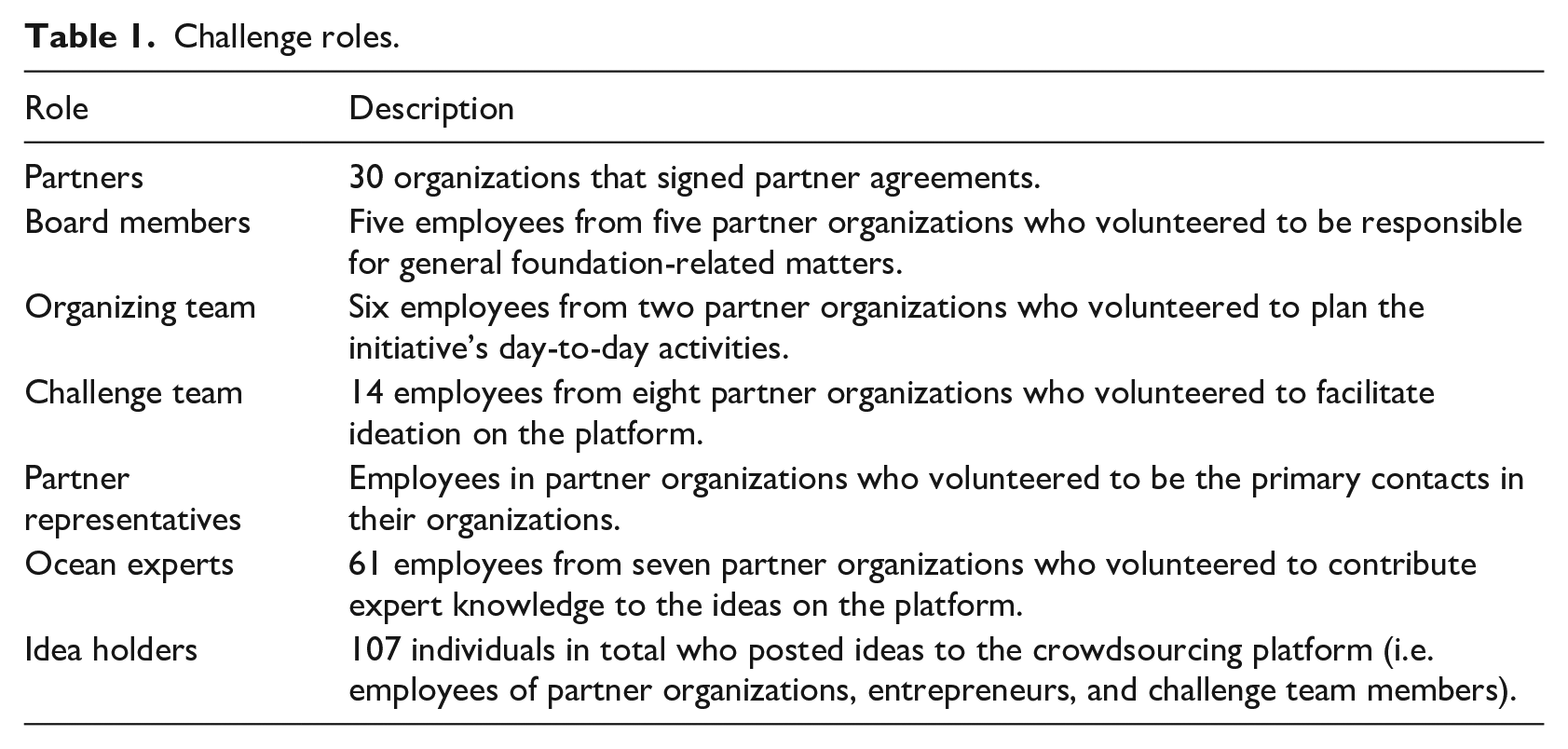
In 2014–2015, SOO hosted its first innovation challenge, where 12 partner organizations collaborated with numerous stakeholders to develop 87 ideas into 21 viable business plans. In 2016, SOO decided to launch a second innovation challenge, this time as a self-sustaining foundation independent of the founding partners. The number of partners progressively increased to 30 organizations throughout the OI process as new aspects of the problem emerged and new resource needs became apparent. The partner organizations committed to the initiative by giving their employees time to perform different roles and contribute to the challenge in multiple ways. The diversity and involvement of the stakeholders performing these roles also fluctuated over time; for instance, as issues around legal aspects and intellectual property (IP) rights emerged halfway through the challenge, an IP lawyer joined the initiative and later became a board member. See Table 1 for a summary of the different roles within the initiative.
Challenge roles.
SOO was organized in six phases: challenge selection, problem formulation, idea generation, evaluation, selection, and development. During challenge selection, partner representatives co-created challenge areas to be addressed in the OI process. Problem formulation entailed a workshop in which the partner representatives, joined by the board and the organizing team members (hereafter referred to as ‘the organizers’), co-created the challenge problem definitions to be posted on the crowdsourcing platform. Subsequently, during the idea generation phase, employees of partner organizations and the public were invited to submit their ideas that addressed the identified problems. During this phase, ocean experts ‘enriched’ the ideas posted by providing knowledge whenever issues requiring their expertise emerged, while challenge team members stimulated discussions among all the participants on the open platform. A total of 161 ideas were generated and enriched by 952 participants worldwide. Ocean experts, challenge team members, and the partner representatives evaluated all the submitted ideas, after which the partner representatives and the organizers selected the 20 most promising ones. In the final idea development phase, the participants behind the top 20 ideas worked closely with the various SOO stakeholders to further develop their ideas into viable business plans. Fifteen participants made it to the end of the idea development phase and pitched their business plans at a final event where an independent jury selected the ‘challenge winners’.
Data collection
We collected longitudinal data from various sources, including observations, interviews, and documents, between the years 2016 and 2018, and this provided us with an extensive real-time record of how the orchestration of the OI process unfolded over time. Triangulation across these multiple data sources allowed us to increase our findings’ reliability (Patton, 2002) and enabled us to reconstruct the elements of the process.
First, we observed the organizers’ meetings and key events like problem formulation and selection workshops, the idea announcement, and the final event in which participants with different roles came together. Our participant-observer role allowed us to see who was involved in real-time, what kind of information was disclosed, and how the participants made sense of the process (Patton, 2002). Throughout our observations, we took detailed fieldnotes and engaged in informal ethnographic interviews with the participants, which we later documented in detail and included in our analysis.
In addition, we conducted 46 semi-structured interviews with different SOO participants, including the board, the organizing team, the challenge team, ocean experts, partner representatives, idea holders, and the platform provider. Our questions covered their involvement in SOO, how they perceived their participation in the process, and how they interpreted the information shared during the initiative. These interviews allowed us to gain a comprehensive view of who was included or excluded in the activities, and gave us an insight into the participants’ experiences and assessments of the OI process over time (Barley & Tolbert, 1997).
Finally, we collected 69 documents produced by SOO as part of the organizing process, and accessed the crowdsourcing platform data. These sources provided valuable details on the specific activities in each phase, and allowed us to understand how and when SOO shared information throughout the process. We also obtained access to the organizers’ emails and the minutes of their meetings, which helped us make sense of the patterns we observed in our data. For instance, when we observed shifting levels of openness between activities, we could infer from email exchanges if the organizers planned these, and if so, why and how.
Data analysis
Our analytical strategy combined a process approach with inductive and deductive elements. We used an iterative approach (Corbin & Strauss, 1990) in which we alternated between writing case narratives, coding the various data sources, and reading additional literature.
We started our analysis by creating a chronological event list (Poole, Van de Ven, Dooley, & Holmes, 2000), based on our close reading of the observation notes and interview transcripts, and reconstructing the overall development of SOO’s OI process. We wrote descriptive narratives detailing the participants’ experiences and considerations in their language, drawing on quotes and texts from our data (Langley, 1999). We used temporal bracketing (Langley, 1999) and decomposed this process into the six distinct phases described above to structure our further analysis. Subsequently, we created schematic representations of the overall SOO process and its phases using visual mapping techniques (Langley, 1999).
As a next step, we used open coding (Corbin & Strauss, 1990) to uncover the orchestration of the OI process over time. An emergent theme was the changing involvement of participants across phases and how this process was orchestrated by creating frameworks to reach the desired co-creation. Through our engagement with additional literature, we recognized that our codes resembled the constitutive view of openness, which allowed us to further analyze our data with a more deductive lens.
Using a question-driven approach (Dobusch et al., 2019), we paid explicit attention to closures, such as the specification of timelines, roles, and responsibilities used to orchestrate the OI process and how they affected openness. For each phase, we analyzed how, when, and why relevant closures were deployed, and how these decisions influenced participants (e.g. who was included in what form), content (e.g. what content was created by whom, what content was modified and why), and information access (e.g. what information was shared or kept opaque, and with whom).
Informed by our coding and the visual representations of the data, we identified the events that were critical for understanding how the orchestration of the innovation process unfolded by dynamically creating moments of closure. Specifically, we considered events as critical if they (1) had a noticeable impact on the open organizing process and co-creation, and (2) could be linked to the conceptual categories and key concepts in our research framework (adopted from Poole et al., 2000). For instance, we considered it a critical event when the lack of commitment from potential stakeholders at the start of the OI process triggered a chain of reactions from the organizers who resorted to a temporary closure to get the co-creation process off the ground.
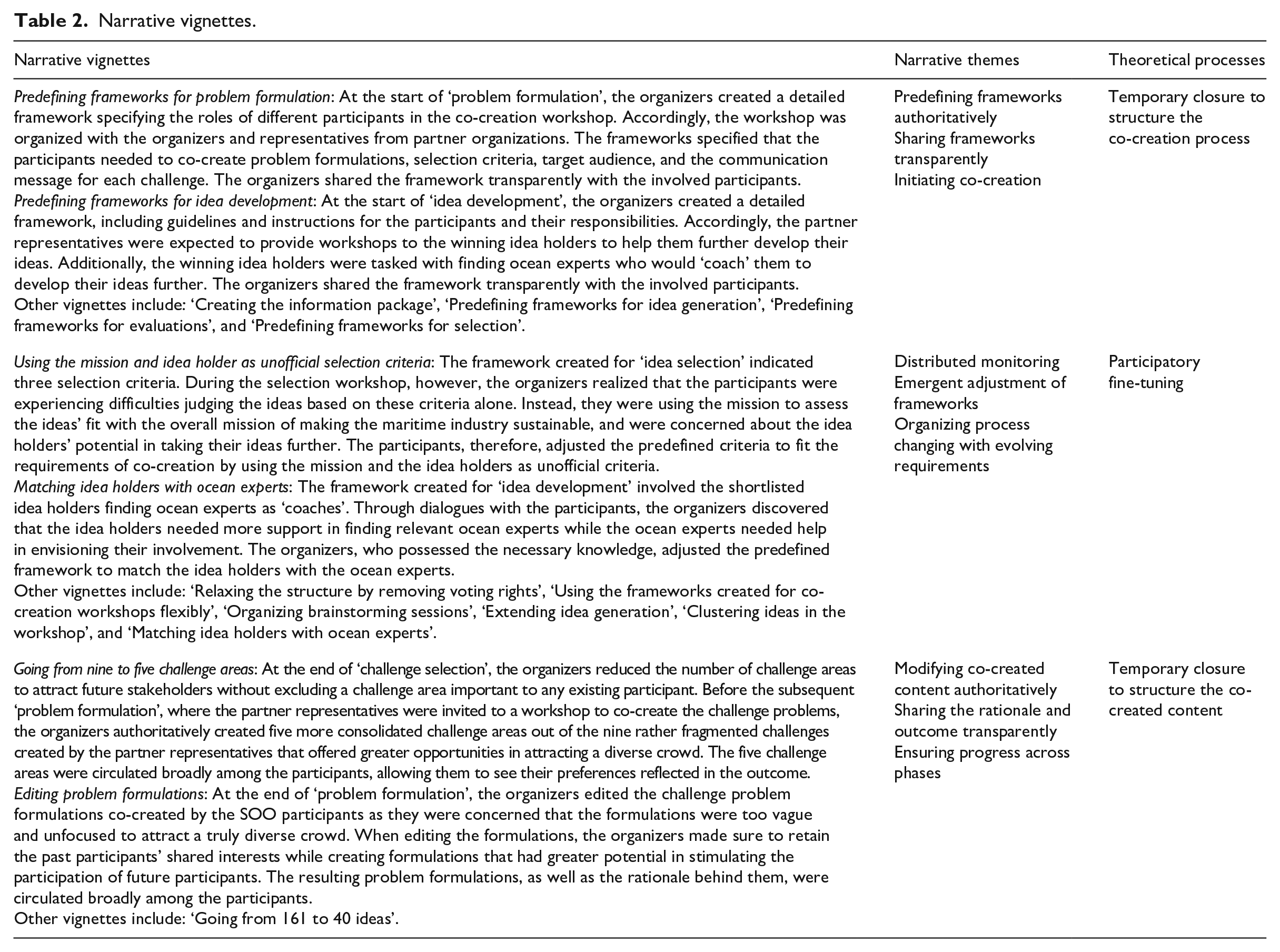
Iterating between the chronological event lists and themes emerging from our analysis, we created a visual map of the critical events constituting the theoretical processes throughout the SOO initiative (Figure 1). Moreover, we wrote narrative vignettes to understand the interdependencies and relationships between different dimensions of openness and closure, and how these could be explained by theoretical processes unfolding around these critical events. Table 2 provides exemplary narrative vignettes describing three theoretical processes drawing on our insights. Our findings give an overview of these processes and detail the temporal patterns we observed in openness and closure during the orchestration of the SOO OI process.
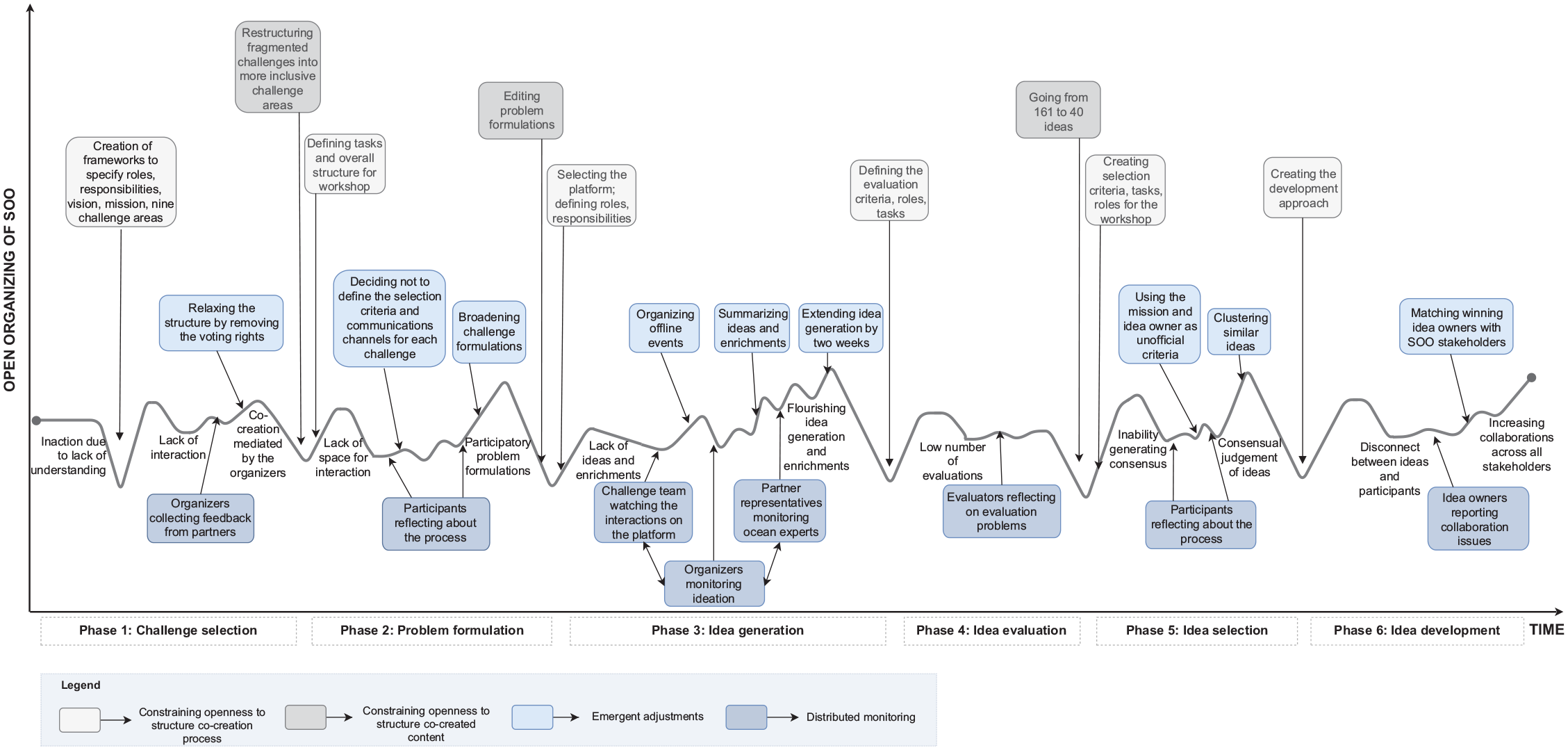
Process model of punctuated openness.
Narrative vignettes.
Findings
In this section, we first explain how the SOO organizers constrained the openness of the organizing process at the beginning of each phase by predefining frameworks to initiate co-creation. Next, we reveal how the participants were actively involved in the organizing process and adjusted these frameworks to fit their emergent requirements as the OI process unfolded. Finally, we demonstrate how the organizers constrained the openness at the end of each phase to ensure progress. These mechanisms are the building blocks of a process of punctuated openness that we elaborate on in our discussion.
Constraining openness to initiate co-creation
As an open, collaborative crowdsourcing initiative, SOO pledged to create an inclusive and transparent discussion around the sustainability challenges of oceans. Accordingly, the organizers initially started SOO without imposing any procedures, rules, or responsibilities for the initiative: ‘What you normally do in a business development case, you make end dates or a timeline and things like that. But here we have a process that has much more of an open mindset.’ (Partner representative, Interview).
While this ‘open mindset’ intended to signal the inclusiveness of the initiative to diverse stakeholders, the resulting lack of structure inadvertently led only the willing few to participate on their own accord. Puzzled by the unwillingness of prospective participants to commit to the initiative, the organizers reached out to the relevant stakeholders to determine the reasons for their hesitancy to join. Numerous conversations revealed that participants struggled to grasp SOO’s open approach and envision their involvement in the initiative: ‘It did not help partners because they did not know what we wanted to talk about…For us, SOO was logical, but for everybody else hearing about it for the first time, it was everything besides logical.’ (Organizing team, Interview). Like many so-called ‘open’ innovation initiatives, SOO started with an ideal of openness that quickly went unrealized in practice.
In response, the organizers temporarily constrained openness to provide more clarity to prospective participants regarding the overall process, their roles, and responsibilities. They realized that giving a framework defining ‘the rules of engagement’ could play an essential role in generating commitment to co-creation: ‘Decisions are needed and must be documented to provide a clear program to partners. Changes to the concept are, of course, possible when partners are on board, but SOO must provide a complete initial plan. Only when our story is complete can we approach partners.’ (Organizing team meeting minutes).
Indeed, by spelling out the tasks and roles of the prospective participants, the frameworks provided a structure enabling the various stakeholders to better imagine their involvement in the initiative. Specifically, the organizers assembled an ‘information package’ outlining 10 potential challenge areas, a timeline of the entire process, milestones for key moments of co-creation, and different roles and responsibilities for the participants. Notably, while the participants were only selectively involved in developing the framework, the resulting information package was circulated broadly to generate a shared understanding of the overall SOO process. The transparency of the framework helped reduce the ambiguity and uncertainty about the process, making it easier for the stakeholders to commit.
We observed this pattern throughout the SOO open organizing process. Informed by their initial experience, the SOO organizers outlined frameworks to structure not only the overall process but also each phase of co-creation throughout the challenge, to stipulate the broad roles and overall responsibilities. They shared these frameworks transparently with the relevant participants at the beginning of each phase (see narrative vignettes in Table 2 for further details). For instance, the framework for idea generation indicated that SOO would host an online platform where ideas could be posted by the employees of the partner organizations and the individual enthusiasts outside the SOO partner network for three months. During this phase, the ‘partner representatives’ were tasked to ensure the active participation of the ‘ocean experts’ who were asked to ‘enrich’ the posted ideas through their expertise, while the ‘challenge team’ would facilitate the ideation on the platform.
Similarly, at the beginning of the ‘idea evaluation’, the organizers created a framework specifying that the ocean experts were expected to evaluate the ideas before passing them on to the partner representatives who would finalize the evaluations for their organizations based on the criteria provided by the organizers: ‘We chose the “yes”, “no”, “maybe” evaluation criteria. . . . otherwise, you need to already dive into the ideas, which would be a lot of work.’ (Organizing team, Interview). By creating frameworks for each phase of co-creation and transparently sharing them, the SOO organizers generated a shared understanding around each phase of activity, thereby helping participants discern their roles in the co-creation process and envisage their contributions.
We noticed that the co-creation process had to be reinitiated at the beginning of each phase, as new sets of participants took a central role in accomplishing the tasks, changing from one phase to the next. Authoritatively deploying frameworks was instrumental in this regard because outlining the structure of the process provided participants with an understanding of how to contribute. However, while these frameworks were essential for initiating a commitment to co-creation at the beginning of each phase, the organizers soon experienced the limits of predefined frameworks for co-creation to unfold in practice.
Adjusting frameworks to emergent requirements
The wicked nature of the problems tackled by SOO required the involvement of various participants with diverse interests and demands that were impossible to anticipate. As the participants interacted, their understanding of the problem advanced, producing co-creation issues that also had implications for the structure of the process. The predefined frameworks were rendered obsolete once the co-creation process was off-the-ground.
When the organizers noticed that their frameworks no longer matched the emergent requirements of co-creation, they responded by opening the organizing process. Specifically, they involved the participants in adjusting the predefined frameworks to better suit the evolving process. Instrumental in identifying these emergent requirements was a distributed monitoring process that involved participants in sensing when and how adjustments were needed. Indeed, monitoring was not the exclusive responsibility of the organizers; instead, it was performed as a shared responsibility by various groups of participants picking up and passing on signals of potential failures.
While each group was responsible only for monitoring specific elements of the process, they were all engaged in interlaced dialogues to sustain a continuous flow of information. Participants with dual organizational roles facilitated exchanges across groups: one member of the ‘organizing team’ also acted as a ‘challenge team’ member, while another participant was included in all the meetings as well as all the correspondences of the ‘board’. Moreover, the participants monitored the process both individually and collectively. For instance, while the challenge team members monitored the interactions on the crowdsourcing platform in their particular challenge areas, they all shared the signals of emergent issues in their routine weekly meetings to recognize patterns across the platform and look for solutions collectively: ‘There are a lot of new faces but no engagement yet. What can we do?’ (Challenge team meeting minutes).
Distributed monitoring was crucial for understanding the instances when the process needed an intervention, and how the predefined frameworks could be adjusted. For instance, when the challenge team sensed at the beginning of ‘idea generation’ that only a few ideas and enrichments were posted on the platform, they passed on this signal of co-creation issues to the organizers to discuss an appropriate remedy. The organizers were alarmed that the framework they had created to get different sets of participants involved failed to generate the desired co-creation. Further discussions with partner representatives revealed that they needed more support in pulling the ocean experts out of their work routines to participate in the platform. ‘It is quite complicated to involve my colleagues internally, and so far, it has not been high on their agenda. I think they do not feel very much committed to this subject.’ (Partner representative, Interview). Moreover, the ocean experts needed help enacting their role in the idea generation. Obtaining such contextualized insights through interactions with various participants was essential, as the organizers could sometimes merely see the symptoms while the participants could better understand the underlying problem. This was particularly important in the context of SOO as the boundaries of the problem continuously changed, and the participants had to (re)align their involvement.
In response to the emergent co-creation issues, the organizers opened up the process and involved various participants in adjusting the predefined frameworks in a participatory way. For example, the organizers sourced ideas from ocean experts and partner representatives to increase interaction on the platform, considering their emergent understandings and interests: ‘You have to become active before you can really post something. But thinking of these challenges and discussing them sometimes goes so deep that it is very hard to do on your own. You actually need some kind of creative environment with different people and interaction to really come to ideas.’ (Partner representative, Interview). Adjusting the framework for ideation by offering face-to-face brainstorming sessions provided the ocean experts with additional ways to contribute their expertise to the co-creation process: ‘Offline brainstorm sessions were really appreciated and important to have employees [ocean experts] know how they can contribute.’ (Organizing team meeting minutes). Indeed, the enrichments within the platform improved in both frequency and quality.
Similarly, participants experienced the need to adjust the predefined frameworks as co-creation was ongoing in other SOO phases (see narrative vignettes in Table 2 for further details). For instance, in the ‘idea development’, the ocean experts were initially expected to act as ‘coaches’ and collaborate with the winning idea holders to develop their ideas into viable business plans. However, conversations revealed that the idea holders lacked knowledge of all the ocean experts involved; therefore, they needed additional support to connect with the relevant ocean experts who could coach them during the idea development. Accordingly, adjustments to the process were made such that the organizing team ‘paired’ idea holders with ocean experts.
Interestingly, we observed a noticeable negative impact on co-creation when the participants failed to adjust the frameworks in one phase. A few days into ‘idea evaluation’, the organizers noticed that only a few participants began evaluating the ideas. Through informal conversations, they realized that asking them to evaluate 161 ideas in two weeks was too much of a burden, while the ocean experts were still puzzled about their involvement in this phase: ‘My question is, why do the ocean experts vote? I need to vote, but why do you tell me to vote?’ (Ocean expert, Interview).
Although the lack of co-creation was alarming, the organizers failed to open up the process for emergent adjustments as ‘it was way too short to organize all that’ (Organizing team member). With a date for the idea selection workshop set two weeks after the idea generation, the organizers were reluctant to open up the process. An organizing team member reflected on what they could have done to accommodate the process to the emergent requirements of co-creation: Maybe we had to organize more evaluation days as we did during the idea generation. Start organizing offline evaluation days two weeks before the ending of the platform, go to all the partners, and have a similar workshop to force people to go to the platform for a few hours and rank the ideas or actively go through the ideas with them. You know for sure that the response will be high then. People find it very hard to go online and spend half an hour or an hour on the platform. (Organizing team, Interview)
As a result, only 24 out of 80 participants evaluated ideas and, thus, idea evaluation became the phase with the lowest co-creation. This example illustrates that staying committed to predefined frameworks can be problematic in open organizing processes characterized by frequent changes. In a dynamic OI process, involving participants in monitoring the process to identify co-creation issues and adjusting the predefined frameworks can help to accommodate the emerging requirements of co-creation. Ironically, however, the more successful SOO was in adjusting the frameworks to the emerging context and boosting co-creation within each phase, the more difficult it became to retain and make the co-created content accessible to the participants of the subsequent phase, ensuring cumulative progress across phases.
Constraining openness to ensure progress across phases
After each successful co-creation phase, given the frequent changes in participants and tasks, the organizers were concerned that the co-creation process in one phase could not easily converge on an outcome suitable as an input for subsequent activities. Failing to adequately capture the co-created content from one phase and transition it to the other could jeopardize SOO’s continuity, as the new set of participants could not seamlessly take up the work-in-progress generated by others with diverse perspectives on the problem and its potential solutions.
To overcome this issue, SOO organizers deliberately constrained openness at the end of each phase to ensure the transition of co-created content. In addition to imposing deadlines and nudging participants to wrap up the current phase by identifying and summarizing essential elements of the co-created content, the organizers authoritatively structured content to facilitate subsequent co-creation involving a new set of participants. For instance, towards the end of ‘problem formulation’, the organizers worried that SOO would not be able to attract a diverse crowd in the ideation phase if the partner representatives failed to converge on problem definitions that were ‘both open-ended and focused’ as well as ‘personal, relevant, concrete, goal-oriented, and understandable’ (Problem formulation workshop, Fieldnotes): Formulating the problem is an art in itself because it is quite difficult to define a short, concrete, compelling question that has all the details and tickles your imagination to create ideas but is focused enough not to create too many out-of-the-box ideas. (Organizing Team, Interview)
Indeed, participants had their interpretations of the problems, and picking one could have estranged other perspectives during problem formulation. As a result, rather than contemplating their activity’s impact on the subsequent ideator involvement, the partner representatives formulated the problems broadly and included their diverse perspectives. However, as the resulting formulations were too vague and unfocused, the organizers made significant edits to structure the problem formulations before posting them on the platform, to ensure that a truly diverse crowd could be attracted. For example, the organizers modified the partners’ co-created problem formulation of ‘How can new ocean resources be developed sustainably?’ (Problem formulation workshop, Fieldnotes) to one offering more tangible connections to prospective participants: ‘Can you help us exploit the ocean resources whilst benefiting our society and the oceans?’ (Email to partners). While authoritatively structuring the problem formulations, the organizers tried to balance two competing concerns: stimulating the participation of ocean experts and potential ideators in ‘idea generation’ while retaining the partner representatives’ shared interests which needed to be reintroduced in the process in ‘idea selection’.
We observed a consistent pattern at the end of most phases—organizers constraining openness by structuring the co-created content to ensure progress across phases (see narrative vignettes in Table 2 for further details). While the organizers authoritatively constrained openness, our data suggests that they did so with the ultimate objective of increasing the openness of the initiative. For example, during ‘challenge selection’, the partner representatives co-created a multitude of challenge areas to be addressed in the subsequent phases. However, each individual challenge only represented selective SOO partners’ interests in the problem. The organizers were concerned that such fragmented challenge areas could jeopardize the involvement of the ideators and new potential partners in subsequent phases. Accordingly, they decided to restructure the nine fragmented challenges into five consolidated ones that promised better opportunities for new stakeholders to connect in the ensuing phases. In this authoritative structuring of content, the organizers ensured they did not exclude aspects important to any partner representatives. Indeed, they were able to spark enthusiasm among the diverse stakeholders for the five challenge areas while keeping the partner representatives interested in collaborating with the winning idea holders for the solutions co-created in ‘idea development’.
While the process of constraining openness at the end of a phase was often opaque to the other participants, its rationale and outcome were transparently shared to enhance inclusiveness, similar to what we observed around the predefined frameworks deployed at the beginning of phases. For instance, at the end of ‘problem formulation’, the organizers communicated via partner updates that ‘small revisions’ and ‘rewordings can still happen’ to the co-created formulations before they can be posted on the platform to attract a diverse crowd. They also shared the resulting formulations via another partner update after restructuring the content. ‘If it is transparent, it is much clearer, and you know what you are doing, and the commitment of doing this is much stronger.’ (Partner representative, Interview).
We observed only one phase where the organizers failed to disclose the rationale and outcome of an authoritative structuring of co-created content, which led to a noticeable negative impact on the process. At the end of ‘idea evaluation’, the organizers created a shortlist of 40 ideas based on the participants’ evaluations to allow enough time to discuss each promising idea in detail and select the top 20 ideas in the subsequent ‘idea selection’ phase. However, they failed to disclose their rationale for this decision, nor did they share the list of 40 ideas with the other participants not involved in the idea selection phase. Due to this lack of transparency, the participants began to question the organizers’ motives for this authoritative closure, as well as the legitimacy of the process: ‘It [how they went from 161 to 40] was a big mystery. I think it is important, also for the foundation itself, to be transparent . . . we are now focusing on the top 20, but I think that we also should spend time on the remaining 141 because maybe there are brilliant ideas we left out.’ (Board member, Interview).
Apart from this incident, the organizers exercised great care when adapting the content to fit the interests and activities of new participants while also retaining past participants’ interests to secure their (re)inclusion in later phases. Authoritative structuring of co-created content allowed the organizers to connect contributions across the different phases of the process, enabling the involvement of the changing sets of participants to be sustained for the long term. The significance of this process became apparent in one instance when the organizers did not deploy temporary closure at the end of the idea generation phase. The sheer number of ideas and enrichments overwhelmed the ocean experts and partner representatives, most of whom were not actively involved in the idea generation. Participants pointed out that standardized idea summaries would have made it easier for others to join the effort: ‘A small summary of every idea with the strong and weak points just listed out briefly or maybe a summary of the enrichments, because sometimes you had a lot of enrichments, would have been very nice because then you have more fundamental, quick information which you can base your opinion on.’ (Ocean expert, Interview). Consequently, co-created content invaluable for the subsequent phases was overlooked as not all enrichments were considered by the evaluators, inadvertently influencing the outcome of the idea evaluation phase. Constraining openness by modifying co-created content was, therefore, instrumental in ensuring the continuity of the SOO process across phases.
A Model of Punctuated Openness for Open Organizing
We began this article by highlighting that OI initiatives addressing multi-stakeholder problems that are wicked in nature may benefit from an open organizing approach combining open and closed modes of orchestration to accommodate the frequent (re)alignment of changing stakeholders. We argued that while the role of closures for generating desired open qualities in open organizing is well-documented (e.g. Dobusch & Dobusch, 2019; Dobusch et al., 2019; Luedicke et al., 2017), there is little insight into when and how to close certain dimensions of the process to facilitate the participation of diverse stakeholders, especially when the OI process entails multiple phases of changing activities and stakeholders. Our analysis shows that through an open organizing approach interrupted by moments of closure—a pattern we labeled as punctuated openness—the OI process can catalyze co-creation among changing sets of stakeholders.
We integrate our findings in a process model explaining open organizing through punctuated openness (see Figure 2). In a process characterized by changing activities and stakeholders across phases, temporary closures constraining participants’ agency through authoritative structuring can be instrumental in enabling their active participation in the process. Our analysis revealed that such authoritative structuring entails two aspects: structuring the co-creation process and structuring the co-created content. Due to their diverse understanding of the process and the frequently changing activities in which they need to be involved, it may not be immediately clear to all stakeholders how they can contribute. If they struggle to understand their roles, envisage their contributions, and understand how the process will unfold, they may be reluctant to engage in a given co-creation activity. By structuring the co-creation process with the deployment of frameworks that predefine procedures, rules, and responsibilities, organizers can help stakeholders develop a shared understanding of the process and imagine their involvement in a particular phase, thereby facilitating their participation in co-creation. However, such forward-looking structuring of the process is insufficient in open organizing processes characterized by frequent changes in stakeholders. In such a dynamic process, stakeholders’ active engagement in co-creation depends on the contributions co-created by others in previous phases. It can be a daunting task to maintain an overview of all that has materialized during one phase of co-creation, particularly if stakeholders join at a later phase of the process. Therefore, the open organizing process could risk moving from one phase to another without taking on the content co-created by the participants of an earlier phase. The organizers can mitigate this risk by structuring co-created content when transitioning to another phase. When communicated transparently, this type of structuring provides an overview of what has emerged in the past, allowing changing sets of stakeholders to identify and focus on the issues important to the collective. In other words, it helps to channel stakeholders’ efforts towards the desired ends and ensure cumulative progress across phases.
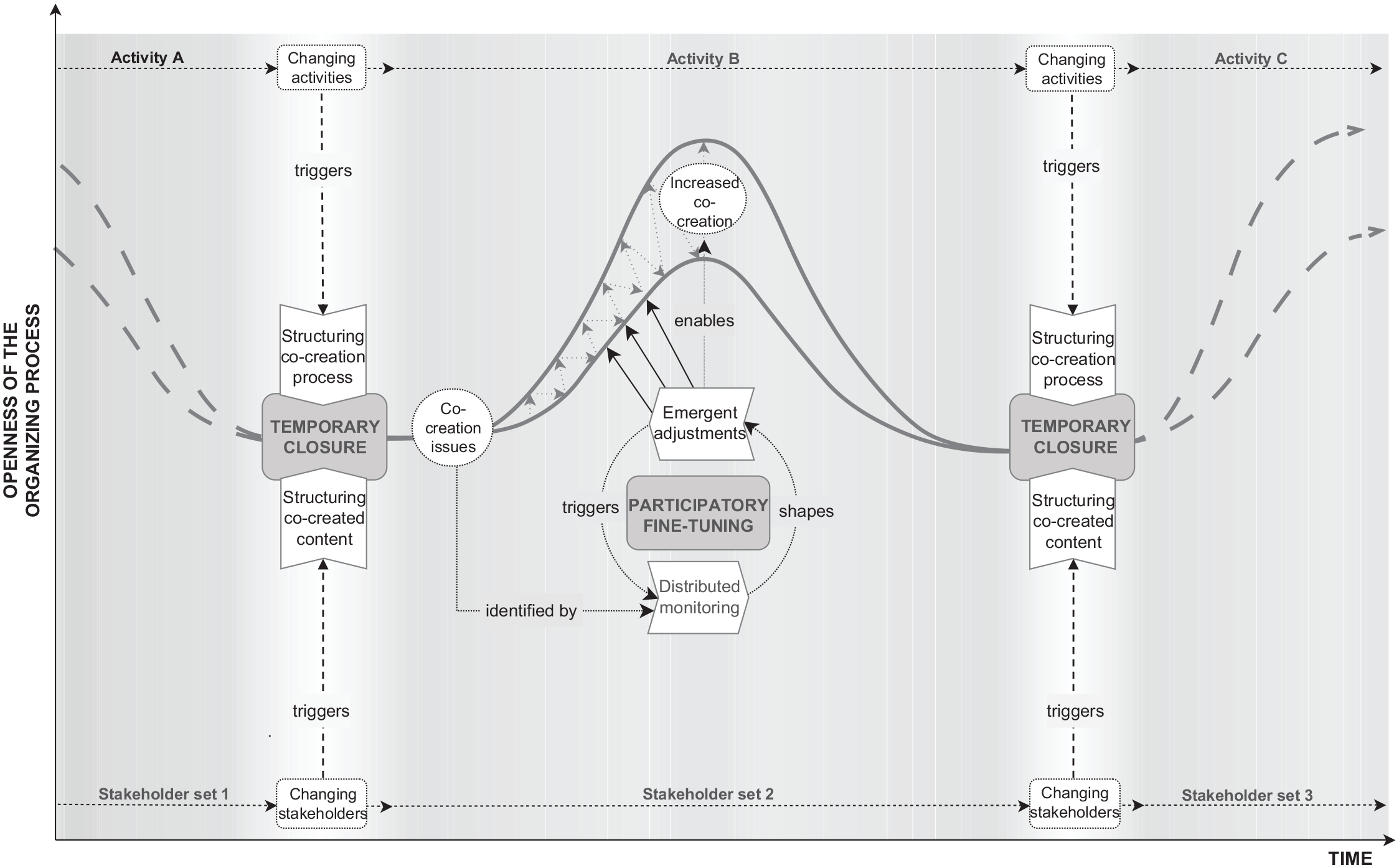
Overview of SOO process.
Our model of punctuated openness assumes that the closures deployed for structuring the content and the process can only be temporary. The predefined structures will inevitably become obsolete in open organizing processes characterized by a high level of unpredictability regarding which stakeholders will get involved and when or what roles they will perform. Therefore, following a temporary closure, organizers need to progressively relax the constraints imposed on the process and allow predefined structures to evolve. Organizers ensure that the emergent requirements of stakeholders are accommodated by involving them in participatory fine-tuning. Through distributed monitoring, organizers can pick up weak signals indicating when structures impede rather than facilitate co-creation in practice. Moreover, organizers can involve participants in making emergent adjustments, collectively deciding when to place or relax predefined structures and how to adjust them.
Distributed orchestration of open innovation
By applying the model of punctuated openness to our context, we explain how SOO has orchestrated an OI initiative spanning various phases and involving changing sets of stakeholders and activities to tackle a multi-stakeholder problem that is wicked in nature.
Our study highlights the essential role of authoritative closures in catalyzing the (re)alignment of past and future participants, making it possible for them to engage in co-creation even when their participation shifts across the phases of the OI process. This insight represents an interesting contrast to studies of OI describing how the alignment of stakeholders in relatively stable collaborations occurs through informal and direct interactions (Faccin, Wegner, & Balestrin, 2020; Urbinati, Landoni, Cococcioni, & De Giudici, 2021). Although we also observed such attempts at SOO, the changing involvement of stakeholders precluded time for trust-building interactions required for mutual (re)alignment. Authoritative closures can be helpful in this regard as they can alleviate the tensions between individual goals and shared objectives (O’Mahony & Ferraro, 2007), and direct their efforts towards shared goals even when time is scarce (Endrissat & Islam, 2021) while reducing inertia due to a lack of social, cognitive, and organizational proximity between participants (Ooms & Piepenbrink, 2021). Therefore, authoritative closures—e.g. predefining frameworks or structuring co-created content to align future and past participants—can substitute for informal discussions when mutual alignment is difficult to achieve.
Authoritative closure, though, can only serve as a temporary catalyst of the OI process. While the understanding of the problem, even as the stakeholders are addressing it, continues to evolve, the OI process needs to remain open to accommodate the requirements of the process that are constantly in flux, due to the changing understanding and interests of the involved stakeholders. In this regard, our model highlights the critical role that participants play in shaping the orchestration process. By enlisting multiple individuals on various levels in the distributed monitoring of the OI process, participants help organizers identify moments when adjustments are needed. In contrast to other OI contexts, where monitoring is a means to exert social control over the process and enforce compliance with authoritative frameworks (Ahrne & Brunsson, 2011; Reischauer & Mair, 2018), our study shows that distributed monitoring can be used for generative purposes. By picking up the weak signals of emerging issues that could result in critical ruptures (Weick & Sutcliffe, 2006), OI initiatives involving multiple stakeholders can respond heedfully to unexpected events that rapidly evolve while keeping participants involved in the process.
Based on these observations, we suggest that open organizing of OI to address multi-stakeholder problems that are wicked in nature represents an interesting contrast to other multi-stakeholder OI initiatives in which an orchestrator typically takes the responsibility of scanning the environment to detect necessary adjustments to the predefined OI process (Reypens et al., 2021; Schepis, Purchase, & Butler, 2021). The participatory fine-tuning we observed in our study represents a robust alternative to the responsive adjustments by central orchestrators, particularly when the orchestrators struggle to keep up with the frequent changes of an evolving process. Involving stakeholders in shaping the OI process creates an informal and emergent system of shared attention for the OI process and generates a shared basis of authority, which is essential for the orchestration of OI (O’Mahony & Ferraro, 2007). In other words, the insights from our study show how the open organizing of OI for wicked multi-stakeholder problems can be accomplished through an interplay between deploying authoritative structures and involving stakeholders in co-creating these structures as the OI process unfolds.
Temporal patterns of openness and closure in open organizing
By introducing the concept of punctuated openness, our study highlights the temporal dimension of deploying closure in open organizing. The constitutive view on open organizing directed our attention to the interplay between openness and closure, suggesting that openness depends on, and is complemented by, certain forms of closure (Dobusch & Dobusch, 2019; Dobusch et al., 2019). Indeed, prior empirical work showed that open organizing requires balancing the intertwined elements of openness and closure to reach the desired open qualities (e.g. Luedicke et al., 2017; Mack & Szulanski, 2017; Shaikh & Vaast, 2016; Smith, Callagher, Crewe-Brown, & Siedlok, 2018). Our study contributes to these findings by adding a temporal perspective to understanding when temporary closures are necessary to generate the desired open qualities over time.
Specifically, our model of punctuated openness suggests that temporary closures are instrumental in initiating the participation of diverse stakeholders who may feel overwhelmed by the open organizing process. In line with prior research, such closures entail a structuring of the process by deploying frameworks that transparently predefine procedures, rules, and responsibilities. These closures create ‘corridors of action’ that facilitate participants’ future involvement in a particular phase (Dobusch & Dobusch, 2019). This insight resonates with previous studies showing how transparency of prescribed procedures can generate openness (Dobusch et al., 2019). Authoritative frameworks for structuring the process can be broadcast widely to many audiences (Gegenhuber & Dobusch, 2017), generating an inclusionary effect that lasts even after authoritative closures are relaxed.
In addition, we argue that temporary closures in open organizing are essential for channeling the participation of diverse stakeholders who might get overwhelmed by the amount of co-created content, particularly at the end of each phase when the co-creation activity needs to be wrapped up. By structuring co-created content from the past when transitioning to another phase, organizers pre-process information to channel stakeholders’ efforts towards the desired ends. This insight resonates with prior research suggesting that extreme openness often comes with unintended consequences, such as information overload that may result in paralysis (Dobusch et al., 2019; Luedicke et al., 2017; Ringel, 2019). Under such conditions, moments of closure can be used as a counterbalancing mechanism to avoid the side-effects of openness (Dobusch & Dobusch, 2019; Dobusch & Kapeller, 2018; Luedicke et al., 2017). Our model of punctuated openness adds nuance by showing that counterbalancing need not be limited to informal, reactionary measures; in addition, planned moments of closure can help to ensure cumulative progress across phases.
Further, to secure the continued involvement of stakeholders in the process, it becomes crucial to transparently share the rationale for such closures and their outcome with involved stakeholders. If organizers fail to do so, participants may question the organizers’ motivations and consider the authoritative moves illegitimate (Ringel, 2019). Generating openness through closure is only considered legitimate if the participants recognize that such a closure does indeed benefit the open organizing initiative and its stakeholders (Dobusch & Dobusch, 2019).
While our model of punctuated openness highlights the importance of planned moments of closure, it also underscores the importance of emergence in open organizing. Our findings show that predefined frameworks deployed at the beginning of each phase need to be complemented by more emergent mechanisms as the involvement of a broad range of stakeholders can only be planned to a certain extent. Indeed, prior research has shown that open organizing processes frequently take unexpected turns (Porter et al., 2020; Shaikh & Vaast, 2016). Once the process is underway, organizers need to adjust the initial frameworks to the evolving circumstances. As these changes to the organizing context are so frequent and emergent, it is challenging for organizers to adjust the frameworks through a slow, evolutionary learning process (Seidl & Werle, 2018). Instead, as the involved stakeholders take up their predefined roles and responsibilities, they can collectively decide when to relax predefined structures and how to adjust them during any phase. Thus, organizers can leverage the open organizing process itself to fine-tune the frameworks to absorb new stakeholders and their requirements into the unfolding process to maintain openness.
The recurrent pattern of punctuated openness that we observed suggests that in open organizing settings characterized by changing sets of stakeholders and activities across phases, it becomes possible to anticipate when openness or closure is appropriate. Accordingly, organizations do not depend on counterbalancing practices as reactionary measures; instead, they can proactively plan for their deployment. When there is a need to initiate the involvement of a new set of stakeholders in a specific activity, deploying closure through predefined frameworks is essential to kick-start co-creation. A period of reopening the predefined frameworks to the adjustments by participants can be expected shortly thereafter, and this will continue until co-creation has been achieved. Closure is once again needed to structure the co-created content so that it can be a useful collective input for a new set of stakeholders. Over time, this recurrent process generates a pattern of punctuated openness.
The above insights are particularly relevant for open organizing processes characterized by multiple phases across which the involvement of stakeholders continuously changes, compared to settings where the boundaries between the different phases of the process are less visible. For instance, in settings like Wikimedia (Dobusch et al., 2019) or Premium Cola (Luedicke et al., 2017), where the involvement of stakeholders is characterized by more stability, it is less likely that the changes in actors across phases will lead to a breakdown in the process if a new set of stakeholders fail to build on the work of the previous ones. While prior work has pointed out how critical it is to manage the transition of the co-creation process across phases of innovation (Porter et al., 2020), our findings shed further light on how punctuated openness can channel the participation of diverse stakeholders before, during, and after such critical transitions.
Conclusion
Openness as an organizing principle holds great potential for tackling multi-stakeholder problems that are wicked in nature. However, orchestrating such an OI process can be a daunting task as it is difficult for any organizer to keep up with frequent changes in the involved stakeholders and activities. The insights of our study offer important guidance on when and how to proactively deploy open and closed orchestration mechanisms across the different phases of these initiatives, enabling the organizers to mindfully deploy open and closed modes of orchestrating over time. While we anticipate that our findings are applicable to other contexts of open organizing with frequently changing stakeholders and activities, managing the intricate relationship between openness and closure calls for more research to understand how openness can be leveraged as an organizing principle for organizations and society at large.
Footnotes
Acknowledgements
This paper received valuable input and support from many people. First, we are grateful to the partners and participants of Save Our Oceans for taking us along in their open organizing efforts. We also thank Paula Jarzabkowski, Gary Burke, David Seidl, Fannie Couture, Rene Wiedner, Letizia Mortara, and our colleagues at the KIN Center for Digital Innovation for their feedback on earlier versions of this paper. Our paper has benefited from the valuable comments and questions of the participants at the European Group for Organizational Studies Colloquia in Edinburgh, the Academy of Management Annual Meeting, and the World Open Innovation Conference. Finally, we extend our sincere thanks to Leonhard Dobusch, Georg von Krogh, Violetta Splitter, Peter Walgenbach, and Richard Whittington for their excellent guidance and support as guest editors and the three anonymous reviewers for their constructive comments and suggestions.
Funding
The author(s) received no financial support for the research, authorship, and/or publication of this article.
