




Abstract
Three decades of discourse on rising emerging nations have failed to produce a theory of emerging multinational-led emancipation. This paper draws on the case of Huawei in China and the European Union (1987–2020) to theorize multinationals’ role in writing back an emancipating imaginary from the Global South to the Global North. Combining postcolonial theory of the multinational as a hybrid space, and a post-Gramscian lens on the multinational as a counter-hegemonic agent, I theorize the multinational as a “writing-back myth-prince.” The lens of a multinational as a writing-back agent and space from the global south radically broadens the emancipatory potential of the key postcolonial concept mimicry. It also affords a view on emancipation beyond the opposites and distincts of very different subject positions in the Global South and North. I identify four writing back phases, each of which involves the political and fantasmatic articulation of an emancipating imaginary from the Global South. I develop critical explanations of the four writing back phases, insofar as they reproduce inequality, disenfranchisement and oppression, and weaken the multinational as a space and agent of hybridity rather than essentialism.
Keywords
“The world cannot leave us because we are more advanced. . .If the lights go out in the West, the East will still shine. And if the North goes dark, there is still the South. America doesn’t represent the world. America only represents a portion of the world.” (Ren Zhengfei, Director and CEO of Huawei, 18 February 2019)
How can a multinational from the Global South write back an emancipating imaginary to the Global North? Three decades of discourse on rising emerging nations have failed to produce a theory of emerging multinational-led emancipation. The dominant assumption remains that multinationals’ membership of modern world society requires conformance with “powerful rationalized myths” from the “advanced” north (Chakrabarty, 2008: 1, 15; Jack, 2016; Mutch, 2018: 252–253). Before the 2008 financial crisis, Western free market myths had transcended Anglo-American origins to reach the level of a global imaginary (Laclau, 1990: 63; Steger, 2008). This imaginary allowed humans across the world to articulate a global society beyond Anglo-American “myth-making” origins (Bergson, 1935: 109). It enabled the emerging periphery to “imagine” postcolonial identities and instrumentalities (Castoriadis, 1997: 181, 361; Steger and James, 2013: 23) shared with the West. The price of admission to this new global imaginary, however, was acceptance of postcolonial binaries that confirmed the periphery’s subaltern status: West versus Rest (Özkazanç-Pan, 2008), technologically advanced versus “backward” (Dhanaraj and Khanna, 2011: 688; Kotliar, 2020: 932).
Consecutive financial, democratic and identarian crises in the West (Hensmans and Van Bommel, 2020: 370; Lounsbury and Wang, 2020: 3) have opened up opportunities to “write back” a global imaginary from the Global South to the Global North (Mir and Mir, 2013). The goal of writing back is to displace the postcolonial imaginary, articulating an emancipating imaginary from the Global South to the Global North (Frenkel, 2014; Wallerstein, 1982: 52; Zhang, 2013). Drawing on a longitudinal study (1987–2020) of the Chinese multinational Huawei in China and the European Union (EU), this paper investigates how an emerging multinational can articulate these writing back opportunities (Lyan and Frenkel, 2020; Mir and Mir, 2013). Founded in the middle of China’s postcolonial crisis in 1987, the case of Huawei has extreme properties. Initially considered a “bastard of a business” in a country traumatized by a 100 years of “foreign humiliation” (Interview Senior Huawei Manager, 2020; Xie, 1997: 14), the firm developed through four stages of articulation to epitomize the greatest writing back threat from a multinational to global imaginary in recent postcolonial history. It ultimately prompted an extraordinary decoupling from global imaginary by the US government and its allies.
By focusing on an emerging multinational (Huawei) and home nation (China) that are politically ambitious and geo-economically weighty enough to challenge the postcolonial imaginary and articulate an emancipating alternative from the Global South (China) to the Global North (the EU), this study affords a theoretical lens beyond the limitations identified by previous writing back studies (e.g. Frenkel, 2014; Lyan and Frenkel, 2020). To further writing back theorizing, I combine postcolonial theory of the multinational as a non-agential hybrid space with a post-Gramscian perspective on the multinational as a counter-hegemonic agent. In particular, I draw on political discourse theory to envision multinationals as leading agents of the articulation of myths in an emancipating global imaginary (Howarth, 2010; Laclau and Mouffe, 1990), that is, an imaginary that removes “repressive restrictions upon the development and articulation of human consciousness” (Alvesson and Willmott, 1992: 432; Butler and Spoelstra, 2014: 540).
Postcolonial theory conceives of multinationals as third, hybrid spaces of negotiation (Boussebaa et al., 2014; Frenkel, 2008). Conceived as a third space, the multinational does not lead emancipating action but provides the opportunity to hybridize hegemonic myths beyond essentialist, postcolonial binaries. From a post-Gramscian perspective, by contrast, a multinational occupies a leading “myth-prince” position (Levy and Scully, 2007: 987) from where it can act “on a dispersed and shattered people to arouse and organize its collective will” (Gramsci, 1971: 128). A first contribution of this study to postcolonial international management theory thus is to theorize the multinational as a “writing back myth-prince,” that is, a leading agent of and space for the articulation of an emancipating imaginary from the Global South. Such a lens articulates the theoretical relation between the multinational as an agent and as a space. Furthermore, it radically broadens the emancipatory potential of the key postcolonial term mimicry, potentially inverting the positions of the Global North and South in global imaginary. Finally, it affords a view on an imaginary of emancipation beyond the opposites and distincts of very different subject positions in the Global South and North.
In what follows, I set the theoretical background on emerging multinationals and the obstacles they face in writing back an emancipating global imaginary. After detailing the extremely revealing properties of the Huawei case, I set out my methodology of data analysis and theory building: the logics of critical explanation. Drawing on this methodology, I identify four phases of multinational-led writing back: myth-prince positioning, appropriating and inverting the global imaginary, and finally myth-prince reinventing. Each stage involves articulating myths in a political and fantasmatic imaginary that has emancipatory purchase. I develop critical explanations of the four writing back phases, insofar as they reproduce inequality, disenfranchisement and oppression, and weaken the multinational as a space and agent of hybridity rather than essentialism.
Emerging multinationals, myths and the postcolonial imaginary
A colony writing back perspective denotes the will to emancipate from the postcolonial imaginary that knowledge still flows unidirectionally from the former imperial territories in the Global North to the former colonized periphery (Ashcroft et al., 1989; Frenkel, 2014). In doing so, a colony writing back perspective opens up emancipatory “myth-making” spaces (Bergson, 1935: 98–99, 109) for actors in the Global South. As the original building blocks of justice and progress in foundational fantasies of political societies (Bendix, 1980: 4, 72), myths not only provide a timeless source of political and fantasmatic authority (Meyer, 2009: 85; Wallerstein, 1983). They dramatize societal and organizational meanings from the past to legitimize preferred power constellations, concealing political identities for greater resonance (Boje et al., 1982; Emery and Trist, 1965), and meeting a universal human need for fantasmatic “clarity” (Barthes, 2006: 256; Brown, 1994: 863).
Emerging multinationals: Obstacles to writing back an emancipating imaginary
For emerging multinationals being part of global imaginary requires adherence to a number of postcolonial management myths. Emerging from “technological backwardness” (Williamson et al., 2013: 294) requires the Englishization of native practices (Boussebaa et al., 2014), adherence to the belief that “the market acts as the ultimate authority in contemporary global capitalism” (Vaara and Tienar, 2008: 989), and acceptance of the core-periphery hierarchy in global value-chain activities (Clegg et al., 2018: 754). Furthermore, emerging multinationals are advised to obtain a public listing in a nation-state that espouses free market capitalism, liberalizes trade and investment policies and strengthens private intellectual property rights (Ravenhill, 2014: 264).
Several obstacles stand in the way of emerging multinationals writing back an emancipation imaginary to the Global North. A key obstacle is managers’ and scholars’ lack of critical self-reflection, historical consciousness, and dialog on possibilities of multinational hybridity (e.g. Coronado, 2012; Decker, 2010; Dhanaraj and Khanna, 2011; Frenkel, 2014; Frenkel and Shenhav, 2006; Gu, 2012; Hamann et al., 2020; Islam, 2012; Srinivas, 2021; Yousfi, 2014). Mainstream international business theory disregards the role of geopolitics in sustaining postcolonial imaginary, denying emerging multinationals a role in writing back an emancipating imaginary. Emerging multinationals should stay the course of liberal capitalism, gradually outgrowing their reputation of being “technologically backward” and “only good at making cheap products” (Ramamurti, 2012: 241–242), by acquiring and learning from the superior market resources of the West (Luo and Tung, 2018; Madhok and Keyhani, 2012; Williamson et al., 2013).
Other obstacles include the US and other Western governments defending the postcolonial imaginary (Ferguson, 2003), emerging powers’ lack of geopolitical ambition and weight to challenge the Western imaginary (Lyan and Frenkel, 2020; Taylor, 2016), and a transnational elite that protects the hegemonic status quo (Girei, 2016). While Western multinationals have been prime movers and translators of postcolonial myths in a global imaginary (e.g. Maclean et al., 2018: 768), non-Western natives mimic these myths to legitimize their membership of the modern world (Lyan and Frenkel, 2020; Mir and Mir, 2009). By typifying their own, native practices as “primitive” (Gu, 2012), “weaker, more backward, and more ignorant than. . .Europe and the US” (Kotliar, 2020: 932), agents in the Global South make it hard for each other to write back. A transnational managerial elite, or “comprador management” (Gantman and Parker, 2006: 26), has been particularly active at opening the doors to the postcolonial imaginary and protecting Western hegemony of global value chains in emerging markets such as Pakistan or India (Boussebaa et al., 2014; Gantman and Parker, 2006; Munir et al., 2018). In sum, the tremendous hegemonic power of the postcolonial imaginary and its constitutive global management myths “oppresses” the articulation of alternatives to postcolonial imaginary (Freire, 1973; Westwood et al., 2014).
To visualize writing back possibilities beyond the essentialist binary of Western hegemony and non-Western mimicry, postcolonial scholars have drawn on Bhabha (1996) to advance the metaphor of multinationals as hybrid spaces (Frenkel and Shenhav, 2006: 85). In these spaces, Western and non-Western managers and natives have the opportunity to hybridize an imaginary beyond postcolonial divides (Frenkel, 2008; Nkomo, 2011). Multinational hybridity can lead to vastly different types of mimicry and writing back, depending on the particular historical and cultural context (Jack et al., 2008, 2011; Yousfi, 2014). Hybridity can engender quasi-colonial mimicry of “whatever the West is doing” (Kothiyal et al., 2018: 144). Or it can be a tool of symbolic management, leading to an uneasy combination of Western and non-Western elements (Alcadipani et al., 2012). Then again, hybridity and mimicry can undercut the effectiveness of the postcolonial imaginary by simultaneously eliminating and maintaining the alterity of the “Other” (Boussebaa et al., 2014). Or they can lead to alternative ways of organizing that are remarkably continuous with local culture (Yousfi, 2014). Finally, hybridity and mimicry can also be an act of self-conscious assertiveness, of a reflexive “sense of historical irony and ambivalence” toward postcolonial myths rather than an act of self-colonization (Islam, 2012: 163).
What has remained unclear is what an assertive and reflexive hybridity means practically (Hamann et al., 2020: 7), most notably for multinationals with writing back ambitions. How can multinationals become leading agents of and spaces for the articulation of an emancipating global imaginary from the Global South? In what follows, I draw on neo-Gramsican political discourse theory to prepare the ground for such theorization.
From myths to emancipating imaginary: Political discourse theory
By arguing that “myth is constitutive of any possible society” (Laclau, 1990: 67), political discourse theory furthers two Gramscian insights that are particularly relevant to the context of this paper. As a “surface of inscription” devoid of essential meaning, a myth allows the rearticulation of fantasmatic projections and political identities in a qualitatively new “space of representation which bears no relation of continuity with the ‘structural objectivity’” of current hegemonic discourse (Laclau, 1990: 61). And counter-hegemonic action by the subaltern requires the emergence of a “myth-prince” that articulates an alternative imaginary of society, namely one that different aggrieved social groups can identify with beyond their particular economic-political interests (Gramsci, 1971: 128).
At any given time different imaginaries struggle for discursive hegemony. Hegemonic struggle centers on “provincializing” the “universality” of the other’s mythical claims (Chakrabarty, 2008), and temporarily “fixing” a new universal meaning to signifiers that are “empty” of fundamental essence but have mythical appeal such as progress, justice, society, democracy, customer service, innovation, or intellectual property rights (Howarth, 2014: 10; Jørgensen and Phillips, 2002: 148; Sturdy, 1998; Välimaa and Hoffman, 2008). Indeed, myths are “empty signifiers” par excellence—“signifiers without signified” (Laclau, 1996: 36) that different social groups can identify with because they are “vague, highly variable,” or mean “different things to different people” (Chandler, 2017: 90). As empty signifiers, myths have to reflect hybrid realities to appeal to different social groups, providing a conceptual link to the postcolonial hybridity literature.
Laclau and Mouffe (1985: 102) coin the practice of fixing meaning to myths “articulation.” Articulation requires the skillful fixing of myths in terms of political and fantasmatic logics (Glynos et al., 2009: 11–12). Articulated as a fantasmatic logic, a myth projects a beatific imaginary, a utopian future of omnipotence and just organizational and societal relations (Dey et al., 2016) that supplants the horrific imaginary of humiliation and impotence (Glynos and Howarth, 2007: 15). Politically, articulation draws upon the logics of equivalence and difference. The logic of equivalence simplifies the political imaginary by articulating a friend/enemy distinction. It associates membership of the friends category with a morally superior imaginary —such as “alternative globalization.” Membership of the enemy category is denounced as immoral and atavistic—a “neo-liberal oligarchy” that uses manipulation and violence to ensure its privileges (Hensmans, 2003: 360; Mouffe, 1993: 50). The logic of difference, by contrast, complexifies political imaginary, re-articulating myths to include challenger identities (Laclau, 1990: 63).
To seize a writing back position (Laclau, 1990: 61) multinationals have to articulate myths native to the Global South in a politically and fantasmatically effective imaginary of emancipation. Previous studies of emancipating articulation, for instance in the digitalization arena, demonstrate the relevance of fantasmatic and political logics in successful and failed emancipation (Hensmans, 2003, 2021). Organizational studies of counter-hegemonic articulation have mainly focused on how the Western neoliberal order undermines emancipating imaginaries through the deployment of a logic of difference (Girei, 2016; Taylor, 2016). Studies of NGOs and worker organizations describe how governments and multinationals subvert emancipation from the Global South by rearticulating it as just another instantiation of neoliberal imaginary (Girei, 2016: 206; Ruckert, 2006). To explore and theorize how a multinational from the Global South can become a leading writing-back agent and space, this paper draws on the case of Huawei in China and the EU (1987–2020).
Case selection and methods
I selected the case of Huawei in China and the EU for its extreme properties, and its promise to generate insights that would have remained absent or obscured otherwise (Flyvbjerg, 2006). Prior postcolonial studies on multinational knowledge flows from Brazil, India, or South Korea (Alcadipani and Caldas, 2012; Lyan and Frenkel, 2020: 17; Mir and Mir, 2009; Westwood et al., 2014) did not assume the possibility of a multinational writing back an emancipating imaginary from the Global South, inverting the positions of the Global North and South in global imaginary. In contrast to the South Korean, Indian or Latin American cases, the Chinese challenge to the postcolonial imaginary is geopolitically ambitious and weighty enough to allow for such an ambitious writing back perspective.
While Anglo-American free market myths provide the foundations of the 21st century postcolonial imaginary, this study focuses on the European Union for both theoretical and historical reasons. In postcolonial theory hegemony refers specifically to the “domination of non-Europeans by Europeans” through “the construction of myths” that present the non-European culture as “inferior and vulnerable” (Nayar, 2015: 87). Also, China at the turn of the 20th century and the European Union at the turn of the 20 first century provide fascinating mirror images of the effects of the US government’s Open Door policies. The Open Door policy was originally aimed at opening up the vast Chinese market to the US and its Western allies. By forcing the Chinese government to sign the most humiliating treaty in its history (the 1901 Boxer Protocol), it consolidated a state of semi-colonialism of China (McCormick, 1967; Mühlhahn, 2012; 156; O’Leary, 1980). A century later, US Open Door policies induced the liberalization of Western telecommunications markets, opening the doors for Chinese Huawei to mount a writing back challenge in the European Union.
The case of Huawei provides an opportunity to theorize writing back processes from emancipatory beginnings at home through global rearticulations on the soil of former European colonizers. Drawing on its “leadership position in the European Union,” Huawei by 2017 “had remade the global telecommunications industry in its image.” While no direct North American competitors remained, European competitors now mimicked Huawei’s global imaginary [Field notes, European telecommunications analyst; Interview, Huawei Vice-President]. Huawei’s writing back from Chinese and European soil was so successful that the US government from 2019 initiated the extreme geopolitical step of decoupling Huawei’s emancipating imaginary from the Western world system, prohibiting any supply of products or services that contained US software or hardware. This extreme property of the Huawei case thus makes visible a very confrontational stage of writing back that remained absent in prior postcolonial studies.
Huawei’s beginnings in 1987 provide equally extreme case properties. The firm was founded at the height of China’s postcolonial identity crisis, 9 years after the Chinese Communist Party gave in to the US Open Door policy. By 1987, the Chinese felt a complex feeling of fear of and admiration for the “Western Other,” similar to what the Chinese experienced from “their Western masters” during the earlier era of “foreign humiliation” (Wang, 2014a; Xie, 1997: 14). Initially associated with the Western import of telecom equipment, Huawei was coined a “bastard of business.” That is, until the firm started articulating a new Chinese imaginary. Huawei’s articulation of a new global imaginary focused on the European Union, since the latter’s telecommunications industry also felt oppressed by the US’ Open Door policies. Threats of an “imminent holy war” by the US government and multinationals such as Motorola “if the Europeans did not wait for and accommodate” US telecommunications standards, induced a profound sense of “US oppression” [Fn. Finnish telecommunications official, 1999; Doc. Holy War 1999].
The logics of critical explanation: Five methodological steps
In what follows, I draw on political discourse theory’s logics of critical explanation to analyze the “China Dream” of a world society built on an emancipating global imaginary (Hui and Karl, 1998; Shih, 2001; Wang, 1997, 2010, 2014b) and the Huawei dream of being one of its leading forces. Methodologically, the logics of critical explanation follows five interconnected, but analytically separate steps (Glynos and Howarth, 2007; Howarth et al., 2016).
Step 1: A first step of problematization consists in challenging established assumptions and constructing the object of study as a problem at a more requisite level of empirical openness, complexity and critical abstraction. This paper problematizes depictions of Huawei and Chinese society as informed by either Western or anti-colonial essentialism. Western managerial essentialism omits the voice of the non-Western Other (Jack and Westwood, 2009; Nkomo, 1992; Prasad, 2012; Westwood, 2001), judging it by the authority of Western mythical references (Said, 1979). A Western essentialist lens would depict Huawei as merely a geopolitical tool of the Chinese Communist Party (CCP), arguing that Chinese entrepreneurs should “wake up from Mao’s dream” and embrace liberal market capitalism (Marquis and Qiao’s, 2020: 9). Likewise, an anti-colonial essentialist stance would claim a uniquely non-Western identity (Nkomo, 2011), predicated on the illiberal myths pushed by the CCP to recover China’s imperial grandeur (Meinhof et al., 2017; Sheng, 2007: 13).
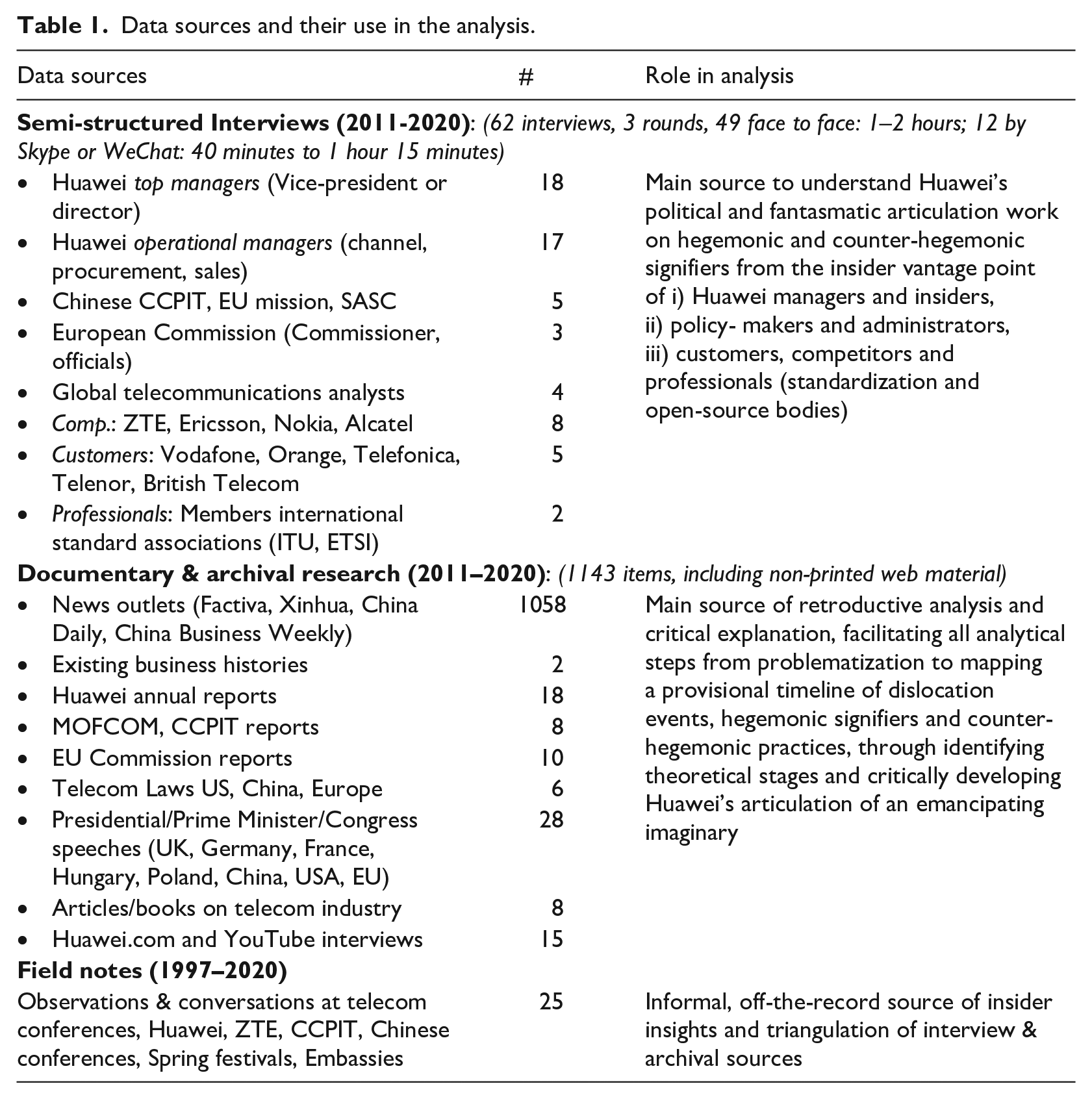
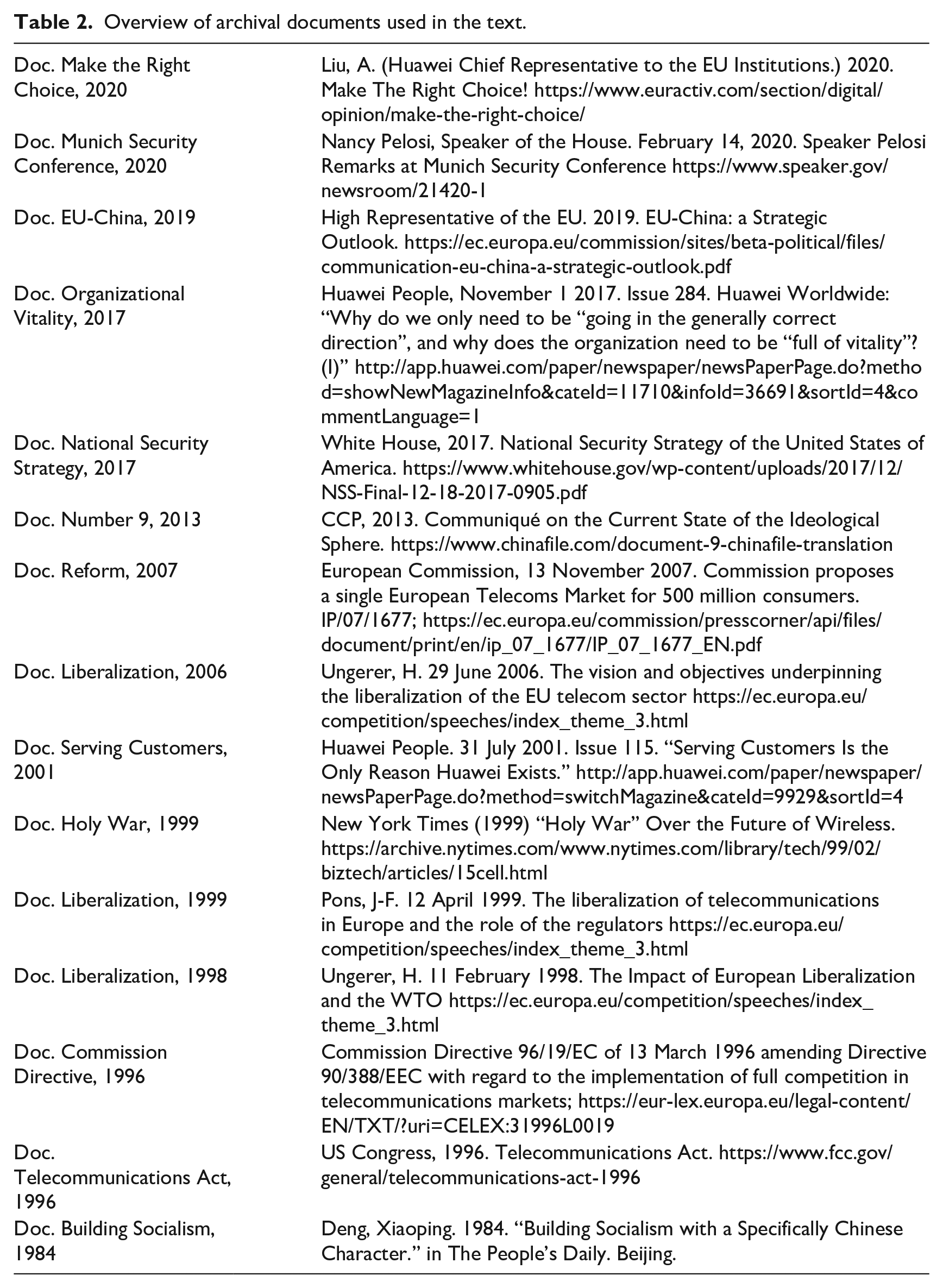
Following this problematization of Huawei’s emancipatory articulations, I engage in retroduction, that is, the creation and refinement of tentative hypotheses from the empirical sources that plausibly account for the problematized phenomenon (Glynos and Howarth, 2019). To facilitate the entire retroductive cycle I created a provisional timeline of critical events, hegemonic signifiers derived from Western myths, and the articulation of an emancipating imaginary from the Global South. I hereby drew on data sources collected through Interviews [Int.], archival research [Doc.], participant observation [Fn.] and informal conversations with insiders [Convrs.] in the period 2011–2020 (see Table 1). Table 2 provides an overview of the archival documents used in the text.
Data sources and their use in the analysis.
Overview of archival documents used in the text.
Historical contextualization is central to retroduction (Glynos and Howarth, 2007). I was a European telecommunications analyst at two historical turning points in the global telecommunications industry (1997–2001). The 1996 US Telecommunications Act ushered in the liberalization of European telecommunications markets [Doc. Commission Directive 96/19/EC., Doc. Liberalization, 1998, 1999, 2006; Reform, 2007]. And the telecommunications stock market crash of 2001 opened a window of opportunity for Chinese new entrants in the West. I attended telecommunications industry conferences and informal meetings, learning first-hand from Finnish and Swedish government representatives, Ericsson, Nokia and Motorola managers, and Western telecommunications analysts about hegemonic struggles in the telecommunications industry, and the looming West-East battle—with the likes of Huawei being stigmatized as “primitive. . .cheap copy-cats. . .the Chinese only make for good tailors” [Fn., Motorola, 2001; France Telecom, 2002].
A Chinese government insider helped me obtain further non-Western insights about Huawei, Chinese competitors in Europe in general, and various Chinese State bodies. Having worked as a senior manager at a Chinese State-owned multinational for 10 years, he was well-connected to policy-makers at the Chinese State-owned Assets Supervision and Administration Commission of the State Council, the CCPIT, the Chinese Mission in Europe and the Association of Chinese Enterprises in Europe. His Chinese network extended to colleagues and friends at Huawei headquarters and subsidiaries in China, Europe and Latin America.
Step 2: As a first retroductive step I sensitized myself to the problematized context from a historical perspective, attempting to abduce an alternative explanation that “may be” (Peirce, 1960: 106). I actively mobilized doubt about current essentialist assumptions to allow for the emergence of a new common-sensism from my data sources that challenges established theorizing (Glynos and Howarth, 2007: 28; Peirce, 1960: 293).
An abductive insight that emerged early on in the Huawei study is that a myth-prince can invert the direction of mimicry and hybridity. Huawei’s key emancipatory move was to infuse Western myths of superior innovation, customer service and intellectual property rights with more performative substance derived from the broader historical context of Chinese myths of heroic struggle. The viability of Western myths became conditioned on the substance of Chinese practices.
Step 3: As a methodology of critical explanation, retroduction does not end with the generation of abductive hypotheses. The next step in the retroductive cycle is to critically develop and adjust the content of these tentative hypotheses in terms of political and fantasmatic articulations (Howarth et al., 2016: 100). Drawing on further systematic data collection and analysis, I elaborated Huawei’s political and fantasmatic articulations. I organized a total of 62 semi-structured interviews on Huawei’s political and fantasmatic work on Western and Chinese myths, in three rounds (2011–2020). One Chinese insider helped me conduct interviews in Mandarin Chinese, so as to use a language all interviewees felt comfortable with—in addition to English, French, Spanish and Dutch. Table 1 details the informants interviewed in this study. We also made field notes and memos of 25 informal conversations during visits at Huawei, the CCPIT, telecommunications conferences, Chinese Spring Festivals and Chinese Embassy parties. Finally, archival data reaching back to 1979 provided further opportunities for refinement of insights on Huawei’s emancipatory articulations. We consulted Huawei’s annual reports and internal magazine, as well as governmental and chamber of commerce documents on the telecommunications equipment industry. Finally, we focused on a variety of CCP archives: five-year plans, press releases and opinions, as divulged through official government channels and the Xinhua News Agency, the CCP-owned newspaper China Daily and China Business Weekly.
Step 4: Subsequently, I refined my provisional timeline and theorized phases of emancipatory articularion (see Figure 1). Concretely, I identified four qualitatively different phases of multinational-led writing back: “positioning” the myth-prince (1990–1996), “appropriating” the global imaginary (1997–2008), “inverting” the global imaginary (2009–2018), and “reinventing” the myth-prince (2019–ongoing).
Step 5: Finally, I produced critical explanations that “provide the means to challenge historically malleable structures of domination and oppression in the name of a universal human emancipation” (Glynos and Howarth, 2007: 9). Critical explanations add a “reflective” theoretical layer to the retroductive cycle, “that highlights and intensifies contradictions of a hegemonic order, while simultaneously proposing alternatives” (Glynos and Howarth, 2007: 9). In particular, this fifth step served to expose how political logics exclude rightful challenges by disenfranchised or oppressed people, and fantasmatic logics induce people to desire hegemonic relations at the expense of emancipatory concerns (Glynos and Howarth, 2019; Glynos et al., 2009). The self-reflexivity of critical approaches (Girei, 2016: 200) also implies that researchers face up to how their own political lenses exclude rightful alternatives (Alvesson and Deetz, 2000) and how their desires for a particular fullness-to-come diminish universal emancipation considerations (Glynos and Howarth, 2007).
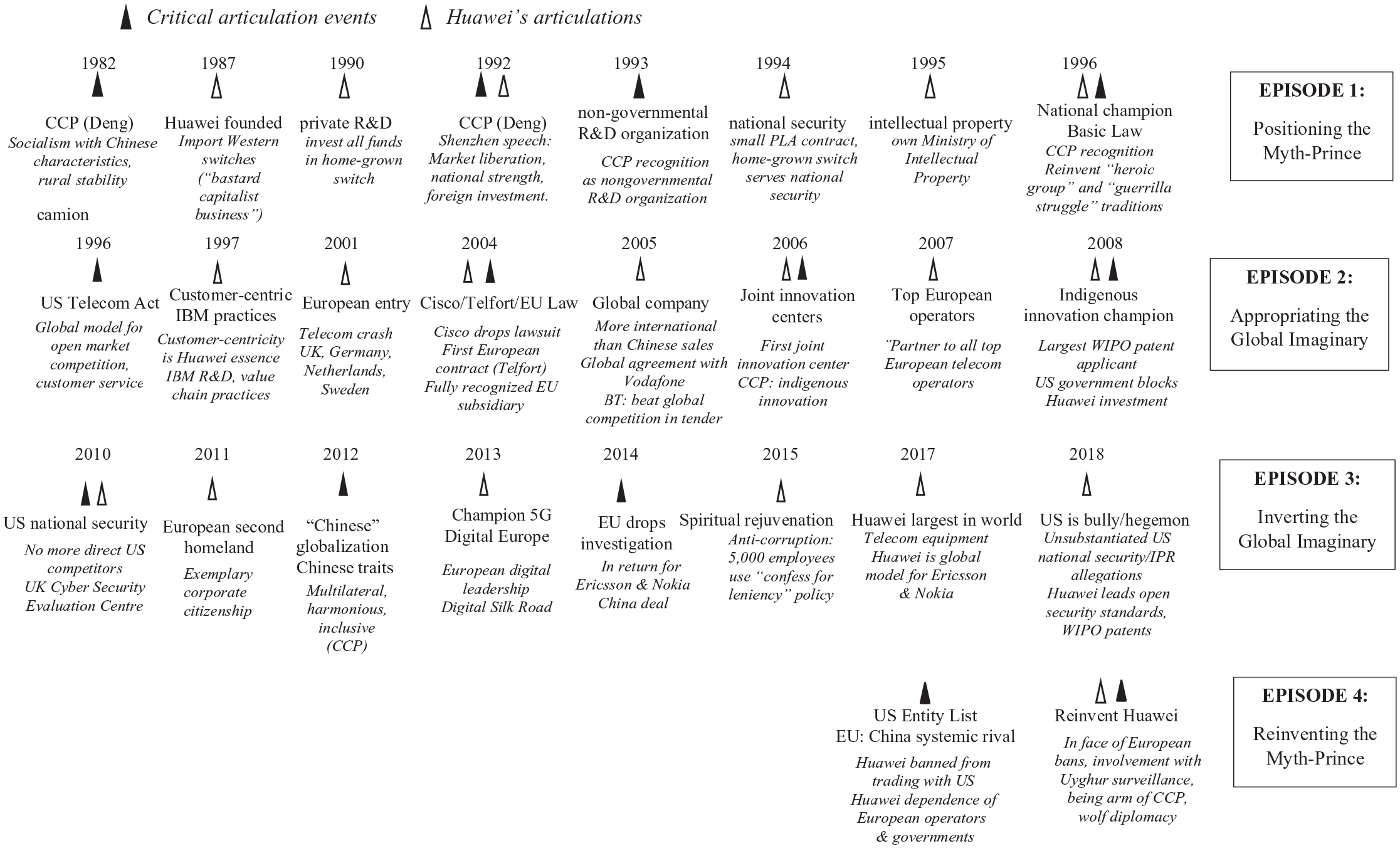
Timeline of Huawei as a writing back myth-prince (1987–2020).
Following the above five methodological steps, I provide a critical account of Huawei’s four writing back stages
Huawei in China and the EU: Four phases of emancipatory articulation
Positioning Huawei as a writing back myth-prince
The fallout of Mao Zedong’s Great Leap Forward cast a shadow on the CCP’s role as revolutionary myth-prince of an alternative Chinese modernity. Intent on building a modern type of “socialism with a specifically Chinese Character” [Doc. Building Socialism, 1984], the CCP left the substance of “Chinese character” signifiers open-ended. While in the long run Western liberal American capitalism “was still an adversary for the CCP,” China meanwhile had no choice but to “welcome foreign investment and Western advanced practices and technologies” [Convrs., Huawei insider].
Within this context of Chinese dislocation and powerlessness to halt Western postcolonial practices, Huawei positioned itself as an emancipatory myth-prince of “Chinese self-reliance” [Convrs., Insider]: “Instead of offering cheap original equipment manufacturing services to advanced Western companies, as other Chinese firms, Huawei [from 1990] decided to lessen dependence on Western technology transfer and champion a self-reliant nation. We built ‘China-made’ advanced switches based on homegrown R&D and of course a bit of reverse engineering from Western parts.” [Int., Vice-President Huawei Shenzhen].
Politically, Huawei identified itself as a “nongovernmental” organization, autonomous from the Chinese State and CCP, which was unconventional in China [Convrs., Huawei Insider]: “Founder Ren Zhengfei believes in ancient Chinese myths of national progress through heroic struggle, but not in the conventional sense. Huawei wants to claim its own heroic struggle and leadership, not through politics but through markets. In Chinese history, businessmen were political dependents. The Mao period was an extreme example of the removal of autonomy, and closedness to the West. . .We very much agreed with Chairmen Deng’s words on global opening and reform, and wanted Huawei to become a heroic market leader of ‘Chinese achievements’.” [Int., Former Huawei Vice President].
Fantasmatically, Huawei positioned itself in the continuity of Mao’s mythical “Long March,” articulating a discourse of “national rejuvenation” against foreign “imperialism.” Mao’s March proceeded “from the periphery to the center” and so did Huawei. It first champion “customized and affordable telecom equipment” solutions for the rural customers and local governments disenfranchised by both Western telecom companies and Chinese State companies. Moving to the center, the firm articulated an imaginary of national “rejuvenation” against “foreign humiliation” [Int., retired Huawei manager]. The “Huawei way” was to “suffer heroically” and overcome horrific obstacles in name of the beatific dream of a new global “China in the making” [Int., Former Huawei Vice President].
Political and fantasmatic articulations enhance each other (Hensmans, 2021). The fantasy of national rejuvenation was premised on Huawei creating a political equivalence between different Chinese subject positions; “the Communist Party elite in the large cities and the neglected rural periphery, together against foreign humiliation.” By enabling the subaltern “80% in the countryside” to identify with the “China dream of the urban 20%,” Huawei earned the CCP’s recognition as a “national champion” [Convrs. Huawei insider].
Appropriating the global imaginary
The 1996 United States Telecommunications Act, followed by the 2001 Western telecommunications crash, ushered in a more global stage of emancipatory articulation. The US government launched the Act to re-articulate a global imaginary of free market competition for customers [Fn., Telecommunications Analyst]; “The goal of this new law is to let anyone enter any communications business, to let any communications business compete in any market against any other. The Telecommunications Act of 1996 has the potential to change the way we work, live and learn.” [Doc., Telecommunications Act, 1996].
The key mythical signifier in the Act was “customer,” mentioned 72 times in the document. US companies were supposed to profit “disproportionately” from the liberalization of telecommunications, as they represented “the global gold standard” of not only “customer service,” but also customer-oriented “intellectual property rights” [Fn., Telecommunications Analyst]. In practice, discourse of “customer service and customer-oriented intellectual property rights did not amount to much in an industry heretofore dominated by national champions” [Fn., Telecom analyst]. Instead of greater customer orientation, the Telecommunications Act induced “more greed.” When the “bubble burst,” “Western firms were left badly exposed” [Fn., Telecommunications Analyst].
Huawei set out to fix the emptiness of customer language with more substantial Chinese meaning. In the wake of the Act, Huawei “introduced the concept of customer-centricity as the company’s foundation [Huawei’s Basic Law]” claiming that—as a form of “market liberation” with “Chinese characteristics,” “serving customers is the only reason that Huawei exists” [Int., Retired Huawei headquarters manager; Doc. Serving Customers, 2001]. From 1997, Huawei expended millions on integrating the “customer service” practices of IBM—the “highest-status” US “tech company.” Huawei did not mind that Western stakeholders interpreted this as a typical act of “imitation by a Chinese firm” [Convrs., Huawei insider]. Under the symbolic cover of imitation, Huawei appropriated customer service as originating in its own neo-Maoist “Basic Law”: “In 1996, Ren Zhengfei asked Chinese professors – and obviously also Party members – to reinvent Chinese traditions of heroic groups and struggle in terms of competition for customers. Huawei’s resulting Basic Law yielded guerrilla war statements that went on to obtain an almost spiritual pedigree such as “shock our customers, get me the contract,” “price offensive, kill the opponents,” “dare to spend money for customers” and others. “[Int., Retired Huawei Vice-President]
To “prepare for a battle” on customer-oriented intellectual property rights, Huawei established its own “Ministry of Intellectual Property” in 1995 [Convrs., Huawei Insider]. US telecom companies met Huawei’s Western entry in the early 2000s with a “patent wall” as well as lawsuit. The likes of Cisco and Motorola demanded Huawei “pay up to 7% of sales to patents” [Int. Senior Huawei Manager]. Investing “more in R&D than any other peer,” Huawei became the leading patent applicant at the World Intellectual Property Organization as early as 2008. Huawei now was the “poster child” of Chinese “indigenous innovation” [Convrs. Huawei insider].
In response to further US conformance pressures, most notably for Huawei to become a standard, public listed company, the Chinese multinational shifted its focus to the “more open” European Union. Starting in 2002, Chinese expatriates to the European Union were “selected for their character rather than their experience.” They had to be “totally convinced of the superiority of the Huawei way,” yet also prepared “to suffer heroically” and “appropriate local practices,” just like “European missionaries”: “They came to Europe like European missionaries went to Africa. They very much were thrown in the deep end and had to learn to think in European terms on the spot. Whenever they had a customer contact, top management flew over to propose Chinese discounts of almost 95%. This was not credible. Over time, they learned European customer codes. . ..But headquarters decided against becoming publicly quoted or using English as a global lingua franca, as the company aims to be a hero of global Chinese achievements.” [Int., Vice President Huawei].
In the years thereafter, Huawei successfully articulated an emancipating imaginary of joint innovation for the subaltern across Sino-European boundaries. This imaginary included customer, professionals and governments in both the Global South and North (Europe). For instance, governments and telecom operators in Brazil wanted to be “taken seriously, on a more equal and long-term footing” than in the current postcolonial imaginary. Uniquely, Huawei offered to customize its latest intellectual property rights “to Brazilians’ own wants and needs” [Int. Senior Manager Huawei Brazil]. Likewise, in Europe telecom operators were looking for an alternative to the “inflexible and expensive” customer service of European and North American vendors. European standardization professionals decried the overly “tactical, cautious and stingy” investments of Western telecom vendors in emerging 3G, 4G, and 5G standardization developments [Convrs, Senior Standardization Professional].
“Ericsson, Nokia, Alcatel, Marconi. . .they were all used to push their newest technology on us at relatively high prices. Huawei by contrast really listened to our grievances and tried to develop products that we wanted. Only Huawei said yes to our demands. They delivered at a very reasonable price, two to three times faster than the Europeans and Americans. After that, we agreed to go one step further and engage in their joint innovation center concept, which was the opposite of ‘push’: Huawei helped us transition from one technological generation to another at lower costs and less disruption.” [Int., Senior Vodafone manager]. “We adopted a much more open and financially generous attitude than our Western competitors in standardization bodies, volunteering to test our developments in all openness with other vendors and operators. In the first few years, operators simply used us for free, to get better terms of their legacy vendors. But from 2005 Huawei’s credentials as a scientific, almost nonprofit contributor to standardization bore fruit. Huawei engineers started occupying the first senior positions in the ITU and ETSI as vice or principal leaders of standards teams.” [Int., Former Vice-President Huawei Shenzhen]
And while European governments were eager to take part in postcolonial imaginary “beggars cannot be choosers”: Huawei’s generous foreign direct investment and joint innovation imaginary “won the day” [Convrs. Telecom analyst].
“Without openly challenging” neoliberal signifiers, Huawei articulated a chain of equivalence between the Global North and South, appropriating disparate grievances in an imaginary of “more generous and empowering” globalization at the service of the “disenfranchised” [Convrs. Huawei insider]. In practice, however, Huawei’s articulations did not reduce the large inequalities between the subaltern in the Global South and North: “Huawei attracted customers in Africa or such as Brazil with very cheap China Development Bank loans, putting it in a very strong position to negotiate contracts with high profit margins there. In the EU, by contrast, Huawei made large losses. It basically offered its services almost for free, investing huge sums in products and services customized for Europeans. So profits from relatively poor operators in the Global South were diverted to relatively rich European operators. We could not compete with that, particularly many South American and Africans see Huawei’s long-term investment stance as a game-changer.” [Int., Nokia Manager].
Inverting the global imaginary
While in the prior phase Huawei’s efforts to fix the emptiness of mythical signifiers such as customer service proceeded as unobtrusively as possible, this was no longer the case in the wake of the Western financial crisis (2009–2010). By 2012 the (Western) core—(emerging) periphery positions in the imaginary of global telecommunications were inverted: “By 2012, Huawei’s imaginative customer and standardization approach and its global lead in patent applications effectively meant it was remaking the telecom industry in its image. Contrary to Huawei, US competitors suffered a crisis of imagination. They could not understand why technologies that did not originate in the US could win. In 2006, French Alcatel acquired Lucent, and in 2010 Nokia acquired Motorola’s cellular infrastructure business.” [Int., telecom analyst].
European competitors Ericsson and Nokia were copying Huawei’s “now mythical” practice of joint innovation centers, recognizing the Chinese firm’s “much greater willingness to listen to customers” in Europe, but also in [Convrs., Nokia Director of Corporate Culture; Hensmans, 2017]. Huawei’s ambitions did not end there. It set out to spiritually rejuvenate customer service practices beyond the “neo-liberal scourge” of self-interest: “The financial crisis taught us that traditional Western management and performance approaches are nihilistic. . . based on rational self-interest. We need to root these practices in our own spiritual culture of ‘contributing and sharing’. Employees, wherever in the world, that demonstrate a sense of collective mission and who make contributions are role models and will be promoted faster” [Doc. Organizational Vitality, 2017].
Facing an increasingly confrontational US government, Huawei sought the shelter of the CCP for its articulations of an emancipating global imaginary. An emboldened CCP criticized the “historical nihilism” and “zero-sum mentality” of US-led globalization, articulating the Chinese dream of an alternative global modernity: the time had come for a world with “Chinese characteristics,” that is, a “multilateral,” “harmonious,” and “benevolent” world: “Western countries, led by the United States, carry out their Neoliberal agendas under the guise of ‘globalization’, visiting catastrophic consequences upon Latin America, the Soviet Union, and Eastern Europe, and have also dragged themselves into the international financial crisis from which they have yet to recover” [Doc., CCP Document Number Nine 9].
Likewise, Huawei contrasted the horrifically “atavistic” principles governing the US-led postcolonial imaginary—“unilateral,” “winner takes it all” and “zero-sum” domination—with its own beatifically “advanced” principles of “harmonious” and “benevolent” globalization [Convrs. Huawei insider]. As the global myth-prince of “multilateral mutualism,” the firm vowed it did “not want to dominate the world” [Doc. Make the Right Choice, 2020]. The “success of European companies in China is in Huawei’s strategic interest” [Fn. Banner at Huawei Annual Market Conference, 2012]. Huawei “punished sales managers that sought to dominate Ericsson and Nokia, by winning over their remaining customers” [Convrs. Huawei insider]. The firm also set up a European-themed Chinese campus to further articulate a global imaginary at service of European emancipation and rejuvenation: “Huawei champions multi-lateral win-win cooperation, and shows tremendous readiness to share its gains, whether with European customers, competitors or governments. Huawei champions the EU’s multilateral world discourse by sponsoring and taking the lead in the Digital Europe initiative with huge investments in 5G and Internet of Things projects.” [Int., EU official]
As popular opinion turned against Western corporations’ “neoliberal” practices of offshoring jobs, R&D and taxes, Huawei presented itself as a model corporate citizen in Europe: “Huawei managed to convince most French and European officials with its take on corporate citizenship. While the French multinational Total and the likes of Google or Apple make a lot of money here, they pay virtually no taxes. By contrast, Huawei does not make profits in France. Still, Huawei executives instructed corporate accounts to ‘find a way to pay our fair due of taxes in this country’.” [Int., Global Account manager].
In the prior stage of appropriation, Huawei had recruited many European managers with “a great customer network” using a comprador approach: paying them “extremely handy wages” and promoting them to “high managerial positions. . .as long as they would work very hard to convert European customers to Huawei’s joint innovation approach” [Convrs. Huawei insider]. And it had used a very open, almost “nonprofit” scientific approach to “buy into” standardization bodies [idem]. The Chinese firm stepped up its recruitment efforts through the period 2011–2018, articulating a type of inverted comprador management which consisted in recruiting influential former policy-makers at the EU and national government levels to act as its native agents: “They generally were former ministers or administrators that had shown sympathy for Chinese claims for an alternative global order in the past, and were now willing to peddle their influence to enact this agenda with the EU parliament, commission and national governments. . .Although they have extremely well paid executive positions at Huawei, inside the firm they do not have a lot of clout, they really act as external agents.” [Int, former Huawei manager]
Hegemonic confrontation: Reinventing the myth-prince
The downside of Huawei’s CCP-coordinated inversion approach was its decreasing autonomy. Huawei felt compelled to articulate the CCP’s increasingly essentialist discourse on China’s alternative modernity, demonstrating zealous allegiance to Xi’s anti-corruption and repressive surveillance logics in the Chinese province Xinjiang: “Soon after the introduction of the anti-corruption policy, Ren Zhengfei announced that about 5,000 Huawei employees had used the firm’s ‘confess for leniency’ program to admit corruption somewhere through their career. Internal policing was very harsh, because Huawei wanted to be a model citizen for the CCP. . ..When it comes to the Uighurs, Huawei argues that all it does is supply technology, it is not engaged in surveillance itself. The argument is of course that the Chinese approach is much less violent and more harmonious than the US approach in its ‘war against terror’.” [Int., Huawei insider]
The US government, core hegemon of the Western world system, used Huawei’s increasing closeness to the CCP to confront its geopolitical influence. It declared Huawei “an enemy” of the State and China a “revisionist” power [Doc. National Security Strategy, 2017]. The US Department of Commerce’s Bureau of Industry and Security added Huawei to its Entity List on May 15, 2019. Further export controls effectively decoupled Huawei from the global value chains it had helped to shape. Furthermore, while Huawei only had a small, rural customer base in the USA, its leadership on the European continent prompted the US government to threaten European States that did not follow the US ban with “retaliatory measures” [Int. Senior Huawei manager].
To restore the postcolonial imaginary, the US government and allied multinationals created a new political equivalence logic of “democratic versus authoritarian technology” and a fantasmatic logic of how a new “Western” dawn would avoid a horrific scenario of “Westlessness” and a decaying world order. In face of US retaliatory threats and the argument that “working with Huawei is like ‘choosing autocracy over democracy’” [Doc. Munich Security Conference, 2020], the EU cast China in the role of “systemic rival” [Doc., EU-China, 2020]: “At the end of the Huawei is a better performer with telecom customers and professionals, all this really is about power. Telecommunications is a geopolitically strategic industry. Every meaningful telecom firm has close ties to government, whether it concerns Motorola, Alcatel, Nokia, Ericsson or Huawei, the West or China. . .The Boards of both Nokia’s and Ericsson’s Chinese joint ventures are pervaded by Communist Party members And Nokia set up a Communist Party Unit as part of its governance structure in China.” [Convrs. Telecom Analyst].
Faced with US’ geopolitical confrontation and European allies falling into line, Huawei distanced itself even further from postcolonial imaginary: “To achieve Huawei’s peaceful rise in globalization we will further shrink the offensive scope or our strategy and focus all our resources on the small area at the top of the needle, the strategic no-man’s land of the ICT industry. There, at that pinpoint, we will be so differentiated that all conflicts of interest with Western counterparts can be avoided. We will have complementary demands with European rivals in high-value business and achieve a cooperative balance with them globally.” [Int., Vice-President Huawei].
The firm set out to reinvent its myth-prince origins (Shils, 1981) through a combination of Chinese technological self-sufficiency and “open, science-based globalization” aimed at “mutualizing” profits, away from the neoliberal “winner takes it all model.” While launching the “Nanniwan” project to “de-Americanize” its products and production, and achieve self-sufficiency in line with the CCP’s “All under the Chinese heaven” dream, Huawei worked hard to renew its myth-prince credentials and “heroic autonomy” from the CCP: “Huawei’s ascendancy is often attributed to CCP connections in the West, but not in China. Many Chinese love Huawei because it was chosen by destiny rather than by the CCP. Every Chinese knows the story that Ren’s wife, daughter of a high-ranking CCP leader, left him for being delusional. Of course Huawei needs government support to survive. But if ever it became just another CCP instrument, it would be finished” [Convrs. Insider].
At the world society level, however, the firm’s renewed myth-prince aspirations of an “All under Huawei’s technological world” were threatened by a combination of factors, some within and others beyond its control [Convrs., Chinese Telecom insider].
Huawei did little to dispel Western accusations of contributing to the mass ethnic persecution of Uighurs, apart from articulating its allegiance to “national laws, anywhere in the world.” Furthermore, Chinese officials’ threats of retaliatory counter-measures “if European governments did not treat Huawei fairly” [Fn., Handelsblatt Industrial Summit], worked as a self-fulfilling prophecy of Huawei as an “agent of the Chinese state.” Finally, in the wake of the Covid crisis and US government-fueled Sinophobia—most notably Trump’s articulation of a “China virus” conspiracy—the CCP’s “wolf diplomacy” backfired, prompting further retaliatory bans of Huawei [Convrs. Telecommunication insider; EU official].
Discussion
How can a multinational from the Global South write back an emancipating global imaginary to the Global North? I began this paper with the ambition of further writing back theorizing beyond the obstacles identified by international business and management scholars, all of which entrench the postcolonial imaginary. To do so, this paper combines postcolonial theory of multinationals as non-agential, third spaces with a post-Gramscian perspective on multinationals as counter-hegemonic agents. The combination yields a lens on the multinational as a leading agent of and space for the articulation of an emancipating global imaginary from the Global South. This study explores and theorizes this lens, drawing on the rise of Huawei as a writing back myth-prince in China and the EU (1987–2020).
Articulating an emancipating global imaginary: Four phases
Longitudinally, the case of Huawei elucidates how a multinational can provincialize Western myths in the global imaginary (Chakrabarty, 2008: 254), by hybridizing them with more performative, emancipating myths from the Global South. To become a myth-prince of emancipation and unify “opposites and distincts” (Gramsci, 1971: 137) in the global imaginary, a multinational needs to engage in highly unconventional behavior; transcending “immediate,” “narrowly selfish” corporate interests (167).
In a first phase of myth-prince positioning, the aspiring multinational positions itself as the myth-prince of her nation’s coming emancipation from the postcolonial imaginary. Opportunities to articulate counter-hegemonic myths into an emancipating imaginary emerge during times of dislocation; when there is an acute need to articulate a political and fantasmatic imaginary of an emancipated national society (Glynos and Howarth, 2007: 15; Laclau, 1990: 61–63; 243–244). As the myth-prince of a new Chinese march against foreign imperialism, Huawei drew on the neo-Maoist political logic of “a rejuvenated China against foreign humiliation” to unite formerly divided urban elites and rural people against the postcolonial imaginary. As both an agent and space for Mao’s dream of a self-reliant nation, Huawei articulated a fantasmatic utopia that supplanted present foreign humiliation with a beatific sense of fullness-to-come (Dey et al., 2016). A horrific scenario of victimization—Huawei’s projection of another 100 years of foreign humiliation—notched up desire for the emancipating imaginary of a self-reliant nation.
In a second phase of appropriating the global imaginary, the myth-prince internationalizes its gaze to articulate an emancipating imaginary for the world. The myth-prince’s global aspirations face a daunting obstacle: an entrenched postcolonial imaginary that typifies knowledge and technology from emerging nations as “backward” (Kotliar, 2020: 933–934; Ramamurti, 2012: 241–242) and “primitive” compared to advanced multinationals (Coronado, 2012: 216; Lyan and Frenkel, 2020). Multinationals are expected to act as diffusers (Thite et al, 2012: 254), or enforcers of mythical “best practices” from the Global North (Mutch, 2018: 252–253; Newenham-Kahindi and Stevens, 2018: 893), such as innovation, customer service, and intellectual property rights (Meyer, 2009).
Instead of openly challenging the postcolonial imaginary, the myth-prince chooses a more unobtrusive path of mimicry and hybridization (Hensmans, 2003: 360, 2015). It appropriates mythical signifiers such as customer service, mimicking their form while demonstrating their substantial emptiness and disenfranchisement of customers, professionals, and governments in the Global South and advanced North. Presenting itself as the new myth-prince of customer service, the multinational “fixes” empty myths from the Global North (Laclau and Mouffe 1985: 113) by hybridizing them with more substantially emancipating myths from the Global South.
Postcolonial scholars have used the word “appropriation” primarily to denounce colonial groups’ borrowing from colonized people for hegemonic purposes. European colonizers’ appropriation of Native American myths of cultural distinctiveness is a case in point (Weaver, 2005; Ziff and Rao, 1997: 228). International management scholars have drawn on the concept to reveal the neo-colonial assumptions that underline dominant international management practices (Jack and Westwood, 2009; Westwood, 2001). Some postcolonial scholars have used the concept “reverse appropriation” to describe a type of anti-colonial resistance that visually and explicitly “hacks” hegemonic Western representations (Kola-Bankole, 2017; Oguibe, 2003). This paper goes one step further, defining global appropriation as the borrowing of mythical signifiers from the Global North, and their re-articulation in global imaginary with more performative myths from the Global South.
In a third phase of inverting the global imaginary, a myth-prince draws on a systemic dislocation in the Global North to openly challenge the postcolonial imaginary. The multinational articulates an emancipating imaginary that openly inverts “the claims to reason and universality” (Chakrabarty, 2008: 43) of myths from the Global North and South. As “a radically subversive move,” inversion works by actively altercating the myths by which the hegemonic ideology produces and marginalizes a dominated or deviant group (Parry, 1987: 30). It brings “low what was high” (Derrida, 1981: 42; Dollimore, 1986: 90), openly provincializing myths from the Global North and providing them with new global substance from the Global South.
Defying postcolonial assumptions, the myth-prince uses inverted comprador management practices in the Global North to win political and fantasmatic support for their imaginary. Postcolonial scholars have identified comprador managers as an instrument of Western multinationals’ conversion of the Global South to a postcolonial imaginary, inducing mimicry and hybridization continuous with old colonial structures (Hopkinson and Aman, 2019: 1871). By naturalizing Anglo-American myths and derived practices in management education (Alcadipani and Caldas, 2012; Faria et al., 2010), corporate management (Nkomo, 2011) and corporate language (Boussebaa and Brown, 2017), native managers help to convert the periphery to the tune of the postcolonial imaginary (Gantman and Parker, 2006: 26; Varman and Saha, 2009). This study demonstrates that emerging multinationals can establish their own comprador management in the Global North, to convert Western customers, professionals and government officials to an inverted imaginary. That is, of the non-Western Other as more advanced and the West re-emerging from its current decline through mimicry and hybridization of an imaginary that originated in the Global South.
In a fourth phase of reinventing the myth-prince, core hegemonic agents in the Global North confront the growing global purchase of the emancipating imaginary. Hegemonic states and multinationals use their large share of world economic, ideological and military power to face down “rogue” counter-hegemonic agents and spaces, and restore the power-balance (Chase-Dunn and Hall, 2018: 274). Critical events such as the recent China-originated Covid-pandemic, can shift “systemic attitudes” (Hensmans and Liu, 2020; Wang et al., 2019), tilting the balance in global confrontations and articulations one way or another. Taking advantage of such critical events, hegemonic agents initiate the political and fantasmatic decoupling from the writing back myth-prince. To rearticulate a postcolonial imaginary for greater global purchase, they draw on a mythical discourse of Western difference and superiority, casting the counter-hegemonic myth-prince in the role of systemic enemy rather than legitimate global opponent (cf. Mouffe, 2000: 97).
To avoid being confined to the “Rest” of the world in the global imaginary (Özkazanç-Pan, 2008), the myth-prince has no choice but to reinvent itself. Reinvention involves articulating an imaginary of emancipation with renewed global purchase. That is, in preparation of a new dislocation of the postcolonial imaginary, and new opportunities for appropriation and inversion. Thus, Huawei faces reinvention in face of the revised imaginary of the West as a beacon of democratic civilization, and accusations that “working with Huawei is like ‘choosing autocracy over democracy’” [Doc. Munich Security Conference, 2020]. Reinvention necessarily centers on the Global South.
The multinational as a writing-back agent and space: Mimicry and hybridization
The lens of the multinational as a writing back myth-prince radically broadens the emancipatory potential of the key postcolonial term mimicry. Within postcolonial accounts, mimicry is a colonial practice aimed not only at changing the conduct of the colonized but also at reconstituting its very identity (Bhabha, 1994; Frenkel, 2008: 926). Within an account of the multinational as a writing-back myth-prince, mimicry is aimed at exactly the opposite: reconstituting colonizers’ conduct and identity along emancipatory lines by appropriating and inverting mythical Western signifiers and practices. Appropriation-and-inversion-as-mimicry is similar to how European missionaries’ conversion of African natives to Christianity was conditioned on local myth mimicry—that is, a demonstrated willingness to “live on terms set by” native people (Walls, 2016: xix).
Obtaining appropriation-and-inversion-as-mimicry requires multinationals to assume their role as both a leading collective agent of and space for the articulation of an emancipating global imaginary. This calls for further theorization of the relation between the multinational as an agent and as a space. International business scholars have theorized the multinational as a hybrid space (Boussebaa et al., 2014; Frenkel, 2008), but not as a collective agent that organizes and strategizes an emancipating imaginary (cf. Levy and Scully, 2007). Drawing on political discourse theory this study theorizes that multinationals’ ability to provide a hybrid, emancipatory space depends on their active political and fantasmatic leadership through four phases of articulation.
In political discourse theory, space is as political as agency (Dikeç, 2012: 671). Multinationals cannot be apolitical about the postcolonial imaginary and function as a hybrid space. As other hegemonic imaginaries, the postcolonial imaginary reduces space to a means of control and domination—of hegemonic closure of what can be said and thought (Laclau, 1990: 70). Spaces are never fully closed, however. At any given time there is an agentic possibility of emancipating articulation (cf. Mouffe 1979: 171, 186; Smith, 1998). Agentic opportunities to reoccupy space for emancipating rather than dominating purposes are vastly greater during times of hegemonic dislocation. Financial, democratic or identarian dislocations weaken the hegemonic imaginary, opening not only space for hybridization but also a demand for collective leadership to articulate new political identities and fantasmatic futures (Glynos and Howarth, 2007; Howarth et al., 2016).
In sum, the leadership of a Gramscian myth-prince, or agent of collective emancipation, is needed to reoccupy space and articulate an imaginary that disenfranchised people in the Global South and North can and want to identify with. Becoming a global agent of emancipation is a profoundly political and fantasmatic act. As exemplified by the Huawei case, aspiring multinationals need to inscribe their hybrid space in a larger “historical development” as an “agent of more general activities of a national and international character” (Gramsci, 1971: 103). The political and fantasmatic burden on multinationals to remain globally emancipating agents and spaces is particularly high during times of hegemonic confrontation. The following section critically explains the dangers of a multinational falling prey to essentialist and exclusionary imaginaries.
Critical explanations: Self-reflexivity and the multinational as agonistic agent and space
A second objective of this paper, which follows from its theoretical foundations in political discourse theory (Laclau, 1990, 1996; Laclau and Mouffe, 1990; Mouffe, 1993, 2000, 2008), is to privilege critical over normative explanation (Howarth et al., 2016: 101–103). As a European scholar and former telecommunications insider, this study has profoundly challenged my assumptions of Western difference and superiority. Huawei’s journey against all odds from subject of a postcolonial crisis—reminiscent of China’s 100 years of foreign humiliation—to champion of an emancipating global imaginary, vividly demonstrates the limits of the postcolonial imaginary in the Global South and North. The rise of Xi Jinping’s hegemonic China dream and an increasingly exclusionary United States government have, however, severely curtailed Huawei’s global role as an autonomous myth-prince. Paradoxically, the US government’s ban of Huawei has made the firm’s imaginary more dependent on the Chinese Communist Party’s priorities. This study’s identification of a fourth phase of myth-prince reinvention signals the need for Huawei to retrieve its myth-prince autonomy from a repressive and essentialist state imaginary.
Adopting a self-reflexive stance, I chose not to take sides through this study (2013–2021). Instead, I set out to expose how both sides employ political logics that exclude rightful challenges by disenfranchised people, and fantasmatic logics that induce ideological overinvestment at the expense of real emancipation concerns (Hensmans, 2021). Thus, this paper singles out how the US government’s rearticulation of Western difference and superiority serves to exclude rightful political and fantasmatic challenges. For instance, Huawei rightfully challenged the emancipatory emptiness of mythical signifiers such as “customer service” and “innovation.”
Likewise, Huawei is complicit in the Chinese Communist Party’s articulation of a discourse of nationalist homogeneity through surveillance. This discourse excludes rightful grievances by subaltern Uyghurs to the imperial dream of China as a harbinger of an ethically superior, alternative modernity. Hence, this paper problematizes emerging multinationals’ willingness to give up articulative autonomy to states’ essentialist imaginary during confrontational geopolitical episodes. Essentialist discourse of nationalism and imperialism provides a poor reason to provincialize the West. As argued by Chakrabarty (2008), the project of “provincializing Europe” or “the West” is desirable insofar as it is aimed at “denaturalizing the equation of modernity with a certain version of Europe and associated exclusionary claims to reason and universality” (p. 43). The emancipatory value of this project unravels, however, when it becomes overly coercive, “nationalist, nativist or atavistic” (p. 43), substituting an imaginary of Chinese or non-Western essentialism for European or Western essentialism.
To write back to the postcolonial imaginary, a multinational needs to retain its unique vantage point as a hybrid, non-essentialist and non-exclusionary agent and space (Frenkel, 2008; Boussebaa et al., 2014). Writing back requires an agonistic space of articulation and agonistic agency at all times (Mouffe, 1999), steering away from the closure of essentialist fantasies and exclusionary friend-versus-enemy boundaries. The only way a multinational can achieve this is by articulating an “avantgarde” imaginary beyond opposites and distincts of a national and international character (Gramsci, 1971: 124–125, 146).
Conclusions
Consecutive financial, democratic and identarian crises in the West have accentuated the political and fantasmatic emptiness of the postcolonial imaginary (Guillén, 2018). This has created opportunities for multinationals to articulate a more emancipating imaginary from the Global South to the Global North. This paper theorizes these articulation possibilities, by integrating postcolonial theory of the multinational with neo-Gramscian political discourse theory. I advance the lens of the multinational as both a leading space for and agent of the articulation of an emancipating global imaginary from the Global South. The extreme properties of the Huawei case dramatically reveal and accentuate processes and mechanisms that otherwise would have remained invisible, providing a stepping stone to further generalization to a larger sample of cases (Yin, 2014). The limitations of the Huawei case are also very clear: it fell prey to dual exclusionary and essentialist pressures by, respectively, the US government and the CCP. Further research should investigate how multinationals can avoid the latter trap and remain myth-princes of an emancipating global imaginary.
Footnotes
Declaration of conflicting interests
The author declared no potential conflicts of interest with respect to the research, authorship, and/or publication of this article.
Funding
The author received no financial support for the research, authorship, and/or publication of this article.
