



Abstract
This article contributes to the research agenda of emancipatory entrepreneurship by developing the understanding of emancipation as a social imaginary in entrepreneurship. In particular, we draw on fiction and philosophical hermeneutics to generate three ideal types of the social imaginary of emancipation in entrepreneurship theorizing. Building on our hermeneutic analysis, we introduce a framework that explains how entrepreneurship theorizing can strengthen, undermine, and shape emancipatory practices as well as the social imaginary of emancipation. We conclude our article by explicating and discussing the relevancy of emancipation in and for entrepreneurship theorizing across different social imaginaries and social practices.
“Before a man bit into one of two foods equally removed and tempting, he would die of hunger if his choice were free.”
“Advice to economists: boldly deny the obvious.”
Following the influential article by Rindova et al. (2009, p. 478), which observes that entrepreneurship “requires a bit of emancipation,” researchers have renewed their interest in this theme. To date, numerous empirical studies at the intersection of entrepreneurship and emancipation have been presented (Goss et al., 2011; Jennings et al., 2016; Ruebottom & Toubiana, 2020). Strikingly, despite growing evidence of synchronicity, emancipation has not been seriously pursued in entrepreneurship theorizing (for exceptions, Calás et al., 2009; Jones & Spicer, 2009; Verduijn et al., 2014). Meanwhile, key theorists in the field of entrepreneurship have urged entrepreneurship researchers to aspire to achieving broader social relevance without losing theoretical rigor (Shepherd, 2015; Steyaert & Hjorth, 2006; Wiklund et al., 2019). This exhortation concerns the practical and socially generative dimensions of theorizing (Dimov et al., 2020; Johannisson, 2011; Thompson et al., 2020), and to us it seems high time to address this dearth of theoretical studies, particularly when considering the near-universal social acceptability of both emancipation and entrepreneurship.
In this article, we argue that interrogating the relationship between theory and social imagination is a rewarding way to examine the practical role of emancipation in entrepreneurship theorizing. The social imaginary plays an understated yet meaningful role in theorizing (Taylor, 2002, 2004). We consider both theorists and practitioners as using the social imaginary to make sense of how the social world works. Providing common understanding, social imaginations are culturally contingent and change over time (Dey & Mason, 2018; Gartner, 2007). Hence, a theorist’s ability to engage with social imagination can both make explicit and broaden our capability to uncover alternative paths forward (Cornelissen, 2013; Swedberg, 2014; Weick, 1989). In other words, by focusing on social imagination, researchers can develop more relevant research questions, critically reflect on their methodologies of choice, and, ultimately, produce more rigorous and socially meaningful theory (Taylor, 1985, 2004). In this sense, entrepreneurship scholarship is “catching up” with the meta-theoretical efforts in management and organization studies (Alvesson & Kärreman, 2007; Ketokivi et al., 2017; Tsoukas, 2017); therefore, we believe that by taking a tighter hold of the social imaginary of emancipation, new light can be shed on how to advance theorizing in entrepreneurship.
The purpose of our article is to address the question “why is emancipation needed in entrepreneurship?” To explore this question, we have drawn on philosophical hermeneutics (Dilthey & Jameson, 1972; Gadamer, 1979, 1998; Taylor, 1985, 2004) and fiction (Cornelissen, 2013; Gartner, 2007; Sarasvathy, 2002), in order to unpack the different conceptual and practical meanings of the social imaginary of emancipation in and for entrepreneurship theorizing. In particular, we examined three texts—Camus (1955), Hesse (1922), and Huxley (1932)—through the concepts of “emancipation to” and “emancipation from” (Berlin, 1969). In this way, we approach and develop distinct ideal types of the social imaginary of emancipation that help explain, and reflect upon, how entrepreneurship theorizing strengthens, undermines, or shapes social practices and social imaginations. We conclude by discussing how the unpacking of the social imaginary of emancipation points toward fundamental questions for our field—for instance, at the intersection of theory and practice or unity and plurality—and so sparks new dialogs for advancing and better situating our understanding of entrepreneurship theorizing.
By adopting this approach, we generate several contributions to the literature on entrepreneurship. First, the emancipatory angle aims at increasing the scope of theorizing by understanding entrepreneurship as social change (Calás et al., 2009; Chandra, 2017; Steyaert & Hjorth, 2006). Our study contributes to this theoretical development by offering a new theoretical typology (Cornelissen, 2017) of emancipation, which can help researchers develop a more robust and precise vocabulary (Gartner, 1993; Sarasvathy, 2002; Shepherd & Wiklund, 2020) for studying the emancipatory credentials of entrepreneurship. Second, there already exists an interest in the more implicit features of theorizing processes in entrepreneurship (Lundmark et al., 2019; van Burg & Romme, 2014; Welter et al., 2017). By viewing emancipation as a collectively upheld social imaginary, we illustrate and discuss how entrepreneurship theorizing might offer us a “chance to connect more deeply with others” (Bartunek, 2020, p. 226) and to discover a common concern for making the world a better place in which to live (Baumol, 1996; McMullen et al., 2020; Shepherd, 2019). Third, with the call for more socially meaningful research in entrepreneurship (Wainwright & Muñoz, 2020; Wiklund et al., 2019; Zahra & Wright, 2016), practical relevancy is very much at stake (Alvesson et al., 2017). Our contribution to this concern is to illuminate theorizing as a particular kind of practice (Swedberg, 2014; Taylor, 1985; Van De Ven & Johnson, 2006), specifically by portraying theorizing in entrepreneurship as an emancipatory project.
Theoretical Background
Emancipatory Entrepreneurship
Rindova et al. (2009, p. 478) have taken the position that entrepreneurship researchers should expand their scope of inquiry by holding onto “the belief that research that considers both more closely and more broadly the entrepreneurial dreams and efforts to create change in the world may bring us to a fuller, more comprehensive understanding of the processes of discovery, change, value creation, and ultimately wealth creation.” To do this, Rindova et al. (2009, p. 478) take emancipatory entrepreneuring as a theoretical point of focus, defining it as the study of “understanding the factors that cause individuals to seek to disrupt the status quo and change their position in the social order in which they are embedded—and, on occasion, the social order itself.” Key to understanding this is “entrepreneuring,” a concept that Steyaert (2007, p. 472) argues enables “contextual embeddedness, relational entourage, linguistic performativity, nonteleological openness, connective assemblage and creative involution as different points of entry into a social ontology.” With this in mind, our key aim is to outline theoretically the prospects of entrepreneurship studies to contribute to movements that nurture our capabilities for social imagination (Dey & Mason, 2018).
The idea of a search for social change (Calás et al., 2009), and entrepreneuring as the activity for accomplishing such change (McMullen et al., 2020), is key to the emancipatory entrepreneurship agenda (Rindova et al., 2009). In broad terms, there are two different, yet complementary, conceptions of emancipation. The first is the emancipation of the entrepreneuring subject from prevailing constraints to action, a “negative” (Berlin, 1969) conception of emancipation. Pursuing opportunities to break free from fetters that would otherwise have held them back, emancipatory entrepreneurs are able to “change their position in the social order in which they are embedded” (Rindova et al., 2009, p. 478). According to Schumpeter, one of capitalism’s cardinal virtues is its ability to provide the economic and moral premises for entrepreneurs to transgress the social class system (Schumpeter, 1955a). In this vein, entrepreneuring has been perceived as a transformative socioeconomic practice, potentially pulling its subjects toward a better life (Alkhaled & Berglund, 2018; Shepherd et al., 2020; Tobias et al., 2013). The second is the entrepreneurial emancipation to inflict changes in society in a broader sense, a “positive” (Berlin, 1969) conception of emancipation. With a wider impact in the world in mind, theorists have viewed entrepreneurship not only as an activity that potentially reconfigures the social status of the entrepreneur, but brings about social changes on a scale beyond the direct impact of the entrepreneur (Calás et al., 2009). In addition to the benefits of entrepreneurship to entrepreneurs themselves, entrepreneurship has been theorized to contribute to the social sphere as a whole, again most notably by Schumpeter (1942) with his theory of the socialization of the economy through entrepreneurship. Hence, entrepreneurship has also been seen as a potential “pro-social force” in society (Daskalaki et al., 2015; Farny, Kibler, Hai et al., 2019; Williams & Shepherd, 2016).
The Social Imaginary as Pretheoretical Understanding
Most of us seek some kind of understanding about the world we live in, and sometimes our interpretations culminate in theories (Weick, 1989). Although our efforts to understand the phenomena we encounter may never become fully-fledged theories, they remain meaningful aspects of social life and can become integral to it. Theorizing does not remain independent from the rest of social functionality, but rather ensues from prior collective understandings, aiming at the reassessment and, ideally, edification of pretheoretical knowledge (Gadamer, 1998). To investigate this conceptually, we borrow the Canadian philosopher Taylor’s (2004) term “social imaginary.” According to Dey and Mason (2018, p. 87), “the social imaginary forms an integral part of daily life by providing people with a set of ideal categories and concepts which provides the cultural ‘toolkit’ guiding their subsequent thinking and acting.” In other words, social imaginaries enable people to make sense of how their social worlds work.
Following Taylor (2004), the social imaginary differs from social theory in three ways: it is the way people make sense of their social world without explicit engagement with rational theory; it is shared by a large body of people; and by providing a common understanding it can legitimize social action. Therefore, while theories are influenced by social imaginaries, theories, which begin as relatively isolated rational ventures, can also penetrate the social imaginary and transform it (Taylor, 1985, 2002). In this way, a theory becomes representative of “truth” when it aligns with the social imaginary’s practical concern for the future (Heidegger, 1962). The social world can be understood according to the way in which actions within it fit with what is anticipated as coming (Schütz, 1932), while the means for sustaining a sense of continuity despite the inevitability of social change is provided by imagination (Cornelissen, 2013; Laine & Kibler, 2018; McMullen et al., 2020). Hence, we consider the social imaginary neither as a particular theoretical approach nor as a method, but rather as an ongoing hermeneutical involvement with the way the social world works—which is typically related to theorizing in an ambiguous manner.
Emancipation as a Social Imaginary in Entrepreneurship Theorizing
Like all types of social theorizing, entrepreneurship theorizing does not take place in a mental vacuum but rather follows the “visions or intuitions” that “indicate an object of research” (Schumpeter, 1949, p. 350). Often thought of as a future-oriented research field, a predominant objective in entrepreneurship studies has been to consider entrepreneurship as a tool for good (Alvarez & Barney, 2014; Shepherd, 2015; Zahra & Wright, 2016). Notably, entrepreneurship has been theorized as beneficial to entrepreneurs themselves (McMullen & Shepherd, 2006; Schumpeter, 1955a; Shane & Venkataraman, 2000), but also to the social domain as a whole (Hjorth, 2013; Schumpeter, 1942; Shepherd, 2015). In the emancipatory sense, entrepreneurship has been thought to socially and economically lift those who are indebted to entrepreneurial action (Henry et al., 2018; Kimmitt et al., 2020; Shepherd et al., 2020) as well as contribute to the development of a more socially sensitive and economically just society (Calás et al., 2009; Chandra, 2017; Peredo et al., 2018).
In this article, we consider entrepreneurship theory as largely falling under the dominant social imaginary characterized by Taylor (2004, p. 22) as the “rejection of hierarchical order.” In the economic sphere, freely roaming entrepreneurs are thought to supply the latent demands of society (Kirzner, 1997; Schumpeter, 1934). These economic achievements lead to social development (Schumpeter, 1942, 1955a). Looking more closely, the novel interactions of entrepreneurs with business opportunities (Alvarez & Barney, 2014; Hu et al., 2020; Shane & Venkataraman, 2000) are oriented toward the public sphere, which entrepreneuring, in turn, adjusts (Hjorth, 2013). As opportunities for action increase (Calás et al., 2009; Weiskopf, 2007), constraints for imagination are unmade in the private sphere (Dey & Mason, 2018; Tedmanson et al., 2012). This social imaginary of emancipation is dominant insofar as it is expressed in the moral sphere as concerning all people in the society in question (Taylor, 2004). It is this general contexture that allows us to intimate entrepreneuring with social change (Rindova et al., 2009).
With this, we understand emancipation as a key concept for entrepreneurship theorizing. We arrive at this in three interrelated ways. First, the social imaginary of emancipation enables entrepreneuring by making sense of how society develops through unbounded and creative action. The more preoccupied the dominant social imaginary is with emancipation, the more opportunities for social change will emerge. Second, conversely, and being itself an extension of the possible, entrepreneuring enables emancipation. Pro-social action involves the distribution of opportunities to new social strata; opportunities for social transformation will be made more inclusively available. Third, theorizing emancipatory entrepreneurship, that is, seeing it as the pursuance of plausible explanations to the above, happens as an interplay of imagination and practice. Because social change itself can take myriad forms, this becomes an engagement with plurality; theorizing, therefore, aims at remedying discordances caused by different “prescientific cognitive act[s]” (Schumpeter, 1949, p. 359), for theorists in practice ranging from “the whole of their moral personalities up to their spiritual ambition” (p. 346), in order to keep with the dominant social imaginary that holds the discourse together. In summary, the key argument put forward and developed further in this article is that entrepreneurship theorizing thrives on a social imaginary of emancipation.
Brave New World, The Myth of Sisyphus, and Siddhartha: An Inquiry Into Emancipatory Entrepreneurship
We now draw upon “readymade” imaginations to unpack the ways in which the social imaginary of emancipation can emerge in entrepreneurship. Similarly to how readymade art has been used to interrogate the art world, transporting texts from one context to another can serve as a useful heuristic device for stimulating new theoretical lines of thought (Boje & Smith, 2010; Cornelissen, 2013; Weick, 1995). This is in keeping with our hermeneutical approach (Gadamer, 1979, 1986; Taylor, 1985, 2004), which involves the reinterpretation of the texts by Aldous Huxley, Albert Camus, and Hermann Hesse in a context that differs from that of their origin (Dilthey & Jameson, 1972).
For practical reasons, we have limited ourselves to three texts; fewer would compromise our ability to display variety, whereas a larger selection would extend our analysis beyond the confines of this contribution as well as potentially obscure our argument. Most importantly, for theoretical reasons we argue that each of the three texts presents a unique approach to emancipatory entrepreneurship and helps bring to the fore different core issues in entrepreneurship theorizing. Briefly, Huxley (1932) depicts a dystopia where paradigmatic social change is impossible. Camus (1955) stands for a philosophical imperative for rebellion. Hesse (1922) evokes the imagery of a spiritual journey towards self-transformation and serenity.
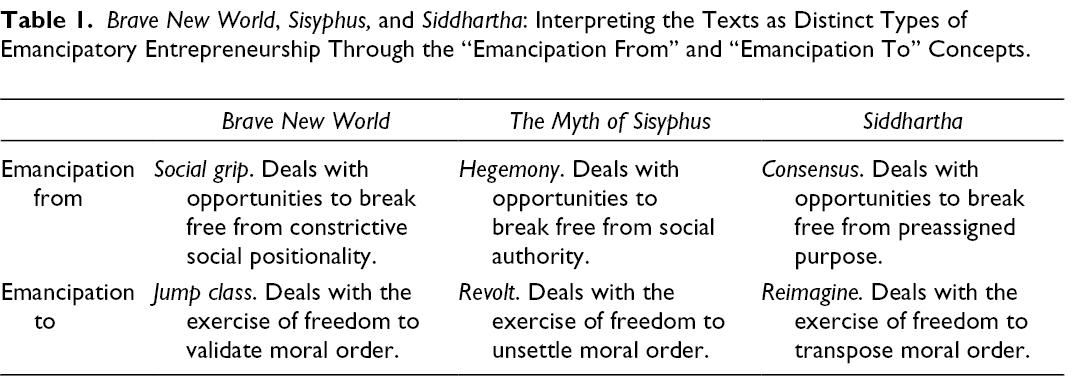
In our subsequent inquiry into the texts, we have sought to “understand an author better than he understood himself” (Dilthey & Jameson, 1972, p. 244) by re-reading them in a theoretical context that refers to lived experiences that differ from those of their authors. Thus, we have left aside interpretations that would explain the author’s intention in regard to the historical moment in which they thought and wrote. Additionally, we acknowledge the limitation arising from our interpretation of the texts in the theoretical context of emancipatory entrepreneuring, which has prevented us from engaging in more expansive readings, informed by literary criticism, into frictions regarding their relationship to modernity invited by the association of modern fiction with mythology. Importantly in this context, we have interpreted each text through the concepts of “emancipation from” and “emancipation to” (Berlin, 1969) and, as a result, consider each as expressing emancipatory entrepreneurship independently as an ideal type (Weber, 1978). This has helped us sketch out the texts as distinct artificial mental constructs thereby, resulting in a more focused and coherent theorizing process (Swedberg, 2018; Weber, 1978). In the following subsections, we present our emerging interpretations of the texts as distinct types of emancipatory entrepreneurship (Table 1), which we will later use as a conceptual base from which to unpack the social imaginary of emancipation in entrepreneurship theorizing.
Brave New World, Sisyphus, and Siddhartha: Interpreting the Texts as Distinct Types of Emancipatory Entrepreneurship Through the “Emancipation From” and “Emancipation To” Concepts.
Brave New World
Huxley’s (1932) Brave New World is a work of dystopian fiction. The fundamental idea in the novel is that in order to make people obedient, they need to be taught to love their fetters. The story is set in London, 600 years in the future. The world is divided into urban and habitation areas, with trespassing between the two zones tightly controlled. In the urban areas, people are chemically designed and produced in factories. Using a specific technique called “hypnopedia,” they are trained to believe that they live the best possible life. Additionally, a freely distributed drug called “soma” helps them overcome any type of distress. Monogamy is considered immoral, as are all types of reciprocal emotionality. Any signs of displeasure cause great social discomfort. In contrast to this, in the habitation area, myth and ritual rule supreme.
The main character Bernard Marx is a member of the highest genetic class, a bright “hypnopedia” expert but physically weak and prone to depression. Others, most notably his superior Director Tomakin, berate Bernard for his social awkwardness. However, Bernard is able to take revenge on Tomakin when he discovers and transports to London Tomakin’s illegitimate son John and spouse Linda, whom he had abandoned in the habitation zone. Putting Tomakin to great shame, John becomes an instant celebrity, while Bernard, as John’s caretaker, receives the positive attention that had previously eluded him. Nonetheless, Bernard’s success does not last long as John shuns the public performances forced upon him by Bernard. John, in turn, is deeply disappointed to find London vacuous and obscene, and in many ways more brutish than the tribes of his homeland. After a series of incidents, Bernard and John end up destroying a shipment of soma together. Captured by the authorities, they are sent to meet Mustapha Mond, one of the ten Controllers of the World State. While Bernard is sent to Iceland, where he is granted intellectual freedom from social pressure, John is provided with an abandoned lighthouse as his new home. However, he is soon discovered by journalists, who are followed by flocks of admirers coming to see John the Savage as if he was an exotic animal. The crowd pushes John into an ecstatic rage, culminating in a soma-induced, redemptive mass orgy. Finding out what had happened the next day, John hangs himself.
In sum, reading Brave New World as a social imaginary of emancipation in entrepreneurship suggests the existence of few, if any, chances of effecting social change beyond that of altering the personal position of the entrepreneur (Rindova et al., 2009). Bernard Marx’s radical behavior, including the public shaming of his superior and destruction of a shipment of a drug essential to keeping order, only results in the temporary loosening and eventual re-tightening of the social grip that had previously held him back, rather than changes in the social system itself (Schumpeter, 1955a). Even if Bernard Marx considers himself to be miserable in the beginning, he suddenly finds contentment once greater privileges are granted within a social order he formerly despised. His emancipation is the emancipation to pursue subjective benefits, for it is impossible to grant anything else here. Validating the moral order, Bernard Marx authorizes the social imaginary of the entrepreneur as an opportunist (Shane & Venkataraman, 2000).
The Myth of Sisyphus
In his essay The Myth of Sisyphus 1 , Camus seeks to develop a suicide-rejecting philosophy. The reason for his grim choice of topic is that “judging whether life is or is not worth living amounts to answering the fundamental question of philosophy” (Camus, 1955, p. 3). For Camus, the finality of death forces one to confront life. The modern person, for whom death is no longer a passage but an end, has to search for happiness in life. However, the search for meaning ends abruptly and inexplicably in death. So why live at all? For solace, Camus presents “absurdity,” which stands for a particular metaphysical attitude that accepts meaninglessness as an essential fact of life. To explain this, he uses the ancient Greek myth of Sisyphus.
Sisyphus was equally famous for his craftiness in life and punishment in death. He had outwitted the gods on many occasions in order to reap benefits for his kingdom and prolong his life. However, he was eventually dragged to the Underworld by Hermes, the messenger of gods, to face his punishment. He was given the task of pushing a huge rock uphill. The gods promised to set him free once he reached the summit and pushed the rock over to the other side. However, whenever Sisyphus pushed his rock, it would fall back down, and he would have to descend and begin his work again. He was doomed to repeat this pushing and descending into eternity. The gods “had thought with some reason that there is no more dreadful punishment than futile and hopeless labor” (Camus, 1955, p. 88). But in Camus’ interpretation, Sisyphus’ ultimate trickery of the gods lies here: aware of his fate, he chooses his verdict and therefore, outlives it. There is no ultimate redemption; freedom to Sisyphus is overcoming despair, choosing life in all its morbid glory. Despite all the melancholy of the rock, Camus asks the reader to “imagine Sisyphus happy” (p. 91).
In sum, reading Camus’ interpretation of The Myth of Sisyphus as a social imaginary of emancipation in entrepreneurship, we see rebellion as a moral imperative despite the fact that there exist only limited chances to change the dominant social arrangement (Calás et al., 2009). Thus, Sisyphus’ victory is neither a victory over domination nor the establishment of a new status quo, but the victory of being a loser by choice and a self-acknowledging minoritarian (Dey & Mason, 2018; Jones & Spicer, 2009). Here, emancipation is the constant breaking away from hegemonic powers, realized in the ability to revolt and disrupt that which is established and taken for granted. A distinctive mark of the free individual, as represented by Sisyphus, is the ability to engage in ongoing transgressions of expected conduct so as to uncover the authoritarian premises on which expectations are built. By unsettling the moral order in this way, Sisyphus disturbs the social imaginary of entrepreneurship conventionally viewed as action driven by commonly accepted goals.
Siddhartha
Siddhartha was written by Hermann Hesse. 2 The novella deals with Siddhartha’s search for the full understanding of human life. Siddhartha shows that understanding leads to enlightenment and freedom; however, understanding cannot be attained intellectually but through experience. Although Siddhartha was born wealthy, he is discontented and leaves home in order to join a group of wandering ascetics, eventually outwitting the group’s leader and leaving them. He meets the Buddha but rejects joining his group, plunging instead into city life. There he embraces a decadent lifestyle, and Siddhartha becomes accustomed to luxury and pleasure. However, over time, he becomes disillusioned with the lack of spiritual depth, abandons everything he has attained as a businessman, and transforms himself as a boat man’s apprentice. As the years pass, Siddhartha gradually loses his ties with the outside world. He and his master become known as a pair of mystics, but on closer inspection they resemble a pair of silly, yet harmless, old men. Siddhartha’s spouse finds him, but dies and leaves the boat men with their son, who is also named Siddhartha. The young Siddhartha grows up, becomes rebellious and leaves. Siddhartha’s master also leaves and Siddhartha becomes a recluse. As a solitary boat man, Siddhartha meets Govinda, his old friend who had been his traveling companion until he chose to become a Buddhist monk. Together they discuss life and Siddhartha explains his recently discovered happiness. Siddhartha tells Govinda how he has come to value love above knowledge, compassion over explanation, and deeds before words. Siddhartha has found himself at unity with the world, and Govinda acknowledges this and tearfully bows before him.
In sum, reading Siddhartha as a social imaginary of emancipation in entrepreneurship, we are offered the image of a heroic journey in which wisdom and enlightenment is sought, understood in the Platonic sense as an ideal end to a process (McMullen, 2017; McMullen & Dimov, 2013). Time and again, Siddhartha is able to overcome locally defined social purposes, first by immersing himself in them, and then by becoming unsettled and moving on (Goss et al., 2011; Verduijn et al., 2014). In this tale, emancipation is the result of understanding, but this equation is often painful for it requires also the questioning of the self. On this entrepreneurial journey, Siddhartha aims at reinventing himself by entering new, unfamiliar, and even discomforting territories of social action (Laine & Kibler, 2018). By thus transposing the moral order, Siddhartha urges reinterpretations of the social imaginary of entrepreneurship as having social progress at its core.
Strengthening, Undermining, and Shaping Practices: Unpacking the Social Imaginary of Emancipation in Entrepreneurship
In this section, we move from interpreting the texts as different “readymade” imaginations of emancipatory entrepreneurship, informed by the concepts of “emancipation from” and “emancipation to,” to approaching the texts as distinct ideal types (Swedberg, 2014; Weber, 1978) of the social imaginary of emancipation in entrepreneurship theorizing. Specifically, we advance the argument that our interpretation of the emancipatory focus of the texts further encourages us to pose fundamental questions about the relationship between theorizing and social imagination (Cornelissen, 2013; Dey & Mason, 2018; Weick, 1989, 1995), and to introduce a practice-oriented theoretical vocabulary (Gartner, 1993; Thompson et al., 2020; Van De Ven & Johnson, 2006) that expresses substantial variety in entrepreneurship theorizing, despite its association with the relatively stable social imaginary of emancipation.
We call to mind that it was during the first half of the 20th century and hence, in the era when our texts were written and published, that entrepreneurship as a research field emerged theoretically (Hoselitz, 1951; Schumpeter, 1955b). It was only later, when interest grew in understanding the phenomenon of new firm creation and economic growth, that entrepreneurship developed into a distinct research discipline (Cornelius et al., 2006; Shane & Venkataraman, 2000; Wiklund et al., 2019). This coincides with the difficulties faced by a disequilibrium-focused entrepreneurship theory entering the mainstream of equilibrium-focused economics. General economic theory that did not “fit in” with the dominant corpus of economics fell out of favor, and the entrepreneurship concept, like other similar concepts, found a new home in the environment of general management studies, traditionally an applied field of research, thereby lending it a particular theoretical vision (Gartner, 1985; Low & MacMillan, 1988; Sarasvathy & Venkataraman, 2011). Since then, an impressive corpus has been constructed around questions of who entrepreneurs are, what they do, and why and how they do it. However, we argue that, in contemporary theorizing on entrepreneurship, there has been a marginalization, and even radicalization, of the social imagination that underlies entrepreneurship theory on the nature of economic and social development, the nature of the economy, and the role of the individual within it (Gartner, 2008; Lundmark et al., 2019; Ramoglou et al., 2020).
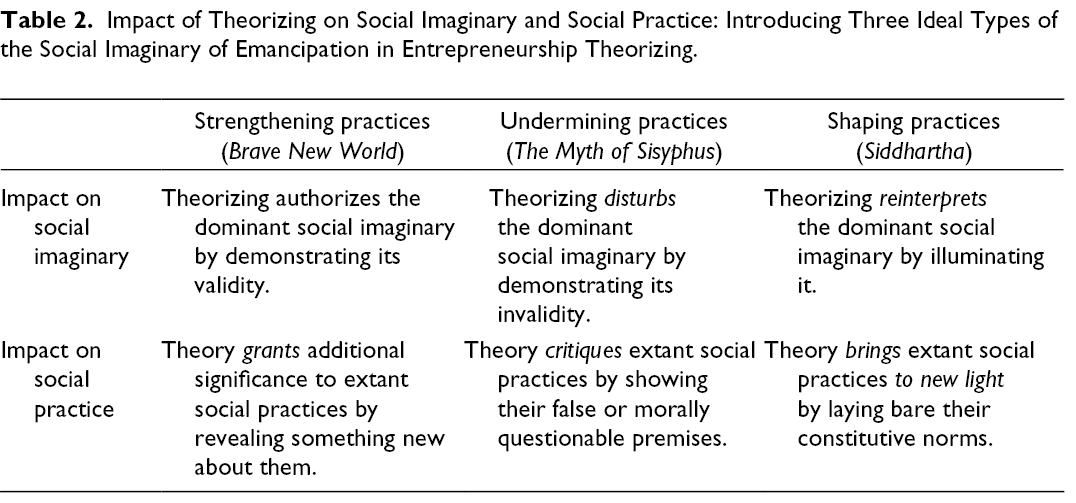
To address this issue in the hermeneutic tradition (Gadamer, 1986), we pursued a number of thought experiments to map ways forward (Weick, 1989), with our aim being to move from our interpretations of the texts as distinct forms of emancipatory entrepreneurship to formulating ideal types of the social imaginary of emancipation in entrepreneurship theorizing. For example, one theoretical trial used the texts as metaphors for the way in which entrepreneurs pursue meaningful goals; another dealt with the discovery of entrepreneurial archetypes through the texts; and a third worked with the texts to reveal different ideological discourses of freedom. Advancing from this, we used the social imaginary of emancipation as a connecting principle between texts and theorizing and, thus, continuously reinterpreted the questions “behind the texts” (Cornelissen, 2013; Gadamer, 1979). In this way, we further abstracted from the texts so as to illuminate the distinct ways in which entrepreneurship theorizing strengthens, undermines, or shapes practices and, subsequently, how commitments to the ways of theorizing affect the social imaginary of emancipation (Table 2). Our conceptual analysis draws largely from Taylor’s hermeneutical vocabulary on the nature of the reciprocal and practical relationship between theorizing and the social imaginary (Taylor, 1985, 2004).
Impact of Theorizing on Social Imaginary and Social Practice: Introducing Three Ideal Types of the Social Imaginary of Emancipation in Entrepreneurship Theorizing.
Strengthening Practices
Definition
Taylor (1985) refers to theories that complement understandings of current practices, or that “show them to be even more significant than we had thought” (p. 98), as theories with a “heightening effect” (p. 99), for example by showing that “important economic or other issues are up for grabs, and await our determination” (pp. 98–99). We view entrepreneurship theories as strengthening practices when they reveal new aspects of the entrepreneurial process or its function in determining, verifying, and proliferating preexisting perspectives, approaches, and habits, and which therefore, enable “business as usual.”
Relevance to Entrepreneurship Theorizing
When entrepreneurship theorizing strengthens practices, it affirms traditional theoretical knowledge regarding entrepreneurship as a potent socioeconomic force. By way of such theories, a society’s dominant or desired practices are granted additional significance; discovering a “correct” fit between theory and practice then both validates theory and justifies practice (Taylor, 1985). Understanding the entrepreneur, and closely associated stakeholders, as a beneficiary rather than prisoner of the prevalent social arrangement promotes emancipation in entrepreneurship theorizing by signaling a move from an inferior social position to one of superiority. In Brave New World, Bernard Marx identifies in John an opportunity to rise from social obscurity to fame. There are theoretical correlates to this. Researchers have taken notice of how entrepreneurs move from a constrained position toward a wider range of possibilities by leveraging various kinds of opportunities for action (Alvarez & Barney, 2014), for example by tapping into cultural resources such as storytelling and impression management (Garud et al., 2014; Kibler et al., 2020). In this conception, entrepreneurs use the metaphorical palette society puts at their disposal in order to advance collectively agreed causes (Clarke & Holt, 2010). Entrepreneurship is theorized as a powerful mechanism of social transformation, but within bounds of conventionality, as for example Tobias et al. (2013) have done, based on their evidence of perceived poverty reduction among those involved with new business opportunities in an economically challenged area. Similarly, conventional forms of entrepreneurship have been theorized to empower marginalized cultural groups (Henry et al., 2018; Ruebottom & Toubiana, 2020). By pointing out a previously hidden or obscured aspect of entrepreneurship and making it accessible as well as offering a possible explanation, such approaches enable a new appreciation of entrepreneurship as an empirically rich phenomenon (Aldrich & Ruef, 2018; Welter et al., 2017). It is situated within a stable social setting, where entrepreneurs act upon various kinds of opportunities that may propel them from an inferior to superior social position. Accordingly, such theorizing can provide entrepreneurship with “added significance” (Taylor, 1985) in seeking emancipation from a social grip that would be tighter if we knew less about the entrepreneurial means by which to loosen it.
In addition to offering an explanation of opportunities for entrepreneurs to break free from a previously held social position, theories may strengthen practices by advancing the understanding of how entrepreneurs exercise their freedom to pursue substantive benefits by making sense of the overarching social arrangement. In Brave New World, Bernard Marx’s disdain for public life is incongruous with his search for social advancement. In entrepreneurship theory, this tension often dissolves, as the benefit of entrepreneurs and different stakeholders is seen to be mutually reinforcing (Shepherd et al., 2020). In this vein, there is sustained interest in theorizing on how entrepreneurship may be better coordinated to produce personal (Kibler & Muñoz, 2020) as well as socioeconomic value (Zahra & Wright, 2016). What such theorizing ultimately aims to show is that what entrepreneurs do, or what they can do, for their own advancement is also for the advancement of others (Kibler, Wincent et al., 2019) and for society at large; the role of external involvement is to incentivize and give direction to such action. This perspective allows for an understanding that the productivity and development of a society hinges on the liberty enjoyed by its entrepreneurs (Zahra & Wright, 2016). Theorizing in this context provides entrepreneurship studies with prospective insight into how entrepreneurs typically exercise their freedom and what happens when and if they are emancipated, as well as ultimately, deciding upon the terms by which emancipation can be understood as appropriate.
Theorizing that affirms entrepreneurship as a type of action that engages with opportunities to break free from preordained social circumstances, or that exercises freedom so as to produce social benefits, tends to authorize the dominant social imaginary, thereby strengthening extant practices. Although we consider this type of theorizing to do little to change the dominant social imaginary, it serves to reveal it in a more complete manner thus, liberating us from previous ignorance (Taylor, 2004). In this way, theorizing may work to safeguard and retain the dominant social imaginary; the usefulness of such theorizing impinges upon its ability to demonstrate its cogency. In other words, theories are validated as well-reasoned simulacra of a collectively held social imaginary. Since we understand this in relation to a pattern of thought that seeks completeness (Gadamer, 1979), in order for theory to strengthen practices, a theoretical foundation is typically involved that can be traced back to a set of foundational thinkers whose ideas have been cemented into the literature. As such, they wield great intellectual influence despite having their origins in a different historical context. The most obvious example of this is the theoretical impact of Schumpeter (1942, 1955a) on the entrepreneurship canon; yet, more recent theses by Baumol (1996), Kirzner (1997), Shane and Venkataraman (2000), and McMullen and Shepherd (2006) can be qualified as seminal theoretical contributions to the social imaginary of entrepreneurship as a modern method for socioeconomic development (Sarasvathy & Venkataraman, 2011). The question, then, is how we must understand the grounds for the universal availability of entrepreneurial opportunities and the productive harnessing of entrepreneurial energy, which informs research as a moral order—a complete, historically sound theoretical venture—that underlies theorizing in entrepreneurship studies.
As such, entrepreneurship theory can be seen to authorize the dominant social imaginary according to which hierarchy as a practical order, understood as central to the functionality of earlier society, is under threat or even rejected. From a broader point of view, the idea that the value of a theory consists of its ability to be applied to practice is closely associated with this. Thus, while it is expected that a relation between theory and practice exists, a constellational distance is retained between the methodical practices of the theorist and those practices that comprise the object of research that is to be theorized. This commitment is straightforward and uncomplicated in its own right, as it considers theory to be about a set of objective practices secondary to the theorist, which thereby forms a pool of data awaiting sophisticated explanation, even while it transforms the theorist’s methodic practices designed to discover a correct “fit” between the two. They, however, remain separated as fundamentally as the ocean is from the ground beneath our feet. Neither theory nor its objects undergo fundamental change. In the context of entrepreneurship, this may be due to the uncertainty that arises when moving beyond established and dominant imageries about what theories should look like and what they should do with the practices they are concerned with; to respond with certainty, the main aim becomes the authorization of the former by its application to the latter.
Undermining Practices
Definition
In Taylor’s (1985) view, theories can also have the opposite effect of upsetting and disturbing a practice “by showing that its essential distinctions are bogus, or have a quite different meaning” (p. 98). For example, what seems like “unconstrained choice is presented as unyielding domination” (p. 98) through a radically new theoretical exposition of current practices as affected by concealed powers of dishonest or an immoral nature. In our view, entrepreneurship theories can undermine practices when they contest the way we see entrepreneurship as part of a wider, ideologically determined context of action, thus, forcing those holding an alternative theory to come to radically different conclusions.
Relevance to Entrepreneurship Theorizing
When entrepreneurship theorizing undermines practices, it aims to demonstrate the false premises of prior understandings regarding the emancipatory potential of entrepreneuring. When theories do this, they disrupt the way we see the social world as functioning; and by so doing, they unsettle previously valid interpretations about our ability to develop society and the economy (Taylor, 1985). The value of a theory is then judged by its ability to discredit the dominant social imaginary in favor of promoting an alternative one. Seeing entrepreneurship as being able to accomplish this typically involves the ability to break up prevailing hegemonies. In The Myth of Sisyphus, we are introduced to Sisyphus as an extraordinarily cunning character who is able to trick the gods and cheat death by always striving to dodge that which is leveled at him “from above.” We recognize the spirit of Sisyphus in research that aims to make explicit the hegemonic basis of the social constructs that are used to make sense of social reality, but which derive from morally questionable premises (Jennings et al., 2016; Jones & Spicer, 2009). Furthermore, since this hegemonic basis is seen as flawed, dissatisfaction with mere theoretical explanation is rife. Instead, emancipatory entrepreneurs are thought to deal directly with opportunities so as to break free from such situations; hence, in addition to theorizing opportunities for the social advancement of entrepreneurs, emancipatory entrepreneurship involves the search for understanding and stimulating more radical behavior (Rindova et al., 2009). It follows that theorists may upset prior understandings of entrepreneurship by producing the kind of knowledge that rids us of the fetters that hitherto have bound entrepreneurship to an order of meanings that otherwise would remain unquestioned.
By way of incremental steps taken toward theories that reveal prior knowledge about entrepreneurship to be misguided, theorists may aim to undermine practices by focusing on such exercises of freedom that renounce previous social orders, and hence widen the scope for action. Camus’ engagement with Sisyphus was motivated by the desire to develop a rationale for avoiding the expected, even when predetermined by divine forces, and showcase rebellion as an existential credo. In a vein not entirely different to this, researchers have taken notice of the emancipatory potential of destructive action by entrepreneurs (Dey & Mason, 2018; Perren & Jennings, 2005). Hence, by theorizing entrepreneurship as not only bringing about new business but discrediting previously held values and beliefs that sustain the understanding of entrepreneurship as an enterprise-driven rather than socioeconomic object of research (Hjorth & Holt, 2016; Jones & Spicer, 2009), we can understand this as a theoretical project of cleansing our understanding of flaws that derive from antiquated strands of thought. This type of theorizing typically takes emancipation as a critical notion, and in this way reasons for a need to overhaul what is considered right and just; in other words, such theorizing seeks to provide opposition to prevailing logics and reveal the defunctness of the established canon. What is disruptive, then, is seen in a positive light, due to the fact that it clears the decks to enable new creativity.
Theorizing that accomplishes the above tends to disturb, rather than authorize, the dominant social imaginary. This type of theorizing is satisfied only by introducing an unsettling voice as “a particular form of critical speech employed to problematise and move beyond entrenched modes of collective imagination conditioned by the orthodox social imaginary” (Dey & Mason, 2018, p. 86). Hence, it possesses the ability to open new vistas for thought and action by dislodging earlier social ideals and morality; and entrepreneurship scholars can take the notion of creative destruction as a principle of criticality in order to demand “entrepreneuring” from entrepreneurship theorizing, thus producing emancipatory science (Hjorth & Holt, 2016; Jones & Spicer, 2009; Steyaert, 2007). The purpose of this is often to unbalance the canon of entrepreneurship thought, and therefore seminal theories of social change are typically sought from other disciplines (Calás et al., 2009; Steyaert & Hjorth, 2006). Commonly, a move in this direction is achieved by applying the thought of an authoritative social critic to entrepreneurship theory so as to reveal a claim to truth that is pretentious rather than just (Alvesson & Willmott, 1992). Using theories from the outside, particularly critical theories, can be accomplished in a way that affirms their completeness in order to disavow the inside view (Gadamer, 1979), particularly in regard to the way entrepreneurship theories lend themselves to ideological usage by those who hold actual power in society (Perren & Jennings, 2005; Tedmanson et al., 2012). The question for theorizing, then, is understanding how entrepreneurship fits in with societal interests; whether it can contribute to social progress; and what types of theories support or disassemble the moral orders in question when entrepreneurship is involved?
Consequently, the value of entrepreneurship theories that are committed to developing an alternative to the dominant social imaginary may lie in their abilities to unsettle a position held by others and to pose a compelling argument for a new position. While this view retains theory as a determinant for the practices that define its objective interests, it aims to upset previous determinations and replace them with others. Such commitment to change can only be satisfied when the theory becomes an agent of change, hence pointing out an essential feature of theory to mold practices—which must begin as differing from what the theory sees as desirable and so, as true. Therefore, while theories do not change, its objects do; and this shift is itself the ultimate aim of theorizing. In entrepreneurship studies, this can occur when theorists demonstrate the unsoundness or inadequacy of what is posited as the dominant view; for example, that entrepreneurship is about profitability, and replace it with a different view—for example that it is about appropriation. The same principle applies even when no replacement is offered or when it is obscured, both of which present quintessential dilemmas for critical research’s claim to social value. The extent to which we can consider an emancipatory agenda as putting such criteria to use serves to illuminate how well-suited a theory is to revealing the strings and their hidden operators, and to engineer their defeat.
Shaping Practices
Definition
In addition to the two practices outlined above, Taylor (1985) points to a third way by showing that theory “is the making explicit of a society’s life, that is, a set of institutions and practices” (p. 100), which it accomplishes by offering “an interpretation of the constitutive norms” (p. 99). In this view, theories lag behind practice, and hence cannot completely determine (i.e., strengthen) or replace (i.e., undermine) them: “even though some feature may find no place in the reigning theory, it may still be a constitutive part of a living practice” (p. 100). We regard entrepreneurship theories as shaping practices when they enable us to bring forth and reinterpret the operations which enable entrepreneuring, regardless of prior theoretical agreement or disagreement.
Relevance to Entrepreneurship Theorizing
When shaping practices, entrepreneurship theorizing illuminates entrepreneuring as among the constitutive features of contemporary society. Theories of this kind neither accept prevailing orders at face value nor make it their primary aim to replace them; instead, they seek to make explicit understandings about how society works (Taylor, 1985). The role of theory is then understood as an enlightenment project that began in antiquity and has its ultimate aim in realizing an ideal way of life (Gadamer, 1998). With entrepreneurship, the question then becomes how, and under which conditions, entrepreneurs can contribute to such development in theory and practice. In the context of theorizing, this involves the forging of a clear vision of obstacles in the way of development. In Siddhartha, we follow a “nonconformist” hero who questions other people’s truths in his quest for perfection. Such a stance can be witnessed in research that identifies the constricting nature of social norms or rules of the game in the pursuit of meaningful goals (Baumol, 1996; Clarke & Holt, 2010; McMullen & Dimov, 2013). Theorizing here takes an active role in identifying those elements thought to be urgently needed or compelling yet, which lie in the way of development. Hence, theorizing of this type takes a direct route to establishing an understanding of how entrepreneurial initiatives can make the world a better place as well as discovering the obstacles on this route. In this way, theorizing can contribute to a renegotiation of social life in order to make a collectively desired future clearly visible and attainable (Taylor, 1985). Theorizing entrepreneurship then amounts to mapping out ways forward amidst multiple choices as well as reaching for a commonly acceptable solution.
In addition to the theorizing of opportunities related to overcoming obstacles to reach an ideal condition, practices can be shaped by theorizing that shows what entrepreneurs may do to create the conditions for furthering positive development. This involves the creation of what Taylor (2004) describes as “metatopicality” to indicate conditions of correspondence free of intentionality and fixed purpose. As part of the public sphere, metatopical spaces enable power externalities—disengaged forums for open discussion, decision-making, and path-setting. Siddhartha is a case in point: his fervent search for wisdom results in repeated lapses from the moral authorities that he seeks to comprehend—yet, which ultimately remain alien to him. He finds his greatest fulfillment in the simple and detached profession of being a boat man, providing people with a friendly but neutral ear as well as a safe ride across the river. Entrepreneuring of this kind can, for example, take the form of creating the conditions for unprecedented social inclusion for others (Chandra, 2017), or mediation between conflicting political, environmental, and business concerns (Salmivaara & Kibler, 2020). This type of theorizing is often the voice of integration; it stands against the academic tendency toward noninterference and calls for a direct and uncomplicated correspondence between theorists and practitioners while retaining the professional status of both (Dimov et al., 2020; Johannisson, 2011; Van De Ven & Johnson, 2006). Emancipation in this sense refers to interrogating subjective claims to truth, seeking to establish necessary conditions to answer “what are we to do?” It is the ability to ask this question free from prejudice that becomes the emancipatory product.
This type of theorizing tends to open up the social imaginary to reinterpretation. Unwilling to either uncritically affirm the dominant social imaginary or to make its overthrow a moral necessity, this type aims to make explicit the moral orders that are expressed in the social imaginary and to subject them to public discourse (Taylor, 2004). This increases the ability to engage with the necessity of a certain “completeness” of understanding and to use it to rid oneself of prejudice (Gadamer, 1979). We consider this to be emancipatory, in the sense of revealing the kinds of background information that is necessary for social behavior but typically remains out of the spotlight (Garfinkel, 1967). This frees us to be more aware and selective of the manner in which we talk about entrepreneurship (Dimov et al., 2020; Gartner, 2008; Lundmark et al., 2019). If this enables us to identify common interests, discussion may center on the truly relevant and move toward new and increasingly inclusive theoretical stances (McMullen et al., 2020). As such, intimacies can be found in themes previously thought as distant. Clear examples of this are to be found in the literature on social entrepreneurship (Chandra, 2017; Hu et al., 2020) and environmental entrepreneurship (Muñoz & Dimov, 2015; Salmivaara & Kibler, 2020). The shaping of practices is a central concern here: theories can be, and indeed are, used selectively; the less useful aspects are discarded in order to develop new theoretical stances that enhance entrepreneur capacities to take on responsibility for developing the public sphere (Hjorth, 2013; Spinosa et al., 1997). This type of theorizing is involved in efforts to establish the grounds for re-determining how we understand the functioning of the social world vis-à-vis the social imaginary. Entrepreneurship, as part of this re-determination process is thought to hold untapped potential for bringing forth the best in theory, as well as in practice.
Consequently, in addition to authorizing and disturbing, entrepreneurship theories may offer a new way to approach the social imaginary, in particular with an eye to enabling its reinterpretation. The value of such theory lies in its ability to make explicit the underlying features of the way the social world works, thus enlivening our understanding of it. Such theory aims to neither affirm nor replace the operative basis of extant practices; rather, it seeks to make it available for common interests to put their stamp on it and as such, make itself available for revision. Social theorizing, in this sense, retains a commitment to develop from theory not only a means for a heightened understanding of its objects, although it certainly holds this in high regard and in fact constitutes a prerequisite, but also a useful means to inform a social collective’s ability to move forward in a self-reflective manner. Theories and objects undergo changes in conjunction with each other. In this vein, it is possible for entrepreneurship theories to subject the dominant social imaginary to reinterpretation through the illumination of entrepreneurial phenomena; constant questioning of a theory’s usefulness then becomes a matter of practice, equally as much as informing practice is a theoretical matter.
Discussion and Implications
We began this contribution by asking: why is emancipation needed in entrepreneurship? To address this question, we have reasoned that entrepreneurship theorizing thrives on the social imaginary of emancipation. As such, we have assumed emancipation to be a crucial social imaginary underpinning not only entrepreneurship research that embraces emancipation explicitly but indeed all entrepreneurship theorizing. Inspired by the use of fiction (Boje & Smith, 2010; Cornelissen, 2013; Gartner, 2007) and the application of philosophical hermeneutics in social science (Gadamer, 1979, 1986, 1998; Taylor, 1985, 2004), we have explored and introduced three ideal types of the social imaginary of emancipation—termed strengthening, undermining, and shaping practices—which we believe can further develop entrepreneurship studies as a field of emancipatory intent. Although strong and socially meaningful theories are able to move between and across social imaginaries and the contexts for social practice enticed by them, very few aim to do so intentionally; in fact, numerous critics have recently pointed out that precisely the opposite case seems far more common (Alvesson et al., 2017; Lundmark et al., 2019; McMullen et al., 2020). For example, critical entrepreneurship scholarship might push for a theory of entrepreneurship as the creation of new social situations by considering entrepreneurship as oppositional to administrative or managerial forces, and therefore refute economic readings of entrepreneurial phenomena. Meanwhile, research streams taking a more “classical” stance might begin from the position of entrepreneurship as an economically productive activity, and hence emphasize the increased availability of opportunities as a definitive feature of a freely developing society. While some theories are able to incorporate multiple perspectives and contexts into their theorizing, surprisingly few have done so (Aldrich & Ruef, 2018; Dimov et al., 2020; Welter & Baker, 2020).
We suggest that the new theoretical understanding developed in this article can serve as an important springboard for entrepreneurship researchers to reflect upon how to develop more socially relevant theory (Hjorth, 2013; Shepherd, 2015; Wiklund et al., 2019) as well as on the practical process of theorizing, in particular the relationship between research contexts and theoretical commitments (Lundmark et al., 2019; Thompson et al., 2020; Wainwright & Muñoz, 2020). In line with this approach, we argue that our typology (Cornelissen, 2017) of how entrepreneurship theories may strengthen, undermine, and shape practices—that is, their impact on practical contexts as well as on the social imaginary of entrepreneurship practice (Table 2)—can be used as both an introduction and heuristic device for understanding entrepreneurship as an emancipatory force.
When entrepreneurship researchers seeks to make their mark, they will typically adopt a particular theoretical perspective, or combination of theories, and proceed to study them in a specific practical context. We believe this process should, in the end, return to a more inclusive framework and contribute to understandings of entrepreneurship across different practical contexts and social imaginaries. Accordingly, we think our conceptualizations of the social imaginary of emancipation, introduced in this article, help to reflect on the field of entrepreneurship as it currently stands, as well as proffer ways forward. In order for the field to advance, it seems crucial for scholars to be able to pay attention and respond to the diversity in emancipatory entrepreneurship theorizing and to move between the contextual boundaries related to social practices. In our view, this provides emphasis to a number of fundamental questions for reflecting on how we can use emancipation as a social imaginary in order to open up new vistas for entrepreneurship research.
In expanding and guiding our discussion, we identify a minimum of four questions pointing toward important research conversations at the intersection of (1) theory and practice, (2) protest and orthodoxy, (3) unity and plurality, and (4) the past and the future. First, it bears repeating that entrepreneurship research is rooted in a cluster of economic and social theories (Hoselitz, 1951; Schumpeter, 1955b) according to which entrepreneurship “works best” within an economic sphere defined by initiatives within it (Kirzner, 1997; Schumpeter, 1934). This theoretical canon has served to build entrepreneurship as an academically respectable discipline (Dimov et al., 2020; Low & MacMillan, 1988). However, it has been of growing concern that this has come at the price of losing touch with the ingenious practices that initially inspired the research (Johannisson, 2011; McMullen et al., 2020; Ramoglou et al., 2020). Hence, we ask: How can we become more practically relevant without losing theoretical relevance? Second, important advances have been made in theorizing opportunities (Berglund et al., 2020; Dimov, 2018), through which entrepreneurship enters into discourse in and on the public sphere (Hjorth, 2013). This notwithstanding, a cleavage remains between the notion of entrepreneurship as economic development, and political analyses of such (Perren & Jennings, 2005; Tedmanson et al., 2012; Verduijn et al., 2014). So we ask: Which part of the economic value of our theories can be retained if we are not economically oriented? Third, even while entrepreneuring has been plausibly associated with the active creation of new opportunities in the private sphere (Calás et al., 2009; Dey & Mason, 2018; Weiskopf, 2007), it is theorizing their discovery and exploitation that comes closest to a unique paradigm vis-à-vis other disciplines (Cornelius et al., 2006; Low & MacMillan, 1988; Shepherd & Wiklund, 2020). However, this has diminished the internal range of the field by imposing restrictions on the scope of attention within entrepreneurship theory (Dimov et al., 2020; Gartner, 2008; Welter et al., 2017). Our question here is: Which is “more” important: the disciplinary credibility of entrepreneurship studies, or entrepreneurship theory as an inclusive field within the social sciences? Fourth, it remains undisputed that entrepreneurship in the moral sphere is imagined to be potentially emancipatory once it becomes a general right (Taylor, 2004). Indeed, a great understatement of entrepreneurship theory is the promise it makes for the future (Sarasvathy & Venkataraman, 2011; Shane & Venkataraman, 2000; Spinosa et al., 1997). However, of great advancement to the empirical study of entrepreneurship and social change has been the use of historical analysis (Baumol, 1996; Schumpeter, 1947; Wadhwani et al., 2020). Accordingly, we raise the point: Can we understand the future by looking at the past; and can we contribute to a better future by understanding the past?
We elaborate upon these questions below to discuss the relevance of emancipation in and for entrepreneurship theorizing, across different social imaginaries and social practices (Table 2). In this way, we hope to spark new dialogs that help move the scholarly field of entrepreneurship forward in both theoretical and practical terms.
Entrepreneurship Theorizing and Social Imaginaries
The focus on social imaginaries suggests that entrepreneurial and emancipatory phenomena can be understood as interwoven (Rindova et al., 2009; Verduijn et al., 2014). The social imaginary inhabits a particular place in the hermeneutics of social science, as the form that enables understandings of how the social world works. Nevertheless, little attention has been afforded to how to deal with such pretheoretical knowledge in entrepreneurship studies. More often than not, understanding is thought of as a complete structure rather than as something ephemeral and processual (Gadamer, 1979). Hence, social imagination can become an object of authorization; that is, finding validity to dominant understandings of the social value of entrepreneurship (Taylor, 2004). From a broader point of view, hermeneutics points at examining the social imaginary as belonging to a set of movements or transitions and asks us to consider any given social imaginary as but one ontological and/or epistemological option amongst many. We have suggested that entrepreneurship theorizing thrives on the social imaginary of emancipation, and we have identified three types of theoretical commitments to this social imaginary, with disturbing and reinterpreting as novel emancipatory impacts that enable deeper incisions into the social imaginary in entrepreneurship. It is through a hermeneutical engagement with theorizing that we are able to relate different types of social imaginaries to each other, to see similarities between them, and to indicate potential movements between them so as to generate a more complete vision of emancipatory entrepreneurship.
Both theorists and practitioners of entrepreneurship engage in social imagination. Hence, by drawing from hermeneutical social science (Schütz, 1932; Taylor, 1985) as well as classical hermeneutics (Dilthey & Jameson, 1972; Gadamer, 1979, 1986), we have suggested the social imaginary (Taylor, 2004) as a natural meeting place for entrepreneurship theory and practice. It is within, and through, the social imaginary that theorists contribute to the formulation of practices as well as being the place where practical reality feeds back to theory. What are the practices we theorize as entrepreneurship researchers, and how does our theorizing relate to them? What is entrepreneurship theorizing when it is understood as a practice? Doesit differ from the social or natural sciences, or from the humanities? Should scholars profess better command of entrepreneurial practices and, more generally, enhance action-based (Wainwright & Muñoz, 2020) and explorative entrepreneurship research (Wennberg & Anderson, 2020), in order to formulate new theories, as opposed to mainly applying, testing and/or extending existing theories? What would be the contribution of entrepreneurship practitioners to theorizing—and could entrepreneurs write their own theories? These are not idle questions, for they are fundamental if we are “to be mindful that a central facet of the field has always been the exploration of novel and important phenomena” (Wennberg & Anderson, 2020, p.9). Considering entrepreneurship theorizing as covering a substantive range in terms of emancipation can help improve the articulation of how our research authorizes, disturbs, and reinterprets the entrepreneurial practices with which it is concerned. Working with the social imaginary, across theoretical commitments, allows us to mitigate the oft-lamented gap between theory-based and practice-oriented understandings of entrepreneurship research (Thompson et al., 2020; Wiklund et al., 2019).
Here, we would like to highlight a breach between those who adhere to the notion of entrepreneurship as a phenomenon belonging primarily to the economic (growth) domain, with secondary causes and effects to be found in the extra-economic, and those who seek novel understandings of entrepreneurship from more political, social, or humanistic standpoints. All of these perspectives are crucial for future developments. Since the former is closer to the traditional view and boasts a historical corpus based on theory and practice, besides being the more commonsensical of the two, the latter tends to self-identify as an oppositional movement. Will such Sisyphean conviction blind one to possibilities that might emerge from seeking integrations between approaches to entrepreneurship that take their theoretical impulses from different strands of social science? What is the dialectic nucleus with which entrepreneurship theorizing can be envisaged as an ingenious approach to social science? If entrepreneurship theorizing has truth as its aim, it scarcely can choose between economic relevancy and social substance (Dey & Mason, 2018; Dimov, 2018). As much as active voices of protest keep orthodoxy from becoming totalitarian (à la Brave New World’s London of the 2500s) an established body of knowledge keeps total disintegration at bay. The irony is that looking back at the work of Schumpeter, perhaps the most influential agenda-setter for entrepreneurship studies, we see an overarching ambition to imagine the future as one that contains entrepreneurship as the main force in both the economic and political spheres. In their relentless challenges to the status quo, the creative destruction brought by entrepreneurs to the economy is reflected in public acceptance of precisely the same principle that undermines established social orders; due to its internal logic, entrepreneurship then makes itself obsolete (Schumpeter, 1942). We can heed Schumpeter’s ambitions for a broad vision, independently of our opinion on its success.
By continuing this discussion in the form of binaries, two ways to think about entrepreneurship can broadly be identified. One is to consider entrepreneurship as a distinct function, in the economic sense or otherwise, that can be revealed theoretically (Schumpeter, 1934, 1947). Imagining the entrepreneurship research community as consisting of the development of a unified, paradigmatic, and disciplined domain of scholarly work, the role of theorizing is to enable this development by presenting a common vision; in other words, the envisioning of a “big theory” and/or a “common core” to entrepreneurship theorizing (McMullen et al., 2020). However, the lived reality of entrepreneurship is diverse, heterogeneous, and mundane (Aldrich & Ruef, 2018; Welter & Baker, 2020), as opposed to the clarity, monotypicality, and ideality of such big theory. This risks empirical poverty as well as potentially consigning research to becoming a procedure to legitimize entrepreneurship, where relevance and social value might be too readily standardized; this then calls for diverse and comparative approaches (Kroeger & Weber, 2014). As such, a second way to think of entrepreneurship is to engage with the richness of everyday entrepreneurial phenomena on their own terms (Johannisson, 2011; Welter et al., 2017). By imagining entrepreneurship research as closer to the bottom-up, inductive approaches of, for instance, social anthropology rather than the theory-driven, deductive take of mainstream economics, theory can be thought to be in the service of those partial to it (Dimov, 2018; Lundmark et al., 2019). Nonetheless, this view may lead to a maze of ideas, or mere descriptions, from which social value becomes all too difficult to extract (McMullen et al., 2020; Wiklund et al., 2019; Zahra & Wright, 2016). Do these perspectives present an “us-versus-them” setting, in that they create the premises for the kind of academic entrenching that not only wastes researcher time but also public funds (Alvesson et al., 2017; Tourish, 2020)? While it is intriguing to observe that entrepreneurship is an approachable field for researchers from different traditions, is entrepreneurship research the appropriate setting for unraveling differences between theoretical traditions within the social sciences? How can the publicly lauded promise of transdisciplinarity be realized by those trained as entrepreneurship researchers; or should this be accomplished by the economists, sociologists, geographers, and psychologists who work at business schools? To consider this, we have advocated a pluralist view in this article by taking a closer look at the theorizing process, an undertaking that is common to social science (Swedberg, 2014; Taylor, 1985). In our view, a major reason for the exciting nature of entrepreneurship as a research field lies in its potential ability to house multiple interpretations and social imaginaries concerning and, pushed forward by, its specific object of theoretical interest.
It remains difficult to contemplate emancipatory entrepreneurship theorizing without becoming engaged with future scenarios. Indeed, both entrepreneurship and emancipation are naturally future-oriented concepts (Rindova et al., 2009; Sarasvathy & Venkataraman, 2011). We engage with the present by worrying about the future (Heidegger, 1962), entrepreneurs perhaps even more so than others (Dimov, 2018; Spinosa et al., 1997). Emancipatory entrepreneurship indicates a move from an inferior past to a superior future, and this process is orchestrated or mediated by entrepreneurs (Calás et al., 2009; Rindova et al., 2009). Is there a place for the past in theorizing and practicing entrepreneurship? It should go without saying that advantages accrue from using historical means (Baumol, 1996; Schumpeter, 1947; Wadhwani et al., 2020) to initiate deeper conversations about time (Lévesque & Stephan, 2020; Wood et al., 2020) and to investigate the specific entrepreneurial journeys that—like Siddhartha’s quest for enlightenment—lead people from one place to another, and then onwards to yet another (Laine & Kibler, 2018; McMullen & Dimov, 2013). In particular, we argue that historical sensitivity can help us understand the present and illuminate entrepreneurship in ways missed by temporality-shunning approaches. How does entrepreneurship help us realize freedom? Will it be today or tomorrow that entrepreneurship gets us to where we want to be? What is it that entrepreneurship theory tells us about the past, and what does it require the past to consist of in order to take us forward? Caught up in the present, we are in the process of moving from the past to the future. Here, we have the past pasts and past futures of “pure history,” the present pasts and present futures of theorizing, and the future pasts and future futures of practical reality that our propensity for social imagination encompasses. Increased ability to move between these we feel, would itself be “emancipatory” and signify an achievement for entrepreneurship theory, as well as having relevance far beyond our field.
Entrepreneurship Theorizing and Social Practices
Theorizing has not only theory, and its ontological and epistemological underpinnings, in mind but also its empirical outcomes and practical concerns, which are, in turn, defined and influenced by theoretical inputs (Gadamer, 1998). As a theoretical objective, emancipatory entrepreneurship is defined by the various contexts within which, as well as the practices through which, it is interpreted and understood (McMullen et al., 2020; Wainwright & Muñoz, 2020; Welter & Baker, 2020). In other words, when we theorize emancipatory entrepreneurship, we do so within the contextual framework allowed by our social imagination. In this article, we have posited the dominant social imaginary as the gradual rejection of hierarchy (Taylor, 2004). We have identified this as a common thread in the different practical engagements and social impact of entrepreneurship theory. Our new hermeneutic of emancipatory entrepreneurship has allowed for a closer inspection of how theoretical commitment to social imagination leads us to imbue social practices with new significance (Taylor, 1985). Moving forward, our hermeneutic approach to social change provides entrepreneurship researchers with a more explicit view of how theorizing may involve both the explorations and fostering of different social practices, thereby making space for critical engagements with the social imaginary. To make sense of this diversity and complexity, we have provided a heuristic typology that we believe can be a useful device for bringing to new light emancipatory entrepreneurship as “a societal mechanism dealing with changing issues and appearing in (and even creating) new contexts” (Shepherd et al., 2020, p. 182).
Much entrepreneurship research, for example, focuses on explaining how entrepreneurs and their ventures can perform better economically (Cornelius et al., 2006; Shepherd et al., 2020). This can maneuver entrepreneurship theory into the position of offering explanations for economic phenomena. However, theories formulated within economics are no longer confined to economic contexts, but are rather used to discover analogies in other practical contexts (Ketokivi et al., 2017). Schumpeter’s theoretical contribution is, again, a prime example of how the author’s intention to develop grand economic theory has fertilized theoretical development in social theories of entrepreneurship (Steyaert & Hjorth, 2006; Swedberg, 2000). Furthermore, just as Bernard Marx reveals the moral orders of the Brave New World not by virtue of his challenge but by ultimately conforming to the predominant social imaginary, emancipation can help see Schumpeter’s economic theories of entrepreneurship as being underpinned by imaginations of the social. In a similar fashion, in the practice of contemporary entrepreneurship research, Kirzner’s economic theory has augmented behavioral theories of entrepreneurship by drawing from psychology and social psychology (McMullen & Shepherd, 2006; Shane & Venkataraman, 2000). In addition to transporting a theory from one context to another, a theory can attract theories birthed in other contexts to support it, and perhaps to validate other theories from other contexts. An example of this being contemporary studies on the psychological well-being of entrepreneurs (Shepherd et al., 2020), where they are defined according to entrepreneurship theory and their mental state is approached through psychological theory (Stephan, 2018). Working across different practical contexts (Welter & Baker, 2020) can help entrepreneurship researchers to situate their theoretical backgrounds better and help them reason for their novel usage of such theories (Shepherd & Wiklund, 2020). In other words, theories can be useful beyond their initial domain. Theories of entrepreneurship that can do this have greater social relevancy, if only for the reason that they attract a wider audience because they address more than one body of literature within the social imaginary of emancipation.
Although we have taken the view that emancipation is a key feature of the overarching social imaginary that can be used to define the modern era (Taylor, 2004), we call to mind that any given social imaginary is but one alternative amongst many. In the view that has become the orthodox position in entrepreneurship research, the innovations that entrepreneurs produce are perceived as being more beneficial than harmful to society and, therefore, are to be encouraged (Shepherd, 2019; Zahra & Wright, 2016), for example by mitigating deleterious secondary effects (Baumol, 1996). Then, some of those who embark from positions other than the economic have called for alternative understandings in order to undermine the claim to good inherent within entrepreneurship (Dey & Mason, 2018; Jones & Spicer, 2009). Can elements of our foundational theories be salvaged if we embrace more radical views that aim for understandings of the concrete? For instance, under which circumstances do certain entrepreneurial activities harm or benefit personal and/or societal well-being (Kibler, Wincent et al., 2019)? What role does ideology and policy rhetoric play in understanding the social purpose and impact of entrepreneurship theorizing (Salmivaara & Kibler, 2020)? If we transport emancipation to the heart of entrepreneurship theorizing, what type of transitions would then be necessary in the social imaginary? Although it is difficult to rid entrepreneurship research of a certain romantic fixation on the heroic entrepreneurial individual (Laine & Kibler, 2018; McMullen, 2017), or of the image of a tightly bundled super-group, this may be better regarded as a strength rather than weakness of the field, for it enables very different viewpoints to contribute to our theorizing and social critique. Our imagination is sparked by considering the ways in which, for example, Van Gogh (Cornelissen, 2013), Ai Weiwei (Hjorth & Holt, 2016), or Picasso (Olive-Tomas & Harmeling, 2019), could lend themselves to entrepreneurial readings, let alone Gandhi or Guevara.
As opposed to Sisyphus, some entrepreneurship researchers may find it difficult to remain content about the superimposition of entrepreneurship with emancipation, feeling that they are unable to face such an impossible task (Rindova et al., 2009, Verduijn et al., 2014). Those advocating a traditional, mono-theoretical view are pushed by the notion of emancipation to reexamine the social value of their theoretical output (Dimov et al., 2020). However, the same principle applies to those who seek to make space for pluralism within entrepreneurship (Wiklund et al., 2019). Thus, to use McMullen’s et al. (2020, p. 28) words, how can we best promote “collective progress without curbing the inclusion and diversity that have become hallmarks of our emerging field’s ethos”? For instance, how can we assess the “right” balance between a narrow and rich set of outcome constructs in entrepreneurship research (Shepherd et al., 2020) so as to make sure that what we (seek to) explain is not only theoretically relevant but also practically meaningful, for both entrepreneurs and society? How can we benefit those we study if we do not adopt a theoretical, that is, more abstract and loftier view of what they are doing? What is the “best” or “correct” level of analysis and abstraction for obtaining social benefits? Can such a correct level be found? Should entrepreneurship research more closely resemble medical research, biochemistry, or something else (Van De Ven & Johnson, 2006)? Furthermore, what role should ethics play in entrepreneurship theorizing? While viewing the business-school initiatives to entrepreneurship education as an achievement preceded by academic disciplinary unity, how are we able to assess the social impact of such education? Can it be thought of as training for social change? In this contribution, we have argued for the view that emancipation is a key social imaginary for entrepreneurship, diffused in practice by way of various theoretical commitments. In order to realize its emancipatory potential, entrepreneurship researchers would do well to reflect on the moral orders (Taylor, 2004) that compose its commonly accepted area(s) of interest.
Emancipatory entrepreneurship asserts that there is a possibility for entrepreneurs to achieve social changes in the future (Calás et al., 2009), if not for all society then at least for themselves (Rindova et al., 2009; Ruebottom & Toubiana, 2020). In Schumpeter’s theory, entrepreneurs contribute to society by creating the premises for socializing the economy (Schumpeter, 1942) as well as providing themselves with the means for social ascent (Schumpeter, 1955a). In this sense, history can be used to study emancipatory entrepreneurship as a social and highly contextual process, and to reflect on time and temporality in entrepreneurship theory more generally (Baumol, 1996; Wadhwani et al., 2020). History is a specific type of empirical research in the sense that it is primarily an engagement with events and phenomena that have taken place without the researcher being present. There are no questionnaires, interviews, or observations associated with social science methodologies with historical tools; not only the entrepreneur of theory (Spinosa et al., 1997) but the theorist of entrepreneurship becomes a maker of history. By strengthening, undermining, and shaping practical conceptions of social change they embark on new journeys, just as Siddhartha did. How have people pulled themselves out of poverty (Kimmitt et al., 2020) or communities recovered from major crises (Farny, Kibler & Down, 2019) by engaging in entrepreneuring? How has entrepreneurship provided individuals with a way out of physical or material danger (Chandra, 2017)? What evidence in the past is there of entrepreneurial activity enabling community development (Henry et al., 2018), empowerment (Marlow & McAdam, 2015), or self-confidence (Ruebottom & Toubiana, 2020) of niche groups? In a nutshell, we argue that in the serious quest for advancing a “we”-voiced (Dimov et al., 2020), compassionate (Shepherd, 2015), socially transformative (McMullen et al., 2020), and/or community development perspective of entrepreneurship (Kibler & Muñoz, 2020), emancipation sensibly forces us to ask how social theorizing may reveal entrepreneurship as being more meaningful than before. Alternatively, it may uncover entrepreneurship as of less common value than previously thought, or, going still further, as something that is at present in a stage of becoming something else, in other words, a future type of entrepreneuring in which the practitioners of social theory have a say.
Conclusion
By holding on to a practical “need” for emancipation in entrepreneurship theorizing (Rindova et al., 2009), in this article we have sought to advance understandings of the relationship between imagination and theory. With the help of three readymade texts by Aldous Huxley, Albert Camus, and Hermann Hesse, we have developed an ideal typology of the social imaginary of emancipation in entrepreneurship theorizing (Table 2) with the intention of building an inclusive yet useful theoretical vocabulary of entrepreneuring as social change. In the spirit of Weber and hermeneutical social science, we have intended our ideal types as ways to confront pretheoretical thinking in entrepreneurship studies and also to encourage theorizing as an imaginative enterprise, thereby generating the potential to discover common concerns in entrepreneurship research despite the field’s celebrated, or indeed, infamous, plurality that can lead to new theory. Furthermore, we believe this line of work can help entrepreneurship researchers to “understand and appreciate phenomena more deeply in ways they had not imagined” (Bartunek, 2020, p. 225) and to reflect on theorizing as a social practice, and so, presenting a new way of approaching social relevancy without sacrificing theoretical ambition.
Of late, there has been warranted concern about the lack of social relevancy in entrepreneurship research. Many critics, especially in the domain of management and organizational theory, have pointed out that a misguided theoretical focus has been the main culprit in obscuring the practical implications of research. The equation that “less theory = more relevance” is all too easily made. However, as the history of social science shows us, a theoretical focus does not mean a lack of relevance for social practice. The real concern to us here is a lack of attention to the social practices of theorizing. Social imagination enables entrepreneurship theorizing as a social practice, and imagination makes theory practical and practice theoretical. If an entrepreneurial theory does not kindle capacities for creating change, it is likely to be irrelevant for social practice; and if an entrepreneurial practice does not stir up theorizing, it is unlikely to cause relevant social change. Finally, to move the whole field forward by focusing on emancipatory entrepreneuring as the search for social change, we are moved to claim that the next set of questions faced by the field is not only “what” the social relevance of entrepreneurship theory is, but also “how” entrepreneurship theorizing may become socially relevant—and, ultimately, “why” social change is sought by theorizers of entrepreneurship in the first place.
Footnotes
Acknowledgments
We would like to thank Susan Marlow, the paper’s editor, for her tremendously important guidance and deep engagement with our work throughout the review process. In addition, we are very grateful for the insightful and constructive suggestions received from our two anonymous expert reviewers. Many thanks to Joep Cornelissen, Ali Aslan Gümüsay, Renate Meyer, and the other session participants at the 2018 ETDW (European Theory Development Workshop) in Vienna, as well as to Steven Parham and Subramanian Rangan, who provided valuable critiques of this article’s earlier iterations.
Declaration of Conflicting Interests
The author(s) declared no potential conflicts of interest with respect to the research, authorship, and/or publication of this article.
Funding
The author(s) received no financial support for the research, authorship, and/or publication of this article.
