




Abstract
This study analyses how the mutual imbrication of organizational and postcolonial power along with the micro-embedding of actors’ shape and structure power struggles in multinational corporations. Drawing on the case of news agency Reuters’ internationalization and centralization approach at its Indian subsidiaries in Mumbai and Bangalore, our research explores how subsidiaries mobilize resources to pursue their interests in a landscape shaped by clashing professional institutional logics and organizational control systems reflected in quality control and performance assessment. Our findings shows that the power struggle and (professional) identity position of both subsidiary staff differs as they face different organizational, institutional and (neo)colonial pressures and are othered in different ways. We argue that as a site of “value production,” both subsidiaries are qualified and disadvantaged in distinct ways. Our study emphasizes the importance of understanding diverse colonial experiences and the mainstreaming of postcolonial insights in the analysis of power in MNCs.
Keywords
Introduction
Studies of power in multinational corporations (MNCs) have made significant strides toward unraveling its complex and imbricated nature (e.g. Geppert and Dörrenbächer, 2011; Hopkinson and Aman, 2019). The relationship between headquarters (HQ) and subsidiaries constitutes a central nexus of power, particularly reflected in the implementation of HQ policies and the transfer of standardized practices (Clark and Geppert, 2006; Kristensen and Zeitlin, 2004; Morgan and Kristensen, 2006). A stream of literature broadly called the “micro-political approach” suggests that power struggles at the subsidiary level are influenced by a combination of power embedded in organizational hierarchies and routines (Geppert and Williams, 2006), in rationalities and discourses embedded in diverse institutional contexts (Dörrenbächer and Gammelgaard, 2011) and multiple idiosyncratic interests, identities and immediate concerns of diverse actors (Bjerregaard and Klitmøller, 2016; Blazejewski, 2009). Parallel to this work, another line of research, labeled “postcolonial organization studies,” points to the way relationships between HQ and subsidiaries are shaped by covert power structures finding their origin in colonial patterns of domination and resistance (e.g. Frenkel, 2008; Mir and Mir, 2009; Mir et al., 2008).
Although both theoretical streams advocate a multi-level approach to power, an important difference between the two perspectives is that while the micro-political approach emphasizes interests and resources as important drivers of politics (Blazejewski, 2009; Geppert and Dörrenbächer, 2011), the postcolonial perspective locates its focus on “asymmetrical power relations” between organizational units and the geopolitical embeddedness of actors largely expressed through discursive and identity struggles (Blazejewski and Becker-Ritterspach, 2011; Frenkel, 2008; Yousfi, 2021).
With few exceptions (e.g. Hopkinson and Aman, 2019), scholars have rarely scrutinized the intersection between these two perspectives and how they can jointly enrich our understanding of power struggles in MNCs. Thus, postcolonial perspectives’ emphasis on embedding power struggles singularly in (post)colonial discourse overlooks how factors such as actors’ personal resources, their professional interests and background, and their position and location within organizational hierarchies along with subsidiary characteristics interconnect to shape and structure resistance (Becker-Ritterspach and Dörrenbächer, 2011; Clark and Geppert, 2011). Similarly, the micro-political perspective overlooks how postcolonial power relations that embed HQ-subsidiary relations connect with and inform actors’ “contextual constitution” or how they impact power struggles, particularly for subsidiaries located in the Global South (Hopkinson and Aman, 2019). This paradigmatic split, we argue, obstructs a more comprehensive understanding of the multi-layered nature of the power struggle between MNC units in the Global South. In the present study, we propose an integrated approach and demonstrate how this integration is essential to the full understanding of relations between the global news agency Thompson Reuters (henceforth, Reuters) and its Indian subsidiaries in Mumbai and Bangalore. Based on interviews with 25 reporters in the two subsidiaries, their foreign branch managers and two ex-employees, we explore the mutual imbrication of postcolonial power with organizational power embedded in demands for standardization and performance assessments as well as quality control systems along with micro-embedding of actors that shape and structure power struggles at subsidiary units.
By taking a more integrated and contextualized view of power and resistance, we aim to make two contributions. At the theoretical level, we push forward the integration of the micro-political approach and postcolonial theories of power and resistance in MNCs. We demonstrate how organizational internationalization efforts and professional practices aimed at standardization and control are mutually imbricated with and further reproduce colonial ethnic and racial underlying assumptions. Similarly, resistance to these practices also integrates anticolonial sentiments with alternative views of rational professional conduct. On the empirical level, by focusing on two subsidiaries of the same MNC in the same host country, we show how worker groups’ location and position within a hierarchically organized, racialized labor system construct various dynamics of subjugation and attempted resistance (Grosfoguel, 2002; Murphy, 2008; Quijano, 2007).
Toward an integrative, multi-layered understanding of power struggles in MNCs
The centrality of power and politics in shaping standardization processes within MNCs has been firmly established (Bjerregaard and Klitmøller, 2016). In contrast to works that assume behavioral homogeneity of subsidiaries and actor groups under the same macro-institutional conditions, several studies have applied an actor-centered micro-political approach to better account for the power dynamics in headquarter–subsidiary conflicts over standardization (Becker-Ritterspach and Dörrenbächer, 2011; Bjerregaard and Klitmøller, 2016; Geppert and Dörrenbächer, 2014; Hopkinson and Aman, 2019). In particular, this stream of work focuses on the multiple idiosyncratic interest- and resource-mobilization strategies of actors and actor groups to show how diverse subsidiary actors construct their immediate context differently as they perceive fit based on their personal context, professional background and aspirations (Becker-Ritterspach and Dörrenbächer, 2011; Bjerregaard and Klitmøller, 2016; Blazejewski, 2009; Clark and Geppert, 2006, 2011; Ferner et al., 2005). Such a focus helps to understand not only how actors make use of institutions in diverse ways; it also captures why actors advance a specific interpretation or decide in favor of applying a specific norm (Becker-Ritterspach, 2009; Clark and Geppert, 2011; Ferner et al., 2012; Geppert and Dörrenbächer, 2011). These findings provide insights into how contextual constitution differs among actors for example, across subsidiaries of an MNC or among diverse groups within the same subsidiary (Blazejewski, 2009; Ferner et al., 2005).
Despite an eclectic approach when integrating macro-level power structures with the micro-institutional embedding of actors in an organizational context, this work rarely takes into consideration insights from postcolonial theorizing of MNC power relations (Hopkinson and Aman, 2019). It overlooks how power relations between HQ and subsidiaries are also constituted through historically determined colonial power relations. Additionally, it neglects the importance of exploring postcolonial power relations in tandem with other forms of power embedded in organizational, institutional, race, ethnicity and personal milieu to structure and shape subsidiary actors’ “contextual constitution” and resource-mobilization strategies (Boussebaa and Morgan, 2014).
Postcolonial theorizing in organization studies largely involves examining how postcolonial power relations and racial and ethnic hierarchies manifest in organizations and business settings to maintain the historical, colonial status quo (Frenkel and Shenhav, 2003; Prasad, 2003; Westwood et al., 2014). In this respect, MNCs’ expansion from Western economies to the Global South is seen as a central means through which colonial power relations are perpetuated in current times. This is reflected not only in extractive practices of plantation, mineral and oil corporations but also in those that utilize the Global South as a source of cheap labor in manufacturing, services, outsourcing and offshoring (Banerjee, 2008; Banerjee et al., 2009; Boussebaa and Morgan, 2014).
However, colonial relations are not limited to control of markets, labor and other resources. They also imply cultural domination of the colonized through reshaping and reinscribing their history and consciousness into western discourse (Banerjee and Prasad, 2008; Prasad, 2003). In this vein, studies show how the transfer of knowledge from Western headquarters to subsidiaries of countries in the Global South perpetuates Western hegemony under the guise of transferring best practices (Boussebaa et al., 2014; Frenkel, 2008; Frenkel and Shenhav, 2006; Mir et al., 2008) and by devaluing existing local knowledge (Fougère and Moulettes, 2009; Mir and Mir, 2009; Sayed and Agndal, 2020). However, studies also show how dominated groups within MNCs resist imposed knowledge, either through rejection (Mir et al., 2008) or through reinterpretation and adaptation (Nkomo, 2011; Yousfi, 2014). In this respect, postcolonial theorist Bhabha’s (1994) hybridity framework has subsequently become a useful lens for analyzing how postcolonial power relations seep into organizational routines and shape resistance at the subsidiary level (Frenkel, 2008; Özkazanç-Pan, 2008). Like micro-political approaches, the hybridity framework allows for a link between social agency and the relational positionality of individual and actor groups in a hierarchical power relationship (Blazejewski and Becker-Ritterspach, 2011). However, there are also important differences between the frameworks. While the micro-political approach emphasizes actors’ interests and resources as important drivers of politics, the postcolonial approach emphasizes discursive struggles involving attributions of identities by colonizers through dominant discourses and local contestations of such attributions (Frenkel, 2008).
Bhabha posits hybridity as a site of resistance against the universalization inherent in colonial logic rather than simply considering hybridity a simple melding of distinct cultural practices. Thereby, hybridity signifies an empowering outcome of cultural negotiation in a context of unequal power relations (Dar, 2014; Kothiyal et al., 2018; Ulus, 2015), transcending the limits of binaries and hierarchical positioning of cultures inherent in colonial and related universalizing ideologies. The central premise of Bhabha’s theorization emerges from his analysis of the colonial discourse based on ambivalence and indeterminacy. According to Bhabha, while ideologies of colonialism expect total homogenization between the colonizer and the colonized, such homogenization undermines the ideological validity of colonialism, because it assumes a structural split (into binaries) between the ruler and the ruled, thereby justifying the domination of one group over another. For Bhabha, such ambivalence exposes colonialism’s grand claims of humanism and enlightenment and underscores that a colonizer’s identity, far from being stable and confident, is characterized by a fluctuation between self-confident universalism and the anxiety of being mocked and losing their authority (e.g. McKenna, 2011; Storgaard et al., 2020). This “indeterminacy” allows for contestation of colonial authority by opening a “space for negotiation in the process of translating and transvaluing cultural differences” (Bhabha, 1994: 252). Consequently, demands for mimicry from the dominated do not result in a seamless identification with, or copying of, the colonizer. Rather, mimicry signifies “double articulation” the desire of the colonizer to create a “reformed and recognizable Other” while generating a “subject of difference” (Bhabha, 1994: 122) that, although similar in many ways, will always fail to be an exact copy. The result of mimicry is, therefore, hybridity—two distinct parts combined—representing subversive co-opting by the mimic. This is a space that pertains to neither one culture nor the other (Shimoni, 2011; Yousfi, 2014)—a third space (Frenkel, 2008).
In the context of MNCs, a range of studies show how the demand for standardization is geared toward maintaining the peripheral relationship between the subsidiary and the headquarters and other core units. These requirements are also in place to ensure the production of a reformed, recognizable “Other” who can be managed and deployed in the service of value extraction from the host country (Boussebaa and Morgan, 2014). Studies further show how resistance to such demands translates into everyday practices in the form of reinterpretation, selective application and adaptation of HQ’s mandates (Mir et al., 2008; Shimoni and Bergmann, 2006), where actors draw on cultural and other symbolic resources in their meaning-making efforts (Becker-Ritterspach and Raaijman, 2013; Shimoni, 2011; Siltaoja et al., 2019; Srinivas, 2008; Thomson and Jones, 2015). The consequence of such contestations are not only hybrid identities and practices (McKenna, 2011; Srinivas, 2013; Yousfi, 2014) but also new forms of (local) power (Becker-Ritterspach and Raaijman, 2013; Hopkinson and Aman, 2019; Murphy, 2008).
However, Bhabha’s theorization has been subjected to criticism, especially for its emphasis on cultural/discursive expressions of colonial resistance and its limited concern with material consequences (e.g. Kraidy, 2005; Werbner, 1997; Yousfi, 2014). In her critique, for example, Anthias (2001: 630) points out that Bhabha’s notion of hybridity “privileges the domain of the cultural as opposed to the material or the political (restricting its sense to that of cultural products) and therefore depoliticizes culture.” While such a critique may not challenge the meaning of hybridity in Bhabha’s work, it does point to a need to examine the scope of domination and resistance beyond the discursive realm (Kraidy, 2005).
Similarly, within postcolonial organization studies, attempts to instantiate hybridity as the outcome of resistance have thus emphasized the emergence of hybrid identities and practices, but researchers have paid limited attention to its (organizational/material) consequences for subsidiary staff (Blazejewski and Becker-Ritterspach, 2011; Jack et al., 2011; Yousfi, 2021). Consequently, we know less about resistance in settings where compliance with organizational routines is mandated and monitored (Shimoni, 2011). In other words, how does resistance unfold where organizational routines such as performance assessments and quality control systems are in place to curtail the very feasibility of hybridity ensuring adherence? Therefore, to understand the full scope of (postcolonial) resistance to imposed standardization, it is important to attend to organizations’ responses to resistance, which are often embedded in organizational routines of performance assessment and quality control. It requires taking a more integrative view of MNCs’ power.
Furthermore, the exercise of colonial power is neither monolithic nor uniform but is constructed on diverse agendas and competing strategies for maintaining control and value extraction in colonized societies (Grosfoguel, 2002; Quijano, 2007; Stoler and Laura, 2016). Colonial strategies are predicated on the exploitation of internal stratification along lines of class, caste, religion and gender in the colonized societies to the colonizer’s advantage. A heterogeneous view of diverse colonial experience is important as the consequences of colonial encounters are embedded in colonized people’s specific context conditions (Jack and Westwood, 2009; Murphy, 2008). Therefore, instead of attempting to draw a standard picture of colonial experience in a same national context, it is important to consider its multiple forms: How are colonial power relations practiced, perceived and resisted among subsidiaries and diverse actors’ groups in the same MNC?
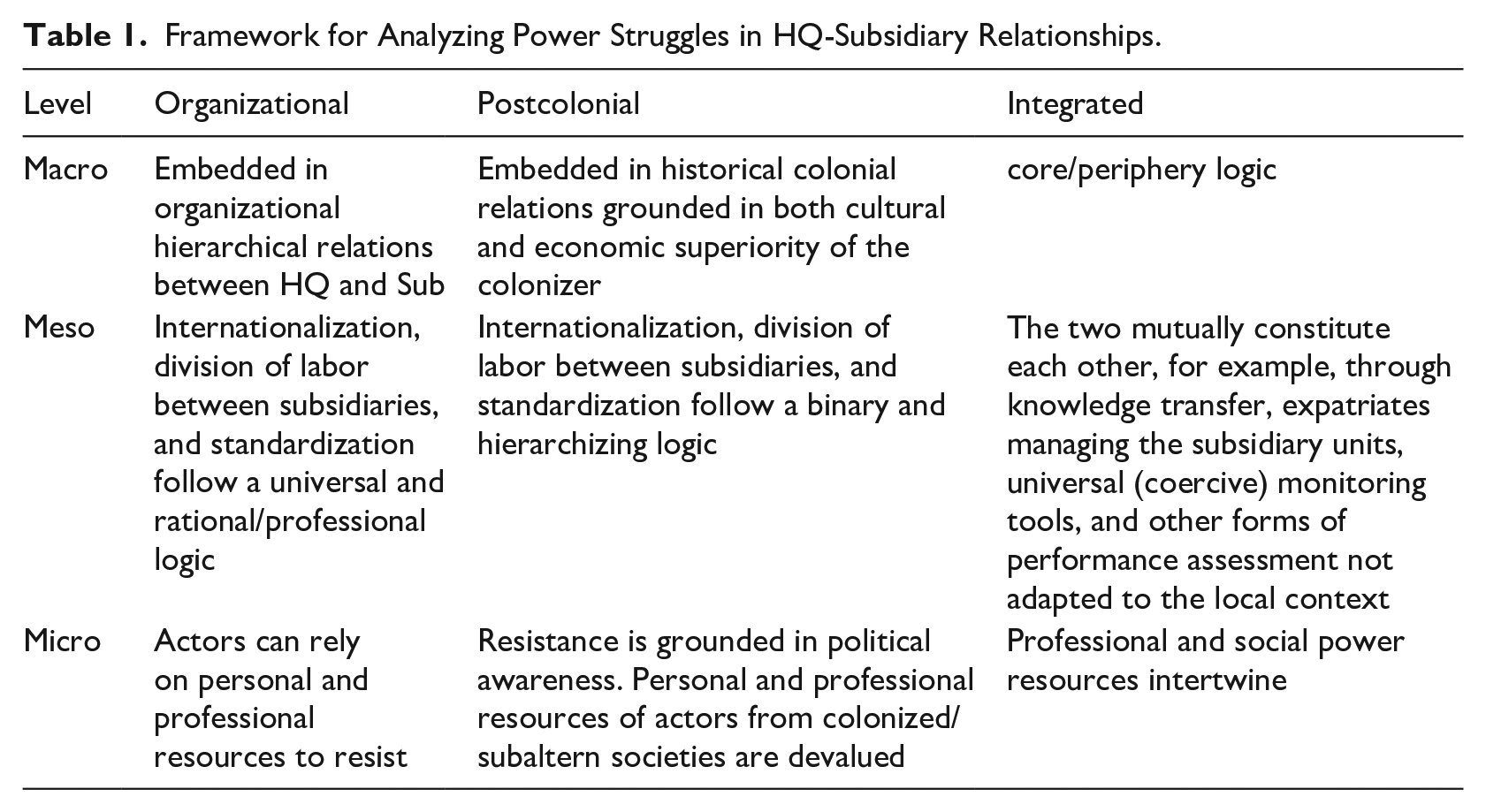
These discussions combined lend weight to the argument that each subsidiary is a complex nexus of intersecting levels of power (Geppert and Dörrenbächer, 2011; Morgan and Kristensen, 2006) where organizational hierarchies, routines, institutional constraints and postcolonial power relations are intertwined with the micro-embedding of actors to shape and structure resistance. By integrating the postcolonial perspective with micro-political approaches to power, we contribute to recent calls for more politically nuanced theorization of the contextual embedding of subsidiaries and their actors. We direct our attention to further explore a) organizational responses to (postcolonial) resistance and consequences for subsidiary staff and b) how (postcolonial) power struggles between subsidiaries differ based on factors such as subsidiary profile and the professional backgrounds and aspirations of subsidiary actors (Table 1).
Framework for Analyzing Power Struggles in HQ-Subsidiary Relationships.
Method
Case context
We conducted an empirical study of two Indian subsidiaries of the global news agency Reuters, namely Mumbai and Bangalore. Reuters’ Indian subsidiaries offered a suitable context for our study for several reasons. First, India’s colonial past and globalizing present offer a useful setting to explore the mutual imbrication of postcolonial relations with power embedded in a multinational organizational context. It is important to acknowledge that neat binaries between imported and local practices are insufficient and unsatisfactory in the Indian context (Srinivas, 2021), as local management practices have continuities with colonial roots and ongoing influence through management schools and training from the U.S. However, these influences are improvised and appropriated continuously to suit the local temperament and sensibilities, resulting in ongoing hybridization processes (Becker-Ritterspach and Raaijman, 2013). This is particularly the case with professions requiring high English-language proficiency (Kothiyal et al., 2018). Second, Reuters represents a context where organizational-level power embedded in the approach to centralization of news reporting practices, performance assessment and output quality control can be discerned clearly. This allows for a more comprehensive analysis of power and resistance dynamics, moving past the implementation phase analysis to incorporate organizational responses to resistance (Blazejewski and Becker-Ritterspach, 2011). Finally, focusing on two subsidiaries involving different roles and staff profiles (the Mumbai subsidiary is an independent newsgathering organization, while the Bangalore bureau performs outsourced work) allows us to parse their homology and observe how co-construction of various forms of power and resistance are shaped and structured differently.
Reuters is the world’s oldest and largest news provider, reaching one billion people every day. With its HQ in Canada and a second major unit in London, Reuters provides news services in most countries and to most major news outlets as well as to a large number of financial institutions (Reuters website). Reuters began its operations in India with the establishment of the Bombay office in 1866, representing an important arm of British rule. Once India gained independence in 1947, Reuters’ near-monopolistic control of news production led to protests among national leaders and subsequent policies restricting foreign media operations in India (Read, 1994). However, India’s economic liberalization in the 1990s generated increased demand for financial news and insights from global investors interested in the Indian market (Shrivastava, 2007). In response to such needs and in the wake of the liberalization of the Indian media sector, Reuters set up units in several major cities in India. Established in 2001, the Mumbai bureau was the result of such an initiative. Covering news from India with a particular focus on the Western region, the Mumbai unit is structured and organized like other leading subsidiaries of Reuters, and its reporters are recruited based on their experiences, local networks and contacts. The bureau head was from the U.K., and other onsite expatriates monitored operations and supported training.
Reuters’ Bangalore bureau was established in 2004, primarily as an offshore support unit to perform round-the-clock updates on the news for the U.S. and U.K. regions and to assist the onshore staff there in background research and fact-checking (Örnebring and Conill, 2016; Ramesh, 2004). Around 120 reporters were grouped into teams based firstly on the countries they covered and secondly by sector. Most reporters in Bangalore were local recruits, and the bureau head was an expatriate from the US. Importantly, according to two senior members of the Bangalore editorial team, the unit deliberately hired unseasoned recruits without work experience to prevent local influences in offshore work.
Data collection
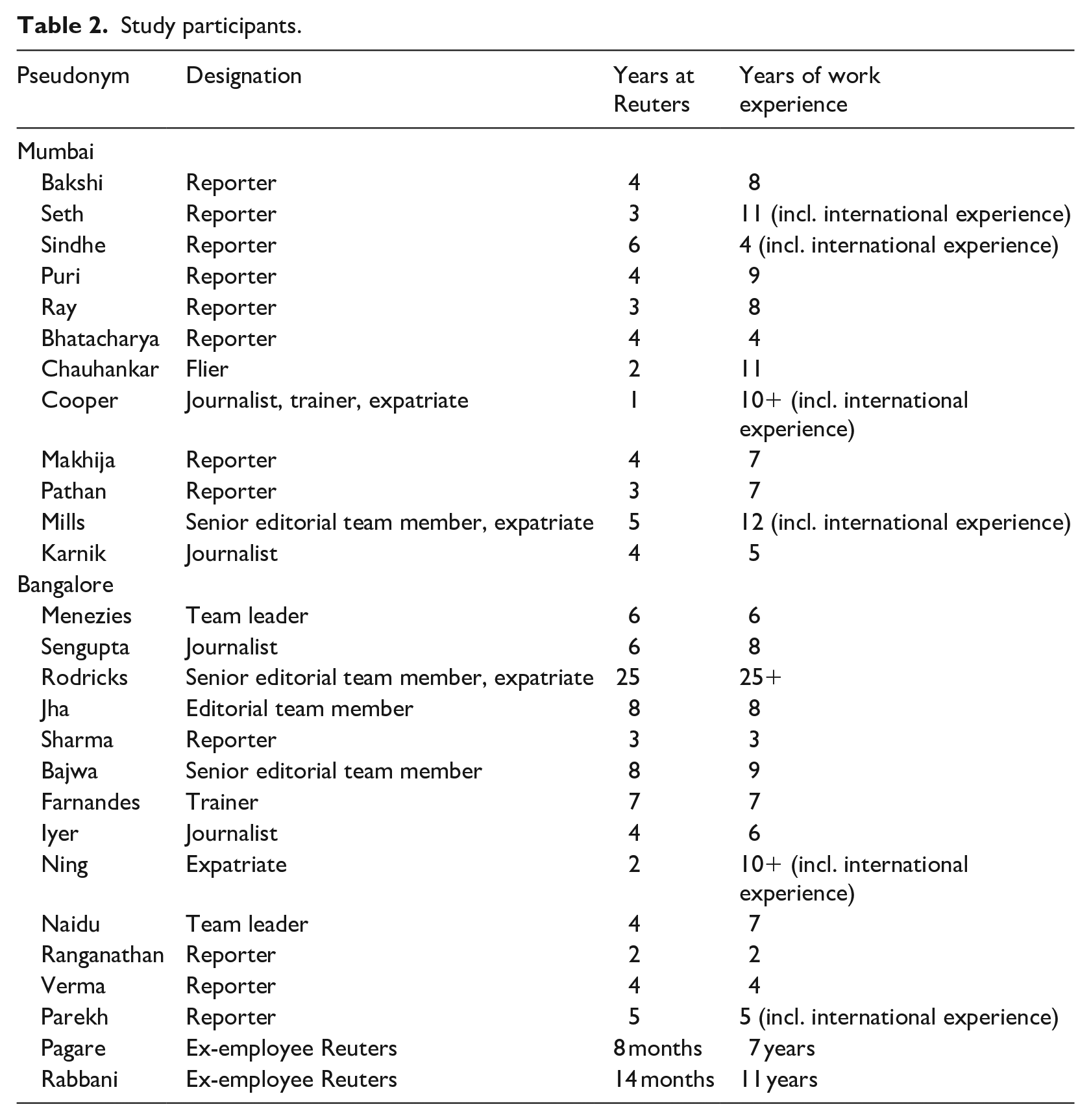
Our empirical material comprised 27 in-depth interviews complemented by field notes, publicly available information about Reuters and internal documents. Twelve interviews were conducted at the Mumbai site and 13 in Bangalore; two participants were ex-Reuters staff. Interview participants at both sites consisted of locally recruited staff and expatriates. The first author conducted all interviews.
Access was achieved via personal contacts in the Indian media industry (for Mumbai) and professional contacts at the Reuters Institute of Journalism Studies (for Bangalore). In coordination with each Units management, the first author spent 2 days observing editorial operation at Mumbai office and 3 days in Bangalore. Mumbai’s bureau chief helped identify participants to ensure adequate reflection of the diversity of the bureau in terms of gender, age, experience, and position. Mumbai interviews lasted from 60 to 90 minutes. In Bangalore, the field researcher was free to choose participants and performed interviews combined with observations ranging from 60 minutes to 3 hours and 40 minutes (Table 2).
Study participants.
Interviews were conducted mostly in English. The first author’s Indian background allowed for occasional switching to Hindi or Marathi (on one occasion), which helped in trust-building with the participants (Brannick and Coghlan, 2007). All interviews were recorded with participants’ permission and later transcribed. The transcribed text amounted to 485 pages. 28 pages of fieldnotes (hand written and digital) included observations, encounters before, after and in-between interviews. Pseudonyms are used to protect interviewees’ anonymity.
Although the interviews were guided broadly by a thematic design based on insights from Reuters ex-employees and initial discussions with bureau chiefs of both subsidiaries, the interview process was largely semi-structured. Interview themes related to a range of issues broadly divided into categories relating to (a) research participants’ biographical narratives including their personal ideology, aspirations and interests regarding their profession and (b) experience working for Reuters in an Indian context, including challenges, contradictions and conflicts relating to Reuters’ organizational rules and routines.
Analysis
As this is an interpretive study, sorting data into themes for analysis was not a straightforward process and required iterative reworking between the empirical setting and theory and the various feedback we received from editors, reviewers and colleagues during the seminar and conference presentations (Alvesson et al., 2008). Interview recordings were retained and regularly revisited during the analysis process to not only make sense of the power relations between the interviewer and the interviewees in various postcolonial spaces (Ulus, 2015), but also to contemplate our own bias and influence as authors of different backgrounds on the process of analysis. The analysis broadly followed three stages.
In the first stage, we searched for patterns in the data and the links within and between them. This process formed the basis for categorizing related data excerpts together and refining them analytically into two broad categories. The first is the top-down flow of power reflected in Reuters’ centralization mandates and other rules, routines and rhetoric to support and enforce them. Here, we identified specific examples of how subsidiary staff at both units relate, interpret, implement and negotiate Reuters’ rules and routines in their everyday work. Secondly, we juxtaposed the selected data excerpts from the first round to identify similarities and differences in the two subsidiaries’ narratives. This involved identifying overlaps in explanations, expressions and examples. Finally, after going back and forth between and theory and data (Mantere and Ketokivi, 2013), we developed theoretically informed explanations of patterns derived from the second round of analysis before deciding on the best examples to support our arguments.
Findings
Top-down flow of power: Intersecting postcolonial and organizational power
Our first finding relates to the mutual imbrication of organizational and postcolonial power in shaping Reuters’ internationalization into India, as well as its coercive centralization approach for more global consistency and control of its subsidiary units.
Reuters’ expansion strategy in India
Reuters’ internationalization into India reflects the mutual imbrication of organizational and postcolonial logic (Banerjee and Prasad, 2008; Frenkel, 2008). From an organizational point of view, the liberalization of the Indian market has called for a closer coverage of the local economy, leading to the establishment of the Mumbai unit, among others. On the surface, the Mumbai unit is organized and resembles the structure of other leading subsidiaries at Reuters, recruiting local staff based on their reporting experiences, local contacts and networks. However, Mumbai’s setup also signifies an underworking postcolonial logic reflected in its staffing policies that denote India as culturally and professionally inferior to other core economies covered by Reuters (Leonard, 2016). For instance, unlike its other subsidiaries in countries such as the U.K. and Germany, Mumbai has a number of expatriates from core units, including the bureau head, to manage and monitor the functioning of the bureau in line with Reuters’ standards.
The Bangalore unit signifies a new phase of Reuters’ internationalization in India; it also reflects a different way in which corporate goals are deeply intertwined with colonial power relations (Banerjee et al., 2009). Studies show that the transfer of repetitive low-end tasks to low-cost destinations is deeply connected with strategies of colonial logic in its universalization of corporate interests and international divisions of labor founded on core-and-periphery hierarchies (Mirchandani, 2012; Westwood et al., 2014). Moreover, such an arrangement ensures that firms can raise market barriers to protect their core assets and capabilities in core economies while commoditizing the activities that they outsource to cheaper destinations in the Global South (Banerjee, 2008). In this respect, the establishment of Bangalore as an offshore unit represents the business logic of cutting costs and maximizing profit, also reflective of the structural divide predicated on colonial relations (Jeffery, 2006; Örnebring and Conill, 2016; Ramesh, 2004; Schifferes, 2007). The main function of the Bangalore editorial division is to assist teams in the U.S. and U.K. in their daily work of fact-checking, background research and round-the-clock updating of already published news. This signifies their “subordinate” position, not only in the organizational hierarchy, but in the racial hierarchy as well (Mir et al., 2008).
The difference in Reuters’ internationalization strategy with regard to Mumbai and Bangalore reflects the colonial pattern of selective value extraction in which the colonizer applies varying strategies based on local differences in the colonized context (Grosfoguel, 2002; Murphy, 2008; Quijano, 2007). Although periphery units by their location (Boussebaa et al., 2014), both subsidiaries differ in the degree of their peripherality. The Bangalore unit suggests parallels with the nimble fingers or electronic sweatshop theses (Bain and Taylor, 2000; Pande, 2005), mimicking the back-end business processing setup in which staff members are largely relegated to the roles of support staff for core units in the U.S. and U.K. In comparison, the Mumbai staff is representative of an elite comprador, acting as intermediaries in the extraction of value from host environments (Boussebaa and Morgan, 2014) due to their knowledge of the Indian market and networks in local official circles acquired through previous experiences.
Reuters’ centralization strategy
The mutual imbrication of organizational and postcolonial power is reflected more starkly in Reuters’ centralization approach (Jack and Westwood, 2009). The operation of organizational power is represented through a bundle of organizational routines intended to support the global standardization of its reporting practices (Edwards et al., 2016). These organizational imperatives further comprise the transfer and implementation of mandated reporting practices (two named sources for each news output), the transfer of more tacit values that guide and justify these practices (news authenticity and accuracy and focus on client interests) and quality/output controls intended to ensure publication only of news fulfilling Reuters’ reporting criteria (reflected in monitoring procedures, performance assessment, promotions and reward systems). Stressing the strategic importance of standardization, Rodricks, expatriate and senior editorial team member in Bangalore, explained:
Every bureau is supposed to uphold the same standards of accuracy, and fairness. [. . .] Anything that is produced from Bangalore should read no different than something produced other than in Bangalore.
However, the organizational imperatives of standardization are interlaced with colonial logic whereby Reuter’s reporting practices are projected as ethically superior to and more “professional” than locally prevalent practices (Frenkel, 2008; Mir et al., 2008). Such binarizing and hierarchizing tendencies were reflected in accounts of the expatriate bureau chiefs in both Mumbai and Bangalore, as they expressed concerns over the questionable credibility of news produced by Indian news outlets. Rodricks, working at the Bangalore office, commented:
The media standards in India are questionable. [People] grow up only reading the local media and not having exposure to any global standards of journalism. [. . .] People could get the impression that this is the way journalism is always done [. . .] everywhere.
Standardization in news products at Reuters is achieved by backing all news reports and analyses with two named sources, claiming that this ensures “reliability” In particular, the two-named-sources rule provides a method of newsgathering in a prescribed and predictable way. If Reuters’ journalists adhere to these practices, their output will also align with the ideals of accuracy and freedom from bias, and similar-quality news will be produced regardless of the location of production.
The two-source requirement denotes company-specific organizational power in several forms. First, it introduces strong hierarchical control within news organizations, steering subsidiary staff to act in a predictable and unified manner. Simultaneously, it provides a measure of protection, minimizing the risk of libel and editorial criticism (Spark, 2012). Furthermore, it promotes a culture where news is defined as information verified primarily by authoritative sources such as government officials or representatives of institutions and large organizations (Boudana, 2011). In other words, information acquires accuracy through the official status and rank of the source, rather than being based on the investigative efforts of the journalist (Maras, 2013). In Reuter’s rhetoric of standardization, this renders news-production processes uniform and news output more accurate and reliable.
The requirement for two named sources is also packaged as protection of the interests of Reuters’ clients. The Reuters handbook explains: “Clients would feel we were holding back key information if we failed to name the source. We must name the source even when we are only quoting it in a market report.” The emphasis on client interests justifying the need for named sources in news reports resonated in many of our interviews. Cooper, an expatriate employee working at the Mumbai bureau, argued: “Clients/investors need to know the source of news; they make investment decisions based on our news.” A large proportion of Reuters’ revenue is generated from high-profile subscribers such as governments, banks, and other financial and investment institutions. Being a “reliable information provider” was frequently cited as a key element in attracting and keeping clients. Reporter Seth explained that “[w]e can’t get it wrong—there is huge money [. . .] involved” which makes it important for Reuters “to tell the readers who their sources are.”
In particular, the organizational imperative of backing news reports with named sources is an offshoot of objective journalism, which first emerged as a framework of professionalism in the U.S. and Britain in the early twentieth century (Raeijmaekers and Maeseele, 2017). It conceptualized the process of newsgathering as “neutral, unbiased, and balanced, and void of personal ideology, and impressions” (Fox and Park, 2006: 37), serving to distance the reporter from the phenomena being reported. Given the growing importance of advertising revenue, the American and British press increasingly removed opinions from news reports to avoid alienating potential advertisers. Subsequently generating a strong discourse of partisan-free objectivity shrouded in a “moral veil” the ideals pursued at Reuters thus reflect an ongoing legacy of capitalist-driven development in the Anglo-Saxon media system (Schudson, 2001). However, research has demonstrated that objectivity, although often debated as a universal ideal, is not the definitive professional norm in journalism, and different media systems define and gauge objectivity differently (Maras, 2013). Thus, Reuter’s effort at standardization reflects how the institutional norms of the home-country translate into the organization’s mandates and how that is informed by colonial power relations where local practices are hierarchized vis-a-vis Reuter’s practices.
The Bottom-up approach to Power and resistance: Mumbai Unit
Our second finding relates to how the top-down flow of imbricated power shapes and structures the resistance of Mumbai staff and the way their professional identity infuses their power struggles (Siltaoja et al., 2019; Thomson and Jones, 2015; Yousfi, 2014). We approach this section through the lens of mimicry and hybridity and further juxtapose resistance with organizational power embedded in quality control and performance assessment (Shimoni, 2011).
Mimicry in the present context emerges from organizational demands for complete adherence to its mandated practices that is continuously monitored. Training acquired and instructions learned at Reuters are not sufficient to over-write practices learned and applied locally (Alcadipani and Caldas, 2012; Srinivas, 2013). Reporters Makhija and Bakshi provide illustrative accounts of their struggle surrounding the implementation of Reuter’s practices in their daily work. Sports reporter Makhija had worked with two national English-language dailies prior to joining Reuters. While stating that he was in complete agreement with Reuters’ principles of accuracy and objectivity, he often found himself at odds with the news-sourcing policies mandated to enforce such ideals. “It’s not always possible to follow the news-sourcing rules; here [in India], things work differently.” Makhija explained, providing an example. During a call to a contact, Makhija learned that three athletes had been caught taking performance-enhancing drugs. The first urine test by the National Anti-Doping Agency (NADA) was positive. NADA, however, will only go public after the second test is confirmed positive, and according to Makhija’s source, these results were not yet in. Due to the close relationship Makhija had built with his source over a period of time, the source gave him the news lead conditional on anonymity. “So, he said, ‘you can’t source me to the names because I’m not supposed to tell you who the athletes are as right now [NADA] are still waiting for the confirmation of the second test sample.”
However, Reuters will not publish news based on an unidentified source. “If I can’t source it, I can’t use the story” continued Makhija. “I can’t say that the NADA source told Reuters [. . .] because an unnamed source is a strict no-no, a single unnamed source is a strict no.” Despite not complying with Reuters’ mandates, Makhija still wanted to publish the news. According to him, this involved little risk: “You see, the second sample never tests otherwise, and everybody knows that.” He also explained that the source was reluctant to go on the record as it would involve acting against NADA’s policy, which had little to do with the credibility of the news, as such. What is more, Makhija argued that his faith in the authenticity of the news was founded on the trust he had built in his source over the years.
I have worked with this source before. [. . .] We build contacts and sources over years and talk with them regularly so that if any such things happen, we should be the first they should come to.
Over time, journalists learn to trust their sources, who sometimes “go out of their way to provide you with information,” Makhija explained. While admitting that he deviated from Reuters’ policies, in his view the news report he had produced was not lacking in credibility. Makhija explains that he took every reasonable measure to confirm the accuracy and authenticity of the news, but also evoked a logic prevalent in Indian news sourcing where to source anonymity is common practice: even if the source is unnamed, the very fact that the reporter has prior relations with that source should attest to the credibility of the news (Kamath, 2009).
Bakshi, a commodities correspondent, seconds this sentiment. A large part of her job involved covering import–export information issued by the government regarding crop produce. She explains that she “got a fax saying that these are the export figures for this month, so you can just report,” even if the official announcement would not be made for a few days. However, her source asked Bakshi not to identify him in the news, so she then “crosschecked it with three of my sources, and my sources were, like, ‘this is the final data. You can go ahead with it.” Having the news confirmed by three unnamed sources still meant that the story had low credibility according to Reuters” guidelines. Bakshi consulted her senior correspondent, and “the order was not to go with the data. ‘Wait ‘til the official data comes.”
Her struggle was also similar to that of Makhija. She further emphasized that she had built her contacts over a significant period of time, even prior to joining Reuters: “I could definitely go with those figures because that source is very close to the development of the report, and I have been knowing that source for many years.”
The examples above demonstrate reporters’ access to local networks and their ability to utilize it in their professional capacity to pursue their work as reporters for Reuters (Blazejewski, 2009; Geppert and Dörrenbächer, 2011). It also illustrates resistance through the process of selective interpretation or misreading—the fundamental ideals of objective journalism that Reuters promotes (Yousfi, 2014). In the paradigm of objective journalism, the accuracy and credibility of news are determined by the status of the source and its identification. The reporter’s task is to assemble facts rather than interpret and construct meaning. However, the reporters violated Reuters’ ideals of objectivity by claiming the power to determine news credibility through their own verification strategies, thereby suggesting that news gains legitimacy through the authority of reporters rather than through named, official sources. Through a postcolonial lens, this represents a process of translation or reinterpretation that entails carrying over features from one culture to another—a process that challenges and alters the meanings of ideas and symbols (Bhabha, 1994: 130). Hybridity thus emerges from the reporters’ subversion of the role of journalist as mere observer and fact-gatherer (as Reuters demands) for that of assigning themselves the power to be guardians of accuracy and credibility by drawing on practices prevalent locally where reporters hold authority over the news they produce. The aforementioned examples thereby illustrate resistance to a hierarchical power relation where subsidiary staff through their selective interpretation or organizational routines and demands collapse the binary divisions between foreign/local and inside/outside on which Reuters’ news-sourcing practices are based.
Postcolonial Resistance and Organizational power: Mirroring the intertwining nature of organizational and postcolonial logics that inform the top-down flow of power to subsidiaries, the resistance strategies of local staff are also a combination of acquired professional acumen and anti-colonial rhetoric or justifications.
Having a news lead and not being allowed to publish it was clearly frustrating for subsidiary staff, particularly when they had applied various, albeit informal, verification practices to assure accuracy and credibility. Makhija expressed his exasperation thus:
The desk will say we can’t get wrong with the names, if it is not from a named source, for if we get the name wrong, it can have a lot of repercussions. So, they [the editor] are also right from their standpoint. But from my standpoint, I think it’s news.
Similarly, several other participants including entertainment correspondent Puri and finance reporter Seth explained that while they are able to go ahead with a story once official approval was given and they could attribute the news to official sources, these incidents leave them feeling “helpless” because they had “gone that extra mile” to ensure news credibility.
Why do reporters feel the compulsion to file news stories that do not fulfill the sourcing criteria demanded by Reuters? And why do they argue that their news is as accurate and worthy of publication when it draws on unnamed sources? The answer lies partly in the competition to be the first to break news and partly in Reuters’ individual performance assessment. All media organizations participate in the same race to be the first to break news (Lewis and Cushion, 2009). At Reuters, the importance of being first, or “speed” as they term it, is justified by their client base needing the most accurate information as swiftly as possible to make informed investment decisions. The criterion of being first to publish a particular news item is therefore reflected in the bi-annual assessment of reporters whose performance is partly judged by how many other news providers publish the same story ahead of them.
Although reporters seemed to agree that Reuters’ policies on news-sourcing were largely appropriate and, in many instances, hailed them as superior to local practices, they were simultaneously frustrated by the restrictions placed on them by source-identification rules and the fact that other local media organizations do not work under many of the restrictions they face. Karnik explains:
“But the news is accurate na! But I can’t publish it and other news channels and everybody bindas (carefree) running it.”
Staff reporters were particularly frustrated by the fact that, although they often receive the news leads before domestic media, due to Reuters’ policies, they are unable to publish until after the local media has already published the numbers, due to their less stringent sourcing policies. “The domestic media, they reported it before me, so I lost only because I did not have any official confirmation,” Bakshi complained.
The control of editorial output disqualifies news reports for being published that do not qualify as news based on the Reuters criteria of two named sources. However, this is also reflected in their bi-annual performance assessment. Therefore, in the present context, while we see the exercise of agency and resistance on the part of the Mumbai staff, these expressions are circumscribed by the organizational power embedded in the performance assessment to significantly challenge journalists’ position in a hierarchical power relation (Mir et al., 2008). Only by juxtaposing resistance with the complex interweaving of organizational, institutional, and postcolonial power do we see how existing power relations in peripheral subsidiaries are reproduced. This allows us to look beyond the discursive domain of power struggles to incorporate their material manifestations—such as the effects of employee performance assessments.
The above examples, however, illustrate one form of resistance, one that emerges from reporters’ struggles to navigate the diverging logic of professional journalism. Two of the former employees of Reuters relate to the ideological unease with Reuters source-led reporting, which tends to privilege the elite interpretations of events and limit the range of opinions in the news, often leaving out marginalized and radical anti-institutional voices (Maras, 2013; Schudson, 2001). For instance, Rabbani, a former reporter for Reuters in Mumbai, reflected:
They have a long list of preferable sources, so after a while, it became easy to perform the task there [. . .] whom to approach for this particular matter [. . .] but then we were just going with the opinions of those [on the list]. That is not good journalism for me, you know.
Similarly, another former Reuters reporter, Pagare, related her frustration with Reuters’ approach to business reporting:
Do you think companies like Reuters would be interested in doing feature stories on, say, the caste system and how our financial sector and business sector are still deeply rooted in this? I can tell you from experience they will not, and why should they as long as profits are made? [. . .] I left Reuters as I saw no scope for tackling this issue. There, it was all about straightforward business reporting. They serve the rich business class. These problems don’t concern them.
Both reporters subsequently related that they left Reuters since their attempts to work outside the pre-defined parameters of news reporting were limited by editorial decisions and organizational assessment systems. Their resignations reflect resistance, but they also signify the availability of options (Becker-Ritterspach, 2009; Geppert and Dörrenbächer, 2011) that can afford alternative employment. Furthermore, such narratives can be interpreted as a more reflective dimension of resistance, wherein the (self) reflections on the part of Indian journalists are a consequence of failed mimicry (Siltaoja et al., 2019). Mimicry may start with the desire to imitate the global or dominant authority. Its failure, however, may not only result in a distorted practice and product but also in self-reflection that generates awareness not only of the limitations of one’s own culture and practices but also of the limitations of the authoritarian culture. In this process, those caught in-between are pushed to assess their own positions and, hence, to be self-reflexive. These examples highlight the multi-layered nature of hybridity emerging in relation not only to practices and knowledge of how to perform newsgathering but is also to the output or product they generate (Yousfi, 2014).
The bottom-up approach to power and resistance: Bangalore unit
In this section, we demonstrate how Bangalore staff occupy an “in-between” space (Bhabha, 1994), distinctly different from Mumbai unit, shuttling between their embodied realities and locational imaginaries that concomitantly structure and subvert the organizational and racial power asymmetries in their everyday struggles (Cohen and El-Sawad, 2007). As an offshore unit, power struggles at the Bangalore unit play out on two levels: (a) in their daily interactions with their team members from the U.K. or U.S. and (b) in their interactions with news sources and other officials from the market they cover.
Offshoring arrangements similar to Bangalore, where the offshore work is largely devoted to support the core activities of onshore locations, organizationally put the onshore team in a position of power. These organizational hierarchies that trespass geographical boundaries also constitute colonial and racial relations (Mirchandani, 2012; Ravishankar et al., 2013). While staff in Bangalore identify themselves as “professionals” working in concert with teams in the U.K. and U.S. to cover news from these markets, their counterparts do not consider them their equals, treating them rather as “subordinate” or “support staff” (Cohen and El-Sawad, 2007). According to several study participants, the hostile attitude of staff members from the U.S. and U.K. is reflected in the constant complaints directed toward their work, relating to their incompetence in news writing, poor quality of English and lack of news sense and general reluctance to share news leads and the contact details for news sources (Upadhya, 2009).
While the majority of offshore jobs in the Global South entails low-end, repetitive work, there is still a fear that with time and improvement in their job skills, more complex tasks will also be offered offshore in these locations (Ravishankar et al., 2013). Fear of job loss puts onshore team members in an antagonistic position toward the offshore staff, and often the criticism toward offshore staff undermines their abilities and competences. Stressing this point, team leader Naidu asserted that the complaints directed toward the Bangalore staff are often to prove “that the operation in Bangalore is unnecessary.” Moreover, the regular criticism and complaints toward the work of Bangalore staff also became a means of justifying taking away any important stories that are expected to generate high investor interest. Team Leader Menezies expressed her frustrations: They would [. . .] want to take it there. They would think that they can write it better, [. . .] which is a little unnerving [. . .].
Akin to the offshore call centers, staff in Bangalore are also required to neutralize their accents and to use a western pseudonym during their interaction with news sources and other public relations officials (Mirchandani, 2012). Scholars have pointed out that organizational demand for identity masking in offshore workplaces is premised on racial logic and serves two interrelated purposes: first, it is undertaken for the convenience of western call receivers in order not to alienate them and to facilitate smooth interactions; and second, it also acts as a measure to combat racial abuse from western clients and workers. Explaining the significance of identity management, team leader Menezies explains:
“to make them aware that we are going to call a lot of people based in the U.S. (and U.K.). We tell them what sorts of mannerisms are common in these countries, which might not be in India, so that sort of thing.”
However, despite extensive training in the professional mannerisms of the region they cover and other identity masking, Bangalore staff are unable to bridge the cultural/racial divide as news sources are often reluctant to speak, let alone give the reporter a news lead. Ranganathan, a sector reporter who works for the U.K. team, narrated some of the reactions of sources she encountered on a regular basis:
“Where are you calling from? [. . .] ‘You are from Bangalore? So, you are covering a U.K. company from Bangalore? Why are you calling me from Bangalore?’ You know, things like that.”
Resistance and organizational power
The discussion above also exemplifies how organizational and racial/historical hierarchies intersect to structure the experiences of the Bangalore unit within a matrix of unequal power relationships (Frenkel, 2008). Their resistance is also reflective of a combination of anti-colonial sentiments and professional aspirations of the staff.
Contrary to an earlier finding that offshore work such as call centers can lead to “role ambiguity and work alienation” (D’Cruz and Noronha, 2014), Bangalore staff stressed the importance of progressing in their career paths through their current job. While the staff in Bangalore were often very explicit regarding the “unfair” treatment they received from their western team members, they were also appreciative of the various benefits their job extended to them, not only in terms of the training they received from Reuters in order to hone their English writing and other reporting skills but also opportunities to attain knowledge about a new and important market. Menezies reflected, “But the whole operation here is for learning these things and for eventually getting things to that standard.”
Having high impact stories taken away from them by their U.K. and U.S. team members based on assumed lack of competence was therefore described as “frustrating.” since this would take away the opportunity from Bangalore to improve their skills as reporters that can handle high impact stories. As team leader Menezies further explains:
You know, we don’t want to do just follow-up stories, just rehashing the statements; we want to do bigger things. Otherwise, there is no growth for reporters here or we are not learning either.
This stance should be interpreted in the wider context of India’s colonial history and postcolonial aspirations, where having or acquiring the English language skills and mannerisms of the British or Americans as well as working for a transnational enterprise with colonial linkages allows for upward socio-economic mobility (Srinivas, 2021). Having an opportunity to be identified as Reuters staff, even if the job profile entails a low-end task, signifies a promise of upward mobility.
Furthermore, it also bears testimony to the nature of resistance as not only an “innocent aspect” of dealing with differences but also a central and conscious factor in response to perceived power asymmetries that constrain their ambitions (Ravishankar et al., 2013). However, while these power arrangements produce resistance, they also indicate the potential of the disciplinary power of global capital in reproducing historically established power relations (Mirchandani, 2012). For instance, the transfer of high-impact stories to core units was also legitimized by headquarters and approved by the bureau chief in Bangalore, who reasoned:
“If they are questioning us, they are questioning us because they did not see something that was done as it should have been. And they are keeping the interest of the client in mind.”
In this case, juxtaposing an organizational response to resistance thus reveals that hybridity emerged in the discursive realms of identity construction and cultural negotiation, historical binaries reigned as a guiding framework through which resistance was managed, work assigned and the core-periphery dynamics between Bangalore and its counterparts in the U.K. and U.S. were maintained (Boussebaa et al., 2014).
Discussion and conclusion
In this paper, we have addressed the question of how the mutual imbrication of organizational and postcolonial power along with the micro-embedding of actors’ shape and structure power implementation and resistance in subsidiary units. In particular, our study illustrates how organizational power operated in the form of practice-transfer and with other HR routines such as employee performance assessments intended to support the global standardization of practices (see e.g. Shimoni, 2011), along with power embedded through external pressures on the organization such as client interests and expectations (see e.g., Morgan and Kristensen, 2006). The organizational power expressed in HQ’s prescribed practices was further interlaced with postcolonial power expressed in the justification of HQ practices as inherently superior to those found locally. Our study further shows how the contours of power struggles were subsequently determined by subsidiary staff’s navigation and negotiation between organizational demands, local praxes, and their distinct professional positions in organizational and racial hierarchies. Therefore, by taking an integrative approach to power we call for the mainstreaming of postcolonial insights and for their inclusion in the analysis of power relations in MNCs. We have suggested that even those top-down implementations of power usually attributed to micro-political relations are also inextricably embedded in postcolonial logic and continuities. Similarly, employees’ bottom-up resistance to power is also grounded in a combination of organizational/professional power resources and postcolonial framing of their positionality.
This article contributes to postcolonial theory by moving beyond the discursive realm of (postcolonial) resistance to incorporate organizational response and the consequences for subsidiary staff (Shimoni, 2011; Yousfi, 2021). Thus, in a subsidiary context where the possibility of hybridity (in management practices) itself is persistently foreclosed through performance assessments, reward systems and other monitoring tools, our findings demonstrate that resistance requires complex negotiations that both accommodate and rupture authoritarian discourses in maintaining or furthering the advancement of one’s position within the organization hierarchy. Our study further shows that while resistance may offer subsidiary staff a sense of control and professional identity within the discursive realm, it also serves (corporate power) to justify and maintain the historical status quo reflected in more tangible outcomes such as performance assessments and quality control.
Furthermore, our empirical work demonstrates how strategies and practice of resistance differ between two subsidiaries based on subsidiary staff’s personal resources and their professional position and location within the organizational and racial hierarchies. For instance, resistance at Mumbai largely involved challenging Reuter’s initiatives of practice standardization and criteria of quality check and performance assessment. These strategies of resistance, we argue were possible due to Mumbai staff’s previous professional experience as journalist and their access to local networks (such as sources etc) among other resources at their disposal as seasoned reporters. Whereas for Bangalore staff resistance included defending the quality of their reports (both language and content) which was subjected to continuous criticism from their counterparts in UK and USA. Therefore, given the nature and scope of their work and with no prior professional experience within the realm of news reporting, everyday resistance for Bangalore staff significantly differed from that of Mumbai unit. In this vein, we have suggested that as a lens for critically exploring “subaltern” agency in relation to power, we must theorize resistance in relation to the personal resources of actor or actors’ group such their professional acumen, their aspirations and ideologies, their access to local networks and knowledge, their location and position in organization and racial hierarchy, and their ability and options in acquiring alternative jobs.
Relatedly, by focusing on two subsidiaries in the same host context of the same MNC our study emphasizes an aspect of postcolonial power that has not been sufficiently explored in postcolonial theories of organization and management studies: the importance of understanding diverse colonial experiences (Grosfoguel, 2002; Quijano, 2007; Stoler and Laura, 2016). Our analysis shows that the power struggle and (professional) identity position of both subsidiary staff differs as they face different organizational, institutional and (neo)colonial pressures and are othered in different ways. We argue that as a site of “value production,” both subsidiaries are qualified and disadvantaged in distinct ways. For instance, Mumbai staff with their knowledge of local context and networks acquired through previous work experience are of value in a different manner than staff in Bangalore with no prior professional experience and recruited to minimize operation costs in core economies (Murphy, 2008).
The organizational response to postcolonial resistance and the consequence for subsidiary actors is still poorly understood (Yousfi, 2021) and highlights the need to develop more incisive insight that incorporates longitudinal and comparative analysis. The insights and implications of this study could be further elaborated through exploration of the trajectory of resistance at subsidiaries over a period to examine interface with factors such as promotions, and the career paths of subsidiary staff. We also suggest that future research investigates how MNCs facilitate the creation of a diverse comprador class to support their operations in the host country (particularly in historically marginalized societies)—not only within the subsidiary but also outside the MNC, such as “official sources” in the present study—and its political implications. This continued enquiry will help progress the emerging debate on MNCs as a “complex totality of power” (Morgan and Kristensen, 2006), a “contested terrain” (Edwards and Bélanger, 2009), and a “third space” (Frenkel, 2008).
Footnotes
Acknowledgements
Our sincere thanks to the Editor-in-chief, the anonymous reviewers, Professor Barbara Czarniawska and Professor Henrik Agndal for their helpful comments on earlier drafts of this article. We would also like to thank the professional reporters who generously shared their time and experiences with us.
Funding
The author(s) disclosed receipt of the following financial support for the research, authorship, and/or publication of this article: The authors gratefully acknowldge financial support provided by Handelsbankens Forskningsstiftelser.
