




Abstract
The notion of uniqueness, as articulated at the centre of most organisational inclusion literature, is inextricably tied to Western-centric idea(l)s of the autonomous, individual and self-sufficient subject, stripped of historical inequalities and relational embeddedness. Following a critical inclusion agenda and seeking alternatives to this predominant view, we apply a Bhabhaian postcolonial lens to the ethnographic study of organisational efforts to include indigenous Kalaallit people in the Greenlandic Police Force. Greenland has home rule, but is still part of the Kingdom of Denmark and is subject to Danish defence policy and the police force. With Bhabha’s notion of mimicry, we explore how police officers, through performing ‘Danish’ (Western) culture and professionalism, both confirm and resist colonial stereotypes and even open up pathways towards hybridity. Building on the officers’ experiences, we introduce the term ‘hybrid inclusion’ by which we emphasise two interrelated dimensions necessary for advancing critical inclusion studies: first, a certain understanding of the to-be-included subject as fluid, emergent and thus ontologically singular but at the same time relationally embedded in a collective colonial past and present; second, organisational practices for inclusivity that address and work with the actual impossibility of a ‘happy inclusion story’, free of contradictions and conflicts.
Introduction
In organisation studies, postcolonial research has shown how the historical colonial rule of ‘the West’ 1 is carried forward into present-day organisational life by a Western-centric and neocolonial domination of politics, economics and culture, which organises people along racialised hierarchies in jobs, professions and organisations (e.g. Alcadipani et al., 2012; Banerjee and Linstead, 2001; Jack et al., 2011; Khan and Koshul, 2011; Mir and Mir, 2012; Nkomo, 2011; Srinivas, 2012). This domination has led to systematic biases in favour of those who seem to effortlessly fit the Western norms (e.g. Essers and Benschop, 2009; Mir and Mir, 2012; Prasad, 2003; Van Laer and Janssens, 2014; Zanoni and Janssens, 2007), while it has resulted in marginalisation and exclusion from positions of power in societies and their organisations for those who are perceived as ‘Non-Western’ (see Césaire, 1972 [1955]; Fanon, 2008 [1952]; Huddart, 2006; Mohanty, 1984; Spivak, 1985). As a result, immigrants in Western countries (e.g. Ashley, 2016; Essers and Benschop, 2009; Muhr and Salem, 2013; Thomson and Jones, 2015), indigenous populations (e.g. Banerjee, 2003, 2011; Lammers, 2003) as well as peoples from the East and Global South (e.g. Boussebaa et al., 2014; Dar, 2018; Kothiyal et al., 2018; McKenna, 2011; Siltaoja et al., 2019; Yousfi, 2014) continuously struggle for inclusion within Western organisations and for obtaining positions of power on equal terms with people who more easily comply with Western (white) norms (Ahmed, 2004, 2007).
Against this background, at first sight it seems surprising that the currently growing field of organisational inclusion studies (Ferdman and Deane, 2014; Oswick and Noon, 2014) has not yet performed a ‘postcolonial turn’ (see for instance Shore et al., 2018), comparable to that of, for example, critical diversity management studies (see e.g. Holck and Muhr, 2019; Jack, 2015; Kaasila-Pakanen, 2015; Kalonaityte, 2010; Prasad, 2006). However, at second glance it becomes apparent that organisational inclusion research first and foremost approaches differences in terms of individual uniqueness (Shore et al., 2011), viewing the relationship between minority and majority employees as potentially beneficial for – and thus reconcilable with – organisational goal achievement (Ferdman and Deane, 2014; for critical accounts see Janssens and Steyaert, 2019; Tyler, 2019). Consequently, a postcolonial approach to organisational inclusion, which problematises the hierarchical cultural demarcations implicit in minority/majority constructions, where the (inferior) minority is to be included into the (superior) majority, seems not to fit with the ‘happy inclusion’ story.
However, we argue that when organisational inclusion efforts do not acknowledge the inherent inequalities and power imbalances of existing minority/majority constructions, they hold very little potential for levelling the organisational playing field for historically disadvantaged and marginalised groups (Holck and Muhr, 2017; Holvino and Kamp, 2009; Muhr and Salem, 2013; Özbilgin and Tatli, 2011; Tatli, 2011). In fact, such efforts may even complicate the struggle for recognition and redistribution of these groups, because they are more or less complicit with the structural asymmetries between the ‘included’ (colonised) and the ‘includer’ (coloniser) (Prasad, 2006).
As stated in the call for papers for this special issue, there is a need for showing the limitations of ‘innocent’ inclusion concepts while venturing into ‘more complex and critical ways of theorising inclusion’. We respond to this call by investigating the effects, limits and potentials of the efforts made to better include indigenous Kalaallit people in the Greenlandic Police Force. The Greenlandic Police Force is a particularly interesting case for studying and (re-)conceptualising organisational inclusion, as Greenland (Kalaallit Nunaat in Greenlandic) is officially classified as an autonomous constituent country within the Kingdom of Denmark, but remains highly affected by its colonial history and complex relationship with Denmark. In 2008 the majority of the Greenlandic people voted for more autonomy from Denmark. Nonetheless, Denmark still contributes an annual block grant to Greenland, which amounts to approximately half of Greenland’s national budget. Denmark also retains authority over foreign and defence policy as well as the military and police force. The continued Danish neocolonial presence in Greenland comes with a political and organisational responsibility for diversity and inclusion, where particularly leaders of the public organisations, such as the police force, have to think of ways to better include Kalaalit people in public offices.
By looking at the case of the Greenlandic Police Force, with its colonial history that manifests itself in the ongoing reproduction of highly dichotomous group differences of ‘Greenlandic’ and ‘Danish’ police officers, we not only introduce the ‘postcolonial turn’ to the organisational inclusion literature, but also make it equipped to challenge ‘innocent’ core assumptions underlying current conceptualisations of organisational inclusion. In particular, we build on Bhabha’s (1990, 1994, 1996) seminal work on stereotype, mimicry and hybridity in order to make sense of the current inclusion-exclusion configuration characteristic of the Greenlandic Police Force. Through Bhabha’s notion of stereotype, we investigate the neocolonial power dynamics and micro level politics of exclusion of Kalaalit in the Greenlandic Police Force. With the notion of mimicry, we explore how officers, through performing ‘Danish’ (Western) culture and professionalism, both confirm and resist colonial stereotypes. Subsequently, we illustrate how enactments of mimicry open a pathway towards experiences of hybridity, which complicate – and, possibly, disrupt – the neocolonial hierarchy of binary identity constructions.
Inspired by the force of hybridity – in terms of challenging gridlocked and hierarchical minority/majority constructions – we discuss whether it is possible to conceptualise and practice organisational inclusion efforts that not only allow for but even evoke subject positions without any kind of (assumed) essence and fixation. Thereby, the perpetuation of asymmetrical includer-included relationships, which undermine organisational inclusion efforts, could be counteracted. However, this represents a tricky – if not impossible – endeavour, as Bhabha’s theoretical premise is to question any kind of single cultural authority, fixed identities and unambiguous meaning/stories, while organisational inclusion efforts tend to do the exact opposite: assign responsibility for activities labelled as ‘inclusive’, construct and measure groups ‘to-be-included’ as well as explicitly streamline their approach. As a consequence, we coin the term ‘hybrid inclusion’ – not as a means of reconciling organisational inclusion efforts and the Bhabhaian postcolonial framework, but rather as an acknowledgment of the actual impossibility of a ‘happy inclusion’ story, free of contradictions and conflicts.
Organisational inclusion studies: Deconstructing the ‘innocence’ of the unique individual
Initially driven by practitioners in US companies, a discursive shift from diversity (management) to inclusion is currently redefining research and practices of managing human differences and related inequalities at the workplace (Oswick and Noon, 2014). This shift acknowledges growing concerns that certain diversity management approaches do not actually promote a diverse workforce (Dobbin and Kalev, 2016; Nishii et al., 2018) and frequently lead to non-intended side effects such as stigmatisation and exoticisation of minority members as well as resistance among majority members (e.g. Dobusch, 2017; Friedman and Davidson, 2001; Romani et al., 2019; Zanoni and Janssens, 2004). Hence, the turn to inclusion is rooted in the desire to ‘close the gap between the promise of diversity and the current ability (. . .) to leverage the advantages of diversity’ (Nkomo, 2014: 584–85).
The centring of inclusion raises the demands on what this notion is supposed to achieve: scholars define inclusion as a ‘general principle that permeates an organisation’s practices, norms, and operational function’ (Nishii and Rich, 2014: 331), as the attempt to build ‘an organization environment that is experienced as inclusionary by all employees’ (Shore et al., 2018: 181), and as the need for ‘creating a “new normal”’ (Nkomo, 2014: 585) that breaks with taken for granted, most likely exclusionary, assumptions underlying everyday organisational practices.
However, empirical studies on organisational inclusion (for a recent overview, see Shore et al., 2018) reveal a discrepancy between aspiration and reality (of operationalisation): Structural changes of the organisation that might make it more inclusive of different needs and preferences as well as more receptive to experiences of discrimination and exclusion are neglected in favour of what Janssens and Steyaert (2019) describe as an ‘individualist ontological stance’. This implies that both the measurement of inclusion (and exclusion) in organisations and the design of connected ‘inclusion initiatives’ revolve around individual organisational members and their perceptions, mental structures and biases (Janssens and Steyaert, 2019). Consequently, the individual becomes the locus for organisational change, neglecting the role of organisations, in their capacity as historically developed inequality regimes (Acker, 2006; Frenkel and Shenhav, 2006; Özkazanç-Pan, 2008; Srinivas, 2012).
The implicit privileging of the individualised subject is particularly apparent in Shore et al.’s (2011) inclusion framework, which has become the canonical basis for conceptualising organisational inclusion. Shore and colleagues understand inclusion as the balance between the needs of belongingness and uniqueness, belongingness being defined as the ‘need to form and maintain strong, stable interpersonal relationships’ (p. 1264) and uniqueness as the ‘need to maintain a distinctive and differentiated sense of self’ (p. 1264). The assumption is that ‘true inclusion’ is possible when organisational members are both able to experience belongingness and to preserve their uniqueness. Further, Shore et al. (2011: 1265) connect the preservation of one’s uniqueness explicitly to organisational benefits: ‘[U]niqueness will provide opportunities for improved group performance when a unique individual is an accepted member of the group and the group values the particular unique characteristic’.
The conjunction of a person’s uniqueness with organisational benefits reveals the conditional character of this approach to inclusion: It ‘remains conditional upon (. . .) adding something deemed to be of value (. . .). Arguably, this means simply replicating rather than tackling hierarchies of recognition in the name of “inclusion”’ (Tyler, 2019: 63). Further, such a conceptualisation of organisational inclusion is not only limited by its condition of (economic) exploitability, but more generally by its onto-epistemological assumptions. Building on optimal distinctiveness theory (ODT), Shore et al. (2011: 1266) describe the manifestation of one’s uniqueness first and foremost as certain perspectives or knowledge. This does not exclude social identities, based on gender, or race/ethnicity, which are deemed relevant, for instance, when organisational members (need to) downplay or emphasise parts of their identity in view of threats towards their belongingness or uniqueness (Shore et al., 2011). However, social identity becomes subsumed under individual uniqueness as part of what constitutes the individual’s unique offer to the organisation.
Inclusion research in this way tends to maintain individuals as the core unit of action, who engage rationally and self-sufficiently with their identity construction, and assumes that the benefits of collaboration between unique individuals can be objectively assessed as the accumulated and unambiguous benefits of their different perspectives and capacities. Consequently, such an understanding of uniqueness neglects dimensions such as gender or race/ethnicity in terms of historically developed, persistent inequality relations, which stem from the systematic preference for and simultaneous devaluation of certain group memberships and/or hierarchical minority/majority constructions (e.g. Kothiyal et al., 2018; Muhr and Salem, 2013; Siltaoja et al., 2019; Srinivas, 2012). However, these inequality relations infuse forms of work organising (Acker, 2006; Ashcraft, 2013), underpinning hegemonic differentiations between desirable peculiarities that are to be valued as ‘unique’ and traits assessed as ‘improperly deviant’ that must be rejected (Dobusch, 2015).
In a nutshell, while the emergence of organisational inclusion research is framed as ‘finally, really’ engaging with structural forms of exclusion in the workplace and offering inclusion approaches that appropriately address these structures, the practice of such research paints a different picture. The reliance on uniqueness as a ‘harmless’ and universally applicable characteristic of every organisational member underestimates supraindividual, historically solidified inequality relations.
By ignoring that the ‘Western concept of the person as a bounded, unique, more or less integrated motivational and cognitive universe (. . .) [represents] a rather peculiar idea within the context of the world’s cultures’ (Geertz, 1984: 126), inclusion research risks perpetuating exclusionary notions of the ‘ideal worker’ (see e.g. Banerjee, 2011; Banerjee and Linstead, 2001; Jack et al., 2011). Therefore, we argue that the Western ideal of the ‘unique organisational member’, combined with the imperative of economic benefit embedded in organisational inclusion concepts, does not contain the potential to level the organisational playing field for historically disadvantaged or marginalised groups. In fact, their struggle for recognition and redistribution might be complicated, perhaps even obstructed, by an inclusion rhetoric that claims to be ‘all-embracing’, but is actually complicit with power relations already in place (Ahmed, 2012; Prasad, 2006).
Seeking to avoid the pitfalls of exclusion by universal individualism, we turn to the work of Bhabha (1990, 1994, 1996), in particular his notions of stereotype, mimicry and hybridity. As we will see, Bhabha undermines any claims to pure or authentic identities and instead emphasises that subjectivities are both inextricably bound to and enabled through the Other (see also Kaasila-Pakanen, 2015). Thereby, the individual actor, who is at the core of most current inclusion studies becomes decentred, and the relationship between the self and the Other, between minority and majority groups, gains importance.
On stereotype, mimicry, hybridity and the idea of third spaces
Bhabha begins from a break with essentialist and monolithic understandings of culture, in particular national culture, in which people’s identities and behaviours are directly and causally associated with their country of origin. Instead, he emphasises the performative element of culture: Colonial stereotypes and neocolonial power structures not only shape people’s behaviours, but also their perception of (separate) cultures. That is, the essentialist and monolithic understanding of culture is upheld by its perpetual, often unconscious, performance. Consequently, as Bhabha shows, when inclusion attempts take place in an already established (colonial) inequality regime, the ‘cultural comparativism’ often resembles ‘acts of assimilation’ (Bhabha, 1994: 7). Thus, Bhabha’s cultural critique exposes a flaw at the very foundation of much traditional normative inclusion theory: if the uniqueness that people need to keep/reclaim/enact in order to feel included is, in fact, rooted in a structural imbalance of power, inclusion attempts in terms of creating equal footing will inevitably fail.
Bhabha not only exposes how colonial inequality regimes are constructed and maintained through stereotyping. With his concepts of mimicry and hybridity, he also demonstrates the disruptive potential inherent in these very constructions and indicates how cracks and openings in the colonial discourse can enable what he defines as a third space: a first and foremost imaginative place stripped of essentialist identity constructions and hierarchical includer-included relationships
Stereotype
In theorising colonial stereotypes, Bhabha begins from Said’s (1978) seminal analysis of colonial discourse in which the East is constructed as primitive, superstitious, mystic, sexual, animalistic, etc., whereas the West is constructed as progressive, rational, professional, civilised, advanced etc. The foundational divisions of this colonial discourse, Bhabha (1994) suggests, lead to a form of governmentality that interpellates people into the subject positions of either coloniser or colonised.
The colonial stereotypes provide order and structure to otherwise complex experiences, assigning everyone a fixed position in a recognisable totality. Thus, stereotypes are central elements of a system of representation that comes to operate like a ‘regime of truth’. As such, stereotypes are tools of power; they uphold the privileged position of the coloniser. Maintaining the colonial order requires a continual and repetitive chain of stereotypical signification: ‘The (. . .) same old stories (. . .) must be told (compulsively) again and again, and are differently gratifying and terrifying each time’ (Bhabha, 1994: 111; emphasis in original). Stereotypes are fuelled by – and add fuel to – the human fascination with stories; stories that, when told and re-told over and over again, become lived as the Truth. That is, stereotypes are core aspects of the performative construction of culture.
However, while stereotypes are presumed to embody collectives, no actual human body performs them fully and perfectly. The relationship between the stereotype and that which it is assumed to represent, therefore, is complex and contingent:
The stereotype is not a simplification because it is a false representation of a given reality. It is a simplification because it is an arrested, fixated form of representation that, in denying the play of difference (which the negation through the Other permits), constitutes a problem for the representation of the subject (. . .). (Bhabha, 1994: 75; emphasis in original)
The ‘denial of the play of difference’, the inability of stereotypes to capture variations within groups of people, is what makes them problematic.
Despite the omnipresence of stereotypes, the subjects of both coloniser and colonised are never unitary and stable, but always discursively constituted in and through ‘a repertoire of conflictual positions’ (Bhabha, 1994: 111). Performing a position that (should) reflect(s) a historically produced stereotype is always contested, as it is ‘the site of both fixity and fantasy’ (Bhabha, 1994: 111). On the one hand, the colonial stereotype of the primitive and irrational Other stabilises the power hierarchy of coloniser-colonised; on the other hand, the contestation of the stereotype exposes it as a colonial fantasy, as the product of the very power hierarchy it serves to maintain.
In sum, ‘knowing’ a population in stereotypical terms based on essentialist and static notions of culture that ‘lock’ people into dichotomous positions allows for discriminatory and authoritarian forms of political control. However, it is the insistence on such – fantasmatic – stereotypes that, by their very simplification and misrecognition, opens up spaces for ridicule and resistance. As stereotypes are socio-historical constructions, they are necessarily open to subversion and transformation. That is, they are open to the creative force of mimicry.
Mimicry
Seeking to become part of more powerful groups of society by breaking with the stereotype of the inferior Other and living up to the fantasmatic Western ideal of professionalism and civilisation, (former) colonised people have engaged more or less voluntarily in ‘copying’ Western ways of being (as powerfully shown by Fanon, 2008 [1952]). However, as argued by Fanon (2008 [1952]), Césaire (1972 [1955]) and organisation studies inspired by their work (Boussebaa et al., 2014; Frenkel, 2008; Kothiyal et al., 2018; Siltaoja et al., 2019; Yousfi, 2014), the colonial stereotype is tied to the racialised body, thus limiting the scope of imitation. Colonial stereotypes are tied to for example, ‘Indian’, ‘African’ or, as is the topic of our empirical analysis, ‘Greenlandic’ racialised bodily markers, meaning that no matter how successfully (former) colonised subjects learn Western language, habits and culture, they are not fully accepted (included) into the group of (former) colonisers.
Bhabha coins his notion of mimicry around this ‘similarity with a difference’:
(. . .) colonial mimicry is the desire for a reformed, recognizable Other, as a subject of a difference that is almost same, but not quite. Which is to say that the discourse of mimicry is constructed around an ambivalence; in order to be effective, mimicry must continually produce its slippage, its excess, its difference. (Bhabha, 1994: 86; emphasis in original)
The ambivalence of mimicry stems from the inherent contradiction between the persistence of the colonial stereotypes and the coloniser’s desire for the Other to mimic the perceived superior behaviour; the colonised is at once locked in the inferior position and encouraged to supersede it. The attempt to mimic the coloniser implies that the colonised adopts the norms of what is perceived as rational and professional behaviour. At the same time, the power distance is reproduced by upholding dichotomous stereotypes: If the Other became the Same, the order that sustains hierarchies of power would collapse. Thus, stereotypes must be (implicitly) sustained even as one (explicitly) seeks to transgress them.
Bhabha’s point is not only to criticise such ‘failed mimicry’ as a foil for the maintenance of ‘Western supremacy’, but also to emphasise the potential for resistance and change that emerges in the very cracks produced by this ‘almost but not quite’ imitation. The resistant potential of mimicry revolves around this very ambivalence: the impossibility of the exact mimic, wherefore it must continually re-produce the stereotype and its connected slippage, simultaneously exposing – maybe even reinforcing – the cracks between and within the Other and the Same.
Ultimately, mimicry results in exposing the lack of a foundational original underpinning of colonial stereotypes. There is no ‘real’ or ‘true’ presence or identity behind cultural performance, there is neither a ‘real’ coloniser nor colonised before colonisation. Both colonisers and colonised mimic the colonial ‘ideal’ in their performance of it, and there is no fixity to either position. Rather, the positions are established and maintained in and through their relationality: ‘The menace of mimicry is its double vision which in disclosing the ambivalence of colonial discourse also disrupts its authority’ (Bhabha, 1994: 126). That is, mimicry falsifies colonialism’s dichotomous foundations, suggesting hybridity as an empirically more appropriate and also normatively desirable explanation, one that builds on the dynamic relationality of identity construction.
Hybridity and the possibility of third spaces
Bhabha uses the concept of hybridity to capture the fluid and emergent elements of culture, showing how the subject is always constructed through a variety of possibly conflicting cultural influences:
[T]he subject – is itself always ambivalent, because of the intervention of (. . .) otherness. But the importance of hybridity is that it bears the traces of those feelings and practices which inform it, just like a translation, so that hybridity puts together the traces of certain other meanings or discourses. (Bhabha, 1990: 211)
Importantly, Bhabha argues that cultures were not stable before colonisation, but have always been unstable, fluid and becoming. In this view, colonial stereotypes represent but one contingent and temporary, albeit powerful, fixation of certain subject positions in asymmetrical relations of power and dominance vis-à-vis one another. Exposing relationality – the interconnectedness, rather than the separateness of cultural subject positions – is, therefore, a first step towards shifting those power imbalances. Colonial hybridity is not to be understood as a problematic relationship between two cultures nor as some form of ‘happy merger’ between them. Rather, it refers to an on-going and open-ended performance, not a closed or reified ‘type of culture’. As a result, ‘hybridity is not something simply to be celebrated, in a magical multiculturalist re-invention of tired national traditions, but is a difficult, agonistic process of negotiation’ (Huddart, 2006: 113).
Colonial discourses, while seemingly locked in the dichotomy of coloniser and colonised, may be destabilised through practices of mimicry that enable – not necessarily conscious – negotiations of ‘hybridisation’ and, in turn, the emergence of third spaces. Bhabha defines third spaces as zones of ‘overlap and displacement of domains of difference’ (Bhabha, 1994: 2). Third spaces provide alternatives to the dichotomous organisation of colonial spaces of – necessarily failing – assimilation and offer opportunities for imaging different post- or de-colonial realities of hybridity:
It is that Third Space, though unrepresentable in itself, which constitutes the discursive conditions of enunciation that ensure that the meaning, and symbols of culture have no primordial unity or fixity; that even the signs can be appropriated, translated, rehistoricized and read anew (Bhabha, 1994: 55).
The process of enunciation that becomes possible within, and is itself constitutive of, the third space denies the binary reality and power of coloniser/colonised, setting up possibilities for different social spaces, discourses and forms of subjectivities (Shumar, 2010). In conclusion, rather than ‘exotici[sing] multiculturalism or the diversity of cultures’, we need to forefront ‘culture’s hybridity’ as productive of third spaces. Thereby, ‘we may elude the politics of polarity and emerge as the others of our selves’ (Bhabha, 1994: 56; emphasis in original).
In what follows, we use Bhabha’s framework as a lens to investigate the current post/neocolonial order that underpins everyday work at the Greenlandic Police Force. We seek to unravel the specific inclusion-exclusion configuration that currently serves to uphold this order, but also to identify the cracks through which alternatives might become conceivable. This analysis leads to our discussion of ‘hybrid inclusion’ as a contribution to current conceptualisations of organisational inclusion in which we acknowledge the actual impossibility of a ‘happy inclusion’ story free of contradictions and conflicts. In preparing the ground for these two steps, we first present our methodology.
Methodology
Case background
Even though there had been earlier Viking settlements in Greenland, the year 1721 officially marks the beginning of Greenland’s colonial ties with Denmark, when the missionary Hans Egede founded a trading company and a Lutheran mission near present-day Nuuk. In 1953 Greenland’s official colonial status was abolished, and in 1979 the Danish government granted home rule to Greenland. With home rule, Greenland remained part of the Kingdom of Denmark, and all Greenlanders hold Danish citizenship. Denmark maintained control of constitutional affairs, foreign relations and defence, while Greenland gained control over economic development, municipal regulations, taxes, education, the social welfare system, cultural affairs and healthcare. Greenland also retains the right to take over more civil responsibilities, such as the police force, or to seek complete independence. Although independence has been a hot political topic for a long time, the people of Greenland have not yet 2 agreed on the matter, resulting in continued Danish presence.
To understand the continued neocolonial dynamics, some demographic details are important. Greenland covers 2,175,600 km2, but only has a population of approximately 56,000 people, of whom almost 20,000 live in the capital, Nuuk. Because most of the country consists of ice and the greener coastlines are full of fjords and mountains, no cities in Greenland are connected by roads (in fact the longest stretch of paved road in Greenland is about 7 km long). Due to the limited mobility and the restricted educational and job possibilities, many Greenlanders have moved or move temporarily to Denmark in search of jobs or education.
In 2018, 16,470 people of Greenlandic descent were registered in Denmark. This represents a significant proportion of Greenland’s population (56,000) but a very small proportion of the population of Denmark (5.8 million). 3 According to Statistics Denmark, 12% of Greenlanders are of Danish or other European descent and 88% are of Inuit descent. However, and as we shall detail later, such a division into ‘Greenlandic/Danish’ is an approximation. Further, it is both problematic and artificial due to the fact that an ‘objective’ measure of the difference between ‘Danish’ and ‘Greenlandic’ is impossible. The number in itself is thus an indication of the cultural complexities in question. Because of the country’s long and close ties to Denmark, most Greenlanders have a mix of predominantly Inuit and North European backgrounds, but contrary to practices of other countries with indigenous populations, for example Australia, this is not registered in any official manner.
With regard to the specific organisational context of our case study, the Greenlandic Chief of Police reports directly to the Danish Minister of Justice, and the governance of the Greenlandic legal system remains with the Danish Parliament as well. In 2016 the Greenlandic Police Force was composed of approximately one-third ‘Danish’ police officers and two-thirds ‘Greenlandic’ police officers. 4 This number is heavily influenced by the fact that the admissions test to the Greenlandic Police academy is taken in Danish. Further, the only police academy in Greenland is in Nuuk, but training from the academy in Denmark also qualifies officers for service in Greenland. The official working language of police force in Greenland is Danish, but a large part of the population speaks no or very little Danish, while some (both the Danish expatriates and some Greenlanders brought up in mixed families) do not speak any Greenlandic. The vast majority of the Danish officers are in Greenland on shorter stays, either on 2-year contracts or on 4- to 6-month summer assistance assignments. Nevertheless, many leadership positions are held by Danish officers, a few of whom (including the Chief of Police) have lived in Greenland most of their lives and consider themselves more ‘Greenlandic’ than ‘Danish’.
Data collection
The data collection started in February 2015, when a full week’s cross-cultural training programme arranged by the Danish police academy was observed. The participants in the course were Danish officers going on summer assistance assignments in the summer of 2015. The course aims to prepare the summer assistants for both the cultural, legal and practical differences between police work in Denmark and Greenland. In August 2015, two of the authors travelled to Greenland for 13 days to conduct interviews and observe police work in three different cities. We took part in the daily life at the stations: arriving at the same time as the officers in the morning, interviewing officers during quiet time and going on as many trips, patrols, house searches, arrests, etc. as possible. Generally, we experienced 100% open access to the stations and were invited to participate in everything that happened during our time there. The trip resulted in approximately 60 pages of field notes and 13 interviews, lasting between 1 and 2.5 hours. Before and after the trip, 12 additional interviews with officers all over Greenland were conducted via satellite link from the main police station in Copenhagen.
In November 2016, the same two authors were invited back to Greenland by the Chief of Police to facilitate a full day of leadership training on cross-cultural collaboration. The leadership seminar was designed as an intervention based on our ethnographic data and constitutes an important embodied and interactionist supplement to our more classic ethnographic interviews and observations conducted in Denmark and during the first trip to Greenland. At the week-long leadership seminar, the 33 most senior officers of the Greenlandic Police Force were present. We observed 1 day where the organisational culture of the police (meaning, the culture of the Danish police, which includes Greenland as a district) was analysed, we facilitated 1 day of leadership training, and we were present at two dinners/social events: ‘burger night’ and ‘gala dinner’. Detailed field notes were written during all this time, including by a colleague from the Danish Police who shared their notes with us.
Since the official language of the Greenlandic Police is Danish and since Danish is the first language of the two authors who conducted the fieldwork, all interviews were conducted in Danish. The interviews were transcribed in full length, but only the quotes selected in the various coding processes were translated into English and shared and discussed with the non-Danish speaking author. None of the field researchers speak Greenlandic; thus, when the officers at times spoke Greenlandic together – for example, during lunch – we took notes about tone of voice and body language. This, however, only happened very rarely and mainly in private conversations that we would not have considered part of the data collection regardless of their language.
Bodies and positionality
Researchers and respondents work within an asymmetrical power relationship, which shapes both parties’ identities and actions (Cunliffe and Karunanayake, 2013). This is particularly so in a (neo)colonial setting where historical power asymmetries are part of daily life. As will become apparent in the analysis, the racialisation of bodies – both those perceived as ‘Greenlandic’ and those perceived as ‘Danish’ – is central to the way work and inclusion are constructed as well as the way they are studied. As we have discussed elsewhere (Holck and Muhr, 2020), our white bodies – and the fact that Danish is our native language – mattered greatly to the access we got, the conversations we could have and the way the data was analysed.
It is impossible to erase a – racialised – white researcher’s body, which in itself is a marker of politics, privileges, and resources. Accepting this impossibility, we have, instead, tried to linger in the affective circulation around the ethnographic work. For example, when we came home and looked at our field notes – particularly from the first trip – it became obvious that we had, indeed, ‘suffered’ from what Ahmed (2004) describes as white people’s yearning to make a difference. Our field notes contained several instances in which we quite clearly viewed ourselves as the sources of good praxis, believing in our ability to transcend the conditions of neocolonial order that we observed around us (see also Swan, 2017). Instead of trying to deny the existence of such feelings or try not to feel anything for the fieldwork, we have aimed at exploring those feelings. Seeking to understand their potential hybridity, we thus engaged with our data in a more embodied and affective way (see also Ashcraft, 2018).
The officers’ embodiment and how we attempt to describe it is equally complex. When we refer to the officers in the analysis, we try as much as possible to not label them ‘Greenlandic’ or ‘Danish’ – although sometimes we cannot avoid it. In those cases, we explicitly use quotation marks in order to emphasise the artificiality of these distinct labels. This is also why we have chosen not to give the officers pseudonyms, as this could insinuate their cultural identification or our attempt to identify them. Where relevant, we refer to how they themselves identify or provide other information such as how long they have lived in Greenland or what professional position they hold.
Analytical strategy
A reflexive and thematic approach to data collection and analysis was adopted (Braun and Clarke, 2006; Silverman, 2000). Initial coding happened before the leadership seminar, when we selected quotes to present to the group of police leaders in Greenland. We deliberately chose quotes in which the police officers spoke about each other in stereotypical terms, inviting reflection on these stereotypes and how their everyday use influences collaboration. Part of this initial coding was, therefore, conducted by the police officers themselves, as they discussed the quotes at the seminar. Upon our return from the second trip to Greenland, we conducted a second round of inductive open coding (Strauss and Corbin, 1990) of our field notes and transcripts in the light of the discussions at the seminar. This second round of coding was done independently by the two researchers who conducted the fieldwork.
This step confirmed what had been indicated during the leadership seminar, namely that the categories of ‘being the same’ or ‘being different’, which were dominant in our interviews, constantly broke down during the exercise, thus opening up for hybridity. Progressively, we could see how hybridity and related practical and social experiences became the main topics of our dialogue with the participants, and hence emerged as the focus of this paper. At the end of the second round of coding, the three analytical categories of (1) stereotype, (2) mimicry and (3) hybridity and third space had been established, and the entire data set was re-coded accordingly. As a final step before writing up the analysis, the quotes selected in the last coding process were refined via axial coding, understanding progressively how the themes intermingled around ideas of exclusion and inclusion (Strauss and Corbin, 1990).
Analysis
Police work in Greenland is heavily influenced by Greenland’s and Denmark’s historical and present (neo)colonial relationship. As one senior officer on a long-term contract says:
We are all products of a colonial past, which we can’t undo. We are in this together for better and worse and we need to make it work. That is why we need to work on inclusion and collaboration. It needs to be a leadership focus to make Danish and Greenlandic officers work well together.
It is, of course, necessary to acknowledge the neocolonial relationship between the two countries and the challenges that it necessarily creates for the Greenlandic Police Force. However, this recognition often leads to reproduction of stereotypes, as most inclusion efforts are based on an essentialist cultural understanding of the differences between Danish and Greenlandic culture. As one senior officer, who has been in Greenland approximately 40 years, says as the first thing when he is asked about what characterises his work life:
I came to Greenland from Denmark back in the late ’70s and became a leader shortly after. The biggest revelation has been the prevalence of two different cultures in our organization: the Greenlandic and the Danish.
What is particularly interesting about this officer’s remark is that even after 40 years in the Greenlandic Police Force, the first thing he mentions is the idea of fixed cultural differences between Greenland and Denmark. And he is not alone. Most of the officers in the Greenlandic Police Force mention cultural differences between ‘Danish’ and ‘Greenlandic’ officers as one of the key challenges of collaboration. Inclusion and cross-cultural collaboration initiatives are, therefore, necessarily on the leadership agenda. The problem, however, is that they are implemented in an organisation, in which very fixed colonial stereotypes – about both (former) coloniser and colonised – tend to dominate the everyday understanding of each other as people and colleagues.
Colonial stereotypes
Racialised stereotypes dominate the descriptions of the Greenlandic-Danish relationship: The ‘Greenlandic’ culture is most often described as ‘basic’ and in touch with nature and the ‘Danish’ as efficient and professional. As one officer explains:
There are huge cultural differences. We are just different. I have grown up with fishing and hunting, that is a culture which is pretty basic. I still fish most of the fish I need, shoot birds and hunt seals after work. In a couple of weeks, we are going reindeer hunting. So, I still hunt most of the food for my family myself.
To this officer, hunting is not only necessary in order to get food on the table in a country where the vast distances and lack of logistical links between cities makes fresh food a scarce resource, it is also a way to keep in touch with his Greenlandic roots. It is something he prioritises and spends most of his spare time doing. However, being in touch with nature and prioritising hunting is often perceived as unprofessional by the ‘Danes’. As an example, an officer on a short-term contract translates the desire for hunting after work into a lack of work ethic:
They just don’t get things to work. Their efficiency is non-existent and that is culturally determined. That is my opinion at least. It’s not like they are evil bastards towards us, it’s just not in them to work more than 8-16. They just want to work and go home (. . .) or go hunting.
Because the working language is Danish and because it is not the first language of most of the ‘Greenlandic’ officers, lack of language skills is also translated into lack of work ethic and lack of competencies. As another officer explains ‘the problems’ with the ‘Greenlandic’ officers:
It is the way reports are written. They’re just not detailed enough. It’s about having pride in what you do. I mean, it’s not like they are not proud of what they do, but it is really not good work, there is just a different perception of standard.
Thus, not taking into consideration that many officers work in their second language – in their own country – lack of Danish skills is translated as not being professional.
The stereotypes not only fixate the officers into dichotomous colonial subject positions, they also expose the paradoxical colonial fantasy of both wanting to change and control the Other:
They wouldn’t be able to have a police force if we weren’t here. So, we need to be here to train them and teach them the way of professional work. If they ever are to become independent, they need us here now. But it also seems impossible for them to learn. It’s just not in their nature, it’s not in their culture.
On the one hand, the officer wants to teach the ‘Greenlanders’ what he perceives to be a necessary ‘Western’ work ethic. On the other hand, by essentialising their ‘nature’, he makes it impossible for ‘Greenlanders’ to ever be included into his in-group: the ‘Danes’.
The stereotypes go both ways. The stereotype of ‘Danish’ efficiency often translates into being loud, arrogant and a control freak:
You can recognize a Dane by the fact that they talk loudly and a lot. We Greenlanders talk more quietly together. When two Danish colleagues greet each other, it all becomes very technical, ‘where have you served’ and such. They try to find something [professional] they have in common and then they have a point of departure.
The perception is that many ‘Danes’ isolate themselves in order to maintain and reinforce their stereotypical perception of ‘Greenlanders’. This makes organisational inclusion initiatives difficult on two fronts, as both ‘Danes’ and ‘Greenlanders’ construct each other as two different groups that don’t mix or overlap. They are constructed as ‘naturally’ excluding each other:
When the Danes come up here, the first thing they do is to create Danish ghettoes: eat together, go out together, do everything together. And then they end up telling the same story over and over again, the story about how nothing works in Greenland, how we are lazy and afraid of conflicts. And after a while that story becomes the truth for them.
Stereotypes about the ‘Danes’ also lead to their exclusion from the ‘Greenlandic’ in-group of people who are perceived to ‘truly’ belong in the country. No matter how long they have lived in Greenland, they are constructed as not fully understanding the culture and the nature. For example, an officer, who describes himself as half Greenlandic and half Danish – born in Greenland, but not speaking much Greenlandic – says about an officer from Denmark, who has lived permanently in Greenland for more than 20 years, was married twice to ‘Greenlandic’ women and has children with both of them:
He is part of the Danish police, but he is more Greenlander than I am. I mean he both owns a boat, shoots seals, and drives a dog sledge. The latter I don’t even know how to do. (. . .) And he speaks quite a bit of Greenlandic. Every time people begin to translate, he says ‘yeah, yeah, I did understand’.
When the interviewer asks whether this is something people notice, he says:
Of course, people
This quote shows that ‘Danish’ officers are also locked into a coloniser position, where their cultural background is essentialised. They may be expected to learn the ‘Greenlandic way of life’, be interested in the culture etc., but when they do so, they cannot live up to the inclusion criteria of the in-group. Their bodies are also racialised as white and ‘Danish’ and thus become marked or noticeable in relation to ‘Greenlandic’ activities like riding a dog sledge.
Mimicry
The problem with colonial stereotypes is not only that they lock people into coloniser/colonised subject positions, but that they enable a very distinct power hierarchy. Particularly in work situations, the values that are attached to bodies coded as ‘Danish’ – or white/Western – are those associated with professionalism and a strong work ethic, which automatically and unconsciously positions these bodies accordingly. This has distinct exclusionary organisational effects on bodies coded as ‘Greenlandic’ or non-white, as they are perceived as not professional. The stereotypes attached to bodies perceived as ‘Greenlandic’ are, therefore, contested and resisted to a much higher degree than those attached to ‘Danish’ bodies. One way this is done is by what Bhabha identified as mimicry.
Although the Danish and Greenlandic languages are very different from each other, Danish is the official language in the Greenlandic Police Force and proficient Danish skills is a requirement to be accepted into the police academy. Conversely, no Greenlandic language skills are required, and there are many officers in the police force who do not speak any Greenlandic. Most of the officers we talked to defend this. As a bilingual officer born and raised in Greenland explains:
A lot of people fail the admissions test to the academy because of lacking Danish skills. Their Danish is simply not good enough. As we write everything in Danish and are under the Danish Police, we damn well need to be able to speak Danish.
While the practice is generally accepted, it is also broadly agreed that it is the number one reason that so many ‘Greenlanders’ fail the admissions test and one of the main reasons for the shortage of ‘Greenlandic’ officers, which means assistance from ‘Danish’ officers on both short- and long-term contracts remains necessary. Still, a bilingual leader, who strongly identifies as ‘Greenlandic’, prefers the working language to be Danish:
Yes, it is really too bad [that they don’t speak fluent Danish]. Because it is people who are really good at the day-to-day police work, but they are really not that good at writing reports. But if you ask me. . . If the day comes that I am to write the reports in Greenlandic, I’ll find myself another job. It is ten times easier to read a Danish text, as the words are shorter and the sentences more straight-forward.
The problem, as this officer explains it, is not the Danish language, but the ‘Greenlandic’ officers’ inadequate mastery of it.
The normalisation of Danish as the professional and official language has deep historical roots. Between the 1960s and 1980s Greenlandic kids were sent to Denmark to learn the language, because it was seen as the only way to have a proper future. As one of the more senior officers recalls:
I was nine when I was sent to Denmark the first time. It was normal to send very young kids without their parents to Denmark to learn Danish. People were of the opinion that you would have much better chances in life, if you knew the language well. I lived with a family there for 10 months. When I came back, I had forgotten a lot of my Greenlandic and couldn’t really communicate with my parents to begin with because they didn’t speak Danish. It took me three months to re-learn Greenlandic.
Although this officer does say that it was a very tough experience and that it was a horrible thing to do to kids, he still appreciates his parents’ decision, as the Danish language helped him to get where he is today:
I hated it, but it gave me the language skills necessary to possess the position I have today. Most of my professional life is in Danish. I am a part of the Danish police because of this.
Today, kids that young are not sent to Denmark, and it is considered cruel and violating. However, the tradition still lives on, as most people in the police force – if not born in Denmark – have spent at least a year in high school or similar in Denmark.
The Danish language becomes so much of a habit that the officers even find themselves speaking Danish in work contexts where they all could use Greenlandic. As one officer jokingly remarks:
At our station everything is in Danish as we have so many Danish officers here. So, speaking Danish becomes part of our work culture. However, a couple of months ago, we were almost only Greenlanders [due to holiday schedule and education and other things that influenced staffing of the station], but we still only spoke Danish to each other. That was really funny.
What is interesting here, is that mimicry is normalised for this respondent – as well as many of the others we talked to – in a way that is not connected to resistance or frustration (as shown by, for example, Thomson and Jones, 2015), but to humour. Speaking Danish has become a habit, not just an imposed copy, but a part of ‘Greenlandic’ culture too, which they find amusing. In this sense, the mimicry they perform reminds more of Thomson and Jones’ (2015) category of the successful ‘consummate mimics’ rather than (deliberately) less successful ‘reluctant mimics’ or ‘frustrated mimics’.
Mimicry, however, includes more than just language. As an officer, who identifies as ‘Greenlandic’, but only speaks Danish explains:
I might look Greenlandic, but I don’t speak Greenlandic, I only speak Danish, as that was the language my parents thought was most important for me to learn. And they [the ‘Danish’ officers] might brand me as what they think is ’Greenlandic’, but if you come to my house and live with us for two or three weeks and eat the same like us, live like us, I don’t think you would feel a difference at all. We, of course, do eat some Greenlandic specialties once in a while, but besides that we eat the same.
In this way mimicry facilitates and supports the falsification of the dichotomous foundations of available subject positions as it counters and resists the stereotype of ‘Greenlandic’ inferiority. Particularly through the normalisation of behaviour, mimicry becomes more than the mere copying of so-called ‘Western’ ways of working and living. Rather, the behaviour has become as foundational to ‘Greenlandic’ culture as it is to ‘Danish’ culture. In fact, cultural signifiers are fused so closely that it becomes difficult to distinguish them.
Mimicry – as an inherent practice rather than conscious copying – exposes that there is no ‘real’ or ‘true’ cultural essence behind the behaviour of the police officers. Thereby, it complicates simplistic assumptions of including one pre-existing and separate group into the other. No matter whether the included identity is group-based or individualised, inclusion, paradoxically, binds ‘the included’ to a fixed set of cultural values that is the basis of exclusion. The mimicry practiced by all officers, problematises dichotomous foundations altogether: it opens up for hybridity.
Hybridity
At the leadership seminar, we presented the officers with the colonial stereotypes in the form of anonymised quotes. Seeing the stereotypes come out so explicitly in statements within their own organisation made the officers engage in a very passionate and open discussion about the dichotomous categorisation of people and the exclusion it incurs. As a reaction to the stereotypes, many officers spoke of themselves as ‘hybrids’ or ‘bastards’. As one officer explains:
I am half Danish and half Greenlandic. I speak both Danish and Greenlandic almost fluently. I understand Danish and Greenlandic humour – and the Greenlandic mindset.
But he also describes this position as difficult to navigate:
We have several in our community [of hybrids] who do not speak Greenlandic; they definitely face a cultural dilemma, as they do not understand the everyday jokes in Greenlandic. You miss a lot when you are not 100% into the Greenlandic way of life, and you have to be able to understand the Danish mindset.
The difficulty arises from understanding hybridity as ‘both/and’. In fact, many officers express that they need to be able to perform both cultures ‘perfectly’ in order to perform ‘successful hybridity’.
Hybridity, here, is not understood in Bhabha’s sense of transgressing cultural dichotomies, but is taken to be the ability to simultaneously navigate both cultures, perceived as essentially different. Thus, the officers’ enactment of hybridity remains rooted in cultural essentialism, as is also clear in the following excerpt, where an officer explains how he engages in a sort of exaggerated mimicry in order to be able to be included as ‘Greenlander’:
I am what I call a bastard; I am mixed Greenlandic and Danish. And I have always all through my childhood been told: ‘You have more light skin than us, so you are more Danish than us’. They tried to exclude me, push me out. But I have always felt: ‘You know what, I am Greenlandic’. I still feel that, and when I speak Greenlandic, I make sure to have and use a broader vocabulary than others. I’ve made an effort to be better at speaking Greenlandic [than the other ‘Greenlanders’].
This officer’s mimicry exposes the impossibility of hybridity in Bhabha’s sense as long as the stereotypes are so deeply ingrained in the available subject positions for both: ‘Greenlandic’ and ‘Danish’ officers. When hybridity is performed through the lens of colonial stereotypes, the experience of inclusivity becomes difficult because the stereotypes reinforce the either/or. Thus, hybridity in the example above leads to exclusion – and even exclusion from being perceived as ‘Greenlander’, a group that the officer otherwise feels that he belongs to.
The enactment of hybridity in Bhabha’s sense has to involve the play of difference. It needs to allow for – and endure – a certain level of ambivalence and fluidity. Otherwise it will end up in a frustration of not belonging to either of the sides – the troublesome state of ‘in-betweenness’ (Fanon, 2008 [1952]). As the below quote implies, exclusion from the ‘Greenlandic’ in-group, does not grant full inclusion in the ‘Danish’ in-group either:
I am so lucky – or unfortunate – to have a foot in each camp. So, Danish officers quite often say to me, ‘You think Danish’, and then they put me into the ‘Danish box’. But I am not completely there, I have become their jester, and then, ‘Presto!’ – they have a Greenlandic friend.
Because this officer has a ‘foot in each camp’, he is ‘more easily’ accessed as a friend. But he is exoticised as the ‘Greenlandic friend’. His cultural roots are still essentialised by ‘both groups’, which obstructs the inclusion in both. Another officer explains very explicitly how his hybridity means he does not belong anywhere:
I don’t know how many times I have heard ‘but you are not really Danish’ or another one ‘wow, you really speak good Danish’. I never seem to belong on one or the other side no matter how well I speak the Danish language or no matter how much I have grown up here exactly like all the others.
The difficulty of navigating hybridity without falling back into stereotypes shows how ingrained the stereotypes are; they seem necessary for categorising the Other and making sense of oneself. However, we also find that building understanding of hybridity in the Bhabhaian sense enables problematisation of the stereotypes and the closed spaces they create. Towards the end of the leadership seminar one officer said:
We have a role in many different subcultures, so they don’t make sense as closed spaces. And they influence each other dynamically.
And another added:
Subcultures and one’s roles in them influence each other; they are more fluid than we think.
In the course of the seminar, then, the officers went through a process of questioning the stereotypes and the mimicry of them that led them to begin developing a language of fundamental hybridity and created space for discussing the im-/possibility of organisational inclusion, in which symbols of culture have no (or at least much less) primordial unity or fixity. It became clear to the officers that if they are to strive for organisational inclusion in a way that does not automatically and unconsciously inscribe all people within an always-already (neo)colonial power relationship, they need to develop a much more fluid and ambiguous perception of culture. This would represent the basis of what Bhabha refers to as third space. A space where cultural significations are radically questioned and people develop the potential to ‘emerge as others than themselves’, being less associated with the colonial stereotypes that make hybridity so difficult to navigate at present. What this space would look like, we do not know (and if we claimed to know, it wouldn’t be a third space), but we do know that our intervention at the seminar enabled the officers to radically question themselves and the way they cast each other. With the term ‘hybrid inclusion’ we want to emphasise the potential of organisational practices that work towards inclusion as the im-/possibility of creating third spaces.
Concluding discussion
The analysis shows how (neo)colonial stereotypes dominate and delimit the available subject positions of police officers in the Greenlandic Police Force. While all officers are influenced and restricted by essentialist and static group categorisations, it is first and foremost those racialised as ‘Greenlanders’ that need to engage in mimicking attempts of ‘being Danish’ in order to be perceived as professional and competent officers. Not only because it is hegemonically constructed as the superior way of working and living, but also very practically because it is explicitly ‘required’ by the entry conditions to the Greenlandic Police Force: speaking Danish is (still) mandatory for becoming a police officer in Greenland. However, exactly because the dominant subject positions of former coloniser and colonised are characterised by a highly dichotomous relationship that denies any identity construction in between, the ‘Danish coloniser’ and the ‘Greenlandic colonised’ also tend to have a highly precarious status – always on the verge of being exposed as simplistic constructs that do not, in fact, represent the actual lifeworld of the officers, for whom experiences of hybridity are much more common than of uncomplicated belonging to one group or the other.
In the leadership seminar, the officers explicitly recognised that the stereotypical subject positions are not able to capture all aspects and nuances of working in a simultaneously postcolonial and neocolonial context with decolonial potential, like the Greenlandic Police Force. This allowed the participants to articulate experiences and subject positions that do not conform with the binary logic of the colonial order and, hence, opened up paths that diverge from (expected) differentiation and (forced) assimilation. In this context, a number of officers took to self-identifying as ‘hybrids’ or ‘bastards’ and thereby dissolved the disciplining ideas of distinct cultures embedded in a stable hierarchical relationship.
Building on these observed experiences, we coin the term hybrid inclusion to capture two interrelated dimensions necessary for advancing critical inclusion studies (see Table 1): first, an understanding of the to-be-included subject that acknowledges the ‘hierarchical force of (. . .) binaries’ (Prasad, 2006: 135) lingering in any kind of orchestrated inclusion attempts; second, organisational practices for creating inclusivity that address and work with the actual impossibility of a ‘happy inclusion story’, free of contradictions and conflicts.
Dimensions of hybrid inclusion.
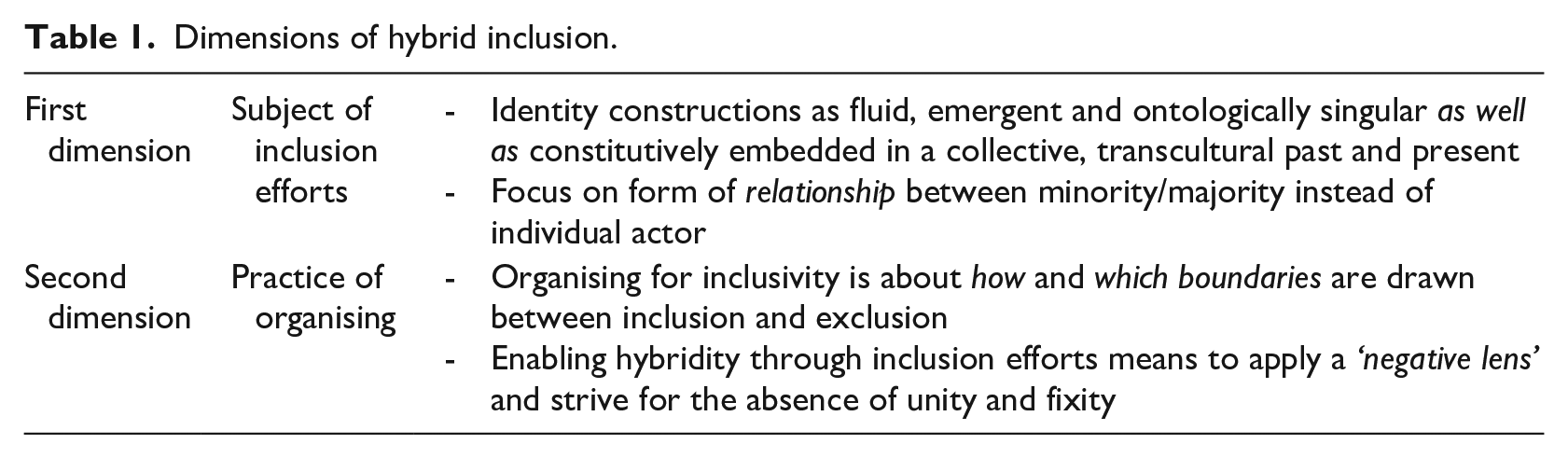
With respect to the first dimension of hybrid inclusion, we argue that the conventional imagination of the organisational member as both unique and striving for belongingness (e.g. Shore et al., 2011) is deeply rooted in Western-centric idea(l)s of the autonomous, individual and self-sufficient subject (Geertz, 1984). Consequently, this imagination is neither as ‘innocent’ nor as all-embracing as claimed in the organisational inclusion literature. Instead, it can be expected that it is the ‘peculiarities’ of Western majority group members that become intelligible as ‘unique’ – and appreciated by the organisation – rather than those of historically disadvantaged or marginalised non-Western groups (e.g. Alcadipani et al., 2012; Khan and Koshul, 2011; Srinivas, 2012). Furthermore, by emphasising the uniqueness of every organisational member, the context-specific significance of group memberships connected to power asymmetries and historical inequalities is neglected (Alcadipani et al., 2012; Nkomo, 2011; Siltaoja et al., 2019; Srinivas, 2012; Yousfi, 2014). For instance, as shown in our analysis, the availability of unique subject positions is defined and restricted by the aftermath of a dominant colonial discourse that disciplines ‘Greenlandic’ officers who act/appear inappropriately ‘Danish’ and vice versa.
At the same time, the case of the Greenlandic Police Force shows not only that highly dichotomous group differences are effectively fantasmatic and always threatened by collapsing, but also that the subject position of the coloniser is existentially bound to – depending on – that of the colonised (Said, 1978). We thus argue that it is not the individual actor that should be at the core of inclusion efforts but rather the form of relationship that leads to certain minority and majority constructions in the first place. In the case of the Greenlandic Police Force less exclusionary subject positions, such as ‘hybrids’ or ‘bastards’, can only emerge by challenging the dichotomous relationship between colonisers and colonised.
With this first dimension of the term of hybrid inclusion, we therefore want to acknowledge the simultaneity of two countervailing dynamics: the fluidity and emergence of ontologically singular identity constructions and these singular identities’ relational embeddedness in a collective colonial past and present. Inclusion efforts that seek to abandon binary, essentialising group relations need to establish forms of distinctions that challenge ‘claims of fixed polarities and originary pasts’ (Kaasila-Pakanen, 2015: 187).
This leads us to the second dimension of hybrid inclusion – the need for organisational practices that work with the actual impossibility of a ‘happy inclusion story’ that is free of contradictions and conflicts: in particular, this means to orientate the practice of organising for inclusivity towards the idea that inclusion and exclusion are mutually constitutive instead of oppositional (Goodin, 1996). For instance, inclusion in a work organisation is always dependent on certain boundary conditions – and thus entrance barriers – such as qualification requirements (e.g. Danish language skills) for future employees. Organising for inclusivity is not about erasing exclusion, but rather about how and which boundaries are drawn between inclusion and exclusion (Dobusch, 2020; Ferdman, 2017; Kaasila-Pakanen, 2015). Here, Bhabha’s notions of hybridity and third space can function as landmarks for inclusion-exclusion configurations that do not perpetuate dichotomous, essentialising identity constructions. For instance, establishing a language policy in the police force that acknowledges and makes use of both the Danish and Greenlandic language skills – the second skill currently being present but remaining unrecognised in the Greenlandic Police Force.
However, leaning on Bhabha’s conceptual framework is also a tricky endeavour, since it is positioned in opposition to any kind of fixation or essence, which complicates fulfilling the desire for simple recommendations of ‘how to undertake inclusion efforts’ that do justice to a postcolonial perspective. This provokes the question of whether it is even possible for organisations to strive for ‘hybrid inclusion’ whose core is not to be definitely fixed, not to be boxed into measurement units, not to be stripped of its ambivalent characteristics. Our answer would be that it is not possible – at least not in the sense of a positive definition of what ‘hybrid inclusion’ should look like. Instead, we follow Bhabha’s (1994) notion of third space, which he describes as ‘unpresentable in itself’ (p. 55) and as relying on ‘discursive conditions of enunciation that ensure that meaning, and symbols of culture have no primordial unity or fixity’ (Bhabha, 1994). In applying this notion to inclusion, we argue that organisations should seek to establish inclusion-exclusion configurations that allow for hybridity. This can be done by applying a ‘negative lens’ on inclusion efforts, turning the inquiry away from the individual and towards the organisation and ask an entirely different question: what kind of organisational structures, processes and practices need to be in place in order to ensure the absence of (demands for) unity and fixity?
This is where we see the potential for future research of critical inclusion studies: by empirically and theoretically investigating forms of organising that systematically provide and secure opportunities for fluid and emergent identity constructions as well as encounters that are capable of enduring ambivalence, incompleteness and divergence (see Janssens and Steyaert, 2020 for a similar, practice-based argument). In this regard, critical inclusion studies could benefit from visiting feminist research such as Ashcraft’s (2001) work on ‘organised dissonance’ and take further inspiration from organisational forms that seek for and work with dialectical tensions as well as studies on the reoccurring need for closing organisational processes in order to secure new forms of openness (e.g. Dobusch et al., 2019; Luedicke et al., 2017). Thereby critical inclusion studies can engage in conceptualising self-reflective, systematic modes of boundary drawing that are always-already preliminary and, hence, open for negotiations by default.
