




Abstract
This article explores how members of one of the largest Canadian consumer co-ops, reacting to what they saw as an assault on its democratic principles, use social media to try resisting the attempt from the board of directors to change its governance rules. Building on the Economies of Worth and Critical discourse analysis joint framework that considers power relations in the justification context, we unveil two essential moments. Initially, our analysis points to hegemonic justification struggles marked by the board and resisting consumer-members drawing on and reordering multiple worlds to debate the risk of democratic degeneration in consumer co-ops. Second, the critical insights suggest that the hegemonic control over the official deliberative arena pushed dissenting actors toward social media, an alternative space where they could deconstruct the co-ops-controlled discursive arena and create new conditions of possibility. Our article contributes to the literature on democratic degeneration in alternative organizations. More specifically, in the case of large consumer co-ops in which consumer-members have limited embodied presence, our results highlight how social media can offer a new space for debates, dissensus, and critical deconstruction. Our research also extends the post-structural criticism of the domination tendency of rational debate frameworks by showing that strategic displacement to new alternative spaces is essential to create new possibilities beyond those in central discursive arenas.
Introduction
The influence of social media (SM) on democratic practices has been increasingly debated by scholars over recent years (Ingram and Bar-Tura, 2014; Kushin and Yamamoto, 2010; Loader and Mercea, 2011). While some scholars have heralded SM as the new public square, where everyone can freely participate and debate (Dahlgren, 2013; Papacharissi, 2010), others criticize its lack of structures for supporting rational debate (Lutz and du Toit, 2014) and its excessive control based on platforms’ ‘invisible’ algorithms (Van Dijck, 2013). Nonetheless, in these times of crisis of representation in liberal democracies, where politicians and political processes are losing legitimacy (Ingram and Bar-Tura, 2014), SM have been growing as a new space for everyday politics.
Apart from recent studies about its potential in contexts of collective, unionized workplace action (Bennett and Segerberg, 2012; Upchurch and Grassman, 2016), little is known about SM’s potential impact on democracy inside organizations. Democracy is central in co-operatives, given their member-owned, member-controlled, and member-benefiting nature (Zeuli and Cropp, 2004). Yet, sustaining democratic decision-making through active and meaningful membership is a challenge for such organizations, especially consumer co-operatives (Pestoff, 2017). Indeed, as they grow and mature, co-ops display a tendency toward ‘democratic degeneration’ (Cheney et al., 2014)—where, amid struggles to survive in a highly competitive environment, boards often adopt more centralized decision-making processes by professional management experts.
Technology offers multiple business opportunities for co-ops (Gould, 2017) and can also impact their democratic governance. As recently proposed by Couchman (2017), ‘[m]odern communication has removed all excuse for members not to be consulted or engaged on any issue which does not involve commercial confidentiality [and] [e]ven on these, the strategy behind such decisions can be open’ (p. 256). Co-ops thus provide a stimulating context for studying organizational democracy-related issues on SM and assessing whether SM can galvanize participation and debates to thwart the democratic degeneration tendency.
We examine the Mountain Equipment Cooperative (MEC) case to explore how consumer-members try to resist democratic degeneration through SM. Our question resonates with recent debates on the revalorization of everyday politics as an alternative to official democratic spaces (Bevir, 2010) and on the importance of opening arenas of politics against the ‘sacralization of consensus’ through emphasis on discursive struggles (Laclau and Mouffe, 1985) or displacement (Rancière, 2006). In large, geographically dispersed consumer co-ops—distinct from often studied worker co-ops (Cheney et al., 2014; Jaumier, 2017)—consumer-members may have limited access to traditional organizational spaces of contention. Resistance to degeneration may be achieved, therefore, through a movement toward ‘disembodied’ struggles in the alternative space of SM.
We approached the case through the complementary lenses of competing justifications and critical discourse. First, building on the Economies of Worth (EW) framework (Boltanski and Thévenot, 1999, 2006), we identify the justification strategies adopted by officials and consumer-members to debate the value of the board’s proposed changes to MEC’s democratic governance. Considering EW’s limits in treating elements of power around discourse and in light of the hegemony of MEC’s discourse inside the co-op’s traditional deliberative arena leading to members’ resistance displacement to the alternative SM space, the analysis was strengthened by insights from critical discourse analysis (CDA; Fairclough and Wodak, 2000) to account for justification power structure.
The analysis of over 100 single-spaced pages of SM material covering a period of 15 months allows us to contribute significantly to the literature on co-ops, democracy, and SM. First, by investigating a case of resistance to democratic degeneration inside a consumer co-op, we explore the specific political dynamics of an understudied case within the co-op literature (Ashforth and Reingen, 2014; Byrne et al., 2015; Choi et al., 2014). Second, we demonstrate the importance of alternative discursive arenas, such as SM, as spaces of dissent (Huault et al., 2014), especially suited to meta-discursive deconstruction of the power–discourse relationship (Van Dijk, 2003) and expression of new conditions of possibility (Rancière, 2004, 2006) that might extend and feed hegemonic battles in central arenas of ‘democratic’ debate (Laclau and Mouffe, 1985). Finally, we contribute to the debate on the performative value of critical deconstruction (Spicer et al., 2009), showing how actors themselves can exploit SM as an existing ‘critical performative engine’ (Leca et al., 2014).
Democracy and politics in the SM era
Traditional literature on democracy has focused on determining ‘the positive criteria of the desirable society’ (De Cock and Böhm, 2007). From Hobbes to Rawls, these criteria have been based on an assumed natural state that requires the establishment of a social contract to create a stable society. This ‘hypothetical contractual arrangement to which individuals tacitly agree’ (Fryer, 2012: 29) determines individuals’ basic rights as society members and, more importantly, specifies who has the power to determine the rules by which citizens should abide. Growing from ancient traditions of absolutism, modern liberal societies have established the standard of representative democracy (Bevir, 2010), where elected officials representing the people lead the State.
Recently, however, this model has been attacked as the ‘death of politics’, with wealthy lobbyists and soi-disant political experts controlling representative government (Rancière, 2006), and traditional political scholars focusing on ‘ahistorical models, correlation, mechanisms, or processes’ (Bevir, 2010: 3) of the modern liberal democracy without considering its fragmentation among numerous powerful interests. Both authors suggest returning the idea of democracy to the everyday politics of citizens constantly rejected by those in power as ‘the confusion of a formless and squawking horde’ (Rancière, 2006: 93). Accordingly, it is essential to ‘open the spaces of politics’ and focus on the living democracy of the commons: Egalitarian society is only ever the set of egalitarian relations that are traced here and now through singular and precarious acts. Democracy […] is not based on any nature of things nor guaranteed by any institutional form. It is not borne along by any historical necessity and does not bear any. It is only entrusted to the constancy of its specific acts. (Rancière, 2006: 96–97)
SM and everyday politics
The debate on everyday politics gained a new dimension with the development of SM. Heralded by some as the ‘new public space’ (Dahlgren, 2013; Papacharissi, 2010), SM attract attention among scholars and practitioners for its democratic potential. Scholars have found a direct relationship between SM and increased political involvement and skills (Kushin and Yamamoto, 2010; Loader and Mercea, 2011), linked to three factors: user accessibility, information diversity, and free expression.
First, although a digital divide persists, technology is accessible to a more diverse contingent of the population—particularly disadvantaged groups (Delli Carpini, 2000), who now have easier access to ‘positions in which they can influence public debate’ (Ingram and Bar-Tura, 2014: 74). Thus, it helps engage citizens normally at the margins of politics. As such, SM differ starkly from ‘models of deliberative democracy [that] frequently privilege a particular style of “rational” communication that largely favors white, wealthy males to the exclusion of other identities’ (Loader and Mercea, 2011: 1).
Second, this diverse population has access to many more discourses that would not be available in the traditional public space, challenging control of information by the State and media (Kushin and Yamamoto, 2010). Choices are now informed by not only official channels but also ‘shared recommendations from friends, networked discussions and tweets, and direct interaction with conventional and unconventional political organisations’ (Loader and Mercea, 2011: 5). Moreover, through SM interactivity, users can access multiple interpretations of different discourses, adding further diversity (Barros, 2014).
Finally, Web 2.0 specifically opened virtual space to ‘produsers’—or, better yet, ‘citizen-users’—within a network of virtual political spaces (Dahlgren, 2013). These actors, unconstrained by procedural democracy rules, can engage in diverse forms of expressions such as testimony and storytelling (Young, 2000). Free self-expression, ‘a key component of democratic participation’ (Lutz and du Toit, 2014), is an essential feature of this new public square.
SM’s impact on democracy, however, has also been depicted as a myth. Critics claim that information access is severely limited by the power of platforms and their underlying algorithms (Van Dijck, 2013) and that most participants are actors previously engaged in political action, who use the Internet to extend their network (Loader and Mercea, 2011). Finally, the slacktivism phenomenon calls into question the commitment of virtual users who, from their couches, constantly engage in—and disengage from—multiple actions (Schmidt and Cohen, 2013).
Most importantly, a general criticism of democracy in the SM era mirrors a general malaise identified by Rancière (2006) among the political elite that SM reflect the behavior of the ‘squawking horde’, with no place for establishing procedures of rational consensus. In political terms, ‘social media holds huge promise for democracy in the capacity of interest articulation, but falls short with respect to interest aggregation’ (Lutz and du Toit, 2014: 9) and so would fail as a ‘new imagined community’
Here, we suggest that SM fulfill Rancière’s criteria for a new political space. Social technology can promote—rather than the ‘death of politics’ through the dictatorship of consensus (Laclau and Mouffe, 1985)—an alternative space for actors to access political debates with the power to change traditionally ingrained democratic practices. In fact, Rancière (2006) celebrates, The notion that the increasingly immaterial forms of capitalist production concentrated in the universe of communication are, from this moment on, to have formed a nomadic population of ‘producers’ of a new type; to have constituted a collective intelligence, a collective power of thought, affects and movements of bodies that is liable to explode apart the barriers of the Empire. (p. 96)
Organizational democracy and SM
The development of SM has therefore been depicted as ‘dramatically expanding the opportunity for expression of competing and controversial ideas in society’ (Auger, 2013: 369). But while SM impact on democracy has been central to debates at social and governmental levels, it has been mostly absent from organizational studies. This is most surprising in civil society organizations, such as co-ops, given their officially espoused values of democracy. Promises that ‘information and technology can lower the transaction costs of exercising voice and democracy’ and that ‘a smart phone “workplace democracy app” could allow democratic participation without the endless meetings’ (Davis, 2016: 137) seem not to materialize in most alternative organizations.
Despite early recognition, by Saxton et al. (2007: 144), of the potential of ‘interactions between [nonprofit] organizations and citizens and consumers’, research has portrayed SM as offering predominantly ‘one-way communication’ from organizations to their constituents and wider communities (Auger, 2013). Focusing on the functions of SM posts, research on civil society organizations has scarcely explored followers’ responses and attempts to participate in interactive conversations (Lovejoy and Saxton, 2012: 351) and further less co-operatives’ members debates with regard to their own organization.
We fill this gap by investigating a case of resistance through SM in a consumer co-op. We believe that co-ops, given their premise of ‘one member, one vote’ inspired by traditional liberal democracies, offer a perfect context to explore the impact of social technology on organizational democracy.
Co-operatives, co-op democratic degeneration, and SM
As defined by the International Co-operative Alliance (ICA, 2018a), a co-operative is ‘an autonomous association of persons united voluntarily to meet their common economic, social, and cultural needs and aspirations through a jointly owned and democratically-controlled enterprise’. According to the ICA, 3 million co-operatives exist in the world, bringing together over 1.2 billion people as members (ICA, 2018b). These members (be they workers, customers, or other, depending on the type of co-op) are the co-operative’s owners in common, with whom co-op managers must interact and who must be involved in major decisions (Quarter et al., 2017: 244). ‘Democratic member control’ is actually one of the seven principles of co-op identity; as previously mentioned, co-operatives are member-controlled as well as member-owned and member-benefiting organizations (Zeuli and Cropp, 2004). This led Quarter et al. (2017) to assert that ‘management in co-operatives is often evaluated in terms of how well the organization serves its members’ (p. 244).
As co-ops do not represent the dominant organizational model (Davis, 2016; Rothschild, 2016), they encounter challenges in establishing themselves as an alternative (Cheney et al., 2014) and in staying true to their values in competitive environments (Bousalham and Vidaillet, 2018). This has led authors to revisit an old issue for the co-op model—that is, threats to its democratic values—suggesting practitioners and scholars should examine ‘the capacity of and obstacles to the reinvention of democracy within cooperatives’ (Cheney et al., 2014: 595) and, specifically, how economic performance and democratic participation can be balanced effectively to fight democratic degeneration.
The degenerative thesis is ‘based on the idea that alternative noncapitalist organizations are too weak to confront capitalism and so they will either adapt to its logic or fold’ (Kokkinidis, 2015: 861). As Cornforth (1995) summarizes, it forecasts co-ops’ adoption of capitalist practices in order to survive, with their ‘gradually becom[ing] dominated by managerial elite’ (p. 488). In line with this trend, internal conflicts emerge between ‘traders’/‘pragmatists’ and ‘idealists’ (Ashforth and Reingen, 2014; Briscoe, 1988), between ‘modern managers’, and ‘co-operative fundamentalists’ (Storey et al., 2014). Such tensions are reflected in board-related governance concerns in alternative organizations, for example, deciding board membership/attendance between experts and lay members (Cornforth, 2004). Gould (2017) observes that The present mantra is to disparage the co-operative board structure by impugning the judgment of the people in ordinary walks of life who serve on board because of the nature of their professions: ‘housewives’, ministers, etc. It is essential for the future of the co-operative model that co-operatives not be bullied into unfounded concessions that educated middle-class individuals are incapable of contributing to a business strategy. There is much more evidence that incestuous board relationships comprised of ‘professionals’ in an industry are harmful to the business, although seldom to the interests of those professionals themselves. (p. 604)
Moreover, as their membership grows, alternative organizations such as co-operatives may trade more direct forms of democracy for representative democracy, which ‘assumes and enforces homogenization and unity, which in turn leads to the exclusion of some viewpoints or people within those organizations’ (Kokkinidis, 2015: 865).
Some scholars (e.g. Birchall and Simmons, 2004; Cornforth, 1995; Hunt, 1992) have argued that degeneration can be resisted through ‘healthy, explicit, active and vigorous internal debate’ (Storey et al., 2014: 640) to balance business performance and fundamental co-op values. Such ‘reinvention of democracy’ (Cheney et al., 2014) can be achieved through persistent internal conflicts and negotiation between members and management, as shown by studies of worker co-ops (for instance, Hunt, 1992; Storey et al., 2014), usually of small size. However, it is important to ask what happens in consumer co-ops, where members are not physically present in the daily operations of the organization, typically do not interact with each other on a regular basis, and cannot systematically check whether managers’ decisions respect co-operative values?
Studies in consumer co-ops suggest that organizations that can satisfactorily resolve democratic degeneration issues normally maintain local action, with consumer-members still being part of spaces of debate and information sharing (Ashforth and Reingen, 2014). As consumer co-ops scale up, however, questions of proximity (Byrne et al., 2015) and access to information (Birchall and Simmons, 2004; Choi et al., 2014) challenge member participation (Gould, 2017). Commenting on the Swedish consumer co-op movement’s democratic degeneration, Pestoff (2017) laments how it has changed ‘from active to passive membership’ to the extent that ‘today “membership” in a consumer co-op probably means as much or as little as “membership” in American Express, the IKEA Family, or the H&M Club’ (p. 84). Pestoff (2017) insists on the need, for consumer co-ops and the co-op movement more broadly, to sustain meaningful membership and renew democracy, both inside and outside, notably through the rediscovery of their political and social dimensions. For Couchman (2017), ‘[t]he Co-operative Movement is one of a number of organizations which evolved models of engagement that were radical in the nineteenth century, but which will either have to reform or die in the twenty-first century’ (p. 256).
Our study focuses on threats to democracy at MEC, a consumer co-op with over 4 million members spread all across Canada. Such a scale engenders the risk of rendering the link between members and decision-making ‘thin and bare’, with ‘professional managers’ arrogating the control of key decisions, away from members (Gould, 2017: 603). Considering limits on proximity, information access, and practical involvement associated with members’ lack of physical presence inside the organization, but also acknowledging the opportunities created by new communication technologies ‘to engage far more brains in a process than an elected handful’ (Couchman, 2017: 256), our study focuses on alternative, disembodied means used by consumer-members to resist, through SM, their co-op’s democratic degeneration. To illuminate this process and uncover the debates sparked by MEC’s board-proposed resolution to alter its democratic governance, we turn to an analytical framework joining EW (Boltanski and Thévenot, 1999, 2006) and CDA (Fairclough and Wodak, 2000).
Compromises, hegemony, and displacement: toward a more critical lens on justifications
When interests, logics, or values conflict with each other, actors seek to justify the merits of their worldview to others. Such justification work is even more important in pluralistic organizations, such as co-ops, where actors pursue various objectives in diffuse power contexts (Denis et al., 2007; Jaumier et al., 2017). To understand justifications formulated in the debates surrounding the ‘reinvention-of-democracy’ controversy at MEC, we first turn to the EW framework (Boltanski and Thévenot, 1999, 2006). As put forward by Blokker and Brighenti (2011), EW allows us to ‘explore the plurality of democratic languages and justifications, the complexities of an always fragile but nevertheless persisting social and political order, the unavoidable and indispensable forms of conflict and critique, and the irreducible openness and inquietude that characterize democracy’ (p. 297).
As heir of the rational debate framework initially put forward by Habermas (1981), EW tends to disregard power issues. Laclau and Mouffe’s (1985) post-structural critique highlights how any attempt to compromise 1 is an exercise in domination that excludes and marginalizes other perspectives. While Laclau and Mouffe (1985) consider the discursive and spatial displacement of alternatives by dominant players, they remain largely silent about the organizational processes by which marginal actors could create counter-hegemonic narratives (Müller, 2013). Furthermore, despite this movement to the margins, the notion of hegemonic struggle remains mainly centripetal, obscuring how voices and conditions of possibility could appear in peripheral arenas (Rancière, 2004).
To highlight the procedural hegemony behind the justification debate and the power effects of displacement, we thus bring the contribution of CDA. CDA, as a theoretical framework, is ideal to understand the relation between discourse and space since it is based on the idea of a dialectical relationship between discursive practices and their sociocultural context (Chouliaraki and Fairclough, 1999). Most importantly, CDA will help us illuminate how actors might resist by criticizing established discursive power relations and opening up new conditions of possibility through strategic displacement.
On hegemonic justification: the EW framework and its limits
EW aims to understand how actors can coordinate themselves, given the very different ‘worlds’ mobilized in justification work, that is, discursive practices through which ‘people justify their actions in everyday disputes’ (Oldenhof et al., 2014: 54). This focus on mundane justifications coincides with our interest in understanding democracy in everyday practices. EW gives us tools especially fit for an unfolding controversy (Dionne et al., 2019), that is, a context offering an ideal setting for observing critiques and justification work.
A ‘highly original perspective stressing the importance of processes of critique and justification in the production of organizational order and change’ (Jagd, 2011: 344), sociologist Boltanski and economist Thévenot developed EW to overcome the limitations of their respective disciplines, that is, structural determinism and methodological individualism, to study coordination and the agreement–discord relationship (Cloutier et al., 2017). Indeed, On Justification aims, [T]o build a framework within which a single set of theoretical instruments and methods can be used to analyze critical operations that people carry out when they want to show their disagreement without resorting to violence, and the ways they construct, display and conclude more or less lasting agreements. (Boltanski and Thévenot, 2006: 25)
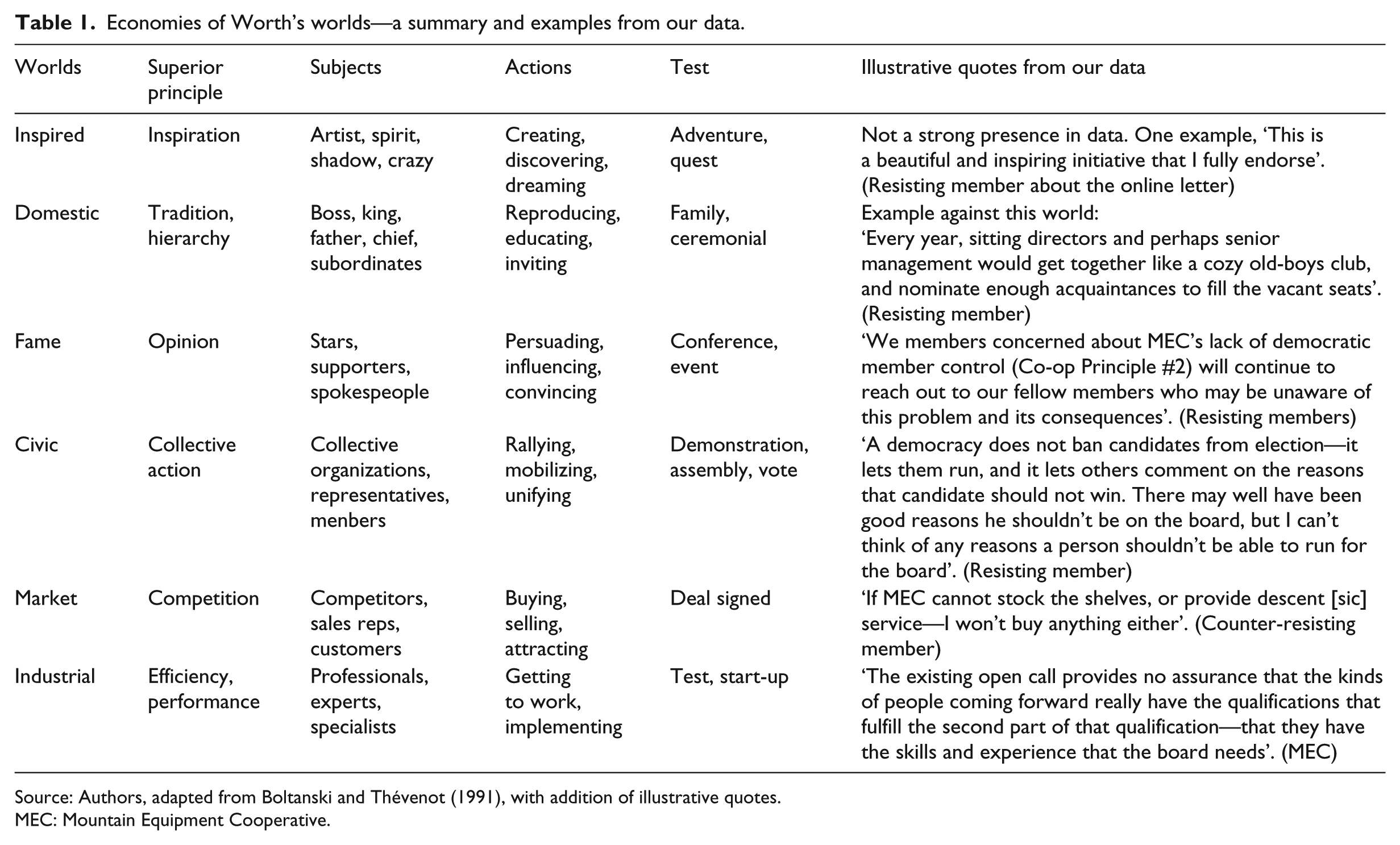
To do this, Boltanski and Thévenot (2006) analyzed canonical texts of political philosophy, which aimed at ‘constructing a common humanity’ (p. 13). From these, they derived six ideal types of the common good, leading to six ‘worlds’ (see Table 1) that, they argue, still underlie contemporary justifications. Worlds—also referred to as ‘cities’ and ‘orders of worth’ (Gond et al., 2017; Oldenhof et al., 2014)—are systems of justification or ‘regimes of worth’ upon which actors draw in moments of controversy or discord, in order to build compromises without resorting to violence (Boltanski, 2009: 53).
Economies of Worth’s worlds—a summary and examples from our data.
Source: Authors, adapted from Boltanski and Thévenot (1991), with addition of illustrative quotes.
MEC: Mountain Equipment Cooperative.
In contrast to predetermined logics and social habitus (Bénatouïl, 1999), worlds are reflected in actors’ discourses, in action—more specifically, in ‘critical moments’ or ‘tests’. Tests render worlds salient and identifiable in actors’ justifications (Boltanski and Thévenot, 2006; Patriotta et al., 2011): [A] test is at the heart of the reflexive process leading to the relativization of observed deviations, the reaffirmation of existing organizing principles, the evocation and integration of new principles into particular situations, or even the framing of new ones. (Dansou and Langley, 2012: 510)
For Boltanski and Thévenot (2006), orders of worth constitute a ‘political grammar’. Others have underlined EW’s focus on normative, moral values in constructing compromises and in associated ‘activities that are political by nature, in the sense that they point to the construction of shared representations of the “common good”’ (Gond et al., 2017) or have highlighted how power is considered in EW, with some actors more powerful than others within their field (Patriotta et al., 2011: 1811). Yet, EW has also been criticized for bypassing power relations that permeate the context of production, along with interpretation of these exchanges, and for ‘downplay[ing] the constitution of the political regime in which politics is played out’ (Nyberg et al., 2017: 144). EW presumes ‘public face-to-face justification’, where an ‘ideal-speech situation’ is taken for granted (Cloutier and Langley, 2013), and neglects the potential discursive control of official spaces of debate. Moreover, the ‘status of politics remains ultimately ambiguous and underspecified’ in EW (Blokker and Brighenti, 2011: 284).
Extending post-structural criticisms: conditions of possibility at the margins
Boltanski (2009) himself later acknowledged that ‘complex modern societies are virtually always subject to […] “domination” that is, attempts to overcome the hermeneutic contradiction, to create coherence and closure in order to diminish uncertainty and inquietude’ (Blokker and Brighenti, 2011). For Boltanski (2009: 176–77), domination allows for the possibility to restrict critique, partly or fully, and for the confirmation function to supersede the critical one.
This resonates with Laclau and Mouffe’s (1985) criticism of ideal-speech consensus-seeking frameworks where any form of compromise necessarily privileges and tries to establish some world as universal and total (Laclau, 1977, 1996), since ‘any discourse is constituted as an attempt to dominate’ (Laclau and Mouffe, 1985: 112). The main strategy for accomplishing discursive hegemony is through displacement, with other perspectives marginalized from official debate arenas, or chains of equivalence, where through interest aggregation (e.g. the success of the co-op) alternatives are emptied and incorporated by the dominant discourse (Laclau and Mouffe, 1985; Nyberg et al., 2013). Since every discourse is flawed and incomplete, hegemony is nevertheless fragile, and this opens up the possibility of contestation by alternative views (Cederström and Spicer, 2014; Meriläinen et al., 2008; Müller, 2013).
While acknowledging the post-structuralists’ contribution on the question of hegemonic struggle, we suggest that they have largely disregarded ‘how organizational processes inflect, facilitate, or subvert hegemonic discourse’ (Müller, 2013: 286) and how alternative discourses could be developed at the margins. We suggest that exploiting ‘negativity, gaps, absences or “lack”’, in spaces of near total domination where main discourses control underlying debate procedures, is not enough to establish alternative ‘conditions of possibility’ (Cederström and Spicer, 2014; Contu and Willmott, 2005). We instead propose that by decentering toward new alternative discursive spaces, like SM, we bring to the forefront the contextual discursive procedures that will help explain the contestation of old and the emergence of new voices.
Therefore, we propose to investigate the idea of strategic displacement where actors move to alternative discursive arenas, where they are able to express new marginal perspectives (Rancière, 2004, 2006) and deconstruct the structural power supporting mainstream justification debates (Nyberg et al., 2017). Considering the limits of the post-structural analysis regarding the centrifugal critique and reinvention of the procedural elements of justification, we turn to CDA as a complementary, contextually sensitive analytical grid that will help us better appreciate critical deconstruction and creation of alternatives in SM settings.
CDA, power context, and displacement
When displacement becomes a power strategy, we need frameworks that put emphasis on the contextual elements of the discursive debate. To understand the power structure of justifications, we bring the contribution of CDA (Chouliaraki and Fairclough, 1999), which focuses on ‘the way social power abuse, dominance, and inequality are enacted, reproduced, and resisted by text and talk in the social and political context’ (Van Dijk, 2003: 352). CDA possesses a ‘built-in critical stance’, considering language as central to producing and reproducing the status quo; it exposes discursive practices of domination, while creating a critical awareness of the discursive strategies of those in power, with emancipatory intent (Fairclough and Wodak, 2000).
We thus build on CDA’s elements of discourse as a social practice, part of Fairclough’s (1992) three-dimensional social theory of discourse (i.e. discourse as text, as discursive practice, and as social practice). This choice is linked to our interest in the structure of the official arenas justification debate, but also in the impact of SM as a marginal discursive context. This allows us to unveil how actors’ justifications—considered as discourse in the sense of language-in-action (Gee, 2010)—are shaped by extra-discursive elements, especially power contexts.
In particular, we explore how actors themselves engage, through deconstructing discursive power relations, with new conditions of possibility. Those alternative perspectives involve new subject positions (who has access and can formulate justifications), social interactions (how the production, diffusion, and interpretation of justifications are controlled), and systems of knowledge (what is deemed legitimate justification). We suggest that these new conditions of possibility created at the margins may in turn feed the hegemonic struggle in central discursive arenas.
The MEC case
Launched in 1971 with $65 of operating capital, MEC was founded by a group of mountaineers dissatisfied with the limited variety of climbing gear in Vancouver, Canada. Inspired by the US-based Recreational Equipment, Inc. (REI) Co-op, the six founders started a consumer co-op to provide high-quality yet affordable mountaineering gear. Over the years, MEC expanded its range to other outdoor and active lifestyle products (skis, bikes, etc.). In order to shop at MEC’s 22 stores spread across Canada or on its online boutique, one must purchase a $5 lifetime membership, granting the right to participate in democratic governance, whether for surplus-distribution decisions, election of the nine-member board, or voting on rules and resolutions. As put by MEC on its website (https://www.mec.ca/en/explore/mec-as-a-co-op), We’re a co-op. That means we’re a little different than most outdoor gear stores. Everyone who shops here is a member and an owner, and our business structure is designed around values, not profit. But there’s more to MEC than just that. When you join, you become part of a community of more than 5 million people who love to get active outdoors.
In 1985, for the first time, there were more candidates than positions available on the board, leading to MEC’s elections. In 2015, voter turnout was approximately 48,680 members which, as Quarter et al. (2017: 191) observe, can be viewed either as a very impressive number of voters for a board election or as a very low percentage of total members (about 1% at that time). While this may be read as a lack of interest and participation in MEC’s democratic governance, what follows tells a different story, one in which the nomination and election of the board is of major importance for consumer-members.
The special resolution and initial reactions
Ahead of the members’ general assembly of March 2012, the board proposed a special resolution to ‘modernize’ MEC’s organizational governance. Through a new ‘nomination committee’, MEC’s board sought to screen all candidacies before submitting them to general assembly election. Prior to the proposed change, any member could submit his or her candidacy and run in elections. According to MEC’s official discourse, the special resolution would ensure the competency of board candidates. As a special resolution, the proposed changes required approval by at least 75% of the voting members.
Some members vigorously opposed the proposed changes. After a failed attempt to discuss the issue at the general assembly, resisters had to find an alternative outlet to voice their perspectives. Turning to virtual space, they quickly published an online letter (‘Democracy and the value of co-operation: An open letter to MEC members’, initially published on http://rabble.ca/), signed by 376 members who considered the special resolution a threat to MEC’s democratic principles. A year later, before the 2013 general assembly, the board submitted another special resolution to explicitly indicate which candidates were formally supported and recommended by the board, thus giving members strong and clear voting indications. This new proposal elicited reactions, another online letter, and both traditional and SM debates.
Methodology
To study resistance to democratic degeneration in consumer co-ops, we needed to seek the often forgotten voice of the members (Heras-Saizarbitoria, 2014). Our data collection from SM, with its open politics features, helped recuperate this perspective usually obscured by management discourse in times of increased competition. Our methodology focuses on the ‘critical story’ (Paranque and Willmott, 2014), offering an alternative to mainstream perspectives of what happens in ‘democratic’ organizations. Indeed, although the official MEC democratic discourse emphasizes the adoption of its board’s resolution by a vast majority of voters, our analysis of SM allows a complementary story to be told—one that captures the justification and deconstruction work that animated non-official channels of communication.
Data collection
This study relies on texts posted mainly on SM and uses official documents and press articles to provide context. An online, documentary data collection of the MEC controversy was conducted following a multi-sited online methodology (Howard, 2002), where we ‘followed the issue’ to determine the boundaries of our data collection, that is, which sites discussed the MEC controversy. We specifically searched four types of SM: online forums, blogs, Facebook, and Twitter.
We retrieved all posts and comments published over the course of our case timeline to identify those texts that mentioned the controversy. Keyword searches on Facebook and Twitter produced MEC-related unofficial accounts, such as ‘MEC members for a democratic co-op’. The results of this search generated over 100 single-spaced pages and 32,000 words of material. Some MEC members (for instance, an advocate for democratic reform and a former board member) were more vocal, but the online letters and subsequent SM debates were clearly a collective endeavor. 2 Press articles were also collected to develop a better understanding of the issue as exposed in traditional media, including comments linked to these articles, which represent important data on public opinion about the controversy. In addition, MEC official publications—for example, annual reports, rules, and election booklets—were gathered and coded. These were essential to understanding the co-op’s decision-making process and proposed changes.
All texts were retroactively collected between March 2012 and April 2013. Following other studies of justification work (Patriotta et al., 2011), we isolated key triggering events, leading us to examine the period covering the first resolution proposal, first members’ backlash, 2012 election, second proposal, members’ subsequent reactions, and 2013 election. Thus, we fully captured public online discourses around both issues and gathered data on the subsequent impacts on scrutiny.
Data analysis
Our article has two analytical moments. The first is centered on the analysis of MEC representatives and members’ justifications, for which we applied established EW analysis (Oldenhof et al., 2014) to identify justification strategies. The second moment is motivated by what we have called the strategic displacement of resisting members, whereby the power context of justifications reveals itself as problematic. Therefore, we needed a framework that is sensitive to this issue, such as CDA. What is distinctive about our article is that we cannot (and should not) claim to perform CDA ourselves, since it was in fact the resisters who performed the analysis. Our analytical role is to represent their voices as faithfully as possible using CDA as a theoretical (rather than methodological) framework.
EW analysis
Similar to Dionne et al. (2019), ‘multiple events were analyzed chronologically, focusing on the orders of worth mobilized by protagonists to evaluate the situation over time’. To organize the multi-source material in chronological order and identify key events of the controversy, we first used a narrative strategy—‘a detailed story from the raw data’ (Langley, 1999: 695)—to make sense of it and to capture the triggering events.
We initially used EW to thematically identify the worlds emerging from the material and how they were mobilized (Cloutier et al., 2017: 11). This analysis comprised ‘an initial phase of inductive exploration and a sequential phase of deductive coding’ (Oldenhof et al., 2014: 56) based on the EW framework (Boltanski and Thévenot, 1999), with the addition of the ‘green’ world, associated to the natural environment (Lafaye and Thévenot, 1993). To identify justifications, we sought expressions about ‘what should be or should not be’ (Oldenhof et al., 2014), then associated these justifications (reasons and arguments for or against the proposed changes) with the worlds to which they referred. For instance, excerpts in which MEC officials claimed that the changes were needed to make the co-op ‘more competitive’ were coded as ‘market’ justifications (see Table 1 for further examples).
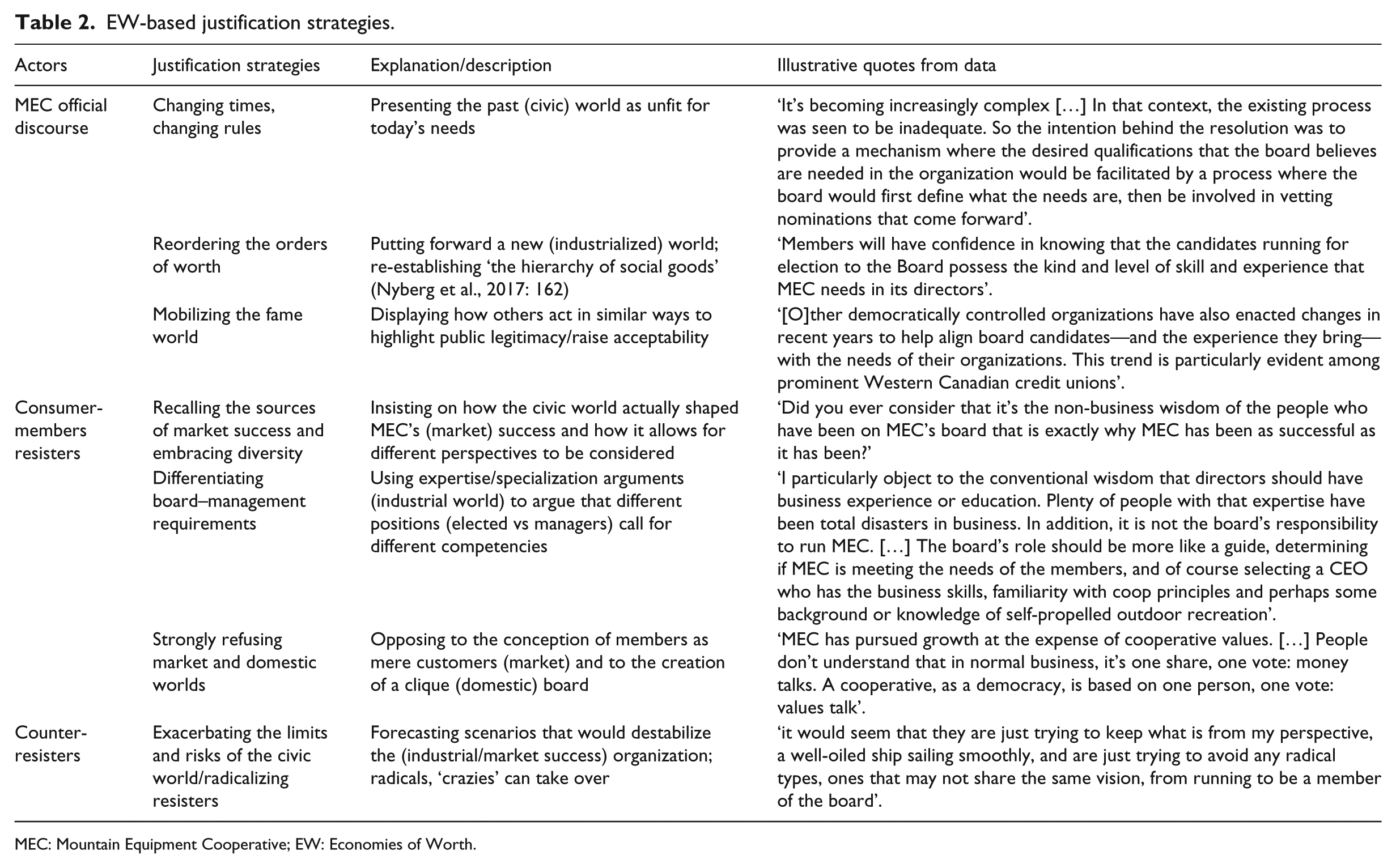
Each codification of a world was accompanied by the inductive, systematic identification of whose justifications were expressed (i.e. those of MEC, resisters, or counter-resisters) and of the tensions and relationships found between the worlds (e.g. explicit subordination of the industrial to the civic world by some consumer-members opposed to the change). Justifications and tensions were compared through time, for each party, as we looked for patterns and vignettes that would capture them. This led to the identification of different justification strategies by the various actors, depicted in Table 2 and further discussed in the findings.
EW-based justification strategies.
MEC: Mountain Equipment Cooperative; EW: Economies of Worth.
CDA analysis
As previously explained, EW presumes ‘public face-to-face justification’ with a taken-for-granted ‘ideal-speech situation’ (Cloutier and Langley, 2013) and neglects the potential discursive control of official spaces where the justification work unfolds. Indeed, while we could identify some hegemonic moves in the justification strategies above, what struck us as important in our story was the power and control issues around the justifications initially revealed through newspaper articles. Furthermore, this perceived hegemony of MEC’s discourse inside the co-op’s official deliberative arena prompted a displacement by members to SM. This induced us to look at the discourse developed by members in that alternative space. However, our analysis of justification work based on EW alone did not allow us to fully grasp those issues, leading to a second round of analysis by the power context–sensitive CDA framework.
We, therefore, examined SM texts again to identify instances of power deconstruction. It is extremely important to mention that we, as researchers, did not perform CDA per se, as CDA methods (Fairclough, 1992) would normally require (e.g. Nyberg et al., 2017). Instead—and in line with On Justification’s deep recognition of the actors’ competence to unveil, by themselves, their opponents’ intentions and concealed failings (Boltanski, 2009: 51)—we identified the deconstruction work done by the actors themselves. Results from our abductive analysis were then iteratively connected to Van Dijk’s (1997) framework of power in and over discourse.
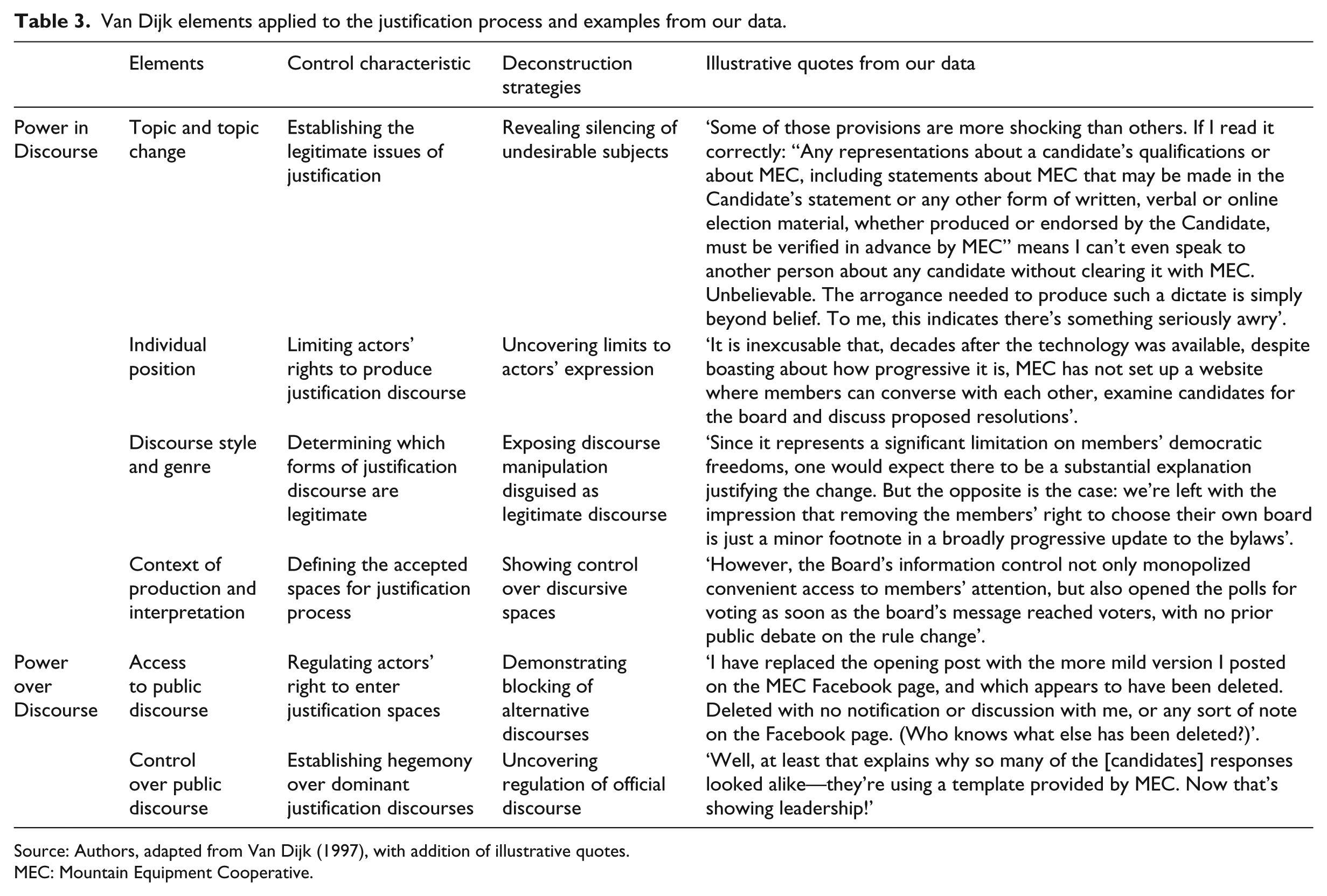
This allowed us to identify particular passages and significant texts where resisting members uncovered issues of operationalization of power through discourse control, access, control of production, and interpretation. Based on this, we could identify some deconstruction strategies employed by resisters to expose the political underpinning of justifications by considering subject positions, social interactions, and systems of knowledge. For example, when members discussed MEC’s meddling with candidates’ statements, we coded this as ‘revealing silencing of undesirable subjects’, based on Van Dijk’s power in discourse control of topic and topic change (see Table 3).
Van Dijk elements applied to the justification process and examples from our data.
Source: Authors, adapted from Van Dijk (1997), with addition of illustrative quotes.
MEC: Mountain Equipment Cooperative.
We approached each post and comment on SM as a source of information about the institutionalized context surrounding the production of justifications. These SM texts were complemented by other ‘official’ sources (company rules and regulations, reports, etc.) that might confirm or contradict the members’ depiction of the company’s discursive control. These data were used to reveal members’ views on the conditions of possibility for the justification debate’s emergence, rather than as an ‘“objective” context that is distinct and fully separable from texts’ (Zanoni and Janssens, 2015: 1469).
On justification of MEC’s controversial change and resisters
Initial EW-based analysis shows how MEC framed the proposed change using justifications drawn from the market, industrial, and fame worlds, while resisters mainly mobilized arguments from the civic world. The two justification discourses clarified the actual ‘order’ of the orders of worth, with different priorities and evaluations of MEC’s success. We also show how the domestic world, linked to tradition and family, implicitly penetrated MEC’s and resisters’ discourses, as both conveyed the importance of preserving something, although the endangered dimension varied greatly: for MEC, it was about business survival, while resisters feared the erosion of democracy. Finally, we consider counter-resisters’ justifications.
MEC’s justifications for the proposed changes
To understand MEC’s justifications, our analysis relies on its official documents, particularly the special resolution of 2012, the first related to the governance changes (see Figure 1). The latter was officially presented by MEC in an election booklet sent to all members before the general assembly.
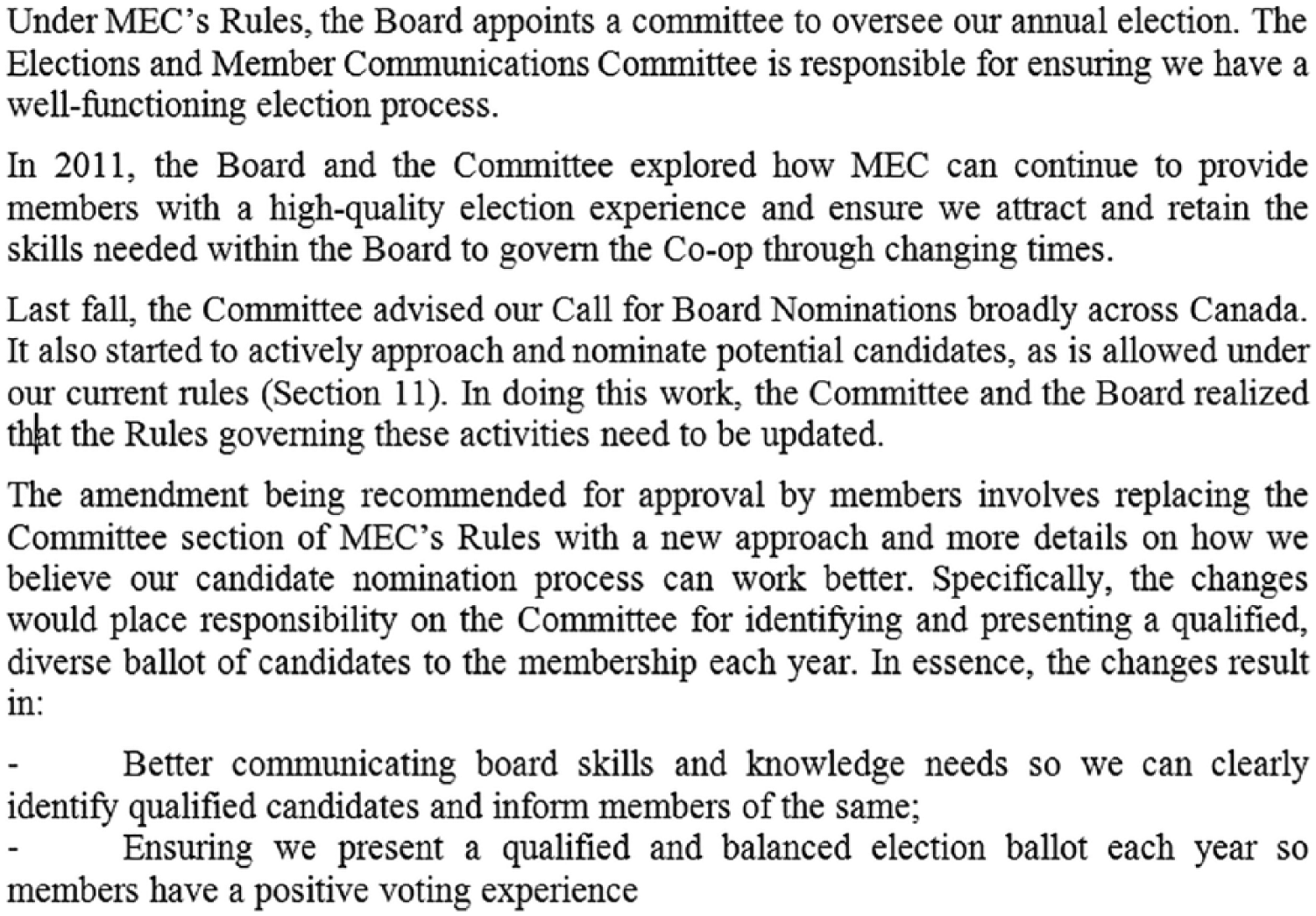
MEC special resolution.
Changing times, changing rules
MEC justified the first proposed changes in bylaws in simple, constant terms: ‘MEC needs strong and balanced leadership at the board level if it is to continue to grow and succeed’ (Q&A document on the special resolution). Given its changing, competitive environment, MEC argued it needed to update its bylaws to ensure its board comprised the most competent and skilled members. This echoes the degenerative thesis and resonates with the ‘managerial’ type of domination described by Boltanski (2009: 203), in which the dispositifs of domination are based on the need for perpetual change pleaded by experts’ authority.
In EW terms, the market world challenges the past rules of the (outdated) civic world, and the industrial world comes to the rescue to update them. For MEC, the industrial world—focusing on expertise and specialization—promises qualified people (instead of risking anybody running for elections): Just as MEC’s business continues to evolve, so too do its governance requirements. Over the last year, the Board determined that MEC’s nominations process was out of step with the organization’s growing leadership needs in terms of ensuring that qualified candidates were standing for election. The more laissez-faire nominations approach of the past was believed to be ill suited to a $265 million outdoor retail co-operative with approximately 1,500 employees and complex business requirements.
Boltanski and Thévenot (2006) identified no compromise between the market and civic worlds. MEC tried to create one by instilling the industrial into the civic world. However, this was done through reordering the orders of worth, with the civic world being pushed down, subsequent to the industrial screening.
Reordering the orders of worth
Indeed, MEC’s resolution aimed to allow a board committee to solicit potential candidates and to screen candidates based on its needs. By emphasizing how the proposed selection process would strengthen the board, MEC tried to convince members that the resolution would result in improved governance, better work by their elected officials, and even a ‘positive voting experience’. In EW terms, this accentuated the qualified objects and subjects of the civic world. This improvement is made possible through the civic world being overtaken by the industrial world: The proposed Rule change […] would empower the Board […] to recruit potential candidates, assess them against the Board’s predetermined leadership needs, and ultimately nominate those candidates who the Board believes are qualified to lead MEC. In turn, as happens today, members will decide which candidates are the most qualified to serve as MEC directors. In effect, the Board will be better able to uphold its fiduciary responsibility of stewarding the Co-op on members’ behalf.
MEC’s resolution thus appears as an attempt to reorder the orders of worth, re-establishing ‘the hierarchy of social goods’ (Nyberg et al., 2017: 162). The imperatives of the market world and potential dangers of the (civic) ‘laissez-faire nominations approach’ made the previous arrangement outmoded.
Mobilizing the fame world
The market and industrial worlds were the main sources of justifications for MEC, but—in line with the opinion/fame world—MEC added that other democratically controlled organizations had made similar (industrial world) changes to their governance rules: It also bears noting that other democratically controlled organizations have also enacted changes in recent years to help align board candidates and the experience they bring with the needs of their organizations.
By giving examples of other like-minded organizations having introduced similar changes to their governance rules, MEC conveyed the message that the trend was real and legitimate.
Resisters’ justification against the proposed changes
MEC’s response to the market threat was operationalized using industrial-world inputs; however, for resisters, the core element under threat was the democratic life of the co-op (civic world). They did not see the democratic dimension as risky, but rather at high risk of potential hostile takeover by the industrial/market/domestic worlds. While MEC’s justification strategy was relatively straightforward, the resisters’ strategy relied on multiple worlds.
Recalling the sources of market success and embracing diversity
One of the resisters’ central arguments was that democratic rules were not problematic, given MEC’s success, especially when compared to other less successful competitors: Considering that MEC has flourished over the last 40 years and runs still a vibrant business, the existing criteria for running for board membership can’t have been a problem. Compare this to the eventual failure of all the other outdoor businesses that have come and gone during that time.
For many resisters, democracy was not the problem; on the contrary, MEC’s success was attributable to its democratic rules. Instead of seeing democratic procedures as threatening MEC’s competitiveness, resisters positioned democracy as a strength that allowed differentiation: Large co-ops in Canada have a history of drifting toward acting like for-profit companies run for shareholder profit, seeing their member-owners as customers rather than owners. At MEC, some member-owners have from time to time fought this trend, and the result of these initiatives is precisely what makes MEC compelling today: leading-edge sustainability practices.
Similar to MEC’s ‘re-ordering’ strategy, resisters proposed their own: for them, the civic world took precedence over—and even reinforced—the market world. Thanks to the civic world rules, some candidates—who could have been excluded if the proposed resolution had been passed—joined the board and infused MEC’s business practices with green/ethical concerns, thus creating one of MEC’s competitive advantages.
In line with the last quotation, some resisters rejected the opposition between business skills and activism: You also seem to be unable to grasp that there are plenty of people who are skilled businesspeople AND are committed environmentalists.
However, another justification strategy was observed, interestingly supported by the industrial world: that of distinguishing the responsibilities (and thus skills/profiles required) of board members from those of managers.
Differentiating board–management requirements
While the last quotation conveyed the idea that board members could (and probably should) be both skilled at business and engaged socially/environmentally, another line of justification for resisters distinguished the responsibilities of MEC’s board members from those of its managers: The board has a variety of committees, such as the nominations committee and the finance committee. The board can place on any committee, MEC members who are not directors. (Nonmembers may also be able to sit on MEC board committees.) Thus, if MEC finds it lacks expertise on the board in any given area, it is free to appoint to committees non-directors with the needed skills.
This last excerpt reframed the industrial-world justifications articulated by MEC by attributing different places for the different worlds to be enacted, rather than the industrial world superseding the civic world. Based on this resister’s argument that, interestingly, drew from the industrial world’s focus on specialization, both the civic and market worlds could be endorsed, yet in distinct spaces. However, for others, the market world was problematic and had to be more categorically opposed.
Strongly refusing market and domestic worlds
For resisters, one clear danger was that MEC members would be reduced to mere customers (market world), with MEC ‘downgrad[ing] members from active participants in the co-op to mere consumers of its products’. In the ‘Democracy and the value of co-operation’ open letter to members, resisters proudly claimed, Along with 3.3 million other members, we don’t just shop at MEC stores as consumers. […] The fact that MEC is a co-op, that it represents a different way of doing business, is a big part of why we support it.
The danger of transforming members into ‘mere’ customers was repeatedly evoked. For many resisters, MEC is not just a retail store nor are its members just looking for products. One resister, a previous MEC employee, recalled, ‘When I worked on the sales floor, many members were very concerned about the ethical and environmental impact of the products’. The following excerpt explores the ambivalence of MEC being more than—yet no different from—other outdoor stores: Sure, they are big and thus impersonal. And they are a marketing machine. They are also more than that—you just haven’t been looking. I have, and I am impressed with them. When I needed a place to hand out material drawing attention to threats to the canoe routes, they were welcoming and supportive.
Although their fight for the protection of MEC’s traditional, community-based, and co-op roots could relate to the domestic world, resisters also strongly rejected some of its downsides. More specifically, they feared the board becoming a complacent club, with a ‘serious conflict of interests’, as it ‘would become possible to stack the board with like-minded members, and to shut out anyone who thinks differently’: If there were going to be any so-called ‘screening’ it can only be a clear conflict of interest if said screening is done by sitting board members. That practice would also pave the way for sitting board members to select only candidates agreeable to their own personal agendas, in a worst case scenario. It’ll be a bigger joke than patronage appointments to the Senate in our parliamentary system, which has long been a travesty of justice.
Such justifications alerted fellow members to the dangers of letting the civic world wane—not only at MEC but also at a societal level. Indeed, this last excerpt illustrates the somewhat catastrophic scenarios depicted to warn fellow members. Again, framing the issue very differently, for resisters, the erosion of democracy and dark sides of the domestic world were much more dangerous than market challenges and risks of ‘laissez-faire’ nomination results. Yet, these dangers were not equally felt or feared by all members.
A few words on ‘counter-resisters’
While most consumer-members’ discourses on SM supported resisters’ justifications against the proposed changes to governance, some posts supported the changes. Some of these counter-resisters followed the same lines as MEC, but most went much further in expressing the risks of democratic ‘laissez-faire’, thus crafting their own catastrophic scenarios in response to those of resisters: Boards nominate people who contribute to their mission statement and support a common goal. In theory, if MEC allowed a bunch of ‘crazies’ (not my word) to get in through election, they could affect decisions for the entire company because boards make policy. So, while one ‘crazy’ is not a big deal, a bunch is.
The civic world was presented not only as dangerous but also as costly and non-effective: ‘[K]eeping their administration costs to a minimum and being able to act decisively without having to entertain every individual notion or whim is I think what this restructuring is about’. For many counter-resisters, MEC was ‘a well-oiled ship sailing smoothly […] just trying to avoid any radical types’. Observations that MEC was actually doing well, that the board was doing a good job, and that it therefore deserved trust were frequent among counter-resisters: I would be more persuaded to venture an opinion against it if I had proof the current board was leading the co-op in the wrong direction. Or making bad policy. Or sinking the company into debt. Or acting criminally or unethically. That is what matters.
While the last excerpt refers to governance and the civic world, some members reduced their relationship with MEC to the market world—to the ‘mere consumers’ feared by resisters—because they either did not understand or did not care about co-op principles: ‘As long as I continue to receive the level of service I have for over three decades now, I am good with whatever the existing board decides. Why stir the pot, if nothing is sticking to the bottom?’
Through the EW-based analysis, we thus showed how different groups of actors used different worlds to put forward their vision of what is valuable. In a nutshell, MEC’s official discourse mainly relies on the imperatives from the industrial and market worlds to justify their proposed alteration of the democratic practices. While this discourse is relayed by some members (‘counter-resisters’), in the majority of the SM posts gathered, MEC members, in contrast, emphasize the prime importance of the democratic, civic world for the governance of their co-operative, against all market and industrial threats. The resolution was finally adopted and elements of power must now be accounted for, to better understand how this outcome came about.
MEC’s controversy: justifications under control
The CDA analysis of our data showed that the debate around the (endangered) democratic values of MEC happened in different discursive arenas. In fact, the co-op’s official channels seemed to leave no space for dissenting voices to challenge the proposed changes. Despite an attempt at the general assembly to discuss the issue, resisters had to find a different outlet to expose what they thought was a manipulative and biased process.
More importantly, our analysis shows that resisters went beyond the discursive realm of justification to expose meta-discursive power issues surrounding the board’s attempt to change the governance rules. Here, they used four different deconstruction strategies. First, they exposed official discourse bias in the documents supporting the proposed changes. Second, they unveiled democratic-process control by the board through restrictive rules of communication. Next, they proposed alternative forms of exchange to assure better and more open communication between members. Finally, they revealed that when the co-op accepted and created these supposedly freer means of exchange, staff still subtly exerted forms of discursive control.
Deconstructing official discourse
In the open letter of March 2012, the ‘MEC members for a democratic co-op’ established that they were battling to improve democracy in their co-op. They claimed that ‘by sneaking through a resolution which claimed to “modernize” MEC’s bylaws’ and that was ‘misleadingly-labelled’, the board gave itself illegitimate power. This was the first time resisters suggested MEC’s representatives had used a biased discursive style that deceptively convinced members to adopt the resolution without questioning its merits in terms of governance power. The letter signaled a general shift of focus from the expected rational justification process to a critical awareness of the issues precluding this debate.
Following the open letter, many resisters on SM platforms deconstructed official MEC texts to expose hidden elements or distorted narratives showing the board’s real intent. The main object of inquiry was the resolution itself and the text that accompanied and promoted it to members. Resisters accused MEC’s representatives of deceptive language, with voters ‘being given only one side of the story, as though they were being taken for dummies’. In one of the many pieces written on independent blogs, just before the March 2012 election, one member accused the board of intentionally digressing to conceal the main significance of the resolution and of using doublespeak: Since it represents a significant limitation on members’ democratic freedoms, one would expect there to be a substantial explanation justifying the change. But the opposite is the case: We’re left with the impression that removing the members’ right to choose their own board is just a minor footnote in a broadly progressive update to the bylaws. Need a ‘DO NOT LIKE’ button. I know double-speak when I see it, and ‘… the skills and experience that the Board believes would be beneficial at that point in time …’ means they get to set the criteria with respect to the incoming board members. […] Are these so-called ‘beneficial qualifications’ outlined? No. Why not? So they can be fluid and ‘adaptive’ […] Shame on you for hiding this from members.
MEC’s board was also blamed for showing only ‘one side of the story’, that is, attempting to ‘publicize only arguments favoring this change and nothing about why it may be a bad idea’. Moreover, there were accusations that this ‘badly-worded resolution’ was hidden behind layers of Internet hyper-textual information. This, according to some, helped create misinformed choices, which seemed to be the board’s objective, since ‘[m]ost MEC voters wouldn’t have taken the time to click through the two levels on MEC’s website to read the actual text of the resolution’. In response, many accessed the data and publicized it on blogs, Twitter, and Facebook, along with ‘quotes of the deceptive language that fooled members into supporting the Special Resolution’.
According to many comments on independent blogs, consumer-members who eventually discovered the problems related to MEC’s resolution encountered obstacles to informing others. Therefore, another criticism of the co-op’s board was that they controlled not only members’ access to relevant data but also the election process and participants’ communication. A MEC member described their feelings of powerlessness: A few members dug into the details, realized that such a loss of democratic rights would be hard to reverse, and tried to alert others. However, the Board’s information control not only monopolized convenient access to members’ attention, but also opened the polls for voting as soon as the board’s message reached voters, with no prior public debate on the rule change.
Controlling candidate discourse
‘MEC members eligible to vote got a pamphlet in the mail. It’s green and doesn’t look like election material. In fact, it says on it: ‘IT’S NOT POLITICS’. I’m not sure what MEC thinks it is’. This blog comment by one member, concerning the election leaflet, points to MEC board’s clear effort to depoliticize the campaign and transform it into a supposedly neutral contest of expertise. This trend could be confirmed by another official practice that upset some resisters.
One main source of resisters’ material was Votermedia, a blog dedicated to election matters in organizations. There, an active resister described his efforts to contact candidates about the power issues involved in the resolutions. What surprised him was not the answers given by candidates but a regulatory issue linked to diffusing the exchanges: I would like to share their replies here with all MEC members, to help us all make more informed voting decisions. However, I hit the following obstacle—at the bottom of each candidate’s reply email was: ‘This message is intended only for the use of the individual or entity to which it is addressed and may contain information which is privileged, confidential or proprietary’.
Furthermore, when the resister contacted candidates about these restrictions, most were unaware of them. In fact, members learned afterwards that MEC’s staff created a special email address that candidates had to use for all election-related matters; the message was an in-built feature. When the resister tried to circumvent these regulations by asking candidates whether they minded making their answers public, MEC’s control of candidates’ discourse was exposed in their replies: [W]e are very limited in our ability to say what we want and to whom we want—this is very clearly outlined in the rules for candidates. Our email is also audited by MEC staff. As candidates, we were asked to abide with rules on how to communicate with members, which include using this MEC address.
Once this practice was exposed, an important discussion was ignited between members. Some were surprised about the implication of the rules for candidates’ communications, suggesting a dictatorial (‘how soviet of them’, as one member put it) quality: ‘Obviously MEC directors are being boxed into toeing a party line, rather than representing the sometimes differing views of the people who elected them’. Afterwards, resisters started to deconstruct candidates’ messages and expose what they thought were examples of control and conformist behavior: It’s curious so many responding candidates used similar phrases to thank you for contacting them. It’s also obvious that none of their candidate statements addressed the resolution, and I find that both odd and unacceptable. Well, at least that explains why so many of the responses looked alike—they’re using a template provided by MEC. Now that’s showing leadership!
Resisters’ next step in collectively unveiling MEC’s discourse control was to deconstruct the rules behind it. Some members accessed the actual rules governing the election for discussion and published them on SM. Many resisters analyzed the text and exposed some quotations that seemed particularly outrageous to them, while showing how they impacted the democratic logic of the co-op: Some of those provisions are more shocking than others. If I read it correctly: ‘Any representations about a candidate’s qualifications or about MEC, including statements about MEC that may be made in the Candidate’s statement or any other form of written, verbal or online election material, whether produced or endorsed by the Candidate, must be verified in advance by MEC’ means I can’t even speak to another person about any candidate without clearing it with MEC. Unbelievable. The arrogance needed to produce such a dictate is simply beyond belief. To me, this indicates there’s something seriously awry.
Finally, some resisters also analyzed the organizational power aspects of these rules. In particular, they worried that members’ loss of control over MEC was also linked to the increased powerlessness of the board vis-à-vis managers. This reflects a common pattern in these discussions, suggesting that people in charge of managing the organization did not support the co-op’s traditional values: As if it weren’t possible, the full picture is even worse. The staff who police candidate email correspondence, and the Senior Manager, Governance, who supervises the board, report to the management. Not the board. So the people who have hands-on control of all this are in the management structure as opposed to the board which represents the member/owners.
In the 2013 elections, another independent source, Media Co-op, decided to follow suit, asking candidates about the new power dynamics implied by the proposed resolutions, among other issues—for example, the board could not only select candidates but also indicate its recommendations in the ballot. This time, they could post the answers online to other members, but Media Co-op did not have access to all candidates: ‘I was not able to interview members whose candidacy was rejected by the board’.
Proposing discursive online solutions
To circumvent these restrictions, resisters started a movement to petition for alternative communication means for members. One key demand to MEC was for the creation of a permanent online forum for members to discuss not only elections but also any issues concerning co-op activities. Many believed this could ensure better member scrutiny: If MEC members had a discussion site where they could talk to and about candidates, and discuss proposed resolutions, no one would dare run for improper reasons, and the board wouldn’t dare put half-baked and misguided resolutions before the membership. Both would look stupid pretty quickly.
Resisters started defending the online forum as a panacea against the discursive control that might be exercised by MEC’s board: ‘[T]he forum is crucial if members are to have a say in these large co-operatives’. According to these resisters, the online forum would allow them to expose to more members the questionable changes behind the resolutions and effectively impact the results: ‘There is no online forum on the MEC website where members can discuss election issues with each other. Had there been one, we could have alerted fellow members to the above deception’.
On the SM blogs and forums, resisters complained that MEC had no excuse for not offering this tool: ‘THERE IS NO GOOD REASON why MEC can’t provide an online discussion site where board candidates and proposed resolutions can be discussed, and where censorship is limited to what’s typical for these sites’. In fact, one resister suggested that the technology was easily accessible at reasonable cost to the co-op. Moreover, other similar organizations had already started the same initiative with their own members: MEC has built a beautiful detailed election website at www.mec.ca/election, with well-organized information about each candidate. However, this website does not facilitate an open shared discussion among MEC members about the candidates. Open shared discussions are a common feature on many websites, so software for that is readily available.
Members started promoting a collective movement to create a resolution in subsequent elections in favor of creating an online discussion forum for members: ‘[M]aybe some members need to sponsor a special resolution to require MEC to set up a website where members can talk to each other’. The lack of such tools, according to resisters, showed the extent to which the organization wanted to maintain control over the election discourse and its realization that it could not do so in the SM arena: It is inexcusable that decades after the technology was available, despite boasting about how progressive it is, MEC has not set up a website where members can converse with each other, examine candidates for the board and discuss proposed resolutions. It is all too easy to view this as an entrenched practice to limit the power and rights of the members and keep the board a relatively ‘closed shop’. However, the joke is just about over. Either the MEC board can salvage some dignity by setting up such a site, or someone else will do it for them.
Controlling SM
Before the 2013 election, MEC’s board finally created an online discussion forum especially for the election period; there, members could discuss the election process, candidates, special resolution, and so on. Resisters largely welcomed the new feature as a turning point in their democratic relationship with the co-op. However, celebration quickly turned to criticism when obstacles to accessing the forum seemed to prevent real debate: Unfortunately though, the benefits of an online forum are undermined by continuing the policies of opening the polls for voting before discussion can start, and prominent placement of the board’s spin, compared to inconvenient access to the forum.
Resisters started to identify instances where, in SM spaces, MEC was subtly trying to exercise discourse control. The main criticism was about the co-op’s main Facebook page: ‘[MEC] has a Facebook page, but seems quite willing to censor content on there’. Censorship, according to resisters, ranged from sidestepping critical comments (‘[L]ame response to my post on the MEC FB page today. C’mon guys, if you think this stinks, then stir the pot!’) to deleting posts altogether (‘For those interested in the debate on the special resolution, there are comments appearing and disappearing from MEC’s Facebook page’).
In addition to highlighting and criticizing these aspects, one main response by resisters to MEC’s perceived marginalizing efforts was to reproduce their posts on other SM platforms and even to publish screenshots before posts were deleted. Other members also said they changed their style and posted ‘toned-down’ or ‘mild’ versions of their comments to see whether they would survive MEC’s screening process: I have replaced the opening post with the more mild version I posted on the MEC Facebook page, and which appears to have been deleted. Deleted with no notification or discussion with me, or any sort of note on the Facebook page. (Who knows what else has been deleted?)
All in all, those who shared in this resistance initiative had mixed feelings on SM’s effectiveness. Some participants enthused about the debate: ‘I’ve enjoyed reading all of this discussion and it has informed and influenced the way I voted in this year’s election’. In fact, some members, who had been initially unaware of the significance of the changes, were excited by the possibility of accessing these opinions and hearing ‘the other side of the story’. Moreover, these participants seemed to appreciate gaining insight into the co-op and its official discourse: ‘I was wondering what was going on behind their somewhat odd “it’s not politics” campaign’.
Others felt that SM had limited power to bring about change in the face of MEC’s discourse-control authority: ‘“[S]ocial media” failed to even put a dent in MEC’s ability to mail one-sided information to what appears to be a very gullible membership’. This was countered by those who argued that such controlling behavior from MEC’s board and staff required immediate action: If MEC deleted my post from the Facebook Group, then I can see they really have their heels dug in on this, they are fully determined to continue to cloak MEC’s reality in cheerful happy stories, and it would take a major effort to reverse this. Probably it would take escalation to the point of getting registered letters from MEC’s lawyers.
Many resisters, however, seemed to agree that their SM campaign challenged MEC’s traditional ‘do-gooder’ image: ‘MEC members take advice from the board at face value’ and ‘people just accept that if MEC’s board says something, then that something must be true, fair, valid etc’. Ultimately, all these issues debated by resisters demonstrated that ‘what MEC has to say should not be taken without question’ and that this might entail ‘the end of MEC’s monopoly on communication with and between MEC members’.
Counter-resisters’ delegitimizing criticism
While resisters were highly critical of MEC’s discourse and attempts to control communication, their discourse in itself was also deconstructed. Some counter-resisters tried to defend the co-op’s proposed changes by downplaying resisters’ critiques in three ways.
First, counter-resisters, while acknowledging resisters’ demands, tried to delegitimize their validity based on their emotional dimensions. Following the adage ‘it’s not personal, it’s business’, the counter-resisters presented the proposed changes as necessary for the co-op. For them, the critics demonstrated a misplaced attachment to traditional democratic values: So while I understand the emotional comfort of a totally democratic, don’t exclude anyone Director ballot, let the members alone decide, it may not produce the best result for MEC, which has clearly stated its preferences for directors with specific skills and experiences in this year’s elections.
Second, in reaction to one of the main resisters’ criticisms of the board’s supposed anti-democratic attitude, counter-resisters suggested he had personal motivations. On one online forum, the resister mentioned being a former MEC employee and board member and his struggle with other members because of his resistance to many decisions. One counter-resister suggested, I did a search on this topic and see it has been posted by yourself on another forum. Apparently, you were fired from MEC for insubordination. It explains a lot. Of the 46 replies to this post, [resister username], 23 are yours. What dog do you have in this fight? What is the real story here?
Finally, counter-resisters also criticized resisters’ basic democratic arguments by separating traditional political views from the depoliticized perspective on business. Counter-resisters’ relationship with MEC was essentially based on the producer–consumer dyad and that foreclosed the discussion of any other topic. Therefore, any comparison with conventional politics would be considered irrelevant, as when one resister supported his argument against candidate pre-selection by reference to the inalienable participation rights of minorities in Canadian elections: Now we are discussing the relative merits of Quebec separatists and MEC membership in the same thread? :o […] I am starting to realize this is probably not going to stick, but a store that sells sporting goods and bikes along with pots and pans and some dehydrated food is not a government.
Counter-resisters’ criticisms were immediately answered on SM by other users directly or indirectly involved in the exchange. However, these new actors added another dimension to the initial conflict between the respective discourses MEC and the original resisters. In a way, resisters were confronted to some of the discursive deconstruction they had initially directed at the co-op.
Through the CDA-based analysis, we exposed how resistant actors’ (with some opposing voices) displacement to SM allowed them first to deconstruct what they saw as a controlling organizational discursive space. Resisters’ alternative discourse exposes that the justification debate was biased because of restrictive rules and limits to free expression. Despite calls to use the potential of virtual technologies, subtler forms of control were still in place. Next, we explore the failure of the co-op democratic process and the power behind the resisters strategic displacement to SM.
Justifications and power: subverted democratic consensus and SM deconstruction
While resisters inside the consumer co-op may have deployed a richer range of arguments than the relatively uniform justification in MEC’s official discourse (at least from the perspective of justification strategies), the analysis falls short in explaining why MEC’s justifications ultimately succeeded, especially since EW overlooks power disparities between parties, as ‘not all justifications or orders of worth are equal’ (Nyberg et al., 2017: 166). When we examined the broader context of discourse formulation, based on our analysis, MEC’s discursive hegemony and members’ restricted access to other discourses/interpretations were notable. Interestingly, this critical perspective was clearly developed by consumer-members themselves, who deconstructed the power behind the ‘democratic’ discussions and tainted the credibility of MEC’s board. The justification and deconstruction processes and spaces involved are illustrated in Figure 2.
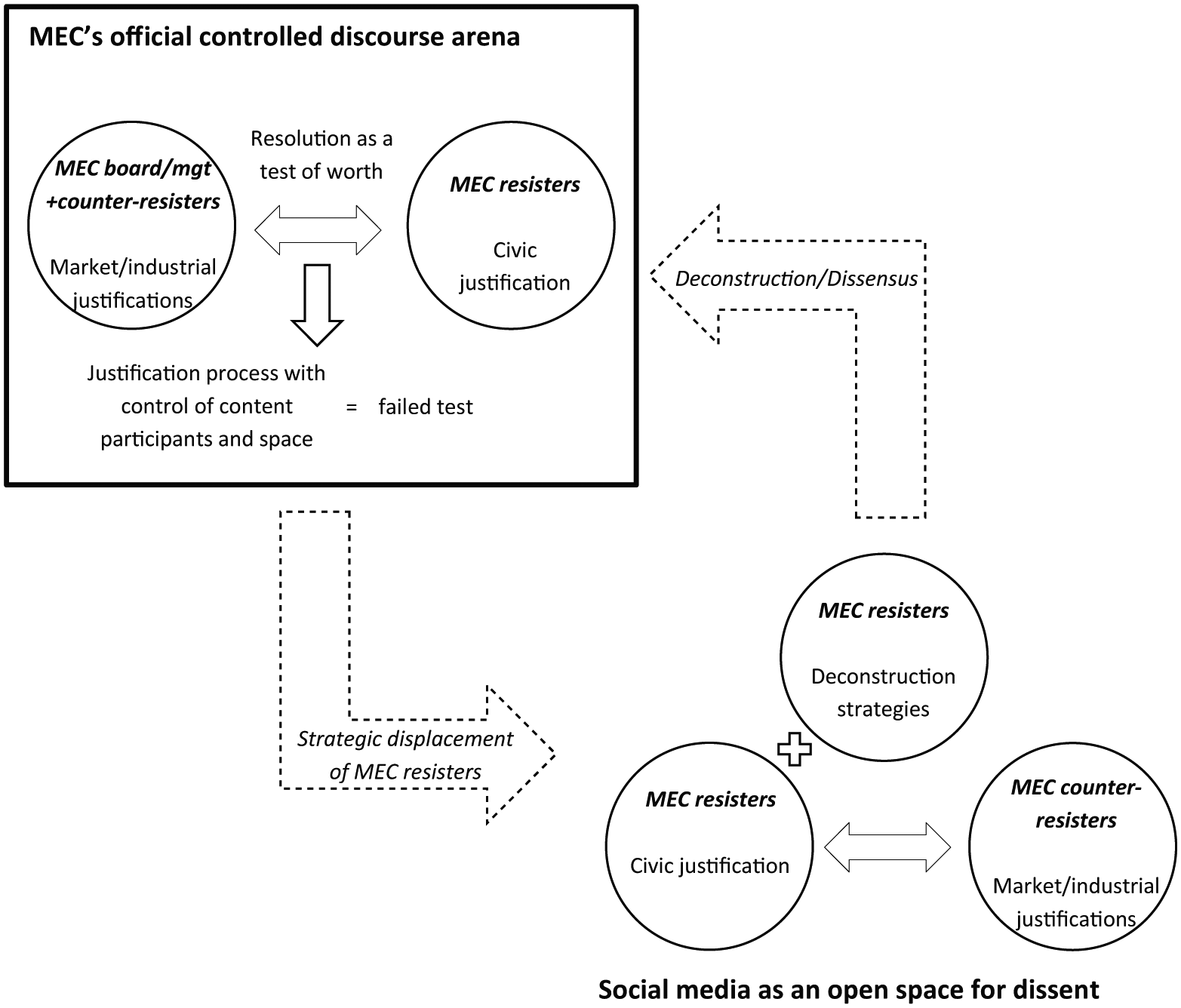
Spaces and stages of justification and deconstruction.
As Figure 2 shows, MEC’s official discourse was articulated using one-way justifications based on the market and industrial worlds; these justifications, according to members, permitted little (if any) debate. As the test of this justification process failed based on the hegemonic imposition of MEC’s discourse through the control of debate procedures, unsatisfied members deliberately moved to SM to voice alternative justifications (provoking further counter-resistance) and deconstruct the power in and over debate. While these spaces evolved in parallel, members participating in debates in the open space of SM helped to feed the official ‘democratic’ arena with new perspectives constructed at the margins.
‘Democratic’ justification process
Resisters fought to protect the civic world against democratic degeneration. In MEC, without the day-to-day conflict of a mobilized resistance against the ‘powers that be’ that characterizes consumer co-ops, the test of the civic world was limited to the vote. As such, MEC’s general assembly voting for/against the special resolution appeared as the ultimate test of worth. Support for the special resolution downplayed members’ power vis-à-vis the board, at least from an official, procedural democratic perspective.
Yet, given our attention to the power context in which justification work was performed, we must understand how the MEC board succeeded in changing the governance rules. According to our analysis, MEC ensured that the disruptive justifications of resisters, situated in displaced and disembodied resistance due to the nature of consumer co-ops, could not infiltrate its channels of communication (MEC’s website and official SM accounts, in particular) through controlling content and limiting participation in discussions (by members and even candidates). Furthermore, regarding alternative spaces for debate, responses to the resistance were not voiced by MEC: MEC was absent from the SM platforms mobilized by resisters (unless MEC in fact hid behind some counter-resisters, but we cannot verify this).
In other words, opposed justifications were expressed in separate arenas, and MEC’s control limited contact between them. Resisters actively occupied SM, by their own account, due to the obstacles to entering official channels. Conversely, MEC’s official discourse was reinforced in the latter and absent from non-traditional discussion spaces. Moreover, only MEC could reach out to its entire list of members (through ‘snail mail’, for instance) to explain why the special resolution needed support. This suggests that only a small proportion of the members had access to—or even knowledge of—resisters’ alternative discourse in the SM space and to opposite justifications (based on the democratic world) challenging MEC’s industrial- and market-world imperatives.
SM as a dissensus and deconstruction space
Despite the ‘successful’ hegemonic outcome (i.e. the adoption of the resolution) achieved in MEC’s official democratic arena, the alternative space occupied by resisters through strategic displacement from MEC’s official, controlled discursive arena was important. In the alternative SM space, members exploited some conditions of possibility to produce, transmit, and interpret different justifications of the consumer co-op’s democratic challenges. More striking, however, is how resisters progressed from EW justifications to a meta-discursive deconstruction and started to unveil hidden power structures that prevented them from accessing MEC’s official discourse, contacting members, conversing with candidates, and so on. Furthermore, they proposed that MEC uses SM as an open space for communication, but ultimately felt that MEC also tried to colonize this alternative space and limit their free expression even at the margins.
Nevertheless, it should be noted that while the co-op’s democratic arena was duly deconstructed in its conditions of possibility, SM itself as a discursive context was never really discussed by actors in our study. It seems that questions of power, while prominent in the organization, were taken for granted within the new technological context. Both resisters and counter-resisters, while identifying some interference of MEC’s representatives in the virtual space, failed to fully deconstruct the subtler forms of control behind the platforms and algorithms that supported their endeavor. SM thus seemed to be considered as a space of free expression.
In the next few paragraphs, we suggest some elements that may explain why dissensus—and, in particular, deconstruction strategies—were possible through these social technologies. The conditions of possibility for dissensus in SM have been largely discussed (and criticized) in the literature. Technology supporters suggest that the presence of multiple perspectives, accessibility for diverse (and often marginalized) groups, and open and unhindered expression creates a space where no discourses are barred (Loader and Mercea, 2011). However, while these elements explain diversity, they do not elucidate dissensus. We suggest that the justification is, in fact, expressed by SM detractors who lament SM’s lack of rational debate procedures that might structure arguments into coherent demands (Lutz and du Toit, 2014). In other words, the heavily criticized unstructured element of SM is what ultimately guarantees the lack of control by traditional democratic procedures.
Suggesting the conditions of possibility for the production of deconstruction strategies on SM, however, requires us to go beyond the literature on SM’s impact on democracy and to look at the idea of premise of equality proposed by Rancière (2006). This premise suggests that true democratic politics occur through active equality (May, 2008) when every individual demonstrates his or her capacity and willingness to have an equal political voice. Rancière (2006) claims that equality is a necessary founding principle of any emancipation project: According to Rancière, you are not subservient because you do not know the mechanisms of subservience. After all, knowing a situation and being able to ‘see through it’ may also be one way of taking part in it […] On the contrary, the possibility of emancipation arises from the fact of not knowing the sort of requirement that would otherwise compel you accept modes of workplace domination. (Huault et al., 2014: 30)
From this radical idea, we propose that SM for many of its participants follow this equality premise. The resisters’ use of blogs and social platforms shows their overall capacity and willingness to exploit these spaces to express their voice against the co-op’s representatives. Therefore, the possibility of deconstruction by resisters in our case comes from the inevitable comparison of the basic condition of ‘politics of dissensus’ inside the SM space to the control attempted during MEC’s official democratic proceedings. These elements were particularly evident when MEC’s management attempted colonization of SM by controlling virtual arenas, such as Facebook, when resisting actors immediately rebuked the attempted control over the platform where their free expression was supposedly guaranteed.
Rancière’s (2004, 2006, 2009) ideas help us make sense of a surprising feature of our study: the deconstruction strategies. Furthermore, the equality premise helps us to shed a different light on new social technologies. SM, in our case, go beyond a simple space of constructing dissensus and contesting dominant discourses to include the deconstruction of the ‘boundaries of what is considered legitimate public sphere communication’ (Dahlberg, 2011: 861).
Discussion
We have examined how some consumer-members tried to resist the democratic degeneration of their co-op using SM. Through a critically enriched (Fairclough and Wodak, 2000) EW framework (Boltanski and Thévenot, 1999), our analysis shows that, due to the limits of the justification debate inside MEC, SM first worked as an alternative space of dissensus in which members could express their own perspectives and challenge the official discourse of the co-op board and management. Surprisingly, members also used SM to go beyond the discursive realm-of-justification debate, actively deconstructing the meta-discursive power structure that limited the production, transmission, and interpretation of alternative justification discourses inside the organization. In other words, they created their own space of politics that not only remained beyond the control of the official co-op ‘democracy’ but actively critiqued its foundations.
Studying the MEC controversy offers three essential contributions. First, we contribute to the literature on co-ops and, more specifically, to the debate on democratic degeneration (Ashforth and Reingen, 2014; Briscoe, 1988; Cornforth, 1995; Hunt, 1992; Storey et al., 2014). This issue has been primarily investigated in the context of worker co-ops, but we suggest that the lack of embodied presence of members in consumer co-ops fosters different dynamics. Under these conditions, through procedural hegemony, MEC’s board could silence most dissenting voices regarding the proposed democratic governance changes. The MEC case sharply contrasts with the direct democracy put forward in the small workers’ co-op collectives studied by Kokkinidis (2015), where disagreement was not perceived as something to suppress or eliminate, ‘but rather as something that has to be embraced in creative ways so as to minimize the exclusion of members from the governance of the collectives’ (p. 867). Being largely absent from the localized spaces of contention inside the organization (Choi et al., 2014), very numerous but isolated from each other given the geographical distribution of MEC shops, and the fact that buying outdoor and mountaineering gear is not a daily nor collective activity, MEC consumer-members turned to alternative spaces open to disembodied discursive forms of resistance, such as SM. The displaced discursive practices of these co-ops demanded a new set of analytical tools.
Therefore, our proposed combination of EW and CDA brings forth a more power-sensitive vision of the justification process, where the failure of the civic test must be nuanced, as we were able to show that the actual dispositifs for debating and voting in the consumer co-op were not deployed in the ideal-type setting of the civic world. First, potential explanations for the end result include the problem of dictatorship of consensus where, in various chains of equivalence or displacement strategies (Laclau and Mouffe, 1985), MEC either incorporated dissenting voices into the new market needs of the co-op or excluded opposing voices by questioning the validity and legitimacy of their worlds. Second, from a CDA perspective (Van Dijk, 2003), the hegemony was cemented through the control of the debate procedures, as the co-op established when and where dissent could officially be voiced by resisters before any public dispute could happen: making it impossible for resisters to voice their opposite justifications to all fellow members, deploying censure on the co-op’s official channels, and encouraging members to cast votes electronically before the general assembly.
This democratic ‘failure’ brings us to our second contribution, centered on SM’s impact on democracy through the lens of Rancière (2004, 2006, 2009). In our article, we add to Laclau and Mouffe’s (1985) notion of hegemonic struggle, whereby the dominant discourse excludes alternative perspectives, by exploring challenges to the power of procedural forms of deliberative democracy controlled by the political elite and experts (Bevir, 2010). In that perspective, Rancière (2006) proclaims the importance of everyday politics in which the dictatorship of consensus is substituted for anarchic transgression in alternative spaces of officially imposed rules on who can speak, about what, and how.
Our case suggests that SM may be an alternative disembodied space of dissensus where people at the margins of the established democratic debate can voice their opinions in an open and diverse agora. Following the call by Huault et al. (2014) for a new view of emancipation based on Rancière’s (2009) ideas, we suggest that MEC resisters could break the distribution of the sensible, that is, who can say what regarding the co-op. By creating an alternative political space outside the traditional co-op ‘democratic’ structure, they ‘set the stage on which their arguments are audible, on which they are visible as speaking subjects’ (Rancière, 2009: 176).
The idea of disembodied resistance through strategic displacement, in our case, contributes to other theories of disembodied cognitive or discursive strategies (Brown and Humphreys, 2006; Fleming and Spicer, 2003), to studies of displacement (Gupta and Ferguson, 1997), and (more generally) the relationship between power and space (Taylor and Spicer, 2007), where powerful groups can move disenfranchised groups outside spaces of influence where their embodied presence is no longer a motor of resistance. Fraser (2005), for instance, identifies the act of limiting access to spheres of participation as one essential mechanism of political injustice. The basic assumption is that individuals are exiled into powerless locales where they cannot impact decision-making for long. However, our study highlights the possibility of a process of strategic displacement where the new space occupied by disadvantaged individuals is not disenfranchised, but instead enables them to exercise a different kind of power afforded by new virtual tools. We propose that SM can offer a space where disembodied resistance may still impact embodied places of power through the action of the ‘squawking horde’ (Rancière, 2006), amplified by the tool’s connective power (Ingram and Bar-Tura, 2014).
Therefore, the strategic displacement by members to the alternative SM space extends and feeds the hegemonic struggle perspective proposed by Laclau and Mouffe (1985). In essence, we suggest that in situations of near total hegemony where the dominant discourse controls the procedural rules of debate, disenfranchised actors move to the margins as a way of constructing new conditions of possibility. In turn, these novel perspectives or redistributions of the sensible (Rancière, 2004) will feed back into the central discursive arena and help bring a new balance to the hegemonic battle.
Our case of disembodied resistance, however, goes beyond Rancière’s proposal of redistributing the sensible to its actual deconstruction. Our third contribution is therefore to the literature on critical performativity. The debate about critical engagement with practice (Cabantous et al., 2016; Fournier and Grey, 2000; Spicer et al., 2009) highlights how scholars can ‘actively and subversively intervene in managerial discourses and practices’ (Spicer et al., 2009: 544). Authors have suggested different ways for researchers to engage with actors to help them transform their organizational conditions. This task, however, has usually been portrayed from an academic-centered perspective in which we ‘enlightened scholars’ are supposed to guide actors in their critical assessment and action. When critical production by actors is contemplated, it normally focuses on practical alternatives (Paranque and Willmott, 2014), but does not necessarily involve an engaged critical analysis of reality. The EW and CDA analytical grid of our case opens up the understudied alternative of actors as critical performers themselves who can engage in purposeful deconstruction of the reality (Spicer et al., 2009) to uncover their own conditions of oppression (Rancière, 2006).
In this task, we suggest that SM function as a ‘critical performative engine’ (Leca et al., 2014), offering a more accessible, diverse, and freer political space that stands in stark contrast to official democratic channels (Delli Carpini, 2000; Ingram and Bar-Tura, 2014; Loader and Mercea, 2011) and challenges representative democracy governance settings and their homogenization effects (Kokkinidis, 2015). Therefore, we argue that SM embody the conditions of possibility for a critical deconstruction of the power elements behind the democratic discourse and practice of MEC, our studied consumer co-op.
Conclusion
Consumer co-ops hold an important place in the history of the co-op movement. We believe that future studies should focus on their specific characteristics and on how to further engage consumers-members. While the size and geographical dispersion of MEC certainly pose challenges to democratic participatory practices, these are not insurmountable. Indeed, Chen’s (2016) recent research on Burning Man shows that expansion can fit with sustained participatory practices. While Burning Man is an extreme case of participation, the enactment of democracy is not limited to alternative organizations. ‘[D]emands for deeper participation are also evident in communities and cities, and the search for more involving and less bureaucratic structures has spread into many for-profit firms as well’ (Rothschild, 2016: 7), making MEC’s case of interest to a range of organizational scholars, not just those studying alternative organizations.
Our study does have some limitations, the central one relating to the corpus, as the analyzed texts were those made public and online, both by MEC and resisting consumer-members. Other sources—for example, interactions at general assemblies—may have shed a different light on this process. Concerning the generalization of our findings to other sites, we believe that our results must consider size and geographical distribution: the fact that MEC is a national consumer co-op selling specialized consumer goods (both in-store and online) to millions of members means the distance between consumer-members and the decision-making spaces is greater than in smaller alternative organizations.
In terms of practical implications, this case suggests that ‘organizational alternatives’ (Davis, 2016)—co-ops, nonprofits, employee-owned/partly controlled enterprises, and so on—should seize the potential offered by SM to sustain open dialog and debates (Couchman, 2017). In fact, by resisting and trying to control it, MEC tarnished its image as a democratic institution, possibly tainting further interactions with its members. 3 This raises the need for ‘more research on the catalysts and blockages to […] emancipatory potential’ and for the ‘follow-up study of former members to see how experience with democratic control processes shaped participants’ collective identity, and if so, then how it shaped their subsequent political framework and action’ (Rothschild, 2016: 27).
In line with this, our case opens up more general avenues for future research into the impact of SM on democratic practices. We suggest that further studies are needed to identify its emancipatory limits and potentialities as a space of dissensus, particularly with regard to organizational spaces of contention. Also, the impact of SM as a ‘critical performative engine’ (Leca et al., 2014) with an equality trigger (Huault et al., 2014) for deconstruction processes merits analysis in other alternative organizations. In essence, we do not believe that the performativity of deconstruction we observed is an isolated case; this heralds an interesting twist to the critical impact of resistance in and around civil society organizations.
Footnotes
Acknowledgements
We want to thank Carla-Ève Bourdeau for her assistance in data collection. We also would like to thank Damian O’Doherty and the anonymous reviewers for their challenging and stimulating comments on previous versions of the manuscript.
Authors’ note
Both authors contributed equally to this work.
Funding
The author(s) disclosed receipt of the following financial support for the research, authorship, and/or publication of this article: This research benefitted from the financial support of Université du Québec à Montréal (PAFARC Research start-up funds) and from the Fonds québécois de recherche – Société et culture (Research support for new academics, grant 2015-NP-179903).