




Abstract
As enterprises that are owned and governed by workers themselves for their mutual benefit, worker cooperatives are currently re-emerging as a promising antidote against precarity and economic dependence in the gig economy. Considering the social and geographic fragmentation of gig workers, it remains unclear whether cooperatives can count on the member commitment necessary to survive. This study investigates whether preference deviation and social disembeddedness stifle the commitment of gig workers to such cooperatives. A cross-sectional survey was used to gather data from members of four interconnected cooperatives in Italy that consist of gig workers in the cultural, ICT and education sectors (n = 425). The results show that members with more deviating preferences and less social embeddedness among fellow members have a lower commitment towards their cooperative. These findings demonstrate the conditions for gig workers’ commitment to cooperatives, being a key factor in cooperative longevity.
Introduction
Since the late 1970s, European labour markets experienced a sharp increase in flexible types of work that depart from the standard employment relationship (Kalleberg, 2000). ‘Gig work’ is only the latest iteration of this much longer trend, which concerns short-term services that are typically organised through labour market intermediaries (Koutsimpogiorgos et al., 2020). The gig economy is not limited to a particular sector, but ranges from low-skilled logistics jobs to knowledge and creative freelance work. Because they are commonly self-employed, gig workers fall outside the scope of traditional unions and labour laws in modern welfare states, while often also lacking the capability or desire of becoming full-flung entrepreneurs (Woodcock and Graham, 2020). This raises their risks of precarity and dependence on labour market intermediaries (Vallas and Schor, 2020). In other words: gig workers fall through the cracks of existing labour market institutions.
Recently, the search to fill this institutional void around gig work turned to the potential of worker cooperatives (Cheney et al., 2014; Eum, 2019; Schor, 2020). A worker cooperative is defined as a business enterprise that is collectively owned and democratically governed by its worker-members to serve their mutual benefit (Vieta et al., 2016). Applied to gig work, cooperatives might provide protections against precarity and operate as a shared enterprise in which individual economic activities can be pursued (Koene and Pichault, 2020). In particular, these cooperatives may offer members salaried employment with associated labour rights, while practically letting them continue to do their work as autonomously as independent freelancers (Bajard, 2020). How this works is that members obtain a non-permanent employment contract, which allows them to accept or decline gigs that clients request from the cooperative while also finding gigs outside of the cooperative. As such, these new worker cooperatives operate much like other labour market intermediaries but with the key difference being that collective ownership allows for organising protections against precarity and removing dependence on outside owners (Koene and Pichault, 2020).
To be viable and remain resilient, it is known that worker cooperatives require a high commitment for continued membership (Hidalgo-Fernández et al., 2020; Jussila et al., 2012a; Oliver, 1984). One reason for this is because in these organisations workers are not only contributing with their labour, but often also provide some capital input and have a role in decision-making (Vieta et al., 2016). In contrast to less institutionalised forms of collective action, worker cooperatives therefore demand a long-term commitment of members. Research also shows that having a lower commitment results in workers exiting their cooperative more often than using voice as a strategy to address grievances (Hoffmann, 2006). Worker cooperatives may incentivise their members through fulfilling material needs, but also by addressing idealistic or social motives (Rothschild-Whitt, 1979). Nevertheless, it remains unclear whether cooperatives can generate enough commitment among gig workers to survive. The apparent tension between gig work as highly individualist and cooperatives as highly collectivist requires attention in particular.
The fragmented nature of non-standard types of employment is typically regarded as an obstacle to collective action for two reasons (Kalleberg, 2000; Smith, 1998; Vereycken et al., 2021). First of all, gig workers engage in various jobs, work different hours, may fall under dissimilar legal regulations, and do not always intend to continue working in the gig economy, which makes it difficult to find shared interests with respect to working conditions. It is well recognised in the literature on cooperatives that such heterogeneity could undermine member commitment for individuals with preferences that deviate more from the collective choice (Belloc, 2017; Höhler and Kühl, 2018), but empirical research is still lacking. Secondly, gig workers also usually work on their own, geographically dispersed, and in competition with each other. This stands in stark contrast to the social embeddedness that is at least traditionally central to the functioning of cooperatives as member communities (Levi and Pellegrin-Rescia, 1997). Social embeddedness refers to the social relations between members as a form of social capital that functions as an important pillar for member commitment to worker cooperatives (Kanter, 1968). Both preference deviation and social disembeddedness reflect an unsatisfying socioeconomic relationship between individual members and the cooperative as a whole, thereby inciting members to re-evaluate their commitment to the cooperative. Our study thus sets out to answer the following research question:
To what extent do preference deviation and social disembeddedness negatively affect gig workers’ commitment as members of a cooperative?
The remainder of this article is structured as follows. The second section elaborates on member commitment as a challenge for cooperatives of gig workers, and hypothesises how preference deviation and social disembeddedness negatively affect commitment. Next, we report on the survey data collection as it was carried out within four interconnected cooperatives of gig workers, and set out our statistical models. The results support our expectations that worker-members with more deviating preferences and less social embeddedness have a lower commitment towards their cooperative. These findings are not only relevant to advance scholarship on the gig economy and worker cooperatives, but also have implications for policymakers looking to implement employee ownership and participation to increase security in flexible labour markets. We reflect on this in the concluding section.
Theory
Employee ownership and participation in decision-making increasingly gain attention in the literature for their anticipated favourable outcomes on both individual workers and organisational performance (O’Boyle et al., 2016; Weber et al., 2020). The reasoning is that more profits are then in some form returned to the workers or reinvested into the enterprise. This holds for worker cooperatives, but also for less extensive versions of employee ownership and participation such as employee stock ownership plans and work councils. Interest in ownership and participation by workers is also grouped under the concept of workplace democracy (Landemore and Ferreras, 2016), which is best reflected in worker cooperatives by the principle of ‘one member, one vote’. Nevertheless, the same literature demonstrates that workers’ attitudes and behaviour are not automatically affected by co-owning a firm or participating in its decision-making (Basterretxea and Storey, 2018). Instead, the anticipated effects on individual workers and organisational performance would depend on the workforce and its management (Meyers, 2011). It is therefore not possible to assume that member commitment to worker cooperatives is of a high level by default.
There are various perspectives on what commitment to an organisation means (Kanter, 1968; Meyer et al., 2002). In this article, we define member commitment as the desire for continued membership because of an emotional attachment and long-term dedication to the cooperative. Such affective commitment has been identified as the most important form of commitment to conventional firms for a wide range of performance indicators such as productivity and employee turnover (Meyer et al., 2002). This definition also most closely resembles the bond of devotion as expressed by Hirschman’s concept of loyalty, which relates to greater member participation in decision-making of worker cooperatives and lower indifference or exit (Hoffmann, 2006).
Preference deviation
The challenging nature of preference deviation for cooperatives of gig workers can be illustrated through the problem of collective choice (Dow and Skillman, 2007; Hansmann, 1996). Building on transaction cost theory (Williamson, 1980), this problem starts from the premise that any firm with multiple owners incurs costs to aggregate their preferences into organisational priorities. One type of costs is related to the decision-making process itself (Hansmann, 2012), such as the time and effort of negotiation between owners. The other type of costs originates from legitimacy problems in the resulting decision, since the preferences of a pivotal voter do not necessarily reflect those of the entire membership (Hart and Moore, 1996). In turn, the argument goes, both costs increase the more heterogeneous the preferences are among owners. The result of this is relatively higher costs for worker cooperatives than for conventional firms. That is because capital-suppliers have a shared interest in profit maximisation regardless of their background, while labour-suppliers have a plethora of different interests depending on their background (Dow, 2018). Naturally, preference heterogeneity occurs frequently in cooperative enterprises (Belloc, 2017; Höhler and Kühl, 2018) and common-pool resource management more generally (Van Klingeren and De Graaf, 2021). As such, the collective choice problem is often posited as an explanation for the relative rarity of worker cooperatives compared to conventional firms, especially in sectors with a heterogeneous workforce.
At the start of a cooperative’s lifecycle, however, the costs of collective choice would likely be lower when its membership is still small and relatively homogeneous. Some cooperatives even choose to stay small and homogeneous by design, or become active in sectors where these conditions are normal for businesses. Yet, the larger and more heterogeneous a membership becomes, the harder it will be to agree on the utility of working together in a cooperative (Benham and Keefer, 1991; Gupta, 2014). For example, younger workers might prioritise flexibility and learning opportunities while older workers attach more value to job security and protections against illness. Not all differences in background necessarily result in more heterogeneous preferences (Cook, 2018), but finding shared interests in a highly fragmented context such as the gig economy is expected to be more difficult (Dunn, 2020; Friedman, 2014; Smith, 1998). In other words, the costs of collective choice will likely put pressure on the viability of worker cooperatives in the gig economy.
In reality it may well be possible to reduce the costs of negotiation with good design of governance (Iliopoulos and Valentinov, 2017). However, worker-members whose preferences are inadequately reflected in the cooperative’s organisational priorities will likely still lose commitment (Apparao et al., 2019). Minimising negotiation costs, for example by leaving most decisions to an elected board, could also increase legitimacy costs if decisions more poorly reflect the preferences of the membership as a whole (Ng and Ng, 2009). Even mass involvement in decision-making may result in greater legitimacy costs if decisions are taken against the interests of a small number of highly successful members (Burdín, 2016). Whatever method of aggregating preferences into organisational priorities is adopted by a cooperative, some members’ preferences will deviate more than for others. Research on national elections similarly shows that the more voters’ positions deviate from actual policies, the lower is their satisfaction with the democratic system (Kim, 2009). This leads us to the following expectation:
H1: The more members’ preferences deviate from organisational priorities, the lower their commitment will be towards the cooperative of gig workers.
Social disembeddedness
Individual preferences are certainly an important motivator for cooperative members (Jussila et al., 2012b), but commitment might also originate from the will to work for and as part of a community (Rothschild-Whitt, 1979). Experimental research shows that a substantial share of people would still want to be a cooperative member, even when not being a member yields better monetary outcomes for them individually (Abraham et al., 2020). Next to their formal organisational structure, cooperatives need to be understood as communities based on social relations, trust and solidarity between members (Puusa et al., 2016). When absent or neglected, community itself can become a challenge for cooperatives.
The challenging nature of this community role for cooperatives of gig workers can best be explained through the notion of social embeddedness. Based on the work of Karl Polanyi, social embeddedness refers to the degree to which economic activity ‘is linked to or depends on action or institutions that are non-economic’ (Granovetter, 2005: 35). For example, working conditions are not only shaped by markets, but also by political choices, social relations and cultural norms. A gig worker is often less embedded than regular employees in two ways: isolation from other workers (Ashford et al., 2007) and commodification of labour (Wood et al., 2019). First, isolation refers not just to working alone instead of in a team, but also to geographical distance between gig workers who share no common work location. Algorithmic management, as applied by digital labour platforms, further restricts the opportunities for meaningful contact between gig workers (Heiland, 2021). Next, commodification occurs by labour market reforms that promote competition between gig workers (Greer, 2016). As competitors, they are less likely to mingle with their peers and become part of a collective (Wood et al., 2018).
Cooperatives are traditionally seen as highly embedded, because their activities are subordinate first to the members’ interests and only second to outside market forces (Dufays et al., 2020; Levi and Pellegrin-Rescia, 1997). Embeddedness in cooperatives is also based on the exchange of help and support between members via informal social ties as a distinct form of social capital (Jussila et al., 2012c). We expect that members who are socially embedded gain a ‘we-feeling’ that generates commitment to the cooperative (Kanter, 1968). If members lack social embeddedness, on the other hand, they will likely lose commitment as their emotional attachment to the cooperative is eroded (Puusa et al., 2016). Workers in a situation of social disembeddedness, which as we argued is the case for gig workers, will therefore more likely treat cooperative membership as purely instrumental and easily disposable. Cooperatives might try to counteract the disembeddedness of gig workers, and to the extent they succeed, we hypothesise:
H2: The more members are socially embedded, the higher their commitment will be towards the cooperative of gig workers.
Building on the notion of embeddedness, Zelizer (2012) suggests that social considerations are also actively weighed in economic relations. This means that if cooperatives of gig workers succeed in creating a vibrant community, their members will likely weigh not just their own preferences with respect to organisational priorities, but also those of other members (Puusa et al., 2016). Despite having deviating preferences, members who are more socially embedded then settle for a compromise without large legitimacy costs because they perceive it as a socially just distribution of organisational resources. It is therefore expected that social embeddedness compensates for preference deviation at least to some extent:
H3: Social embeddedness decreases the negative relationship between preference deviation and member commitment.
Context of the study
We tested our hypotheses on survey data from a network of cooperatives in Italy. The context of this study deserves special attention for three reasons. First, gig work is widespread in the Italian economy. Relatively late, but more so than other European countries, Italy reformed its labour market since the late 1990s/early 2000s in order to increase flexibility by removing regulatory constraints for non-standard employment (Berton and Richiardi, 2012). Unionisation declined from 50% to 35% between 1980 and 2010, which was not offset by an increasing union presence in the service sector or by traditional confederations creating new unions and self-help associations for non-standard workers (Regalia, 2012). In the aftermath of the 2008 financial crisis, a new Jobs Act was adopted by the Italian government that further increased atypical contracts and self-employment (Fana et al., 2016). In response to these institutional changes, new worker cooperatives and other alternative organisations were set up to provide gig workers with labour rights and a shared setting to pursue their individual economic activities (Mondon-Navazo et al., 2021).
Second, as Italy leads the world in numbers of worker cooperatives (Pérotin, 2013), suitable cases are more prevalent. Its cooperative movement has a long history and 7.4% of total employment in Italy can be found within cooperatives (Navarra, 2016). New forms, including cooperatives of gig workers, might take root more easily in this institutional context. A specific characteristic of Italian worker cooperatives is that most profits go in a collective fund that cannot be appropriated by members as residual claimants, but that is used for reinvestment in the firm (Navarra, 2016). How the fund is used is subject to collective decision-making and therefore to members’ preferences with respect to their work conditions. Recently, the reputation of worker cooperatives in Italy has become blemished by so-called ‘false cooperatives’ set up by employers as a legal shell to outsource labour while eluding legal compliance and taking advantage of favourable cooperative legislation (Iannuzzi and Sacchetto, 2020). At the same time, there is relatively strong institutional support for worker cooperatives in Italy as a policy strategy to save jobs during crisis and stimulate decent work conditions (Vieta, 2019).
Third, Italy was one of the hardest hit countries by the COVID-19 pandemic and the following socioeconomic crisis (Alesina and Giavazzi, 2020). Since data were collected during this period, we must take into account with regard to external validity that participants likely re-evaluated their cooperative membership, which made their responses (either positively or negatively) more pronounced. Two other cooperatives of gig workers that were asked to participate in this research declined because they feared it would put too much stress on their members during these circumstances. At the same time, new worker cooperatives could play a key role in economic recovery post-COVID-19 (Billiet et al., 2021), in particular by providing precarious gig workers with access to labour rights and economic opportunities.
Methodology
Data
To test our expectations about member commitment, we gathered cross-sectional survey data from an Italian network of four cooperatives that consists of gig workers in the cultural, ICT and education sectors. In contrast to cooperatives of single occupational groups sharing an office (e.g. dentists, lawyers) or social cooperatives that help unemployed people engage in entrepreneurship, these cooperatives of gig workers respond to the challenges of non-standard employment faced by diverse project-based service providers (Koene and Pichault, 2020). Some examples of members’ occupations include sound technicians, photographers, web developers and piano teachers. This unique case was selected because of its relatively large size, which is only matched by three other cooperatives of gig workers in Europe (Eum, 2019), so that we could collect a sufficiently sized sample of gig workers and observe potential detrimental effects of preference deviation. The network of worker cooperatives specialises in providing professionals a work environment that lets them autonomously develop their economic activities with shifting clients, while at the same time giving them access to labour rights through on-call or smart worker contracts. Each of the four cooperatives further organises specific services for their members such as training, administration and legal support. Members pay an annual contribution and a certain percentage on every transaction with a client via the cooperative. Clients gain access and are matched to gig workers by the cooperative functioning as a single supplier. While the network of four cooperatives has physical offices all over Italy, many of its activities are in fact organised through a digital platform. This includes the services to members, member participation in cooperative decision-making, and matchmaking between worker-members and their clients. For that reason, it also self-describes as a platform cooperative (Scholz and Schneider, 2016). Next to these shared physical and digital infrastructures, each of the four cooperatives has an annual general assembly as its sovereign body that operates under the principle of one-member one-vote to decide on important matters and elects a board of directors to carry out daily management.
Our contact person in the cooperatives provided useful feedback to make sure that survey questions would fit the particular setting. Our data collection was then approved by the ethics review board of the first author’s university in December 2020. The survey was distributed among members of the cooperatives through an online questionnaire, which was made available in Italian and English. As a non-monetary incentive, some items on the questionnaire were used to display a work preference profile at full completion that, resembling the outcome of a personality quiz, provides insight into what they find most important in the workplace. Of the total membership, far fewer are actively working through their cooperative. Partly this can be explained by the irregular nature of gig work, especially in the cultural sector, but there also seems to be a significant share of ghost-members. Between late January and mid-March 2021, n = 643 members responded to the questionnaire. This corresponds to a response rate of approximately 7.5% of total membership and 71.8% if only considering active members. The final sample of usable and completed responses consisted of n = 425, distributed over the four cooperatives as follows:
XL cooperative = 6861 total members (active in past months: 448), with n = 304
L cooperative = 1085 total members (active in past months: 367), with n = 56
M cooperative = 507 total members (active in past months: 78), with n = 55
S cooperative = 68 total members (active in past months: 2), with n = 10
Measures
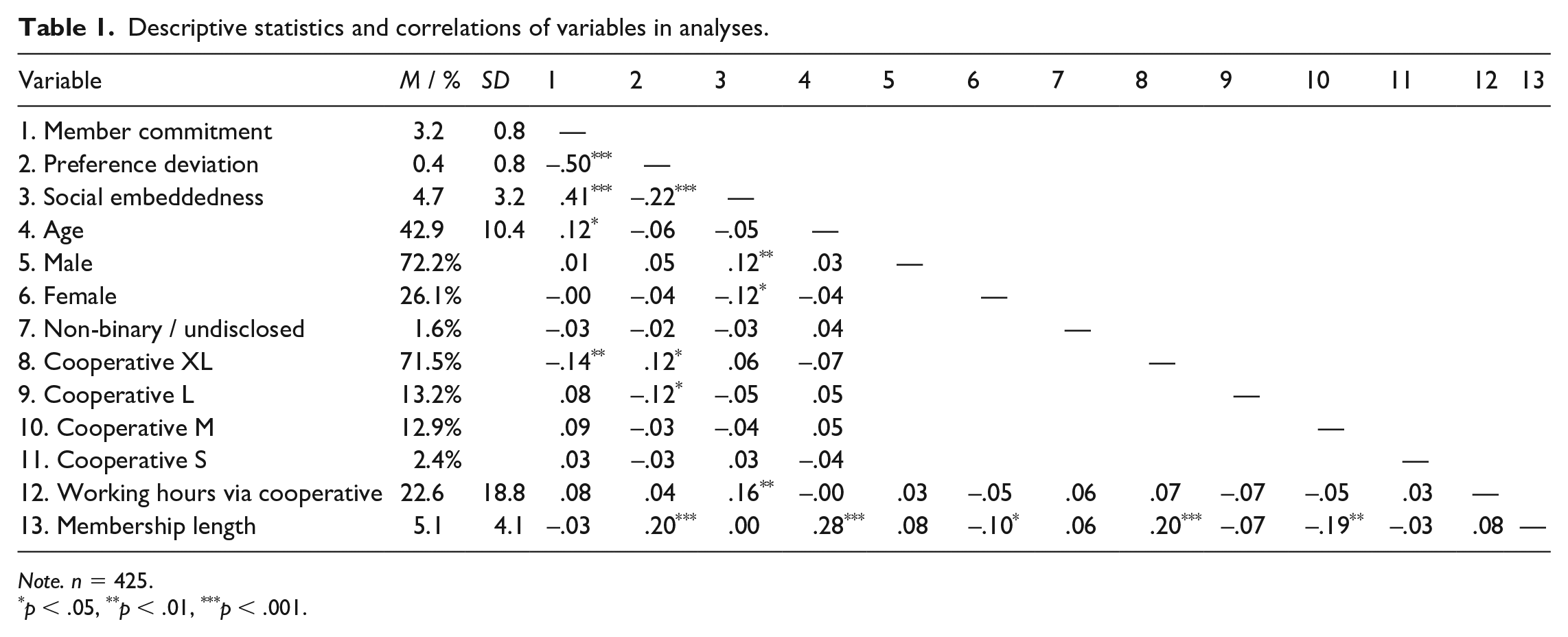
Our dependent variable member commitment was operationalised using the eight-item Affective Commitment Scale of Allen and Meyer (1990), but rephrased to cooperatives. An example of an item is ‘I would be happy to spend the rest of my career with my cooperative’ (see online Appendix for a detailed list of all items). Five-point Likert scales were used to measure participants’ agreement with the statements (1 = totally disagree, 5 = totally agree), and the reliability of these items was high (Cronbach’s α = .88). Benchmarked against affective commitment among employees of regular Italian firms (M = 3.17, SD = 0.85) (Odoardi et al., 2019), the average commitment in our study of gig workers as cooperative members was slightly higher (M = 3.20, SD = 0.80) (see Table 1). However, it is lower compared to the commitment among employees of cooperatives in a recent Ecuadorian study (M = 3.89, SD = 0.47) (Hidalgo-Fernández et al., 2020).
Descriptive statistics and correlations of variables in analyses.
Note. n = 425.
p < .05, **p < .01, ***p < .001.
The first independent variable, preference deviation, was measured by calculating discrepancy scores between individual preferences and organisational priorities concerning work conditions. Respondents were first asked to rate on a five-point Likert scale how important a list of 13 items was to them with regard to work (1 = not at all important, 5 = extremely important), and second to what extent their cooperative provides them with each of these 13 items (1 = strongly disagree, 5 = strongly agree). The items were selected based on their relevance to this study from Ros et al. (1999) and Lyons (2003). We then calculated the discrepancy scores by subtracting organisational priorities from individual work preferences (Cennamo and Gardner, 2008), so that a positive difference reflects under-provision on member preferences and a negative difference indicates over-provision. For our main analyses, we took the mean over these discrepancy scores as a formative construct. On average there is a small positive difference (M = 0.40, SD = 0.76), which implies that preferences more often deviated from organisational priorities in a way that reflects under-provision than over-provision. Additionally, we conducted an exploratory factor analysis on the underlying work preference dimensions and used the resulting factors to further disentangle the effect of preference deviation on extrinsic, prestige, social and intrinsic work preferences.
Social embeddedness was measured as a form of social capital among members through a resource generator instrument (Van Der Gaag and Snijders, 2005). We asked respondents if they knew another worker who could give them access to 11 work and organisation related resources (see online Appendix for a detailed list), and counted those resources for which they indicated there was another member of their cooperative who would do so. These 11 items were adjusted from Van Der Gaag et al. (2010) to the specific target group of gig workers, for example someone ‘who can take over some of your tasks temporarily’ or ‘with whom you can informally chat about what is currently happening in the cooperative’. Participants reported on average close to 5 out of 11 resources that a fellow member could provide them with (M = 4.65, SD = 3.25).
Control variables included age (in years) and gender (male, female and non-binary/undisclosed) as demographic characteristics. We also controlled for three membership properties: cooperative size, working hours via cooperative and membership length. Categorising the four cooperatives by size allowed us to distinguish whether participants were member of the smallest (S), medium (M), large (L) or very large (XL) cooperative. Working hours via the cooperative were measured per week and membership length was measured in years.
Analytic approach
First, we report the correlation matrix including bivariate and point-biserial correlation coefficients. To analyse the independent effects, we estimated ordinary least square (OLS) regression models since all Gauss–Markov assumptions were satisfied. After the main analyses, we conducted an exploratory factor analysis on the items in our preference deviation scale to distinguish between deviating preferences on extrinsic, prestige, social and intrinsic work preferences. The extracted factor scores were used in a final regression model to analyse which types of preference deviation matter most for explaining member commitment.
Results
Table 1 presents the descriptive statistics and correlation matrix. As expected, we find a relatively strong negative correlation between preference deviation and member commitment (r = –.50, p < .001), and a moderate positive correlation between social embeddedness and member commitment (r = .41, p < .001). A few other significant correlations are interesting to point out. For example, participants with more deviating preferences are also less socially embedded (r = –.22). Older members report a higher member commitment than younger members (r = .12). We also find that men are more socially embedded among fellow members (rpb = .12). Members of the XL cooperative experience a lower commitment (rpb = –.14) and more deviating preferences (rpb = .12) than members of the smaller cooperatives. In addition, members with more working hours via the cooperative are more socially embedded (r = .16), whereas respondents with a longer membership tenure report more deviating preferences (r = .20).
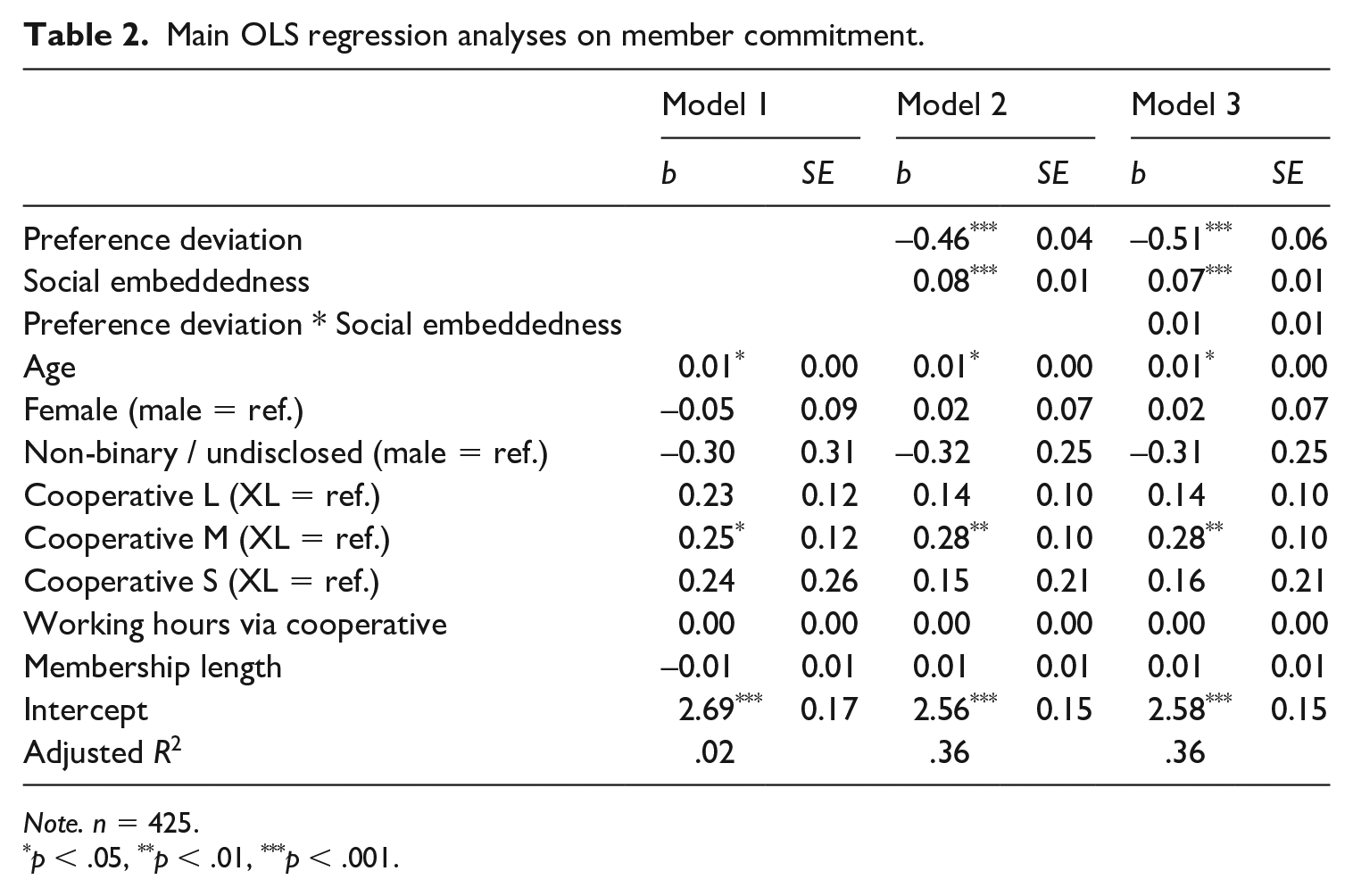
To test our hypotheses, we estimate three OLS regression models on member commitment (see Table 2). Model 1 only includes the control variables, which explains just 2.5% of the variance in member commitment: F(8, 416) = 2.35, p = .017. Model 2 adds the independent variables, which increases the explained variance up to 36.2%: F(10, 414) = 25.09, p < .001. We find a significant negative effect of preference deviation on member commitment (b = –0.46, p < .001), thus supporting H1. This means that, keeping all else constant, members with an average preference deviation of 1 (implying under-provision) have a 0.46 lower commitment towards their cooperative on a five-point scale. H2 is also supported, since social embeddedness has a significant positive effect on member commitment (b
Main OLS regression analyses on member commitment.
Note. n = 425.
p < .05, **p < .01, ***p < .001.
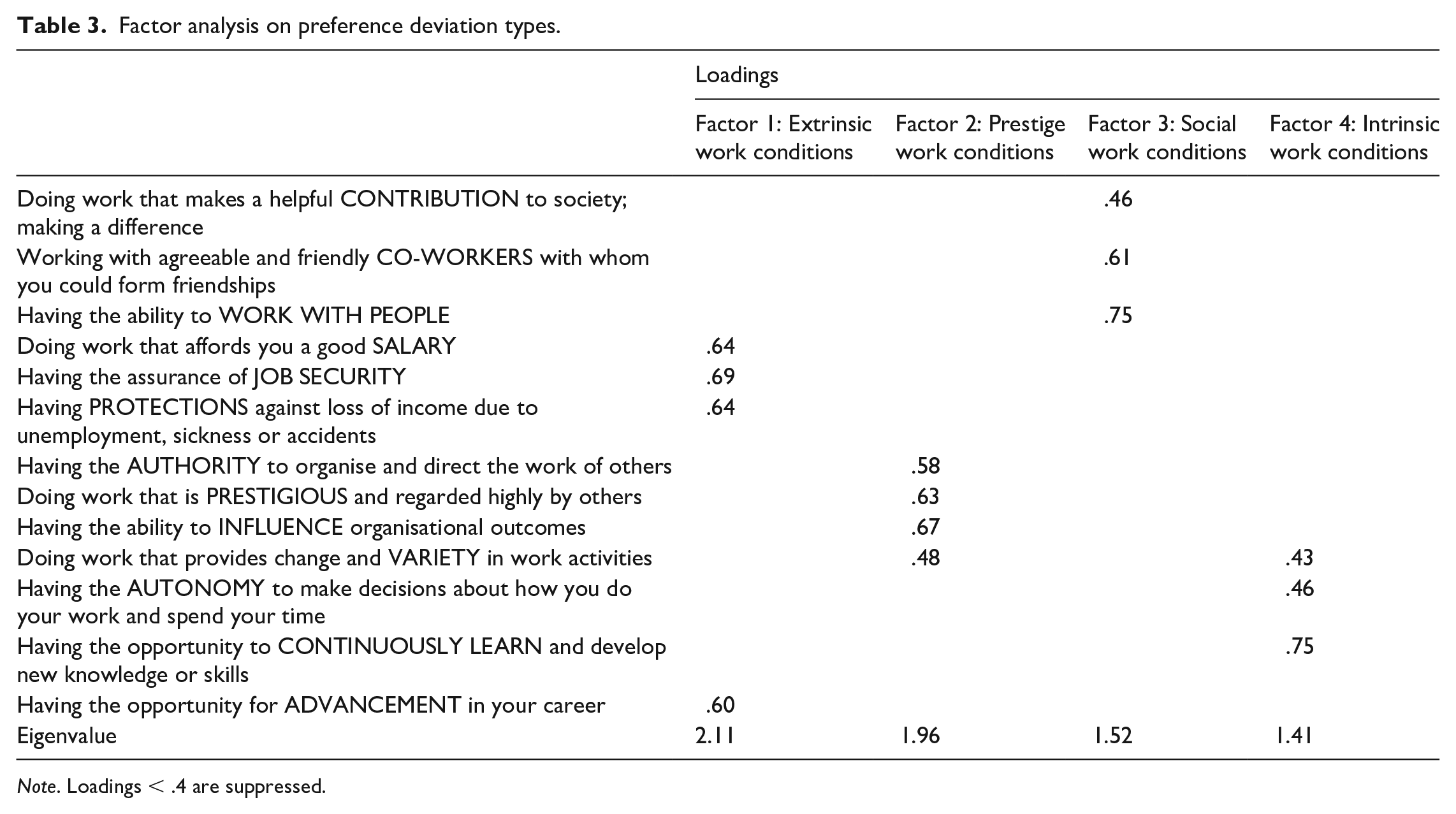
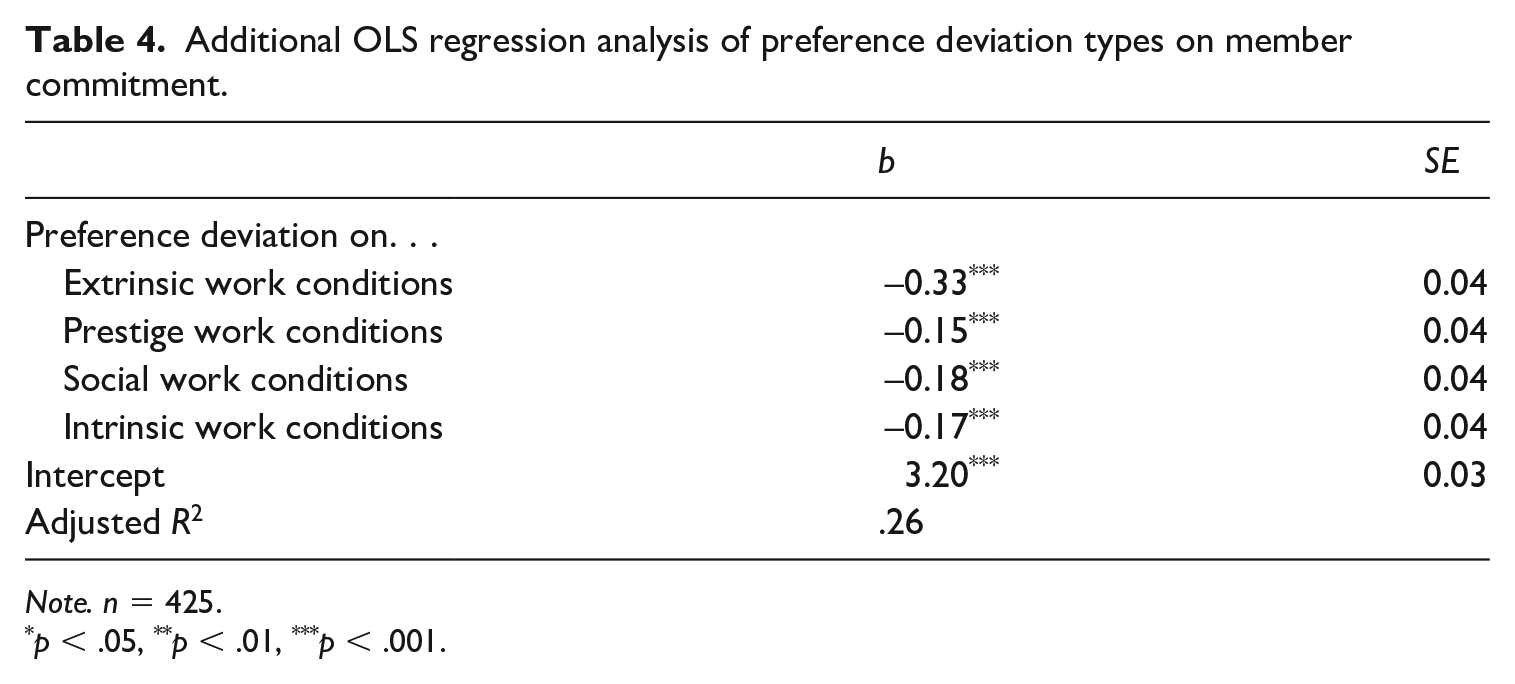
To decompose the effect of preference deviation, we use an exploratory factor analysis with maximum likelihood estimator and varimax rotation on its underlying items. We find a four-factor solution gives the best fit and represents deviating preferences on extrinsic (Cronbach’s α = .82), prestige (Cronbach’s α = .75), social (Cronbach’s α = .73) and intrinsic (Cronbach’s α = .74) work preferences (see Table 3). One item loaded slightly higher on the prestige factor than the intuitively more logical intrinsic factor. Yet overall the four factors were clearly interpretable. Table 4 presents an additional regression model with the four extracted factor scores as predictors of member commitment. This model explains 26.3% of the variance in member commitment: F(4, 420) = 38.80, p < .001. Considering that factor scores are standardised, we find that deviating preferences on extrinsic work conditions have by far the largest negative effect on member commitment (b
Factor analysis on preference deviation types.
Note. Loadings < .4 are suppressed.
Additional OLS regression analysis of preference deviation types on member commitment.
Note. n = 425.
p < .05, **p < .01, ***p < .001.
Conclusions and discussion
Coming back to our research question, that is whether deviating preferences and social disembeddedness negatively affect gig workers’ commitment as members of a cooperative, the findings show that members with more deviating preferences and less social embeddedness among fellow members do in fact have a lower commitment towards their cooperative. However, in contrast to what was expected, social embeddedness did not compensate for the negative influence of deviating preferences on member commitment. The analyses also demonstrated that preference deviation from organisational priorities matters most on extrinsic work conditions for explaining member commitment. Taken together, our findings shed light on the challenges of creating resilient worker cooperatives in the gig economy.
In line with literature on the collective choice problem in worker cooperatives (Dow and Skillman, 2007; Hansmann, 1996), the current study finds that if a member’s preferences deviate more from perceived organisational priorities, their commitment towards the cooperative is lower. This means that in a context of high preference heterogeneity, as is the case for the gig economy (Dunn, 2020), the legitimacy costs of aggregating all members’ preferences to a satisfactory whole will be quite substantial for worker cooperatives (Belloc, 2017; Hart and Moore, 1996). The analyses also showed that preference deviation is a more prominent problem in the largest of the four cooperatives in our study, which supports the idea of a cooperative lifecycle with different challenges at each stage of growth (Cook, 2018). Interestingly, although we had no prior expectations on this, additional analyses showed that deviating preferences matter most for member commitment concerning extrinsic work conditions. This could reflect an instrumental motivation of gig workers for organising in a worker cooperative, especially for professionals in individually-oriented and competitive sectors, or that basic material needs are simply most pressing for workers in general. The economic crisis during the COVID-19 pandemic might also have elevated the importance of this type of motivation as many gig workers (especially in the cultural sector) could not generate an income from work and thus had greater needs in this area. Further research is needed to determine what motivators are the most important for gig workers as members of a cooperative.
Our finding that members with more social embeddedness among fellow members also have higher levels of commitment towards their cooperative, supports the notion that members who are socially embedded gain a ‘we-feeling’ that generates commitment to the cooperative (Kanter, 1968). When workers are less embedded because of isolation and competition, as can be assumed for many gig workers, they will find it relatively difficult or even unnecessary to form an emotional attachment to the cooperative (Puusa et al., 2016). While social embeddedness in the member community helps to form a commitment to the cooperative, we do not find evidence that social embeddedness negates the negative impact of preference deviation on member commitment. Social considerations about the preferences of other members do not make up for a difference between individual preferences and organisational priorities (Zelizer, 2012). A limitation of this study is that we cannot establish causality empirically, which means that the effect of social embeddedness could be due to selection processes: more committed members likely also become more socially embedded as they meet peers via their involvement in the cooperative. Future research could further disentangle the direction of this association, or whether we are dealing with a two-way relation, through longitudinal analysis.
At first sight, our research results seem to paint a rather bleak picture for worker cooperatives in the gig economy, given that we know deviating preferences and social disembeddedness are more likely to occur among gig workers than regular employees. Yet the average level of member commitment in the studied cooperatives is similar to the commitment of employees in regular Italian firms (Odoardi et al., 2019), and somewhat lower than the commitment among employees in a study of cooperatives in Ecuador (Hidalgo-Fernández et al., 2020). Still, the least committed members likely did not respond to our survey at all. If that is the case, we missed responses of the least committed members and overrepresented the more committed members. Considering this selection bias, reality is likely even more pessimistic than our results suggest. Despite in-depth qualitative research on the subject (Sobering, 2021), there is currently a lack of statistics on worker cooperatives that go beyond simple efficiency measures, making it difficult to evaluate when member commitment becomes too low. Further research is needed that compares new worker cooperatives in the gig economy with more traditional worker cooperatives. Especially of interest is the tipping point at which member commitment becomes ‘too low’ and thus results in an indifferent or even declining membership (Hoffmann, 2006).
Worker cooperatives are increasingly suggested as a remedy for problems with precarity and economic dependence that plague the gig economy (Cheney et al., 2014; Eum, 2019; Schor, 2020). Nevertheless, the current study shows that the cards are stacked against these worker cooperatives and it takes more than just a different ownership and governance structure of labour market intermediaries to gain commitment of gig workers. We can derive a few practical implications. The ability of worker cooperatives to address problems in non-standard forms of employment should not be overestimated: on their own, they are unlikely to fill the void left by retreating welfare states and declining unions. Still, these worker cooperatives strengthen the position of gig workers who otherwise fall through the cracks of existing labour market institutions. One way to limit problems of preference deviation could be stricter selection processes, membership criteria, or restriction to one or a few similar occupations. Another option could be to create a federation of worker cooperatives in the gig economy, with a maximum membership size and more homogeneous preferences in each individual cooperative. Gig workers in low-skilled, local tasks like food delivery or ride hailing might be more socially embedded than the more entrepreneurial professionals surveyed in this research. This calls for further investigation of worker cooperatives in different sectors of the gig economy.
Supplemental Material
sj-pdf-1-eid-10.1177_0143831X221101425 – Supplemental material for Commitment issues? Analysing the effect of preference deviation and social embeddedness on member commitment to worker cooperatives in the gig economy
Supplemental material, sj-pdf-1-eid-10.1177_0143831X221101425 for Commitment issues? Analysing the effect of preference deviation and social embeddedness on member commitment to worker cooperatives in the gig economy by Damion Jonathan Bunders and Agnes Akkerman in Economic and Industrial Democracy
Supplemental Material
sj-pdf-2-eid-10.1177_0143831X221101425 – Supplemental material for Commitment issues? Analysing the effect of preference deviation and social embeddedness on member commitment to worker cooperatives in the gig economy
Supplemental material, sj-pdf-2-eid-10.1177_0143831X221101425 for Commitment issues? Analysing the effect of preference deviation and social embeddedness on member commitment to worker cooperatives in the gig economy by Damion Jonathan Bunders and Agnes Akkerman in Economic and Industrial Democracy
Footnotes
Acknowledgements
The authors are also thankful to the network of four cooperatives and their members who participated in this research, as well as to the anonymous reviewers.
Declaration of conflicting interests
The authors declared no potential conflicts of interest with respect to the research, authorship, and/or publication of this article.
Funding
This study is part of the research programme ‘Sustainable Cooperation – Roadmaps to Resilient Societies’ (SCOOP). The authors are grateful to the Netherlands Organisation for Scientific Research (NWO) and the Dutch Ministry of Education, Culture and Science (OCW) for generously funding this research in the context of its 2017 Gravitation Programme (grant number 024.003.025).

Supplemental material
Supplemental material for this article is available online.
Author biographies
References
Supplementary Material
Please find the following supplemental material available below.
For Open Access articles published under a Creative Commons License, all supplemental material carries the same license as the article it is associated with.
For non-Open Access articles published, all supplemental material carries a non-exclusive license, and permission requests for re-use of supplemental material or any part of supplemental material shall be sent directly to the copyright owner as specified in the copyright notice associated with the article.
