




Abstract
Moral disputes regarding consumption issues are increasingly mediated by social media platforms. Nevertheless, there is a lack of research explaining how social media platforms shape consumer morality. Thus, this article combines large-scale quantitative text analysis with qualitative methods to explain the construction of moral discourses concerning guns on YouTube and Twitter among Brazilian users. We contribute to theory on consumer morality by proposing the Process of Morality Formation on Social Media Platforms, which explains how moral discourses are fueled by social actors displaying and commenting about news pieces and political events; how the expressive and connective affordances of social media platforms mediate the dynamics of moral discourses; and how social actors differently appropriate content, frame and justify their public positions by adopting different “worlds of justification” (Boltanski and Thévenot 2006). The implications of this work for marketing and society are discussed, and government and corporate initiatives are suggested.
Introduction
“Today, I will recommend two models of guns for home protection…following the new gun decree of President Bolsonaro, which aims to guarantee everyone's right to have firearms for self-protection…since in Brazil there is this bullshit of restricted calibers, I will refer to the allowed guns…a 12-caliber semiautomatic shotgun and a semiautomatic pistol, which would be my choice too, but I prefer a weapon with a manual recharge, a pump-action shotgun.”
This is an excerpt from the transcription of a video of a social media influencer (SMI), a Brazilian YouTuber specializing in the topic of guns. In this video, the SMI reviews two gun models for home protection. In addition to the technical elements, i.e., the usability, the pros and cons of each model, and the context of self-protection during a home invasion, the YouTuber also criticizes the legal restrictions imposed by the Brazilian government, which limit Brazilians’ access to guns. The most common comments on this video are not technical testimonies on gun matters but exaltations of the moral correctness of an armed man, moral disputes with opponents to the liberalization of gun access in Brazil, and moral criticisms of the Brazilian government, e.g., “the only force that can stop a malicious armed man is a good-intentioned armed man,” “when will this bullshit of caliber restriction end in Brazil?,” and “left-wing gun-control bastards!!”. In other words, such consumer discourses about guns on YouTube are essentially moral discourses—they are “related to evaluations of actions, actors, norms, and practices as right or wrong, good or bad, desirable or undesirable” (Shadnam, Bykov, and Prasad 2021, p. 201).
Moralizing consumption “is itself a phenomenon worth of study” (Wilk 2001, p. 245), as consumption phenomena quite often raise issues of fairness, justice, and the common good (Wilk 2001). Consumer morality comprises the norms, values, and beliefs involved in the judgment of the right course of action in consumption-related situations (Hunt and Vitell 2006). Consumer morality is shaped by institutions and cultural and media discourses, which affect whether markets (e.g., cannabis-based products), companies (e.g., Airbnb), and practices (e.g., gambling) are considered legitimate or not (Coffin and Egan–Wyer 2022; Fitzmaurice et al. 2020; Hitlin and Vaisey 2013; Humphreys 2010). Building on the sociology and consumer research literature, we label this first perspective the “top-down” morality formation dynamic.
Of course, consumers also shape morality within markets “from below” (Barbe and Hussler 2019), especially in the context of social media platforms, where consumers invent and discover new ways “to share knowledge with electronic speed” (Levy and Luedicke 2013, p. 61). However, research suggests that consumers’ moral stances and disputes are also mediated and structured by social media platforms and their “affordances”, which are defined here as the mutuality of technology capacities and their potential for action and individuals’ intentions and uses of such technologies (Schrock 2015). Although the crucial role of social media platforms in the formation of public opinion has been widely discussed across disciplines (Barisione, Michailidou, and Airoldi 2019; Jost et al. 2018; Papacharissi 2015) and social media platforms has been increasingly studied in connection with morality and consumption (Napoli and Ouschan 2020; Rauf 2021), there is still a lack of research shedding light on how the combined influences of different social media platforms’ affordances and social actors’ creative capacities collectively shape consumer morality and affect market issues. To bridge this gap, we explore how social media influencers and their consumer audiences on Twitter and YouTube collectively produce moral discourses about gun ownership. More specifically, we investigate a) how consumer morality is discursively deployed on social media platforms and b) how social media platforms’ distinct affordances differently affect the presentation of moral justifications.
We rely on Boltanski and Thévenot’s (2006) work on justification to interpret the plurality of online moral discourses regarding guns. According to this theoretical perspective, which is associated with French pragmatic sociology (Jagd 2011), morality is understood as grounded in social actors’ capacity to justify their position in situations of dispute, i.e., on discussions about controversial market issues on social media platforms. Boltanski and Thévenot’s (2006) ideas are useful for this work since they provide a framework for understanding morality formation as a situational justification game, in contrast to the top-down perspective in which morality is largely influenced by institutions and wide schemes and norms (Coskuner-Balli, Pehlivan, and Hughes 2021; Giesler and Veresiu 2014). Boltanski and Thévenot’s (2006) work has recently been employed in numerous studies investigating moral issues in the field of business (e.g., Barbe and Hussler 2019; Finch, Geiger, and Harkness 2017; Forssell and Lankoski 2018; Giulianotti and Langseth 2016), but it remains underused in research investigating the morality of consumers, especially in the context of social media platforms.
This paper combines large-scale quantitative text analysis and qualitative methods to map the social construction of moral discourses concerning guns on YouTube and Twitter in Brazil. This cross-platform and mixed-method investigation aims to illuminate how lay consumers as well as journalists, politicians, and social media influencers – e.g., the YouTuber in the above example – collectively justify the right to own guns in the Brazilian market, a market that is still characterized by rigid limitations on gun purchase.
By purposefully considering a period of legislative debates on gun deregulation, we also highlight how social media platforms’ affordances can affect consumers’ negotiation and adoption of moral repertoires. If consumers’ moral expressions differ significantly from one social media platform to another, then we can hypothesize that platforms’ specific affordances affect morality formation differently and that these differences need to be explained.
Guns are a quintessential contested market, “one where the legal, cultural, and moral legitimacy […] are in flux and in tension” (Coskuner-Balli, Pehlivan, and Hughes 2021, p. 663). The proliferation of guns among civilians is a societal problem (Witkowski 2020) since even when the main purpose for possessing guns is self-defense, gun ownership may lead to unintended, often fatal consequences, increasing criminal and domestic violence (Donohue, Aneja, and Weber 2019). Keeping and carrying guns introduces risks for gun owners and others (Barnhart et al. 2018), increasing the chances of “suicide, accidental injury, and violence toward women,” as a “preponderance of scientific evidence indicates” (Witkowski 2022, p. 185). Therefore, understanding how moral values concerning guns are socially constructed allows us to explore consumer morality “at the crossroad between the market and society” (Blanchet and Depeyre 2016, p. 44); however, there is a lack of studies examining the ways in which consumers are socialized to guns through social media platforms. For instance, while Shapira and Simon (2018) investigated the role of learned mental schemes in the formation of moral values concerning guns, their work did not consider the potential impact of social media platforms and their communicative dynamics, including the ongoing online interactions between gun enthusiasts and critics enabled by these platforms (Huff and Barnhart 2018) and the dynamics of moral justification that may follow from these interactions. Hence, in this study, we explain the formation of consumer morality in the gun market as a process that is a) fueled by news pieces and political facts; b) mediated by social media platforms’ expressive and connective affordances; and c) framed, appropriated and justified by social actors in digitally situated discursive justifications (Boltanski and Thévenot 2006).
This article is structured as follows: First, we review the literature on morality formation dynamics and present Boltanski and Thévenot’s (2006) ideas about justification and moral disputes, followed by a description of how social media platforms affect debates on moral issues. Second, we describe our research context. Third, we present our methods and data. Fourth, we present our findings, proposing that the formation of consumer morality on social media platforms is a process involving top-down and bottom-up dynamics, and describe how platforms’ affordances affect such dynamics. Finally, we discuss the societal and market implications of morality formation on social media platforms, the theoretical contributions of the article, and conclude by presenting our limitations and some directions for future research.
Theoretical Background
Theorizing Morality Formation: “Top-Down” and “Bottom-up” Dynamics
In both psychology and sociology traditions, morality and moral systems have been traditionally conceptualized as a structuring force on individual and group behavior. Durkheim argued that morality reflects the organization of society (Hitlin and Vaisey 2013) and Max Weber “saw moral (‘value-rational’) action as a vital force in social life” (Hitlin and Vaisey 2010, p. 3) that individuals internalize as norms that guide their behavior. Such theoretical understandings of morality as “society-wide schemes and norms” (Dubreuil, Dion, and Borraz 2023, p. 676) that constrain the subject to existing institutional moral norms and social systems have recently been criticized in sociology research for being excessively functionalist and “nearly synonymous with conformity” (Hitlin and Vaisey 2013, p. 53; Shadnam, Bykov, and Prasad 2021). Following other researchers from consumer studies (Caruana, Glozer, and Eckhardt 2020; Dubreuil, Dion, and Borraz 2023), we call this perspective the “top-down” dynamic of morality formation.
Contemporary approaches to morality formation in sociology, which have been developed in multiple traditions, have tended to focus on group dynamics, with morality belonging “more to cross-cutting groups and less to society as a whole” (Hitlin and Vaisey 2013, p. 53), ultimately considering morality in terms of negotiable symbolic boundaries—e.g., the work of Lamont (1992) on socioeconomic, moral, and cultural accounts of personal worth—and situated practices—e.g., the work of Boltanski and Thévenot (2006) that theorizes how people rely upon different “worlds of justification” to argue and justify their actions. Following other researchers from sociology and consumer studies (Caruana, Glozer, and Eckhardt 2020; Dubreuil, Dion, and Borraz 2023; Rosa 2022), we call this perspective the “bottom-up” dynamic of morality formation. From this perspective, the role of culture in driving action is limited to imposing constraints via the available repertoires that are used to “make sense” ex post of one's preferred behavior and choices (Vaisey 2009, p. 1680). Additionally, from this perspective, consumer moral values and ideas exist at many different levels, and they can “bind groups together” but also “be the subject of negotiation, contestation and exclusion” (Hitlin and Vaisey 2013, p. 53–54). We propose that consumer morality on social media platforms should be studied with consideration of both top-down and bottom-up dynamics, given the structuring role of technology (as we explain in the next section) but also the conflicting moral debates among heterogeneous groups that revolve around market issues (Hitlin and Vaisey 2013).
From a top-down perspective, morality is largely influenced by institutions and wide schemes and norms. In business and consumer studies, this perspective can be illustrated through the creation of “responsible consumers” as a product of institutional forces and a market structure that transforms individual morality (Giesler and Veresiu 2014). The morality of the responsible consumer is therefore a consequence of the moralistic governance regime of neoliberal institutions, such as the World Economic Forum and global corporations, which portray the consumer as the locus of the solutions to complex social problems. Similarly, Humphreys (2010) and Coskuner-Balli, Pehlivan, and Hughes (2021) highlight how market actors’ strategic practices may influence moral, cognitive, and legal legitimacy in the casino and legal cannabis markets in the United States. Another example is institutional actors in the forest industry and environmental activists, who observe public sentiment and act accordingly to morally “succeed in the game of argumentation” (Joutsenvirta 2011, p. 58). Finally, Barnhart, Huff, and Scott (2023) explain how moral appraisals of the use of guns for self-defense are complex structures that are affected by individuals’ political ideology, its effect on how individuals interpret the second amendment to the United States constitution, and their understandings of the nature of the threat, the space (public or private) where the threat takes place, and the characteristics of the individual who is assuming responsibility.
From a bottom-up perspective, individual agents are relatively free to choose their moral views autonomously in accordance with real-life situations and specific institutional and social contexts. For instance, Luedicke, Thompson, and Giesler (2010) highlight how Hummer owners leverage moral narratives for their identity project, which include enacting the moral values derived from the City Upon a Hill and the Pioneer discourses of patriotism, self-reliance, entrepreneurism, and personal liberty, while also marking their opponents with “bad” moral values - hypocrisy, passivity, and intellectual elitism. Additionally, Fitzmaurice et al. (2020) show how participants in the sharing economy justify their use of sharing platforms (e.g., Airbnb and Couchsurfing) and their moral worth by linking them to the imaginary of “the home” or “the local”, in contrast to the cold business practices of traditional market players.
In sum, by drawing from the sociology of morality literature and in line with consumer studies that have theorized how the formation of consumer morality is a social process that adheres to both top-down and bottom-up dynamics (Sassatelli 2007), we investigate consumer morality discursive formation on social media platforms. The extant literature has not clarified how social media platforms, which have significantly disrupted predigital public opinion dynamics by allowing novel forms of top-down consumer manipulation and bottom-up consumer-to-consumer communication, affect how individuals morally justify the consumption of controversial products. We adopt Boltanski and Thévenot’s (2006/1999) ideas about morality formation to formulate a process that explains how top-down and bottom-up dynamics are involved in how individuals morally justify their positions regarding a morally controversial product—guns.
Worlds of Justification and Moral Disputes
Boltanski and Thévenot (2006/1999) conceptualize a social order that is fragmented, negotiated, and grounded on social actors’ cognitive ability to justify their position in situations of dispute, seeking common understanding, legitimation, and social coordination (Friedland and Arjaliès 2017; Lindberg and Mossberg 2019). The theory is also labeled sociology of critical capacity (Lindberg and Mossberg 2019) for its view of social actors as “equipped with a critical sensibility” (p. 112) to justify their position-taking in social interactions by situationally relying on a plurality of “orders of worth” (or “worlds of justification”—the two terms are often used interchangeably in the literature), which are “higher order principles” (p. 112) on which actors rely to structure their positions in disputes (Giulianotti and Langseth 2016). Importantly, negotiations may happen through positive justifications or through criticism of opposing views (Forssell and Lankoski 2018).
In any given situation of dispute, social actors may justify what is good or worthy by referring to a single or multiple worlds of justification at once. These worlds are social conventions that sustain criticism and justifications in public disputes (Finch, Geiger, and Harkness 2017). In the domestic world, what is good and worthy is associated with the family, which is based on tradition, hierarchy, and the command of firm individuals who champion customs, conventions, honor, and respect to combat disorder. In the civic world, it is based on collective interest, and worthy individuals act for the community, fighting for “fair” common causes. In the market world, it is based on market competition, profits, and other arguments based on the market economy. In the industrial world, it is based on science, technology, and technical efficiency. In the inspired world, it is based on grace, inspiration, and creativity. Finally, in the fame world, what is good and worthy is based on success, public opinion, and reputation. Later, Thévenot, Moody, and Lafaye (2000) developed the notion of the green world, which is based on environmentalism. Importantly, these worlds of justification were conceptualized to account for the qualitative diversity of justifications and disputes in empirical contexts. Empirical investigations explain the dynamics of moral disputes through some (and sometimes all) of these worlds; an example of this is the study by Finch, Geiger, and Harkness (2017). While established in sociology and to a lesser extent in management and organization studies (Giulianotti and Langseth 2016; Jagd 2011; Patriotta, Gond, and Schultz 2011), this analytical perspective remains underused in both research on social media platforms and in studies investigating the morality of consumers within market contexts (Lindberg and Mossberg 2019).
A brief description of a few studies that adopted Boltanski and Thévenot's theories on justification (Boltanski and Thévenot 2006/1999) in business and marketing contexts can illustrate how organizations and, to a lesser extent, consumers differently justify their positions in moral disputes around market issues. For instance, Finch, Geiger, and Harkness (2017) describe how chemical service companies providing for the petroleum industry and facing public criticism in environmentally sensitive contexts justify their market products and services by drawing from justifications connected to the industrial world (i.e., production infrastructures can be controlled to manage environmental risks) and to the market world (i.e., the offer of long-term contracts of chemical management services for oil companies enables greener alternatives). Similarly, Forssell and Lankoski (2018) investigate how alternative food retailers attempt to shape what is right and desirable in the food industry by deploying discourses connected to the industry world (i.e., the human scale of food provisioning), the market world (i.e., high-quality products), the civic world (i.e., responsibility for the community), and the green world (i.e., sustainably produced foods).
As previously mentioned, few studies have analyzed how consumers morally justify their positions in situations of dispute, and these studies do not focus on the context of social media platforms. For instance, Lindberg and Mossberg (2019) describe how distinct groups of serious hobbyists within a climbing place—i.e., sports climbers and lifestyle climbers—differently justify their engagement with the climbing practice and their worldviews about society. Sports climbers adopt discourses connected to the market and the fame world (i.e., discourses about competition and status), while lifestyle climbers adopt discourses connected to the civic and the green world (i.e., solidarity and environmentalism). In a different vein, Dubreuil, Dion, and Borraz (2023) explain how consumers and journalists justify the morally questioning explicit violence of rugby games by aestheticizing such violence (i.e., by adopting the vocabulary of the inspired world to describe athletes and performances).
As the abovementioned studies illustrate, Boltanski and Thévenot's theory on justification (Boltanski and Thévenot 2006/1999) is adequate for investigating how social actors adopt moral discourses on Twitter and YouTube and use different worlds of justification to engage in online public debates concerning guns, defending their positions and challenging opposing views. Nevertheless, we also need to account for how social media platforms affect online debates on moral issues, which we explain next.
How Social Media Platforms Affect Debates on Moral Issues
Social media platforms have dramatically changed social participation (Bucher 2018). Lowered barriers to social participation on digital platforms have provided consumers with unprecedented possibilities for autonomously expressing identities and affiliations and have entailed key implications for research on consumer morality. In this section, we borrow from a fragmented literature from media, internet, and consumer studies to propose directions of how social media platforms affect debates on moral issues.
First, social media platforms amplify content about sensitive phenomena such as political misinformation, polarization, hate speech, or terrorism (Bruns 2019; Diaz Ruiz and Nilsson 2023; Rauf 2021), allowing social actors to selectively and strategically seed information to online audiences. For instance, Rauf (2021, p. 230) explores how social media platforms can assist terrorist motivations through “pre-event ideological subculturization, in-event sensory sensationalization, and post-event proselytizing popularization.” Additionally, Diaz Ruiz and Nilsson (2023) highlight how the online echo chambers of flat-Earthers on YouTube provide online participants “with a repertoire of arguments to oppose critics, establishing rules for who is a valid participant in the debate and who is a critic that must be opposed” (p. 31). Their case shows how the spread of online disinformation serves as a rhetorical weapon within moral disputes.
Second, digitally mediated moral debates tend to be volatile, as they are triggered by contingent news and political events (Jost et al. 2018; Papacharissi 2015). For instance, the ephemeral and largely conflicting character of moral disputes on social media platforms stands out clearly in public discourses about the European refugee crisis on Twitter, which initially engaged left-wing and right-wing activists before rapidly shifting toward far-right positions immediately following the Paris terrorist attacks in November 2015 (Barisione, Michailidou, and Airoldi 2019).
Third, the expressive and connective affordances of online platforms can significantly affect social dynamics (Bucher 2018; Caliandro and Gandini 2017; Schrock 2015; Shamayleh and Arsel 2022) and, therefore, the formation of moral discourses. Expressive affordance is the capacity “to create and share content […] for self, identity, political, affective, and creative expression” (Shamayleh and Arsel 2022, p. 113). Connective affordance is “the capacity to connect with other users through features” (p. 116), which changes communication practices over time (Schrock 2015). These expressive and connective affordances typically contribute to the abovementioned top-down (or bottom-up) dynamics of consumer morality formation because they significantly shape, through properties and functions, the diverse ways in which individuals receive, create, and share content. For instance, YouTube's communication flows largely occur within community-like audiences who subscribe to the channels of content producers who are able to produce videos of relatively long duration (Arthurs, Drakopoulou, and Gandini 2018). YouTube also affords audiences the ability to read, comment on, and interact with other comments on each piece of content on these channels. Conversely, Twitter's algorithmic “trending topics” facilitate the social participation of public-like groups of consumers, which are heterogeneous social formations, technically aggregated by platform affordances such as hashtags (e.g., #louisvuitton) and capable of discursively channeling consumers’ volatile affect (Arvidsson and Caliandro 2016). Twitter also affords a relatively limited space for users to create content; in 2023, there was a limit of 280 characters and up to four pictures for each tweet. Finally, the connective affordances of platforms’ algorithms confer social actors with a high centrality degree a disproportionate power to influence moral debates. Therefore, institutional actors such as mainstream journalists and politicians continue to exert influence with their tweets as information hubs and gatekeepers (Barisione, Michailidou, and Airoldi 2019).
These expressive and connective affordances can enable or constrain users’ content exchanges and coordination activities. For instance, there is a vast body of literature describing the enabling power of platforms for social movements (Jost et al. 2018). Ray Chaudhury, Nafees, and Perera (2021), for instance, describe how citizen consumers engage in moral shaming to expose social media influencers who cause damage to the environment in public lands just to obtain great pictures and visibility on Instagram. Similarly, Napoli and Ouschan (2020) describe how vegan bloggers present a moral character that not only justifies their lifestyle choices but also undermines the stereotypes of veganism presented by out-groups. Finally, Rokka and Canniford (2016) describe how “selfies” on Instagram were used to renegotiate champagne brands’ imaginary. These are all examples of how platforms enable activists and consumers to express their views and present and justify their moral views on political and consumption issues, in what we described before as the “bottom-up” dynamic.
To a lesser degree, the literature also empirically describes how platforms can limit consumer participation. Kozinets, Ferreira, and Chimenti (2021), for instance, investigate how an evaluation platform (i.e., Reclame Aqui) offers consumers some capacity to have their voices heard by companies and individually seek justice for their dissatisfaction, but it also “soften[s] and censor[s] consumers’ communications, limiting consumers’ capacity for self-expression” (p. 447), constraining the catalytic power of consumers’ collective voice, and not offering capacities (functionalities) for consciousness raising, in contrast to other social media platforms such as Twitter and YouTube, which are “especially useful for mobilization and consciousness raising” (p. 449).
This rich and fragmented literature clearly suggests that social media platforms a) fuel moral debates in a volatile way, b) affect the formation of consumer morality through their expressive and connective affordances, and c) have top-down and bottom-up dynamics affecting the formation of the consumer morality process. Nevertheless, we still need to account for exactly how social actors creatively deploy moral discourses on social media platforms (i.e., in bottom-up dynamics) and how social media platforms with distinct affordances differently affect the presentation of moral justifications. Next, we discuss our research context—the historical debate about easing access to guns among the Brazilian population—and then describe our methodology.
Research Context: The Rise of Gun Debates on Twitter and YouTube in Brazil
Historically, access to guns in Brazil has been restricted by the state through legislative norms. This was true when Brazil was a colony of Portugal (until 1822), and it remained so after the establishment of the country's first criminal code (in 1830). Even so, due to its enormous socioeconomic injustices and disparities, its disorganized urbanization, and the rise of organized crime, Brazil remains one of the most violent countries in the world, with one of the highest homicide rates (Aleixo and Behr 2015; UNODC 2019). Furthermore, it is among the top 10 countries in firearm death rates (Witkowski 2022).
Due to a rise in criminality and violence in Brazil, in 1997 (through Law 9.437) and in 2005 (Law 10.826), the federal government decided to firmly regulate and restrict the manufacture, commerce, purchase, possession, and carrying of guns, practically eliminating the right to gun ownership, with rare exceptions (Aleixo and Behr 2015). For instance, Law 10.826 attributes to the federal police the right to issue a firearm registration certificate, provided the individual demonstrates his or her effective need, suitability, lawful occupation, specific residence, psychological aptitude, and technical capacity for handling firearms. These regulations have been the topic of disputes among the Brazilian population. For instance, in October 2005, the federal government consulted the population through a referendum about the prohibition of guns and ammunition sales, and 63.9% of the population voted against the prohibition (Veiga and Santos 2008).
The election of President Jair Bolsonaro in 2018 occurred amid a fervent debate about the liberalization of access to guns for the general population, which was one of his main campaign promises, motivated by the high level of violence and criminality in the country. Gun advocacy groups defended the necessity to change the country's laws, even though the majority of polls indicated that Brazilians were mostly against increased access to guns. One poll, conducted in March 2019, after Jair Bolsonaro passed a decree to facilitate carrying guns, showed that 73% of the population were against making it easier for the common citizen to carry guns and that 61% did not support easing the restrictions to having guns in the home (Globo 2019).
Since his election, Jair Bolsonaro has attempted to change the legislation a few times, often with decrees that were ultimately cancelled by the legislative power. Despite the few effective changes via such legislation, Brazilians have increasingly applied for licenses to own firearms. Hence, the number of annual gun registrations conceded by the army during each year after 2018 has been greater than the total number of such registrations between 2009 and 2018 (Schreiber 2021). In this article, we focus on the Twitter and YouTube-based discourses that were produced during the first eight months of this debate (from January 2019 to August 2019), a period marked by consecutive attempts to change firearm legislation, efforts that subsequently became more intermittent for political reasons. As shown in the Findings section below, these political drivers provoked an increase in online activity regarding guns, specifically on January 15, March 13, May 8, and June 12, 2019 (see Figure 1).
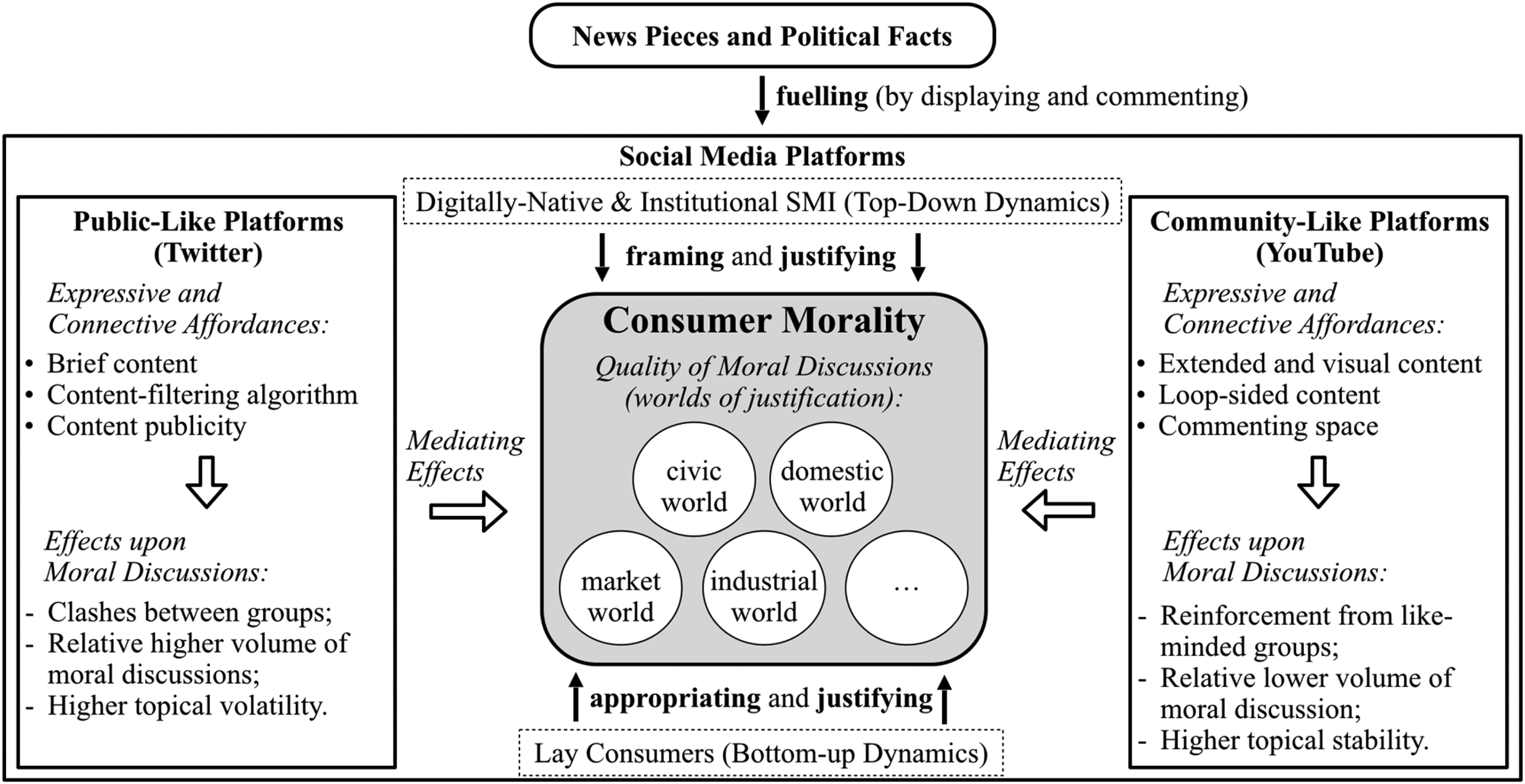
The Process of Morality Formation on Social Media.
According to Statista (2021), Twitter and YouTube are among the five most commonly used social media platforms in Brazil, with 10.29% and 7.61% of all social media platforms visits, respectively. Brazil ranks fifth in the world for national Twitter usage, and debates on gun liberalization were particularly salient on this medium at the time of our data collection. Our choice to focus on YouTube is motivated by the significant presence of influential YouTube channels that are dedicated to guns and self-defense strategies and are followed by large communities of consumers. Additionally, as mentioned above, the distinct expressive and connective affordances of Twitter—a hashtag-based, microblogging platform populated by heterogeneous and ephemeral public-like audiences (Arvidsson and Caliandro 2016)—and YouTube—a video-sharing platform where SMIs produce videos for asynchronous consumption by highly interactive community-like audiences (Arthurs, Drakopoulou, and Gandini 2018)—allow us to address our research questions through a comparison, the ultimate aim of which is to “stand above the idiosyncratic features of particular contexts and help us understand morality and moral phenomena in generalized terms” (Shadnam, Bykov, and Prasad 2021, p. 206).
Data and Methods
Our empirical study is based on quantitative and qualitative analyses of two large datasets of Brazilian social media platforms content generated by both lay consumers and social media influencers on Twitter and YouTube in a longitudinal study that covers the most intense moment of Brazil's political debate about the liberalization of gun ownership (from January 1 to August 15, 2019). Table 1 offers an overview of these datasets.
Research Datasets and Analytical Purposes.
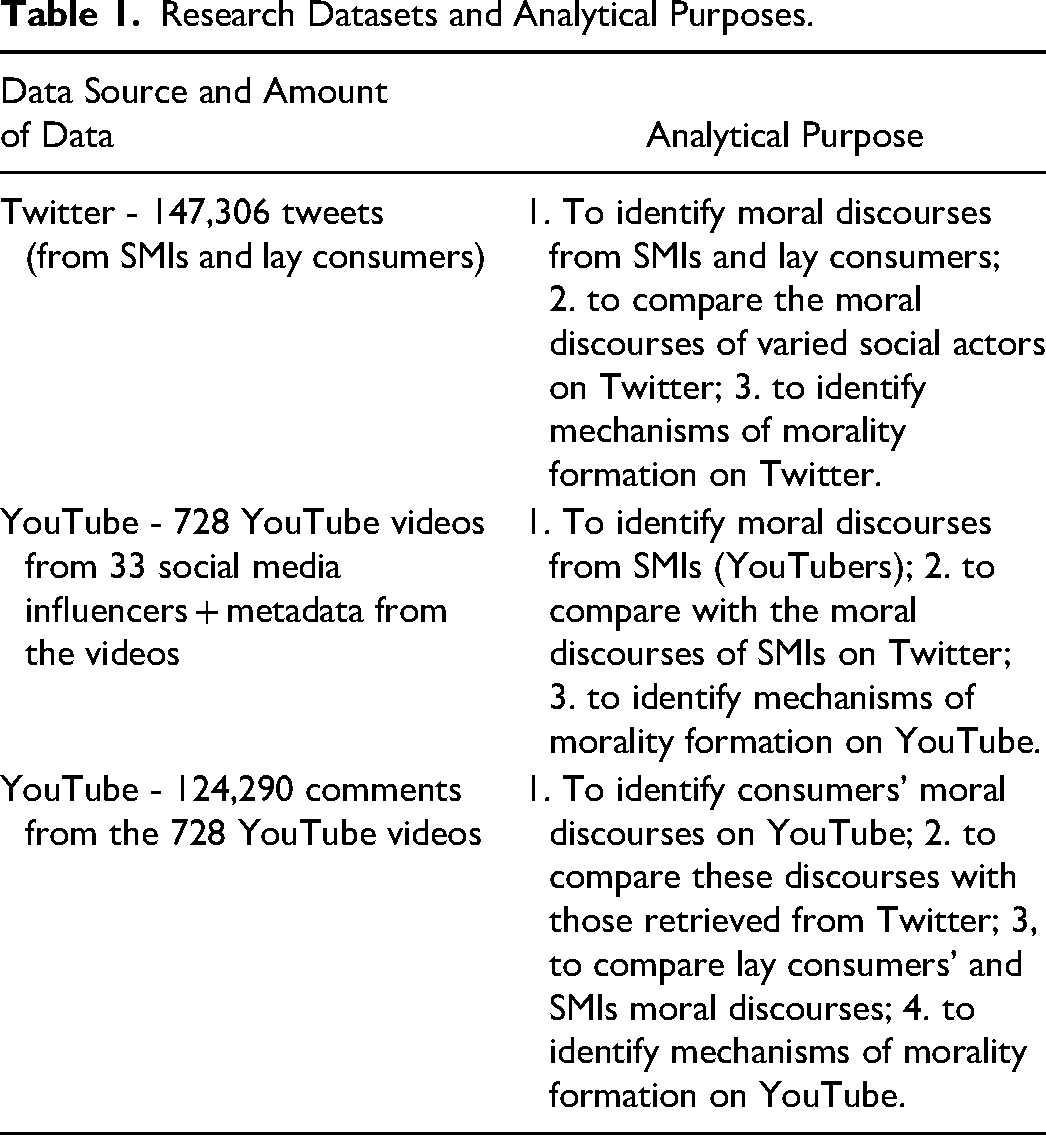
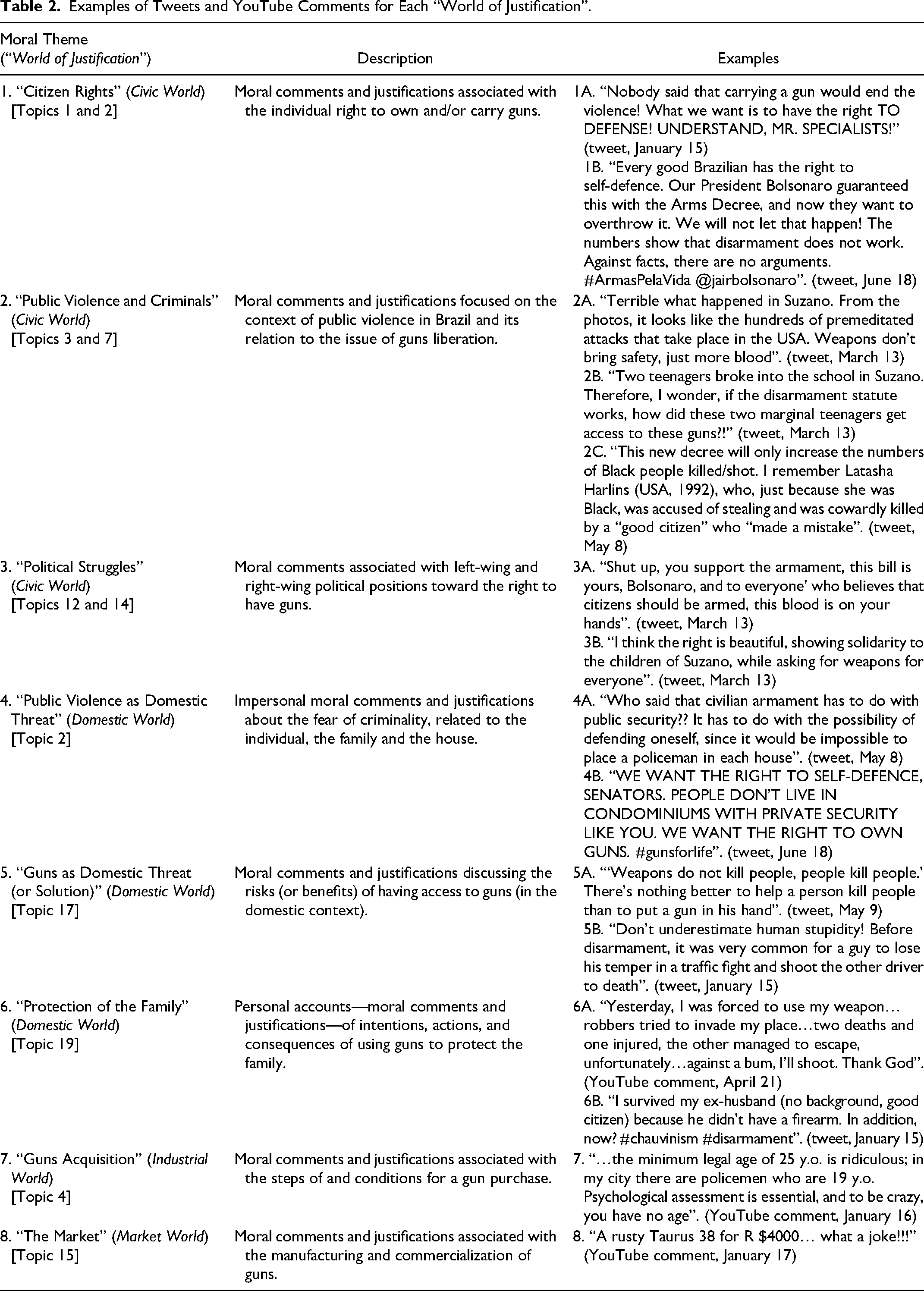
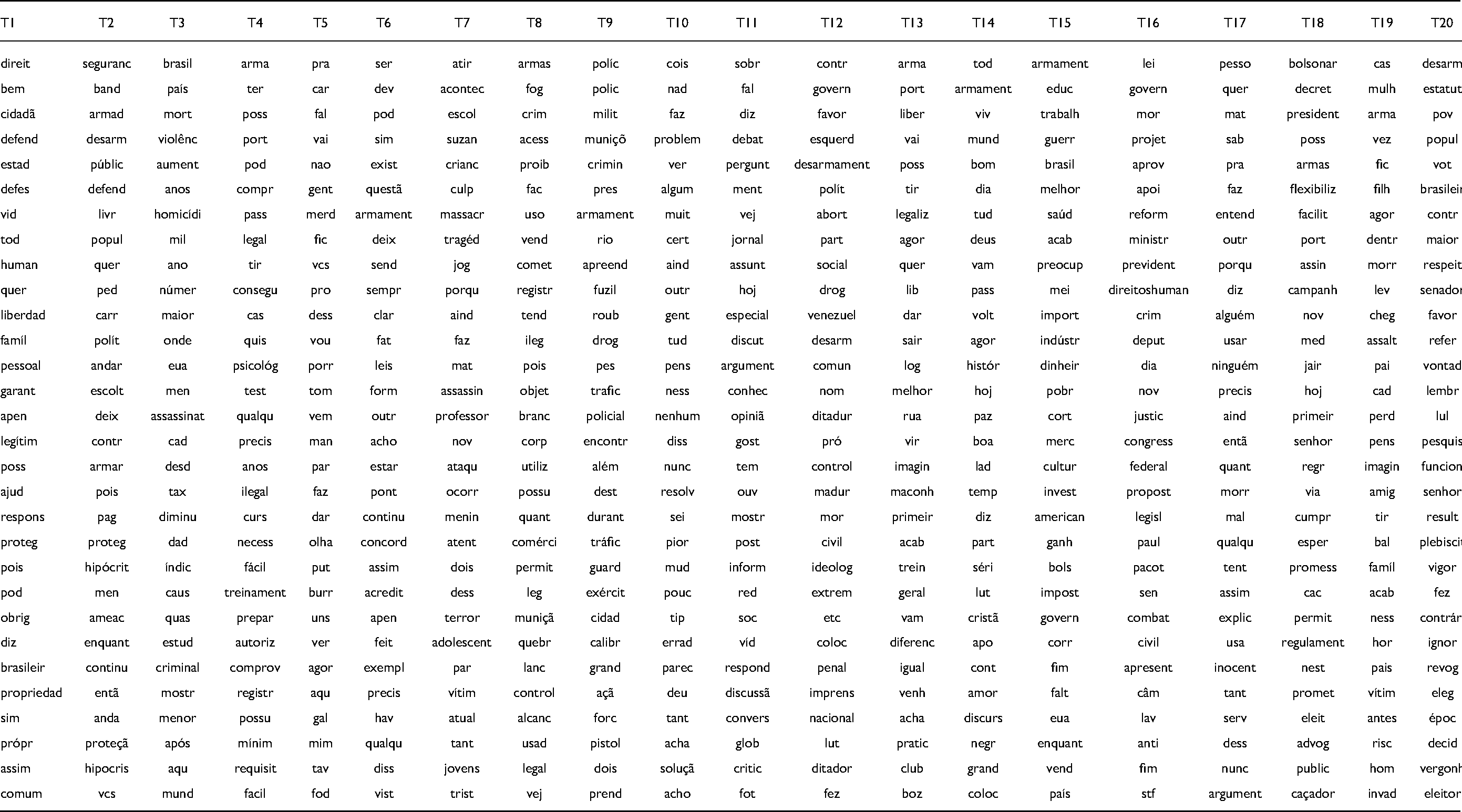
First, we partnered with the social media platforms monitoring company Vert to retrieve 215,136 tweets that were published by Brazilian Twitter users and featured gun-related keywords and hashtags (e.g., the Portuguese equivalents to “firearms” and “selfdefense”). Second, a preprocessing phase in R was conducted. Tweets were stemmed, and irrelevant “stop words” were removed along with mentions (@) and URLs (Krippendorff 2013). Tweets with fewer than 10 words were removed from the final corpus for analytical reasons (DiMaggio, Nag, and Blei 2013). Afterward, a final corpus of 147,306 tweets was obtained. We then analyzed the corpus to inductively identify and quantify the different facets of this online discourse. By applying Latent Dirichlet Allocation (LDA), an established topic modeling technique in sociology and consumer research (DiMaggio, Nag, and Blei 2013; Humphreys and Wang 2018), we inductively discerned 20 main “topics”, i.e., lists of frequently cooccurring terms, which characterize our corpus of tweets (see Appendix). The k number of topics was set by the second author after several attempts to maximize both the interpretability and statistical validity of the results (DiMaggio, Nag, and Blei 2013, p. 582). Then, following Humphreys and Wang’s (2018) advice, the first author profiled each topic—i.e., analyzed the content of the 20 topics by iteratively examining their terms and tweets—and then applied theory—i.e., the “worlds of justification” (Boltanski and Thévenot 2006)—to group these topics in light of the adopted analytical framework—i.e., connecting topics to broader categories (“moral themes”) and associating these themes with the relevant “worlds of justification” of Boltanski and Thévenot (2006) (see Table 2), in an abductive process, going back and forth between our empirical materials and the theoretical framework (Humphreys and Wang 2018). For example, Topics 1 and 2 were categorized as “Citizen Rights” (moral theme) since their prevalent words and tweets concerned the individual right to own and carry guns, e.g., “direita” (right) and “defend” (protect) – a theme associated with the civic world of justification (Boltanski and Thévenot 2006). Through this procedure, eight moral themes, each comprising multiple topics, were qualitatively identified and associated with one of the four worlds of justification of Boltanski and Thévenot (2006) that were noted in the dataset (see Table 2), and tweets were thus automatically classified based on their statistically prevalent moral theme (for more details, see DiMaggio, Nag, and Blei 2013). Since moral justifications associated with the other worlds of Boltanski and Thévenot (2006) were not identified in the dataset (which is not uncommon in empirical studies), we adopted these four worlds in the craft of our process theory of the formation of consumer morality in social media platforms.
Examples of Tweets and YouTube Comments for Each “World of Justification”.
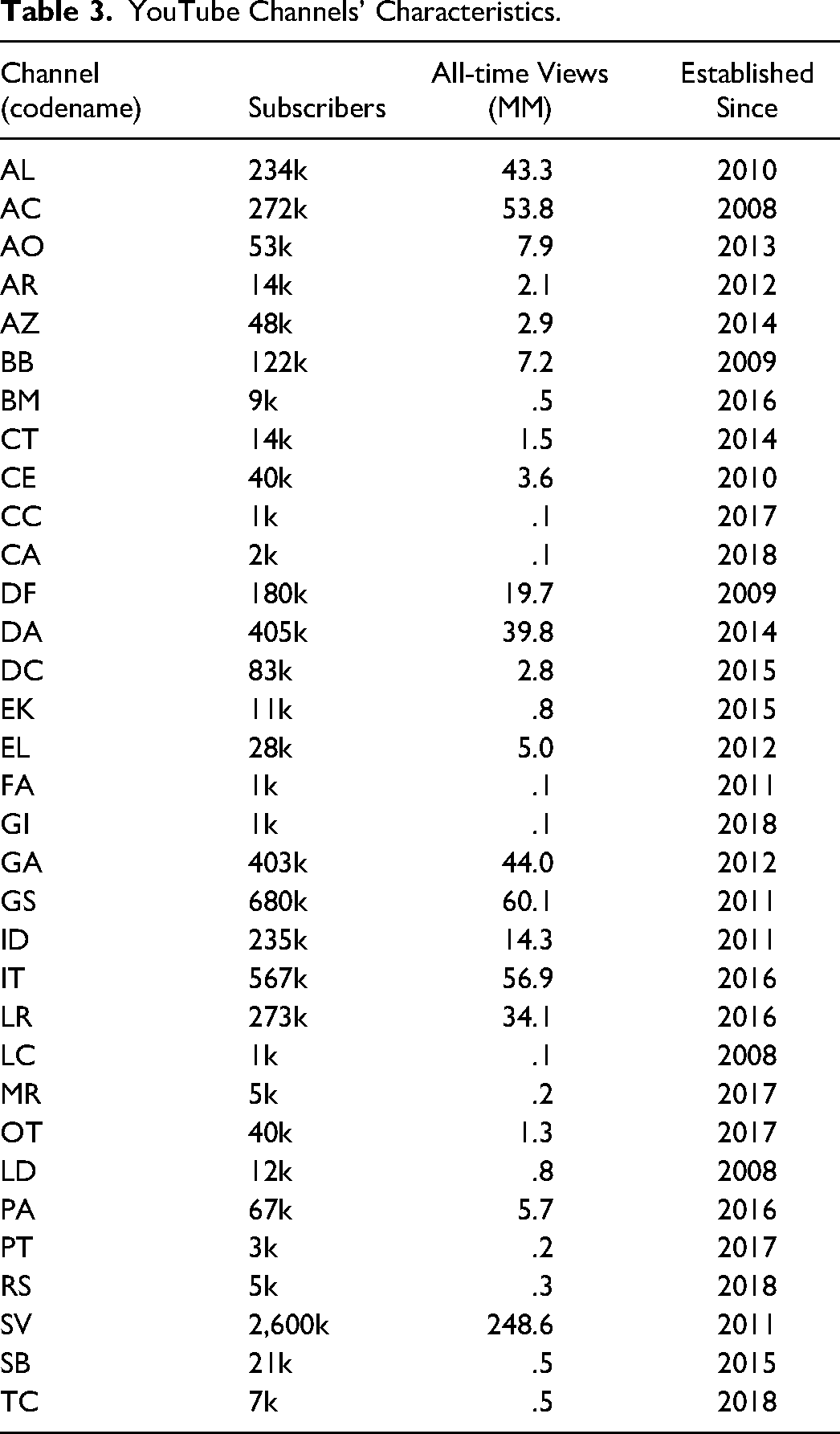
Second, YouTube data were collected through the following “digital methods” approach (Caliandro and Gandini 2017): a set of 9 Brazilian YouTube channels specializing in guns was identified through a preliminary qualitative immersion in the field. Using YouTube Data Tools (Rieder 2015), we then retrieved metadata from approximately 111 YouTube channels that were “related” to the seed channels by the platform algorithm to enlarge the research field in an inductive “snowball” fashion. Through a manual keyword-based exploration supported by network analysis metrics, we then selected 33 gun-related YouTube SMIs whose video content was subsequently subjected to open and theoretical coding (Saldaña 2009). All YouTubers received pseudonyms (Table 3), and the identity of the authors of comments was omitted. Additionally, the content was collected and analyzed in Portuguese, and the final report was written in English, ensuring that the examples reported in the text could not be traced back to their authors. The first author viewed 12 to 16 highly viewed videos for each SMI and then coded them. The first author adopted an open coding approach (Saldaña 2009) to generate a description of the video content—i.e., “individual freedom,” “interventionism,” “shooting experience,” and “market monopoly”. This was sufficient to reach topical saturation. Subsequently, the authors connected these first-order codes to the “worlds of justification” of Boltanski and Thévenot (2006). Additionally, metadata for all videos published by the selected SMIs between January and August 2019 (n = 728) were collected, and all user-generated comments posted on these videos within the time span (n = 124,290) were extracted. This second textual corpus, which was also preprocessed and quantitatively analyzed in R, allowed us to measure consumers’ moral discourses on YouTube and compare them with those we retrieved from Twitter. Specifically, based on a dictionary composed of the 2,844 unique words that were mostly associated with the 20 topics previously identified on Twitter (Humphreys and Wang 2018), we automatically identified the prevalent moral theme of each YouTube comment, thus enabling a cross-platform comparison.
YouTube Channels’ Characteristics.
Additionally, to address the first research question (i.e., how consumer morality is discursively deployed on social media platforms) and establish to what extent lay consumers’ discourses concerning guns mirror the moral views of influential accounts on the two platforms (i.e., to what extent there is some degree of bottom-up dynamics of consumer morality formation on social media platforms), we compared influencers’ and regular users’ moral discourses. On YouTube, this operation was conducted in a purely qualitative manner by the first author due to the need to compare audiovisual and textual content (i.e., SMI videos and user-generated comments). In the case of Twitter, we proceeded in the following more quantitative way. Building on Campbell and Farrell (2020), all accounts with more than 100,000 followers at the moment of our data collection were deemed SMIs (n = 451). All SMIs were screened by the first author and then classified as “institutional” (politicians, institutions connected to governments or politics, NGOs focused on politics, accounts that promote a certain politician, media outlets, and journalists) or “digitally native” SMI (creators with no association with the previous categories of accounts). We then quantitatively compared the distribution of moral themes between SMIs’ tweets (n = 2,454) and lay consumers’ tweets (n = 144,852) while considering the different categories of SMI.
Finally, the authors identified the most relevant expressive and connective affordances of Twitter—i.e., brief content and content publicity—and YouTube—i.e., extended and visual content—given our research objectives, and adopted the “objective qualities” (Schrock 2015, p. 1239; Shamayleh and Arsel 2022) of both platforms in the theorization of the process of consumer morality formation, as the authors analyzed how moral discourses were differently produced in both platforms. Overall, this quali-quantitative digital methods approach allowed us to explore and measure the nuanced facets of online discourses concerning guns on a large scale and in a fine-grained way, illuminating the longitudinal cross-platform dynamics of consumer morality formation.
Findings
Our findings reveal a process of morality discursive formation on social media platforms (Figure 1). By “morality formation” on social media platforms, we mean the public display of moral discourses and their correspondent ideas, norms, and values by social actors to make sense of their worlds, justify their worldviews and actions, and antagonize those with whom they disagree. In this section, we unpack how moral discourses are fueled by social actors’ displaying and commenting of news pieces and political events, which affects the volume of moral discourses on social media platforms; the following sections explain how the expressive and connective affordances of each social media platform mediate the dynamics of moral discourses and how social actors differently appropriate content, frame, and justify the right to own and carry guns by adopting different worlds of justification (Boltanski and Thévenot 2006).
How Moral Debates are Fueled on Social Media Platforms
In this section, we start to unpack the process of morality discursive formation on social media platforms. Online moral discourses are fueled by consumers displaying and commenting on news and political events, framing the matter through different worlds of justification and producing different explanations for why gun ownership and carrying are (or are not) morally right. Our longitudinal analysis shows how news pieces ignite collective moral discussions on social media platforms, affecting the volume of these debates over time but not their direction, which may depend on social actors’ adoption of different worlds of justifications, in a dynamic that is mediated by the expressive and connective affordances of Twitter and YouTube (as we describe in the following subsections).
First, our data reveal how news pieces and political events fuel gun-related debates on social media platforms, as they create opportunities for these debates to evolve, as the longitudinal distribution of tweets and YouTube comments concerning guns in Brazil illustrates (Figure 2). The two series are positively correlated (.284, p < .001) and clearly present three main peaks around January 15, March 13, and May 08, 2019. Below, we use these activity peaks to describe how moral discourses on social media platforms are formed over time.
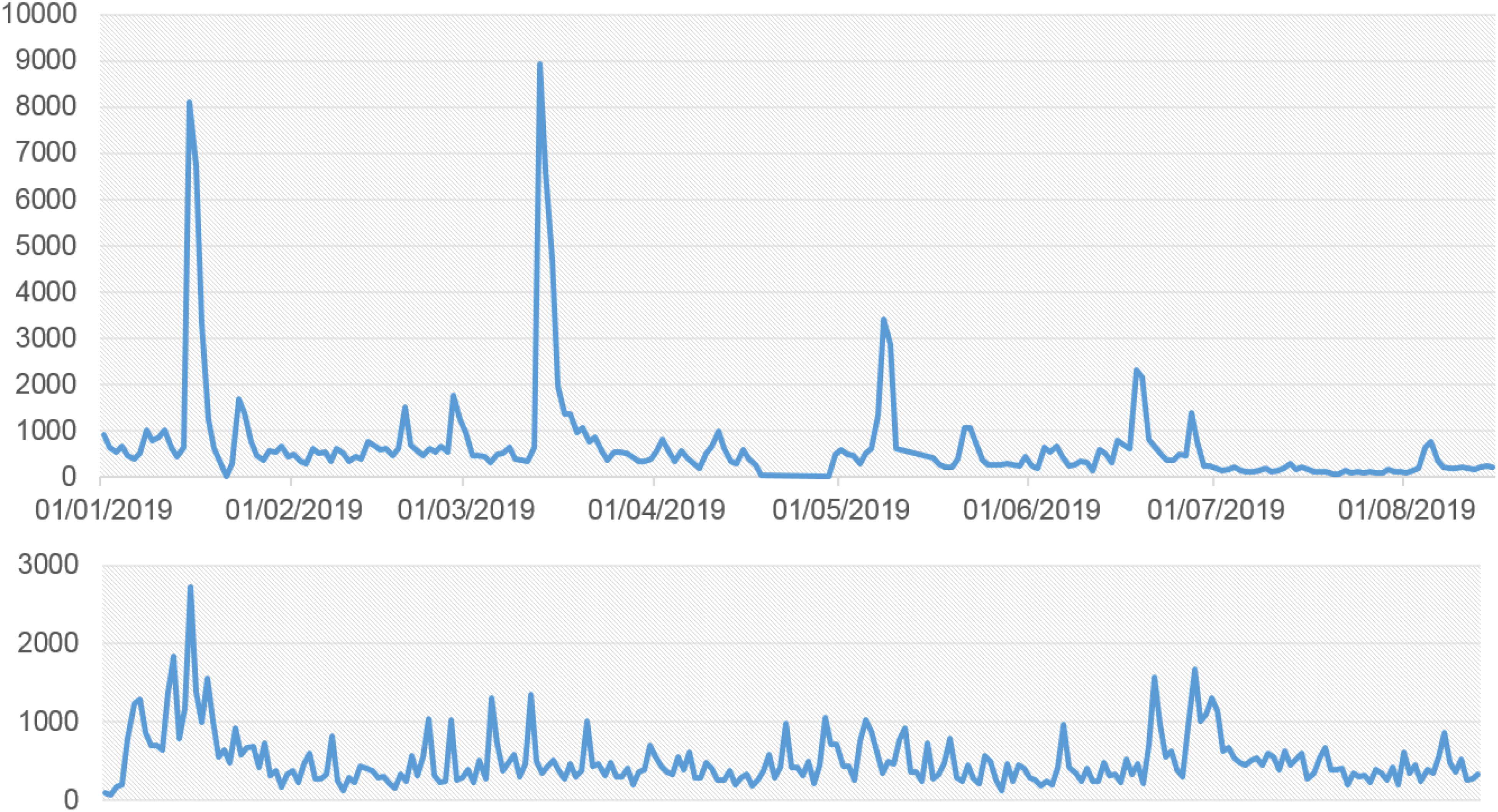
Temporal Evolution of User Activity on Twitter (Tweets, Upper Chart) and YouTube (Comments to Videos, Lower Chart).
To explain the longitudinal dynamics of consumer morality discursive formation, we describe how the three major activity peaks are formed. As anticipated above, by qualitatively interpreting the 20 topics quantitatively derived from Latent Dirichlet Allocation (LDA), we identified 8 moral themes comprising 11 of the 20 topics (see Table 2 and Appendix). These account for approximately 55% and 40% of the Twitter and YouTube debates, respectively, and these 8 moral themes point to four “worlds of justification” (Boltanski and Thévenot 2006): the civic world, the domestic world, the industrial world, and the market world. Table 2 describes each moral theme and its related “world”, and provides examples of tweets and YouTube comments. Additionally, Figure 3 shows the relative temporal distributions of these moral themes across platforms. Scrutiny of these moral discourses in correspondence with their peaks of activity allows us to start unpacking the process of morality formation on social media platforms.
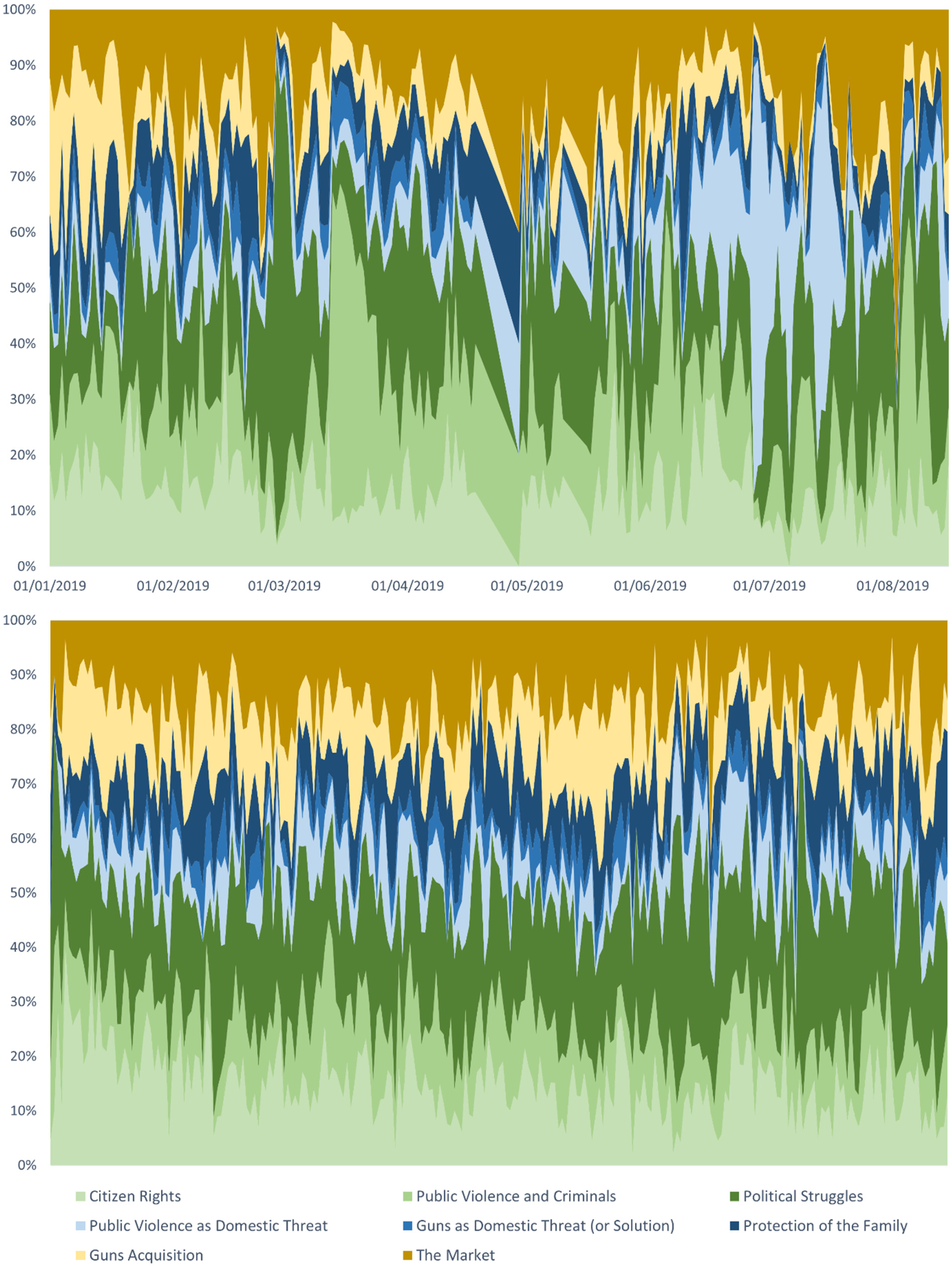
Relative Distribution of Moral Themes Over Time on Twitter (Upper Chart) and YouTube (Bottom Chart).
The first discussion peak on both platforms (January 15, 2019) stemmed from a decree by President Jair Bolsonaro facilitating the possession of weapons—one of his main campaign promises. This political fact and its reverberation on the news media were the triggers for increased moral discussions on Twitter and, to a lesser extent, YouTube. Figure 3—which shows the distribution of moral themes for each platform over time—illustrates how the resulting discourses during this period concerned not only the decree but also bottom-up appropriations of the news. The latter involved moral themes pertaining to the civic world—the alleged “citizen rights” to own guns for self-defense, illustrated by Example 1A in Table 2, and the “political struggles” against the political forces that work to limit such rights (i.e., the left). As this example illustrates (together with the following ones), lay consumers do not merely receive information that is originally published via traditional media vehicles (top-down dynamic); instead, they appropriate the news for their own ends, raise discussions on gun-related issues, and morally justify their position (bottom-up dynamic), according to different worlds of justification (Boltanski and Thévenot 2006).
Moral discussions are particularly triggered by emotionally charged news pieces (Papacharissi and Fatima Oliveira 2012). This process drove the second activity peak on Twitter (March 12, 2019, Figure 2) following a massacre that was perpetrated by two young individuals in a public school in the city of Suzano (Brazil). The massacre was followed by almost 20 days of discussions in which the dominant theme on Twitter was “public violence and criminals”. These tweets expressed divergent moral views, connected to the civic world, about gun control (or gun possession) as the solution to the problem, as Examples 2A and 2B in Table 2 illustrate. Pro-gun advocates argued that criminals in Brazil are already armed (i.e., 2B, Table 2). Gun-control advocates argued that more guns would only bring more violence (i.e., 2A, Table 2). Accordingly, pro-gun advocates engaged in moral justifications that justified the liberation of firearm possession as a “citizen right,” an individualistic alternative in the context of public violence and criminality.
The third activity peak on Twitter was on May 8, 2019. President Jair Bolsonaro issued a decree facilitating the import of arms and ammunition, increasing individual ammunition limits, and extending the possibility of carrying guns to individuals in many professional categories and in more places and situations. This political fact was another trigger for moral discussions, i.e., for the expression of divergent opinions about the themes of “public violence and criminals” (civic world) and “public violence as domestic threat” (domestic world). Gun-control advocates decried the increased social costs of an armed society, e.g., the potential increase in the deaths of Black people (2C, Table 2). In contrast, pro-gun advocates justified their position, again, through the individual right to self-defense, often through abstract and impersonal justifications, such as it being “impossible to have a policeman in each house” (4A, Table 2).
Overall, our longitudinal analysis shows that news pieces and political facts fuel moral discussions on social media platforms, affecting the volume of these debates over time. Next, we explain how the dynamics of moral debates are mediated by the affordances of Twitter and YouTube.
How Platforms’ Expressive and Connective Affordances Affect the Dynamics of Moral Debates
Moral debates on Twitter
Twitter is a public-like formation that is based “on a continuous focus of interest and mediation” (Arvidsson and Caliandro 2016, p. 727). Individuals use Twitter to connect with other members of the public, be informed, and express their views (Papacharissi 2015), and they do so based on some key expressive and connective affordances that affect users’ practices. First, Twitter affords the emission of “brief content”. For instance, in 2019, Twitter afforded the limit of 280 characters per tweet, the ability to upload videos of up to 140 s, and the limit of 3 images per tweet. Additionally, Twitter's content-filtering algorithm defines the timeline display—the stream of tweets for each user—based on the user activity—i.e., the accounts and topics the user follows—and on recommended tweets from accounts that the user does not follow but the algorithm recommends. Finally, Twitter affords content publicity of tweets and interactions, which facilitates sociality and engagement among publics of users with different opinions about common interests and shared focal points (i.e., #guns).
As we show, these expressive and connective affordances affect the dynamics of moral discussions within each platform. Next, we investigate the extent to which the moral justifications regarding the liberalization of guns employed by different categories of users—lay consumers and SMIs—on Twitter are similar. Our assumption is that if the moral repertoires of lay consumers significantly differ from those of SMIs, then lay consumers are to some degree creatively expressing their own moral justifications concerning the topic of guns.
In terms of quantity, we found compelling evidence that lay consumers engage more intensely in moral discourses on Twitter than other social actors. Lay consumers provide moral discourses in 55.15% of their tweets compared with digitally native SMIs (46.51%) and institutional SMIs (29.49%). The quality of moral discourses of lay consumers is varied (see Figure 4). They are mostly divided between themes belonging to the civic world, such as “public violence and criminals” (25.2%), “political struggles” (18.2%), and “citizen rights” (13.5%), and those of the domestic world, such as “public violence as domestic threat” (9.9%), “protection of the family” (7.4%), and “guns as domestic threat (or solution)” (4.9%).
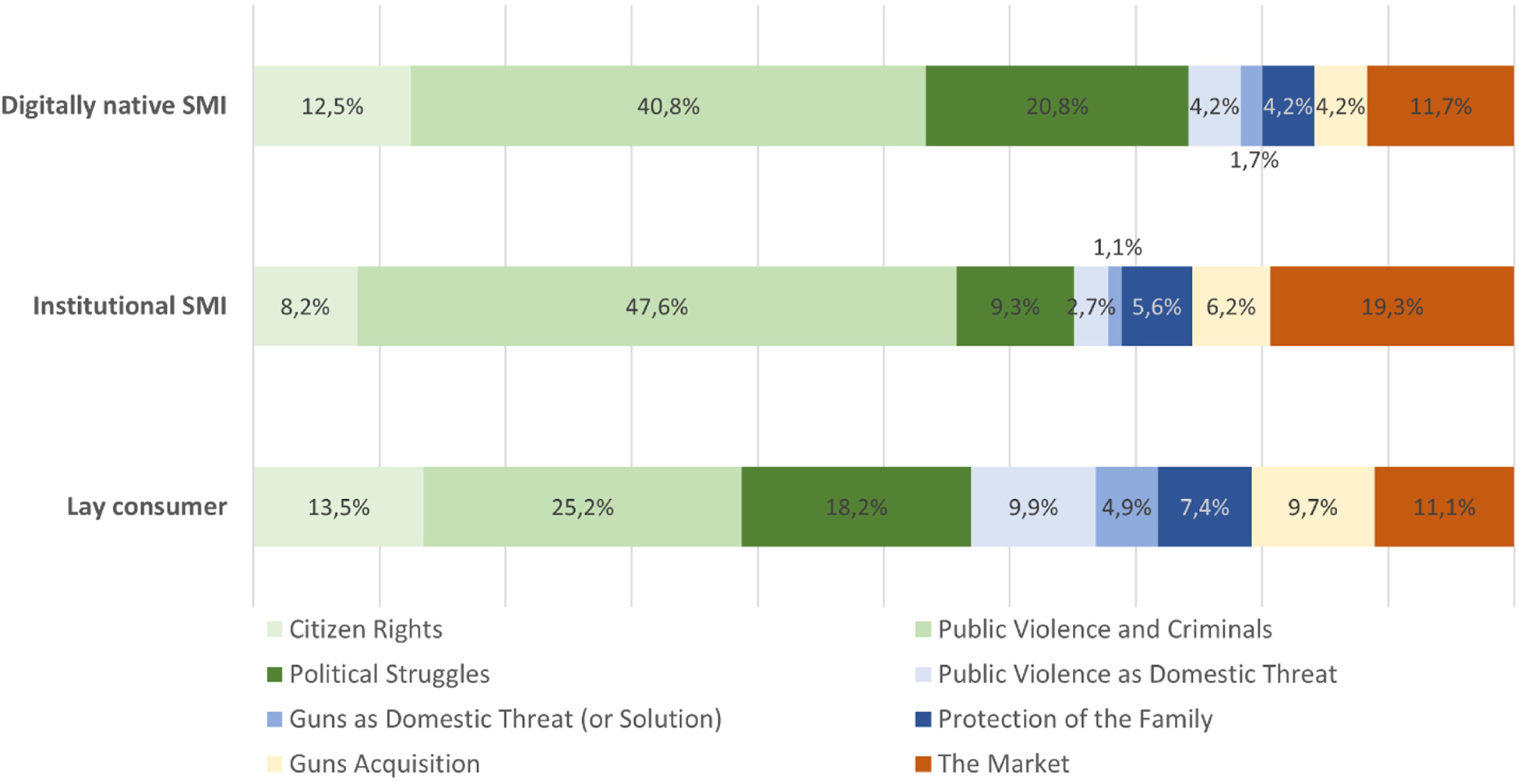
the Distribution of Moral Themes Across Categories of Actors on Twitter.
The predominance of moral discourses belonging to the civic world in debates on Twitter is marked by the clash of divergent worldviews regarding guns among lay consumers. The production of moral discourses connected to these worldviews is suffused by two affordances that enable confrontational dynamics: first, the content-filtering algorithm, which generatively produces a timeline suited for each user's interests (e.g., guns and politics); and second, the content publicity, which facilitates encounters and clashes among publics of users with different opinions about guns. For instance, gun-control advocates are concerned about the social outcomes of a potential increase in the number of guns among the population (e.g., more violence). Conversely, pro-gun individuals critique the left-wing position as threatening what they deem individual rights. This clash of worldviews and moral justifications is illustrated in the tweets below, which were published during the first activity peak. Both are replies to a thread in which one of the main leaders of the left, the former presidential candidate Fernando Haddad, criticizes Bolsonaro's decree: “@Haddad_Fernando Thankfully, the disarmament was a complete success, right??? No homicide recorded since the inmate Lula, against the will of the population, took away the people's right to self-defence.”
“So, do you defend that everyone is armed on the streets? What do you want? A bang-bang?”
Another example of how Twitter affords bottom-up dynamics for consumer morality—i.e., the agency of lay consumers—is their rate of discussing topics related to the domestic world, which is more than twice that of SMIs (Figure 4). Lay consumers appropriate the ongoing debates concerning guns on Twitter to express their moral views to justify the gun issue as either an individualistic (domestic) issue—for pro-gun advocates—or as a societal problem with personal implications—for gun-control advocates. The following tweets exemplify these expressions, which often reveal first-hand experiences of being robbed, fights among neighbors, and other everyday forms of violence:
“@jairbolsonaro, congratulations on the decree on firearm possession, because a good criminal is a dead criminal…I was robbed at two in the morning in Rio de Janeiro because I am a truck driver, and I thank you for doing that.”
“The average Brazilian does not have the psychological capacity to ask his neighbor to lower loud music without fighting. Can you imagine what would happen if the possession of firearms in civil society was allowed?”
Twitter also affords top-down dynamics for consumer morality formation, as SMIs frame the guns issue and justify their opinions aiming for audience engagement. The data reveal that digitally native SMIs’ moral justifications on Twitter are also concentrated in the civic world (74.1%), with “public violence and criminals,” “political struggles,” and “citizen rights” accounting for 40.8%, 20.8%, and 12.5% of classified tweets, respectively (Figure 4). The same can be said of institutional SMIs, whose moral discourses focus mostly on the theme “public violence and criminals” (47.6%). Indeed, this is the group with the highest concentration of moral discourses associated with the civic world (Figure 4). Thus, SMIs engage their audiences in moralized debates by framing the problems of Brazilian society. For instance, in the following examples, a left-wing politician (the first example) and a journalist (the second example) tweeted just after the Christchurch terrorist attack in New Zealand to criticize the position of pro-gun advocates, i.e., that access to guns is a solution to the violence problem:
“We are extremely concerned. By making it easier to carry a weapon…it will further aggravate the situation of violence that plagues the country.”
“The Public Security Yearbook counts 2,400 robberies (followed by death) in 2017—a situation that many pro-gun advocates want to defend themselves against. Conversely, intentional homicides total 55,900. This is Brazil's real problem: the culture that killing is an option.”
In short, on Twitter, the quantity and quality of moral justifications is affected by bottom-up and top-down dynamics, as social actors appropriate and frame news pieces and political facts for moral justification purposes in a process that is mediated by the platform's expressive and connective affordances.
Moral debates on YouTube
In this section, we investigate how the dynamic of consumer morality formation is mediated by the affordances of a community-like environment such as YouTube. YouTube is a user-generated social media platform that is especially valuable for communities of consumers and activists—not only progressive ones—who are able to engage supporters without editorial limitations (Arthurs, Drakopoulou, and Gandini 2018). In this research, our focal YouTubers are digitally native experts and pro-gun advocates who discuss the technical details of gun models, user experiences (e.g., tutorials and product reviews), and other gun matters (e.g., legislation). Overall, the YouTubers in our sample are adult males (30 to 50 years old) with right-wing political inclinations (e.g., pro individual freedom, against state interventionism) who present themselves as both educated and passionate about guns and reasonably responsible concerning the legal duties and technical implications of owning or carrying guns. Audiences typically value the amateur and often noncommercial perspective of YouTubers (Arthurs, Drakopoulou, and Gandini 2018). Thus, the YouTubers in this research form a network of content dissemination and debate about gun-related issues. Collectively, they produce gun-related content igniting moral discourses among their viewers and commenters.
First, YouTube affords creators the capacity to produce extended and visual content (i.e., videos of long duration). The duration of the videos within the dataset varied from a few minutes to more than one hour. For instance, one of the most famous Brazilian pro-gun activists usually posts videos with detailed information to support his values and ideas. In one video, he explains that Canada is a nonviolent country despite the relatively high penetration of guns among the civilian population. To illustrate the argument, he borrows scenes from Michael Moore's documentary Bowling for Columbine (1999) with Canadian Citizens declaring how safe they feel to be. He also asks the audience to read one article of his blog with detailed statistics on gun safety. This example illustrates how YouTube affords the creation of extended content so the creator can justify his personal views, in this case with pro-gun moral justifications based on the civic world (i.e., the low levels of public violence) and the domestic world (i.e., the individual perception of absence of domestic threats). Similar to what we saw among other YouTubers, his audience responds with largely enthusiastic comments, saluting him as a leader of the movement: “I have been following your work since 2010! I hope my children will read your name and the names of many others who defend our freedom in schoolbooks.”
“Make more videos. You can convince a lot of laypeople, deconstructing lying research.”
Second, the architecture of the platform itself is designed to suggest similar content after each video, encouraging the formation of algorithmically driven echo chambers (Colleoni, Rozza, and Arvidsson 2014) with similar worldviews. This affordance affects consumer morality formation by continually connecting individuals to loop-sided content, with similar moral discourses and justifications from YouTubers and audiences.
Finally, individuals can use the commenting space of each video and express their views, questions, suggestions, and support, connecting with like-minded individuals. This connective and expressive affordance enables the deployment of moral discourses among lay consumers, following the videos posted by YouTubers. Audiences appropriate the content and creatively express their own opinions and moral views, which are particularly vehement when the content opens space for moral expressions. For example, after a video comparing the promises and the effective achievements of Jair Bolsonaro to facilitate access to guns, lay consumers commented on the topic and called for more actions from the federal government, with their arguments being mostly connected to the civic world (“lots of promises and nothing real… we are among the bandits”) and to the market world (“paying R$ 3.500 for a [name of the brand] is to be robbed to be protected”). The contrast between the YouTubers’ content, with mostly a political and legal discourse, and the moral discourses of lay consumers illustrates how lay consumers appropriate content and engage in their own moral justifications, similar to the bottom-up dynamics observed on Twitter.
Another example of bottom-up dynamics can be seen when YouTubers post content that is unrelated to moral or political debates. For instance, after a technical video showing how the qualification exam to acquire the gun-carrying license is, many of the comments that followed mentioned the individual right to self-defense (e.g., “GOOD CITIZENS ARMED NOW!”) and expressed hope that President Jair Bolsonaro would fulfil his promises of easing firearm access. These comments are also evaluated by the audience through likes and comments.
In short, on YouTube, consumer morality formation is mediated by the platform's expressive and connective affordances and is discursively formed in a process involving the justifications of SMIs (top-down dynamic) and those of lay consumers (bottom-up dynamic). Next, we compare the quantity and quality of moral discourses on both platforms to further understand how moral discourses are discursively formed.
Consumer Morality Formation: The Contrast Between Twitter and YouTube
In this section, we further unpack the differences between consumer morality formation on Twitter and that on YouTube. Although the relative distribution of moral themes on the two platforms is generally comparable (see Figure 5), moral considerations concerning guns on YouTube are considerably less frequent than on Twitter (approximately 15% less, over the total number of texts in our corpus), suggesting that Twitter induces moralizing discourses more intensely than YouTube. This finding can be interpreted by considering the public-like nature of Twitter, with its ephemeral formation based on a continuous focus of interest and affective self-expressions by consumers (Arvidsson and Caliandro 2016; Papacharissi 2015). Additionally, given the content publicity of tweets and the content-filtering algorithm, pro-gun and gun-control consumers can encounter their respective out-groups more easily than on YouTube; therefore, ideological clashes occur more frequently.
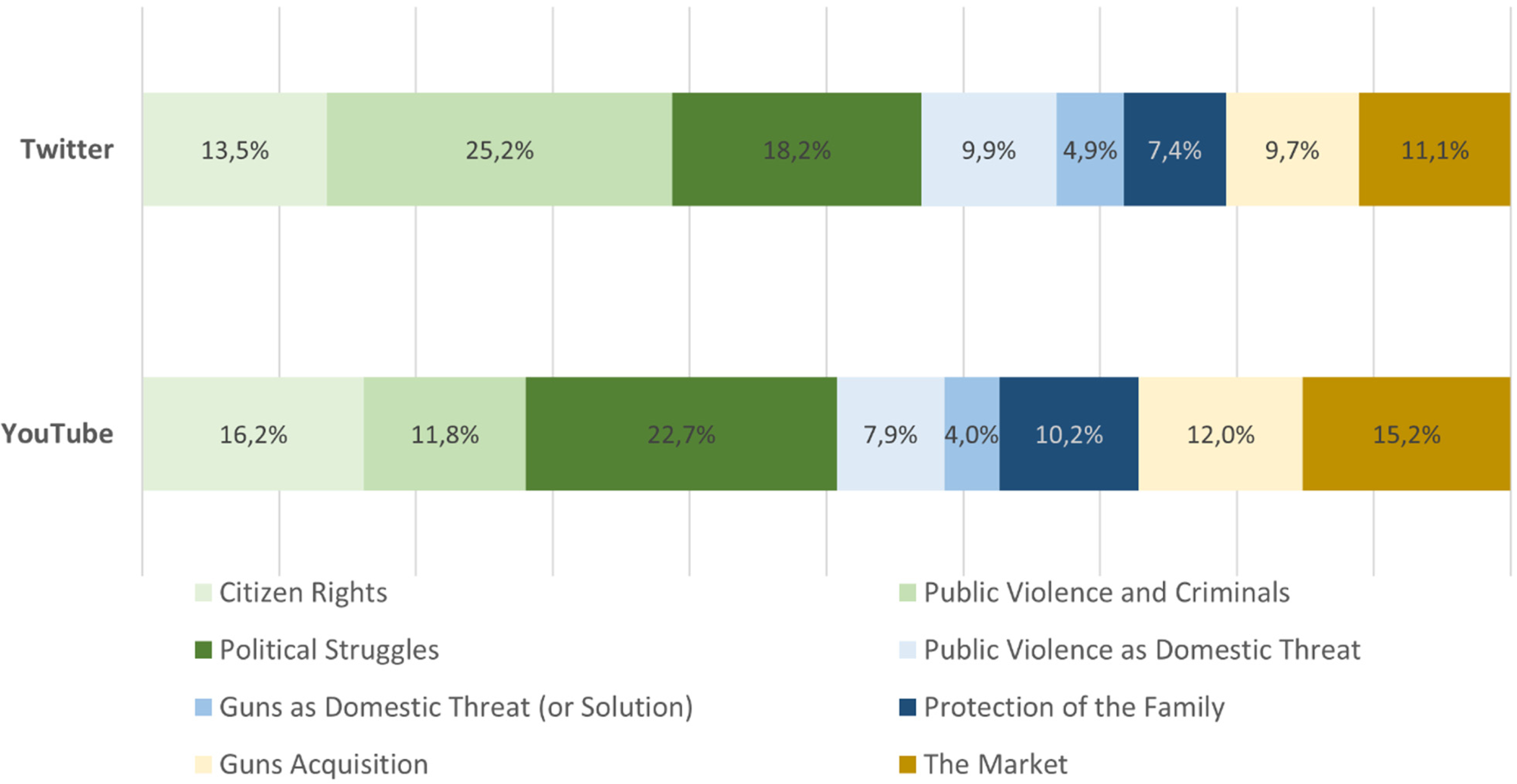
The Distribution of Moral Themes Among Consumers on Twitter and YouTube.
In addition to the volume of moral discussions, there are differences regarding the quality of discussions—the worlds of justification that consumers use to position themselves in disputes (Boltanski and Thévenot 2006). On Twitter, groups with different worldviews and political positions either justify the right to gun ownership, mostly for self- and family protection (Figure 5), or criticize it via the societal implications of having more firearms in circulation. The public-like nature of Twitter audiences affects these disputes, producing a relatively higher volatility of moral discussions, both in terms of quantity and quality (Figure 3). Conversely, on YouTube, we observe more stable conversations, given the community-like nature of its audiences, which are composed of like-minded individuals who follow SMIs with similar pro-gun worldviews and are exposed to similar content via the influence of algorithmically driven echo chambers (Colleoni, Rozza, and Arvidsson 2014).
Although on both YouTube and Twitter the majority of conversations refer to the civic world (Figure 5), the most frequent moral theme among consumers on YouTube is “political struggles” (22.7% of total comments). A possible explanation is that community-like platforms such as YouTube may foster the development of echo chambers where the depreciation of moral opponents is socially rewarded by likeminded consumers. For instance, in the comments section of a video, one lay consumer mentioned his neighbor, whom he portrayed as a supporter of the left who hates guns. The commenter joked about promising to respect him and thus never protect him with his own guns if needed. This joke received almost 200 likes.
Another difference between the platforms is that on YouTube, there is a greater proportion of moral comments connected to the market and industrial worlds (Figure 5). Comments associated with the industrial world often describe the difficult process of acquiring the license for gun ownership in Brazil, while comments associated with the market world tend to be about specific products and manufacturers (see Examples 7 and 8, Table 2). As previously mentioned, YouTube's expressive affordances provide experts with the ability to produce long videos in formats such as unboxing, reviews, or tutorials about gun models, usually in visually appealing places, such as shooting clubs. These types of content may instigate subsequent comments concerning guns, i.e., about their qualities, uses, and availability on the Brazilian market.
Overall, morality discursive formation on social media platforms is a process that begins with social actors displaying and commenting on news pieces and political facts, evolves as SMIs and lay consumers frame, appropriate, and justify their positions, and is mediated by social media platforms’ expressive and connective affordances. Thus, morality discursive formation on social media platforms is affected by top-down dynamics—the media that frames political events into news pieces, the SMIs who appropriate these news pieces to their worldview and interests, and the affordances of social media platforms—and, to a lesser degree, by lay consumers’ appropriations of news pieces and political facts (bottom-up dynamics). Importantly, we highlight how the expressive and connective affordances of each social media platform create different conditions for the formation of moral discourses, generating important variations in the moral repertoires that circulate in public-like (e.g., Twitter) and community-like (e.g., YouTube) contexts.
Discussion
Societal and Market Implications
Macromarketing is intrinsically concerned with situations of market dispute (Blanchet and Depeyre 2016). The findings of this research open a discussion about the extension of social media platforms’ accountability for the formation of consumer morality. There are growing concerns over the power of social media platforms, the Silicon Valley tycoons who own them, and the algorithms embedded in their infrastructures, which influence the content to which consumers are exposed. Are social media platforms responsible for the increasingly polarized moral views concerning guns, vaccines, or cannabis-based products? Rauf (2021, p. 245) proposes that “morality, which is mediated by news, is in the hands of algorithmic design.” Although not fully disagreeing with Rauf’s (2021) general statement, this research reveals a more complex dynamic of consumer morality formation on social media platforms.
We extend Rauf’s (2021) argument and propose that the process of morality formation is fueled by the ongoing flow of information (i.e., news pieces) and their appropriation and framing by lay consumers and SMIs, mediated by the specific expressive and connective affordances of social media platforms (i.e., forming public-like or community-like contexts). Consumer morality formation also follows top-down and bottom-up dynamics, as social actors appropriate and frame information differently, morally justifying their public positions in a process that simultaneously reflects influential discourses and lay consumers’ subjective worldviews. Thus, although there is undeniable power “in the hands” of social media platforms, as they select the content each social actor is exposed to, lay consumers and SMIs appropriate and frame news pieces and political facts to justify their positions according to their own worldviews and interests.
The process of morality formation on social media platforms can also extend discussions on market disputes for legitimacy in controversial (Blanchet and Depeyre 2016) or contested markets (Coskuner-Balli, Pehlivan, and Hughes 2021), as social media platforms, lay consumers, and SMIs collectively affect consumer morality formation in several markets, such as guns (Barnhart, Huff, and Scott 2023; Witkowski 2020, 2022), casinos (Humphreys 2010) and cannabis-based medicines and consumer products (Huff, Humphreys, and Wilner 2021) and market issues, such as consumer mobilization for brand cancellation (Demsar et al. 2023). If cultural legitimacy is formed in a process involving social media platforms’ affordances and lay consumers’ and SMIs’ ongoing appropriation and framing of information, governments, corporations and NGOs need to take seriously both the technological capacities of social media platforms and the responsibilities of SMIs and how they affect the formation of consumer morality.
From the standpoint of governments, NGOs, corporations, and brands that aim to cultivate socially responsible values and ideas regarding guns, social media platforms constitute a point of concern. The platforms we investigate are designed to magnify moral debates and promote clashes between groups (Twitter) or reinforcement of moral discourses from like-minded groups (YouTube). Although we suggest that social media platforms can modify their algorithms to amplify the visibility of rational content and reduce the visibility of affective content, this measure seems to be more effective for improving the quality of moral debates on public-like platforms (i.e., Twitter). Content production in community-like platforms (i.e., YouTube) is derived from SMIs’ values, ideas, and interests. Thus, co-opting SMIs from the field through traditional influencer marketing techniques is not an option; SMIs in this field have a priori negative values and ideas about gun control. Therefore, governments, NGOs, and brands should work with SMIs from other fields to constitute a pro-social alternative influence network (Lewis 2018) which can spread moral values and ideas regarding the personal and societal risks and implications of having an increasingly armed society.
Furthermore, our findings regarding YouTube seem to extend the implications of what Lewis (2018) calls the alternative influence network, a discursive system involving the cross-promotion of an interlocking set of coherent content provided by independent parties. Lewis (2018) describes how an alternative influence network creates an “intertextual common-ground” (p. 8) for an alt-right ideology. Our work explores the nature of the moral repertoires that circulate within such influence networks. As our data reveal, these moral repertoires and justifications for a pro-gun worldview are compelling, and they derive from a social dynamic which seems to be particularly dangerous in social media platforms that afford the formation of less-public and more closed groups with hundreds of thousands of participants, e.g., WhatsApp and Telegram. Our findings suggest that government regulators have reason to be concerned about the effect of these groups on the formation of public opinion, especially when these platforms adopt low or no politics of content moderation (i.e., Telegram).
Finally, our research also illuminates how SMIs affect morality formation on each platform. On YouTube, SMIs are central nodes that frame and amplify moral views about sensitive topics, channeling information within groups and framing topical discussions that garner the attention of like-minded audiences (Lewis 2018) and leverage SMIs’ perceived credibility and authority. On Twitter, various SMIs amplify the volume of moral discourses and act as central nodes in out-group clashes, reinforcing in-group moral values and beliefs (Bruns 2019; Jost et al. 2018). Thus, there is a co-responsibility among SMIs and platforms for the moral content that circulates within online collectivities, which may foster moral views, legitimate products, and affect consumption practices (sometimes troubling ones). Platforms and SMIs need to be held accountable—i.e., through government regulation—for the spread of moral discourses when they potentially implicate negative consequences for society, since platforms have the technical capacity to monitor and restrict the access of lay consumers to content that could potentially damage the public interest. Recent cases of SMIs spreading misinformation about COVID-19 vaccines (Moran, Grasso, and Koltai 2022) and sharing imagery that could harm national parks and monuments (Ray Chaudhury, Nafees, and Perera 2021) illustrate our argument. Hence, the process of morality formation illuminates how SMIs act as moral influencers, a consideration that may attract the attention of government regulators and the brands that work with SMIs. Of course, when and how to use regulatory power (i.e., governments) and economic power (i.e., brands) to silence certain discourses is a wicked problem (Huff et al. 2017), since a functional public space requires the coexistence of different worldviews (Rosa 2022).
Theoretical Implications
The main contribution of this article is to propose a process of morality discursive formation on social media platforms. Specifically, we apply the concepts of worlds of justification (Boltanski and Thévenot 2006) and expressive and connective affordances (Schrock 2015; Shamayleh and Arsel 2022) to illuminate the dynamics (and plurality) of consumer morality discursive formation regarding guns among multiple actors on two social media platforms. Accordingly, we explain how the formation of consumer morality on social media platforms is a process that a) is fueled by news pieces and political facts; b) is mediated by social media platforms’ expressive and connective affordances; and c) is framed, appropriated, and justified by SMI (top-down dynamics) and lays consumers (bottom-up dynamics) in digitally situated discursive justifications (Boltanski and Thévenot 2006).
Regarding the variation in consumer morality formation across platforms, public-like platforms (i.e., Twitter) present higher volumes of moral discourses and higher topical volatility regarding moral justifications. Conversely, community-like platforms (i.e., YouTube) present relatively lower volumes of moral discourses and less topical volatility. On public-like platforms, there are clashes between groups that antagonize. Conversely, on community-like platforms, consumer morality is formed by like-minded groups who share interests and values and reinforce their moral discourses (Jost et al. 2018), seeking to confirm their beliefs while also attacking out-group opponents (Lewis 2018). That is, community-like platforms contribute to the formation of echo chambers (Colleoni, Rozza, and Arvidsson 2014) where morality is cocreated through networked narratives (Kozinets et al. 2010) involving SMI and lay consumers. Additionally, in both types of platforms, SMIs are key to the amplification of moral discourses, due to their network centrality, making their moral justifications relatively more visible than those of lay consumers.
Our findings challenge the literature that broadly suggests that social media platforms is primarily a structuring force on social dynamics (Bruns 2019; Rauf 2021; Shadnam, Bykov, and Prasad 2021). Regarding consumer morality formation, this is only partially true. Although social media platforms do have enormous power, the bottom-up dynamic highlights the collective power of lay consumers to foster consumer morality on Twitter and YouTube according to their own worldviews and experiences. This finding contrasts with Kozinets, Ferreira, and Chimenti's (2021) work, which reveals how consumer evaluation platforms may limit consumers’ capacity for self-expression and constrain the catalytic power of their collective voice. Therefore, while agreeing with Shadnam, Bykov, and Prasad (2021, p. 204), who suggest that social media platforms are always “morally charged,” we extend the meaning of being “charged” by accounting for platforms’ complex sociomaterial arrangements of technologies and social actors that jointly affect consumer morality formation.
Limitations and Directions for Future Research
Our paper has several methodological limitations. First, the extraction of Twitter data was subject to unavoidable limitations linked to our selection of keywords and reliance on the platform's application programming interface (API), which does not allow the collection of the totality of tweets posted by the users (Caliandro and Gandini 2017; Gerlitz and Rieder 2013). Similarly, our YouTube data were derived from a data-driven but ultimately qualitative data collection strategy and are therefore not statistically representative of the platform's overall content. Nonetheless, the considerable size and diversity of our two datasets—nearly 300,000 online messages posted by 138,767 consumers—allowed us to examine Brazilian online discourses concerning guns at an unprecedented depth and scale.
Second, although our choice to classify YouTube comments based on topics inductively derived from tweets facilitated a systematic cross-platform comparison, it also implied that any moral discourses peculiar to YouTube and absent from Twitter could not be identified or measured. As a result, we cannot entirely rule out the possibility that digitally native types of moral justification that do not correspond to Boltanski and Thévenot's “worlds” (Boltanski and Thévenot 2006) might have emerged otherwise. Accordingly, we suggest that future research should pay further and closer attention to the plurality of moral justifications circulating on social media platforms by replicating our study while considering different platforms and markets. Digital research on morally charged markets such as cannabis-based medicines and consumer products (Huff, Humphreys, and Wilner 2021) or vegan products (Napoli and Ouschan 2020) could shed new light on emergent forms of consumer morality, particularly in the case of “closed” online platforms, such as WhatsApp and Telegram.
Third, although we investigated the difference in moral discourses between lay consumers and SMIs and the effects of social media platforms’ expressive and connective affordances on consumer morality formation, we understand that there are other sources of influence, coming from many types of agents—e.g., “old” media and socializing institutions such as the family. Future research could illuminate these interconnected social actors and their effects on moral discourses on social media platforms.
Finally, our qualitative analysis and coding of SMIs’ YouTube videos as well as our ex-post classification of LDA topics, which generated our eight moral themes, inevitably reflect the authors’ partial understandings and interpretations. On the one hand, this hermeneutic mixed-methods approach reduces the generalizability of our findings; on the other hand, we believe that it has facilitated a deeper understanding of the techno-social roots of morality formation on social media platforms, particularly in comparison with purely quantitative investigations. Future studies should dedicate more attention to the role of algorithmic systems in governing platformized morality dynamics, as suggested by Rauf (2021, p. 245).
Footnotes
Associate Editor
Terrance H. Witkowski
Declaration of Conflicting Interests
The authors declared no potential conflicts of interest with respect to the research, authorship, and/or publication of this article.
Funding
The authors received no financial support for the research, authorship, and/or publication of this article.

Author Biographies
Appendix. 20 topic LDA solution,most associated (stemmed) terms.
| T1 | T2 | T3 | T4 | T5 | T6 | T7 | T8 | T9 | T10 | T11 | T12 | T13 | T14 | T15 | T16 | T17 | T18 | T19 | T20 |
|---|---|---|---|---|---|---|---|---|---|---|---|---|---|---|---|---|---|---|---|
| direit | seguranc | brasil | arma | pra | ser | atir | armas | políc | cois | sobr | contr | arma | tod | armament | lei | pesso | bolsonar | cas | desarm |
| bem | band | país | ter | car | dev | acontec | fog | polic | nad | fal | govern | port | armament | educ | govern | quer | decret | mulh | estatut |
| cidadã | armad | mort | poss | fal | pod | escol | crim | milit | faz | diz | favor | liber | viv | trabalh | mor | mat | president | arma | pov |
| defend | desarm | violênc | port | vai | sim | suzan | acess | muniçõ | problem | debat | esquerd | vai | mund | guerr | projet | sab | poss | vez | popul |
| estad | públic | aument | pod | nao | exist | crianc | proib | crimin | ver | pergunt | desarmament | poss | bom | brasil | aprov | pra | armas | fic | vot |
| defes | defend | anos | compr | gent | questã | culp | fac | pres | algum | ment | polít | tir | dia | melhor | apoi | faz | flexibiliz | filh | brasileir |
| vid | livr | homicídi | pass | merd | armament | massacr | uso | armament | muit | vej | abort | legaliz | tud | saúd | reform | entend | facilit | agor | contr |
| tod | popul | mil | legal | fic | deix | tragéd | vend | rio | cert | jornal | part | agor | deus | acab | ministr | outr | port | dentr | maior |
| human | quer | ano | tir | vcs | send | jog | comet | apreend | aind | assunt | social | quer | vam | preocup | prevident | porqu | assin | morr | respeit |
| quer | ped | númer | consegu | pro | sempr | porqu | registr | fuzil | outr | hoj | drog | lib | pass | mei | direitoshuman | diz | campanh | lev | senador |
| liberdad | carr | maior | cas | dess | clar | aind | tend | roub | gent | especial | venezuel | dar | volt | import | crim | alguém | nov | cheg | favor |
| famíl | polít | onde | quis | vou | fat | faz | ileg | drog | tud | discut | desarm | sair | agor | indústr | deput | usar | med | assalt | refer |
| pessoal | andar | eua | psicológ | porr | leis | mat | pois | pes | pens | argument | comun | log | histór | dinheir | dia | ninguém | jair | pai | vontad |
| garant | escolt | men | test | tom | form | assassin | objet | trafic | ness | conhec | nom | melhor | hoj | pobr | nov | precis | hoj | cad | lembr |
| apen | deix | assassinat | qualqu | vem | outr | professor | branc | policial | nenhum | opiniã | ditadur | rua | paz | cort | justic | aind | primeir | perd | lul |
| legítim | contr | cad | precis | man | acho | nov | corp | encontr | diss | gost | pró | vir | boa | merc | congress | entã | senhor | pens | pesquis |
| poss | armar | desd | anos | par | estar | ataqu | utiliz | além | nunc | tem | control | imagin | lad | cultur | federal | quant | regr | imagin | funcion |
| ajud | pois | tax | ilegal | faz | pont | ocorr | possu | dest | resolv | ouv | madur | maconh | temp | invest | propost | morr | via | amig | senhor |
| respons | pag | diminu | curs | dar | continu | menin | quant | durant | sei | mostr | mor | primeir | diz | american | legisl | mal | cumpr | tir | result |
| proteg | proteg | dad | necess | olha | concord | atent | comérci | tráfic | pior | post | civil | acab | part | ganh | paul | qualqu | esper | bal | plebiscit |
| pois | hipócrit | índic | fácil | put | assim | dois | permit | guard | mud | inform | ideolog | trein | séri | bols | pacot | tent | promess | famíl | vigor |
| pod | men | caus | treinament | burr | acredit | dess | leg | exércit | pouc | red | extrem | geral | lut | impost | sen | assim | cac | acab | fez |
| obrig | ameac | quas | prepar | uns | apen | terror | muniçã | cidad | tip | soc | etc | vam | cristã | govern | combat | explic | permit | ness | contrári |
| diz | enquant | estud | autoriz | ver | feit | adolescent | quebr | calibr | errad | víd | coloc | diferenc | apo | corr | civil | usa | regulament | hor | ignor |
| brasileir | continu | criminal | comprov | agor | exempl | par | lanc | grand | parec | respond | penal | igual | cont | fim | apresent | inocent | nest | pais | revog |
| propriedad | entã | mostr | registr | aqu | precis | vítim | control | açã | deu | discussã | imprens | venh | amor | falt | câm | tant | promet | vítim | eleg |
| sim | anda | menor | possu | gal | hav | atual | alcanc | forc | tant | convers | nacional | acha | discurs | eua | lav | serv | eleit | antes | époc |
| própr | proteçã | após | mínim | mim | qualqu | tant | usad | pistol | acha | glob | lut | pratic | negr | enquant | anti | dess | advog | risc | decid |
| assim | hipocris | aqu | requisit | tav | diss | jovens | legal | dois | soluçã | critic | ditador | club | grand | vend | fim | nunc | public | hom | vergonh |
| comum | vcs | mund | facil | fod | vist | trist | vej | prend | acho | fot | fez | boz | coloc | país | stf | argument | caçador | invad | eleitor |