




Abstract
Cooperatives are seen as the bedrock of democratic control and an alternative to capitalist enterprises but also as sites of ‘degeneration’ of democratic values and hopes. In this article, the authors conceptualize that cooperatives are a prime example of a paradoxical organization, which must deal with the organizing paradox of democracy and hierarchy. Based on a multiple case study of 14 cooperatives in Germany, the authors unfold four different ways of handling this organizing paradox, ranging from upholding a grassroots democracy to seemingly uncontested forms of autocracy. Their typology demonstrates that participatory practices are not determined by the size of the cooperative or the sector in which it operates. Furthermore, it highlights the importance of participation and democracy as sensemaking devices, which fosters reflections on the organizing paradox and its handling and subsequently on the promises and pitfalls of cooperatives as ‘imperfect democracy’.
Introduction
The history of cooperatives and the cooperative movement are accompanied by a controversial discussion regarding the cooperative model as a democratically as well as economically sustainable alternative to capitalist corporations. From the invention of the modern consumer cooperative through the Rochdale Pioneers in 1844, the cooperative movement was driven by a constant enthusiasm advocating that cooperatives are a bedrock of a democratic and self-determined path of working together (e.g. Birchall, 1997; Rothschild-Whitt and Whitt, 1986; Wright, 2014). This enthusiasm was fed through cooperative values such as open membership, a concern for community, or the ideal of democratic control through its members, regardless of their shareholding size (‘one member, one vote’; International Cooperative Alliance, 2019). Throughout history, the framing of cooperatives as an alternative form of organization has its ups and downs, depending on, for example, the political and economic landscape or the power of alternative movements (Diamantopoulos, 2012; Webb and Cheney, 2014). In recent years, we can observe a renewed interest in cooperatives and a renaissance of the cooperative idea, which is fuelled by the economic and ecological crises of our times (e.g. Birchall, 2013; Birchall and Ketilson, 2009; Cheney et al., 2023; Gibson-Graham et al., 2013; Schiller-Merkens, 2022; Webb and Cheney, 2014). As Cheney and colleagues put it: ‘Cooperatives, including worker owned enterprises, have important roles to play in reimaging and reconfiguring the economy as a whole as well as bringing to the table alternative forms of governance’ (Cheney et al., 2014: 592).
However, the discourse about the cooperative movement is also characterized by persistent stereotypes and a deep scepticism about both the potential of cooperatives as a bedrock of democratic control as well as its success in economic terms (Bretos et al., 2020; Cornforth, 1995; Mangan and Byrne, 2018). In our view, both enthusiasm and scepticism are linked to the paradoxical nature of the cooperative endeavour. Thus, cooperatives are a prime example of a paradoxical organization, whose empirical unfolding is characterized by a permanent mediation between hierarchy and democracy, social and financial performance, alternative and mainstream, degeneration and regeneration (Audebrand, 2017; Bretos et al., 2020; Diamantopoulos, 2012; Kaswan, 2021; Ng and Ng, 2009; Oliver, 1989).
Our article presents a multiple case study of 14 cooperatives in Germany and explores the handling of the organizing paradox of cooperatives – that is, the addressing and negotiation of the ‘dual nature’ of cooperatives as an economic enterprise and democratic project. In doing so, the article explores the empirical diversity of cooperatives through an identification of different ways of enabling or preventing participatory practices in cooperatives. Furthermore, it highlights the paradoxical nature of any alternative endeavour, which must deal with the problem of order and disorder, with the unfinishable work of democracy and the promises and pitfalls of authority and hierarchy.
The article proceeds as follows. In the next paragraphs, we give an overview of the literature on participation in cooperatives and present our conceptualization of cooperatives as a paradoxical endeavour. In the following section, we present our methodology. In the remainder, we present our typology and discuss the handling of the organizing paradox for each type.
Cooperatives as a paradoxical endeavour
From the very beginning, cooperatives are characterized by their ‘dual nature’ as an economic enterprise and democratic project (Cheney, 1999; Diamantopoulos, 2012; Leca et al., 2014; Vastenaekels and Pelenc, 2018). The ‘dual nature’ of cooperatives finds its expression in the definition by the International Cooperative Alliance: ‘A cooperative is an autonomous association of persons united voluntarily to meet their common economic, social, and cultural needs and aspirations through a jointly-owned and democratically controlled enterprise. . . . Cooperatives are based on the values of self-help, self-responsibility, democracy, equality, equity, and solidarity’ (International Cooperative Alliance, 2019). While this definition conceals the ‘dual nature’, Cheney (1999: 30–31) succinctly determines the inherent tension of the cooperative endeavour: ‘Can an organization which has been economically successful also maintain a democratic order and its own professed humane values?’ Against this backdrop, it is no surprise that the literature on cooperatives oscillates to some extent around this tension. On the one hand, cooperatives are described as a democratic alternative to contemporary capitalism and its dominant organizational forms (e.g. Birchall, 2013; Cheney et al., 2014, 2023; Gibson-Graham, 2006; Rothschild-Whitt and Whitt, 1986). For example, Wright (Hahnel and Wright, 2016: 90; Wright, 2013) sees cooperatives as an example of a ‘real utopia’ of transforming capitalism, understood as a ‘hybrid economic form, combining capitalist and socialist elements, but a hybrid in which the socialist component has considerable weight’. On the other hand, there exists a longstanding tradition that questions the idea of cooperatives as a democratic and alternative form of organization (Cornforth, 1995). This scepticism is, for example, famously associated with the work of the Webbs (Potter, 1891; Webb and Webb, 1921). Whereas the Webbs were strong advocates of consumer cooperatives, they were highly sceptical about the democratic potential of producer coops. Based on observations of the development of different worker cooperatives in Europe and England, they concluded that, in the case of the survival of the cooperatives, ‘they have . . . become associations of capitalists on a small scale’ (Webb and Webb, 1921: 463–464). For the Webbs, this ‘degeneration’ was driven by internal factors, mainly a lack of discipline, lack of knowledge of the market, and an unwillingness to adopt innovations. In addition, Michels’ (1962) ‘iron law of oligarchy’ referred to psychological factors, such as the desire to establish a leader, which results in a centralization of power. It also leads organizational factors, mainly the size of an organization, to argue for a degeneration of democratic values (Rothschild-Whitt and Whitt, 1986: 21–24).
More recent studies have seen cooperatives subject to managerial domination or ‘oligarchization’ (Varman and Chakrabarti, 2004), creating ‘facades’ of participation and ritualized participatory practices. In the case of Mondragón, Cheney (2001) fears that in the process of internationalization, ‘authentic workplace democracy’ is compromised, and the coop might become ‘just another set of market-driven companies’ (Cheney, 2001: 9). Heras-Saizarbitoria’s (2014) study about Mondragón highlights a process of decoupling and the erosion of authenticity in the course of a general ‘cooperative degeneration’ (Heras-Saizarbitoria, 2014: 658–659). Changes within a cooperative or a tendency towards a degeneration of democratic principles can also cause the resistance of some of the members of a coop. This might lead the board of the coop to silence these voices, like in the case of a consumer coop, as described and analysed by Barros and Michaud (2020).
In reference to research about paradoxes in organizations in management and organization studies (MOS) (Lewis and Smith, 2022; Poole and van de Ven, 1989; Putnam et al., 2016), we trace back the high hopes and the scepticism to the paradoxical nature of cooperatives – that is, the presence of ‘contradictory yet interrelated elements that exist simultaneously and persist over time’ (Audebrand, 2017; Audebrand et al., 2017; Hernandez, 2006; Putnam et al., 2016; Schad et al., 2016; Smith and Lewis, 2011: 382). By following Audebrand and colleagues (2017), we conceptualize cooperatives as an emblematic example of paradoxes in organizations. Within the field of MOS, there is an extensive consideration of the terminology of paradox and its neighbouring categories, like dilemmas, to reduce conceptual fuzziness. Whereas in some parts of the literature, organizational paradoxes and dilemmas are used interchangeably, Lewis and Smith (2022) distinguish between dilemmas as situations that require sporadic trade-off choices and paradoxes as persistent tensions, with both dilemmas and paradoxes being based on contradiction and interdependence. Following Berti and Cunha (2023: 872), an inherent characteristic of paradoxes is undecidability, ‘the impossibility to split, or to assimilate an entity to either side of a dichotomy or opposition’. Moreover, Berti and Cunha (2023) propose a power-sensitive framework of organizational paradoxes, arguing that power relations shape the way organizational tensions become visible and are managed. The authors suggest that organizational tensions – heterogeneous as they might be – can be considered as devices of sensemaking as paradoxes become manifested and visible through them. In addition, Berti and Simpson (2021) argue that power relations may restrict (individual) actors’ capacities for enacting legitimate responses to tensions with the consequence of ‘disempowered agents’. When considering how organizations cope with organizational paradoxes, the authors note manifold examples that strongly resemble micropolitical tactics and range from strategic vision formulation through rhetorical practices and procedures to talk, humour, oscillation or vacillation when addressing competing demands in organizations. In further attempts to answer the question of how organizations deal with and respond to paradoxes, the respective literature comes up with different considerations. Poole and van de Ven (1989) differentiate between four modes of working with paradoxes: (1) opposition: accept the paradox and use it constructively; (2) spatial separation: clarify levels of analysis; (3) temporal separation: temporally separate the two levels; and (4) synthesis: introduce new terms to resolve the paradox. Smith and Lewis (2011) distinguish between virtuous and vicious cycles. Virtuous cycles are considered as the so-called ‘both/and’ approaches to paradoxes and are assumed to support organizational sustainability and creativity. Opposingly, vicious cycles are associated with ‘either/or orientations’ that are generally considered less fruitful and undermine sustainable solutions (Aust et al., 2017: 418).
In a similar manner, Aust et al. (2017) differentiate between defensive (passive) and active responses to paradoxes. Defensive responses are said to include strategies like denying paradoxes, ignoring them, or using temporal and spatial splitting strategies (Guilmot and Ehnert, 2015), whereas active coping strategies include accepting or opposing paradoxical elements as well as embracing, adjusting, accommodating or transcending them (Aust et al., 2017; Poole and van de Ven, 1989).
Whereas the field of MOS offers a number of useful categories and concepts to explore paradoxes in organizations, it is remarkable that cooperatives, as fundamental paradoxical endeavours, are largely absent in this stream of research (Leca et al., 2014; Smith et al., 2017). Thus, there exists a growing body of studies that focus on contradictions and tensions within the cooperative form which is rarely mentioned in research about organizational paradoxes. For example, Vilmar and Weber (2004) argue that the transformation of democratic companies to capitalistic enterprises proceeds in different ways, with the conventional private company being only one result of the transformation process. Many restructured companies preserve democratic, solidarity or social principles (Vilmar and Weber, 2004: 130). Batstone (1983) rejects the idea of a deterministic cooperative life-cycle (Meister, 1974) and discusses ways of resurgence of democratic procedures in cooperatives. In their long-term study of a worker cooperative, Varman and Chakrabarti (2004) consider different contradictions occurring in an Indian cooperative, e.g. the contrast between participation and oligarchizing by ‘a few articulated members’, where participation has more ‘form than substance’ (Varman and Chakrabarti, 2004: 199). In a study of a large Mexican cooperative, Hernandez (2006) conceptualizes cooperatives neither as democratic nor oligarchic, but rather as the sites of ongoing contestation between these two tendencies, which could not necessarily be resolved. Defying any final solutions, the study shows that there is an ongoing and everlasting struggle for participation; for instance, between management and rank-and-file members of the cooperative. Storey et al. (2014) compare the John Lewis Partnership with Eroski and discuss multiple tensions in the cooperatives, e.g. regarding purposes and membership as well as issues of participation in face of economic success. In contrast to ‘degeneration’, the authors propose a ‘regeneration thesis’, highlighting the temporal, dynamic and fragile character of participative arrangements that demands ongoing reflexivity and negotiations from all participants. Tensions regarding participative values can arise from global demands as well. Flecha and Ngai (2014) focus on the decoupling of conflicting aims – global market demands and participation – by creating separate structures like in the case of Mondragón in order to respond to the contradiction. In his ethnographic study of a French cooperative, Jaumier (2017) observed a permanent questioning of authority, a type of representative democracy and an egalitarian culture that hinders board members from becoming individual leaders. Meira (2014) describes the interesting case of a worker-owned cooperative in Brazil, framing its management style as ‘the paradoxical combination of profession and heart’. The contradictions here are most evident in the tensions between the member workers and the rest of the workforce, despite the emphasis on community and solidarity (Meira, 2014: 721). A study by Cathcart (2014) focuses on non-union workplace partnership in John Lewis. Here, more paradoxes and contradictions come to light, including a management that likes to encourage debate, but at the same time demands loyalty to and support for all management decisions. Vice versa, the non-managerial partners insist on their voice in important decisions, but also show their trust in management when it comes to strategy and prefer to stick to operational business (Cathcart, 2014). Ng and Ng (2009), in their case study of women cooperatives in Hong Kong, discuss the balancing of democracy and efficiency and argue that, paradoxically, collectively agreed leadership is able to revive democracy. Finally, Basterretxea et al. (2022) analyse the bankruptcy of Mondragón’s flagship Fagor Electrodomésticos S. Coop and highlight the tensions between growth and effective governance mechanisms. All of these studies indicate the complex and paradoxical nature of cooperatives as ‘imperfect democracy’ (Rothschild-Whitt, 1979: 518), where members need to process the social and economic dimension and negotiate the democratic spirit in face of oligarchic tendencies and market pressures. As scholars emphasize that paradoxes as well as responses by organizations are highly context-contingent with different organizational settings imposing specific paradoxes and ways of dealing with them through organizational actors (e.g. Fredberg, 2014), context-sensitive empirical approaches are of utmost importance when addressing this topic.
Turning to our multiple case study, we would like to contribute to this context-sensitive approach by exploring different paths of dealing with the organizing paradox of cooperatives. As discussed by Audebrand (2017; Audebrand et al., 2017), the organizing paradox focuses on the tension between democracy and hierarchy, which, according to Hernandez, can be understood as the ‘unresolvable contestation between oligarchic and democratic forces’ (2006: 129). In following Audebrand, the organizing paradox is one of four paradoxes cooperatives must deal with. The best-known paradox exists between financial and social performance, but arguably cooperatives also have to deal with tensions between communality and individuality and ‘staying alternative’ and ‘going mainstream’ (Audebrand, 2017). We focus on the organizing paradox, assuming that the organizing paradox lies at the heart of every alternative project. Thus, an alternative form of organizing without any idea of democracy, participation and self-management is doomed to failure (Fournier, 2002; Hahnel and Wright, 2016). Democratic organizing is pivotal to the cooperative form and, as such, opposes and problematizes the model of hierarchy and authority ubiquitous of modern organizations. This does not neglect that the organizing paradox is not influenced by the other paradoxes and vice versa. For example, a focus on market success can lead to a decline or ‘degeneration’ of participatory practices. Thus, the handling of the organizing paradox is embedded in the wider organizational landscape. In the next section, we will outline the context and the method of our study before discussing four different types of cooperatives and their handling of the organizing paradox.
Method
Context of the study
Our research is based on 14 qualitative case studies of cooperatives of different sizes, operating in the banking, housing, agricultural and retail sector in Germany. The landscape of cooperatives in Germany is highly diverse, ranging from very small ones with only a few members up to huge cooperative banks and credit unions that have hundreds or thousands of employees and more than 100,000 members (DGRV, 2022; Stappel, 2019). Speaking of German cooperatives in general, there are more than 7000 organizations with more than 23.5 million members, most of them in the banking sector. With regard to the four branches of our sample, there exist 772 cooperative banks in Germany, with around 18.2 million members and 135,500 employees and 1800 housing coops with a total of 2.9 million members (23,000 employees). Furthermore, there are 458 consumer coops with 0.3 million members (5000 employees) and around 500 agricultural coops with 16,000 members and 21,000 employees (DGRV, 2022).
By German cooperative law (Genossenschaftsgesetz, 2022, GenG), which defines the legal context, the minimum number of members, the content of the statutes of cooperatives and the establishment of the democratic authorities are regulated. The statutes must contain the amount of the minimum share (§7 GenG), as far as financial participation is concerned. The formal participation is regulated by the establishment of the managing board, the supervisory board and the general assembly, whereby a supervisory board can be dispensed with if there are fewer than 20 members (§9 GenG) and the general assembly can be replaced by a representative assembly.
According to the cooperative principle of self-administration, cooperatives are managed by their members themselves. Ideally, the management bodies, managing board and supervisory board are staffed by the members of the cooperative (Klemisch and Vogt, 2012). On the other hand, the principle of self-administration is based on a process of democratic decision-making, taking place in the annual general assembly or the representatives’ assembly, in which members can exert equal influence on decisions, irrespective of their cooperative shares (Klemisch and Vogt, 2012: 22). While the managing board is accountable for the corporate governance, the general or representative assembly owns the right of basic decision-making. The forms of participation enshrined in the statutes of a certain coop are often quite broad, e.g. some cooperatives have advisory boards, working groups, committees, etc. (Klemisch and Flieger, 2007: 18). Therefore, practices of participation can be very diverse and take place at different levels or stages.
Methodology
Following Fitzgerald and Dopson (2009), qualitative case studies offer flexible research design, open to a diversity of research methods (interviews, participant observation, document analyses, etc.). Qualitative case studies allow the detailed investigation of participation in a real context (Eisenhardt, 1989; Eisenhardt and Graebner, 2007; Yin, 2018) and the investigation of dynamics and processes within each case (Eisenhardt, 1989: 534). The variety of data (Eisenhardt and Graebner, 2007: 28) and the possibility to capture the complexity of cases (Stake, 1995, 2013) are benefits of choosing such a research design. Besides being an effective tool for investigating phenomena in their respective contexts, case studies can provide useful theoretical groundwork. They can thus form the basis for further, quantitative investigations and provide hypotheses (Hambrick, 2007; Helfat, 2007; Patton and Appelbaum, 2003; Tsang, 2014).
Organizations are embedded in complex contexts and environments; reconstructing these with case studies can also include a historical or genealogical perspective (Fitzgerald and Dopson, 2009: 468). When it comes to participation, historical contexts and biographical experiences can prove to be important sensemaking elements. Another major advantage of the case study approach is the possibility to identify a wide diversity of stakeholders and groups of actors that are related to the phenomenon at hand (Fitzgerald and Dopson, 2009: 468). In addition, our design of a multiple case study (Stake, 2013; Yin, 2018) strengthens the analytical power (Eisenhardt and Graebner, 2007). Drawing on a sample of 14 different cases and further analysis, we established a typology of cooperatives and their ways of dealing with the inherent paradox.
Data
In our sample, we selected sectors in which cooperatives have mainly natural persons as members. There are, however, also cooperatives that are associations of companies, i.e. legal entities (e.g. retailers’ cooperatives; Warich, 2011). As we are particularly interested in the participation of individual members, personal membership was a very important criterion. Therefore, we have chosen the following sectors:
Housing cooperative (three cases)
Consumer cooperative (three cases)
Credit union/cooperative bank (three cases)
Agricultural cooperative (five cases)
The case selection followed the logic of replication proposed for a ‘multiple-case design’ (Yin, 2018). This aligns the case selection both with the assumption of generating similar results in a case comparison (‘literal replication’) and – on the basis of the previous theoretical and empirical work – with contrasting findings as well (‘theoretical replication’, Yin, 2018: 55–56). Thus, the sample of 14 cooperatives varies in terms of number of members and employees as well as the year of foundation. This follows the assumption of previous theoretical and empirical work that participation is determined both by the size and the age or maturity of the cooperatives.
In each case, the aim was to reconstruct and analyse findings based on diverse sources (Eisenhardt and Graebner, 2007) such as interviews, documents or participant observation, which also includes reflections on the limited access of data in some cases. A central element of the study was interviews with management, employee representatives, employees and ‘regular’ members, i.e. members who do not work in the cooperative. Across all cases, a total of 55 interviews with a total duration of around 41 hours were conducted. Starting with interviews with management representatives, we continued to speak to employees and/or other members of the organization. Occasionally, we made use of personal contacts and were able to arrange interviews. In these cases, ‘gatekeepers’ – most of them regular members or employees – provided further access. Depending on the interviewee, semi-structured interviews were conducted on the basis of different interview guides, e.g. management compared to regular members (i.e. customers of a consumer coop). In each case, the focus was on the processes of decision-making and the possibilities of participation for staff and members. Further issues were, for instance, the importance of membership in a cooperative or the individual background of the interviewee. The transcripts of all interviews, documents (statutes, annual reports, member magazines, press releases, etc.), extensive field notes and memos of each case were finally merged and coded using MAXQDA.
Analysis
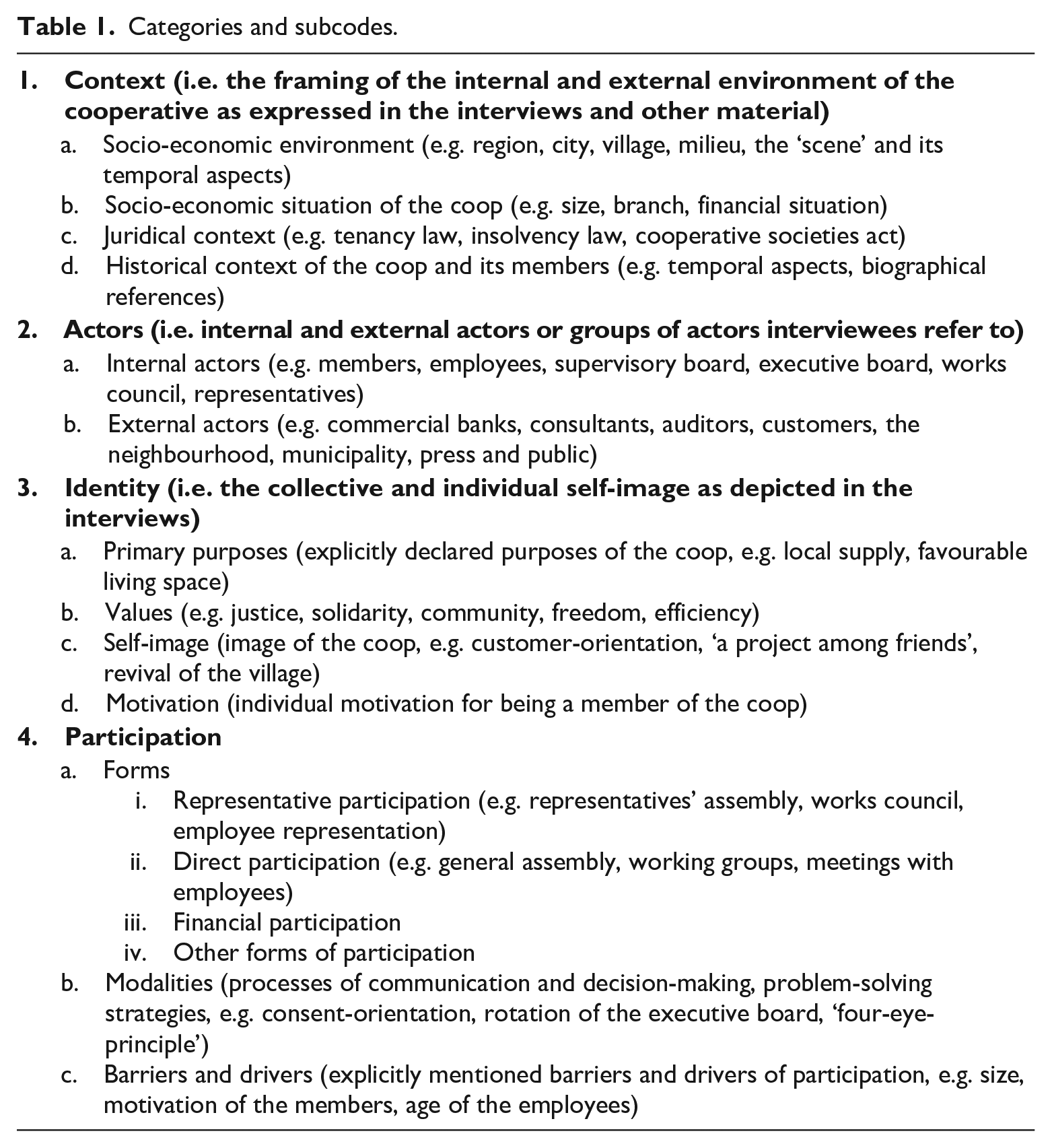
Based on the first interviews, a preliminary inductive coding was carried out. This initial coding followed the idea of identifying relevant actors and forms of participation, but also, for example, providing context for the cases. The focus was therefore not yet on paradoxes, as this is a phenomenon that only became evident in the course of further investigation. On the basis of this first coding, four categories (meta-codes) were created and used as a basis for the further coding of the interviews, documents, field protocols, etc. One of the categories was ‘participation’, comprising direct, representative and financial participation as well as the perceived barriers and drivers. This category also covered modalities (e.g. processes of communication and decision-making). The categories of ‘context’ and ‘identity’ also proved to be effective in capturing the discursive ‘embeddedness’ and the corresponding identity of the cooperative actors. Finally, the category ‘actors’ covered all internal and external actors and groups of actors considered relevant to participation so that the case studies resembled a ‘multistakeholder analysis’ (Fitzgerald and Dopson, 2009: 468). Just like the creation of our main categories, the following coding process followed an inductive approach. Thus, the codes and subcodes under the categories are derived from the data, and some are even ‘in vivo codes’ (Charmaz, 2014). Table 1 provides an overview of the four main categories as well as the respective subcodes.
Categories and subcodes.
Although we have chosen to employ an inductive methodology, it is important to acknowledge, as noted by Vaughan (2004), that theoretical background knowledge in the form of models and concepts always exists within such a process. Whereas grounded theory originally emphasized the avoidance of pre-existing concepts (Glaser and Strauss, 1967), Vaughan highlights the advantages of conducting a consistent comparative analysis between cases, which still closely aligns with the principles of grounded theory (Glaser and Strauss, 1967; Timmermans and Tavory, 2012; Vaughan, 2004).
Using the coding and the respective categories as a basis, detailed case descriptions were prepared. In the course of this process, we ensured triangulation (Denzin, 2009; Flick, 2011, 2018; Natow, 2020; Patton and Appelbaum, 2003; Stake, 2013). All authors were equally involved in the analysis, and we regularly discussed our individual interpretations (Kuckartz and Rädiker, 2019; Stake, 2013).
As indicated previously, we created a typology (i.e. a ‘qualitative classification’; Bailey, 2003: 79) based on the coding and comprehensive case descriptions, comprising all 14 cases (Kluge, 2000). Basically, the creation of a typology or type formation is considered to be an ‘aggregation of such objects into types that – with regard to certain characteristics – are more similar to each other than others’ (Büschges, 1989: 249). By doing so, the cases are intended to show the greatest possible similarity within the respective type (internal homogeneity), while the types should be as distinct from each other as possible (external heterogeneity; Kluge, 2000). As for the creation of the typology, we have included various characteristics and distinctive dimensions of a ‘property space’ (Barton, 1955: 40; see also Lazarsfeld and Barton, 1951):
What is the function of participation? Here, we assumed that participation as a ‘meaningful element’ has a positive connection to the development of participatory practices. We therefore assumed that in some cases, participation is seen as signifying and thus guiding the cooperative actors. However, in other cases, participation has no constitutive meaning for the self-image and identity of the cooperative.
Are there institutional bodies of participation for employees? This criterion directly addresses one of the central research questions. Yet, it is also concerned with the extent to which existing participation mechanisms are used. Furthermore, it was asked if they play a role in the day-to-day operations and processes of decision-making.
What is the character of the general assembly or representatives’ meeting? Is it business or member-oriented? This aspect addresses the central role to which the general assembly is assigned. Is it conceived as a more formal act, or is it directed towards the active participation of members?
Are there any informal bodies of participation for members? The question here is about the participation of members that exceed legal requirements; i.e. more possibilities to participate.
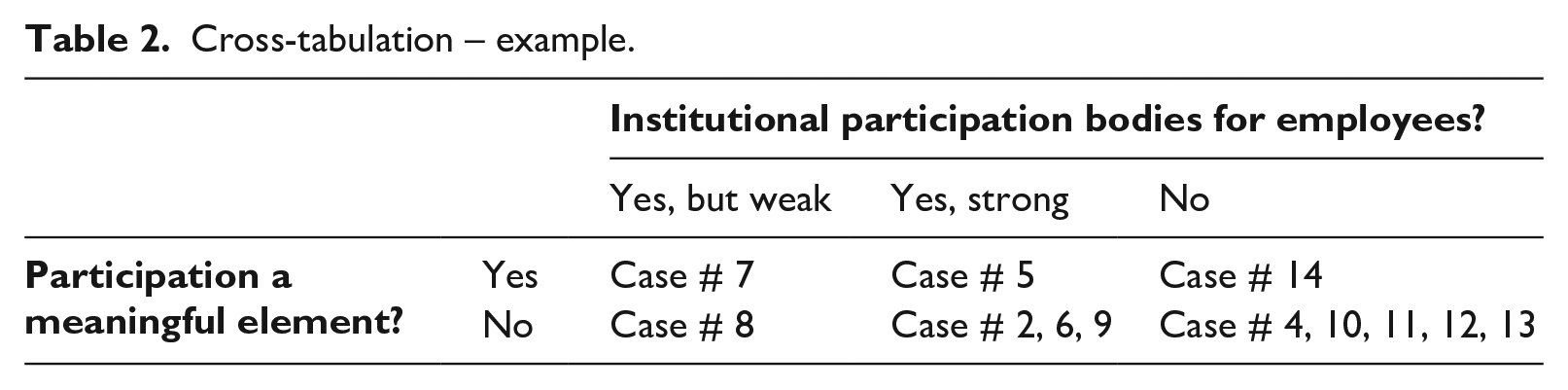
Using the specified dimensionalizations, the property spaces were determined based on these four defined characteristics. An exhaustive discussion within the research team and a final assignment of individual cases to the dimensions were carried out through a series of cross-tabulations. To exemplify and illustrate this procedure, Table 2 presents the cross-tabulation of the feature ‘Can participation be considered to be a meaningful element?’ with the feature ‘Are there institutional participation bodies for employees, and if so, are they rather strong or weak?’ Subsequently, cases 1 to 14 were assigned accordingly.
Cross-tabulation – example.
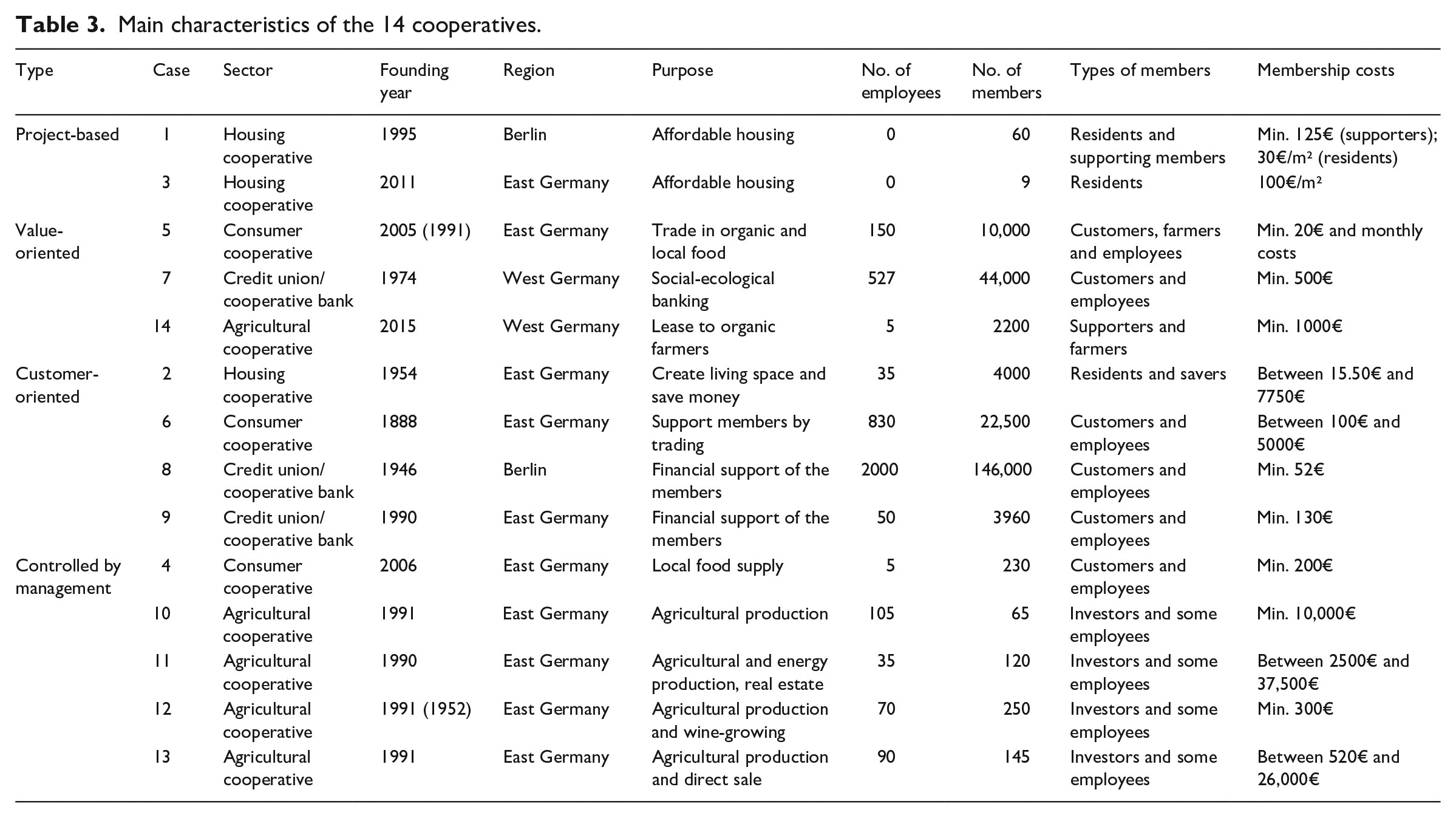
From these features, their dimensions, and the respective assignments of individual cases, four distinct types could be derived. These types represented distinct groups exhibiting internally homogeneous expressions of the considered features: project-based, value-oriented, customer-oriented participation and participation controlled by management. Table 3 shows the final classification of all cooperatives by type and outlines the major characteristics of each case. What also stands out are the diversity of the sample and the differences in the size and number of members. The most striking observation to emerge from the typology was that participatory practices and the respective type of participation do not necessarily depend on the size or the sector. Each type of cooperative is characterized by a different way of dealing with the inherent paradox. In the following section, we will give a more detailed account of the four types and describe, in a highly condensed way, the major characteristics of each type.
Main characteristics of the 14 cooperatives.
Results: Types of participation
Type 1: Project-based participation
The cooperatives of this type are small projects with fewer than 100 members and no employees. The two cases from our sample within this type are small housing associations that own one or two houses. An essential motive for the foundation of the cooperative is the preservation and provision of affordable housing. What they have in common is that they do not see their cooperative as a company, but rather as a project. Its implementation fits with the legal form of cooperative due to its participative, member-oriented opportunities. Moreover, the cooperative form resonates with the grassroots character of the projects. The following extract from a flyer gives an impression of the motives of the founders: In order to protect the tenants of these houses from speculation and predominantly profit-oriented modernisation, the cooperative offers the opportunity to buy their houses together with the tenants. This is intended to maintain stable and cost-effective rents in the long term. (Extract from a leaflet, 1997)
This said, this type is embedded in an alternative milieu or scene, from which most of the members as well as the founders of the cooperative originate. Community therefore plays an overriding role, with the tendency of the cooperative to be closed to the outside world. The project is to remain related to a certain group from the start and should only benefit this group. In contrast to the other types of participation, a large part of the work is done on a voluntary basis.
Projects implemented in the form of cooperatives are usually associated with large deposits from their members, since debt financing through loans is rather small due to the size of the company. Due to the members’ high level of commitment, these project-based cooperatives can still successfully operate economically and fulfil their purpose. After all, they are not profit-oriented or market-oriented. The members identify themselves with the values of self-realization, self-determination, participation and community. As one member puts it: We wanted to get cheap living space and of course we can offer here shared rooms to a few people. That is exactly the main purpose and it is also about the fact that you can do the whole thing self-determined, right? So not only cheap but also that you can somehow do a lot by yourself or simply decide what should happen. (F3_A: 6)
Participation can be identified as a meaningful element of these cooperatives. The decision-making process is guided by the will of the members and not by the supposed requirements of the market in which the cooperative operates. Not only because of the size, but also based on the self-image of the members, direct participation is the norm. Project cooperatives conduct general assemblies, but they are understood as nothing more than a legal obligation. Participation is dominated primarily by informal and direct practices. Frequent meetings of many members, day-to-day communication, consensus-based decision-making processes, mutual trust, work-sharing and short electoral cycles determine the type of participation. In addition, special forms of participation can be identified, such as physical work on the project or the acquisition of knowledge that is especially necessary for the implementation of the project. Grassroots democracy is an essential driver of project-based participation and is not questioned. However, the obligations associated with the cooperative, such as the annual inspection, drawing up the balance sheet, the formal criteria of the general assembly or certain board activities, are perceived as a burden or constraint, since they are based on initiative and voluntary work. These tasks require a lot of time for certain members and are unevenly distributed, which is why they are sometimes even described as undemocratic.
Type 2: Value-oriented participation
This type, which comprises a consumer, a credit and an agricultural service cooperative, encompasses economically successful, rapidly growing cooperatives that see themselves as an alternative to conventional, market-driven companies. It is characterized by the fact that participation shapes the identity of the cooperatives. The value of participation co-evolves with further values, in particular ecological and social sustainability. By contrast, maximizing profits is explicitly assigned a subordinate meaning. As one member of the cooperative bank puts it: [T]he main goal of the [TGR Bank], as I understand it, is that they can spread and develop their social business model and that they can finance as many social projects as possible. (F7_F: 100)
The designation of the type as ‘value-oriented’ emphasizes this alignment with the perspective of sustainability in connection with participation. As in the ‘project-based’ type, the cooperatives of this type are anchored in an alternative, often ecologically inspired milieu, which in our cases also includes the customers and supporters of the respective cooperatives. In all three cases, the legal form of the cooperative was chosen deliberately because it resonated with the values of the members. It was also seen as a way of dealing with the problems of growth and the upholding of participation, which was no longer guaranteed in another legal form (e.g. as association). Even if the choice of legal form was made deliberately, in this type, the advantages of the cooperative in terms of participation only became apparent in the further development of the cooperative. Thus, the idea of the cooperative supplemented the existing ecological and social values.
The participation of members often goes beyond the legal requirements: Despite the considerable size and the growing number of members, forms of direct participation for members are maintained and organized, including the deliberate maintenance of the general assembly. Although the participation of the members and employees differs among the cases, there exist diverse formal and informal participation opportunities for members and employees; for example, so-called future workshops, weekly staff meetings, world-cafés, blogs and workshops about income distribution. As a form of representative employee participation, there exist ‘circles of trust’ (in German: Vertrauenskreis), which are described by their members as a powerful means to influence decision-making: We [. . .] also have to give our final approval to all changes, restructuring, personnel changes [. . .]. So, if we don’t agree, it wouldn’t happen, yes? That’s why that they involve us at an early stage. (F7_E: 48)
Also, these alternative arrangements are based on the conviction that alternative forms of representative participation would better fit the self-image of the cooperative as a ‘value-oriented’ community, whereas works councils only represent certain interests and convey a conflictual understanding of organizations.
Despite the different efforts to maintain direct forms of participation, the board of directors plays a strategic role in controlling the direction of the coop and communicating it to its members and employees. However, all the cases of this type demonstrate that if participation is an important, meaningful and practical element of the cooperative, the growth of the cooperative needs a sustained reflection on the possibilities of maintaining participatory practices and a development of different formats to sustain participation.
Type 3: Customer-oriented participation
The third type of cooperative is represented by four large organizations in the banking, consumption and housing sector. They have between 4000 and 150,000 members and employ between 35 and 2000 people. Due to their long-standing history, all cooperatives of this type are deeply rooted in their regions or cities. In cooperatives of this type, an explicit market and service orientation prevails, functioning as the main mode of organizational sensemaking. Members are primarily addressed as customers that are portrayed as ‘demanding’ players whose trust must be won through high-quality services and whose opinion must be taken seriously: Yes, customer criticism, let’s call it customer criticism, both positive and negative, appears daily. And we strive to respond promptly and to answer everyone. And as long as customers and members talk to us, they give us a chance. There is trust there: ‘If I call or send an e-mail, something will change’. And we won’t lose that trust, right? You must [. . .] remain authentic and you can’t just brush people off, right? That is not possible. (F6_B: 22)
Above all, the management and the supervisory board in the customer-oriented cooperatives are committed to the successful business operations of cooperatives. Furthermore, there is a clear difference between participation modes. The dominant form of participation for members is financial participation, which is offered either as dividends or as special conditions for members. In contrast to this, immaterial participation is either of marginal importance and equated with a statutory burden that must be managed, or it is prescribed as a tool that can be used to guarantee customer satisfaction. Moreover, there is a clear prevalence of representative instead of direct forms of participation. Instead of a general meeting of members, the meeting of representatives is considered a suitable decision-making body of participation. Accordingly, meetings of representatives are extensively practised. Their focus is less on the concerns of the members and more on strategic business issues. As a result, the representatives enjoy a special position within the cooperative, in contrast to ordinary members. While ‘regular’ members are limited to the legally prescribed (e.g. the election of representatives) or informal and marginal participation practices (e.g. participation in events) that exclude any serious decision-making power, the representatives are equipped with access to participation practices that go beyond the legal requirements, such as participation in advisory bodies to support the board of directors. Representatives also act as mediators between the board and the members. Given this strategic role of representatives, their selection is strongly controlled by the managerial board. Possible candidates, in most cases members with an academic background, are approached in a targeted manner and asked by board members to be a candidate for elections. As for the elections, the so-called ‘list election’ instead of an individual election is the usual practice. That means that only candidates from an existing list and no individual candidates can be elected.
In terms of a representative participation of employees, there are works councils in all cooperatives of this type. Unfortunately, in several cases, empirical access to the works councils was denied. The available findings suggest that in the customer-oriented cooperatives, works councils act primarily as a consensus body even if their positions of power differ depending on the size of the cooperative and the concrete situation. Particularly in cases where works councils are members of supervisory boards, they are perceived to be in a powerful position. An explicit influence and a predominance of the board of directors are the main features of the customer-oriented cooperatives: So, the management runs the company. Neither the meeting of representatives nor the supervisory board has to meddle with this. Of course, the supervisory board has far-reaching rights to receive information. [. . .] But the representatives’ meeting, it just has its right to ask questions in both meetings. (F6_C: 30)
The concentration of power in the managerial board is linked to a sharp differentiation between member representatives with considerable power in decision-making on the one side and the ordinary members on the other side who are mainly excluded from decision-making in this type of cooperatives. As long as high customer satisfaction is achieved, however, the actual powerlessness or resulting apathy among ordinary members is not regarded as a relevant issue.
Customer-orientation is the main modus operandi, considered to guarantee economic stability. There are only a few challenges to this logic. For example, one employee we interviewed particularly misses the participative dimension as a distinguishing feature of the cooperative. As long as the explicit ‘commercial character’ of the cooperatives prevails, the interviewee considers his employer as hardly different from conventional competitors in the sector. In this individual’s case, the absent participation of rank-and-file members and employees was mentioned as the reason for leaving the organization.
Type 4: Participation controlled by management
This type appears to be the one in which contradictions between cooperative ambitions and everyday practice are not addressed at all. In fact, a contradiction itself is hardly ever evident, since no or barely any cooperative values are displayed.
Beside one consumer coop, this type can be found primarily among the large agricultural producer cooperatives of our sample. After the fall of the Berlin Wall, these were created from former agricultural producer cooperatives (in German: Landwirtschaftliche Produktionsgenossenschaften). For these cases, the tense market situation in the agricultural sector plays an important role. At the same time, there are significant differences regarding the economic situation of the different companies. This is also a result of individual development after the political transformation. While some agricultural cooperatives are currently experiencing substantial growth, others are operating on a rather small scale or are forced to downsize. The number of members of all agricultural cooperatives of this type within our sample has fallen sharply over time and ranges between 65 and 250 (from originally over 1000). The number of employees ranges between 35 and 105, although not all of them are members of the cooperative.
Similarities among the cases of this type already become obvious when it comes to self-perception of actors within the cooperative: the organization is considered a ‘normal’ agricultural enterprise or was mostly portrayed as a ‘perfectly normal cooperative’, as one interviewee put it. This stance is reflected in the question of participation of employees and members: for most of the cooperatives’ representatives, this is not an issue, just like type 3. Moreover, the mere attempt to explore this aspect by means of a research project was almost considered an affront or at least an ‘odd endeavour’. In all cases of this type, informants argued that the cooperative must be managed as a regular company – notwithstanding the legal form of a cooperative. Agricultural production is regarded as the primary purpose and one can observe a strong market orientation where participation has no sensemaking function. Members act primarily as investors and only participate in the distribution of annual dividends (as far as the economic situation of the company permits). This argumentation and logic of necessity is also reflected in the rights of employees to participate in decision-making. Accordingly, even the members elected to a committee are quite limited in their participative roles: [T]here are some employees who are both shareholders and members of the supervisory board. And who then turn board meetings into union events. And that’s where you simply have to get involved – you have to stress that it’s actually about corporate decision-making, because I say: ‘social competence doesn’t mean that you distribute as much as possible’. You can only distribute what you have earned. (F13_A: 92, chair of the board and CEO)
The membership of the employees is taken as a sign of loyalty to the company. But once again, the possibility of participation is limited. This is illustrated by the fact that a works council does not exist in any of the cases of this type, and, in some cases, its establishment was prevented. Membership itself is often restricted; this means that not all employees can become members. In one of the cases, for example, the chair of the board said that they ‘first have to prove themselves’. In another case, the individual share to be acquired must amount to at least €10,000. Compared to other cooperatives of our sample, this is a rather large amount of money, and many ordinary employees will probably not be able to afford it.
Just like participation is restricted, the access for us as researchers appeared to be limited as well. Very rarely were we allowed to speak to ‘normal’ members of the coop. According to the interviews we were able to conduct, the participatory structures for members are based on the legal requirements and do not exceed them at any point. There is an annual general assembly where members rarely raise their voice and hardly any discussions take place. There are no informal opportunities for members to participate. Other forms of participation are at best simply ‘information’ provided by the management. Besides this, there are annual events such as crop feasts.
Accordingly, the cooperative of this type is managed by the CEO under their sole responsibility. However, in cases of this type and in contrast to the others, the chair usually considers themself to be the ‘boss,’ and is also referred to as such by the employees, often taking up quite a patriarchal role. Only in the case of major investments, is consultation with other board members and coordination with the supervisory board obligatory. The chair is thus a planner and decision-maker which, in one case, also affects the plan of succession: One of the chairmen of the board, Mr. [Brent], head of field crops, he will become my successor – in four and a half years, when new elections take place [. . .] and I will – if I feel well, if I am healthy – stay there, taking his function. We just swap positions, I’d say. He just doesn’t know that yet, you know? (laughing). (F12_A: 112-114, chair of the board and CEO)
This example illustrates well how democratic decision-making and participation in cooperatives are undermined. Of all four types and in its neglect of participation, this one is certainly the most extreme. The autocracy that prevails in cases of this type represents a stark contrast to participation that is actively strived for, as in types 1 and 2. At the same time, however, the method of managing these coops is only made possible by the existing legal framework and its possibilities of establishing a facade, if necessary. Whilst the voting rights of members in cooperatives are mentioned as a special feature, it is simultaneously pointed out that a strict management of the company is essential: The voting right is different. . . because it is not based on a shareholder’s share. . . given the economic situation as it currently is in the market, the management of the company must be the same. . . yeah!. . . so I actually see the voting right there which is definitely more important than in a public limited company. (F11_A_B: 128-129, chair of the board and CEO)
Such references to the possibilities of participation in coops might result from a social desirability bias and was possibly triggered by us researchers. The inherent contradiction to the original agenda behind the concept of a cooperative is thus not actively addressed and ignored at best.
Discussion
When we look at how paradoxes, and in particular the organizing paradox, are handled within the four types of cooperatives, we can firstly distinguish between the passive and active ways of its handling (Aust et al., 2017). In cooperatives where participation represents a core dimension of organizational sensemaking, as in type 1 (project-based) and type 2 (value-based), the inherent trade-off between democracy and hierarchy is actively addressed in the day-to-day processes of the cooperative. These coops try to dissolve the paradox by dealing with it actively and transcending it. For example, the members of the cooperatives of type 1 try to uphold the ideal of a grassroots democracy, with a strong emphasis on informal participation of its members by refusing any formal procedures or responsibilities, even if it leads to a ‘tyranny of structurelessness’ (Freeman, 1972), where the informal procedures result in time-consuming activities, an unequal distribution of power and forms of self-exploitation. Cooperatives of the value-based type are characterized by a massive growth in recent years, which affects their handling of the organizing paradox. Although informal participation still plays a strong role, there are several attempts to create formal procedures upholding participation in times of growth. However, the cases of this type also show the establishment of a democracy with a strategic apex. This refers to the development of a strong management that tries to influence and strategically control the continuity of the cooperative. In handling hierarchical tendencies, these cooperatives explicitly try to maintain a strong, that is, member-led general assembly and utilize other powerful methods, e.g. the trust circle as the body of the employees. That said, this type resonates with the idea of a ‘democratic hierarchy’ (Viggiani, 1997).
In contrast, types 3 and 4 follow a rather passive approach of dealing with the organizing paradox. They deny the contradictions or the existence of a ‘problem’ deriving from the cooperative as an organizational form. In the case of the consumer-oriented participation, we can observe a splitting strategy (Smith and Lewis, 2011). The sensemaking in these cooperatives is oriented towards a reframing of members as consumers, where participation is reduced to a focus on a good customer-relationship. Following Cheney (1999: xi), this shift is part of a wider attempt to turn citizens into consumers. The result can be described as a ‘pseudo-democracy’, where participation becomes shallow and routine. The focus on financial participation, that is, on material wants, and on representative forms of participation that creates different camps for members and employees as in the cases of type 3, supports this critical diagnosis. Similarly, a persistent reference to the market characterizes the sensemaking of type 4, where participation is controlled and circumvented by the management. The autocratic structure of these cooperatives is close to Michels’ ‘iron law of oligarchy’. The organizing paradox is ignored by and large, and participation of ordinary members (and the lack of it) seems not to be problematized at all, which coincides with the restricted access to the cases. Regarding the cases of type 4, we could not observe informal patterns of participation nor formal procedures for the participation of employees. Thus, handling the organizing paradox means here to sustain an autocratic and patriarchal style of leadership. This probably frustrates any attempt for participation or democratic procedures in the cooperatives and, as our cases indicate, leads to ‘disempowered agents’ (Berti and Simpson, 2021) and ‘voluntary servitude’ among ordinary members as well as employees in cooperatives of this type.
The research contribution of our study is multifaceted. Firstly, it substantiates the assumption put forth by scholars that both paradoxes and the organizational responses to them are contingent on contextual factors (Fredberg, 2014). Given that the tension between organizational democracy and hierarchy represents a pivotal dimension of cooperatives (Audebrand et al., 2017), our multiple case study provides context-sensitive comparative data on how cooperatives deal with this organizing paradox. Secondly, our study identifies typical approaches adopted by cooperatives in response to the organizing paradox, ranging from transcending the paradox to neglecting it and establishing autocratic structures. The four types of responses to the organizing paradox outlined in this study offer an analytical framework that allows for a comprehensive examination of previous discussions concerning the ‘democratization’ or ‘oligarchization’ of cooperatives (Varman and Chakrabarti, 2004) as just few among several potential modes of response. Thirdly, our study highlights a strong link between the ways in which cooperatives address the organizing paradox and the sensemaking activities within these organizations. While there may be various reasons why cooperatives choose one approach over another in dealing with the organizing paradox, the manner in which participation and organizational democracy are conceptualized and understood within the organization’s specific sensemaking processes appears to play a fundamental role. For example, active approaches to cope with the paradox, such as transcending it, necessitate a problematization of participation as an issue, as exemplified by the types of ‘project-based participation’ or ‘value-oriented participation’.
Nonetheless, we have to acknowledge several limitations that should be taken into account when critically assessing the generalizability of the study’s findings. In certain instances, particularly in the case of type 4, the data received primarily reflect the viewpoints of management, with insights into the perspectives of ordinary members and employees missing. As a result, the findings may not fully capture the nuances and variations in the ways different organizational actors approach the organizing paradox. Additionally, since the data were exclusively collected in Germany, where cooperative organizations are bound by specific legal frameworks, it remains open whether the results can be fully applied to cooperatives in other countries. Finally, our study did not explore the emergence, decline or development of participatory practices over an extended period of time. Obviously, such a longitudinal perspective could lead to additional insights into the long-term changes in the handling of the organizing paradox.
Regarding future research prospects, we believe that at least two issues merit further exploration and in-depth analysis. Firstly, the typology proposed in this article could serve as a valuable starting point for investigating why and under what circumstances each of these response types emerges within cooperatives dealing with the organizing paradox. Factors such organizational or members’ history could shed light on the reasons for each response type. Secondly, the relationship between paradoxes in organizations and sensemaking activities represents a relatively new topic in the existing literature. Exploring how sensemaking activities shape the ways in which organizations grapple with paradoxes and, conversely, how dealing with paradoxes is reflected in organizational sensemaking, would be a fruitful endeavour. Integrating these two lines of research would contribute to advancing management research on paradoxes as well as research on cooperatives, fostering stronger connections between these two related fields of study.
Conclusion
Our study identifies different ways of handling the organizing paradox, ranging from forms of grassroots democracy to autocracy. Handling the organizing paradox is also a burden and any active coping with the tensions between hierarchy and democracy creates complexity, and any denial or suppression seems to reduce it. As type 3 (customer-oriented participation) and even more, type 4 (management-controlled participation) demonstrate, there seems to be a desire for order and structure, which also highlights the power-laden processing of paradoxes and the disempowering of certain types of members and employees (Berti and Simpson, 2021). In contrast, the cases of type 1 remind us of the dangers entailed in the denial of the benefits of any formalization (Parker et al., 2014). Given the complexity and unresolved tensions of our cases, we believe that cooperatives remain among the most striking cases for investigating the promises and pitfalls of alternative forms of work and organization and organizational democracy.
Footnotes
Declaration of conflicting interests
The authors declared no potential conflicts of interest with respect to the research, authorship, and/or publication of this article.
Funding
The authors received no financial support for the research, authorship, and/or publication of this article.
