




Abstract
Corporations play an increasingly significant role in public policy and democratic politics. This article seeks to understand how corporate political activities gain political influence through intertextual strategies. The analysis is conducted on the texts produced by the Australian government in proposing a new tax as well as the texts produced by the mining industry in campaigning against the tax. We show how the government texts represent the proposed tax as a fair opportunity, while the mining industry texts represent the tax as an unfair threat. The findings attend to the processes of how the mining industry ‘stitched’ together constituencies in support of their representation. This article contributes to the existing literature on corporate political activity by showing how overt and indirect corporate activities and communications influence public policy agendas. It also contributes to critical studies of corporate political activity by theorizing how textual strategies can be used to align corporate interests in hegemonic political struggles through the creation of a phantom community. Finally, the article contributes to theories of intertextuality by developing a typology to analyse textual representation.
Introduction
On 24 June 2010, Kevin Rudd resigned as Prime Minister of Australia. He was replaced in office by his former deputy, Julia Gillard. During her first speech and press conference as Prime Minister, Gillard (2010) announced that she was ‘throwing open the government’s door to the mining industry’ to negotiate the design of a new tax on resources. The following day Australian newspapers connected the mining industry to Rudd’s downfall with front page headlines such as ‘Tycoons claim credit for burial’ (The Sydney Morning Herald, 2010) and ‘Miners hold fire, for now’ (The Australian Financial Review, 2010). A concerted campaign by the mining industry was widely seen to have influenced democratic politics, linked to a collapse in support for Rudd and the revision of adverse policy (Bell and Hindmoor, 2014; Gilding et al., 2012).
The mining industry’s campaign against the proposed tax is symptomatic of the increasingly significant involvement that corporations have in public policy and democratic processes (Barley, 2007; Hillman et al., 2004). This involvement takes the form of corporate political activity (CPA), which is here broadly defined as ‘any deliberate firm action intended to influence governmental policy or process’ (Getz, 1997: 32–33). The emphasis in the CPA literature to date has been on establishing the reasons for engaging in CPA, the tactics employed in CPA and the outcomes of CPA for the firm (Hadani and Schuler, 2013; Mantere et al., 2009), with comparatively less development in regard to how these activities influence public policy, that is, the mechanisms of how corporate interests become meaningfully represented and justified.
To understand how political strategies are influencing public policy debates, this article employs the concept of intertextuality in examining how texts are constructed in order to represent public policies and justify particular policy positions. With texts, we refer to any kind of symbolic expression taking on a material form accessible to others, including written documents, verbal reports, artwork, spoken words, pictures, symbols and artefacts (Grant et al., 1998). Every text is intertextual in that it refers to other texts in producing particular versions of reality (Kristeva, 1980)—a representation of knowledge of a situation which influences practices (Hall, 1997). Texts then function to produce particular ‘readings’ of the situation, which (re)produce ideological structures or discourses (Foucault, 1991). These ideological premises refer to historically specific representations of the world that are presented as natural and timeless (Barthes, 2009). Intertextuality is useful in order to understand this representation since it implies ‘the insertion of history (society) into a text and of this text into history’ (Kristeva, 1980: 68).
The intertextual analysis is conducted on texts produced by the Australian government in proposing a new tax and the texts produced by the mining industry in Australia campaigning against the proposed tax. The analysis shows how the texts construct contrasting representations of the proposed tax and how the intertextual features work to assemble and verify support for their particular representation. Through the intertextual analysis of the public policy debate, we make three central contributions. First, we contribute to the CPA literature by theorizing how corporate activities influence public policy overtly and indirectly through horizontal and vertical intertextuality. Through intertextual strategies, the mining industry stitched together constituencies representing their position. This is a textually constructed community supporting the position of the industry—a phantom community (Robbins, 1993). Second, this contributes to neo-Gramscian studies of politics by showing how in current mediatized society hegemony can be accomplished through textual representation of hegemony, without necessarily aligning ‘real’ interest or identities. Third, we develop intertextual analysis to show how texts dialogically weave together temporal and contextual dimensions to present a singular history/society. Intertextuality thus helps us explain the possibility for corporate political influence and how such activity is grounded in specific contexts.
CPA
Since the 1980s, there has been a substantial expansion in the amount of CPA that firms engage in to manage regulatory risk (Hillman et al., 2004). These efforts to influence and minimize government regulation of business activity can be seen as enactments of the broader neoliberal project of changing the conditions for capital accumulation in Western capitalist democracies (Crouch, 2011; Harvey, 2005). Barley (2007) even argues that representative democracy has been replaced with a ‘corporate society’ in which corporations influence legislation for their own benefit above and beyond citizens. It is important, therefore, to understand how corporations produce this influence.
CPA research in management and organization studies is predominantly concerned with the strategies of influence available to firms in changing public policy to enhance corporate performance (Dahan et al., 2013; Hillman et al., 2004; Lawton et al., 2013). Hillman and Hitt (1999) distinguish between three generic CPA strategies to this aim: (a) providing information to political decision-makers through, for example, lobbying; (b) providing monetary incentives through, for example, campaign contributions; and (c) providing voter support through, for example, constituency building. The two former strategies are normally covert and direct, where, for example, corporations provide financial contributions to political candidates or parties through industry affiliations or political action committees (PACs). In contrast, constituency building is an ‘attempt to influence public policy by gaining support of individual voters and citizens, who, in turn, express their policy preferences to political decision makers’ (Hillman and Hitt, 1999: 834). This is an indirect and complex process of mobilising a network of actors to signal their support to politicians by engaging in political actions such as attending rallies and contacting representatives. All three strategies are generally understood to be mutually beneficial for corporations and politicians as a means to subsidize participation in electoral politics through the provision of political goods (information, money, voter support) to decision-makers (Hall and Deardorff, 2006; Walker, 2009). The emphasis on corporate performance and mutual benefits suggests a lack of more critical examination of CPA (Mantere et al., 2009).
If democratic politics, as Arendt (1958) suggests, is basically about conflict over meaning, some form of contestation or struggle is a prerequisite for politics and political activities. This is recognized by more critical scholars, who are sceptical towards the harmonious relations prevalent in the mainstream CPA literature (see, for example, Levy and Egan, 2003; Nyberg et al., 2013). Employing a neo-Gramscian analysis of corporate influence, these studies provide explanations of how corporate actors engage in contestation, or ‘war of positions’ (Gramsci, 1971), to influence public policy. In this war of positions, public policy is contested through establishing hegemony by ensuring that the interests of the corporation overlap with the interests of other groups in society (Nyberg et al., 2013). This is a political struggle of mobilization (Levy and Scully, 2007), achieved through strategically linking corporate interests with ‘allies’ and against ‘enemies’ within the territory of the contestation (Van Bommel and Spicer, 2011). A dominant hegemony, or ‘historic bloc’ (Gramsci, 1971), requires the alignment of (a) various groups of actors and (b) discursive configurations that stabilize and (re)produce meaning (Levy, 2008; Levy and Egan, 2003). For example, Nyberg et al. (2013) identified two corporate political strategies used to influence the public debate on climate change: (a) building common identities with other civil society groups, such as politicians, industry associations, think-tanks and non-governmental organizations (NGOs), and (b) synchronizing the corporate interests with broader national or societal principles of economic and environmental good. Thus, hegemonic corporate political activities require both popular representation and forms of moral justification.
Constituency building is then accomplished by linking corporate interests with actors’ or communities’ identities or interests (Laclau and Mouffe, 1985). To reach and sway ‘popular beliefs’ (Gramsci, 1971), corporate contestation of policies are public struggles. It is through the production and distribution of texts (advertorials, press releases, speeches, education programmes etc.) that corporations build or defend hegemonic positions (Fairclough, 2010). While the neo-Gramscian perspective explains how corporate strategies effect public policy change (Levy and Egan, 2003), the field lacks detailed examination of the textual strategies aligning corporate interest with constituencies (Contu et al., 2013). This leads us to the broad research question guiding our study: How do texts produce public representation and moral justification in contesting public policy? To respond to this question, the following section details an analytical employment of the concept of intertextuality.
Intertextuality as textual political activity
Intertextuality—‘the notion that a text is relationally bound to other texts’ (Riad et al., 2012: 122)—is a useful concept to understand textual representation and justification because it foregrounds the social connectedness and political context of texts. The theoretical background to the development of intertextuality is the Bakhtin circle’s (Bakhtin and Medvedev, 1978; Bakhtin and Voloshinov, 1986) move beyond linguistic structures in arguing that texts exist in relation to social situations and evaluations. The meanings of a text derive from the surrounding discursive configurations used to produce and interpret the text. Texts are in dialogue with previous and future texts (Bakhtin and Voloshinov, 1986). The implication of this is that language is always in a ‘ceaseless flow of becoming’ (Bakhtin and Voloshinov, 1986: 66). Since all textuality is intertextual, to be meaningful a textual analysis requires a focus on the underlying dialogic relations and their historical and social significance (Bakhtin and Medvedev, 1978). Texts are then pivotal in enforcing and challenging political domination (Bakhtin, 1981). Bakhtin informed the development of the concept of intertextuality for textual analysis, most prominently by Kristeva (1980) and Fairclough (1992).
With reference to Bakhtin, Kristeva (1980) coined the term intertextuality in reference to the open and productive function of texts. Kristeva (1980) argues that ‘any text is constructed as a mosaic of quotations; any text is the absorption of a reply to another text’ (p. 66). The meaning of a text is co-constructed in interconnections with surrounding texts, such that a single word can possess many meanings dependent on the situation in which it is uttered. In situating a text, Kristeva (1980) developed an analytical intertextual grid of horizontal and vertical axes. The horizontal axis is the line between the subject and addressee (the dialogue between the producer and the consumer of the text), the latter being either a character to whom the text is directed or a general reader. The vertical axis is the line between the text and its context. This line emphasizes the text’s relation to surrounding discourses. Any text is in dialogue along the two axes of writer—reader and text—context (Kristeva, 1980). This dialogism assumes the productive aspects of texts in forming the positions the text engages with. This implies that through intertextuality, texts take part in forming existing discourses (Kristeva, 1980) and constitute ideological struggles (Allen, 2000).
Drawing upon both Bakhtin and Kristeva, Fairclough (1992) further analytically developed the concept of intertextuality. Fairclough (1992) draws a distinction between (a) ‘manifest intertextuality’, where other texts are explicitly drawn upon, and (b) ‘constitutive intertextuality’, where discursive configurations are implicitly engaged with (pp. 95, 104). Manifest cues are quotation marks and references to other texts evident in, for example, academic writing (Riad et al., 2012). However, texts may manifestly incorporate other texts without being explicitly referred to in, for example, using irony or negating a position (Fairclough, 1992). Constitutive intertextuality refers to the productive configuration of a text by a diverse set of discourses and genres (Fairclough, 1992), that is, how text signifies particular aspects and perspectives (discourse), and the particular type of discursive activity, such as report, interview and press release (genre). Fairclough (1992, 2003, 2010) developed the approach to intertextuality in order to interrogate hegemonic struggles in society, that is, the domination and naturalization of particular representations of the world. These representations are ideological in that they support power constellations and domination (Fairclough, 2003).
Kristeva’s vertical intertextuality can be seen to broadly overlap with Fairclough’s constitutive intertextuality. In both categorizations, the dialogues in the text are with specific social and historical discourses. However, with horizontal intertextuality Kristeva emphasizes the subject—addressee relationship—while in contrast, Fairclough’s manifest intertextuality emphasizes the traces of textual relationships. Even so, both horizontal and manifest intertextuality denote a temporal dimension and placement of the text. The interest is not in the temporal development of an individual actor or the source of a particular text (Kristeva, 1996), but rather the transformation of meaning in the textual production over time. Furthermore, considering that they share the aim of understanding the processes and struggles in producing social hierarchies and hegemony (Fairclough, 1992; Kristeva, 1980), their analytical dimensions can fruitfully be combined into a grid interrogating how political representations of the world are weaved together (see Figure 1). In this grid, the horizontal axis is a line between the producer of the text across to the reader or consumer of the text. The vertical axis is a line between the text and the context. These textual dialogues or relations can be either manifest, with explicit representation of characters or readers, or constitutive with representation through discourses. Both these axes are combining space and time in their dialogue, with representations formed through past, present and future events and discourses.
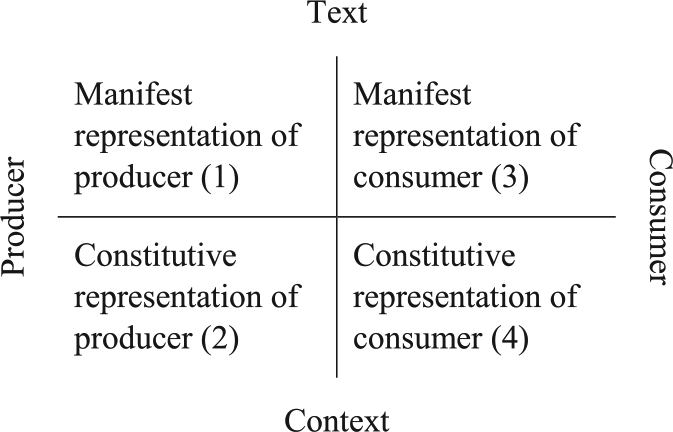
Intertextual grid for analysis of political activities.
The first (1) square indicates manifest representation of the producer of the text. This often includes self-referencing, where the text draws attention to credentials in order to establish authority. For example, corporate texts often include stories of past ‘legends’ and ‘heroes’ for the moral justification of corporate activities and agendas (Boje and Rosile, 2008). The second (2) square of the grid denotes the discourses engaged to represent or justify the position of the producer. Commonly, this includes engaging in moral discourses of what is right or good for the industry, community or nation. Similarly, the third (3) square indicates manifest representation of the consumer or character of the text through, for example, the explicit incorporation of other texts to create a caricature for the purposes of critique or ridicule (Ott and Walter, 2000). For example, in her parodies of Sarah Palin during the 2008 presidential elections in the United States, Tina Fey drew on verbatim quotes to create a particular representation of Sarah Palin in the American TV show Saturday Night Live, which had the potential to influence interpretations of the original character. Finally, the fourth (4) quadrant denotes the discourses engaged in the text to represent the position of the consumer or character of the text. For example, in portraying Sarah Palin, Tina Fey engaged discourses associated with ultra-conservatism and rural United States (Esralew and Young, 2012). All four squares are dialogues in that they inform the relations between the text—context and producer—consumer. The grid foregrounds the relations between producer—reader and text—context in order to unpack representations of knowledge and truth, that is, the ideologies that are embodied in the stabilized meanings in the representation of the world.
The aim of the intertextual analysis is to bring forward the intertextual function of texts in (re)producing ideologies, that is, the system of representations that are given specific historical context and functioning within a society (Kristeva, 1980). Media institutions are crucial for these ideological processes in society by engaging people to form opinions and reflect upon national events (Fairclough, 2010; Riad et al., 2012). Mass media allows for the opportunity to denote a ‘public’—‘large-scale political subject’ (Cody, 2011: 38)—in support of certain actors and interests. In management and organization studies, this has been studied in how media texts participate in the legitimation of national ideologies in mergers and acquisitions (Riad et al., 2012) as well as the legitimation of shutdowns of corporate units (Erkama and Vaara, 2010; Vaara and Tienari, 2008). These studies show the importance of media in promoting and distributing particular representations of decisions and events. In promoting or contesting public policy, actors can engage with different forms of media in constructing a favourable representation of their position. Media is thus important as a medium for intertextuality in investigating our question of how texts produce public representation and moral justification in contesting public policy.
The study
Setting: the Resource Super Profits Tax
This study examines the texts produced by the Australian government and the mining industry following the proposal of a new tax on resource profits. The Resource Super Profits Tax (RSPT) was one of 138 recommendations emerging from the Henry Review of the Australian taxation system released on 2 May 2010 by then Prime Minister Kevin Rudd and Treasurer Wayne Swan (Commonwealth of Australia, 2010). The announcement of a new tax on mining profits sparked a public relations battle between the government and the mining industry (often represented by the peak professional body, the Minerals Council of Australia (MCA)).
In response to the proposal, the MCA, BHP Billiton (BHP) and Rio Tinto all issued press releases on the same day as the announcement by the government (BHP, 2010b; MCA, 2010a; Rio Tinto, 2010b). On 7 May 2010, the MCA began a print campaign that ran until 24 June 2010 with full-page advertisements in newspapers across Australia. On 9 May 2010, the MCA launched its campaign website ‘keepminingstrong.com.au’, along with the release of its first consultant’s report on the impact of the tax (Radar Group (MCA), 2010). The campaign increased in intensity and scope from 21 May 2010 as other mining entities began to advertise, and the MCA supplemented its print advertisements with radio and television advertisements. From 24 May 2010 until 25 June 2010, 10 different MCA radio advertisements aired 4510 times (141 times a day on average), and from 31 May 2010, 5 different television advertisements aired 1236 times (50 times a day on average) on free-to-air channels (Ebiquity, 2011). Another industry body also joined the campaign, the Association for Minerals and Exploration Companies (AMEC), whose four different radio advertisements aired 713 times (36 times a day on average) from 5 June 2010 until 24 June 2010. Individual mining companies also began running their own print campaigns in late May.
Following the mining industry’s initiative, the government launched its own taxpayer-funded campaign of print, radio and television advertisements. Public information campaigns explain new policies, and since this campaign would explain a proposed policy, it required the government to obtain an exemption from the limits on political advertising (Department of Finance and Deregulation, 2010). Exemptions can be granted on the basis of national emergency, extreme urgency or other compelling reason. In order to facilitate this, the Treasurer requested an exemption from the restrictions on 10 May 2010, which was granted by the Special Minister of State on 24 May 2010, who wrote, Given that co-ordinated misinformation about the changes is being promulgated in paid advertising as I write, I accept the need for extremely urgent action to ensure Australians receive accurate advice about the nature and effect of the changes. (Finance and Public Administration References Committee, 2010: 2–3)
Government radio and print advertisements began on 29 May 2010, followed by television advertisements from 6 June 2010, and all ran until 24 June 2010. Print was the primary channel for government advertisements (Australian National Audit Office, 2012: 153).
The RSPT was the single biggest media issue throughout this time, with 10,784 mentions in the press, 66,503 mentions on the radio and 43,490 mentions on television (Media Monitors, 2010). Individual mining companies and industry associations spent a total of AUD$22.2 million on political advertising during their campaign against the RSPT (The Sydney Morning Herald, 2011), and the government spent a total of AUD$10.6 million on its own advertising (Australian National Audit Office, 2012: 157). The projected difference in tax receipts between the originally proposed RSPT by Prime Minister Rudd and the revised Mineral Resources Rent Tax introduced by Prime Minister Gillard has been reported to be ‘at least $100 billion’ over a decade (The Australian Financial Review, 2011).
Data collection
All texts generated by the government and the mining industry which entered the public domain during the period between the announcement of the RSPT on 2 May 2010 and the declaration of a truce between the miners and Prime Minister Gillard on 24 June 2010 were collected for analysis. Table 1 provides a detailed overview of the 614 communications collected for empirical analysis from the key actors in the debate, of which 139 referred to the RSPT.
Primary communications by the government, mining industry peak bodies and mining companies, 3 May to 24 June.
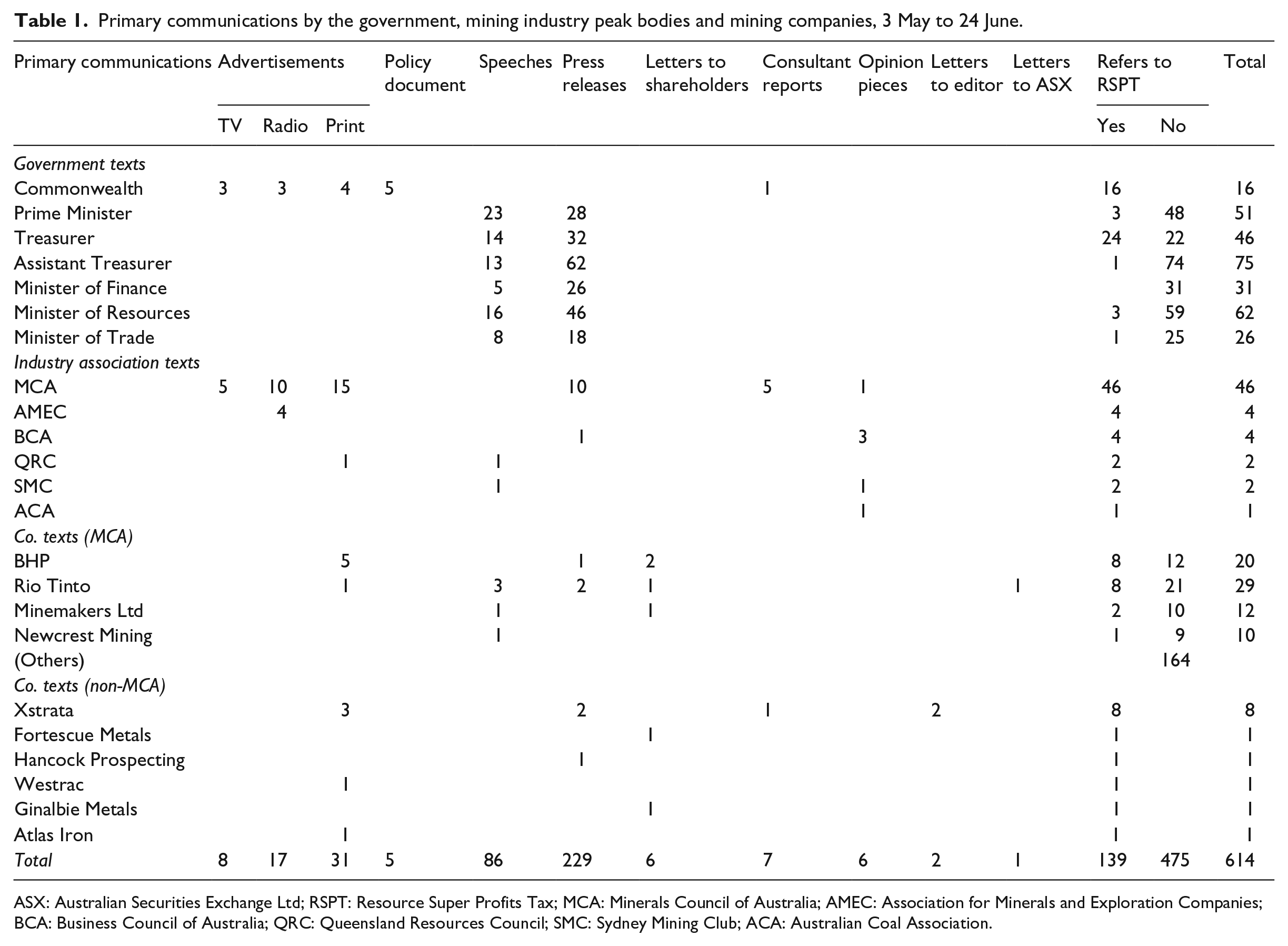
ASX: Australian Securities Exchange Ltd; RSPT: Resource Super Profits Tax; MCA: Minerals Council of Australia; AMEC: Association for Minerals and Exploration Companies; BCA: Business Council of Australia; QRC: Queensland Resources Council; SMC: Sydney Mining Club; ACA: Australian Coal Association.
We also collected media texts to contextualize the event in broader societal discourses to ensure that our interpretation would be intertextually grounded. A total of 705 articles reporting on the RSPT were drawn from the two Australian newspapers with a national circulation, The Australian and The Australian Financial Review. These two newspapers represent the two major newspaper companies in Australia, Fairfax (The Australian Financial Review) and News Limited (The Australian), and provided the most articles on the debate (Gilding et al., 2012). All articles in these papers that referred to the RSPT were collected for the contextualization of our analysis.
Data analysis
In the first stage of analysis, we developed a narrative account of the political campaign. All audio and video files were transcribed. Using government and industry texts as well as the media reports of the events, we constructed a timeline of significant events that lead to the abandonment of the proposed tax (see Figure 2). We chronologically ordered these events by identifying relevant sources of texts and noting down the author, date and type of communication for each text in establishing ‘who said what, and when’ (Maguire and Hardy, 2009: 153). From our timeline, we identified a pattern of three phases in the contestation of the proposed tax. The first phase was the initial communications from the government and the mining industry. We identified a second phase when the mining industry began constructing intra-campaign intertextuality by responding to its own texts. Finally, we identified a third phase of the campaign when there was a multiplication of industry voices participating in the campaign and the public was presented as protagonists within the texts. The third phase developed and constructed a phantom community in support of the mining industry’s position. Thus, rather than a debate comprising claims and counter-claims between the two parties that addressed similar points, mining industry texts tended to respond to their own texts (phase 2) and respond as the public (phase 3), while government texts responded explicitly to claims in mining industry texts.
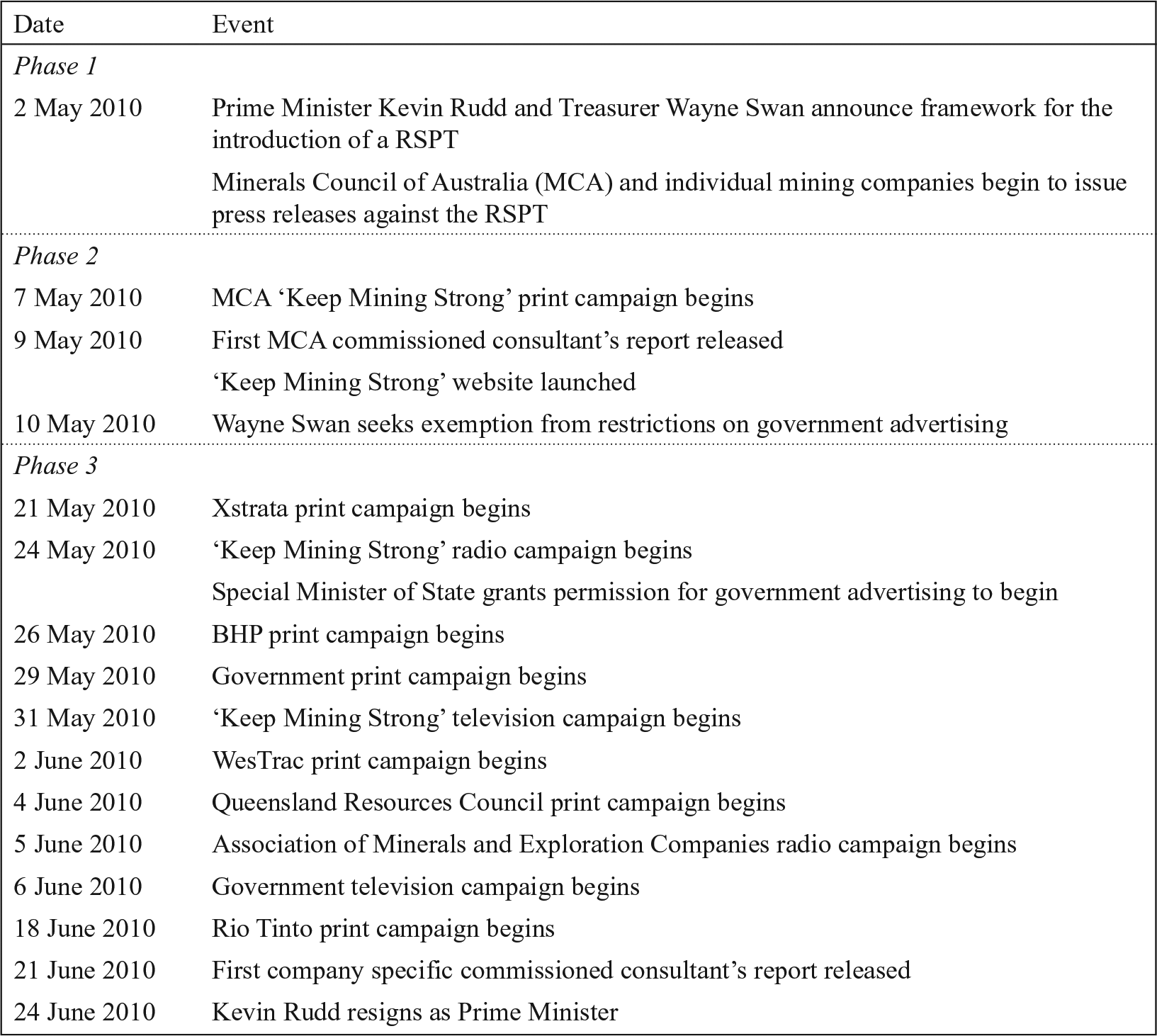
Key textual events in the ‘Keep Mining Strong’ campaign.
Faced with competing representations rather than competing arguments, we sought to draw out the political process of shaping interpretations and editing representations of events through intertextual analysis. In analysing the government and industry texts, we identified the key intertextual strategies for both manifest and constitutive elements of intertexts (see Table 2). In the analysis of horizontal intertexts, we identified the type of intertextuality for manifest inclusions of other texts and identities in each text. Following from this, we also identified the constitutive discourses provided to these other texts and identities. For example, in the government’s initial announcement, The long term tax plan we announce today will strengthen the economy and make the tax system fairer and simpler for Australian working families and businesses. These are the first steps in a 10 year agenda that will help ensure we share prosperity fairly, maximise our opportunities, and keep Australia in the box seat as the global recovery gathers pace. (Rudd and Swan, 2010)
Intertextual strategies.
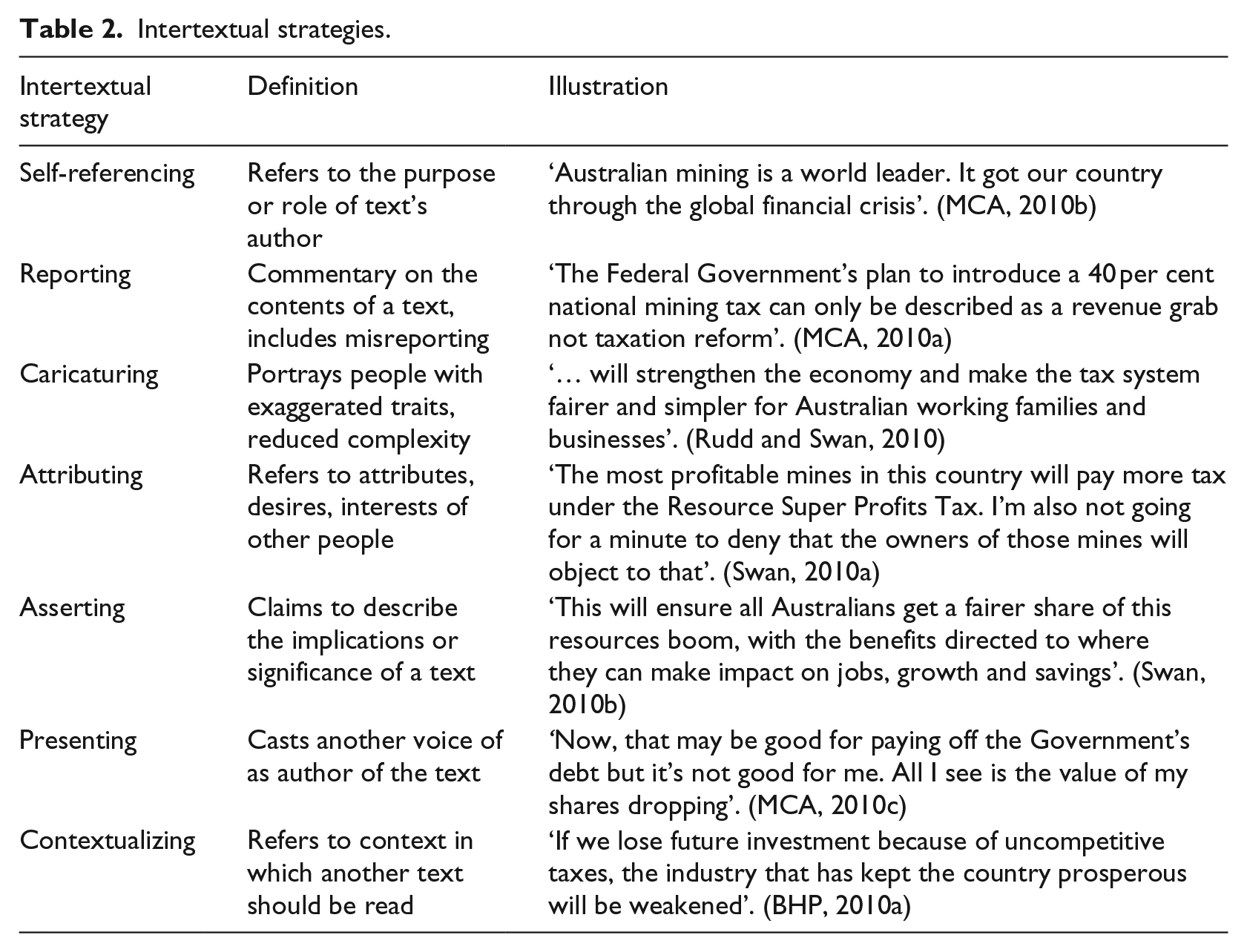
The horizontal intertexts in this extract include (manifest) self-referencing of the government as an actor with strategic (constitutive) foresight, (manifest) caricaturing of the public as ‘working families and businesses’ as well as (manifest) asserting of the interests of the public as a (constitutive) fair society through the (constitutive) tax system. The horizontal intertexts portray the interests of particular publics as provided for by the government, which will use the tax system to share prosperity fairly and maximize opportunity. Through the analysis of horizontal intertexts, we identified interactions between the intertextual networks of government and mining industry texts in the way that each contested and claimed the support of constituencies and texts (see Table 3).
Illustrations of horizontal and vertical intertextuality in government and mining industry texts.
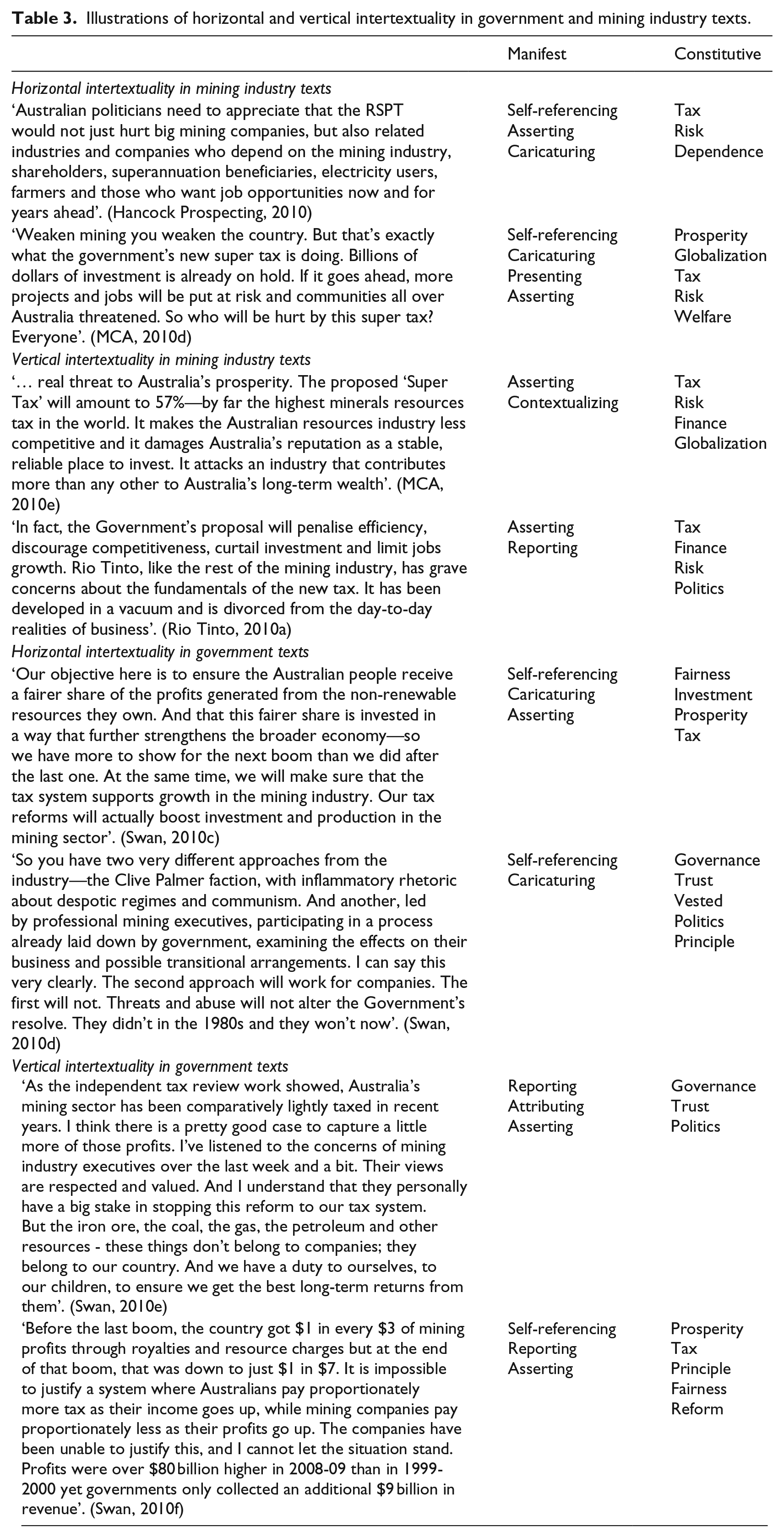
With the vertical intertexts, our analytical focus was on how the tax and the world were meaningfully represented (Hall, 1997). Again, this involved the identification of both manifest and constitutive elements of each text. In the above extract, the vertical intertexts include (manifest) asserting the nature of the political situation drawing on (constitutive) policy development as a normal part of (constitutive) governance as well as (manifest) asserting the nature of the tax as (constitutive) fair through increasing overall (constitutive) welfare and optimising economic (constitutive) opportunity.
In the final stage of the analysis, we explored how each account was naturalized, that is, how the text represented its particular position as factual by appropriating familiar narratives (Barthes, 2009). In doing this, we identified the ideological premises for the text’s representation. The mining industry texts relied upon premises consistent with a neoliberal ideology: a competitive state should prioritize the economy, ruling out taxes that impede investment (see also Gilding et al., 2012). In contrast, the government texts relied upon premises consistent with a social justice ideology: the state should prioritise the welfare of its citizens, where taxes are the distributive mechanism for ensuring the delivery of welfare.
Findings
The presentation of our findings follows the timeline of the debate through the three phases. The focus is on developments within and interactions between the respective intertextual networks of government and mining industry texts. This focus on the phases allows us to draw out how the mining industry representation expanded by building on previous mining industry texts, independent of dialogue with government texts.
Phase 1 of the debate, 2–6 May
The initial communications from the government portray the policy as increasing opportunity and fairness for society and refer to attributes and interests of various actors in horizontal intertexts. Self-referencing portrays the government with strategic foresight in economic reform. Also included is reporting on analysis conducted by ‘independent economic modellers KPMG Econtech’ (Swan, 2010a). Beneficiaries of reform are nominated by caricaturing the community as ‘Australian working families and businesses’ (Rudd and Swan, 2010) and asserting their support of the government. The mining industry is also caricatured as a self-interested opponent of reform.
In vertical intertexts, the government connects governance to the development of policy which enhances overall prosperity and welfare. This includes asserting features of the tax as an opportunity to produce prosperity through increased improved economic efficiency and as a distributional mechanism to ensure ‘Australians get a fair share’ (Swan, 2010b). Texts also include reporting on the process of policy development with statistics and projections. Overall, in phase 1, government texts portray corroboration for their representation from economic modellers and political support claims from the Australian community. The government texts engage with discourses of governance, policy development, welfare and trust which verify the RSPT as an opportunity to increase prosperity and provide a fair share for Australians, whose interests are advanced against mining industry self-interest.
The instant response from the mining industry portrayed the reform as unnecessary, a threat to the future prosperity of Australia. The horizontal intertexts include reporting on and caricaturing of the government texts as ‘a 40 per cent national mining tax’ and ‘a revenue grab and not taxation reform’ (MCA, 2010a). Self-referencing depicts the mining industry as the source of prosperity, coupled with reporting on economic statistics to suggest that the mining industry guarantees welfare by paying for ‘schools, hospitals and roads’ (MCA, 2010a). This is also attributing the community with interests vested in the mining industry.
The vertical intertexts depict the political situation in terms of a government playing politics and the tax as an unfair threat. This includes asserting that the tax will drive investment overseas. Texts are also attributing the interests of workers, investors and small businesses to be dependent on the financial flows generated by the mining industry. Associated with this is attributing the tax with negative connotations as a ‘self-induced slowing’ (Hooke, 2010) and reporting that government texts do not tell the whole story about the tax. Overall, in phase 1, the mining industry portrays community support through references to themselves and others. In doing this, the mining industry engages with discourses of tax, finance and politics to represent the reforms as an unfair threat to the community, whose interests are defended by the mining industry against untrustworthy politicians.
In the first phase of the debate, the primary intertextual interaction is the claim from both the government and the mining industry texts to represent the community. Figure 3 shows how actors were included along the horizontal axis, with the contested claim to represent the community highlighted. The vertical axis further shows how the competing representations draw on different discourses and present temporal implications for positions for and against the reforms. Government texts draw on a discourse of a welfare state with the capacity to guide prosperity through prudent economic management and to share prosperity fairly through the tax and transfer system. Government texts represent community interests as advanced through the proposed tax. It is an opportunity to enhance prosperity and produce a fair outcome for society. Mining industry texts draw on neoliberal discourses, where the state is responsible for attracting investment and financial markets are trusted to distribute prosperity more efficiently than politicians with sectional motivations. Mining industry texts represent the tax as working against community interests. It is a threat to prosperity and unfair for society.
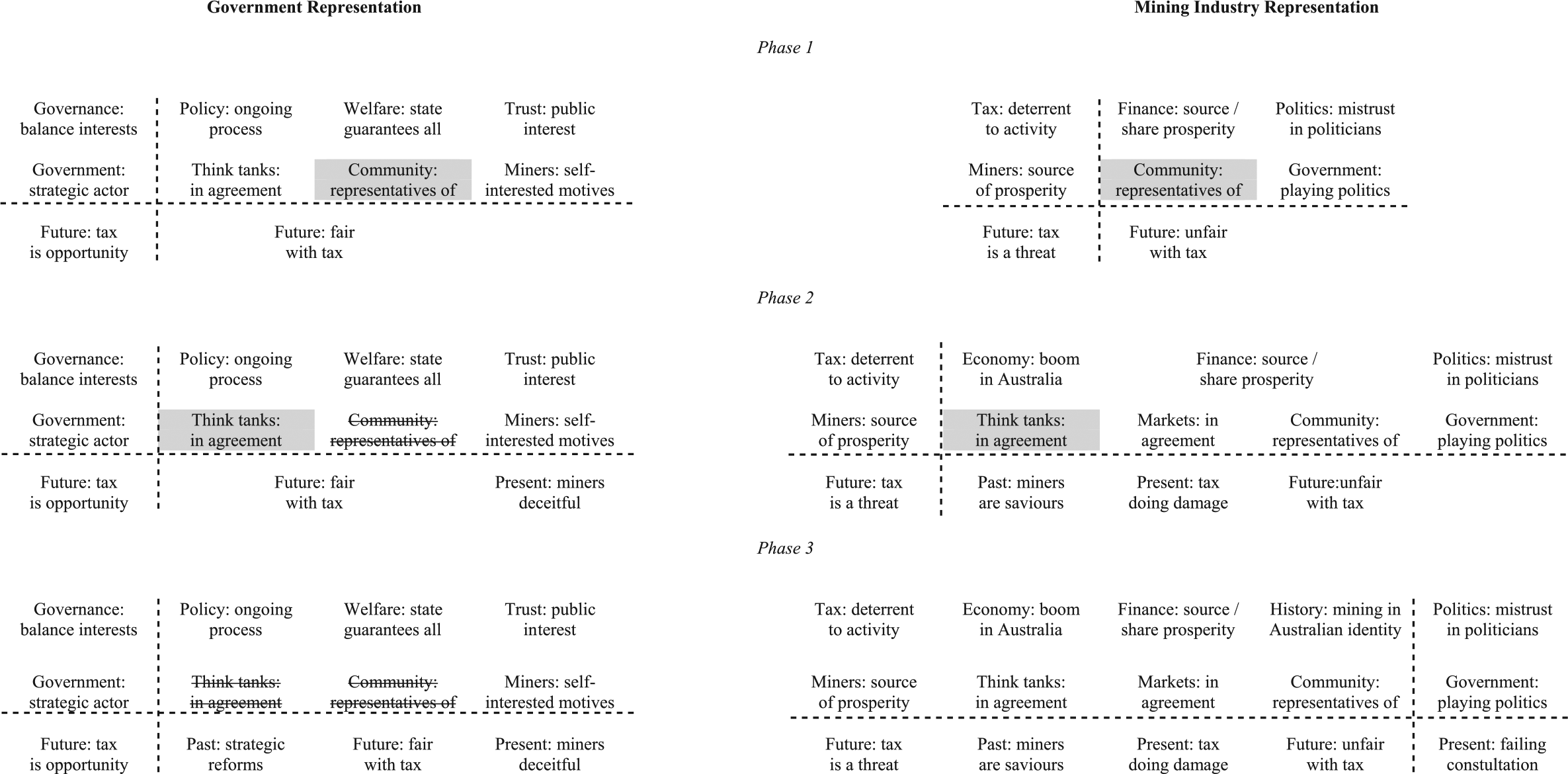
Intertextual relations in competing representations, government and mining industry texts.
Phase 2 of the debate, 7–20 May
The second phase of the debate started on 7 May when mining industry texts began to respond to their own previous texts. This increases the complexity of the intertextual network since traces of text are built upon previous traces of text in the campaign. In the mining industry texts, this is evident in horizontal intertexts that are caricaturing earlier caricaturing of government texts. For example, the 40% super profits tax in government texts became a 40% tax on mining (in phase 1) and then a 57% ‘super tax’ on mineral resources (phase 2). Similarly, mining industry texts include reporting on claims their phase 1 texts were asserting. For example, reporting of commissioned analysis appears to confirm that the tax is designed to fix a non-existent problem: ‘In a modern, dynamic, growing economy, there are always sectors that are expanding and contracting as demand and supply conditions change and prices adjust’ (Deloitte (MCA), 2010). This reporting also connects the mining industry to support from actors threatened by the tax should it be introduced. For example, investors, financial markets and the vested public are portrayed as being impacted in the manner previously predicted by the mining industry: ‘Already billions of dollars of investment is on hold, and the superannuation funds of millions of Australians have dropped’ (MCA, 2010f).
Vertical intertexts in mining industry texts continue to portray the government’s ‘super tax’ as a threat to prosperity. This includes asserting the impact on different industries. For example, the rhetorical question ‘Which Australian businesses will be hurt by the Government’s ‘super tax’ on mining?’ is positioned above pictures of nine industries depicted, such as engineering, restaurants, small business and hotels, with the answer provided below: ‘All of them’ (MCA, 2010g). Claims that future economic prosperity is dependent on mining are also given a present and a past. In the present, mining industry texts connect a familiar narrative about continuous economic growth in Australia to the existence of mining, and reporting on commissioned analysis that the industry saved Australia in the past: ‘mining sector brought Australia through the GFC relatively unscathed compared to other countries’ (Radar Group (MCA), 2010). The connection between the mining industry, economic growth and the global financial crisis (GFC) is also achieved through contextualizing the tax and the political situation, whereby mining industry texts portray Australian interests against other nations in a zero-sum globalized economy. Overall, in phase 2, the mining industry texts purport to integrate world events, additional actors to support their claims and political support for their position. In doing this, the mining industry also portrays a government at odds with ‘political reality’ in a globalized economy.
Government texts in phase 2 remained similar to the earlier phase of the debate. In horizontal intertexts, there is engagement with the mining industry texts through reporting on claims, presented as a chance to clarify misunderstanding. There is no development of additional intertextual strategies to portray support or agreement. Instead, the talking-points from phase 1 are repeated as the government texts continue attributing the mining industry with self-interest motivations and reporting on their claims as a deceit. Government texts also continue attributing the public with support. This consistency is affirmed in the vertical intertexts, with government texts asserting the normality of interest group resistance in policy development.
The intertextual networks in phase 2 show how the mining industry expanded their representation through the inclusion of additional claims to support for their representation and disrupt the government’s representation. This is shown in Figure 3, which records the absence of manifest intertextuality for community support in government texts and highlights the additional contestation of think-tank agreement along the horizontal axis. The representation in mining industry texts is further strengthened and expanded along the horizontal axis through the representation of community and financial market support. Figure 3 also shows how this expanded representation was reinforced by engaging with additional discourses and narratives in vertical intertexts. These portray mining as the pursuit of Australian interests in a global economy. The representation is also aligned with a familiar narrative of ongoing economic growth in Australia, which is asserted to be a consequence of mining. The representation in government texts is manifestly addressed to contesting the representation in mining industry texts, attributing them with self-interest motivations and a lack of credibility in claims to community support.
Phase 3 of the debate, 21 May–23 June
The third phase of the debate was marked by a multiplication in the number of voices which echoed mining industry texts. This included several instances where the public was represented as the author of mining industry texts. This completes one of the developments along the horizontal intertexts: mining industry texts were attributing the public with support in phase 1, reporting on instances of public support in phase 2 and presenting the public as protagonists in phase 3. For example, all of the radio advertisements introduced speakers as ‘everyday Australians expressing concern about the new mining tax’ (MCA, 2010h). Four of the later print advertisements pictured concerned faces with ‘a message to Canberra’ (MCA, 2010i), which also featured in four of the five television advertisements. One of the television advertisements (MCA, 2010j) illustrates this well by cutting between 22 different faces performing a 1-minute script to camera. Each speaker’s name and city are displayed at the bottom of the screen, along with job information such as mechanic, geologist, draftsperson, farmer, electrician and pilot. In the background, familiar Australian scenes such as work sites and city streets are shown. Where the initial texts represent the mining industry communicating to the government and the broader public, these texts represent the broader public communicating to the government.
The sheer volume of new mining industry texts is a further development in horizontal intertexts. In phase 3, the mining industry produced more than one new advertisement each day, as well as new press releases and consultant reports. The existence of other texts is manifestly marked on the surface of mining industry texts yet difficult to trace. For example, the proposed RSPT is now simply referred to as a ‘57% super tax’, with texts reporting on and asserting the impact the proposed tax has already had and will continue to have. One such text presents a series of five quotes as external texts, creating and displaying agreement between the mining industry and other actors who replicate the argument about the tax and its likely impact. The other actors are portrayed as impartial experts. However, the quotes used to represent wide agreement were from the MCA campaign itself. That is, internal texts from the MCA campaign were reproduced as external texts and presented as coming from neutral third parties who agree on the effect claims about a 57% super tax. In this way, the appearance of numerous texts, purporting to represent the policy, constituency support and expert agreement, is assembled. The expanded representation is a hall of mirrors, stitched together through forms of intertextuality.
The failure of the government to respond to mining industry demands is portrayed as a failure of the political process. The isolation of the government is also portrayed when reporting on the tax as ‘developed in a vacuum’ and ‘divorced from the day-to-day realities of business’ (Rio Tinto, 2010a). In addition, the use of Australian stereotypes and imagery is further deepened through references to connections with and dependence on the land such as attributing raw materials with building the nation. Familiar narratives are further integrated to validate effect and support claims in the mining industry representation.
As in the previous stage, government texts continued to respond directly to mining industry texts, with little evidence of any intertextual evolution. For example, in horizontal intertexts, government texts continue to reporting on a misinformation campaign in mining industry texts and reporting facts and figures from independent modelling by KPMG Econtech. In vertical intertexts too, government texts continue asserting the normality of the political situation. This involves reporting previous ‘scare campaigns’ (Rudd, 2010) from the mining industry and asserting the role of the state in managing economic reforms.
In phase 3, the intertextual network of government texts withered while the network of mining industry texts expanded. This is particularly evident along the horizontal axis in Figure 3, with the absence of evidence for government claims to support overwhelmed by the sheer number of mining industry texts, which portrayed agreement between all of the non-government texts. The inclusion of the voices from the public was presented as evidence for both support and effect claims and helped portray the policy as the work of a recalcitrant government, now depicted as the audience of texts from all actors. Figure 3 shows how this expanded representation was further reinforced in vertical intertexts, through alignment with familiar narratives and stereotypical Australian imagery. Government intertexts provide evidence of their isolation, reporting on mining industry deceit and asserting that they themselves truly represent the community, while voices ostensibly from the community itself challenge this claim.
Discussion
Our article responds to the calls for developing the political, as distinct from the profitable, dimension of CPA (Barley, 2010; Matten, 2009). We developed and employed an intertextual typology in analysing how corporate and government texts produced public representation and moral justification in contesting public policy. In this section, we explain how the mining industry constructed hegemonic intertextuality by (a) linking their position to influential nationalistic discourses, (b) continuously expanding their intertextual grid and (c) constructing a phantom community supporting their position. This produced a representation of the proposed tax as unfair and opposed by the Australian public.
First, the findings outlined how the mining industry representation gained credibility through alignment with familiar narratives and recognizable elements of stereotypical Australian identity. The mining industry representation in vertical intertexts—the tax as an unfair threat to society and the political situation as a government policy without support—was reinforced through horizontal intertextuality, which stitched constituencies together to form a politically influential mass. Instead of being confined to a debate about narrow interests, protecting after-tax profits, mining industry texts contested the meaning of fairness and so justified opposition to the tax as a moral act: representing all Australians.
Our intertextual analysis showed how mining industry texts constructed an alternative and self-contained representation of events supporting their position in society. This brings forward ideological work in the texts. While government texts referred to reasonable opportunity in an egalitarian society of social justice guaranteed by the state, the mining industry portrayed a neoliberal Australia dependent on a mining industry that saved Australia during the GFC and guaranteed future prosperity. In the mining industry texts, fairness is portrayed as procedural and individualist, with capital investment as the source of community welfare and the government as mainly an untrustworthy impediment. This neoliberal representation disconnects the state from its role as a guarantor of welfare, with welfare more appropriately distributed through financial market returns on investment. By interweaving narratives of the mining industry and Australia, the claims of the mining industry were associated with taken-for-granted understandings or common knowledge in producing and propagating their representation as ‘common sense’ (Gramsci, 1971). In the context of political competition, underscored by notions of trust and truth, the mining industry texts claimed further credibility through alignment with the taken-for-granted ideological terrain underpinning neoliberalism (Harvey, 2005).
Second, our analysis showed how the mining industry contested and disrupted the government’s proposed tax with an expanding intertextual network of mining industry texts. The expanding intertextual grid of supporting voices and included discourses imply the importance of movement in ideological representation. While the government repeated similar talking-points and sought to discredit mining industry claims as a typical ‘scare campaign’ (Rudd, 2010) of ‘threats and abuse’ (Swan, 2010d), the mining industry asserted claims about political support and the impact of the tax, and then included and multiplied ‘community’ voices as confirmation for their claims. In the continuously expanding intertextual configuration that included caricatures of caricatures and citations of self-as-other, the mining industry was a quickly moving target, often hiding behind the clout of the Australian public. The mining industry’s claims to represent the interests of the community as well as the attacks on government figures were articulated through voices from the public. This was accomplished by stitching constituencies together to form a political front demonizing the government as an out-of-touch political elite ‘divorced from the day-to-day realities of business’ (Rio Tinto, 2010a).
As such, the case represents a significant development in understanding how corporations can contest public policy. The mining industry successfully portrayed opposition to the proposed tax as a credible political act through what we term constituency stitching, an instant and top-down textual mobilization. This is distinct from a long-term strategy of constituency building, which involves the recruitment and mobilization of constituencies which in turn themselves campaign for policy change and pressure representatives directly from the bottom-up. This type of engagement differs from the broader understanding of CPA as the provision of political goods (information, money, voter support) to assist decision-makers. Indeed, these very goods were deployed to oppose the government. These developments, a new mode and scale of engagement, are indicative of an increased potential in corporate campaigns which presents challenges to policy-makers in changing the status quo, especially against resourceful private actors.
Third, through the intertexts, the mining industry stitched together a phantom public. Not in the sense of Lippmann’s (1927) disenchanted private citizens incapable of engaging in public policy. Rather, through intertextuality, the mining industry constructed a simulacrum—a representation of a representation—substituting for the public in the campaign. Employing the media to present the voices of the public, the mining industry came to represent ‘everyone’, except for the government. However, this is a public without voice and a representation without an inventory, where the mining industry took advantage of the absence of a public forum in an age of mass media to create the illusion of a unified and well-informed public—a phantom community. Considering the volume and frequency of produced texts, it is clear that some actors are better positioned to exert power of the mass-mediated public (Cody, 2011).
To be sure, we do not know the actors’ strategic intentions or the effects that the texts had on the public. However, neither did the actors in the campaign. We argue that this is significant in that the perception of representation is enough to capture political agendas and maintain ideological dominance. Indeed, Bell and Hindmoor (2014) argue, based in part on interviews with a senior member of the cabinet, that the key to the RSPT victory was that the mining industry convinced the government that it had convinced the public. By employing double-voiced intertextuality (Bakhtin, 1981), the mining industry texts served two consumers of the texts at the same time: the government and the public. In doing this, the mining industry managed to forge the representation of public support for its own legitimacy.
Conclusion
Our conceptual development and empirical analysis contribute to understanding the political role of corporations. It is in many ways remarkable that the introduction of the RSPT was successfully contested by a small group of well-resourced non-citizens rather than a large group of ordinary citizens, especially as a media campaign expands the conflict and should favour broad over narrow interests (Bonardi and Keim, 2005). Through the intertextual analysis of the political contestation, we make three central contributions.
First, our study provides a better understanding of how constituencies can be forged and deployed through textual representations. Rather than building political pressure through the more traditional strategies, such as lobbying representatives in private and constituency building (Hadani and Schuler, 2013; Hillman et al., 2004; Hillman and Hitt, 1999), we found that corporate interests were able to create political pressure in a very short timeframe through what we term constituency stitching. This was shown in how horizontal and vertical intertextuality created the appearance of agreement between actors in the debate through the quotations of words and the dissemination of voices in advertisements. This gave the impression that the mining industry had the support of multiple constituencies although this amounted to a debate between the mining industry and its supporters. This finding supports previous claims about the perceived success of constituency mobilization by business interests which has been associated with a trend towards privatizing participation in politics (Crouch, 2011; Walker, 2009).
Second, our analysis of the intersection between vertical and horizontal intertextuality explains the potentiality for corporate influence of society and success in hegemonic politics (Levy and Egan, 2003; Nyberg et al., 2013). In particular, we show that, through constituency stitching, the discourse of the dominant can also be used against the government should it try to deviate from the neoliberal script. Constituency stitching suggests that in the ‘war of positions’ in a public policy debate, identities and interests can be represented without a clear link between signifier and signified, between citizens and their representation. It is a politics of empty universals such as ‘community’ and ‘people’, without grounding in the represented public. The articulation of a phantom community not only constructs an empty universal to identify with, it is also included as a voice speaking for all. Thus, hegemony no longer requires the creation of a consensual historical bloc of diverse actors and groups (Gramsci, 1971); in reverse, the historical bloc is claimed for diverse actors and groups.
This further contributes to neo-Gramscian analyses in management and organization studies by suggesting that in a mediatized society there is no need for active consent in civil society to maintain dominance. This is significant in that it is not necessary for constituencies to align their interests or identities with a historical bloc as long as the representation thereof (i.e. the phantom community) is not challenged by these constituencies in, for example, social movements or elections. Rather than the consent of the majority (Gramsci, 1971), the perception of approval can secure hegemony. This suggests the possibility of domination by fostering passivity, with the subject as audience, rather than mobilization (Contu et al., 2013; Levy and Scully, 2007). This passivity does not ground the analysis in unconscious subjects or systemic distortion of ‘false consciousness’ (Lukes, 1974), but rather in the rapid circulation of manufactured intertextual representations in mass media. The public is temporarily upheld and undermined by asymmetrical public relations work feeding media.
Third, the development of an analytical device to interrogate texts also contributes to discussions of intertextuality (Fairclough, 1992; Kristeva, 1980). The intertextual grid proved useful in bringing forward the plural and often contradictory claims and voices in political texts. The two axes of the model enabled us to unpack the temporal and contextual dialogues in political contestation. The political domination was shown through the expansion of intertextual dialogues with subjects and discourses to naturalize and stabilize a particular representation of the world. The grid thus brought forward the ideological processes in sustaining and reproducing neoliberalism. In particular, the expansion of the grid explains how cumulative intertextual texts turned isolated truth claims into a reified reality of the situation (Hodges, 2008). The series of internal links within mining industry texts can be seen as a chain of reification, represented as external texts in circulation via the media to reiterate truth claims. This reification lasted long enough for the government to withdraw their proposed tax. While useful to interrogate the ideology of the texts, this type of intertextual analysis is a tool which cannot be employed to produce stability or order in representations or to claim authority over texts or critical voices (Allen, 2000: 209). It is a tool solely for questioning authority, not to form a singular reality.
This relates to the limitations of our study. First, we have used a singular political contestation to contribute to discussions of CPA. This was a particularly aggressive corporate campaign by a resourceful industry, which suggests that we need to be careful in generalizing our findings. While the volume of texts provided an opportunity in understanding intertextual processes, alternative CPA strategies are still commonly used. Second, our study examines only one aspect of CPA, showing how corporate communications edit and assemble texts to amass political influence. Indeed, we were able to go into considerable depth in this study because it spilled into the public domain. Ideally, further studies will be able to overcome the considerable access issues to examine the use of parallel strategies of influence employed by lobbyists in private. Third, although the media was a significant site for the CPA we examined, we did not examine any actions or influence by the media organizations themselves. This is potentially important as media coverage has significant capacity for influence in public debate by, for example, sensationalizing or prolonging conflicts in attempts to engage readers. Previous studies have pointed to the capacity of journalists to act as gatekeepers who can give voice or silence actors to show how the media can edit, frame and legitimate particular viewpoints (Vaara et al., 2006; Vaara and Tienari, 2008). This is an important strand of research to understand how publics are ‘managed’.
Finally, our findings point to democratic implications in the form of a change in the relationship between business and society towards the representation of business as society. That money matters is not a new finding. Our study starts to develop an explanation of how and why money matters through the capacity of a powerful industry to engage in politics through representation and so provides one way to analyse CPA and the potential influence of corporate power and money in a democracy. Whether credible or not, the capacity to construct and maintain an alternative representation of the political situation is not available to many interest groups, and the amount of resources required by government to contest an alternative representation provides policy-makers with further incentives to avoid confrontation with business interests. Beyond the CPA literature itself, debates over corporate citizenship (Matten and Crane, 2005) and hard versus soft regulation (Djelic, 2011) appear to be good first steps towards the re-examination of corporate involvement in politics, with a need for further examination of how corporations participate in politics and how corporate participation is transforming politics.