




Abstract
This article investigates how an industry leveraged media coverage to publicly oppose governmental policy. Based on a frame analysis of the political contest between the mining industry and the Australian government over a proposed tax on resource corporations, we show how the industry aligned its position with mass media to (a) make the policy contest salient, (b) frame their position in the contest as legitimate and (c) construct negative representations of the policy as dominant. The analysis reveals how the industry’s corporate political activities leveraged media coverage to align disparate frames into a consistent message against the policy in the public sphere. This contributes to the literature on corporate political activity by explaining the process of alignment with mass media frames to legitimize corporate positions on salient issues. Second, we contribute to the framing literature by demonstrating the process of frame alignment between non-collaborative actors. Finally, we contribute to the broader discussion on corporations’ role in society by showing how corporate campaigns can leverage the media to facilitate the favourable settlement of contentious issues. These contributions highlight the pitfalls of corporate political influence without necessary democratic standards.
Introduction
Mason (1950) provided an early warning that corporations could organize their political power and employ propaganda in mass media to oppose proposed legislation. He described how the National Association of Manufacturers in the United States (established in 1895) realized the importance of political organization, and beginning in 1934 steadily increased public relations campaigning to oppose government initiatives by aligning corporate interests with those of the public, employing slogans such as ‘What helps industry helps you’. These types of campaign gave rise to concerns that in the absence of democratic standards and effective social control, corporations may take ‘law into their own hands’ (Mason, 1950, p. 342; see also Epstein, 1974). Critical voices heeded Mason’s warning by problematizing mass media’s dependence on corporations for advertising revenue and information subsidies (e.g. news releases and interviews with journalists) (Herman & Chomsky, 1988), which creates an unequal playing field that undermines broader democratic participation in the media as the public sphere (Habermas, 1996).
Corporations participate in democratic societies through corporate political activity (CPA) (Hadani & Schuler, 2013) aimed at shaping public policy by influencing political decision-makers, either directly through ‘inside’ strategies such as lobbying and campaign contributions (Ridge, Ingram, & Hill, 2017), or indirectly through ‘outside’ strategies such as newspaper op-eds (Livesey, 2002), advocacy advertising (Brown & Waltzer, 2005) and grassroots mobilization (Kraemer, Whiteman, & Banerjee, 2013). Firms implement these outside strategies to communicate their interests and views to policy-makers and to influence members of the public (Kollman, 1998). Mass media thus plays a significant role in shaping the public’s views of legislation that affects corporations (Weber, Rao, & Thomas, 2009) as well as firms’ reputations, legitimacy and value (Pollock & Rindova, 2003).
It is well established that firms employ CPA to influence public policy in mass media (Nyberg & Murray, 2020; Nyberg, Spicer, & Wright, 2013). The focus in this literature is primarily unidirectional and focused on the media as an arena for setting policy agendas. Such studies conceptualize the media as a tool that extends the reach of corporate advocacy in political contests (Murray, Nyberg, & Rogers, 2016; Nyberg & Murray, 2020). Yet, organizational scholarship has shown how the media is not only an arena for reflecting societal opinion (Bednar, 2012), but also an engine that shapes public opinion through its own framing of issues (Klein & Amis, 2020). This suggests that when engaging in framing contests over policy issues in mass media, firms likely take the media’s framings into account. Yet few researchers have attended to the media’s role in explaining how framing struggles or contests unfold over time (Cornelissen & Werner, 2014; Roulet & Clemente, 2018). We address this oversight by examining the dynamic interactions between firms and mass media in public policy contests.
Our interest originated from a political contest between the Australian government and the mining industry over a proposed tax policy that played out in mass media. It was widely perceived that mining industry’s outside CPA blocked the policy, thereby saving ‘at least $100 billion’ over a decade (Kehoe, 2011), and triggered the resignation of then Prime Minister Kevin Rudd (Bell & Hindmoor, 2014). That the industry’s media-driven CPA was credited with provoking the withdrawal of the policy prompted our empirical investigation, which was motivated by the following research question: How do industries use mass media in political contests over public policy?
Following this inductive research approach, we collected and analysed texts produced by the government and the mining industry, and articles published in Australia’s only national broadsheet newspaper, The Australian. Our analysis shows how the mining industry engaged mass media to propagate counter-frames in opposition to the government’s framing of the policy, validate these counter-frames using media frames, and solidify the counter-frames as reflecting reality. Through CPA, the industry made the policy contest salient, claimed legitimacy as a participant in the contest, and constructed the dominant representation of the policy in the public sphere.
Our findings make three key contributions. First, we contribute to the CPA literature by explaining how firms can use mass media coverage to legitimize corporate positions in public policy contests (den Hond, Rehbein, de Bakker, & Lankveld, 2014; Hadani, Aksu, & Coombes, 2019), thereby detailing how firms make such contests salient and legitimate their positions. Second, we contribute to the organizational framing literature by demonstrating the process of frame alignment between non-collaborative actors in framing contests (Gray, Purdy, & Ansari, 2015; Kaplan, 2008). Third, we address the broader discussion of corporations as political actors and the democratic implications of corporate political campaigns (Barley, 2010; Murray et al., 2016; Nyberg & Murray, 2020; Nyberg et al., 2013). This is important, considering industry successes in delaying policy responses to social (e.g. smoking) and environmental (e.g. carbon emissions) issues.
Corporate Political Activity and Mass Media
The term CPA is widely used to describe corporate strategies to influence public policy (Hillman, Keim, & Schuler, 2004). Firms engage in CPA by providing political goods such as money (e.g. donations), information (e.g. lobbying) and votes (e.g. constituency building) in exchange for public policies that complement their market strategies (Hillman & Hitt, 1999). However, multiple groups claiming to represent the interests of the general public typically engage in public debate, advocating for the best or fairest solution (Dahan & Gittens, 2010). Beyond rivalry between firms and industries (Bonardi, Holburn, & Vanden Bergh, 2006), civil society includes many other organizations (e.g. NGOs, social movements, religious organizations, labour unions) that publicly exert policy pressure (Hadani, Doh, & Schneider, 2018). The dominant CPA framework theorizes these interactions as a ‘political marketplace’ (Hadani et al., 2019), with firms and other civil society actors on the ‘demand’ side all competing in efforts to sway public policy providers on the ‘supply’ side (Hillman & Keim, 1995).
In such political contests, the mass media becomes an arena for public discourse (Petkova, Rindova, & Gupta, 2013) wherein corporations communicate their policy preferences (Hillman & Hitt, 1999). Through mass media, firms advocate for a particular explanation and/or solution to a social problem by trying to convince the general public to adopt and signal support for particular policy preferences, thereby pressuring political decision-makers (Kollman, 1998). Although the CPA literature details strategies and tactics for influencing policy issues in the media (Bonardi & Keim, 2005), researchers have largely ignored the role of mass media as an actor or resource in the production of influence. Mass media attention is primarily viewed as something to be avoided with regard to contested issues, because media attention exacerbates rivalry among policy demanders (Bonardi, Hillman, & Keim, 2005) and reduces the likelihood that favourable policies will be implemented (Hillman et al., 2004). Furthermore, firms may be viewed as having low credibility in mass media (Bonardi & Keim, 2005), which likely compounds the reputational risks for firms that engage in CPA (den Hond et al., 2014).
Yet there is considerable evidence that firms do engage in CPA on widely salient issues (Hadani et al., 2018; McDonnell & Werner, 2016). For example, corporations have long sought to stymie legislative reform by policy-makers on climate change (Nyberg et al., 2013). Corporations are also drawn into public disputes with activists and social movements that engage with firms and industries directly through actions such as protests and boycotts (de Bakker, den Hond, King, & Weber, 2013; Soule, 2012). Previous studies of the contest over the Australian mining tax have shown the power of the industry (Bell & Hindmoor, 2014) in employing discursive strategies to generate political legitimacy (Nyberg & Murray, 2020) and create the impression of public support (Murray et al., 2016). For example, Nyberg and Murray (2020) developed the concept of corporate citizenspeak to illustrate how industries can draw on corporate citizenship discourses to legitimize their CPA and thereby disguise their pursuit of self-interest by claiming to deliberate both as and for the common good. While providing insights into the discursive strategies underlying CPA in political contests, these studies reduce the media to a site or arena for CPA with limited consideration for the media’s role as an actor in its own right. Although scholars have examined the political contestation of salient issues (Hadani et al., 2018; McDonnell & Werner, 2016), including the contestation of the Australian mining tax (Murray et al., 2016; Nyberg & Murray, 2020), the mass media’s dynamic and important role in how firms and industries engage in CPA has not been fully explored from a theoretical perspective.
Frame alignment processes as contested political activity
Whether to question public policy (Fooks, Gilmore, Collin, Holden, & Lee, 2013) or to promote positive media coverage (McDonnell & King, 2013), the articulation and construction of a problem and suggested remedies can be seen as a frame (Entman, 1993). Frames are established ‘schemata of interpretation’ that individuals use to render events meaningful and organize experience (Goffman, 1974). Frames simplify and condense the ‘world out there’ in ways that are intended to mobilize potential adherents, to garner the support of bystanders and to demobilize antagonists (Benford & Snow, 2000, p. 614). These can be produced, negotiated and shared in an effort to inspire group formation and motivate political action (Benford & Snow, 2000).
A premise of political communication is that political actors try to mobilize support for policies by encouraging audiences to think about those policies along particular lines, invoking ‘frames in communication’ (Chong & Druckman, 2007). Actors thus engage in framing by presenting issues in ways that emphasize or legitimize different ways of thinking (Chong & Druckman, 2007; Hirsch, 1986). In political contests over policy, firms ‘engage in framing practices in an attempt to make their frame resonate and mobilize action in their favor’ (Kaplan, 2008, p. 730). Corporations strategically employ frames to increase issue salience in media coverage and shape public opinion (Berger, Hertog, & Park, 2002), which constitutes ‘the struggle over the production of mobilizing and countermobilizing ideas and meaning’ (Benford & Snow, 2000, p. 613).
Through frame alignment, actors make their social construction of reality appear congruent with the interests of the target audience for mobilization (Creed, Langstraat, & Scully, 2002). Frame alignment refers to congruence between interpretive orientations that establish links between individuals (interests, values, beliefs) and organizations (activities, goals, ideology) (Snow, Rochford, Worden, & Benford, 1986). Alignment processes forge these links by bridging related but unconnected frames, amplifying frames through clarification and reinvigoration, extending frames to encompass broader issues or transforming frames to align with new circumstances (Snow et al., 1986). Thus, frame alignment resembles the task of outside CPA: convincing the general public to adopt and signal support for particular policy preferences.
Mass media in framing contests
The mass media’s role in contestation is to disseminate how opposed actors frame specific issues. Mass media attention increases the size and visibility of actors’ frames (King, 2008), as firms and industries campaign to influence public opinion and shape how opposing actors are perceived in framing contests. In political contests, corporations provide information (through press releases, public interviews or press conferences) which is publicized, reinterpreted and spread via mass media, thereby facilitating discussion around the issue (Zavyalova, Pfarrer, & Reger, 2017). As such, the mass media provides an arena wherein corporations communicate their policy preferences and influence external stakeholders (Bednar, Boivie, & Prince, 2013; Hillman & Hitt, 1999).
Mass media also actively shapes public opinion by framing contested issues (Entman & Rojecki, 1993), actors (e.g. politicians, citizens, interest groups and firms) and their claims (Entman, 2007). In understanding how issues are framed in the media, communication scholars make a useful distinction between first-level framing (i.e. agenda framing), whereby media outlets define which issues deserve public or government attention through coverage decisions (Entman, 2007; McCombs, 2004), and second-level framing (i.e. emphasis framing), whereby the media provides an interpretation that advances one position over another which manifests in how news is covered (Chong & Druckman, 2007; Entman, 1993). In political framing contests, the media constructs dramatized realities as newsworthy (i.e. agenda framing) (Rindova, Pollock, & Hayward, 2006), and a positive or negative tone in coverage influences reactions to the firm or industry involved (i.e. emphasis framing) (Bednar et al., 2013).
Thus, the media plays an important role when firms and industries are organizing public campaigns over policy issues, serving both as an arena for firms to publicize their frames and influence external stakeholders, as well as an engine for framing contests over political claims. The conceptualization of a political market consisting of competing policy advocates corresponds with the notion of the mass media as an arena in which different groups seek to influence political decision-makers. However, by viewing the media as an engine, corporations can actively participate in the media’s agenda framing and emphasis framing processes (Clemente & Gabbioneta, 2017) by, for example, priming media through informational subsidies to steer event coverage (Roulet & Clemente, 2018). The implications of these arguments have yet to be addressed in the CPA literature, where researchers have either sidestepped the media’s own capacity to frame policy issues (Murray et al., 2016; Nyberg & Murray, 2020) or identified this capacity as a reason to avoid engaging in CPA via mass media (Bonardi et al., 2005; Hillman et al., 2004). This motivates our research question: How do industries use mass media in political contests over public policy?
Research Methods
Our inductive study originated in the analysis of the public contest between the mining industry and the Australian government over the proposed introduction of a new tax on resource companies in Australia – the Resource Super Profits Tax (RSPT). Several attributes of the case made it ideal for investigating our research question: (a) it was a public contest that played out in mass media; (b) there was an obvious contest between two actors (government and industry); (c) the actors framed the policy differently; (d) the mass media played an important role because there was no election during the contest; and (e) the contest lasted less than eight weeks, which enabled us to study the entire process. Between the announcement of the proposed policy on 2 May 2010 and the abandonment of the RSPT as government policy on 24 June 2010, the RSPT was the single biggest media issue (Media Monitors, 2010). The scale, coordination and discipline of the industry’s political campaign against the proposed government policy made it a revelatory case with regard to how industries use mass media coverage in public framing contests (Yin, 2011).
The RSPT’s design originated from a recommendation in the Henry Review, a comprehensive ‘root and branch’ review of the legal, economic and administrative structure of the Australian taxation system that received submissions from individuals, research institutes and industry associations, including the Minerals Council of Australia (MCA). Announcing the publication of the Henry Review on 2 May 2010, then Prime Minister Kevin Rudd and Treasurer Wayne Swan proposed the RSPT. This provoked an immediate response from the mining industry centred on a media campaign led by the MCA that included press releases, opinion pieces and full-page advertisements in newspapers across Australia, as well as radio and television advertisements. Other civil society actors tried and failed to join the debate. For example, the civil society organization GetUp ran a solitary half-page print advertisement calling out the industry’s ‘scare campaign’, and the Australian Workers Union produced an advertisement for YouTube that depicted mining executives as out of touch. Following the public framing contest between the industry and the government that played out in mass media, the proposed RSPT was abandoned with the resignation of Prime Minister Kevin Rudd and corresponding elevation of Julia Gillard as the new Prime Minister on 24 June 2010.
Data collection
We collected all documents generated by the government and the mining industry that entered the public sphere during the political contest (see Table 1). Both campaigns provided us with electronic versions of their external communications, which we cross-checked against media coverage ourselves (print) and via a commercial monitoring service (radio and television). We also downloaded press releases and transcripts from websites of the government, mining industry associations and their member organizations. The sample includes all communication from the government in the form of advertisements, speeches and press releases (n = 43) and all communications produced by leading organizations in the mining industry, including publications and consultant reports, press releases, opinion pieces, fact sheets and advertising materials (n = 48). Finally, we collected and scanned all of the print editions of the only national broadsheet newspaper, The Australian, in which we identified 419 articles that referred to the RSPT policy during the study period. The Australian is a central actor in the Australian media landscape (Manne, 2011) and this centrality was evident in the case, with both the government and the mining industry using it as the primary outlet for their print advertisements. The mining industry used media quotations that first appeared in The Australian to support its claims.
Data Summary.
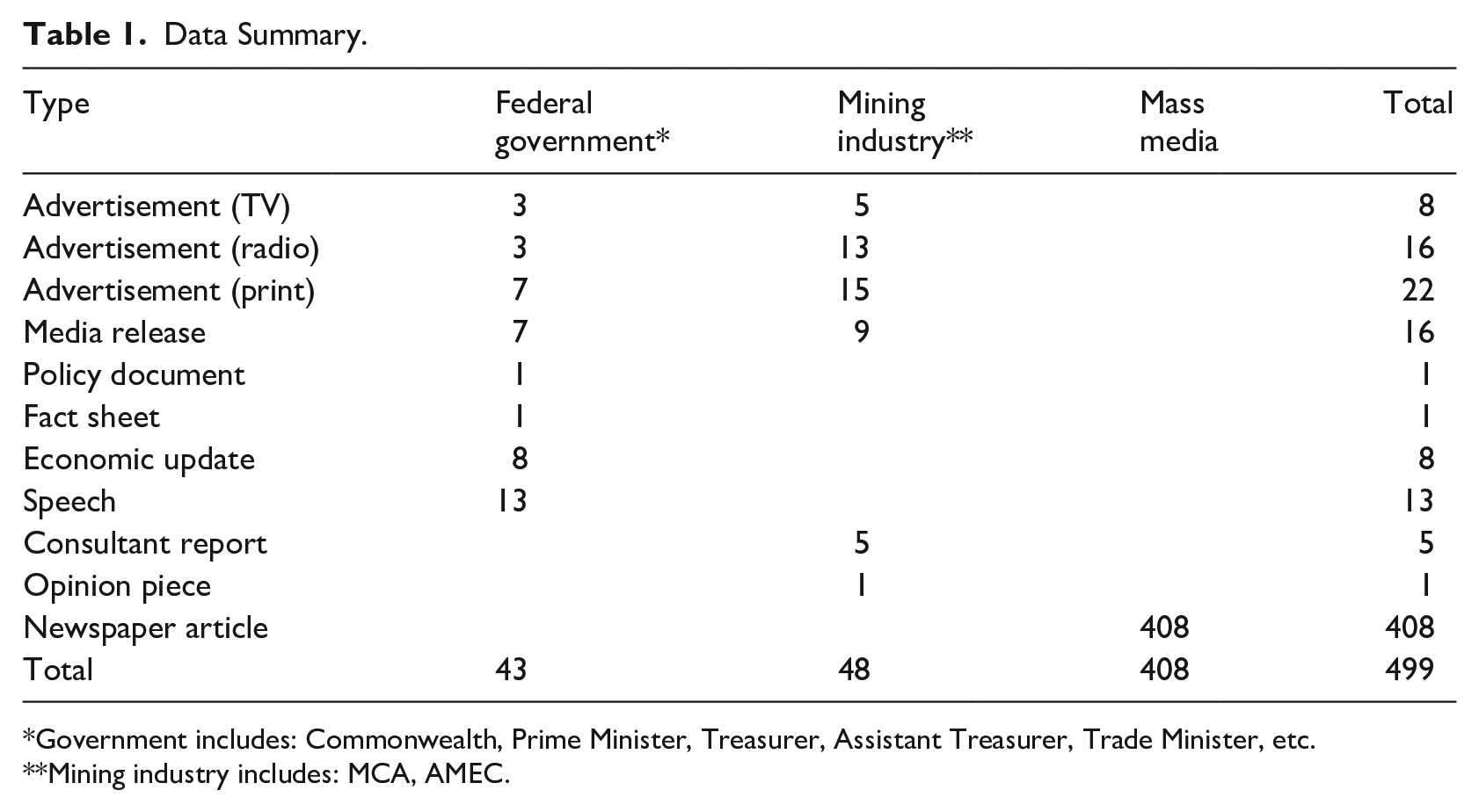
Government includes: Commonwealth, Prime Minister, Treasurer, Assistant Treasurer, Trade Minister, etc.
Mining industry includes: MCA, AMEC.
Data analysis
We followed an iterative process during the analysis phase, moving back and forth between theory and data. We began inductively by analysing each individual text to become familiar with its content and to identify any initial patterns of argument that could be followed throughout the data corpus (Suddaby & Greenwood, 2005). At this stage, we constructed a detailed narrative account of the contest – that is, who said what and when. From this, we developed a timeline of actions taken by the three key players in the contest: the mining industry, the government and the media. During this early analysis, we noticed how the mining industry’s communications changed over time, with press releases at the outset displaced by advertising toward the end of the contest (see Figure 1). We further noticed that the messages communicated in these texts changed over time, which guided our decision to employ framing to understand and analyse the contest between the government and the mining industry (Creed et al., 2002; Kaplan, 2008).
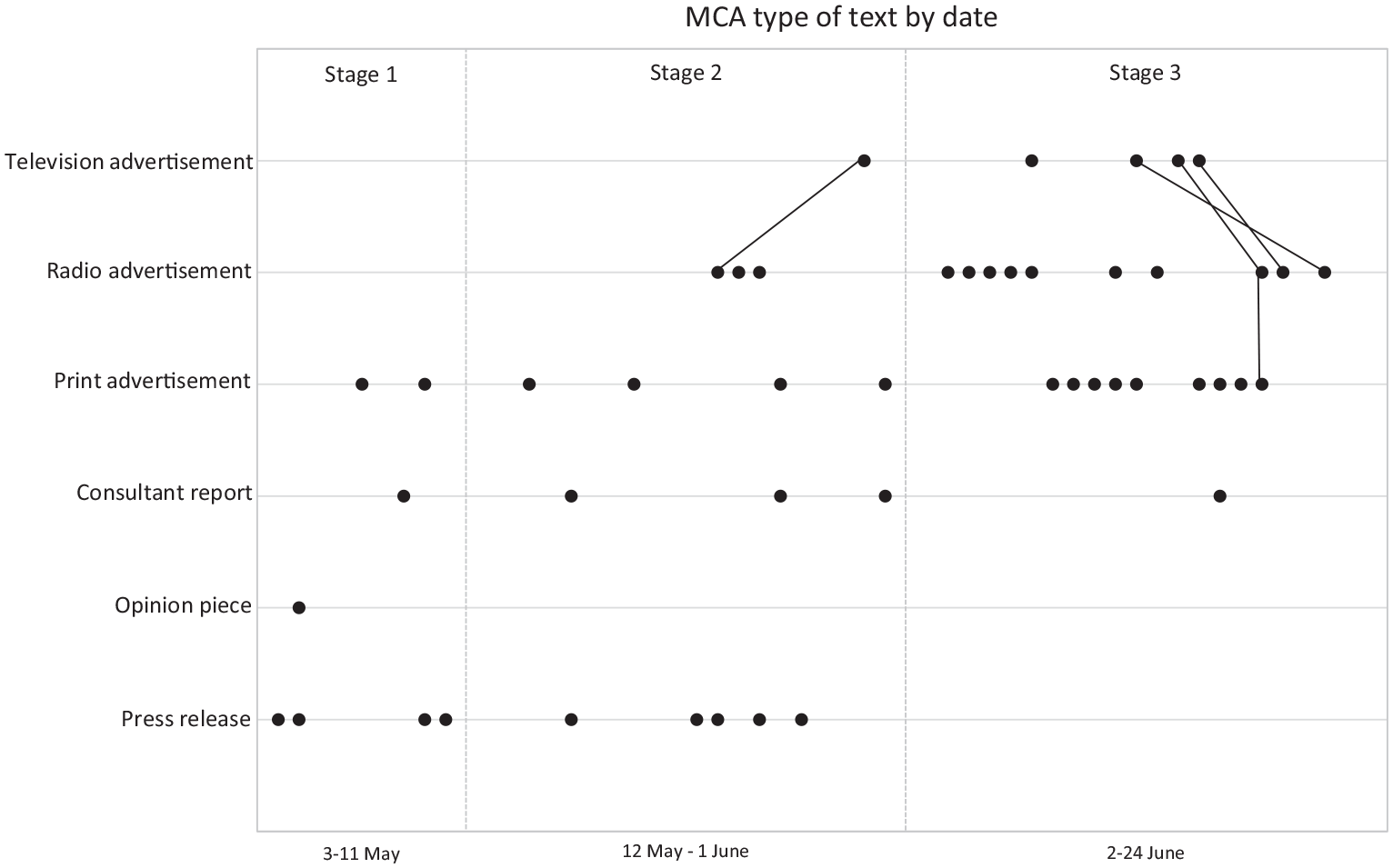
Mining industry texts by type over time.
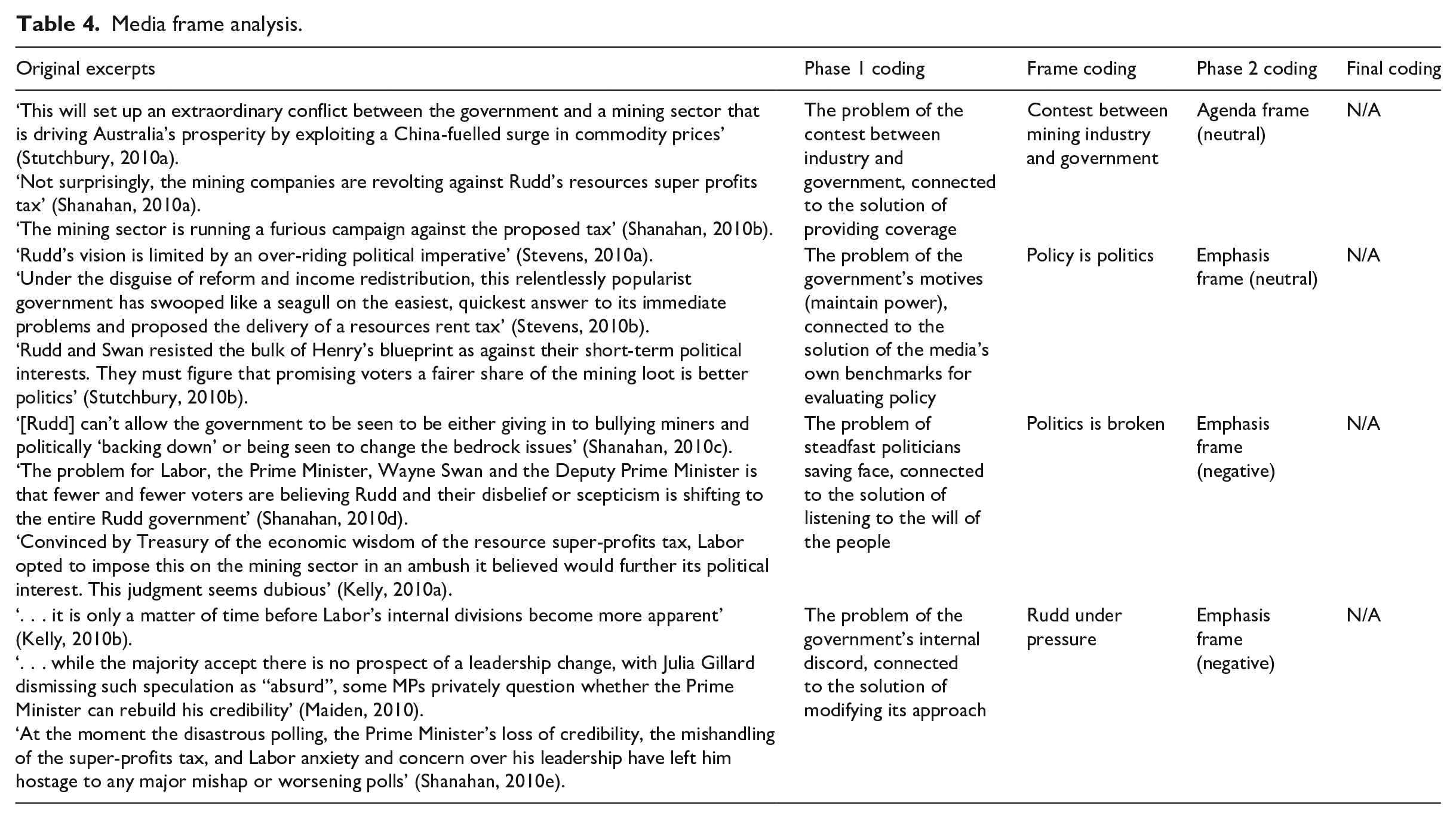
The second stage consisted of frame analysis, which proceeded in two rounds of coding performed by the lead author. First, we analysed how the RSPT was portrayed as a course of action by each of the three main actors (i.e. the policy’s efficacy). At this stage, we removed 11 newspaper articles from the corpus because they did not include frames of the RPST, which left us with 408 newspaper articles. We constructed initial codes by staying close to the original texts, expanding and collapsing the number of codes to capture the corpus. After the initial coding, we began toggling between our codes and framing theory (Benford & Snow, 2000; Entman, 1993) by analysing each text in terms of the problem identified, the actors defining the problem, and the solutions offered. To further situate the identified frames in the context of the framing contest, we coded for whether they were agenda framing or emphasis framing. For emphasis framing, we also coded for positive or negative policy efficacy (see Tables 2, 3 and 4).
Government frame analysis.
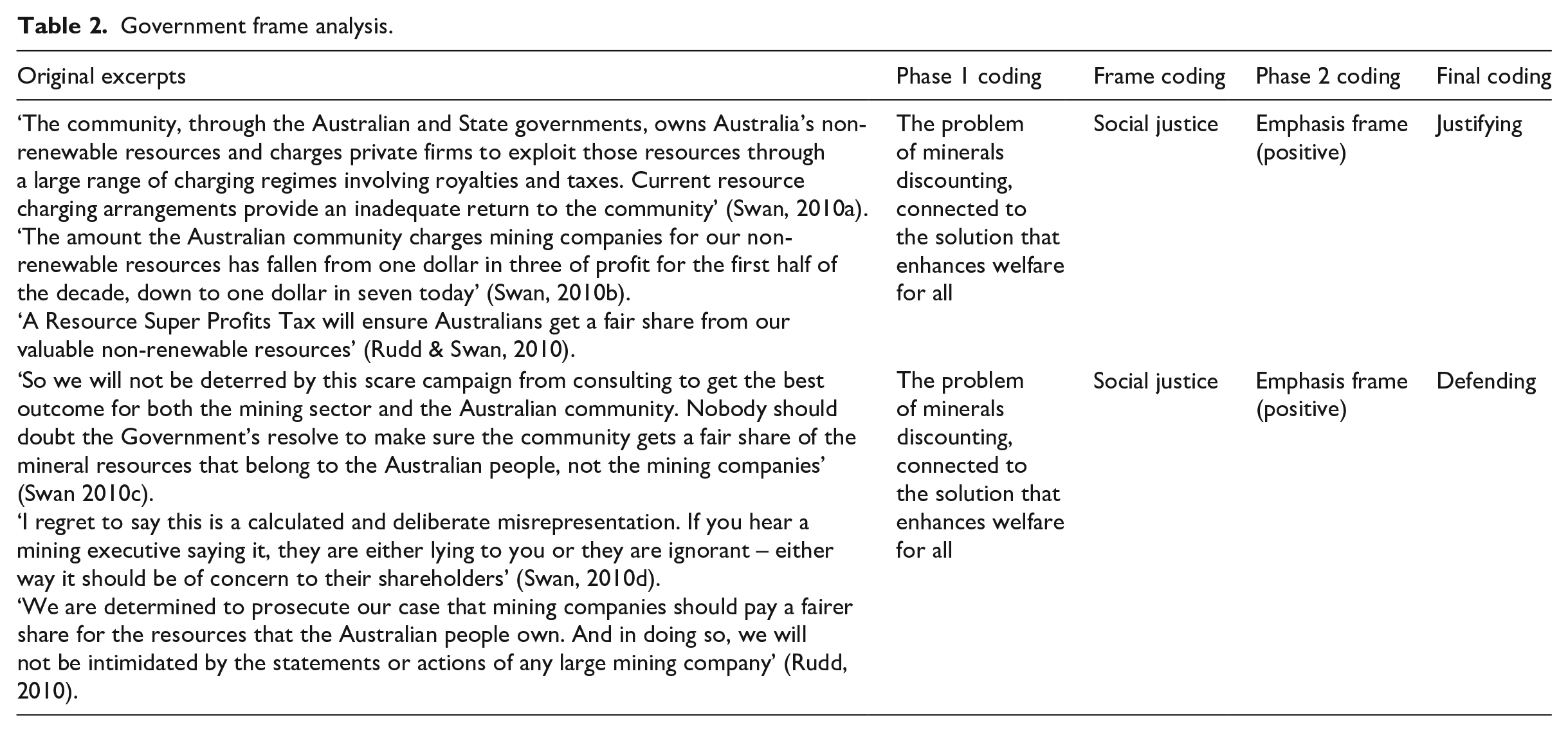
Mining industry frame analysis.
Media frame analysis.
The third stage of analysis focused on how the frames developed in the contest over time. In this form of axial coding (Corbin & Strauss, 1990), we noticed that the multiple frames provided by different actors moved through distinct phases. This analysis showed changes in how the RPST was framed over time, as well as how frequently different frames appeared in the media (see Figure 2). In this stage, we observed progressive overlaps between the frames of the mining industry and the media, as changes in the media framing were subsequently reflected in the mining industry framing.
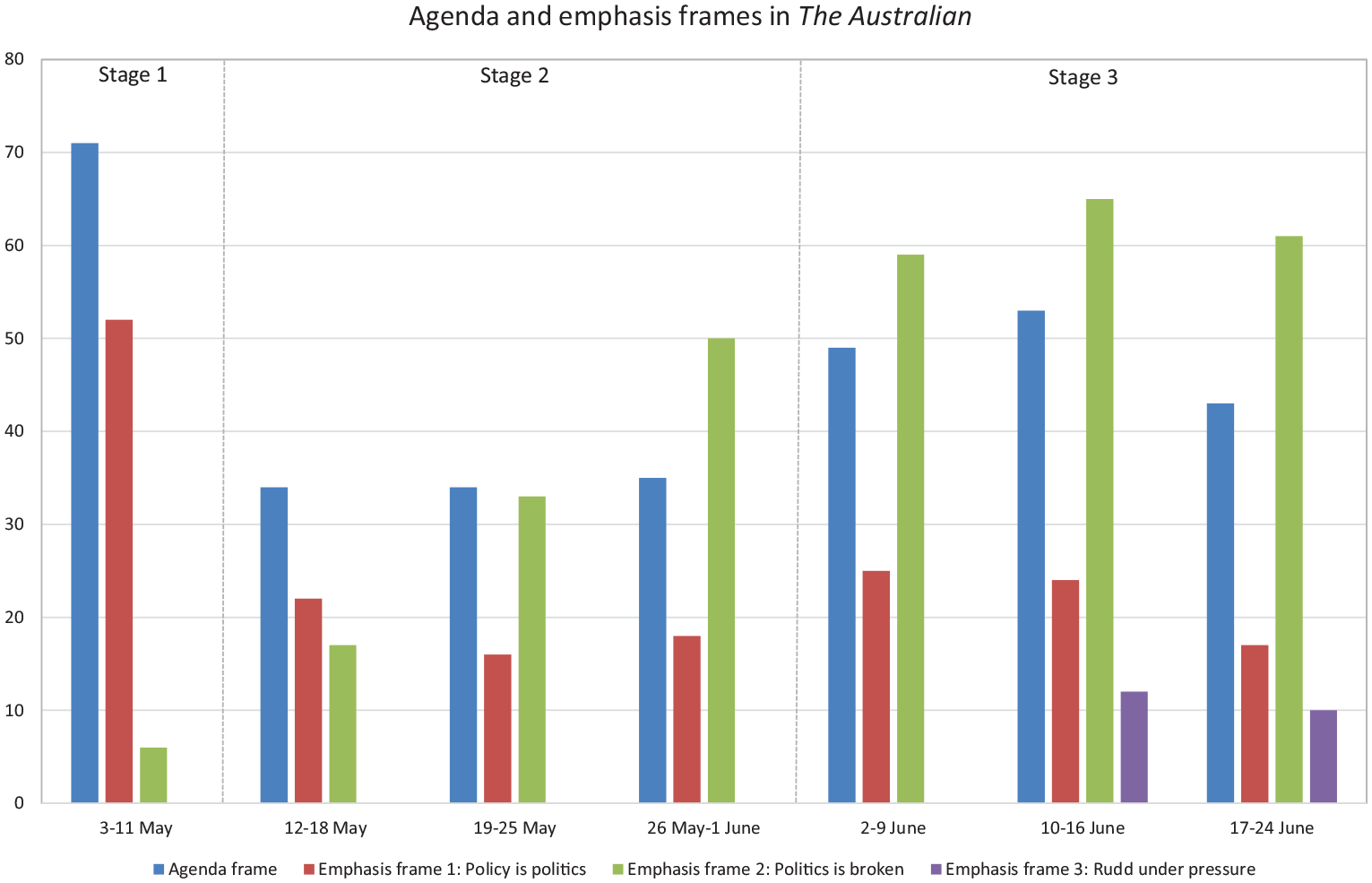
Agenda and emphasis frames in media coverage over time.
This led to the final stage of the analysis aimed at explaining overlaps between the frames of the mining industry and the media, and shifts in framing over time. Working with our previous frame analysis, we investigated whether and how government and mining industry frames related to media frames at different points in time throughout the contest. In this final stage of analysis, we identified the CPA strategies deployed in relation to media coverage. This involved interrogating variations in the frames and identifying any turning points in the political claims of each actor as well as in the media coverage. Frames were not bound to distinct phases in an exclusive sense, but three noticeable shifts in emphasis reflected how actors framed the RSPT during the debate in response to each other and external events. For each transition in these three identified stages, we traced the source (another actor in the debate or outside events) and looked for changes in the claims of other actors in the debate.
Findings
In this section, we set out the different framings employed by the actors throughout the three stages of the contest over the RSPT. Because the government employed the same framing of the RPST throughout the contest, the three stages primarily represent shifts in the mining industry’s framing. Finally, we show how the industry succeeded in aligning its frame with that of the mass media to construct a dominant opposition to the RSPT in the public sphere.
Stage 1, 2–10 May: The mining industry propagates counter-frames
The proposal to implement the RSPT triggered a political contest between the government and the mining industry. In the initial stage, the government, industry and mass media all produced unique emphasis frames of the policy. Mass media also produced an agenda frame of the contest between government and industry.
The government’s emphasis frame justified the policy in terms of social justice. The nature of the problem was that ‘the community’s share in the increased value of its deposits, received through existing resource taxes and royalties, has been declining’ (Commonwealth of Australia, 2010, p. 10). Hence the ‘objective of the RSPT is to ensure the Australian community receives a fair share of the realised value of Australia’s non-renewable resources’ (Commonwealth of Australia, 2010, p. 30). This emphasis frame diagnosed a problem with extant arrangements and justified the RSPT as a solution that would enhance social justice (see Table 2).
The industry’s response involved propagating counter-frames in numerous negative emphasis frames, which created and maintained a political contest with the government. For example, one counter-frame portrayed politicians as untrustworthy: ‘The push for higher tax from the resources sector is based on a false premise. The minerals sector is not under-taxed’ (MCA, 2010b). Because the policy addressed an imaginary problem, the source of the problem was attributed to presumed motives of the government to ‘increase tax collections’ and ‘slow the mining sector down and let the rest of the economy catch up’ (Hooke, 2010). Other counter-frames portrayed the RSPT as an abuse of power against political adversaries, as a gift to foreign mining companies and likely to backfire (see Table 3). Thus, the industry produced a number of different counter-frames, taking a ‘scattergun’ approach in opposing the policy as a course of action.
The government announcement and the industry’s counter-framing provided a drama that fed the media cycle. The media’s agenda framing deemed the contest newsworthy through statements such as ‘the industry will fight’ (Stevens, 2010a) and ‘the battleground is set’ (Durie, 2010). As shown in Table 4, the media’s ‘policy is politics’ emphasis framing suggested that policy was a means for politicians to amass electoral support: ‘policies have been spun into political weapons of class warfare because of the proximity of an election’ (Shanahan, 2010f). These initial frames identified contending actors with opposing claims and provided a distinct interpretation of events, which is a routine journalistic practice for claiming objectivity (see e.g. Tuchman, 1972). The media constructed themselves as ‘battlefield’ reporters (agenda framing) with a unique ‘take’ (emphasis framing), thereby signalling their independence from the claims of each actor.
Stage 2, 11 May–1 June: The mining industry validates media emphasis
The dynamics of the debate changed over time as actors responded to external events as well as the alternative framings. The emergence of new frames in the media and the mining industry signalled that the debate had entered a second stage. Interestingly, the government generally defended its original social justice framing (see Table 2).
The media maintained its initial agenda and emphasis frames by continuing to deem the contest newsworthy and communicate the ‘policy is politics’ message. However, as events unfolded, a second emphasis frame – ‘politics is broken’ – emerged (see Table 4 and Figure 2). The media interpreted the RSPT’s negative effects on stock prices in the mining industry as evidence of a problematic disconnect between politicians and the ‘real world’: ‘a wonderful theoretical concept in Canberra, complete with neat algebraic equations to supposedly prove the Treasury case, is running into huge difficulties in the real world’ (Hewett, 2010). Combined with the government’s continued defence of its course of action, this emphasis framing pointed to a failure of governance: ‘the government doesn’t appear to be listening’ (Hewett, 2010). Over time, this emergent emphasis frame became the main way the media portrayed the contest between the government and the mining industry (see Figure 2).
Although the industry primarily communicated through press releases in the first stage, there was a discernible shift towards advocacy advertisements (both print and radio) in the second stage (see Figure 1). This shift was accompanied by an evolution in the industry’s emphasis framing as it streamlined its scattergun approach and began to portray the policy as ‘playing politics’. Crucially, the transition in the industry’s emphasis frames involved validating its claims via the media’s emphasis framing. For example, the industry adjusted its diagnosis of the problem from a punitive attack to political manipulation: ‘Why does the Government continue to resort to spin to justify its new super tax?’ (MCA, 2010e). Similarly, as the emergent media framing focused on the policy’s impact on financial markets, the industry shifted accordingly. In doing so, the industry included quotations from the media in its advertisements to bolster the legitimacy of its claims. For example, the industry cited media commentary that the policy ‘runs counter to everything that made Australia rich’ in two print advertisements (MCA, 2010j, 2010k). Through these shifts, the industry shifted the focus of its framing from how the policy would impact the mining industry in Australia and benefit international mining companies to the proposed policy’s impact on financial markets.
Stage 3, 2–24 June: The mining industry’s frame solidifies with the media’s frame
A third stage of the contest was signalled by a final transition in the mining industry’s framing. During this period, the government and media frames remained largely unchanged. The government continued to defend its original frame and the media maintained its previous frames, with some additional frames emerging in response to events, but not dominating the coverage (see Figure 2). The main movement in this phase was the solidification of the industry’s frame with the media’s ‘politics is broken’ frame.
The mining industry continued counter-framing, which influenced the media’s agenda framing. However, similar to the second stage, there was a discernible shift in the form of communication, with the constant release of new print, radio and television advertisements (see Figure 1). The industry’s new emphasis framing eliminated any remaining differences with the media’s framing. For example, the disconnect between politicians and the ‘real world’ became a talking point in the industry advertising, which identified ‘theoretical’ modelling as the source of the problem: ‘The more you hear about this mining super tax the more you wonder if the government has really thought this through’ (MCA, 2010m). Here, the industry used direct quotes from media coverage to link it with the industry’s position. For example, the heading in one print advertisement, ‘If the Prime Minister was listening, this is what he’d hear’, was followed by a series of five negative quotes from media coverage (MCA, 2010n). The electoral costs of politicians admitting their mistakes, as portrayed in the media’s emphasis framing, was solidified into the industry frame.
A Grounded Model for Leveraging Media Coverage in Political Contests
Thus far, we have explained processes of frame alignment that occurred through three stages of the framing contest that unfolded over eight weeks. Through framing and counter-framing, the contest continued from the initial policy announcement until the proposal was withdrawn. Whereas the government continued to defend its initial emphasis frame that justified the new tax, the industry continuously adjusted its counter-frames by aligning them with media coverage of the contest. In this section, we develop a grounded model of how the industry used mass media in the political contest. We focus on how the industry used mass media as leverage in the political contest to construct a dominant representation of the policy in the public sphere.
The industry communicated numerous initial counter-frames via press releases. In this initial stage of propagating, there were no overlaps between evaluations of the policy in the emphasis frames produced by the mining industry (multiple negative frames) and the media (different, predominantly neutral frames). The industry’s intensely negative reaction to the policy attracted the attention of the media, which engaged in agenda framing by deeming the contest newsworthy. Propagating multiple lines of attack through press releases thereby constructed antagonism and made the contest salient in the public sphere by generating media coverage that the industry would subsequently use in its CPA campaign.
After creating a newsworthy spectacle, the industry began aligning its frames with the media coverage it had created. This was achieved by replacing ‘misfiring’ frames with those that validated their position within the contest. The industry portrayed the media as supporting its position by citing negative coverage regarding the policy’s efficacy, thereby establishing partial alignment between its new frames and the media’s emphasis frames, and validating its position in the contest. The industry also incorporated this constructed alignment into its CPA campaign and sustained media coverage through print and radio advertisements. By constructing alignment with media coverage, the industry could claim the legitimacy of its position in the public sphere.
Finally, once the emphasis framing of the industry was aligned with prevalent media frames, the industry employed CPA to articulate a solidified frame. The industry adjusted its framing once again by eliminating remaining differences with the media emphasis framing, which had become increasingly negative on the policy. This solidified emphasis framing was communicated in print, radio and television advertising. The switch to advertising enabled the same emphasis framing to be communicated across different formats targeting the public. During the last stage of the contest, the public was bombarded with messages articulating the solidified frame (an average of 141 times a day on radio and 50 times a day on TV). The industry’s sustained negative reaction, alignment with the media’s negative emphasis frames and extensive advertising campaign constructed a dominant negative representation of the policy in the public sphere.
Our process model explains how the mining industry used the media to construct a dominant negative representation of the policy in the public sphere by aligning its framing with media coverage (see Figure 3). Rather than any obvious cooperation between the industry and the media, this process was driven by how the industry aligned its framing with favourable frame elements from media coverage, and incorporated the solidified frame into advocacy advertising targeting the public. Thus, the industry leveraged the media in the political contest to make the policy contest salient, legitimize its position and construct a dominant representation of the policy.
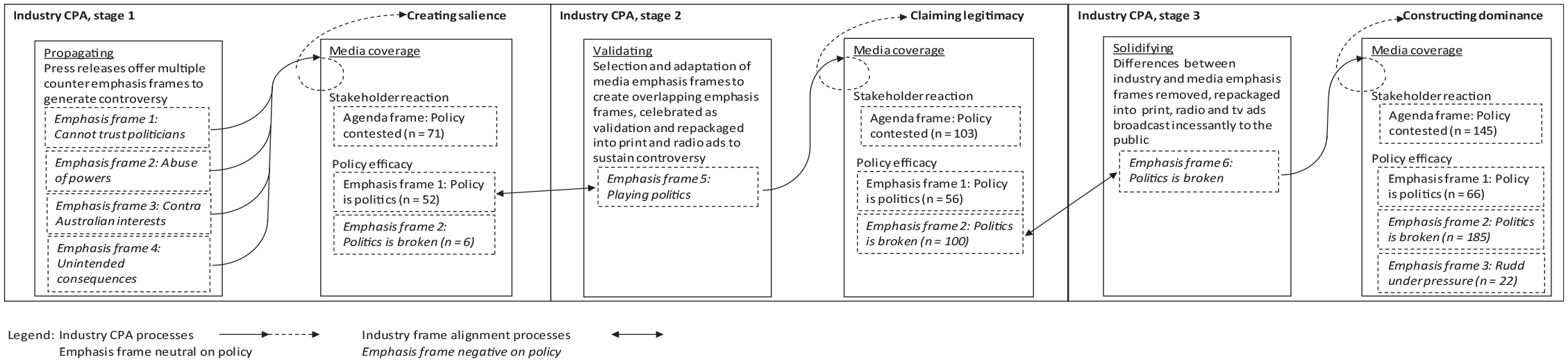
Process model of mass media frame alignment in contested CPA.
Our explanation of how media frames were used in CPA applies to other instances of corporate advocacy in relation to proposed policy changes. For example, organizations that deny climate change criticize mainstream reporting that does not include an anti-science perspective, demanding that the media present ‘both sides’ and engage in ‘balanced reporting’ (Boykoff & Boykoff, 2004). This follows a similar basic pattern of asserting antagonism to generate media coverage and create salience, using the media coverage itself as a vehicle to claim legitimacy in the debate, and then seeking ways to amplify beliefs about those involved in the contest. Thus, the model (Figure 3) can be useful for unpacking framing contests in both traditional and social media (MacKay & Munro, 2012), ranging from re-establishing the legitimacy of nuclear power after nuclear accidents (Patriotta, Gond, & Schultz, 2011) to defending ongoing fossil fuel extraction (Nyberg, Wright, & Kirk, 2017). Even so, some of the contextual factors in the mining industry’s CPA campaign may relate exclusively to the case, which suggests some boundary conditions for the model.
First, only a resource-rich industry would be able to uphold a contest over several weeks and flood the media landscape with particular frames of events. With asymmetric stakes in this case (i.e. mining firms perceived massive losses for themselves, the government promised marginal benefits to the entire population), the size and wealth of the industry was crucial to creating and sustaining a newsworthy controversy and converting the media coverage into claims intended to resonate with the public. Although the resource-rich fossil fuel industry has engaged in public campaigns for decades by offering counter-frames against the urgency to act on climate change (Levy & Egan, 2003), ‘winning’ such public policy contests requires constructing equivalent interests or beliefs among the population (Nyberg et al., 2013). Our findings show that resource-rich industries can construct equivalent interests via mass media in their CPA campaigns.
An industry’s standing within the community also affects whether the legitimacy of particular frames can be established (Litrico & David, 2017). CPA that sparks and leverages media coverage depends on the emergence of some favourable frames. For instance, it would be extremely difficult for the tobacco industry to generate frame alignment through media coverage, as its standing in the community would hamper attempts to build legitimacy. Instead, the tobacco industry must rely on inside CPA strategies such as lobbying to influence government legislation. In contrast, the mining industry plays a prominent role in Australian economic narratives that supports its legitimacy claims (Bell & Hindmoor, 2014). This standing in the community is important to expand a framing contest and construct equivalence between the industry and the population, which suggests firm synergies between CPA and corporate social responsibility (CSR) efforts as another potential boundary condition.
Discussion
Despite the centrality of mass media in democratic politics in general (Herman & Chomsky, 1988; Habermas, 1996) and the media’s capacity to frame contested policy issues in particular (Bonardi & Keim, 2005; Entman, 2007), CPA scholarship has devoted limited attention to the interplay between corporate advocacy and mass media. We have examined these dynamics in a case study that was motivated by the question: How do industries use mass media in political contests over public policy? Our analysis shows how the mining industry leveraged media coverage to conduct CPA by: (a) propagating counter-frames to generate media coverage and make the framing contest salient; (b) validating their claims by aligning its frames with those of the media to claim legitimacy; and (c) solidifying the dominant representation of the contest in the public sphere. Our findings explain how media frames can be a resource for CPA in public policy contests.
Contributions
Our findings make three key contributions. First, our findings contribute to the CPA literature by explaining how firms and industries can align their positions with the mass media to strengthen and legitimize their claims in the public sphere. This reveals limitations of the dominant ‘political marketplace’ view (Hadani et al., 2019) that corporations exert pressure ‘behind the scenes’ (Hadani et al., 2018, p. 2070) and avoid salient issues (Bonardi et al., 2005). Prior research has demonstrated the importance of the mass media for CPA (McDonnell & Werner, 2016) and revealed how the mass media serves as an arena for corporate advocacy and political contestation (Nyberg & Murray, 2020). In contrast, our case shows how media coverage is generated and leveraged for frame alignment purposes in CPA campaigns to make framing contests salient, claim legitimacy and construct dominant frames. Our findings contribute to current discussions of corporate advocacy via mass media by showing how the mass media serves as an engine that drives particular framings, which in turn are incorporated into CPA campaigns. Thus, our study reveals the dual role of media – as arena and engine – by showing how media coverage can be used in political contests to legitimately demand public policies aligned with corporate interests.
Second, our study provides insights into frame alignment processes between (ostensibly) non-collaborative actors. Our detailed analysis of the public policy contest shows how, over time, different parties appeared to converge on a single representation of the events. Extant scholarship on public framing contests has shown how skilled actors can employ strategic frames to win over actors (Gurses & Ozcan, 2015; Kaplan, 2008) and how resourceful industries can solidify intra-industry frames in public contests (Gray et al., 2015; Nyberg, Wright, & Kirk, 2018). We extend this literature by explaining how an industry can construct a dominant representation of events through frame alignment. Our study demonstrates the important role of the media in shaping the dynamics of public framing contests, which is crucial because perceptions of public opinion also inform policy decisions. This supports recent evidence that framing contests are not settled based on superior arguments or authoritative evidence (MacKay & Munro, 2012; Nyberg et al., 2018).
Third, our study contributes to the broader discussion about corporations’ role in society (Barley, 2010), with governments ceding to corporate interests and citizens playing a somewhat passive role in public policy debates (Nyberg et al., 2013; Nyberg & Murray, 2020). There are increasing concerns that Western liberal democracies have been captured by private interests, with large corporations designing and influencing public policy (Crouch, 2004). While most of this influence is achieved through inside CPA, which seeks to shape policy prior to public deliberation (Wolin, 2008), our study shows how industries can use the media to engage in outside CPA to counter unfavourable policies when they are proposed. As political actors, corporations are able to leverage the media to produce dominant representations of public policies. We contribute to current discussions of corporate dominance in mass media (Nyberg & Murray, 2020) by showing how industries engage in CPA by generating and sustaining controversies in the media. Corporations exploit the media’s dual role by generating newsworthy controversies and leveraging media coverage in CPA. By focusing on policy outcomes rather than values or beliefs, industries are able to abandon misfiring frames and instrumentally adapt to prevailing media coverage. Importantly, there is no need for collusion between industry and the media (Herman & Chomsky, 1988), as firms can leverage their wealth and organizational resources to validate and solidify dominant representations of public policies.
Limitations and avenues for future research
Two key limitations of this paper warrant future study. First, we studied a rather unique political contest, where a resourceful industry spent AUD$22.2 million on advocacy advertising (Davis, 2011), more than double the amount spent by the government (AUD $10.6 million) (Australian National Audit Office, 2012 p. 157). The uniqueness of our case may limit the generalizability of our findings. The mining industry’s prominent role in Australian politics (Bell & Hindmoor, 2014) helped ensure media attention which peripheral industries might not attract. Researchers who study other industries and contexts are likely to discover a range of strategies used to dominate the public sphere. To that end, it would be interesting to investigate whether alignment between CPA and CSR plays a role in framing contests (den Hond et al., 2014).
Second, our textual data limit the conclusions we can draw about intentionality of the mining industry’s CPA. Without conducting interviews with industry actors, we cannot establish whether or to what extent CPA strategies were deliberate or emergent. Similarly, our frame analysis of the texts produced by the actors means that framing effects (which might establish whether the competing frames produced any variance in public opinion about the policy) are beyond the scope of the study. Thus, there is still some uncertainty over whether the mining industry’s media dominance influenced public opinion regarding the political issue (Marsh, Lewis, & Chesters, 2014) and whether this was the key reason why the government abandoned the policy. Nevertheless, government sources reported that the mining industry had convinced the public (Bell & Hindmoor, 2014), which suggests that by aligning frames with the media, the industry established ‘what the public thinks’ (Gamson, 2004, p. 246) through outside CPA (Kollman, 1998). It has frequently been noted that CPA takes place in an unpredictable political arena where it is hard for researchers to assess its impacts (Hadani & Schuler, 2013) because both industry and political actors are reluctant to discuss it. Researchers can investigate these dynamics by attending to the intentionality of strategies among contending actors and accounting for framing effects among the public.
Conclusion
Our study explains how corporations, as political actors, construct dominant representations of public policies by leveraging mass media coverage. Media attention is generally seen as problematic for corporations who favour ‘quiet politics’ (Walker & Rea, 2014); yet our study reveals how corporations use mass media coverage to make framing contests salient, claim legitimacy and construct dominant representations in the public sphere. CPA produces asymmetric political participation in public debates from which citizens are largely excluded, but whose interests are claimed to be represented by industry (Nyberg & Murray, 2020). When citizens become audiences who merely watch politics as a spectacle (Flyverbom & Reinecke, 2017), democratic participation is demoralized. Although CPA can be used to advocate for the public good, turning economic power into political influence undermines equal opportunity and goes against the foundational principle of democratic governance – to prevent might from prevailing over right (Mason, 1950).
Footnotes
Funding
John Murray thanks the Handelsbanken Research Foundation for funding which facilitated the research for this article.
