




Abstract
Legitimacy and legitimation practices are key constructs in the neo-institutional literature. So far, much scholarship has drawn on ideational and discursive approaches of legitimation. Yet, the organizational world has become increasingly iconographical, and visuals seem to have been at the core of contemporary legitimacy claims. This research investigates the visual artifacts and practices embedded in the elaboration of legitimacy claims. Through an iconographic lens applied to practices unfolding in a meeting room, this research emphasizes the image-screen and image-object iconographies involved in the elaboration of legitimation claims. Visual practices elicit symbolic spaces that organizational actors may then mobilize as worlds of justification and legitimization.
Keywords
Introduction
More than ever, legitimacy is at the core of organization and organizing (Bitektine, 2011; De Vaujany and Vaast, 2014; Suchman, 1995; Vaara and Tienari, 2008, 2011; Wasserman and Frenkel, 2011). What is more, with the proliferation of old and new media, legitimation claims have increasingly gained a visual dimension. Of note, the growing reliance upon Information Technology and the Internet in organizational dynamics has made visuals more omnipresent but also less inscribed in material artifacts. This trend has actually made the matters of visuality more complex, diversified, and with multiple potential implications (Davison, 2013; Meyer et al., 2013). At the same time, in a world where visuals are increasingly accessed through screens, visuals inscribed in material artifacts (e.g. architecture, objects) maintain a certain quality that may convey legitimacy to the organization (Meyer et al., 2013; Wilson, 2011).
Yet, ‘surprisingly enough, and despite a prominent line of research that addresses discourse […], the visual mode of meaning construction has remained largely unexplored in organization and management research’ (Meyer et al., 2013: 490; see also Davison, 2013 on this issue). In particular, the role of visuality in legitimation practices remains a neglected topic in management and organization studies, for example, neo-institutional literature. In other words, ‘institutional theory […] could add the visual dimension to existing lines of thought on legitimation’ (Meyer et al., 2013: 590). Indeed, the institutional literature on legitimation has remained focused on its ideational and discursive dimensions. Nonetheless, ‘a promising field of future research will be concerned with the way in which visual communication can be employed for persuasive or rhetorical purposes in all types of advocacy’ (Meyer et al., 2013: 529).
In this article, we argue that the matters of the visual, that is, how media and artifacts ‘make’ the visuals of organizational legitimation practices, deserve further examination for today’s organizational dynamics. We also explore the visual underpinnings of legitimation practices. In particular, we want to identify the visual modalities of practices related to legitimacy claims. We endeavor to contribute to the neo-institutional and broader literature in management and organization studies about legitimation practices in organizations.
In order to more systematically examine what constitutes the visual in organizational legitimation practices, we draw on iconography (Panofsky, 1982). According to Müller (2011), ‘Iconography is both a method and an approach to studying the content and meanings of visuals’ (p. 283). Emerging as a discipline in the 16th century to categorize visual motifs of paintings, contemporary iconography has been famously conceptualized by Warburg and Panofsky in the 20th century. The key ambition of iconography is to provide an analysis of the material features, typical modes of designing, main aspects of the artistic field, and possible intents of artists involved in a visual piece of art.
Baschet (2008) recently offered a revealing distinction between two kinds of iconographies: image-object or image-screen. Image-object iconography implies that meaning is deeply grounded in the matter, time, and space of the artifact encountered in the context of a ritual. The location of a statue, for instance, the time of its encounter, its matter, and so on are meaningful in themselves. In contrast, screen-based iconography is more instantaneous and fragile. The matter, time, and space of the encounter are not expected to make sense systematically. The notion of image-screen has strong commonalities with the modern concept of ‘media’. Media are expected to convey a sign and meaning. It is not expected to convey meaning by itself. It is only a ‘borrowed surface’ (‘surface d’emprunt’ in French). Each iconography is also related to specific practices. Object-based imagery is grounded in ritualistic practices (of pilgrimage, mass, reading of sacred texts, etc.). It is also grounded in a structured field. Screen-based images rely on practices that are more evanescent. They are grounded in moving debates and networks likely to give meaning to the visual. Expected legitimation (of the practice and the effect it produces) is highly ritual for object-based imagery, and more contextual and provisional for the screen-based imagery.
This research relies upon iconography and Baschet’s (2008) distinction to explore visual practices (i.e. signifying patterns of behaviors related to body postures, artifacts, and spatiality with a visual value for the justification of the actions of those attending it) in the context of a highly symbolic room involved in the legitimacy and the legitimation of an organization. This room happened to be the former North Atlantic Treaty Organization (NATO) commandment room from 1959 to 1966 and is the location where new services are announced and major events are organized in a French university. It is a space where all the university’s major external stakeholders convene. Importantly, the room hosts numerous visual artifacts involved in communication practices and legitimacy claims.
Through an auto-ethnographic analysis, the article makes several contributions to the organizational literature on legitimacy and legitimation that add to the consideration of the visual and material dimensions of the practices involved in legitimacy claims. For one, it shows how practices mobilize visuality to produce legitimacy claims. It identifies key artifacts and five visual practices involved in the process. We thus provide an answer to Meyer et al.’s (2013) call for a fine-grained description of the neo-institutional process of legitimation and its visual modalities. It also sheds light on the symbolic environments instantiated by visual practices. These environments are sequentially and simultaneously mobilized by visual practices to convey ‘worlds of justification’ (Boltanski and Thévenot, 1991), specific logics that are then used as the context for argumentative strategies. This article, therefore, contributes to ongoing interest in the neo-institutional literature about institutional logics and their visual and material underpinnings (Jones et al., 2013; Meyer et al., 2013). Finally, building upon Suddaby and Greenwood (2005), our work illuminates contemporary legitimation practices through a historical perspective. It shows how organizational legitimation today requires both image-object and image-screen iconographies.
The remainder of the article is organized as follows. First, we discuss issues associated with organizational legitimation as conceptualized in the neo-institutional literature. We then note the relative absence of the iconographical and visual practices in the understanding of legitimacy and legitimation. Then, we elaborate upon the potential of an iconographical approach of organizational dynamics and, in particular, adopt the lens offered by Baschet (2008). We describe our research design, based on auto-ethnographical accounts of 15 events the first author attended, before detailing our case narrative. We finally highlight the contributions of this research to neo-institutional accounts of organizational legitimation.
Organizational iconographies and legitimation practices
In contemporary organizations, visuals and artifacts are embedded in the material and symbolic spaces in which organizing takes place (Bell et al., 2014; Van Marrewijk and Dvora, 2010). Space is often related to the values that are conveyed by organizations and their members (Gagliardi, 1992). An organizational space may rely upon image-screen and image-object iconographies that support legitimation practices.
Building legitimacy for an organization involves promoting the notion that ‘the actions of an entity [the organization] are desirable, proper, or appropriate within some socially constructed system of norms, values, beliefs, and definitions’ (Suchman, 1995: 574) or the idea of an ‘implied congruence with the cultural environment, with the norms of acceptable behavior of the larger system’ (Dowling and Pfeffer, 1975: 122; see also Bitektine, 2011 for a literature review). Through legitimation practices, organizational members attempt to convince stakeholders of the rightfulness and suitability of the organization in its current broader institutional field.
Legitimacy is now a key concept in management and organization studies. It is present in numerous sub-streams, in particular Institutional theory (which will be our focus here), resource dependence theory, and organizational ecology (Bitektine, 2011). Beyond organizational perspectives, communication theorists (see, for example, Cooren, 2015; Van Leeuwen, 2007; Van Leeuwen and Wodak, 1999) have also conceptualized and applied the notion of legitimacy. If legitimacy is broadly defined as a social or cognitive compliance, legitimation is ‘the process of social construction of legitimacy’ (Bitektine, 2011: 152), with a strong focus on the organizational and managerial practices likely to favor or disfavor it.
Managing legitimacy is highly challenging to organizations since it involves striving to manage stakeholders’ perceptions of the organization (Dowling and Pfeffer, 1975; Suchman, 1995). Because it attempts to affect others’ judgment and perceptions, managing legitimacy is highly communicative and discursive in nature (Bitektine, 2011; Suchman, 1995). Max Weber (1964) stressed these dimensions when he wrote, ‘Language is without doubt the most important vehicle for these attempts’ (p. 325). Basically,
Incipient legitimation is present as soon as a system of linguistic objectification of human experience is transmitted. For example, the transmission of a kinship vocabulary ipso facto legitimates the kinship structure. The fundamental legitimating ‘explanations’ are, so to speak, built into the vocabulary. (Van Leeuwen, 2007: 191)
The analysis of texts behind legitimacy (Brown and Jones, 2000; Suddaby and Greenwood, 2005; Vaara and Tienari, 2008; Van Leeuwen, 2007; Van Leeuwen and Wodak, 1999) has thus been particularly precious to come closer to the modalities involved in legitimation. With the use of Van Leeuwen and Wodak (1999) legitimating strategies (authorization, rationalization, moral evaluation, and mythopoesis 1 ), Vaara and Tienari (2008) offered an illuminating account of a media text dealing with a production unit shutdown in the context of the communication of a multinational corporation.
Legitimation practices go beyond producing verbal accounts, corporate mission statements, and text-based legitimacy claims (Elsbach and Sutton, 1992; Höllerer et al., 2013; Mazza, 1999; Meyer et al., 2013). Recent research has focused, in particular, on artifacts and space that generate discourse and appeal to aesthetics as part of the legitimation apparatus of organizations (Berg and Kreiner, 1990; Panayiotou and Kafiris, 2011; Rippin, 2013; Yanow, 1998).
This perspective highlights the interrelationships between material and symbolic artifacts and organizational sense-making processes, in particular, legitimation practices (Mazza, 1999). Recent research has also started to examine the relationship between symbolic space and organizational legitimacy, hence revealing that legitimation practices can unfold sociomaterially in organizational spaces (Proffitt and Zahn, 2006; Schröder, 2013; Wasserman and Frenkel, 2011).
Literature on organizational legitimacy has to some extent acknowledged that legitimation practices may involve verbal and non-verbal (e.g. visual) accounts (Elsbach and Sutton, 1992; Fiol and O’Connor, 2006; Henderson, 2007; Höllerer et al., 2013; Schröder, 2013):
Though language plays the central role in legitimation, some forms of legitimation can also be expressed visually, or even musically. Stories, for instance, can be told visually, in the form of comic strips, movies and games. Role models can be shown as engaged in activities that need legitimation. And moral evaluations can be connoted visually or represented by visual symbols. […] In audiovisual texts, music may accompany the representation of social practices, and this too can add moral evaluation legitimation. (Van Leeuwen, 2007: 107)
However, as noted in Jones et al. (2013) and Meyer et al. (2013), most neo-institutional research (in particular, empirical research) has so far focused on discursive practices and ideational dynamics, and thus on the verbal accounts associated with legitimation practices (Höllerer et al., 2013; Meyer et al., 2013). Neo-institutional research has focused, in particular, on text-based discourse—its rhetoric, content, and logic of argumentation—rather than on other dimensions (in particular, the visual ones) that may shape an organization’s communication practices (Henderson, 2007; Howard, 2008; Lammers and Barbour, 2006). Yet, ‘an inclusion of the visual “evidence” actors provide will open novel insights into legitimation—and potentially reveal new impression management techniques’ (Meyer et al., 2013: 529). Recent attempts at visual analysis are worth mentioning in the current literature. Höllerer et al. (2013), for instance, have analyzed the emergence of a ‘field-level logic’ through the treatment of 1600 images in stand-alone corporate responsibility reports (CSR) of publicly traded corporations. Van Leeuwen (2007) tried to include the presence of images (e.g. cartoons) in an analysis of educational communication as it appears in handbooks. Drori et al. (2011, 2015) have studied the history of universities’ logos for some Middle Age universities through centuries. Nonetheless, in the rare articles (connecting visuality with legitimacy) we identified in the institutional field and even outside, visuality was present in a set of artifacts (leaflets, handbooks, logos, journals …) analyzed. This has been particularly useful to understand how legitimation relies on visuality, the translations, and temporal dimensions involved in the emergence of field logics (Höllerer et al., 2013: 163). Nonetheless, we did not find ethnographic studies exploring everyday practices (e.g. in the context of a set of meetings) and their relationship with visuality and field-level dynamics. Indeed, visuality was more a technique added to make sense of legitimacy and legitimation (in the context of argumentation, communication, and rhetoric) than a concept and a specific theoretical lens supplementing institutional analysis.
Interestingly, calls for more visuality in neo-institutional analysis today go beyond the analysis of the emergence or reconfiguration of fields at large. Recently, neo-institutional literature has insisted on the ‘institutional logics’ that help sustain and frame legitimation (Friedland and Alford, 1991; Lounsbury and Boxenbaum, 2013). Institutional logics are the domains of justification (see also Boltanski and Thévenot, 1991) and the social order likely to be involved in legitimation processes (e.g. art, religion, science). Institutional logics are at the heart of legitimacy and legitimation. For Berger and Luckmann (1966) legitimation provides
the ‘explanations’ and justifications of the salient elements of the institutional tradition. [It] ‘explains’ the institutional order by ascribing cognitive validity to its objectivated meanings and […] justifies the institutional order by giving a normative dignity to its practical imperatives. (p. 111)
Institutional logics relate to specific symbols, artifacts, and rhetoric likely to be legitimately mobilized in the context of this domain. Yet, again, most research about institutional logics—and the practices and processes of legitimation related to them—have focused until now on discursive and ideational aspects of institutional logics (Jones et al., 2013). Therefore, ‘at times, it appears as though institutional logics are located at the level of language […], the ideal elements, on the other hand, appear to constitute the institutional logic’ (Friedland, 2013: 589). Even though materiality is frequently mentioned in relation to logics, the view of materiality is rather disembodied and connotes structures and practices rather than artifacts, which remain ‘inert and invisible’ (Friedland, 2013: 590). With the growing presence of communication practices based on visuality (Meyer et al., 2013), it has become increasingly important to examine how logics are ‘brought down to the ground’ (e.g. McPherson and Sauder, 2013). Visuals fulfill informational (MacKay, 1969; Miller, 1999) and communicational roles for organizations (Bell, Warren, and Schroeder, 2014). They help construct and display meaning through material or virtual signs (Eco, 1992; Puyou et al., 2012; Rose and Tolia-Kelly, 2012).
Image-object and image-screen: two relational iconographies
How to answer the call for more visual analysis in institutional research about legitimation? We believe that the field of iconography provides very interesting avenues for the exploration of legitimation practices from a visual perspective.
In this research, we thus rely on the work of historians (in particular, Baschet, 1996, 2008) and their use of iconographic techniques to distinguish two ideal types of iconographies that are relevant to today’s organizations. The two ideal types of iconography—image-object and image-screen—help to compare, contrast, and illuminate how organizational members use visuals in their legitimation practices.
Through iconography, actors, organizations, and institutions communicate meaning(s) to intended audiences by means of symbolic and material images. Icons and the logic in which they are inscribed and display are meant to generate meaning through relational experiences (Baschet, 2008; Krautheimer, 1942). Scholarship on iconography (or ‘iconology’) 2 is heavily grounded upon the historical analysis of religious artifacts and has seen multiple and divergent conceptualizations. Here, we focus on Baschet’s work and his vision of visual artifacts and images. 3
In medieval studies, Baschet (1996, 2008) distinguished between two types of iconography: image-objects and image-screen. An image-object iconography corresponds to a material sign that needs to be experienced in a specific, historically, and spatially defined context, often in relation to other artifacts, to fully convey its intended meaning (e.g. a religious icon or statue to be experienced in the church building and through the followers’ body). In the Middle Ages, religious icons constituted image-objects intended to be ‘taken in’ by followers in the context of a church or an abbey during a particular event (e.g. mass, pilgrimage), calling for specific experiences (e.g. devotion, humility). Icons were expected to trigger a phenomenological and emotional experience for the believer (e.g. admiration of divinity, feeling of plenitude, privileged connection to God, etc.). In the religious realm, the image-object usually needs to be combined with ritualistic practices (e.g. a prayer, an itinerary of pilgrimage, a posture of humility) to fully take on its intended meaning. Key to this ideal type of iconography and of particular relevance for today’s organizations, the medium, matter, color(s), and shape(s) of an artifact and the context of one’s encounter with it are part of the message itself (Le Goff, 1956; Verdon, 2010). In other words, image-objects have a strong material foundation, and their full meaning needs to be enacted through practices embedded in a particular spatially and temporally bound context. For image-objects,
it is not the image itself which is expected to be powerful, but rather the combination of a gesture, a prayer, a personal disposition […] and the direct presence in front of the image, in a precise place and eventually, in a precise festive time. (Baschet, 2008: 61)
Built eight centuries ago, the Chartres Cathedral in France epitomizes image-object iconography (see Burckhardt and James, 2012; Doré and Pansard, 2012). The Cathedral’s semantic system demands to be experienced through a complex context, which itself is characterized by a combination of images, artifacts, places, and meanings that are only collectively present at the site. The status, icons, stained-glass windows, and the famed labyrinth at the entrance of the Cathedral 4 need to be an embodied experience in order to take on their full meaning. As they walk through the labyrinth, visitors experience three distinct moments. At first, the maze on the floor seems to be simple, in that it appears to converge toward the center of the room. Then, the visitor is led to walk in circles, which can lead to a sense of desperation. Finally, the labyrinth leads the visitor to the only path that converges toward the center.
The meaning of the labyrinth is both spatially and historically bounded. In the Middle Ages, especially during pilgrimages, one’s visit and path through the Cathedral’s space were meant to be symbolically meaningful, that is, to be experienced religiously as a journey from the Old to the New Testament (Doré and Pansard, 2012). How the pilgrims of the Middle Ages experienced the Cathedral’s image-objects differs drastically from how tourists tangibly experience these same image-objects today.
With image-object iconography, matter does not convey meaning per se—its choice, location, and time of encounter is a meaning (sign) in itself (Baschet, 2008). It is important to recall that this sense-making process can be explored at different points of time. For today’s visitors, the cathedral’s complex semantic system is more ‘intriguing’, ‘beautiful’, or ‘surprising’ than religiously meaningful. Nonetheless, during the Middle Ages, icons were not mere ‘cartoons for illiterate people’ (Baschet, 2008); they primarily targeted literate clergymen or women who would likely be able to experience the semantic system in its entirety and to glean the wisdom that this system would stimulate.
By contrast, ‘image-screen’ iconography is more recent and introduces a dichotomy between the medium and the message (see Hayles, 1999). Image-screen iconography represents a set of signs that are destined to become part of an instantaneous sense-making process, that of the images, scenography, and sometimes, text and sounds that directly accompany it. Visuals are meant to be distributed, reproduced, transformed, and commented on:
Between object and image-screens, the difference is more in the relationship with image than the medium itself. Whereas image-object is not separate or separable from its material support (as the text can be separate from a book or music from its sound execution), the link between image-screen and its medium is not intrinsic anymore. The furtive appearance of image implies a screen, but it is only a borrowed mean among many others. (Baschet, 2008: 351)
However, the experience of image-screen iconography is not an abstract experience. It is also felt, embodied, and interpreted, and personal subjectivity is expected in a way. There are no institutionalized rituals of prayers, pilgrimage, or institutionalized recognition of specific shapes or matter (see Krautheimer, 1942) that must precede the image-object, which is instead incorporated into an open flow of people, signs, and materials. It is less elitist than the image-object (which often requires a long and complex initiation for those who produce it and those who read it), as well as more standardized in regard to the medium and technical or cognitive infrastructure that will depend on it. In today’s corporate word, the image-screen iconography conveyed by a PowerPoint presentation—through a video projector or by a website on a tablet—illustrates this idea as it exists in today’s organizations. The tablet’s features and material specificities can trigger specific experiences in its users, but the medium through which the image-screen iconography is presented (the iPad) is secondary to the user’s own sense-making process.
Iconographies in today’s organizational dynamics
Image-object and image-screen are complementary and intricately related aspects of contemporary organizational dynamics. Image-objects are still perceptible in ceremonial practices. Specific artifacts in a broad sense of the term (e.g. an ancient room, a building designed by a famed architect, a piece of art work, or even someone’s body) and unique embodied experiences become part of ritualized practices (e.g. a board meeting, the launch of a new product) that bring legitimacy to the organization in the presence of various stakeholders. The embodied experience of the artifacts may produce or be expected to generate a legitimating effect.
On the other hand, and often concurrent as well, organizational dynamics also rely upon image-screen iconography (see, for example, the prevalence of electronic slides in any current corporate meeting). Images are reproduced and diffused beyond the time and space of communication practices. Texts, images, and symbols may travel from one organizational setting to another. What they mean for their audience may or may not remain the same as they change settings. In contrast to image-objects, because of the absence of ritual involved in their unfolding and meaning, their experience may be more personal and subjective even as different media may display them.
These two iconographies participate in and illuminate the legitimation practices of contemporary organizations. We illustrate and theoretically deepen this notion through the case of a meeting room. Turning to our methods and analyses, we examine in greater depth how legitimation practices are associated with the two ideal types of iconographies in a meeting room.
Research design and methods
Researchers interested in visuality and visual practices can follow different approaches (Bell and Davison, 2013; Meyer et al., 2013; Putnam and Mumby, 2014). Meyer et al. (2013) identify five key strategies: archeological, practice, strategic, dialogical, and documenting (see, for example, page 505). Here, we follow the practice approach (focused on visual practices) they suggest. ‘The practice approach is interested in what visual artefacts actually “do.” In line with traditions that emphasize micro-processes (for instance, process theories, strategy-as-practice, action research, actor-network-theory, or institutional work), research focusing on “visualize-ing” draws heavily on ethnographic research designs’ (p. 511).
To come closer to everyday visual practices, we adopt an ‘auto-ethnographic’ stance (Ellis and Bochner, 2000; Hayano, 1979; Hesse-Biber and Leavy, 2006), that is, an ethnographic study in which the field researcher details his or her physical engagement with the material setting as well as his or her interactions in space (Hesse-Biber and Leavy, 2006: 22). The researcher becomes his or her own subject, using his or her own thoughts as a means of exploring the social world. Auto-ethnography is a process of self-reflection as much as a reflection on the environment in which the researcher is immersed (Spry, 2006). As such, by writing ethnographies, researchers can reflect on their bodies within space as well as on the imprint of the surrounding environment (Davies, 1999). This method is a relevant means of exploring the artifacts that are embodied and interpreted over the course of their instrumentation (Yanow, 1995, 1998). To sit back and reflect upon observations, the field researcher frequently discussed with the second author. From these discussions, deeper observations and alternative explanations emerged. These conversations were pivotal in the empirical and theoretical evolution of the case.
Here, our auto-ethnographic approach focused on a space in which both legitimation practices and a reliance on visual artifacts were especially visible. The first author participated in or observed 15 meetings from September 2009 to December 2012 in the executive room of a French university, which itself was a former NATO command room from 1959 until 1966. During these meetings, we were particularly interested in the use of visual artifacts (e.g. leaflets, slides, furniture) and their role in the elaboration of legitimacy claims, that is, statements, postures, physical configurations enacting the obviousness of a situation or the qualities of a product/service (see Appendix 1).
This room is particularly interesting for this research due to both its importance for the university and the multiple activities that it hosts: many key university events targeting all major university stakeholders have taken place there. It constitutes a central hub for multiple legitimation practices. Additionally, this room has a very particular history as a former NATO command room that gives it a strong symbolic dimension.
In order to understand the overall context of the room, its iconographies, and the overall, changing legitimacy demands placed upon the university, we ‘zoomed out’ (Nicolini, 2009) in time and space in order to collect archival data (including models and maps) related to the history of the building (since 1959) and the university (since 1968). We also unearthed pictures, press articles, websites, and social networks related to the larger space and territory of the university, which is located in the 16th arrondissement of Paris.
Furthermore, in an effort to explore communication practices, we ‘zoomed in’ on actions that incorporated the space in which they took place, such as when actors physically pointed out an object in the room or mentioned it in their discourse. Through a thematic coding of our data (field notes from the observation of the 15 meetings taking place in the investigated room) (Huberman and Miles, 2002), we identified artifacts involved in visual practices and legitimacy claims. The coding was based on notes about all communication practices related to what appeared as legitimacy claims. We isolated those claims that related obviously to an artifact present or supposed to have been present in the immediate context of the room. This coding scheme was saturated around a set of nine artifacts involved in five key visual practices and legitimacy claims (see Appendix 1). This approach is close to that labeled as ‘semiotics’ by Bell and Davison (2013). This methodology ‘focuses on the duality of signs, the relationship between the signifier, the word or image that is used to represent a signified concept or meaning which, together with other signs, form part of an overall system of meaning’ (p 178). We considered artifacts and their visual dimensions as potentially connoting a social world (they belong to) once imbricated with a practice of communication.
Other artifacts were sometimes pointed out in the flow of discourses (but not in the context of our sample): former NATO ashtrays incorporated into the table, NATO stars on the entry grid of Dauphine, business buildings (of La Défense), which can be seen from the window of the room and are pointed out by presenters.
The resulting set of artifacts was then categorized into three symbolic spaces (‘historical’, ‘critical’, and ‘corporate’ spaces), each of which relating to specific iconographies (more or less object- or screen-oriented) and systems of justifications.
The organizational context of this room is the University of Paris-Dauphine. This French university was established in October 1968 in the immediate context of the May 1968 student uprisings and inherited a building formally home to the headquarters of the NATO from 1959 to 1966.
When first established in the empty building, the new university recycled various settings and rooms that had been at the heart of the NATO space. As such, many material and symbolic artifacts were reappropriated by the new university: the former command room was used for executive committee meetings, the room formally used for general assemblies became an examination room before being remodeled and becoming ‘Amphitheater 8’ in which all major large scale events now take place, a number of NATO mainframe computers were used as calculators for teaching and research, telecommunication facilities were reappropriated, the former NATO maxim appearing in the ‘lost step’ room was used in university leaflets, the entrance gates featuring NATO stars are still used as the University’s main entry point, among other things. All these artifacts are visually striking.
The former NATO command room, located on the building’s second floor, is the focus of our investigation. This rectangular room has very high walls and once featured an impressive, circular wooden desk at its center (removed in late 2012). The former secretary general of NATO and the heads of national delegations used to deliberate in this room during the height of the Cold War. Toward the end of the 1960s, a quote 5 from the French sociologist Raymond Aron (RA) was placed at the highest point of the room’s walls. Since 1969, the room has been used for executive committees, meetings with sponsors, conferences, debates, and major research seminars (see Figure 1 below). In the paragraphs that follow, the field researcher personally reminisces about his experiences in and related to the room.
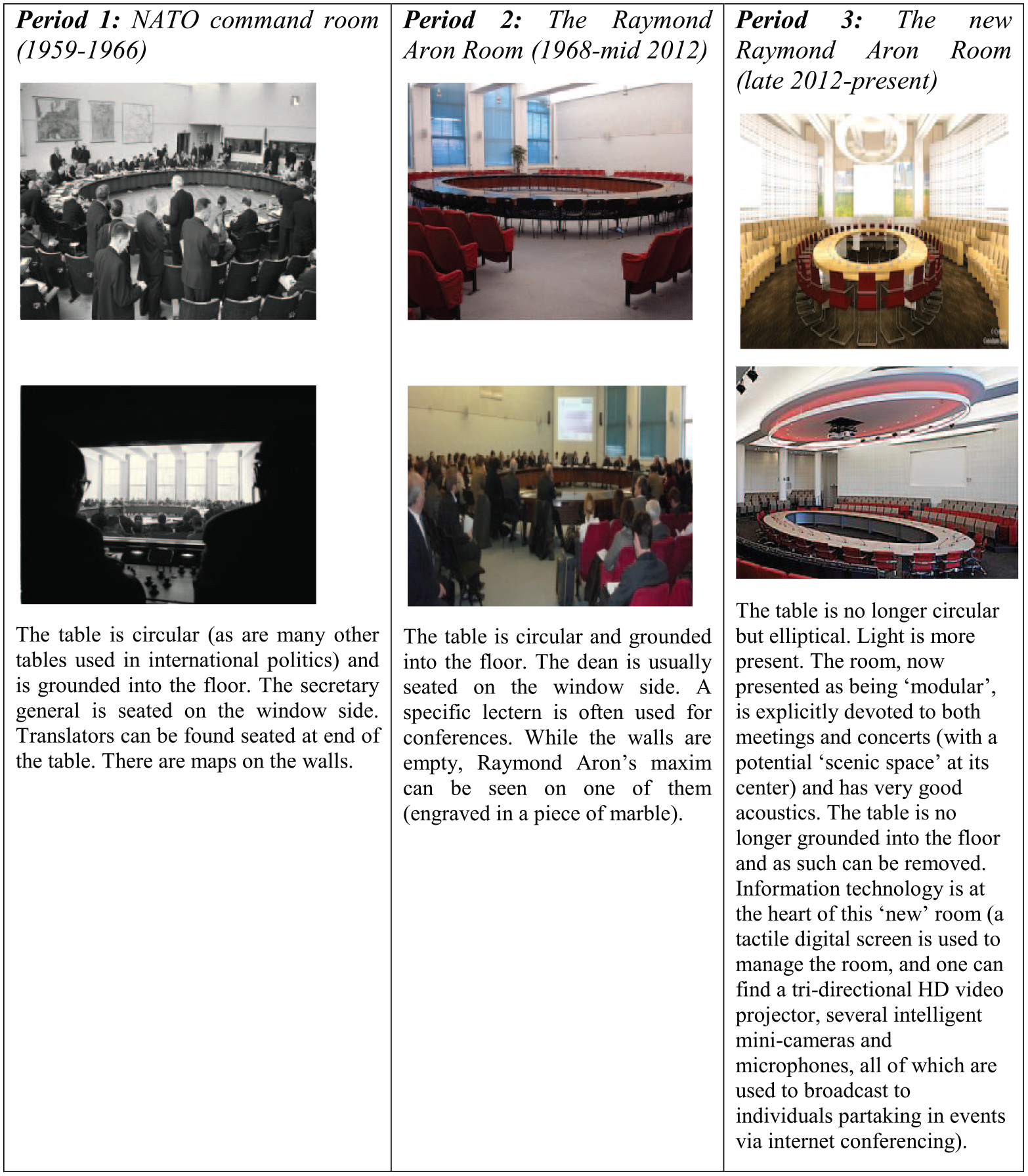
Views of the Raymond Aron (RA) room from 1959 to today (sources: NATO archives and authors’ photographs).
An auto-ethnographic account of the iconographies and visual practices taking place in a meeting room
I 6 first attended a meeting in the RA room in September 2009. The purpose of the meeting, which was led by the University’s President, was to welcome faculty and staff back and to present the University’s strategic direction for the upcoming academic year. I was so intimidated that I did not dare sit at the table, instead taking a seat in a chair at the back of the room. While at the time I knew little of the room’s history, I was still taken by its solemnity. With the wisdom of hindsight, I see this emotion as a symptom of my own feeling of illegitimacy. I probably unconsciously felt that it was not the right moment to seat there and talk. That I would need time to get accustomed to the place and the space.
From 2009 to 2012, I attended several meetings involving both academics and other stakeholders (e.g. students, prospective students, executives, administrative staff). During these events, speakers implicitly and explicitly invited audiences to think and imagine the room in which they were seated as being made up of what I see as three distinct spaces. Each of the rooms relied on a specific iconography and was associated with different moments of the history of the organization, its space, and artifacts (see Appendix 1): the historical space that called attention to the former NATO room and the historical table at its center, the critical space that called attention to the origins of the University and the quote from RA placated on the wall, and the executive space that called attention to the executive and contemporary practices via PowerPoint presentations and other technologically mediated artifacts.
The ‘historical’ space was at times enacted in front of external stakeholders (business partners, new students, sponsors of a new chair, etc.) in order to lend the University, or the event at hand, legitimacy via the room’s historical prestige: ‘It is with emotion that I welcome you in this room, which has been the heart of this building since the NATO period between 1959 and 1966’, said the director of a program in front of his in-company tutors. When a former prime minister of France was invited to speak in the room, he also started his presentation by reminding the audience of the NATO period. Audiences find the historical room striking: as a colleague once told me during a ceremony organized to present an award for the year’s top dissertation: ‘It’s amazing. Most of the time, when we invite practitioners, they are always impressed to be here in this room. They realize they are at Dauphine’. The historical space is a solemn, international, deliberative space.
The ‘critical space celebrates the (immediate post May 1968) history of the young university. At times, I noticed that speakers would read RA’s maxim as a means of reinvigorating the University’s initial impetus. I distinctly remember a certain Vice President (VP)’s speech in which he quoted the maxim in front of guests. We all looked up at the wall that we had long forgotten. The room suddenly looked bigger. In that moment, I realized I was part of a still young university, host to an original and critical educational project. The critical space is the first instance of a ‘reappropriation’ that took place in the wake of May 1968. This reappropriated area was an experimental, ‘post-May 68’ space, an arena for disputing, qualifying, performing, justifying, deconstructing, and (at times, vehemently) legitimating innovative practices (e.g. new teaching or research methods, new fields of research).
However, people mostly experience the third, decision and business-oriented ‘executive space’. The room is a bridge between academic and corporate worlds, managers, and society at large. It is the microcosm of the university at large (which is also a bridge between the business district and the academic heart of Paris). The room is, on the one hand, open to the business world—and quite literally so, as the main Parisian business district of Paris can be seen from its window. On the other hand, the room also represents the academic aspirations of an organization that aims at being a widely and highly recognized university in the French and international fields of higher education.
Multiple lower-level meetings and steering committees are organized in the executive space. Usually, these events replicate the spatial configuration of university executive meetings (the chair of the session sits in the Dean’s chair, etc.). At times, these events are solemn due to the use of microphones, which are technically not necessary. At times, during research seminars that I attended, the room mirrored the hierarchy of executive committees. Senior professors were seated around the table (with microphones in front of them), while more junior staff members and PhD students remained in the back of the room. I have also seen chair directors seated in the Dean’s seat.
Each space corresponds to the translation of broader institutional logics (Friedland and Alford, 1991), more or less social- or industry-oriented (Gumport, 2000). The NATO, historical space introduces traditions, prestige, and elitism as a way to make sense and justify organizational activities: Trust us … we are part of a powerful, long history, which is a justification by itself. The critical space brings with it a more intellectual, independent, innovative, experimental, and transformative set of justifications: Our university is at the core of society. It aims both at understanding and transforming it. We are not part of usual political power; we are beyond them. Finally, the corporate space is a way to link the local space to business milieu, managerial ideologies, managerial techniques, and business fashions: Here, it looks a little bit like your own place … we are an entry point to and a boundary object of the business world.
Each symbolic space also conveys its own symbolic tensions. With the historical space, people sometimes experience a tension between the past and the present. Justifying the present through the past increases the risk of misfits with presentism and old-fashioned discourses. With the critical space, the tension is felt more between criticism and selectivism (or even elitism). How can we promote the critical stance of the institution, with its will to be an independent place and likelihood to criticize dominant powers, while at the same time claiming to be part of a contemporary elite? Finally, with the executive space, organizational members may endure a tension between the corporate flavor of the location and the public nature of the university.
Since the room’s renovation (completed in 2012), the place has become a more ‘modern’, corporate, and open (expected to be ‘transparent’) space. The room is now also used to host concerts and serves as a bridge between Dauphine and society at large, in particular, companies from the city’s nearby business district (La Défense), which can be seen from one of the rooms’ many windows. Moreover, the executive space is now visually part of the ‘conceived space’. Microphones abound and can even be found at certain seats beyond the central table. This was not the case in the previous room, which means that attendants were not expected to talk during the meetings or events. Video projectors are omnipresent. The room’s tactile command system, colors, acoustics, and the design of its table are meant to reflect the standards of the prestigious executive rooms of specific companies located in the business district. The space of this new room (whose renovations were partially financed using private funds) 7 is no longer that of a nascent university. Furthermore, the historical and critical spaces are no longer explicitly visible, with the exception of a number of subtle symbols that have been preserved (in particular, the number of seats once located at the NATO table (43) has been retained). 8
All in all, contingent upon events and stakeholders’ practices, the RA room can become one of three symbolic spaces, each of which relies on key artifacts, visuals, and intricate image-object and image-screen iconographies (see Table 1 below).
Three symbolic spaces.
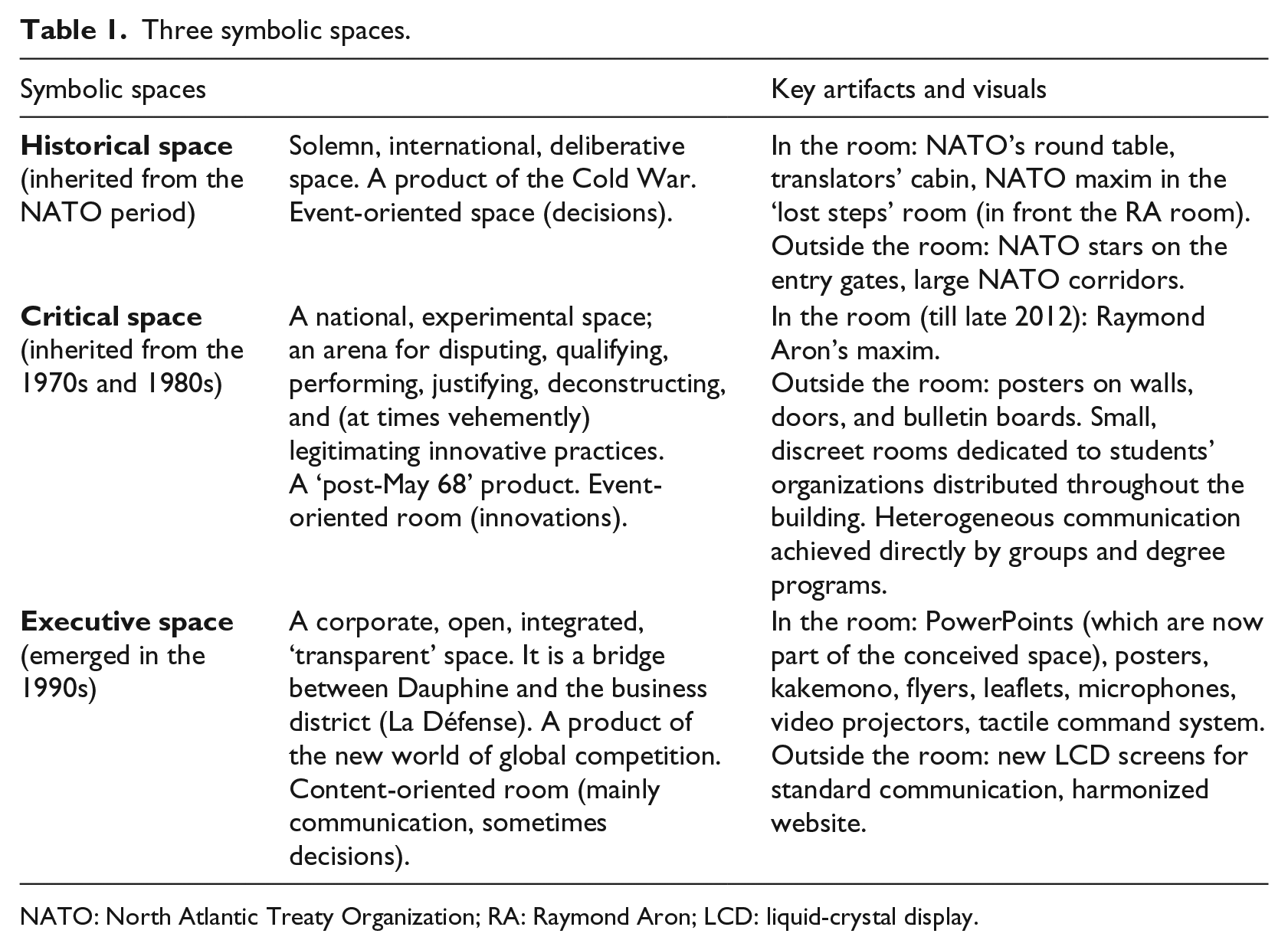
NATO: North Atlantic Treaty Organization; RA: Raymond Aron; LCD: liquid-crystal display.
The historical room is a solemn space where various forms of communication occur. Rhetoric—the respect of international, diplomatic conventions (which often implies that the issue at hand has been discussed and prepared beforehand)—is assisted by the presence of artifacts that remind people of the NATO period (i.e. image-objects). People instantiate the symbolic space and invoke the importance and legitimacy that comes from inhabiting a space that used to host a major international institution. By discursively invoking artifacts that are relics of the NATO period—such as the round table, the former translators’ cabin, or the former ‘lost step’ room—individuals create a visual appeal to the historical space. Indeed, imagining what the space looked like during the NATO period is powerful and offers a sense of legitimacy to those interested in history. The artifacts present in this room accomplish this in a subtle way (e.g. the round table that has been redesigned since the NATO period) and, in turn, form a ‘staged authenticity’ (MacCannell, 1973) that people may rely on in their legitimation practices. Of course, this staged authenticity relies on partial deception, as the NATO period is long past and as the room has already been partly renovated, a fact that was rarely revealed to external parties before its renovation (this would have probably weakened legitimacy claims).
The critical space serves as a host to more passionate—yet less explicitly ideological or political—discussions (e.g. concerning the underlying values of research, the social impact of academic activities, the more or less critical nature of teaching and research, etc., as was the case in the early years of Paris-Dauphine). Metaphors, poetry, tracts, and images are all part of this space’s communication practices, which together make up more of a debate (e.g. scientific and pedagogic discussions) than a negotiation. Given this, imagery must be effective for attendees within the time and space of meetings. Images are expected to support a local discussion, which is then expected to contribute to something greater. Again, in this instance, we are closer to the image-object than to the image-screen. Arguing, contesting, questioning, deconstructing—these are all tangible activities that involve both actors and symbols. Oddly, we see such activities as being connected to the past, as the University of Paris-Dauphine was conceived of as an ‘experimental’ and ‘critical’ university within the heated context following the uprising of May 1968 (Richard and Waks, 2009, authors’ translation).
In the context of the executive space, communication practices maintain a presence that extends beyond the time and space in which they occur. The image-screen iconography dominates. People rely on slides, which are key tools for contemporary communication practices in organizations (Gabriel, 2008). The redesigned RA room has also incorporated the use of slides into the ‘conceived space’ (Lefebvre, 1991): when one closes the curtains of the room using the tactile command system, the video projector automatically switches on. Artifacts support the image-screen iconography of the executive room. Through slides (which are likely to be distributed electronically to all attendees before or after the event), leaflets and posters advertising the events in the building’s corridors, and various electronic communications practices (e.g. Tweets about the event, online videos, links on social networks after the event), numerous traces give a certain global visibility to what would have otherwise been an ephemeral event. At the same time, the local context and local interpretations are still important in lending meaning and legitimacy to the event; however, in contrast to the historical and critical symbolic space, they do not require the room itself nor a direct experience with symbolic artifacts to be meaningful. One could imagine the same event as taking place at Dauphine or elsewhere and producing the same meaning.
Today, these three spaces variously combine screen- and image-objects practices in giving meaning to visuals and to the artifacts within the room that embody them and that lend legitimacy to the organization.
Regardless of the particular event that is taking place, the use of artifacts for image-screen iconography (in particular, PowerPoint-based slides) is often interrupted by the interjection of image-objects via direct interactions with the audience. Events often mobilize PowerPoint presentations, leaflets, flyers, or posters for communication practices. Moreover, PowerPoints are usually distributed to audiences following the events. Oftentimes, presentations are also photographed, filmed, or broadcast on the University’s website. Research seminars and conferences are the epitome of this: in many cases, they replicate (possibly with some adjustments) presentations that have already been given elsewhere. The use of PowerPoints, in particular for communications with corporate partners, has become a ‘must’, a standard and expected practice in the context of the room. Attendees often request copies of the presentation after the event if they have not already received it beforehand.
The new material setting of the room has added to this trend. Beginning late in 2012, the new room became equipped with ‘smart’ technologies such as mobile video cameras that follow speakers in motion. Furthermore, the acoustics have been dramatically improved to better broadcast sound. This updated, or for some, ‘sanitized’ environment, may make it more difficult to evoke the ‘critical’ or ‘historical’ spaces. At the same time, however, speakers may also have an increased communicative flexibility within this more impersonal space, making it easier for them to appropriate the two former incarnations of the room. Nonetheless, even in the context of the redesigned room, image-objects are still part of communication practices, in particular, at the end of PowerPoint-based presentations, when the floor is opened for questions. Often, when replying to questions from the audience, speakers respond by making the bodies of people in the audience part of their communication practices, pointing to specific places in the room and involving attendees in their legitimating narrative. Since 2013, even I myself have begun to symbolically appropriate certain new artifacts in the room during my own communication practices. For example, in the context of a round table discussion that was organized for a master’s program, I mobilized the five columns located at the back of the room to validate an argument. During the discussion, I noticed that two senior professors were seated in front of two of the columns. I used this to my advantage, saying, ‘I would now like to thank professors X and Y—both of whom are seated in front of two beautiful columns that support this building’s ceiling—for their longtime support of this program’. Will these columns replace the NATO-era round table in the University’s collective imagination? Will the historical and critical spaces be enacted in image-screen of the future?
In December of 2012, three events were organized in the newly remodeled RA room before its official inauguration in 2013. I participated in one of these events, a meeting for manager-mentors of a master’s program in business consulting. All the attending students and a number of staff members were impressed: ‘At least we’ve got one good room now’ a staff member sarcastically remarked. A video projector was used to display our PowerPoint presentation on all three walls simultaneously. A tactile system helped us to manage the system and the microphones. Intelligent cameras detected when someone would talk and captured image and sound. I felt like I had entered a completely new environment that was at once more corporate and global, perhaps due to the much-discussed new strategic direction that Dauphine was trying to take.
After the presentation that detailed what was expected from firms and students during their apprenticeships, the program administrators organized a cocktail reception. In this context, I participated in a discussion with a (senior) staff member. The new, visibly expensive room enthralled him; he found it effective and aesthetically pleasing. Nonetheless, he considered that something important had disappeared: the empty space at the center of the former NATO-era table. In the former version of the room, there was a large space at the center on the table. This space could not be used because the table was drilled into the floor. In a Parisian context, in which real estate is very expensive and must therefore be optimized, this senior staff member saw empty space as a sign of prestige and power. ‘Where is the prestige and power now?’ he asked me.
I also noticed a growing gap between students attending the events and myself. During the reception, I exchanged with some of them. I told them that I regretted somewhat the ahistorical aspect of this newly beautified room. I said that the room did not seem any more like a testament of the prestigious NATO period or to the exciting project of the then new university. Their reaction was clear. To them, Dauphine is no longer an institution that must be defended by something or someone. It is an established university. Additionally, the NATO period, the Cold War, and the 1950s and 1960s were not meaningful to them (‘That’s all old news!’). I suddenly realized that the common knowledge behind the critical and historical spaces were those of specific older generations whose members had retired or were close to retirement. Newer generations do not carry the same common knowledge of the past and the history of the room as older generations. The 20-, 30-, and 40-year-old stakeholders (prospective, matriculating, or executive students, sponsors, visiting academics, auditors for certifications, etc.) who need to be convinced of the University’s prestige are no longer impressed by the objects and image-objects that previous incarnations of the RA room used to convey. The stories must be simultaneously more local and more global, that is, more aligned with today’s RA room and today’s myths—but which ones? Perhaps, these stories must be aligned with today’s immaterial artifacts. As a co-organizer of different events that have taken place in the RA room, I am always impressed by the number of people (not present at the events) who request speakers’ PowerPoint presentations in the days following the event, and in turn reacting as if they heard the full presentation. The time and space of the presentation are clearly stretched by the use of image-screens.
For the time being, it seems that the communication practices that are carried out in the RA room constitute opportunities for visual presentations, for example, PowerPoints, videos, poster-based visuals, and so on. Will the center stage presented in the project change or preserve the event- and decision-oriented nature of the room? It is too early to tell. Moreover, one can wonder if the new, more ‘impersonal’ space will allow speakers to create convincing narratives by means of the increasingly flexible symbolic artifacts located around them. If not, we may move from a space that hosts events (and narrations) toward one that hosts content (meant to be replicated and diffused at the detriment of historical and critical spaces). The use of image-objects is likely to become more virtual (a pure narrative or an element replicated on a PowerPoint), and therefore less in line with what Baschet (2008) says of this visual category.
Object- and screen-based imageries appeared as largely intertwined in most events I attended. Mentioning a participant, showing an object, referring to a document distributed and inviting attendees to read something in it directly, pointing out an object in or outside the room (e.g. Aron’s maxim, the round table, the NATO maxim, the business district behind the windows) strengthen, punctuate, or emphasize an important issue narrated with a PowerPoint. Beyond the visual effect, such actions also give rhythm to the events. A key concern of most presenters was probably to avoid boring their audience and becoming a routinal noise for them. Beyond the issue of rhythm, intertwining screens and image-based iconography enable both local connotations (involving people in the discussion and making them happy to directly attend to the rhythm) and broad diffusion (as the key parts of the talk can be circulated through slide decks, online videos, or audio podcasts). This makes it possible to produce legitimacy claims both at the time and space of the event as well as after it ends.
Visual practices, artifacts, and organizational legitimation in the meeting room
Visual practices invite various contexts of justifications, that is, institutional logics (see Lounsbury and Boxenbaum, 2013), in the context of the room. Each symbolic space structures a possible world or combination of worlds of justifications (see Boltanski and Thévenot, 1991) to produce legitimacy claims. These symbolic spaces seem brought down ‘to the ground’ (McPherson and Sauder, 2013: 166) to logics on the floor.
Speakers’ invocations rely on visual practices deploying artifacts into the communication practices of the speaker. Through the descriptive coding of our observations, we identified nine visual artifacts involved in the invitation of justification and legitimacy claims (see Table 2) and five associated visual practices (see Table 3).
Key visual artifacts involved in communication practices.
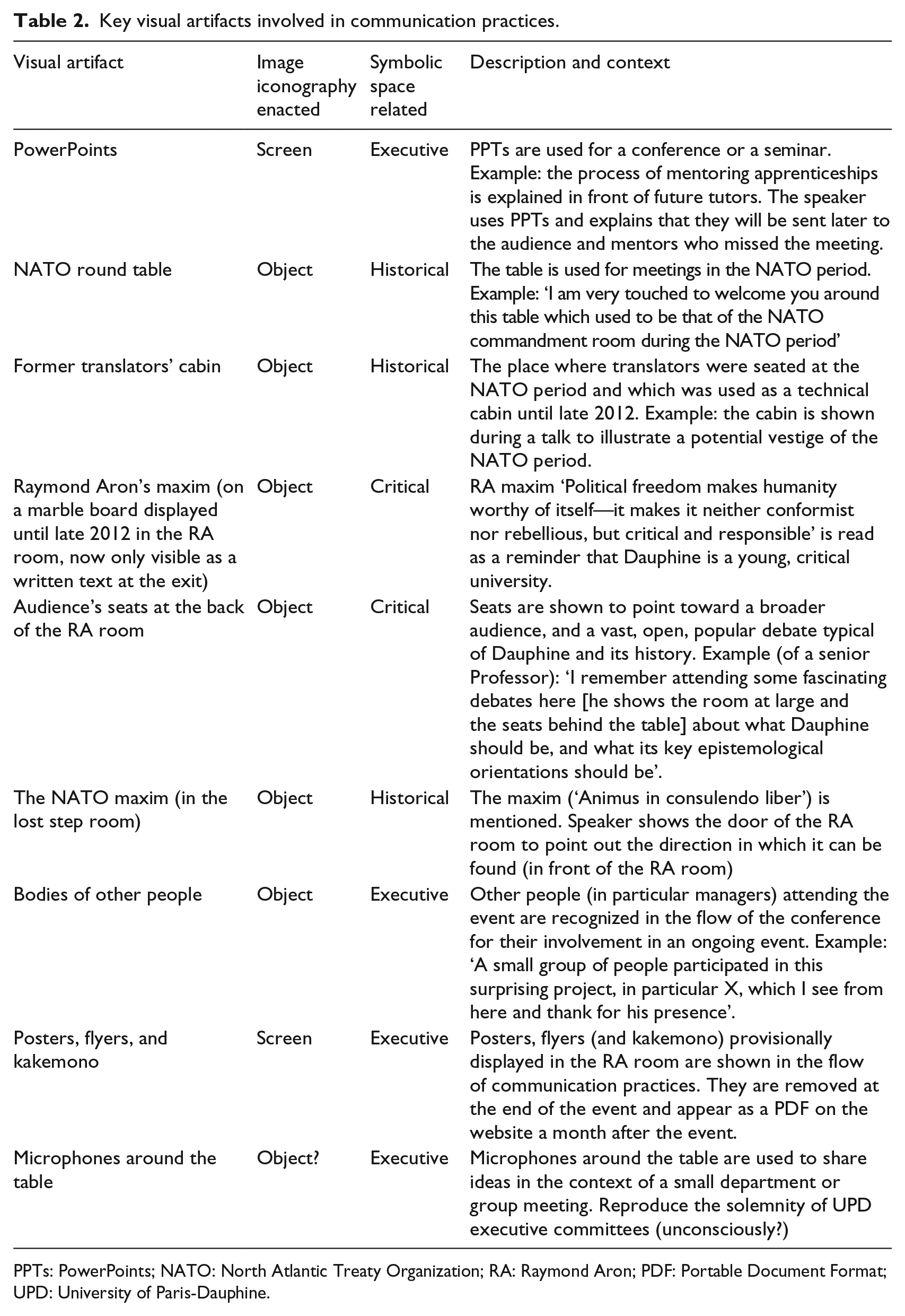
PPTs: PowerPoints; NATO: North Atlantic Treaty Organization; RA: Raymond Aron; PDF: Portable Document Format; UPD: University of Paris-Dauphine.
Key visual practices at the core of legitimacy claims (in the context of the RA room).
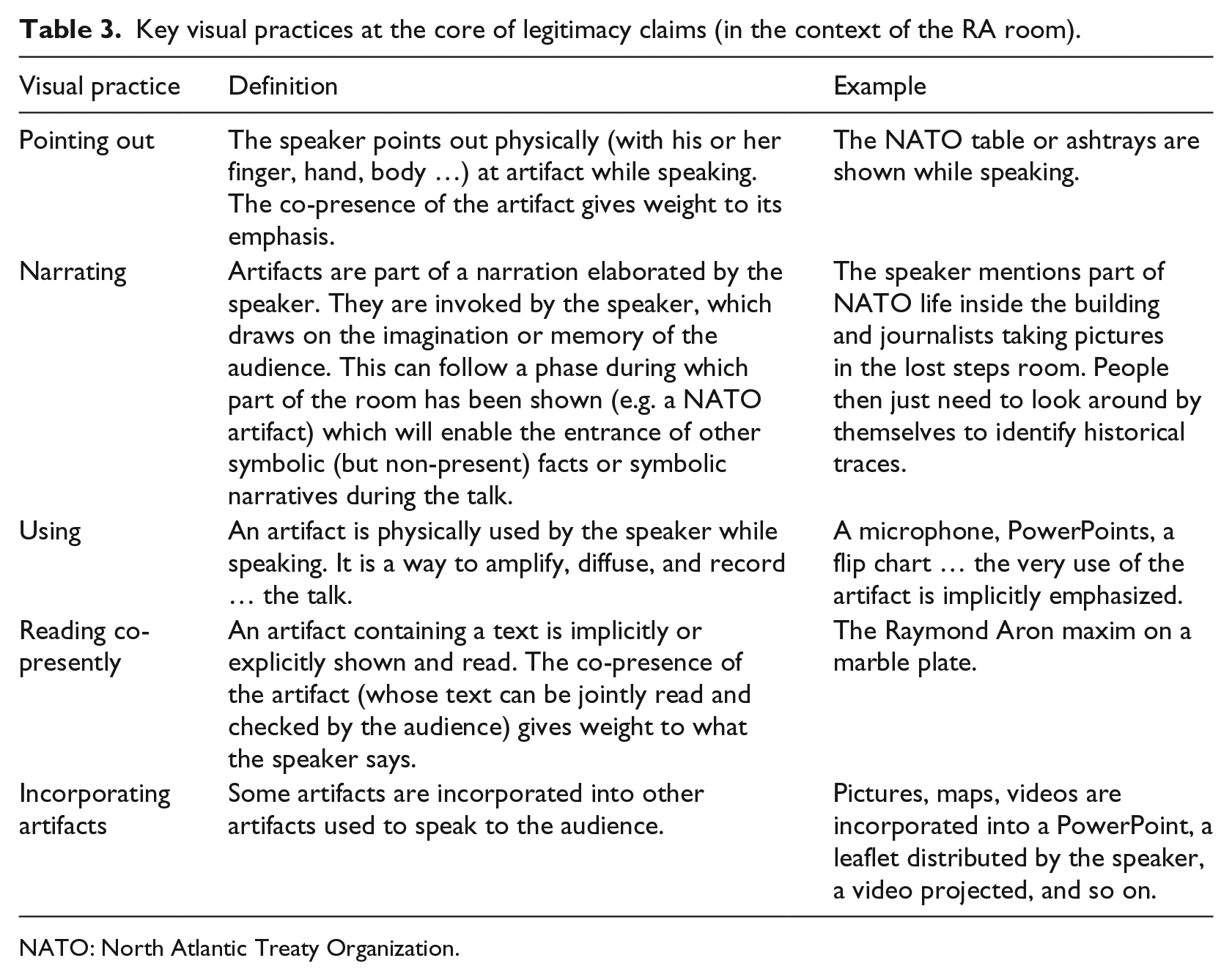
NATO: North Atlantic Treaty Organization.
In the context of our 15 observations, we also identified five key visual practices associated with legitimation dynamics in the RA room (see Table 3).
All in all, the case of the RA room allows us to speculate on how organizational actors mobilize, separately and jointly, image-object and image-screen iconographies in their efforts to bring legitimacy to the organization. For one, the relative role of these two iconographies depends on the availability of artifacts that can be given symbolic meaning by the organization. Whether and to what extent legitimation practices rely on artifacts as image-objects depends on whether stakeholders are able to associate the intended symbolic meaning with these artifacts. In contrast, legitimation practices that are not particularly spatially or temporally grounded may rely entirely on image-screen iconography and be conveyed entirely through Information Technology (IT). Moreover, these iconographies are also dependent on the stakeholders’ anticipated knowledge and understanding of these symbolic artifacts. Artifacts may only become image-objects that can support legitimation practices if stakeholders can understand the meaning of the artifact and the reputational effect associated with its visibility. The flow of communication (more or less improvised, interactive, metaphorical, or technical) is also crucial in the enactment of these dual iconographies in legitimation practices. Interactions with the audience and the integration of symbolic artifacts (acronyms during speeches, the use of posters and leaflets, the speaker’s request that attendees read certain books beforehand, etc.) recreate the (fragile) image-objects that render the rediffusion of the event more difficult.
Our research also emphasizes the extent to which organizational members are reflexive within their immediate material and symbolic space, as well as how central space is to everyday legitimation practices. Organizational legitimation can be grounded in artifacts that must be situated in a specific spatial and temporal setting in order to produce a legitimating effect. In the table below, we contrast image-objects and image-screens in the context of the nature of their sociomaterial ‘entanglement’ (Orlikowski and Scott, 2008) and their relationship with legitimation practices (see Table 4).
Dual iconographies, entanglement of information and artifacts, and legitimation practices (authors’ own).
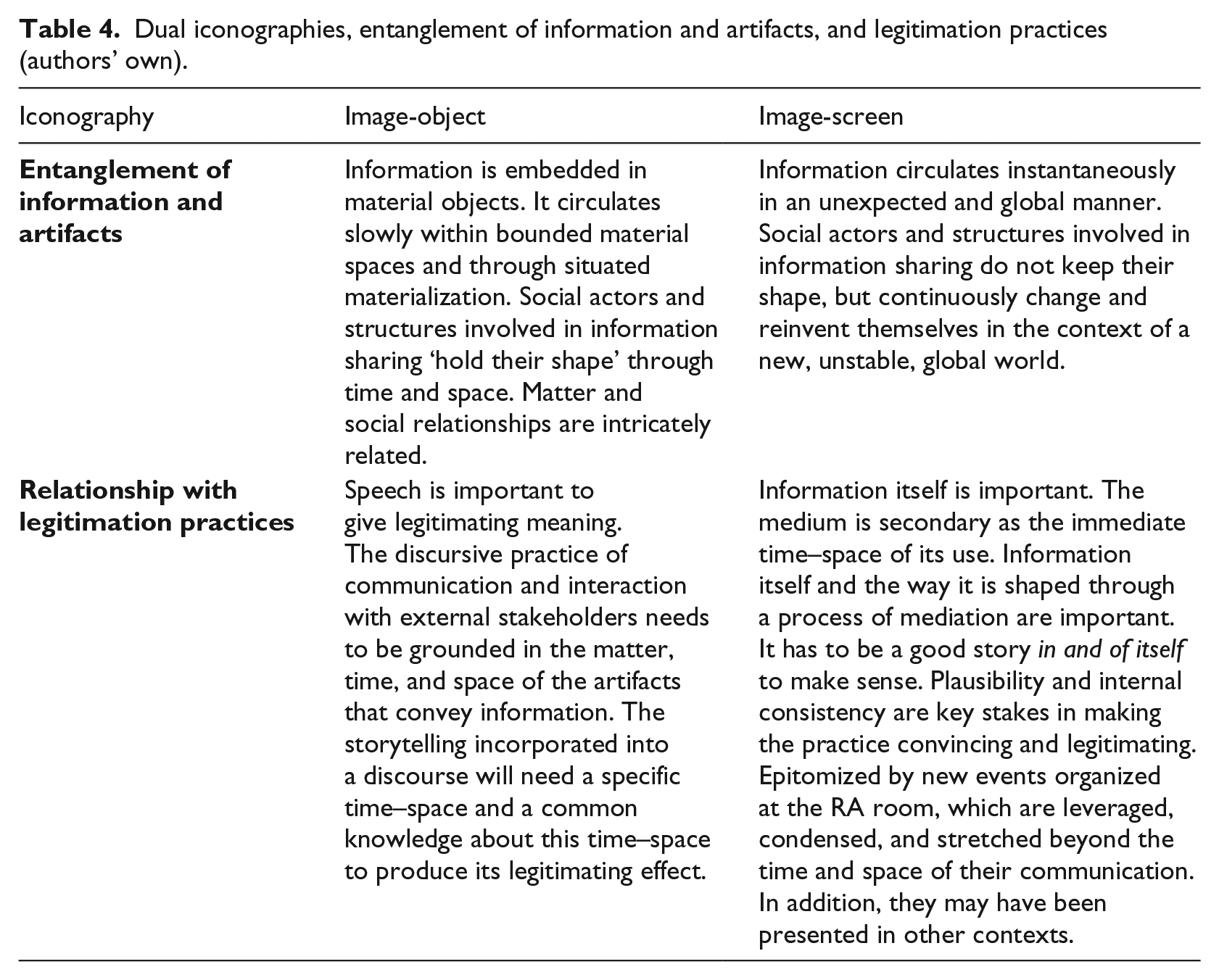
Both iconographies (screen- or object-based) contain specific material underpinnings of legitimation: one that requires a shared representation and a specific space–time to be effective (image-objects), and the other that is more specific to the direct relation with the artifact and the story it conveys, and whose legitimating power depends more on the internal consistency and plausibility of the narrative and the visuals that it includes (image-screens). The latter implies a technical and cognitive infrastructure, which, beyond the matter immediately encountered (e.g. that of the screen of the iPad, laptop, video projector, or poster), enables organizational members to make sense of the content being presented.
Because ‘image-objects’ require common (often historical) artifacts, stakeholders who can be won over by legitimation practices and their growing demographic diversity may lead managers to rely on screen-object iconography or new, IT-based, image-objects in their legitimation practices. Such practices involve a subtle switching back and forth between screen-based and object-based iconographies in order to humanize discourse, give it rhythm, involve local audiences, and to connect with external audiences well after the (spatially and temporally bounded) event has already taken place.
All in all, Figure 2 summarizes how, in the RA room, legitimacy claims were produced through the combination of symbolic spaces and visual practices.
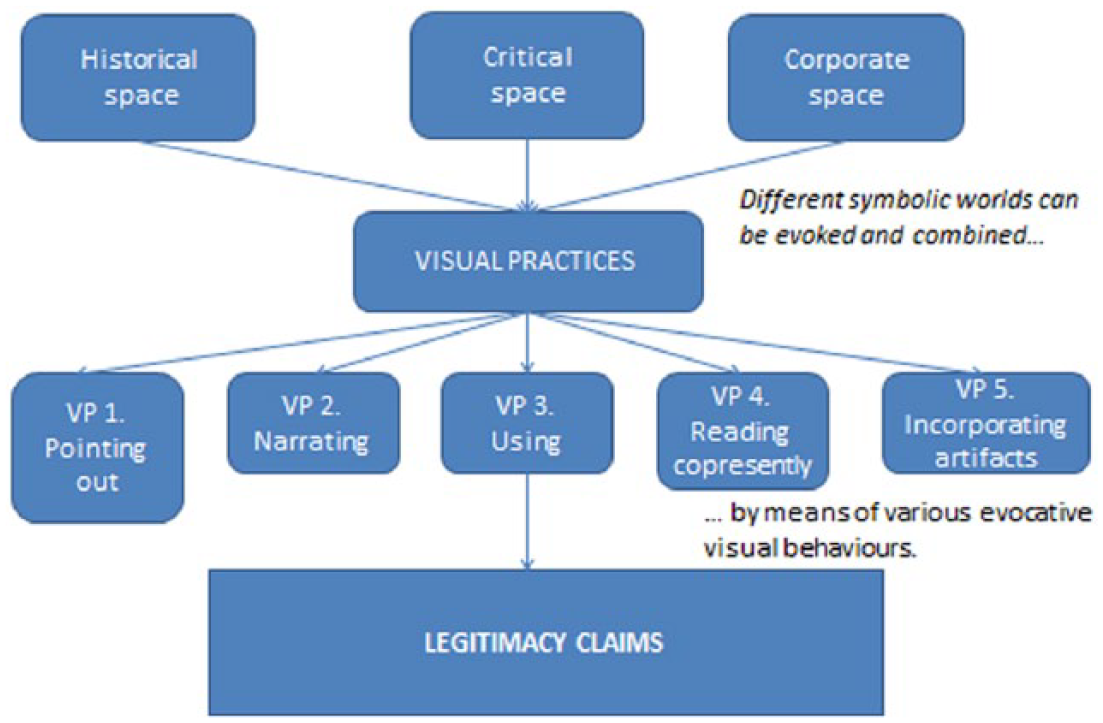
The relationship between visual practices and legitimacy claims in the RA room.
Visual practices instantiate (through five possible modalities) the three symbolic spaces (and their corresponding institutional logics) we identified. The final legitimacy claims appears as continuous plays and bricolages with a connotative set of visual artifacts and imageries. At the end, both image-objects and image-screen are involved in the process.
Discussion: the role of visuality and visual practices in the elaboration of legitimacy claims: an iconographical perspective
In the RA room, organizational actors relied upon visual practices as they attempted to lend legitimacy to specific events and to the entire organization by appealing to what they perceived as various stakeholders’ values and expectations. The contributions of this work to neo-institutional scholarship on organizational legitimation are threefold.
First, it shows how ritual or improvised practices mobilize visuality to produce legitimacy claims. It identifies key artifacts and five visual practices involved in the process. It contributes to answering Meyer et al.’s (2013) call for a fine-grained description of the neo-institutional process of legitimation and its visual modalities. This research extends studies on organizational legitimation by going beyond the distinction between verbal and non-verbal accounts (Elsbach, 1994; Elsbach and Sutton, 1992; Suchman, 1995). Our case narrative helped us theorize two different legitimation modalities, relying on two iconographies. The first iconography—image-object iconography—is highly material and embodied. Discourse gives legitimating meaning that is inscribed materially. The discursive practice of communication and interaction with external stakeholders is grounded into the material, time, and space of the artifacts that convey the discourse. The storytelling incorporated into a discourse needs a specific time–space and a common knowledge about this time–space to produce its legitimating effect. With the second iconography—image-screen iconography—information itself is important. The medium is secondary and constitutes mostly the setting or context through which information is displayed, and the ways it is shaped through a process of mediation are the key elements of this iconography. It has to make a good narrative in itself to make sense. Plausibility and internal consistency are key stakes in making the practice convincing and legitimating, epitomized by new events organized in the meeting room at the heart of our case narrative, which are leveraged, condensed, and stretched beyond the time and space of their communication. In addition, they may have been presented in other contexts. As social archetypes, image-objects and image-screens, their dynamic and interplay in organizational communication, can be very helpful to understand the underpinnings of legitimation processes. Screen- and object-based imageries have become increasingly embedded into organizational legitimation practices. Through visual practices, visuality and materiality are then intertwined to make an impression on an audience and make it continuously move between the global narrative (which can then travel beyond the time and space of the presentation) and that of an immediate experience (e.g. the embodied reception of communication practices). Legitimacy will then be grounded both in the here and now of material mediations (e.g. of the NATO round table or RA marble plate) and the there and tomorrow of visuality (of the slides and videos sent after the event). The very tempo of the alternation of screen- and object-based images appears as a powerful device to impress an audience and produce identifiable legitimacy claims. Those who attend the event directly have the privilege to be ‘on board’ in the instantiation of material mediations. The pointing out (see, for example, Goodwin, 2000 on the issue of ‘pointing’) is a powerful practice addressing those present and not those who will see the video or the PowerPoints sent after the event. Attendants become direct witnesses and conscious of the legitimacy claim. They are part of its fabric.
This work also sheds light on the symbolic spaces and institutional logics instantiated in practices. These spaces may be sequentially and simultaneously mobilized through visual practices to convey worlds of justification, specific logics that will then be used as the context of argumentative strategies (more or less corporate, historical, or commemorative). This research thus adds to ongoing discussions in the neo-institutional literature about institutional logics and their visual and material underpinnings (Jones et al., 2013; Meyer et al., 2013).
Finally, building upon Suddaby and Greenwood (2005), this work contributes to the understanding of contemporary legitimation practices by adding the importance of historical depth. History-based legitimacy claims are at the core of communication practices relying on the historical space we identified. Speakers reflexively draw on ‘spatial legacies’ (i.e. parts or strata of the artifacts related to an organization which are labeled as ‘historical’ by organizational members and recognized as such by some key external stakeholders). Spatial legacies (see De Vaujany and Vaast, 2014) can help to produce strong legitimacy claims. Here, we come closer to the fabric of these specific legitimacy claims by showing how through the pointing, use or narration of artifacts, history can enter into the world of justifications of the speaker. Objects and images can help materialize history quickly, even though it is ‘staged authenticity’ (MacCannell, 1973; Urry, 2002). The NATO round table removed in 2012, although a strong visual artifact was not fully the original round table used in the context of the NATO commandment room, but was presented as such.
In closing this analysis, we acknowledge that auto-ethnography has some limitations. If it made our presence invisible and legitimate, it also made it difficult to go beyond legitimacy claims and to put ourselves in the shoes or the ‘eyes’ of the beholders of legitimacy. In addition, it centered the narration heavily around the body, location, perspective, and emotions of the auto-ethnographer. Nonetheless, through discussions (distant in time and space) between the first and second author, we did our best to make the analysis as reflexive as possible. We also acknowledge that the case on which it is based focuses on a specific, bureaucratic environment (a public French university) whose culture, structure, and history are highly unusual, but by the same token, also highly illuminating. Moreover, our research focused on a room that has been deliberately appropriated, redesigned, outfitted, and presented as a place for communication and legitimation. Yet, legitimation practices also occur in other spaces throughout the university. More research could help to expand the boundaries of our investigation. Furthermore, as we focused on iconographies and the legitimation practices associated with visuals, we may have neglected other legitimation practices that rely on other non-verbal forms of communication. In this regard, we were especially intrigued by the embodiment of legitimation practices through the actual bodies of both presenters and audiences in the room. We would finally like to see future research examine the embodiment of legitimation practices and its relationships with image-screen and image-object iconographies. In this regard, we see much potential in the incorporation of ‘gender performativity’ building upon Butler’s (1993) seminal theorization and upon Tyler and Cohen’s (2010) argument on organizational spaces into the perspective presented in this article. Most of all, we believe that it is possible to go one step further in the exploration of legitimation as process. The visuality, materiality, and temporality of legitimation remain largely under explored in the literature. Matching social expectations often appears as a gradual exercise. Through activities of appropriation, deappropriation, and reappropriation of space, a context (based on space, texts, artifacts …) is often described as progressively aligned with social expectations (see, for example, De Vaujany and Vaast, 2014; Proffitt and Zahn, 2006). If visuals, artifacts, and space at large are conceptualized as evolving and more or less constituted by practices, they all have an ontology. Other perspectives could conceptualize legitimation as something closer to a process or a movement, a field of ‘events’ (Hernes, 2014; Schatzki, 2010). Visualization more than visuality could be at the heart of these future works, which we look forward to reading.