



Abstract
In recent years, we have seen a proliferation of research on discursive legitimation, which has shed light on how legitimacy is established through communication. However, this body of work remains fragmented, and there is a need to synthesize and develop a more comprehensive and in-depth theoretical understanding of this vibrant area of research. This article aims to address this need by providing an integrative theoretical framework and outlining an agenda for future research. The framework encompasses five key elements of discursive legitimation: strategies, positions, foundations, temporality, and arenas. Drawing on this framework, we present a research agenda that highlights key topics related to these elements along with theoretical and methodological considerations cutting across them. Our contribution lies in conceptualizing discursive legitimation as a multifaceted and dynamic phenomenon, offering a complementary framework to existing models and paving the way for future studies, and placing discursive strategies—which have been the focus of prior research—in context by highlighting the critical role of key discursive elements in enabling or constraining legitimation processes.
Keywords
The purpose of this article is to offer an integrative theoretical review of research on discursive legitimation, a dynamic area of research exploring how organizational legitimacy is established through communication. Legitimacy is one of the key concepts in the social sciences that explains what is seen as appropriate, normal, or accepted in social and societal life (Deephouse, Bundy, Tost, & Suchman, 2017; Suddaby & Greenwood, 2005). Organizational legitimacy is defined as “the perceived appropriateness of an organization to a social system in terms of rules, values, norms, and definitions” (Deephouse et al., 2017: 9). In recent years, scholars have focused special attention on legitimation as the process where legitimacy is constructed, thus offering a more dynamic perspective on this body of work (Bitektine & Haack, 2015; Deephouse et al., 2017; Suddaby, Bitektine, & Haack, 2016).
Scholars have increasingly pointed out that communication plays a crucial role in legitimation (Maguire, Hardy, & Lawrence, 2004; Suddaby & Greenwood, 2005; Vaara, Tienari, & Laurilla, 2006). Drawing from diverse traditions, this body of work uses different terms interchangeably to capture essential aspects of discursive legitimation, such as “language,” “communication,” and “discourse.” To add conceptual clarity, we adopt “discursive legitimation” as the overarching term referring to the use of language or communication to create a sense of what is positive, favorable, beneficial, understandable, necessary, or otherwise acceptable in a specific setting (Vaara, 2014). 1
We thus use “discursive legitimation” as an umbrella term to encompass research on how language or communication may relate to underlying assumptions about what is deemed legitimate, even though prior studies on discursive legitimation represent different streams and traditions. In particular, scholars have used rhetorical perspectives to focus on deliberate acts of persuasion or convincing, thus focusing attention on both the actors and the rhetorical means used for legitimation (Green, 2004; Harmon, Green, & Goodnight, 2015; Suddaby & Greenwood, 2005). Others have drawn on discourse analytical theories and methods, especially critical discursive approaches (Van Leeuwen, 2007; Van Leeuwen & Wodak, 1999), which have, among other things, highlighted the role of underlying discourses and the ideological aspects of legitimacy struggles (Vaara et al., 2006; Vaara & Tienari, 2008). Framing has been yet another approach used in making sense of legitimacy, highlighting the key role that specific frames play in establishing legitimacy (Benford & Snow, 2000; Cornelissen & Werner, 2014; Snihur, Thomas, Garud, & Phillips, 2022). Scholars have also focused on narratives to view legitimation processes as the construction of compelling plots and story lines (Brown, 1990; Golant & Sillince, 2007). Finally, others have used metaphors to understand the microlevel communicative construction of legitimacy (Budd, Kelsey, Mueller, & Whittle, 2019; Cornelissen, Holt, & Zundel, 2011).
While these and other studies have offered insightful ideas and advanced our understanding of discursive legitimation, these streams have remained relatively disconnected. This is unfortunate in and of itself, and it has also hindered the development of a more comprehensive and in-depth theoretical understanding of this key area of research. Hence, we argue that there is a lack of synthesis: a systematic review combining insights from different streams of research to provide a theoretical framework that elucidates key aspects of discursive legitimation as a phenomenon and paves the way for future research. Such a review can be seen as an integrative theoretical review (Elsbach & van Knippenberg, 2020), which we aim to offer in this article.
In what follows, we first provide a brief overview of prior reviews of legitimacy and legitimation, pointing to a need for a systematic review of discursive legitimation. We then explain the methods used in our comprehensive review. This leads us to propose an inductively derived integrative theoretical framework comprising five key discursive elements: strategies, positions, foundations, temporality, and arenas. Additionally, we outline an agenda for future research within and across these elements. We conclude by explaining the key contributions of the article: Our integrative review conceptualizes discursive legitimation as a multifaceted and dynamic phenomenon, our theoretical framework complements existing models and sets the foundation for future research, and our analysis helps to place discursive strategies—the focus of prior research—in context by highlighting the critical role of key discursive elements that enable or constrain discursive legitimation.
Prior Reviews of Legitimacy and Legitimation
Legitimacy is a ubiquitous phenomenon and has been a central concept in social sciences since Weber’s foundational work (Weber, 1968; Weber, Roth, & Wittich, 1978). Since then, legitimacy has played an important part in theories and frameworks across the social sciences (Bourdieu, 1985; Giddens, 1984; Parsons, 1960; Weber et al., 1978). This has included several natural systems theories and frameworks in areas such as population ecology (Hannan & Freeman, 1977, 1984) and institutional theory (DiMaggio & Powell, 1983; Meyer & Rowan, 1977; Stinchcombe, 1965, 1997). Furthermore, legitimacy has become a key concept in social psychology (Tyler, 2006; Zelditch, 2004).
Research on organizational legitimacy has grown from these streams to create new theoretical ideas and models. This is especially the case with institutional theory, where legitimacy has become a cornerstone of theoretical and empirical work that helps explain the emergence, maintenance, and disruption of institutional order (Deephouse et al., 2017; Scott, 2008; Suchman, 1995; Suddaby et al., 2016; Suddaby & Greenwood, 2005). Moreover, scholars in organizational psychology and behavior have developed theoretical models to increase our understanding of how legitimacy judgments are formed and shaped (Bitektine & Haack, 2015; Haack, Pfarrer, & Scherer, 2014; Haack, Schilke, & Zucker, 2021; Tost, 2011; Zelditch, 2001). More recently, we have also seen legitimacy being linked with related concepts, such as reputation, status, or stigma (Bitektine, 2011; Deephouse & Suchman, 2008; Devers, Dewett, Mishina, & Belsito, 2008; Pollock, Lashley, Rindova, & Han, 2019).
An overview of this entire field of research is beyond the scope of our article, but it is helpful to summarize existing reviews in this area. Table 1 summarizes existing reviews on legitimacy, comprising theoretical syntheses and actual review articles.
Reviews of Research on Legitimacy and Legitimation
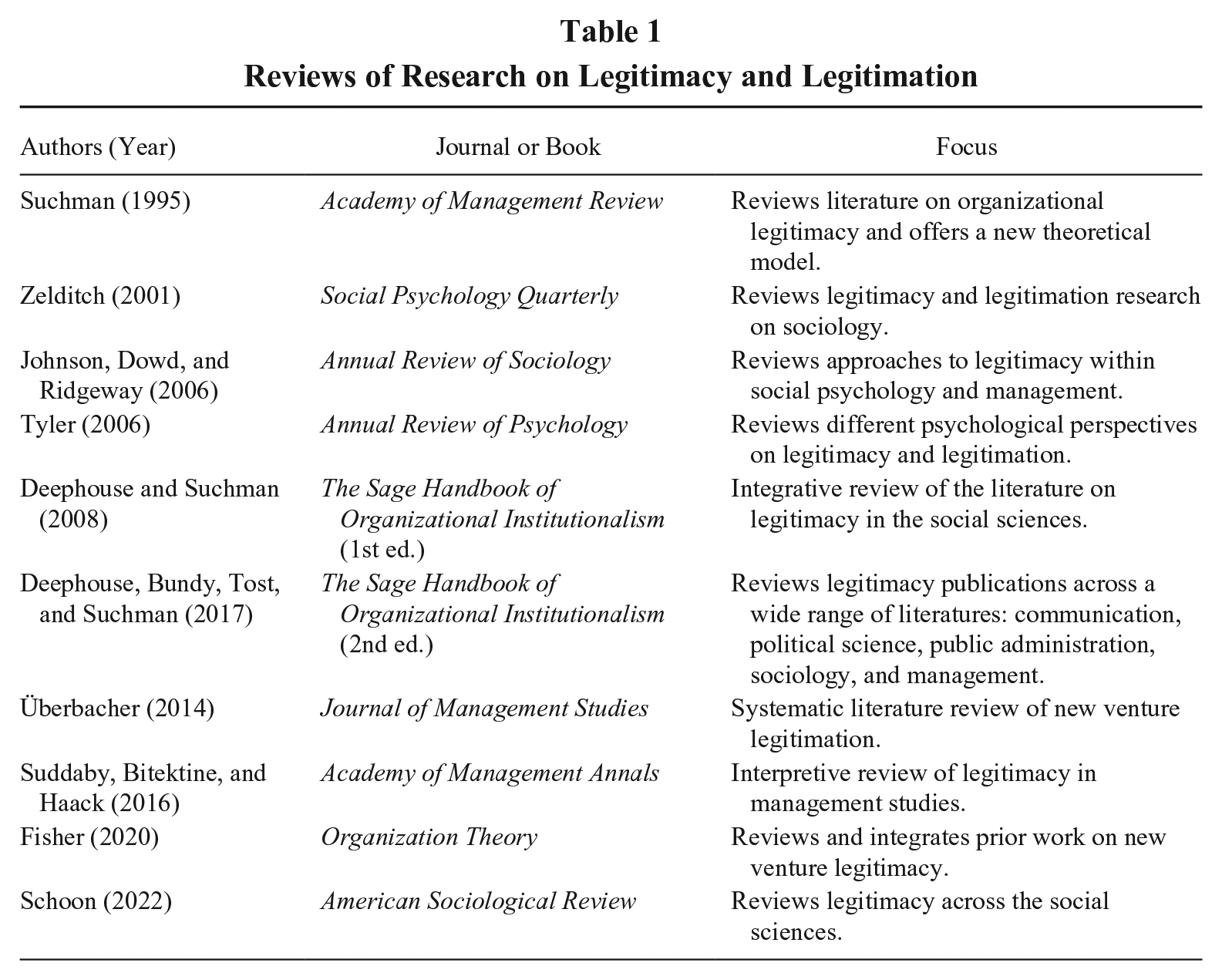
One of the first theoretical syntheses was offered by Suchman (1995), who outlines how legitimacy may rest on three foundations: pragmatic, based on self-interest; moral, based on normative approval; and cognitive, based on comprehensibility and taken-for-grantedness. While Suchman’s work influenced research on organizational legitimacy, it did not focus on legitimation as a process. Zelditch (2001), in turn, provides a chronological overview of classical and contemporary approaches across disciplines to explain legitimacy and its underpinnings, emphasizing the importance of dynamic approaches. In sociology, Johnson, Dowd, and Ridgeway (2006) provide one of the first reviews, focusing on legitimation as a social process of meaning construction through active and continuous interactions among multiple actors. Similarly, focusing on social and organizational psychology research, Tyler (2006) offers a systematic review characterizing legitimation as a fundamental social process but primarily focusing on legitimizing authority in organizations.
Deephouse et al. (2017) and Deephouse and Suchman (2008) present comprehensive reviews of organizational legitimacy in their book chapters. They initially defined legitimation as “the process by which the legitimacy of a subject changes over time” (Deephouse & Suchman, 2008: 57) and later extended their definition to “include stakeholders’ actions to endorse or contest an organization’s legitimacy as well as the organization’s actions to defend itself” (Deephouse et al., 2017: 21). They propose five scenarios explaining how legitimation processes unfold over time—gaining, maintaining, challenging, responding, and institutionally innovating—pointing to, but not focusing on, the key role of communication (Deephouse et al., 2017). In turn, Suddaby et al. (2016: 27) offer one of the most complete reviews of legitimacy, in which they point out the need to study legitimation as a process “grounded in language.” Schoon (2022) then provides the most recent overview of legitimacy in sociology, proposing a generalizable approach to operationalizing legitimacy. Although it offers novel opportunities for measuring the effects and relevance of legitimacy for significant outcomes, it pays little attention to discursive aspects. There are also more specific reviews. For instance, Überbacher (2014) and Fisher (2020) have focused on the central process of new venture legitimation, pointing to the importance of communication and narratives in these processes.
Although these reviews have provided essential insights into our understanding of legitimacy and legitimation, they have not focused on discursive legitimation per se. It is, however, important to develop a deeper understanding of how linguistic elements shape legitimation and how actors use language strategically to develop a fuller understanding of this crucial part of legitimation. Moreover, while previous studies have pointed to the pivotal role of language in legitimation processes (Deephouse et al., 2017; Suddaby et al., 2016), we lack an overall picture of how various discursive, rhetorical, narrative, and other linguistic elements either enable or constrain legitimation. Hence, we aim to address the current fragmentation of research on discursive legitimation through an integrative theoretical review (Cronin & George, 2023; Torraco, 2016). The key idea is to connect explicit or implicit themes to provide an overarching conceptual framework and a more comprehensive theoretical understanding of discursive legitimation (Elsbach & van Knippenberg, 2020) that will serve as the basis for developing an agenda for future research.
Review Methodology
We conducted a systematic review of organizational research on discursive legitimation following prior review studies published in the Journal of Management as well as recent methodological articles on conducting reviews (Aguinis, Ramani, & Alabduljader, 2023; Hiebl, 2023; Kunisch, Denyer, Bartunek, Menz, & Cardinal, 2023; Short, 2009). This included six steps with iterations between them.
First, we defined the scope of the review. Since our purpose was to “synthesize and build linkages and relationships across previously disconnected studies” (Kunisch et al., 2023: 16), our process was designed to include a broad set of articles. In this initial step, we openly screened the organizational literature to identify key approaches and perspectives recurrently referred to in legitimation studies. Through preliminary inductive screening and team discussions, we identified perspectives and themes related to communication, language, rhetoric, discourse, framing, narrative, metaphor, and other tropes central to discussions about discursive legitimation. This was an important step, providing the basis for developing and refining our search in subsequent steps (i.e., the keywords used in Step 3).
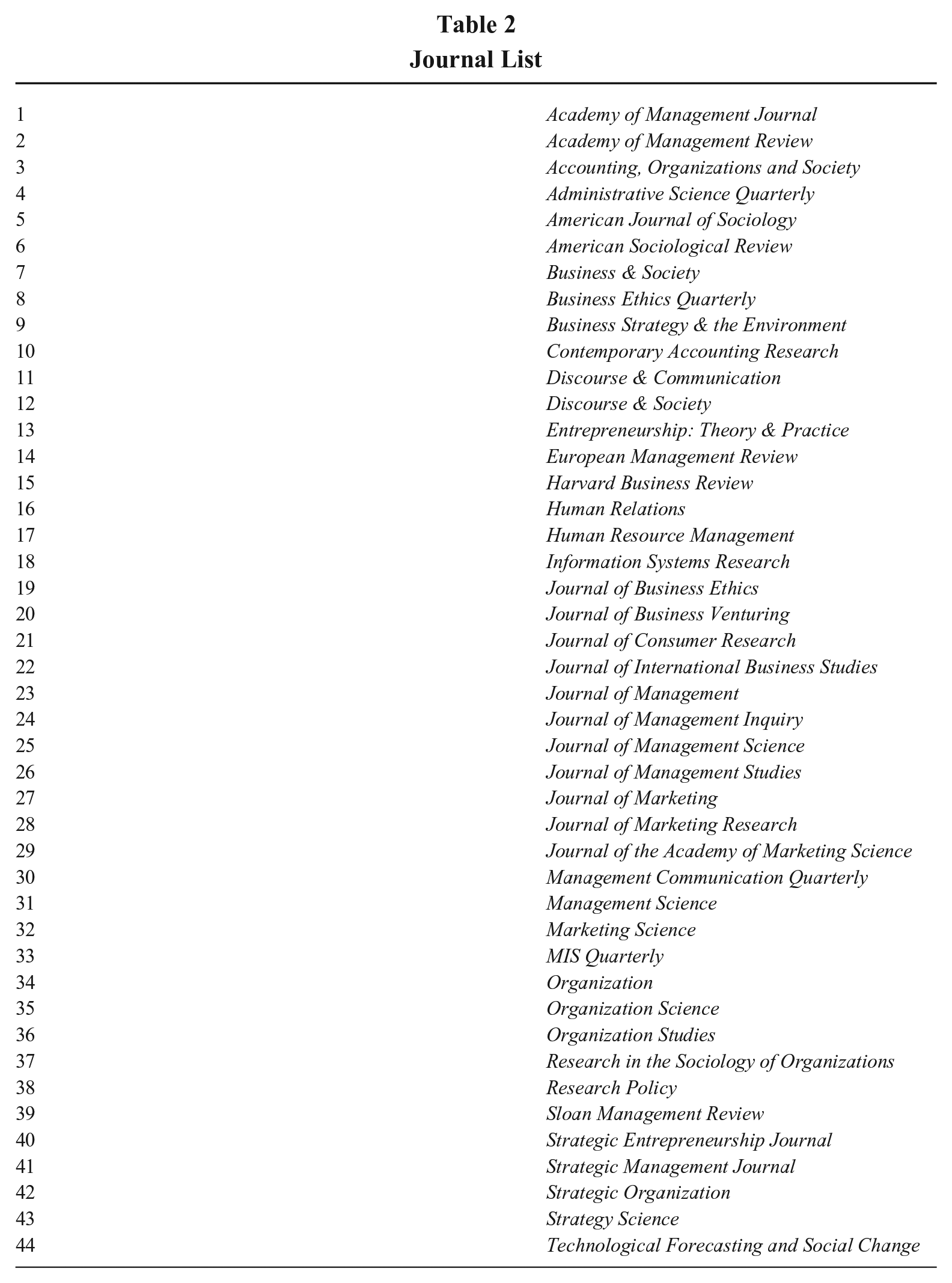
Second, we selected the journals for inclusion in our study. We focused on the most prominent and cited outlets in organization or management studies, identified using the Web of Science Journal Citation Reports database (Aguinis et al., 2023). Since this list included 397 journals across various research areas, we selected highly cited potential outlets for legitimation research or at the intersection of organization or management with fields such as sociology, communication, or linguistics. To avoid blind spots that may result from solely relying on top-cited journals, we used snowballing methods to further identify relevant journals (Hiebl, 2023). Following a preliminary scan of more than 100 journals, we finalized a list of 44 journals that included articles on discursive legitimation (see Table 2).
Journal List
Third, we searched for articles published in each of the selected journals. Given the prevalence of EBSCO in previous management reviews (Hiebl, 2023), we searched this database for the occurrence of our inductively derived keywords (see Step 1). Specifically, within EBSCO, we searched for the co-occurrence of the following terms in the article’s abstract, title, or keywords: legitim* AND (communic* OR language OR discourse OR discursive OR rhetoric* OR frame OR framing OR narrative* OR metaph*). Our search was limited to articles published by the end of 2022. This process yielded a total of 927 articles.
Fourth, we identified the most relevant articles for our review. For this purpose, two authors read all the articles’ titles, abstracts, and key sections to categorize them as relevant or irrelevant. An article was classified as suitable for inclusion in our review if it met one of two criteria: (a) a theoretical focus on discursive legitimation in organizational or interorganizational settings or (b) a methodological orientation linked with discursive perspectives for understanding legitimation. Hence, we excluded articles that used communication, language, discourse, rhetoric, framing, narrative, or metaphor only in passing, without focusing on discursive legitimation. This selection process resulted in 217 potentially relevant articles published between 1993 and 2022.
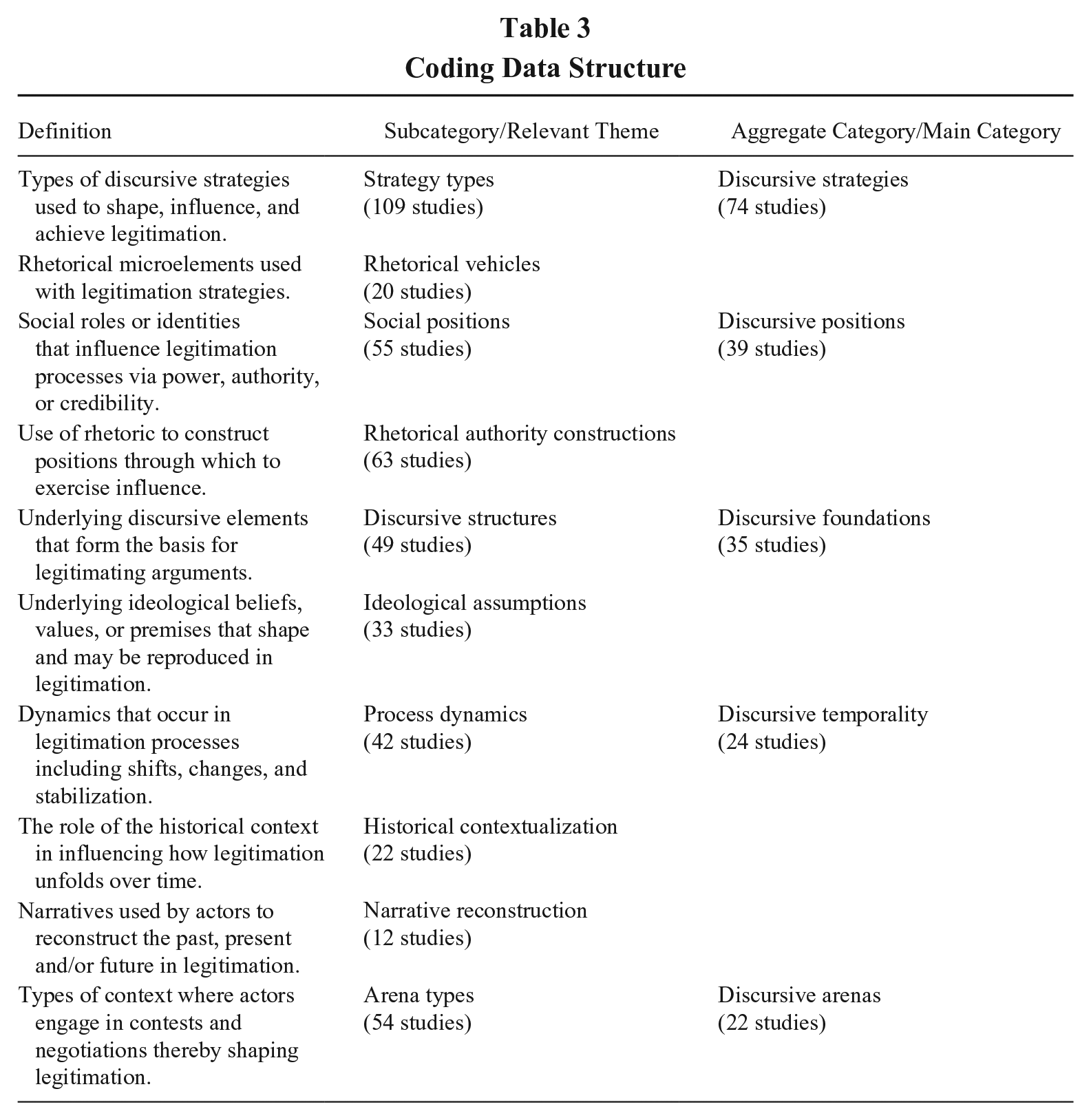
Fifth, we inductively coded each of the 217 articles in our preliminary sample. This process unfolded in two stages. Initially, two authors read the text of a sample of selected articles to extract the dominant claims or focus of these studies. Similar to recent reviews on discourse (Whittle, Vaara, & Maitlis, 2023), our approach aimed to capture the central aspects of research on discursive legitimation. After several iterations, we identified 10 central subcategories: strategy types, rhetorical vehicles, social positions, rhetorical authority constructions of positions, discursive structures, ideological assumptions, process dynamics, historical contextualization, narrative reconstruction, and types of discursive arenas. Next, one of the authors and a research assistant independently read the full text of all 217 articles to assign each article to one or more subcategories. This involved several iterations, resulting in a final sample of 194 articles in 26 journals. Disagreements regarding categorization were resolved through discussion within the author team. As a result, we assigned 459 codes to our final sample of 194 articles, distributed as follows: strategy types (109 articles), rhetorical vehicles (20 articles), social positions (55 articles), rhetorical authority constructions (63 articles), discursive structures (49 articles), ideological assumptions (33 articles), process dynamics (42 articles), historical contextualization (22 articles), narrative reconstruction (12 articles), and arena types (54 articles).
Sixth, in the final step, we inductively derived overarching categories. Our goal was to identify and elaborate on the key aspects of discursive legitimation that capture the essence of studies on how legitimacy subjects and objects are constituted through discourse. We followed an inductive and iterative process to group the 10 subcategories identified in the previous step, revealing relevant aggregate categories. We began by using the coding scheme from Step 5 to capture the essence of each subcategory (see Table 3, column 1). Additionally, for a deeper understanding, our author team engaged in thorough discussions of potential groupings, assessing the attributes of each subcategory and consolidating closely related subcategories into overarching categories. After several iterations, revisiting Step 5, we derived five aggregate categories. We assigned each article in our final sample to a corresponding primary discursive category (see Table 3): strategies (74 articles), positions (39 articles), foundations (35 articles), temporality (24 articles), and arenas (22 articles). 2
Coding Data Structure
An Integrative Theoretical Framework
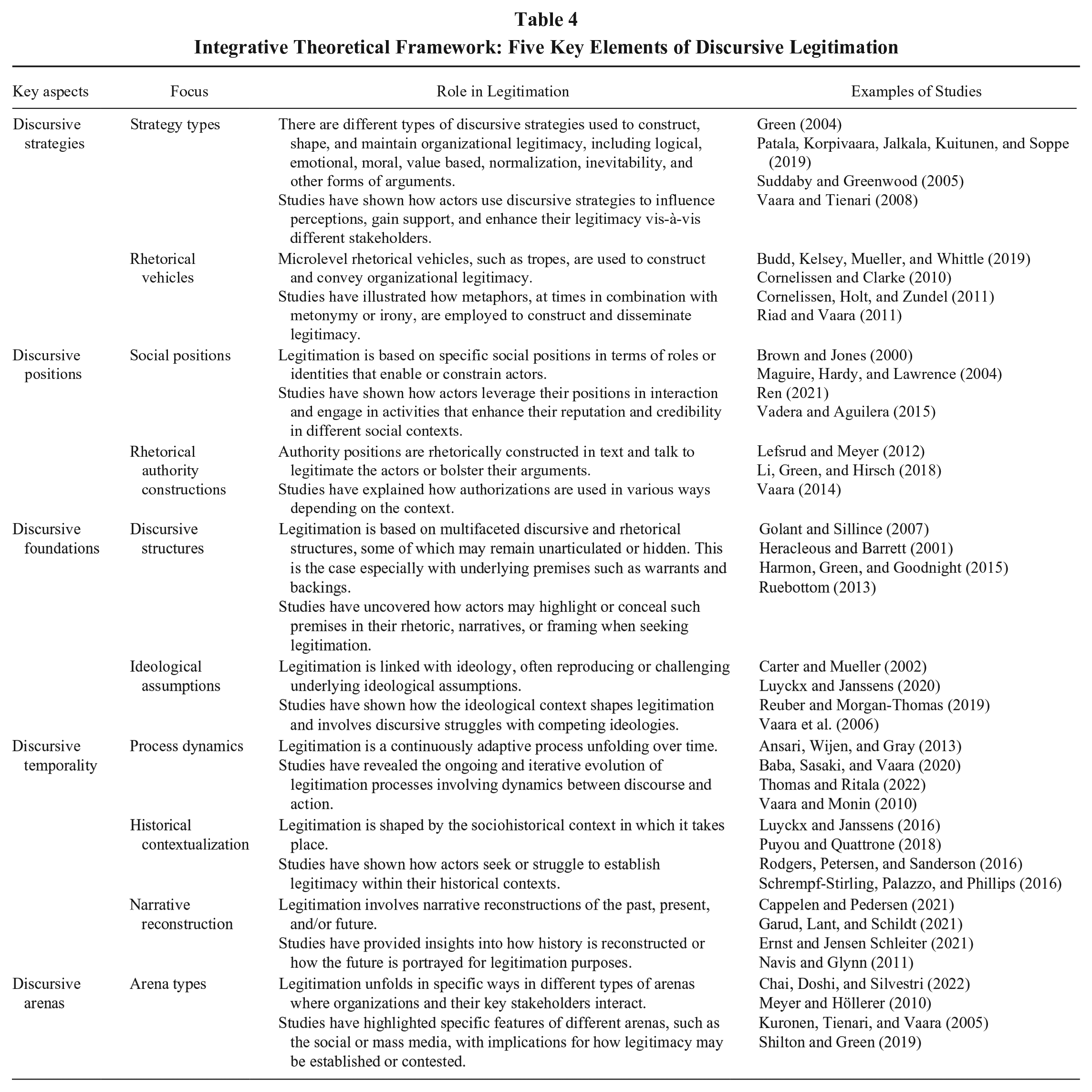
As a result of this review, we developed an integrative theoretical framework that organizes and synthesizes prior research in discursive legitimation. It highlights five key elements of discursive legitimation: strategies, positions, foundations, temporality, and arenas. We use the term “element” to denote important aspects that could also be perceived as key dimensions in discursive legitimation. Table 4 summarizes the key characteristics of each element.
Integrative Theoretical Framework: Five Key Elements of Discursive Legitimation
Discursive Strategies
There is a proliferation of research on how actors attempt to establish legitimacy, including research on rhetoric (Suddaby & Greenwood, 2005), discourse (Vaara & Tienari, 2008), and framing (Lefsrud & Meyer, 2012). As shown in Table 3, a significant part of this work has focused on discursive legitimation strategies, defined as the deliberate use of language to develop, maintain, or change perceptions of legitimacy. More specifically, this work comprises analyses of strategy types (types of discursive strategies used to shape, influence, and achieve legitimation) and more microlevel studies of rhetorical vehicles (rhetorical microelements used with legitimation strategies).
Strategy types
Research on legitimation strategy types may be seen as the area where scholars have gone the furthest in developing a cumulative body of work helping us understand the discursive ways actors attempt to construct legitimacy vis-à-vis specific audiences—in terms of both the number of studies (see Table 3) and the development of explicit theoretical frameworks around strategy types. Nevertheless, it is important to note that this stream of work consists of different traditions, of which the rhetorical approach has focused more clearly on intentional attempts of persuasion and convincing vis-à-vis particular audiences, and the critical discursive tradition has emphasized forms of language use.
Drawing on the Aristotelian tradition in rhetoric, Green (2004) was among the first to elaborate on the three rhetorical legitimation strategies commonly used by actors: logos (rhetoric appealing to the audience’s reason, based on logical arguments), pathos (appealing to the audience’s emotions), and ethos (appealing to the speaker’s status or authority, making the audience more likely to trust them). After that, Suddaby and Greenwood’s (2005) study on rhetorical strategies moved this area forward by studying the rhetorical legitimation of a new organizational form in profound institutional change. These authors found five theorizations of change with their respective rhetorical strategies: ontological (appeal based on what can or cannot exist), historical (appeal based on history or tradition), teleological (appeal based on “divine purpose” or “final cause”), cosmological (appeal based on inevitability), and value based (appeal based on underlying beliefs or value systems). Other scholars have followed suit in exploring different types (Green, 2004; Harmon et al., 2015).
Building on an adjacent but different tradition in critical discourse analysis (Rojo & van Dijk, 1997; Van Leeuwen, 2007; Van Leeuwen & Wodak, 1999), scholars have delved into various discursive strategies (Vaara et al., 2006; Vaara & Monin, 2010; Vaara & Tienari, 2008). For instance, Vaara and Tienari (2008) employed a critical discursive perspective to identify and elaborate on four types of strategies used to legitimize a contested shutdown decision: authorization (based on authority construction), rationalization (providing a rationale), moralization (constructing a moral basis), and mythopoesis (constructing a compelling narrative). Other studies have continued this tradition (Avakian & Fotaki, 2024; Joutsenvirta & Vaara, 2015).
There is also recent work combining insights from the rhetorical and critical discursive traditions (Erkama & Vaara, 2010; Oriaifo, Torres de Oliveira, & Ellis, 2020; Patala, Korpivaara, Jalkala, Kuitunen, & Soppe, 2019). For instance, Erkama and Vaara (2010) combined rhetorical and critical discursive analysis in their study of the legitimation of a shutdown decision. They developed a model that includes the three classical dynamics of logos (rational arguments), pathos (emotional moral arguments), and ethos (authority-based arguments) but also autopoiesis (autopoietic narratives) and cosmos (cosmological constructions). Patala et al. (2019) have, in turn, distinguished between discursive strategies actors use depending on whether objects and subjects are gaining or losing legitimacy.
Studies in this area have often focused on the logic of argumentation (Brown, Ainsworth, & Grant, 2012; Green, 2004; Suddaby & Greenwood, 2005). However, some analyses have critically evaluated the conventional assumptions in these models. For instance, based on the Aristotelean tradition, Brown et al. (2012) have demonstrated how multiple competing logics, which often dominate a field, can become incorporated into key texts. Their key point is that logics exist in tension and are often contradictory, frequently leading authors of texts to favor particular logics over others. This has multiple consequences for legitimation outcomes and power relations between stakeholders.
More recently, we have seen a surge of research focusing on the emotional aspects of discursive legitimation (Roccapriore & Pollock, 2023; Valor, Lloveras, & Papaoikonomou, 2021; Voronov & Vince, 2012; Zietsma & Toubiana, 2018). This has also resulted in some key papers dealing with the emotional components of discursive strategies. In particular, Moisander, Hirsto, and Fahy (2016) offer a rare analysis focusing on discursive legitimation strategies building upon emotion work: eclipsing, diverting, and evoking emotions. These strategies are used to arouse, regulate, and organize emotions among actors, making sense of legitimacy in political struggles. We come back to this theme in the Future Research section.
Rhetorical vehicles
Discursive strategies also involve the use of microlevel linguistic vehicles. Metaphors (figures of speech conveying thoughts and feelings by describing one domain through another domain) and other well-known tropes, such as metonymy (substituting the name of an attribute for that of the thing meant) and irony (using contrasts and opposite meanings often associated with humor), are potent devices for associating new meanings with particular objects or subjects. 3 Research in this area has explored the effective use of metaphors in legitimation processes (Budd et al., 2019; Cornelissen et al., 2011; Cornelissen & Clarke, 2010; König, Mammen, Luger, Fehn, & Enders, 2018). For instance, Cornelissen et al. (2011) offer a theoretical analysis of the role of analogical reasoning and the related use of metaphors in the framing and legitimation of organizational change, showing that relational analogies and metaphors are generally more effective in gaining support in contrast to analogies or metaphors that highlight common features. Drawing from critical discursive analysis, Budd et al. (2019), in turn, studied media coverage of payday loans to advance our understanding of organizational delegitimation. They revealed the metaphors used in the press—predators and parasites, orientation, warfare, and pathology—to construct the industry as a “moral problem.”
Other tropes, like metonymy or irony, also contribute to legitimation, even though relatively limited attention has been given to them (Sillince & Barker, 2012). However, in their analysis of contested cross-border mergers, Riad and Vaara (2011) showed how metonyms may play a crucial role in discursive legitimation. For instance, in Lenovo’s acquisition of IBM Personal Computer Division, color could represent nation or ideology—such as red for Lenovo, China, and communism and blue for IBM (nicknamed Big Blue), the United States, and capitalism. Interestingly, these representations could be combined with metaphors and irony to create evocative imagery, engaging wit, or subversive irony.
In sum, a substantial body of work on discursive legitimation strategies has shed light on the use of different strategy types and rhetorical vehicles in legitimation. These deliberate legitimation strategies, however, need to be placed in context. This is why we next turn to the discursive positions of the actors involved and then explore the discursive foundations as well as the role of the temporal dynamics and arenas where legitimation unfolds.
Discursive Positions
A second fundamental element of discursive legitimation deals with who is given a role or voice in legitimation processes. Traditionally, ethos (i.e., the character of a speaker or writer expressed to persuade an audience) can be seen as one of the key rhetorical strategies used (the others being logos—rational arguments—and pathos—emotional appeals). However, advances in rhetorical and discursive analyses have pointed to the significance of roles, identities, or subject positions as enabling or constraining legitimation (Lefsrud & Meyer, 2012; Maguire et al., 2004). Thus, we define discursive positions as the roles, identities, or subjectivities that enable legitimation. These discursive positions can be broken down into entrenched social positions (social roles or identities that influence legitimation processes via power, authority, or credibility) and rhetorical authority constructions (using rhetoric to construct positions through which to exercise influence).
Social positions
Scholars have pointed to the importance of social positions in legitimation processes so that actors may have a voice and participate in the debate. Such discursive positioning may be attributed to the existing power positions or identities that actors create in a given setting or discussion. Most discursive legitimation research assumes that powerful actors may successfully influence discursive legitimacy struggles by virtue of favorable subject positions (Maguire et al., 2004). Indeed, studies focusing on a variety of topics in different contexts have shown how actors in hegemonic positions tend to control the content, structure, and processes of discussion to legitimate particular objects or subjects (Brown & Jones, 2000; Etchanchu & Djelic, 2019; Zueva & Fairbrass, 2021).
Nevertheless, these attempts may also be resisted and result in legitimacy struggles. In an illuminating study focusing on the “arms to Iraq” case in the United Kingdom, Brown and Jones (2000) show how actors may respond to allegations undermining their legitimacy. This can include self-deception, hypocrisy, and scapegoating, which may also be combined in the legitimacy struggles. Others have then demonstrated how less powerful actors may use narratives to counter dominant frames imposed by key institutional actors to legitimate their practices (Vadera & Aguilera, 2015) or challenge or reinforce status hierarchies (Ren, 2021).
Rhetorical authority constructions
How, then, are the discursive positions constructed? The classic way is to use rhetorical tactics such as authorizations—the creation of authority positions in text or talk through different rhetorical means (Humphreys & Brown, 2002; Lefsrud & Meyer, 2012; Li, Green, & Hirsch, 2018; Vaara, 2014). For instance, in their analysis of framings and identity work associated with the discursive construction of climate change science by professionals, Lefsrud and Meyer (2012) elaborated on constructions of authority positions and their linkage to expertise. The key point was that these authority constructions were based on the subtle use of language and frames, which easily passes unnoticed in organizational and societal discourse. They involved the use of a variety of frames (e.g., “comply with Kyoto,” “nature is overwhelming,” “economic responsibility,” “fatalism,” and “regulation activism”) and other discursive elements, such as metaphor. Vaara (2014) has, in turn, shown how actors in media discussions may use distinct types of authority positions and authorizations in public debates. Interestingly, this could be based on specific rhetorical means to emphasize political or scientific expertise or to give voice to the public. Both studies also highlight the struggles in such constructions and how actors in opposing camps use different discourses and rhetorical means to construct authority. More recently, in their analysis of the rhetoric of China’s reform leaders, Li et al. (2018) have shown how discursive authority constructions may be based on “rhetorical genres”—combinations of argumentation and narration in which the content and style differ in accordance with the context. By so doing, they illuminate the dynamic nature of authority constructions.
In all, research has shown that discursive positions play a crucial role in legitimation processes. To understand how the strategies and positions are linked with the underlying criteria for establishing legitimation, we now focus on discursive foundations.
Discursive Foundations
A third key element of discursive legitimation is what we call discursive foundations. Social evaluations are always based on some criteria (Bundy & Pfarrer, 2015; Deephouse et al., 2017). Discursive (Joutsenvirta & Vaara, 2015; Vaara et al., 2006), rhetorical (Harmon et al., 2015), and narrative (Carroll & Ratner, 1996; Ruebottom, 2013) studies have, in different ways, illuminated these foundations. Thus, we define discursive foundations as the underlying linguistic meaning systems the legitimation is based on. In particular, discursive foundations contain discursive structures (underlying discursive elements that form the basis for legitimating arguments) and ideological assumptions (underlying ideological beliefs, values, or premises that shape and may be reproduced in legitimation).
Discursive structures
Prior studies have provided insights into the underlying discursive structures of legitimation. Drawing on Toulmin’s (1958) rhetorical theory, Harmon et al. (2015) have clarified the multifaceted nature of rhetorical legitimation. Toulmin’s theory is based on a model that an argument moves from data to claim by virtue of a “warrant,” the reason that authorizes the link between data and claim, but also a “backing,” which offers “the grounds for regarding a warrant as generally acceptable” (Toulmin, 1958: 106). Accordingly, Harmon et al. (2015) explain in detail how rhetorical legitimation deals not only with data and claims but also with the warrants (the assumption that links the support with the claim) and backings (additional support provided for the warrant) that the claims rely on. By doing so, they conceptualize legitimation as shaping and reflecting actors’ assumptions at two levels: the action or practice within a given field (focusing on claims, data, and warrants) and the context (focusing on backings providing additional support). In the former, actors use rhetoric in context to challenge or defend the legitimacy of an action or practice. In the latter, actors use rhetoric to disrupt or establish the context’s legitimacy, as shown in the use of backings, thus contributing to institutional maintenance or change.
Another stream in rhetorical analysis has focused on enthymemes (i.e., rhetorical arguments that hide the value premises; Heracleous & Barrett, 2001; Sorsa & Vaara, 2020). In particular, Heracleous and Barrett (2001) have illuminated the role of discourse that leaves parts “unsaid” in shaping organizational-change processes through its influence on actors’ interpretations and actions in the case of electronic trading implementation in the insurance market. Sorsa and Vaara (2020) have, in turn, shown how actors can deliberately leave things unsaid or use ambiguity to reach common ground when pursuing strategic change.
Narrative studies have also explained how legitimacy may be constructed through compelling stories based on taken-for-granted narrative structures and dominant narratives that legitimate objects or subjects (Geppert, 2003; Golant & Sillince, 2007; Mercier-Roy & Mailhot, 2019). Such taken-for-granted structures in which narratives are embedded have also been called metanarratives. For instance, in her study of social entrepreneurship, Ruebottom (2013) has shown how actors can use rhetoric that draws on and reproduces the protagonist metanarratives and counters the antagonist metanarratives.
Ideological assumptions
Critical discursive studies have then explored the linkage of arguments or claims and the underlying discourses and ideologies (Luyckx & Janssens, 2020; Vaara et al., 2006; Vaara & Tienari, 2008). Scholars have pointed out that ideologies are the underlying structures within which discursive arguments may or may not resonate (Carter & Mueller, 2002; Luyckx & Janssens, 2020; Reuber & Morgan-Thomas, 2019; Vaara et al., 2006; Vaara, Tienari, & Koveshnikov, 2021). Vaara et al.’s (2006) early work elucidates how discursive legitimation strategies draw on underlying discourses. These authors identify “neoliberal” (linked to the ideology of neoliberalism), “nationalistic” (related to nationalist ideology), “humanistic” (a more critical discourse linked to particular kinds of humanism), and “entertainment” (a mix of organizational- and personal-level dramas) discourses that are relevant for legitimation in a mergers-and-acquisitions context. Moreover, Vaara (2014) has elaborated on how ideologies such as neoliberalism, nationalism, or humanism are mobilized to form the basis for discursive legitimation.
In a recent analysis of corporate restructurings, Luyckx and Janssens (2020) demonstrate how texts drawing on two different discourses not only reproduce but also, at times, challenge dominant ideologies through mechanisms that they call the refutation of ideological representations, appropriation of key vocabularies, hybridization of ideological representations, and ideological pioneering. Such studies have shown how multiple discourses enable dynamic shifts that impact legitimation processes and how actors adapt their discursive legitimation strategies to these shifts. Interestingly, these studies also point to the importance of temporal dynamics, which we will turn to in the following subsection.
In sum, research has shown that the discursive foundations play a crucial role in legitimation processes, especially in terms of the discursive structures and ideological assumptions. However, to place the discursive strategies, positions, and foundations in context, we must also focus on discursive temporality and arenas.
Discursive Temporality
Temporality is another key element of discursive legitimation that characterizes the conditions for establishing legitimacy. We define discursive temporality as the time-related aspects that shape legitimation processes. Three strands of temporality in legitimation processes can be identified: process dynamics (the dynamics that occur in legitimation processes, including shifts, changes, and stabilization), historical contextualization (the role of the historical context in influencing how legitimation unfolds over time), and narrative reconstruction (the narratives used by actors to reconstruct the past, present, and/or future).
Process dynamics
Scholars have explored how actors use legitimation strategies and elucidate legitimation dynamics over time. They include work on how frames developed over time (Ansari, Wijen, & Gray, 2013), how discursive legitimation moves from one phase to another (Baba, Sasaki, & Vaara, 2020; Vaara & Monin, 2010; Vaara & Tienari, 2011), and how legitimacy may emerge over time (Thomas & Ritala, 2022). For instance, Vaara and Monin (2010) offer a dynamic model explaining legitimation and organizational action in a complex merger case. Baba et al. (2020) focus on progressive legitimation dynamics in the case of the Cree First Nation struggling for the recognition of its rights. Their analysis shows how the Cree increased their dispositional legitimation in and through several settlements in a long-term trajectory of change. Thomas and Ritala (2022) have, in turn, developed a process model of legitimation explaining how ecosystem legitimacy is constructed over time. The key in their model is that the orchestrators, complementors, users, and external actors all contribute to discursive and performative legitimation.
Historical contextualization
It is also important to recognize the role of historical context in legitimation, a topic that has become increasingly central thanks to renewed interest in historical analysis (Durepos, Shaffner, & Taylor, 2021; Wadhwani, Suddaby, Mordhorst, & Popp, 2018). Studies of discursive legitimation have shown how the historical framing of social phenomena shapes legitimation processes and organizational responses in a particular sociohistorical context (Luyckx & Janssens, 2020; Puyou & Quattrone, 2018). Actors may also construct problems or issues based on their temporal interests and orientations, significantly affecting the legitimation process (Luyckx & Janssens, 2016; McGivern et al., 2018). In an illuminating case, Luyckx and Janssens (2016) focused on the legitimacy struggles involving multinational corporations. They identified three historical phases during which the images of actors that either legitimized or delegitimized the corporations or their opponents were created. In the context of accounting, Puyou and Quattrone (2018) provide another kind of historical analysis in which they concentrate on how rhetoric is linked with the material and visual aspects of legitimacy. Their analysis focused on three different eras—Roman times, the Renaissance, and modernity—and revealed the distinctive features of rhetorical legitimation in these periods. Moreover, studies have shown that collective memory may be closely linked with legitimating ideologies (Rodgers, Petersen, & Sanderson, 2016) and that the past influences how we perceive practices such as corporate social responsibility (Schrempf-Stirling, Palazzo, & Phillips, 2016).
Narrative reconstruction
Studies adopting an explicit or implicit narrative perspective offer unique insights into how history is reconstructed for legitimation purposes (Cappelen & Pedersen, 2021; Currie & Brown, 2003; Kopf, 2020). While narratives generally help actors make sense of and legitimate certain phenomena (Brown, 1998), they may also be used explicitly as discursive resources for legitimation (Anteby, 2010). For instance, Abolafia (2010) investigated how elite policymakers use narratives to make sense of a complex environment to maintain legitimacy. In their analysis of culinary heritage, Cappelen and Pedersen (2021) show how actors such as restaurants can use “strategic ambiguity,” that is, selective remembering of the past in their legitimating narratives. The actors engaging with a new form of cuisine came together to construct a new narrative in which they deliberately remembered some aspects of the past and forgot others.
Similarly, future-oriented legitimation may be based on narratives of the past and present (Gephart, Topal, & Zhang, 2010; Hernes & Maitlis, 2012; Kaplan & Orlikowski, 2013), as shown especially in research on new ventures (Garud, Schildt, & Lant, 2014; Navis & Glynn, 2011) or strategy making (Kaplan & Orlikowski, 2013). For example, Navis and Glynn (2011) have explained how identity narratives are important in legitimating new ventures and the dynamics and dilemmas frequently encountered. Moreover, Gephart et al. (2010) have explored the role of future-oriented sensemaking, discussing five perspectives relevant to temporality: Weickian sensemaking, post-Weickian sensemaking, institutional rhetoric, agentivity, and ethnomethodology. Garud et al. (2014) have, in turn, focused on storytelling as the key means for new venture legitimation. They highlighted a paradox in that the expectations created in projective stories for legitimation purposes may be a source of disappointment if they are not met.
Temporality is thus vital in discursive legitimation processes, encompassing process dynamics, historical contextualization, and narrative reconstruction. Yet, these processes occur within specific contexts, prompting us to now focus on discursive arenas.
Discursive Arenas
Finally, it is also essential to focus on discursive arenas, which we define as the discursive spaces where legitimacy is established and legitimation is thereby shaped. Specifically, research has focused on studying different arena types (i.e., the type of context where actors engage in contests and negotiations, thereby shaping legitimation).
Prior research includes a set of studies that have explored legitimation in different organizational contexts. Explicitly or implicitly, these studies show that the nature of legitimation processes depends greatly on the nature of the issue and the institutional or sociocultural context. Scholars have also theorized the nature of legitimation processes in issue fields (RMeyer & Höllerer, 2010), transnational fields (Schussler, Ruling, & Wittneben, 2014), or commons (Ansari et al., 2013), thereby adding to our understanding of the importance of different arena types. For example, in their analysis of adopting the “shareholder value” concept, Meyer and Höllerer (2010) explain how legitimation depends on the structural features and opportunities offered by the context. Their analysis shows how this requires using framings that work in specific contexts characterized by particular meaning structures. Others have then elaborated on how discursive legitimation may involve arenas at different levels and the implications thereof. Chai, Doshi, and Silvestri (2022), in turn, examined the interplay between organizational and industry legitimacy in the space community after Virgin Galactic’s test flight crash. They showed how the industry participants could use the firm’s failure to either maintain or challenge legitimacy.
Furthermore, the central role of the media as a critical arena where legitimation is established has garnered considerable attention. Although not zooming in on the discursive or rhetorical practices, a key part of legitimation research has focused on the media (Jonsson & Buhr, 2010; Jonsson, Greve, & Fujiwara-Greve, 2009; Lounsbury & Glynn, 2001). Scholars have shown how media coverage can serve as an indicator (Baum & Powell, 1995; Kennedy, 2008; Rao, 1994; Ruef, 2000) or a propagator (Pollock & Rindova, 2003; Rindova, Pollock, & Hayward, 2006). More specifically, studies have demonstrated how the media may work as an agenda setter and influence how an organization is evaluated and judged (Bansal & Clelland, 2004; Jonsson et al., 2009; Jonsson & Buhr, 2010; Pollock & Rindova, 2003). For instance, Pollock and Rindova (2003) have shown how the information provided by the media has a major impact on investors’ perceptions of new public firms. Jonsson et al. (2009) have examined how media coverage of scandals about particular organizations may or may not damage the legitimacy of others. Carberry and King (2012) have, in turn, elaborated on the media’s role in disseminating negative information that threatens organizational legitimacy. In another line of inquiry, Petkova, Rindova, and Gupta (2013) have shown how media attention impacts the evaluation of new organizations by expert audiences.
More recent research has focused on legitimation in different types and forms of the media, including social media (Glozer, Caruana, & Hibbert, 2019; Roccapriore & Pollock, 2023), and blogs, online forums, and communities (Case & Piñeiro, 2006; Shilton & Green, 2019). For instance, in their discourse analysis of privacy, Shilton and Green (2019) elaborated on how online forums provide different kinds of spaces for ethical discussions and how actors use these spaces to legitimize their values.
It should be noted that several studies referred to earlier in the context of discursive strategies and other elements have also focused on the media. This is especially the case with articles in the critical discursive studies tradition (Luyckx & Janssens, 2016, 2020; Vaara, 2014; Vaara et al., 2006; Vaara & Tienari, 2008), which we will not reproduce here. There are also studies focusing on the role of journalists in constructing legitimacy in and through particular genres and texts (Kuronen, Tienari, & Vaara, 2005; Riad & Vaara, 2011). For instance, Kuronen et al. (2005) explain how rhetorical choices are linked with broader genres and discourses that enable and constrain legitimation or delegitimation. Thus, these studies illuminate the multilevel nature of discursive legitimation and underscore the significance of context-specific communication dynamics in shaping legitimation outcomes.
A Summary of the Integrative Theoretical Framework
Based on the review and discussion of the discursive elements, our integrative theoretical framework is summarized in Figure 1.
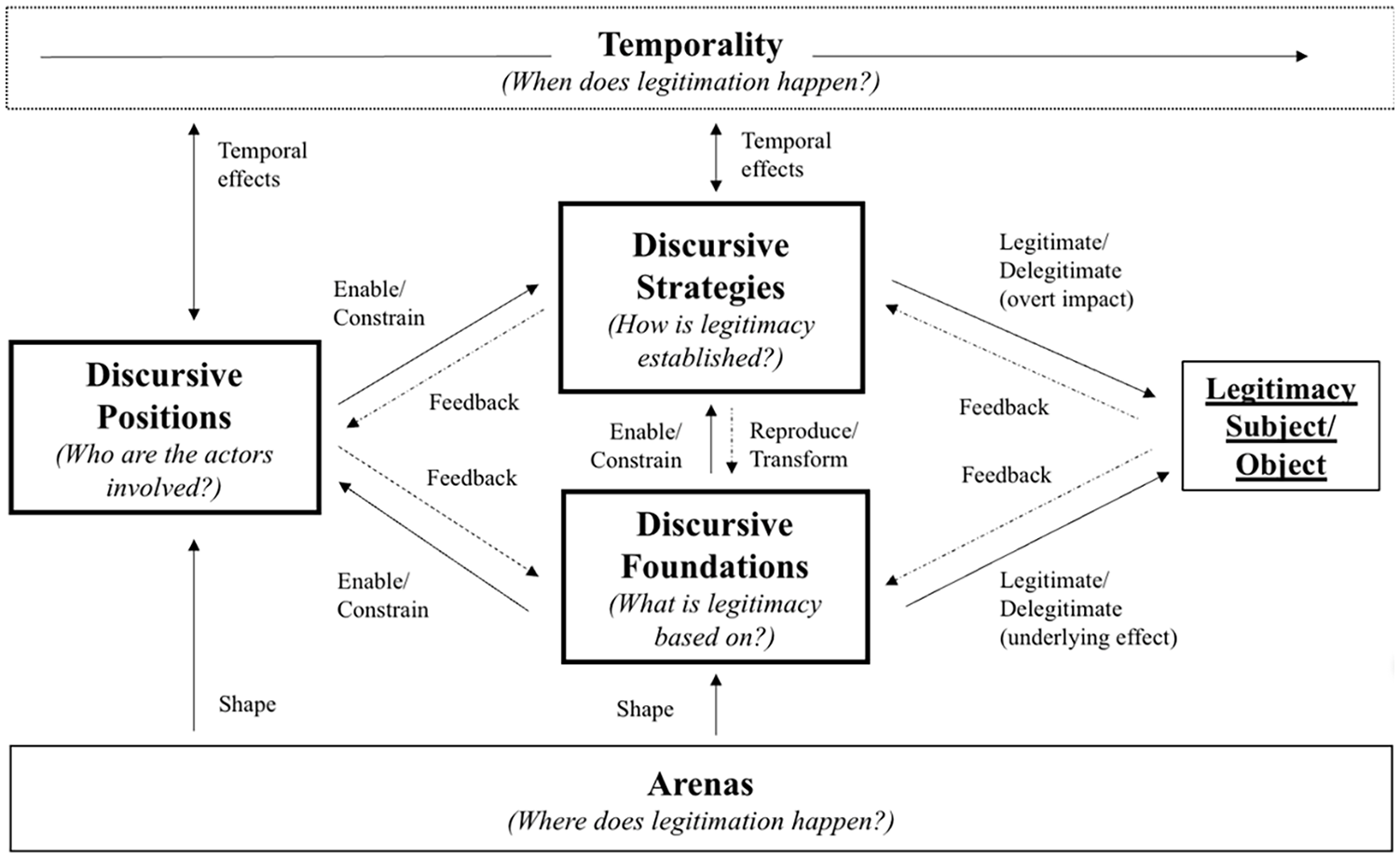
An Integrative Theoretical Framework on Discursive Legitimation
The model focuses on the five key elements: strategies, positions, foundations, temporality, and arenas. Our review shows that each element plays a key role in discursive legitimation. While legitimation strategies are well established in the literature, as evidenced by prior frameworks and models (Bitektine & Haack, 2015; Deephouse et al., 2017; Harmon et al., 2015; Suddaby et al., 2016; Suddaby & Greenwood, 2005; Vaara, 2014), this is not the case with other elements that have received less emphasis or remained implicit in previous research. Thus, it helps place discursive legitimation strategies in their broader context.
Each element highlights particular questions in discursive legitimation. Discursive strategies help us understand how legitimacy is established, discursive positions contribute to our understanding of who the actors associated with legitimacy are, discursive foundations unveil what legitimacy is based on, discursive temporality elucidates when legitimation takes place, and discursive arenas explain where legitimacy is established. With this framework, we can thus analytically disentangle key elements of discursive legitimation and specify the questions they help to answer.
The model also elucidates the linkages between the elements, which are captured by the arrows in the model figure. Starting from left to right, discursive positions enable or constrain the ability of actors to engage in legitimation and the types of legitimation strategies they may or may not leverage to their advantage. The use of legitimation strategies is further enabled or constrained by the discursive foundations or the structures and ideological elements that the legitimation strategies are based on. However, using legitimation strategies also tends to reproduce or, at times, transform broader discursive structures or ideologies, which are captured by the feedback loops. The framework also depicts how discursive foundations enable or constrain the adoption of discursive positions, thus showing the dynamic interplay of these central elements. All these interactions are shaped by the context in which they occur in terms of the different types of discursive arenas, as depicted in the lower part of the model. Moreover, the unfolding of these processes over time is one of the critical aspects emerging from the dynamics between the elements, as shown in the temporal-effect arrows in the upper part of the model figure.
Finally, on the right-hand side, deliberate discursive strategies have overt legitimating or delegitimating effects on the legitimacy subject or object. However, there is also an underlying impact from the discursive foundations that define the basis of establishing legitimacy in a given context. Thus, the framework elucidates the dynamic interplay of the elements as an inherent part of discursive legitimation. While this summary clarifies the overall nature of these relationships, this is a crucial area that requires special attention in future research, a theme we will revisit later.
An Agenda for Future Research
On the basis of our integrative theoretical review, we can identify both mature areas and gaps in existing work on discursive legitimation. This leads us to propose future research opportunities within and across the elements and to reflect on methodological issues.
Future Research on the Discursive Elements
Discursive strategies
Although we know a great deal of legitimation strategy types, there are important research opportunities in at least two key areas. As noted in the Review section, scholars have started to develop a more critical understanding of the key aspects of logics of argumentation (Brown et al., 2012). Future work could focus on other aspects of these logics, such as the truth value of the claims, including strategies like “playing with the truth.” In addition to examining how the truth is distorted, it would be interesting to study responses to such strategies, which may involve labeling them as “fake news” or assessing the spread of conspiracy theories. Another interesting topic in this realm is “bullshit,” implying the use of rhetoric or discourse that is empty or outright distorted in its content but still used for legitimation purposes (Christensen, Kärreman, & Rasche, 2019; Frankfurt & Bischoff, 2016). Thus, it would be interesting to study the variety of ways in which truth is used instrumentally for political correctness or “window dressing.”
Another topic for future development is developing a more in-depth understanding of the emotional aspects of discursive legitimation. Although this has triggered increasing attention among scholars, few analyses have focused on the emotion-based discursive strategies (Moisander et al., 2016). Future research could take additional steps to identify such strategies and to examine the broader effects of emotion-based argumentation. They could draw on recent work illuminating the intuitive and feeling-based aspects of legitimacy judgments. For instance, in their analysis of transnational governance schemes, Haack et al. (2014) argued for a “legitimacy-as-feeling” perspective that helps explain how legitimacy judgments about actors impact broader perceptions of legitimacy.
As pointed out in our Review section, one could expect a variety of rhetorical vehicles to be employed in legitimation struggles. Hence, in addition to metaphor, future research could elaborate on the use of other tropes in discursive legitimation. This could include a more in-depth analysis of how metonymies are used in establishing similarities and differences, association and disassociation, and exemplarity and deviation in discursive legitimation in different contexts (Riad & Vaara, 2011). Furthermore, a great deal can be gained by focusing more attention on humor-based irony as a rhetorical means. Such rhetoric is often used in legitimation but has not been given adequate attention theoretically or in empirical analysis. Yet humor, in general, offers “entertainment value” that audiences find appealing, and irony, in particular, helps to deal with complex issues in indirect ways that help audiences understand and accept them (Gylfe, Franck, & Vaara, 2019; Kwon, Clarke, Vaara, Mackay, & Wodak, 2020). How such rhetorical means are used in discursive legitimation in different contexts offers many opportunities for future research.
Discursive positions
Research has shown how social positions either enable or constrain legitimation attempts, but we know less about the dynamics involved in gaining or losing such discursive positions. Thus, there is a need for studies focusing on cases where the actor’s power bases, identities, or subjectivities change during legitimation processes.
Although credibility or trustworthiness has been a part of discursive and rhetorical models for a long time, there is a need to update our understanding of what credibility means in and around contemporary organizations. Related to the new legitimation strategies based on playing with the truth discussed in the previous subsection, there is a need to study credibility or trustworthiness based on different settings to further develop our theoretical understanding of this crucial part of discursive legitimation. Discursive positions also involve complexities, ambiguities, and contradictions that should be explored in future research. For instance, credibility is not always based on truthfulness, and particular audiences may evaluate the trustworthiness of actors in different ways. This means that future research could aim at a more nuanced analysis of what credibility consists of and how it is constructed vis-à-vis different stakeholders.
Discursive foundations
Although studies examining rhetorical, discursive, or narrative structures have shown that the arguments used rarely explicitly include all the underlying premises, future research could focus on silence and silencing in discursive legitimation. This would be important to develop a more comprehensive understanding of what may be automatically excluded or more deliberately silenced. Future research could concentrate on such rhetorical processes in legitimation, drawing on related theoretical ideas and models (Bitektine & Haack, 2015; Clemente & Roulet, 2015).
Prior research has helped us understand how legitimation may rely on ideologies and reproduce or, at times, transform ideological assumptions. However, new ideologies, such as populism, are gaining ground and merit special attention. Populism offers a distinctive value basis, with implications for discursive legitimation—linked with our earlier discussion of strategies based on playing with the truth and new forms of credibility. In a recent study on Brexit, Hensmans and van Bommel (2020) explain how populist arguments may successfully challenge prevailing views and mobilize actors to call for new alternatives. Similarly, future research on discursive foundations could focus on how particular premises, underlying beliefs, and values are used in populist discourse in (de)legitimation.
Discursive temporality
In recent years, studies have focused on how legitimation processes unfold over time, based on framing (Ansari et al., 2013) or other kinds of dynamic models (Baba et al., 2020). Still, future research could further elucidate the dialectical (as in legitimation resistance) or dialogical (as in alternative views on legitimation) dynamics at play. Another central part of legitimation dynamics is attention, which remains a relatively undertheorized and underexplored issue. While we know something about the attention dynamics related to spinning attention or silence (Bitektine & Haack, 2015; Clemente & Roulet, 2015), the linkages to legitimation strategies and judgments have yet to be explained in research in this area.
Although scholars explored how legitimation is embedded in its sociohistorical contexts and may involve narrative reconstructions of the past, present, and/or future, future studies could take additional steps in theorizing the role of history in legitimation. In particular, work on rhetorical history could add to our understanding of the role of rhetorical vehicles and discursive strategies in legitimation (Suddaby & Greenwood, 2005). Another helpful framework can be found in discourse-historical analysis (Wodak & Meyer, 2015), a form of critical discursive analysis. Although critical discursive analysis has played a prominent role in legitimation research (Van Leeuwen, 2007; Van Leeuwen & Wodak, 1999), its historical dimensions have thus far received far too little attention.
Discursive arenas
Prior research has studied different arena types, but less attention has been focused on the rules of the game that are linked with a given arena. Research on accounting reports (Yuthas, Rogers, & Dillard, 2002), corporate social responsibility and sustainability reports (Castelló & Lozano, 2011; Hossain, Islam, Momin, Nahar, & Alam, 2019), company websites (Coupland, 2005; Reuber & Morgan-Thomas, 2019), and inquiry reports (Brown, 2000, 2004, 2005) shows how rhetoric and discourse are used in these contexts. However, thus far, scholars have not yet taken additional steps to specify and theorize such rules of the game. This would, however, be important for advancing our understanding of how the different arenas enable or constrain discursive legitimation.
Given legitimation’s central role in today’s mass and social media, future research should analyze how it may combine different modes and genres of communication across arenas (e.g., traditional and social media). For instance, studying dynamics in “bubbles” of like-minded people driving the conversation through “echo chambers” would be crucial. Future research could analyze how such shared assumptions are reflected differently in multimodal communication strategies and examine the extent to which they are (not) interlinked.
Future Research Across the Elements
In addition to the topics discussed already, next we point to overarching theoretical themes cutting across the discursive elements.
Co-construction of discourses, positions, and strategies
Although our model has highlighted the logical connections between the different elements of discursive legitimation, there is a need to focus special attention on their interplay in future research. This is especially the case with the ways in which the discursive foundations, positions, and strategies are co-constructed in social interaction. The key point is that rather than focusing on discursive strategies alone, a deeper understanding of the discursive legitimation dynamics requires analysis of the underlying discursive bases that legitimation is based on as well as the positions that actors are speaking from. However, it would be too simplistic to assume that the foundations or positions remain static in discursive legitimation processes. Instead, positions may be constructed and reconstructed as enabled or constrained by the available discourses and vice versa. To understand how this would unfold at the micro level, future research could draw from discursive psychology or conversation analysis to zoom in on these constructions in social interaction. To comprehend how such dynamics would play out at the more macro level, scholars could instead focus on the changes in discourses and rhetorical patterns in media texts. In addition to advancing research on discursive legitimation, such analysis would inform broader discussions about the co-constitution of actorhood and institutions in and through communication (Meyer & Vaara, 2020).
Multimodality in discursive legitimation
A key theme that cuts across different aspects of discursive legitimation is multimodality: how legitimation may draw from different communication modes. Although there is increasing interest in multimodality in organization research, its potential has yet to be fully realized in research on legitimation. Recently, scholars have started to pay attention to a variety of discursive modalities, exploring the role of visual images and textual content in discursive legitimation processes (de Vaujany & Vaast, 2016; Lefsrud, Graves, & Phillips, 2017; Puyou & Quattrone, 2018). In particular, Roccapriore and Pollock (2023) have explored how fitness influencers enhance the engagement of their followers on Instagram through their use of words and images and also provided interesting insights on legitimation mechanisms in social media. However, it would also be interesting to study how particular images work as a legitimation strategy or how they affect legitimacy judgments. It would also be interesting to examine other aspects of multimodality, such as movements or gestures (Wenzel & Koch, 2018).
Analysis of forms of legitimation versus delegitimation
There is also a need for a more nuanced analysis of legitimation versus delegitimation processes. Previous research has mostly focused on discursive legitimation, with comparatively less attention dedicated to delegitimation (Deephouse et al., 2017; Suddaby et al., 2016). Our understanding of the role of discourse in the process of delegitimation remains limited, as illustrated by several calls for more research on this area. For instance, Deephouse et al. (2017) have called for processual analyses that differentiate between the “states” of illegitimacy they identified: accepted, proper, debated, and illegitimate. Similarly, Siraz, Claes, De Castro, and Vaara (2022) have recognized the need to study the characteristics of different states of illegitimacy: conditional illegitimacy, unknown legitimacy, and illegitimacy. Thus, rather than assuming that the discursive dynamics in these other processes are similar, it would be important to focus on the differences between legitimation and delegitimation processes.
Discursive construction of legitimacy judgments
Finally, although there are important exceptions, including the “legitimacy as feeling” perspective (e.g., Haack et al., 2014) and the studies of the role of media reviewed earlier, research on discursive legitimation has mainly focused on how legitimacy is established, for example, through legitimation strategies, but usually not on legitimacy judgments or perceptions per se. This is partly because legitimacy judgment formation has traditionally been dominated by social psychological models and methods (Bitektine & Haack, 2015; Haack et al., 2021; Tost, 2011; Zelditch, 2001). Another reason is that scholars have usually lacked the empirical material and means to examine the role of communication in the formation of legitimacy judgments. However, this has changed with the availability of data in social media and other platforms that offer ample evidence of how actors attempt to establish legitimacy and how legitimacy judgments are constructed. As pointed out by recent research, such perceptions are not only black-and-white evaluations but involve multiple levels and forms, such as different types of consensus (Haack et al., 2021). It would be important to explore the discursive construction of such complexities and nuances in future research.
Methods for Future Research
Although not the focus of our theoretical review, there is a need to consider the methods used in research on discursive legitimation. As our review has shown, most research in this area has used qualitative methods, and there are many opportunities to go deeper into issues and questions of discursive legitimation by using increasingly sophisticated qualitative methods established, for example, in rhetorical, discursive, and narrative studies. There are also methodological approaches, such as ethnomethodology and discursive psychology (Budd et al., 2019), that would allow for dynamic microlevel analysis that would help in advancing our understanding of issues such as the use of new rhetorical vehicles, the complexities and ambiguities in credibility and trustworthiness, and the role of the unsaid, as discussed earlier.
Scholars can also study discursive legitimation using new opportunities stemming from quantitative methods. With notable exceptions (e.g., Harmon, Rhee, & Cho, 2023; Hiatt & Park, 2022; Kennedy & Fiss, 2009; Patelli & Pedrini, 2014), relatively few studies have seized the opportunities of advanced quantitative methods. In particular, automated textual analysis is a tool that can significantly advance discursive legitimation, as it allows researchers to use big data to track the antecedents and consequences of discursive legitimation or to dig deeper into its dynamics. Scholars may fruitfully draw on quantitative automated text analysis tools, such as “bags of words” (Rhee & Fiss, 2014) or topic modeling (Hannigan et al., 2019). These tools may capture cultural meaning around legitimation by identifying frequent word co-occurrences (DiMaggio, Nag, & Blei, 2013). For instance, Croidieu and Kim (2018) drew on topic modeling of 28 years of historical texts to explore the field-level legitimation of the amateur radio operator movement in the United States.
Studies may also fruitfully combine new automated tools, such as topic modeling, with qualitative methods, such as discourse analysis (Aranda, Sele, Etchanchu, Guyt, & Vaara, 2021; Galperin, 2020). Such mixed-methods approaches may facilitate the analysis of discursive legitimation in two ways: first, to move toward testable hypotheses and causal effects and, second, to deepen our insights from qualitative analysis thanks to the validation of discursive patterns in extensive textual data.
Discussion and Conclusion
This article provides an integrative theoretical review of discursive legitimation research. By so doing, it advances research on legitimation in general and discursive legitimation in particular in three ways. First, this integrative review helps conceptualize discursive legitimation as a multifaceted and dynamic phenomenon in its own right rather than merely a theme linked with other aspects of legitimacy and legitimation. Such conceptualization is important theoretically and empirically, especially in our mediatized society, where communication plays a central role. Thus, we have provided a synthesis of prior research that leads to an integrative theoretical framework offering a systematic conceptual basis and overall model for making sense of discursive legitimation as a phenomenon. In particular, we have integrated insights from different traditions, including rhetorical, discursive, narrative, framing, and other approaches. While pluralism is valuable, and we appreciate the need for increasingly focused theoretical and empirical analysis, ensuring that we can foster communication between scholars drawing on different traditions and combining their insights is essential for developing a systematic understanding of discursive legitimation.
Second, our integrative theoretical framework complements existing models and paves the way for future research. While there are several frameworks and models of legitimation (Bitektine & Haack, 2015; Deephouse et al., 2017; Haack et al., 2021; Suddaby et al., 2016; Tost, 2011), our integrative theoretical model serves an important purpose by focusing on discursive legitimation. Existing models have concentrated on discursive legitimation strategies, such as rhetorical analyses (Harmon et al., 2015; Suddaby & Greenwood, 2005) and research drawing on critical discursive approaches (Vaara, 2014; Vaara et al., 2006). Our integrative framework instead covers five key elements: strategies (how legitimacy is established), foundations (what legitimacy is based on), positions (who the actors associated with legitimacy are), temporality (when legitimation takes place), and arenas (where legitimacy is established), helping us to understand the relationships between these key elements of discursive legitimation.
This framework can also serve as a basis for future research. We have pointed to several key topics that warrant special attention in future research on specific discursive elements: new types of strategies dealing with the truth value and emotional aspects; new types of rhetorical vehicles, including humor and irony; dynamics in gaining or losing favorable discursive positions; complexities and ambiguities in credibility and trustworthiness; silence and silencing; new forms of ideologies in legitimation; new theorizations of legitimation process dynamics; use of history in legitimation; rules of the games related to specific arenas; and new forms of mediatization. Furthermore, we have highlighted themes cutting across particular elements, such as the co-construction of discourses, positions, and strategies; multimodality in discursive legitimation; differences in forms of legitimation versus delegitimation; and discursive formation of legitimacy judgments. We also pointed to new methodological opportunities, including mixed methods, that can help to advance future research on these topics.
Third, related to the preceding, our analysis helps place discursive legitimation strategies—which have played a dominant role in prior research—in context. By elucidating the role of other key elements that hitherto have received less attention, our analysis highlights the less obvious or hidden aspects of discourse that nevertheless play a crucial role in legitimation. This is especially the case with discursive positions that enable or constrain actors in their use of legitimation strategies; discursive structures, including the underlying rhetorical and ideological aspects of discourse that significantly impact discursive legitimation; and discursive arenas that offer specific opportunities as well as restrict legitimation. Moreover, discursive temporality points to the historical embeddedness of discursive legitimation. Thus, our analysis helps broaden the scope of discursive legitimation research toward a fuller appreciation of the multifaceted and dynamic discursive elements that enable or constrain this process yet easily pass unnoticed in more conventional analysis.
