




Abstract
This article investigated elite maintenance in the field of management and how early career researchers are taught to behave to become part of the elite. We develop insights into how the elite reproduces itself through socializing subsequent generations of scholars into the norms and hegemonic practices of the elite. Through analysis of sessions for early career researchers at a major academic management conference held online in 2021, we investigated how the elite functions as a racket, instructing the next generations of scholars how to enhance their chances of entering this racket. Relying on role modeling and specific behavioral advice, the elite reproduces itself by laying out the basic rules for the next generations on how to behave as the elite. This includes overemphasizing how early career researchers can join the academic elite while neglecting the discussion of how we could improve the academic system itself. We discuss the implications of racket-like manifestation of academic disciplines, including the control of a rather small group of elite scholars over an entire field of scientific investigation through which alternative voices are suppressed.
Introduction
Academic conferences often offer sessions for PhD students and early career researchers (ECRs) with the aim of integrating them into the academic world and guiding them with practical advice to develop their academic careers. Such sessions are usually appreciated by the participants and considered an honor to deliver for elite scholars, as it provides them an opportunity to share their knowledge with less experienced colleagues. These sessions may focus on how to survive the tenure process, academic career development, or how to get published in top-tier journals. They are usually presented as helpful sessions for ECRs to get socialized into academia and learn the tips and tricks of publishing.
The purpose of these sessions as socializing ECRs into the values and norms in the academic field may be widely shared (cf. Egri, 1992; Morita, 2009), yet at the same time, such socialization sessions may also have a hidden, unintended, and problematic side to them (Tierney, 1997). In particular, these sessions can be understood as events where current generations of scholars project norms and attitudes on the next generations, and thus teach them not only “appropriate” ways of behaving but also perspectives about the “normal” and taken-for-granted state of affairs in the academic discipline (Bal et al., 2023). However, thus far, little is understood about such hidden and implicit meanings of ECR sessions, and thus the processes through which ECRs are taught “appropriate” ways of behaving in academia. From a critical perspective, these sessions function as occasions where the elite perpetuates the status quo to retain their power, by elucidating to new generations the ways through which the academic system is maintained and the networks they have to become part of to have a chance to enter the elite.
To understand how the dynamics within these sessions play out, we build on Racket Theory (Horkheimer, 1941, 1985, 1988) to understand how domination and hierarchy are maintained in academia. Frankfurt School leader Horkheimer (1941) introduced Racket Theory to explain how connections and power dictate society and organizational life. Translating his work to academia, we postulate the existence of an academic racket (cf. de Solla Price and Beaver, 1966; Roucek, 1963) to explain how academic elites preserve their power by forming an invisible network. However, so far, there has not been any empirical research on how academic rackets emerge and how they manifest and are maintained. To broaden and deepen our understanding of academic rackets, we analyze ECR sessions at a large, international Management conference. Using Critical Discourse Analysis, our findings show how the academic elite constitutes an academic racket. Moreover, we show what ECRs are expected to do to make a chance to be accepted within the racket. Finally, we show how ECRs are expected to do this: borrowing from Yurchak’s (2005) concept of Reproduction of Form, we show how ECRs are taught to precisely reproduce the ways of doing and writing about research. When such norms prevail, it is restrictive of academic freedom, as academics are expected to be compliant and not to seek alternative ways of doing and communicating research.
Our study elucidates the existence and functioning of an academic racket, which hitherto has not been studied empirically. While previous research has focused on the socialization of ECRs into academia (Morita, 2009; Tierney, 1997), these studies have relied primarily on the individual-level experiences of the academic system. Our analysis, however, pertains to how domination by the elite manifests and is perpetuated. We show the existence of the racket, and how elite scholars share a common discourse, even when they do not know each other. Moreover, we show that entry into the elite is not merely a matter of scientific merit and hard work (Tierney, 1997) but a matter of total commitment and submissive attitude to the racket. This manifestation of elite dominance, and the expectation of total submission, offers a radically new interpretation of socialization in academia, and our study shows how elite domination processes have become prescriptive to the extent that academic freedom may become constrained and under pressure (e.g. Tierney, 2004).
The study contributes to the literature in the following ways. It highlights how ECR sessions at conferences are not “neutral” events but serve an ideological purpose (i.e. to perpetuate power positions). Moreover, the study shows how these sessions introduce the academic racket to newcomers and offer specific attitudinal and behavioral advice for ECRs to make their way into the academic racket. This elucidates how the rules of academic life are dictated: the way to make a career in academia is to publish in top-tier journals, adhere to the norms around the formulaic nature of publishing, and accordingly make one’s way into the racket. Finally, the study shows how the academic racket manifests, how it is maintained, and how the next generations are socialized into the workings of the racket, so the racket can be perpetuated over generations of scholars. With our work, we want to problematize the taken-for-granted, hypernormalized hierarchies within academia (Bal et al., 2023), in which the elite dictates acceptable ways of “doing academia” and socialize ECRs into such behaviors. Moreover, through showing the dark side of academic socialization and organized fetishization around top-tier journal publications, we hope to offer alternative ways in which academic careers can be developed and research can be conducted, communicated, and recognized.
Theoretical background
Academia is in crisis (Bal et al., 2019), and is in desperate need of positive change given the toll academic life takes on people’s well-being and the rise of burnout in academia (Gewin, 2021; Korica, 2022). Hence, there are important questions to be asked about the contemporary academic system. For instance, the publication system is becoming more and more competitive, while academics are expected to frequently publish in top-tier journals to ensure an academic career and to protect or earn their research time (Aguinis et al., 2020; Rothengatter and Hil, 2013). This is particularly challenging for ECRs, as they lack the publishing experience of more senior and elite scholars, and they thus have to find their way in an increasingly competitive and precarious academic world. It is not surprising that ECRs are eager to be guided in their attempts to develop an academic career. Through ECR sessions at conferences, they also have a chance to get connected to famous scholars, get to know themselves and develop friendships and collegial ties with the powerful (Colussi, 2018).
In response, conferences (and institutions such as the Academy of Management and Society for Industrial and Organizational Psychology) offer sessions to ECRs (including PhD students). These sessions may include workshops given by editors and experts on how to write academic papers for top-tier journals, which should enhance their chances of getting published. Experts reveal the “formula” of how to write academic papers, which offers predictability for those wishing to publish. Such a formula is usually seen as a-political and neutral and, therefore, result of a “natural” process of academic publishing. In other words, the way academic articles should be written is normalized as the only possible way to communicate scientific knowledge (Bal et al., 2023). Hence, the elite provides instructions on how one should behave and work to make a chance to “get published.” Generally, aspiring ECRs are expected to reproduce this way of working to be accepted by the academic elite.
This pressure to shape one’s research such that it fits in top-tier journals has far-reaching consequences. Highly formulaic research is more likely to get published in top journals (Spence, 2019), and critical career decisions connected to hiring, promotion, and firing are made under the heavy influence of metrics (e.g. Myers and Kahn, 2021). These practices are becoming not only prescriptive but also restrictive, such that researchers must find their places in very limited sets of outlets, where space is limited.
This motivates ECRs to seek the best opportunities to fit in the academic world (Tierney, 1997), while it leaves decreasingly little room for creativity, concern for social impact, and academic freedom, especially before tenure. Tenure is the system used in many countries where academics move from precarious to permanent, secure positions in their universities (and become “tenured” academics). The tenure-track structure was traditionally designed and intended to secure freedom, and not to restrict it (Tierney, 2004). However, academic freedom is under pressure when academics, to get published, are forced to comply with specific requirements that only favor one particular ontology (Islam and Sanderson, 2022). However, relevant and impactful papers are hard to get published and do not count for “more” than any other paper.
Instead, it is usually taken for granted that the academic system is as it is, and that its structure is the result of a natural process through which academic knowledge is produced. The function of ECR sessions as active normalization of the current system is obscured, and they are presented as a response to the high demand for knowledge among ECRs on how to access the system while restricting any more fundamental discussion of why systemic academic norms persist.
Socialization in academia
While there is a wide literature on organizational socialization (Allen et al., 2017; Bauer and Erdogan, 2014), they often treat socialization uncritically as something inherently good for organizations, when employees find their ways to assimilate into organizational life. However, the studies of Tierney (1997) and Morita (2009) elucidated a darker side to socialization in academia, with ECRs being exposed to the normalization of long working hours, self-sacrifice, and exclusion of foreign graduate students. Hence, ECR sessions at conferences can also be analyzed as events where the next generations are socialized into more dysfunctional normalized behaviors (Bal et al., 2023).
ECR sessions are events where participants are staged as relative novices in the academic world, while the speakers are introduced as experienced experts, who have learned the ropes, and who are specifically instructed to convey their knowledge about the workings of the academic world. Often, these experts function as gatekeepers themselves, either through professorial positions (i.e. being a supervisor to PhD students and thereby shaping their work and academic mentality) or through editorial board positions (e.g. in “Meet the Editors” sessions). Power differences are central to the staging of such sessions (Egri, 1992), and it is important to understand the more hidden meanings of such sessions as imprinting academic norms onto ECRs in the field. It could be stated that these sessions have an ideological meaning, thereby conveying not merely behavioral norms to enhance one’s career in academia, but also the ways through which the current dominant structures in academia are maintained and perpetuated. Hence, these sessions enable the reproduction of an academic system in which dominance, hegemony, and power inequalities are not contested but reinforced through the socialization of ECRs into system justification (Bal et al., 2023).
Emergence of academic rackets
These notions of perpetuation of dominance through socialization can be understood through the classic “Racket Theory” introduced by Critical School leader Horkheimer (Granter, 2017; Horkheimer, 1941, 1985, 1988). Rackets were described by the Frankfurt School as a characterization of advanced capitalism to expose the hidden connections that made up groups and social classes (Granter, 2017). Horkheimer (1985, 1988; Adorno and Horkheimer, 1997 [1944]) introduced racket theory to understand how powerful actors in society maintained their privileged positions through the creation of rackets. It is important to note that in our analogy, building on Horkheimer, we deviate from an understanding of racket (and racketeering) as a criminal mafia-like activity (see Granter, 2017), and interpret it in the original Horkheimerian sense of domination (in German: Herrschaft; Horkheimer, 1985: 287) and the creation of hierarchy and control within a field.
Racket Theory was used to understand how connections and power played a key role in life and careers. Connections among key players in a field were primarily intended to protect the interests of the powerful and to retain centralized power (Heins, 2006; Horkheimer, 1941). Rackets are created when the leaders of an organization or a group in society organize in such a way that they obtain a monopoly in their respective field, and protect their hegemonic position and interests through dependence of all those lower on the hierarchy upon them. Rackets emerge through the quest for domination and perpetuation of the status quo. Horkheimer (1985) discusses the main function of rackets as providing protection to those people within the elite, which comes at the price of “giving up one’s personality” while requesting total loyalty of the individual to the racket. Hence, it represents an exchange relationship, whereby an individual can potentially become part of a racket (if granted access), thereby being provided protection (and a career in an organization), but only when the individual is loyal to the racket beyond anything. Therefore, the individual is expected not to criticize the racket or other members within the racket, at the risk of being punished severely for disloyalty or behaving in a way that may threaten or damage the racket. Inherent to rackets is the inclusion of its own loyal members, and exclusion of everyone not deemed part of the racket. Racket Theory as domination and control aligns well with the work of Bourdieu (e.g. Collyer, 2015; Ratle et al., 2020), who explained how domination in society and organizations is perpetuated through “soft” forms of violence, or the development of culture of “terror” (Collyer, 2015; Ratle et al., 2020), in which professional obligations are packaged as “kind advice.” In addition to Bourdieu (and chronologically preceding), Racket Theory explains how elites maintain their powerful positions and the status quo. Rackets are all about domination, and in that respect differ from other concepts, such as a community, which would have a much stronger focus on bottom-up generated meanings, a sense of collectivity, and inclusivity. Rackets, in contrast, are about exclusion of nonmembers, preferential treatment for insiders, and perpetuation of the status quo to retain power for the elite. Horkheimer (1988: 325) already referred to bureaucracies and the medical profession as spaces where rackets emerge (cf. Kirchheimer, 1944). In a similar vein, academic rackets manifest when control over the key resources to building an academic career (e.g. access to publishing in top-tier journals) are controlled by a small elite who impose strict behavioral norms on anyone aspiring to become a member of the elite. While Horkheimer (1941) did not provide a precise definition, we conceptualize academic rackets as “a system where domination and control are exercised and perpetuated by a scientific elite to protect the status-quo and their own interests” (cf. Granter, 2017; Heins, 2006; Klein and Regatieri, 2018). This definition conveys that it is not merely a group of people, but a system of practices with specific aims to dominate, control and retain the status quo within academia. Hence, rackets can only exist through the practices within groups but independent of specific individuals. Essential to the functioning of a racket is that social position (e.g. membership of a racket) is dependent on relationships or connections, and not on the “compensation for individual effort” (Kirchheimer, 1944).
As published in academic journals has become the primary objective of academic work, previous studies have focused on how academic rackets have emerged in the publication system, including the rise of “predatory journals” that perpetuate (neo-)colonial power relations (e.g. Haack, 2019; Roucek, 1963; Truth, 2012). Moreover, work on the “Invisible College” (de Solla Price and Beaver, 1966) elucidated the hidden structures defining the academic world, and how collaborations were maintained by groups of people exerting control over scarce resources, such as through their journal editorships, committee positions, and professorial influence. The question, however, is how the elite ensures the status quo. They may do so via an ideology of Reproduction of Form, a concept we borrow from anthropologist Yurchak.
Reproduction of form
Yurchak (2003, 2005) identified Reproduction of Form as the way through which the Soviet Union was governed after the death of Stalin (Bal et al., 2024). After Stalin, acceptable discourse (e.g. propaganda, cultural symbols, and newspapers) was perfectly reproduced to sustain hegemonic order and stability in society. However, such discourse became increasingly dissociated from reality, necessitating citizens to “read between the lines,” not to interpret public speech literally, and be pragmatic in how they could understand official speech and their “real” constitutive, meaning (Bal et al., 2024; Yurchak, 2005).
Along the same lines, reproduction of form can be observed in contemporary academic management research, which is also how the racket can be protected. Academic research is highly formulaic, dictated by the elite in terms of what type of research is accepted in the top-tier journals (with a strong preference for positivistic quantitative research), and how it should be written. Even the literal form of journal papers is highly prescribed and needs to be reproduced to be accepted into the racket. In this study, we assess how this proposed reproduction of form is discussed in ECR sessions in relation to academic rackets.
In the current study, we posited the main research question: how do academic rackets manifest through Early Career Sessions? With this question, we aimed to study these sessions from a critical perspective, focusing on how power is used by elite scholars to perpetuate the academic racket and socialize the next generations.
Methods
At the online 2021 conference of a major global, academic management association, two authors of this article participated in four sessions designed for the Early Career Faculty Consortia (ECFC), including two ‘Meet the Editors’-sessions, a “Generating and Evaluating New Research Ideas” session and one on “Surviving the Tenure Process.” All these sessions took place online (because of COVID-19) and were particularly targeted at doctoral students and ECRs. Two authors participated in the four sessions as observers, positing themselves as ECRs. All sessions were hosted and chaired by ECRs, while the experts were senior scholars and serving on various editorial boards of top-tier US-based journals. All the moderators and experts were US-based, while participants represented a wider variety of backgrounds. The four sessions consisted of different panels, and while the views of the panel members were independently expressed, we analyzed them as a discourse emerging around publishing and academic career management, bolstered through our assessment of the consistency of views and expressions across the sessions, and thus among the experts.
We ensured that we complied with ethical research guidelines. 1 The YouTube videos we utilized were in the public domain and freely accessible to anyone who had the link. The videos were recordings of online meetings that were posted on YouTube after the conference. The experts were aware that the sessions were being recorded for public viewing. Therefore, they implicitly provided consent for the recordings to be shared and accessed by viewers. We took measures to anonymize the participants and any personally identifiable information in this article. We refrained from using real names or any identifying information, thus protecting the privacy of individuals involved.
The sessions usually consisted of a general discussion structured around a set of questions for the panel, and more specific discussions in break-out rooms. We only analyzed the general discussions, which are available online on YouTube, as they represent more general advice rather than personal questions from the individual participants. We analyzed the transcribed data in an anonymous manner because we were interested primarily in the discourse within academic rackets around advice for ECRs rather than experts’ individual views.
While the statements made by the expert scholars may represent their individual views, we analyzed them as indicative of discourse, as these experts act as dominant gatekeepers, all serving as editors or editorial board members for flagship journals in the field. Therefore, it is not the specific individual that is of interest when analyzing spoken word, but the discourse emerging through speech. In total, we analyzed over 4 hours of discussion. One of the authors transcribed the discussions, after which the three authors independently analyzed the discourse present in the discussions. The authors went back and forth between coding the data and discussing the themes identified from the data. The data were analyzed in light of our main research question around the manifestation of an academic racket, and discussion among the authors generated the themes for the analysis of the academic racket. Hence, we worked using an iterative process, from independent coding of the data to discussions among the authors about the specific themes.
We used Critical Discourse Analysis to analyze the sessions. Critical discourse analysis is a particular form of discourse analysis that focuses on the relationships between discourse and other social elements, such as ideology, power and inequality, and dominance (Blommaert and Bulcaen, 2000; Fairclough, 2013). Discourse is defined as the totality of written or spoken communication or debate, and discourse analysis as such is an appropriate form of analyzing the spoken debate emerging from the recorded sessions at the conference.
While discourse analysis would lend itself to the analysis of the debate and the meanings of language, we are particularly interested in the critical analysis of the discourse created through such sessions (Islam and Sanderson, 2022). A critical approach is fitting since these sessions are not taking place as neutral events, where knowledge is shared on a basis of equality among the participants and the guest speakers. In contrast, the power inequality between those attending is inherent to the organization of ECR sessions, with experts sharing their knowledge with ECRs. Sometimes, ECRs also have to pay additional fees to join such sessions.
We focused on analyzing how rackets manifest, how they are maintained, and how ECRs are introduced into the workings of the racket. While analyzing the data we also found evidence for the importance of Reproduction of Form (Yurchak, 2005). Jointly, Racket Theory and Reproduction of Form explain how these socialization sessions at conferences are not merely instructive for ECRs in terms of how to develop their academic careers but also convey a hidden discourse aimed at maintaining the status quo in academia and the hegemonic positions and structures inside the academic discipline.
Reflexivity
This article is authored by three scholars, and we self-identify as one senior scholar, and two mid-career scholars, and we all have experienced the racket on the receiving end (when we were ECRs, and trying to publish and to survive the tenure process ourselves). Currently, we are to some extent part of the racket, in our capacity of journal authors, editors, and PhD supervisors. However, through our current work, we are deliberately trying to make changes to academia. In our roles as inducting new academic generations, we explicitly include discussions such as in this article, and we are engaged in various activist academic networks and collectives. Our main assumption about our own roles is that while we have gained some status within academia, it is our duty to use our privileges to strive for a more dignified and humane academia. This includes working with ECRs to change our system, while nonetheless having to comply with some norms of academia (e.g. to publish in reputable journals to gain an academic career and gain legitimacy to be taken seriously; Alvesson and Spicer, 2016).
Findings
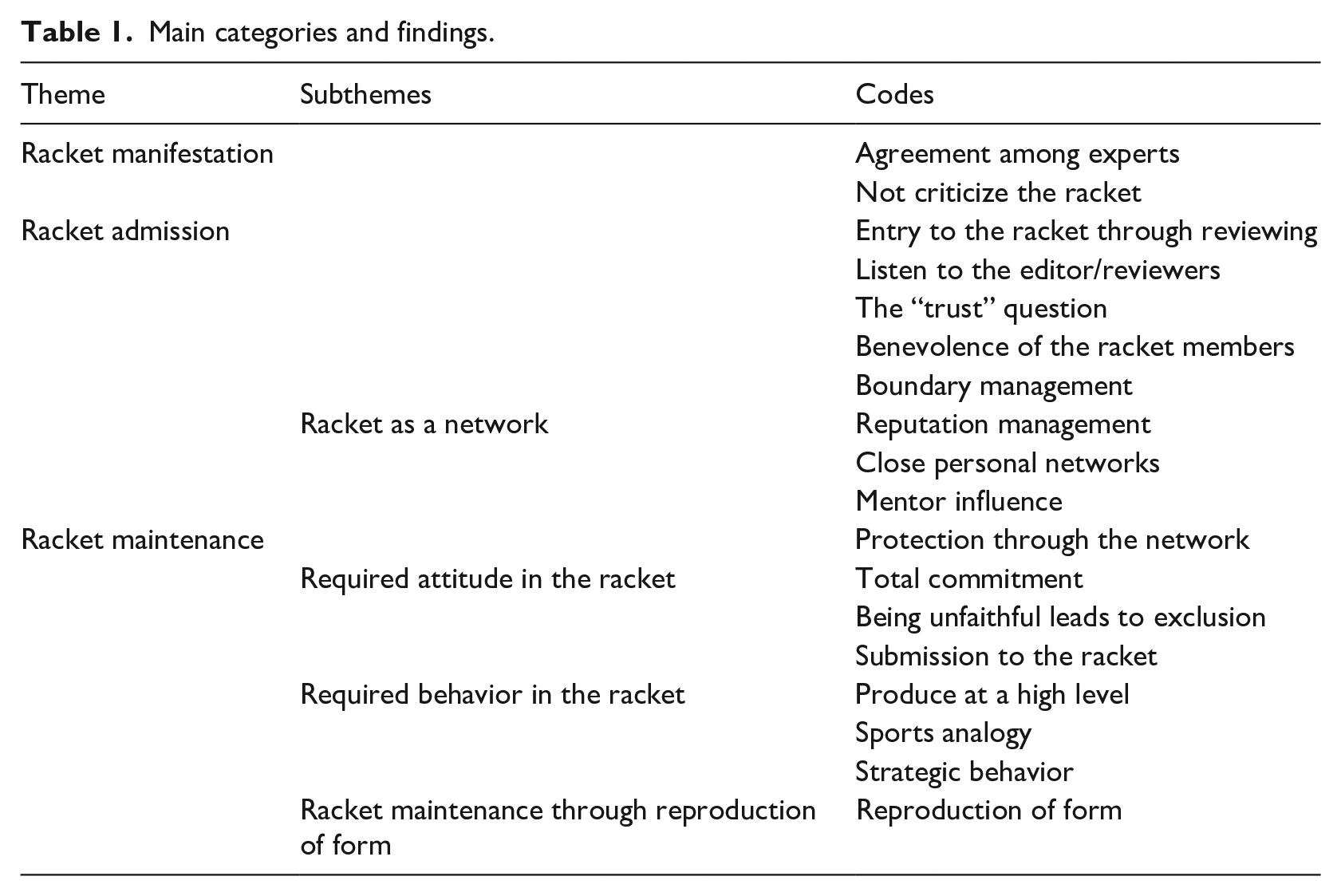
Table 1 shows the overview of the main categories we identified through our critical discourse analysis and Table 2 shows supporting quotes. The critical discourse analysis revealed three primary processes through which the academic system in Management and Organization Studies is maintained: (1) racket manifestation, (2) racket admission, and (3) racket maintenance, including reproduction of form as a central feature of how the racket is perpetuated and strengthened over time. We discuss, using relevant quotes from the sessions, how the existing racket manifests and is maintained and strengthened through reproduction of form.
Main categories and findings.
Supporting quotes from the sessions..
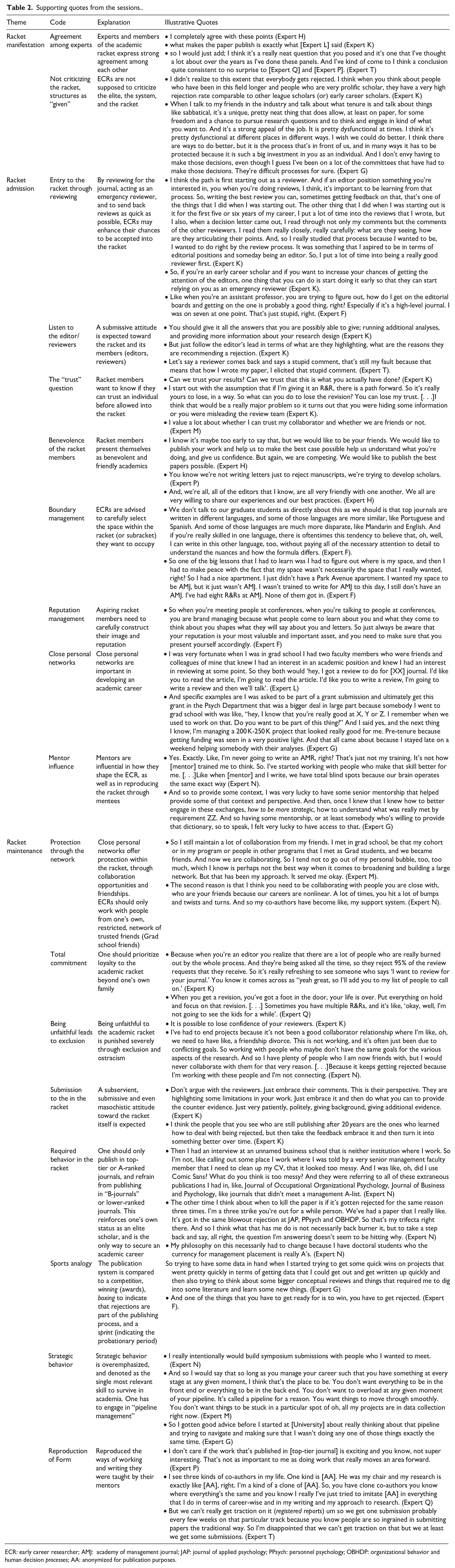
ECR: early career researcher; AMJ: academy of management journal; JAP: journal of applied psychology; PPsych: personnel psychology; OBHDP: organizational behavior and human decision processes; AA: anonymized for publication purposes.
Racket manifestation
To assess the racket as functioning in the way Horkheimer theorizes, we should first support its existence. As the racket is constructed and maintained through speech, the first premise was to show the use of language supportive of the presence of the racket. When analyzing the data, it was striking how consistent the experts were in their opinions about how academia functions. Experts regularly expressed their agreement with other panel members, indicating that their views represented not just their individual perceptions, but more generalized, shared views among elite scholars about the academic system and how to “survive” in this system. We found 37 occasions across the sessions where experts expressed their agreement with the previous speaker. For instance, experts started their contributions by stating: I would echo everything Expert N said. (Expert M) These are excellent points and I would like to add [. . .]. (Expert H)
Even though some of them may not know each other personally, their views about the system and how to behave are strikingly similar and tend to converge around similar themes, all related to how the academic racket functions, including acknowledgment of who the elite scholars are and how the elite scholars are exemplary of how one ought to behave to be potentially included into the group of elite scholars. Experts not only expressed explicit agreement, it was also striking how little critique they expressed toward the academic system, even though at times it was acknowledged how difficult it has become to publish in top-tier journals and to secure a permanent job in academia. While there were some ambiguous statements about the costs of the system (e.g. about the high burnout), we did not find any indication of systemic critique or attempt to propose change to the academic (publication) system itself, even though there has been ample in the recent years (e.g. Bal, 2021; Orhan, 2021; Tourish, 2020). This compliance with the current system, and a submissive attitude toward the current structures as merely “given,” is subsequently conveyed to the next generations of scholars. For example, one expert expressed his view about the tenure track system and the processes involved as follows: Are there abuses of the process? Absolutely. Is it objective? Absolutely not. But it’s the process that we’ve got. And I think that there were some good reasons why the process was initially instituted, even if we don’t necessarily continue to talk about and perpetuate those reasons for it continuing to exist. (Expert F)
Instead, the main focus of these sessions is (explicitly) on how to enter and how to survive the academic system, without questioning the academic structures themselves. Given the relative lack of agency and power ECRs typically have (Spina et al., 2022), it is not ECRs who can be expected to address the systemic problems in academia, but at the same time, the elite refused to acknowledge any of these while merely recommending individual adaptation to the system. The racket manifests itself through the unanimity among the experts about the permitted discourse in these sessions, which is signaled further by the experts making references to agreeing with other experts in the network. Further expression of the racket is revealed by addressing the academic system as “given,” constructing an impossibility of criticizing or changing the system, in favor of individual responsibility for adjustment (Kirchheimer, 1944).
Racket admission
Our analysis reveals that these sessions can be understood as an introduction to the academic racket. In the sessions, experts provided various tips on how aspiring ECRs could enter the racket, and how they could enhance their chances to be accepted into the racket. For instance, they were advised to be accessible and quick reviewers for journals, which would ease the job for editors and establish their name as a trustworthy academic colleague.
I think the path is first starting out as a reviewer. And [. . .]it’s important to be learning from that process. So, writing the best review you can, sometimes getting feedback on that, that’s one of the things that I did when I was starting out. [. . .] So, I put a lot of time into being a really good reviewer first. (Expert K) I mean, early on, I actually reached out to the action editors to tell them ‘thank you so much for inviting me to review for you. I would be willing to do more if you’re interested in assigning me more papers. (Expert K)
While reviewing can be considered one of the cornerstones of academic research, the experts ignored this, while overemphasizing the strategic purpose of reviewing to establish one’s name with the elite (i.e. journal editors), and enhance one’s chances of becoming accepted into the racket. Through being quick and accessible reviewers, experts indicated that ECRs would increase their chances of being noticed by the editors (i.e. the elite scholars), and they were specific in how ECRs should interact with editors and reviewers. Generally, they should be unconditionally submissive to the reviewers’ assessments, and never question the opinions of the editors.
You should give it all the answers that you are possibly able to give; running additional analyses, providing more information about your research design. (Expert K) Let’s say a reviewer comes back and says a stupid comment, that’s still my fault because that means that how I wrote my paper, I elicited that stupid comment. (Expert T)
While ECRs are instructed about how they may enhance their possibilities to enter the racket, the experts in their place regularly raised the “trust-question”: to be able to allow an aspiring ECR into the racket, it is necessary for the existing members to trust the ECR to be loyal to the racket, to comply with its practices and not to criticize people or the system. Trust is the basis on which rackets maintain themselves and therefore define the invisible glue through which networks function (Horkheimer, 1941). The trust question was raised explicitly, for instance, I start out with the assumption that if I’m giving it an R&R, there is a path forward. So it’s really yours to lose, in a way. So what can you do to lose the revision? You can lose my trust. [. . .]. (Expert K) I value a lot about whether I can trust my collaborator and whether we are friends or not. (Expert M)
At the same time, the elite paid great attention to presenting themselves as benevolent and kind colleagues (cf. Ratle et al., 2020), trying to attract ECRs to become part of the racket: I know it’s maybe too early to say that, but we would like to be your friends. We would like to publish your work and help us to make the best case possible, help us understand what you’re doing, and give us confidence. (Expert H) You know we’re not writing letters just to reject manuscripts, we’re trying to develop scholars. (Expert P)
However, before being able to enter the academic racket, ECRs are advised to pay close attention to boundary management, or delineating what sub-racket one wants to be part of and put one’s investments in. This is often influenced by academic mentors (e.g. PhD supervisors) whose ways of approaching the racket are often used as an example.
So one of the big lessons that I had to learn was I had to figure out where is my space, and then I had to make peace with the fact that my space wasn’t necessarily the space that I really wanted, right? So I had a nice apartment. I just didn’t have a Park Avenue apartment. I wanted my space to be AMJ, but it just wasn’t AMJ. I wasn’t trained to write for AMJ to this day, I still don’t have an AMJ. I’ve had eight R&Rs [Revise and Resubmit] at AMJ. None of them got in. (Expert F) And there are some journals that ask me to review for them and I’ve never submitted anything to them and I will never submit anything to them. So, I feel kind of safe to decline. (Expert K) I’m never going to write an AMR (Academy of Management Review), right? That’s just not my training. It’s not how [my mentor] trained me to think. (Expert N)
Subsequently, ECRs are advised not just to identify one’s own space or (sub)racket one wants to belong to, but also to acknowledge who the elite scholars are, learn from them, and model one’s own behavior accordingly to fit in with the elite network. It is emphasized how access to the racket offers advantages to its members, including friendships. Yet, before even being able to enter the racket, ECRs are advised to carefully manage their reputation.
We’re all, all of the editors that I know, are all very friendly with one another. We all are very willing to share our experiences and our best practices. (Expert H) So when you’re meeting people at conferences [. . .], you are brand managing because what people come to learn about you and what they come to think about you shapes what they will say about you. [. . .] So just always be aware that your reputation is your most valuable and important asset, and you need to make sure that you present yourself accordingly. (Expert F)
Racket as a network
Across the sessions, experts emphasized the importance of developing close personal networks in developing an academic career (and thus one’s chances to enter the racket). Elite scholars developed small groups of people with whom they conducted their work on publications, often involving former PhD supervisors who belong to the racket. Experts referred to their supervisors as mentors, influencing them not just in their research interests, but also acting as role models in how they approached their careers and their attitudes toward academia. They emphasized how they copied the way their mentors conducted research and approached the publication process as the way to build an academic career.
The experts also emphasized unconditional loyalty to the academic system. This manifested through two primary ways experts suggested to behave. This meant that one should only work with people from one’s own restricted network of trusted friends. Often, such friendships developed in “grad school” (during the PhD years), and once friends have reached the elite status, there is an even stronger incentive to restrict one’s collaborations to those within the elite network.
I was very fortunate when I was in grad school I had two faculty members who were friends and colleagues of mine that knew I had an interest in an academic position and knew I had an interest in reviewing at some point. So they both would ‘hey, I got a review to do for XX journal. I’d like you to read the article, I’m going to read the article. I’d like you to write a review, I’m going to write a review and then we’ll talk.’ (Expert L) I have a pretty small circle. Uhm but those relationships are incredibly important to me and finding someone that can give you honest feedback and say “you know what the hell, Expert P, that doesn’t make any sense you’re just like going out on a limb here” and rope you back in is really important. [. . .] So that’s been kind of the unexpected but wonderful part of collaborating is developing some really good friendships. (Expert P)
The racket is further maintained through the impact that mentors have on ECRs, not merely in teaching them appropriate ways of behaving, but also by giving them easier access into the journals by co-authoring, teaching how to be strategic, and helping with securing permanent positions (e.g. through guiding them with “tenure letters,” which are part of achieving tenure in the US system). It is through the essential role of “mentoring” that elite scholars select and socialize ECRs into the racket, through which the system is reproduced and maintained.
I’ll tell the story, which is, as a grad student, I published a lot of, my advisors as we do. We’ve got some offered connections here today, and as a senior person, [mentor] knew exactly where to send papers to get them published. He knew how to write them, you know how to give feedback. And so I thought, that’s what you did. You wrote a paper, and then you sent it in, and then it got accepted. [. . .] And I was really taken aback at this idea of getting a paper rejected because I’ve really been leaning on success and expertise of my adviser. (Expert G) I was very lucky to have some senior mentorship that helped provide some of that context and perspective. And then, once I knew how to better engage in these exchanges, how to be more strategic, how to understand what was really meant by requirement [ZZ]. And so having some mentorship, or at least somebody who’s willing to provide that dictionary, so to speak, I felt very lucky to have access to that. (Expert G)
Racket maintenance
While making oneself available to become part of the academic racket (e.g. through engaging in the behaviors above), and successfully passing the “trust” question from the elite, ECRs might be accepted onto the racket. What kind of behaviors are expected when an academic has entered the racket?
Once accepted, one benefits from collaboration opportunities and protective support systems. This entails possibilities from long-standing friendships to jointly publish while excluding unfamiliar people from collaboration. Co-authoring with elite scholars also helps as the handling editors will be other elite scholars who will be more likely to accept papers written by members from the academic racket.
So I still maintain a lot of collaboration from my friends I met in grad school, be that my cohort or in my program or people in other programs that I met as Grad students, and we became friends. And now we are collaborating. So I tend not to go out of my personal bubble too, too much, which I know is perhaps not the best way when it comes to broadening and building a large network. But that has been my approach. It served me okay. (Expert M). You’ll get kind of like, cold emails from people being like, I’m going to do a project. Do you want to do it? I think there are some people who jump at those kinds of things. I’m pretty risk averse because the publication process is long and arduous and it beats you down sometimes. So I really want to make sure that it’s my friends that I’m working with. (Expert N)
While working with “friends” may offer benefits in easier access to publication opportunities if they are also part of the racket (e.g. being editors), people from outside the racket are excluded from collaboration opportunities, thereby also being excluded from the experience and knowledge about the publication process. It is also striking how these networks focus primarily on prestigious US universities, thereby not just excluding Americans from lower-ranked universities, but also academics from the rest of the world (see also Roucek, 1963). This is very much how Racket Theory as in- versus exclusion functions to perpetuate domination in a field (Horkheimer, 1941).
Required attitudes in the racket
The price, however, that has to be paid for access to the academic racket is total commitment to the academic career beyond one’s personal life. For instance, one expert told about receiving an invitation for an R&R, and indicated that he “would not see his kids for a while.” This shows that one should prioritize loyalty to the academic racket beyond one’s own family, and one should be willing to give up time with one’s children to pursue one’s academic goals. Developing an academic career and becoming part of the elite will have costs in terms of one’s health and well-being as the burnout crisis in academia shows (Gewin, 2021). The experts acknowledged that there are risks of academic work for one’s health and well-being.
Because when you’re an editor you realize that there are a lot of people who are really burned out by the whole process. And they’re being asked all the time. (Expert K)
Nonetheless, experts also indicated how loyalty to one’s university (or “school”) is inferior to the loyalty one ought to have toward the profession, indicated by a valuing of “industry-specific human capital” (e.g. publishing, networking) above “school-specific human capital” (e.g. serving on internal committees). The racket exists beyond specific universities or schools, and requires loyalty to the racket beyond anything else. Moreover, the requirement of racket loyalty also implies a subservient, submissive and even masochistic attitude toward the racket, compliance, and a prohibition to criticize the racket. For instance, experts emphasized how much journal rejection is part of the system, and how one should not be affected emotionally, and distance oneself from the psychological trauma multiple rejections may cause and instead accept the wisdom of the racket itself (i.e. executed through journal editors), even though such decisions may be (perceived to be) unfair. Hence, even though the system may be unjust or biased, the experts ambiguously denied this and emphasized the system is ultimately fair, and did not dare to criticize the racket. Meanwhile, ambivalence about the system surfaced frequently, yet experts did not dare to criticize the racket explicitly.
Don’t argue with the reviewers. Just embrace their comments. This is their perspective. They are highlighting some limitations in your work. Just embrace it and then do what you can to provide the counter evidence. Just very patiently, politely, giving background, giving additional evidence. (Expert K) But one of the things that no one ever really spends a lot of time talking about is I had one day where I got six rejections, and you have got to be psychologically hardy enough to pick yourself up off the canvas when something like that happens and realize that that’s just a part of the process and that you can’t let that stop you. (Expert F) I know at [top-tier journal] the people that I have in place as associate editors, they don’t give a crap about what institution you’re coming from. That is not biasing their decision. These people are super talented and they’re looking at your research and I’ll tell you what. No matter what your affiliation is if you’ve got a really good study, they’re gonna recognize it. I think people might think that’s holding them back a little bit more than it actually is. I could be wrong you know but it’s just kind of my feeling. (Expert Q) And I think there is always the possibility of implicit bias. I agree. I really don’t think that’s operating. (Expert P)
While membership of the racket implies submissive masochism and loyalty in return for protection and status, disloyalty to the academic racket is punished severely through exclusion and ostracism. For instance, one expert (being editor of a flagship journal) indicated that a betrayal of trust by a collaborator led her to exclude that person from ever working with her.
Required behavior in the racket
Behavioral norms are defined in a detailed manner within the academic racket. While loyalty to the racket is a precondition, and thus the uncritical acceptance of norms and values of the academic system, there are also explicit requirements for those who want to belong to the elite. For instance, multiple experts indicated that one should only publish in top-tier or A-ranked journals, and refrain from publishing in “B-journals” or lower-ranked journals. Through publishing exclusively in “A-journals” (Aguinis et al., 2020), one distinguishes oneself from other (aspiring) academics, and publishing solely in these journals is a defining feature of belonging to the elite and thus having a central position in the racket. Through doing this, one not only reinforces one’s own status as an elite scholar, but also reproduces the system by only acknowledging this small list of journals as the only valid publication option.
Then I had an interview at an unnamed business school that is neither institution where I work. So I’m not, like calling out some place I work where I was told by a very senior management faculty member that I need to clean up my CV, that it looked too messy. And I was like, oh, did I use Comic Sans? What do you think is too messy? And they were referring to all of these extraneous publications I had in, like, Journal of Occupational Organizational Psychology, Journal of Business and Psychology, like journals that didn’t meet a management A-list. (Expert N) It’s how many A publications you have, which kind of makes me cringe that even repeating this information out loud right now. (Expert N)
Such attitudes toward the academic system signify a cynical disidentification from the contemporary academic (publication) system. All experts were strikingly silent about the potential societal relevance or meaning of our work while overemphasizing the relevance of getting published in top-tier journals as the only way to obtain an academic career. Instead, they advised ECRs to be strategic but also discouraged any critical attitude toward the system, at the risk of exclusion not just from the racket but from the academic world itself through postulating the necessity of publishing only in (artificially restricted) top-tier journals.
My philosophy on this necessarily had to change because I have doctoral students who the currency for management placement is really A’s. (Expert N)
The duty of academics to serve the public or students through our research was not mentioned in any of the sessions. Hence, all behaviors in the academic racket become focused on maintaining the racket itself beyond any societal value (Kirchheimer, 1944). The (publication) system was often framed through a sports analogy, emphasizing the strategic how rather than the what or why, and “winning” rather than mentioning the actual meaning of our research. Various sport-concepts were used to refer to the system, such as publishing as a game, as a competition, winning (awards), boxing (“to win a fight, you’re going to have to get hit” to indicate that rejections are part of the publishing process), and a sprint (indicating the probationary period).
I think one of the things that comes to mind is this notion of what I call what I’ve heard called quality shots on goal. [. . .] You know you can’t control things about what reviewers say and that sort of thing, but what you can do is put yourself in a position to win. (Expert Q) And I didn’t realize I was signed up to be a boxer, but that’s exactly what it is. In order to win a fight, you’re going to have to get hit. Sometimes you might get hit a lot. Sometimes when you get hit, you might go down. You’re going to have to become skilled at picking yourself up, dusting yourself off, figuring out like, okay, how do I make sure that that not happens again? (Expert F)
Using such sports analogies dissociates from the (lack of) meaning of the publication process (i.e. publishing academic papers to contribute to scientific knowledge), and draws attention to the process itself, and thus the necessity of accepting the system as is, and perceiving it as a sports game in order to enhance one’s chance to get into the elite, and become a member of the racket oneself (Butler and Spoelstra, 2020). In the sports analogy, one needs to engage in strategic behavior to “win,” and to perceive academic work only as a strategic endeavor. There is little if no discussion on the inherent meaning of academic work (for scientific knowledge, the wider public, or students), but in contrast, strategic behavior is heavily (over)emphasized. For instance, various experts talked about the strategic relevance of organizing symposia at conferences or how one should engage in “pipeline management.”
And so I would say that so long as you manage your career such that you have something at every stage at any given moment, I think that’s the place to be. You don’t want everything to be in the front end or everything to be in the back end. You don’t want to overload at any given moment of your pipeline. It’s called a pipeline for a reason. You want things to move through smoothly. You don’t want things to be stuck in a particular spot of oh, all my projects are in data collection right now. (Expert M) So I think one of the things that we have to realize is just how important it is to be strategic, and some might substitute political force strategic there. And realizing that everything that we do as a faculty member is brand management, the types of work that you do, where you submit it, who you submit to, who you co-author with, the types of schools that you work for, the types of schools that you went to. All of that is brand management, and people are using that to size you up and to make sense of who it is that you are as an academic, and so just be conscious and be intentional in the decisions that you make in managing your brand and realize that things that might seem like very small decisions to you may be very significant decisions to others. (Expert F)
Hence, research is no longer valued for the scientific contribution that it aims to make, but only for strategic purposes, or how it enhances one’s chances to get into the elite and become part of the racket. In sum, entrance into the racket is exclusive, and based on publications in top-tier journals, and to achieve this, experts suggest perceiving this process as a competition, in which “winning” is more important than the actual content or meaning of the research itself. This allows for a gap to be opened between the proclaimed scientific ideals (e.g. help individuals flourish in the workplace), and actual practice (i.e. do anything that is required to do to get into top-tier journals and secure one’s position in the racket). To understand in greater depth how academics should approach their behavior in such a way to secure that position, we borrow from the Russian anthropologist Alexei Yurchak (2005), who coined the term Reproduction of Form, to understand how academics approach their research, and maintain the status quo of the racket itself.
Reproduction of form
We found evidence for reproduction of form as an essential dynamic of how the racket maintains itself through dictating the way research is conducted and communicated. Experts repeatedly told how they precisely reproduced the ways of working and writing they were taught by their mentors. Thus, the “form” refers to the ways research is communicated via journal papers, which is highly prescribed and maintained by the elite. While all members of the racket may have different research interests, there is a strong unitary paradigm underpinning research, with little or no access to the elite for those who do not comply with the hegemonic ways of conducting research. Hence, experts explicitly suggested reproducing the ways of working and doing research as done previously, by their own mentors and by themselves, constituting the current elites and securing their position for the future. This way, access to the racket becomes conditional upon one’s willingness not only to be loyal to the elite scholars (and to not criticize them), but also to reproduce precisely their ways of conducting research. Experts repeatedly talked about “red flags,” or research practices that would not get ECRs into the top-tier journals.
I don’t care if the work that’s published in [top-tier journal] is exciting and you know, not super interesting. That’s not as important to me as doing work that really moves an area forward. (Expert P) I see three kinds of co-authors in my life. One kind is [AA]. He was my chair and my research is exactly like [AA], right. I’m a kind of a clone of [AA]. So, you have clone co-authors you know where everything’s the same and you know I really I’ve just tried to imitate [AA] in everything that I do in terms of career-wise and in my writing and my approach to research. (Expert Q)
While reproduction of form may seem to be functional in offering predictability and validity of the scientific method, it also exposes a more hidden meaning in the maintenance and perpetuation of the academic racket, through imposing norms upon anyone aspiring to become a (-n elite) scholar in the field, to reproduce the same form of conducting one’s research and one’s academic outputs (e.g. prioritizing journal publications beyond anything else). This way, the imposed reproduction of form not only stifles creativity of academic expression, it also narrows freedom of expression itself, as academics have to comply with dominant norms within the discipline. Any act of disloyalty leads to exclusion, so any valid critique on the practices within the racket leads to exclusion by elite scholars. Hence, through imposing the need for reproducing the hegemonic ways of doing research, the status quo is maintained, the racket asserts itself, and critical or alternative voices are stifled and excluded from the scientific field. Ultimately, this leads to a stagnating discipline that becomes more and more self-indulgent while becoming less relevant in relation to societal problems, such as climate destruction.
Counterinterpretations
There are also possible counter-interpretations to Racket Theory from the data we gathered. One is around well-being, whereby experts emphasize well-being concerns within the system. For instance, the choice of “subracket” can be also simply informed through a choice of commitment. To belong to the “hyperelite” (i.e. those exclusively publishing in top-tier journals such as AMJ, etc.), one must invest even more strongly into one’s academic life while giving up everything else, such as personal life. For those unable or unwilling to exert such devotion, and to protect one’s well-being to some extent, a psychological process may unfold whereby one internalizes the idea that other, lower-ranked, journals are also sufficient, and thereby showing resistance to the hyperelite (journals/editors/scholars) to retain a sense of “sufficient self.” Yet, at the same time, academic work and achievements are never enough, and there is always the internalized pressure to publish more, in more reputable journals, even when one receives multiple rejections from the same (top-tier) journals. In this sense, well-being concerns intersect with academic identity: while a striving for the protection of some level of well-being while being in an academic job may spur resistance against the desire to belong to the hyperelite, the insecure nature of academic identities may also motivate individuals to continue wanting to belong to the hyperelite, or those who (exclusively) publish in the absolute top-tier journals such as AMJ and AMR.
Discussion
This article investigated the manifestation and maintenance of an academic racket in Management. We analyzed the content of ECR sessions held at a major academic global conference. It is, in addition to interactions in daily work life, at academic conferences that socialization into the values and norms of academic life takes place. However, such sessions have remained a black box in understanding its ideological implications. With this study, we elucidate the process of how discourse around this socialization process unfolds. In the sessions, experts, being elite members of the academic racket, project their perceptions of how the system functions upon next generations of scholars. ECRs are attracted to securing their place in the elite and thus are eager to model their behaviors in line with the elite. It is striking how little critique elite scholars express on the system itself while seemingly being in a safe position to make use of their power to address the problematic features of our contemporary academic system (see, for example, Tourish, 2020). Instead, elite scholars reproduce the system through socializing ECRs into the ways of behaving they learned themselves, often taught by their own (US-based) mentors. However, we do not argue that all journal editors are willingly part of the academic racket and act in such a way to protect the racket: many editors genuinely want to develop the work of authors and contribute to scientific progress. Hence, we are not questioning individual motives and authentic practice of editors: this study is about academic rackets as a system of practices, in which individuals may play their own, ambivalent part.
Jointly, these analyses elucidate the nature of academia as a racket (Horkheimer, 1941, 1985, 1988), which reveals a darker side of the functioning of the Management discipline. In an academic racket (Roucek, 1963), the primary function of members’ behaviors is to protect its members and the status quo of the racket. The racket’s function is no longer the proclaimed scientific ideals (e.g. scientific progress, knowledge accumulation, ethical duty toward students or individuals in the workplace, none of which were mentioned at all in the sessions), but the maintenance of the status and positions of the powerful within the network. It is striking how this is conducted under the banner of friendliness, informality, and benevolence. Yet, academic rackets reveal a dark side of academia, where scientific progress is made inferior to the protection of the interests of the elite and status quo. Academic freedom is under attack when elites dictate the contours of possible academic discourse (Yurchak, 2005), and anyone who does not conform to the workings of the racket is ostracized and excluded.
Those who do not become part of the racket because of their “failure” to publish in the top-tier journals and to develop a CV worthy of becoming part of the racket, are simply condemned to working lives in the margins at lower-ranked universities and publishing in lower-ranked journals. Often, they are also forced into teaching-only jobs when they work in institutions demanding publications in top-tier journals to protect research time or secure promotions. Moreover, those who refuse to conform to the norms as dictated by the elites, are ostracized through rejection of their work and experience more informal ways of exclusion, such as talking negatively and gossiping about them (Blackmore, 2015; Settles et al., 2021). In sum, our analysis contributes to a richer understanding of the phenomenon of early career sessions and their role in maintaining academic rackets. Hence, ECR sessions provide a way for the elite can perpetuate the existing order within a scientific field and how they try to socialize next generations into normalized behaviors within the racket.
We also contribute to Racket Theory (Granter, 2017; Horkheimer, 1941, 1988). While Racket Theory assumes an implicit exchange agreement between the racket and its members (i.e. power and domination for loyalty and submission to the racket), our study shows how this unfolds in an academic racket. It involves a process through which ECRs are expected to be loyal members who can be trusted while carefully managing their reputation. Moreover, they have to engage in unpaid academic labor, such as reviewing, to have a chance to be accepted into the racket. At the same time, they are expected to pay attention to which subracket they want to belong to. Once in the racket, they are expected to reproduce the attitudes and behaviors of the existing racket, to be loyal, submissive, and strategic in how they approach their careers and standing within the racket. Finally, they are expected to precisely reproduce what they create from the existing racket: journal outputs are formed through perfect reproduction to sustain the status quo (Yurchak, 2003). In sum, while we found empirical evidence for many of the facets of rackets already described long ago (Horkheimer, 1941; Kirchheimer, 1944), such as total loyalty and submission to the racket, we also contribute by showing how academic rackets unfold in practice.
In contemporary academic rackets, it is not about scientific progress, but about publishing to retain the status quo. The value of intellectual contributions is deemed valid only if the publication appears in top-tier journals, so the competition over publishing at top-tier journals keeps growing, while ECRs’ future potential or other contributions are largely ignored. The academic racket maintains itself by de-emphasizing values underpinning science (e.g. scientific progress, accumulation of knowledge) while prioritizing publishing as a mere strategic endeavor to build a career and enter the academic elite. Moreover, even though the sessions analyzed were about broader issues than publishing (“surviving the tenure process”), it was striking how the experts exclusively discussed publishing as the only way through which a career is secured. Teaching was not mentioned in the sessions, and it is important to open up discussions of academic identities beyond a mere focus on publishing in top-tier journals. This would allow for a true valuing of academic activities beyond publishing and a recognition of a wider academic identity (Bal et al., 2019).
Nonetheless, the publication system also needs to be reformed. While in the sessions, the experts usually proclaimed the system to be fair and providing equal access, there is increasing evidence of priority access to journals for elite scholars (see, for example, Connelly, 2021, providing examples of elite scholars getting easier access to the Journal of Management, or the “invitation-only” Special Issues/Sections). Journal editors have incredible power over the careers of thousands of scholars, who are increasingly pushed to publish their work in journals that are artificially restricted in access (and which are proud of rejecting up to 95% of submissions to indicate their exclusiveness).
Consequently, (elite) scholars have started treating publishing (in top-tier journals) as a game, that has to be won, and for which one has to engage in strategic behavior to be successful. Treating the publication process as a game causes a disconnection between publishing and the inherent meaning of research. In the current system, rewards come from “becoming a good game player,” or someone who can boast about their publication records (Butler and Spoelstra, 2020). ECRs are also instructed to be strategic in their academic behavior, and, thus to renege upon any moral calling that should be integral to academic identification.
The way through which the elite maintains the academic racket and the status quo, allowing their own graduate students into the racket while excluding others, is not unlike Soviet society (Yurchak, 2005), in which Reproduction of Form became the primary vehicle for the maintenance of power by the elite, and is thus intrinsically linked to how rackets function. In other words, ECRs are instructed to precisely reproduce the ways of working influential scholars have done, and to also craft their research in precisely similar ways as done currently. This leads to the writing of very similar types of papers. Critical approaches toward such hegemonic form also become less accepted, reducing the ontological and epistemological underpinnings of the field to one hegemonic form (i.e. the unitarist, positivistic, natural science-like, quantitative type). For aspiring ECRs, their chances of building an academic career become restricted to following such prescribed norms.
This is how the system again reproduces itself and maintains the racket, as acceptance upon the elite is dependent upon compliance with the dominant form and ways of working. Meanwhile, critical societal challenges are not effectively addressed in top-tier journals, and only through ways acceptable within the racket (e.g. the curtailing of sustainability to a variable or marginally relevant concept; Bal and Brookes, 2022). The current paper is an attempt to bridge the gap between the need for reproduction of form to get published, and thus to stick somewhat to the prescribed norms of how to write an academic empirical paper, and the necessity of finding our own voice as scholars concerned about the future of the field (see also Bal et al., 2019). 2
Reproduction of form offers benefits to individuals and an academic field, including predictability, as there seems to be agreement about how academic research should be conducted and reported. Yet, there are inherent drawbacks to this practice, especially as it is strongly tied to the maintenance of the academic racket. At a collective level, reproduction ensures stability, as it offers academics a highly structured format for how to conduct their work as well as how to assess others’ work as reviewers. This common discourse and practice can, once learned, be easily understood. This facilitates communication among academics, and reduces time and energy spent on reading and interpreting research and publications (many top-tier journals currently prescribe exactly how to write a paper—the Journal of Management (2020), even offers a template for how to write a paper for the journal).
While a common discourse may facilitate conversation, it may also stifle debate and critical thinking. Many of the concepts used in social science are essentially contested concepts (Gallie, 1955), or inherently empty in itself through which they can be interpreted in a variety of ways. Reproduction of form offers hegemonic interpretations of inherently empty concepts, whose meanings are seemingly consistent among publications. Hence, academics can simply adhere to a dominant definition provided by earlier research (see, for example, the literature review on virtual teams, Orhan, 2017). This encourages uncritical thinking and use of concepts and incremental research.
Effects of reproduction of form to maintain rackets
Why would reproduction of form be problematic? If standardization serves the development of a common discourse in which insiders know perfectly what others are talking and writing about, it may seem that reproduction of form is merely unproblematic. The opposite could be more problematic, as the openness to a wide variety of styles raises the question of reliability of expression, or the notion that academic writing may be fundamentally misunderstood due to a lack of common discourse. However, is the fundamental misunderstanding not precisely the problem of reproduction of form? For instance, the use of a concept such as sustainability in management removes its potential radical meaning toward something that is incremental and aligning with hegemonic neoliberal ideology (Bal and Brookes, 2022). The dissociation of terminology’s constative meaning from its authoritative meaning in reproduction of form (Yurchak, 2005) obfuscates a possible common discourse.
Limitations
There are limitations to our study, including the use of secondary data to assess the manifestations and maintenance of academic rackets. We relied upon discourse analysis, and hence, we cannot assume consistency across discourse and experienced reality (Yurchak, 2005). In other words, we do not know how the academic racket actually functions, and whether the prescribed behaviors are in reality providing access to the racket. Moreover, we did not capture the attitudes of ECRs themselves, or assess how such sessions are received by ECRs themselves. They have to interpret such sessions and distinguish between what is said, what it means, and how they can translate this into their own work, careers and academic functioning.
Moreover, we were able to take a snapshot of the existing racket, as enunciated through elite members. However, we do not know how rackets emerge, how they began, and how they developed in the past. Rackets develop over time, both in response to contextual change and actions from its members. We do not know how the current elite has contributed to the manifestation of the racket, and how they have influenced the development and strengthening of the racket over time. Future research may shed more light on these issues.
Practical implications
The analysis presented here raises the question: what is to be done? If the academic system is maintained through the formation of a racket, in which elite scholars function as gatekeepers to decide who will be included in the racket, who has the chance to get published in top-tier journals and thereby build an academic career in the field, and impose how members ought to behave, the question is how academic creativity and scientific ideals can be best protected. The system has developed such that it no longer guarantees the primacy of scientific development while protecting the well-being of academics (Bal et al., 2019). To address the potentially destructive effects of rackets, we present a number of recommendations.
The academic racket is unlikely to dissolve any time soon. Research over the last century (de Solla Price and Beaver, 1966; Horkheimer, 1941; Kirchheimer, 1944; Roucek, 1963) has shown the pervasive nature of rackets in society and academia in particular. Elite networks are difficult, if not impossible to stop functioning, as the networks exist independent of specific individuals, and maintains itself through hegemonic practices.
Nonetheless, the most important recommendation concerns the transformation of Early Career Sessions at academic conferences to include a much stronger focus on the why rather than merely the how. In other words, ECRs should be encouraged to reflect upon the very system we are collectively part of, and such sessions provide excellent opportunities to engage in dialogue with more senior colleagues in the field on how we can collectively improve our academic system. Narrowly focusing on how ECRs can merely engage in strategic behavior to build a career in academia only accentuates their lack of agency and expected submissiveness toward the system and lack of potential to change it.
However, it may be unlikely that elite scholars will voluntarily engage in this shift. Hence, it is also important we engage in the democratization of the publication process. While currently editors, who are exclusively elite scholars, control the publication process, and thereby function as key gatekeepers not only to publishing, but to access to academic careers, we need to remove this and democratize control over publishing. Currently, editors maintain the racket and protect exclusive access to top-tier journals, while new, open-access (though commercial) journals show that the publication system can be changed. Key to such change is debate and peer review after publication, such that the value of academic knowledge can be assessed by the academic community rather than a small group of elite scholars.
For journals functioning within the current system, it would be advisable to work with blind submission systems. Currently, editors can see the names of submitting authors, without any obvious need for this beyond practical concerns (e.g. so editors can select reviewers who are not colleagues in the same institution or previous co-authors). While practical concerns prevail to retain this practice, we continue to rely upon editor discretion: while many will uphold ethical editorial practice, there are also editors who deliberately take into account the author names and reputation to make their judgments, and such processes may also lead to unconscious bias in editorial practice (e.g. men may be implicitly seen as more capable than women authors; Knobloch et al., 2013). As long as editors can identify names and affiliations of authors, rackets are more likely to be maintained through priority access for friends and those within the network. However, properly blind submission is unlikely to solve all problems, as journal editors are often contacted by peers and friends before they submit their work. For non-Americans and non-American universities, it would also be advisable to dissociate from the prioritizing of American journals as “top-tier” at the expense of non-American journals. US-based scholars are likely to have priority access to these journals, and there is no need for the rest of the academic world to unnecessarily comply with their hegemonic practices to communicate academic knowledge. It is imperative to note that disseminating scientific findings in the form of journal publications is just one of several alternative ways of communication. Furthermore, it is also essential to underline that the peer review process is not a foolproof method for determining the suitability of publications.
In the transformation to new publication systems, content and actual meaning of research should be valued, and not merely the journal in which research is published. Furthermore, other forms of communications should be equally valued to the journal paper: books, websites, blogs, videos and so forth have much greater potential in conveying research findings, and can form a much more important way of communicating academic knowledge than the journal article. In so doing, there are many opportunities to move beyond the prescribed reproduction of form that maintains rackets: other forms of academic communication may provide ways for more diversity in academic expression. If the hegemonic interpretation of scientific communication concerns a highly structured format of Introduction-Methods-Results-Discussion, this should be exposed as an academic absurdity that bears little meaning (Bal et al., 2023).
What should early-career sessions be about? Without the discussion of how to gain access to the academic racket, there is space to imagine together how academia could be organized to facilitate interesting research that matters. To (co)-create a welcoming academic environment for research that addresses grand societal challenges, and how this translates to management (see, for example, Bal and Brookes, 2022). Diversity and creativity in expression allow for much more meaning to be generated, and will allow lesser heard voices to enter the field, and are therefore also of great relevance for the decolonization of management studies.
Conclusion
This article investigated the hitherto underacknowledged phenomenon in management studies of racket manifestation and maintenance and focused in particular on how elite scholars in the field socialize next generations of scholars into the values and norms of the racket. Analyzing early career sessions at a primary academic conference, where elite scholars instructed ECRs how to behave in the academic field, we identified the ways through which the racket manifests, how admission functions and how it is maintained, and how ECRs may become part of the academic elite. Key to entry into the racket is a submissive or even masochistic attitude of commitment toward the wisdom of the racket and those who represent it (e.g. journal editors). ECRs are advised to behave strategically and to envision the publication system as a “game,” in which one should focus on “winning.” The way to do so is through precisely reproducing the ways of working, writing, and behaving as the current elites do.
However, ultimately, such rackets no longer function as academic knowledge production is stifled, and the entire field risks becoming obsolete and no longer capable of generating any significant understanding of contemporary societal issues. It is time, therefore, to think and debate the future of the field (see also Bal et al., 2019), and design an academic system that is future-proof, democratic, and able to facilitate academic debate about the important issues in today’s workplaces.
