



Abstract
This paper analyzes academic research practice in Management and Organization Research drawing on the concept of reproduction of form. Reproduction of form refers to the continuous repetition of discourse shaped by authoritative ideology. While discourse originates from and is influenced by ideology, its performative meanings become increasingly ambiguous, paradoxical, and ultimately meaningless over time. We analyze the manifestation of reproduction of form by intertwining theory and empirical illustration from four top-tier management journals, and discuss two paradoxes relating to the emergence of reproduction of form. To further understand its functioning, we employ a psychoanalytic reading of reproduction of form and its inherent paradoxical nature. Freud’s repetition compulsion is used to understand why individuals engage in reproduction of form, while Lacan’s notion of the second death provides a framework to understand it from a collective perspective. Finally, we use Žižekian philosophy to understand individual and collective behavior through the notion of the undead. We conclude the paper by identifying how a parallax view, or taking a wholly different perspective, may deliver more constructive ways to convey academic knowledge and insights.
Keywords
Introduction
Why does so much research in Management and Organization journals, including top-tier ones, look alike (e.g. Alvesson and Gabriel, 2013; Tourish, 2020)? Why do academics spend their time writing papers that are uninteresting to read and are barely read (Bartunek et al., 2006)? These are some questions raised in academic discussions over the last years. However, already 20 years ago, Bartunek et al. (2006) reported that Academy of Management Journal editors identified problems with research being formulaic and not really interesting. At the same time, journal editors and the community require novelty and uniqueness when evaluating paper submissions (Mone and McKinley, 1993) and emphasize “theoretical contribution” vis-à-vis previous work. This would imply that papers published in Management and Organization Research (MOR) are evaluated on whether they offer a novel contribution and are unique from previous work. How could we understand these seemingly opposed observations that while uniqueness is emphasized, so many papers look alike? This needs to be understood within the context of the ever-increasing number of published papers, and an environment where each year more journals emerge, and more papers are published. While usually academic research, especially in MOR, is judged whether they deliver a novel “theoretical” contribution to knowledge, it can be questioned what kind of contributions these thousands of papers collectively published annually really make (Ware and Mabe, 2012). Do all of these papers really advance scientific knowledge?
Scholarly research often tends to repeat itself in specific ways, as academics are constrained by institutional norms and expectations that shape how ideas are communicated. This repetitive nature is evident in various dimensions, including epistemological approaches, research design, rhetorical structures, and the standardized language of academic discourse. Students are trained, mentored, educated, and socialized to comply with these norms, which are further reinforced by institutional reward systems that prioritize publications in prestigious journals (Mingers and Willmott, 2013). “Meet the Editor” sessions targeted at early career researchers frequently provide informational guidance on how to align with stylistic, theoretical, and methodological expectations, emphasizing compliance with established standards (Bal et al., 2025).
The focus on established frameworks and methodologies limits the scope for creative exploration (Alvesson and Sandberg, 2013). Such constraints can lead to the reproduction of familiar forms, even when the stated goal is to advance novel theoretical contributions. In MOR, this phenomenon is particularly pronounced, as the field places high value on adherence to specific paradigms and theoretical traditions (Thornton et al., 2012). These structural and ideological influences result in a paradox: while journals emphasize the importance of originality and theoretical contribution, much of the published research reflects a certain uniformity in form and style, perpetuating established academic conventions.
This conformity contributes to what Gabriel (2019) describes as the production of “hollow virtuosity,” where texts excel in technical rigor but increasingly lack meaningfulness or genuine insight. Similarly, Tourish (2020) highlights how the overemphasis on conformity, jargon, and superficial theorizing has led to meaninglessness and a proliferation of papers that prioritize complexity over clarity. As a result, much of the research produced is shaped more by a desire to meet the demands of journal editors and reviewers than by a commitment to advancing knowledge or addressing pressing societal issues. Despite extensive critique of the repetitive and formulaic nature of academic research, the reasons how and why individuals, and the field as a whole, engage in this and continue doing so, deserve further exploration.
In the current paper, we explore this tension between the emphasis on uniqueness versus the observed repetitive nature of research. We will do so by applying the concept of “reproduction of form,” originally coined by Yurchak (2005) to understand hegemonic practices in Post-Stalin Soviet Union, to MOR. Reproduction of form is a concept that explains how and why research, while uniqueness is emphasized, is reproduced and standardized continuously (Alvesson and Gabriel, 2013). Yurchak’s (2005) analysis showed how reproduction of form served ideological purposes to retain the hegemonic status-quo, and similarly, we will argue and show how it also functions accordingly in MOR. We analyze how the concept can be used in MOR, followed by an empirical illustration of how reproduction of form manifests in the field. To do so, we have analyzed how four top-tier management journals communicate publication expectations to prospective authors. Our analysis shows how reproduction is ensured and perpetuated through editorial gatekeeping, even when it concerns critical research.
Finally, to understand why, as a field, we engage in reproduction of form we apply a psychoanalytic reading of reproduction of form, providing contextualization and further understanding of the findings. First, we explain how repetition compulsion, as introduced by Freud, can explain why individuals continue reproducing the hegemonic form of academic expression. Second, we link repetition compulsion with the Lacanian concept of the second death to explain why scientific disciplines continue to reproduce themselves while scientific progress is stagnating (Park et al., 2023). It is in between the symbolic death of a field (or paradigm, tradition, or discipline) and the actual death, that established traditions are reproduced whilst ignoring the symbolic death. It is the trauma of this upcoming actual death, whilst symbolic death has already occurred, that leads individuals to a repetition compulsion, in which they use reproduction to cope with the imminent death of a discipline.
In this paper, we will thereby not only show how reproduction of form unfolds, and thus developing a theoretical and empirical understanding beyond previous anecdotal work (e.g. Alvesson and Gabriel, 2013; Bartunek et al., 2006), but also why scholars in the field continue to reproduce already existing work, ideas and knowledge over again. Lacan and Žižek (Hook, 2016) refer to this period between symbolic and actual death as the “undead life,” or in other words, being dead while alive. It is in this stage between the symbolic and actual death of a discipline (a stage which may las t for decades) that an undead life emerges, in which even enjoyment can be found in repetition (Hook, 2016), or the acting as if novelty is created, while it merely functions in light of maintaining the status-quo and psychologically as a way to cope with the trauma of the death of a field.
We first focus on reproduction of form in academic research, and in particular in Management and Organization Research. We use the term MOR to encompass a broad scholarly field of management and organizational studies, including organizational theory, organizational behavior, industrial/organizational psychology, and human resource management (Rousseau, 1997). While our analysis pertains to the field of MOR, as it constitutes our own field and therefore allows us to analyze dynamics in more depth, MOR may not be different from other scientific disciplines, and similar dynamics may be perceived elsewhere. After our empirical illustration and psychoanalytic explanation, we provide directions for future research in advocating a parallax view, necessitating an entirely different perspective on academia, including writing and publishing (Bal et al., 2024; Kociatkiewicz and Kostera, 2024).
What is reproduction of form?
Reproduction of form was coined by the Russian-born anthropologist Yurchak (2003, 2005). He studied the paradoxes that were at the heart of society during the last decades of the Soviet Union after Stalin’s death. In the decades that Stalin ruled the Soviet Union, he acted as an external Master who stood outside of ideological discourse. His interpretations of Lenin (whose writings represented “objective truths” in Soviet society) provided a way to manage the gap between ideological enunciation and actual rule (Yurchak, 2005), or the paradox that in the Soviet Union, ideological enunciation (e.g. solidarity and brotherhood) became increasingly separated from actually existing practice (e.g. the terror used). Stalin stood outside of this gap and because of the cult of his personality was able to conceal this paradox. However, after his death, there was not such a supreme Master anymore (e.g. especially following the denunciation of his cult of personality, Yurchak, 2005).
To manage the gap between enunciation and practice, post-Stalin rulers held on to the authoritative discourse as approved by Stalin to regulate public speech; any other public enunciation could potentially form a threat to the system. However, without the external Master (Stalin) who dictated the boundaries of acceptable public enunciation, discourse became increasingly fixed and frozen, and focused on the perfect replication of officially mandated text during the Stalinist era. This explains the rise of “reproduction of form” in the Soviet Union, to manage public discourse without an external judge in assessing whether enunciation fitted with ideology (and in particular Lenin’s writings and spirit). Any officially published text after Stalin’s death aimed to maintain ideological order in society and to not threaten ruling elites. All public statements (e.g. newspapers, cultural symbols, and propaganda) therefore perfectly replicated acceptable discourse, while at the same time becoming more and more meaningless. Yurchak’s (2005) research showed how the production of text and cultural symbols (e.g. Soviet paintings) became increasingly an anonymous and collective effort, in which the sole aim became to reproduce existing and allowed formulations. At times, this was conducted word for word, to not cross any boundaries of permissible authoritative discourse, the crossing of which could immediately signal transgression and violation of norms or resistance to the regime.
Authoritative discourse, emphasizing the importance of brotherhood, collectivity, and solidarity, was endlessly reproduced but increasingly without any straightforward meaning. This necessitated citizens to “read between the lines.” They needed to pragmatically engage with the performative dimension of ideology, by engaging in the same reproduction of meaningless authoritative discourse, but at the same time, they were able to find creative ways to reinterpret authoritative discourse into meaningful (local) action. However, reproduction of form offered predictability to the rulers and the people. At the same time, this reproduction of form meant an ever-increasing gap between authoritative discourse and experienced reality. The more ideological text became frozen, the less it was able to describe existing reality for citizens in Soviet society, which explains the absurdity of the conspicuous gap between what is said publicly and what was actually unfolding in society (cf. Bal et al., 2023).
Reproduction of form is not merely an essential feature present in Soviet culture, but can also be located in contemporary contexts. Bal et al. (2023) studied how the absurd becomes normalized in contemporary society, a process which is enabled through reproduction of form. Normalization of absurdity serves an ideological function, and reproduction of form is therefore an ideological tool to maintain hegemonic order and to downplay resistance against dominant discourse (Bal et al., 2023). Reproduction of form also operates most effectively when external demands and pressures become internalized as standards of legitimacy and compliance (Tekeste, 2025). In the current paper, we conceptualize reproduction of form as the replication of style and discursive features over and beyond the importance of meaning or content of text, through which the content functions as an empty signifier over time (e.g. Brown, 2016; Walker, 1989). In the Soviet Union, this involved the replication of ideological text and symbols which aimed at maintenance of hegemonic order, and subordination of people. In contemporary contexts, we refer to reproduction of form as the replication of text and discourse that is increasingly focused on performing the stylistic expectations rather than being concerned with the constative meaning of what is enunciated. This conceals a more hidden, ideological meaning of discourse, not to constitute a language of change and progress, but of retention of the status-quo (e.g. Bal and Dóci, 2018; Rhodes, 2019). It is important to differentiate reproduction of form from reproducibility of research, the latter referring to the extent to which research findings can be reproduced (and thus whether findings are reliable, valid and credible). Reproducibility does not relate to style of writing but to findings of research itself, constituting a separate scientific debate, which this paper does not address (Cortina et al., 2023).
Reproduction of form in Management and Organization Research
Reproduction of form is prominent in MOR. With the neoliberalization of academia (Ball, 2012; McCann et al., 2020), perpetual growth is the primary economic mechanism to sustain the existence and survival of academia. Moreover, the commercial interests and multi-billion-dollar industry behind the publication system logically push for growth of paper production, as this means greater revenue for publishers. Yet, the rise in quantity has co-aligned with a rise in isomorphism and uniformity of form and an associated ideological underpinning of this uniformity of form (Alvesson and Gabriel, 2013; Plavén-Sigray et al., 2017; Tourish, 2020). Hence, this has led to the paradoxical situation that more and more papers are published annually, but at the same time, these papers are increasingly alike and seem to offer less diversity in form and style.
Manifestation of reproduction of form
Many top-tier journals now reject around 95% of submissions. To make the publication process seemingly more transparent and to provide authors with clear expectations, editors increasingly dictate how submissions should look like. Many journal editors prescribe how articles must be written to make a chance to be published. This may include somewhat trivial, yet highly detailed, instructions, including the spacing, font, structure (e.g. Introduction, Methods, Findings, and Discussion) and reference format. The main argument for this revolves around the comparability among papers and predictability for both reviewers and readers. Editorials in which the entire publication process (i.e. from the development of first ideas until the review and revision process) is discussed, are also increasingly common among journals (Bal et al., 2025). While such formatting requirements may appear trivial in isolation, they are not the primary concern of reproduction of form. More consequential, however, are explicit and implicit prescriptions regarding what counts as a legitimate theoretical contribution, how novelty must be articulated, and how arguments should be structured to signal relevance and rigor, all of which may be more hidden behind stylistic requirements imposed by journals.
Editors and scholars organize more workshops nowadays on how to write an academic paper. In such workshops, it is not uncommon to present the “formula” of how to write an academic paper (Bal et al., 2025). This should enhance the chance to get published in top-tier journals, and is often highly valued by aspiring academics. Such prescribed form for the academic paper offers predictability for those who wish to publish in academic journals. However, there is hardly any debate around such prescriptions, as they are usually seen as a-political and neutral and therefore, result of a “natural” process of academic publishing (Bal et al., 2025). The dominant format remains prescribed at both general and detailed level, and authors have to comply with these standards to make a chance to “get published.”
The development and implementation of a common form and style that is prescribed top-down has spurred a transformation of the academic system itself. While these developments have occurred throughout academia, they have also impacted MOR. For instance, doctoral students and early career researchers (ECRs) are often advised to strategically plan their research and future projects in line with mainstream research expectations that could fit in leading, prestigious outlets, rather than being encouraged to conduct research in areas that could tackle grand societal challenges or approach problems from unconventional and novel perspectives, methods and styles (Bal et al., 2025; Callagher et al., 2021). They are even discouraged from challenging established theories and scholars, as the academic system often penalizes those who question dominant paradigms (Alvesson and Sandberg, 2013; Knights and Clarke, 2014). Critical career decisions connected to hiring, promotion and firing are made under the heavy influence of publication record and associated metrics. Therefore, ECRs are advised to network and get familiar with the top scholars in the field, who are often on the editorial boards of prestigious journals (Bal et al., 2025).
The result of these processes is that a cyclical movement unfolds. Starting from an authoritative discourse around theoretical contribution, novelty and uniqueness (Cornelissen et al., 2021; Mone and McKinley, 1993), hegemonic elites dictate norms around what constitutes a valid contribution and how ideas and research should be presented. Such norms are often developed and implemented by elite scholars who function as gatekeepers through their roles as editors of top-tier journals. This leads to a process of standardization. New standards are set top-down by editors and the hegemonic elite within a field, and are consequently adopted by scholars aiming to publish in these journals (Harley, 2019; Jensen and Zawadzki, 2024). Through the neoliberalization of academia with its emphasis on corporate management and quantitative evaluation of academic work (Jensen and Zawadzki, 2024), standardization is also imposed and enforced through the system. This is the primary process that leads to reproduction of form, and constitutes a way through which standards are set top-down and consequently internalized by individual scholars themselves.
However, at the same time, reproduction of form is not something new, and some of its aspects have been addressed for decades (e.g. Alvesson and Gabriel, 2013; Bartunek et al., 2006; Mone and McKinley, 1993). In some ways, Mone and McKinley (1993) argued for reproduction of form by problematizing the focus on uniqueness of research. While parts of their arguments may serve a conservative agenda (e.g. the authors argue that an emphasis on uniqueness discourages standardization of concepts, leading to perpetual confusion of the precise meaning of concepts, notwithstanding the fantasmatic nature of a belief that concepts can be understood univocally), the tendency toward uniqueness has also spurred the rise of counter-movements in MOR, such as the rise of critical work in management. In some ways, critical work wanted to deviate from the reproductive nature of capitalist discourse in academia (Vanheule, 2016). In this way, critical work is positioned as an escape from reproduction of form, to create a discourse centered around uniqueness rather than reproduction of authoritative discourse. However, the question is whether critical work delivers on this promise. To get a better understanding of how reproduction of form unfolds in academic journals, we therefore undertook an analysis of four main MOR journals. We analyzed these journals to understand whether and how reproduction of form manifests, and our analysis offers an empirical illustration of the phenomenon in MOR journals. While not a full-fledged empirical analysis of the entire field, it serves as an empirical illustration of reproduction of form within MOR. To be able to assess reproduction of form, we analyzed the authoritative discourse created by journals and editors (cf. Bal et al., 2025). While the reproductive nature of written work in MOR could be analyzed, we took one step back and analyzed how this work is shaped through editorial discourse. It is authors who shape their work to comply with the expectations of journals in order “to get published” and hence, it is the journals and the editors who actually function as gatekeepers and functionaries of reproduction of form. We therefore focused on what journals communicate to prospective authors to assess how reproduction of form is dictated.
Methods
We focused on four traditional “top-tier” MOR journals, three of which also explicitly invite critical work to be submitted to their journal. We selected these four journals based on being “top journals” and thus having a large impact on the entire field through their practices and work they publish. We chose one US-based journal (Journal of Management) and three more international, European-based journals (Human Relations; Journal of Management Studies; and Organization Studies), to represent a more varied perspective of top journals. All journals are Western-based, in line with the current dominance in the field. The three Europe-based journals were selected because they welcome critical work, such that we could assess their attitude toward both mainstream and critical work.
We scrutinized the website of the journals including all information available for prospective authors, any additional guidelines the journal offered for preparation of manuscripts, and editorials published in the journal that offered additional publishing advice. Finally, we analyzed four publicly available YouTube videos, consisting of three webinars and one instructional video, in which editors from the journals discussed how to prepare submissions for their journal. The three webinars are explicitly aimed at discussing how critical work could be published. The overall dataset, therefore, comprised texts available on journal websites, written guidelines, published editorials, and the transcripts from the videos. Table 1 shows the data we used for the analysis of the reproduction of form in editorial discourse.
Overview of data sources for the four journals analyzed.
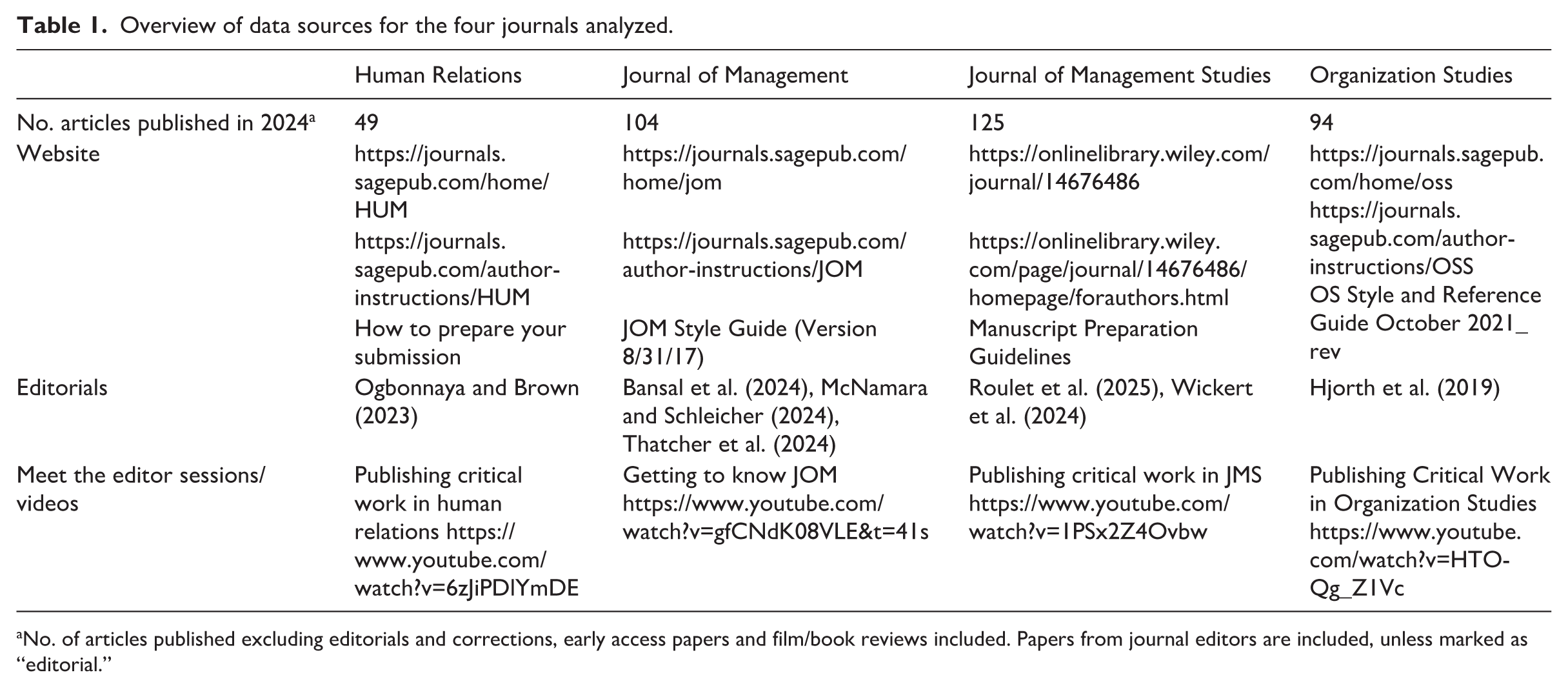
No. of articles published excluding editorials and corrections, early access papers and film/book reviews included. Papers from journal editors are included, unless marked as “editorial.”
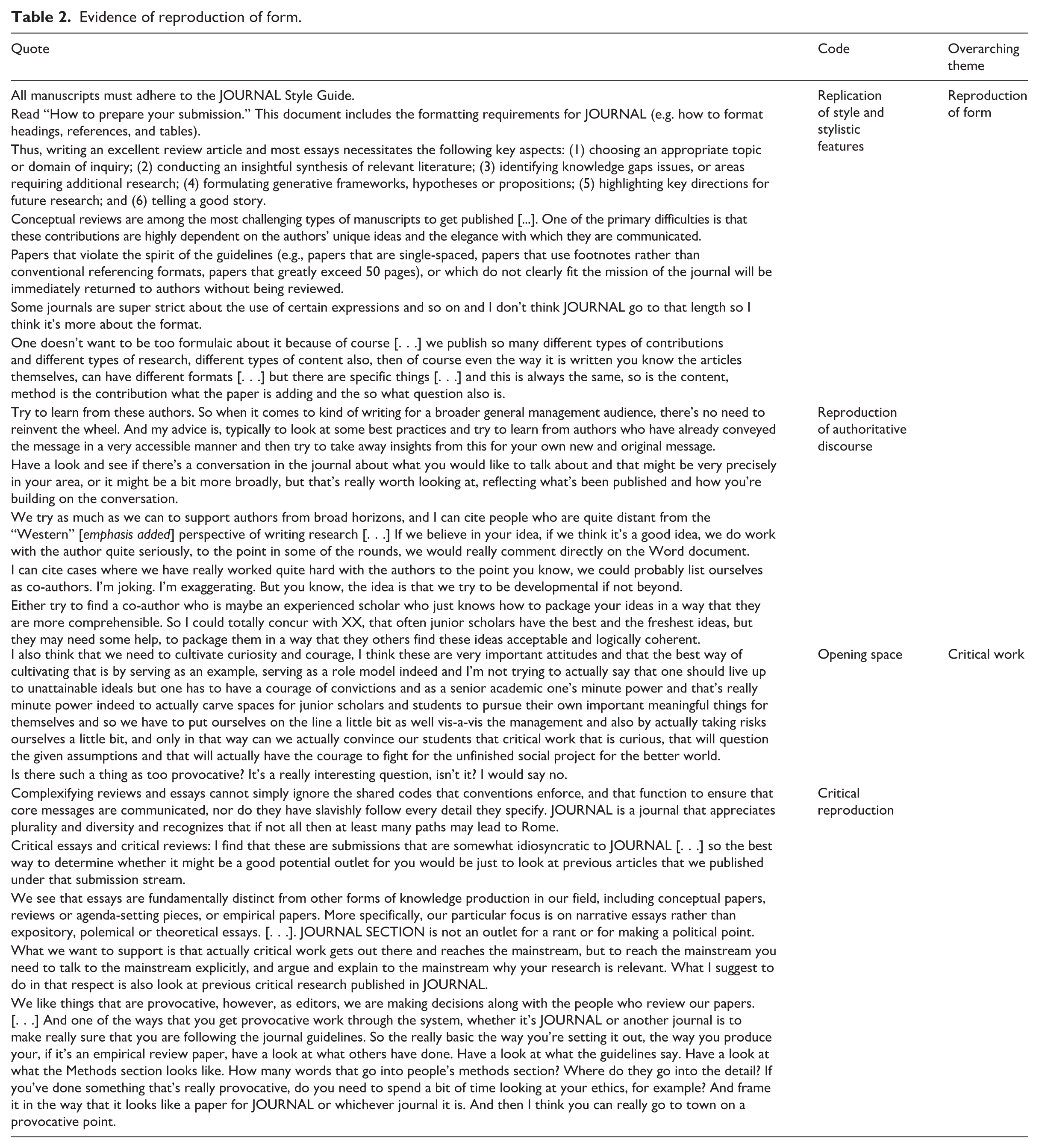
We analyzed the entire dataset, and categorized quotes iteratively. We analyzed the data anonymously, as our analysis was not focused on one particular journal, but on how reproduction of form manifests within the field. Our target therefore was not these journals specifically, but the extent to which they represent or shape the field. We conducted thematic analysis and highlighted quotes representative of reproduction of form throughout the entire dataset, after which we categorized these into codes and finally into overarching themes. Subsequently, we identified quotes that were most representative for each category and included them in the table. Table 2 shows our findings, including quotes (direct from the data), codes, and main themes. The quotes are therefore direct statements from editors on the journals’ websites, editorials or from the webinars.
Evidence of reproduction of form.
Findings
Two main themes emerged from our analysis: manifestation of reproduction of form and critical work. Reproduction of form as an overarching theme manifested through two main categories: replication of style, and reproduction of authoritative discourse. These are two interrelated dimensions of reproduction of form, which jointly dictate and ensure reproduction of journal content. Replication of style is the most straightforward requirement: journal websites dictate how submissions need to comply with journal style guides, but editors also emphasize how they select submissions not based on their actual content or contribution, but on whether they comply with guidelines. Editors express that submissions compliant with dominant styles and structures are less likely to be rejected, and also provide guidelines for how submissions should be crafted and structured. At the same time, they acknowledge that other types of submissions (e.g. conceptual reviews) are much harder to publish, and only for specific (famous) authors.
Conceptual reviews are among the most challenging types of manuscripts to get published. [. . .] One of the primary difficulties is that these contributions are highly dependent on the authors’ unique ideas and the elegance with which they are communicated.
There is some self-awareness of the reproductive nature of research. For instance, in one of the webinars, an editor expresses that “the last thing we would want is for authors to take an overly “formulaic” approach in preparing papers.” This exemplifies a prevailing editorial discourse around uniqueness and novelty of papers. However, at the same time, editors consistently emphasize the need for reproduction. For instance, one editor in a webinar mentioned: One doesn't want to be too formulaic about it [. . .] but there are specific things [. . .] and this is always the same, so is the content, method, is the contribution what the paper is adding and the so what question also is.
Such statements signify that despite the awareness of reproduction and the “formula” of a paper, it cannot be simply denied by editors, and that they continue to comply with given structures, styles and format of how papers should look like. Nonetheless, it is not merely about the replication of style; behind it, a reproduction of authoritative discourse co-exists with this replicative style. This reproduction was particularly signaled through the editorial sessions at the webinars, where editors usually express themselves more freely, spontaneously, and naturally than in the formal statements on websites and in published editorials. Here, their enunciations revealed a more direct engagement and requirement to engage in reproduction of form to be able to “get published.” Editors especially advised on two strategies to ensure reproduction of form: on the one hand, they put the emphasis on reproducing the way articles are written within the journal. Rather than focusing on novelty and creativity, editors advise authors to reproduce the style and discourse as dominant in the journal. On the other hand, editors advise authors to collaborate with experienced authors to “package” research such that “others” (editors, reviewers) “find these acceptable.” While acknowledging that junior scholars may have creative ideas, reproduction has to be ensured through collaboration with experienced scholars. One more extreme example pertained to an editor who explained that they almost acted as co-author: I can cite cases where we have really worked quite hard with the authors to the point you know, we could probably list ourselves as co-authors. I'm joking. I'm exaggerating. But you know, the idea is that we try to be developmental if not beyond.
While presented as constructive, developmental or supportive, editors may engage in a process whereby they transform academic work into a reproductive nature to comply with journal discourse, and where they personally intervene in the writing process of authors, raising questions about the academic freedom of authors. Given the top-tier nature of these journals, authors are likely to have little choice than to comply with editors when they want to secure publications in these journals. Hence, editorial gatekeeping is an important way through which reproduction of form manifests, and where editors ensure that papers passing through the system comply with the style, discourse, and structure as “acceptable” for the journal. Moreover, authors also comply with this process, given that authors continue to submit work to journals even though they face in theory a 95% chance to be rejected.
Critical work as a main theme included two categories: opening space and critical reproduction, and constitutes an important element within reproduction of form. While the Europe-based journals claim to be open to critical work (as evidenced by their participation in webinars on this topic), the findings also show a much more ambiguous picture. On the one hand, editors from these journals welcomed critical work, and wanted to open space for critical research in their journals, and to advocate for “critical work that is curious, that will question the given assumptions, and that will actually have the courage to fight for the unfinished social project for the better world.” Editors expressed their openness to critical work, and for instance explained that “there is no such thing as being too provocative.” However, at the same time, critical work is also dictated to comply with the norms of the journal and to fit within a reproductive frame. For instance, authors engaging in critical work are reminded not to ignore “shared codes that conventions enforce,” to only submit critical papers when there have been critical papers before in that journal, not to engage in “rants” or “making a political point,” and to “explain to the mainstream why your research is relevant.” One editor elaborated, and explained: We like things that are provocative, however, as editors, we are making decisions along with the people who review our papers. [. . .] And one of the ways that you get provocative work through the system, whether it's JOURNAL or another journal is to make really sure that you are following the journal guidelines. So the really basic the way you're setting it out, the way you produce your, if it's an empirical review paper, have a look at what others have done. Have a look at what the guidelines say. Have a look at what the methods section looks like. How many words that go into people's methods section? Where do they go into the detail? If you've done something that's really provocative, do you need to spend a bit of time looking at your ethics, for example? And frame it in the way that it looks like a paper for JOURNAL or whichever journal it is.
Hence, even when it concerns critical work, authors are suggested to make their work reproductive, and especially align their work with what is published in these journals. While (some of) these journals have very limited histories of publishing critical work, any subsequent attempt to get critical work through this system must first comply with any conventional norms set by the journal (editors). Hence, this shows that through gatekeeping, any attempt at critical work needs to align with conventions, and reproduce mainstream criteria. One external participant in the webinars commented that it is critical work that needs to reach out to mainstream researchers and explain to them how their critical work informs mainstream research, while the opposite is no requirement. This observation underpins how reproduction serves to maintain the status-quo, whereby “mainstream” research functions as the neutral standard. In sum, reproduction of form is an important way through which journals and discourses are maintained. Analysis of four MOR journals shows that through editorial gatekeeping, any prospective author is required to reproduce the style, form, structure, and discourse as prevalent in the journal.
Empirical discussion
The analysis of four top-tier MOR journals revealed that reproduction of form represents an essential way through which editors frame the publishing process. While journal publications form the most important credit for academics, publications in top-tier journals are the way academics build their careers and gain status. In this environment, reproduction of form can be understood as an emergent consequence of coordination needs among editors, reviewers, and authors. Across websites, editorials, and public webinars, editorial guidance promotes fit with established norms and expectations, which in turn fosters conformity and compliance as practical means of coordination among editors, reviewers, and authors. Authors learn acceptable styles from prior publications, collaborate with experienced scholars to package contributions (cf. Bal et al., 2025), and stick to the advice of editors whose roles may become increasingly blurry when they intervene in the paper writing process to ensure compliance and conformity of form, thereby reinforcing reproduction.
Because reproduction of form represents such a powerful mechanism for the running of journals, it is impossible for critical work to escape this dynamic, and editorial practices function to ensure that critical work is ultimately limited to the extent it reproduces existing and acceptable style, structure, and discourse. The consequence of this enforced reproduction of form for authors is that it not only implies a reproduction of style and discourse, but also an ideological reproduction (Bal et al., 2023, 2025; Yurchak, 2005). A related effect is intellectual reproduction, in which authors preferentially align their arguments with established findings, avoid overt disagreement with highly visible prior work, and de-emphasize conflicting or ambiguous evidence before submission. As a result, intellectual and stylistic heterogeneity is less visible to readers, as such variations are considered as risky and less likely to be accepted within the journal space.
The effect of which concerns the emergence of concepts as “empty signifiers” (Brown, 2016), in which concepts’ meanings become void and subject to ideological interpretation. For instance, concepts such as voice do not refer to workers’ opportunity to express their opinions, but to voice as an instrumental tool for performance enhancement (Barry and Wilkinson, 2016). Hence, readers have to read between the lines to understand the actually existing meaning of concepts within their ideological nature.
While reproduction of form is essential to how editors frame the publishing process, there is little if no discussion of the constraints being put on the advancement of academic knowledge and progress when all research that is to be considered “top-tier” has to comply with strict norms about how this knowledge should be communicated and structured. While curiosity and courage are mentioned, at the same time, knowledge has to be framed in a way fitting with shared codes and conventions, and avoid being perceived by editors as rants or political points. Therefore, reproduction of form functions as the way the system maintains the status quo and constrains any possible alternative way of expression.
Paradoxes of reproduction of form
From the above analysis, two main paradoxes can be identified. The first paradox pertains to the emphasis on unique theoretical contribution (Cornelissen et al., 2021; Mone and McKinley, 1993) versus the emergence of reproduction of form itself. This paradox lies at the heart of the critiques on the boring, repetitive and opaque nature of MOR (Alvesson and Gabriel, 2013; Tourish, 2020). How is it possible that despite such persistent discourse around novelty and uniqueness of research, reproduction of form has emerged and may constitute a significant part of contemporary academic research? Beyond the obvious reasons, such as the commercialization of the academic publication system and the linking up of performance appraisal criteria and general academic career capital with one’s publication list (e.g. Hanson et al., 2024), our analysis shows that existing forms and research are editorially dictated, while more creative and meaningful ways of scientific expression are suppressed. To understand this paradox, we introduce a psychoanalytic reading of reproduction of form. However, it cannot be stated that all MOR is reproductive—as discussed above, critical and creative work is published, and there is a growing space within academia for such alternative voices.
The role of critical work
While reproduction of form disincentives creativity of expression, it has not been unnoticed by journals and editors. More journals now have special sections in which authors are offered a different space for academic writing (Gilmore et al., 2019). For instance, the Journal of Organizational Behavior has a Point-Counterpoint section, and the Journal of Management Studies offers a JMSSays section especially for essays. Such sections within academic journals provide space for different types of writing. Such endeavors aim some way out of the reproduction of form in scientific publishing and the isomorphic way in which academic publications are produced (Cunliffe, 2022). A similar observation could be made regarding the rise of critical work in MOR during the last decades, in which critical work aims to find a way out of reproduction of form.
However, the dynamics underpinning reproduction of form were also identified in how critical work is perceived by journals, and hence, a second paradox emerges here. This paradox holds that attempts to break out of reproduction of form, through an emphasis on (authentic) uniqueness (e.g. through essays, critical work or writing differently, Kociatkiewicz and Kostera, 2024), risks a process of standardization and reproduction itself. Hence, despite often being presented as a binary distinction between reproductive mainstream research and creative critical research, it is the latter that risks itself from becoming subject to hegemonic forces, imposing reproductive norms on how critical scholarship should be done (e.g. Spicer and Alvesson, 2025). In some cases, it is even the hegemonic elites in critical areas themselves, who lament the reproductive nature of critical research (Lê, 2024). Hence, attempts to break out of the deadlock of reproduction of form may fall prey to reproduction itself, rendering the research and writing that occurs under this umbrella as more and more meaningless over time.
An important factor may be status and prestige, whereby critical work that is published in top-tier journals may be prone to forces that render it reproductive, while truly creative work is destined to take place within the margins, such as books or journals which offer a space for alternative expression, but which are not considered of equal status as publications in top-tier journals. Hence, a reproduction of critique can be witnessed, and when published in top-tier journals, writing differently is often writing not so differently. Therefore, reproduction of form affects not just dominant scholarship, but also counter movements in processes of norm setting, standardization and reproduction as our illustration of editorial discourse on critical work shows. A focus on uniqueness leads to reproduction of form, and attempts to escape from it instigate new processes of reproducing formulaic research (Spicer and Alvesson, 2025).
Psychoanalytic reading of reproduction of form
To explain these processes, we now turn to a psychoanalytic reading of reproduction of form to understand why reproduction occurs and is maintained, both at the individual and collective or system level. While there are mundane, socioeconomic explanations for the compliance with reproduction of form, as it may serve one’s academic career, it is also known from Yurchak’s (2003, 2005) work that reproduction of form served other, ideological purposes. With the link between ideology and fantasy (Žižek, 1989), a contemporary psychoanalytic reading of the meaning of reproduction of form for individuals and MOR generally, elucidates not only why reproduction of form remains dominant (even though problematized for decades), but also why even specific attempts to escape from it are ultimately also captured within reproductive dynamics. We use Freud’s repetition compulsion to explain why individuals engage in reproduction, Lacan’s Second Death to explain the workings of MOR as a scientific discipline, and Žižek’s interpretations of Lacan in explaining the undead to understand individual and collective behavior in contemporary MOR.
Repetition compulsion
Sigmund Freud introduced the somewhat enigmatic concept of repetition compulsion in relation to his clinical work in his 1920 essay “Beyond the Pleasure Principle” (Freud, 2003; Levy, 2000). He observed that following (childhood) trauma, people often showed a compulsion to repeat traumatic events, dreams, certain actions, or habits. Levine (2020) explains that a repetition compulsion is an ungovernable, involuntary, process stemming from the unconscious, aiming to discharge tensions resulting from trauma and may manifest through compulsive play, tics, or even fetishistic rituals (Levy, 2000). In so doing, individuals create fixations that may help them with coping or overcoming a trauma. In a similar vein, we could understand reproduction of form as an example of repetition compulsion—the compulsive act of academics to repeat their work, their working patterns (writing papers, going through tedious review processes) and the hegemonic forms in writing about research findings (cf. Sanchez-Cardenas, 2021). While it could be argued that reproduction of form merely serves individual agendas such as getting published to ensure a career, there is also an argument for repetition compulsion. On the one hand, universities are one of the few spaces in society where people should have academic freedom, or a freedom of expression based on scientific principles, and it is striking why academics would give up on their academic freedom merely to conform to an increasingly meaningless discourse. On the other hand, there are ample cases of academics who keep on reproducing their own research over and over again in slightly different ways. Academics who publish hundreds or even thousands of papers during their career are no longer an exception, and with the aid of AI, research productivity has yet begun skyrocketing (Hanson et al., 2024). This reproduction, whilst likely boasting academic careers, also serves another purpose in coping with trauma (Levine, 2020), or to repress a certain meaning (Sanchez-Cardenas, 2021). What is this trauma or repressed meaning? Repetition compulsion derives from the unconscious, and is often directed at coping with the meaninglessness of human existence (Levine, 2020). Through creating habits, people protect themselves against the trauma of meaninglessness. The compulsive repetition of publishing (going through the motions of highly structured paper writing), provides a sense of form, structure and meaning, not just for mainstream, but just as much for critical scholars. It helps academics with shaping their working patterns and working lives by structuring their scholarly work into the rhythms of paper publishing. Thereby, academics no longer have to question the meaninglessness of the contemporary state of academia. At the same time, this repetition drive may lead to entropy, a state of disruption and randomness, as philosopher Stiegler (2019) has argued. But what is this trauma of the state of academia? To postulate an answer, we complement the notion of repetition compulsion with Lacan’s second death to explain the systemic features of reproduction of form. While repetition compulsion explains why individual academics repeat their work and working patterns over again in response to the trauma of meaninglessness, the notion of second death explains more specifically the interaction with the systemic features of reproduction of form, and the extent to which reproduction is a function of a dying system itself.
Second death
Freud’s work on repetition compulsion directly linked with his work on the death drive (Freud, 2003), relating it to the difference between physical and psychological death, and extending the notion of repetition compulsion beyond the clinical use to postulate principles about life generally (Picht, 2022). Building on Freud, Lacan distinguished between the two deaths that people experience (“you only die twice”), but which could also be attributed to systems, states or institutions. Usually, biological death precedes symbolic death, such as in the case when someone dies (i.e. indicating biological, real death), and the symbolic death occurs when the funeral takes place and when people say their final goodbye to the deceased. In many cases, symbolic death occurs later than biological death, such as when the memory of the deceased lives on in the minds and hearts of the bereaved. Hence, there is biological, real, death of the material self, and the symbolic death, which refers to the collapse and disintegration of the symbolic order, and which can be separated in time from biological death. However, symbolic death can also precede biological death, such as is the case for people with severe dementia, where their symbolic death may occur preceding biological death, and where people around them may already said farewell. Similarly, this could be the case with institutions or even states. Yurchak’s analysis of the Soviet Union after Stalin’s death could also be understood as a study of the symbolic death of the Soviet Union after 1953, while the actual death of the Soviet Union took place almost four decades later. In a similar vein, one could argue that MOR has symbolically died, while its actual death is still to come. Is it appropriate to state that reproduction of form is a function of the symbolic death of MOR, while the actual death of the discipline is yet to come? It is perhaps too farfetched to state that the discipline as such has symbolically died, but certain aspects of the discipline (and beyond the discipline in academia more widely) may have experienced their symbolic death. For instance, the publication system is no longer functioning, and while it may seem that the system is thriving with record numbers of journals and papers published, the question is to what extent any new useful knowledge is actually produced (Hanson et al., 2024; cf. Spicer and Alvesson, 2025, who make a similar argument about Critical Management Studies CMS). Meanwhile, thousands of papers are being produced annually, but with decreasing, if not marginal, value to academia itself and the world beyond.
It may be the trauma of this symbolic death of (some aspects of) MOR (e.g. the publication system), that triggers in individuals and the system itself a repetition compulsion. The trauma refers to the symbolic death of academia: universities have existed for more than 1,000 years, based on the notion of being places of independent learning, study, and reflection. Many academics have entered their academic careers with such aspirations, only to be caught up in the neoliberal university (Jensen and Zawadzki, 2024). Hence, the trauma pertains to the lost object that the University represents: an institution that is no longer there, if it ever existed. As alluded to above, MOR is in crisis, with decreasing relevance, increasing repetition and a potential demise of the discipline (Dundon and Rafferty, 2018). To deal with the symbolic death of the publication system, MOR academics continue to reproduce the existing forms as a trauma response (Levine, 2020). At the collective level, reproduction ensures stability and predictability, as it offers academics a highly structured format for how to conduct their work and fill their days as academics. It presents a common discourse which, once learned, can be easily understood among academics. It also provides a feeling of meaningfulness in reproducing through disavowing the actually existing state of academia. This disavowal signifies the typical response to the symbolic death of the discipline: academics very well know that the discipline is disintegrating and that the publication system is dead and meaningless, but nonetheless act as if the system is still very much alive and meaningful (Zupančič, 2024). Such disavowal may even provide a sense of enjoyment among academics, especially for those who flourish in the system and publish dozens of papers annually. Moreover, enjoyment may also be experienced among those struggling in the system, while reproducing research and meanwhile secretly enjoying their submission to the status quo. However, this enjoyment is also decadent within a system that is more and more stagnating, struggling and absurd (Bal et al., 2025). But what does this time between symbolic death and actual death signify? In the Soviet Union, it meant stagnation, where discourse was frozen, until the collapse from 1989 onward. To explain this phase in between, we turn to Žižek (1989), who built on the Lacanian second death principle and explained the concept of the “undead.”
Undead systems and people
Žižek (1989, 2014), following Lacan (“L'entre-deux-morts”), argued that if people may have died biologically, but their memory is still alive, the reverse could also be the case. This signifies that people (or systems) are still alive but are colonized by the dead symbolic order (Žižek, 2014). They are alive but dead symbolically, which according to Žižek designates a “monstrous dimension.” This means there is no simple opposition between life and death, but life itself is split into “normal life” and “a horrifying undead life.” Hence, in the meaninglessness created by the symbolic death in MOR (of the publication system), we witness an undead life in which the hegemonic ways of working are merely reproduced continuously, but no real novelty is created. Everything is merely reproduced from the authoritative discourse as dictated hegemonically. However, while Yurchak’s (2005) study explains that reproduction of form led to an increasingly meaningless discourse over time, ultimately eroding the entire Soviet Union from within, a psychoanalytic interpretation shows that reproduction of form arises from the meaninglessness of the symbolically dead publication system itself (Žižek, 2014). In this way, reproduction of form is the act of the undead discipline to bridge between the symbolic and the actual death (if occurring at all). Metaphorically, MOR reproduction of form acts as the music played by the orchestra on the Titanic, which symbolic death preceded (when the ship hit the iceberg) its actual death (the sinking of the ship). The famous example of the orchestra playing on signifies the undead, continuing to play without meaning. This also shows the contribution of a psychoanalytic reading of reproduction of form, arguing that meaninglessness was already present within the system, and spurred a repetition compulsion to cover up the gap between the symbolic and actual death of a discipline. While not inconsistent with Yurchak’s analysis of reproduction of form, it complements his analysis by showing the presence of the symbolic death, and the associated meaninglessness that actually gives rise to reproduction of form, rather than merely following from it.
General discussion
This paper argues that contemporary research suffers from an ideological reproduction of form which manifests through a number of ways, and is associated with two main paradoxes, of uniqueness versus reproduction, and of critique against reproduction and critique being reproductive itself. Contemporary journal requirements are highly formulaic, through which academics must comply with a prescribed form of ideological expression, without real freedom of expression. This pertains to the structure of papers, as well as the ways through which arguments are developed, theory is used, and studies are presented. For instance, in quantitative empirical articles, it is prescribed that a theory section precedes a set of hypotheses which are then “tested” in a specific (organizational) context, results of which are shown in tables and figures, after which the results are discussed in a structured and highly predictable manner (i.e. theoretical implications, limitations and suggestions for further research, and practical implications). Our empirical analysis showed that this reproduction of form is enforced through editorial gatekeeping, in which specific requirements are imposed on authors and how they shape their work to be considered for publication in top-tier journals.
Reproduction of form shapes norms, leads to an idealized image of a scholar who conforms to hegemonic practices, again penalizing critical research and voices. Instead, “sameness” is the criterion, as shown by the rise of meta-analyses, systematic reviews, and the use of AI to write papers. Aspiring early career researchers often start their careers with conducting systematic reviews, which are a popular type of paper, as they allow researchers to learn about a particular field or topic by only reading one paper. Systematic reviews are often praised for their ability to summarize the state-of-the-art, and thereby further setting the rules of the game in an entire field of research. However, is the core purpose of systematic reviews not to show the reproduction of form in a field, and the fact that hundreds or thousands of papers can effectively be summarized into one single story? Moreover, with the hegemonization of English as the universal language of scientific communication, it is also through language that reproduction of form is reinforced, while scientific communication in other languages is given less credit and recognition, at the expense of reification of English as the only valid language.
One important difference with Soviet reproduction of form concerns the continuous “discovery” of new concepts in MOR. While discourse in the late Soviet Union became frozen and entirely fixed on reproduction of the terminology, phrases and arguments that were allowed during the Stalin era (Yurchak, 2005), contemporary academia finds itself in a slightly different position. More specifically, we have witnessed the rapid invention of new terminology over the last decades. Hence, content may vary more strongly within MOR, but the underlying ideological anchoring remains fixed, especially when it concerns top-tier journals. It is only in more critical journals and in books that plurality is found, but at the same time, such publications are typically not regarded as equally important as top-tier journal publications. Moreover, the continuous invention of new terminology that is meaningless or merely repetitive of what existed before (old wine in new bottles) may also signify an undead life of a discipline between its symbolic and actual death (Hook, 2016; Levine, 2020).
Another key difference between the (post-)Stalinist context analyzed by Yurchak and the academic context is the absence of a singular Master figure who could assume Stalin’s symbolic role and unilaterally dictate or influence dominant discourse. In academia, authority is instead diffused and distributed across a scientific elite involved in editorial boards, ranking systems, hiring committees, and evaluative metrics. Dominant discourse is not only articulated formally through guidelines and evaluation criteria, but is also lived and reproduced through experiences of acceptance and rejection, circulating rumors among colleagues, formal and informal advice from mentors and senior faculty, and an imagined yet internalized set of norms and expectations (Bal et al., 2025). In this context, researchers learn to read between the lines of Meet-the-Editor sessions, editorial decisions, reviewer comments, and discipline-specific urban legends, gradually inferring what can be said, how it can be said, and which deviations are likely to be sanctioned. One of the central mechanisms of reproduction of form is therefore internalized compliance, whereby normative assumptions about what constitutes legitimate research are produced and reinforced through multiple feedback loops, including peer review, editorial guidance, mentoring, and informal advice. As a result, early career researchers tend to devote considerable effort to mastering the formulaic codes of publishable scholarship, rather than engaging primarily with the substantive questions that initially motivated their research.
The ideological meaning of reproduction of form
Why has reproduction of form emerged as a guiding principle of academic research in MOR? The ideological meaning of reproduction of form shows (a) the emergence and maintenance of reproduction of form in MOR, and (b) the problematic nature of reproduction of form for the advancement of scientific knowledge, in its stifling of academic freedom and creativity. Reproduction of form in the Soviet Union served an important ideological function, as the frozen nature of authoritative discourse enabled the rulers to control society and public enunciation. In a dictatorial state, it meant that the elites could exercise their power over the people and dictate public expression and what would be considered “against the interests of the Soviet people,” with the inherent risk of incarceration of writers and dissidents. Taking reproduction of form to the Western world, in which freedom of expression is also under attack (see e.g. Clark et al., 2023), such an ideological purpose of controlling public expression manifests, nonetheless, in a more complex way. Limitations to what can be enunciated publicly are managed not only through the creation of authoritative discourse and strict monitoring in society, but more indirectly through ideological encapsulation (Žižek, 1989). This involves more subtle ways of structuring reality as a fantasy, which helps to understand the emergence and maintenance of reproduction of form. Beyond all, it serves to cover up the symbolic disintegration of a discipline, denoted by its meaninglessness that is nonetheless reproduced under the cover of authoritative discourse that seems impressive but cannot hide its emptiness anymore.
Problematizing reproduction of form
Why would reproduction of form be problematic in a more practical, everyday meaning beyond signaling the demise of a discipline (Dundon and Rafferty, 2018; Orhan et al., 2025)? If standardization serves the development of a common discourse in which insiders know perfectly well what others are talking and writing about, it is likely that academics perceive reproduction of form as unproblematic (Mone and McKinley, 1993). The opposite could be more problematic, as the openness to a wide variety of writing styles raises the question of reliability of expression, or the notion that academic writing may be fundamentally misunderstood due to a lack of common discourse. However, is the fundamental misunderstanding not precisely the problem of reproduction of form? The dissociation of terminology’s constative meaning from its authoritative meaning in reproduction of form (Yurchak, 2005) obfuscates a possible common discourse. In other words, the assumption of a common discourse neglects the fact that concepts cannot be unequivocally understood, and by definition will have a plurality of constative meanings in workplaces.
The ideological function of reproduction of form protects academics from having to truly engage in critical reflection upon the state of the discipline and its symbolic death, thereby protecting one’s own career in academia. Thereby academics may engage in the performative dimension of reproduction of form (by writing academic papers themselves which perfectly align with authoritative discourse, but which are increasingly meaningless themselves), whilst maintaining the constative dimension of authoritative, academic discourse. The latter projects upon the community and society what can be considered a “normal” discourse (e.g. that individuals and organizations need to be resilient in turbulent times), while stifling critical debate around these concepts and ideologies, and delegitimizing re-imagination of concepts by projecting hegemonic, authoritative, interpretations of concepts. At the same time, underlying ideologies remain hidden and unexposed in MOR (Bal and Dóci, 2018). Meanwhile, reproduction of form is increasingly associated with feelings of alienation from the core purpose of academia and scientific research (Tourish, 2019), which may also be one of the primary reasons for the existence of burnout and alienation in academia, in addition to the high workloads. The perception of decreasing meaning of the academic job itself is likely to have long-lasting, devastating effects on academia, and ultimately may amplify the symbolic death, and the feelings of being undead in academia. While publishing has become most important part of academic life, our analysis of the symbolic death of MOR pertains primarily to the death of the publication system. However, the symbolic death may also pertain to academia as an entire institution itself (Jensen and Zawadzki, 2024). Nonetheless, there may be corners in academic life where flourishing takes place, such as in teaching students critically, and friendships and collaboration in academia (Robinson et al., 2023).
Parallax view
Is there a way out of reproduction of form when any attempt in doing so risks being caught in similar dynamics? The reproduction of critical work (cf. Spicer and Alvesson, 2025) shows how reproduction of form also perpetuates in critical circles, and as such, a way out of reproduction of form necessitates a complete overhaul of the entire system and predicament (Žižek, 2014). In this sense, it could be advocated that a parallax view is necessary – which refers to the extension of the binary opposition between reproduction and uniqueness toward a perspective from an entirely different angle, which may provide a fundamentally different perception of the subject matter (Kilroy, 2019; Žižek, 2009). This is perhaps where CMS failed, in trying to engage critically with the existing structures while remaining compliant with the system itself. Given the symbolic death of the publication system, more fundamental questions need to be addressed about the meaning of writing and publishing, and it may be that the system can only be saved by abolishing the entire publication system, corrupted as it is, functioning within capitalist dynamics (i.e. owned by the most profitable publishing houses while reliant upon free academic labor). While it remains unlikely that universities will dissociate from the publication system, and no longer emphasize publication CVs as the currency for academic careers, it will ultimately be the establishment of new universities as places of critical learning which may offer the possibility of production of academic knowledge for the sake of learning, real advancement of knowledge and societal impact for a more fairer, inclusive and dignified society (cf. Robinson et al., 2023). A parallax view argues for a fundamentally different perspective, and the question remains to which extent this will be possible within the constraints of the current system. The publication of this piece is another example of conveying another story while using the same means of publishing, which may make academics hypocritical (Lê, 2024) in both critiquing and benefiting from the system. New universities may also provide the space for the many academics who are now struggling. There are many academics who truly love their work, and genuinely care about the meaning of their work, and the impact it has on making society fairer, more dignified and more sustainable (Robinson et al., 2023). Not all academics comply with reproduction of form, and find their own ways of conducting meaningful research, and new platforms, universities, and systems may provide more dignified spaces for them and students who subscribe to these ideals too.
Despite its drawbacks, the system has allowed opportunities for new spaces where resistance, opposition, and alternative modes of scholarly communication have naturally evolved. Critical and collectively governed outlets such as ephemera, Tamara, M@n@gement, and similar initiatives explicitly challenge commercial structures and dominant publication logics by allowing greater flexibility in form, voice, and argumentative structure. These examples illustrate that academic knowledge can be communicated in ways that are less tightly bound to standardized templates and predefined expectations of contribution. Yet, these initiatives still operate at margins; there is still a need for reimagining the way research communication is conveyed. The dominance of the journal article as the primary written form of academic communication has itself become naturalized and internalized by many, often treated as a neutral and self-evident vehicle for knowledge production. Thus, recognizing alternative forms, different channels, different styles, and alternative methodologies is still unimaginable for many. In this sense, the persistence of reproduction of form is less a failure of the existence of alternative than a consequence of norms and assumptions about scholarly communication itself, assumptions that remain largely unquestioned even where resistance appears possible.
Conclusion
Reproduction of form (Yurchak, 2003, 2005) proves a useful concept to understand the state of contemporary MOR research, as it elucidates the stylistic, content-based, and ideological reproduction in the field. Through reproduction of form, scientific progress is stifled and academic freedom and creativity are under threat. In this paper, we have analyzed the ways through which reproduction manifests, how editorial gatekeeping plays an important role in ensuring reproduction of form, the paradoxes that result from reproduction of form, and the deeper unconscious meanings of reproduction of form as a trauma response to the symbolic death of academia. While we have pointed to some alternative ways of doing and communicating research, we also need more debate around how the need for standardization of academic discourse can be managed such that it continues to allow freedom of academic expression.
Footnotes
Funding
The authors received no financial support for the research, authorship, and/or publication of this article.
