




Abstract
Over the past 15 years, social innovation (SI) has gained ground as a promising approach for tackling today’s grand challenges. A “weak” conception of SI focuses on improving how social needs are addressed through new products, services, technologies, business models, or practices. In contrast, a “strong” conception emphasizes deep social transformation and the empowerment of historically marginalized groups. In management education, SI has predominantly been taught through the lens of the weak conception. This paper explores the pedagogical opportunities and challenges of teaching a strong SI to business school students. We conducted a qualitative study of six courses that emphasize a strong SI, drawing on semi-structured interviews with both instructors and students. Our findings reveal the transformative potential of these courses, suggesting they can better prepare students to tackle today’s complex challenges by reshaping the traditional ethos of business schools. However, teaching a strong SI also requires instructors to navigate several key tensions related to action, organizations, management, emotional engagement with the world, and consideration of values and politics. These tensions offer a pedagogical map not only for courses centered on a strong SI but also for those adopting a critical approach to management and business organizations.
Keywords
Over the past 15 years, social innovation (SI) has gained ground both within and outside academia as a promising approach to tackle today’s grand challenges—complex, large-scale problems with global interdependencies (Gariel & Bartel-Radic, 2024), which “significantly and adversely affect human welfare and well-being” (Ferraro et al., 2015, p. 365), such as climate change, poverty, social inequalities, or the collapse of biodiversity (Edwards–Schachter & Wallace, 2017; Gariel & Bartel-Radic, 2024; Howaldt & Schwarz, 2021; Kickul et al., 2012; Lachapelle, 2021; Mailhot & Lachapelle, 2022; Mehmood et al., 2020; Montgomery & Mazzei, 2021; van Wijk et al., 2019). SI ranges from addressing tangible societal needs with new products and services (i.e., micro-credit, educational programs, and social business models) to reshaping social relations through the establishment of new eco-organizational, social, and institutional arrangements (i.e., national kindergarten network, universal basic income, and the commons; Andion et al. 2017; Lachapelle, 2021; Montgomery, 2016; Moulaert, 2013; Moulaert & MacCallum, 2019; Pel et al., 2020, p. 2).
In management education, SI has mainly been embraced in its “weak” conception as finding new or better ways to address social needs through the development of new products, services, technologies, business models, or practices (Howorth et al., 2012; Lawrence et al., 2012; Phills et al., 2008; Tracey & Phillips, 2007). Courses about social entrepreneurship have flourished (Kwong et al., 2012; Miller et al., 2012), and SI has been added to the toolkit of sustainability management (Aksoy et al., 2019). In contrast to this weak approach, a strong approach to SI (Ayob et al., 2016; Klein et al., 2019) prioritizes deep social transformation that goes beyond merely responding to social needs and focuses on reconfiguring existing power relations. More critical, radical, and holistic, a strong conception of SI cannot easily be integrated into the business school curriculum. Like critical management education or courses based on a “strong” sustainability (N. Landrum, 2018; N. E. Landrum & Ohsowski, 2018), courses promoting a strong conception of SI break away with the traditional business school ethos.
In this paper, we explore the pedagogical opportunities and challenges of teaching a strong conception of SI to business school students. We conducted a qualitative study within our own institution, HEC Montréal, a large, research-intensive, Canadian business school which, as a result of its historical and cultural context, has been actively developing courses based on a strong conception of SI. We targeted six courses within three different programs, conducting semi-directed interviews with eight instructors who designed and taught those courses as well as with 11 students who participated in them.
Our results suggest that a strong conception of SI challenges the traditional business school ethos in several ways, requiring instructors to navigate five pedagogical tensions related to action, organizations, management, emotional engagement with the world, and commitment to values and politics. These tensions provide a pedagogical map not only for courses centered on a strong conception of SI but also for courses on sustainable and critical management, which share similar characteristics. These results also highlight the potential of such courses to transform the ethos of business schools, better preparing students to address today’s grand challenges.
Literature Review
Social Innovation: Weak and Strong Conceptions
SI is a polysemous and widely debated concept (Andion et al., 2017; Ayob et al., 2016; Durand Folco, 2019; Lachapelle, 2021; Marques et al., 2018; Montgomery, 2016; Moulaert, 2013; Moulaert & MacCallum, 2019; Mulgan, 2012; Nicholls & Murdock, 2012). Most definitions conceive of SI as new forms of social relationships and as the generation of new ideas and solutions that have a positive societal impact. Within this broad conception, contestation occurs between the weak and strong traditions, a distinction developed by Ayob et al. (2016) in their systematic literature review and taken up by other authors outside business education (e.g., Ardill & Lemes de Oliveira, 2021; de Bruin & Read, 2018; Haskell et al., 2021; Klein et al., 2019; Mehmood & Imran, 2021).
The weak tradition derives from the business and management literature and from the Anglo-American entrepreneurship tradition (Ayob et al., 2016; Moulaert & MacCallum, 2019; Pol & Ville, 2009). SI is defined as a “novel solution to a social problem that is more effective, efficient, sustainable, or just than existing solutions and for which the value created accrues primarily to society as a whole rather than to private individuals” (Phills et al., 2008, p. 36) It implies the development of new products, services, markets, or collaborations within the traditional sphere of the market (Phills et al., 2008; Tracey & Phillips, 2007; e.g., social impact bonds, ethical consumerism, crowdfunding for social causes, or fair trade labels). In this utilitarian perspective, SI is led by individual entrepreneurs/innovators, philanthropists, and businesses through market–oriented initiatives (e.g., social business, social entrepreneurship, and bottom–of–pyramid model; Andion et al., 2017; Moulaert & MacCallum, 2019).
In contrast, the strong tradition SI is rooted in the third sectors of Europe and Quebec and the social movements tradition (Moulaert & MacCallum, 2019; Klein et al., 2012). It emerged in the 1980s in the third sector (non-profit organizations and cooperatives) within the context of new social movements and local and territorial concerns, in response to economic recession, unemployment, decline of the Welfare state, rise of the ecological movements, and political unrest in various countries. It draws from sociology, economics, geography, social work, and alternative management, focusing on the general process of social change rather than on individual capacity or new organizational structures. A strong conception of SI involves new forms of social relations, the re-shaping of power relations and the social transformation of institutions (Klein et al., 2012; Pozzebon et al., 2021; Tello–Rozas, 2016). It refers to “innovation in social relations based on values of solidarity, reciprocity and association” and to “a solidarity-based approach to building community and society” (Moulaert & MacCallum, 2019, p. 1). It aims at bringing “greater social inclusion and social justice via the changing of existing social (and particularly power) relations” (Ayob et al., 2016, p. 645). The central actors of a strong conception of SI are civil society, community organizations, and third sector organizations, and the SI process is one of coproduction and collaborative processes (Ayob et al., 2016). Examples of initiatives that fit into the strong conception of social innovation are workers’ cooperatives, indigenous land rights movements, universal basic income experiments or community land trusts. Figure 1 illustrates the distinction between the strong and weak conceptions of SI as described by Ayob et al. (2016).
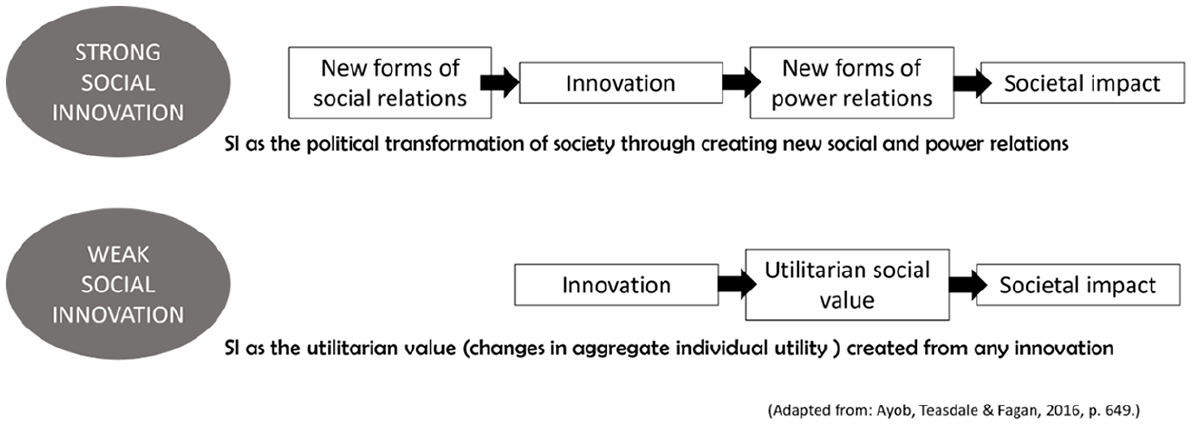
Strong versus weak social innovation.
Strong Social Innovation, Management Education, and the Business School Ethos
A weak conception of SI has been integrated in the curriculum of several academic fields to better prepare students to address socio-ecological grand challenges (Alden Rivers, Armellini, Nie, 2015; Bagelman & Tremblay, 2017; Bayuo et al., 2020; Córdoba–Pachón et al., 2021; Haskell et al., 2021; Milley & Szijarto, 2022), including in management education, with new courses on social entrepreneurship and social enterprises (Lawrence et al., 2012; Nicholls, 2010; Nicholls and Murdock, 2012). The weak conception of SI can easily be integrated into management curricula (Haskell et al. 2021), by adding new topics and by adapting content and pedagogy (Lawrence et al., 2012; Miller et al., 2012; Ngui et al. 2017; I. H. Smith & Woodworth, 2012). The tools and models used by social entrepreneurs are conventional business tools augmented by, or hybridized with, social or environmental dimensions (Mailhot et al., 2021; Ngui et al., 2017; Pache & Chowdhury, 2012).
To our knowledge, no study has focused on the integration of a strong conception of SI in management education. However, the weak/strong distinction regarding SI echoes the weak/strong distinction about sustainability (Dedeurwaerdere, 2014; Gutés, 1996; N. Landrum, 2018) which has been used in management education (André, 2020; Arevalo et al., 2020; Ergene et al., 2021; Kurucz et al., 2014). A weak sustainability “is a modest position, adjusting and accommodating to the demands of environmentalists, while striving to maintain the status quo” (N. Landrum 2018, p. 7); it is “a “safe” position that accommodates but does not give away power or control” (N. Landrum 2018, p. 7). In contrast, a strong sustainability calls for a transformation of socio-economic systems (e.g., post-growth) and organizations (André, 2020; Demastus & Landrum, 2024; Ergene et al., 2021; Kearins & Springett, 2003; Kiss et al., 2024; Kurucz et al., 2014) and, as such, is more difficult to integrate in business school curricula (André, 2020; Arevalo et al., 2020; Urdan & Luoma, 2020).
Advocates of a strong sustainability in management education have faced several teaching challenges (Ergene et al., 2021; Kurucz et al., 2014) that could also apply to teaching a strong conception of SI: justifying the interest and distinctiveness of a strong approach when a weak one seems “good enough” (Kearins & Springett, 2003; Urdan & Luoma, 2020), and establishing consistency between this strong conception taught in one or a few courses, and the practices and values exemplified in other courses and in the institution as a whole (Aragon-Correa et al. 2017; Figueiró & Raufflet, 2015; Kanashiro et al., 2020).
More generally, the critical management education (CME) literature has stressed the perils and pedagogical challenges of exposing and criticizing the ideological and political foundations of business organizations and management to business school students (Dyck & Caza, 2022; Fenwick, 2005; Perriton & Reynolds, 2004, 2018). With its focus on restructured power relations and political change, a strong conception of SI could face the same challenges. It is difficult to reconcile a “language of critique” with a “language of possibility” (Kurucz et al., 2014, p. 439), or a “managerialist” with a “critical” views of management education (Grey & French, 1996, p. 6).
What courses about critical management, strong sustainability or a strong SI have in common is the assertion that “management is not about neutral techniques but about values,” and that “it is possible to have a conversation about what those values should be” (Grey, 2004, p. 180). These courses involve exposing and questioning the business school ethos, those “assumptions, beliefs, and ideas contained in study material and teaching through which students, often unconsciously, learn to relate to the world” (van Baardewijk & de Graaf, 2021, p. 190). The business school ethos is about the role of business and markets in society, “the “goods” of business and the “good life” in general,” and about the role that business school students could play in society (van Baardewijk & de Graaf, 2021, p. 190). The current business school ethos has been described as valuing customer satisfaction and shareholder value (van Baardewijk & de Graaf, 2021), promoting a positivist approach to management and a worldview centered on the organization, and as being based on the beliefs that business is the key engine of progress (Lozano, 2012) and that “a managed world is to be preferred to an unmanaged world” (Grey, 2004, p. 179).
With its focus on social justice, power relations, systemic change, oppressive structures, non-profit organizations and collaborative processes, a strong SI seems at odds with many aspects of the business school ethos. Yet the growth of the courses about a strong SI in our own business school over the past 5 years suggests that teaching a strong conception of SI to business school students is indeed possible, even desirable. In what follows we explore the opportunities and challenges of teaching a strong SI to business school students through the concrete experience of the instructors who teach these courses, as well as that of the students who attend them.
Methodology
We conducted a qualitative study aimed at exploring the opportunities and challenges of teaching a strong conception of SI in management education. We did so from the perspectives and experiences of the instructors and students involved in these courses (Denzin & Lincoln, 2005; Miles & Huberman, 1994). The research was conducted at HEC Montréal, the home institution of two of the authors. Over the past decade, this large Canadian business school has seen a growing number of SI courses and thus offers fertile ground for this study. Our “insider/outsider (I/O) research team” (Bartunek & Louis, 1996) was composed of two insiders—a professor and a lecturer teaching SI course at this institution—and two outsiders—a professor at the institution not involved in SI courses and a Ph.D. student in social sciences. This team configuration enabled us to strengthen the links between first-order (informant-centered) and second-order (researcher-centered) analysis and to enrich the dialogue between both voices—informants and researchers (Gioia et al., 2013, p. 18).
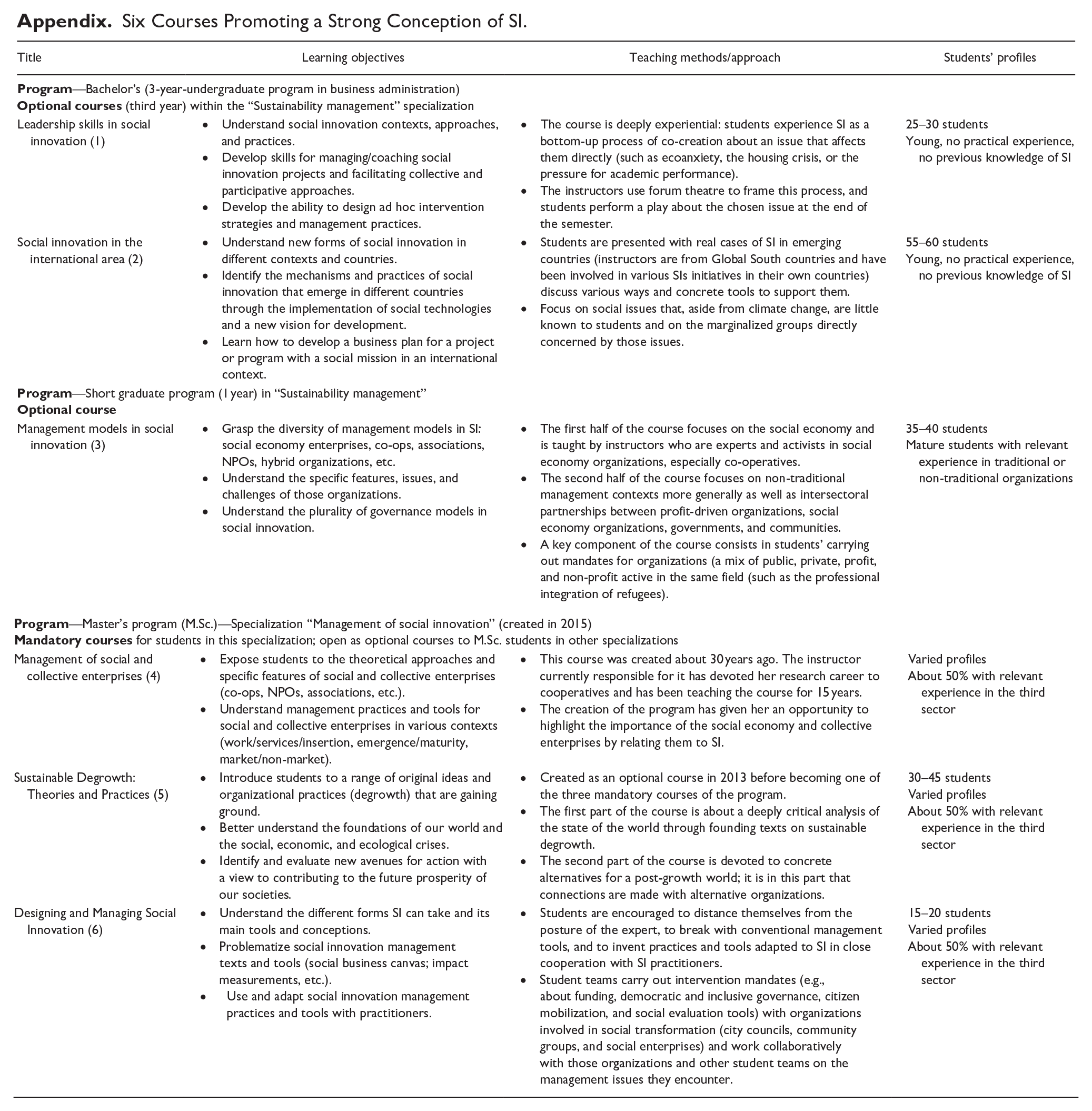
We first identified the courses and programs within the institution incorporating the term “social innovation” in their name: six 45-hr, one-semester courses in three different programs (see the Appendix). For each of these courses, we drew on three data sources: the course syllabi and other materials provided by the instructors; semi-structured interviews with the instructors, including the two insider researchers; and semi-structured interviews with 11 students enrolled in one or more of the six courses (see Table 1).
SI Courses and Study Participants (Instructors and Students).
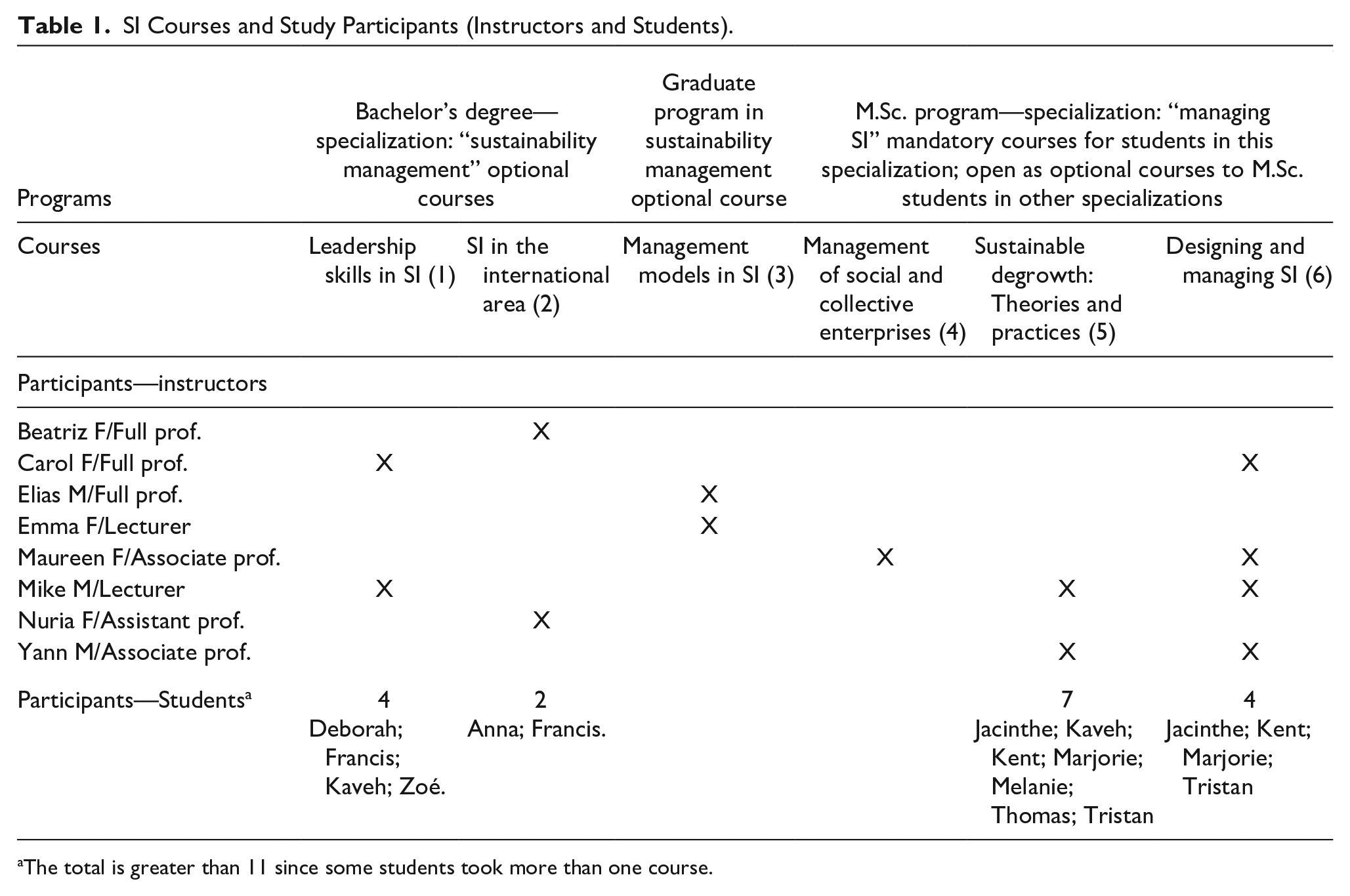
The total is greater than 11 since some students took more than one course.
We asked the instructors who had designed or were teaching these courses to participate in our study. Of the dozen teachers originally involved, six agreed to participate in addition to the two insider researchers. The others were either not available at the time of data collection or were no longer teaching at this institution. Two of the eight interviews were conducted a year after the first six when a preliminary version of this article had already been submitted. We took advantage of the revise and resubmit process to add the perspectives of two more instructors who had not been available at the time of the initial data collection to enrich the data already collected (the same interview outline was used with no changes to the questions or the prompts). All participating instructors provided their consent for the research and the publication of its findings. While we used pseudonyms to protect their identities, they were aware that complete anonymity could not be guaranteed.
About 40- to 80-min in-person interviews were conducted by one of the outsider researchers—the professor not involved in SI courses. The interviews covered the following topics: the educator’s perspective of SI; description of the SI course(s), the educator’s approach to teaching SI in a business school context; and satisfactions and challenges related to teaching those courses. Although it was clear that the research was not about assessing the courses or the instructors’ teaching quality, the social desirability bias that comes with being interviewed by faculty colleagues should be acknowledged. One way to address this possible bias was to supplement the instructors’ point of view with that of the students.
After the courses had been completed and their grades finalized, 20 students (5 students who had been randomly selected from each of the four courses whose instructors agreed to provide their class lists) were invited to participate in the study. Eleven answered and agreed to participate, which introduces a possible selection bias as those who agreed to participate might have been students who were satisfied with the courses. Thirty-minute videoconference interviews with these students were conducted by one of the two outsider researchers (a Ph.D. student), to minimize the social desirability bias that may be present when students are asked about their courses and instructors by another instructor in the same institution. The interviews covered the following topics: academic background, program, discipline, and major; their conception of and interest in SI; assessment of the SI course(s); and career goals and projects. Six of the 11 students had taken several of the courses and were able to compare them (see Table 1). Instructors had not provided us with class lists for two of the courses (“Management models in SI” and “Management of social and collective enterprises”), so no interviews were conducted about these two courses. Table 1 presents the research participants (instructors and students) and their links to the six courses.
All of the interviews were recorded, transcribed verbatim, and exported to NVivo (version 10). As with many other qualitative approaches, the major steps were data organization, reduction, and interpretation (Miles et al., 2014). The interview transcripts were read by all of the authors who agreed on two major themes: (1) the conception of a strong social innovation put forward in the courses and how this conception relates to other courses and the rest of the business curriculum; and (2) the challenges and satisfactions of teaching a strong conception of SI. Regarding the first theme, following the principles of interpretivist research (Corbin & Strauss, 2008), the two outsider researchers independently coded excerpts of the instructors’ and students’ data and, after discussion and several iterations, settled on key ideas that represent the ethos underlying a strong conception of SI. They submitted their analysis to the two insider researchers, which led to further clarification and refinement of these key ideas.
We then turned to the second theme—the challenges and satisfactions of teaching a strong conception of SI. After an initial holistic assessment of the data, the two outsider researchers agreed that a key idea was that of having to reconcile apparently contradictory positions about key dimensions of management education such as problem-solving, action, organizations, and management. The idea of “pedagogical tensions” was submitted to the two insider researchers, and the four of us discussed the nature of these tensions, relating them to the key ideas about the ethos underlying a strong SI (first theme). After composing an initial list and description of the tensions, the two outsider researchers returned to the data set and coded the data accordingly. After several iterations and discussions during which we compared our understanding of the tensions and resolved the discrepancies in our interpretations, we ended up with five pedagogical tensions that could be related to the key ideas about the ethos of a strong SI. The final step was to ensure that each pedagogical tension could be identified in at least four of the courses and was experienced not only by instructors, but also by students. The results are presented in the next section.
Results
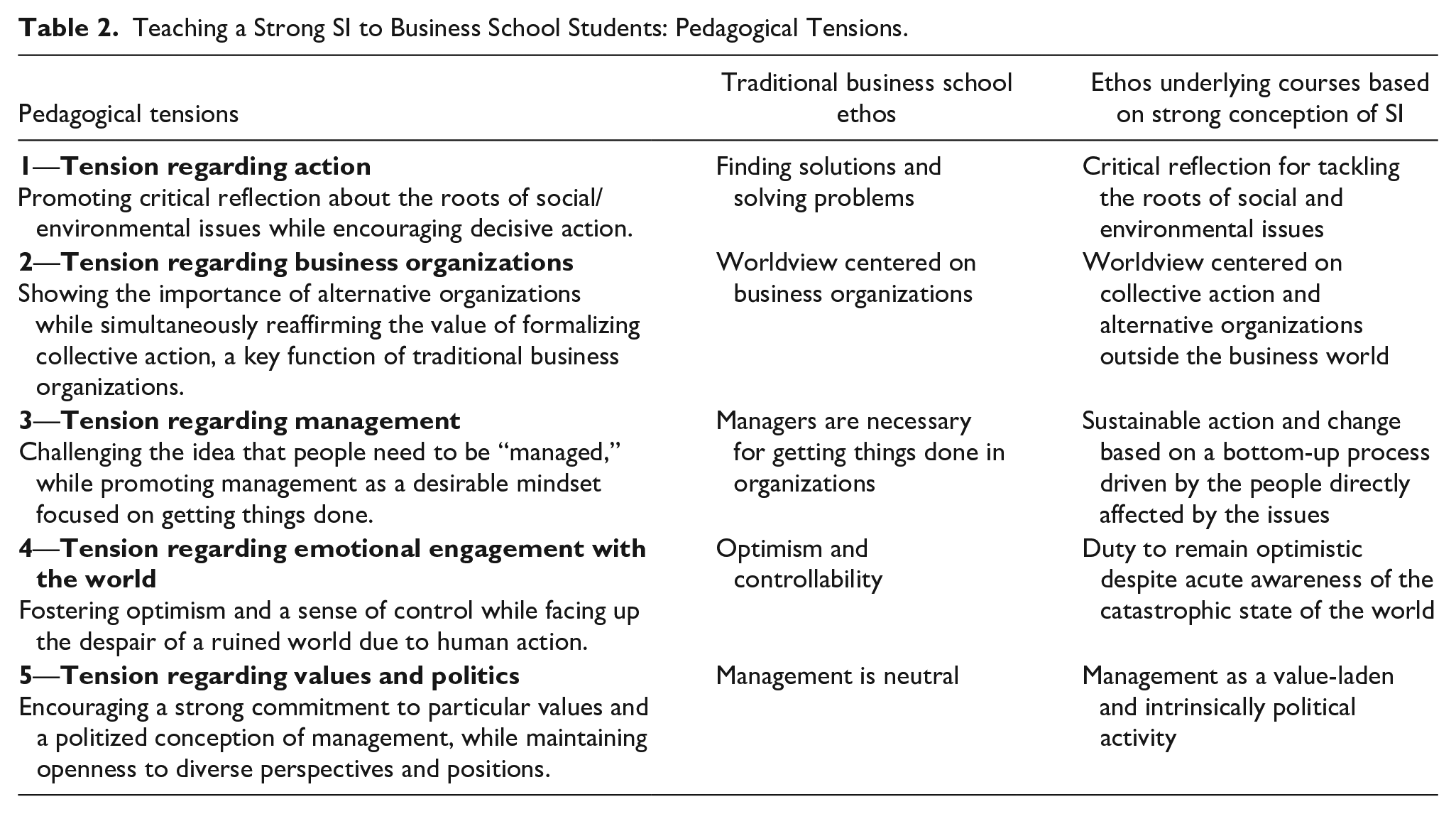
Teaching a strong conception of SI presents an opportunity to promote an ethos based on values, beliefs, and assumptions that significantly differ from the traditional business school ethos. Instead of trying to replace one ethos with another, the instructors we studied seek to reconcile the ethos underlying a strong SI with the traditional business school ethos, recognizing that certain components of the latter remain relevant and desirable. This process requires navigating several pedagogical tensions, where seemingly contradictory elements must be embraced simultaneously (W. K. Smith & Lewis, 2011, p. 382). The five tensions that emerge from our findings are summarized in Table 2.
Teaching a Strong SI to Business School Students: Pedagogical Tensions.
Tension Regarding Action—Promoting Critical Reflection About the Roots of Social/Environmental Issues While Encouraging Decisive Action
Teaching a strong conception of SI involves exposing and tackling the root causes of social and ecological issues—deep-seated drivers involving systemic conditions, rather than mere symptoms or surface-level manifestations—and embracing the complex causal web that weaves together social, economic, and environmental issues (Sabadash & Denysenko, 2018). It requires resisting the urge to break down these pressing issues into manageable problems and to come up with short-term solutions, as these solutions tend to create new problems in an endless series of perverse effects: “We want to deconstruct this notion of solution (. . .) Often we find out five years later that the ‘solution’ isn’t a solution at all. It had perverse effects and contributed to aggravating the problem rather than solving it” (Elias—Instructor—Course 3). Understanding a strong concept of SI thus depends on fostering critical reflection, defined as “a commitment to questioning assumptions and taken-for-granteds (. . .), and to raising questions that are moral as well as technical in nature and that are concerned with ends at least as much as with mean” (Reynolds, 1999, p. 538), and resisting the urge to “jump” into action. Critical reflection, however, is not an end in itself; it is a prerequisite for considering actions that may represent tentative steps toward addressing today’s grand challenges.
The tension between critical reflection and action requires balancing two seemingly contradictory positions: on one hand, instructors aim to raise students’ knowledge and critical awareness of the complex web of micro and macro phenomena at the root of social and environmental issues. They promote critical reflection and urge caution toward the idea of “solving” today’s “problems” without addressing these root causes. On the other hand, they want their students to remain action-oriented, focusing on tackling today's issues rather than becoming stuck in a purely critical or theoretical stance about the roots of these issues: In the face of what I view as a disaster, my pedagogical intention is to question the causes of that disaster, to question this world, and to work out ways out of it. The intention is to introduce them to these radical critiques and then get them thinking about ways out of this world. The distant and critical posture is not enough. In terms of concrete organizations, what kind of position could I support?” (Yann—Instructor—Courses 5 and 6).
Students vary in whether they need to be pushed to stand back and reflect or to act and get moving. Some students feel they already have reflected on the shortcomings of the existing system and are eager to take action: It annoys me to sit and just listen to what social innovation is and really theorize about it, when it’s a thing that happens so much in action. I feel like I’m having a bit of trouble just thinking about it. There’s a distancing that takes place in class that I don’t like.” (Jacinthe—Master student—Courses 5 and 6).
Critical reflection is not always welcomed by students: Every time we talked about a SI case, we had to reflect, be critical, and find issues about the case, and I think that’s what [instructor’s name] wanted, but it’s all very well to say it, but you have to do something with it.” (Anna—Bachelor student—Course 2).
Other students, however, believe they need reflexive and conceptual handles to feed and give meaning to their doubts and dissatisfactions with the current social and economic system: When I was on the road [traveling around the world], I saw it [the failure of the entire system]. I experienced it, but I didn’t conceptualize it, and that was the missing piece. The course enabled me to put words to many ideas that I had, and it made me push a lot of those reflections. (Tristan—Master student—Courses 5 and 6)
Encouraging ambitious action outside the “solution mode” implies considering the type and level of action required, against the backdrop of the complex, interdependent links between localized actions and systemic changes. Instructors try to address the question of action at both micro and macro levels and at both the individual and collective level. In Course 1, instructors emphasize that any global phenomenon—such as the climate crisis—is experienced locally and implies microprocesses affecting people in specific contexts: Rather than viewing the problem at the level of the great structures of domination, we stage a situation based on the knowledge of those who are experiencing the systemic situation, and the way to resolve this is really in the microprocesses” (Carol—Instructor—Course 1).
In Course 2, the instructor stresses the many local actions around the world and suggests that the multiplication of local initiatives might end up having a structural impact at the macro level: At the micro level, there’s a whole host of extraordinary people right next to us all the time doing fantastic things. Seeing this, bringing these examples to life, describing and illustrating everything that’s happening around us so we are moving toward a more positive transformation – that’s fundamental.” (Beatriz—Instructor—Course 2).
The multiple cases of SI over the world that some instructors bring in class inspire some students to take action themselves as they see they are part of a collective movement: What gave me great satisfaction was the realization that there are plenty of people around me who want to initiate change, who have positive ideas, and who think a bit like me that we need to rethink the world and find more positive solutions. Being part of a community, knowing you’re surrounded by people who also want change. (. . .) It’s very inspiring to see that local initiatives are springing up all over the world” (Francis—Bachelor student—About course 2).
Others, however, tend to fall back on localized actions which they acknowledge have a limited impact but whose impact is at least tangible: I’ve been thinking about the fact that if we want to change things, it’s always in our immediate environment that we can make the change. It’s not big things we can do. It’s going to be small projects, small scale, that will influence maybe four people.” (Jacinthe—Master student—About courses 5).
A pedagogical challenge, thus, is to encourage local actions, but also to raise students’ awareness that these local actions are constrained by macrostructures that may remain unchanged unless directly targeted. Some instructors thus focus on the macro level and on the transformation of structures and rules: If you think about things on a more macro scale, it seems to me that there are ways out. I’m always looking for examples: see, it exists. There are seeds! The challenge is to think about it on a macro scale. (Yann—Instructor—Courses 5 and 6).
Some students embrace this perspective and aim for action at a level they consider more structuring: I think it takes systemic change. If, for example, we want the commons, we first have to put things in place so that the commons can function. After that, if the mechanisms have been put in place, the commons may be possible. (Kent—Master student—Courses 5 and 6).
Tension Regarding Business Organizations—Showing the Importance of Alternative Organizations While Simultaneously Reaffirming the Value of Formalizing Collective Action, a Key Function of Traditional Business Organizations
Non-profit and community organizations are the main constituents of a strong conception of SI. Whereas the traditional business school ethos is centered on business organizations, the ethos underlying a strong conception of SI values organizations outside the business world. Although non-profit and alternative organizations, especially cooperatives, have found their way into management courses (Chamard, 2004; Shaw, 2012), they are usually presented as marginal organizations that complement traditional companies (Parker, 2018; Reedy & Learmonth, 2009). This worldview centered on non-business organizations entails a tension between two potentially contradictory elements. On one hand, teaching a strong SI implies undermining the importance of for-profit organizations with which business school students are familiar and which they expect to build or join, and showing the importance of alternative organizations; on the other hand, it implies reaffirming the importance of organizations as a tool for formalizing collective action: An organization, in its broadest sense, is a tool for development, not an end in itself. It has a role to play in the development of communities and territories. Social innovation is also about social movements and the commons. When you want to make it sustainable, you end up with organizations, but social economy organizations, not for-profit enterprises.” (Maureen—Instructor—Courses 4 and 6).
Moving from a worldview centered on business organizations to one centered on alternative organizations outside the business world thus implies “seeing organizations in a different light”: “We see an organization as a unit that enables a certain collective action and that redefines itself over time. We want our students to see organizations in a different light.” (Elias—Instructor—Course 3). This is a challenge since students often lack the prior knowledge to appreciate the difference between business organizations and non-business organizations: Increasingly, with some students, I’m unable to deconstruct, because they have no understanding of the capitalist system and capitalist organizations. I have to explain to them what a capitalist organization is before I can make them understand that there are other organizations that work differently. (Maureen—Instructor—Courses 4 and 6).
To respond to this tension, instructors get students to discover and study these alternative organizations up close and try to enhance their perceived legitimacy as “real” organizations. Students are expected to carry out mandates for a diversity of organizations: a mix of public, private, for-profit, and non-profit organizations active in the same field (such as the professional integration of refugees). As a former student in the Bachelor program, one of the instructors testifies to the lack of visibility of alternative organizations in management courses: I had the impression in retrospect that I’d been lied to during my bachelor’s degree in management: why did I have to get to the master’s level before being told that there’s a complex sector called the social economy, with organizations each more interesting than the last? (Emma—Instructor—Course 3).
Tension Regarding Management—Challenging the Idea That People Need to Be “Managed,” While Promoting Management as a Desirable Mindset Focused on Getting Things Done
A strong conception of SI implies the political transformation of society through the creation of new social and power relations. The underlying ethos is the empowerment of marginalized groups: Social innovation is a means to achieve inclusion. To achieve social innovation, you have to think about how to include the people in the process, not only as an outcome, but also in the process, thinking about it as inclusively as possible. In social innovation, you have this key idea that empowerment is behind everything. To be transformative, it has to come from the community; it empowers and includes the people. (Nuria—Instructor—Course 2)
Instructors promote a perspective in which action and change are driven by people who are directly concerned by the issues, who develop projects and initiatives to address them through a bottom-up process. Such a perspective directly challenges the business school ethos which assumes that management is managers’ job, the latter being responsible for getting things done through the appropriate use of human and material resources. Teaching a strong SI thus entails a tension regarding management: on one hand, management is deeply questioned when it implies that people in organizations need to be managed: The people for whom they’re seeking solutions already have a large part of the solution. So, listen to them, work with them, give them not just a say, but the power and the right to decide. It’s not participation, it’s power. (Maureen—Instructor—Courses 4 and 6).
On the other hand, management is redefined as a practice aimed at making things happen through a process of co-construction and continuous change, which implies appropriate practices and tools: In a weak conception of SI, tools such as the social business plan are tools that were originally developed for market-type organizations. They just added the word “social”. But if we start thinking about a more emancipatory approach to SI, what does management look like? What do management tools look like? We teach them to have the reflex, before taking a tool and applying it, to ask themselves: Is it really suitable? For example, what does a planning exercise look like from this perspective? And what about leadership, in a context we often associate with flat, self-organizing structures, what does it look like? (Carol—Instructor—Courses 1 and 6).
Suggesting to business schools’ students that those individuals and groups who struggle first-hand with highly complex issues should have the power to decide what should be done beyond mere “participation” is a hard sell. The bottom-up process at the core of a strong SI often includes marginalized groups that may be far removed from students’ own reality. Some instructors draw on their own experience to bring this reality into the classroom. Course 2 (Social innovation in the international area), for example, has been designed and taught by instructors from Global South countries who have been involved in various SI initiatives in their own countries. Other instructors use an experiential approach which puts students in the position of the people struggling first-hand with particulier issues. In Course 1 (Leadership skills in social innovation), students experience the bottom-up process of co-creation by dealing with issues that affect them directly, such as ecoanxiety, the housing crisis, or academic pressures, using forum theatre as a teaching method: Forum theater is about giving a voice to the most oppressed. So we took a situation that had been experienced by a student in the class. We tried to stage it as best we could, and we practiced it. Then we presented it to an audience that’s familiar with the situation, and while we’re playing it we let people say “stop” and go and replace a character to show us how they would have acted in their place to try and find solutions to the problem. The fact that we’ve lived through it, that we’ve had emotions about it, means that I feel I’m learning more. (Zoé—Student—Course 1).
Tension Regarding Emotional Engagement With the World—Fostering Optimism and a Sense of Control While Facing Up the Despair of a Ruined World Due to Human Action
Teaching a strong SI involves making students aware of the calamitous state of the world and aware that this state is the result of human action. On an emotional level, these courses can be challenging by fostering or reinforcing various negative feelings, such as anxiety, despair, powerlessness, guilt, and so on. At the same time the ethos underlying a strong SI also implies the belief that a better world is still possible, and that we somehow have a duty to be optimistic and hopeful. Optimism and a sense of control are taken-for-granted in the traditional business school ethos; in contrast, in the perspective of a strong SI, they must be the subject of explicit emotional work, so that despair and powerlessness don’t take up all the room.
Each instructor in his or her own way tries to balance these opposing emotions so as not to overwhelm students emotionally: In any critical course that reflects on the current state of affairs, there will be times when we feel catastrophized. Otherwise, we’re not really thinking about what’s going on. So it’s going to happen. But at the same time, I have a perspective that’s not fatalistic: things are always moving, down, up, down; it’s always very dynamic.” (Beatriz—Instructor—Course 2).
This tension about students’ emotional engagement is closely linked to the tension about action presented above: “Some people find the idea of degrowth pessimistic because it’s so critical, but the very idea of degrowth is optimistic. It’s the idea that we could get out of this harmful system” (Yann). While the tension between critical reflection and action operates at the cognitive level, the tension between optimism and despair is its emotional counterpart at the affective level.
Students acknowledge the feelings of discouragement and powerlessness induced by those courses: With a course like that, you get your legs broken, and then you go through a period where you have to question yourself: what am I doing here, what am I going to do with this, how are we going to get through this? (Tristan—Master student—Course 5).
These negative emotions are sometimes seen as a necessary step toward forging a more solid, realistic conviction about their possibilities for action: I was shaken, a lot of things in this course shocked me deeply, but in the end it’s a blessing because it brought additional reflection to the decisions I’m going to make in the future, both personal and professional. (Marjorie—Student—Course 5).
Tension Regarding Values and Politics—Encouraging a Strong Commitment to Particular Values and a Politized Conception of Management, while Maintaining Openness to Diverse Perspectives and Positions
Teaching a strong conception of SI implies acknowledging, and embracing, particular values and their political implications: “There are dimensions of social innovation that are non-negotiable, that are questions of value. Social innovation implies a logic of autonomy, social justice, and sustainability.” (Mike—Instructor—Courses 1, 5, and 6). It implies considering different systems of domination—not just capitalism, but also patriarchy, racism, and colonialism—and acknowledging that organizations and management are part of these systems of domination. Management is thus conceived as a value-laden and intrinsically political activity in contrast to the traditional business school ethos which tends to promote a neutral conception of management.
This value-laden and political approach to organizations and management creates a tension between two positions that must be embraced simultaneously: on one hand, instructors encourage students to commit to specific values and recognize the political dimensions of management, particularly in relation to social justice; on the other hand, they want students to remain open and tolerant of diverse perspectives, including those that challenge or disagree with a strong conception of social innovation. This tension, like the previous one, operates primarily at the affective level and entails the ability to combine strong conviction and emotional commitment with openness and tolerance.
Instructors try to exemplify this combination of commitment and openness: Of course, we’re always going to fight to ensure that social transformations move in a direction that we believe to be fairer and more just. But divergence, differences, and conflicting visions are important for transformation. We can have an impact in terms of at least sowing this willingness to think, to be more critical, to try to think more about inequalities. (Beatriz—Instructor—Course 2).
By displaying their own commitments, they are acutely aware of the risk of indoctrinating their students: I realized that the course worked very well, perhaps too well. It’s extremely convincing, especially with students who aren’t well trained in politics or philosophy, students who don’t necessarily have a lot of conceptual frameworks, and here I give them a bunch all at once and it’s well put together and holds together well, and I think it has a very, very powerful effect. They’re fragile, and I give them something to hold on to, and they get on board at full speed: they start seeing everything through the prism of degrowth, to the point of not wanting to hear anything different. (Yann—Instructor—Course 5).
In courses 1, 3, and 6, instructors present various conceptions of SI before looking more closely at a strong conception and they insist on pluralism: “It’s learning pluralism, it’s learning diverse postures. We’re not promoting a single model of social innovation.” (Elias—Instructor—Course 3). In courses 2, 4, and 5, instructors focus on a strong conception of SI but insist that why this approach is more desirable that others remain open to debate and that students are not assessed on their values or whether they agree with the instructor’s perspective: I tell them that what I’m going to assess is not whether or not they agree with me. I have a duty to assess what they’ve learned, so my learning objective is simply to assess whether they’ve understood these concepts, whether they’re able to mobilize them, and whether they’ve identified their limits. (Yann—Instructor—Course 5).
The students we interviewed seemed to appreciate instructors’ openness about their values and commitment: I find the radicalism of the teacher extremely positive. . . The fact that this teacher is super radical is a bit like a lighthouse, and from that direction we made our own way, but we knew in which direction degrowth was going. (Thomas—Master student—about Course 5).
They also seemed to accept the idea that management education from any perspective is value-laden: In other courses, they don’t tell us this is a capitalist vision of how an organization should work. It seems obvious to us, and then it’s almost as if it’s neutral in the end. I really like the intellectual transparency of at least taking a stand. (Kaveh—Master student—about Course 5).
Although a selection bias might imply that such positive comments may not be representative of all students, it is notable that instructors’ clear commitment to particular values or political perspectives is not necessarily synonymous with student indoctrination or alienation—quite the contrary. It may help students defining their own stance within a pluralist, but not relativist, perspective: Those courses forged a certain opinion in me. I was a very open-minded person, everybody’s right, there’s no such thing as the truth. Those courses enabled me to set cursors that stemmed from values, that enabled me to position myself and finally say, well yes, I understand that you understand things differently from me, but here I really think you’re wrong, I’m going to support that point. (Tristan—Master student—about Courses 5 and 6).
These five pedagogical tensions imply that teaching about a strong conception of SI to business school students is certainly challenging. Instructors nevertheless see it as a very valuable opportunity to evolve the business school ethos into one that is better able to meet today’s grand challenges. The polysemous nature of the concept of “social innovation” can be a strength in that regard. The instructors we studied suggested that they took advantage of the vagueness underlying the concept of social innovation as well as its positive and desirable connotation to develop courses, whose critical or subversive nature is not immediately apparent, and thus arouse the curiosity of students, rather than their mistrust: The more I dug into it, the more I discovered that SI was an empty shell, that there was nothing tangible about it. They were hollow, elusive definitions, but I immediately saw the value of this notion, which was very reassuring, very positive. No one can be against social innovation. I saw it as an umbrella for my own stuff: you could put whatever you wanted in it. (Yann—Instructor—Course 5)
The current popularity of the concept of “social innovation” has also enabled to revitalize and repackage existing courses that weren’t necessarily popular with students. This is particularly true of courses about cooperatives and social economy organizations (courses 3 and 4) that gained new momentum once they were brought together under the “social innovation” umbrella: “teaching about social economy organizations from the perspective of social innovation enabled me to reconnect with the role of these alternative organizations in the transformation of society” (Maureen—Instructor—Courses 4 and 6).
Discussion
Integrating social and environmental grand challenges in the business school curriculum is essential but difficult (Arevalo et al., 2020; Mailhot & Lachapelle, 2022; Dehler, 2009; Hoffman, 2021), especially when it comes to uncovering and questioning the values and political foundations of businesses and management, as “strong” conceptions of SI or sustainability imply (N. E. Landrum & Ohsowski, 2018; Perriton & Reynolds, 2018). Scholars in sustainable management education as well as CME have discussed the content (what to teach) and pedagogical methods and activities (how to teach) that could support this new management education agenda, as well as the organizational and institutional conditions that may facilitate or hinder its (Ergene et al., 2021; Kurucz et al., 2014; Perriton & Reynolds, 2018).
In this paper, we contribute to this debate by focusing on the level of the business school ethos, which encompasses the values, beliefs and assumptions regarding how to engage with the world, as well as the nature and roles of business, organizations, and management within it. Although rarely made explicit or discussed, this ethos is an important dimension of the informal curriculum (Caza & Brower, 2015) and of students’ tacit learning in management education (Høgdal et al., 2021). Taking the case of courses based on a strong conception of SI, we suggest that these courses promote an ethos which significantly differs from the traditional business school ethos. Beyond course content and activities, teaching a strong conception of SI therefore entails an “ongoing work on the pedagogical posture” (Beaujolin-Bellet & Grima, 2011, p. 203, our translation) which implies navigating the tensions between the traditional business school ethos and a new ethos more in tune with today’s grand challenges.
Our findings suggest that this pedagogical work can be mapped into five tensions as instructors try to “attend to competing demands simultaneously” rather than “choosing among competing tensions” (W. K. Smith & Lewis, 2011, p. 381) and locking themselves into an “either/or” logic (Putnam et al., 2016). Instructors try to (1) promote critical reflection about the roots of social/environmental issues while also encouraging decisive action; (2) highlight the value of alternative organizations while simultaneously reaffirming the value of formalizing collective action, a central feature of traditional business organizations; (3) challenge the idea that people need to be “managed,” while promoting management as a desirable mindset focused on getting things done; (4) foster optimism and a sense of control while facing up the despair of a ruined world due to human action, and (5) encourage strong commitment to specific values and a politized view of management while maintaining openness to diverse perspectives and positions. Beyond courses focused on a strong conception of SI, these five tensions provide a conceptual and practical map for reflecting on any course that takes a critical approach to management and business organizations (e.g., courses about sustainable and critical management).
Future research could build on these findings in three key areas: first, management educators teaching sustainable or critical management could assess whether these five tensions adequately reflect the challenges they encounter in the classroom, or whether adjustments are needed to this framework. Second, further research could investigate the specific practices educators use to navigate these tensions in more depth; while this paper offers some insights, there is much more to explore. Finally, if these courses do indeed signal a shift in the ethos of business schools, it would be valuable to study how this ethos is evolving across different institutions and cultural contexts.
For all management educators, a key takeaway is the importance of examining the underlying ethos promoted in their courses—beyond just the explicit learning objectives and teaching methods—and evaluating how this ethos aligns with or contrasts against the traditional business school ethos. For management educators committed to teaching courses that challenge this traditional ethos, our findings suggest several practical strategies: (1) approach their pedagogical work as a process of navigating tensions rather opposing two irreconcilable ethos; (2) openly acknowledge and discuss these tensions with students, drawing on one or more of the five tensions identified in this research; (3) give special attention to the emotional dimensions of these tensions (particularly the tension between optimism and despair), and (4) design their courses in a way that encourage students to explore their own values, beliefs, and assumptions about their capacity to act, and about the role and nature of organizations and management.
Over the past decade, more and more SI programs and courses have been offered at our school, attracting a growing number of students, a trend that seems to be fairly widespread as business school students become increasingly concerned about social and environmental issues and critical of a “business as usual” attitude (Koris et al., 2017; Swaim et al., 2014). However, what we observed about SI courses in our own institution may have been heavily dependent on our specific context and may not be transferable to other business schools. Our school is part of a society with a rich tradition of cooperatives and third-sector organizations, and courses about social and collective enterprises have been part of our curriculum for decades (cf. Course 4). Besides, many of our instructors have backgrounds in the social sciences, and critical perspectives have long co-existed with mainstream ones. Finally, our school values pedagogical innovation in terms of both content and methods, so new courses, such as the course about Degrowth (Course 5—see Appendix) 10 years ago, and new programs, such as the new Master’s program called Management of SI launched in 2015 (see Appendix), may be faster or easier to implement than in other institutions.
These courses about a strong SI are attracting some students who might not otherwise have considered attending a business school. These students tend to have strong political beliefs and values, are often ignorant of management theories and practices, have little or no experience in business but significant experience in the third sector, and are looking for benchmarks, tools, practices, and inspiration for action (Ergene et al., 2021; Mailhot & Lachapelle, 2022). They find themselves working alongside our more traditional management students, who tend to have little or no political background, are familiar only with commercial enterprises, and have only a vague understanding of the underpinnings of the capitalist system in which those companies operate. This mix of traditional and non-traditional management students might be key for repositioning management as a set of practices serving societal transformation (Dyck & Caza, 2022; Koris et al., 2017).
Conclusion
As part on ongoing efforts by management educators to reshape management education and better equip students to address today’s grand challenges (Mason et al., 2024; Shantz et al., 2023), this paper explores how teaching a strong conception of social innovation (SI) to business school students can contribute to this mission. Unlike a weak conception of SI, which does not fundamentally challenge the core ethos of business schools, we argue that a strong conception of SI promotes forms of social transformation that question the values and assumptions typically embedded in these institutions. Rather than calling to “shut down the business school” (Parker, 2018), our study highlights the potential to transform the business school ethos “from within”—a challenge long recognized in the field of Critical Management Education (Breen, 2017; Dehler, 2009; Knights et al., 2022; Parker, 2018; Perriton & Reynolds, 2018; Toubiana, 2014). This transformation requires navigating several pedagogical tensions related to individual action, the role of organizations and the nature of management, as well as our emotional engagement with the world. Ultimately, we hope this paper encourages other management instructors to design and teach courses that promote a strong conception of SI, empowering students to think critically, and act toward social transformation and social justice.
Footnotes
Appendix
Six Courses Promoting a Strong Conception of SI.
| Title | Learning objectives | Teaching methods/approach | Students’ profiles |
|---|---|---|---|
| Leadership skills in social innovation (1) | • Understand social innovation contexts, approaches, and practices. • Develop skills for managing/coaching social innovation projects and facilitating collective and participative approaches. • Develop the ability to design ad hoc intervention strategies and management practices. |
• The course is deeply experiential: students experience SI as a bottom-up process of co-creation about an issue that affects them directly (such as ecoanxiety, the housing crisis, or the pressure for academic performance). • The instructors use forum theatre to frame this process, and students perform a play about the chosen issue at the end of the semester. |
25–30 students Young, no practical experience, no previous knowledge of SI |
| Social innovation in the international area (2) | • Understand new forms of social innovation in different contexts and countries. • Identify the mechanisms and practices of social innovation that emerge in different countries through the implementation of social technologies and a new vision for development. • Learn how to develop a business plan for a project or program with a social mission in an international context. |
• Students are presented with real cases of SI in emerging countries (instructors are from Global South countries and have been involved in various SIs initiatives in their own countries) discuss various ways and concrete tools to support them. • Focus on social issues that, aside from climate change, are little known to students and on the marginalized groups directly concerned by those issues. |
55–60 students Young, no practical experience, no previous knowledge of SI |
| Management models in social innovation (3) | • Grasp the diversity of management models in SI: social economy enterprises, co-ops, associations, NPOs, hybrid organizations, etc. • Understand the specific features, issues, and challenges of those organizations. • Understand the plurality of governance models in social innovation. |
• The first half of the course focuses on the social economy and is taught by instructors who are experts and activists in social economy organizations, especially co-operatives. • The second half of the course focuses on non-traditional management contexts more generally as well as intersectoral partnerships between profit-driven organizations, social economy organizations, governments, and communities. • A key component of the course consists in students’ carrying out mandates for organizations (a mix of public, private, profit, and non-profit active in the same field (such as the professional integration of refugees). |
35–40 students Mature students with relevant experience in traditional or non-traditional organizations |
| Management of social and collective enterprises (4) | • Expose students to the theoretical approaches and specific features of social and collective enterprises (co-ops, NPOs, associations, etc.). • Understand management practices and tools for social and collective enterprises in various contexts (work/services/insertion, emergence/maturity, market/non-market). |
• This course was created about 30 years ago. The instructor currently responsible for it has devoted her research career to cooperatives and has been teaching the course for 15 years. • The creation of the program has given her an opportunity to highlight the importance of the social economy and collective enterprises by relating them to SI. |
Varied profiles About 50% with relevant experience in the third sector |
| Sustainable Degrowth: Theories and Practices (5) | • Introduce students to a range of original ideas and organizational practices (degrowth) that are gaining ground. • Better understand the foundations of our world and the social, economic, and ecological crises. • Identify and evaluate new avenues for action with a view to contributing to the future prosperity of our societies. |
• Created as an optional course in 2013 before becoming one of the three mandatory courses of the program. • The first part of the course is about a deeply critical analysis of the state of the world through founding texts on sustainable degrowth. • The second part of the course is devoted to concrete alternatives for a post-growth world; it is in this part that connections are made with alternative organizations. |
30–45 students Varied profiles About 50% with relevant experience in the third sector |
| Designing and Managing Social Innovation (6) | • Understand the different forms SI can take and its main tools and conceptions. • Problematize social innovation management texts and tools (social business canvas; impact measurements, etc.). Use and adapt social innovation management practices and tools with practitioners. |
• Students are encouraged to distance themselves from the posture of the expert, to break with conventional management tools, and to invent practices and tools adapted to SI in close cooperation with SI practitioners. • Student teams carry out intervention mandates (e.g., about funding, democratic and inclusive governance, citizen mobilization, and social evaluation tools) with organizations involved in social transformation (city councils, community groups, and social enterprises) and work collaboratively with those organizations and other student teams on the management issues they encounter. |
15–20 students Varied profiles About 50% with relevant experience in the third sector |
Declaration of Conflicting Interests
The author(s) declared no potential conflicts of interest with respect to the research, authorship, and/or publication of this article.
Funding
The author(s) received no financial support for the research, authorship, and/or publication of this article.
