



Abstract
Introduction
Suicide rates often increase following media coverage of celebrity suicide (Niederkrotenthaler et al., 2020). This is thought to occur because individuals more vulnerable to suicide may be more apt to identify with celebrities and to imitate behavior that they model (Armstrong et al., 2021; Niederkrotenthaler et al., 2009, 2012, 2019; Sinyor et al., 2019). The Werther effect was coined by Phillips (1974) to characterize imitative suicide that can emerge after an exposure to suicide-related content in the media. In contrast, the Papageno effect was coined by Niederkrotenthaler et al. (2010) to describe the corollary phenomenon whereby suicide rates are reduced following media stories emphasizing hope, healing, and survival. Syntheses of the extant literature suggest that incorporating stories of hope, healing, and survival within suicide-related media reports can positively impact the reader while bringing awareness to suicide prevention (Domaradzki, 2021; Niederkrotenthaler et al., 2022a). Given these findings, media guidelines have been created in an effort to help prevent Werther effects and to encourage media to disseminate Papageno narratives. Numerous national and international health organizations, such as Everymind in Australia (Mindframe guidelines), Suicide Awareness Voices of Education (SAVE) in the United States, the Canadian Psychiatric Association (CPA), the Samaritans in the UK, and the World Health Organization (WHO), have released their own safe media reporting guidelines (Everymind, 2020; Samaritans, 2022; SAVE, 2022; Sinyor et al., 2018; WHO, 2023). Although guidelines may differ by region, safe suicide reporting guidelines generally advise journalists and other media content creators to avoid mentioning suicide methods, to avoid using stigmatizing language, and to encourage the inclusion of resources for help-seeking. Examples of stigmatizing language include “commit suicide,” “successful suicide/attempt,” “unsuccessful suicide,” and “failed attempt” (Hwang and Hollingshead, 2016). Research on guideline adherence indicates that approximately 60% of articles breached three or more guidelines, such publishing details of suicide methods or inappropriate images, and fewer than 25% of articles included recommended help-seeking information or educational content (Antebi et al., 2020; McTernan et al., 2018; Sheftall et al., 2019). It is important to note that media guidelines do appear to have had some impact in improving the quality of suicide-related reporting over time (Sinyor et al., 2020).
Social media platforms (e.g. Instagram, Twitter), have transformed traditional methods of consuming news. Suicide-related information is easily accessible online through user web searches, stories in the popular press, and also because social media platforms sometimes “push” suicide-related content to vulnerable individuals through their search algorithms and news feeds (Luxton et al., 2012). Given that the Werther and Papageno effects are thought to occur through social learning (Domaradzki, 2021), social media may be an important vector for social transmission of suicide and/or survival.
On June 13th, 2022, former Australian tennis star Jelena Dokic posted an Instagram post revealing her struggles with mental health problems and suicidal thoughts. The Instagram post included an image of Dokic in tears with a lengthy caption. The caption included a detailed account of her suicide crisis, beginning with “I almost jumped off my 26th floor balcony and took my own life” (Instagram, 2022a). This aspect is of substantial concern from a suicide prevention standpoint due to its prominent placement in the caption and inclusion of a suicide method. The post then described at length Dokic's struggles with sadness, mental anguish, and suicidal thoughts. However, its concluding lines shared messages of hope and affirmations including “I’m fighting and I believe I can get through this”; “It's ok to feel sad just keep fighting and come back”; and “Don’t be ashamed of what you are feeling.” Dokic ended her post by saying: “Love you all and here is to fighting and surviving to live and see another day. I will be back stronger than ever” (Instagram, 2022a). This component of the story is consistent with a Papageno narrative.
Dokic's Instagram post was widely covered by media in Australia and internationally and, according to subsequent messages she posted, she received many responses from fans and well-wishers who offered her support and words of encouragement including “You are most needed in this world,” “Stay strong with you all the way!,” “Your [sic] amazing thank you for your transparency, it helps so many people” (Instagram, 2022b). On June 21st, 2022, Dokic released another post thanking her community for their support (Instagram, 2022b). The post included a video of Dokic speaking about her experience, specifically pertaining to her recovery. Dokic noted that “I am well, much better than during April, I am getting the help I need, I am going day by day on the road to recovery, I am taking small steps every day” (Instagram, 2022b).
As mentioned, there is a substantial literature examining media reporting on celebrities who die by suicide. However, Dokic's story functioned as a natural experiment and presents an opportunity to examine how the media reports stories of hope, healing, and survival across the globe. We aimed to explore the quality of reporting on Dokic's posts worldwide and whether there were regional differences in adherence to media guidelines for responsible reporting of suicide. Because countries across the world each have their own media and, often, their own responsible reporting guidelines, it is important to understand regional differences to identify places where suicide reporting is suboptimal and that could be targeted for further intervention. Given prior findings, we hypothesized that adherence to guidelines would be suboptimal overall, and that substantial regional variability would be observed.
Method
Search strategy
We aimed to characterize publicly available media reports and, therefore, we performed a Google News search and an entire University of Toronto library catalogue search with keywords “Jelena Dokic” with “Suicide” OR “Suicidal” filtered to June 2022. To capture articles that may have been missed in the Google search, we conducted a second search using the same keywords through the University of Toronto archive, which has a comprehensive collection of media publications worldwide. Searches were filtered to June 2022, the month in which Dokic's posts were made. Inclusion criteria consisted of any article that mentioned (a) Jelena Dokic, (b) her Instagram post(s) detailing her experience with suicidality and mental health, and (c) written in the English language. If an article did not specifically mention Jelena Dokic's Instagram post(s) or make reference to her recent related experience with suicide and mental health, it was excluded from the analysis. Articles were accepted across all regions with no limitation on the article's country of origin.
Article categorization and coding procedure
After identifying all relevant articles, we categorized each according to whether they were published in the following three regions: (a) Australia (AUS) & New Zealand (NZ), (b) United States (US) & Canada (CAN), and (c) United Kingdom (UK) & Ireland (IRL).
Our team created a coding scheme for this study based on common aspects of media recommendations across the three main world regions where the story was reported, variables used in prior media studies (Niederkrotenthaler et al., 2010; Sinyor et al., 2018), and the details of Dokic's story. Specifically, we coded each identified article according to the following general categories: (a) putatively harmful article characteristics (e.g. stigmatizing language), (b) putatively protective article characteristics (e.g. alternative coping methods), and (c) other article characteristics (e.g. mention of other celebrities, photo included). Note that, some article elements in the “other” category have been previously considered putatively harmful (e.g. the photo of a deceased celebrity). However, given the specifics of this story, we did not consider elements like a photo of Dokic to be harmful and made the decision to include such article aspects in a neutral category. Lastly, there has been recent emerging evidence that the overarching message of media reports may be of key importance (Hawley et al., 2023; Niederkrotenthaler et al., 2020, 2022b). We therefore included a Gestalt narrative variable as well. See the Supplementary File for a full list of variables. For the “Gestalt” narrative variable, we asked coders to identify the main message of the article (e.g. story of hope, healing, and survival vs. story of a person's suicidal behavior). Coders received a coding guide with examples of presented variables.
Two trained researchers coded all articles. A >95% agreement was determined among coders. Both coders were initially blinded to the geographic source of each article. Dates, authors, media outlets, and local helpline information were redacted by a researcher not involved in the coding, prior to coding. All articles were first coded separately by both coders who then met to discuss disagreements with the senior author resolving them. Once all other coding was complete, the coders were unblinded and returned to the articles to code for lifeline or crisis helpline inclusion.
Statistical analysis
We used Chi-squared analyses to identify whether there were differences in article characteristics and/or media guideline adherence between articles published in different regions. We conducted all analyses using SPSS version 26.
Results
We identified 73 articles for potential inclusion from the three main regions of media interest including AUS/NZ (n = 20; across 7 news outlets), US/CAN (n = 37; across 16 news outlets), and UK/IRL (n = 16; across 10 news outlets). Note that 2 of the 37 articles from US/CAN were neither available for purchase online nor through the university's database and therefore were not included in the article content analysis. This left 71 articles that we included in our analyses. The initial coverage of the story began on June 13th, 2022, the day on which Jelena Dokic shared the first Instagram post revealing her experience. The majority of articles covering this story were published from June 13th to June 15th, 2022 (n = 61). Additional articles circulated covering Dokic's second post thanking her followers for their support between June 21st and June 29th, 2022 (n = 8). Two additional articles that covered Dokic's post were identified and included but their exact date of publication could not be determined.
In terms of adherence to responsible media reporting guidelines, we found the following (see Table 1):
Characteristics of articles about Jelena Dokic's suicidal crisis in the three world regions (n = 71) according to the region in which articles were published.
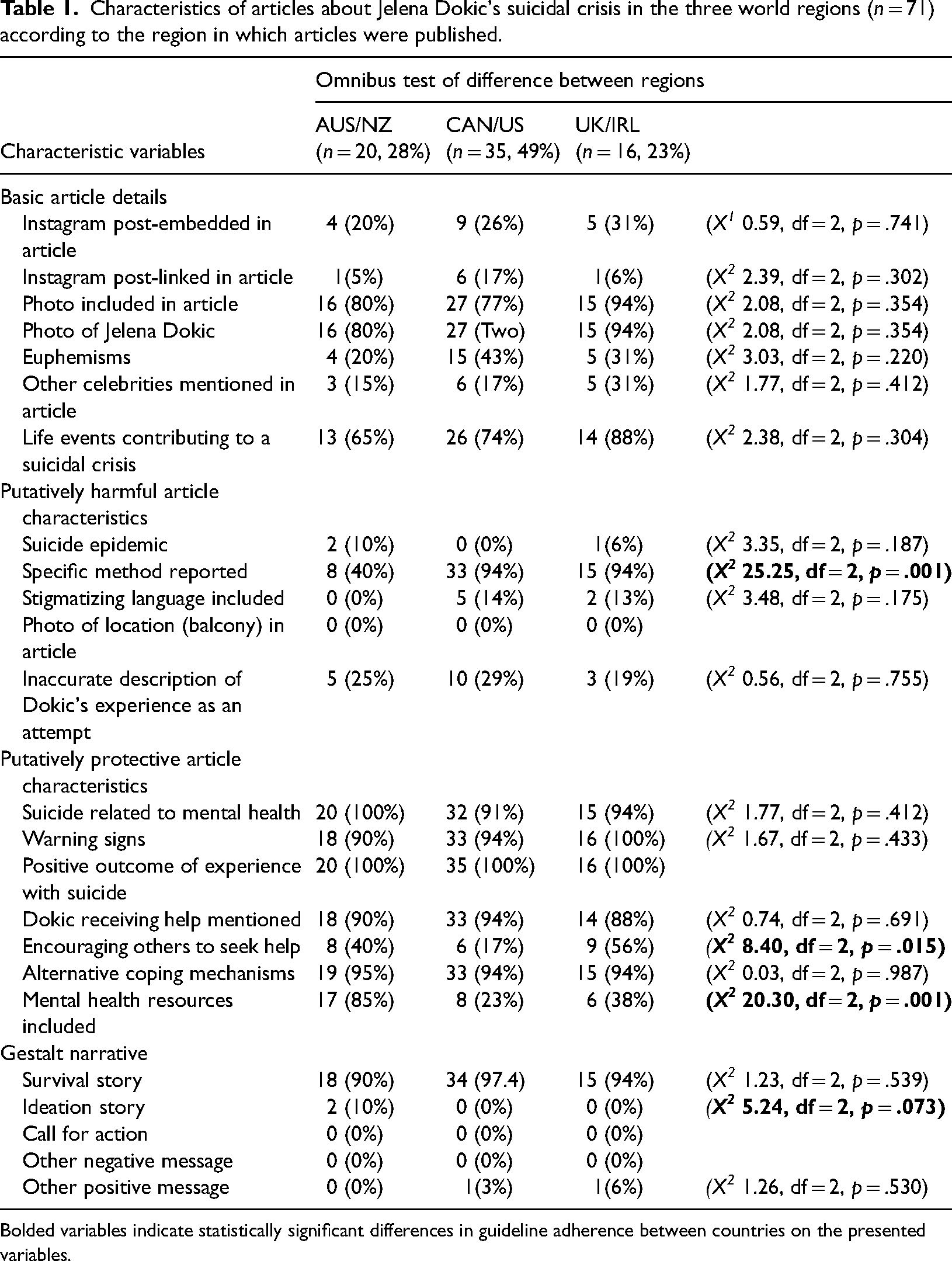
Bolded variables indicate statistically significant differences in guideline adherence between countries on the presented variables.
Putatively harmful article characteristics
Stigmatizing language
We found stigmatizing language in 7 (10%) articles. For example, the following sentence included the word “commit” which is discouraged by guidelines as it evokes the historical criminalization of suicide: “As a result of immense suffering she’d been going through, the tennis star tried to commit suicide on April 28th in Melbourne” (Marija, 2022). Additional examples are describing a suicide attempt/death as “successful/unsuccessful,” “attention seeking,” or “crazy.” There were no differences between regions (X2 3.48, df = 2, p = .175). However, notably, 0/20 articles (0%) from AUS/NZ included stigmatizing language.
Suicide method
Fifty-six (79%) articles included the method Dokic stated she contemplated (i.e. jumping from a height). Most of these articles reprinted the direct quotation from Dokic's Instagram post: “I almost jumped off my 26th floor balcony and took my own life” (Instagram, 2022). This information was usually included in the body of the articles, although 5 (7%) articles included the method in the article title. Regional differences were observed for the reporting of the method, with only 8 of 20 articles (40%) from AUS/NZ mentioned the method, compared to 48/51 articles (94%) in the remaining regions, a significant difference (X2 25.25, df = 2, p = .001).
Inaccurate descriptions of Dokic's experience as a suicide attempt
A total of 18 (25%) articles inaccurately described Dokic's disclosure saying that she had attempted suicide (e.g. “Australian tennis player Jelena Dokic recently opened up about feeling suicidal and that she attempted to end her life earlier this year”; Ross, 2022). The remainder correctly identified her post as describing suicidal thoughts as part of a suicide crisis without an attempt. Omnibus testing showed no significant regional differences (X2 0.56, df = 2, p = .755). AUS/NZ, US/CAN, and UK/IRL, had 5/20 articles (25%), 10/35 articles (29%), and 3/16 (18%) articles, respectively, that erroneously described Dokic's experience as a suicide attempt.
Putatively protective article characteristics
Alternative coping methods
Sixty-seven articles (94%) mentioned an alternative coping mechanism (i.e. seeking professional help, support service mention) with no regional differences (X2 0.03, df = 2, p = .987). Sixty-five articles (92%) specifically mentioned Dokic receiving professional help after her experience with her suicidal crisis. For example, Dokic's Instagram caption was often quoted: “I pulled myself off the edge, don’t even know how I managed to do it. Getting help saved my life” (Instagram, 2022). Thirty-one articles (44%) provided readers with one or more resources for help-seeking (e.g. crisis hotline). Regional differences in the provision of help-seeking resources were observed (X2 20.30, df = 2, p = .001) and these were again driven by differences between AUS/NZ (17/20; 85%) compared to CAN/US (8/35; 23%), and UK/IRL (6/16; 38%). Twenty-three of the 71 articles (32%) also had language that specifically encouraged readers in distress to seek help.
Other article characteristics
Mention of other celebrities
Fourteen articles (20%) mentioned sports figures and/or celebrities other than Dokic. Six articles mentioned a suicide attempt by a celebrity other than Dokic and seven articles mentioned another celebrity's experience with mental health challenges. No article included information about a celebrity who died by suicide, and/or another celebrity who experienced suicidal ideation without a suicide attempt. Three of 20 articles (15%) from AUS/NZ, 6 of 35 articles (17%) from the US/CAN, and 5 of 16 articles (31%) from the UK/IRL included an additional celebrity mention (X2 1.77, df = 2, p = .412). There were no regional differences in reporting of this variable. Two examples of this type of content were:
“Less than a month ago, another Australian [Women's Tennis Association] player talked about suicide attempt—Destanee Aiava didn’t want to make it to her 22nd birthday and revealed that she wanted to throw herself off a bridge on the night of Easter Sunday, but people that drove by dragged her off the rails” (Marija, 2022). “Mental health has been in the spotlight in tennis since former world number one Naomi Osaka withdrew from last year’s French Open and said she was battling depression. Men's world number two Alex Zverev opened up about his own mental health issues during the recent French Open, saying social media meant current players were subject to ‘a lot more hatred’ than past ones” (Reuters, 2022).
Life events as a contributor
Among all articles, 53 (75%) mentioned Dokic's life challenges as a contributor to her mental health challenges and/or suicidal crisis. In particular, most articles mentioned Dokic's previous disclosure regarding alleged abuse by her father (e.g. “she had suffered years of physical and emotional abuse from her father”; Zee Media Bureau, 2022). We did not find any regional differences in reporting of this variable (X2 2.38, df = 2, p = .304).
Gestalt narrative
Nearly all articles were categorized as focusing on a story of hope, healing, and survival (67/71; 94%). The four remaining articles were characterized as a story focused on a person's suicidal thoughts (2/71; 3%) and stories with other positive messages (2/71; 3%).
Discussion
Jelena Dokic's Instagram posts presented a unique natural experiment as well as an opportunity for media worldwide to disseminate a celebrity's story of hope, healing, and survival to the general public. Unfortunately, as predicted, the results were somewhat disappointing from a public health standpoint. Adherence to media guidelines for responsible reporting of suicide was relatively low across most regions, with evidence that AUS/NZ was the most adherent. This is a concern given evidence that guideline adherence can help to prevent imitative suicides (Bohanna and Wang, 2012). It is notable that Dokic's story, as presented on her Instagram, had an unambiguously positive, Papageno narrative that provided a clear roadmap for the media to disseminate a story of survival. The narrative did, however, begin with a prominently placed sentence describing a suicide method. Reassuringly, almost all articles conveyed the overarching Papageno narrative. Yet, one-quarter of reports also presented Dokic's story inaccurately (that she had attempted suicide). This is a public health concern given evidence that disseminating stories of survival can be associated with lower suicide rates while disseminating stories of suicidal behavior can have the opposite impact (Domaradzki, 2021; Ha and Yang, 2021; Kim et al., 2013; Niederkrotenthaler et al., 2020; 2022a, 2022b). As described above, media reporting that focuses on suicidal thoughts in individuals has a greater likelihood of enhancing identification with the individual in question and their experience, which can facilitate social learning either related to suicidal behavior or to survival depending on the story content (Cheng et al., 2007). Unfortunately, the framing of many of these articles may have been problematic, considering the high proportion of articles that placed some emphasis on potentially harmful aspects of Dokic's post (e.g. the suicide method contemplated), rather than the positive outcome.
There is essentially universal agreement among responsible media guidelines worldwide on the importance of avoiding the presentation of suicide methods (Everymind, 2020; Samaritans, 2022; SAVE, 2022; Sinyor et al., 2018; WHO, 2023). Our group has identified some evidence that an overarching story narrative may potentially be more impactful than the details included (Sinyor et al., 2021). In the case of reporting on suicide in celebrities, Niederkrotenthaler et al. (2020) found a 30% increase in suicide deaths by the same method following media reporting about the death. Given this, it is notable that, among the regions we studied, AUS/NZ showed the greatest adherence to the recommendation not to report on methods.
The use of stigmatizing language refers to the use of language related to mental health and suicidal behavior that could be viewed as pejorative, invalidating, or otherwise inappropriate. Overall, it is encouraging that the large majority of articles about Dokic's post did not include stigmatizing language and notable that there were no articles published in AUS/NZ with stigmatizing language.
Dokic's prior alleged abuse by her father had already been extensively reported in the media (Rossingh, 2018) and, given that it was one of the subjects of her post, it is understandable that the media included it in their reports for context. On one hand, this does provide a realistic context for readers given evidence that previous life events including abuse can confer risk for developing future suicidal thoughts and/or behaviors (Rajalin et al., 2020). On the other hand, the greater the similarity between a celebrity and the reader, the higher the risk of imitative behavior (Niederkrotenthaler et al., 2019). This underscores the importance of the framing of the story. Articles emphasizing Dokic's resilience in the face of mental health difficulties and suicidal thoughts following an experience of abuse could lead readers with similar stories to follow her example. Articles emphasizing suicide methods and the erroneous notion that she attempted suicide could have a more troubling effect on vulnerable readers.
There is also increasing empirical support for the importance of conveying information about how to cope with suicidal crises in media reports (Niederkrotenthaler et al., 2022a). One of the more encouraging aspects of our findings is that many articles did include such information including reaching out to support services, lifelines, and support groups. However, that overarching finding may obscure important regional differences. The fact that 85% of articles from AUS/NZ included one or more resources for help seeking, while the proportion was only 23% and 38% in the US/CAN and UK/IRL, respectively, suggests substantial room for improved reporting in the latter regions.
Although this study was not designed to identify why certain regions may have had reporting that adhered better to guidelines, it is worth considering potential reasons why AUS/NZ journalists appeared to perform better than other regions. One potential explanation is that Australia has Mindframe, among the most longstanding and, arguably, best-developed national programs supporting safe media reporting (Bohanna and Wang, 2012; Pirkis et al., 2022; Skehan et al., 2006; Thienel et al., 2019). Mindframe aims to deliver best-practice communication and media reporting to reduce stigma, break down myths and encourage people to seek help (Everymind, 2020). Potentially further enhancing Mindframe's efforts is Stigmawatch by SANE, which monitors media reports and reaches out to journalists when portrayals are inaccurate and/or inappropriate and stigmatizing (SANE, 2022). Longstanding evidence suggests improvement in suicide-related reporting after the implementation of Mindframe (Pirkis et al., 2001), and more recent analyses have suggested that it saves lives and is cost-effective (Flego et al., 2022). Another potential reason for greater adherence to guidelines in AUS/NZ could be that people in the region are most familiar with Jelena Dokic as a local celebrity, including her previously disclosed struggles with mental health and abuse (Rossingh, 2018). That might mean that, for media consumers in the region, there is built-in interest and familiarity with Dokic that may have resulted in less of a drive for journalists to find a sensational or provocative angle for covering her story. Lastly, while the three main regions of study are comprised of high-income, English-speaking countries with some cultural overlap, these regions nevertheless have their own cultures and distinctive social mores, and these could have also contributed to the observed differences in the way Dokic's story was presented.
Mindframe notwithstanding, it is clear that, generally, adherence to media guidelines worldwide has historically been modest (Acosta et al., 2020; Antebi et al., 2020; McTernan et al., 2018; Pitman and Stevenson, 2015; Stack, 2020; Tatum et al., 2011). This finding emphasizes the need for ongoing collaboration with journalists who can sometimes be skeptical about the utility of guidelines (Sinyor et al., 2016). Having other regions across the world emulate the Mindframe approach or, if possible, join in the creation of a coordinated worldwide effort could result in greater adherence and mutual understanding when reporting suicide. Having journalists and experts further engage people with lived experience can also assist with more accurate depictions and increase the likelihood that helpful aspects of survival stories are highlighted.
Limitations
To our knowledge, this is the first study to examine differences in coverage of a potential Papageno story across world regions. However, this study had a number of limitations. Although our list of articles is likely to be relatively comprehensive, it is possible that our search might have missed some articles, especially those from countries outside the three main regions and not written in English. It is important to highlight that there were 71 media articles included in our study. While this is likely a large number compared to the average media story about suicide, it may be smaller than the volume of stories that we have observed anecdotally following the deaths of celebrities by suicide. Future studies could examine the question of reporting volume by story-type. Our study design does not allow us to determine how many people read each published article and measure consumer reactions to the media reports and Dokic's post. Thus, we do not know the impact on behavioral outcomes. This would be of interest for future study. It is possible that the Gestalt narrative approach to this study may miss more nuanced story presentations. This is something to consider for future studies. Our study did not examine the quality of reporting about Dokic's story in relation to other suicide-related stories published in these regions. Meaning, we cannot say whether it was of higher or lower quality. Future research comparing the quality of different story types would be valuable. Finally, due to the exploratory nature of this study, we elected not to use a Bonferroni correction, meaning that readers should interpret associations with a note of caution.
Conclusion
Suicide-related media reporting can have a significant impact on subsequent suicides. Maintaining guideline adherence when reporting on mental health and suicidality, especially in celebrities, can minimize risk and, in cases of survival stories, may help save lives. Responsible reporting guidelines remain the best available intervention at a population level to mitigate the potentially harmful effects of media reports. This study identified some encouraging, and also some worrying aspects of the world media's approach to covering tennis star Jelena Dokic's experience with a suicidal crisis. Notably, AUS/NZ was found to be most adherent to existing guidelines and told the story of Dokic's resilience largely in the absence of harmful content. In contrast, our results suggest that scientific experts and media creators in the US, Canada, the UK, and Ireland should continue working to promote increased adherence to responsible reporting practices. Future research examining behavioral outcomes following the publication of Dokic's story would be helpful. Given the tenor of the presented media reporting, a Papageno effect may not be expected, particularly outside of AUS/NZ.
Supplemental Material
sj-docx-1-mia-10.1177_1329878X231221347 - Supplemental material for Jelena Dokic's suicide-related social media post and the worldwide media's portrayal of a story of survival: a natural experiment
Supplemental material, sj-docx-1-mia-10.1177_1329878X231221347 for Jelena Dokic's suicide-related social media post and the worldwide media's portrayal of a story of survival: a natural experiment by Daniella Ekstein, Amy Posel, Sarina Rain, Angela Nicholas, Jane Pirkis, Thomas Niederkrotenthaler, Ayal Schaffer and Mark Sinyor in Media International Australia
Footnotes
Acknowledgements
The authors thank Dr Navneet Kapur of the University of Manchester for his insight and guidance regarding this work.
Declaration of conflicting interests
The authors declared no potential conflicts of interest with respect to the research, authorship, and/or publication of this article.
Ethics statement
This study drew data from publicly available sources. As such, ethics approval was not needed.
Funding
The authors disclosed receipt of the following financial support for the research, authorship, and/ or publication of this article: Dr Sinyor receives salary support through Academic Scholars Awards from the Departments of Psychiatry at Sunnybrook Health Sciences Centre and the University of Toronto.

Supplemental material
Supplemental material for this article is available online.
References
Supplementary Material
Please find the following supplemental material available below.
For Open Access articles published under a Creative Commons License, all supplemental material carries the same license as the article it is associated with.
For non-Open Access articles published, all supplemental material carries a non-exclusive license, and permission requests for re-use of supplemental material or any part of supplemental material shall be sent directly to the copyright owner as specified in the copyright notice associated with the article.
