




Abstract
Numerous guidelines on responsible reporting of suicide are available to journalists globally, offering advice on best practice regarding approaches and suitability of content. Whilst their advice is compelling and legitimate, their use is uneven at best. With a suicide death every 40 seconds worldwide, it is imperative journalists understand and recognise the best ethical practices in order to report suicide responsibly. To address these shortcomings, the authors present a model for responsible suicide reporting (RSR) that is grounded in news-work and embeds media reporting guidelines within journalistic storytelling practices. The RSR model consists of a typology of suicide narratives and ‘othering’, ethical rules and a standard of moderation. Methodologically, these typologies emerged from analysis of 159 suicide news stories published in 2018–19, with particular focus on adherence and non-adherence to global media reporting guidelines. We posit through the process of producing stories using the RSR model, journalists should interact more effectively with critical risk factors for example, stigmatisation, copycat effects, harmful speculation, highlighted by media reporting guidelines.
Introduction
According to the latest global statistics, suicide is the 17th leading cause of death, accounting for 1.4% of all deaths worldwide (WHO, 2017a). Nearly 30% of all suicides occur in India and China, and in the WHO European region, 128,000 people are estimated to kill themselves every year (Befrienders, 2020; WHO Europe, n.d.). Suicide is the 11th leading cause of death in the USA with 48,344 people dying by suicide in 2018 (AFSP, 2020) and in Australia, 3,046 people took their own life in 2018 (Australian Bureau of Statistics, 2019). In the UK, 6,507 people killed themselves in 2018, which cost the UK economy £11.1B in future economic potential, National Health Service (NHS) expenditure and supporting those bereaved by suicide (Knapp et al., 2019). Recent research indicates for everyone who takes their life, between six and 135 people are significantly impacted (Cerel et al., 2018). Every 40 seconds a person dies by suicide and for every individual who dies, at least 20 more will attempt to kill themselves (WHO, 2017b).
Media reporting of suicide occurs throughout the world and the harms to which this coverage can contribute have been widely acknowledged (Cheng et al., 2007; Fu and Yip, 2009; McTernan et al., 2018; Niederkrotenthaler et al., 2012; Pirkis and Blood, 2001; Sisask and Varnik, 2012) even if the debates about the effects of such reporting have proved less conclusive and more contentious (Barker and Petley, 2001; Hittner, 2007; Jamieson et al., 2003; Luce, 2016, 2019; Niederkrotenthaler et al., 2010; Phillips, 1974; Scherr and Steinleitner, 2015; Till et al., 2018). Such debates accentuate the importance of responsible media coverage of suicide and its beneficial effects (Bohanna and Wang, 2012; Dare et al., 2011; Jamieson et al., 2003; Pirkis et al., 2006; Scherr et al., 2017) and the global suicide prevention community place considerable emphasis on the need for responsible suicide reporting through various approaches including use of guidelines, education and training, and consultation or collaboration with media companies (Mindframe, 2014; Samaritans, n.d.; WHO, 2017a). Journalistic coverage traditionally focusses on negative perceptions, stereotypes, sensationalism and deviance by ‘othering’ those who die by suicide into specific social categories via method, location and description of death (Luce, 2016). Irresponsible suicide reporting has been shown to be unethical, uncaring and potentially harmful to those bereaved by suicide (Duncan and Newton, 2017) so the relevance of responsible reporting as noted above is apparent.
A preventative measure recommended by the global suicide prevention community is journalists’ adoption of reporting guidelines (Bohanna and Wang, 2012; Gunnell and Lewis, 2005; Niederkrotenthaler et al., 2020; Zalsman et al., 2016). Research demonstrates that journalistic adherence to guidelines is uneven, cutting across different international contexts (Chandra et al., 2014; Niederkrotenthaler at al., 2010; Nutt et al., 2015). Exceptions are Australia where guidelines are effective in the local market (Machlin et al., 2012) and New Zealand, where tighter legal controls are in use (Coroners Amendment Act, 2016). Studies show the impact of suicide reporting on the bereaved depends largely upon how stories are covered (Ji et al., 2014; Machlin et al., 2013; Niederkrotenthaler et al., 2012; Tatum et al., 2010). There is broad agreement within guidelines that key areas to consider include: method and location; copycat behaviour; appropriateness of language and word placement in a story; sensationalising or romanticising suicide; celebrity cases; unusual situations like murder-suicide; use of video, audio and social media and the inclusion of helpline information. However, the clauses in media regulatory codes of conduct – as opposed to guidelines – mostly concentrate on reporting the method, and whilst they might aim to minimise harm, their scope in terms of suicide prevention advice is limited.
Concentrating on
Yet, despite the availability of abundant guidelines from professional organisations for example, Mindframe (2014), the National Union of Journalists (2015), Samaritans (2013), World Health Organisation (2017a), some media outlets do not report suicide responsibly, or consistently follow guidelines (Bohanna and Wang, 2012; Pitman and Stevenson, 2014; Tatum et al., 2010; Thom et al., 2011). Journalists do not always recognise the manner in which their reporting might be considered sensationalistic and stigmatising (Markiewitz et al., 2019). Unawareness of guidelines may also be an issue (Scherr et al., 2019), whilst concentrating on minimising risk rather than explaining what could be included in suicide stories could be another (Machlin et al., 2012). Some news outlets, including those who are members of regulatory bodies such as IPSO in the UK, may choose to contravene voluntary guidelines because they are not a legal requirement as in New Zealand. Further, a journalist’s professional ‘news-work’ may impact suicide reporting.
To address the shortcomings noted above, we devised a model for responsible suicide reporting (RSR) that is grounded in news-work and embeds media reporting guidelines within journalistic storytelling practices. Some researchers have identified responsible reporting as the presence of beneficial elements and the absence of potentially harmful elements within stories (Scherr et al., 2017, 2019). Our model is pragmatic and internal to journalists’ news-work. It functions within the storytelling process, reflecting recognised journalistic narratives involving people, although it may not be applicable to every extant story type for example, stories based predominantly on data/statistics. Thus it addresses hindrances to journalists’ use of guidelines for example, lack of awareness, reluctance to consult them, taking time away from reporting to check and apply them, tight deadlines and fewer journalists doing increasing amounts of work.
Our Responsible Suicide Reporting (RSR) model consists of three parts: a typology of suicide narratives and ‘othering’, ethical rules and a standard of moderation. We posit through the process of producing stories using the model, journalists should interact more effectively with media reporting guidelines on suicide. Thus, our research is guided by the following research questions:
RQ1: What types of suicide stories do journalists write?
RQ2: How do journalists ‘other’ in suicide stories?
RQ3: What instrument could be created to assist journalists in following media reporting guidelines?
Methodology
Previous research concerning suicide stories tends to be quite descriptive, without trying to understand the news process that underpins the story (Machlin et al., 2013). Our research significantly broadens understanding of the types of news stories that emerge when suicide is reported, as well as identifying how journalists ‘other’ suicide when reporting.
To ascertain these outcomes we analysed 159 suicide news stories from UK publications sourced from the Nexis database from January–June 2018 and from Google News from July 2018–February 2019. The Nexis sample includes publications like The Sun, The Times, MailOnline, The Herald (Glasgow), the Belfast Telegraph, the South Wales Echo and the Yorkshire Post. Our Google News sample, comprises national and regional publications, like The Guardian, Mirror Online, Manchester Evening News, Birmingham Mail, the Daily Record, and specifically online outlets for example, BBC News and The Independent. The period of June 2018–February 2019 was chosen to avoid replicating the Nexis sample. We searched for stories containing the words ‘suicide’, ‘killed’ (himself/herself/themselves), and ‘his/her/their own life’ anywhere in the text. This produced an initial corpus of 273 stories. Articles were removed that included duplication, items with tangential reference to our keywords, stories about suicide bombers or assisted suicide and entertainment-based articles referring to fictitious suicides. This left a sample of 159 articles.
Drawing upon Duncan’s five narrative model of grief (Duncan, 2012) and using a qualitative, inductive approach, we identified common themes and structures in journalism production processes. By using Luce’s categories of ‘othering’ and rules for ethical suicide reporting (Luce, 2016), we discursively ascertained how journalists test stories for newsworthiness and how they then stigmatise suicide and those affected by it.
Using content analysis (Berger, 2000), the stories were further examined for their adherence to five different sets of global media reporting guidelines on suicide: NUJ (UK), Samaritans (UK), IPSO Editors’ Code of Practice (UK), Society of Professional Journalists (USA) and World Health Organisation (Global). They were chosen because they are the most well-known by journalists (Luce, 2019). The aim was to establish how journalists adhere to media reporting guidelines in their storytelling.
Findings
Duncan’s five narrative model of news stories about unexpected deaths provides a taxonomy that determines how journalists frame the bereaved’s personal narratives as expressions of their grief (Duncan, 2012). The five types are: event-driven, tribute-driven, post-judicial, anniversary and action-as-memorial. In line with media guidelines the narrative model focusses on stories about people who have died by suicide, or have been affected by suicide, that is, the bereaved and the wider community. It provides a means for journalists to reflect upon their ethical responsibility to minimise harm, as advocated by media guidelines. Through close analysis of suicide reporting in our sample, we found these five recognised narrative types involving people contain core plots that follow a temporal sequence, many of which remind the audience of previous, similar stories. For this research we distinguish between a single suicide story that could have a minimum of five story types attached to that one death, and suicides that become ‘events’, when the reporting extends over weeks and months. In our sample, 34.6% of stories were event driven; 15.1% were tribute-driven; 41.5% were post-judicial; 1.3% were anniversary and 7.5% were action-as-memorial.
We then identified how journalists stigmatise and sensationalise in each story type. Luce’s (2016, 2019) work on the Bridgend suicides in South Wales in 2008 identified that journalists stigmatise the reporting of suicide by ‘othering’ it into five main categories:
Reaction to death by those left behind
Reasons for death
Description of the deceased
Infantilisation/‘childishness’
Suicide and internet/Social media usage
Luce further identified the stigmatisation vectors begin during the newsgathering process, using the 5Ws and How, familiar to journalists as the start of crafting a story at most global news outlets (Luce, 2016, 2019). Thus, stigma is introduced in reporting when journalists answer:
What? Why? (reaction to death by those left behind)
Why? How? Where? (reason for the death)
Who? When? Where? How? (description of the deceased)
What? Why? How? (infantilisation/‘childishness’)
What? Where? Why? How? (blaming the internet/social media)
To make this more accessible for journalists, Luce (2016) created four simple rules to eliminate stigmatising and sensationalistic reporting (helpful mnemonic device: SSGG).
Journalists should not: Sensationalised reporting is when journalists use the word ‘suicide’ in a headline, or use quotes such as ‘heaven has a new angel’ or ‘RIP Babes’. Stigmatised reporting can occur through labelling, e.g. describing someone as a ‘victim of bullying’, ‘autistic’, or labelling them based on their religion or nationality. Glorification of suicide can occur when suicide is presented as a life choice in a story, or the story explicitly describes a method of the suicidal death. Gratuitous reporting can occur when the reason for the suicide is overly emphasised, alongside the specific location of the death, e.g. Golden Gate Bridge or Beachy Head.
We further examined the 159 news stories for Luce’s categories of othering, which we found in 100% of suicide news stories. Through this systematic approach, we identified how stigma evolved through the newsgathering process when journalists answered the 5Ws and How questions.
Typology of narratives and ‘othering’/ethical rules (SSGG)
Event-driven
Event-driven refers to the first recognition by journalists that a traumatic event has happened and a newsworthy death has occurred. Event-driven stories (34.6% of stories in our sample), tend to lead with the death, the person who has died, and the circumstances, especially its unusualness and some form of public involvement (e.g. the discovery of a body). These story types frame the death as futile, depicting a sense of shock and denial from the bereaved.
From our sample, an online event-driven story in the Express could be deemed too explicit and contrary to media reporting guidelines: ‘Two men who were complete strangers jumped 100ft to their deaths from the Humber Bridge within minutes of each other’ (Express, January 3, 2019). Whilst fulfilling news writing norms by providing the reader with detailed information, it specifies explicit details of the suicide method and gives the precise location and distance of the men’s fall, plus the time and condition of the water. Subsequent paragraphs glamorise the deaths by describing them as a ‘double tragedy’, stating they were not considered to be ‘a suicide pact’ thus introducing emotive terms, whilst emphasising the coincidental factor that the men were last seen 50 metres apart on the nearly mile-and-a-half-long bridge (Express, January 3, 2019).
Event-driven suicide stories often try to explain why a person took their own life through imputation and inference. The reason for suicide, then, can be as important as the actual death, with the suicide framed in terms of justification. Some suicide stories are tied to a popular news hook, for example, Brexit, cyberbullying, whereas the news hook in other death stories is the death itself. In an event-driven story, the risk of sensationalising, stigmatising, glorifying and gratuitously reporting on suicide (SSGG) is high. All five categories of othering appear in event-driven stories, and were found in our sample.
Post-judicial
This suicide story type focusses on a court case, inquest or other legal proceedings. These stories can appear months – or years – after the death. Post-judicial stories usually focus on the legal case, and less on the relatives’ reaction to the verdict.
Reports on inquests were the largest type of suicide story in our sample (41.5%). A landmark ruling in the UK in April 2019 changed the standard of proof required by a coroner to determine a death as suicide, meaning journalists are now exposed to more of these cases (see Maughan v. Her Majesty’s Senior Coroner for Oxfordshire, 2019).
Our research sample showed that in 41% of post-judicial articles, journalists included excessive detail in inquest stories compared to the event-driven category where it could be seen in 18% of stories. Journalists are entitled to report what is said in a courtroom so providing context to the death by including comprehensive, unequivocal evidence is pertinent. However, journalists and editors should judge whether this is in accordance with best practice. For instance, whilst the IPSO Editors’ Code of Practice recognises journalists’ right to report legal proceedings in its clause on suicide, it warns care should be taken to prevent simulative acts when reporting the method (Clause 5, Editors’ Code of Practice, 2018; IPSO, 2020).
From the sample, it is evident numerous news outlets did take a responsible view. Many avoided mentioning suicide, or explicitly detailing the method in the headline, or intro/lead, and instead used phrases like ‘took her own life’ or ‘killed himself’, terminology which is widely recommended in good practice guidelines as it avoids using ‘commit’ with its criminological overtones. However, those that did refer to the method linked this to emotional aspects or newsworthy attributes, like live streaming a person’s death; a soldier with Post Traumatic Stress Disorder (PTSD) or identical twins who died together. Mental illness was most often given as a reason for death, even when there was no evidence in the report to suggest that the person had mental health issues. Another common theme focuses on correlations between the deceased’s emotional state and their social media use.
It is in the post-judicial story where we see journalists replicate stigmatising discourses around suicide, including phrasing around morality, mental illness, or infantilising the act itself. Consider this story from our sample, in The Huddersfield Daily Examiner headlined: ‘Tragedy of shopaholic who jumped to his death from same spot he’d tried to kill himself before’ (Sutcliffe, 2018). It stigmatises by inferring people who have suicidal thoughts go on to kill themselves, which is rarely the case (Owens et al., 2002). Reporters should be aware the ‘reason’ for suicide – the answer to the ‘why’ question – is never straightforward and simplistic – trying to categorise blame is rarely advised.
Tribute-driven
Tribute-driven stories focus on the grieving family and friends paying tribute to the deceased. They tend to appear quite swiftly after the death, and may be either a direct follow-up to the event-driven story, or one which replaces it, if a news outlet has not reported the death earlier. The focus shifts to the bereaved family’s expression of their devastation at the loss of their loved one, meaning the content is likely to be highly personal and emotional.
Tribute-driven suicide stories can contain interviews with bereaved relatives (around two thirds of this type in our sample did), but they also concentrate on the bereaved’s search for answers, especially the reasons behind a loved one taking their own life. Blaming organisations – like the medical, social and educational services – whilst paying tribute to their loved one, was common within our sample. Details about the deceased also appeared via a family’s written statement, the bereaved’s social media posts, or a police press release rather than an interview with a grieving relative. For example, in a story about a young woman who died by suicide hours after her boyfriend was killed, quotes from family and friends were taken from social media posts rather than an interview. Also, seven photographs in the story, all from Facebook, were made into an additional video presentation (Parker, 2018). Social media is an important newsgathering tool in journalism but taking personal content of or about the deceased, even though it appears on a public forum, to produce a tribute story can be perceived as cruel and harmful to the bereaved (Duncan and Newton, 2017; Skehan and Maple, 2014).
Whilst there were only three ‘suicide event’ stories in our sample (all about Swedish DJ Avicii: Newman, 2018; Ralston, 2018; Robson and Saunders, 2018), we saw evidence of journalists employing this reporting technique. An article in The Sun concerning the suicide of actor David Labrava’s son involved journalists writing a story sourced from Instagram and a crowdfunding page (Cox, 2018). Guidelines like those produced by the Samaritans, NUJ and WHO caution journalists to take care when using social media. The largest risk associated with tribute-driven stories of this type may add to suicide stigmatisation for the bereaved, and potentially sensationalises suicide in the aftermath of the death.
Anniversary
Anniversary stories normally mark the first anniversary of a suicide but can be later. These narratives chiefly focus on the bereaved’s attempts to resolve unfinished business. Only two anniversary stories appeared in our sample, yet we know from prior research (Chen et al., 2010, 2012; Luce, 2016; Yang et al., 2012) that this is a common suicide story type, especially around ‘suicide events’, including celebrity suicide (e.g. Bridgend suicides (2008), Bristol University student suicides (2017), Robin Williams’ suicide (2014)).
Anniversary stories for ‘suicide events’ generally happen on the 1-year, 5-year, 10-year, or in the case of Kurt Cobain, 25-year anniversary. They are often used to reflect societal changes regarding suicide, and the impact of suicide prevention policies. In our sample one story focused on how ‘Jonny Benjamin turned his life around and went from near-suicide to mental health campaigner’ (Moore, 2018). Here, the story marks the 10th anniversary of the day that stranger, Neil Laybourn, talked Jonny out of killing himself. It takes a positive frame, emphasising and retelling the story of his survival and recovery as a hook into productive current events that is, the publication of Jonny’s autobiography and the pair’s charity work to encourage openness about mental health issues.
Action-as-memorial
Action-as-memorial stories focus on the bereaved undertaking a campaign, a fundraising event, giving talks or setting up a trust in memory of their loved one. In our sample, 50% of stories were about campaigns, 33% about charity events and 17% about raising awareness through talks. This typology has a more positive tone than the other story types. Effectively, the bereaved may strive to overcome the death by seeking closure and some form of resolution (Duncan, 2012; Duncan and Newton, 2017). Unfortunately, several action-as-memorial stories in our sample contained harrowing accounts of the deceased’s struggles, usually framed through raising awareness of issues linked to a suicide, contravening several media reporting guidelines for example, by referring to suicide in the headline. A story in the Mirror avoids suicide in the headline but uses ‘committed suicide’ in the intro/lead. It details the turmoil of two soldier friends before they killed themselves within weeks of each other (Warburton, 2018). Their distressing stories are used to emotionally engage readers with a campaign the newspaper group is running but in doing so the news outlet risks stigmatising the men’s mental ill-health and glorifying suicide as a solution. Good practice was also evident in the sample where reporters were careful in their choice of language and tone for example, an article in the Daily Gazette (Essex) about a woman who raised funds for a military charity after her friend, a former military police officer, took his own life. It avoids using suicide in the headline or text, avoids sensational content or tone and focusses on raising funds in his memory (Bryson, 2018).
Adherence to media reporting guidelines
As we identified and created our typology of narratives and ‘othering’ in suicide stories, we discovered the categories for ‘othering’ aligned quite closely with the findings from our content analysis where we tested for adherence to five different sets of media reporting guidelines on suicide: Samaritans (UK), NUJ (UK), IPSO Editors’ Code of Practice (UK), Society of Professional Journalists (USA) and World Health Organisation (Global).
Adherence to all five media reporting guidelines was irregular. Nearly 55% of all stories in our sample were sensationalised, with 25% providing explicit details about method, and 23% providing explicit and unwitting ‘guidance’ on suicidal methods. The word suicide appeared in 32% of all headlines, whilst in 22% of stories, specific mention of location of the death appeared in the story. Nearly 13% of stories framed and ‘normalised’ the act of suicide as if it were a solution to a problem, a simplistic assessment of a complex phenomenon. Unsurprisingly, 61% of stories implied or emphasised a connection for the reason for suicide. In 15% of stories, quotes were from social media posts, whilst 16% of images came from social networking sites. In 15% of online stories, video accompanied the story. More worryingly, 60% of stories did not contain helpline information.
By further interrogating stories based on narrative type, we found post-judicial stories (59%) and event-driven stories (56%) are more likely to engage in sensationalism. Explicit detail of method was found mostly in post-judicial (41%) and anniversary (50%) story types – the latter of which will need further investigation as there were only two anniversary-type stories identified in our sample. A roadmap for completing suicide occurred in post-judicial (30%), event-driven (27%) and anniversary (50%) stories. We found communal expressions of grief in event-driven stories (35%), and the ‘normalisation’ of suicide as a solution to a problem in both event-driven (15%) and post-judicial (14%). For the publication of helplines alongside story types, we found evidence that only 17% of action-as-memorial stories and 29% of post-judicial stories included helpline information. Faring only slightly better was the event-driven narrative where 49% of stories included a helpline but despite this inclusion some stories breached numerous guidelines. The use of social media in the event-driven story was slightly alarming, with nearly a quarter of stories using quotes from online sources; nearly a third contained images from social networking sites; and 20% of stories used online video to accompany their stories. Tribute-driven stories also used social media content, with 33% of stories having online sources; 25% included images from social networking sites; and 21% of stories contained video.
Through our analysis, we have identified a typology of narratives and ‘othering’ in suicide stories. We have also ascertained that in our sample media reporting guidelines are not used consistently by UK journalists, and there is further evidence this is the case globally (Chandra et al., 2014; Niederkrotenthaler et al., 2010; Nutt et al., 2015). Given this inconsistent use, as substantiated by our analysis above, it is clear journalists need help in adhering to media guidelines. Therefore, building on our findings we developed the third part of our RSR model – a standard of moderation – a device that journalists can use to make effective ethical decisions.
Standard of moderation
With limited opportunity to contemplate decisions, some journalists may depend on routine heuristics to determine the way they report a suicide. Voakes states people–journalists, in this case – often base decisions on ‘small fragments of information’, ‘relying heavily on stereotypes and routine ‘framing’ of situations that may not be appropriate’ (1998: 380). Therefore, journalists should act virtuously in order to develop the practical wisdom required to make effective ethical choices, alongside considering their duty, the rules they should follow, and consequences of suicide reporting (Duncan and Newton, 2017). Following the rules – taking a deontological approach – only works if journalists know them and have an obligation to follow them (ibid). Our findings indicate that stories produced by journalists erratically adhere to guidelines. Thinking through the consequences of reporting – adopting a utilitarian approach – has its limitations, not least the journalist’s ability to anticipate what effect their reporting might have on different audiences (ibid). Conversely, behaving virtuously is inherent in practice and improvement as it is based on moral character, ethical development, discernment, and acquiring practical wisdom to choose the right action (ibid). It is habit-forming and suggests moderation, pursuing the middle way to avoid extremes of behaviour.
To encourage more responsible journalism practice and improve storytelling we suggest journalists apply what we term a ‘standard of moderation’ to their suicide stories. This potentially avoids the excesses of sensationalism and harmful reporting, or at the other extreme, repudiates self-censored, vague and meaningless content that adds little to public understanding of suicide.
Accordingly, with public interest as a driving factor, if journalists apply a standard of moderation, they are testing their stories for key ethical principles, as well as balancing being truthful, independent and fair, alongside minimising harm. Journalists should recognise they are accountable to those affected by their coverage, including their sources and their audience. Avoiding stereotypes, harmful content and stigmatising narratives are urgent factors to consider in all stories. The people who could be hurt are a segment of their audience, which is far from homogenous. Thus, harm minimisation – a concern to reduce adverse consequences of media reporting – should be applied ‘to the greatest extent possible’ and, in those cases where harm occurs, news outlets should ‘be able to justify it in ethical terms’ (Richards, 2009: 21).
Distilling our research findings and adopting a virtuous ethical approach, we arrived at six questions that make up our standard of moderation. We believe journalists should ask themselves the following questions when reflecting on their newsgathering, reporting and production processes that is, their news-work:
Have I minimised harm to those affected by suicide?
Have I told the truth yet avoided explicit details of method and location?
Have I taken care in producing the story including tone and language?
Have I used social media responsibly?
Do I avoid stereotypes, harmful content and stigmatising stories?
Have I provided support via helplines?
The Responsible Suicide Reporting Model
Our Responsible Suicide Reporting model is pragmatic and emulates the news process, with storytelling at its core. It enables reporters to test whether their reporting is responsible, and thus in line with suicide reporting guidelines, relevant clauses in codes and journalism regulators. Whilst the underpinning research for the RSR model is anchored to UK journalism and ethical codes, we have applied international media reporting guidelines and argue it is applicable globally. In essence, journalism storytelling techniques share common principles despite cultural and societal differences, so connecting with audiences on sensitive subjects has universal relevance.
Our RSR model is an attempt to provide an instrument that journalists can habitually implement as they report, without having to search for or recall external guidance whilst they are under pressure to produce content. Three fundamental aspects are vital to the RSR model: (1) a familiar storytelling structure that facilitates the production of a suicide story; (2) a set of rules that journalists can apply to test the integrity of their stories; and (3) a standard of moderation that allows journalists to critically reflect on their reporting process (see Figure 1).
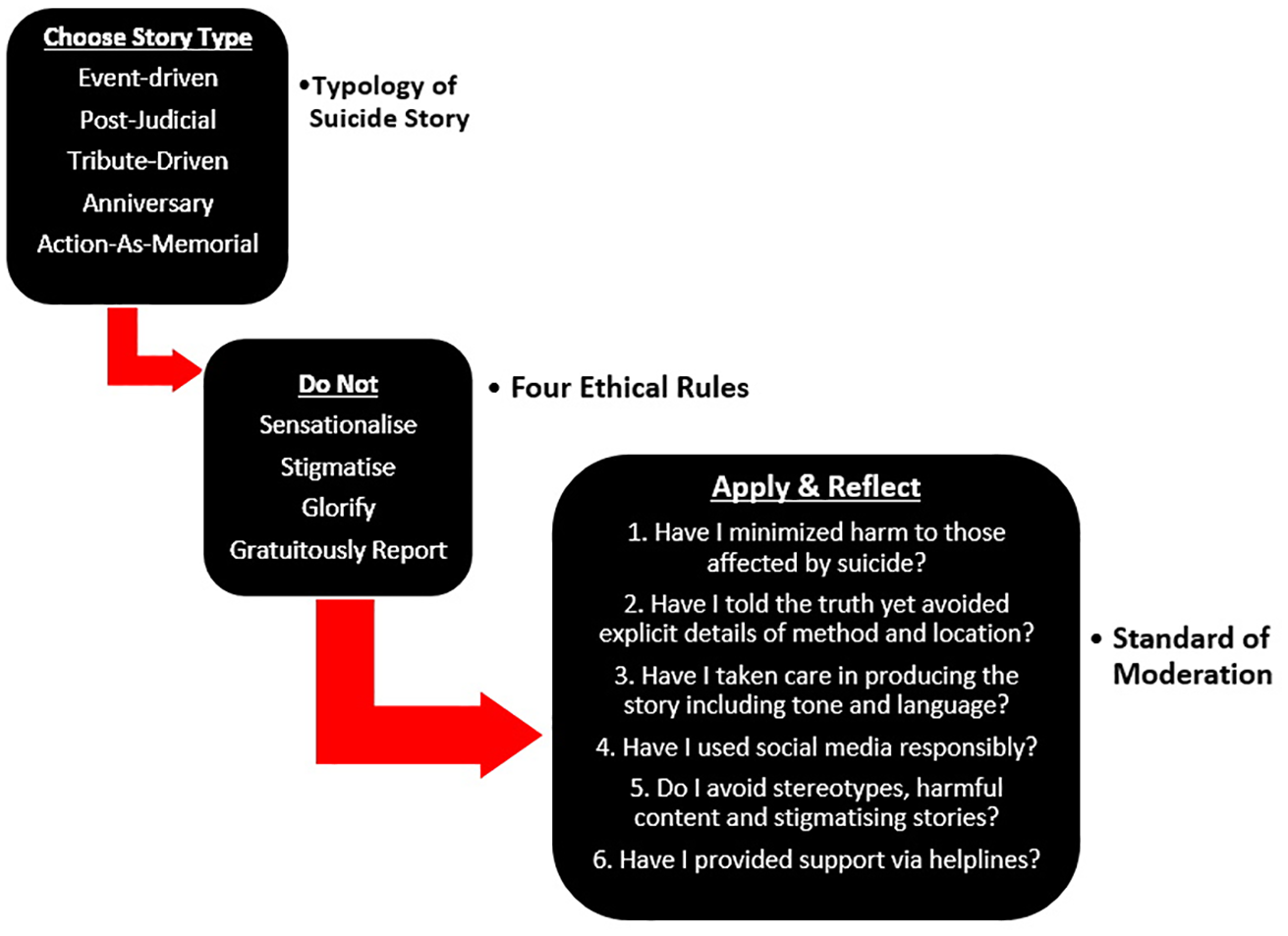
The Responsible Suicide Reporting Model.
Conclusion
The RSR model recognises the internal and external influences that can affect storytelling in the news process, for example, providing a public service, deadlines, being first to break news, using web analytics to set the news agenda, economic factors, changing newsroom practices and audience expectations. All these can influence decisions about content selection, tone and language. Breaking storytelling into narrative types with recognisable, recurring patterns specific to suicide stories allows journalists to unravel the more complex ethical concerns associated with critical risk factors. Identifying risks, according to the categories of ‘othering’ and applying the SSGG rules supports journalists in assessing whether their stories are likely to adversely affect people, their audiences and social actors generally. Through frequent application and practice such activities could become habitual.
Concomitantly, with little time within news-work for journalists to reflect on specific sensitivities in a suicide story, they might rely on routine heuristics, which may at times achieve the desired result, but are hardly failsafe. In contrast, our standard of moderation is designed to enable journalists to make more rigorous decisions about the right, ethical action by considering whether their reporting is moderate. Suicide reporting should mitigate between being excessive and being uninformative, the aim being to situate stories between these two polarities.
Rather than suggesting a replacement for media guidelines, the RSR model provides the journalistic underpinning for why journalists should follow them. Thus, we make the following recommendations:
Embed RSR in journalism education and vocational training;
Use the RSR typology of stories to determine how to ethically report on suicide;
Use the RSR rules to critically reflect on how to change the language, tone and sentence structure of suicide stories;
Use the RSR standard of moderation to critically reflect on the newsgathering and reporting process. More specifically, to: Avoid including excessive details about the method in line with media guidelines and codes, even in inquest stories; Be aware of the potential to produce stigmatising messages around mental illness, blame and infantalising the deceased by describing their ‘youthfulness’, or nonconformity; Take care over content gathered from social media regarding accuracy and reporting inconsistency to avoid stigmatising, sensationalising and glorifying suicides; Keep suicide details to a minimum for example, method, location and justification in all types of suicide stories; Consider the impact of the different story types on the bereaved and wider community and include supportive helplines in their stories.
Finally, we recognise further testing and evaluation of the RSR model is needed globally, alongside the development of educational resources for journalists-in-training.
Footnotes
Funding
The author(s) received no financial support for the research, authorship, and/or publication of this article.
Author biographies
 as well. She currently is the Research and Media lead for the Dorset Clinical Commissioning Group and is a member of the National Suicide Prevention Alliance in the UK.