



Abstract
Suicide is a major public health problem. For young adults in the United States, the rate of death by suicide has increased substantially. The evidence for the effects of social media on mental health are contradictory. However, there is limited research investigating effects of social media usage on suicide ideation. Given the interpersonal nature of social media (SM), we examined the relationship between Instagram, Twitter, and suicidal ideation in the context of the Interpersonal Theory of Suicide in 449 young adults. We found a significant indirect effect of Instagram use on lower suicide ideation through lower perceived burdensomeness. Our results are inconsistent with the literature demonstrating negative mental health effects associated with SM usage. Rather, our results indicate that some SM platforms may be associated with positive mental health outcomes. Our results also demonstrate that different SM platforms may result in differing effects on mental health and interpersonal factors specifically. Future research should examine the content and activities that users engage in while using SM to provide a deeper understanding of these relationships.
Introduction
Suicide is a major public health problem for the United States. For young adults, the rate of death by suicide has increased by 36% since 2007 and is the second leading cause of death for this age group (Curtin & Heron, 2019). Recent literature has demonstrated that social media (SM) sites are being used for suicide-relevant conversations, seeking suicide-relevant content, and sharing one’s experiences with suicide or self-harm through photos and videos (Brown et al., 2018). Despite the broad base of the literature surrounding suicide and SM, the majority of research in this area has mostly focused on identifying posts that contain suicide-relevant content and the development of interventions embedded in SM sites (Coppersmith et al., 2018; Robinson et al., 2016). Although this work is important, there is limited research investigating the effects of SM usage on suicide ideation.
SM platforms, or social networking sites, consist of online websites or mobile phone applications that allow users to share information, messages, and multimedia content with relatives, friends, and strangers (Pittman & Reich, 2016). In recent years, SM use among Americans has increased steadily, with data indicating that 69% of U.S. adults used SM sites in 2017, compared with 61% in 2013 (Poushter et al., 2018). SM platforms offer individuals an interpersonal social experience; as technological developments continue to progress, SM is increasingly beginning to offer as a stand-in for, or supplement to, older forms of interpersonal communication (Barnes, 2008).
Recently, there have been concerns that SM may be contributing negatively to mental health, especially in young adults, due to the increase in SM usage and increase in depressive symptoms and other negative mental health outcomes among young adults over the same time period (e.g., Coyne et al., 2019; Vanucci et al., 2017; Twenge et al., 2019;). Consistent with these concerns, recent studies have found relationships between time spent on SM and increased depression symptoms, increased anxiety, detrimental social comparisons, and lower subjective wellbeing (Coyne et al., 2019; Sherlock & Wagstaff, 2019; Vahedi & Zannella, 2019; Vanucci et al., 2017; Yoon et al., 2019). Furthermore, it may be the case that increasing SM use steadily from adolescence into adulthood can increase depressive symptoms and other negative outcomes (Coyne et al., 2019). However, other longitudinal work has demonstrated limited evidence of this effect and has also generated further need for exploration into the causal relationships of depressive symptoms and SM use (Heffer et al., 2019). However, there is also evidence that SM may have positive effects on mental health in some situations (e.g., Bailey et al., 2018; Valkenburg et al., 2006). Specifically, SM use might provide a sense of social support thereby acting as a protective factor (Berryman et al., 2018). Given these somewhat discrepant findings, it may be especially important to examine differences between SM applications. Because of the differences in content that the user is exposed to, and differences in the interactions that the user is a part of, it is likely that there are differing effects on users’ mental health. Combining all SM sites into a single overarching construct fails to account to these differences. The current study represents an important step in understanding the nuances associated with two separate SM platforms, Instagram and Twitter.
Instagram and Twitter are two of the most commonly used SM platforms for young adults (Greenwood et al., 2016). Instagram, with over 500 million active daily users (Clement, 2019), is a photo-sharing platform where users can add filters to alter their photos, write descriptions of any length for their photos, and “tag” other users in photos, which are then uploaded to a timeline where other users have the ability to view, like, share, and comment on the photo. Another popular feature of Instagram is the direct message (DM) function which allows users to connect more directly. Recent research has suggested that many Instagram users may pursue social connection and interactions with friends and family through the platform (Alhabash & Ma, 2017; Pittman & Reich, 2016). Instagram is particularly popular among young adults aged 19 to 29 with 71% of young adults using the application (Tankovska, 2021). Twitter, with 80 million active daily users in 2019, allows users to compose 280-character “tweets” that can contain words, links, photos, and videos to interact with other users. Tweets are then posted to a timeline where other users can interact using mentions, replies, and hashtags as well as follow accounts to read others’ tweets. Research suggests that Twitter is more anonymous, and users are more likely to seek information about politics, sports, and other group activities (Alhabash & Ma, 2017; Clement, 2019; Hughes et al., 2012; Pittman & Reich, 2016). There is also a body of research that aims to identify signals of suicide risk through content analysis of tweets (Coppersmith et al., 2018). In addition to the identification of suicide-relevant tweets, there has also been research suggesting the utility of various campaigns to encourage help-seeking and conversations about suicide and mental health (Schlichthorst et al., 2018). 1 Although less popular than Instagram among young adults, Twitter is still considered one of the more popular SM platforms for young adults with 42% of young adults using Twitter (Tankovska, 2021). Although limited, research has demonstrated that both Instagram and Twitter have been specifically associated with negative mental health outcomes (Donnelly & Kuss, 2016; Jeri-Yabar et al., 2019). Considering the differences Instagram and Twitter, it is important to further understand the differences between the two applications and their influence on mental health outcomes such as suicidality.
Limitations in data collection of SM use may also contribute to some of the mixed findings regarding SM and mental health. Recent studies have used self-report items created by the authors (e.g., Sherlock & Wagstaff, 2019) or self-report questionnaires (e.g., Coyne et al., 2020). Self-report methods can be prone to error stemming from social-desirability bias (Fisher & Katz, 2000) and memory biases (Shiffman et al., 2008) and as a result, there have been efforts to identify methods for more accurate SM reporting. A promising method of obtaining objective measurements of SM usage are collecting the data directly from participants’ cell phones. Furthermore, recent research has shown that self-reported SM use and SM use measured via data from participants’ mobile phones are only modestly correlated (Hunt et al., 2018). As such, obtaining more objective measures of SM use may also be important in resolving mixed findings within the realm of SM research.
The Interpersonal Theory of Suicide is one of the most prominent models for understanding the development of suicidal thinking and behavior and posits that interpersonal difficulties contribute to the development of suicidal ideation (Chu et al., 2017). Specifically, perceived burdensomeness (PB), the belief that the individual is a burden on others, and thwarted belongingness (TB), the belief that the individual is disconnected from others, are the two interpersonal factors thought to lead to ideation (SI; Van Orden et al., 2008). 2 Thus, social connection and its disruption plays a critical role in suicidal thinking. Although these variables have not been examined in relation to Instagram and Twitter, existing research regarding social connection via SM applications suggests that the use of these applications may increase feelings of social connection (Pittman & Reich, 2016). Conversely, research has also suggested that higher levels of Instagram and Twitter usage can increase fear of missing out (FoMO), or fear and apprehension about being absent from rewarding experiences that others are having (Przybylski et al., 2013). Furthermore, there has also been some research to suggest that SM usage can disrupt social connections that users pursue (Sharp, 2020). There are also some studies to suggest that negative interactions through SM broadly may increase thwarted belongingness, but not to the degree of negative face-to-face interactions (Ringer & Anestis, 2018). Considering the different relationships that research has revealed, it is possible that SM usage could contribute either positively or negatively to perceived burdensomeness, thwarted belongingness, and suicide ideation. Interactions and connections via Instagram or Twitter could potentially result in lower feelings of PB and TB, resulting in lower SI. As outlined in the affordances literature, SM sites present unique affordances such as identity affordances, social affordances, cognitive affordances, emotional affordances, and functional affordances. Unsurprisingly, SM sites provide social affordances to users by providing a sense of community and belonging as well as opportunities to affiliate with groups of interest through the use of hashtags and ability to follow other users (Moreno & D’Angelo, 2019). Instagram and Twitter users have a variety of different methods to connect and interact with others, thereby potentially influencing perceived burdensomeness, thwarted belongingness, and suicide ideation. However, it is also possible that disruption in social connection and belonging through FoMO related to SM use could contribute to increased feelings of PB and TB resulting in increased SI.
Despite the interpersonal nature of SM (Tang et al., 2016) and the recent research indicating a relationship between SM use and negative mental health outcomes, we are not aware of any studies that have investigated the relationship between Instagram or Twitter use, SI, and elements of the Interpersonal Theory of Suicide. As such, we investigated the relationships between Instagram and Twitter use, PB, TB, and SI among young adults. Given the importance of examining the unique effects of specific SM applications and the popularity of Instagram and Twitter among this age group and the specific findings linking these platforms to negative mental health outcomes, we focused on these two platforms. Given the prior research that has found a positive relationship between SM use and negative mental health outcomes, we hypothesized that greater Instagram and Twitter use would be associated with increased PB, TB, and SI. Also consistent with the Interpersonal Theory, we hypothesized that Instagram and Twitter use would have an indirect effect on SI through PB and TB.
Method
Participants
We recruited 479 college (M age = 19, SD = 1.2) students attending a large Midwestern university who indicated that they used Instagram and/or Twitter. Due to the method of recording SM use data (see below), only participants with iPhone products running iOS operating systems were included in these analyses, resulting in a final sample of 449. The data were collected as part of a larger, ongoing, preregistered study (#16076 aspredicted.com) investigating the relationship between Instagram and Twitter use and symptoms of depression and anxiety. Participants were recruited using an online subject pool used by the university. The research was approved by the university’s Institutional Review Board and all participants provided informed consent.
Materials
Hopelessness-Depression Symptom Questionnaire-Suicide Subscale
The Hopelessness-Depression Symptom Questionnaire-Suicide Subscale (HDSQ-SS) (Metalsky & Joiner, 1997) is a four-item measure designed to assess participants’ suicide ideation during the previous 2 weeks. The HDSQ-SS is rated on a four-point scale with higher values indicating more frequent SI. Responses vary for each item with responses stating “I do not have thoughts of killing myself” to “I always have thoughts of killing myself.” Internal consistency for the HDSQ-SS in this study was excellent (Cronbach’s α = .9).
The Interpersonal Needs Questionnaire
The Interpersonal Needs Questionnaire (INQ; Van Orden et al., 2008) consists of 15 items designed to assess participants’ levels of perceived burdensomeness (PB) and thwarted belongingness (TB). The measure consists of six items designed to measure PB (e.g., “These days, the people in my life would be better off if I was dead” and “These days, I think I make things worse for the people in my life”) and nine items designed to measure TB (e.g., “These days, I often feel like an outsider in social gatherings” and “These days, I think I am a burden on society”). Participants rate each item according to a 7-point Likert-type scale ranging from 1 to 7 with 1 being not at all true for me and 7 being very true for me. Internal consistency for the PB scale was acceptable (α = .73) and was good (α = .83) for the TB scale.
Demographic Data
Participants reported their age, gender, race/ethnicity, and sexual orientation.
SM Usage Data
To measure SM use, participants gave consent for a research assistant to collect data from the “Settings” application in the participants’ phone. At the time of the study only iPhone products with iOS operating systems provided the required data and, as noted above, participants with other phone types were excluded from these analyses. We recorded the percentage of battery life spent on the application (Twitter and/or Instagram) over the prior 7 or 10 days. Prior to iOS 12.0 iPhones recorded battery life spent on applications over the prior 7 days. After the release of iOS 12.0 on 17 September 2018, iPhones recorded battery life over the prior 10 days. While battery life spent on an application does not provide details about the specific activity on the application, it does provide an objective measure of the overall use of the application. As such, this provided us with an objective, non-self-report measure of Instagram and Twitter use.
Procedure
Participants who indicated they used Instagram or Twitter “at least once or twice per week” (or more frequently) qualified and were invited to participate in the study. Following informed consent procedures, participants were seated at a laboratory computer and completed online questionnaires through the web-based platform, Qualtrics. Following the completion of questionnaires, application data was collected from the participants’ cell phones. Following application use data collection, participants completed other tasks associated with a larger study that are not reported further here. After completion of all tasks, participants were debriefed and given a list of local psychological resources and contact information of the principal investigators.
Analytic Plan
We used zero order correlations to examine associations between Instagram use, Twitter use, PB, TB, and SI. To test our mediation hypotheses, we used bias-corrected bootstrapping with 5,000 resamples using the SPSS PROCESS macro (Hayes, 2013).
Results
Participant Characteristics
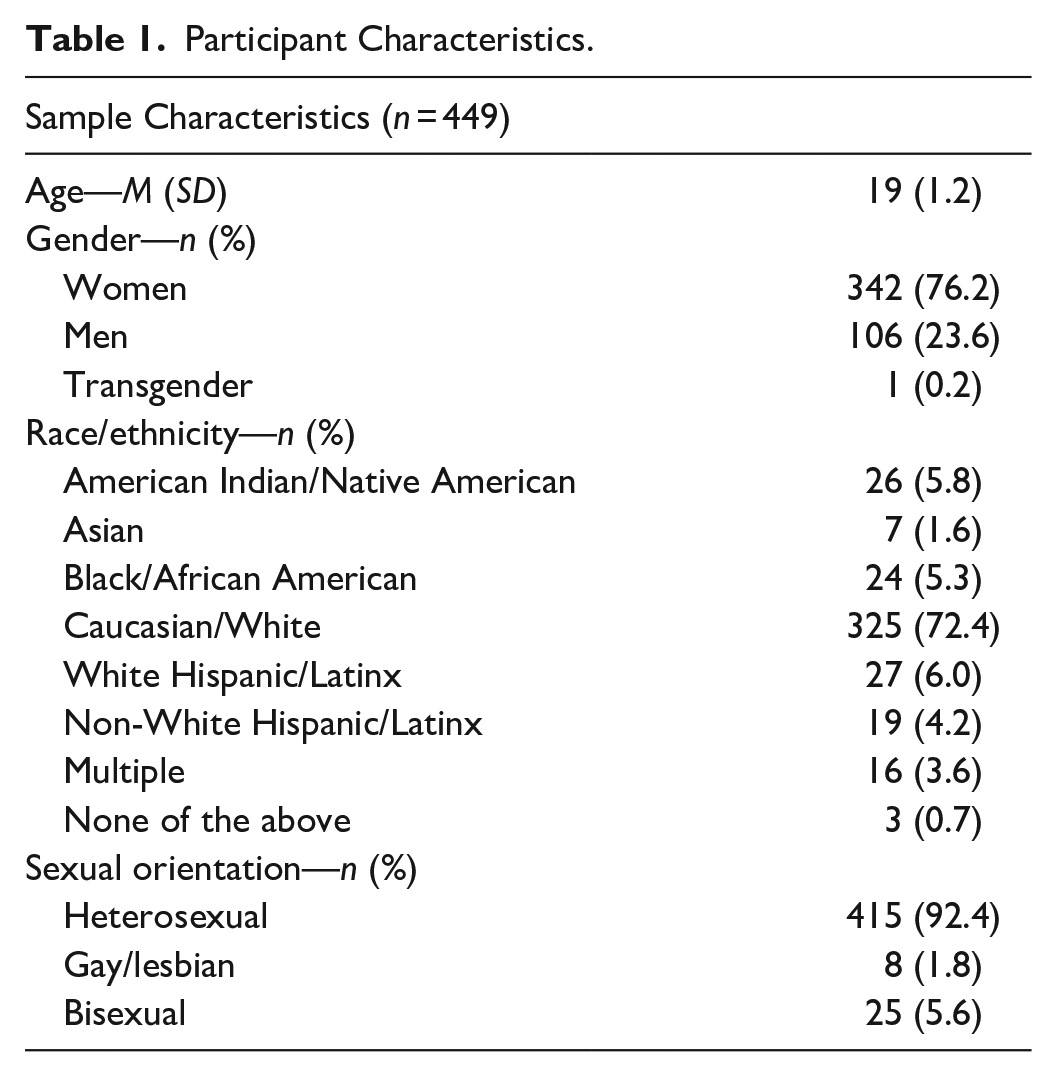
As expected, participants were college-aged and the sample was primarily female, Caucasian/White, and heterosexual and the age of our sample ranged from 18 to 27. (M age = 19, SD = 1.2). There were 342 women in our sample, 106 men in our sample, and 1 person who identified as transgender. We were able to extract Twitter use data from the phones of 419 participants and Instagram data from 446 participants. Mean Twitter battery use was 6.7% (SD = 7.1, range: 0%−55%). Mean Instagram battery use was 12.7% (SD = 8.3, range: 0%−60%). Descriptive statistics for the sample can been seen in Table 1.
Participant Characteristics.
Planned Analyses Results
Contrary to our hypothesis, Twitter use was not associated with perceived burdensomeness, thwarted belongingness, or suicidal ideation (all p > .6). Instagram use was negatively associated with perceived burdensomeness (p = .001) and suicidal ideation (p = .036) but was not associated with thwarted belongingness (p = .063); see Table 2. Using α = .008 to adjust for multiple comparisons, the association between Instagram use and perceived burdensomeness remains significant but the association between Instagram use and suicidal ideation does not.
Means, Standard Deviations, and Correlations Between the Variables.
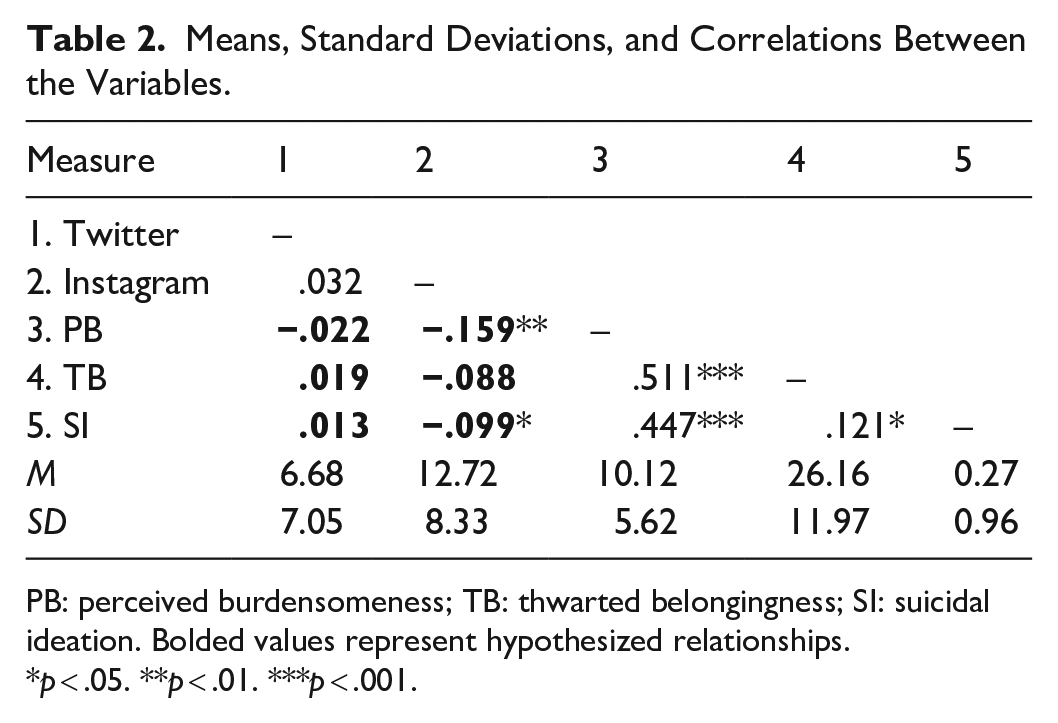
PB: perceived burdensomeness; TB: thwarted belongingness; SI: suicidal ideation. Bolded values represent hypothesized relationships.
p < .05. **p < .01. ***p < .001.
Given that Twitter use was not associated with our variables of interest, we did not examine indirect effects. However, we did examine an indirect effects model of Instagram use on suicidal ideation through perceived burdensomeness using the SPSS PROCESS macro (Preacher & Hayes, 2008) with 5,000 resamples. To bootstrap an indirect effect, an approximation of the sampling distribution of the product of the a and b paths is generated from the resampling with replacement which is then used to calculate ab*, which is the indirect effect of the single resample. Significance is determined based on the absence of zero in the confidence interval which is generated by sorting the resamples from low to high and more accurate confidence intervals are derived from bias-correction. There was evidence of this indirect effect as indicated by a confidence interval that did not include zero [−.015, −.003]. 3
Discussion
We examined the relationships between Instagram and Twitter use, perceived burdensomeness (PB), thwarted belongingness (TB), and suicidal ideation (SI). Contrary to expectations, our results indicate that there is a negative relationship between Instagram use and PB and SI. Furthermore, there was an indirect effect of Instagram use on SI through PB. There were no significant relationships between Twitter use and SI, PB, or TB.
Our results are inconsistent with the pool of literature that has found that SM use is related to negative mental health outcomes (Vahedi & Zannella, 2019; Yoon et al., 2019). Our results could potentially stem from our examination of individual applications. Much of the research examining the effects of SM usage focuses on Facebook, with most studies demonstrating a negative effect on users’ mental health (for review, see Frost & Rickwood, 2017). As a result, it could be the case that certain features or content on Facebook create more detrimental effects for users than Instagram or Twitter.
In comparison to research regarding Facebook, research examining Instagram and Twitter is limited, although there is some evidence for positive aspects of both applications. Specifically, it has been shown that Instagram can provide social support, as well as other types of support (i.e., informational support and esteem support) to users (Andalibi et al., 2017). In addition, users are more likely to interact with and encounter content on Instagram from the user’s friends or family whereas, Twitter interactions tend to take place between individuals with no connection outside of Twitter (Alhabash & Ma, 2017; Clement, 2019; Hughes et al., 2012). This is consistent with our results demonstrating a negative association between Instagram and perceived burdensomeness and thwarted belongingness. It is possible that Twitter provides a sense of social connectedness about a shared interest or activity whereas Instagram social support might be more representative of social support provided one’s friends or family and therefore, it more related to constructs of suicide ideation.
Our results are consistent with the body of literature that has demonstrated positive responses to SM usage. Although somewhat more limited than research examining detrimental effects of SM, there is a body of work to suggest that SM use can benefit the user particularly if the user received positive feedback on their posts or profile (Valkenburg et al., 2006). Past research has suggested that SM usage can increase communication with others further enhancing socialization and relationships (Kaur & Bashir, 2015). In addition, studies have shown that Instagram usage specifically can increase feelings of social support in users (Andalibi et al., 2017). Many studies have highlighted the importance of social support as a protective factor against suicide ideation (DeBeer et al., 2014; Matarazzo et al., 2014). Furthermore, increased social support has been associated with lower perceived burdensomeness (Jeon & Heo, 2019). It may be that when users are engaging in more Instagram use, they feel as if they are contributing to their social networks, resulting in decreased feelings of perceived burdensomeness and lower levels of suicidal ideation.
It is also possible that there are factors that affect the relationship between SM and mental health that related to differing experiences with SM by age cohorts. The mean age of our sample was 19 (SD = 1.2) and recent research has indicated that this age group represents a large portion of U.S. SM users with 90% of individuals aged 18–29 have at least one SM profile (Escobar-Viera et al., 2020). With Facebook, Twitter, and Instagram being created in 2004, 2006, and 2010, respectively, it is very likely that our sample had exposure to these SM sites throughout their youth and subsequent development into young adults. Due to the early exposure of SM, it may be the case that these individuals react differently to SM usage than individuals who did not grow up with exposure to SM. Some research suggests that SM allows for identity experimentation and opportunities for social support and self-disclosures (Davis, 2012; Ko & Kuo, 2009). It is possible that the age group of our sample may actually benefit from some types of SM usage in some circumstances.
It is also possible that our results differ from prior work due to our method of collecting information about SM usage. The majority of previous research in this area has collected SM usage data via self-report. Even the most recent research studies have typically used self-report items created by researchers (e.g., Sherlock & Wagstaff, 2019) or self-report questionnaires (e.g., Coyne et al., 2020). Self-report data are often affected by social-desirability bias (Fisher & Katz, 2000) and memory biases (Shiffman et al., 2008) and there is only a modest correlation between self-reported SM use and more objective measures of use (Hunt et al., 2018). In the current study, we collected data about participants’ Instagram and Twitter usage directly from their phone which provides a more accurate and objective measurement of their application usage. As such, it is possible that our data collection method may have contributed to differences between our results and studies that found an association between Instagram, Twitter, and negative mental health outcomes.
The results of the current study should be evaluated in light of its limitations. First, the current study is cross sectional in design; longitudinal and experimental work will be needed to clarify potential causal relationships among the variables. In addition, participants with Androids were excluded due to our method of data collection of Instagram and Twitter use; however, this excluded less than 10% of our total sample. In addition, although we found statistically significant relationships, the sizes of the effects were quite small, suggesting that Instagram use is associated with PB and SI, but may play a small role in these relationships. The use of a college-aged, primarily White, heterosexual, and female sample should be noted, and future work should examine these relationships in more diverse samples. Finally, future work should focus on the content that users are interacting with and the activities and interactions that users are engaging in while using Instagram and Twitter. This is particularly relevant considering existing evidence that negative interactions through SM result in increased thwarted belongingness (Moberg & Anestis, 2015). Although the current study addressed limitations by examining the effects of two different SM applications, our study is still limited due to our lack of knowledge about the content users were engaging with or the interactions that occurred. There are potentially differing effects on users stemming from these different types of content and activities that cannot be measured by the amount of time spent or the percentage of cell phone battery life spent on an SM application. This is particularly true regarding suicide research due to recent work suggesting that there are many differing therapeutic affordances stemming from SM use such as connection and collaboration with professionals and peers, exploration and information gathering, the ability to disclose or tell one’s story, and introspection (Dodemaide et al., 2019). In addition, considering the extensive differences between Instagram and Twitter in terms of the types of content and the interactions that occur, research should focus on investigating specific factors that differentiate these applications as well as individual level differences and continue to examine the effects of Instagram and Twitter usage separately (Beyens et al., 2020).
This study also has notable strengths. The current study had a large sample size which provides us with confidence in the robustness of the results. In addition, the current study gathered Instagram and Twitter use data directly from the participants’ phones rather than relying on self-report estimations, allowing for a more accurate and precise measurement of Instagram and Twitter use. Ours is also the first study to examine the relationship between the use of specific SM platforms and suicidal ideation.
In conclusion, the current study provides evidence that different SM platforms may have differential effects on suicidal ideation, specifically, and mental health, broadly. Instagram use in particular, may be related to reduced perceived burdensomeness and less suicidal ideation. Future research should examine the role specific SM platforms have on individuals’ social connectedness and self-esteem and other potential protective effects on mental health outcomes and suicidal ideation.
Footnotes
Declaration of Conflicting Interests
The author(s) declared no potential conflicts of interest with respect to the research, authorship, and/or publication of this article.
Funding
The author(s) received no financial support for the research, authorship, and/or publication of this article.
Open Access Statement
Data and materials are available upon request of the primary author.
