




Abstract
This article examines ‘huns’ – specifically celebrity huns in the public spotlight – as memetic ‘figures’ who are defined by their loud, tongue-in-cheek and humorous display of British femininities coded as working class. Unlike other female figures routinely mocked and laughed at in contemporary popular culture (such as the ‘chav[ette]’ in Britain and ‘Karens’ in America), huns have been celebrated online in a seemingly more progressive and supposedly politically aware sociocultural context. However, this article argues that laughter aimed at the celebrity hun, though deemed inclusive by her fans, is ultimately ambivalent, polysemic and multifarious. Transformations online have led to the discursive creation of the hun through her ‘memeability’. Therefore, I will analyse this new classed and gendered figure via social media. Using the Instagram account ‘loveofhuns’ as a case study, I examine three memes from this page to showcase how huns are represented in complex and competing ways. Overall, this article questions whether the humour in memes uplifts huns or reinforces stereotypes of this typically derided image of (classed) femininity.
Introduction
What is a ‘hun’? Simply put, she is a figure who represents a distinctly British and female-oriented form of campness and ‘low culture’. A term prevalent on social media networks, mainstream print and digital media outlets, the term is said to have originated from the phrase ‘U OK hun?’ (hun being short for the moniker ‘honey’). According to Urban Dictionary (2018), a crowdsourced online dictionary for slang words and phrases, it is a ‘standard response from a lower-class British female on Facebook to a friend of the same ilk, usually in response to an attention-seeking / ambiguous statement’. This ‘attention-seeking lower-class British female’ is classed by her ‘devalued [. . .] signifiers of excess’ and/or normative femininity (Skeggs, 2001: 301), both in her speech patterns on social media and in her loud presence. Drinking, crying, laughing, partying and her emotional, everyday ‘onlineness’ are affective responses deemed humorous by fans of the hun. For pop-culture critics, ‘“U OK hun?” has [. . .] become shorthand for a disingenuous public display of concern’ (Alderton, 2016), often used as a marker of derision and ironic detachment by people who demonstrate a self-reflexive understanding of its working class and (presumed) socially inferior roots.
This article examines huns – specifically celebrity huns in the public spotlight – as memetic ‘figures’ (Tyler, 2008) in the context of British culture. By analysing three memes from the Instagram account ‘loveofhuns’, I explore how this new classed and gendered figure is constructed in online spaces and question whether the hun is a subject or object of laughter. First, this article will review the literature around classed femininities in Britain, specifically via the figure of the ‘chav(ette)’ and the figure of the ‘ladette’, before outlining the methodologies used to examine huns, and which posts will be analysed on the Instagram account ‘loveofhuns’. Then, it will contextualise how the humour of huns has developed via camp and ironic sensibilities, comparing this to female figures framed negatively in the United Kingdom and the United States. Thus, the politics of laughter, class and contemporary femininities will be examined in relation to the hun. Finally, this article will provide a close analysis of three memes to explore the multifarious nature of humour before giving a summary and critique of the findings.
Reviewing the literature: from ‘ladettes’ to ‘huns’
In 2019, Vice writer Hannah Ewans wrote an article entitled ‘A Brief History of the Hun, the Most Relatable Woman in Britain’, stating that, above all, the pleasure of the hun derives from an ‘excuse to share and celebrate your most base desires: booze, food and emotions, packaged in a self-aware, British way’. The hun has thus become an entertaining and socially acceptable form of the ladette, a reconfiguration of past behaviours that were once deemed abominable by the press (for more on ladettes, see Jackson and Tinkler, 2007; Muncer et al., 2001; Redden and Brown, 2010). Huns can be ‘ordinary’ or ‘everyday’ women who make their presence known in online spaces, but there has been a distinct focus on the celebrity hun on social media sites such as Instagram. Celebrity or otherwise, the hun is loud, tongue-in-cheek, often comprehended as down-to-earth because of her unrefined behaviours, and she is symbolically coded as working class through her tastes – regardless of any changes to her material position – much like configurations of the chav(ette) (Tyler and Bennett, 2010: 375).
Indeed, some celebrity huns bear similarities to the celebrity chav(ette) in that one of their defining features is ‘an inability to perform femininity correctly [. . .] these celebrities are subject to invasive levels of public surveillance in which the slightest “error” in appearance or speech can expose them to negative class judgements’ (Tyler and Bennett, 2010: 381), which Imogen Tyler and Bruce Bennett argue can be seen in celebrities such as Coleen Rooney (née McLoughlin), the wife of British professional footballer Wayne Rooney. However, as they also suggest, ‘[c]elebrity is a form of improvisatory, excessive public theatre. It is class pantomime and the “chav”, a vicious and grotesque representation of the undeserving poor, is a stock character’ (Tyler and Bennett, 2010: 380). Huns are not represented in this way and are often admired for being ageing women on British television, women who act ‘natural’ on camera, or women who are excessive in their behaviour. In many respects, the hun can be defined as an ‘unruly’ woman because she is ‘too fat, too funny, too noisy, too old, too rebellious’ (Rowe, 1995: 19) and, as such, is perceived as too much. Deliberately drawing laughter from her rebellion, Kathleen Rowe (1995) contends that unruly women are subjects of laughter that express ‘anger, resistance, solidarity, and joy’ (p. 5), resisting middle-class and feminine standards of decorum. For example, Alison Hammond fits this model of unruliness. She is a hun who, following her appearance on the reality competition series Big Brother (Channel 4 and Channel 5, 2000–2018), subsequently appeared on many TV programmes before becoming a presenter on the morning talk show This Morning (ITV, 1988–). She laughs loudly and often, with her interviewees laughing with her. As a fat Black woman with a broad Birmingham accent, her television appearance demarcates her as an exception to TV’s white, middle-class and London-centric norms (Johnson, 2021). Yet while Tyler and Bennett (2010) argue that, with women such as Colleen Rooney and celebrity chav(ette)s, ‘[w]e laugh at their faux pas and share our disgust at their shameless promiscuity, tasteless lifestyles, parental incompetence and bigotry’ (p. 387), Alison Hammond’s lack of personal restraint is a source of pleasure for audiences. Fans laugh with her, a key expression of identity for those who celebrate huns.
These fans are creating pages dedicated to huns on the social media site Instagram, with ‘loveofhuns’, ‘HUNSNET’, ‘thehunlife’ and ‘uokhunofficial’ being prime examples. A popular figure among young women and gay men, the hun is both excessive and seemingly ‘authentic’, with celebrities who embody this concept being emanant persons from the late 1990s and early 2000s ladette era. Nostalgia for the 1990s and 2000s has seen celebrities who were former ladettes being reconfigured as huns in recent years, with television personalities such as EastEnders (BBC One, 1985–) actor Danniella Westbrook and glamour model turned professional celebrity Katie Price (aka Jordan) remaining sources of national attention. Breakout stars from the 2010s, such as reality TV performer Gemma Collins, are also deemed huns in the British media landscape.
To understand this figure, then, the ladette must first be contextualised. In the 1990s, ladettes were defined as the epitome of young, troubled femininities in Britain, the ‘hard-drinking, swearing, confrontational style of [their] male counterparts’ (Muncer et al., 2001: 35). Angela Smith (2011) argues that the British press was primarily responsible for fuelling moral panic around excessive behaviours of the era’s youth, such as ‘binge drinking, alcohol-induced violence, and increasing levels of sexually transmitted diseases’ (p. 153). Young women’s hedonism thus became publicly visible in the media, flouting traditional femininity and therefore shifting the gendered order of society. British celebrities such as DJs Sara Cox and Zoe Ball, alongside TV presenters Denise Van Outen and Gail Porter, were criticised by the press for their unacceptable presentation of female independence and transgressing gendered boundaries of classed respectability. In essence, the ladette was linked to a moral decline in society. The celebrity hun can be seen as a contemporary extension of the ‘ladette’ in that she displays similar behaviours.
However, as scholar Angela Smith notes when detailing the rise and fall of the ladette, the decline of this figure is largely due to the ‘greater acceptance of different gender roles. It’s much more acceptable to behave in a diverse way’ (Smith, quoted in Donovan, 2017). Audiences can forge new identities and create interpretive communities in online spaces where shifts in gender roles are appreciated. These are spaces where the hun’s camp, excessive qualities are deemed humorous. Indeed, while the ladette was configured in the British press/tabloids and thus shaped through media spectacle, this article further suggests that transformations online have led to the discursive creation of the hun in the digital realm and through her ‘memeability’ (Mercer and Sarson, 2020). As such, this article will explore the recent sensation of huns through Instagram – specifically via the account ‘loveofhuns’ – and examine how classed and gendered subjects are formed via posts on this page.
Methodology
This section will now outline the methodologies used to examine huns in online spaces. Broadly speaking, this article examines the hun as a social and memetic figure in the same way that the ladette and chav(ette) have been considered in cultural studies. Imogen Tyler (2008) uses this ‘figurative methodology’ in her work on chavs to explore how ‘[s]ocial classifications are complex political formations that are generated and characterized by representational struggles’ (p. 18). These representational struggles, she suggests, ‘are often played out within highly condensed figurative forms’ (Tyler, 2008: 18). The repetition and recurrence of such figures across multiple media contribute to their image as unruly, distorted and often derogatory. This publicly imagined figure thus captures an underlying crisis or anxiety, which is then mobilised to create boundaries between individuals and/or groups.
Jo Littler uses this methodology to explore how figures in society can be ambivalently represented. The term ‘yummy mummy’, she suggests, is ‘quasiemancipatory’ in that it allows mums to be seen as sexual beings. Yet it simultaneously places a distinct spotlight on a hyperfeminine form of maternalism that signals the rise of neo-conservative values (Littler, 2013: 238). Littler (2020) also points out how the ‘mother behaving badly’ is an ambivalent figure in the contemporary climate in that she sits ‘somewhere between [. . .] two extremes of vilification and veneration, although she is closer – in terms of establishment-sanctioned social “acceptability” – to the latter’ (p. 500). Memetic figures of womanhood have also been circulating in the United States. ‘Karen’, for instance, is a pejorative slang term signifying an obnoxious, entitled and often racist middle-aged and middle-class white woman. According to Diane Negra and Julia Leyda (2021), this figure ‘crystallizes a particular constellation of entitled white supremacy and class privilege into a scathing dismissal of white female anger that deserves attention’ (p. 350). Other terms have also been used to negatively characterise women in the US, such as ‘basic bitch’, which disparagingly refers to a ‘stereotypically feminine woman, particularly in terms of her consumerist practices and media tastes’ (Olson, 2020: 167). These figures share similarities with huns because they are loud and visible in popular culture. However, while Karens and basic bitches are negatively framed and characterised, the term hun is an endearing and affectionate term when used by fans.
Although figures have spanned British and American cultures, this analysis locates the hun within a specific national context and is based on accounts of British celebrities and British pop-cultural references. Using Imogen Tyler’s (2008) ‘figurative methodology’, I argue that the hun is an ambivalent figure, much like the yummy mummy and mother behaving badly, because of the varied affective responses she generates – from disgust to affection to laughter. This plays out through social media within an apparently more progressive and supposedly politically aware sociocultural context that ostensibly celebrates this typically derided image of (classed) femininity. In this article, I use the Instagram account ‘loveofhuns’ as a case study to examine how huns are constructed online because, contrary to other female figures such as the ladette, huns operate predominantly in the digital realm as memes. Given that memes are ‘powerful persuasive devices, transmitting loaded messages in their content under the guise of humour or jokes’ (Drakett et al., 2018: 36), it is significant to gauge how the creator(s) of ‘loveofhuns’ playfully mock the hun for their excessive behaviours and what this audience engagement reveals about attitudes towards women who are in the public spotlight and whose appearance/behaviour are coded as working class.
I consider three memes from this page that span popular culture, camp humour and feminine modes of viewing – from reality TV series RuPaul’s Drag Race (Logo TV and VH1, 2009–) to the soap opera EastEnders – providing an in-depth and considerate analysis of how huns are represented. As Limor Shifman (2013b) proposes, Internet memes can be analysed as groups of digital items sharing common characteristics of content, form and/or stance. Content refers to the ideas and ideologies conveyed by a meme; form contains the visual and audible patterns in the meme – its mise-en-scène (or meme-en-scène); and stance refers to how the audience positions themselves in relation to the text (Shifman, 2013b). I use Shifman’s framework to examine these three dimensions while situating the meme within British cultural practices. This enables an understanding of the post’s relevance to the contemporary situations they address and respond to.
First, however, the hun will be analysed alongside other memetic figures who have typically been derided and ridiculed in popular media. By comparison, the hun can be perceived as an inclusive, comedic and camp remixing of British culture from the 1990s and 2000s. As John Mercer and Charlie Sarson (2020) argue, while meme production sits alongside industrialised image management and therefore has the potential to be resistant to or even destabilise the brand identity of an individual celebrity, it is progressively being deployed in a more self-aware manner, drawing on irony and camp and becoming part of the image-making strategy of celebrities. (p. 489)
Thus, memes are ideal formats for fans and followers to consolidate their affective relationship with huns. Drawing on other forms of pop culture – specifically online magazines and online news articles – this article notes how the hun has received considerable attention from journalists and cultural critics. Memes are often created and built upon pop culture/current affairs, while online magazines and news articles influence pop culture. This complementary cycle means that both communicatory forms shape and drive celebrity content in the 21st century. In analysing these various media artefacts, this article examines the formation of the hun as a comedic memetic figure, particularly since the growth of new media has expanded how audiences interact with and consume celebrities.
Laughing at or laughing with? Finding the funny in popular figures
Before analysing huns via memes on Instagram, I begin by contextualising the power of laughter and how it has been aimed at female figures in the contemporary Anglo-American media landscape. In this section, the chav(ette)s will be considered as an object of laughter in popular culture before examining how huns have been seen as both objects and subjects of laughter. As this section suggests, huns are represented in complex and competing ways: simultaneously positioned as figures of derision and camp icons.
Broadly speaking, there is an ambiguity inherent in comedy. This ambiguity has led to ‘its appropriation to both conservative and radical ends, both to mock the weak and to provide a space in which to challenge and upturn social conventions that serve to stigmatise and alienate those marginalised by mainstream society’ (Davies and Ilott, 2018: 6). Although laughter involved in stereotyping the hun is framed positively, with Vice writer Hannah Ewans (2019) contending that ‘there’s a universal hun spirit, a joie de vivre that bonds huns together’, this laughter can be harmful and oppressive depending on the intention of the joke and whether the teller of said joke is in a position of power. In other words, who are we laughing at and why? Laughter is typically directed at figures in popular media, with the anger and humour used to mock Karens in America and chav(ette)s in Britain. When exploring the abuse of chavs – that is, white-working-class subjects – Imogen Tyler (2008) argues that humour is ‘a way of naming, managing and authorising class disgust, contempt, and anxiety’, which she suggests is ‘intimately bound up with, and authorised by, comedy and the community forming power of laughter’ (p. 23). Tyler uses the example of Vicky Pollard – a character from the comedy sketch show Little Britain (BBC Three and BBC One, 2003–2007) – as a televisual representation that has come to embody debates around female chav(ette)s who are young, working-class mothers. Played by upper-middle-class white comedian Matt Lucas, Vicky Pollard is an over-weight moody teenage girl who is usually dressed in a pink Kappa tracksuit, wearing badly applied make-up with some of her long, bleached blonde hair pulled back into a ‘scrunchy’ [. . .] [M]uch of the comedy derives from Lucas’ performance of incomprehensible teenage banter. (Tyler, 2008: 27)
With the popularity of Little Britain in the 2000s, the name Vicky Pollard became synonymous with chav(ette). As Tyler (2008) summarises, Pollard has become deeply entrenched in the British cultural zeitgeist and popular imagination as a negative figure, with ‘the movement of this fictional figure from scripted television comedy into news media, political rhetoric and onto the streets foregrounds the disturbing ease which the chav figure shapes social perception and comes to be employed in instrumental ways’ (p. 28).
The hun has been represented via similar comedic strategies on television. In the popular, long-running American sketch show Saturday Night Live (SNL) (NBC, 1975–present), upper-middle-class white comedian Phoebe Waller-Bridge, who is most well known for her darkly comic and critically acclaimed BBC series Fleabag (BBC Three and BBC One, 2016–2019), parodies the British dating game show and reality TV series Love Island (ITV2, 2015–). Visually exemplifying and mocking huns via her physical transformation as an Essex-girl stereotype, Waller-Bridge’s long, dark and wavy hair; oversized fake lip fillers; false eyelashes; and tanned skin contrasts with her trademark short bob and red lipstick, that is, her familiar expression of middle-class womanhood. Although huns do not necessarily share similar appearances – and can range from plain-faced soap opera characters such as Coronation Street’s (ITV, 1960–) Gail Platt (played by Helen Worth), to the heavily made-up glitz of glamour model turned reality star Katie Price, – Love Island contestants fall under the umbrella of huns for their relatable and excessive campness. On SNL, they have been mocked for their looks and working-class backgrounds. This is perhaps most evident when Waller-Bridge proclaims: ‘Me dad’s a boxer and me mum’s a pub’ (S45: E02). This binary, for audiences, is a potential source of humour since Waller-Bridge is performing on Saturday Night Live because of her stardom, personality and celebrity status (Minor, in press). The creator of Fleabag thus performs and parodies a distinct form of femininity vastly different from her own, or, as the narrator of the skit puts it, her character is one of ‘the hottest people from the worst towns’.
In some ways, this mocking of working-class-based femininity bears similarities to Matt Lucas’s depiction of Vicky Pollard in Little Britain. However, Sharon Lockyer argues that, in some respects, Vicky Pollard can be deemed important because (s)he articulates and negotiate class identities, with Pollard drawing attention away from middle- and upper-class representations. Lockyer (2010) positions Vicky Pollard as a potentially progressive and transgressive character in that her appearance works against the postfeminist ideals of self-improvement. Yet Waller-Bridge’s character and body do not challenge these media expectations because many huns are concerned with image, as is Waller-Bridge. Indeed, numerous huns perform aesthetic labour upon their bodies via the doing of beauty work, which is often associated with neoliberal postfeminist culture (Gill and Scharff, 2011) – and huns are routinely mocked for failing to live up to standards of normative beautification. As writer for The Times Dolly Alderton (2016) argues, ‘[s]ome say they find the hun culture cruel, a way to ridicule women who fall beneath society’s expectations; often the hun is working class, has issues with her weight or drinking and spectacularly bad taste in clothes’. While laughter can be politically, culturally and socially moving in its ability to incite change, laughter at this SNL skit is socially regressive and repressive in its aim at working-class women by framing sexist humour as ‘just a joke’. Framing something as ‘just a joke’ through irony is, as Rosalind Gill (2007) suggests, ‘“having it both ways”, of expressing sexist, homophobic or otherwise unpalatable sentiments in an ironized form, while claiming this was not actually “meant”’ (p. 159).
Yet while irony can be - and has been - used to ridicule, it can also be used to establish or challenge power relations – particularly irony that forms the basis of camp as an aesthetic style and sensibility (Sontag, 1964). Katrin Horn (2017) defines camp as ‘a parodic device that uses irony, exaggeration, theatricality, incongruity, and humor to question the pretext’s status as “original” or “natural”’ (p. 6), and it can be perceived as positive in its sincerity, the demystifying qualities of its irony, and the communal foundations of its humour (p. 26). Camp can be seen across various genres and formats in America – from cable TV series Desperate Housewives (ABC, 2004–2012) to Hollywood films such as What Ever Happened to Baby Jane? (Aldrich, 1962). In Britain, women who have acted in reality TV, soaps and daytime television, or those who have had short-lived pop careers are typically defined as huns. That is, those who perform and operate in the realm of ‘feminine’ or ‘female’ television (as well as other mass media). Such genres are typically seen as ‘lowbrow’ and are aesthetically dismissed in a landscape privileging a high-culture/low-culture divide – a landscape that is also thoroughly gendered. Television has ‘always had its eyes on women’ (Spigel and Mann, 1992: vii), and it has been noted since the 1980s – in Tania Modleski’s (1982 [1979]) influential work on soap operas – that mass culture’s low status is intertwined with its relation to women and the feminine.
Faye Woods argues that the reality TV series The Only Way is Essex (ITV, 2010–), which catapulted hun Gemma Collins to fame, embodies camp. Collins often refers to her alter-ego as ‘the GC’, a diva who demonstrates the role of excess in classed femininities. She is big, blonde and buxom, with her exaggerated performances on television – crying, laughing, shouting and arguing – extending to numerous reality TV series, including I’m a Celebrity . . . Get Me Out of Here! (ITV, 2002–), Celebrity Big Brother (Channel 4 and Channel 5, 2001–2018), Celebs Go Dating (E4, 2006–) and Dancing on Ice (ITV, 2006–), in which she self-consciously performs as her marketable self. While genres such as reality TV are understood as ‘lowbrow’ – intellectually basic, cheap and exploitative – for Faye Woods (2014), The Only Way is Essex is seen as ‘employ[ing] a knowing tone and engagement with camp that seeks to smooth tensions that structured reality creates between intervention and “authenticity”, drama and reality TV, with classed femininities and performativity’ (p. 198). British reality TV plays with ‘excess artificiality and awkwardness’, incorporating camp as a sensibility and mode of address to highlight the ironic viewing habits of younger viewers, thereby ‘allowing the program to flatter its audience, recognizing their genre literacy, and offering a comfortable position of at times derisory detachment’ (Woods, 2014: 201). Katrin Horn (2017) also defines camp through its creative audience engagement and ‘the pleasure derived from it’ (p. 5). The importance of viewing habits in establishing new communities of taste for fans of camp is equally important for fans of huns. Indeed, Charles Allan McCoy and Roscoe C. Scarborough (2014) argue that employing a ‘camp sensibility’ allows viewers to admire the cultural object for how ‘bad’ it is. The viewer does not look down on the show, but rather it is lifted up, above the symbolic boundary, as the viewer appreciates the cultural object on its own terms. (p. 56)
The consumption of huns fits this description, in part because of how they are watched on television via camp viewing habits, but also because, as I will argue now, they are celebrated in online spaces. Social media has become a significant site for this affective intensity, and audience engagement with huns is crucial in locating their humour.
‘Memeing’-making: analysing ‘loveofhuns’
The hun is a figure who is both mocked and enjoyed (ironically or through camp admiration). As the last section demonstrated, the conflicting consumption of ‘bad’ cultural products has predominantly been analysed via the televisual landscape. However, I will examine how these viewing practices have extended to social media, specifically Instagram. Here, I closely analyse a select few memes to provide a deep and considerate examination of how huns are represented. This analysis will question whether the humour in memes uplifts huns or reinforces stereotypes of this typically derided image of (classed) femininity. First, however, I will outline the significance of the account ‘loveofhuns’, Instagram and memes for this study.
A pop-culture meme account which started in 2017, ‘loveofhuns’ has become a viral success on Instagram, with over 600,000 followers and 1500 posts. It has been the subject of many headlines in youth-oriented magazines (which have contributed to and remarked upon its success). For instance, Nick Levine (2020) of Dazed writes that ‘in a year like 2020, this Instagram account was a salve, a prism for understanding the world, and a reminder to live, laugh, love through the most gorj and glam elements of British culture’. Given its popularity in the contemporary cultural landscape, this section undertakes a focused and holistic examination of ‘loveofhuns’ using a case study approach. Though ‘loveofhuns’ has both an Instagram and Twitter account, Instagram was the platform of choice to generate data for this investigation because its primary function is visual distribution, unlike other social media sites such as Twitter or Facebook, which are both text- and image-based. With over 1 billion active monthly users (Statista, 2018), Instagram is an important site for constructing, contesting and consuming messages. It is also important to examine how the hun is celebrated for her ‘memeability’ (Mercer and Sarson, 2020), particularly because memes are predominantly visual works. However, this analysis would be insufficient without considering the whole post and hence its caption.
For this reason, I will analyse the relationship between text and image on ‘loveofhuns’ via three posts that contain various celebrities, modes of comedy and types of content: from videos to images to text. The first post that will be explored comprises two videos comparing famous drag queen Bimini Bon-Boulash with hun Katie Price. The second post to be examined is primarily visual and depicts EastEnders character Shirley Carter (played by Linda Henry) as a replacement for the British Prime Minister Boris Johnson. Finally, the third post considered portrays EastEnders star Natalie Cassidy, with the caption and comments forming an integral part of its meaning. Through an in-depth analysis of these heterogeneous memes, this section will determine whether specific patterns of humour can be found on ‘loveofhuns’.
Memes will be examined because they are exemplary forms of user-generated content in the age of social networking and user participation. Put simply, they are ubiquitous images, videos and other media that circulate on social media feeds – expressing thoughts and ideas, or, as Shifman (2013a) suggests, they may best be understood as cultural information that passes along from person to person, yet gradually scales into a shared social phenomenon. Although they spread on a micro basis, memes’ impact is on the macro: They shape the mindsets, forms of behavior, and actions of social groups. (p. 14)
Since online spaces – particularly anonymous ones – are hostile and unwelcoming to those who do not identify as male, which forms an extension of offline gender relations (see Lewis et al., 2017), it is essential to recognise how female-centric memes are being created.
Many scholars have examined the gendered nature of humour in online spaces. Limor Shifman and Dafna Lemish (2012), in their content analysis of 150 popular jokes, found that traditional stereotypical gender representations still prevail and that Internet humour ‘is not inherently more subversive or liberating than content produced by mass media’ (p. 268). Using thematic analysis on a sample of 240 image macro Internet memes, Jessica Drakett et al. (2018: 116) similarly identify ‘a clear reproduction of heteronormative (and heterosexist) constructions of sexuality and gendered relations through the use of humour’ and conclude that ‘women are not welcome in memes – they can be visible, but not vocal, rendering opportunities to challenge or resist [. . .] constructions potentially difficult’ (p. 123). As this article argues, women can be welcome in memes and rendered vocal, but this is complicated by the inherently ambivalent nature of humour directed at memetic figures who are often subject to public affection and hostility.
I have chosen to examine memes on the Instagram page ‘loveofhuns’ for its popularity and engagement with fans/celebrities. Numerous celebrities in Britain frequently comment on its posts and are (typically) the subjects of said posts. These have included: X-Factor winner Alexandra Burke, Northern actor Sheridan Smith, reality TV and Celebrity Big Brother star Kim Woodburn, the hosts of daytime women’s show Loose Women (ITV, 1999–), 2000s pop star Sophie Ellis-Baxtor, a plethora of drag queens and morning talk show host Trisha Goddard. Denise Welch, a host on Loose Women, has remarked: ‘I love it when I’m on here’, with the BBC’s official Instagram page similarly commenting, ‘We made it on to Love of Huns – life ambition COMPLETE!’ Fan-creator interactions are mediated through this page, which functions as a comical hub for fans of a specific strand of 1990s and 2000s British culture. I examine three memes that allow fans to claim ownership of the meaning-making potential of huns – to revel in the joys of this figure and a distinctly British feminine sensibility based around markers of class.
The first post I have chosen to examine concerns RuPaul’s Drag Race UK, a reality competition TV series that helped reshape the visibility of drag culture in the United States and internationally. In 2019, it was transnationally translated for UK audiences (BBC, 2019–) and is currently in its second season after 12 million views gave the streaming service BBC iPlayer a ‘record-breaking’ year (Kanter, 2019). In the series’ most popular and anticipated challenge – Snatch Game – competing drag queens are challenged to perform in character as a celebrity of their choosing in a parody of the Match Game (NBC, CBS, and ABC, 1962–) to demonstrate their improvisation ability, make-up skills and competence in creating comic characters. One drag queen, Bimini Bon-Boulash, performed as Katie Price, imitating her character to generate laughs and win the challenge. Her performance was celebrated by fans and the media alike (with the video of her performance being frequently shared online). In a post by ‘loveofhuns’, the page’s creator acknowledges her win with a video of Bimini’s performance positioned next to a video of Katie Price on a morning talk show. Hence, audiences only have to swipe left and right to compare/contrast the two. The caption of the videos reads: ‘Bimini’s Katie Price is truly BAFTA worthy’. The official BAFTA (Home of the British Academy of Film and Television Arts) Instagram page comments with a golden trophy emoji in response, playing along with the joke.
In Figure 1, a video of Bimini in character as Katie Price states: ‘Is it cold in here or is it just my nipples?’ while Figure 2 depicts Price, in an interview on This Morning, reeling off the difficulties she has endured this year: from her mother being told she was dying, to the threats she received from gangs planning to kidnap her son Harvey with a £1 million ransom. This post includes and excludes significant parts of Bimini’s performance. In the clip, Bimini refers to Price’s breast augmentations – a seemingly superficial gag related to appearance. Yet it excludes other moments in which she visually and aurally mimics the celebrity, joking about how her ‘implants got held at gunpoint in South Africa’ in reference to carjackers attacking Price and her two children, Princess and Junior, in 2018. According to Price, she was sexually assaulted and held at gunpoint by five men, who then stole her mobile phones, laptops, passports and money (Griffin, 2020). Bimini further jokes about Price’s experiences when she states: ‘I walked in the stables and caught my horse cheating on me’, seemingly alluding to how Price’s ex-husband Kieran Hayler cheated on her with two women – one her best friend – in the stables at her former house (Phelan, 2014). While viewers were impressed with the similarities between Bimini and Price’s visual and aural utterances, ultimately, the laughter here is at the expense of Price.
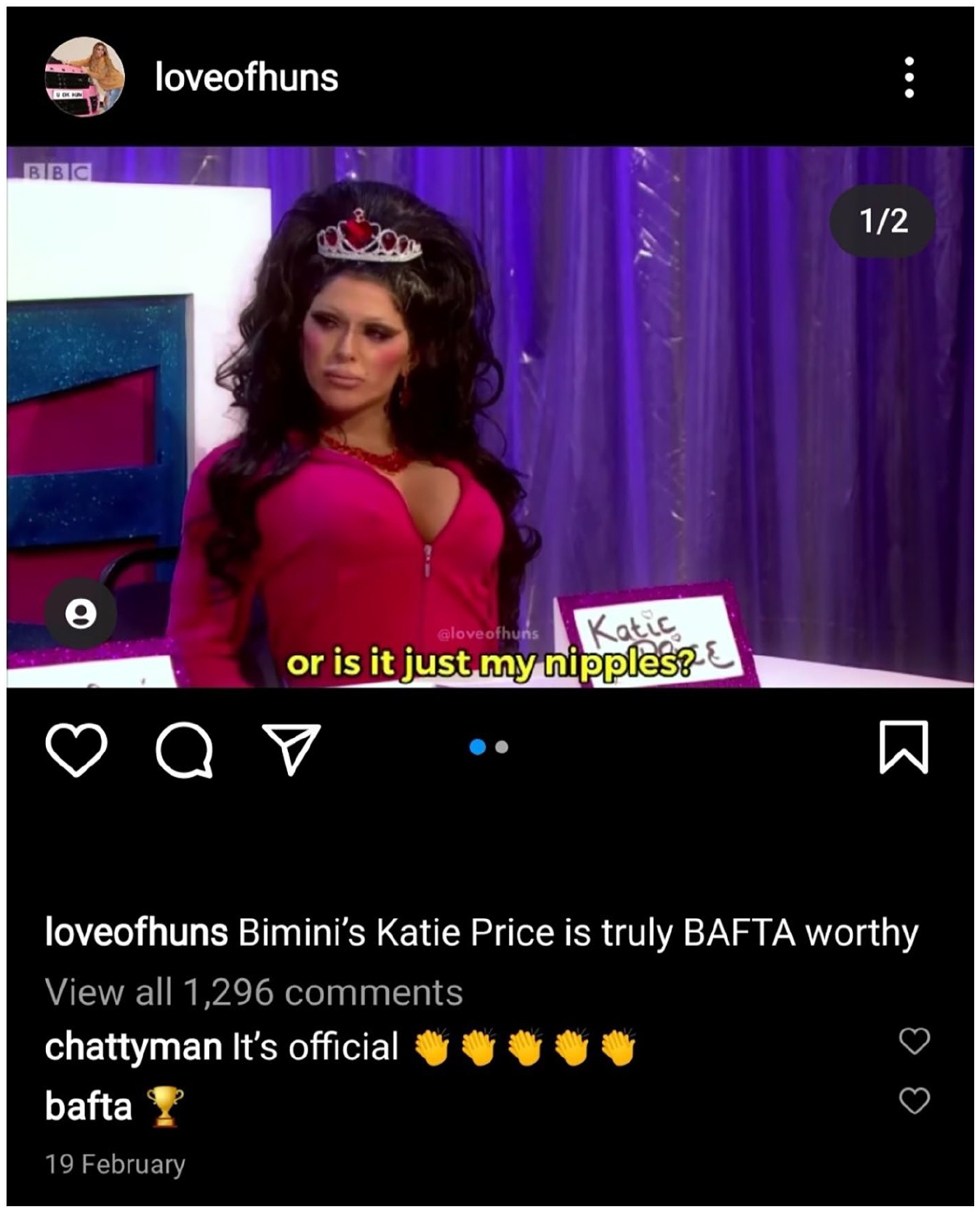
A post on the ‘loveofhuns’ Instagram account showcasing Bimini Bon Boulash’s caricature of Katie Price and BAFTA’s comment.
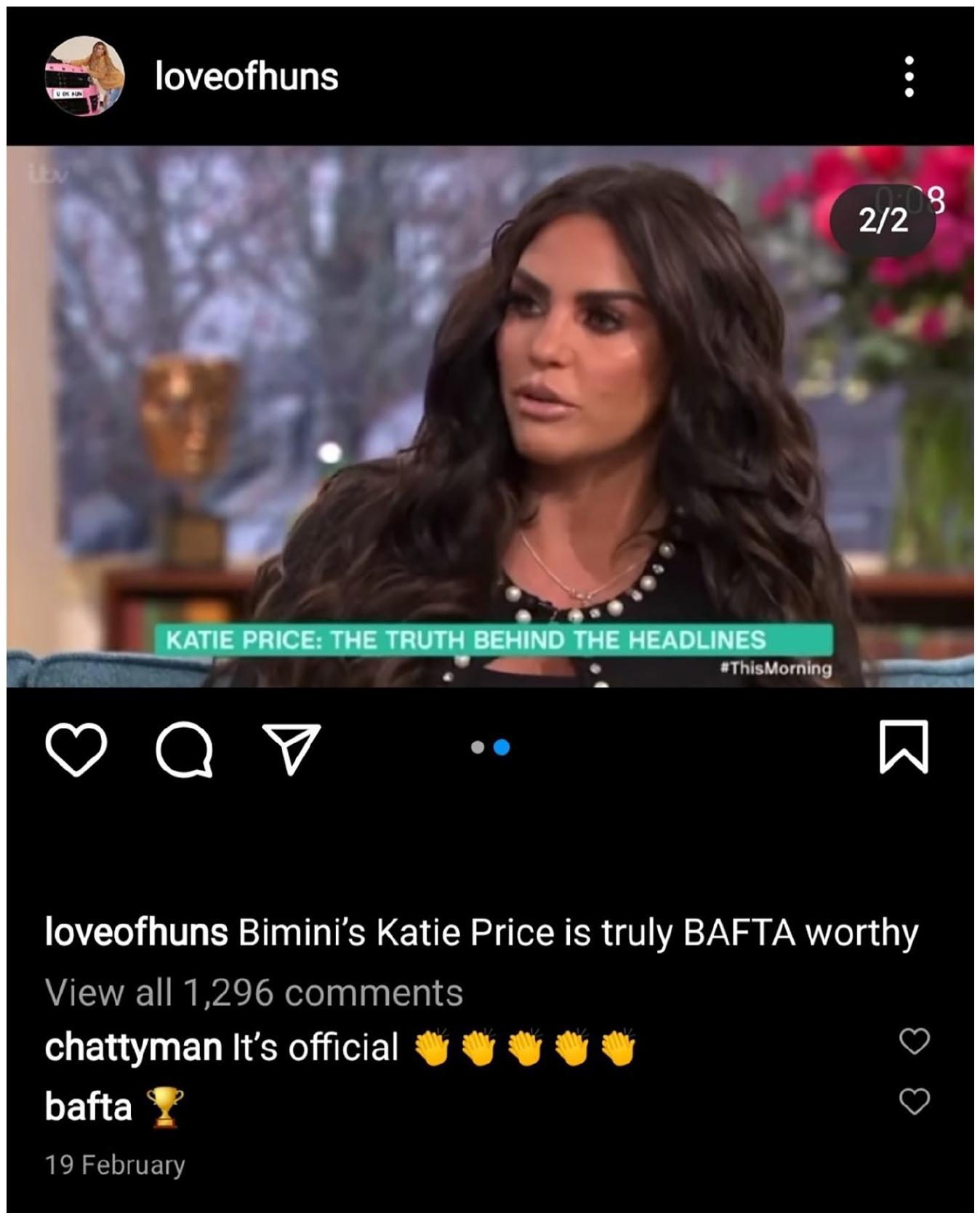
The same post on the ‘loveofhuns’ Instagram account comparing Bimini’s performance withKatie Price’s interview.
The aesthetic and evaluative judgement on reality TV has been suspended for RuPaul’s Drag Race UK and a recent interest in huns here. The series has referenced huns more than once, and in one of the week’s challenges the drag queens must perform as girl groups with the pre-written and pre-recorded song ‘UK Hun’. The single launched at number 27 on the UK music charts, showcasing just how popular drag, huns and this form of camp nostalgia have become. As the creators of the song, Leland and Freddy Scott, state, the song has ‘got a nostalgic feel to it. They [the drag queens] also modeled themselves on the Spice Girls, so it has [appeal] to a different age bracket!’ [. . .] ‘It’s so ridiculously catchy, which obviously gives it high replay value’ (quoted in Nolfi, 2021). This is a form of what Elizabeth Freeman (2010) coins ‘temporal drag’ – the queerness of ‘mining the present for signs of undetonated energy from past revolutions’ (p. xvi), or, in short, ‘the pull of the past on the present’ (p. 62). In the ‘loveofhuns’ post celebrating Bimini’s performance, the layers of irony and self-referential mixing of the past and present ultimately seeks to mask who audiences are really laughing at. This is particularly salient because, though this drag queen dismantles gendered expectations of masculinities and femininities, the treatment of celebrity huns is reinforced, encouraged and supported through BAFTA’s approval and cultural elevation of this classed caricature. The typically marginalised performances of drag queens have been subsumed into a prestigious British cultural institution, and dialogue has thus been created between traditionally ‘lowbrow’ and ‘highbrow’ forms of entertainment (with social media pages becoming important sites in creating and maintaining these relationships).
It could be argued, then, that Katie Price is being judged in the same way celebrity chav(ette)s are often ‘systematically reproduced as abject, gauche and excessive tragi-comic figures’ (Tyler and Bennett, 2010: 376). However, viewers and fans of huns are wholly celebratory of Bimini’s performance. When Katie Price was asked how she felt about Bimini’s caricature in an interview with Dazed, she remarked: ‘I can take the piss out of myself, and I do. If you can’t take the piss out of yourself, who can you take the piss out of?’ (Price, quoted in Dazed, 2021). The self-deprecating humour of Price here is a common strategy utilised by women. It is an act of self-censorship that accommodates the perception of others and directs satire towards the self rather than ‘confronting external targets’, as Danielle Russell (2002) argues. Yet self-deprecating humour can also be used to construct collective identity and solidarity. Price’s public image as ‘one of us’ showcases her working-class ethos, much like the page ‘loveofhuns’, which provides huns and those typically derided in popular culture the ability to control the nature of discourse via social media. Pamela Robertson (1996) contends that [m]ost people who have written about camp assume that the exchange between gay men’s and women’s cultures has been wholly one-sided; in other words, that gay men appropriate a feminine aesthetic and certain female stars but that women, lesbian or heterosexual, do not similarly appropriate aspects of gay male culture. This suggests that women are camp but do not knowingly produce themselves as camp and, furthermore, do not even have access to a camp sensibility. Women, by this logic, are objects of camp and subject to it but are not camp subjects. (p. 5)
This assumption bears similarities to the idea that women cannot be present and harness the power of visibility in memes. Yet Price’s response to Bimini’s classed and gendered caricature suggests she is aware that it is a performance celebratory of her personality and persona as a hun. In this way, there is an ambivalence to the representation of Katie Price on the ‘loveofhuns’ Instagram page. Viewers express amusement at the intimately personal details of her life, yet she reclaims this laughter, even appearing on RuPaul’s Drag Race UK vs the World (BBC Three, 2022–) as a guest judge. She moves from an object to a subject of humour, demonstrating how the binary between mocking a figure and enjoying a figure collapses with huns who are now self-aware and can self-promote through these opportunities.
In another post on the ‘loveofhuns’ account (Figure 3), Conservative Prime Minister Boris Johnson’s photo on Wikipedia has been replaced with a character from the popular, long-lasting soap EastEnders – Shirley Carter (Linda Henry). The jokes in this meme are predominantly visually and socio-politically motivated, with the similarities between Carter/Henry and Johnson’s blonde hair, as well as their differences in class and stature, being the focus of comedic intent. There are inherent ambiguities in the memetic joke being both (ironically) conservative and radical in its presentation.
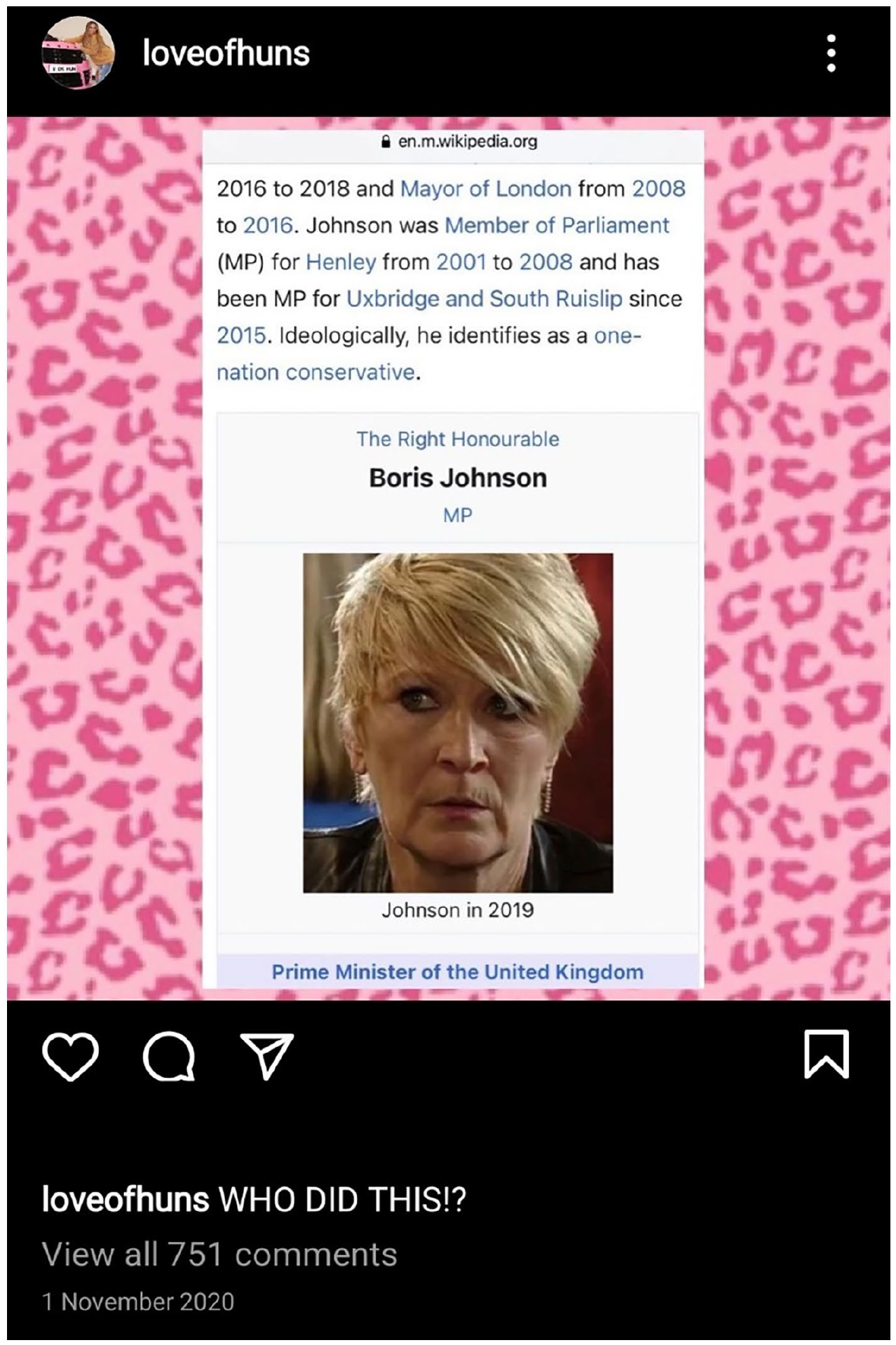
A close-up of Linda Henry replacing the UK Prime Minister Boris Johnson on Wikipedia, posted by ‘loveofhuns’
First, there is potential for transgressive destabilisation in positioning Linda Henry centrally in the frame and replacing a Conservative figure. If, as Kathleen Rowe (1995) argues, women’s ‘public power is predicated largely on visibility’ (p. 11), then Henry’s visual dominance is vital in transforming popular narratives – of who gets to be seen and why. As such, context is central to understanding a meme’s cultural value. EastEnders is a long-running popular soap opera set in Albert Square, a fictional area in East London. The drama is centred around several extended families – focusing on key themes such as community-building, working-class relationships and a distinctly ‘feminine’ way of seeing/being that has historically been associated with soaps. Indeed, ‘[o]ne of the generic demands of soap opera is that there should be substantial, even assertive, female roles within its representation of the family and community’ (Aston and Clarke, 1994: 212). This can be seen in Shirley’s role as the Carter matriarch, whose fractured family life is a constant in the soap’s storyline(s). Carter is a much-loved character on EastEnders for her no-nonsense attitude, sharp wit and androgynous appearance, often described by news articles as a ‘soap legend’ (Tutton, 2019), with ‘fans regularly tweeting their admiration whenever she appears on screen’ (Koncienzcy, 2019).
By comparison, Boris Johnson has been a contentious presence in UK politics. He has developed a reputation, as Leah Tomkins (2020) argues, for ‘picking and choosing whether and when to show up’ (p. 335), with the British public experiencing a ‘deep sense of betrayal that is evoked by the quasi-parental abandonment of not caring’ (p. 35). Shirley Carter, by contrast, has emotional appeal because she is a constant – ‘showing up’ because of the regularity and everydayness of soaps as a TV format. The genre’s longevity and frequency allow female consumers to derive a sense of enjoyment and reassurance through this ‘ritual pleasure’ of viewing (Brunsdon, 1984: 86). By replacing an absent figure with someone who is continually present, for fans of huns and EastEnders, the meme comments on contemporary politics and emphasises ‘comedy and the sense of nostalgia for a lost way of life’ (Geraghty, 2002: 66).
It is also important to note how a character created in the 2000s has been subsumed into the present for radical ends, that is, as a popular replacement for the current political leader. Pamela Robertson (1996) argues that women can ‘reclaim camp as a political tool and rearticulate it within the theoretical framework of feminism’ since ‘camp offers a model for critiques of gender and sex roles’ (p. 6). With a Conservative stronghold and (upper) middle-class representations dominating the media (see Friedman et al., 2016), it is a small yet significant gesture to portray a working-class woman as both visually powerful and in an imagined space of power. The pink leopard print background also alludes to this, as leopard print is often associated with the working-class glamour of soap opera matriarchs, poor taste and overt sexuality. Lauren Eglen (2020) similarly argues that it has ‘been employed as a symbol of rebellious respectability’. By using this backdrop and drawing the viewer’s eye to this space, the creator of ‘loveofhuns’ strengthens the association of Carter/Henry’s distinct, working-class femininity with the Prime Minister, further imbuing Linda Henry’s character with power by taking up space not traditionally built for her.
Yet there is a troubling conservative element to this joke which is apparent in comparing Carter/Henry and Johnson’s appearances, with short hair on Carter/Henry and the slightly longer hair on Johnson blurring the lines of femininity and masculinity, positioning them as visually alike in their incongruous gender representation. While this meme can be perceived as humorous in its destabilisation of gender stereotypes, positioning masculinity and femininity as masquerade, we have to question why this is funny. Although the target of this humour is Boris Johnson – the joke is also on Linda Henry. It is uncertain whether she would find comedy in being perceived as masculine or likened to a male. The self-deprecation of women who perform comedy, or comedy involving women, is lost here because of Henry’s lack of involvement in the meme’s creation – unlike with Katie Price. In this way, humour can be multifarious, ambiguous and polysemic depending on who is ‘in on’ the joke. Despite this, the appropriation of her character in EastEnders points to the transformative abilities of online humour and the ubiquitous, potentially radical envisioning of an impossible future.
In the final post (Figure 4), a photo of the EastEnders actor Natalie Cassidy with the caption ‘Roses are red, violets are blue, i love natalie Cassidy more than I love you xx’ was uploaded on Valentine’s Day, 2021. Although the majority of ‘loveofhuns’ and its content are typically jokes, humorous memes, or videos, this post is a photo of the soap star stripped naked behind a cut-out heart decorated with red glitter, which was used for a special calendar in aid of the charity Children in Need. In response, Cassidy commented ‘Awww’ on the post, demonstrating her appreciation of ‘loveofhuns’ and its earnest and heartfelt dedication to her.
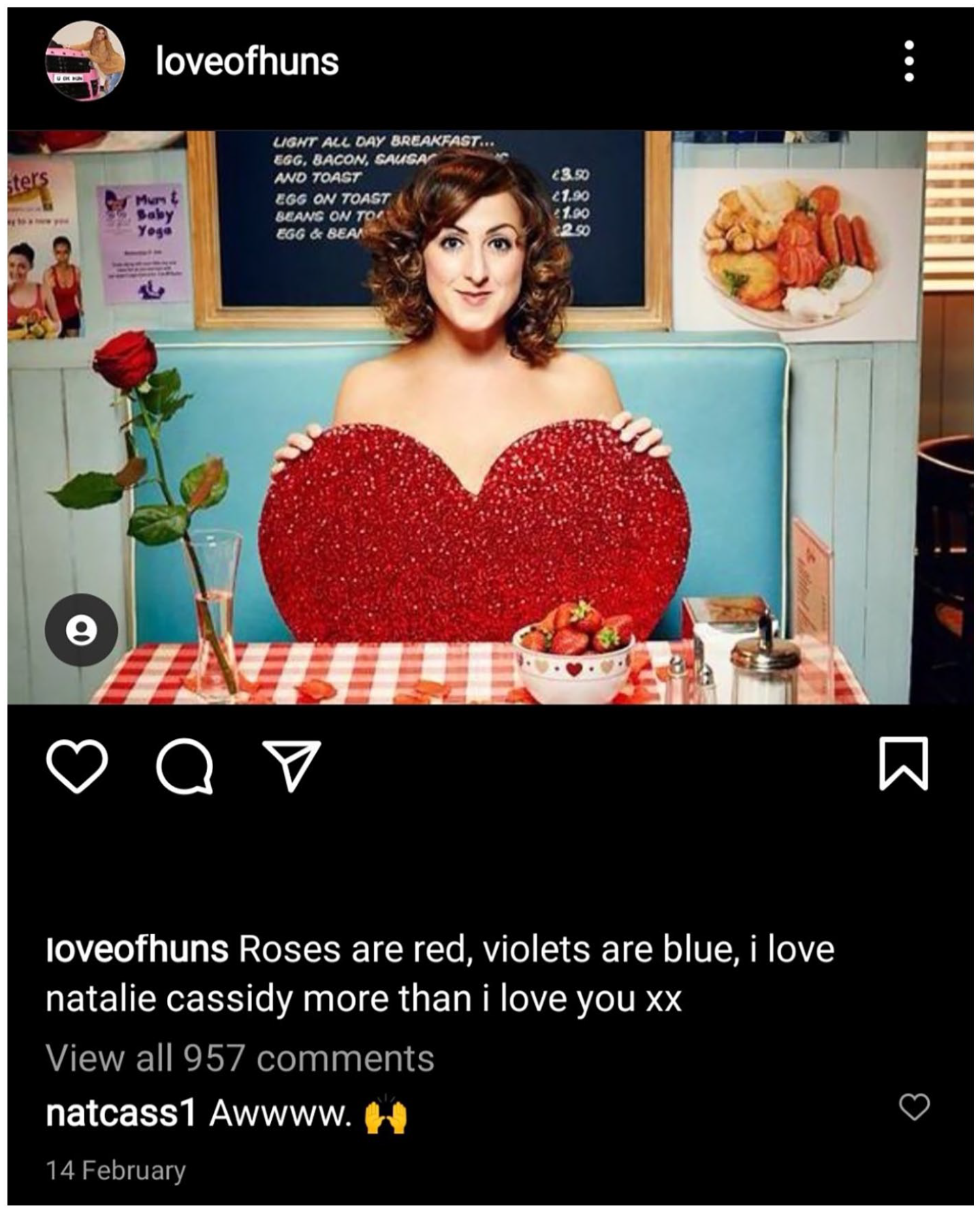
A photo of Natalie Cassidy behind a glittery heart is posted on the ‘loveofhuns’ Instagram page on Valentine’s Day. The caption reads, ‘Roses are red, violets are blue, i love natalie Cassidy more than i love you xx’. In the comments, Natalie Cassidy, via her account @natcass1, responds, ‘Awww’.
Natalie Cassidy is an actor associated with ‘ordinariness’ via her role in EastEnders. Cassidy has been in and out of the series since 1993, when she was 10 years old, and viewers have grown with her character while she has simultaneously grown with the series. One of the most popular storylines involving her character, Sonia Fowler, portrayed her teenage pregnancy and the decision to place her baby for adoption. Like Linda Henry’s character Shirley Carter, audiences of a specific age have become intimately familiar with her character history and development. With Natalie Cassidy in particular, younger fans have engaged with her persona. Writer for Vice magazine Hannah Ewans (2019) believes that [t]hose who adore hun culture are largely working class themselves, or as the ‘Hunsnet’ owner points out, ‘people who are from a working class background but may have had a glow-up of late. They’ve gone to university, now might be working in London or Manchester’.
If an appreciation of huns is linked with age in conjunction with class background, then this form of cultural and camp nostalgia has resulted in fans mining memories of shared collective experiences in the wake of increasingly fractured communities. Since ‘camp is not just nostalgia, but rather a distillation of its pleasurable essence’ (Stevenson, 2003: 113), then this transcendent form of nostalgia bears similarities to the imagined space of power Linda Henry has been placed in.
Indeed, the relationship ‘loveofhuns’ has with Natalie Cassidy is both nostalgic and uplifting – reminding us of Cassidy’s previous work in EastEnders while promoting the videos she uploads on her personal Instagram page. This post, in particular, reminds us that Instagram accounts dedicated to huns are primarily run by individuals, anonymous people who choose what content to curate and engage with. In an interview with Dazed writer Nick Levine, the owner of ‘loveofhuns’ ‘says a watershed moment came when one of their favourite huns, Natalia Cassidy (Sonia from EastEnders), followed them back. ‘The moment that happened, I was ready to clock off early, pour myself a ‘secco, (and say) “my job here is done”’ (Levine, 2020). This is ultimately positive – deriving fun, creativity and a sense of belonging from fan practices and uplifting women’s voices. As the owner of the account has further stated: ‘I can only speak for myself, hunni, but the clue’s in the title – we love the huns’ [. . .] ‘It’s inclusive: if we’re laughing, then we’re laughing along with our fellow huns, not at them’ (Levine, 2020).
Although the owner of ‘loveofhuns’ is concerned with laughter’s inclusive capabilities, which can be seen in the post’s undoubtedly genuine and earnest celebration of Natalie Cassidy as a hun, we have to assess the meme’s content critically. More specifically, the ideas and ideologies conveyed by a meme’s image in conjunction with its caption. The quote ‘Roses are red, violets are blue, i love natalie Cassidy more than i love you xx’ syntactically emulates the phrase ‘U OK hun?’ in its deviation from standard English and association with working-class women. The anonymous creator of ‘loveofhuns’ uses incorrect spelling/grammar and leaves two kisses at the end of their sentence when celebrating Natalie Cassidy. These two elements of lexicon are often connected with the phrase ‘U OK hun?’ in that they display an ironic awareness of working-class women’s speech patterns online in a distinctly British context. By mocking the spelling of a celebrity hun, this joke showcases how huns are ‘like us’ while simultaneously ‘punching down’ to reassert (class) difference.
This ironic awareness can be seen in other posts on the page. For instance, a photo of actor Danniella Westbrook striking a yoga pose bears the caption: ‘When your weekly screen time report is down by 2% #NammyStay #mindbodysoul’. The incorrect spelling of namaste here is used for humorous effect. Yet, in line with the ambivalence of these posts, it also voices a critique of feminine cultures of performative ‘wellness’ associated with middle-class yummy mummies and influencers. Rachel O’Neill (2020) argues that ‘wellness’ is ‘[b]illed as a more intuitive approach to health and well-being’ (p. 628) that has been transformed into a movement on social media, with entrepreneurs creating self-promotional content that promotes Western beauty standards and thin-ideals. O’Neill (2020) further argues that the most brightly illuminated wellness entrepreneurs in the United Kingdom – those who not only command large followings online and top best-seller lists, but whose activities are spotlighted by lifestyle features and TV appearances – adhere to a particular profile. They are young, slim, class-privileged, able-bodied, and almost uniformly white [. . .] they are lit up and illuminated – literally and symbolically – as embodiments of idealized femininity. (p. 629)
This middle-class wellness entrepreneur differs significantly from the hun, who is not always young and slim but, more often than not, is an ageing celebrity in the British media landscape who does not adhere to or live up to normative beauty standards. Her appearance is matched by an excessive ‘larger than life’ personality. In this way, the posts on ‘loveofhuns’ reinforce stereotypes while using humour to subversive ends – mocking middle/upper-class ideals while providing significant space for huns visually coded as working-class.
Conclusion
This article has engaged with scholarship on mediated figures of (classed) femininity, celebrity culture and social media to examine how audiences construct the hun as a memetic figure online. While other memetic figures such as Karens, chav(ette)s and ladettes have been figures of ridicule and scorn in the popular media landscape, the hun has been celebrated on social media. Nostalgia for the 1990s and 2000s has produced spaces in which the past and the present collide, creating digitised comedic moments to reclaim power from the tabloid cult of the celebrity where acceptable female behaviour was initially dictated.
Although the aim of ‘loveofhuns’ and the conceptualisation of huns more broadly is to be celebratory, ultimately, it is ambivalent in who is the target of its posts, memes and jokes. The creator of ‘loveofhuns’ argues that its page is a love of huns and inclusive. However, it must be questioned whether this inclusivity is merely surface level – given that the working-class woman still has symbolic violence enacted against her in Britain and is reduced to a stereotype of being loud (visible online) and unintelligent (through her typographical errors). This bears similarities to Imogen Tyler and Bruce Bennett’s (2010) assertion that, for the celebrity chav, media engagement is not merely directed towards the pleasures of a comparative sense of self-worth; it also serves to reinforce the understanding that ‘we’, the audience, occupy a secure position from which to make evaluative assessments of the inferior class status of others. (p. 380)
In the case of huns, this comparison is not overtly expressed; instead, it is wrapped up in layers of camp nostalgia and humour. This situates the hun as a multifarious and polysemic source of laughter.
As is further suggested throughout this article, memes are important textual artefacts in demonstrating how fans intertwine elements of humour, nostalgia and British femininities to compare/contrast the past/present and create new spaces of possibilities: from picturing Linda Henry/Shirley Carter as the Prime Minister to remembering Natalie Cassidy as an important soap star in the televisual landscape. ‘Camp’ remains a significant sensibility in this regard as it has demonstrated the critical potential for this political work, with fans of the hun creating more substantial equity in the public sphere by revelling in the joys of Alison Hammond and Katie Price. While this laughter often has competing and conflicting messages, online spaces have evidently forged new spaces for female connectivity, collectivity and solidarity.
Footnotes
Acknowledgements
I would like to thank the two reviewers and editor Helen Wood for their helpful and supportive feedback on earlier drafts of this paper.
Author’s Note
Laura Minor is now affiliated to University of Salford, UK
Funding
The author received no financial support for the research, authorship, and/or publication of this article.

Teleography/Filmography
Big Brother (2000–2018) Channels 4 and 5, 14 July.
Celebrity Big Brother (2001–2018) Channels 4 and 5, 9 March.
Coronation Street (1960) ITV, 9 December.
Celebs Go Dating (2016) E4, 29 August.
Dancing on Ice (2006) ITV, 14 January.
Desperate Housewives (2004–2012) ABC, 3 October.
East Enders (1985) BBC One, 19 February.
Fleabag (2016–2019) BBC Three and BBC One, 21 July.
I’ma Celebrity . . . Get Me Out of Here! (2002) ITV, 25 August.
Little Britain (2003–2007) BBC Three and BBC One, 9 February.
Love Island (2015) ITV2, 7 June.
Loose Women (1999) ITV, 6 September.
RuPaul’s Drag Race (2009) Logo TV and VH1, 2 February.
RuPaul’s Drag Race UK (2019) BBC Three, 3 October.
RuPaul’s Drag Race UK vs the World (2022) BBC Three, 1 February.
Saturday Night Live (1975) NBC, 11 October.
The Only Wayis Essex (2010) ITV, 10 October.
This Morning (1988) ITV, 3 October.
What Ever Happened to Baby Jane? (1962) Directed by Robert Aldrich [Film].