




Abstract
In an Australian regional and rural context, inequalities in the location of telecommunications infrastructure and uneven development pose urgent spatial justice questions for policy and planning. These spatial injustices are reinforced by the imaginaries and ideologies of telecommunications development and which populations and locations can benefit from the growth gains attributed to enhanced telecommunications infrastructures. First Nations contributions to telecommunications planning and development are marginalised within the imagined futures and current experiences of internet and mobile coverage in regional and rural towns. Drawing on data from a project focused on regional and rural consumer understandings of smart technologies in North West New South Wales, Australia, we suggest that in order to more substantively position First Nations as growth contributors to telecommunications futures, a re-orientation of place, connectivity, and mobility in planning and engagement is necessary.
Keywords
In an Australian regional and rural context, the power dynamics of telecommunications infrastructure reveal inequalities in location and raise policy and planning concerns regarding spatial justice. Imaginaries and ideologies of telecommunications development exacerbate spatial injustice, particularly the expected growth gains for regional and rural towns resulting from enhanced telecommunications infrastructure. This paper draws on data from a project focused on regional and rural consumer understandings of smart technologies in North West New South Wales, Australia. Given the importance of location and spatial justice to these understandings and experiences of telecommunications, the exclusion of First Nations’ stakeholders and knowledge of place and Country from policy and planning is problematic. The experiences of internet and mobile coverage and their imagined futures for regional and rural towns reveal socio-spatial relations of inclusion and exclusion that work to marginalise First Nations contributions to telecommunications planning and development. We suggest that a re-orientation of place, connectivity, and mobility will work to more substantively position First Nations as growth contributors to telecommunications futures and help address spatial justice.
In the first part of the paper, we outline the project and connect the project data on internet and mobile service to spatial justice and the mobility anticipated by telecommunications futures. We articulate the relationship between telecommunications and regional growth as a spatial struggle over scale for infrastructural parity with cities and the attendant economic benefits this parity will bring. The scale of what is possible in terms of telecommunications is mediated by the topographical refractions of internet and mobile coverage where the geographical unevenness of coverage hinders and reduces the scale of regional development. Turning towards First Nations conceptions of Country as agentic and an actor in infrastructural networks, we argue that regional scales of development assume non-Indigenous conceptions of mobility where place is implicitly construed as an obstacle to growth. What might telecommunications futures sound like if the environment was an actor rather than logistical obstacle to connectivity? How might regional growth be rescaled so that place-based responsibilities enhance connection to development opportunities? Aligning regional and rural telecommunications landscapes to First Nations futures provides an opportunity to address spatial justice in policy, planning, and consumer domains.
Telecommunications and spatial justice
A consistent theme on the literature of telecommunications’ inequalities has highlighted the role of geography and location in providing certain cities and regions with a developmental advantage (see McMahon et al., 2021; Park, 2017). Summarising this research, Tooran Alizadeh points to the utility of a spatial justice approach to telecommunications infrastructure. Such a framework highlights how ‘geographically uneven and underdevelopment of critical infrastructure provision … produces injustice’ whereby ‘infrastructure unevenness rigidifies into more lasting structures of privilege and advantage’ (2015: 282). In the context of smart technologies, research and planning favours smart ‘cities’ (see Campbell, 2012; Caragliu et al., 2011). According to Christine Steinmetz-Weiss et al. (2022), ‘limited attention has been given to the “smartisation” of regional and rural areas’ and the differing ‘spatial scales’ of these areas (p. 1). As a result, ‘what “smart” looks like in the regions is currently under-explored’ (p. 2). Our project focused on regional and rural communities and their digital experiences of smart technologies inclusive of telecommunications. The project was funded by the Australian Communications Consumer Action Network (ACCAN).
The case studies for the project were from North West New South Wales and included Dubbo, Wellington, Narromine, Gilgandra, and Peak Hill. These towns are located in the Orana region, which is situated in Wiradyuri Country. Wiradyuri comprises one of the largest First Nations in New South Wales. Other nations from this region include Wangaibon Country, in the Ngiyampaa Nation, and the region is also home to Gamilaraay, Wiradyuri, and Wayilwan peoples. Out of the five case sites, Dubbo is the largest with a population of approximately 40,000 (ABS, 2020a). The populations of Wellington, Narromine, Gilgandra, and Peak Hill range from 1000 to 6500 (ABS, 2020b, 2020c, 2020d, 2020e). First Nations make up 15% of the population of Dubbo and constitute a relatively high proportion of the population in the surrounding towns, for instance a third of the population in Wellington are First Nations (ABS, 2020e). According to Australian Bureau of Statistics classifications of remoteness from Major Cities, Dubbo is an Inner Regional area and the other four sites are Outer Regional. Participants in the Outer Regional areas referred to themselves as rural.
The project comprised three components: a questionnaire (with 119 respondents) and the option for a follow-up interview (totalling 10), interviews with a range of stakeholders (local councils and Land Councils, totalling 10), and case studies of the five sites plus an overall case study on Local Aboriginal Land Councils. The latter represent First Nations communities in a local area and at the New South Wales state level. Their responsibilities include managing land assets and supporting the development of local communities. Local councils manage municipal operations within local government areas. Local government areas do not always spatially correlate with Local Aboriginal Land Councils. For instance, both Dubbo and Wellington are managed through a single local government area whereas there are two separate Local Aboriginal Land Councils in Dubbo and Wellington. Councillors provided consent for their names to be used in the project results. Interviews with consumers resulting from the questionnaire use de-identified codes (e.g. Q1, Q2, etc.).
The project utilised a mixed-methods qualitative approach to understand participant experiences with smart technologies and telecommunications. The case studies included council planning documents and policies, state and federal policies, newspaper articles, attendance at council seminars and workshops, the project interviews, and local knowledge of the project lead who lives in Dubbo. Project data was coded using NVivo and common themes were extracted for analysis. To proceed with the online questionnaire, participants were first required to complete the consent cover page and interviewees signed consent forms prior to the interviews. The project was approved by Charles Sturt University's Human Research Ethics Committee (H20316).
We have published elsewhere on participants’ perceptions of telecommunications as effecting infrastructural inequality and how this inequality impacts growth and liveability in rural and regional New South Wales (Randell-Moon and Hynes, 2022), including a focus on First Nations smart planning. We have also focused on the project results related to consumer knowledge and awareness of smart technologies in regional and rural areas (Randell-Moon and Hynes, forthcoming). In this paper we examine some of the assumptions regarding regional growth, mobility, and telecommunications parity with metropoles. Although the project was focused on smart technologies, a consistent and pervasive theme throughout the participant data was poor telecommunications service and how this service hindered participants’ capacities to imagine smart futures. We turn now to a consideration of the geographies of scale related to regional and rural telecommunications and how these scales impacted participants’ ability to imagine the future development or underdevelopment of their town.
Regional and rural telecommunications and geographies of scale
In Australia, federal and state governance of the regions has tended towards devolution to ‘local governance scales’ putting more responsibility on municipal councils to determine and drive planning agendas within constrained fiscal budgets (Tonts and Horsley, 2019: 119). Local governance contributes to uneven development with amenity migration channelled into better-resourced regional areas based on select industries such as tourism (p. 119) and the natural minerals sector. The concentration of infrastructure into already resourced places creates spatial injustice. Andrés Rodríguez-Pose has identified these trends as exacerbating resentful polities and places that feel ‘left behind’ (2018). In their study of regional telecommunications, Julie Freeman et al. (2020) also identified residents’ fears for the future and being ‘forgotten’ (p. 1953; see also Park et al., 2019: 152).
How regional infrastructure is experienced as ‘good’ or uneven is differentially tied to scale. Here we draw on the work of Neil Smith (1992) and his theorisation of scale as central to the geographical effects of policy, planning, and the economy on diverse social groups (p. 74). Social groups may be relatively empowered or disempowered by the scale of planning or governmental programmes. In our project, when discussing telecommunications infrastructure, a town mayor stated: ‘I’d like to see someone have the same opportunity in Gilgandra as … [they] have in Chatswood to utilise technology’. Gilgandra is one of the small rural towns in our study and Chatswood is a major business and residential suburb in the capital city of Sydney. The mayor is comparing Gilgandra to Chatswood to illustrate the taken-for-granted infrastructural amenities in metropolitan areas. The scale of comparison is to illustrate that location should not differentially impact telecommunications provision. At the same time, the scale also frames infrastructure within particular planning imaginaries and ideologies that assume there are no infrastructural inequalities and digital divides in Sydney. Qualitative as well as quantitative understandings of telecommunications impact spatial justice. That is, it is not just technical efficiency but comparative quality of opportunity with other places that matters for telecommunications equality.
One of the authors witnessed the struggle over infrastructural scale during the 2021 Regional Telecommunications Review NSW Central West online consultation (September 10). The Review broadly surveys telecommunications performance in regional areas. Participants kept insisting that the internet had been ‘turned down’ – that is, the speed had been ‘reduced’. The panellists, mainly technocratic experts, were at pains to point out that in times of congestion, access is managed so that more people can use the internet, which means ‘slower’ speeds are experienced. Participants nevertheless suggested that if speed could be managed for deceleration then conversely, acceleration was possible and should be implemented. These different understandings and perception of internet regulation indicate a struggle over scale where local residents view infrastructure as something you have or do not have versus a managerial approach premised on economising and therefore scaling infrastructural resources.
Participants in our project expressed frustration with the scale of telecommunications provision in terms of both geographical unevenness and its consequences for the scale of regional growth. These scales are also connected to mobility and anticipated futures. Peter Adey has connected imagined geographies with the spatialisation of the future and anticipation in an examination of transport infrastructure such as air travel (2010). The introduction of new technologies creates new ways of practicing and experiencing mobility and anticipation that are spatially differentiated depending on where these technologies are located. Telecommunications is a significant site of mobility in the transportation of knowledge and relationships across space. The term ‘mobile’ for phones indicates this space-time compression of distance. As indicated in the above comments regarding Gilgandra and Chatswood, telecommunications actively structures the ‘future practices and performances’ (Adey, 2010: 10) of regional development.
We would like to rescale these concepts of mobility further by linking them explicitly to the settler colonial context of regional development. Chickasaw scholar Jodi Byrd (2009) has argued that digital conceptions of the future position technology as rendering place and therefore First Nations with place-based responsibilities redundant. Within settler colonial infrastructural imaginaries mobility and growth are scaled as unproblematic and normative. As we have argued elsewhere (Randell-Moon, forthcoming), regional infrastructure and regional development have a settler colonial history involving frontier and resource warfare where ‘closed’, ‘under-developed’ and ‘place-less’ locations are ‘opened’, ‘mapped’ and ‘developed’ through transforming Indigenous immobility into supra-regional mobility on a global scale. This is an over-writing of already existing Indigenous routes for trade, transport and the circulation of knowledge. For Kwanlin Dun First Nations scholar Anne Spice, critical infrastructure projects are implemented through policy and planning frameworks that anticipate futures for a settler public (2018). As we will go on to discuss, regional Indigenous populations are literally evaluated as immobile and unproductive in productivity assessments. Tebrakunna country et al. argue that regional development needs to shift from a deficit to growth positioning of First Nations. The increasing importance of place-based regional strategies can capitalise on the scale of Indigenous connections to place. But where ‘Any community may identify with a place or leverage its attributes … the time scale of Indigenous communities’ place knowledge and place attachment is of a completely different order’ (2019: 1511). First Nations’ connections to place highlight the non-Indigenous assumptions in both telecommunications policy and planning and regional and rural responses to this planning as spatially deficit.
First Nations mobility and regional development
Telecommunications quality was understood by project participants through scales of growth connected to mobile populations and scales of development connected to roll-out programmes. Population drift was a recurring theme in our project data with participants expressing urgent concerns that the lack of quality telecommunications was inhibiting growth and liveability in regional and rural areas. References to aging populations and population decline in the region were common. Such populations are positioned in policy and planning discourse as slowing down growth and their immobility is a problem for mobile economies (Rodríguez-Pose, 2018: 205). Residents were conscious of the importance of quality telecommunications infrastructure for liveability and growth in relation to the scaling of local to the global: Well, being connected, I suppose, and that's a bit of a pun, but being connected to the broader community. It means that you can be a small rural community, but still have access to up-to-date information … Because we have the technology now, you can be living in Peak Hill and still working … having that technology to be able to then work from home, which you could do in a very small community but still be connected to the likes of the world, I suppose. (Louise O’Leary, Parkes Shire Councillor)
However, concerns regarding population drift due to lack of infrastructure did not explicit this drift as non-Indigenous. First Nations populations in regional and rural areas remain generally stable. In addition, First Nations are a demographically young population. As with the designations of rural, regional and urban, non-Indigenous settlement patterns predominate conceptions of space and the power geometries of scale. Major capital cities are generally located on the coast of the Australian continent and considered ‘centres’ of the national economy. Rural and regional towns geographically located in the centre of the continent are paradoxically rendered peripheral.
Telecommunications’ regional and rural futures tend towards non-Indigenous assumptions of growth and liveability. In our project, we surveyed a range of smart and digital policy development in regional New South Wales and could not find publicly available evidence of First Nations being recognised as stakeholders to the economic benefits promoted by enhanced telecommunications capacity. We have argued elsewhere the exclusion of First Nations from smart planning is a constitutive planning absence (Randell-Moon and Hynes, 2022) and reproduces assumptions that First Nations and technologies are in binary opposition. Because technologies are imagined as futuristic, the framing of First Nations as non-technological reiterates what Yugambeh writer Maddee Clark describes as: ‘One of the central fantasies of colonisation in Australia’ where ‘Aboriginal people have no future’ (2016).
Paradoxically, despite being a young population who remain in place in regional and rural areas, First Nations are constructed as immobile and a problem for productivity. For instance, in the Australian Government's Productivity Commission report Transitioning Regional Economies, Indigenous preference for staying on Country is positioned as limiting employment choice and mobility (2017: 185). The adaptive capacity of regions to national and global economic trends may be slowed by Indigenous population in some of the metrics – ‘as the proportion of Indigenous population gets higher, each additional percentage of Indigenous population has a smaller influence on the region's adaptive capacity’ (pp. 240–241). First Nations relationships to Country and choice to stay in regional (and rural) areas are valued as a deficit and become an infrastructural and productivity problem to be solved.
The policy and planning construction of First Nations’ immobility reflects the broader structural impact of programmes on telecommunications unevenness. The decentralisation of regional infrastructure has led to a roll-out version of neoliberalism (Tonts and Horsley, 2019) where project or programme-specific support for telecommunications is provided. Roll-out programmes – as opposed to fundamental funding – were frustrating to participants as it caused planning delays and inhibited local initiatives. One mayor exclaimed their local strategies were ignored by federal and state governments because they were ‘Too smart!’ – that is, too efficient and locally responsive for the broader government regulation and funding processes to handle (Randell-Moon and Hynes, 2022). Because of these planning buffers, participants were ‘embargoed into a relationship of temporal economics’ (Adey, 2006: 89) waiting for infrastructure and funding roll-outs. Participants’ views regarding these anticipated futures reflect scholarly and policy consensus that lack of digital infrastructure ‘reduces the attractiveness of regional and rural areas to industry, business, and younger, more mobile workforces, impeding job creation and economic growth’ (Steinmetz-Weiss et al., 2022: 2). Such a consensus weights telecommunications with expectations in ‘the role of posited future’ (Mahony, 2019: 1279). Even though it is market growth that results in the lack of market incentive for regional telecommunications services, such growth is paradoxically weighted with anticipation and expectations to ameliorate telecommunications inequalities.
There is geographical unevenness in centralised telecommunications infrastructure and programmes for regional and rural areas. The government broadband infrastructure, the NBN (National Broadband Network), was described as slow, not competitive in regional areas, not well aligned with community service obligations, and potentially exacerbating rather than addressing infrastructural inequality (Randell-Moon and Hynes, 2022). NBN is constrained by a profit remit while being simultaneously required to provision internet access to regional and rural areas where there may not be a cost recovery or viable consumer base for a service provider. The federal government's Mobile Black Spot Program (Australian Government, Department of Infrastructure, Transport, Regional Development and Communications, n.d.[a]), which can improve mobile coverage through tower and telecommunications infrastructure placement, was also considered slow and inefficient (Randell-Moon and Hynes, 2022). This is partly due to the difficulty of installing infrastructure in regional and rural topographies where signal transmission is uneven. The project lead asked about the federal government's Regional Connectivity Program (Australian Government, Department of Infrastructure, Transport, Regional Development and Communications, n.d.[b]) and found participants did not view it as a key resource for resolving telecommunications issues.
Participants in the Telecommunications Review session discussed the impact of buffering on the conduct of online meetings. These are examples of what Freeman et al. (2020) describe as ‘interrupted access’ (p. 1947). Telecommunications universal service obligations provide access to internet but not providers or type of access (Australian Government, Department of Infrastructure, Transport, Regional Development and Communications, n.d.[c]). NBN can provide areas with fibre to the node but if no service provider utilises the network then consumers miss out. One town mayor explained, ‘On the junction basically to the main street from Warren Road there's now fibre to the node into there, which allows the technology up the main street, but no one will provide it’. Participants also discussed the wait times to access certain packages or change packages when they do not work, with one reporting ‘a six-month battle’ [Q6]. These participants feel like ‘yo-yos’ (Freeman et al., 2020: 1954) in bearing the time-costs for accessing quality service (Park et al., 2019: 146).
Such service interruptions and the experiences of waiting in-between programme roll-outs are a consistent feature of First Nations policy (Huencho, 2021; McKenzie, 2010; Moreton-Robinson, 2020). Non-Indigenous comparative scales are weighted towards expectations of parity with cities. First Nations’ governance and development needs take place in a policy setting where governmental and industry failure to deliver are normalised. On the one hand, interrupted funding parameters can compel innovation as with the case of Gila River Telecommunications, Incorporated, in the United States. This corporation was established to deliver telecommunications to a rural area neglected by state and federal authorities. On the other hand, First Nations communities, as with regional and rural communities, are reliant on what service is provided by select telecommunications companies.
Service provider monopolies were a consistent feature in the uneven geographies of regional telecommunications experienced by participants. One participant stated: mobile coverage is pretty good. The thing that I would probably – I think the problem is that it's basically … Telstra. If you go 5, 10ks [kilometres] out of town, you basically have Telstra. You’ve got nothing else. As you get further out, it's literally – you have Telstra and nothing else. They tend to be relatively intra-competitive in terms of their pricing when it comes to some of the plans that – I think that's not ideal and could be improved. Yeah. [Q3]
Due to the increasing costs of internet service providers, 5G has emerged as an alternative market with particular implications for regional (and potentially rural) consumers. According to ACCAN, 91% of Australians use a mobile to access the internet (ACCAN, 2021: 9). The federal government has regulated the 5G spectrum allowance for Mobile Network Operators (MNOs) to no more than 40% of low band spectrum for urban areas with 45% being set for regional areas (ACCAN, 2021: 22). The latter recognises the need to incentivise MNOs in non-urban areas, which has been a longstanding concern in Australia (Cameron, 2006; Crase et al., 2001). Consumer use of 5G in this project's case areas is constrained by the monopoly of Telstra, the largest of Australia's three MNOs. The other two operators are Optus and TPG Telecom. Telstra began as Telecom, Australia's public, national monopoly service provider, and only began to be privatised during the second half of the 1990s (Given and Goggin, 2000). Telstra has the most extensive 5G network across Australia, and was the only MNO providing 5G service in outer regional and remote Australia until 2022, when Optus reported 5G sites in these areas for the first time (ACCC, 2022).
The 5G receptivity was largely clustered towards the centre of town during the period of our project (2021). Accessing 5G broadly replicates socio-spatial inequalities within the towns in terms of infrastructural prioritisation of some areas over others. Telstra's T25 Strategy ‘sets the goal of around 95% population 5G coverage by 2025’ and they have so far ‘switched on 5G services in more than 100 regional towns and cities’ reaching a 5G penetration rate of 75% (ACCAN, 2021: 36). As can be seen from Figure 1, there is a danger that when Telstra enacts the planned switch-off for 3G in 2024, users outside of the centre of towns may be disadvantaged (see ACCAN, 2021: 5, 17), particularly given the shorter range of 5G signals (Freeman et al., 2020: 1954).
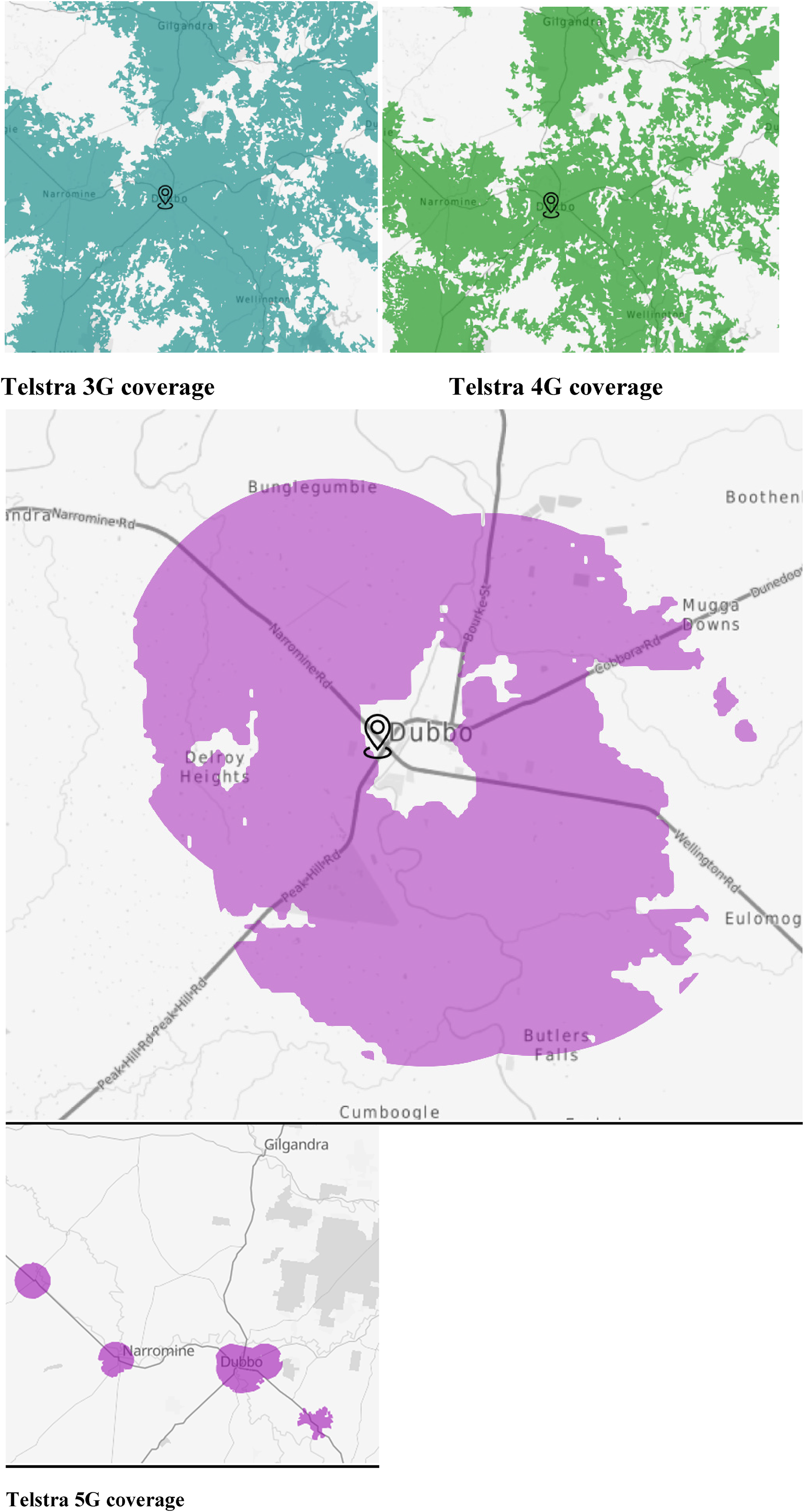
Telstra coverage in Dubbo and surrounds. Source: https://www.telstra.com.au/coverage-networks/our-coverage
Participant concerns with liveability informed their views on telecommunications quality, particularly with respect to amenity migration and growth assumptions related to fears of population decline. There was evidence of frustration with service provider and roll-out programme lags interrupting both business and leisure practice. While these concerns were shared across participants, it is important to note that population decline is largely demographically non-Indigenous and that programme and service gaps are a consistent feature of First Nations’ community and governance development. In the following section, we want to rescale these concerns further in relation to the positioning of topography as an obstacle for telecommunications receptivity.
Rescaling telecommunications spatial justice
So far we have been discussing how the unevenness of telecommunications infrastructure is experienced through geographical scale – scales of growth associated with who lives in regional and rural areas and who could live in these areas if quality telecommunications were realised now. Comparative scales were also used to illustrate spatial justice and the resources available in other spaces to achieve growth. Participants were aware of the relationality of telecommunications networks and their connections of the local to other geographical scales. For instance, one interviewee described the speed of the internet as ‘very slow’ because ‘at certain times … one would anticipate, well, that's the Americas waking up’. Such experiences of speed, buffering, and delay exemplify lively and unpredictable infrastructure (Amin, 2014) as well as the ‘new types of knowledge encompassing broader contexts of connectivity’ (Freeman et al., 2020: 1947). A source of frustration for participants was the seemingly arbitrary way topography impacts internet and mobile reception, with some residents experiencing quite different speeds while inhabiting the same area (see also Freeman et al., 2020: 1954; Park et al., 2019: 147). The following interview with Local Aboriginal Land Councils identifies these gaps: Interviewee 1: Oh, it is up in that new estate, where the old railway line was there— Interviewee 2: Magnolia Estate. Interviewee 1: —where Margaret Crescent is. On the other side of that, where the new homes are— Interviewee 3: There's no coverage. Interviewee 1: —there's no coverage. They gotta come outside their house and across the road to get mobile service. Interviewee 2: It's the same with Delroy. Interviewee 3: There's a blank spot in Delroy as well, where they can’t get Internet. They didn’t realise that when they built their houses there. Interviewee 1: They don’t tell ‘em that when they build it. No.
For tebrakunna country et al., First Nations concepts of Country have value for place-based regional development (2019: 1516). They note that ‘policy-makers tend to construe Indigenous groups as communities in need of assistance to overcome disadvantage, rather than as important regional development actors’ (p. 1509). They identify three specifically First Nations contributions to regional development: ‘deep regionalism’, ‘Indigenous worldviews’ and ‘reframing colonial relationships’ (p. 1511). Understandings of Country from a First Nations perspective, where land facilitates relational and reciprocal responsibilities for those who inhabit it, are helpful for illustrating how rural and regional terrain have agency in facilitating receptiveness to telecommunications. Such understandings combine deep regionalism and knowledge of Country and may help to overturn colonial constructions of First Nations as technologically deficit. David Kelly (2019) describes First Nations’ axiological conceptions of Country as ‘a living body that has the capacity to affect and be affected’ (p. 385). For this reason, ‘the spacetimes of a living Country’ (p. 387) enact their own forms of connectivity and mobility. The representation of regional and rural topography as impeding the smooth flow of mobile receptivity is an over-writing of the agency of Country and its capacity to ‘signal the arrival of uncertainty where dominant modes of thought and being become disordered’ (p. 391). Using the concept somatechnics, Ngāti Maniapoto, Tainui, Ngāi Te Rangi, Ngāti Awa scholar Pounamu Jade William Emery Aikman resituates technology within the environment whereby ‘land is the techné, or technology, that gives rise to life’ (2019: 291).
Per tebrakunna country et al. (2019), reorienting infrastructure planning and development to recognise First Nations in ‘growth-focused regional development’ (p. 1509) can occur through rescaling conceptions of land as an active generator of technés for mobility, responsivity and connection. Specifically, First Nations’ and Elders’ detailed and specific knowledge of Country has potential for telecommunications planning and the location of infrastructure in areas that best serve both the environment and human actors. Such knowledge would align with policy calls for ‘Place-based connectivity solutions’ (ACCAN, 2021: 37) that ‘better address varying topography and communities’ socio technical capabilities’ (Freeman et al., 2020: 1961). Commenting on dominant economic and development paradigms, Kaely Woods notes that First Nations are often presented with ‘development or culture’ as a binary choice (2016: 87). That is, First Nations’ culture and heritage may be explicitly recognised as important but not linked to actual development plans. In the NSW Government's report on its smart planning, The State of SmartNSW: Key insights (2022), there is an Acknowledgement of Country at the very beginning but First Nations do not otherwise feature in the remainder of the report. Although the number of First Nations participants in our project was small, they expressed concern regarding the sustainability of governance work and business planning needs. These were identified as strategic and urgent areas requiring smart capacitation. It is unfortunate then that Dubbo Regional Council's Smart Region Strategy (2022) only identifies cultural applications of smart technologies for First Nations. For instance, ‘virtual technologies can provide new opportunities for appropriately documenting and sharing culturally and historically significant information’ (p. 18).
Jennifer Carter and David Hollinsworth argue that the persistent reference to culture in planning policies is a result of hegemonic stereotypes of First Nations as non-urban and cultural rather than economic, ‘Dominant representations of remote Aboriginal people living on traditional homelands and engaged in “traditional” environmental protection are assumed to hold for all places’ (2009: 414). Notions of ‘traditional Aboriginal culture’ work to ‘preclude informed, economic motivations and privilege primordial attachments to land that are overwhelmingly spiritual and communal’ (p. 415). These models of engagement construct First Nations’ interests only in relation to culture and heritage and therefore displace the potential for First Nations to be positioned within economic development as decision-makers and growth contributors. Rather than viewing First Nations as immobile due to ‘primordial attachments’, we argue there is a need to shift the immobility of non-Indigenous perceptions of First Nations’ habitation of Country as a problem to be solved. In the context of smart planning and telecommunications infrastructure, these scales of mobility have a constraining effect on future imaginaries. As Martin Mahony notes, ‘the definition of who gets to imagine and define futures’ impacts “social marginalization”’ (2019: 1280).
Dominant conceptions of mobility are premised on power dynamics whereby immobility is transgressed (Adey, 2006: 77) and overcome. But immobility is relative and never absolute, there are ‘only mobilities which we mistake for immobility, what could be called relative immobilities’ (p. 83) as ‘everything, eventually, is mobile’ (p. 82). Applied to the specifics of this paper, the relative immobility of regional and rural growth, the capacity for ameliorating ‘declining’ populations, and the obstinacy of topography, form an experiential, policy and scholarly consensus regarding regional telecommunications infrastructure. If these assumptions are rescaled, it is possible to reposition topography as agentic and receptive with First Nations expertise playing an important strategic planning role in telecommunications. Telecommunications infrastructural inequalities relate not only to spatial injustices but scalar injustices in terms of the populations included in mobile futures and the immobilities that attend to marginalised groups in dominant assumptions of regional growth.
Conclusion
Telecommunications revolutions create anticipatory futures premised on growth and mobility. These anticipated futures actively shape practices and experiences of uneven telecommunications in regional and rural areas. Policy and planning need to recognise the spatial justice concerns of regional and rural telecommunications consumers where technical efficiency and access are as important as qualitative concerns with parity. Data from our projects show that dominant assumptions of growth have the potential to create comparative scales of resentment and fear of places being ‘left behind’. We suggest that the extant literature on spatial justice concerns can be augmented through further inclusion of First Nations stakeholders and challenging non-Indigenous assumptions of scale, mobility and connectivity. Spatial justice considerations for telecommunications can incorporate First Nations’ experiences of policy and planning interruptions, service monopolies and relational scales of place. Participants in our project had a shared understanding of how their telecommunications’ use related to other places. Regional and rural consumer concerns with being ‘left behind’ can be mitigated by reorienting understandings of topography not as an obstacle but a place-based asset. The latter could address industry and planning calls for bottom-up place-specific programmes that align with community needs.
Regional and rural telecommunications are characterised by immobilities as much as mobilities and there are socio-spatial implications for which populations are included or excluded from mobile futures. Consideration of First Nations as telecommunications and regional planning stakeholders offers the opportunity to rescale assumptions regarding population growth and topography deficits. Common discourse which ties population demographics to regional areas in relation to an aging population and decline overlook First Nations’ presence in regional and rural areas. More troublingly, this discourse contributes to a constitutive First Nations planning absence in telecommunications policy and applications such as smart technologies. Telecommunications revolutions are aligned with acceleration and growth but are inevitably limited by environmental factors. Where the environment creates spatial obstacles for telecommunications parity between regional and rural areas, First Nations’ relationships with Country offer the opportunity for ‘decolonial articulations of sociotechnic futures’ (Mahony, 2019: 1282). Scaling infrastructure to respond to rather than overcome topographical specificity will better align telecommunications with sustainability and reframe the scale of telecommunications parity to the communities within regional and rural spaces.
Footnotes
Acknowledgements
We acknowledge the sovereignty of the Wiradyuri, Wayilwan, and Gamilaraay Nations and language groups as well as the Gadigal peoples of the Eora Nation on whose lands this study was conducted. We pay respects to Elders past, present, always. We honour them for their custodianship of these lands, which has enabled the maintenance of knowledge and information pathways across Country and into the future. We also thank the editors and reviewers for their insightful comments and suggestions which have improved the paper. We acknowledge the funding and support from ACCAN to undertake the project upon which this research is based. The research outlined here constitutes the views of the paper’s authors.
Declaration of conflicting interests
The authors declared no potential conflicts of interest with respect to the research, authorship, and/or publication of this article.
Funding
The authors disclosed receipt of the following financial support for the research, authorship, and/or publication of this article: This work was supported by the Australian Communications Consumer Action Network.
