



Abstract
5G is described as a step change in mobile delivery. While it has the potential to provide significant benefits to remote First Nations communities and homelands in Australia, the current market-driven model of 5G deployment building outward from urban and regional centres risks increasing existing digital inequalities. A new Closing the Gap target aimed at digital equity for First Nations people by 2026 provides a critical lens to assess the impact of new technologies on digital inclusion for vulnerable populations. This article draws on findings and case studies from the Mapping the Digital Gap research to analyse the potential benefits, risks and limitations of 5G in closing the digital gap across remote Australia. Alternative communications solutions combined with co-design principles may be more effective in addressing remote First Nations communities’ needs. The authors call for more holistic policy and targeted programs to improve digital inclusion for remote First Nations people.
Keywords
Introduction
In 2020, a new Closing the Gap 1 Outcome 17 was introduced to ensure Aboriginal and Torres Strait Islander people ‘have access to information and services enabling participation in informed decision-making regarding their own lives’ (Closing the Gap, 2020). The associated Target 17 ambitiously aims for equal levels of digital inclusion to other Australians by 2026 (Closing the Gap, 2020). As governments and businesses transition to digital service delivery, the achievement of other targets in the Closing the Gap agreement, such as those related to improved health, education and employment outcomes are now closely linked to progress on digital inclusion.
Access to affordable, reliable communications may have become an essential service, yet the Australian Digital Inclusion Index (ADII) shows that many remote Australian First Nations people 2 remain highly digitally excluded (ADII, 2023). This paper examines the potential benefits, opportunities and limitations of 5G connectivity in Australia in progressing Closing the Gap Target 17. We consider the promise of 5G in the distinctive contexts of specific communities.
5G is described as a step change in mobile connectivity, providing high-speed, low-latency broadband services that will enable applications and services such as augmented and virtual reality, Internet of Things (IoT), automated systems, telehealth, and autonomous vehicles (Commonwealth of Australia, 2020). 5G, therefore, has the potential to contribute towards closing the gap for remote Australian communities. 5G could help to improve service delivery, reduce staffing and travel costs, extend network coverage across dispersed communities, and empower and enable First Nations people.
However, while the current deployment of 5G services in urban and regional centres is likely to improve digital access and applications, it risks exacerbating existing digital inequalities for First Nations people living in remote towns, communities and homelands 3 (RTIRC, 2018; NIAA, 2023). Market-based or engineering-driven approaches to the 5G rollout are unlikely to address the lack of mobile coverage in many small remote communities, characterised by sparse populations, thin markets, and limited network capacity.
The Closing the Gap framework presents a new calculus for communications policy, focussing our questions on Australia's most persistent digital inequalities. Using case studies from two remote communities included in the Mapping the Digital Gap research project, we consider the possibilities of 5G in relation to existing communications infrastructures, usage patterns, and access to services. Based on this analysis, we note the need for infrastructure and services that build on the diverse range of communications services already in place. We argue that future investments should reflect place-based and community-led solutions, and especially the need for affordable access, and reliable and sustainable operations. We position technological solutions such as 5G as but one element within a suite of enabling factors needed to address digital exclusion. We conclude that progress on Target 17 will require a coordinated effort by Australian governments and industry working in partnership with First Nations agencies and communities.
Communications services in remote First Nations communities
There has been a significant expansion of mobile coverage in remote communities since the early 2010s thanks to the Australian Government's Mobile Black Spots Program (MBSP), Regional Connectivity Program (RCP) and various State and Territory government co-investment programs (Featherstone, 2020). 3G or 4G mobile coverage is now available in over 870 of the 1545 First Nations communities. This is predominantly in sites with more than 100–150 residents and where there is existing fibre optic backhaul. There is an increasing use of satellite backhaul for small-cell mobile services in sites beyond fibre networks, with 40 additional homelands currently scheduled for small-cell mobile services under RCP and co-investment programs.
Despite these improvements, an estimated 670 small communities and homelands across Australia 4 are currently without any mobile coverage, and 106 sites have 3G services only. 5 3G is to be switched off by mid-2024, 6 a requirement of the Australian Communications and Media Authority that will then enable the 850 MHz spectrum to be re-purposed for 5G services, with the spectrum for regional Australia already auctioned off to the three major mobile network operators (Telstra, Optus, and Vodafone). Telecommunications providers are currently upgrading all 3G services to 4G, with assurances that the current 3G coverage will be fully replaced by 4G. It is at the discretion of the network providers as to whether they deploy 5G capability as part of the upgrade from 3G; whether they do so will likely be based on cost, backhaul capacity, and potential market return.
While there is no public information on whether remote or regional First Nations communities will receive 5G services following 3G switch-off, the 2021 Regional Telecommunications Review report warned that ‘the uneven deployment of 5G networks in urban, regional and remote areas may widen the digital divide’ (RTIRC, 2021: 48). The limited markets in remote areas are a key factor in deployment decision-making, with the 2023 ACCC Regional Mobile Infrastructure Inquiry reporting that ‘numerous stakeholders submitted that providing greater mobile coverage in regional, rural and remote areas of Australia is “uneconomical” or commercially unattractive’ (ACCC, 2023: 38).
With 5G offering speeds from 100 Mbps to 1 Gbps in urban and regional areas, an uneven deployment along geographic lines will exacerbate the inequity in broadband speed and latency built into NBN's broadband technology zoning. The reliance on NBN's Sky Muster satellite service as the only NBN option in remote and regional Australia has limited domestic services to 25/5 Mbps speeds to date, 7 with significantly higher latency and lower data limits than premises in fixed-line or fixed wireless zones. 8
The ACCC report also found that many remote First Nations communities ‘have extremely limited access to mobile network coverage and substantially poorer mobile connectivity compared with urban Australia’ (ACCC, 2023: 12). It noted that, while there are alternative ways to access the internet, including satellite services, ‘options are not always known to consumers or can be expensive’ (ACCC, 2023: 12).
The profound consequences of the unequal access to reliable mobile services were emphasised during the COVID-19 lockdowns, when households across much of Australia were required to switch to home-based work, business, study and online services. Without the infrastructure to enable this digital pivot, remote First Nations households without fixed household internet fell further behind, experiencing reduced access to education (Winch, 2020), workplaces, healthcare, goods, and other essential services (Featherstone, 2020).
Research context and initial findings
The Australian Digital Inclusion Index (ADII) provides our most widely used measure of digital inclusion in Australia. The Index provides a relative inclusion score from 0 to 100 across three dimensions of access, affordability, and digital ability, which refers to skills and confidence in using digital devices and applications. According to the 2023 ADII report, the relative gap between First Nations people and other Australians is 7.5, with this gap increasing substantially in remote (24.4) and very remote (25.3) parts of Australia (Thomas et al., 2023).
The 2023 ADII results incorporate the first-year survey findings of the Mapping the Digital Gap project. The project is being undertaken over three years (2022–2024) to track the distribution of digital inclusion and use of digital and media services in remote Aboriginal and Torres Strait Islander communities across Australia. The 2023 ADII report includes a case study on the Mapping the Digital Gap project, with a Background Paper available outlining the methodology, partnership model, and research sites (Featherstone et al., 2022b).
Working in partnership with local First Nations organisations and community co-researchers, the research team undertook 5-day visits to 10 remote and very remote communities in New South Wales (NSW), Queensland, Western Australia (WA) and Northern Territory (NT) in 2022, conducting over 530 surveys and 140 interviews with local agencies, community leaders and other stakeholders. The research data and findings are provided back to each community in a detailed Community Outcomes Report (for Community Outcome Reports, see ADM+S, n.d.), including a local digital inclusion plan section outlining possible community-led strategies to address identified obstacles.
The types of communications and media services available in the selected communities varies significantly, influenced by community size and location, available backhaul infrastructure, geographic and contextual factors, and level of local agency. Eight of the 10 communities visited in 2022 had mobile services, with residents in the remaining 2 sites, Yuelamu and Gängan homeland in Northern Territory (NT), primarily reliant on public phones and limited satellite-delivered Wi-Fi services for communications.
Pre-paid mobile services are the most common means of phone and internet access in remote communities, with approximately 84% of all survey respondents owning or sharing a mobile phone and 94% of these using pre-paid services. The primary modes of phone and internet access are mobile and Wi-Fi, with low average use of fixed home telephony (7%) and public phones (22%) across all 10 communities. Even in sites without mobile services, mobile phone ownership remains high, used for accessing Wi-Fi and when visiting towns or communities with coverage.
While most community agencies and housing for non-local staff have fixed broadband access (typically NBN Sky Muster or ADSL), we found very low fixed broadband take-up by First Nations households, with about 13% having an NBN Sky Muster service and 1% with ADSL services. The primary reasons are that fixed broadband services are post-paid only, a limitation for people on very low and unreliable incomes, together with a preference for the flexibility of personal mobile phone ownership. Mobile services are also often better suited to a remote context where many people live in large, shared households, have high levels of mobility, and regularly travel to regional centres for work, health and other services, and social and cultural activities (Brady and Dyson, 2016). While mobile connectivity offers advantages, the high demand and limited backhaul has resulted in mobile services in many remote communities becoming slower, more congested and less reliable over time (ACCC, 2023; RTIRC, 2021). Six of the eight research sites with mobile services reported patchy coverage, low penetration inside houses, congestion during peak periods, and reliability issues, such as regular dropouts or outages.
Case studies: two remote communities
In order to assess the potential benefits or limitations of 5G rollout in remote communities, we discuss 2 of the 10 sites visited in 2022 as comparative case studies. We provide an overview of the existing communicative modes in each site, including backhaul and last-mile delivery, and some of the existing challenges faced by each. These two sites were selected because they offer important points of difference, in their modes of broadband backhaul, road access, terrain, and local communications options. Both sites are in the tropical north and are affected by wet season factors. While both are medium-sized communities and not necessarily representative of larger communities or small homelands, they provide a useful comparison in terms of the potential issues of 5G provision and offer insight into broader strategies to address community-identified needs. In the following section, we use these case studies to assess the potential role of 5G in helping to close the digital gap for First Nations people and highlight likely requirements for appropriate and sustainable communications services in remote communities.
Case study 1: Kalumburu, Kimberley region WA
Kalumburu is a very remote community located in the traditional lands of the Kwini (Kuini) and Kulari people in Western Australia's Kimberley region. Kalumburu is 279 km north-west of the regional centre Kununurra and 886 km by road from Broome, but these connections can be cut off for up to six months each year during the wet season, making effective and reliable communications critical. Kalumburu has a population of 388 (ABS, 2021), of which 88% identify as Aboriginal (ABS, 2021). Of the First Nations residents, the median age is 27 and median weekly personal income is $296. There are 120 occupied private dwellings with an average of 4 people per household.
Until recently, Kalumburu had only limited residential phone and broadband services. Today, Kalumburu has a range of communications systems. Alongside the Telstra Higher Capacity Radio Concentrator (HCRC) microwave telephony system, 9 initially installed in the early 1990s, we find Optus 3G and 4G satellite small-cell mobile services, NBN Sky Muster, and the relatively new Activ8me Wi-Fi mesh network installed in November 2021.
The Optus satellite small cell was installed in late 2018, providing 3G and 4G mobile coverage to an approximate 3 km radius. Being over 550 km from the nearest fibre optic cable in Derby meant Kalumburu did not have terrestrial backhaul to support a macro-cell base station or funding options to provide backhaul. 10 However, with rapidly increasing demand, the mobile service is heavily congested, with residents describing regular dropouts, slow downloads, audio issues due to latency, and difficulty getting a connection due to user limits on both 3G and 4G. Funding efforts are underway to address community demand for a Telstra mobile service to reduce congestion and provide handset compatibility with neighbouring communities and towns. 11
While most agency buildings and staff houses in Kalumburu have post-paid Sky Muster services, only about 18% of residents surveyed had a dedicated household Sky Muster service; 16% of survey respondents said they rarely or never use the internet. Affordability was a concern with 49% of regular internet users citing cost as a key reason for not using the internet more often; 44% of regular internet users reported sacrificing on essential household costs to afford internet access in the prior six months (Featherstone et al., 2023).
A Wi-Fi mesh solution was installed in Kalumburu by Australian Private Network (APN/Activ8me) in November 2021, with Australian and WA government investment to subsidise the operational and maintenance costs of the network for seven years. 12 Seven repeaters provide household Wi-Fi connectivity to all 128 dwellings and agency buildings in Kalumburu, with 6 Sky Muster services as backhaul for the network. Each dwelling has a VoIP phone installed that provides free local phone calls.
Affordability of services is a key consideration for the community, as well as aggregation of data to ensure all households could access services, not just those with reliable incomes. To support affordable access, users are allocated 1 GB free data per month with unlimited free access to government websites such as Centrelink and MyGov. Additional data vouchers are available for $2 per GB. Content filtering enables community decision-making on restrictions, including pornography and gambling sites.
Table 1 sets out the range of communications services and infrastructures available or in use at Kalumburu, with comments on the advantages and disadvantages of each based on our observations and interviews.
Communication services and infrastructures at Kalumburu, May 2023, from most to least used.
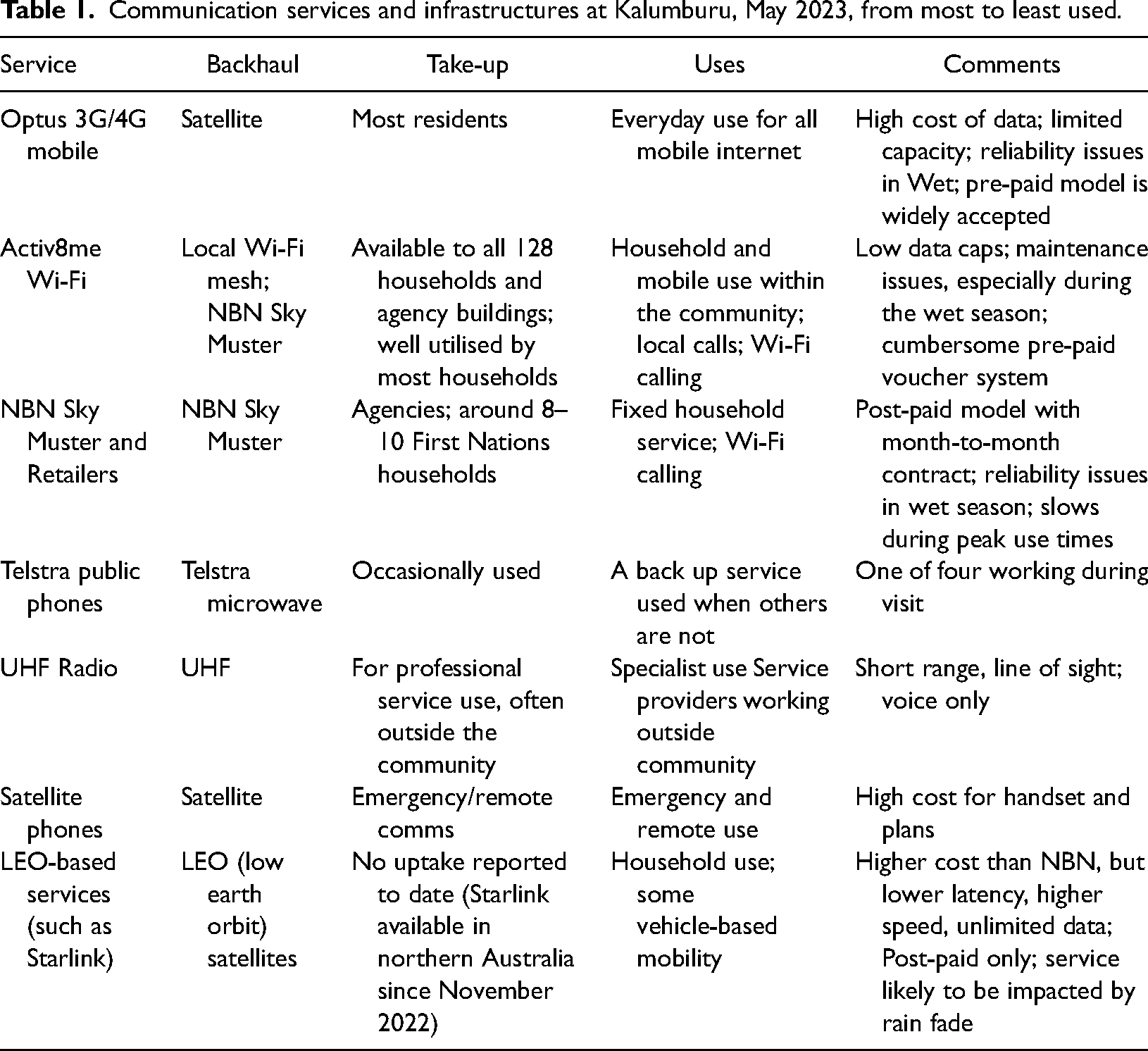
As Table 1 shows, a diverse set of communications services are available in Kalumburu, from the mainstream Optus mobile service to the widely used Wi-Fi mesh provided by the specialised service provider Activ8me. There is ongoing demand for improved services to address capacity limitations, latencies, and reliability issues. At the time of our 2022 visit, lightning had damaged the Wi-Fi mesh network and there was very high congestion with regular dropouts on the Optus satellite small-cell mobile service. Interviewees expressed frustration at the lack of reliable broadband services: When everyone [is] trying to get on the [mobile network it] crashes. [If] you wake up early enough, the kids will finally go to sleep and you might get it for a couple of hours, but other than that [it's] Kalumburu's only traffic jam. […] We’re at the top of the Kimberleys. [We] need these services [to] be sustainable [to] move forward. (Madeline Gallagher-Dann, CEO, Kalumburu AC, pers. comm., 2022)
Case study 2: Wujal Wujal, Cape York Peninsula, Queensland
Wujal Wujal is in Eastern Kuku Yalanji country, on the Bloomfield River in Cape York, North Queensland. It is located about 71 km south of Cooktown, 346 km by road from Cairns, and 2017 km north of Brisbane. The population is approximately 550 people, according to Wujal Wujal Aboriginal Shire Council, with 94% Aboriginal and/or Torres Strait Islander people (ABS, 2021). The median age is 29 and median weekly personal income of $332. There are 73 occupied private dwellings with an average of 3.4 people per household. There is a dispersed population across nearby town Ayton (10 km away) and numerous homelands along the Bloomfield River and coastline.
Wujal Wujal has fibre optic connectivity running from a regional exchange in Cooktown. 4G mobile is the primary means of phone and internet access, with 96% of survey respondents owning or sharing a mobile phone and 88% of these using pre-paid services (Featherstone et al., 2022a). But this mobile coverage is patchy, offers low penetration inside houses, is unreliable, and highly congested during peak use periods. There is 4G mobile coverage at Ayton and the nearby Bloomfield River State School; however, most homelands in the region have limited 3G or no coverage.
Of the Wujal Wujal residents surveyed, 18% have a NBN Sky Muster service, a higher rate than in most communities visited. Service providers within the community reported either Sky Muster satellite services, fixed-line telephony, ADSL or fibre optic connections to the premises; however, most reported issues of slow or variable speeds and regular dropouts on both fixed-line and satellite services, particularly in wet season. The limited mobile coverage was described as a health and safety risk, impacting service delivery and access by clients. [Connectivity in Wujal Wujal is] bad. Nothing. Especially when we have wet season. Everything not working. [We] can’t ring out, we [have] no contact. […] Wet season goes here in Wujal from December right up to [April/May], it's a long time. (Kathleen Walker, elder, Wujal Wujal, pers. comm., 2022)
Table 2 provides a summary of the uptake of services available in Wujal Wujal in order of use.
Communication services and infrastructures at Wujal Wujal, March 2023, from most to least used.
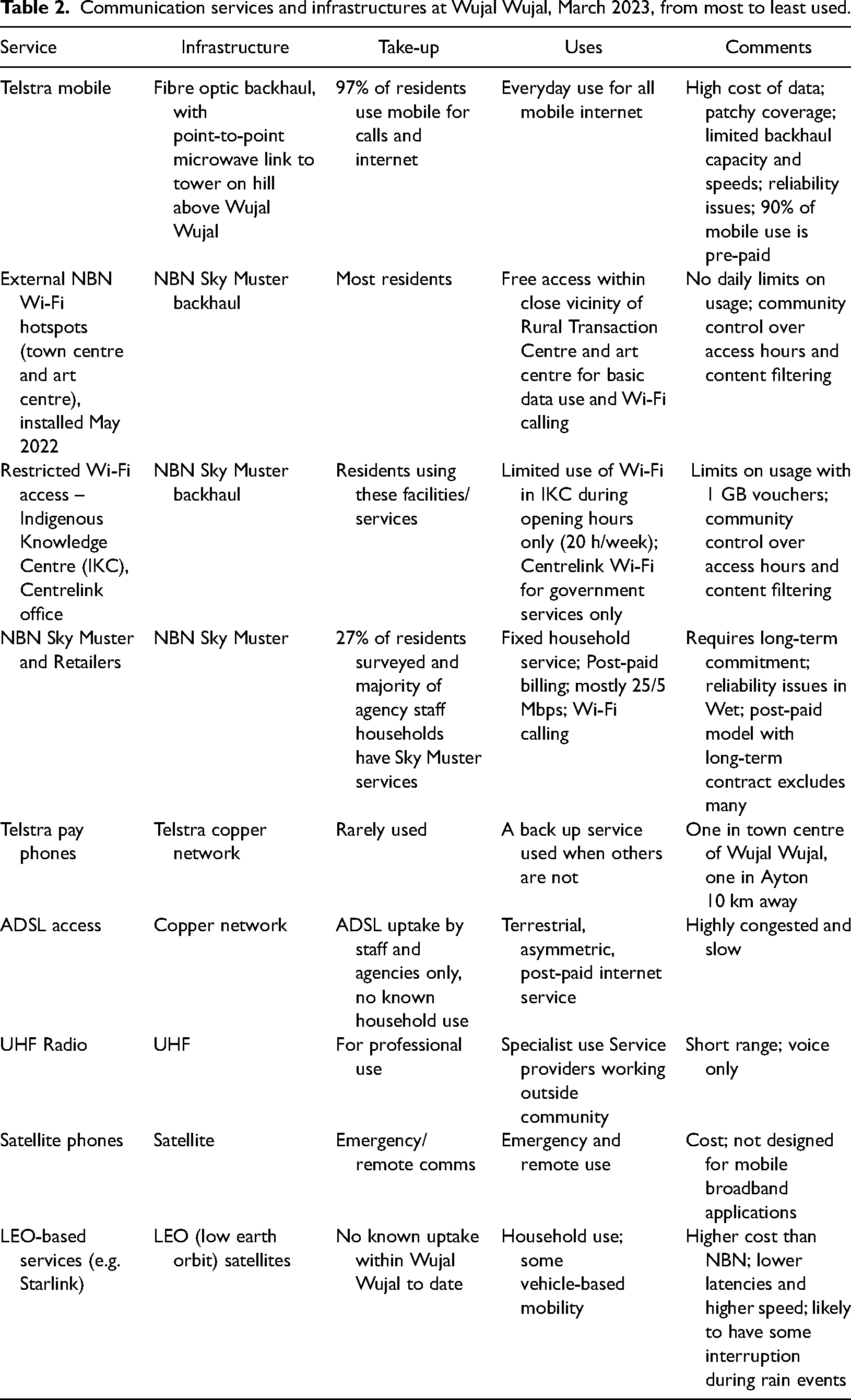
On first glance, the array of services at Wujal Wujal appears to be similar to that at Kalumburu. But there are significant differences: the intensively used mobile services at Wujal Wujal are provided by Telstra with fibre backhaul. At Kalumburu, the Optus mobile service relies on geostationary satellites for backhaul. Wujal Wujal has free to use Wi-Fi hotspots provided by NBN; there is no pre-paid community-wide Wi-Fi mesh of the kind provided by Activ8me at Kalumburu. While there is a fibre optic backhaul and 4G mobile connectivity in Wujal Wujal, interviewees described the need for upgraded services to improve coverage, speed and service reliability: We’d like to see greater connectivity where people [can] stay connected to the world. Whether it's to do their personal online banking, or just personal communications to family. [We need] reliability and efficiency, and price isn’t going to send them broke. [Also] competition [so] people have options. (Stephen Wilton, CEO Wujal Wujal Aboriginal Shire Council, pers. comm., 2022)
The potential benefits and limitations of 5G
Drawing on the research findings from Wujal Wujal, Kalumburu, and other sites, in this section, we consider the potential benefits and opportunities of 5G in helping to close the digital gap for remote First Nations communities. We also consider the converse risk of the digital gap expanding due to the uneven deployment of 5G, and a lack of policy focus on delivering fit-for-purpose services.
If deployed in remote First Nations communities, 5G technology has the potential to significantly improve the access dimension of the Closing the Gap target in communities by addressing current limitations and quality issues. It could also help to address other Closing the Gap targets by improving critical services such as telehealth, online education and training and essential service provision. During our research visits, remote service providers regularly described staff time lost to slow, unreliable internet, weather impacts, and failure of videoconferencing and cloud-based records systems due to latency. When we have storms [or cyclones] we’re off air for several days. [We return] to a paper-based system. [Without] our patient information, [with] previous histories, it makes it very difficult to operate. […] The lack of faster internet connections means [about] a quarter of our time is wasted […] It's very costly. (Dave Corstorphan, Remote Area Nurse, Kalumburu Clinic, pers. comm., 2022)
For residents, a transition to 5G would provide continuity with the existing preference for mobile technologies. While devices will need upgrading to take advantage of improved services, the familiar hardware, software and pricing models, including pre-paid options, would remain. Additionally, the interdependencies between cellular services and Wi-Fi remain, enabling users to access online services via free or affordable Wi-Fi services, such as those provided at Centrelink agencies. [Most] people haven’t got the money [for home computers] and everyone is low income. [The free Centrelink Wi-Fi] is there for everyone to use. […] They can come and sit on the veranda and connect to the Wi-Fi [with their phones]. (Marie Shipton, Elder/ Cultural Advisor, pers. comm., 2022)
Of the 10 research sites for the Mapping the Digital Gap project, we are aware of only one where a 5G service is planned: Wilcannia community in western NSW. There is limited transparency about the deployment process beyond a Telstra announcement that 5G would reach 95% of the Australian population by 2025 (Fenech, 2022). Given Telstra's current 4G has coverage of 99.4% of the Australian population, this suggests that many remote and rural sites are not planned for upgrades in the near future. The history of previous 3G and 4G rollouts in Australia suggests a considerable lag is likely in upgrades to rural and remote Australia (Park et al., 2015). Based on the current number of 3G only sites, this lag could be a decade or more in the most remote sites.
There is currently extensive work underway by telecommunications businesses across regional and remote Australia in preparation for the planned 3G switch-off by mid-2023, with the current 850 MHz spectrum of 3G to be re-farmed for 5G use, enabling long-range 5G services in regional areas. While the upgrade from 3G will include some network improvements, it is unlikely to expand existing coverage footprints without government co-investment, for example, through the MBSP or RCP. In our research visits, we heard significant concerns about the potential loss of existing 3G mobile coverage and increased safety risks for those living, working, and travelling in areas without mobile services. [We] drive a couple of minutes out of town either way and the [reception] drops out. [We need] that ability, wherever we are, if something [happens, we] can call comms straight away. (Wujal Wujal police officer, pers. comm., 2022)
More importantly, without addressing existing limitations of backhaul and network capacity in many remote areas, it is unlikely that 5G will provide significantly improved speed, reliability and quality of services compared with existing mobile services. Rather than a step change, these backhaul constraints may result in relatively minor differences between 4G and 5G in many remote and regional locations.
Beyond access issues, affordability of services and devices is another key factor in the scale of the digital gap. While post-paid plans increasingly offer high or unlimited data limits, the costs of increased data usage is being felt most acutely by those using pre-paid services. The costs of 5G deployment and network upgrades are already driving increases in mobile and broadband service pricing, with Telstra increasing pre-paid mobile rates in June 2023, and forecasts that other service providers will also raise prices (the previous $30 Telstra pre-paid vouchers now costs $35, with increase in data from 10 to 15 GB) (Baird, 2023).
The rollout of 5G is also unlikely to significantly improve digital ability or provide any additional motivation for low- or non-users to use broadband services. That would require more targeted solutions, such as the provision of community access facilities, training and mentor support programs, as well as addressing motivational drivers relating to online usage, such as scams and online safety issues.
Beyond 5G: diverse communications infrastructures
As we see in our two case studies, mobile services are very popular in remote communities. Nevertheless, improved mobile services are unlikely to close the digital gap in themselves and may not always be the most effective means to reduce digital inequality. Instead, given the mix of communication infrastructures and services in these communities, attention should be directed towards alternative, place-based solutions designed for the variable needs of small communities and homelands. As our case studies show, a diverse ecology of alternative and complementary communications technologies, including satellite, Wi-Fi hotspot and Wi-Fi mesh networks, already exists, and these are increasingly being used to enable more affordable and fit-for-purpose access options.
A continuing role for Wi-Fi
Wi-Fi services, in particular, are likely to play an important continuing role in providing internet access in remote communities. In the last decade, public Wi-Fi hotspots have become increasingly commonplace in communities and homelands. This includes over 110 hotspot installations under NBN's Communities in Isolation program, Wi-Fi capability of 301 Activ8me public phones in homelands of under 50 residents, 14 Wi-Fi on Centrelink agencies for government service access, and a range of state and territory government services and community initiatives (Featherstone, 2020).
With appropriate router and software systems, Wi-Fi services enable a level of community governance through local decision-making about hotspot locations, content filtering, curfew times, free or vouchers, choice of unmetered services and daily data allocations. However, Wi-Fi has its limitations, with low range requiring line of sight access, signal attenuation with buildings or obstructions, and a lack of privacy when located in outdoor public spaces. Also, speed, reliability, and data allowances via shared Wi-Fi services are limited by backhaul capacity and the number of concurrent users.
Wi-Fi mesh networks are also becoming more widely used, as in the Kalumburu case study. Rather than individual satellite services on houses, this more affordable model enables aggregated use of centralised satellite services distributed to households via a community-wide repeater network and local households repeaters. Similar networks have been established in several WA communities, with RCP funding, including Mowanjum in WA's Kimberley region and Jigalong in the Pilbara region. NBN are currently trialling free Wi-Fi mesh networks in four sites – Warakurna in WA, Indulkana and Koonibba in South Australia, and Aurukun in Queensland – with plans to expand this model to other communities.
An emerging role for LEO satellites
Since the mid-2010s, satellite small-cell mobile services have been installed in many smaller sites without fibre optic or microwave backhaul. These mobile services use one or two geostationary (GEO) satellites in a fixed orbit 36,000 km above the Earth. While GEO satellite services have enabled mobile coverage in previously unserved markets, there are many reports of unreliability, often with speed and data capacity limitations. GEO services are particularly prone to rain fade in Northern Australia, with rain and heavy cloud common during the wet season.
By contrast, low earth orbit (LEO) satellite constellations consist of hundreds or thousands of satellites in constant orbit about 500–2000 km above the Earth. This lower altitude enables reduced latency of about 40–50 ms compared with 600 ms for GEO. The network configuration also enables higher data speeds than traditional GEO services and unlimited data services. As LEO satellite networks, such as the Starlink service operated by SpaceX, are entering the Australian market, they are likely to play an increasing role in future broadband access, Wi-Fi networks, backhaul for small-cell mobile services, as well as direct mobile-to-satellite services. While the rain fade characteristics of LEO services have yet to be tested during northern Australia's wet season, anecdotal evidence suggests improved reliability of Starlink services over NBN Sky Muster services during heavy weather events.
Since entering the market in 2021, Starlink services have been adopted by over 125,000 households in Australia, compared with 93,000 NBN Sky Muster subscribers (Bonyhady and Baird, 2023). With wholesale network One Web and Amazon's Project Kuiper services to be introduced in Australia in 2024, LEOs are rapidly becoming a key part of the communications ecology in remote Australia, providing a means for delivering high-speed low-latency mobile services to sites without fibre optic backhaul, such as Kalumburu.
Following announcements by Telstra of partnerships with LEO providers OneWeb in 2022 (LightReading, 2023) and Starlink in July 2023 (Biggs, 2023), and a similar announcement from Optus (2023), small-cell mobile services are expected to begin to use LEO satellites for backhaul rather than the traditional GEO satellites. The reduced latency, higher speeds, and throughput are expected to improve the quality of service and provide the capacity necessary to meet increasing demand. In time, this will include backhaul for 5G services, either for community-wide coverage or more bespoke applications, including telehealth, remote monitoring, IoT, autonomous vehicles, and mining and agriculture solutions.
The emergence of LEO backhaul may also offer new market opportunities for small mobile networks in remote and rural Australia – following the lead of Wi-Fi service providers such as Activ8me – who may be able to offer alternatives to the major mobile network operators. 15
Community-driven solutions in First Nations communities
The expansion of mobile services in remote Australia has relied heavily on public funding, including successful co-investment mechanisms such as the MBSP, RCP, and State and Territory government initiatives. However, the MBSP 16 is increasingly limited in delivering 4G coverage into small communities and homelands due to thin markets, the high cost of macro-cell base stations, and the lack of existing fibre backhaul infrastructure (Featherstone, 2020).
The more flexible RCP allows for funding of satellite-delivered small-cell mobile, Wi-Fi solutions, backhaul infrastructure upgrades, and some operational costs. RCP is enabling smaller industry players to introduce more innovative solutions, including satellite small-cell mobile and Wi-Fi solution such as the Kalumburu Wi-Fi mesh project. Due to market failure and low levels of access, there is a clear need for a targeted program to provide mobile coverage or other appropriate solutions to small First Nations communities and homelands with limited connectivity.
The Closing the Gap framework requires a new way of thinking about communications infrastructures and services, moving beyond the usual technical considerations, such as network capacity, last-mile delivery, and coverage footprints. It asks questions about whether new technologies are likely to substantively improve digital inclusion for First Nations people, considering all aspects of access, affordability, and digital ability. With limited resources available to address communications needs in remote locations, a co-design approach can ensure communications solutions are fit-for-purpose, sustainable, and have community ownership, improving long-term outcomes for residents, local agencies, telecommunications providers, and governments. Conversely, a lack of community consultation can lead to exclusion. For example, on Erub (Darnley Island), in the Eastern Group of Torres Strait island clusters, a 4G tower located in the central village is patchy or inaccessible for residents in 16 of the island's 19 villages. Alternative technologies including satellite, Wi-Fi and mobile small cells or boosters, would both improve access and provide redundancy in the case of backhaul or power failure, a common issue in remote communities.
Local digital inclusion plans are a means to promote a community-driven approach to decision-making rather than a market- or engineering-driven approach. Such plans provide strategies to address identified obstacles, such as public Wi-Fi hotspots, community access computers, digital training and mentor support, technical support, as well as potential partnerships and resourcing needs to implement these solutions. Local plans may inevitably identify other priorities over new mobile technologies. Examples of such plans can be found in each of the Mapping the Digital Gap community reports published to date (Featherstone et al., 2022a, 2023).
Conclusion
5G mobile technologies, together with the applications and network coverage they enable, have the potential to provide improved services and capability for First Nations people, particularly, in remote Australia. However, improvements in mobile and communication technologies alone will not achieve Closing the Gap Target 17, without addressing the related aspects of affordability and digital ability.
There is a greater risk that the uneven deployment of 5G, coupled with limited network capacity in remote Australia to enable high-speed, low-latency services, will instead exacerbate existing inequalities in access and service. With remote communities characterised by sparsely distributed locations, low populations and typically low incomes, the market-driven rollout of 5G is unlikely to include remote communities without targeted government investment. Indeed, rather than narrowing the digital gap, the 5G rollout may increase it, as digital access and capability are accelerated elsewhere.
While improvements in infrastructural access are critical, it is important that policymakers consider all aspects of digital inclusion along with the unique needs of remote communities. A targeted and multi-pronged policy and funding strategy is required that enables technology-agnostic, place-based solutions that are co-designed to support the diverse needs and contexts of First Nations communities. Such a strategy should coordinate effort and resources between governments and industry, and support local digital inclusion plans to address locally identified challenges, priorities, and solutions. Given the dynamics of remote First Nations communities and their existing ecologies of use, it is likely that the diverse communications systems beyond 5G – such as Wi-Fi hotspots, mesh networks, LEO satellites, or microwave backhaul – will be critical in providing fit-for-purpose, culturally appropriate, and affordable services.
Major technology transitions, such as the introduction of 5G, are never only about technology; as this special issue shows, they invariably generate controversy and conjecture as to their costs, benefits, winners and losers. A positive feature of 5G may be that, alongside the new policy calculus of Closing the Gap target 17, attention is focussed on the growing inequalities in Australians’ access to critical digital services, and the best ways to address digital inequality.
Footnotes
Declaration of conflicting interests
The authors declared no potential conflicts of interest with respect to the research, authorship, and/or publication of this article.
Funding
The Mapping the Digital Gap project receives funding support from Telstra and the Australian Research Council.
