



Abstract
This article explores community-based rock music education as a site for strengthening social cohesion in a context of postwar, interethnic divisions. Focusing on small and incremental changes, it examines the practices of Music Connects, a project in the Western Balkans, and its goals of revitalizing rock culture in support of a more inclusive social life and greater freedom of movement in the region. The article explores the ways that an organizational and participant focus on aesthetic practices and artistic goals can still contribute to social goals. It highlights three key tasks connected to rock music education and revitalization, captured in the novel conceptual constructs of rehearsal space, the incubator, and the expansion of normal. Drawing upon qualitative data gathered in 2019 and 2021 from 40 participants, the article tells a story of small social changes through music-making that added up to significant developments in the region, musically and socially.
Introduction
In societies affected by war and armed conflict, many music education programs have both artistic and social goals, positioning music as a vehicle for strengthening social cohesion, inclusion, and psychosocial well-being (e.g., Baker, 2021; Durán & Rodríguez-Sánchez, 2023; Figueiredo & Odena, 2023; Howell et al., 2019; Odena, 2010). This complex goal landscape is constructed on multiple fronts that span funding bodies’ priorities—particularly in contexts receiving humanitarian or development funding, where priorities cluster around health care, education, transitional justice, economic development, and peacebuilding (Haskell, 2015; Howell, 2018; Matarasso, 2020; Stupples, 2017; Woodward, 2012)—and community desire to restore prewar cultural practices and aesthetic production (Baker, 2021; Grant, 2017; Kallio & Westerlund, 2016; Schippers & Howell, 2023; Schippers & Grant, 2016), among others.
For project organizers, aligning with non-arts funding priorities can provide the financial means to make music and other arts opportunities happen (Hunter & Page, 2014; Yúdice, 2003). However, non-arts change agendas are complex and multidimensional. Practitioners and funders may have only a limited understanding of how music activities will deliver the desired outcomes, and often fail to fully consider the structural and social drivers of participation in these contexts (Bartleet, 2023; Yerichuk & Krar, 2019). This underestimation of the complexity of the operational space can lead to broad and vague claims of effectiveness and success (Bartleet & Howell, 2020; Bergh, 2010; Boeskov, 2017; Dunphy & Ware, 2017).
Participants’ motivations, on the contrary, where these are documented (see Bergh, 2010 on the pervasive absence of participants’ voices in arts-in-conflict literature) are grounded in their attraction toward the artform and the desire to develop skills, express themselves, connect with like-minded others, and achieve their arts-related aspirations (Baker, 2021; Balandina, 2010; Bergh, 2010; Howell, 2015, 2021; Marsh, 2012). In time, they may recognize the additional benefits for their mental health, social life, or sense of meaning, but it is their interest in educational and creative agency that drives their involvement.
The non-arts agendas attached to arts projects can be a source of disillusion for participants (Stupples, 2017). They see the ways that funders’ priorities can determine the opportunities available to them and sometimes even dictate the artistic content so that it conforms with desired “development” narratives, constraining artists’ creative agency. They notice when program delivery changes (often not in an artist-centered way) when a donor government’s priorities change. Many see these norms as refusing to take seriously their artistic aspirations, contributions, and agency (Korum & Howell, 2021; Stupples, 2017). This suggests the legitimacy of a music education opportunity is contingent on its ability to center the artistic objectives in ways that support the self-actualization of participants.
This disjuncture between participant motivations, externally driven program goals, and legitimacy (Howell, 2023) poses both a challenge and an opportunity to music education program deliverers working in complex settings. The challenge is in ensuring “the aesthetic [and the educational] in the work does not become subsumed in the usefulness of its social value” (Balfour, 2009, p. 356, brackets added). Seeking greater alignment presents the opportunity to better understand the ways that maintaining a focus on aesthetic practices can still contribute to social goals, albeit in smaller, fleeting, or incremental ways—what could be called the “arts of small changes,” to paraphrase Balfour (2009).
We consider this opportunity in relation to a community-based rock music education initiative in a postwar environment. Funded by Creative Twinning, a funding program of the Netherlands Ministry of Foreign Affairs targeting cultural projects in countries bordering the European Union, its goals were to address social cohesion, inclusion, and geographic mobility in a context affected by violent conflict, ethno-nationalist politics, and entrenched ethnic divisions. While originally we had expected to approach the research with the social goals in the foreground, our interactions with participants made clear that for them, this was not the lead story of their rock school experience. Their pride was in the fact that they were learning to become rock musicians, and that their efforts had legitimacy in the world of rock. Thus, we focused our lens on the interaction of educational and operational practices and uncovered a story of small social changes in the midst of rock music education that added up to something significant in the region, musically and socially. Importantly, the practices contributing to the realization of social goals were also inherent to the work of forming and working as a rock band and building a local rock culture.
We begin by introducing the Music Connects project and its sociopolitical context. We then present three ways that Music Connects progressed its musical and social goals through a series of incremental changes. Our concluding comments summarize the findings and conceptual frames, and suggest a focus on small changes as a useful lens for capturing impact in similarly complex contexts.
Placing Music Connects in its context
Music Connects was a 3-year project to build social connection, inclusion, and geographic mobility through rock music initiated by Musicians Without Borders (Howell et al., 2021). Here, “social connection” is understood holistically as encompassing social bonds and ties across ethnicities and borders, within and beyond the musical experience, and of varying durability and intensity. Inclusion refers to multiethnic inclusion and diversity, and conscious efforts to ensure multiethnic representation in all aspects of project delivery. Geographic mobility refers to the freedom to move and work throughout the region. Music Connects involved three rock schools, described below, in Kosovo and North Macedonia. It offered participants regular collaborative activities, hosted by each of the schools in turn, in the form of intensive training weeks (four to six per year, addressing rock music performance, production, and audio engineering) and an annual, week-long, residential Summer School. Through this combination of the music and the social, Music Connects aspired to help revitalize the region’s rock music culture.
The sociopolitical history of the operational context is complex. Contemporary interethnic tensions and divisions in both Kosovo and North Macedonia have been shaped by the violence and belligerent nationalist politics that accompanied the break-up of Yugoslavia. These events and their legacies created social landscapes where most young people’s friendships are within their own ethnic group.
Constitutionally, Kosovo is a multi-ethnic state, with provisions for minority communities enshrined in law. However, interethnic divisions between ethnic Albanians and ethnic Serbs across the country remain entrenched and are particularly marked in the city of Mitrovica, located in Kosovo near the Serbian border. Mitrovica is divided into North and South, split geographically by the Ibar River and run as parallel administrative systems—Serbs in the North and Albanians in the South (Gusic, 2020). Parallel systems of health care, education, and utilities shape everyday life and reinforce divisions (Gusic, 2020; Janjić, 2015). Albanian–Serbian bilingualism is rare among the generations educated since the dissolution of Yugoslavia, making language a further barrier to potential mixing across the different ethnic groups (Gusic, 2020, p. 148). Movement between sides happens, but always with a hyper-awareness of one’s surroundings and corresponding strategies for minimizing unwanted attention (Maloku et al., 2017).
While Kosovo’s divisions are spatial and institutionalized, segregation in North Macedonia is maintained through many small daily practices and choices, making it challenging to address. North Macedonia youth identify multiple major barriers to developing interethnic relationships, including language, the segregated education system, geographic separation, and scant institutional support for extracurricular mixing (Bozinovski, 2020; Zivetz, 2019). An overwhelming majority of young people (85%) tend to socialize only within their own ethnic group (Bloodworth, 2020; Zivetz, 2019, pp. 44–45). And while discrimination based on ethnicity and political affiliation remains widespread between Macedonian and Albanian communities, Roma communities experience the most compounded forms of racism, segregation, and discrimination in areas of employment, housing, and education (Bozinovski, 2020). Despite constitutional reforms enshrined in 2001 that safeguard language rights and equal opportunities (Crowther, 2017), in many contexts (including education), complex cultural and structural norms position Macedonian as the default language (Bloodworth, 2020).
The Music Connects participants
The first of the three Music Connects rock schools is the Mitrovica Rock School (MRS) in Mitrovica, widely regarded as one of Europe’s most divided cities. Co-founded by Musicians Without Borders in 2008, MRS offers a daily program of activities from branch premises on either side of divided Mitrovica. It also facilitates the formation of ethnically mixed bands that rehearse, write songs, record, and perform. The Skopje Summer School is a highlight of the annual MRS program. English is the lingua franca for mixed bands, given the rarity of Albanian–Serbian bilingualism among young people.
The Roma Rock School (RRS) is based in Skopje, North Macedonia, and began in 2017. It draws its students from the municipality of Šuto Orizari, notable as a Roma-majority municipality where the Roma language is an official language. RRS is based in Skopje city center. 1 Its bands create music that fuses elements of Roma traditions and rock music, and its social goal is to create opportunities for its musicians to work and connect with musicians outside Šuto Orizari. The language of instruction in RRS is Macedonian.
The third school, Music School Enterprise (MSE) is a fee-paying school where some of North Macedonia’s best rock musicians provide tuition to (predominantly Macedonian) youth. MSE offers instrumental lessons and opportunities for students to play in informal bands in weekend jam sessions. At the time that Music Connects began, MSE offered a bespoke rock music curriculum with a focus on cover songs. Macedonian is the dominant language of instruction in the school.
As part of their involvement in Music Connects, each school committed to increasing enrolments of young people from less-represented communities, and to expanding opportunities for mixed bands to form, record, and perform in the region. The Netherlands-based Fontys Rockacademie, a bachelor-level music academy for rock and pop music, was a Music Connects project partner, providing training in sound engineering, band coaching, and skills development throughout the 3 years of the project. Fontys Rockacademie staff taught in English during Summer School and training weeks.
Methodology
The research that informs this article is from an evaluation of Music Connects commissioned by Musicians Without Borders in 2018. Using a case study approach, we analyzed each of the participating schools as a discrete case (Stake, 2006). Differences in outcomes were analyzed with consideration of the sociocultural norms of each context and the discourses of inclusion within each school (Yazan, 2015). The key research question was, “What music practices can be engaged to foster social environments of inclusion and connection, in contexts of protracted division and conflict?”
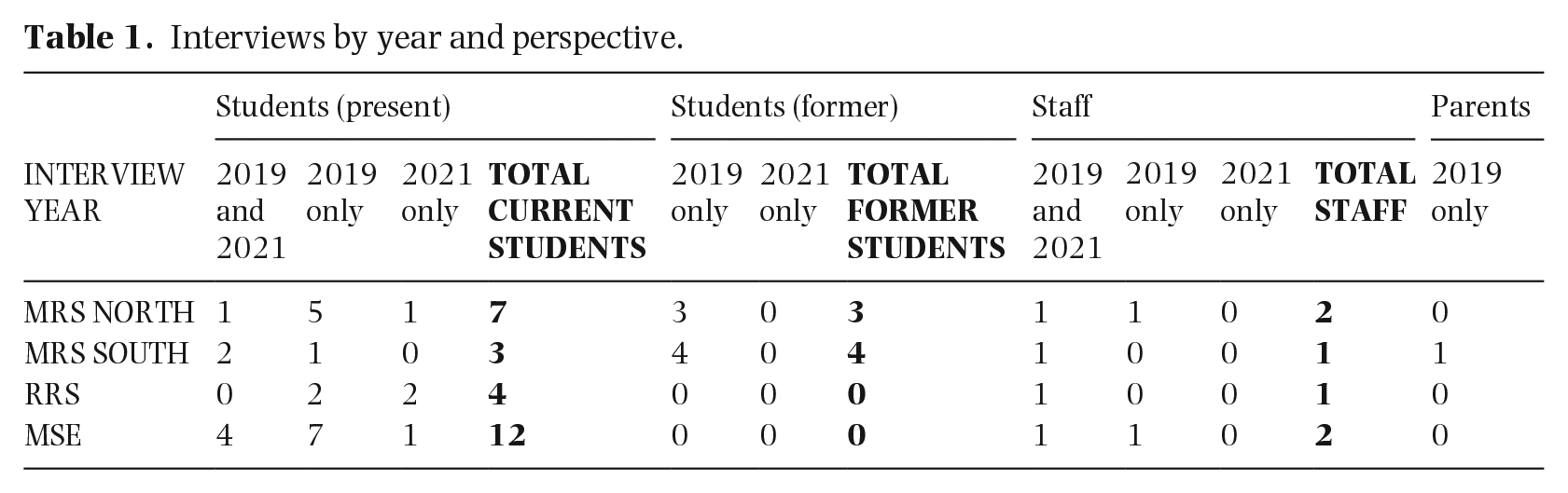
Fieldwork was conducted in-person in Mitrovica and Skopje, August 2019, and online, April 2021 due to COVID-19 travel restrictions. Thirty-three Music Connects students (present and former) were interviewed in total. Nine interviewees along with four Music Connects rock school directors were interviewed twice, in 2019 and 2021, helping to capture changes in perspective and meaning over that time. Four students were interviewed in 2021 only, and seven former MRS participants were interviewed in 2019, enabling consideration of the longevity of any social changes experienced, and the potential for this to be mirrored in Music Connects. One parent was also interviewed (2019), making a total of 40 research participants (Table 1). Participants could be interviewed in English or their preferred local language, with an interpreter. Most chose to speak in English, reflecting the high levels of English fluency among the cohort.
Interviews by year and perspective.
These interviews and focus groups generated over 20 hours of audio data that were transcribed in full. Observational data, informal conversations, and daily reflective memos were recorded in Howell’s fieldwork journal in 2019. Data were analyzed thematically and iteratively, using inductive coding to generate themes and categories, and NVivo 12 software was used to facilitate comparisons and interactions across the data set (Charmaz, 2006). G.H. conducted the analysis; B-L.B. and J.D. critically reviewed it; and Musicians Without Borders and Music Connects staff provided feedback on the analyses and offered further nuance at delivery milestones throughout the project.
Ethical considerations
The study received full clearance from Griffith University’s Human Research Ethics Committee (Ref. 2019/030). Informed consent was obtained via participant information sheets and consent forms in Albanian, Serbian, Macedonian, and Roma, shared with students and their parents prior to the 2019 Summer School. Parental consent was required for those aged between 15 and 17 (those younger than 15 did not participate in the research). The research and the participants’ right to withdraw were also explained prior to each interview. The fieldwork researcher endeavored to interview roughly equal representation of the different ethnolinguistic backgrounds.
All student quotations are anonymized, attributed with the informant’s school affiliation, role, and status (current or former), and the year of interview (2019 or 2021). Facilitators are identified by first names, with their permission.
Researcher positionality
The authors are an Australia-based team with experience working in complex intercultural settings in Australia and internationally. Collectively, they have expertise in community music, music psychology, music education, peacebuilding, community cultural development, and evaluation, and have led multiple projects in partnership with arts organizations and nongovernmental organizations. All authors are outsiders to the Western Balkans region. G.H. is a second-generation Australian of Anglo-Irish heritage with lived experience in the Balkans; B-L.B. immigrated to Australia from South Africa; and J.D. immigrated to Australia from the United Kingdom. We recognize our positionality as outsider researchers, and worked closely with Musicians Without Borders and local leaders at each research stage, seeking their guidance and feedback.
Findings and discussion
Insights from the participants drew our attention to three musical-social practices that were consistent with the “small changes” in our conceptual framework. These are explored here as (1) negotiating a band identity, (2) broadening regional social-musical networks, and (3) expanding perspectives on “normal” interactions.
Negotiating a band identity
A central objective of Music Connects is the formation of ethnically mixed bands. Initially, rock school staff help to put bands together, to facilitate connections between players who do not yet know each other due to the wider norms of ethnic segregation. 2 Given that it is more typical in rock music culture for peers to initiate band formation (e.g., Green, 2002, p. 79), this approach to band formation made the development of a shared band identity an all-important but potentially fraught task. Band members described the complementary roles that songwriting, recording, and band coaches played in the formation of their band identity.
Much of the focus of rehearsal time during Summer School (when the first fieldwork in this study took place) was on the collaborative writing of new songs. Individuals put forward an idea (e.g., a song lyric, a bassline, a drum groove), their bandmates responded to it, and band coaches facilitated the composition process by encouraging, clarifying, and scaffolding decision-making. This process required many musical and social negotiations.
For many interviewees, the most challenging negotiations were around music genre. New bands could be made up of players with radically different musical interests (e.g., a hardcore punk guitarist working alongside a pop-loving singer), so finding musical ideas upon which everyone could agree—particularly when band members were still getting to know each other—could produce tension and creative impasses. This is unsurprising, since genre preference is highly individual and closely attached to social identity (Cleaver & Riddle, 2014; Frith, 1981). It can signal important information about your personality, attitudes, and affiliations, creating “imagined communities” and affective alliances among those with similar preferences (Born, 2012, p. 206), with the potential for a corresponding sense of distance from those with contrasting preferences. Thus, negotiating issues of genre in the mixed bands necessitated skills in finding consensus across opposing musical and social identities.
Language was another relevant negotiation in the songwriting process. Most bands adopted English as a lingua franca to circumvent language barriers between Albanian and Serbian (for MRS bands), and Macedonian, Albanian, and Roma (for MSE and RRS bands). The fact that English is the language of many globally admired rock bands gave the Music Connects musicians’ English lyrics an additional layer of rock world legitimacy. English thus supported participant aspirations while sidestepping geopolitical language hegemonies and tensions.
As their skills in negotiating and consensus-formation developed, band members reported that they began to feel like a band:
When you create something with somebody, you are basically connected. You have something that you made together. . . . So, when band members with different identities, different personalities, different tastes, different everything get together, they create something completely new. A band becomes a whole new identity by itself. (MRS North former student, 2019)
The intensity of the Summer School experience—offering only 7 days within which to write, record, and perform two or three new songs—also imposed time pressures that appeared to fast-track the development of this shared identity. For example, one of the newest bands, convened only a few months earlier and attending their first Summer School in 2019, had been scheduled to record a new song on the third day of Summer School. Shyness and insecurity had been inhibiting their songwriting progress in the rehearsal room, and their new song was still to be completed the day before their allotted studio time. Two of the bandmates—each from a different ethno-linguistic group—took charge, planning a last-minute evening rehearsal to bring the band together to complete the song. Rather than exacerbating tensions, the short timeframe compelled them to cooperate, which in the process helped them forge stronger musicosocial connections and realize a shared aspiration.
Participants also highlighted the role that their band coaches played in helping bands to cohere. Band coaches were local music industry professionals, bringing an important layer of industry knowledge and norms to the learning environment. They provided pedagogical scaffolding that encouraged the young musicians to be the primary decision-makers in their songwriting but also helped bands to move through impasses. Project partner Fontys Rockacademie uses the term “demand-driven learning” for its approach to band coaching; the focus placed on creative agency, peer learning and sharing, and facilitation indicates a philosophical orientation aligned with community music pedagogy (Howell et al., 2017; Higgins & Campbell, 2010; Veblen, 2009) and informal and non-formal music pedagogies (Green, 2008; Mok, 2011; Ng, 2018).
Research participants recalled the experience of building their shared band identity with a degree of pride. They recounted stories of learning, such as learning to relinquish personal control over the songwriting (cited by two students from MSE, 2021); the musical and social value of finding compromise between conflicting musical ideas (former MRS South students, 2019; current MRS students, 2021); and how the songwriting began to flow when the shared band identity and chemistry between the band members was strong (MRS North band, 2019). Some former MRS musicians recalled the artistic benefits of successfully navigating band members’ various genre conditions: Their negotiations enabled them to create a hybrid sonic identity that was uniquely theirs (MRS South former students, 2019). The collective capacity of “a band” was seen as greater than the sum of its parts: “[being a band means] we have great ideas separately, but together we are better” (MSE band, 2019).
Learning to identify as a band is a key step in the development of young rock musicians. The creation of a shared, mutually valued identity that can co-exist with individual identities is also a significant milestone in interpersonal peacebuilding (Söderström et al., 2021). This interplay of musical and social goals in Music Connects can be conceptualized as a rehearsal space for the navigation of differences, a low-stakes way for participants to hone their (musical and social) negotiation repertoires. The next section considers the practices supporting these interactions beyond the rehearsal room and the band identity.
Broadening regional musical and social networks
Prior to the Yugoslav wars, rock music had been “the most important popular-cultural force of the land” (Mišina, 2013, p. 304), with well-established touring networks and collaborations between musicians across the federation of states. This influential role ended during the war, when all forms of media that could be considered “avenues of information, expression, and sociality” were systematically neutralized by the ruling power (p. 323, note 5, citing Gordy, 1999), and armed conflict across the region made intercountry touring and collaborations impossible. Music Connects’ intercountry activities and performance opportunities have the aim of revitalizing the region’s latent rock culture through building the musical capacities of a new generation of performers and re-establishing regional networks of production staff and supportive venues.
This is easier described than enacted, however, as the regional disapproval of interethnic mixing and mobility is deeply ingrained. One MRS musician explained,
There is no way I could even look at or think of dating [someone from the other side of the Ibar River]. If I did, I’d be dead. Playing in the mixed band is OK, but there is family resistance to anything beyond this. For me, this resistance is foolish, but the older generation is attached to it, because they went through the war. (Conversation with MRS student recounted in Howell’s fieldwork journal)
This description illustrates both the tense environment that young people are navigating, and the trust in Music Connects shown by parents (noted by Milizza, MRS Co-Director, 2019). It also illustrates that Music Connects offered its participants space and time away from a particularly intense and constraining form of societal pressure, a “safe place basically for kids who want to make music [where] the nationality and everything like this is forgotten” (MRS North former student, 2019). It configured Music Connects as what many participants described as a “bubble”: a liminal space bounded by time, activities, and environment in which the normal rules of behavior could be suspended and new identities and relationships could be explored, experimented with, and deepened (see also Bergh, 2010; Boeskov, 2017, citing Turner, 1969).
Two operational aspects were instrumental in forging interethnic and intercountry friendships within this bubble: an unambiguous ethos of social acceptance, safety, and non-judgment, and strategic scheduling of social time. Of the former, Emir (MRS Co-Director, 2019) stated that the organizers aimed “to keep the place as open minded and as accepting of everyone, [in particular] people who are not accepted by others. Not only about ethnicity or something.” Of the latter, participants highlighted the social outcomes of having ample unstructured, informal “hang out” time woven throughout Music Connects activities. This included buses to and from the rehearsal venues, shared mealtimes without allocated seating, informal social spaces around the hotel, rehearsal and gig venues, and an excursion to a swimming pool and restaurant:
The social time in front of the hotel [is the best place to meet new people] because everybody just talks about stuff that they like, so it’s the easiest way to meet people and realize what music they like, what they like to create, how they play, stuff like that. (MRS North student, 2019)
Musicians Without Borders program staff explained that easily-accessed social spaces such as that “in front of the hotel” had been strategically cultivated since the first Summer School, to circumvent the likelihood of people socializing offsite in their language groups during downtime (conversation noted in Howell’s fieldwork journal, 2019).
The importance of these unstructured social spaces was highlighted during the 2019 Summer School through the contrasting experience of the MSE students. Unlike the MRS and RRS students, they did not sleep in the hotel and only joined the group for lunch each day. MSE interviewees described a more restricted social experience, with no descriptions of new friendships or alliances. The excursion to the swimming pool was the main unstructured time they had for social interactions (MSE students, 2019). An exception was one MSE student who, prior to Summer School, was invited to be lead vocalist for a senior MRS band. Her social experience appeared richer and more varied than that of her MSE peers; 3 during the COVID-19 lockdowns she established an online duo with an MRS musician from a different band, and they shared videos recorded in each of their homes that were very popular with Music Connects participants. Thus, the repeated unstructured opportunities to mix were critical to creating the small social changes of new interschool and intercountry links and friendships among the musicians.
Metaphors are always informative, and the bubble metaphor reveals the limits of the robustness of the Music Connects space. Bubbles offer a valued liminal space that facilitates experimentation with alternative discourses of identity and sociality. However, real-world bubbles are easily burst (Howell & Korum, 2022). This fragility means their social benefits may struggle to inhere beyond the bubble’s boundaries. An alternative conceptual construct is that of an incubator, also a temporary space, but one with preparatory as well as protective function. It presumes a time when the incubated small changes in social relations will have sufficient resilience to survive beyond its walls. The next section considers how this might occur within the Music Connects project through incremental changes in its rehearsal and performance aspirations.
Expanding perspectives on “normal” interactions
As noted above, Music Connects intended that its work across two countries and three music schools would contribute to the vitality of the region’s rock music culture and networks, through indicators such as networks of supportive venues, an increased pool of skilled audio professionals, high-quality recording infrastructure, and networked, skilled musicians, well-positioned for collaboration. While each of these indicators had funds and strategy supporting their realization, our analysis suggested that there was another, less tangible contributor, in the form of an accumulation of small and incremental changes that we conceptualize as an expansion of normal, to mean a constant but gradual expansion of perspectives on what “normal” interactions and mobility look like locally.
This conceptual construct first arose in an analytical conversation with Musicians Without Borders staff, who acknowledged the loaded and coded nature of the word “normal” in the postwar contexts of former Yugoslav countries. It has strong emic salience, used to evoke social practices that, before the wars, were usual and therefore unremarkable (e.g., Mišina, 2013; Robertson, 2010). In the postwar context, this might refer to social practices and institutional contexts that reject ethno-nationalist cultural norms (e.g., socializing with people from other ethnic groups). For some, it also signals an ideological position, invoking a “right” or more prosocial way (see Maček, 2007). Our conceptualization acknowledges these emic meanings and is grounded in the former, synonymous with “usual.”
The notion of an expansion of normal comes from the MRS experience, whose approach to mixed bands and band coaching was the template for Music Connects. In Mitrovica, a rigidly conservative and nationalistic town, geographic mobility has been strongly shaped by the local norms of segregation, reinforced through individuals and institutions, and controlled in part by fear of the potential repercussions of moving between the sides of the city. For example, a former student from MRS North admitted, “crossing the bridge isn’t the easiest thing. You never know if somebody is going to come up and beat you” (2019). The threat of violence can come from one’s own community as well as from those on the other side, making it normal to avoid practices that involve ethnic mixing and crossing sides.
Challenging these norms has been gradual and incremental at the MRS, and subject to constant review. When the school first opened in 2008, it was too dangerous for mixed bands to form and rehearse in Mitrovica. The first Skopje Summer School was a way to bring the town’s young musicians together in a neutral third space, and it was so well-received by participants that Musicians Without Borders and its partners resolved to continue the program in Mitrovica year-round. The two branches of the MRS (on either side of the boundary line) were established at that time. “Normal” interactions for mixed bands were initially limited to social media and annual rehearsal periods in neighboring Skopje.
In 2015, some modest but promising relaxations in local political dynamics prompted MRS to ask their mixed bands to consider rehearsing in person at one or other of the MRS branch schools (in North and South Mitrovica). MRS provided safe transport for those crossing to the other side. This began tentatively, but gradually became more commonplace; more “normal.” Consequently, students joining the school in 2016 and 2017 understood rehearsing in either branch school was a normal (i.e., anticipated, unremarkable) part of the school’s mixed band activities. By 2022, mixed bands had committed to regular rehearsals on either side of the city. Some members even walked to their rehearsals from the other side. “Normal” was thus expanding.
Similarly, in the earliest years of the MRS, mixed bands could not perform in Kosovo. Band members were not identifiable in the music videos they released of their songs (Hassler-Forest, 2014). But through careful monitoring of the political climate, in 2016 MRS mixed bands began giving concerts in several Kosovo cities. Performing in their hometown Mitrovica was always deemed the most risk-laden, as it has historically been more prone to violent confrontations. Therefore, when the first performances of MRS mixed bands in North and South Mitrovica took place in 2018, it was a significant milestone and expansion of normal. 4
Each small expansion of normal created a pathway for the next cohort of participants to follow. For example, a former North student, asked about the first time they traveled to the South branch to take part in a training week, admitted,
I was a little scared because I never went there [before]. But I knew people [from my side] who were always going there. . . [and] when I went there, everything was cool and there were no problems. Now I can go [i.e., feel confident to go] anytime I want. (Former MRS North student, 2019)
Significantly for this research, expansions of normal within MRS also expanded participants’ perspectives on their independent mobility and access to the city. Several participants described feeling more confident to explore a wider personal geography because of their MRS experiences. One interviewee explained, “every time I go to the North side to buy something, it’s impossible not to see one of the [MRS] guys. And you have always something to talk to them [about]” (MRS South student, 2021). Seeing a friend from Rock School created a sense of pleasure (“I found someone I know!”) as well as a sense of security and insider knowledge (“if I want to find something that it’s not in the South, I only need talk to them, and they tell me where to find or where to go”). The same interviewee was looking forward to traveling independently to Skopje soon where he anticipated re-activating his links with MSE and RRS musicians.
Note, however, that while MRS experiences could encourage new norms, student perspectives on mobility were also moderated by other factors, such as family support, age and personality, and individual susceptibility to current political dynamics. Furthermore, “normal” could contract due to changes in local politics. For these reasons, MRS staff approached any expansion of normal with extreme care and risk aversion. “We have to be careful because if [an attack] happens, I don’t know how we would continue this” (Emir, MRS Co-Director, 2019). “This” referred to the artistic and aesthetic mission of supporting young people to create and play rock music together, rather than the social goal.
While everyday life in North Macedonia is less overtly divided, the MRS participants’ expansion of normal offers a framework for identifying comparable changes in Music Connects. Language use is one potential site for small and incremental changes. For example, in 2019 one of the MSE band members described that it was normal for her to speak Macedonian with her bandmates despite Albanian being her mother tongue. She declared, “I am Albanian but I speak Macedonian, and I live here” (MSE band member, 2019). This and some other comments from MSE participants indicated that Macedonian, the dominant language in society, was also the default language within the school. However, by 2021, several MSE interviewees explained that their bands communicated in English, as this was the language that was most inclusive of everyone.
The COVID-19 public health measures were still in force at the conclusion of the research, limiting opportunities to consider how continued expansions of normal might facilitate sustained regional networks and revitalize the prewar touring capabilities of the region. However, the MRS experience and the early indicators of similar recalibrations occurring within other Music Connects schools were promising. Increased participant mobility and the normalization of cross-community ties are necessary factors for future independent collaborations and initiatives. The expansion of normal is thus a barometer for assessing the readiness of a context for new initiatives as well as a novel and locally grounded way to track and communicate the social difference a music education program is making.
Conclusion
In this article, we have explored (some of) the “small changes” that occurred in a rock music education initiative in a war-affected, deeply divided context—changes that helped to strengthen inclusion and regional mobility for participants. Inspired by Balfour’s (2009) proposition of a “theatre of little changes” for applied theater, we have sought to understand the ways an organizational and participant focus on aesthetic and artistic practices can still contribute to social goals, and conceptualized the intersections of the artistic and social through the constructs of rehearsal space, the incubator, and expansions of normal.
Each of these conceptual constructs is mobilized through the participants’ shared interest in rock music and aspiration for achievement in this field. At the intra-band level, the rehearsal space is a space for navigating differences and negotiating toward agreement, developing in the process a valued collective identity: becoming a band. At the interband and interschool level, the incubator is a liminal space for social experimentation and the formation of regional ties spanning ethno-linguistic and state boundaries. It is a space for nurturing alternative social lives, and for building robust and resilient ties and interpersonal trust. At the community and regional level, the expansion of normal is a process through which a gradual accumulation of small changes in perspectives on “normal” interactions and patterns of mobility might help to activate social new norms for an increasing number of people. Rehearsals and concerts were important mechanisms for expansions of normal.
Our findings suggest Music Connects’ approach reduced the disjuncture between participant motivations, externally driven program goals, and legitimacy by letting the artistic process lead the way, rather than the social goals. This ensured it retained legitimacy in the eyes of participants. Given that for any social change agenda to be sustainable, it must be pursued on terms that have been agreed with its targets or beneficiaries, attending to “small changes” arising through the non-linearity and iterative qualities of artistic and aesthetic practice is not only an effective way to capture change in complex sites, but an ethical stance that supports the self-actualization of participants, taking seriously their aspirations which may include—but are not driven by—the social potential of music.
Footnotes
Acknowledgements
The research from which this article is drawn was an evaluation consultancy for Musicians Without Borders of the Music Connects project in Kosovo and North Macedonia. The full report, “First of all, be friends,” can be downloaded from the Musicians Without Borders website. The report and this article were written independently of the commissioning and sponsoring bodies, although they were given opportunity to read a final draft and to offer corrections to any factual errors. Thanks to research assistants Jill Pope and Jodie Rottell for their excellent work on the original evaluation report, and to all the project participants who shared their Music Connects experiences in such candid and thoughtful ways. Thanks are also extended to the two anonymous reviewers, whose critical feedback helped us strengthen the final article.
Author Contribution(s)
Declaration of Conflicting Interests
The author(s) declared no potential conflicts of interest with respect to the research, authorship, and/or publication of this article.
Funding
The author(s) disclosed receipt of the following financial support for the research, authorship, and/or publication of this article: This research was co-funded by Musicians Without Borders (via Creative Twinning, a funding program of the Netherlands Ministry of Foreign Affairs, implemented by the Netherlands Enterprise Agency), the Queensland Conservatorium Research Centre, and the University of Melbourne.
