




Abstract
The central focus of this article is the interaction between religious actors and urban regeneration in the former industrial area of Amsterdam North. While there is extensive literature on the structural, sociocultural, and economic impact of urban regeneration and related processes of gentrification, the role of religious groups in these processes of neighborhood change has largely been ignored. Based on ethnographic research, I examine how different Christian movements interact with their changing neighborhood in varied forms. The redevelopment of industrial buildings and the gentrification of working-class neighborhoods in Amsterdam North enable different but particular forms of Christian place-making. I focus on two forms of engagement with urban spaces: (a) the reuse of industrial buildings by Pentecostal movements and (b) the transformation of traditional Protestant church buildings into socially mixed neighborhood centers. These two different forms of urban place-making highlight how Christian organizations bring the active agency to urban regeneration and cocreate urban neighborhoods materially and socially.
Introduction
In this article, I seek to demonstrate ethnographically the varied relationships between religious actors and cities, focusing on the interaction between Christian movements and urban regeneration 1 in the former industrial area of Amsterdam North. 2 Research in the last two decades has demonstrated the continuous importance of religion in cities (see Introduction to this Special issue) and that urban change interacts with religious innovation (Becci et al., 2013; Garbin & Strhan, 2017; Hancock & Srinivas, 2008). Importantly, religious institutions take part in the regeneration of city areas and related processes of gentrification. 3 On one hand, for example, in recent years, religious organizations in the United States have redeveloped their buildings into mixed-use facilities, including residential, commercial, and retail uses, and have become more entrepreneurial to be able to maintain their organizations (Mian, 2008). Traditional church buildings in Europe are being reused as restaurants, theaters, and hotels (Beekers, 2018), sometimes combined with a smaller space for religious activities. On the other hand, transnational religious institutions have converted former industrial buildings across the world, such as warehouses and garages, into religious places (Freston, 2005, pp. 48–49; Krause, 2008). These religious redevelopment projects and the reuse of buildings can contribute to regenerating city areas and to the positive or negative consequences of gentrification, among others by either offering affordable housing or raising real estate values (Mian, 2008). In short, the varied religious engagements with real estate contribute to altering city areas in different ways, demonstrating the relevance of religious material presence in urban contexts (Knott et al., 2016) and how religious organizations are part of the creation of intertwined secular, postsecular, and religious places in contemporary cities (Hackworth & Gullikson, 2013).
Furthermore, religious groups can play important social roles in urban neighborhoods that are regenerated, including providing community services and advocating for marginalized residents, and they may bring residents with different ethnic and socioeconomic backgrounds together (Putnam et al., 2010). The moral discourses of religious leaders offer followers a window into how they could view urban developments in their city area and how to connect or disconnect to the area and fellow residents. There is ample research about the social role of religious groups in neighborhoods that are regenerated or become gentrified. Studies about gentrification suggest that because the new middle-class facilities and activities are consumption related, there is no place for traditional (religious) institutions and service organizations, and these are forced out of the area (Lees et al., 2008, pp. 214–215; Zukin, 1998). Ley and Martin (1993) found a relationship between gentrification and disaffiliation from traditional churches in major postindustrial cities in Canada. Yet they also mention that the new middle class tends to opt for alternative methods of spiritual and religious practice (Ley & Martin, 1993, p. 230; see also Kern, 2012). In his study of churches in parts of Brooklyn, New York, Cimino (2011, p. 159) demonstrates that gentrification and religious revitalization can go together as religious leaders, among others, create “lifestyle enclaves” for young, highly educated newcomers in the neighborhoods (see also Boy, 2015).
In this article, I am particularly interested in how diverse Christian movements interact with their changing urban neighborhoods in different ways. For example, the redevelopment of industrial buildings and the gentrification of working-class neighborhoods in Amsterdam North enable different but particular forms of Christian belonging. By examining Christian place-making in postindustrial Amsterdam, I seek here to contribute to the central focus of this Special Issue on cities as “ordinary” sites (Robinson, 2005 and see Introduction) where global influences and local cultures intersect and create new spaces. I depart from Massey’s (2005) understanding of place and space 4 (a) “as the product of interrelations; as constituted through interactions, from the immensity of the global to the intimately tiny”; (b) “as the sphere in which distinct trajectories coexist”; and (c) as “relations which are necessarily embedded material practices which have to be carried out, it is always in the process of being made” (Massey, 2005, p. 9). Christian urban place-making, then, does not just examine the religious practices that “happen to take place in cities. . . [it is] what comes from the dynamic engagement of religious traditions [with] specific features of the industrial and postindustrial cityscapes and with the social conditions of city life” (Orsi, 1999, p. 43 in Bielo, 2013, p. 301). I thus aim to demonstrate how Christians make the places in which they live, showing Christian communities as religious actors in urban spaces (Bielo, 2013). In so doing, I will explore two forms of Christian place-making in the regeneration of Amsterdam North. First, I will look at how place-making involves material practices, as industrial buildings come to contain and express religion in specific forms. Second, I will focus on the social making of places by considering Christian engagements with gentrifying areas as a social space.
Socioreligious Ecology of Gentrifying Amsterdam North
Over the course of the 20th century, Amsterdam North developed into the most important industrial area of the city, with a flourishing shipbuilding industry close to the river with the name “IJ” (Figure 1). To be able to house the increasing number of factory workers, newly designed neighborhoods for working-class families were built by municipal and private housing associations. These village-like urban neighborhoods can be traced to the Garden City movement, led by Ebenezer Howard, that emerged during the late 19th century and was intended to be an alternative to the poverty and chaos of the modern industrial city. The garden villages in Amsterdam North were characterized by low, single-family homes with a front and back garden, surrounded by parks and community centers; importantly, every village or neighborhood also had one or more churches—Catholic, mainline Protestant, Orthodox-Protestant, Mennonite—exemplifying the pillarized structure of Dutch society at the time (Lijphart, 1968/1975). The lack of urban entertainment, such as pubs, and the strong emphasis on family, faith, and community ties were considered crucial to the formation of “decent citizens” (De Regt, 1995). The churches played an important role in the moral education of the children in the garden villages by offering schooling and founding the first schools in the area (Alberts, 2011, pp. 35–37).
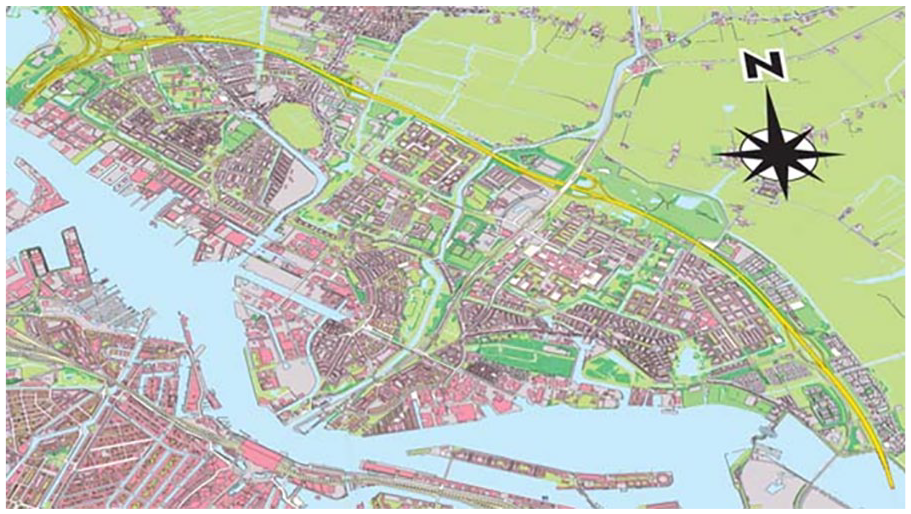
The River IJ Separates Amsterdam North From the Rest of the City© Bureau Scherpenisse.
The industrial fallout in the second half of the 20th century, the wider migration of many city dwellers to suburban towns, and the ongoing process of secularization in the Netherlands resulted in falling numbers of church members and the closure of several churches. Some of these buildings were repurposed: One of the oldest church buildings in Amsterdam North, the Protestant Buiksloter Church, has a sociocultural function to this day (Alberts, 2011, pp. 31–32). Recently, one of the former Catholic church buildings, the Rita Church, has become a hotel. The three remaining mainline Protestant Churches (Protestanste Kerken Amsterdam-Noord) are considering merging. The Orthodox Christian Reformed Church in Amsterdam North made a resurgence about 15 years ago and has become a flourishing, multicultural church, attracting various newcomers, including young urban professionals and migrants.
From the 1970s and 1980s, labor migrants of Turkish and Moroccan descent started to live and work in Amsterdam North. Due to urban renewal programs in other parts of Amsterdam in the 1990s, an influx of people with a migration background 5 took place in a few garden villages, making them more multicultural. Similar changes occurred in the rest of the area as well: An increasing number of mosques opened in the North as well as so-called “migrant churches”; a former Protestant church became a Coptic Orthodox Church; Ghanaian Pentecostal churches started holding Sunday church services in neighborhood centers and schools, as they did not have their own church buildings (van der Meulen, 2009); and several transnational Pentecostal churches from Brazil and West Africa bought or rented former industrial buildings to use as churches (L. van de Kamp, 2017; see also Krause, 2008).
Since the early 2000s, young urban professionals have been moving into Amsterdam North and creating an increasing number of cultural hotspots, such as innovative cultural centers and restaurants, as well as fitness centers offering yoga and capoeira. Many of these new urban initiatives are located in former industrial buildings, a move facilitated by an active urban planning policy aiming at the revitalization of dilapidated industrial buildings as part of a new creative economy (Savini & Dembski, 2016). Young urban professionals have been buying social housing units in garden villages, owing to national and urban-planning policies (VROM, 2007) designed to create socioeconomically mixed communities through strategies of state-led gentrification (Bridge et al., 2012); such strategies target so-called “problem districts” (Uitermark & Bosker, 2014), including “disadvantaged” working-class neighborhoods in Amsterdam North. Increasingly, foreign investors and national corporations are investing largely in buying land and buildings in Amsterdam North, housing prices are steadily rising, and the area has been heavily promoted as a tourist destination for day visitors. Meanwhile, long-term residents often struggle to keep their community centers and churches alive due to a lack of finances, volunteers, and participants, and tensions between long-term residents and newcomers have been on the rise (L. van de Kamp, 2021; see further below).
I conducted fieldwork in different gentrifying neighborhoods in Amsterdam North in relation to the redevelopment of the surrounding former industrial areas. Through participant observation during various meetings and activities in neighborhood centers and religious buildings, I examined how the neighborhood policies that focused on regeneration worked in practice. I conducted interviews with residents, religious actors, civil servants, social workers, and entrepreneurs. I visited religious services and activities and followed the presence of religious groups on various social media. In this article, I mainly focus on a variety of Christian actors in Amsterdam North, allowing me to demonstrate the complex and varied relationships that have emerged between Christian movements and cities (Bielo, 2013).
Material Practices: Industrial Buildings as Christian Places
Since about the early 2000s, several Pentecostal Christian movements 6 started to rent and transform former industrial buildings, such as garages, warehouses, and factories, into religious buildings. In this same period, Amsterdam’s municipal government began to assume new planning strategies (Savini et al., 2016) that included some important elements of contemporary “neoliberal urbanism” (Smith, 2002) through a focus on entrepreneurial and creative policies. To regenerate postindustrial areas with high rates of unemployment, such as Amsterdam North, urban planners adopted the idea propagated by Richard Florida (2002) that investment in culture would attract “creative classes” 7 and inspire innovation, fostering high-growth business sectors such as creative industries and high-tech engineering. Amsterdam, and Amsterdam North, in particular, became one of the most receptive and important locations for this contemporary social and economic policymaking (Peck, 2012) and a reference for this form of creative city-making (Savini & Dembski, 2016). The former NDSM shipyard 8 area in the North, where artists and squatters had established an incubator place of urban subculture, formed the starting point for investments in projects that would redevelop landmark buildings, such as the former shipyards.
Several Pentecostal churches use former industrial buildings in the vicinity of the NSDM area and are surrounded by social and creative enterprises that stimulate the reuse of spaces with innovative and sustainable “do-it-yourself” experiments. In September 2017, I attended the opening of the new building of a Dutch multicultural Pentecostal church in a redeveloped factory. The church service consisted of multisensory worship, the use of digital media, and speeches by different pastors and leaders. In line with Pentecostal discourse, the pastor of the church told the multicultural, multigenerational audience of 80 people that as a young boy, he had dreamed of working on a big ship as a sailorman. But, “the God of Miracles” had told him in a dream: “One day, you are going to lead a different ship.” 9 The pastor continued, “Now, God planted us, the Centre of WorSHIP, in a former industrial area that has become a creative hub . . . and we are part of it” (capital letters are the pastor’s emphasis). He showed pictures of the new trendy places in the surrounding area, including restaurants, sports facilities, creative industries, and self-built houses of the new creative middle class. The pastor further narrated that the church had become part of this new transformation by redeveloping an “old ship,” referring to the former shipyards, into a new one, using “the refreshing oil of the Holy Spirit.” 10
Just a few streets away from the Worship Church, I attended the church services of a transnational Portuguese Pentecostal Church. This church began renting a former garage in the early 2000s when the North was still a marginal area in the city, and thus former industrial buildings were financially affordable, and, importantly, the loud worship would not be a problem for neighbors. It struck me, the first time I attended the church, that despite the marginal position in Amsterdam and the usually small presence of about 20 visitors, there were huge speakers in the church, and the main leader of this international church addressed the congregation via satellite transmission through a projection screen set up in the chancel of the church, followed by screenshots of the Church’s presence in different cities in the world. In other words, the performances during the church services presented the church and its followers as the central junction in a large international network and communicated mobility, urbanity, and connectivity (see also L. van de Kamp, 2017).
Pentecostal Christianity serves as the exemplar of cultural globalization in modern times: Its doctrines, organizational formats, and services are easily adopted all over the world (Csordas, 2009). The Worship Church is part of a network of churches aligned to the Australian Hillsong megachurch network. Everywhere in the world, the worship spaces of Hillsong churches offer spectacular and multisensory worship events through the employment of digital media; at the same time, they promote a cosmopolitan lifestyle and generally attract upwardly mobile creative and young professionals (Klaver, 2021). The transnational landscapes of Pentecostal connections are clearly linked to urban expansion, attracting urban classes that look for and invest in upward mobility, empowerment, and self-realization in socioeconomic and cultural terms (see e.g., Lima, 2007; Van Dijk, 2010). The cosmopolitan and entrepreneurial focus in Pentecostalism intersects with international urban neoliberal developments, evolving into specific urban-religious configurations. Pentecostalism can be considered a “constitutive force of urban modernity” and a medium for urban world-making, as it creates alternative urban worlds through its transnational connections (Lanz & Oosterbaan, 2016).
In Amsterdam North, Pentecostal urban dwellers, such as those from the Worship Church and the Portuguese Pentecostal Church, explicitly act as cosmopolitan and entrepreneurial Christians, even if they do so in different ways. In the case of the Worship Church, the material redevelopment of the building as a trendy place with the latest digital technologies contributes to the regeneration of an “industrial ruin” (Mah, 2010). The potential of the material dimensions of sounds and visuals that can transform city spaces (Oosterbaan, 2017) are central elements of the Worship Church’s place-making practices.
The Portuguese-speaking Christians saw their church building, a former garage, as a functional connection point in a larger international network (see also Krause, 2008, pp. 120–121). They emphasized how they reach out to the world and Amsterdam North by displaying God’s power through huge speakers and satellite connections. On several occasions, during the service or during the house group, 11 I attended, the Dutch-Angolan Pentecostals pitied the Dutch for their short-sighted ethnic outlook of socio-culturally mixed neighborhoods in gentrifying city areas. They described such Dutch people as being unfamiliar with the global power of the Holy Spirit that makes one not an Angolan, Portuguese, or Dutch citizen but a citizen of the world with many opportunities and blessings (cf. Glick Schiller, 2011). The Dutch-Angolan Pentecostals felt strengthened by their connections with Christian Pentecostals in other cities around the world (see also Coleman & Maier, 2013). Demonstrating this global power of the Holy Spirit to the residents of the North and the rest of the world, the Dutch-Angolan Pentecostals organized prayer walks. Walking through the streets of the North in small groups and praying, they spread the power of the Holy Spirit who can exorcize the evil forces of socioeconomic deprivation, regardless of sociocultural or ethnic background, reenergizing the city area successfully.
In both cases, and similar to Elisha’s (2013) analysis of the city-wide prayer movements in the United States, the point is not how successful the prayer and other religious activities are, especially in light of the small number of Pentecostal participants in Amsterdam North, but rather how Christians “engineer novel programs for ‘holy living’ that will elevate the city to great new levels of magnitude and permanence” (Elisha, 2013, p. 328). Furthermore, by being part of an international network, which involves connections from the local to the transnational level and on a global scale, whether they be part of the Hillsong international network or a Portuguese-speaking one, Pentecostals stress that they contribute to the spread of the power of the Holy Spirit through buildings, sounds, visuals, and actions, adding to the significance of their presence in city areas that are in need of revitalization.
Social Practices: The Church as a Socially Mixed Community Center
The three remaining mainline Protestant churches in Amsterdam North have seen a significant decline in membership and are approaching the moment when they cannot afford the costs of the buildings anymore. In one of the church buildings, however, a lively community center has been set up. The church opened its doors for a foodbank in 2018 and organizes coffee meetings for recently arrived migrants to practice Dutch.
The socially engaged work of this Community Center Church is directed at local populations, such as poor residents, the elderly, and persons without a social network. This activity follows the tradition of Christian social outreach. In the case of the Netherlands, after a focus on the financial support and moral education of poor people in the 19th and first half of the 20th centuries, the social welfare work of the Protestant churches—the diaconal work—increasingly moved toward combating structural inequalities and promoting social justice (Noordegraaf & Stoppels, 2011). On one hand, this shift was related to the rise of the Dutch welfare state after the Second World War, including governmental care for poor citizens. This made the church’s relief work vis-à-vis the poor redundant. On the other hand, as part of international developments in decolonization and increasing globalization, as well as the role of the World Council of Churches in development aid, a new awareness arose about political and socioeconomic relations and inequalities. In short, these developments resulted in a new diaconal presence of churches in urban neighborhoods, for example through the establishment of various community centers that offered places to serve people in need. This shift was also based on the influential theological work of Harvey Cox’s (1965/2013) The secular city, in which he argued that God is also present in the secular realms of life, and thus churches should not condemn urbanization and secularization, but rather be at the forefront of societal changes (P. van de Kamp, 2003, pp. 131–142).
The social welfare work of churches has always raised a discussion among Protestants about the distinction between social outreach and religious proselytizing (Van der Spek, 2010). Yet with the decline in church members and the closure of church buildings, the social outreach appears to become increasingly important as a renewed form of religious presence in the city. By transforming churches into diaconal communities aimed at an “inclusive society” that “empowers” vulnerable persons, the diaconal social workers try to support these persons to fully participate in society and to improve their position (Noordegraaf, 2018, pp. 6–7). This seems even more important now that the Dutch welfare state is fading and “citizen participation” has become the new governmental strategy to invite or even force citizens to take care of their neighborhood, their neighbors, and themselves through participatory projects (Verhoeven & Tonkens, 2018).
In addition, creative professionals started to organize activities in the church, such as mindfulness and philosophy courses, to attend to the needs of the new middle-class residents. In a few cases, the different groups of residents—‘old’ and ‘new’—met at the monthly neighborhood dinner in the church. The social workers and other initiators have encountered various tensions along the way, as activities and meetings often contribute to “bonding social capital,” which confines connections within a community to similarities in socioeconomic and cultural characteristics (Putnam, 2000), rather than “bridging social capital,” which seeks to include different groups and social classes.
Long-term, low-income residents who meet each other at the foodbank in the Community Center Church emphasized in their conversations with me that they were happy they could go there and to the coffee meetings, as other community centers in the neighborhood have closed. 12 They also said that the Church’s community center offered coffee and tea for a “normal price” 13 or free of charge. The residents commented and exclaimed that “these new places in the neighborhood serve coffee for four euro!” They also indicated that the activities organized by “the yuppies,” such as yoga and mindfulness, were fine as long as “we don’t need to participate.” As long as they have the possibility to meet and organize their own activities, such as bingo and dance evenings, and can drink coffee that costs one euro, these residents feel they still belong in the neighborhood (L. van de Kamp & Welschen, 2019). For the long-term, low-income residents who live on social security, the close-knit relationships they have with each other are crucial for them “to get by” (de Souza Briggs, 1998). Their welfare does not necessarily depend on their own income, but on their own income relative to the income of the people surrounding them. Therefore, as Lees (2008) has argued, increased social mixing in gentrifying neighborhoods can worsen the quality of life for long-term residents because they become a minority.
The new middle-class residents who participated in activities such as mindfulness and yoga also said that they preferred these events rather than needing to attend activities like bingo. While some enjoyed connecting with the old Northerners because of their “authenticity,” they often found it difficult to establish a relationship because of disconnecting lifestyles. One young mother said that when she brings her children to the neighborhood dinner, “the old Northerners comment on their upbringing.”
One of the social workers at the church’s center explained that while she and her colleagues initially tried to organize socially mixed activities, they increasingly recognized the added value of bonding activities for different residents, especially for poor (long-term) residents, because of the support they could give each other, that is, bonding social capital. Moreover, she and her colleagues became aware of the negative consequences that social mixing could have because of the feelings of exclusion rather than inclusion that emerged (see also Leonard, 2004). Yet their main concern is that the church’s community center would not be taken over by one group or the other but that it would remain a place of sociability for different people. In more sociological terms, the church’s social workers are increasingly working toward making a public meeting place where they do not necessarily aim to achieve shared identities between people with different (socioeconomic and cultural) backgrounds, that is, bridging social capital, but rather where they try to build a place of “public familiarity” (Blokland & Nast, 2014), where people with diverse backgrounds recognize others and are recognized.
Conclusion
Culture is a crucial dimension of urban belonging and place-making, and in this brief contribution, I have attempted to demonstrate how religion is an important aspect of urban belonging as realized by material and social place-making in city areas that are being regenerated and gentrified. First, the cases of Pentecostal churches that repurpose industrial buildings show the multifaceted cross-articulations between religious materialities, local and global connections, sociocultural positions, and creative policies in the making of urban spaces. Through media technologies and prayer-based activities, urban Pentecostals contribute to the revitalization of city areas. Second, the Community Center Church is a good example of how religion is an important dimension when it comes to social and cultural differences and issues of residential segregation and social inclusion or exclusion. While it is far from easy for Christian communities to play a bridging role in their gentrifying neighborhood, at the same time, by offering different possibilities for bonding capital and daily encounters in their building, this Community Center Church, like other Protestant churches in Amsterdam, aims to contribute to a space of “public familiarity” (Blokland & Nast, 2014), where a minimal form of social inclusion is created in an increasingly divided city area. Importantly, and going back to Massey (2005), urban places are not only fixed, physical localities but also are environments created and shaped by multiple local, national, and transnational lived relationships which provide them with meaning. In these processes of place-making, religion is “more than belief” (Vásquez, 2011) as it is an important force in cocreating the urban.
Footnotes
Acknowledgements
Research for this article was funded by the Netherlands Organization for Scientific Research (NWO). The author wrote the first version of this article in 2019 when she was based at the Department of Sociology, University of Amsterdam. The authors thank Julia Martínez-Ariño and the two anonymous reviewers for their helpful suggestions. The author thanks the many interlocutors with whom she exchanged ideas and experiences during her fieldwork.
Declaration of Conflicting Interests
The author(s) declared no potential conflicts of interest with respect to the research, authorship, and/or publication of this article.
Funding
The author(s) disclosed receipt of the following financial support for the research, authorship, and/or publication of this article: The author received funding from the Netherlands Organization for Scientific Research (NWO).
