




Abstract
This article conceptualises Afro-Christian churches as vectors for the circulation of spatial knowledge. Scholarship on the ‘reverse mission’ of Afro-Christian churches to Europe emphasises their emplacement in global cities. Yet, during the last decades, new religious geographies have been produced, resulting in a dense, trans-urban network of Afro-Christian churches in Europe, covering not only global cities but also – and more dominantly – midsized cities. This article argues that along this emerging polycentric, trans-urban network of Afro-Christian churches place-making practices are exchanged that impact on and interconnect urban landscapes globally. Referring to recent advances in policy transfer literature, this phenomenon is conceptualised as a ‘mobile urbanism from below’. Apart from discussing the Afro-Christian place-making practices that are circulated by mundane transfer agents and the emergence of a ‘transnational vernacular’ that (invisibly) regenerates ‘the surrounds’ of cities worldwide from below, the article demonstrates how this ‘mobile urbanism from below’ has significant implications for the (subjective) scalar repositioning of cities. By developing the notion ‘mobile urbanism from below’, this article illustrates how (the spatialities and materialities of) European cities are made in relation to cities elsewhere and questions Eurocentric views within urban studies from within Europe itself.
Transnational migration and the circulation of spatial knowledge
In 2018, the Redeemed Christian Church of God (RCCG) inaugurated the largest church auditorium in the world seating three million people on 3 km2 in Redemption Camp, a real estate project just outside of Lagos (Nigeria) nicknamed ‘God’s city on earth’. It is conceived as a self-sustaining city, an urban alternative to Lagos’ (alleged) infrastructural failure. For now, it is a spectacular climax of RCCG’s ‘aggressive form of religious revival that transcends the borders between economics, spirituality and territorial conquest’ (Ukah, 2016: 525). It is, nevertheless, also an exception to the RCCG’s growth model, which since the 1980s has been based on the multiplication of small ‘model parishes’ with the ultimate ambition of covering the entire world. Or, in the words of an RCCG pastor in Dallas (USA), ‘we plan to build churches as numerous as Starbucks coffee shops’ (Margolis, 2014). Considering the shared corporate logic, it is perhaps no coincidence that the RCCG’s logo resembles that of Starbucks and that its parishes across the globe – like the coffee shops – show common spatial features.
In this article, I conceptualise Afro-Christian churches as vectors for the global circulation of spatial knowledge, arguing that they are an excellent – although overlooked – example of what McCann et al. (2013: 586) call ‘practices of citation and reference in a world of inter-connected urbanism’. Since the turn of the century, Afro-Christian churches (also called Pentecostal or born-again churches) have been deploying a ‘reverse mission’ comparable to – but in the reverse direction of – European colonial missions to Africa (Freston, 2010). Transnationalism and migration scholars have discussed this ‘reverse mission’ at length, as religion is often considered an important aspect in African migrants’ transnational lives (Levitt, 2003; Smith and Eade, 2008). However, this ‘reverse mission’ is not bidirectional, as the term might suggest (Adogame and Shankar, 2013), but part of a broader process of globalisation of religion, in which the accelerated, transnational migratory flows of the last decades play an important role (Robbins, 2004; Vásquez, 2008). In this respect, Van de Kamp (2017) speaks about a lusophone Pentecostal ‘urbanscape’ – referring to and merging Appadurai’s (1990) ‘ethnoscapes’, ‘mediascapes’ and other ‘-scapes’ – encompassing Maputo, Rio de Janeiro, Paris and the Dutch Randstad. Within this ‘urbanscape’ Portuguese languages, African-derived spiritual concepts, and Brazilian media cultures travel both physically and virtually. Tying in with literature that studies emergent linkages of urban religiosity, well-illustrated in the book Global Prayers (Becker et al., 2014; see also Garbin, 2023), I argue in this article that also place-making practices are exchanged within such Pentecostal ‘urbanscapes’, a phenomenon I call ‘mobile urbanism from below’. I furthermore contend that this transnational place-making not only impacts on urban landscapes globally, particularly in the ‘surrounds’ (Simone, 2022), but also leads to a (subjective) scalar repositioning of cities. Empirically this article focuses on the (exchange of) place-making strategies of the above-mentioned Redeemed Christian Church of God (RCCG) – a Pentecostal church originally established in Nigeria – in midsized cities in Europe.
Hitherto, scholarship on transnational urbanism (Smith, 1998[2017], 2000) does not really address the circulation of place-making practices in the slipstream of transnational migration. How place-making practices travel within intercity networks has been highlighted within the niche of policy mobility studies (McCann and Ward, 2011; Peck, 2011). Yet, instead of expanding on institutional ‘transfer agents’ who circulate ‘best practices’, my focus in this article is on how migrants circulate place-making practices ‘from below’ and how these interrelatedly impact on urban landscapes within transnational fields. By elaborating on the circulation of migrants’ everyday (religious) place-making, I tie in with the autonomy of migration approach which foregrounds migrants’ everyday practices and mobilities rather than the instituted control over them (Conradson and Latham, 2005; Papadopoulos and Tsianos, 2013). Yet, this scholarship often ignores the material and spatial dimensions on which I dwell in this article (Burchardt and Höhne, 2015). Similarly, studies on migrants’ place-making in European cities feature instances of ‘social place-making’ (Lepofsky and Fraser, 2003; Pemberton and Phillimore, 2018) rather than ‘physical place-making’. Of course, my focus on the spatial and material dimensions of migrants’ place-making does not exclude a recognition of the politicised nature of urban infrastructure (Larkin, 2013). On the contrary, it could be argued that migrants negotiate citizenship through physical place-making, that is, by appropriating and adapting urban infrastructures, a process which is conceptualised by Lemanski (2019) as ‘infrastructural citizenship’. Similarly in this article, the ‘liveliness’ of infrastructure (Amin, 2014) is not only the context but also the substance of citizenship acts and struggles (Holston, 2008; Isin, 2008). However, as we will see below, Afro-Christian place-making does not automatically translate into urban citizenship, insofar as it has political objectives at all.
With the conceptualisation of a ‘mobile urbanism from below’ and by highlighting alternative circuits of exchange of spatial knowledge that go beyond the universal logics of capitalism or postcolonialism (Roy and Ong, 2011), I tie in with Simone’s (2022: 4) recent conceptualisation of the ‘surrounds’: the ‘strange accompaniments’ to normative urbanisation that pop-up worldwide and that ‘elude(s) coherent narratives of development and prospective futures’. Yet, where Simone questions normative and Eurocentric views in urban studies predominantly via the mirror of ‘Global South’ cities, I do this from within Europe itself. Also, other scholars who have highlighted the transformative effects of religious globalisation on urban landscapes in Europe following a spatial turn in both religion and migration studies (Simsek-Çağlar and Schiller, 2018; Garbin and Strhan, 2017; Hervieu-Léger, 2002; Knott, 2010) have seen in it a good ground to question ‘the selective urban theoretical links as defined from the Western perspective between modernity/backwardness, order/disorder, and secular/fundamentalist’ (Lanz, 2014: 25) . Similarly, I also aim to unsettle certain assumptions by developing the concept of ‘mobile urbanism from below’, for instance urban development and migration (as the ‘reverse mission’ involves significant flows of money from the ‘Global South’ to the ‘Global North’) or about European cities being secular (as we increasingly encounter a process of sacralisation in these cities, and not only by Islam).
This article is based on extensive ethnographic fieldwork in Afro-Christian churches, notably RCCG churches, consisting of semi-structured interviews with pastors and worshippers conducted by me and several students I supervised in the period 2016–2021, and participant observation in churches. Apart from an in-depth ‘ethnography of space’ (Low, 2016), we also engaged in a project of ‘architectural ethnography’, mobilising qualitative (and to a lesser degree quantitative) mapping methods derived from architecture and urban planning as instruments of analysis (Kalpakci et al., 2020; Stender et al., 2023). The idea here is that by spatialising and visualising research data new insights will emerge that would have otherwise remained invisible (Beeckmans et al., 2022; Salamé and Beeckmans, forthcoming). This resembles Hall et al.’s (2015: 59) approach, which also combines ethnographic and architectural methods and uses drawing as an ‘exploratory and critical visual practice, providing us tools to see socio-spatial relationships in temporal and scalar dimensions’. The ethnographic fieldwork in the churches was complemented by a form of ‘digital ethnography’, a method that has been applied increasingly since Covid but already existed long before. As place-making practices have very visual outcomes, tapping into ‘migrant digitalities’ (Trimikliniotis et al., 2015) of Afro-Christians churches – renowned for their vivid visual culture – such as Facebook or Youtube, provided a rich source, although one that comes with its own ethical concerns for instance in terms of consent (Dekker and Engbersen, 2014; Fortunati et al., 2012). Additionally, to understand RCCG’s (discourses on) emplacement strategies and the regulatory framework in which they occur, I analysed documents obtained from pastors, RCCG websites, and several local governments and municipal services. I also conducted interviews with the Assistant Continental Overseer of RCCG Europe Mainland in Amsterdam and the head of RCCG Belgium in Antwerp.
New religious geographies beyond the global city
Hitherto, scholarship inquiring into the ‘reverse mission’ mostly focused on the emplacement of Afro-Christian churches in ‘global cities’ such as London or Paris (Coleman and Maier, 2013; Dejean, 2010; Garbin, 2013; Krause, 2008), depicting these cities as ‘laboratories for new religious phenomena’ (Lanz and Oosterbaan, 2016: 487). Moreover, Afro-Christian place-making in these global cities is most often directly related to practices of place-making in Africa. With regard to the Redeemed Christian Church of God (RCCG), Knibbe (2009) talks about Amsterdam as a ‘territory’ directly conquered by RCCG’s international headquarters in Lagos. During the last decades, however, the ‘maps’ of African Pentecostals have drastically changed and new religious geographies have been produced. Compared to 15 years ago, there is now a dense network of Afro-Christian churches in Europe, covering not only global or capital cities but also – and more dominantly – secondary or midsized cities, a type of city that, until now, has perhaps been too easily dismissed as provincial and therefore detached from global phenomena. Along this growing network, together with Afro-Christianity, place-making practices are being circulated every time a new church is established. By addressing the emplacement of Afro-Christian churches in European midsized cities, I respond to the observation of Schiller and Çağlar (2009: 181), who reasoned that ‘the global cities hypothesis impeded the systematic development of a theorisation of locality in migration studies and a comparative perspective on migrant incorporation in cities’.
In the following, I discuss how Afro-Christian churches are emplaced in Europe and how the trans-urban network of Afro-Christian churches takes shape by elaborating on the spatial growth model of the RCCG in Europe. As a case study, the RCCG is interesting because it has very explicit ‘church planting’ strategies and a very strong territorial mission. According to the latest numbers of the RCCG (2018), it has over 50,000 parishes globally spread over 197 countries (of which more than half are in Nigeria), together standing for more than nine million followers. 1 Exact numbers are lacking, but I estimate that today, the RCCG has around 250 parishes on the European Mainland and more than 850 parishes in the United Kingdom (with Nigeria being its former colony), compared to only a dozen in mainland Europe and fewer than 100 in the UK 15 years ago. Most parishes established in the last two decades are located in midsized cities.
The article’s geographical focus is Belgium, and more specifically Flanders, a small yet highly urbanised region with 65 cities, only two of which – Antwerp and Ghent – have more than 200,000 inhabitants. Notably, only one RCCG parish is established in the Walloon, French-speaking, part of the country, in Mons, highlighting the impact of the language barrier (unlike French-speaking people, many Dutch-speaking Belgians are fluent in English – the language most commonly used in services). In contrast to Brussels, which gained much attention as the capital of Congolese migration (a former Belgian colony) (Demart, 2013), the sub-Saharan African experience in these mid-sized cities is largely understudied. Instead of selecting cities beforehand, I was guided by the emplacement strategies of the RCCG, an approach which also brought me to midsized cities in neighbouring countries, particularly in the Netherlands, Luxembourg and France, and which allowed me to avoid ‘methodological nationalism’ (Wimmer and Schiller, 2003). The result is a ‘multi-sited ethnography’ (Marcus, 1995), which is also ‘multi-sighted’ as it primarily pays attention to the importance of the multiple translocal linkages and interconnections in place-making and scalar repositioning processes (Simsek-Çağlar and Schiller, 2018: 10). It is important to mention that the RCCG is certainly not the only Afro-Christian church that has chosen the midsized city in Belgium as a new territory to evangelise. For example, in Ghent, a midsized city in Belgium, I have identified no less than 19 Afro-Christian churches (including two parishes of the RCCG).
Until today, the RCCG is mostly known for its megachurches in, for example, Dallas (Texas, USA), but especially Lagos (Nigeria), where the church was founded in 1952 in the suburbs. Yet some authors have emphasised the dispersed proliferation of the RCCG (Adogame, 2007, 2010), well explaining how the church’s current focus on global spread was introduced around the late 1980s by the second, present-day leader and ‘living saint’ Enoch Adeboye. Although the RCCG presents itself today as an international (multi-ethnic and multi-racial) church, outside Africa it is still very much considered a ‘migrant church’. While there are regularly as many as 20 nationalities in a European parish, 80–90% of worshippers belong to the African diaspora, although some notable exceptions exist. RCCG Antwerp for instance writes on its website that it welcomes of worshippers the following nationalities: Ghanaian, Nigerian, Kenyan, Tanzanian, Sierra Leonean, Rwandan, Indian, Ugandan, Suriname, Iranian, Angolan, Ivorian, Armenian, Congolese, Dutch, Belgian, Cameroonian and English (RCCG Antwerp, n.d.). I observed that Europeans frequenting RCCG parishes are often persons in mixed marriages and people in search of alternative forms of spirituality and solidarity.
Crucial in the conquest of new territories, both in- and outside Africa, is the RCCG’s five-minute rule, widely available on the web as part of its mission statement: ‘We will plant churches within five minutes walking distance in every city and town of developing countries and within five minutes driving distance in every city and town of developed countries’ (RCCG Europe Mainland, n.d.). In regions such as North America, Canada and South Africa, RCCG has adapted its mission statement to account for demographic and geographic specificities, stating that there should be ‘at least 10 minutes [driving] distance to an existing branch’ (RCCG, 2010: 2; 2016: 3). The five-minute rule serves the objective of covering the entire world with churches at regular intervals – leading to a dense, polycentric network – but also aims to avoid competition between them. When I interviewed the Assistant Continental Overseer responsible for Europe Mainland, the five-minute rule appeared to be quite literally applied, as he showed me a self-made map with circles departing from the existing parishes to detect where new RCCG parishes should be planted. From our own mapping, it appeared that the average driving distance between two parishes in Flanders is around 30 minutes, meaning that most churches can be reached within a driving distance of 15 minutes.
While the RCCG’s five-minute rule is regularly cited, little is known about its practical application. To develop its network of churches at five-minute driving intervals, the RCCG employs a system of mother and daughter churches (also called ‘baby’ or ‘satellite’ churches – the terms ‘church’ and ‘parish’ are used interchangeably). When a church reaches a certain size and number of worshippers, it undergoes ‘a process similar to mitosis’ (Rice, 2009): it splits, and a new church is founded on a location deemed ‘fertile for church planting’ (RCCG, 2010: 12). The new church often starts out as a ‘house fellowship’, located ‘in a home or in any other location appropriate for the initial takeoff’ (RCCG, 2010). Later it may ‘metamorphose’ into a regular church (RCCG, 2010). The head of RCCG Belgium told me that generally, each mother church is expected to establish and financially support four satellite churches by finding a new place for worship in a designated city, choosing a new pastor, paying the first months of rent, buying equipment (for example sound installations or musical instruments), and, importantly, sharing place-making practices. The result is a trans-urban network of churches that exponentially expands in all directions following tree-like patterns and often criss-crossing national borders. Belgium now has 19 RCCG churches, compared to only three 10 years ago, with the majority being located in midsized cities. In the coming five years, the head of RCCG Belgium aspires to increase this number to 25–35 churches, mainly by planting churches in the French-speaking part of the country, still largely a blank spot on the RCCG map, probably because of the language barrier.
Afro-Christians’ scale-craft and the (subjective) rescaling of cities
As the network of Afro-Christian churches rapidly expands and new cities are continuously added to the Afro-Christians’ map, new (religious) geographies are formed. In the context of Ghanaian transnational migration, Van Dijk (2011) has described how migrants’ perceptions and subjective evaluations of cities, and above all of specific places or ‘hotspots’ within cities, leads to changing hierarchies of places within certain transnational fields and to a ‘subjective rescaling’ of cities in Europe. I came across similar processes of subjective rescaling, also bringing me to question on ‘whose terms scale is constructed’ in contemporary urban studies (Van Dijk, 2011: 121), see also Schiller and Simsek-Çağlar, 2011). With ‘scale’ referring to the spatial levels at which phenomena occur – such as local, regional, national, or global – and how these levels interact, some scholars have recently pleaded for a more human approach to scale (Linder, 2022). They question the dominant idea in urban studies of a single vertical order of scales (cf. Brenner, 2001) and argue that scale relations are not only substantiated by formal institutions, but also by everyday and embodied practices (Kärrholm et al., 2023; Tsing, 2012). This is particularly the case for migrants whose translocal home-making across state borders not simply conforms to a nested set of scales and whose spatial and temporal scale-making or ‘scale-craft’ (Fraser, 2010) often ‘involves contesting the scale and purity of spatially associated identities’ of the nation state (Kärrholm et al., 2023: 277). Whether this subjective rescaling of place leads to new patterns of migratory settlement and self-distribution over the European territory or is rather just the result of it remains questionable, but my research into the RCCG network nonetheless provides some interesting observations. In any case, it confirms how imaginaries of places and ‘imaginative geographies’ (Hindman and Oppenheim, 2014) significantly impact migrants’ location decision-making (Carling and Collins, 2018).
The first two RCCG churches in Belgium were established almost simultaneously, with a church planted directly in Brussels by the international headquarters in Lagos in 2001 and, only a few months later, another one in Antwerp by a mother church in the UK. Since then, both have operated as mother churches themselves. The Antwerp church for instance established a parish in Ghent, which in turn founded one in Ostend. Initially, this expansion happened in an organic and uncoordinated way. More recently, RCCG church planting in Belgium has become more centrally organised and integrated into the hierarchical structure of Mainland Europe, which has its headquarters in Amsterdam. Within Mainland Europe (which does not include the UK), Belgium is part of Region 3, but Belgium’s geographical neighbours – the Netherlands, Luxembourg and France – are part of Region 1, while Germany is part of Region 2 (Figure 1). This illogical geographical clustering of countries derives from a strategic growth perspective in which the RCCG decided ‘not to put all the best players in the same team’, according to a pastor. While it remains unclear whether this peculiar administrative structuring leads to optimised church planting, it certainly results in new and unexpected transnational connections, for instance through ‘regional’ conferences or Facebook groups. Some pastors and worshippers told me that the administrative subdivision of Europe Mainland into regions had the ontological implication that some cities in Russia are felt to be closer to Belgium on their mental map than cities in neighbouring countries with which Belgium holds obvious linguistic and cultural connections, such as the Netherlands or France. Hence, the Afro-Christian network of churches allocates new prestige to cities on the European continent, leading to a process of scalar repositioning of these cities in the everyday experience of pastors and worshippers.
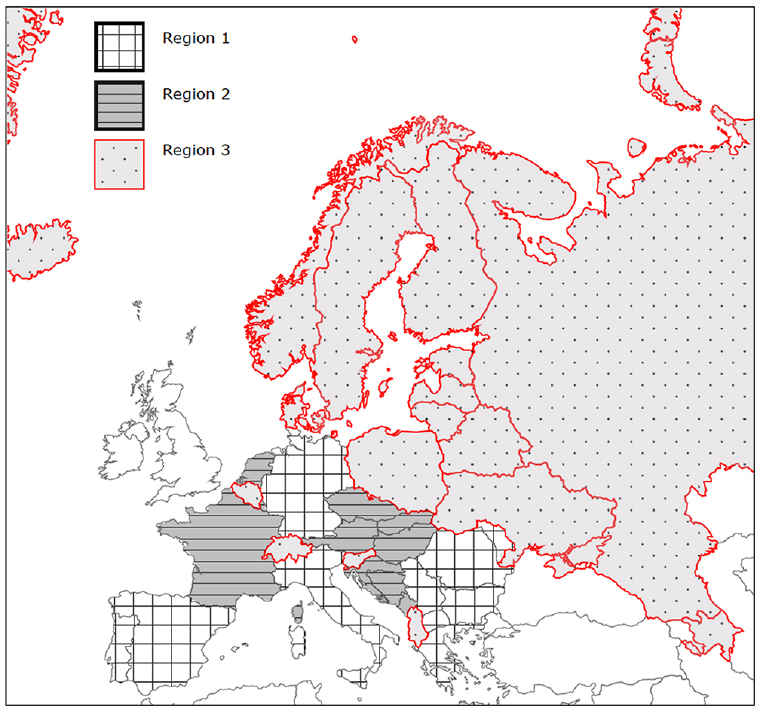
Visualisation of the geographical clustering of countries in regions within RCCG Europe Mainland.
Although the regions are in turn subdivided into provinces (and then into zones, areas, churches (also called ‘parishes’) and house fellowships), these subdivisions seem to be less important, as a nation-state logic seems to predominantly direct further church planting. According to the head of RCCG Belgium, this embedding into the territorial logics of the nation-state is a pragmatic response to the common legal framework with which the churches have to comply. Since 2005, the RCCG parish in Antwerp, which was founded by a diasporic church in the UK, coordinates church planting in Belgium. Under its impetus, the role of the Nigerian headquarters sharply declined, as its interference is often considered troublesome because it tends to misjudge the local situation. Hence, even though the missionary statement of Mainland Europe stipulates that ‘the first parish of any mission field should, as much as possible, be located in the capital city or the premier commercial city of the nations’ (RCCG, 2018), the capital of Belgium on the map of the RCCG is Antwerp, not Brussels. Consequently, the way cities in Belgium hierarchically relate to each other on the RCCG map breaks – to a certain extent – with a national hierarchy of places. Remarkably, and not entirely coincidentally as the RCCG spends a lot of effort in making itself visible on the map of local politicians, it also reproduces a Flemish nationalist hierarchy of cities and their self-proclaimed ‘economic success’ within Belgium.
Moreover, although church planting is now more hierarchically organised within nation-states, many anomalies still occur. As the international headquarters in Nigeria continue to establish churches in Belgium, such as a second parish in Ghent, without consulting the RCCG Mainland Europe or Belgian headquarters, conflicts over territory – and thus worshippers – sometimes occur. This is particularly the case in midsized cities where the territory to draw new potential worshippers from is less extensive. Another example of an anomaly is the RCCG parish in Aalst, which was not established by a nearby parish in Brussels, nor by the Belgian RCCG headquarters in Antwerp, but by an RCCG parish in Luxembourg. Probably because the Netherlands and Luxembourg are in the same Region 1, the parish in Luxembourg also attracts worshippers coming from cities in the Netherlands, again leading to a subjective repositioning of cities. The case of Aalst also shows how the fast-expanding RCCG network of churches sometimes leads pastors – and often in a later phase also worshippers – to settle in Belgium in patterns that bypass the capital as gateway city. This urges us to question the role designated to capital or global cities such as Brussels as ‘arrival cities’ from which African migrants disperse over the hinterland (cf. Saunders, 2011). Indeed, trans-urban Afro-Christian church networks often lead migrants directly from midsized city to midsized city, both via real and virtual connections, thereby also crossing national borders and this without clear directionality, thus countering ‘the grand narrative’ of onward migration (Schapendonk, 2021). Although the pathways for migrant incorporation in midsized cities may be less established than those in capitals, the lower rents and the more ‘tempered urban experience’ still make them attractive places to settle (Dehaene et al., 2012). By sidestepping Brussels, Afro-Christian migrants to some extent challenge scalar hierarchies within the Belgian nation state. Their transnational and trans-urban settlement and mobility patterns therefore invite us to rethink established relations of scale or at least should form the basis for the acknowledgement of the simultaneous existence of multiple scalar orders in the everyday experience of places and cities in Europe (Kärrholm et al., 2023).
Mobile urbanism from below: Mundane transfer agents and everyday best practices
As church-planting happens through a process of mitosis in which new churches are born out of existing ones, Afro-Christian (physical) place-making in one city is linked to place-making elsewhere (Massey, 2005). This conceptualisation of Afro-Christian place-making as ‘both relational and territorial, as both in motion and simultaneously fixed, or embedded in place’ resembles McCann and Ward’s (2011: xv) concept of ‘mobile urbanism’ in the context of policy mobility. Building on the notion of ‘assemblage’ (Allen and Cochrane, 2007; McFarlane, 2011), they highlight the importance of intercity networks in the drawing up of urban policies. This happens through the intervention of ‘transfer agents’ – ranging from the high-profile mayor to academics, consultants, politicians, policy professionals and practitioners – and the circulation of ‘best practices’. Well-known examples of cities with ‘best practices’ informing spatial strategies worldwide are Amsterdam for cycling, Bogotá for bus rapid transit, and Freiburg for sustainability. Apart from stressing the circulation of policy practices, McCann and Ward (2011: xiv) also underline how these policies change as they travel: situated somewhere between being fixed and mobile, ideas always need to be ‘converted into locally appropriate solutions’. Following this literature and its terminology, I am interested in the everyday ‘best practices’ that are circulating along the trans-urban network of Afro-Christian churches in Europe and the ‘transfer agents’ that initiate and facilitate this circulation. Yet, while McCann and Ward almost exclusively focus on institutional and corporate trans-urban networks of policy mobility, my research engages with everyday best practices and mundane transfer agents. Inspired by McCann and Ward, I call this a ‘mobile urbanism from below’. This is closely related to what Papadopoulos and Tsianos (2013: 179) call the ‘mobile commons’, that is, ‘the shared knowledge, affective cooperation, mutual support and care between migrants when they are on the road or when they arrive somewhere’. However, in contrast to this strand of literature, my focus is explicitly on the shared spatial knowledge: a set of place-making practices and spatial references that pastors and worshippers mobilise each time a new church is established (see also, Beeckmans, 2018).
Since the RCCG trans-urban network churches now chiefly expand from mid-sized city to mid-sized city in Europe without interference of the Nigerian headquarters, the circulation of spatial knowledge in Europe occurs mainly across the Afro-Christian diaspora. Therefore, Africa only rarely forms the dominant reference frame for the ‘best practices’. Afro-Christian place-making practices in the broader European (and sometimes North American) diasporic community appear far more influential since they are better accustomed to the socio-economic, juridical, political and cultural context. Through the comparative study of the spatial and material processes and products of Afro-Christian place-making in several European midsized cities, in real and virtual space, I have reconstructed a recurrent set of place-making practices. It is important to note that this set of ‘best practices’ is partly influenced by the virtual circulation of church-building manuals and church-planting instructions – which contain explicit place-making instructions (for examples, see RCCG, 2010, 2016) – but does not exist as such. However, even though the place-making practices were reassembled by me – mainly through observations and interviews – pastors and worshippers did not develop them unconsciously. Although they did not always fully articulate their interventions in spatial terms, their actions frequently seemed to be deliberate strategies – often but not always bound to their diasporic identity – to cope with a new urban context with its hegemonic regulatory regimes and deeply Eurocentric, normative and secularised conceptualisation of urban space. Yet, even though some place-making practices reflect political aspirations, the politics involved could in most cases best be described as the ‘politics which transform the political without ever addressing it in its own terms and practices’ (Papadopoulos and Tsianos, 2013: 188). In the following, I present a (non-exhaustive) set of recurrent place-making practices by zooming in from the spatial scale of the city, via the building to the interior.
The city
The strategy of incremental place-making
Each RCCG church is part of an ongoing project that stretches from real and unfinished places for the time being to imagined and modern places in the future. The incremental nature of the place-making thus has both a temporal and spatial dimension. Many churches first ‘take off’ in a rented room in a larger building, for instance a conference hall in a youth hostel (RCCG Leuven) or IBIS hotel (RCCG Aalst) (RCCG, 2010: 4). Although this clearly has the advantage that the church pays only for the time it occupies it, most pastors aspire to have their own space when the church community has reached a certain capacity. Yet, even after they provisionally settle in, for instance, an ordinary terraced house, most RCCG churches relocate frequently, especially during their first years. This gives them a nomadic, mobile character. In this process of gradual expansion and self-renewal, pastors aspire to a constant optimum between a lack of money and a lack of space. A crucial sign that a parish should look for a new and better location is when the pastor has to hold two succeeding services on Sunday because the premises have become too small. But even then, churches move to larger premises only after years of small, incremental changes to the building.
This strategy of incremental place-making is a driving force for many churches and continues in the pastors’ imagination. An RCCG pastor in Ghent for instance showed me a model of a new church building he hoped to establish close to the football stadium, which somewhat resembled its preferred neighbour, although the pastor referred to RCCG churches in North America as inspirational. Even though he is frustrated at having to hold his services in a former fitness centre (Figure 2, see also: Beeckmans, 2019) while Ghent’s cathedrals attract almost no worshippers, the latter are certainly not his ideal building types. Instead, he aims to establish a modern building for what he calls a ‘modern religion’. This incremental model of architectural and urban settlement, both in time and space, differs fundamentally from a European conception of cities and architecture as planned, designed, stable and permanent, although recent research on squatting has contested this dominant view (Vasudevan, 2017). It is, moreover, reminiscent of Silver’s (2014) concept of ‘incremental infrastructures’ in the context of Accra (Ghana), which points to the many ad hoc material improvisations urban dwellers construct in the built environment to generate access to ‘new infrastructural worlds’ and, more broadly, urbanity (Simone, 2004). Here, I would also like to connect this incremental place-making aspect of this ‘mobile urbanism from below’ to Simone’s (2022: 4) recent concept of the ‘surrounds’: a (spatial) mode of accompaniment to the envisioned, designed process of urbanisation with its overarching logics of capital accumulation of neoliberal rationalities. Or in the words of Simone (2022: 5): ‘In all instances the surrounds are infrastructural in that they entail the possibilities within any event, situation, or project for something incomputable and unanticipated to take (its) place’. Indeed, the RCCG churches, following Simone’s description of the surrounds, just ‘show up across different locations’, forming ‘interstices of momentary possibility’, to ‘move on […] just as soon as you think you know what they are’ (Simone, 2022: 6).
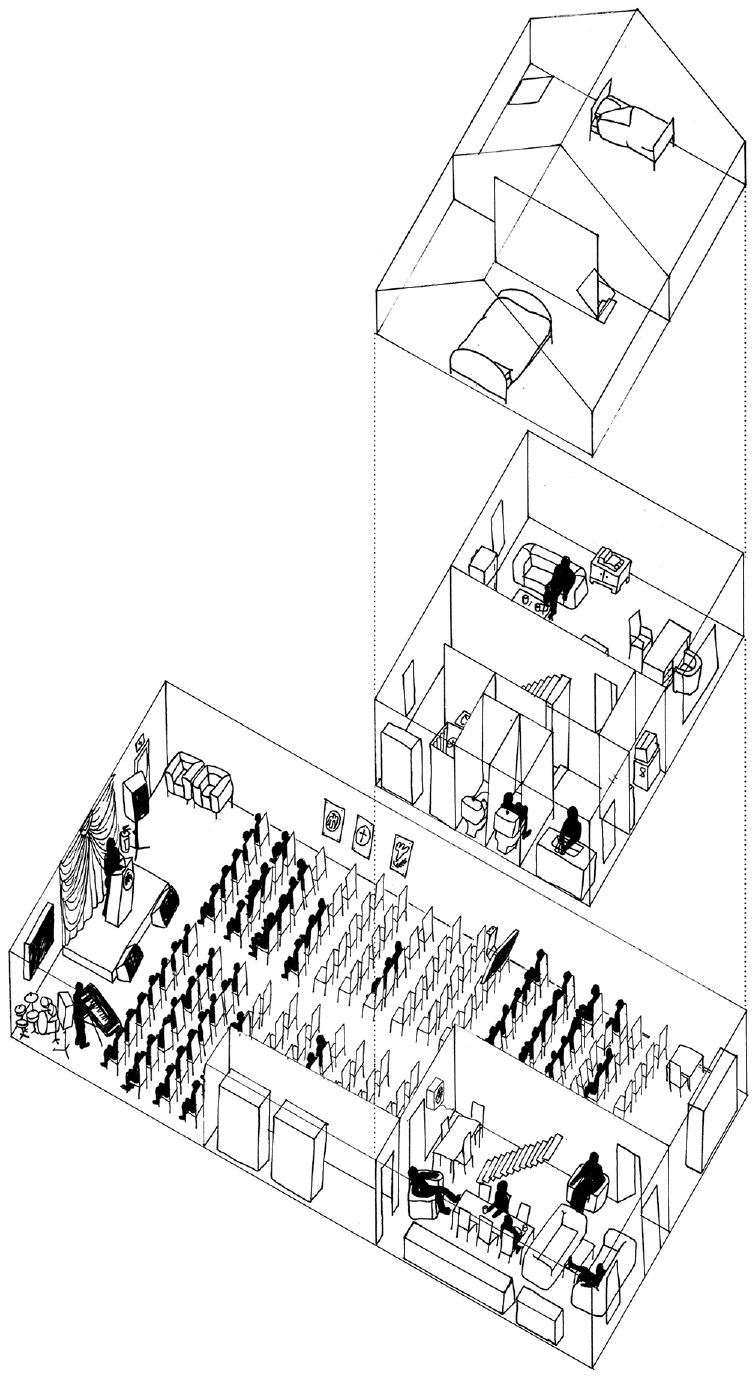
Drawing of a house church with the worship hall in the back in a former fitness centre illustrating the entanglement of domestic and worship spaces with shared kitchen and restroom facilities.
The strategy of fitting in
When searching the city for a (new) location to worship, pastors often follow the path of least resistance: they look for vacant buildings. Therefore, the RCCG ‘parish locator’, available on the internet, can be used to some extent as a ‘vacancy locator’, indicating that many Afro-Christian churches are located in relatively decayed or somewhat forgotten, ‘left-over’ areas, again reminiscent of Simone’s concepts of ‘surrounds’. Although most evident at the urban extensions, according to Simone, surrounds proliferate across all kinds of geographies. In the case of the churches, it is the latent potentialities of a plot, such as the low rent or isolated location, rather than its geography that makes it appropriate to fit in. Scholars have in this regard described how Afro-Christian churches have territorialised the ‘gaps in the post-industrial city’ – vacant storehouses and factories or underutilised port and railway infrastructure in global cities such as London – resulting in what several scholars have called ‘warehouse churches’ (Adogame, 2010; Garbin, 2013; Krause, 2008). Located somewhat atypically in a still largely operational industrial zone (in a former factory building, bought by the Nigerian RCCG headquarters for 1.5 million euros in 2007), the EU Mainland headquarters in Amsterdam are a textbook case of such a warehouse church (Knibbe, 2009). The directions on the RCCG website to the headquarters summarise the ideal urban setting of an RCCG church at the intersection of motorways and public transport and also evoke a certain aesthetic and semiotic of the preferred building: an anonymous shopping mall with only corporate signs instead of clear religious markers.
Although I have encountered similar occupations and appropriations of post-industrial infrastructure, for instance in Ghent – where five Afro-Christian churches (including an RCCG church until some years ago) established a hub in a vacant garage depot along the to-be-redeveloped former docks and have organised alternating church services (Figure 3, see also: Beeckmans, 2020) – most Afro-Christian churches in midsized cities are located in ordinary terraced houses. This is because post-industrial infrastructure is less prevalent in this city type and because Afro-Christian communities are smaller. I call this type of church ‘house church’ borrowing the term from Kong (2002), who used it to describe those residential, secular spaces which are used for worship by Christians in Singapore. In some cases, such as in Ostend, the pastor and his wife – who often fulfils a key role in the church too – begin a ‘house fellowship’ in their living room, which transforms into a mini worship hall several times a week. For each service, around 20 chairs are arranged in the living room, as well as a simple altar and musical equipment. During the services, the pastor’s wife leads the singing, accompanied by their children on keyboard and guitar. Worshippers’ children play upstairs in the private areas of the housel, the pastor’s wife oversees the ‘Children’s Department’, and prepares a snack for all the churchgoers after the Sunday service. But even when there is a separate hall, domestic and worshipping spaces are often deeply entangled, for instance by sharing the kitchen and toilets (Ghent) (Figure 2). House churches are very frequently located in former shops, often rented from more established (often Muslim) immigrant groups, with the previous shop layout facilitating an easy conversion into worship hall.
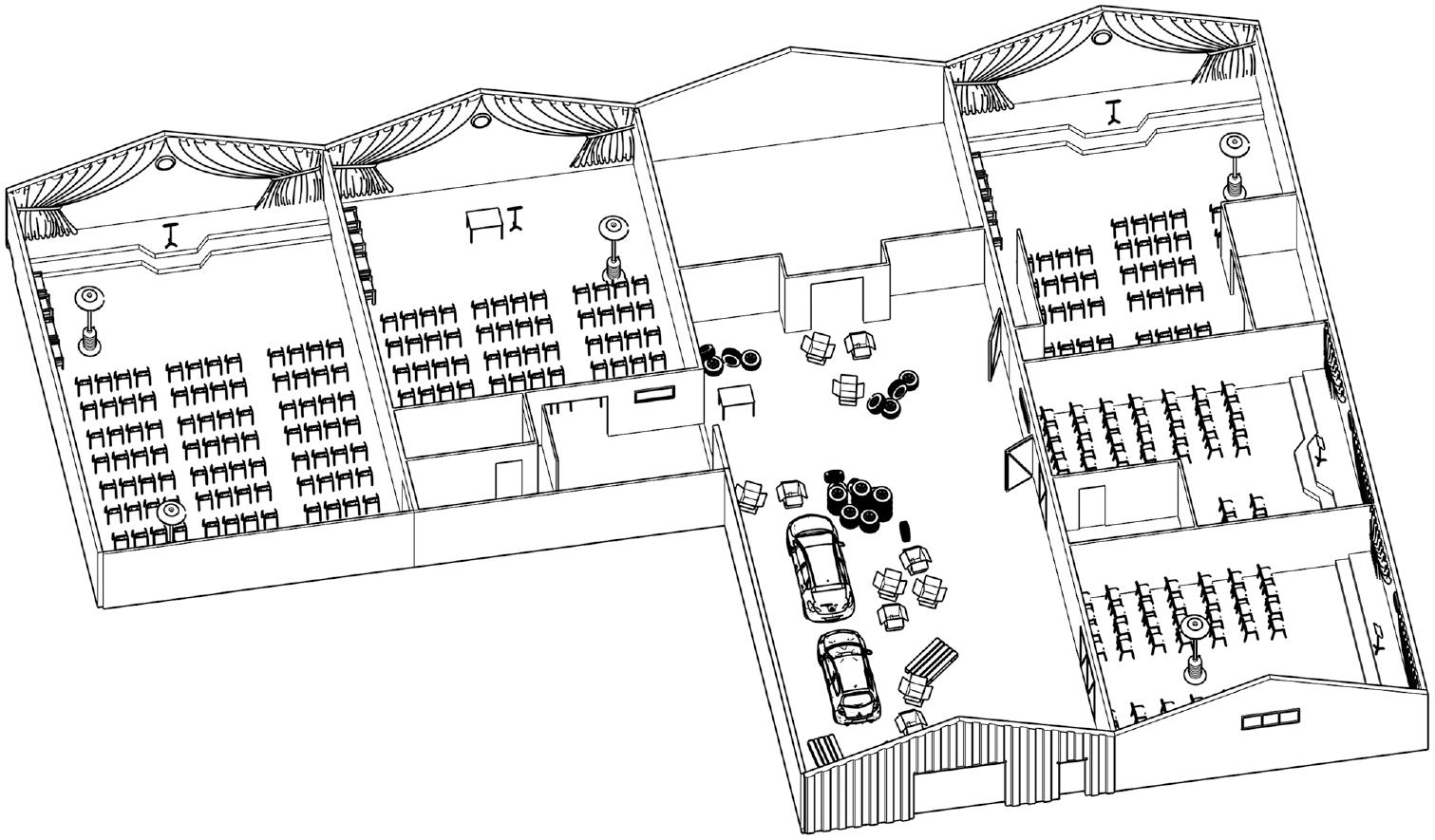
Drawing of a warehouse church where five Afro-Christian churches have established a hub in a vacant garage depot and organise alternating church services.
By regenerating left-over spaces, African migrants negotiate an alternative ‘right to the city’ (Vasudevan, 2015) and (partially) claim urban and ‘infrastructural citizenship’ (Lemanski, 2019). By reinvigorating decayed urban infrastructure and filling vacant spots in the urban fabric, Afro-Christian churches also engage in their own ways into a fragile project of ‘urban regeneration from below’ (Beeckmans, 2020) or ‘grassroots regeneration’ (Vathi and Burrell, 2021). Sometimes, this ‘urban regeneration from below’ paves the way for redevelopment plans by city leaders and real estate developers (Schiller and Simsek-Çağlar, 2011). However, while Afro-Christian place-making should indeed occasionally be ‘placed at the heart of the neoliberal construction of urban place instead of at its margins’ (Lanz and Oosterbaan, 2016: 487) – such as the Redemption Camp Lagos or the RCCG churches in London or Dallas – this is not yet the case for the spatiality of Afro-Christian churches in European midsized cities. In fact, in these cities, the Afro-Christian churches even risk being displaced by the redevelopment plans, as these generally contain a very secularised vision and chiefly focus on return-for-investment housing, a process which is currently the case for the Afro-Christian church hub in Ghent.
The strategy of transport accessibility
Although the strategy of fitting in might suggest that an Afro-Christian church could be randomly emplaced in the city, some zones have a better establishment potential than others. In line with the mission statement’s general goal to establish churches at intervals of five minutes’ driving distance, transport accessibility is crucial in location choice. Consequently, many RCCG churches are positioned along the cities’ inner ring roads or close to public transport nodes (Beeckmans, 2020). Therefore, unlike Catholic churches or Turkish mosques in many Flemish midsized cities, Afro-Christian churches are mostly not integrated in the historical fabric or situated in the heart of a certain neighbourhood.
In a rare example of a church located at a considerable distance from a bus stop or railway station, a pastor developed a car-pooling system to pick up worshippers by transforming his personal car into an RCCG automobile painting it in the church’s blue and green colours and adding large stickers of the church logo, featuring a flying bird, on the sides (RCCG Ghent). Although many worshippers come by bus, parking spaces are an important asset for a church location. In this regard, warehouse churches have a clear advantage over house churches, as they are located along major roads and often use the parking space of neighbouring shopping malls, which are closed on Sundays when the church community gathers. Conversely, the lack of parking space around house churches is often why they move to another location, especially since it regularly results in improper parking and fines during services.
The building
The strategy of invisibility
Paradoxically, the strategy of transport accessibility often goes together with Afro-Christian churches’ high invisibility in the streetscape. Often, only small, semi-fixed appropriations of the façade, sometimes nothing more than a small sticker with the church logo on the front door, mark the presence of an Afro-Christian church (Figure 4). This has much to do with the lack of formal citizenship status of the worshippers and the buildings. Indeed, some Africans I encountered in the churches were people without papers, sometimes on the move to other locations in Europe. Moreover, some of the place-making practices directly conflict with local regulatory regimes, for instance municipal laws on subletting, fire safety regulations, building and zoning regulations, etc. However, Afro-Christian churches opt to stay under the radar for more than just legal reasons. Sometimes, deliberate invisibility in the urban streetscape is also a way to avoid contestation over their (political) presence. Indeed, by not claiming visibility in urban space, these churches choose not to become an object of public debate, a strategy often described in the context of Muslim religious place-making in Europe (Bialasiewicz, 2017; Oosterbaan, 2014). Consequently, Afro-Christian churches are always negotiating a balance between the visibility necessary to function as a semi-public place for worship and the invisibility required for their partial compliance with local legislation (Beeckmans, 2019).
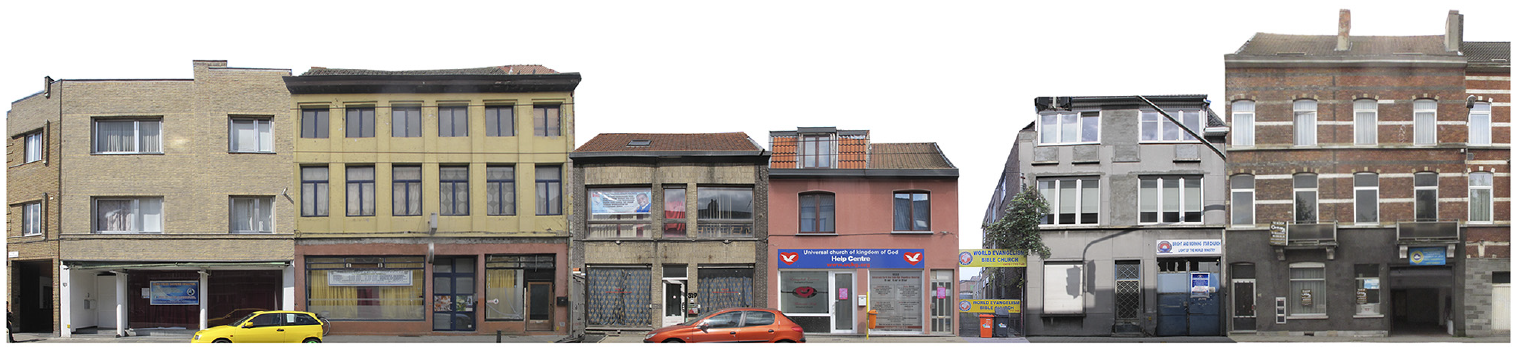
Fictional streetscape combining facades of Afro-Christian churches, with only subtle, semi-fixed markers indicating the presence of a church. Thick curtains often form a threshold between an ‘alien’ outside and a more intimate parochial space inside.
Yet, churches’ high invisibility in the streetscape is not necessarily a problem, since the main access point for worshippers is – apart from networks of kinship – the internet. Worshippers are directed from virtual to real places through the parish locator and social media such as YouTube, WhatsApp and Facebook – most pastors I have met had more than one phone and hundreds of unread WhatsApp messages. In contrast to their high invisibility in the city, many Afro-Christian churches are hypervisible on the internet. This increasing importance of the virtual for the approachability of the churches has spatial consequences as well. In one of the churches I visited, a room painted in blue and green was allocated to broadcasting messages and services on YouTube (RCCG Antwerp). The pastor even suggested that the rise of the internet made the five-minute rule of the mission statement somewhat obsolete.
The strategy of interiorisation
The façades of the buildings occupied by Afro-Christian churches remain to a large degree untouched. Often thick and dark curtains are placed over the (shop) windows to create a more intimate sphere, as African migrants frequently feel a sense of disinterest and discomfort within European public space – a ‘space of appearance’ characterised by specific but often unfamiliar visibility regimes and dominant ideals of ‘the’ public sphere (Staeheli et al., 2009: 633). In this way, a space of ‘mere givenness’ is constructed that ‘allows the (political) subject, the citizen, to be just what she or he “is” ’ (Arendt, 1943, cited in Bialasiewicz, 2017: 382). In some sense, the curtains act as a thin material threshold (Boccagni and Brighenti, 2017) between the street and the church’s semi-public or ‘parochial’ space, substituting any other transitional space between the interior and the street (Beeckmans, 2019).
The resulting interiorisation is thus not only the materialisation of negotiations over visibility and invisibility in the public realm, but also a certain inversion of what is experienced as (semi-)public and as private, at least in a Eurocentric conceptualisation. Scholars have questioned the universality of what is commonly considered ‘public’ and ‘private’ in their study of European Muslim spaces. In her study of a ‘hidden’ network of salons de thé for Maghrebi women in Brussels, Benchelabi (1998: 5) argues: ‘In Brussels, the domestic space is public and private at the same time: It organises all forms of social, religious and family gatherings. It takes on new meanings. It is a form of resistance to an alienating “outside”’. Similarly, Afro-Christian place-making’s focus on the transformation of the interior spaces of the urban fabric, can be seen as a form of (hidden) ‘material resistance’ (Kemmer, 2020) that, beyond conventional forms of political agency, produces (invisible) propositions of what can/could be. Linking it again with Simone’s ‘surrounds’, in particular where he relates it to ‘blackness’, we could say that Afro-Christian ‘mobile urbanism from below’ form an integral, yet not (easily) recognised part of contemporary urbanisation: ‘urbanization continues to be informed by anti-blackness and thus, by implications, is surrounded by a blackness that remains both on the outskirts of normative urban settlement and as an invisible interior’ (Simone, 2022: 24).
The strategy of being soundproof
Another important factor influencing the location of an Afro-Christian church is the ability to achieve what pastors often refer to as being ‘soundproof’, as the services of African churches are typically energetic and lively, featuring live music from loudspeakers, singing through microphones and rhythmic dancing. Almost all incidents requiring police intervention reported by pastors were related to neighbours complaining about noise. While pastors often interpreted these complaints as a pretext for neighbours’ racial intolerance, they invariably reacted by keeping the peace, even preferring to move instead of going to court (RCCG Leuven).
Warehouse churches are certainly more suitable for accommodating Afro-Christian churches because their distance from other buildings ensures that they are soundproof. However, most Afro-Christian churches in European midsized cities are located in terraced houses in dense urban fabric, where the requirement to become soundproof has clear repercussions for the building. Indeed, one of the first changes made after moving in is the installation of insulation on walls and ceilings, even if this further increases the lack of space by adding a thick layer to the inside of the building.
The interior
The strategy of compartmentalisation
While the façade is often only superficially altered, more radical changes are found inside the buildings. Walls are regularly broken through to create the worship hall. This is particularly necessary in house churches characterised by small rooms and often results in peculiar shapes of worship halls, consisting of an amalgam of fragmented spaces in which some worshippers cannot directly view the service. This problem is often solved by adding screens on which awkwardly positioned worshippers can follow the service.
More radical transformations of the building entail the compartmentalisation of space to provide room for the many other church activities related to welfare and hospitality, such as a kindergarten, a bible school, a canteen, a kitchen, toilets, a pastor’s office for counselling services, a foodbank, a small café and relaxation space, a place for broadcasting and ICT, charity, etc. In warehouse churches, this compartmentalisation is often realised by enclosing parts of the larger space, sometimes with tent-like structures, but most frequently with hardboard walls. In house churches, the church community regularly splits the small courtyard into several adjacent annexes using hardboards and sometimes even bricks. Often it is challenging to ensure that these makeshift or bricolage constructions comply with fire regulations. This compartmentalisation shows that Afro-Christian churches offer much more than just religious services. Instead, they are vibrant faith-based organisations, often fulfilling essential social services that are not or no longer provided by a receding welfare state, not only for migrants but increasingly for natives too (Beaumont, 2008).
The strategy of hyperfunctionality
Afro-Christian ‘mobile urbanism from below’ furthermore transforms the interior according to a pragmatic and even hyperfunctional logic, using a recurring set of mobile objects such as draped curtains, heavy (red) carpets, (plastic) chairs, musical equipment, heaters, a plastic altar, television sets and extensive kitchen appliances. These hypermobile objects allow for a rapid transformation process of ‘profane buildings into sacred interiors’ (Cassani, 2012) and, conversely, for a quick withdrawal, as Afro-Christian churches often switch locations within cities. Alluringly, Garbin (2013: 682) called Afro-Christian churches in this context ‘machines for praying in’, referring to Le Corbusier’s famous view of modern homes as efficient, functional and standardised ‘machines for living in’.
Many objects used by Afro-Christian churches, such as the dark curtains and colourful plastic chairs, clearly reflect practices in African cities and the broader African diasporic community and form a kind of shared, highly identifiable visual language, in both real and virtual space. Additional objects have been added to comply with fire regulations. Indeed, emergency lights and fire extinguishers are as much part of an Afro-Christian church in Europe as the plastic altar. As alluded to above, pastors give much attention to fire and building regulations because they want to prevent local governments from closing churches using this pretext, a phenomenon well described in the context of mosques, even authorised ones (Beeckmans, 2019). Bialasiewicz (2017: 377), for instance, discusses how Muslim claims to public space in Italy often provoke discomfort and fear, leading authorities to shut them down by citing ‘public health reasons’ or safety regulations as a pretext (see also Beynon, 2015; Frazier, 2015).
The strategy of corporate branding
Although Afro-Christian churches are sometimes associated with witchcraft and sorcery, when I interviewed pastors and exchanged business cards, I sometimes felt that I was speaking to businessmen rather than spiritual leaders. In fact, many pastors had a previous corporate life that they continue in the churches. Some scholars go as far as calling Afro-Christian churches examples of ‘entrepreneurial religions’, stating that their congregations ‘constitute a paradigmatic neoliberal form of organisation’ (Lanz and Oosterbaan, 2016: 497). Even though Afro-Christian churches in European mid-sized cities do not (yet) operate as neoliberal organisations, my research clearly shows that they are not ‘the Other of modernity and technology’ (Meyer, 2009: 1), as is often presumed, but instead embrace and even pursue such a corporate identity.
Evidently, this has material and aesthetic repercussions as well. The RCCG for instance mimics a style of corporate branding in its logos, signboards, banners, etc. As the latter are also used to decorate the interior and, to a lesser extent, the exterior – often combined with walls painted with the logo’s colours – this corporate branding also influences how the churches are experienced. Yet, although there are strict guidelines for logos and banners, typos frequently appear. Combined with a sometimes-unusual layout, the resulting branded architecture is often considered less modern by outsiders than the pastors would like, and instead sometimes even evokes a certain ‘migrant aesthetics’ (Lozanovska et al., 2013: 76).
Particularly at the extensions, just beyond what has customarily been purported to be the ‘real city’, it is increasingly evident that a continuous recalibration of ‘projects’, material inputs and residues, and altered ecologies of reciprocal causation are generating landscapes that exceed the salience of available vernaculars of analysis and intervention. (Simone, 2022: 4)
As discussed above, mobilising Simone’s concept of ‘surrounds’ to understand Afro-Christian place-making in European mid-sized cities proves to be productive, especially where he describes surrounds as ‘a product of relational location, rather than a geographic one’ (Simone, 2022: 6, emphasis in original, cf. Simone et al., 2023). Indeed, the Afro-Christian ‘mobile urbanism from below’ examined in this article draws attention to spatial and material entanglements across different locations that have the potential to disrupt normative spatial arrangements and scalar compositions. However, rather than framing the resulting spatiality and materiality as dramatically different, it instead forms the ‘twin’ to normative vernacular architecture. The concept of the ‘twin’, as formulated by Lozanovska (2019) in the context of ‘migrant housing’, is particularly relevant here as it enables a shift from a binary ‘other–centre’ framework to a discourse of ‘parallel existence’. Rather than interpreting Afro-Christian churches by means of theories of otherness, the ‘twin’ concept demonstrates how the architecture of Afro-Christian churches instead develops in parallel with normative architecture. While sharing similar spatialities, materialities and place-making aspirations, Afro-Christian churches negotiate these elements within transnational fields. Afro-Christian churches are thus multi-referential: they are both embedded in the local architectural articulations and made in relation to architectural references and practices elsewhere. By spatialising ethnographic notions of the socio-linguistic ‘vernacular’ concept, such as Blommaert’s (2011) idea of ‘supervernacular’, and Bhabha’s (1996) ‘vernacular cosmopolitanism’, I term the architecture arising from the Afro-Christian mobile urbanism from below ‘transnational vernacular architecture’. Walking through the streetscapes of the European mid-sized city, one could easily overlook the transnational vernacular architecture of Afro-Christian churches, as it blends into the normative vernacular architecture despite its distinctive architectural features. This apparent invisibility functions as both its greatest strength and its primary weakness: it enables its existence while simultaneously reinforcing its persistent marginalisation.
Some preliminary conclusions on ‘mobile urbanism from below’
1
In these last paragraphs, I share some reflections on the potential contribution of the concept ‘mobile urbanism from below’ to urban studies. The concept offers an alternative perspective within urban studies, one that foregrounds how ordinary people through everyday engagements contribute to city-making in spatial and material terms. While an extensive body of literature now empirically unpacks various manifestations of everyday city-making, particularly in what is called the ‘Global South’, the role of migrants as constitutive forces in the fabrication of European cities is still frequently overlooked. By shifting the focus to migrants’ spatial practices, this article not only enriches understandings of city-making, but also challenges conventional assumptions about who constitutes an urban actor in the European midsized city (Beeckmans et al., 2022; Simsek-Çağlar and Schiller, 2018).
Exploring migrants’ constitutive role in city-making also critically links discussions on place-making and ‘infrastructuring’ (Arnaut et al., 2025) to debates on citizenship. Indeed, ‘mobile urbanism from below’ highlights migrants’ occupation, appropriation and fabrication of infrastructure as ‘acts of citizenship’ (Isin, 2008), even in the absence of formal citizenship. Through everyday practices of accessing, making, using and providing infrastructure, social rights are made and claimed, and citizenship as an individual and collective subjectivity is performed, enacted and brought into being. At the same time, these infrastructuring practices challenge dominant, state-centred paradigms of citizenship, particularly their entrenched conceptions of legality and legitimacy, and inherent racialised categorisations. ‘Mobile urbanism from below’, moreover, demonstrates how citizenship is enacted through multi-scalar practices that disrupt traditional scalar hierarchies, allowing migrants to navigate, contest and reimagine notions of citizenship traditionally tied to state-sanctioned frameworks of political membership, access to rights, and belonging. As such, ‘mobile urbanism from below’ represents a form of ‘propositional politics’ (Lancione, 2019), prefigurating other forms of citizenship and urban belonging that challenge dominant, (neo-)colonial and capitalist paradigms of belonging.
2
Beyond merely conceptualising ‘urbanism from below’, this article expands on how ordinary people circulate spatial knowledge transnationally, fundamentally transforming urban landscapes, albeit often invisibly at first glance. Particularly in what Simone (2022) has called the ‘surrounds’, we can increasingly observe the emergence of a ‘transnational vernacular’ – an architecture that is not only grounded in the local, but also embeds architectural articulations from transnational fields. While urban studies have often focused on high-profile, institutional exchanges and their impact on global urban development and the scalar repositioning of cities, ‘mobile urbanism from below’ highlights the vast scope of everyday spatial transfers by focusing on Afro- Christian place-making, not only through global proliferation but also through local permeation. Indeed, Afro-Christian ‘mobile urbanism from below’ appears multi-directional and multi-scalar, thus challenging the dominant North–South directionality in both policy transfer literature and migration studies, as well as eluding the hollow binaries between ‘Global South’ and ‘Global North’ cities. Indeed, Afro-Christian place-making ‘pops up’ not only in global or arrival cities, but in all cities worldwide, including smaller, midsized cities in Europe, the focus of this article. As such, the conceptualisation of ‘mobile urbanism from below’ adds to Robinson’s (2016, 2022) comparative urbanism project, which blurs conventional categories between cities to consider all cities just ‘ordinary cities’ (Robinson, 2006).
3
This article’s development of the notion of ‘mobile urbanism from below’ illustrates how European cities are shaped in relation to cities elsewhere, also from below. This bottom-up perspective on how European cities are constructed in connection to (fragments of) cities elsewhere unsettles certain assumptions of European cities as inherently ‘secular’ or ‘planned’ urban spaces. Indeed, this article has demonstrated that these categorisations are more normative framings than reflections of everyday realities. To present itself as ‘modern’, ‘developed’, ‘secular’, ‘planned’, ‘paradigmatic’, etc. and reaffirm this self-understanding, Europe does not only other large parts of the world, but it also obscures its own diverse realities. Indeed, the study of Afro-Christian ‘mobile urbanism from below’ has illustrated that there are multiple ways of being European, or in short, that ‘multiple Europes’ co-exist (Boatcă, 2013). As such, the concept of ‘mobile urbanism from below’ is an invitation to further question Eurocentric views in urban studies from within Europe itself instead of via the mirror of non-European cities as is most often the case. In this sense, ‘provincializing Europe’ (Chakrabarty, 2000) does not end with the demarginalisation of non-European histories and experiences, but extends to acknowledging that there is not one Europe. Within Europe, diverse conceptions of progress, citizenship and secularism exist, many of which remain marginalised in discussions of city-making in Europe. At the same time, Afro-Christian ‘mobile urbanism from below’ complicates Eurocentric views on migration as economically driven with migrants searching for progress and modernity in Europe (Carling and Collins, 2018).
4
Lastly, studying ‘mobile urbanism from below’ has profound methodological implications and potentialities for urban studies research. In fact, the mobile nature of the urbanism discussed has the potential to guide researchers toward diverse and, at times, unexpected urban contexts, thereby quite naturally avoiding (elements of) ‘methodological nationalism’ (Wimmer and Schiller, 2003), and in the case of Afro-Christian place-making, also ‘methodological whiteness’ (Bhambra, 2017). Indeed, the study of mobile urbanism from below almost inherently leads to a multi-sited (Marcus, 1995) or global ethnographic (Burawoy et al., 2000) approach – one that examines cities across contexts without allowing nation-state frameworks to dominate research site selection. Therefore, researchers engaging with (other forms of) ‘mobile urbanism from below’ will almost organically break with a tendency described by McCann et al. (2013: 586) in which ‘cities of the Global South are often narrated through empirical description, through ethnography, through idiosyncratic knowledge, while accounts of cities of the Global North, also provincial, travel as Theory’. ‘Mobile urbanism from below’, not only as a concept, but also as a heuristic, thus contributes to a decolonised urban studies, one which recognises that no single location holds a privileged position in theory formation, just as none is central to in-depth ethnography.
Footnotes
Acknowledgements
The empirical research for this article was conducted with the support of the FWO (the Research Foundation Flanders), which granted me a postdoctoral fellowship for my project ‘Mapping the Invisible City. Spatial Manifestations of sub-Saharan African Diaspora in the mid-size city in Europe’. I presented a first conceptualisation of ‘mobile urbanism from below’ at the start of my fieldwork at the RGS-IBG Annual International Conference in London in 2017 in the panel ‘Decolonizing Urban Geography’, organised by Jennifer Robinson, to whom I am grateful for this opportunity. Initial research insights were published in 2018 in the journal African Diaspora, where I worked still more with the notions of ‘mobile worlding’ and ‘diasporic world-making’ than with ‘mobile urbanism from below’. I appreciate Karel Arnaut, the then-editor of the journal, for his useful and insightful feedback. In 2021, I presented a more elaborated version at the 2021 Annual International Conference of the Society of Architectural Historians (SAH) in Montréal (online due to COVID), particularly elaborating on the notion of ‘transnational vernacular’. The session ‘Diasporic Architectural Histories’ was organised by Mirjana Lozanovska and Anoma Pieris, whose valuable feedback was greatly appreciated. I also wish to express my sincere gratitude to the many students with whom I had the privilege to work on this topic in research seminars at the Department of Architecture and Urban Planning at Ghent University. In particular, my thanks go to the three students whose MA theses I supervised on Afro-Christian churches for their insights, inspiring dialogues and fascinating ethnographic explorations: Pieterjan Dehaene (2013–2014); Helena Sileghem and Zuzanna Rucka (2016–2017). I also thank their co-supervisors, Bruno Notteboom, Johan Lagae and Ben Derudder, for the inspiring exchanges. Furthermore, I extend my sincere appreciation to the entire team of the Innoviris-funded ATLAS project (Access To Housing and Social Infrastructure for People with Precarious Residence Status in Brussels) for the fruitful dialogues on citizenship, which have greatly assisted me in finalising this article.
Declaration of conflicting interests
The author declared no potential conflicts of interest with respect to the research, authorship, and/or publication of this article.
Funding
The author disclosed receipt of the following financial support for the research, authorship, and/or publication of this article: Luce Beeckmans received funding of the Flemish Research Foundation (FWO) for conducting the research presented in this article (postdoctoral fellowship 12I5916N) and from KU Leuven for the Open Access publication of this article (BOFZAP Starting Grant).
