




Abstract
This article demonstrates how tech professionals commuting to neighbourhoods redeveloped for their work are contributing to their transformation into urban tech campuses: gentrified districts where landscapes, understandings of place and temporalities are shaped by their praise of innovation, emotional detachment from place, and daily ebb and flow. While also resulting in displacement, othering, and the rewriting of histories and geographies, commuters’ contribution to tech-led gentrification contrasts with the emotional investment into place and the sense of permanence gentrifiers use in established residential neighbourhoods they perceive as authentic and progressively remake in their image. While concomitant, it also differs from residential new-build gentrification, as it reinforces not only middle-class norms but also the economic discourse of the high-tech industry, which co-produces these places as elite worker oases. Using South Lake Union, Seattle, WA as a case study, this article aims to contribute to a social understanding of tech-led gentrification: while recent research has focused on residential gentrifiers and on the macro political and economic forces that transform declining urban areas into so-called innovation districts, this qualitative study explores gentrification through the narratives and uses of public space of an urban tech campus’s dominant population – an elite, predominantly young, white, male commuter workforce several times larger than the local residential population.
Introduction
I never really understood why anyone would want to live down there. (South Lake Union tech professional)
This paper asks what role commuter tech professionals and their employers play in the transformation of urban neighbourhoods redeveloped as campuses. Technology companies around the US lure their employees into the office by developing luxurious innovation centres replete with amenities that shun rebarbative corporate aesthetics. To further attract their highly educated, highly paid – and predominantly young, white, male – workforces looking for a creative and dynamic urban work environment, tech companies often develop campuses in the core of cities eager to secure the talent, capital and prestige necessary to compete in the global economy (Katz and Wagner, 2014; Zukin, 2020). Examples of this phenomenon abound in the US – in New York, San Francisco, Boston, Portland, Austin – and many more cities globally. Aided by real estate developers and city governments, these companies transform ‘declining’ industrial neighbourhoods into oases that offer their employees the chance to brush with a celebrated urban ‘grittiness’ without experiencing the actual hardships of American downtowns. Paradoxically, while promoted as integrative, 24/7 ‘live–work–play’ spaces, urban tech campuses exude the same impression of seclusion and on/off temporality as suburban tech parks and traditional business districts.
Beyond the macro-economic and political forces enabling these redevelopments, how does the daily inflow and outflow of an elite workforce impact the local landscape and the neighbourhood’s daily functioning? Current research on the ‘shop floor[s]’ of innovation (Stehlin, 2016) and the ‘innovation complex’ (Zukin, 2020) tends to focus on these structural patterns and to see workers as collaterals rather than actors in these transformations. To address this gap, this study uses place-making as a key concept to explore the mechanisms through which tech commuters, through their mundane activities and narratives, produce their neighbourhood of work in their image (Elwood et al., 2015). In doing so, this study points to another gap in the literature: gentrifying place-making is widely studied as a residential phenomenon. How does the population that comes and goes en masse to and from a mixed-use neighbourhood partake in its gentrification?
Through qualitative research in South Lake Union (hereafter SLU), a tech campus in the heart of Seattle, WA, this paper argues that some discourses, practices and ‘rhythms’ (Kern, 2016) seem specific to the commuting elite workforce, making it crucial to research their role in gentrifying innovation districts. While also resulting in displacement, othering, and the rewriting of histories and geographies, tech commuters’ gentrification contrasts with residential gentrification in that it does not rely on an attraction to place history, aesthetics and perceived authenticity. To the contrary, two main mechanisms help tech professionals reshape SLU: an emotional distancing from the tech campus (as opposed to attraction toward and investment into a residential neighbourhood) and the coordinated use of time in or away from campus (as opposed to a permanent foothold in residential neighbourhoods) that obscure and preclude non-tech activities, needs and understandings of the neighbourhood – and thus fail to fulfil proclaimed aspirations for diversity. These findings point to a kind of co-production of tech domination: tech commuters’ place-making practices (both discursive and enacted) reflect and reinforce the material and aesthetic changes carried out for them in the neighbourhood and reinforce the hegemonic discourses of their employers. The following sections describe current literature on tech-led gentrification and gentrifying place-making practices, the qualitative mixed-methods approach used for this research, the case study, and key findings of a two-year immersion into SLU’s transformation.
Tech-led gentrification
The concept of gentrification is a ‘moving target’: it defines an ‘elusive phenomenon’ that evolves over time and depends on local contexts and histories (Knieriem, 2023). Coined in 1964 as the London ‘gentry’ was displacing working-class residents through housing renovations, the term is now used more broadly to describe processes of population displacement in cities around the globe (in favour of inhabitants with more socio-economic capital), along with transformations of the built environment and changes in neighbourhood culture, uses and lifestyles (Knieriem, 2023; Lees et al., 2016).
The aesthetics and perceived ‘authenticity’ (Zukin, 2010) of a neighbourhood draw gentrifiers into established urban areas considered ‘“edgy,”“ethnically diverse,”“cool,”“hipster”’ (Lindner et al., 2021: 20). Once there, gentrifiers aestheticise the landscape (Ley, 2003) to embed their class values and identity in it, thus paving the way for capital investments, housing and living cost increases, and the exclusionary displacement of long-term residents. Despite newcomers’ best intentions to be ‘good neighbors’ (Tissot, 2015), their arrival provokes an ‘upscale homogenization’ of residential and economic uses of the neighbourhood (Lindner et al., 2021: 31). However, rather than fully destroying diversity, as Jane Jacobs argued in 1963 (Lindner et al., 2021), the incoming elite sets the terms of a legitimating but controlled diversity that maintains power imbalances (Tissot, 2015). Residential place-making in these instances nonetheless relies on a labour of love and on the ‘continually reiterated . . . work of individuals’ (Benson and Jackson, 2013: 804).
To the contrary, ‘new-build’ gentrifiers tend to be ‘transient residents’ with ‘little interest in or attachment to the local neighbourhood’ and who ‘do not invest social capital’ there (Davidson and Lees, 2005: 1183). This recent form of gentrification describes the ‘physical and aesthetic remaking’ of former industrial and working-class spaces into newly constructed neighbourhoods catering to middle-class tastes (Naismith and Murphy, 2023: 4). While not always being ‘physically dislocated’, existing residents in these neighbourhoods lose ‘a sense of place-based identity’ as their needs and tastes are no longer met (Naismith and Murphy, 2023: 5).
Yet innovation districts are not just residential. Also built over ‘former manufacturing and warehousing districts’ in urban cores (Kayanan et al., 2022: 343), they consist in geographically compact and globally connected clusters (Katz and Wagner, 2014) formed through the ‘triple helix’ of government, business and university partnerships (Zukin, 2020). Their central location is seen as a cure to the ‘seeming banality’ of the suburban aesthetics of Silicon Valley – or that of the Microsoft headquarters just outside Seattle – and offers the amenities and curated ‘diversity’ (Stehlin, 2016: 487) praised by their elite workforce. Contrary to tech parks, Central Business Districts and university campuses, innovation districts are designed as mixed-use neighbourhoods that ‘incorporate entertainment, retail, and housing amenities in close proximity to work’ to create highly profitable ‘live–work–playgrounds’ blurring the lines between work and other activities and networks (Kayanan, 2022: 52). However, office buildings remain ‘insular worlds’ (Lindner et al., 2021: 53).
Accompanied by the privatisation of public space, patterns of exclusion and real estate speculation, ‘tech-colonialism’ (Maharawal, 2022: 785) displaces ‘long-standing communities’ (Kayanan et al., 2022: 344) in innovation districts and in nearby residential neighbourhoods. San Francisco’s ‘tech boom’ is a prime example of how the arrival of innovation (and its workers) into cities leads to this tech-led gentrification (Maharawal, 2022).
As places of work and residence evolve, merge, shift and follow new spatiotemporalities enabled by more diverse work arrangements and new technologies, questions emerge about the impact workers and businesses have on urban change (Reuschke and Ekinsmyth, 2021). The ‘reorganization of work’ is in fact directly linked to ‘displacement pressures on central city neighborhoods’ (Chapple, 2017: 85). Rice et al. (2020: 150–152) further argue that tech professionals ‘accelerate’ gentrification by electing to live in ‘eco-friendly’ (i.e. dense, walkable, sustainably built) urban neighbourhoods and by working for companies that ‘strategically and intentionally . . . appeal to their desire for . . . environmental sustainability and climate-change mitigation.’
How do tech commuters contribute to these gentrification processes? d’Ovidio (2021) invites us to use place-making as a framework, arguing that workers ‘make place’ as much as they ‘make economies’ in their neighbourhoods (d’Ovidio, 2021: 2280, emphasis in original).
Hegemonic place-making
Place-making is a set of ‘cultural, discursive, and material practices through which people imagine and transform places’ while constructing their group identity (Elwood et al., 2015: 123). This collective production of place through mundane day-to-day activities and narratives has material and symbolic repercussions, ranging from new zoning regulations (Trudeau, 2006), public policies (Blokland, 2009), and transformations of the physical landscape, to competing (re)descriptions of the place’s history and character (Benson and Jackson, 2013).
Place-making is performative and constitutes a ‘discursive practice in action’ (Benson and Jackson, 2013: 797). For minority social groups, place-making can be a ‘creative’ and ‘celebratory’ practice that aims to ‘create sites of endurance, belonging and resistance’ in ‘hostile spaces’ of marginalisation and discrimination (Hunter et al., 2016: 32). For dominant groups, however, place-making relies on the normalisation of their values, consumption habits, ‘temporal landscape[s]’ (Kern, 2016: 446), and aesthetic tastes. It relies on the production of a ‘cultural “common sense”’ that reinforces power by making its organisation seem natural (Spade and Willse, 2016: 551). This ‘unacknowledged consensus’ tends in fact to ‘erase whiteness’ and turn middle-classness into a ‘“nonclass” status’ (Elwood et al., 2015: 124–133). These ‘conscious and unconscious choices’ are ‘inextricably set within a network of power relations’ (Allen et al., 2019: 1010). Place-making is therefore an ‘always ongoing’ relational process, constituting a ‘networked politics of place’ and revealing a struggle between conflicting ideals and uses of place (Pierce et al., 2011: 60, 66).
Hegemonic place-making, then, is a set of mundane local practices that normalise dominant values and place imaginations. It transforms the physical landscape, but also impacts social groups materially, practically and symbolically. The rapid and drastic tech-led transformation of a neighbourhood such as SLU invites an exploration of its dominant (although non-residential) population’s place-making and its contribution to ongoing gentrification.
Methodology
The research presented in this paper is based on a case study of SLU conducted in 2019 and 2020, before the COVID-19 stay-at-home order of March 2020. It consisted in an in-depth qualitative exploration of tech professionals’ understandings and uses of the neighbourhood where they go to work, as well as the neighbourhood’s influence on their collective identity, through an analysis of their place-making practices paired with an analysis of the physical landscape.
This paper focuses on the hegemonic practices of tech companies and their elite commuter workforce to expose and disrupt their normalisation. As a white, middle-class, former tech professional, I consider this work mine to do (The Combahee River Collective, 2014: 279). My understanding of SLU’s tech-led transformation is indeed influenced by my personal experience working in high-tech in Silicon Valley and Seattle. Being a ‘quasi-insider’ helped me connect with interview participants, rapidly grasp their point of view, and discern discursive elements in their responses, including what remained unspoken or unacknowledged. While close to this milieu, I have never worked or lived in SLU, and gained distance from my research in this way. This work is grounded in ‘the recognition that all knowledges are embodied, situated, contextual, and therefore partial’ (Mohammad, 2017: 9).
I conducted in-depth semi-structured interviews with nine professionals working for tech companies (including ‘Big Tech’ firms such as Amazon and Facebook, biotech companies and medical research centres) in SLU and quietly observed activities taking place in SLU’s public spaces to explore mundane practices in this landscape and their co-constituting effects. The interviews teased out the values, tastes, norms, boundaries (physical and symbolic) and imaginaries these commuters build and rely upon through their uses of the neighbourhood and through their discourse, to make (and read) SLU in their image.
In parallel, I took 225 photographs of SLU’s landscape and analysed them along with several dozen archival photographs from the 1990s and early 2000s to explore the neighbourhood’s most recent transformation and what tech professionals might see (or not see) in it. The landscape is simultaneously a canvas on which the dominant group performs its hegemony and a text that individuals take cues from when forming an understanding of place and of their collective identity in relation to those they construct as ‘others’ (Duncan and Duncan, 2010; Mitchell, 2017). Anti-racist scholars argue that the landscape ‘has become part of the repertoire of white privilege, white supremacy, and racial oppression’ (Allen et al., 2019: 1007). A landscape analysis is therefore well-suited to an exploration of the power and privilege of ‘those with the social, political, and economic capital to make their societal visions visible in the landscape’ (Allen et al., 2019: 1002), when used in conjunction with interviews from this group.
Primary and secondary textual and visual sources from the recent past (such as developers’ and tech companies’ publications, city council documentation, maps, news articles and historical analyses) supplemented my analysis of the dominant discourses circulating about SLU.
While the main aim of my work is to disrupt hegemonic practices, this study partakes in the invisibilisation of non-hegemonic experiences by centering privilege once again – giving voice to the dominant group and analysing the visible (and therefore power-laden) features of the landscape. Further research must give voice to a wider range of neighbourhood actors and inhabitants, through solidary and non-exploitative research ethics (Mohammad, 2017), to better grasp the relational nature of place-making (Pierce et al., 2011) and better incorporate ‘overlapping and contradictory spatial imaginations and experiences’ (Allen et al., 2019: 1003).
South Lake Union, Seattle
SLU fits the typical innovation district description. It is physically surrounded by local government, finance and real estate institutions (downtown Seattle), university and research centres (including the University of Washington across Lake Union) and wealthy residential neighbourhoods (such as Capitol Hill and Queen Anne). It sits on a waterfront, provides a mix of office, retail, residential, green and cultural spaces, and is serviced by the city’s two major highways, a streetcar, rapid bus routes and cycle lanes.
SLU’s new landscape of sleek glass and concrete buildings, with their green rooftops and street level plazas and cafés, and the seemingly constant ballet of construction cranes, have been unavoidable signs of the growing presence of global tech companies (Figure 1). This architecture is easily recognisable and very distinct from that of the warehouses and factories of tech companies’ other sites in American suburbs and along worldwide supply chains, located far from elite workers’ view. There is no doubt when walking through SLU that the jobs performed in these buildings are the command-and-control functions of these organisations, rather than the low-waged and often racialised jobs that sustain their operation elsewhere or remain in the shadow on this campus.
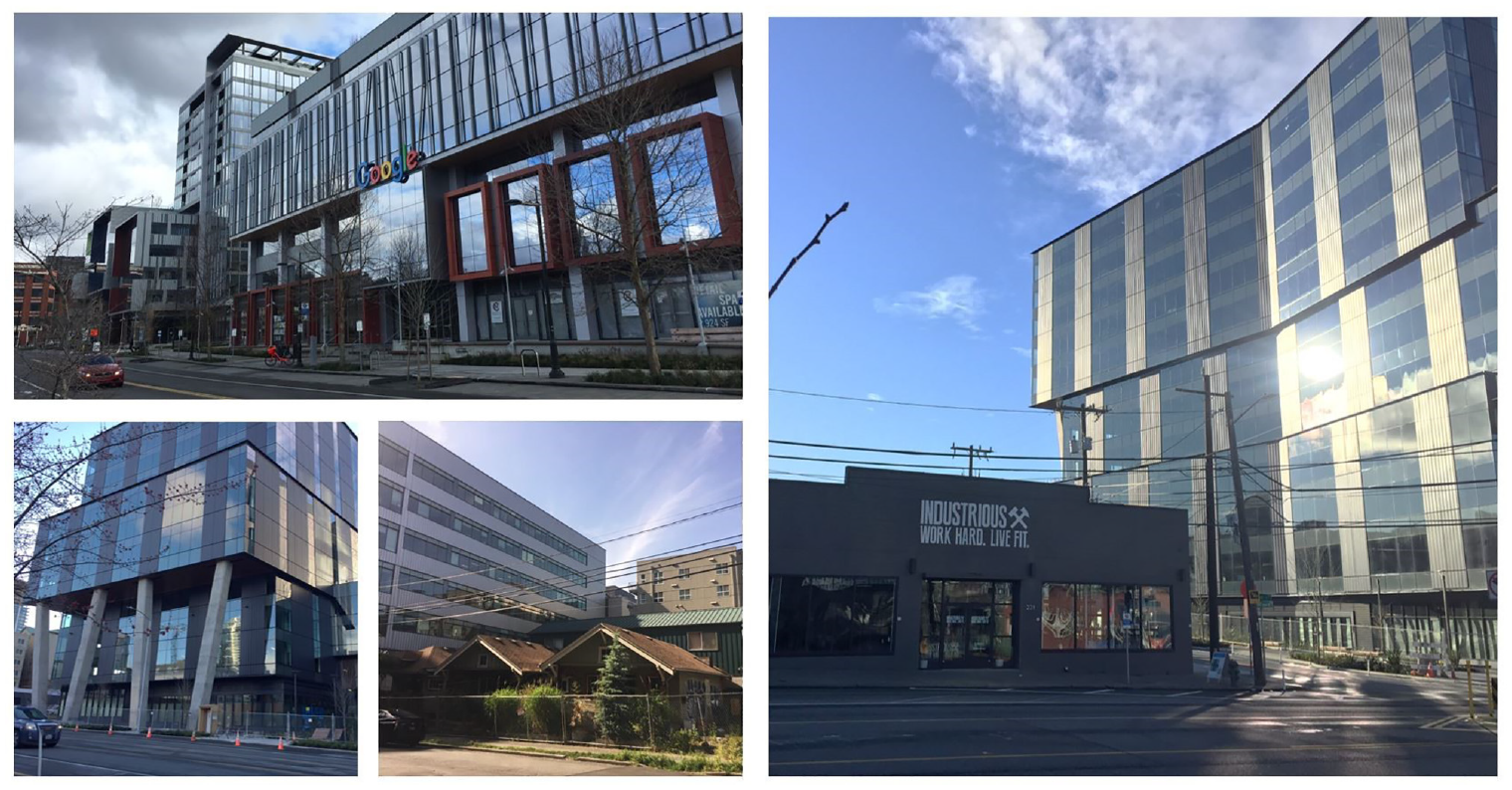
Sleek tech office buildings, disappearing 20th-century houses and small shops converted into luxury gyms form SLU’s new aesthetics.a
The neighbourhood’s latest transformation started in the 1990s after two decades of restrictive zoning, disinvestment and white flight, which made it ‘ripe’ for the arrival of innovation firms looking for ‘cheap land [in] a central location’ (City of Seattle City Planning, 2007: 22). Late 1990s and early 2000s pictures reveal the desertion of a former industrial district, which The Seattle Times described as ‘a patchwork of parking lots, warehouses and low-slung industrial buildings [which] felt like a ghost town, even at midday’ (Balk, 2016). 1
Ever since its first sawmill opened in the 1850s, the lake’s shore has been seen as an industrial site. In the 1920s, auto showrooms joined Ford, Boeing and other manufacturing plants, but the neighbourhood soon started to decline. The area was cut off from the rest of the city by Highway 99 in the 1930s and Interstate 5 in the 1950s. Further decline can be attributed to rezoning ordinances that barred the construction of new residences after 1947. By the 1980s, however, SLU hosted ‘unusual boutique industries and family-owned businesses’ and was a hub for the wholesale flower market (interview, 2020). Meanwhile, the more residential Cascade neighbourhood, which now forms the eastern half of SLU, offered low-rent housing, shelters and social services (Fiset, 2001). 2 SLU was zoned almost exclusively for manufacturing use from 1973 to 1998, at which time the City Council adopted a new neighbourhood plan that boosted residential and office development.
Biotech companies first moved to SLU in 1993 (City of Seattle City Planning, 2007: 23), breaking with a preference for suburban campuses. Lake Union’s south shore was soon identified as a new frontier by investors such as Paul Allen, Seattle-born co-founder of Microsoft, who had the ambition to build a ‘Central Park’ for Seattle there. After the plans for ‘The Seattle Commons’, strongly opposed by local businesses, were voted down in 1995 and 1996 (Baumgarten, 2016), Allen and his company Vulcan Real Estates envisioned a multi-use neighbourhood focused on innovation and offering high ‘walkability, excellent public transportation and sustainable design and construction’ (Discover South Lake Union, n.d.). SLU would retain its ‘character’ through the preservation of historic landmarks and its ‘diversity’ to attract young ‘pioneers’ eager to experience ‘a little bit of city grit’ (Young, 2008). The city formally designated SLU as a key ‘Urban Center’ in 2004 to ‘recognize the expected growth’ in jobs and households (City of Seattle City Planning, 2007: 4) and enable rapid redevelopment. Amazon announced the move of its headquarters (an ‘11-building, 1.7 million-square-foot campus’ (Levy, 2017)) to SLU in 2007. It occupied 19% of the city’s office space 10 years later (Rosenberg, 2017). Most of Amazon’s offices in Seattle are in SLU and the adjacent Denny Triangle. SLU now also hosts the campuses of Google Cloud, Apple and Meta, as well as biotech, medical research centres and innovation-driven philanthropic foundations.
SLU’s residential gentrification has been well documented. Over a 100 evictions 3 were recorded there in the 2010s, making the neighbourhood ‘the most prominent example’ in Seattle of a trend that links evictions to displacement and predominantly impacts Black and Hispanic renter households, as well as poorer and less educated residents (Ramiller, 2022: 1156). Moreover, the urban sustainability policies put in place in SLU through the collaboration of ‘landowners, developers and state actors’ are thought to have ‘actively and intentionally reduce[d] housing supply vis-à-vis demand,’ thus increasing ‘class monopoly rent’ (Anderson et al., 2022: 1113–1114). Like Ramiller (2022), Rice et al. (2020) note significant changes in the residential composition of SLU in the last two decades in terms of race and ethnicity, income, poverty, educational attainment, rents and house values. Table 1 summarises some of these changes.
Residential changes in SLU and the Denny Triangle (US Census, n.d.a). a
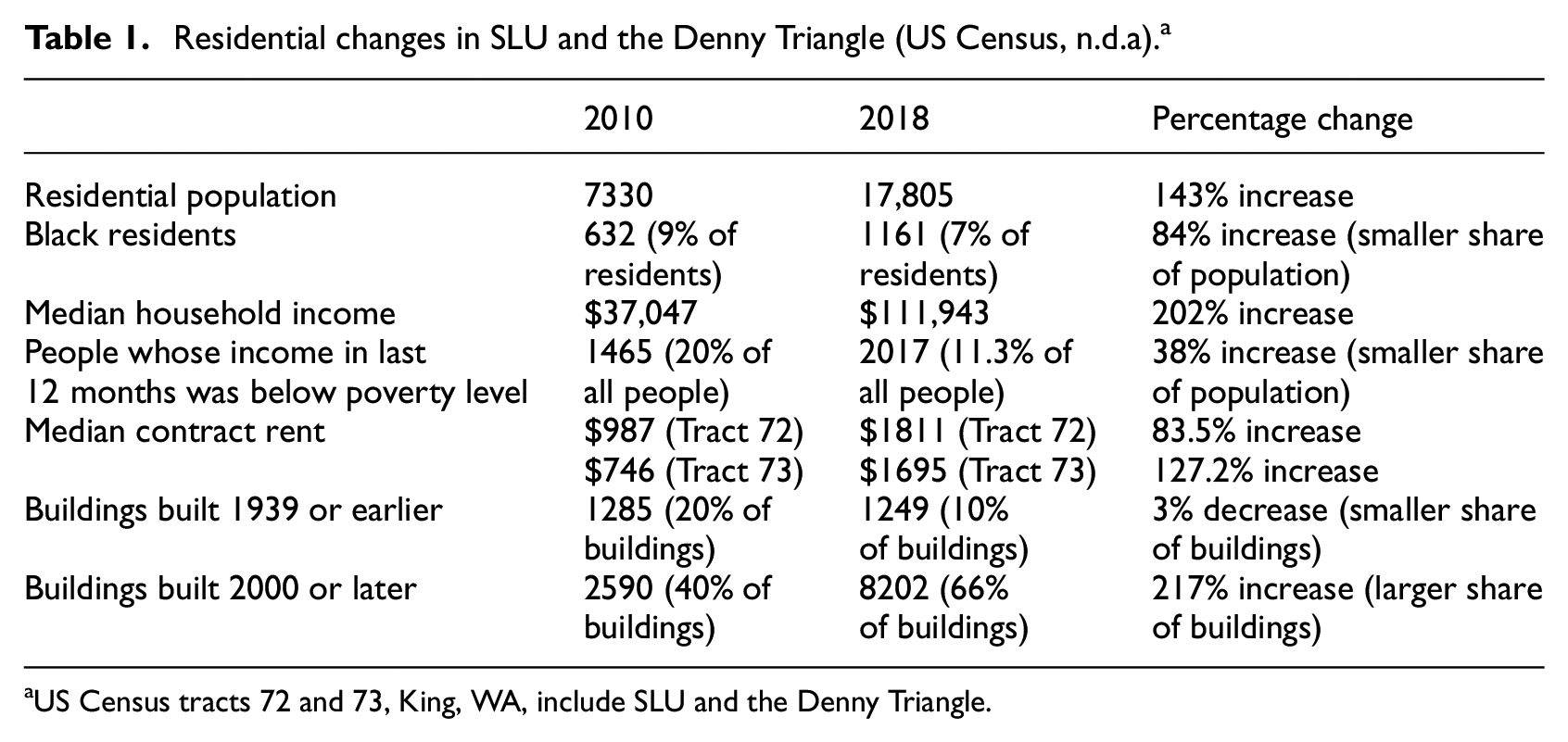
US Census tracts 72 and 73, King, WA, include SLU and the Denny Triangle.
While gentrification is visible in SLU’s residential makeup, a major component of the neighbourhood’s daily inhabitants is its working population. At its peak in 2018 it was nearly three times larger than the residential population and was predominantly made up of elite workers commuting into the neighbourhood, as illustrated in Table 2, while 96.5% of working residents were employed outside the neighbourhood. The recent changes in earnings and industry sectors, compared to Seattle as a whole, illustrate the transformation from an industrial and small-business district to a tech campus. Beyond these metrics, the disappearance of SLU’s independent retail shops, cafés and restaurants has been documented in a grassroots photo archive (Vanishing Seattle, 2016).
Working population changes in SLU and Seattle from 2010 to 2018 (US Census, n.d.b). a
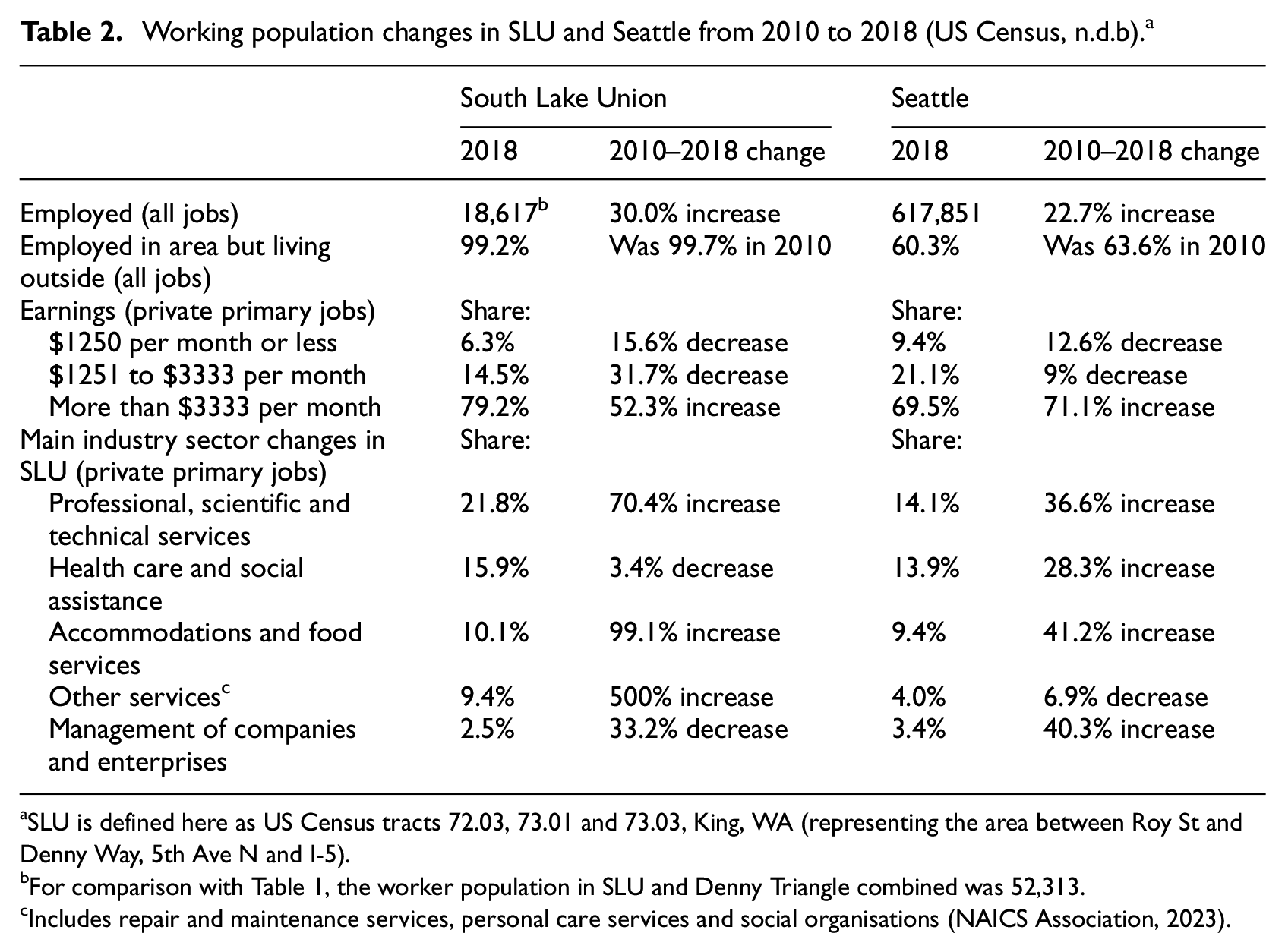
SLU is defined here as US Census tracts 72.03, 73.01 and 73.03, King, WA (representing the area between Roy St and Denny Way, 5th Ave N and I-5).
For comparison with Table 1, the worker population in SLU and Denny Triangle combined was 52,313.
Includes repair and maintenance services, personal care services and social organisations (NAICS Association, 2023).
In addition to these changes, tech companies consistently report acute gender and race imbalances among their workers, which worsen with job seniority. For example, in 2018, Amazon reported that 70.5% of its corporate employees, 72.4% of its people managers and 79.2% of its senior leaders in the US were men (Amazon, n.d.). In a similar trend, 50.7% of its corporate employees, 61.1% of its people managers and 74.3% of its senior leaders in the US were white.
The COVID-19 pandemic shook SLU: tech companies ordered their professionals to work from home in March 2020 and took this opportunity to let office building leases expire and sell office space. However, despite many uncertainties in SLU and other innovation districts, it seems that ‘the growth – indeed, the survival – of cities is [still] interconnected with the power of the tech industry’ (Zukin, 2021: 5). In fact, Amazon employees were asked to return to the office in 2023 (Schlosser, 2023) and capital has continued to pour into the neighbourhood’s buildings (e.g. Bishop, 2022).
I now turn to some of SLU tech commuters’ key gentrifying place-making narratives and their relation to the landscape. In the following sections, quotes indicate verbatim comments made by interview participants, whose voice is represented collectively.
Tech-led erasure and othering
In this section I argue that, like gentrifiers in residential neighbourhoods, tech professionals practise erasure and othering to assert their dominance over the neighbourhoods where they commute to work. In addition, however, these place-making practices (both discursive and material) are reinforced by a landscape replete with amenities and landmarks designed specifically for them. From automated grocery stores to communal (but private) co-working spaces, from yoga studios and specialty coffeeshops to dog lounges and private care clinics, and from the Bezos Innovation Center to pioneering sustainable architecture, SLU’s streets are lined with ‘experiences’ targeted at the affluent tech workforce. The aesthetic characteristics of these sites of consumption are an important contributor to exclusion and to class identity formation (Lindner et al., 2021; Pow, 2009). Moreover, the glorification of innovation reinforces tech professionals’ sense of belonging and legitimacy in SLU. At the same time as their place-making practices produce the tech campus, then, the tech campus landscape contributes to their dominance and to the normalisation of their values.
My informants described SLU as a ‘college campus’, a ‘tech campus’ or a ‘corporate tech park’– an oasis in the middle of the city. SLU was simultaneously ‘downtown’ (with the noises, ‘high rises, and all the hustle and bustle’ of a city) and ‘out of the city’, ‘secluded’ in its own ‘bubble, where some of the rest of the city doesn’t quite bleed into’– what one informant defined as ‘urban light’. A perfect mix of excitement and sense of safety.
They imagined the campus as single-purposed: as a working place for tech professionals. When asked who they saw in the neighbourhood, they described ‘a younger crowd’ of ‘tech bros’, most of them in their ‘mid-20s to mid-30s’, in their first job after college, or ‘fresh from their master’s programs’. In other words, a homogeneous crowd of ‘Amazonians’. Other neighbourhood actors, such as restaurant and store employees, new residents, families, police officers and tourists at the Amazon Spheres, were sometimes mentioned in passing, but seemed inconsequential to this worldview. ‘Amazonians’ (i.e. a working population, regardless of where it resides) were described as wealthy, ‘very techy and very yuppy’. One informant commented explicitly on ‘how male [SLU] feels’. She described passersby on sidewalks as ‘a little army of men in khakis and vests, on their phones, holding laptops’. This gendered description was unique, however. All other informants described tech professionals using implicitly masculine characteristics without mentioning gender, thereby normalising the tech industry’s masculinist discourse. Several informants euphemistically praised the ‘cultural diversity’ of tech workers, many of whom are immigrants (American Immigration Council, 2022). In doing so, they echoed the comments of tech corporations whose recent calls for racial diversity and inclusion are often condemned as a ‘PR strategy’ with no substantial results (Dickey, 2019). Moreover, all my informants deplored the lack of economic and age diversity in SLU. These descriptions of SLU’s population as homogeneous erase difference among tech workers and among the wider array of SLU inhabitants.
Erasure was further made evident by informants’ general lack of curiosity for the neighbourhood’s history prior to the latest few decades of neglect and redevelopment. 4 As far back as most narratives went, SLU was an empty and dangerous land of abandoned warehouses, closed stores and drug-user squats – a ‘frontier’ to be developed. This limited understanding reflects a truncated landscape where the recent industrial and economic past is glorified at the expense of parallel and interrelated histories, as well as longer histories. As my landscape analysis reveals, redevelopment projects almost exclusively showcase early- to mid-20th-century industrial and commercial landmarks. Brick and terracotta facades from former auto showrooms of the 1920s now adorn high-rise office buildings (Figure 2, right). Meanwhile, on the footbridge at Lake Union Park, the Duwamish people’s multi-millenary presence on the lakeshore is reduced to a few hundred years and fixed in 1850, the year before settlers famously arrived at Alki Point (Figure 2, left) (Duwamish Tribe Services, 2018; Thrush, 2007). Similarly, the history of Russian and European immigrant workers in the early 1900s was not mentioned by informants (Fiset, 2001), except for ‘a really cool Russian Orthodox church’, understood as adding character to the neighbourhood rather than being a link to its past. For Santos (2014: 170), devaluing the past as ‘premodern’ reduces reality to its visible part and renders alternative ways of knowing and being unacceptable and non-existent. The erasure of Indigenous and working-class immigrant history and continued presence is linked to the ‘colonial logic’ of tech-led gentrification also at play in San Francisco (Maharawal, 2022: 791). It absolves newcomers of any sense of responsibility for settling and transforming SLU and legitimises their own presence.
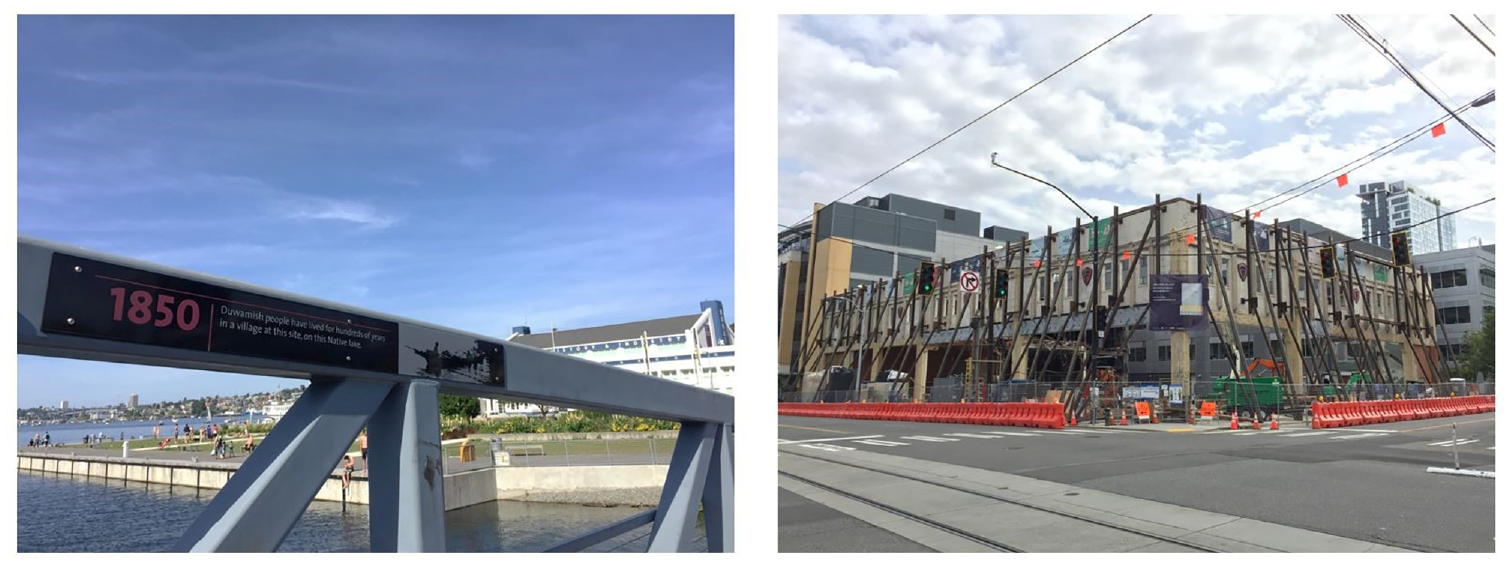
Left: Duwamish history fixed in ‘premodern’ 1850, steps away from the Museum of History and Industry. Right: preserved façade of the 1929 Firestone Auto Care Center on Westlake Avenue.a
Gentrifying discourses and rhythms of tech campuses
This section demonstrates how the imbalance of work and resident uses of tech campuses such as SLU thwarts the proclaimed ‘live–work–play’ and ‘community building’ aspirations of the innovation district (Kayanan et al., 2022: 343). The emotional detachment that tech commuters declare for SLU and their coordinated use of time away from the neighbourhood amount to a form of place-making devoid of ‘making’: a disengagement that nonetheless creates an overbearing pressure on the neighbourhood and precludes alternative uses of space (including for tech residents) or imaginings of space – at least in these commuters’ own understanding of SLU.
Emotional detachment from place
The tech professionals I interviewed were clearly distancing themselves from their neighbourhood of work. Using the aesthetics of the landscape as a script (Trudeau, 2006), they defined SLU as ‘sterile’, ‘cold’, ‘bland’, ‘lonely’, ‘impersonal’, ‘soulless’ and ‘ugly’. The large sidewalks and absence of grown trees make the neighbourhood ‘not super friendly’ to walk through. The buildings’‘tech of the future’ look is ‘just terrible’. To my informants, the neighbourhood is ‘unremarkable’ and lacks ‘character’– the character is ‘flashy Amazon’. Relying on their residential tastes, they preferred the aesthetics of Ballard, a Seattle neighbourhood where ‘brick and brimstone’ create a more ‘neighborhoody, older feel’. Historic-looking landscape features are indeed a ‘lifestyle amenity’ (de Oliver, 2016) that contributes to the attractiveness of a neighbourhood, which otherwise would, like SLU, feel ‘soulless’ (Grinnell, 2015) and ‘placeless’ (Lindner et al., 2021).
Moreover, the neighbourhood’s rapid economic growth and the massive capital investments poured into tech work and innovation, as showcased in the landscape, place capitalism at the heart of the neighbourhood’s projected image and urge tech professionals to understand urban transformation through a capitalist lens. My informants indeed talked about the ‘gold mine’ that cheap, underutilised land represented for investors. As one respondent said: ‘I can totally see how developers coming in would be like “this is prime real estate”. It’s on the water. It’s in the middle of neighbourhoods where people want to be. And downtown is already, especially for Seattle, pretty dense.’ The ‘wild’ pace of construction work, with buildings ‘popping up’‘all the time’ and ‘everywhere’ in SLU, inspired ‘awe’.
Despite its astonishing growth, however, SLU was seen as sterile: incapable of fostering life. The neighbourhood was described as feeling ‘very artificial’ and the growth as unnatural. Even the trees, which are ‘like saplings’, ‘don’t feel like they’re ever going to grow because they’re surrounded by such concrete’. Moreover, SLU was seen as a place where ‘people commute to work’ but do not live: ‘it definitely doesn’t feel like a residential area, even though there are lots of high rises there now’. My informants portrayed SLU residents as a ‘transient corporate population’ (‘people coming in and out to work for a couple years on specific projects for the tech companies’) who, like them, do not love the neighbourhood. This had been the experience of one informant who lived in SLU for a year when he moved to Seattle, but spent all his leisure time outside the neighbourhood, and quickly moved out.
Several participants expressed uneasiness about their role in the neighbourhood’s transformation. As one of them explained, I definitely always had a feeling of [being] one of these assholes. I’m one of these people who came in from the outside, I’m like part of the wave of Amazonians that are destroying your neighborhood . . . I may not be the root cause of it, but I’m part of it.
Yet, they understood gentrification as an economic ‘double-edged sword’. They viewed new construction as inevitable and out of their control, and SLUs’ economic growth as generally positive. They adhered to and replicated the discourse of modernity presented to them in the landscape and by their companies: ‘it’s cleaner, it’s safer’ and ‘you kind of have to just take out some of the old stuff to put in newer things that more people can enjoy’. They concluded that they would ‘rather live in a boom city than a bust city’. This reliance on market logics of rationality, profitability and modernity helps professionals stay emotionally and politically detached from this place.
Tech campus rhythms: A binary use of time
The neighbourhood is further moulded into this hegemonic vision by tech commuters’ synchronised absences from SLU’s streets and venues. While gentrifiers use permanence to produce their neighbourhoods of residence in their image (through property ownership and long-term occupancy, which creates a continuous presence, even as people come and go according to their own schedules), tech commuters can choose to be in the neighbourhood or not after work hours. This on/off rhythm gives them greater control over the activities that can flourish there and means that SLU functions more like a business district or tech park that empties at night than the mixed-use neighbourhood it promised to be.
SLU is shaped by commuters’‘“doing” of place’ (Benson and Jackson, 2013: 794). My informants used SLU primarily as a place of work, professional networking or career development. (In all these work-related activities, they were with coworkers or with other professionals; the impression of being in a ‘bubble’ is thus not only discursive but enacted every day by professionals’ use of space.) Leisure activities within SLU were occasional and included seasonal farmers markets, music and arts events, one-off visits to local museums and high-end shopping.
Tech commuters also shape their place of work by ‘not doing’ certain activities, invoking various reasons for not wanting or needing to be there outside of work hours: the search for ‘separation between my work environment and where I live’, SLU’s lack of attractiveness as a ‘destination’ (‘there’s nothing drawing me there, so I just don’t go there’), but most importantly the perceived lack of vitality of the neighbourhood after hours. Tech commuters understand time in SLU as binary: the neighbourhood is described as ‘packed’ during work hours on weekdays (at least before the pandemic), and ‘like a ghost town late at night, early in the morning, [and] especially on the weekends’, as would a traditional business district. It is described as ‘the kind of place that shuts down . . . after like six, seven o’clock’, when it becomes ‘spookily empty’. On the weekend, it is ‘completely dead’. One informant exclaimed that even Starbucks closes on weekends, one of the Seattle chain’s busiest times in other neighbourhoods.
The neighbourhood is therefore conceived as alive when professionals are present and dead when they are not, rendering those who inhabit this place differently, such as long-time residents of the Cascade, retail workers and business owners, community service workers and their clients, as non-existent (Santos, 2014). The ‘dominant temporal landscape’ (Kern, 2016: 445) imposed by tech professionals’ inflow and outflow at specific times, dictated by tech work, can be seen as a form of ‘slow violence’ that excludes and marginalises other neighbourhood inhabitants.
There is a disconnect, then, between the city and developers’ aspirations for an all-inclusive neighbourhood, and their dominant population’s uses and understandings of it as a place where one simply works. The erasures and normalisations practised through emotional distancing are heightened by this dualistic use of time, which gives tech commuters what Kern (2016: 442) calls ‘temporal power in remaking a neighborhood’.
The Covid era has magnified the use of time away from the neighbourhood as a mechanism to produce place, through a withdrawal of activity and a heightened sense that SLU is sterile in tech professionals’ absence. Not only did they disappear from SLU’s streets, but their absence forced retail stores, restaurants and other services to shut down for lack of customers. Deserted, the streets have felt increasingly ‘dead’ to the elite workforce. This time ‘off’ was first imposed by companies, who requested that their employees work from home, then the state through a series of stay-at-home orders. It is now in part up to individual choice, as professionals can decide when to work from home or the office. With this ‘place-making-through-intermittence’ practice, tech commuters can imprint their hegemony over the neighbourhood both when they are present and when they decide to stay away.
Conclusion: Remaking innovation districts
This article adds a new component to the concept of tech-led gentrification by focusing on its daytime population and demonstrates the outsized influence these commuters have on an area imagined as a mixed-use neighbourhood but dominated by tech work. SLU functions in some ways like a secluded urban campus, where boundaries and other forms of exclusion are produced through daily practices and discourses as much as by the landscape, and by an external population more so than by its residents. The term ‘innovation district’ does not adequately define SLU, then, given the commuting patterns, housing challenges and tech professionals’ reluctance to fully inhabit the neighbourhood.
Might tech companies and their workforce reconsider their relationship with the city? What could prompt tech professionals to invest time and energy in innovation districts – not to impose their values and habits onto them but to celebrate and partake in their diversity? How could they engage with the neighbourhood’s history and with its entire population? What would a collaborative approach to place-making enable? Urban researchers should investigate the potential alliances that the now dominant tech population could forge with other neighbourhood inhabitants. In SLU, there would be many opportunities for this around the Cascade Playground that some of my informants are avoiding, but which hosts a community garden and is surrounded by social housing and services. Furthermore, tech companies could pressure developers and the city to preserve more diverse historical landmarks and commemorate, for example, the minority ethnic working-class residents of the last century and a half rather than the industries that exploited them.
Tech professionals’ departure from cities such as Seattle since 2020 (Badger et al., 2023), fuelled by the new trends of work from home and hybrid work arrangements (Couture and Handbury, 2023), could signify that their detachment is profound enough to alter the co-production of urban tech campuses. Amazon’s turn to a more suburban campus model (with offices opening across Lake Washington from Seattle, and HQ2 opening across the Potomac River from Washington DC) could draw even more tech workers outside of city centres. Will these new geographies satisfy professionals’ desire for an urban lifestyle? Will they change the course of tech-driven urban development around the US and the world? As innovation districts continue to evolve, more attention must be paid to them through a social political exploration of their diverse working, commuting, and residential populations.
Footnotes
Acknowledgements
The author thanks the research participants for their time and openness and thanks Professors Victoria Lawson and Michael Brown, University of Washington, for supervising the research presented in this article.
Declaration of conflicting interests
The author(s) declared no potential conflicts of interest with respect to the research, authorship, and/or publication of this article.
Funding
The author(s) disclosed receipt of the following financial support for the research, authorship, and/or publication of this article: The research presented in this article was funded through a University of Washington studentship.
