




Abstract
Objective:
Mexiletine is an anti-arrhythmic agent also used for the treatment of painful diabetic neuropathy. In this study, the effect of mexiletine on body weight was evaluated in type 2 diabetes patients with diabetic neuropathy exhibiting visceral obesity.
Methods:
Type 2 diabetes patients with neuropathy exhibiting visceral obesity (n = 21) treated by mexiletine (300 mg/day) and a control group of type 2 diabetes patients with the same condition who received vitamin B12 (n = 12) were retrospectively evaluated. Body weight, waist circumference, hemoglobin A1c (HbA1c), blood pressure, liver function, serum lipids, and serum uric acid were assessed before and 6 months after the treatment.
Results:
Mexiletine significantly decreased body weight and waist circumference. The changes in body weight and waist circumference in 6 months in the mexiletine group were greater than in the control group. In metabolic parameters, there were significant decreases in triglyceride (TG) and serum uric acid. There were positive relationships between the change in body weight and the changes in TG, uric acid, alanine aminotransferase (ALT), and HbA1c.
Conclusions:
Mexiletine may affect body weight regulation. It ameliorated the metabolic parameters possibly by decreasing visceral fat. Further study should be performed to clarify the mechanism of the effect.
Introduction
Visceral fat promotes the development of insulin resistance, hypertension, and dyslipidemia.1,2 Insulin resistance is a major cause of impaired glucose tolerance in type 2 diabetes.3,4 Reducing visceral fat results in ameliorating metabolic parameters and eventually decreases the risk of cardiovascular events.5,6
Mexiletine is a sodium channel blocker and commonly used as a class 1 anti-arrhythmic agent or is used for painful diabetic neuropathy.7,8 It has been reported that a sodium current is present in human jejunal smooth muscle cells and plays a role as a key regulator of neuronal and muscle excitability, 9 and sodium channel blockers including mexiletine reduce gastric motility by decreasing slow-wave electro-activity in the smooth muscles of the stomach. 10 It is known that mexiletine causes gastrointestinal side effects such as nausea, anorexia, and gastric irritation which occur in up to 40% of patients. 11 In addition to its anti-arrhythmic and neural effect, these suggest that mexiletine may have an influence on the digestive system relating to body weight regulation. There have been no reports that sodium channel blockers altered body weight.
In this study, the effect of mexiletine on body weight and other related parameters in type 2 diabetes patients with visceral obesity was investigated with the control group prescribed vitamin B12, which improves diabetic neuropathy12,13 and is recommended as “other drugs” in the guidelines for painful neuropathy by the Japanese Society of Pain Clinicians.
Materials and Methods
Subjects and methods
This research targeted patients who had type 2 diabetes with diabetic neuropathy exhibiting visceral obesity during their visits to the clinic from January 2014 to December 2015 (Table 1). Visceral obesity was defined as the condition that waist circumference (WC) was more than 85 cm for men and 90 cm for women 14 in patients who exhibited non-alcoholic fatty liver as diagnosed by an abdominal ultrasound test. Diabetic neuropathy had been diagnosed as having symptoms of sensory polyneuropathy (abnormal sensation on bilateral feet or/and hands) in addition to decreased Achilles tendon reflex. A total of 21 patients received either mexiletine hydrochloride 300 mg/day and 12 patients received vitamin B12 1500 μg/day. All patients continued the same diet, exercise, and medication regimens. The study was conducted in accordance with the guidelines on good clinical practices and with ethical standards for human experimentation established by the Declaration of Helsinki.
Characteristics of patients.
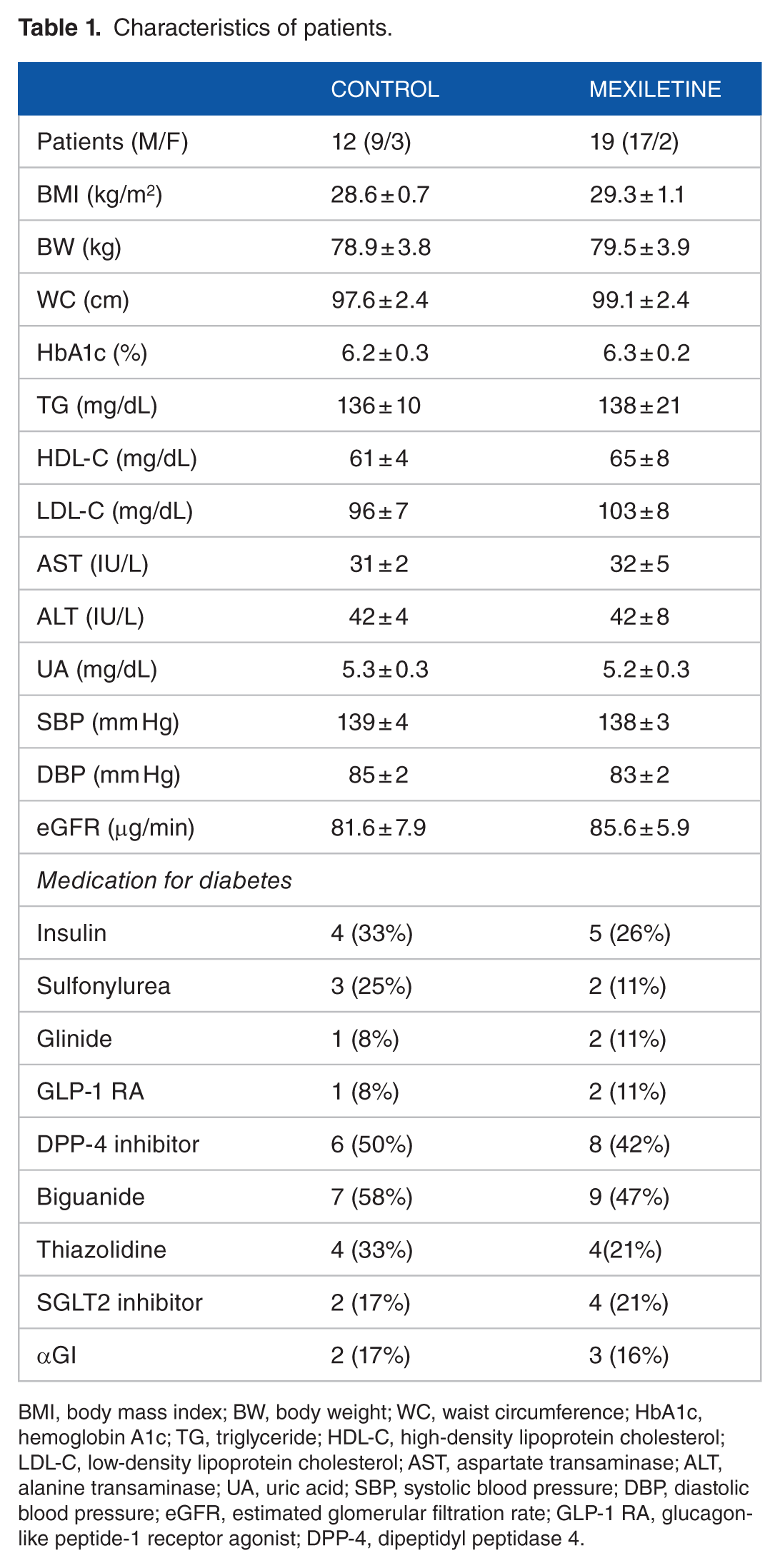
BMI, body mass index; BW, body weight; WC, waist circumference; HbA1c, hemoglobin A1c; TG, triglyceride; HDL-C, high-density lipoprotein cholesterol; LDL-C, low-density lipoprotein cholesterol; AST, aspartate transaminase; ALT, alanine transaminase; UA, uric acid; SBP, systolic blood pressure; DBP, diastolic blood pressure; eGFR, estimated glomerular filtration rate; GLP-1 RA, glucagon-like peptide-1 receptor agonist; DPP-4, dipeptidyl peptidase 4.
Measurements
Body weight (BW), WC, blood pressure, hemoglobin A1c (HbA1c), triglyceride (TG), low-density lipoprotein cholesterol (LDL-C), high-density lipoprotein cholesterol (HDL-C), aspartate aminotransferase (AST), alanine aminotransferase (ALT), uric acid, and estimated glomerular filtration rate (eGFR) were evaluated before treatment and at 6 months after the treatment. Biochemical measurements were analyzed by FALCO Biosystems Ltd, Japan.
Statistical analysis
Results were expressed as mean ± SE. The values of parameters before and after the treatment were analyzed using paired t-test. The changes in the parameters between the groups were analyzed using unpaired t-test. Pearson’s correlation coefficients were employed to analyze the correlation of the change of BW and changes of parameters. Significance was set at P < .05 for all analyses.
Results
There was a significant reduction in BW and WC in the mexiletine group (BW: from 79.5 ± 3.9 kg to 77.9 ± 3.8 kg, P < .05; WC: from 99.1 ± 2.4 cm to 97.6 ± 2.4 cm, P < .05) at 6 months, whereas no changes were observed in the control group (BW: from 78.9 ± 3.8 kg to 79.3 ± 4.5 kg; WC: from 97.6 ± 2.4 cm to 97.9 ± 2.6 cm) (Table 2). The changes in BW and WC in the mexiletine group were greater than those in the control group (BW: mexiletine −1.6 ± 0.5 kg vs control −0.4 ± 0.8 kg, P < .05; WC: mexiletine −1.6 ± 0.5 cm vs control −0.4 ± 0.4 cm, P < .05) (Figure 1). Regarding metabolic parameters, there was a significant decrease in TG (from 138 ± 21 mg/dL to 116 ± 18 mg/dL, P < .05) and serum uric acid (from 5.2 ± 0.3 mg/dL to 4.6 ± 0.2 mg/dL, P < .05). There were decreases in ALT (42 ± 4 to 35 ± 5 IU/L) and HbA1c (6.31% ± 0.21% to 6.16% ± 0.15%; Table 2); however, these are not significant changes. There was no difference between men and women regarding changes in BW, WC, and other parameters. There were positive relationships between the change in BW and the changes in TG (r = 0.38, P = .15), uric acid (r = 0.63, P < .01), ALT (r = 0.38, P = .17), and HbA1c (r = 0.6, P < .05) (Figure 2). There were no significant changes in other parameters. Two patients dropped out of the study because of epigastric discomfort and heartburn. Those patients were excluded from the results.
Parameters after the treatment.

BW, body weight; WC, waist circumference; HbA1c, hemoglobin A1c; TG, triglyceride; HDL-C, high-density lipoprotein cholesterol; LDL-C, low-density lipoprotein cholesterol; AST, aspartate transaminase; ALT, alanine transaminase; UA, uric acid; SBP, systolic blood pressure; DBP, diastolic blood pressure; eGFR, estimated glomerular filtration rate.
P < .05 versus 0 month.

Change in body weight and waist circumference. The change in body weight and waist circumference between 0 and 6 months after the treatment are shown.
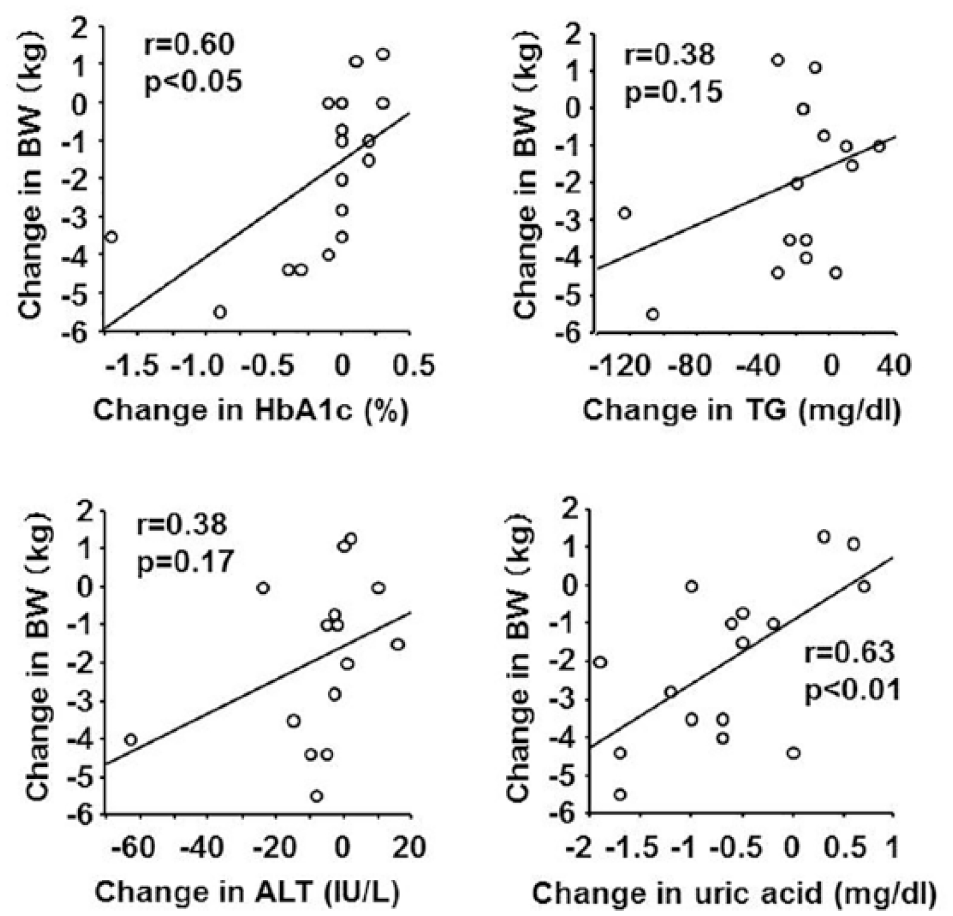
Relationships between change in BW and changes in HbA1c, ALT, TG, and uric acid.
Discussion
In this study, mexiletine decreased BW and WC following 6 months of mexiletine treatment. The change of BW was −1.6 kg which was equivalent to 2% of the initial BW. The decrease was statistically significant but small. In the treatment of visceral obesity, reducing BW is essential as the accumulation of abdominal fat causes metabolic disorders resulting in cardiovascular disease and even in cancer.6,15 Therefore, decreasing BW is crucial for preventing the risk of all-cause mortality including cardiovascular disease. There were positive relationships between the change of BW and the changes of TG, uric acid, ALT, and HbA1c in this study. These suggest that the improvement of those parameters was directly attributed to the decrease in BW.
The underlying mechanism of decreasing BW by mexiletine is not clear. Because sodium blockers do not cross the blood-brain barrier, it is not likely that they affect the satiety or feeding center in the central nervous system, although the possible involvement of parasympathetic efferent nerve pathways remains to be determined. The effect of sodium channels on the digestive tract has been reported. The sodium channels are known to play a role as a key regulator of neuronal and muscle excitability and they are present in human jejunal smooth muscle cells. 9 The sodium current is also present in human intestinal interstitial cells of Cajal (ICC). ICC function as electrical pacemakers and generate electrical slow waves and the contraction of the gastrointestinal tract, resulting in increasing gastrointestinal motility in mice.16,17 ICC may play a role in the control of intestinal motor function, generating the electrical slow wave required for normal gastrointestinal motility. 18 Sodium blockers such as mexiletine and flecainide reduce the electro-activity of small muscle in the stomach and exhibited the delay of gastric motility. 10 Other sodium channel blockers such as tetrodotoxin and lidocaine reduced the contractility of equine jejunal smooth muscle and the activity of the enteric nervous system. 19 Lidocaine decreased slow-wave frequency in human jejunal smooth muscle. 18 Thus, it may be possible that inhibiting the electro-activity of the smooth muscles in the gut and slowing gastrointestinal motility causes the decrease in appetite or influenced the digestive system, leading to the reduction of BW.
Mexiletine has an adverse effect in the digestive tract, 20 and it is reported that those gastrointestinal side effects such as nausea, anorexia, and gastric irritation occur in up to 40% of patients. 11 The adverse effects are relatively common but tolerable, and those are dose related and transient. 21 In this study, 2 patients (11%) had adverse effects and discontinued the medication because of gastric complaints such as heartburn and epigastric discomfort. These adverse complaints may be due to the excessive effect of mexiletine on the gastrointestinal tract.
In this research, it is concluded that mexiletine may potentially affect BW regulation. Further study should be performed to elucidate the mechanism.
Footnotes
Funding:
The author(s) received no financial support for the research, authorship, and/or publication of this article.
Declaration of conflicting interests:
The author(s) declared no potential conflicts of interest with respect to the research, authorship, and/or publication of this article.
