



Abstract
Background:
Unsafe abortion is a serious reproductive health problem in developing countries including Ethiopia. The attitude of healthcare providers toward abortion is one of contributing factors to unsafe abortion. This study aimed to determine the pooled effect of healthcare workers’ attitudes toward safe abortion care and its determinants factors in Ethiopia.
Methods:
Search engines such as Scopus, CINAHL, EMBASE, PubMed, Web of Science, and CAB Abstracts were used to find published studies where as Google and Google Scholar were used to find unpublished research. Preferred Reporting Items for Systematic Reviews and Meta-Analyses (PRISMA) guidelines were used. The analysis was performed using STATA 14 and the random-effects model was used to calculate the odds ratios of medical professionals’ attitudes regarding safe abortion services. Study heterogeneity was assessed by using I2 and P-values. To evaluate the stability of pooled values to outliers and publication bias, respectively, sensitivity analysis and funnel plot were also performed.
Results:
A total of 15 published and unpublished articles with a sample size of 4060 were incorporated in this Review. The overall pooled prevalence of this study was 56% (95% CI: 45-67). Sex of participants (AOR: 2.37; 95% CI: 1.57, 3.58), having training (AOR: 2.86; 95% CI: 1.58, 5.17), Professional type (AOR: 1.55; 95% CI: 1.04, 4.46), and knowledge of abortion law (AOR:2.26; 95% CI: 1.14, 4.46) were the determinants factors that significantly associated with health care workers’ attitude toward safe abortion care. Sensitivity analysis shows that the pooled odds ratios were consistently stable throughout all meta-analyses, and the funnel plot shows no evidence of publication bias.
Conclusion:
Half of health care providers sampled among the pooled studies have favorable attitudes toward abortion services in Ethiopia; which could hamper women’s access to safe abortion care. Sex, training, type of profession, and knowing abortion law were determinants of health care workers’ attitudes toward safe abortion services. Stakeholders should emphasize improving the attitude of healthcare workers toward safe abortion care which has a vital role in reducing maternal mortality. Moreover, working on modifiable factors like training, assigning personnel whose professions align with the service, and updating care providers about abortion law is also the essential key point to improve their intentions to deliver the services.
Introduction
Worldwide, an estimated 56 million abortions were performed between 2010 and 2014. Out of these, 25 million were performed under unsafe procedure. 1 Majority (97%) of these unsafe abortions were performed in developing countries. 2 Unsafe abortion has a direct contribution to 47 000 maternal deaths.3,4 In Ethiopia, approximately 620 300 induced abortions were performed in 2014, and the number of women receiving treatment for complications of abortion was doubled from, 52 600 to 103 600 between 2008 to 2014. 5
Reproductive-age women are encountering potentially fatal complications such as bleeding, infection, and damage to the genital organ from unsafe abortion. 6 To prevent maternal suffering and mortality from the procedure of abortion done unsafely, Ethiopian government allowed safe abortion since 2005 in cases of rape, incest, fetal impairment, and women with physical/mental illness. 5 In order to increase the use of safe abortion, the Ethiopian Ministry of Health updated the technical and procedural guidelines in 2014. Additionally, the government shared and gave the health facilities responsibility for providing safe first-trimester abortions. 7 Furthermore, in 2010, the Ethiopian government proclaimed that second-trimester abortion services were lawful. 8
Despite substantial efforts and progress in abortion legalization and service accessibility, the Ethiopian government faced challenges such as a shortage of trained professionals, insufficient medical supplies, lack of knowledge regarding abortion laws, providers’ unfavorable attitude toward performing the procedures of abortion, social stigma, and personal belief among health care providers.9,10 Classically, the attitude of care providers negatively affects the utilization of safe abortion care.11,12
Even though many primary studies tried to identify the effect of healthcare professionals’ attitudes on safe abortion services in Ethiopia.9,10,13-15 There is no powerful pooled prevalence that indicates the true effect size to generate evidence that can help health service planners and implementers. Some studies were restricted to a limited geographical area and specialty which makes it difficult to generalize. Moreover, Reports from primary studies conducted in Ethiopia revealed that the association of healthcare workers’ attitudes toward safe abortion with abortion law, age, sex, education level, specialty, experience, and training were inconsistent. Therefore, the aim of this systematic review and Meta-analysis was to identify the cumulative effect of healthcare providers’ attitude to safe abortion care and its determinants in Ethiopia.
The following operational definition was used for healthcare providers in this review; health Care providers are: referred to as physicians, midwives, Nurses, and Public health Officers who might conduct safe abortions.
Research Question
What were the pooled prevalence of health care providers’ attitudes and determinant factors toward safe abortion care in Ethiopia?
Methods
Study protocol and registration
To identify the general attitude of medical professionals in Ethiopia regarding safe abortion and its contributing factors, a systematic review and meta-analysis were undertaken. The updated Preferred Reporting Items for Systematic Review and Meta-Analysis (PRISMA) checklist was used to report the review’s findings. 16 Also, we followed the Meta-analysis of Observational Studies in Epidemiology (MOOSE) standards to conduct the meta-analysis and present the findings. 17 On the International Prospective Register of Systematic Reviews, the review was registered under the number IDCRD42022337344.
Eligibility criteria
All observational studies whose primary outcome was to determine the healthcare workers’ attitudes and determinants to safe abortion care were considered in this review. In addition to this, studies published and accessed before August 2022 and written in English were retrieved and included in the review, as well as unpublished article was also considered during the review. However, we excluded the studies that did not report our primary outcome of interest, the articles which not meet the required quality criteria, experimental studies, reviews, commentaries, and editorials.
Information searching strategy
The following search databases such as PubMed, SCOPUS, Web of Sciences, CAB Abstract, EMBASE, and CINHAL (EBSCO) were utilized to obtain the conducted in Ethiopia on healthcare workers’ attitudes and its determinants to safe abortion. Similarly, unpublished sources from Google Scholar, Google Search, and the Ministry of Health of Ethiopia web page were browsed. In addition, experts in the field were consulted to retrieve unpublished studies. The following keywords were utilized as search strings (attitude, safe abortion, health care workers, health care providers, associated factors, determinants, predictors, and Ethiopia). The search terms were modified to meet the database’s requirements, and by doing so, relevant studies were obtained. An extensive search process was made by using the combination of the Boolean logic operators (AND, OR, NOT), free keywords, and MeSH (medical sub-headings). For instance, PubMed search: ((((“health care providers”[All Fields]) AND (“attitude”[All Fields]) AND (“safe abortion”[All Fields])))) AND (“Ethiopia”[All Fields]). For sources that may have been overlooked in the database search, the reference lists of the pertinent articles were also examined. The search strategy created for the chosen database is attached (Additional file 1).
Article selection process
All searched articles were exported to the EndNote X8 library and duplicated articles were eliminated. Then, the article was shared between 6 reviewers (BB, BE, TB, SH, AD, and GA) and they independently screened articles by title and abstract of identified paper using inclusion and exclusion criteria. Differences of opinion between the reviewers were resolved through discussion or asked the third reviewer to weigh in. Then the full-text review was done based on objectives, methods, population, and key findings. Finally, the entire study selection process were presented using a modified PRISMA statement flow diagram (Figure 1).
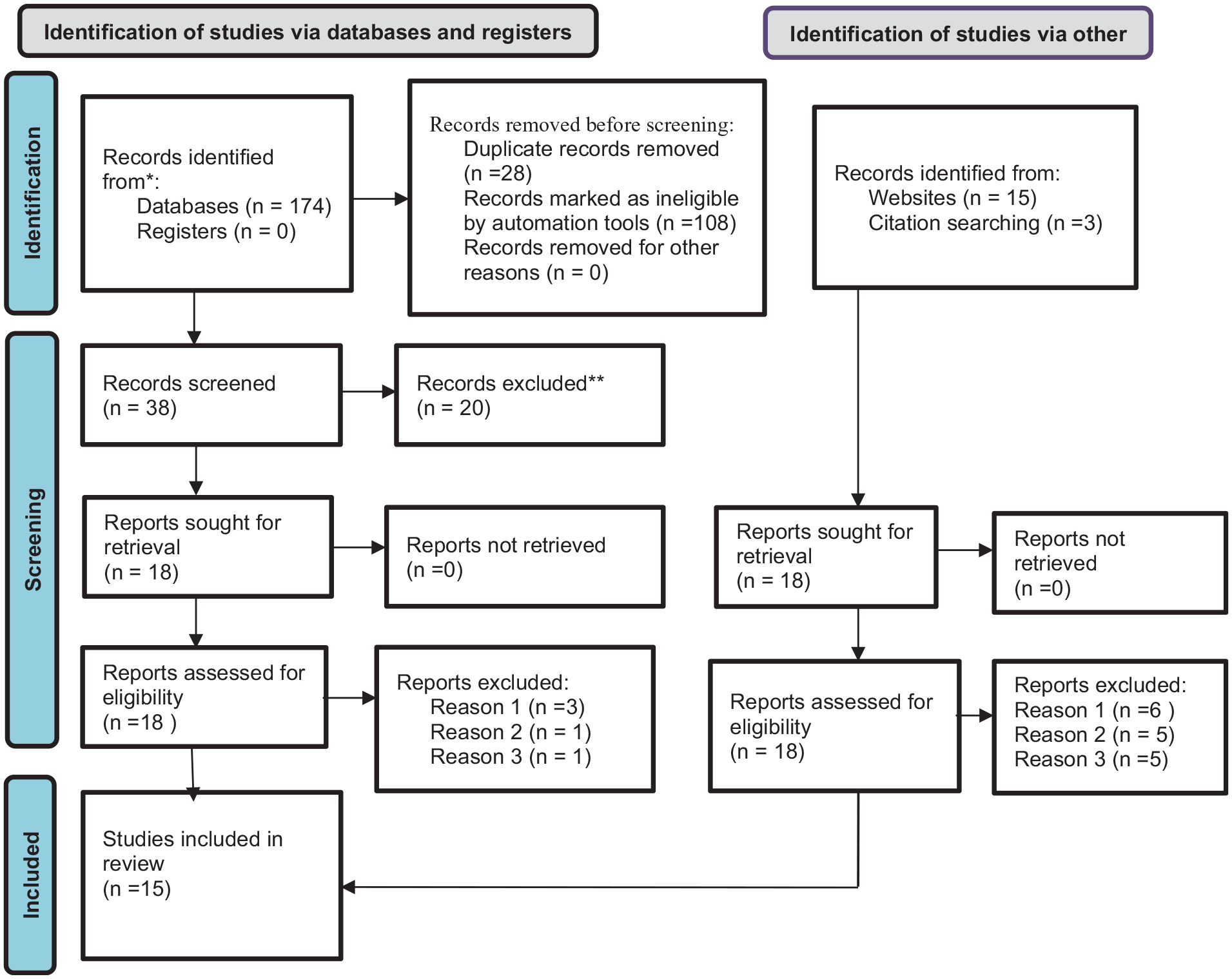
PRISMA 2020 flow diagram for systematic review and meta-analysis conducted on attitudes of health care providers toward safe abortion in Ethiopia, 2022.
Data extraction
The 7 reviewers (BB, BE, TB, SH, AD, EY, and GA) independently extracted the data from the full text of the retained articles. A pre-defined Microsoft Excel 2010 format was used to extract the data from selected studies under the following heading: author, publication year, region, setting, study design, sample size study subject, and primary outcomes of interest (Table 1). The accuracy of the data extraction was verified by comparing the results of the independently extracted data. The data were individually extracted from the full text of the retained articles by the 7 reviewers (BB, BE, TB, SH, AD, EY, and GA). Author name, publication year, study setting study design, sample size, study subject, and primary outcomes of interest were extracted from chosen publications using a pre-defined Microsoft Excel 2010 format (see Table 1). By evaluating the results of the independently extracted data, the accuracy of extracted data was confirmed.
General characteristics of studies included in the systematic reviews and meta-analyses in Ethiopia, 2022.

Abbreviations: AA, Addis Ababa; CS, cross-sectional study; IB, institutional based; HCPs, health care providers.
Study quality and their risk of bias assessment
As all of the papers that met the inclusion criteria were done with cross-sectional study designs, the quality of the retained articles was evaluated separately by the 6 reviewers (BB, BE, TB, SH, AD, and GA) using an adaptation of the Newcastle-Ottawa Scale(NOS), 28 to make a judgment, the authors’ assessment’s mean score was utilized. A consensus was reached to resolve the disagreements about the studies’ inclusion. The included studies were rated as being of high, moderate, or low quality based on their quality against each indicator of the instrument. Score categories for quality include; high (above 80%), moderate (between 60% and 80%), and low (below 60%). The included articles had a score of ⩾60%. The goal of this critical evaluation was to analyze the research’s internal validity (systematic error) and external validity (generalizability), as well as to lower the likelihood of biases. For each study, quality ratings are displayed in (Additional file 2).
Measurement of outcome and statistical analysis
The initial outcome of interest for this review was the attitude toward safe abortion among HCPs. It was estimated based on the proportion of HCPs’ attitudes toward safe abortion. The proportion of attitude of HCPs toward safe abortion mentioned in various articles was described by pooling the attitude of HCPs toward safe abortion mentioned in the incorporated papers. The random effect meta-analysis model was used to take into account the actual effects of the specific study included in the review. To report the pooled estimate a random-effects model was used. Five meta-analyses were done taking training; adherence of HCPs to abortion law, age, sex, and specialty as independent variables to identify determinants of attitude of HCPs toward safe abortion. STATA 14 was used to synthesize the data and conduct the statistical analysis. The attitude of HCPs toward safe abortion was described by forest plots. Different study characteristics like regions and publication year were utilized to perform subgroup analyses. To assess the stability of pooled values to outliers’ sensitivity analyses were done. Egger’s Regression Test and visual inspection of a funnel plot were used to look for any potential publication bias. Also, the presence of heterogeneity was determined using the I2 statistics with a P-value cut-off of .05. I2 test statistical findings of 25%, 50%, and 75% were given the labels mild, moderate, and considerable heterogeneity, respectively. The review’s findings were presented by PRISMA recommendations. A narrative synthesis was used to present the results of the studies that were included.
Results
Description of the included studies
In general around, 174 papers were found using electronic database searches (SCOPUS, CINAHL, EMBASE, PubMed, Web of Science, and CAB Abstracts), whereas 18 papers were identified using non-electronic searches (google, Google Scholar, cross reference, and websites). Duplicates (33 papers) were eliminated after exporting all papers to the endnote library. Once titles and abstracts were evaluated, 131 unrelated papers were also excluded. Subsequently, 28 studies were retrieved for detailed examination. After a full-text evaluation of those papers, 13 papers were removed because they involved a different population or did not describe an important outcome. Lastly, JBI critical evaluation tools were used to select the whole texts of the remaining 15 articles for the methodological quality assessment. All evaluated papers were reviewed since they all matched the criteria for inclusion. The final review includes all research that investigated the factors influencing Health care professionals’ attitudes regarding safe abortion services. The PRISMA presentation for the identified studies is shown below (Figure 1).
The included studies’ characteristics
The general attitude of HCPs regarding safe abortion care in Ethiopia was assessed using 15 primary research which was cross-sectional with a 4060 sample size. Among the considered studies, 5 were conducted in Oromia, 5 in Addis Ababa, and the remaining studies were conducted in Amhara, Tigray, and Harari regions (Table 1).
Attitudes of HCPs toward safe abortion care
The overall odd ratio of a favorable attitude of HCPs toward safe abortion in Ethiopia was 56% (95% CI: 45-67) with I2 = 98.41% and a P-value ⩽ .001 (Figure 2).
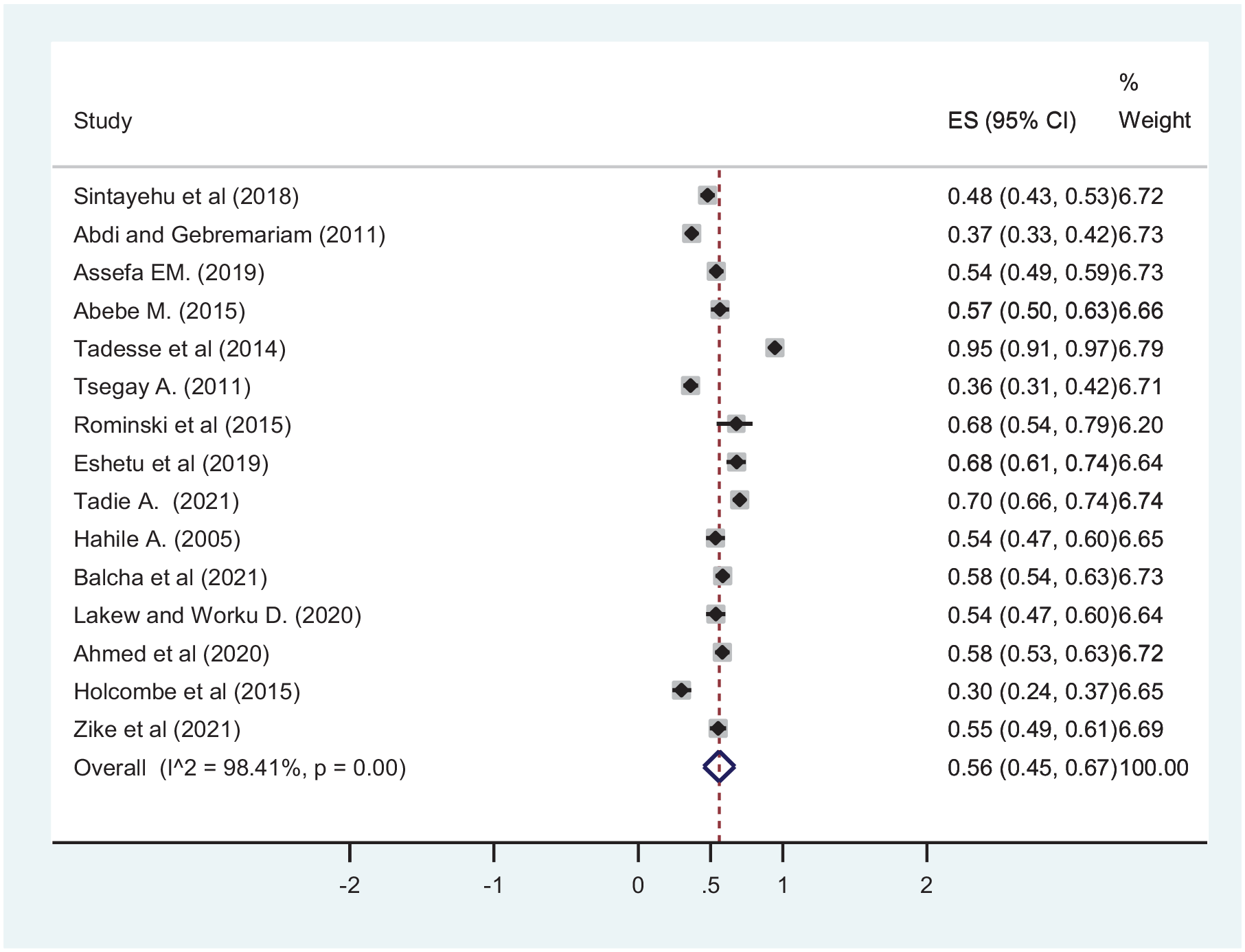
Forest plot of the pooled attitudes of healthcare providers toward safe abortion in Ethiopia, 2022.
Determinants of HCPs’ attitudes toward safe abortion care
The overall odds ratio demonstrated that the attitude of HCPs toward safe abortion care was influenced by training (OR = 2.86; 95% CI: 1.58-5.17)18-21,23 with I2 = 82.2% and a P-value ⩽ .001. The likelihood of having a favorable attitude toward safe abortion was 2 times higher among male providers as compared to female providers (OR = 2.37; 95% CI: 1.57-3.58)9,13,21,23 with I2 = 39.6% and a P-value .017. Health care providers with physician/health officer specialty had a favorable attitude toward safe abortion (OR = 1.55; 95% CI: 1.04-2.32%)15,18,19,21,23 with I2 = 32.9% and a P-value .020. Similarly, HCPs who know the legal rule of abortion were more likely to have a favorable attitude toward abortion care (OR = 2.26; 95% CI: 1.14-4.46)18-21,23 with I2 = 77.1% and a P-value .001 (Additional file 3).
Publication bias
To detect publication bias, a funnel plot, and the Egger regression test was applied. As a result, the Egger regression test (P-value = .029) did not find any evidence of publication bias among the included articles. Also, the funnel plot was examined visually. (Figure 3).
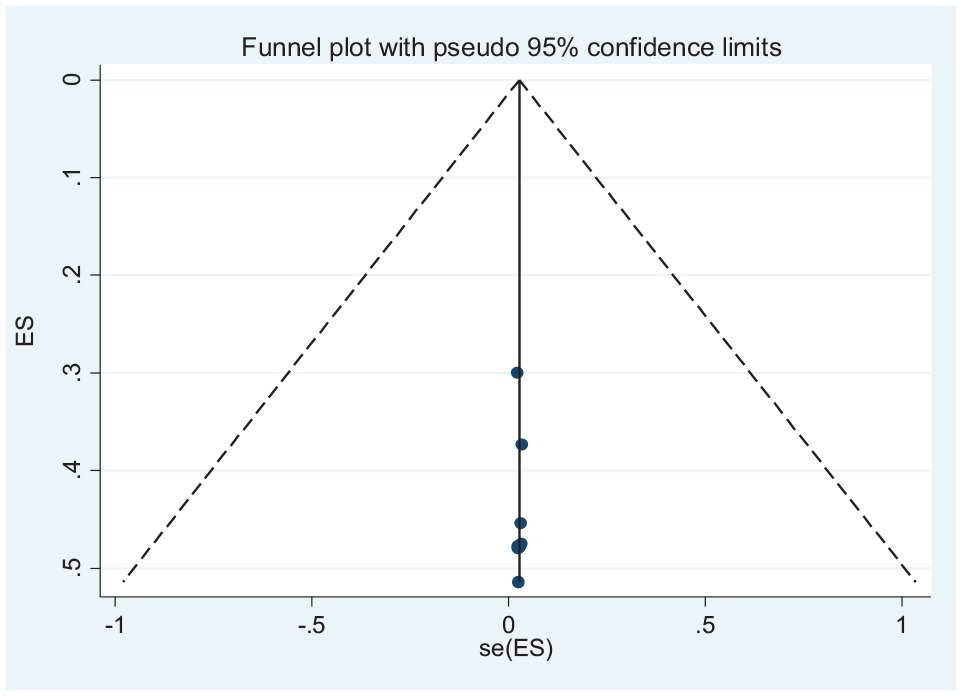
Funnel plot for attitudes of health care providers toward safe abortion in Ethiopia, 2022.
Meta-regression to check the heterogeneity
Since there was statistically significant heterogeneity, with I-square test statistics below 0.05, a meta-regression analysis was carried out. To properly interpret the results, the analysis’s goal was to pinpoint the source of heterogeneity. However significant variable that could account for the heterogeneity was not detected by the meta-regression analysis. Sample size and year of publication of included studies were not statistically significant study covariates. As a result, factors other than those discussed in this research can account for the heterogeneity (Table 2).
Meta-regression analysis to check heterogeneity on healthcare providers’ attitude toward safe abortion in Ethiopia, 2022.

Subgroup analysis
With the presence of heterogeneity, subgroup analysis was performed. As a result, there was significant heterogeneity in this analysis, as indicated by the Cochrane I2 statistic (98.41%, P .001). As a result, subgroup analysis utilizing random model effect analysis was carried out using the area of study (region) and year of publications. Based on the area of the study (region), the attitude of healthcare providers toward safe abortion was 66% (95% CI: 62-69),20,21 81% (78-83)13,14 in Amhara and Tigray respectively. Similarly, regarding subgroup analysis for publication year, the favorable attitude of HCPs toward safe abortion was 59% (53-65) among papers published from 2018 to 2021(Figures 4 and 5).
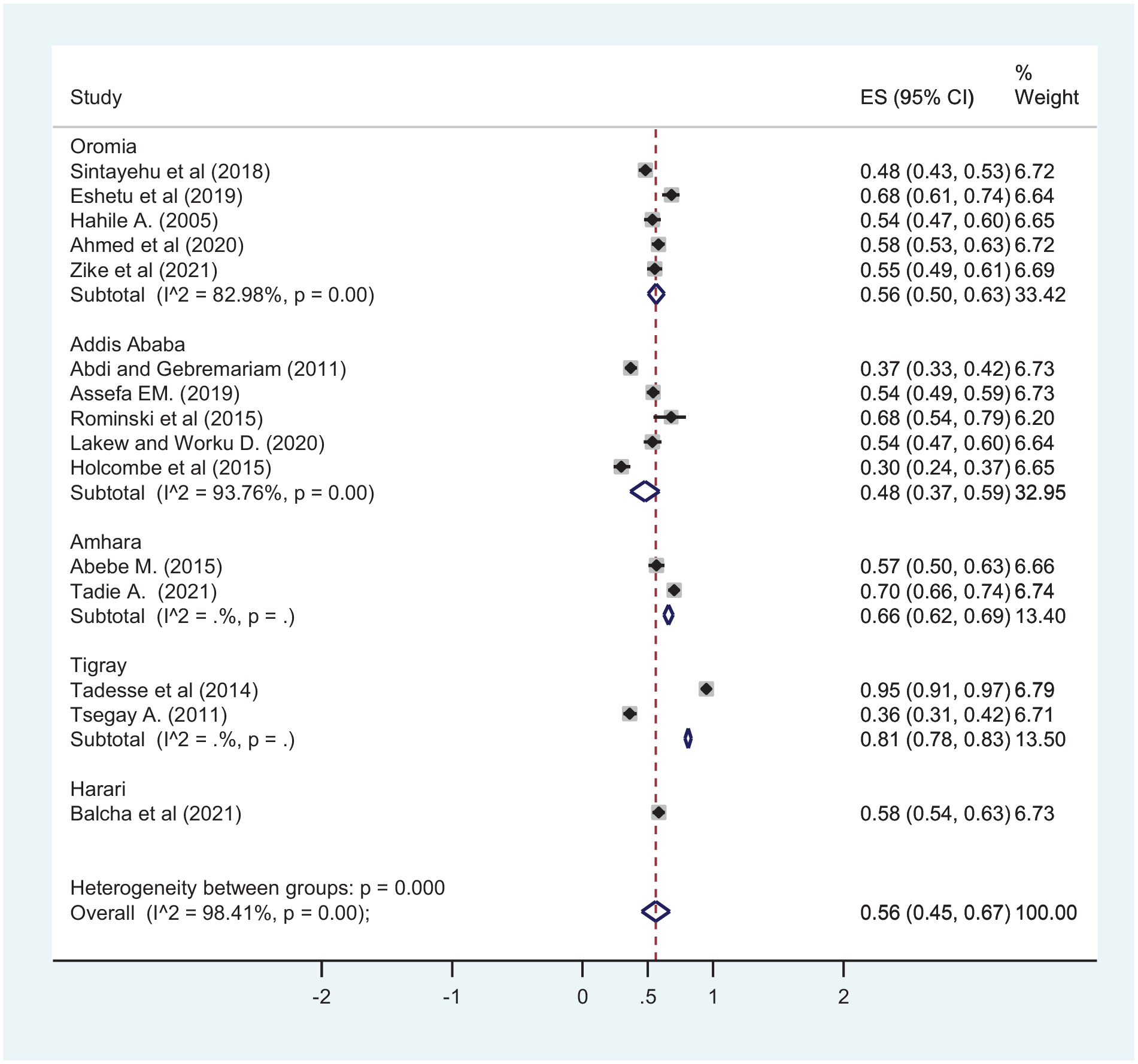
Forest plot of the subgroup analysis based on region (area) of health care providers’ attitude toward safe abortion in Ethiopia, 2022.

Forest plot of the subgroup analysis based on year of publications among health care providers’ attitude toward safe abortion in Ethiopia, 2022.
Sensitivity analysis
Sensitivity analysis was done to evaluate the effect of each study on the pooled prevalence of health care providers toward safe abortion care by excluding each study one by one. The result showed that the excluded studies did not show a significant effect on the pooled estimated prevalence, so we can say this meta-analysis result is not sensitive (Table 3).
Sensitive analysis of HCPs’ attitude toward safe abortion care in Ethiopia, 2022.

Discussion
The attitude of HCPs poses potential barriers to providing safe abortion care in Ethiopia. Socio-demographic factors, specialty, and technical factors affect the attitude of HCPs toward providing safe abortion care.
In this review, the overall favorable attitude of HCPs toward safe abortion care was 56% (95% CI: 45-67). This report is in line with the finding reported by Winson academic medical center by Schmuhl et al, 29 that 65% of physicians had a favorable attitude toward abortion care. The findings from this analysis indicated that more effort is expected from concerned stakeholders to improve the attitude of HCPs toward safe abortion to halt the burden of unsafe abortion. Being a physician or health officer was 1.56 times more likely to have a favorable attitude toward safe abortion care than a nurse/midwife. The possible reason could be Ethiopian curriculum assigned high credit hours for physicians and health officers. So, during their long stay in a practicum, they came across many complications of unsafe abortions and developed the skill to do safe abortion services and this also might influence their attitude. The odds of a favorable attitude toward safe abortion care among HCPs were 2.26 times higher among those who took training about abortion care. Similarly, Tilahun et al 30 report pointed out that the attitude of HCPs toward the provision of sexual and reproductive services was influenced by training. However, unlike this study finding, Rouncivell et al 31 pointed out that training does not affect the attitude of HCPs to provide reproductive services. This may imply a need for more training and awareness creation among the HCPs in Ethiopia to enhance their existing favorable attitude toward client interaction during safe abortion care on a national scale.
Healthcare providers who know the law of safe abortion were almost 3 times more likely to have a favorable attitude toward safe abortion care than their counterparts. This indicates being familiar with the law of abortion helps the HCPs to provide comprehensive abortion services with rationale for their clients. The results of this study call for government and healthcare planners including the Ministry of Health to invest more in the applicability of national safe abortion law and navigate abortion law dilemmas among HCPs.32,33
Male HCPs were 2.37 times more likely to have a favorable attitude toward safe abortion than females. This might be related to the long-lasting male dominance in every aspect of participation in our country and males are more pro-choice than female providers. However, the empowerment of females in abortion care is crucial to improve the quality of care since they are more sympathetic to the pain and complications of unsafe abortion. In addition, it is common to discuss reproductive issues with a similar gender. 34
Strengths and limitations
The investigators conducted detailed and rigorous searches across numerous databases. Published and unpublished as well as Gray literature were included. A standardized tool was used to assess the methodological quality of the studies. Although the literature review was comprehensive and considered all relevant research that was within the required scope, some pertinent articles, such as those reported in local and non-English languages, were overlooked. Only studies with abstracts were included. This might be affecting the inclusiveness of the findings.
Conclusion
The pooled estimate from the studies included in this systematic review and meta-analysis revealed that 56% of HCPs have a favorable attitude toward safe abortion care in Ethiopia. Knowledge about abortion law, specialty, training, and sex were factors significantly associated with the attitude of HCPs toward safe abortion care. However, the age of HCPs was not associated with the attitude of HCPs toward safe abortion care. The government should strengthen the attitude of HCPs to make safe abortion services accessible for all reproductive-age women.
Moreover, the Ministry of Higher Education has to revise the curriculum of education for all specialties of health students. The concerned stakeholders should motivate HCPs through special training and upskilling on safe abortion care, and all HCPs should be trained on the Ethiopian safe abortion law proclamation.
Footnotes
Acknowledgements
We would like to express our deep gratitude to Haramaya University, College of Health and Medical Sciences for facilitating this study.
Funding:
The author(s) received no financial support for the research, authorship, and/or publication of this article.
Declaration of conflicting interests:
The author(s) declared no potential conflicts of interest with respect to the research, authorship, and/or publication of this article.
Authors’ Contributions
BB, AD, BE, HB, SH, ML, and TB conceived and designed the review. BB, AMH, IM, AA, AA, FA, AG, AD, BE, GA, TG, DB, AE, MAK, and TB carried out the draft of the manuscript, and BB is the PI of the review. BB, AD, TB, GA, and BE developed the search strings. The reviewers (BB, BE, TB, SH, AD, EY, and GA) screened, selected studies, and extracted the data. Likewise, all authors evaluated the quality of the studies. BB, HB, and TB carried out the analysis and interpretation. BB, AD, BE, HB, AN, and TB rigorously reviewed the manuscript. All authors read and approved the final version of the manuscript.
Ethics Approval and Consent to Participate
Not applicable.
Consent for Publication
Not applicable.

Data Availability
All necessary data were available in the manuscript.