



Abstract
Background
Involving husbands in pregnancy, childbirth, and postpartum care improves the outcomes for mothers and babies. In most developing countries involvement of husbands towards antenatal care follow up is influenced by different socio-cultural and traditional factors. In Ethiopia, the degree of husband involvement as indicated by several research varied greatly.
Objective
The aim of this study is to measure the overall prevalence of husband involvement during antenatal care follow up of pregnant women in Ethiopia.
Methods
Five databases including PubMed, Scopus, EMBASE, SAGE and Google Scholar were reviewed for relevant articles retrieved from 2011 to 2023. Literature search used keywords, including “male partner involvement,” “husband involvement,” “spouse involvement” “antenatal care,” and “perinatal care” and “Ethiopia”. The Joanna Briggs Institute guidelines were used for appraisal review of journals. Thirteen articles were included in the final systematic review and meta-analysis and random effect model was used to analyze. The presence of statistical heterogeneity was tested using I2, and publication bias was examined by various factors.
Result
Thirteen studies were finally identified and included in this systematic review and meta-analysis. The pooled estimated proportion of husband involvement during antenatal care follow up in Ethiopia was found to be 39.3[95%-CI (38.2, 40.4)]. Cochran Q test indicates that there is heterogeneity since I2 is 98.6%. Egger's and Begg's tests were conducted to check possible publication bias and p-value = 0.679 and 0.807 respectively, which indicates that there is no possible publication bias.
Conclusion
It was discovered that the total pooled proportion of Ethiopian husbands’ involvement towards antenatal care follow up was low. This demands that the nation take action to evaluate the health care policy in order to encourage husbands to participate in antenatal care and yield positive outcomes for the health of mothers and children.
Introduction
A half million women die yearly around the world as a result of pregnancy and child birth and many others are not reported at all. Approximately one women dies every two minutes with almost 800 women dying every day from preventable causes related to pregnancy or childbirth. (Alkema et al., 2016). Socioeconomic disparities sometimes lead to women's lower utilization of health services, indicating that women's status is often lower (Kabanga et al., 2019). Because most cultures consider pregnancy and childbirth to be the realm of women, husbands are often not expected to accompany their wives to the ANC clinic or to be present when the woman gives birth. This is especially true in most African countries (Mullick et al., 2005; Theuring et al., 2009).
Women's and children's health is a major issue, especially in patriarchal nations where women have little control over home resources, little freedom of movement, and little say in decision-making. Where, when, and how women should be able to get healthcare are usually determined by their husbands (Hou & Ma, 2011). Involving husbands allows them to help their wives use obstetric services and help the pair prepare for any issues that may arise. This shortens the three stages of obstetric delay: choosing to seek care, getting care, and receiving care (Yargawa & Leonardi-Bee, 2015). In low- and middle-income countries, study finding reveal that partners can have a substantial impact on the first and second stages of delay, which can improve the outcome of newborns (Redshaw & Henderson, 2013; Story et al., 2012).
Studies found that 43.1% of Nigerian husbands had little involvement in MNCH care, while husband-headed households in Tanzania were associated with a higher prevalence of home births (Falade-Fatila & Adebayo, 2020; Mrisho et al., 2007). According to the study in Anomabo, Ghana's Central Region just 35% of husbands accompany their wife for prenatal care, and 44% do so during the delivery (Craymah et al., 2017). The false belief that pregnancy and childbirth were solely feminine issue and maternity units were only for women was strengthened by the exclusion of husbands from the maternity continuum of care services. However, husbands play a critical role in the community's success in achieving SDG-3, the continuum of care program and improving birth outcomes (Emiru et al., 2020; Izedonmwen & Izedonmwen, 2023).
According to the research, husbands are typically seen as the ones who decide whether or not their wives should use the maternal continuum of care in low-income nations. For instance, research indicates that 95% of Kenyan women and 55% of Ethiopian women need their husbands’ approval to use maternity waiting homes (Endayehu et al., 2020), while 33% of Ethiopian women stated that their husbands refused to let them admit in the maternity waiting homes. (Tiruneh et al., 2019). Husbands continue to have a significant and noticeable role in maternal health decisions, although their influence on reproductive health practices is still unknown (Dudgeon & Inhorn, 2004). A study on husband participation in Kenya found that skilled birth attendance was significantly impacted by husband participation during ANC visits (Mangeni et al., 2013). In the 2016 Ethiopia Demographic and Health Survey, several pregnant women reported that the primary reason they did not see an ANC was because of their husbands (Sisay & Mulat, 2023).
Ethiopia, like other low-income countries, has poor ANC follow-up performance, with only 41.37% of pregnant women using antenatal care services overall (Sisay & Mulat, 2023) and only 41% of pregnant women utilize the optimal antenatal care services, according to data from the Demographic Health Survey based on the latest WHO recommendation (ANC 8 + model). (Deresa Dinagde et al., 2024; Tsegaye & Ayalew, 2020)
One of the severe public health problem and shown as major gap in the country with regards to ANC is late booking for the service, high drop out and missing their antenatal care follow-up in between (Tekelab & Berhanu, 2014; Wolde et al., 2019). Research finding from northern part of Ethiopia revealed 52.5% of the attendants started antenatal care late, whereas 68.6% of the attendants in the southern part of Ethiopian study started ANC late (Mulat et al., 2020; Sisay & Mulat, 2023; Tekelab & Berhanu, 2014; Wolde et al., 2019). Numerous determinant factors impact the use of ANC services and increase the likelihood of late books, dropouts, and missing appointments. Among these husband's involvement, sociocultural factors, the preference for advice from friends, the mother-in-law, or other women, and religious factors such as a preference for prayer and faith healing were major determinant factors (Mulat et al., 2020; Nwaneri et al., 2018).
Involving husbands in reproductive health has been suggested as a realistic way to improve mother and child health since they can play a crucial role in ensuring women have a safe pregnancy, a smooth delivery and spiritual support (Addisu et al., 2022; Nansseu et al., 2017). In order to ascertain the pooled prevalence of husbands’ involvement during prenatal care follow up in Ethiopia, this study was conducted.
Methods
Design
This systematic review and met-analysis describe the overall pooled prevalence of husband involvement on antenatal care follow up of pregnant women in Ethiopia. The type of research used was a systematic review through searching for articles in the following databases, including PubMed, Scopus, EMBASE, SAGE and Google Scholar. A systematic review involves finding, reading, understanding and forming conclusions about the published and unpublished articles and presenting it in an organized manner (Brink et al., 2012). The Preferred Reporting Items for Systematic Reviews and Meta-Analyses Protocols (PRISMA-P) 2020 statement was used as the foundation for the systematic review's approach (Page et al., 2021), which took into account the elements in the PRISMA checklist. (Supplementary file S1) The PRISMA flow chart depicted the study selection process from first detected records to eventually included studies were presented in Figure 1. The research question was defined according to CoCoPop (Condition, Context, and Population): What is the prevalence of husband involvement during antenatal care follow up in Ethiopia? (Condition: Antenatal care; Context: Ethiopia; Population: Husband involvement). According to an updated guideline for reporting systematic reviews (Page et al., 2021) recommendations.

PRISMA 2020 flow diagram describing study selection for systematic review and meta-analysis of the level husband involvement on antenatal care service utilization of pregnant wife in Ethiopia.
Protocol and Registration
This Systematic Reviews and Meta-Analyses Protocols was drafted according to Preferred Reporting Items for Systematic Reviews and Meta-Analyses extension for Systematic Reviews. The International Prospective Register of Systematic Reviews (PROSPERO) received the registration number (CRD42023484325) for the protocol. (Supplementary file S2)
Eligibility Criteria
In this systematic review and meta-analysis both published and unpublished articles conducted from 2011 to 2023, community based cross-sectional studies and explicitly measure the proportion of husband involvement in antenatal care follow up were included. Research with different outcome of interest, studies without complete content, qualitative studies, and papers using various measures of husband involvement in antenatal care were excluded.
Information Sources
Major medical electronic databases, such as PubMed, Scopus, EMBASE and SAGE were searched for relevant material for the review. To find grey literature, the researchers manually searched the literature using Google Scholar, the Google search engine, academic and governmental online libraries and the references of electronically identifiable publications. Only articles written exclusively in English were included in the search.
Searching the Databases for Relevant Studies
The search was conducted using the following MeSH categories and keywords: “Ethiopia,” “male partner involvement,” “husband involvement,” “spouse involvement” “antenatal care,” and “perinatal care”. The search phrases were joined together as needed using the Boolean operators “AND” and “OR”. The search formula was the following: ((Male partner OR spouse OR Husband AND (ANC OR antenatal care OR prenatal care) AND (Ethiopia OR Addis Ababa OR Amhara OR SNNPR OR Oromia OR Somalia OR Benishangul-Gumuz OR Tigray OR Sidama OR Afar OR Gambela)). (Supplementary file S3) To find pertinent content that satisfied the requirements of that specific database, the combination of search phrases was used. Because platforms have common characteristics, several combinations and groupings were used. Eventually, a more satisfactory result was obtained through collaboration and networking among researchers.
Study Selection
Searching the main health and medical electronic databases (PubMed, Scopus, EMBASE and SAGE) as well as additional pertinent sources yielded 2,298 studies; Scopus (n = 353), PubMed (n = 1023), SAGE (n = 613), Embase (n = 257) and Google Scholar (n = 52). Automated methods identified 606 records as ineligible and eliminated 1,216 records from all recognized research. Of the 476 remaining reports, 312 were not retrievable, 103 were removed due to inconsistent measurement of the outcome variable and 48 were removed due to irrelevant target individuals. 13 studies were considered after a comprehensive evaluation to provide a total estimate of the proportion of husband involvement towards antenatal care follow up of pregnant women in Ethiopian (Figure 1). The authors in the included and undetermined categories separately read the entire texts of the studies to ensure that they met the requirements for ultimate inclusion, and differences among the reviewers were resolved by discussion and consensus.
Data Extraction Process
To extract variables, a data graphing table was made in Microsoft Excel. All authors collaborated on a shared document and discussed the items to add in the data graphing table to complete the procedure. The data was then separately extracted by each author, and it was subsequently compared. Disagreements were resolved by conversation until an agreement was reached in order to increase accuracy.
Data Items
The characteristics that were extracted from each articles and incorporated into the tool were the authors, region, study year, design, sample size, year of publication, and proportion of husbands participated during ANC follow-up in Ethiopia. These items were chosen by all authors because they were the most relevant to identifying the study's salient characteristics. Articles that satisfied the criteria were used to provide the data for the final analysis.
Methodological Quality Assessment
By evaluating a study's methodological quality and figuring out how well it addressed potential biases in its design, implementation, and analysis, the authors were able to identify research quality while taking bias risk into account. All of the included studies were critically appraised for their validity by using the Joanna Briggs Institute (JBI) Critical Appraisal tool, which follows the research design used. The JBI for cross-sectional studies includes eight questions regarding inclusion criteria, study participants and settings described, exposures measured, standard criteria used for condition measurement, confounding factors and strategies for dealing with them, outcomes measured, and statistical analyses used (Moola et al., 2017). Critical appraisal tool was used by three authors to assess the methodological quality of the included studies. The fourth author arbitrated disputes or the reviewers discussion was taken together to settle disagreements. The instrument has eight parameters, and each study was rated as having a low, moderate or high risk of bias. The risk of bias was categorized as low (<2) and high (≥3) using a composite quality index. For this systematic review and meta-analysis, articles with only low risks of bias were taken into consideration. (Table 1)
Assessment of the Study Results Criteria.

To decrease publication bias, the researchers searched for and included both published and unpublished articles. The researchers personally scanned the online libraries of governmental agencies, academic institutions, and other organizations in addition to using Google Scholar and the Google search engine to look for unpublished texts, or “grey literature.”
Data Analysis and Synthesis
The primary findings and features of the included articles were specifically detailed in the summary table. All statistical analysis was performed using STATA version 16 software. The results of the meta-analysis were graphically shown using forest plots. Using a random effect model, the total pooled proportion of husbands’ involvement was calculated.
The Higgins I-squared statistic (I2) and the Chi
Result
Description of the Included Studies
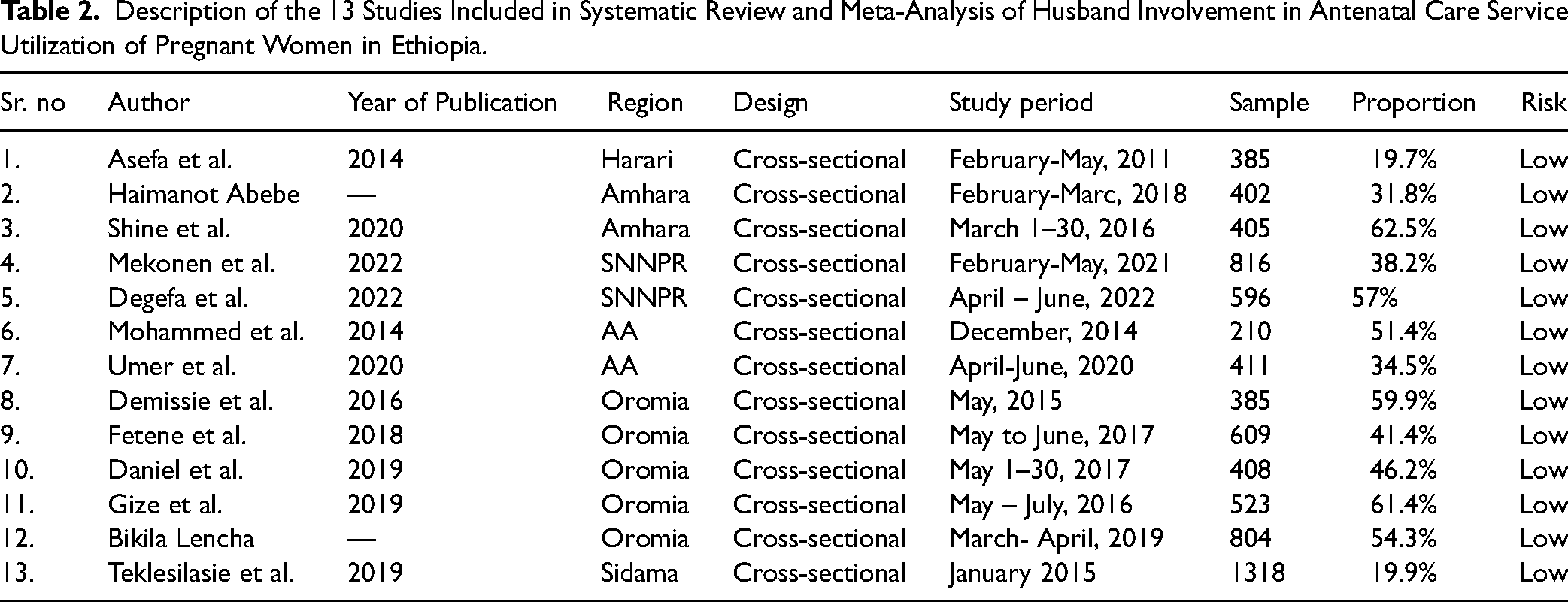
A total of 13 cross-sectional observational studies were included with 7,272 participants in the final systematic review and meta-analysis. Among the listed studies two were unpublished and eleven published articles. Each of the included studies used a cross-sectional design and was conducted in a community. The study, conducted in Addis Ababa (Mohammed et al., 2019), had the smallest sample size of 210; in contrast, study in Sidama with 1,318 participants, had the largest sample size (Teklesilasie & Deressa, 2018). One administrative city and five regions of the country were covered in the current systematic review and meta-analysis. Two studies from the Addis Ababa city administration (Mohammed et al., 2019; Umer & Sendo, 2021), two from the SNNPR (Degefa et al., 2024; Mekonen et al., 2022), five from the Oromia region (Demissie et al., 2016; Fekene, 2019; Gemechu et al., 2020; Gize et al., 2019; Kassahun et al., 2018), two from the Amhara region (Abebe, 2019; Shine et al., 2020), one from the Harari region (Asefa et al., 2014), and one from Sidama region (Teklesilasie & Deressa, 2018). (Table 2)
Description of the 13 Studies Included in Systematic Review and Meta-Analysis of Husband Involvement in Antenatal Care Service Utilization of Pregnant Women in Ethiopia.
Overall Husband Involvement in Antenatal Care
In this systematic review and meta-analysis, 13 cross-sectional observational studies provided information on overall involvement of husband during ANC follow-up of the pregnant women. The pooled proportion of husband involvement during antenatal care was found to be 0.393[95%CI (0.382, 0.404)]. (Figure 2).

Forest plot of pooled prevalence of husband involvement on antenatal care service utilization of pregnant women in Ethiopia.
Considerable heterogeneity was detected between the included studies (I2 = 98.6%). The highest prevalence of husband involvement on ANC service utilization (62.5%) was reported from Amhara region (Shine et al., 2020), while the lowest husband involvement on ANC service utilization (19.7%) was reported in the Harari region (Asefa et al., 2014) (Table 2).
Handling Heterogeneity
To reduce the potential random variations between the included studies, researchers conducted a sub-group analysis by region where the primary studies conducted. According to the sub-group analysis the highest proportion of husband involvement was observed from Oromia 0.53 [95% (0.51, 0.54)] and the lowest proportion was observed from Harari 0.19 [(0.15, 0.23)]. However, highest heterogeneity was observed in Amhara during sub group analysis (98.82%) (Figure 3).

Subgroup analysis between region and husband involvement in antenatal care service utilization of pregnant women in Ethiopia.
Sensitivity Analysis for the Included Studies
Sensitivity analysis was done to check the effect of individual studies on the national level of husband involvement on ANC service utilization of pregnant women. During sensitivity analysis, the pooled prevalence of husband involvement on ANC service utilization was observed high (45.5%) and low (37.7%) when (Teklesilasie & Deressa, 2018) study from Sidama and (Gemechu et al., 2020) study from Oromia were omitted respectively (Figure 4).

Sensitivity test.
Tests for Publication Bias
To deal with publication bias funnel plot was conducted, and there is asymmetrical distribution of studies through funnel (Figure 5). But in Egger's and Begg's statistical test there was no evidence to show publication bias since the p-value = 0.67 and 0.807 respectively.
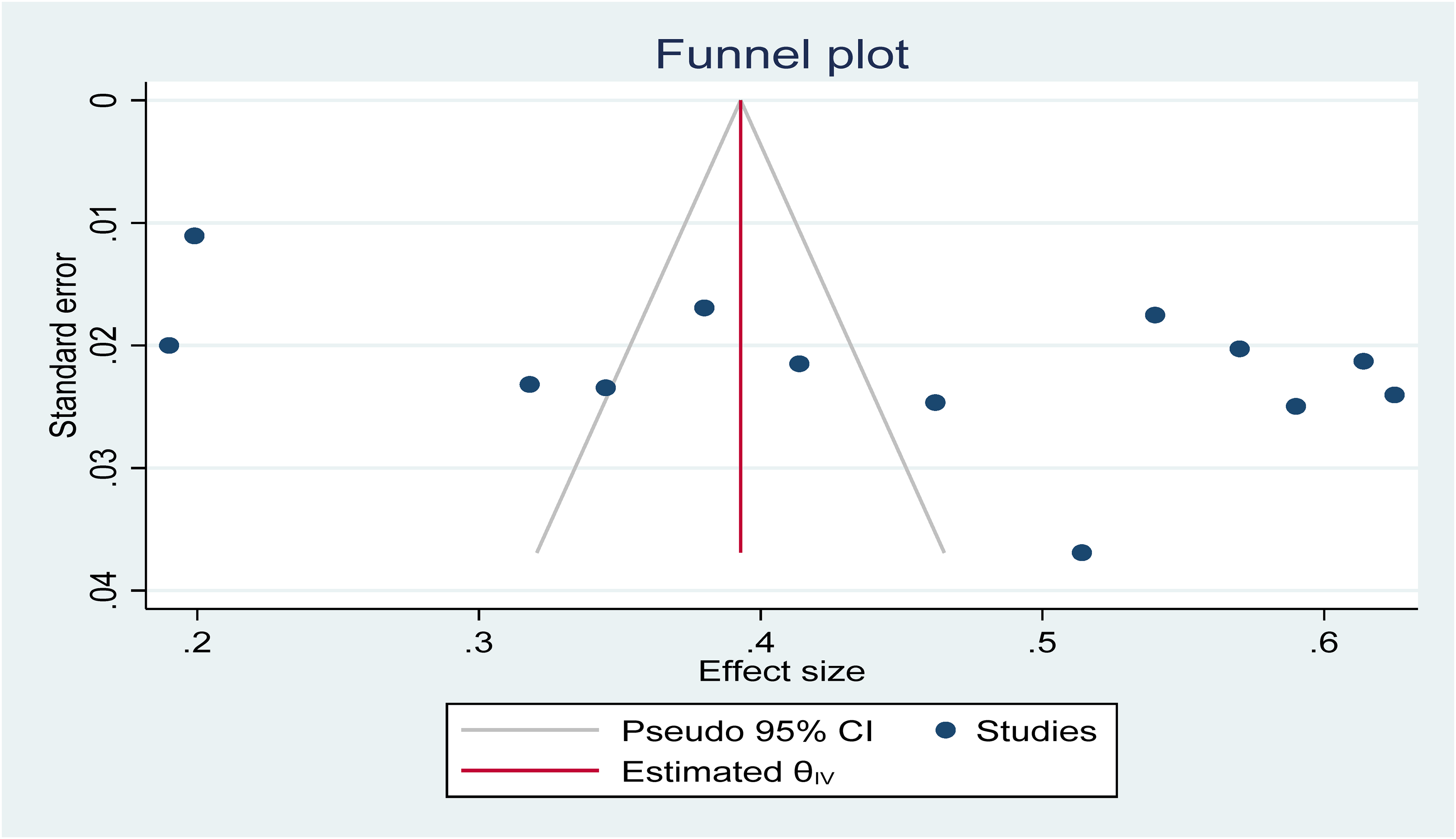
Funnel plot.
Discussion
The purpose of this systematic review and meta-analysis was to evaluate Ethiopian husband's participation in prenatal care follow-up. It was discovered that the total pooled proportion of husband involvement during antenatal care follow-up was 39.3[95%CI (38.2, 40.4)]. This study is relatively consistent with another study that was carried out using analyses of Demographic and Health Surveys in a few African nations, including Burkina Faso (45.2%), Malawi (41.0%), Mozambique (44.2%), and Uganda (49.7%) (Jennings et al., 2014). It is also in line with another study carried out in Muaro Jambi District, Indonesia found that (41.2%) (Guspianto et al., 2022) of husbands participated in antenatal care of their pregnant women.
The pooled prevalence of husband involvement on antenatal care follow up of pregnant women in Ethiopia from this systematic review and meta-analysis was lower than studies conducted in Mbeya (51.0%) (Kabanga et al., 2019), Mwanza City of Northwestern Tanzania (54.4%) (Natai et al., 2020), Bumula Sub-County of Kenya (54.1%) (Nyang’au et al., 2021), Nigeria reveal that (56.9%) (Falade-Fatila & Adebayo, 2020) of husbands had involved during ANC, Upper East Region of Ghana, the level of Husband involvement in antenatal care was (67.2%) (Kumbeni et al., 2019), Central Tanzania where (53.9%) (Gibore et al., 2019) reported that they had accompanied their wives to a prenatal appointment at least once, Gulu district, Northern Uganda Overall, (65.4%) (Tweheyo et al., 2010) husbands attended ANC visit and Rwanda (86.8%) (Jennings et al., 2014) of husband accompanied their partners to ANC, Husbands involvement in Afghanistan on ANC with their pregnant partners was (69.4%) (Alemi et al., 2021), Myanmar (64.8%) (Wai et al., 2015) husband accompanied for an antenatal visit, England where husband's engagement in ANC was (62.5%) (Redshaw & Henderson, 2013) and Indonesia was husband accompanied women during antenatal care visit (74.4%) (Agushybana, 2016). Based on this systematic review and meta-analysis, the pooled prevalence of husband participation on antenatal care follow-up in Ethiopia was higher than that of studies conducted in rural Rwanda, (29.4%) (Kalisa & Malande, 2016) of the husbands assisted their women with antenatal care, Anomabo, Central Region of Ghana, (35%) (Craymah et al., 2017) of husbands accompany their partners for antenatal care, Burundi (18.2%) of husbands participated in antenatal care follow-up, Senegal and Zimbabwe had (32%) of husbands were participated on antenatal care follow up (Jennings et al., 2014).
The disparity in sample sizes, study designs, and sociodemographic and sociocultural factors between the countries could all be contributing factors to the discrepancy. Furthermore, the degree of awareness among husbands in the various countries may also account for the discrepancy, as husbands’ level of involvement in their pregnant women's use of antenatal care services is influenced by their knowledge of pregnancy- and delivery-related danger signs.
Limitation of the Study
Articles reporting only in English and conducted by using cross-sectional study design only were included in this systematic review and meta-analysis, which could have limited our results. In addition to that all unpublished cross-sectional observational studies from all parts of Ethiopia might not be included in this systematic review and meta-analysis.
Implications for Practice
According to the results of this systematic review and meta-analysis, the country must act and revise its health care policy to encourage husbands to take part in antenatal care and improve the health of both mothers and children. Future research should consider an evaluation of the major determinant factors that discourage husband involvement towards antenatal care follow up of pregnant women in Ethiopia.
Conclusion
Husband involvement during antenatal care follow-up of pregnant women in Ethiopian was determined to have a low overall pooled proportion, according to this systematic review and meta-analysis. In order to improve the health of women and children, the nation must take action to evaluate its health care policies, identify obstacles to husbands participating in antenatal care, and encourage those who can help. Furthermore, a variety of behavioral and societal factors influence the concept of husband involvement in ANC in particular and the maternity continuum of care in general, making it a complex variable requiring diverse criteria. Therefore, it is essential to identify and explore the primary sociocultural and behavioral variables using multidimensional characteristics and standardized tools, to support interventions targeted at addressing the primary barriers that prevent Ethiopian husbands from participating during antenatal care follow-up of pregnant women.
Supplemental Material
sj-docx-1-son-10.1177_23779608251321144 - Supplemental material for Involvement of Husband During Antenatal Care Follow up of Pregnant Women in Ethiopia: A Systematic Review and Meta-Analysis
Supplemental material, sj-docx-1-son-10.1177_23779608251321144 for Involvement of Husband During Antenatal Care Follow up of Pregnant Women in Ethiopia: A Systematic Review and Meta-Analysis by Lonsako Abute Woiloro, Takele Tadesse Adafrie, Amene Abebe Kerbo and Mengistu Meskele Koyra in SAGE Open Nursing
Supplemental Material
sj-docx-2-son-10.1177_23779608251321144 - Supplemental material for Involvement of Husband During Antenatal Care Follow up of Pregnant Women in Ethiopia: A Systematic Review and Meta-Analysis
Supplemental material, sj-docx-2-son-10.1177_23779608251321144 for Involvement of Husband During Antenatal Care Follow up of Pregnant Women in Ethiopia: A Systematic Review and Meta-Analysis by Lonsako Abute Woiloro, Takele Tadesse Adafrie, Amene Abebe Kerbo and Mengistu Meskele Koyra in SAGE Open Nursing
Supplemental Material
sj-docx-3-son-10.1177_23779608251321144 - Supplemental material for Involvement of Husband During Antenatal Care Follow up of Pregnant Women in Ethiopia: A Systematic Review and Meta-Analysis
Supplemental material, sj-docx-3-son-10.1177_23779608251321144 for Involvement of Husband During Antenatal Care Follow up of Pregnant Women in Ethiopia: A Systematic Review and Meta-Analysis by Lonsako Abute Woiloro, Takele Tadesse Adafrie, Amene Abebe Kerbo and Mengistu Meskele Koyra in SAGE Open Nursing
Footnotes
Acknowledgments
We would like to thank the Wolaita Sodo University's, for organising training on conducting a systematic review and further personal assistance in developing the search strategy.
Authors’ Contribution
LA conceptualised the study and lead the process of reviewing the literature and analysis. MM, TT and AA screened articles, contributed to data extraction and manuscript preparation. All authors contributed to the development of the manuscript and read and approved the final version. The corresponding author attests that all listed authors meet authorship criteria and that no others meeting the criteria have been omitted.
Data Availability
Data analyzed during the current study will be made available from the corresponding author on reasonable request.
Declaration of Conflicting Interests
The authors declared no potential conflicts of interest with respect to the research, authorship, and/or publication of this article.
Funding
The authors received no financial support for the research, authorship, and/or publication of this article.

Supplemental Material
Supplemental material for this article is available online.
References
Supplementary Material
Please find the following supplemental material available below.
For Open Access articles published under a Creative Commons License, all supplemental material carries the same license as the article it is associated with.
For non-Open Access articles published, all supplemental material carries a non-exclusive license, and permission requests for re-use of supplemental material or any part of supplemental material shall be sent directly to the copyright owner as specified in the copyright notice associated with the article.
