



Abstract
Background:
Climate change globally triggers health, environmental, and socio-economic issues, leading to disasters, resource scarcity, inequality, displacement, and security risks. To address the challenges posed by climate change, green practices have emerged as a major solution. This research aimed to identify and categorize the factors that influence the adoption of green practices in healthcare centers.
Methods:
This manuscript represents a qualitative thematic content analysis conducted in 2024 that systematically scrutinized literature spanning from 2000 to 2024. Multiple databases, including PubMed, Scopus, ProQuest, and the Cochrane Database of Systematic Reviews, were utilized for the search. A quality assessment using 3 quality assessment checklists for different types of studies was conducted on the final studies, followed by a thematic analysis of the findings obtained from the systematic review.
Results:
Twenty-nine references were included in the study as final studies. The quality assessment of these studies delineated their acceptable level of quality and risk of bias. The thematic analysis yielded 2 main themes: facilitators and barriers to the adoption of green practices.
Conclusions and recommendations:
The study found several factors influencing the adoption of green practices within healthcare centers. Meanwhile, it was suggested that governments should collaborate with stakeholders to enforce emissions regulations, invest in clean energy, and offer financial incentives for sustainability. Technological advancements can improve renewable energy adoption; However, developing nations may struggle to integrate green practices into healthcare due to resource constraints.
Keywords
Introduction
Climate change denotes the long-term alterations in temperature and weather patterns on a local, regional, or global scale, resulting from human activities. It is claimed that the balance of the climate system has been gradually altered since the industrial revolution in 1850, and this alteration has become evident since the mid-twentieth century. 1 Such phenomenon affects the world in many ways. It harms health, the environment, the economy, society, and politics. It causes heat stress, air pollution, diseases, disasters, biodiversity loss, resource scarcity, productivity loss, infrastructure damage, healthcare costs, poverty, inequality, marginalization, displacement, conflict, governance challenges, and security risks.2,3 The healthcare industry stands as one of the most carbon-intensive sectors globally, exerting a substantial impact on overall emissions.4,5 Although it has been reported that the negative effects of climate change decreased periodically during the COVID-19 pandemic, leading to significant reductions in greenhouse gas emissions—estimated at one-quarter to one-third in some of the highest CO₂-emitting countries—due to decreased transportation and industrial activities during lockdowns, there was also an increase in the use of sustainable measures to mitigate the effects of climate change.6 -8
To address the challenges posed by climate change, green practices have emerged as a major solution, offering a sustainable, efficient, and effective response.9 -11 Green practices provide co-benefits for health and the environment, such as flood prevention, air quality improvement, and cooling and shading.9,12 Moreover, the healthcare industry can reduce its carbon footprint by lowering its emissions, waste, and pharmaceutical pollution. 13 Meanwhile, integrating public health into climate policy and planning can support greenhouse gas reduction strategies. 14
Green practices denote activities that are environmentally sustainable and aim to mitigate the adverse impacts of human activities on the environment. These practices encompass reducing solid waste, conserving resources, minimizing the use of toxic agents, and enhancing energy consumption management.15 -17 The adoption of green practices has recently emerged as a prominent topic in the global context. For instance, the G20 summit in 2023 declared a commitment to pursue low-greenhouse gas/low-carbon emissions, climate-resilient, and environmentally sustainable development pathways by championing an integrated and sustainable approach to energy and resource efficiency. 18 In this regard, healthcare centers can mitigate their greenhouse gas emissions by implementing specific strategies such as environmentally sustainable energy systems, waste reduction and segregation, reprocessing single-use medical devices, environmentally preferable purchasing, energy consumption management, and pharmaceutical waste management.19,20
Although multiple reviews have examined practices aimed at enhancing sustainability and mitigating the effects of climate change, a comprehensive review of the literature reveals a significant deficiency in systematic reviews that specifically investigate the practices implemented within healthcare centers to address climate change. This observation highlights the urgent need to prioritize research conducted using systematic methodologies in this area. This research holds the potential to furnish invaluable insights for healthcare policymakers, administrators, and prospective researchers, facilitating the development and adoption of strategies within healthcare centers to mitigate the adverse effects of climate change.
According to the literature, the adoption of green practices in healthcare to enhance sustainability and mitigate climate change effects is influenced by a multitude of factors. Research suggests that the implementation of green practices can be facilitated by stringent environmental regulations and increasing stakeholder demands, which also serve as a social imperative. 21 The role of top management is crucial in this context, as it involves motivating employee participation in green initiatives, providing ongoing education and training on environmental sustainability, and closely monitoring organizational progress. 16 However, several barriers hinder the implementation of green practices, spanning individual, institutional, geographical, political, and other levels. These barriers include a lack of knowledge, time, and motivation at the individual level, while institutional barriers encompass costs, conflicting protocols, inadequate staffing, and leadership deficits. Geographical barriers relate to municipal infrastructure and public awareness, and political barriers involve a lack of incentives. 22 In such context, it is presented that awareness and knowledge of sustainability measures, and personal interest can enhance the adoption of such practices. 23
A notable gap exists in the literature, as there is a scarcity of comprehensive reviews within this context. In such context, this paper aimed to address this deficiency by providing an extensive and detailed examination of the factors influencing the adoption of green practices in healthcare centers. The investigation of factors influencing the adoption of green practices in healthcare services has significant implications for stakeholders within this context. Healthcare policymakers and administrators can leverage the findings to inform their strategies, thereby enhancing the adoption of green practices and improving sustainability in healthcare facilities while mitigating the effects of climate change. Furthermore, researchers in this field can utilize the data to build upon existing literature, adopting a more detailed and precise approach in their studies.
Methods
This research was a qualitative content analysis conducted on 2024 that systematically scrutinized literature spanning from 2000 to 2024. During the research process, after conducting searches within the databases, screening the references, and gathering data relevant to the research question, we performed a qualitative thematic analysis on the collected data. The thematic analysis provided a categorized list of the factors influencing the adoption of green practices within healthcare centers in response to climate change.
Research Question
The research question was formulated as “What are the factors influencing adoption of green practices within healthcare centers in response to climate change?”
Data Acquisition and Search Methodology
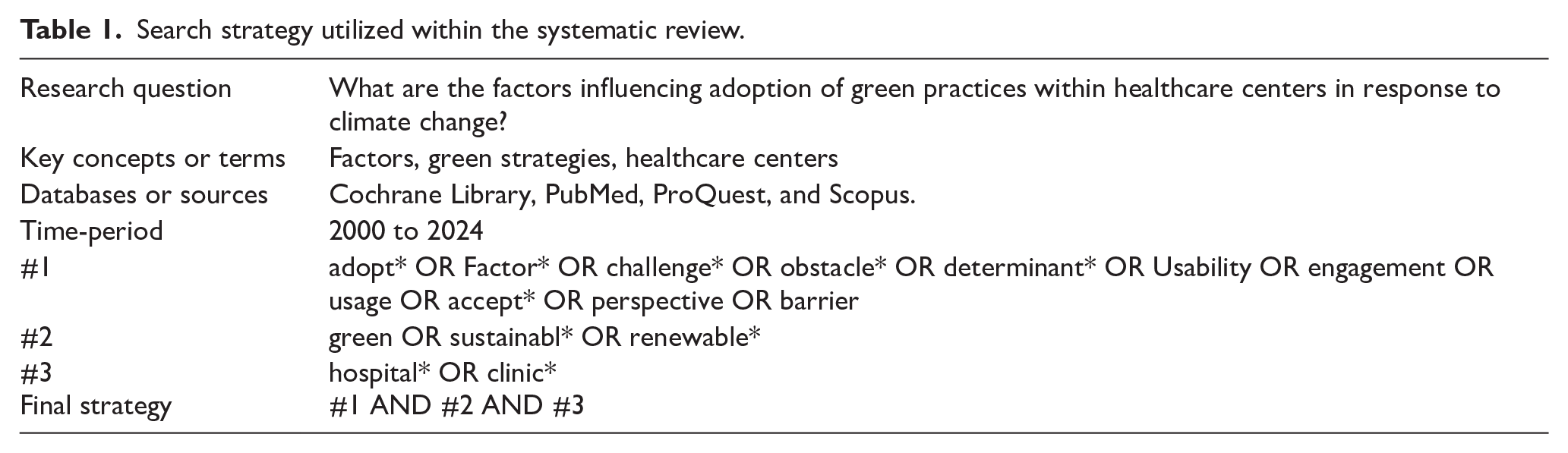
A comprehensive search was executed to locate all articles published pertaining to the factors that influence the adoption of green practices within healthcare centers from 2000 to 2024, exclusively in English. The databases utilized for this search included PubMed, Scopus, Cochrane, and ProQuest. MeSH terms were employed to classify all keywords into 3 categories: Factors, Green Practices, and Healthcare Centers. Synonymous keywords were amalgamated using the logical operator “OR.” The first, second, and third groups of keywords were subsequently integrated using the logical operator “AND.” The EndNote 20.2.1 software was utilized for reference management. The search strategy is delineated in Table 1.
Search strategy utilized within the systematic review.
Inclusion and Exclusion Criteria
The inclusion criteria for this study encompassed articles published in English from 2000 to 2024 that concentrated on the factors influencing the adoption of green practices within healthcare centers. The year 2000 was chosen as the starting point for the inclusion criteria due to the significant increase in climate change research and discussions in the 21st century, particularly in public health, policy, and sustainability, culminating in pivotal global efforts like the 2015 Paris Agreement.
The exclusion criteria included of articles that did not pertain to a relevant subject in healthcare, articles devoid of a title or abstract delineating the factors influencing the adoption of green practices in healthcare centers, or articles lacking a title, abstract, or full-text providing any factor influencing the adoption of green initiatives in any healthcare center. Furthermore, articles identified as low quality based on the quality assessment score utilizing the corresponding checklists mentioned in the quality assessment section were excluded. Additionally, certain types of articles including short communications, letters to the editor, and other irrelevant publications were omitted. The rationale for omitting these certain types of manuscripts was based on the assessment that they typically contain less precise details regarding the topic and undergo a lower level of quality peer review.
Screening and Data Retrieval
The article selection for the review adhered to the guidelines of the Preferred Reporting Items for Systematic Reviews and Meta-Analyses (PRISMA). 24 Duplicate articles were eliminated, and the remaining ones were evaluated based on their title and abstract. Articles that did not align with the research objective were excluded, and the full text of the remaining articles was thoroughly examined. Only those that satisfied the eligibility criteria were incorporated into the final analysis. This entire procedure was independently executed by 2 researchers. In instances of disagreement regarding the results of the procedure, consultation with a third author was sought to finalize the screening process. Data from the final articles that were in accordance with the study objective were independently extracted by 2 authors. Microsoft Office Excel 2016 was utilized to construct a data extraction form for the purpose of data collection. This form comprised sections such as authors, title, year of publication, country of origin, type of study, purpose of the study, and a summary of the results.
Quality Appraisal of Final Studies
The quality of the studies was evaluated using 3 distinct checklists: the CASP Qualitative Studies Checklist, 25 consisting of 10 questions, the AACODS (Accuracy, Coverage, Objectivity, Date, Significance) checklist, 26 comprising 6 questions, and the cross-sectional studies appraisal checklist(AXIS tool), 27 containing 20 questions. Upon selecting the suitable quality assessment checklist in accordance with the study design, a scoring method of Yes = 2, Can’t Tell = 1, No = 0 was employed. The scoring range percentage varied between 0 and 100, with higher scores denoting superior quality. The studies were categorized into 4 quality levels: very low quality (0-25), low quality (26-50), medium quality (51-75), and high quality (76-100). Only studies classified as medium or high quality were deemed eligible for research purposes. The quality assessment process was conducted by 2 authors coordinating with each other simultaneously. Meanwhile, any discrepancies between the 2 authors were resolved by utilizing the views of a third author.
Data Analysis
The data extracted from the preceding steps were analyzed using a qualitative thematic analysis and an inductive approach. 28 The process involved multiple steps, including: (A) Familiarity with the data and assigning codes; (B) Categorization of codes into sub-themes and main themes; and (C) Naming and describing the sub-themes and themes.
During the process, 2 authors meticulously read all the included articles and extractions multiple times to acquire a comprehensive understanding of the data, subsequently assigning initial codes to each significant extraction. All initial codes were scrutinized and finalized prior to their categorization into sub-themes and main themes. The sub-themes and main themes were subsequently named, described, and tabulated. In order to bolster the validity and reliability of the findings and reduce the likelihood of errors or biases, the authors meticulously repeated the steps involved in the thematic analysis. Any disagreements that emerged during this process among the 2 authors were addressed by utilizing the views of a third author.
Results
The findings of this research are organized into 3 distinct sections, encompassing the systematic review, the quality assessment of the final studies, and the thematic analysis.
Systematic Review
The database search yielded 35 538 references. After removing 17 355 duplicates (identified using EndNote 21.2 software) and completing the screening process (which excluded 18 154 records due to the irrelevance of titles and abstracts to the research question), 29 references remained as final studies (Figure 1). The studies were conducted in diverse geographical locations around the world including of the Middle-Eastern and Asian countries such as United Arab Emirates and India and European and North American countries such as United Kingdom and Canada. Utilization of cloud and solar photovoltaic systems beside adoption of green designs in constructions and human resource management were among the most frequent green practices mentioned within the studies. Meanwhile, most of the studies were qualitative and conducted after 2018. Supplemental Appendix 1 (Bibliography of final studies) presents the details of the final studies.
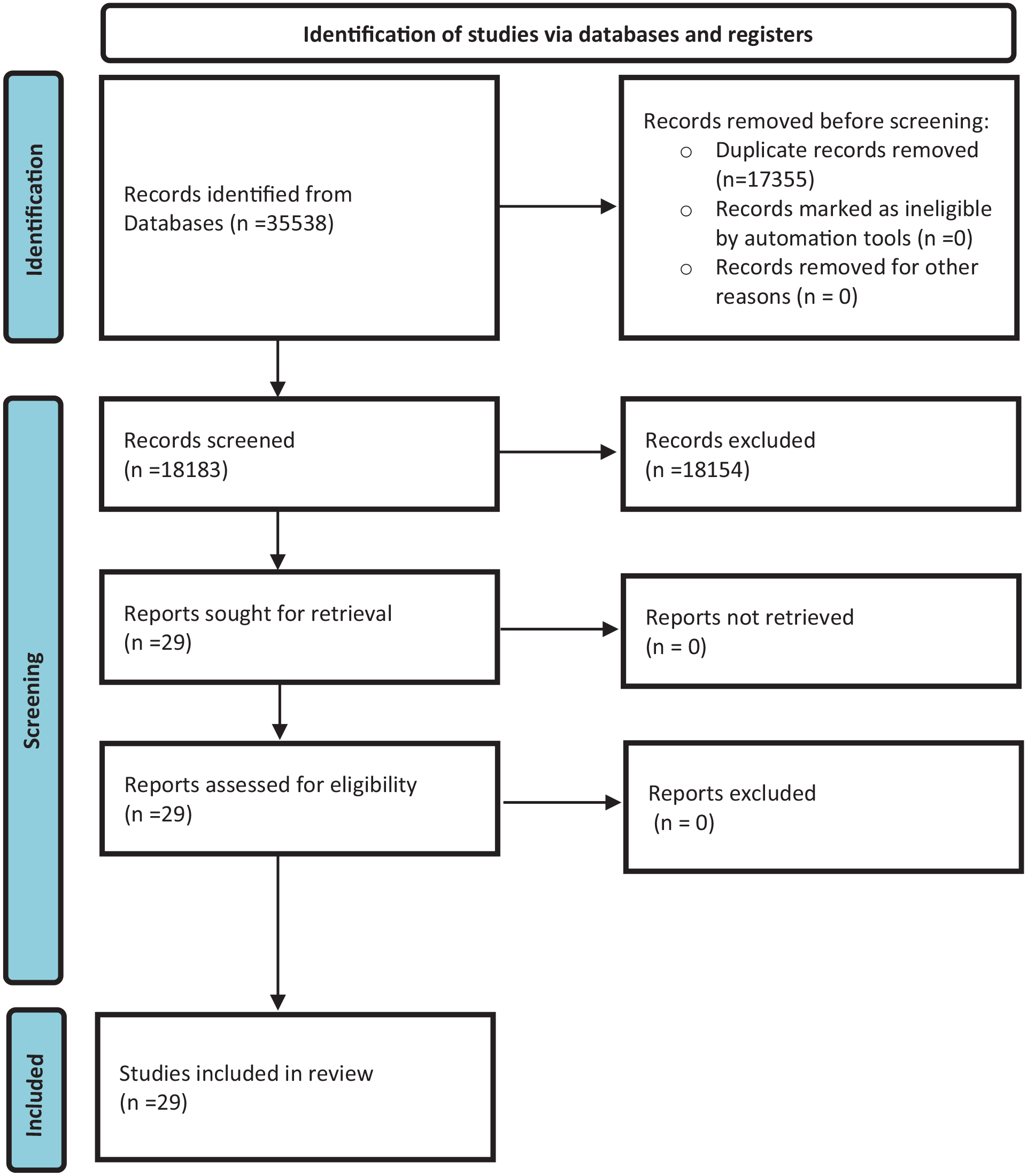
Prisma diagram of the systematic review.
Quality Assessment of Final Studies
The quality assessment of final studies indicated an acceptable level of quality and risk of bias. Meanwhile, the majority of the studies were assessed through utilization of the CASP checklist for qualitative studies as the assessment tool. The quality score of each study is presented in Figure 2. Supplemental Appendix 2 (Quality Assessment of Final Studies) provides further details on the quality assessment process and results.

Quality score of the final studies.
Thematic Analysis
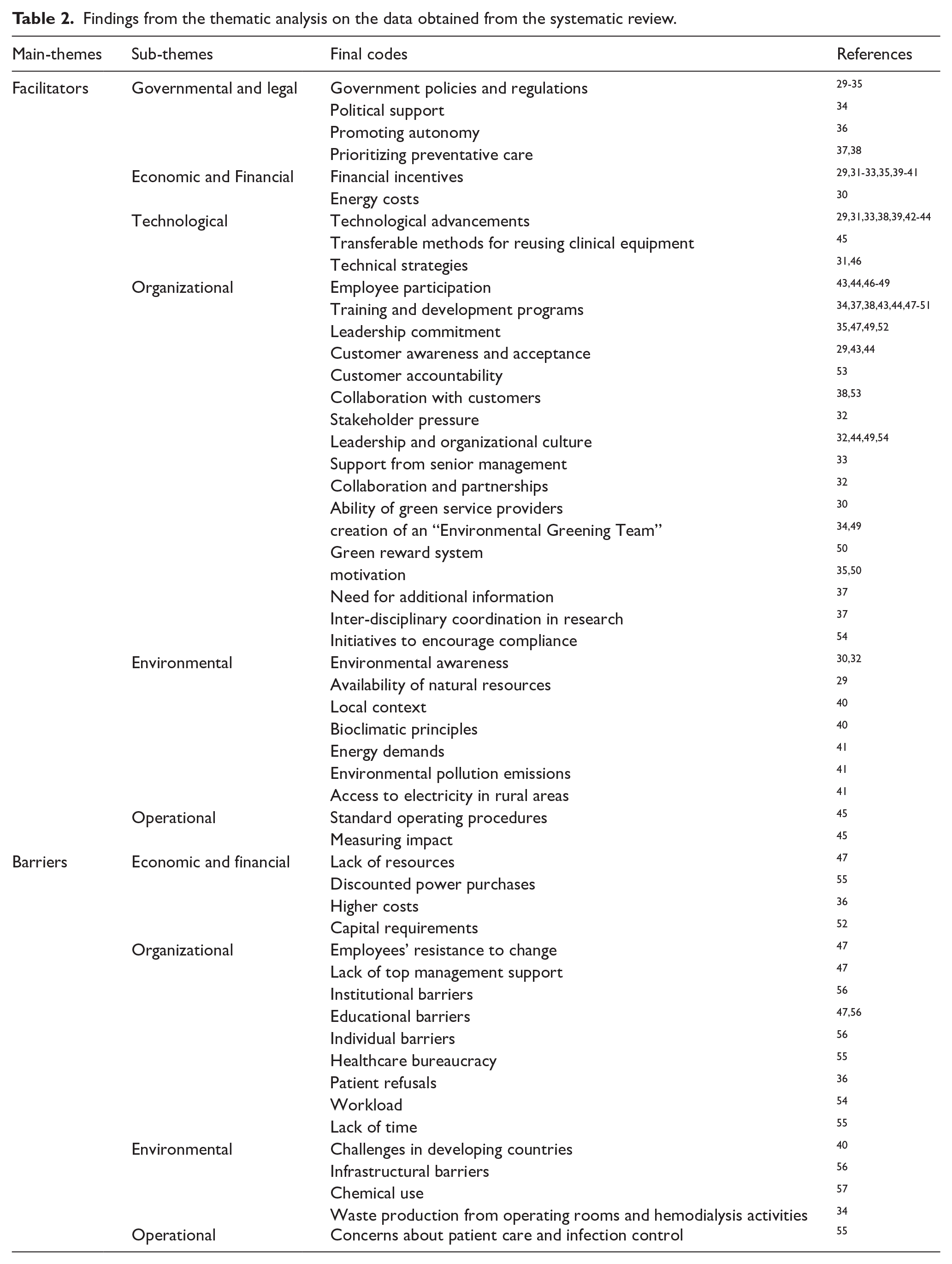
The thematic analysis conducted on the data obtained through the systematic review yielded 2 main-themes including of facilitators and barriers of adoption of green practices within healthcare centers (Table 2).
Findings from the thematic analysis on the data obtained from the systematic review.
Facilitators
The adoption of green practices within healthcare centers is facilitated by multiple groups of factors presented as sub-themes. These include governmental and legal regulations that promote environmentally friendly practices, economic and financial incentives that make green practices beneficial, technological advancements that support such practices, organizational structures and policies that encourage environmental responsibility, the environmental impact of healthcare centers which necessitates the adoption of green practices, and operational modifications that can incorporate green practices into the day-to-day functioning of these centers. More details on these facilitator sub-themes are as follows:
Governmental and Legal
This sub-theme refers to issues such as government policies and regulations, political support, promoting autonomy, and prioritizing preventative care. Renewable energy adoption is significantly influenced by varying policies and regulations across countries, which determine the available incentives and support. Advocacy for environmental sustainability in healthcare centers among policymakers can foster green practices. Furthermore, emphasizing preventative care can lessen healthcare’s environmental impact by reducing the need for health interventions.
Economic and Financial
This sub-theme emphasizes financial incentives and energy costs as factors influencing the adoption of green practices. The adoption of green practices can be incentivized by their efficiency, cost-effectiveness, and available financing options. Meanwhile, significant energy costs may prompt hospitals to consider renewable solutions.
Technological
Technological advancements and transferable methods for reusing clinical equipment fall under this sub-theme. Technological advancements can enhance the viability and effectiveness of renewable energy solutions, thus promoting their use. While, the creation of transferable methods can enable the recycling of clinical equipment, reducing waste. Furthermore, the formulation and execution of technical strategies can aid in the integration of renewable energy systems.
Organizational
This sub-theme includes a wide range of issues such as employee participation, training and development programs, leadership commitment, customer awareness and acceptance, customer accountability, collaboration with customers, stakeholder pressure, leadership and organizational culture, support from senior management, collaboration and partnerships, ability of green service providers, creation of an “Environmental Greening Team,” green reward system, motivation, need for additional information, inter-disciplinary coordination in research, initiatives to encourage compliance. Engaging employees in decision-making can enhance green practices. Furthermore, leadership’s commitment to environmental sustainability, coupled with training programs, can equip employees with necessary skills. While, healthcare centers, under stakeholder pressure, are increasingly adopting green strategies. And, collaborations with external organizations and competent green service providers can facilitate this transition. Meanwhile, a dedicated team and a green reward system can further motivate employees toward environmental management. Finally, additional information and inter-disciplinary research coordination are needed for more sustainable healthcare. Initiatives encouraging waste segregation can improve waste management.
Environmental
This sub-theme covers issues such as environmental awareness, availability of natural resources, local context, bioclimatic principles, energy demands, environmental pollution emissions, access to electricity in rural areas. Climate change awareness is key to implementing green strategies in healthcare facilities. The adoption of these practices is influenced by the availability of natural resources, which varies geographically. Meanwhile, healthcare center designs should consider local customs and bioclimatic principles to optimize resource use and energy consumption. In this regard, energy demands can be met with wind and solar photovoltaic systems, reducing environmental pollution emissions. Moreover, renewable energy is a viable option for rural healthcare centers lacking grid electricity.
Operational
This sub-theme refers to issues such as standard operating procedures and measuring impact. Standardized green procedures ensure consistent, effective implementation. Regular impact assessments of these practices on waste, costs, and student learning can foster continuous improvement and highlight their benefits.
Barriers
The adoption of green practices within healthcare centers faces several groups of barriers presented as sub-themes. The sub-themes include economic and financial constraints, organizational challenges, environmental factors, and operational issues. More details on these barrier sub-themes are as follows:
Economic and Financial
This sub-theme includes issues such as lack of resources, discounted power purchases, higher costs, and capital requirements. The adoption of green practices can be resource-intensive, posing a challenge for adoption. Furthermore, economic factors such as discounted power purchases and higher costs can deter hospitals from implementing sustainable practices. While, the significant capital required for infrastructural changes also presents a financial barrier. However, these challenges can be overcome with careful planning and management.
Organizational
Employees’ resistance to change, lack of top management support, institutional barriers, and educational barriers fall under this sub-theme. Employee resistance to changes in green practices can be mitigated with top management’s support for the practices. Barriers such as lack of education, time constraints, and bureaucratic complexity hinder the adoption of sustainable practices in healthcare. Furthermore, patient refusal and challenges like workload pressures also pose difficulties. Addressing these barriers is crucial for successful green practice adoption.
Environmental
This sub-theme includes challenges in developing countries and infrastructural barriers. In developing nations, the integration of green practices in healthcare centers is hindered by inadequate support and resources. The financial burden of incorporating environmental sustainability infrastructure is a significant barrier. While, the use of toxic chemicals in hospitals and waste from operating rooms and hemodialysis activities are key considerations for environmental sustainability. Therefore, reducing harmful chemicals and waste can enhance the environmental friendliness of these centers.
Operational
This sub-theme refers to issues such as healthcare bureaucracy, patient refusals, workload, lack of time, chemical use, waste production from operating rooms and hemodialysis activities, and concerns about patient care and infection control as operational barriers. The adoption of green practices may raise concerns about potential impacts on patient care and infection control, posing substantial obstacles to hospital sustainability.
Discussion
The thematic analysis revealed 2 main-themes that influence the adoption of green practices in healthcare centers: facilitators and barriers. These 2 main-themes comprised 6 and 4 sub-themes, respectively (Figure 3). The following section provides an analysis and discussion of each sub-theme within the main-themes.

Factors influencing the adoption of green practices within healthcare centers.
Facilitators
This main-theme encompassed 6 sub-themes that enabled the adoption of green practices in healthcare centers. The sub-themes were: governmental and legal, economic and financial, technological, organizational, environmental and operational.
As delineated by the results of the study, renewable energy adoption is influenced by varying country-specific policies.29 -35 In this regard, it is reported that countries with varying economic foundations often implement different climate policies. Nations reliant on fossil fuel industries may adopt less ambitious mitigation strategies due to the economic significance of these sectors, while those with diversified economies can pursue more aggressive climate actions.58,59 The degree of democratization and the structure of political institutions significantly influence these policies. For instance, Sweden has established legally binding carbon neutrality targets by 2045, whereas Finland, despite similar contexts, has struggled to meet its emissions reduction commitments due to differences in political coalitions and policy network inclusivity.58,59 Additionally, while countries are influenced by international agreements like the Paris Agreement, their adherence varies based on domestic priorities and capacities. Some nations strive to exceed commitments through ambitious policies, while others implement only minimal changes to comply with international expectations.59,60 Public awareness and societal engagement also play a critical role; countries with strong environmental movements and public support for climate action tend to adopt more robust mitigation strategies compared to those where public interest is limited or economic concerns prevail.58,59
It is delineated that governments can play a vital role in promoting adoption of green practices. In this regard, it is reported that climate change legislation can set mandatory emission reduction targets and promote renewable energy. 61 While, governments can collaborate with stakeholders on regulatory initiatives to reduce emissions, invest in clean energy infrastructure, and provide financial incentives for sustainable practices. 62 Moreover, policies can be implemented to encourage businesses to align with climate goals. 61
As the findings of the study presented, the adoption of green practices can be incentivized by their efficiency, cost-effectiveness, and available financing options.29,31 -33,35,39 -41 Significant energy costs may prompt hospitals to consider renewable energy solutions as a means of reduction. 30 For development partners, investing in climate resilience can be a cost-effective strategy, as preventative measures often cost less than humanitarian aid and reconstruction following a disaster. Such investments can equip healthcare systems to anticipate and react to climate change impacts. 63 Furthermore, the development of resilience, such as allocating resources for preparation and response to climate change impacts, can assist healthcare systems in managing the changing and escalating health burden, potentially preventing significant financial losses for healthcare delivery systems. 64
As delineated in the findings of the study, technological advancements can enhance the feasibility and efficiency of renewable energy solutions, thereby promoting their adoption.29,31,33,38,39,42 It is reported that telehealth and telemedicine can enhance sustainability and reduce greenhouse gas emissions by eliminating patient travel.65,66 They can positively impact pollution-influenced health conditions like cardiovascular health. 66 Additionally, they provide digital access to test results and medical reports, reducing paper use and improving healthcare efficiency. 65 Furthermore, it is reported that Artificial intelligence (AI) can reduce greenhouse gas emissions by 5% to 10% of an organization’s carbon footprint, translating to about 2.6 to 5.3 gigatons of CO₂ equivalent globally. In healthcare, AI optimizes energy use, improves waste management, and facilitates the shift to renewable energy. 67 It also enhances resource management by predicting energy needs based on patient flow, reducing unnecessary HVAC energy consumption. 68
As delineated in the findings, employee involvement in decision-making, training programs, and leadership commitment can enhance the adoption of green practices.34,35,37,38,47 -52 In this regard, it is reported that the cultivation of a sustainability-oriented culture within an organization can foster environmentally conscious behavior among employees and stakeholders. This can be realized through the establishment of sustainability objectives, the provision of educational opportunities related to sustainability, and the incorporation of sustainability principles into the organization’s mission statement and core values. 69
The findings of the study presented that awareness of climate change’s impact and the availability of natural resources influence the adoption of green strategies in healthcare facilities.30,32 In this regard, it is reported that the execution of an environmental analysis can assist healthcare organizations in pinpointing potential enhancements in their sustainability protocols. This can be accomplished by undertaking a sustainability audit, which serves as a tool for identifying sectors where the organization can minimize its environmental footprint. 70
Lowering the carbon footprint of hospital-based care can contribute to the environmental and financial sustainability of healthcare. This can be accomplished through enhanced medical waste management, evaluation of sustainable technologies, formulation of new guidelines, among other strategies. 71 Impoverished and vulnerable nations, despite their minimal contribution to the cause of climate change, are anticipated to bear the brunt of its catastrophic effects. The global community can assist these nations in adapting by offering financial aid and fostering institutional capacity. 63
Barriers
This main-theme comprised 4 sub-themes that impeded the adoption of green practices in healthcare centers. The sub-themes for this main-theme were: economic and financial, organizational, environmental and operational.
As delineated in the findings of the study, economic factors such as discounted power purchases and higher costs associated with sustainable practices can pose challenges.36,55 The significant capital required to transition from fossil fuels to renewable energy or to procure sustainable equipment can be a barrier, especially for facilities operating on slim profit margins. 52 Therefore, addressing this financial hurdle is vital for the adoption of green practices. Under-privileged and susceptible nations necessitate international assistance for the financial aspects of adapting to climate change. Despite not being the primary contributors to its cause, these countries are poised to endure the most severe repercussions of climate change. 63
Many low-resource settings struggle to secure funding for green initiatives due to a lack of financial institutions willing to invest in high-risk environments, leading to a reliance on external funding that may be insufficient. Additionally, the high initial investment costs of adopting green technologies pose a significant barrier for organizations and governments with limited financial resources, hindering the implementation of sustainable practices.72,73 Furthermore, low-resource settings frequently suffer from inadequate infrastructure to support green technologies, such as renewable energy systems and waste management facilities, which limits the effectiveness and scalability of sustainable strategies. 72 Additionally, a lack of local expertise and training in advanced technologies necessary for green initiatives hampers implementation efforts and stifles innovation.72,74
As presented in the findings, implementing green practices faces barriers such as employee resistance, lack of top management support, absence of sustainability curricula, time constraints, and healthcare bureaucracy.47,55,56 Overcoming these challenges is crucial for the successful adoption of sustainable practices in healthcare. Meanwhile, developing countries face challenges in implementing green practices in healthcare due to limited resources and support. 40 Costs associated with incorporating environmental sustainability infrastructure, the use of toxic chemicals, and waste production from operating rooms and hemodialysis activities are significant barriers.34,56,57 Therefore, addressing these issues, such as finding safer chemical alternatives and reducing waste, is crucial for promoting environmental sustainability in healthcare centers.
As the findings presented, concerns that green practices could potentially compromise patient care or infection control can pose significant barriers to achieving sustainability in hospitals. 55 The deficiency in quality and cleanliness within hospitals can pose obstacles to the execution of environmentally friendly initiatives in response to climate change. The prevalent misbelief that such mitigation measures compromise the quality of care needs to be dispelled. This can be achieved by highlighting that numerous mitigation strategies not only have indirect health co-benefits but can also be implemented without compromising the high standard of care. 75
Limitations and a Call to Action
The study only evaluated articles written in English; This can be considered as a limitation of the study, since there may be some useful data regarding the topic in other languages which the authors have been failed to obtain due to such limitation. The robustness of this study is underscored by its inclusion of a diverse range of studies from various global locations, each characterized by distinct socioeconomic and geographical attributes. It is suggested as an implication that governments can work in conjunction with various stakeholders to enact regulatory measures aimed at reducing emissions, invest in infrastructure for clean energy, and offer financial incentives to encourage sustainable practices.
Based on the findings of this study, it is recommended that healthcare administrators initially conduct a situational analysis considering the context of their country and its characteristics. They should then apply green strategies to mitigate climate change in their healthcare centers while taking into account the economic, social, and political characteristics of their region. Moreover, healthcare administrators should recognize the crucial role of public awareness and societal engagement in implementing green strategies to achieve successful outcomes.
Technological progress can potentially improve the viability and efficiency of renewable energy solutions, thereby fostering their widespread adoption. However, it is important to note that developing nations may encounter difficulties in implementing environmentally friendly practices within the healthcare sector due to constraints in resources and support.
Finally, as our study could not fully address the potential role of new technologies, such as AI, in mitigating the impacts of climate change on healthcare centers due to a lack of literature on this topic—stemming from its novelty—and the limited time and resources available to the authors, this presents an opportunity for future researchers to conduct studies on this issue.
Conclusion
Green practices in healthcare centers are influenced by multiple factors presented as facilitators and barriers. The facilitators and barriers to the adoption of green practices in healthcare centers were categorized as governmental and legal, economic and financial, technological, organizational, environmental, and operational. It is proposed that governments collaborate with stakeholders to implement regulatory measures aimed at curbing emissions, invest in clean energy infrastructure, and provide financial incentives to promote sustainable practices. Additionally, advancements in technology hold the potential to enhance the feasibility and effectiveness of renewable energy solutions, facilitating their broader adoption. Nevertheless, it is crucial to recognize that developing nations may face challenges in integrating eco-friendly practices into the healthcare sector due to resource limitations and lack of support. While the implementation of green strategies varies across different geographical, economic, social, and political contexts, healthcare administrators should assess their country’s specific circumstances and engage the public when applying these strategies to mitigate climate change.
Supplemental Material
sj-docx-1-ehi-10.1177_11786302251332058 – Supplemental material for A Systematic Review of Factors Influencing the Adoption of Green Practices Within Healthcare Centers to Mitigate Climate Change
Supplemental material, sj-docx-1-ehi-10.1177_11786302251332058 for A Systematic Review of Factors Influencing the Adoption of Green Practices Within Healthcare Centers to Mitigate Climate Change by Mohsen Khosravi, Seyyed Morteza Mojtabaeian, Milad Ahmadi Marzaleh and Reyhane Izadi in Environmental Health Insights
Supplemental Material
sj-docx-2-ehi-10.1177_11786302251332058 – Supplemental material for A Systematic Review of Factors Influencing the Adoption of Green Practices Within Healthcare Centers to Mitigate Climate Change
Supplemental material, sj-docx-2-ehi-10.1177_11786302251332058 for A Systematic Review of Factors Influencing the Adoption of Green Practices Within Healthcare Centers to Mitigate Climate Change by Mohsen Khosravi, Seyyed Morteza Mojtabaeian, Milad Ahmadi Marzaleh and Reyhane Izadi in Environmental Health Insights
Footnotes

Author Contributions
MKH conducted the search within the databases; MKH and RI extracted the data and conducted the analysis; MKH wrote the introduction, results and discussion sections; RI wrote the methods section. SMM and MAM cooperated in writing the discussion section and consulted with the authors during each phase of the study.
Funding
The author(s) received no financial support for the research, authorship, and/or publication of this article.
Declaration of Conflicting Interests
The author(s) declared no potential conflicts of interest with respect to the research, authorship, and/or publication of this article.
Data Availability Statement
The data of the research is available through making contact with the corresponding author.
Supplemental Material
Supplemental material for this article is available online.
References
Supplementary Material
Please find the following supplemental material available below.
For Open Access articles published under a Creative Commons License, all supplemental material carries the same license as the article it is associated with.
For non-Open Access articles published, all supplemental material carries a non-exclusive license, and permission requests for re-use of supplemental material or any part of supplemental material shall be sent directly to the copyright owner as specified in the copyright notice associated with the article.
