




Abstract
Background:
Vegetables and fruits are vital components of a healthy diet; however, consuming unclean, uncooked, or improperly prepared products can lead to parasitic infections. Contamination often occurs during both the pre-harvest and post-harvest phases. Thus, the aim of this study is to provide evidence-based scientific information about the level of parasitic contamination and risk factors in Ethiopian fruits and vegetables sold in local markets.
Methods:
A random effects model was selected for analysis. Subgroup analyses and sensitivity analyses were performed to explore potential sources of heterogeneity using the I2 test. Publication bias was evaluated using the funnel plot, Begg’s, and Egger’s tests.
Results:
A total of 3697 samples from 11 studies were included. The pooled prevalence of parasitic contamination was 43.99% (1642/3697) with (95% CI: 38.04-49.95). The highest prevalence was recorded from helminths (26.42%), followed by protozoan infections (17.57%). The most predominant parasites were Entamoeba spp. (6.40%), Ascaris spp. (6.28%), Giardia spp. (5.98%), and Strongylida (4.59%). Contamination rate of fruits alone was 7.02%, while that of vegetables was 36.97%. Additionally, cabbage (8.14%), lettuce (6.46%), tomato (6.12%), carrot (5.71%), and green pepper (5.12%) were the most contaminated vegetables. Factors such as the vegetable produce (aOR = 2.26; 95% CI: 0.86-3.65) and not washed prior to display (aOR = 3.36; 95% CI: 2.00-4.73) were factors associated significantly with parasitic contamination of fruits and vegetables.
Conclusion:
The current finding revealed a significant level of parasitic contamination in fruits and vegetables. As a result, food and drug regulatory bodies, the agricultural sector, and public health organizations need to educate vendors, farmers, and consumers about safe methods for growing, transporting, handling, and eating these products, while also ensuring the establishment of safe market environments.
Registration:
The review was registered in the International Prospective Register of Systematic Reviews (PROSPERO) with the registration number “CRD42024585961.”
Introduction
Intestinal parasitic infections affect around 3.5 billion people globally, leading to over 450 million cases each year. 1 Intestinal parasites, primarily helminths and protozoa, are responsible for many neglected tropical diseases (NTDs) in low- and middle-income countries, constituting a substantial public health issue.1,2 They are closely linked with conditions of poverty, unsafe water, crowded living conditions, and a lack of sanitation and hygiene. 3
Foodborne illnesses remain a significant global health issue, causing substantial morbidity and mortality. 4 Unsafe food causes over 200 acute and chronic diseases globally.5,6 According to a 2015 WHO report, the global burden of foodborne diseases from 31 hazards totaled 600 million cases in 2010, which accounted for 33 million disability-adjusted life years (DALYs) and 420 000 deaths.5,6 Raw fruits and vegetables have seen a rise in causing human infections over the past decade. 4 These parasites—Ascaris lumbricoides, Cryptosporidium spp., Entamoeba histolytica, Enterobius vermicularis, Fasciola spp., Giardia lamblia, hookworm, Hymenolepis spp., Taenia spp., Trichuris trichiura, and Toxocara spp.—can infect humans by consuming contaminated, uncooked, or improperly washed vegetables and fruits. 7
In Egypt, 8 Libya, 9 Saudi Arabia, 10 Iraq, 11 Iran, 12 Nigeria, 13 Sudan, 14 Cameroon, 15 and the Philippines, 16 among other countries, numerous studies were carried out to assess the role of raw vegetables in the spread of intestinal parasites. The importance lies in raw and unwashed fruits and vegetables for the spread of medically important parasites. 17
Fruits and vegetables, rich in essential nutrients, vitamins, minerals, proteins, and fibers, protect the human body from various diseases. Human pathogens spread primarily through the consumption of raw, unwashed produce.12,16 Improper hygiene during planting, harvesting, packing, transportation, and storage increases the likelihood of parasitic contamination of fruits and vegetables. 16
In Ethiopia and similar developing countries, poor sanitation and substandard and crowded living conditions increase susceptibility to parasitic infections.3,16 Furthermore, Ethiopia’s unique geographical location (water quality and availability, soil contamination, agricultural practices, proximity to animal habitats, and access to pest control), climate (temperature and humidity, seasonality, flooding, and temperature extremes), and cultural (hygiene practices, traditional farming and irrigation practices, market conditions, consumer handling, and lack of awareness) features with additional factors such as lack of regulatory oversight, post-harvest handling and transport and storage conditions create ideal conditions for various parasites to thrive. 18 Understanding the burden and distribution of parasites is crucial for developing effective prevention and control strategies. In recent years, there has been an increase in research on parasite epidemiology in fruits and vegetables, with a global meta-analysis found a pooled prevalence of 20% for vegetables and 13% for fruits 19 and 32.4% in the Nigerian meta-analysis. 20 However, no systematic review and meta-analysis has been conducted specifically focusing on the prevalence of parasitic contamination in fruits and vegetables in the local markets of Ethiopia. To address this gap, the current study aims to analyze existing data to provide up-to-date and reliable estimates that can inform prevention and control measures in the country through optimizing their fruit and vegetable intake for health benefits while minimizing parasitic infection risk.
Methods
Design and protocol registration
This systematic review and meta-analysis was designed to estimate the pooled prevalence and risk factors of parasitic contamination of fruits and vegetables in the local markets of Ethiopia. The result was reported following Preferred Reporting Items for Systematic Reviews and Meta-Analysis (PRISMA) guideline 21 (see Supplemental File 1). The review protocol was registered in the International Prospective Register of Systematic Reviews (PROSPERO) under registration number CRD42024585961.
Search strategy
Four databases (PubMed, Scopus, Science Direct, and African Journals Online) were used to retrieve published and unpublished works. Language and time restrictions were not taken during the search for studies, and all published and unpublished studies up to September 1, 2024 were considered. We also looked through reference lists of articles to find studies that were not accessed in online databases. We searched studies using different terms alone or together, using Boolean operations like “OR” or “AND,”, and keywords used were “prevalence,” “associated factors,” “contributing factors,” “predictors,” “parasitic contamination,” “parasites,” “fruits and vegetables,” “fruits,” “vegetables,” “local markets,” and “Ethiopia.”
Inclusion and exclusion criteria
To determine which articles should be included in this study, we considered a number of specific criteria: (1) observational findings; (2) studied in Ethiopia and reported the prevalence or magnitude of parasitic contamination of fruits and vegetables collected from local markets; and (3) published from August 10, 2014, to March 21, 2024. Articles that do not meet the above criteria including (1) reviews and case reports; (2) confusing or unclear analysis results; (4) out-of-scope studies; (5) studies of other microbes; and (6) inaccessible works are excluded.
Study selection and quality appraisal
All retrieved articles were imported into EndNote X8.1.0 (Thomson Reuters, USA). After exclusion of duplications, the titles and/or abstracts of the articles were screened independently by three authors. A full-text appraisal was conducted on articles that met the criteria of our research question and were considered sufficiently valid. To assess the quality of studies, we used the Newcastle-Ottawa Scale quality assessment tool adapted for cross-sectional studies. 22 The tool consists of three main sections. The first section has the potential for 5 stars and assesses the methodological quality of each study. The second section of the tool evaluates the comparability of the studies and has potentially 2 stars. The last part of the tool has a potential for 3 stars to measure the quality of the original articles with respect to their statistical analysis. Articles that achieve a score of 5 or more out of 10 are considered high quality and included in the analysis. Only articles with medium or high quality were included in the meta-analysis (see Supplemental File 2).
Data extraction
Data from studies that met the required criteria were extracted and recorded in an Excel spreadsheet (Microsoft®, Redmond, Washington, USA). Information such as the name of the first author, publication year, region, study area (setting), sample type, local market selection method, sample size, cases, prevalence, sample preparation, and detection technique were extracted from the eligible studies (Table 2).
Data analysis
The I2 statistics were utilized to gauge the level of heterogeneity among the collected data and categorized as low, moderate, substantial, or very high heterogeneity if it was 0% to 25%, 25% to 50%, 50% to 75%, or >75%, respectively. 23 Analysis was performed using STATA version 14 software (StataCorp LLC 4905 Lakeway Drive College Station, Texas 77845-4512, USA). Because of the high heterogeneity, a random effects model was selected for analysis. Additional examinations were conducted, such as subgroup and sensitivity analyses, to identify potential sources of heterogeneity. To evaluate publication bias within the collected articles, a funnel plot, and Begg’s and Egger’s tests were used. A P-value of less than .05 in Begg’s and Egger’s tests indicates a statistically significant presence of publication bias. 24
Results
Selection of studies
A total of 1173 articles were retrieved from the 4 electronic databases and other sources. The first 264 articles were removed due to duplicates. Then, 525 articles were excluded after evaluating the title and/or abstract. Another 178 studies were excluded after the full text evaluation. Furthermore, a total of 195 articles were removed due to: review articles (n = 20); qualitative studies (n = 23); other microbes among fruits and vegetables (n = 65); out-of- fruits and vegetables studies (n = 82); and correspondence, proceedings, and letters to the editor (n = 5). In the end, a total of 11 articles were identified as meeting the necessary requirements and were subsequently incorporated into the systematic review and meta-analysis (Figure 1).

Flow diagram summarizing the selection of eligible studies.
Parasitic contaminations among fruits and vegetables sold in Ethiopian local markets
Out of 11 examined studies, a total of 3697 items (2980 vegetables and 717 fruits) were found, with 1642 (1380 vegetables and 262 fruits) being contaminated with parasites. 12 types of fruits and vegetables such as Persea americana (avocado), Lactuca serriola (lettuce), Brassica oleracea (cabbage), Daucus carota (carrot), Lycopersicon esculentum (tomato), Capsicum annuum (green pepper), Musa paradisiaca (banana), and mangifera indica (mango), Lactuca sativa (salad), Spinacea oleracea (spinach), Solanum tuberosum (potato) and Citrus sinensis (orange) were collected in 11 studies conducted in different local markets in 4 regions (Oromia, Southern Nations, Nationalities and Peoples (SNNPR), Amhara, Tigray) and 1 city administration (Dire Dawa) of Ethiopia. In the 11 included studies such as, Tefera et al (208/360), 25 Bekele et al (196/360), 26 Endale et al (178/376), 27 Bekele and Shumbej (115/270), 28 Alemu et al (87/347), 29 Alemu et al (150/384), 30 Bekele et al (98/270), 31 Gebremariam and Girmay (220/384), 32 Asfaw et al (75/180), 33 Gemechu et al (142/391), 34 and Zeynudin et al (173/375), 35 the parasite contaminated/total sample collected are shown in Table 2 and Figure 2. The frequency distribution of parasitological contamination of items sold in local markets of Ethiopia were shown in Figure 2.
Detailed characteristics of eligible studies.

Abbreviation: SNNPR, Southern Nations, Nationalities and Peoples.

Frequency distribution of parasitological contamination of fruits and vegetables sold in local markets of Ethiopia.
The following items were contaminated by parasites such as green pepper (191/545, 5.12%), cabbage (304/578, 8.14%), lettuce (241/422, 6.46%), salad (39/68, 1.0%), carrot (213/477, 5.71%), tomato (228/582, 6.12%), banana (87/221, 2.33%), mango (80/228, 2.14%), avocado (83/221, 2.23%), spinach (134/244, 3.61%), orange (12/47, 0.32%), and potato (30/64, 0.81%; See Figure 3). The contamination rate of fruits (banana, mango, avocado, and orange) alone was 7.02% (262/1642), while that of vegetables (green pepper, cabbage, lettuce, salad, carrot, tomato, spinach, and potato) was 36.97% (1380/1642).
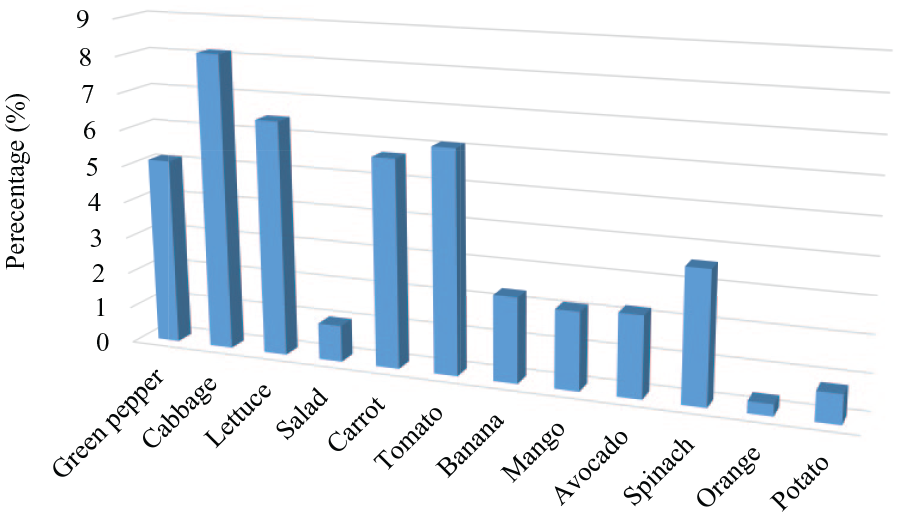
Prevalence rate of parasitic contamination in fruits and vegetables collected from Ethiopian local markets.
The results of 11 parasitological studies showed that 1642 fruit and vegetable samples were microscopically positive for at least one parasite. This gives an overall contamination rate of 43.99% (95% CI, 38.04-49.95). Helminths were more prevalent (26.42%) than protozoans (17.57%). Entamoeba spp. (6.40%), ranked highest, followed by Ascaris spp. (6.28%), Giardia spp. (5.98%), Strongylida (4.59%), Toxocara spp. (3.15%), Hymenolepis nana (3.10%), Cryptosporidium spp. (2.95%), Taenia spp. (2.83%), and Hookworm (2.00%; Table 1).
Prevalence of parasite among fruits and vegetables sold in local markets of Ethiopia.

Characteristics of included studies
The detailed characteristics of the included studies are summarized in Table 2. The 11 eligible studies were studied in 5 regions. SNNPR had the highest number of eligible studies (4), followed by Oromia (3, Amhara 2), and Tigray and Dire Dawa (1 each). All studies used similar sample preparation methods (washing, sedimentation, and centrifugation). Nine studies used light microscope and modified Ziehl-Neelsen staining techniques, while two studies used light microscope only. All studies are cross-sectional and local market-based, and a total of 3697 fruits and vegetables were involved using simple random sampling techniques. The sample size of fruits and vegetables in the included studies ranged from 180 to 391.
Pooled parasitic contamination
The pooled parasitic contamination was 43.99% (95% CI: 38.04-49.95), obtained from 1642 parasite contaminated fruits and vegetables. A very high level of heterogeneity was observed in the included studies (I2 = 93.5%, P < .001; Figure 4).

Forest plot displaying the pooled parasitic contamination among fruits and vegetables in Ethiopian local markets.
Subgroup analysis
Due to the notable heterogeneity of the data, a subgroup analysis was performed. The results are shown in Table 3 and in Supplemental File 3. The pooled prevalence of parasitic contamination in studies conducted with sample sizes greater than 370 (45.22%; 95% CI: 38.07-52.36) was higher than <370 sample sizes (42.98%; 95% CI: 33.30-52.65). Among Ethiopian regions, Tigray had the highest prevalence (57.30%; 95% CI: 52.20-62.40), followed by Dire Dawa (47.30%; 95% CI: 42.25-52.35), Oromia (46.74%; 95% CI: 34.57-58.90), and Amhara (40.39%; 95% CI: 36.80-43.98). While the lowest prevalence was observed in SNNPR at 39.59% (95% CI: 27.52-51.66). A high overall estimate was observed in case-control studies (33.30%; 95% CI: 30.26-36.34) as compared to cross-sectional studies (7.77%; 95% CI: 5.75-9.78) and randomized clinical trial studies (7.29%; 95% CI: 4.14-10.44). The pooled parasitic contamination was greater in studies using both light microscope and Modified Ziehl-Neelsen staining for detection technique (45.10%; 95% CI: 38.02-52.19) than in studies utilizing only one (Light microscope) parasite detection method (38.99%; 95% CI: 33.70-44.28). The pooled parasitic contamination decreases from 45.43% (95% CI: 34.04-56.82) during the period between 2014 and 2019 to 42.80% (95% CI: 36.41-49.19) in the next 5 years (2020-2024).
Subgroup analysis on the pooled parasitic contamination among fruits and vegetables in Ethiopia.

Abbreviation: SNNPR, Southern Nations, Nationalities and Peoples.
Quality assessment and publication bias
Details on the quality assessment of each study are found in Supplemental File 2. Briefly, 100% of the included studies were of high quality (low risk of bias). Additionally, in this systematic review and meta-analysis, there was no publication bias, which was verified with Begg and Egger tests (P > .05; see Supplemental File 4) and there is a symmetrical funnel plot (Figure 5A). Due to the heterogeneous nature of the studies, we conducted a sensitivity analysis by excluding each study individually at a time to evaluate how each affected the overall effect size. In the study on parasitic contamination of fruits and vegetables collected from local markets of Ethiopia, the research of Alemu et al 29 played an important role in influencing the overall outcome. The pooled estimates of 43.89% (42.37-45.41) were recorded with the study conducted by the above-mentioned author (Alemu et al 29 ). After completely removing this study, as indicated in Figure 5B, the estimate becomes 45.89% (44.29-47.50).

(a) Funnel plot representing evidence of publication bias; (b) Sensitivity analysis result of the involved studies that assessed the effect of individual studies on the overall prevalence of parasitic contamination.
Factors associated with parasitic contamination of fruits and vegetables
In this work, the kind of produce and not washed prior to display were reported in 7 articles and they were significantly associated with parasitic contamination among fruits and vegetables sold in Ethiopian local markets (Table 4). However, the medium of the display was reported in 3 articles. Furthermore, the type of market, fingernail status of vendors, and produce source from farmers were reported in 2 articles, but according to this systematic review and meta-analysis, none of the above factors were statistically significant association with parasitic contamination among fruits and vegetables sold in Ethiopian local markets (Table 4).
Factors associated with the parasitic contamination of fruits and vegetables in Ethiopia.

Discussion
In Ethiopia, as in many tropical nations, parasitic infections are common due to the climate’s suitability and unsanitary living conditions allowing for fecal contamination of food, water, and soil.3,16 Due to passing through multiple hands within the market chain, fruits and vegetables may become contaminated with enteric bacteria, viruses, and parasitic pathogens. 36 This systematic review and meta-analysis aimed to examine the level of parasitic contamination and the types of intestinal parasites present in raw fruits and vegetables sold in Ethiopian local markets. In the current study, 11 studies with 3697 fruit and vegetable samples were involved.
The overall parasitic contamination rate was found to be 43.99%, which is comparatively in agreement with the findings reported from Nigerian meta-analysis (32.4%), 20 worldwide (41.22%) 17 and individual studies from Thailand (35.1%), 37 Palestine (36.9%), 38 and Mexico(45%). 39 However, it is higher than the 8.44%, 13 12.5%, 40 and 13.5% 14 reported by individual surveillance studies from Nigeria, Tunisia, and Sudan, respectively. On the other hand, the present finding is lower than the rates of 52.7%, 41 76.9%, 42 and 86% 43 reported by other sets of individual studies from Iran, Yemen, and Egypt, respectively. The disparity among this study and others could potentially be explained by geographical location differences, climatic and environmental variations, sample size discrepancies, distinct laboratory methods used, shoddy post-harvest handling, and socioeconomic status.
Brassica oleracea (8.14%) was found to be the most frequently contaminated product, followed by Lactuca serriola (6.46%), Lycopersicon esculentum (6.12%), Daucus carota (5.71%) and Capsicum annuum (5.12%), Spinacea oleracea (3.61%), Musa paradisiaca (2.33%), Persea americana (2.23%), Mangifera indica (2.14%) and Lactuca sativa (1.0%). Solanum tuberosum (0.81%) and Citrus sinensis (0.32%) were found to be the least contaminated. The variation in contamination between the products might be due to the larger and uneven surfaces of vegetables like cabbage, lettuce, and carrot that can easily facilitate parasite attachment, resulting in varying contamination levels. The smooth surface of Solanum tuberosum, and Citrus sinensis might reduce the rate of parasitic attachment hence explaining the lower contamination rate observed in this study.26,44,45
In the present study, Entamoeba spp. cysts (6.40%) was the most frequently detected parasite from all vegetables and fruits examined in different studies. This finding was comparatively similar to the meta-analysis from Nigeria (4.82%) 20 but lower than the reports from Yemen (20.9%), 42 Sudan (42.9%), 14 and Egypt (40.6%). 43 The current finding is higher than the individual studies conducted in Turkey (1.2%), 46 Mexico (2.5%), 39 and Cameroon (2.84%). 47
Ascaris spp. was the second most observed parasite, with a prevalence of 6.28%. Ova of Ascaris was the third contaminants according to a previous similar systematic review and meta-analysis study done in Nigeria. 20 Comparatively, it is the first predominant parasite in a comprehensive systematic review and meta-analysis conducted in Iran. 48 and other individual studies from Nigeria, 13 Philippines 16 and Kenya. 45 This can be attributed to its widespread distribution nature, the large quantity of eggs produced by the fecund female, and the strong and resilient eggs that endure unfavorable conditions. The eggs remain viable in the absence of oxygen, can last for 2 years at low temperatures (5°C-10°C), and are undamaged by dehydration for up to 3 weeks.
Giardia spp. ranked the third frequently detected parasite in the present study, with a prevalence of 5.98%. This finding was comparatively consistent with an individual study from Iran (5.8%), 41 The current finding is higher than the individual studies conducted from Palestine (1.5%). 38 However, this study was lower than the reports from Egypt (11.6%), 43 Sudan (22.9%), 14 and Zambia (24.2%). 49
In this study, larvae of Strongylida was the fourth frequently detected parasite with a pooled prevalence of 4.59%. This might be due to the fact that the parasite has a free-living state, making it abundant in the environment, hence easily contaminating fruits and vegetables.50-52 Besides, Strongylida infecting animal reservoirs like dogs could also contaminate the environment. The present finding was lower than that reported by other previous reports from Ghana (43.7%), 50 Nigeria (60.4%), 51 and Sudan (62.5%). 53
Produce type was one variable significantly associated with the intestinal parasitic contaminations. Vegetables were 2.26 times [aOR = 2.26, 95% CI: 0.86-3.65] more likely to be contaminated as compared to fruits (P < .001) in the present study. Use of human and animal excreta as an organic fertilizer might contribute to this contamination as confirmed from studies in Ecuadorian Andes, 52 Nigeria, 54 and Ethiopia 55 because edible parts of vegetables grow closer to the soil than those of fruits.
The odds of unwashed produce before display becoming contaminated with at least one parasite was 3.36 times higher [aOR = 3.36, 95% CI: 2.00-4.73] when compared to those washed before display (P < .001). This might be due to the risk of contamination of the produce during transportation and other post-harvest-related activities.25,56
Strengths and limitations
The unique aspect of this systematic review and meta-analysis is that it is the first to report the level of parasitic contamination among fruits and vegetables sold in Ethiopian local markets. Furthermore, the pooled risk factors associated with parasitic contamination were identified. However, this review has its own limitations. Variations in data collection methods and sample sizes across various studies could be the reason for the observed heterogeneity in the current review. This study did not consider all regions and city administrations in Ethiopia due to the lack of availability of articles; therefore, the estimate may not fully represent the country’s prevalence of parasitic contamination. This study also did not address the pooled effect of seasonal variation on the contamination of the fruits and vegetables since all studies included in the current systematic review and meta-analysis are cross-sectional studies, which did not address the effect of seasonal variability on the contamination rate of the fruits and vegetables.
Conclusion
This study has highlighted significant parasitic contamination in vegetables and fruits (43.99%), underscoring the potential health risks associated with the consumption of these products in their raw form without adequate hygiene practices. Entamoeba spp. was the most frequently detected parasite. Vegetable produce and not washed prior to display are factors significantly associated with parasitic contamination. Policymakers and health planners should put a great deal of emphasis on the implementation of relevant prevention and control measures. Further extensive research is needed across different Ethiopian regions and city administrations to understand the nature, dynamics, the effect of seasonal variability, and risk factors associated with parasitic contamination in fruits and vegetables sold in Ethiopian local markets.
Supplemental Material
sj-docx-1-ehi-10.1177_11786302241307882 – Supplemental material for Parasitic Contamination and Its Associated Factors in Fruits and Vegetables Collected From Ethiopia’s Local Markets: A Systematic Review and Meta-Analysis
Supplemental material, sj-docx-1-ehi-10.1177_11786302241307882 for Parasitic Contamination and Its Associated Factors in Fruits and Vegetables Collected From Ethiopia’s Local Markets: A Systematic Review and Meta-Analysis by Abayeneh Girma, Aleka Aemiro, Getachew Alamnie and Yitbarek Mulie in Environmental Health Insights
Supplemental Material
sj-docx-2-ehi-10.1177_11786302241307882 – Supplemental material for Parasitic Contamination and Its Associated Factors in Fruits and Vegetables Collected From Ethiopia’s Local Markets: A Systematic Review and Meta-Analysis
Supplemental material, sj-docx-2-ehi-10.1177_11786302241307882 for Parasitic Contamination and Its Associated Factors in Fruits and Vegetables Collected From Ethiopia’s Local Markets: A Systematic Review and Meta-Analysis by Abayeneh Girma, Aleka Aemiro, Getachew Alamnie and Yitbarek Mulie in Environmental Health Insights
Supplemental Material
sj-docx-3-ehi-10.1177_11786302241307882 – Supplemental material for Parasitic Contamination and Its Associated Factors in Fruits and Vegetables Collected From Ethiopia’s Local Markets: A Systematic Review and Meta-Analysis
Supplemental material, sj-docx-3-ehi-10.1177_11786302241307882 for Parasitic Contamination and Its Associated Factors in Fruits and Vegetables Collected From Ethiopia’s Local Markets: A Systematic Review and Meta-Analysis by Abayeneh Girma, Aleka Aemiro, Getachew Alamnie and Yitbarek Mulie in Environmental Health Insights
Supplemental Material
sj-docx-4-ehi-10.1177_11786302241307882 – Supplemental material for Parasitic Contamination and Its Associated Factors in Fruits and Vegetables Collected From Ethiopia’s Local Markets: A Systematic Review and Meta-Analysis
Supplemental material, sj-docx-4-ehi-10.1177_11786302241307882 for Parasitic Contamination and Its Associated Factors in Fruits and Vegetables Collected From Ethiopia’s Local Markets: A Systematic Review and Meta-Analysis by Abayeneh Girma, Aleka Aemiro, Getachew Alamnie and Yitbarek Mulie in Environmental Health Insights
Footnotes
Acknowledgements
None.
Author Contributions
AG, AA, GA, YM were actively engaged in conceptualization, resources, data curation, methodology, software, formal analysis, investigation, validation, visualization, and supervision, writing—original draft and writing— review and editing. All authors read and approved the final version of the manuscript.
Declaration of conflicting interests:
The author(s) declared no potential conflicts of interest with respect to the research, authorship, and/or publication of this article.
Funding:
The author(s) received no financial support for the research, authorship, and/or publication of this article.
Availability of Data and Materials
The datasets generated and analyzed during the current study are available from the corresponding author upon reasonable request.

Supplemental Material
Supplemental material for this article is available online.
References
Supplementary Material
Please find the following supplemental material available below.
For Open Access articles published under a Creative Commons License, all supplemental material carries the same license as the article it is associated with.
For non-Open Access articles published, all supplemental material carries a non-exclusive license, and permission requests for re-use of supplemental material or any part of supplemental material shall be sent directly to the copyright owner as specified in the copyright notice associated with the article.
