



Abstract
This study aimed to evaluate the impact of varying irrigation levels on haricot bean yield and its related attributes. The experiment was conducted with five irrigation treatments: 60%, 80%, 100%, 120%, and 140% Manageable Allowed Depletion (MAD). The results revealed that the 80% MAD treatment produced the highest haricot bean yields, with 25.03, 26.07, and 23.46 qt/ha in 2016, 2017, and 2018, respectively, with no significant difference from the 100% MAD treatment. The lowest yields per hectare were observed under the 140% MAD treatment, with yields of 18.05, 18.6, and 15.45 qt/ha respectively, across the same years. The average maximum yield across all 3 years was 24.84 qt/ha for the 80% MAD treatment, whereas the minimum was 17.36 qt/ha for the 140% MAD treatment. Water productivity was lowest at 4.32 kg/mm for the 60% and 140% MAD treatments, while the highest values were recorded at 6.09 and 6.07 kg/mm for the 100% and 80% MAD treatments, respectively. Economically, the 80% MAD treatment yielded the highest economic gain of 30,193.1 birr/ha. Therefore, based on these findings, applying 80% MAD under furrow irrigation is recommended for optimal haricot bean production in the semi-arid regions of Ethiopia and similar environments.
Introduction
Irrigated agriculture is a major consumer of water worldwide, using more than 80% of the available water (Dingre & Gorantiwar, 2020). However, this amount is declining substantially in developing nations owing to the increasing demand for industrial, domestic, and other uses (Dingre & Gorantiwar, 2020). This reduction in water resources significantly affects crop production in the agricultural fields. Developing and implementing efficient irrigation management techniques is critical for protecting against global water shortages in irrigated agriculture. Over the past few decades, significant efforts have been made to create and implement various water conservation measures for irrigation water. These water-saving technologies include irrigation scheduling, deficit irrigation, straw cover, and micro-irrigation (Jat et al., 2022; Muroyiwa et al., 2023; Zhang et al., 2023), which enhance the water-use efficiency to deliver sustainable solutions.
Ethiopia faces many challenges, including climate change, high erratic rainfall distribution, increasing population, and extreme drought (Dirirsa et al., 2021; Gelu et al., 2024), and the results have severely impacted many aspects of the seemingly increasing human population’s life, including agriculture and food supplies, natural ecosystems, and human health. Therefore, to optimize yield, water-use efficiency, and irrigation management for crop (haricot bean) production, it is important to understand the irrigation regimes of crops.
Haricot bean (Phaseolus vulgaris) is an important food and cash crop grown in various parts of Southern and Eastern Africa, including Ethiopia (Fentie et al., 2024; Tigist et al., 2023). In Ethiopia, haricot bean is widely grown at altitudes ranging from 1,400 to 2,000 m a.s.l. (F. Gemechu & Sime, 2024; Wasae 2021). It ranks third in terms of export value after coffee and sesame (F. Gemechu & Sime, 2024; Otoro & Hatiye, 2024). It covers 18.6% of the land, with 17.3% of grain production from pulse crops produced in 2021 (The Federal Democratic Republic of Ethiopia Central Statistical Agency [CSA], 2021). Of this total, about 50% of the country’s haricot bean production is found in the Central Rift Valley of Ethiopia (Roba & Miruts, 2024). After tef, haricot bean is the second most important cash crop that farmers grow during intermittent rainfall (CSA, 2016; A. Gemechu, 2024). Tef is a cereal crop grown in Ethiopia and is a major food grain mainly used to make injera a traditional fermented Ethiopian pancake (Gebrehiwot & Ndinda, 2024). Haricot bean is an important source of protein and cash for smallholder farmers in Ethiopia (Fentie et al., 2024). It contributes to nitrogen fixation in the soil (Kebede, 2020). In Ethiopia, the average yearly yield of haricot bean is 1.72 t/ha (CSA, 2022), which is low compared to the 3.0 t/ha produced in the research areas (Miruts, 2022). This is due to the unreliable and poor distribution of rain in this area, and farmers are opting to produce this crop under irrigation. Hence, to enhance crop production, water should be applied according to the crop consumptive demand (crop evapotranspiration, ETc). Knowledge of crop water requirements and irrigation optimization is vital for enhancing haricot bean production in agricultural fields under full and limited irrigation scenarios.
One of the main agronomic strategies to increase haricot bean productivity is to optimize irrigation frequency in particular environments. Globally, there is a growing need for irrigation water owing to population growth, development, and increased demand for food and fiber, resulting in pressure on freshwater resources. In Ethiopia, irrigation consumes a large amount of water extracted from various sources and is characterized by low water productivity. Efficient water use and management are currently a major concern in the country (Eshete et al., 2020). Owing to this concern, limited water resources have attracted significant attention. Therefore, irrigation water should be more efficient to ensure water resources are sustainable and easily available (Gelu et al., 2024; Wale & Girmay, 2019). Irrigation scheduling (when and how much to irrigate) is one of the best mechanisms for sustaining irrigation in areas that receive irrigation. Nevertheless, increasing scheduling and irrigation water productivity has been difficult because of the limited scientific studies on major economic crops (haricot bean). Hence, conducting studies on water requirements and irrigation schedules of crops can reduce the risk of water scarcity and increase agricultural productivity.
Adequate understanding of the timing of irrigation and the quantity of water applied to the crop is crucial for maximizing crop production per unit area under irrigated agriculture (Eshete et al., 2020). In Ethiopia, poor irrigation scheduling practices are a major challenge to the sustainability of irrigation schemes (Yohannes et al., 2019). Small-scale irrigation schemes are generally applied without an irrigation schedule, particularly in semiarid areas. Farmers and decision-makers have low awareness and little evidence of managing water and developing a schedule to optimize water productivity and yield, which results in the underestimation and overestimation of irrigation water. Hence, optimizing irrigation systems and improving water resource allocation through irrigation scheduling are crucial responses to address water scarcity. Therefore, this study identifies the optimal irrigation water demand, haricot bean irrigation schedule, water productivity, and economic return of the irrigation water used. This will contribute to ensuring food security for the increasing population and enhancing the livelihoods of farmers.
Materials and Methods
Study site
The field trial was conducted at Melkassa Agricultural Research Center, Ethiopia (8°24′N and 39°21′E; Figure 1), during the 2016, 2017, and 2018 experimental years. The study site climate was categorized as semi-arid with irregular and unequal distributions of rainfall patterns. Between 1977 and 2018 the average minimum and maximum temperatures varied from 13.8°C to 28.7°C. The area received a mean annual rainfall of 825 mm during the same period. July, August, and September received the highest rainfall amount. From 1977 to 2018 the mean annual wind speed and ETo in the area varied between 0.3 to 2.71 m/s and 3.8 to 5.42 mm/day, respectively. The monthly climate parameters for the haricot bean growing period of 2017 and 2018 are presented in Figure 2. The soil in the study area belonged to the clay loam soil texture class. The soil had a bulk density of 1.13 g/cm3, field capacity (FC) of 0.32 m3/m3, and permanent wetting point (PWP) of 0.22 m3/m3.
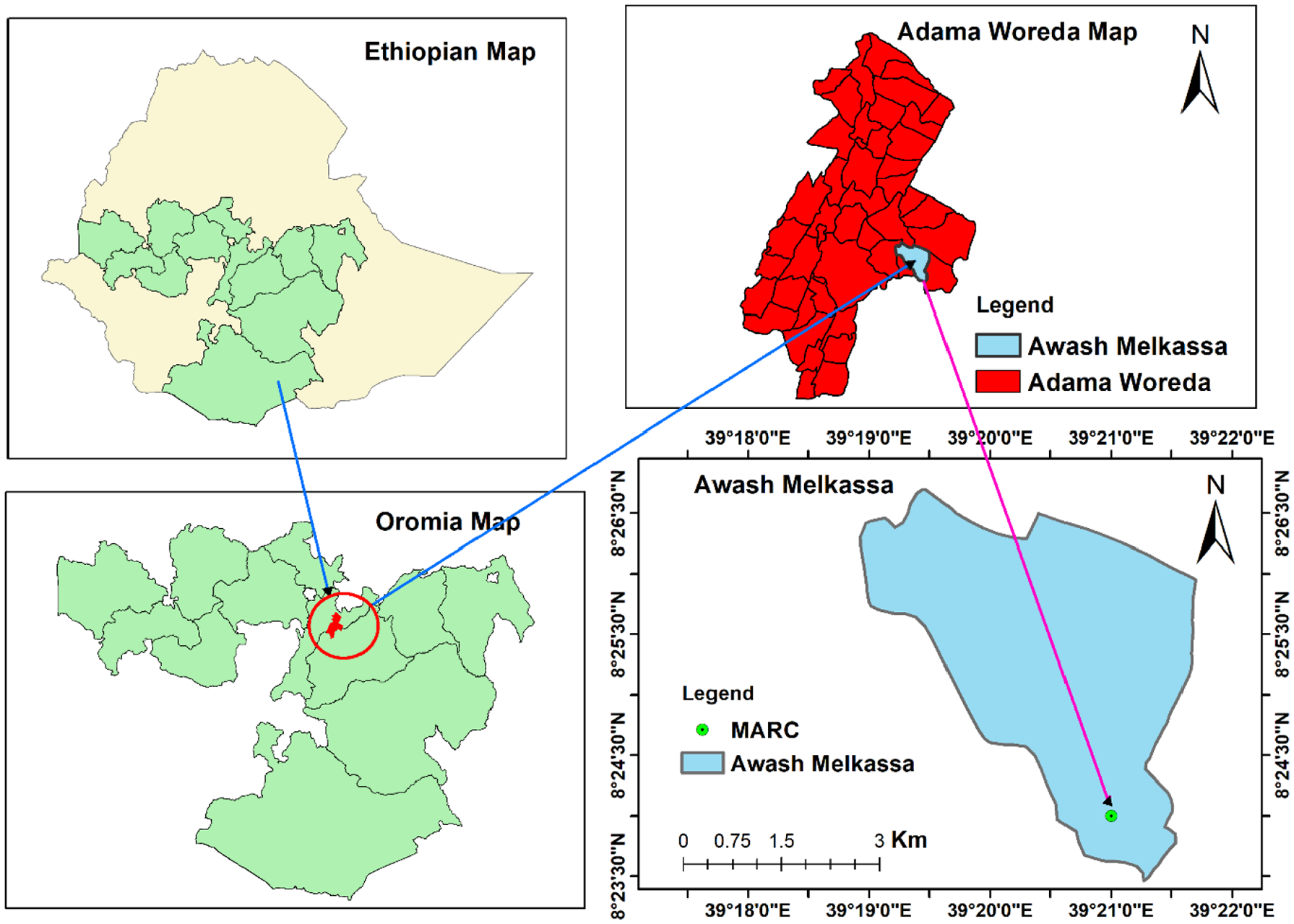
Study area map.
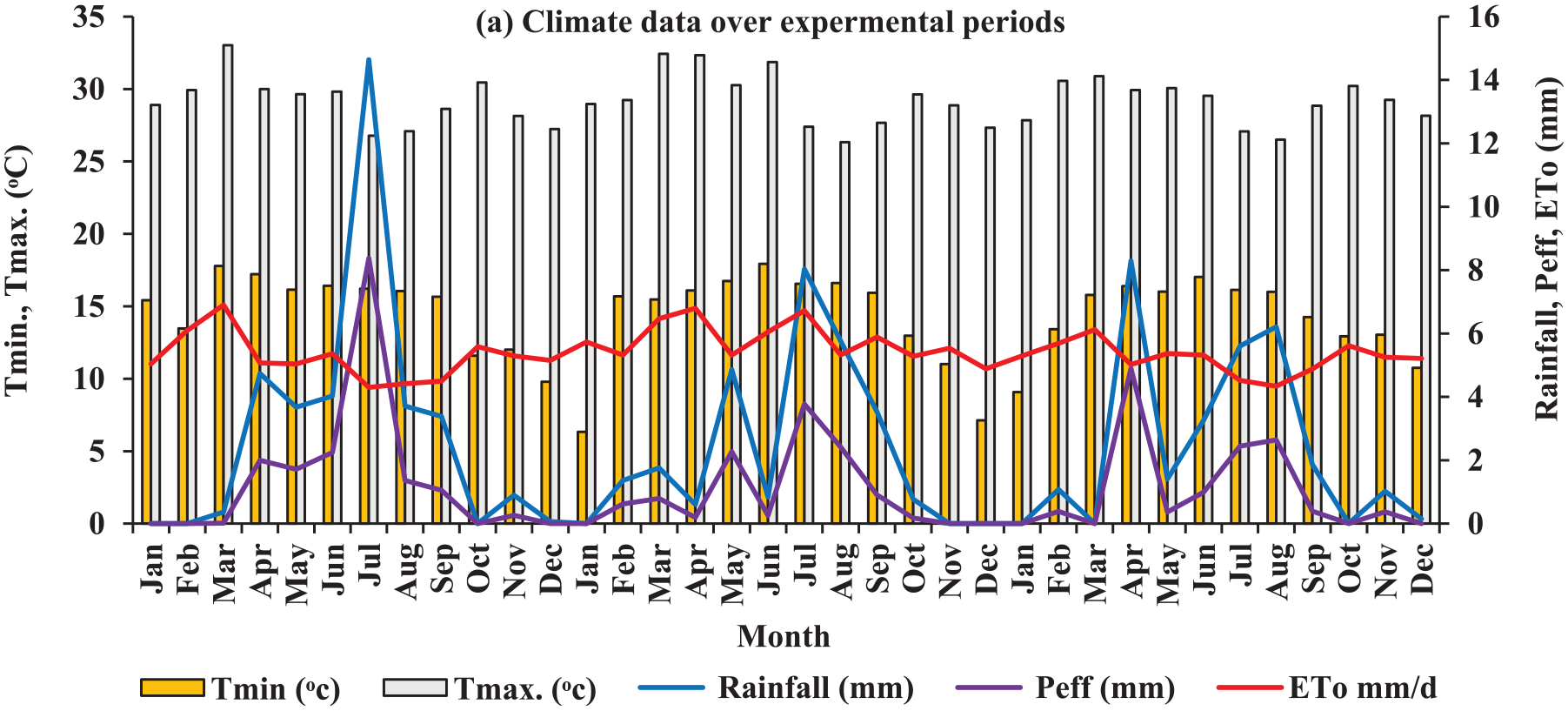
Average monthly parameters over the haricot bean experimental period.
Experimental design and treatments
Five (5) levels of irrigation depletion were used: 60%, 80%, 100% (control), 120%, and 140% MAD. A randomized complete block design (RCBD) with three replications was used for the field trial. The maximum allowable depletion (100% MAD) for haricot beans is 0.45. The maximum allowable depletion levels for other treatments were computed based on their percentage proportions. For the field experiment, a total of 15 plots measuring 3.6 m in width and 5 m in length (18 m2) were utilized. The spaces between the block and plot were 2 and 1.5 m, respectively. There were five rows in each plot; the middle three were sampled and the remaining two were regarded as guard rows. Fifty seeds were sown per row. The spaces between rows and plants were 60 and 10 cm, respectively. The net harvested plot area was 1.8 m × 4 m (7.2 m2), with three harvested rows per plot.
Experimental procedures and crop agronomic practice
Before sowing, the land was plowed, and filed layouts measuring 3.6 m wide and 5 m long per plot were prepared. Haricot bean seeds were hand-drilled into an experimental field plot at a spacing of 10 cm. For each plot, 180 g diammonium phosphate (DAP) and 90 g urea were used during sowing. All agronomic practices (fertilization, weed management, pest control) recommended in the area were consistently applied to crops. After two irrigations, experimental treatments were initiated. After 95 days of sowing, the haricot bean crops were harvested over three successive experimental seasons (2016, 2017, and 2018).
Irrigation application and soil moisture monitoring
Soil moisture was monitored before and after each irrigation, and irrigation events were conducted based on the soil moisture depletion levels. Gravimetric (oven) method was used to quantify the amount of water in the soil. The Bouyoucos hydrometer method was used to identify the percentages of sand, silt, and clay in the soil sample, and the soil texture was determined using a triangle chart. The core method was used to collect undisturbed soil samples to compute the soil bulk density in the experimental field. The total available soil water (TASW) was computed by subtracting the permanent wilting point (PWP) from the field capacity (FC) after measuring the soil water content at the FC and PWP using a pressure plate apparatus (Equation 1). The amount of irrigation water applied to the field was based on the available soil water, following the respective haricot bean soil moisture depletion levels and treatments. Irrigation was terminated when the crops reached maturity. Water for irrigation was delivered to the experimental plots via an open channel, and a Parshall flume with a throat width of three inches was used to measure the water. A field application efficiency of 60% was used to calculate the gross irrigation requirements of the crop. Time was recorded using a stopwatch to control the water applied to each plot. The following formula was used to calculate all required parameters related to the water requirements for crops:

where;

Where:



Where: S = second;
Crop evapotranspiration and reference evapotranspiration
The cropwat8.0 model was employed to compute the daily reference evapotranspiration (ETo) using the FAO Penman-Monteith method (Gabr, 2022). The required model input data, including the daily minimum and maximum air temperatures, wind speed at a height of 2 m, relative humidity, and sunshine hours, were collected from the Melkassa Agricultural Research Center Meteorological Station. The daily crop evapotranspiration (ETc) was computed by relating the crop-specific coefficient (Kc) to the reference evapotranspiration (ETo; Equation 6). The amount of irrigation water used at each irrigation time was determined based on the ETc, crop growth stage, root depth, soil water holding capacity, and precipitation data. The effective rainfall, which was part of the rainfall that fell on the soil and became available for crop production in millimeters, was computed using Equations 7 and 8 (Bokke & Shoro, 2020). This is because it provides sufficient net irrigation water to the crop.

Where;


where;
Agronomic data collection and water productivity
To study the effects of different irrigation treatments (depletion levels) on plant height, five plants were randomly selected from each plot. The heights of the five selected plants were measured from the ground to the apex stem using a ruler. The yield and yield components were also recorded during harvest. A digital balance was used to measure the dry yield of the haricot bean. Water productivity (WP) was calculated as the ratio of yield to total evapotranspiration (ETc) throughout the growing season using Equation (9; Dirirsa et al., 2021; Gelu et al., 2024).

Economic analysis
A partial budget analysis was conducted to assess the effects of different irrigation levels and other input costs for irrigation treatments, including fertilizers, wages, pest control, and herbicides. This analysis aimed to evaluate the economic impact of varying levels of water application and the associated input costs on overall profitability. Partial budget analysis was employed for the economic analysis of the haricot bean experiment (Gelu et al., 2024; Mensa et al., 2023). This approach allows for a comprehensive evaluation of the financial viability of various treatments, thereby ensuring that resource allocation is efficient and effective.
Gross Field Benefits (GFB), Total Costs (TC), and Net Benefits (NB) were used to evaluate the economic analysis of the irrigation treatments. The adjusted yield (qt/ha) was calculated as follows:

Where: Ajy is the adjusted yield in quintals per hectare; Yav is the average yield (qt/ha). The adjusted yield represents the actual or observed crop yield after accounting for various factors that may affect production. The reason for subtracting 10% (0.1) from the average yield (Yav) to compute the adjusted yield (Ajy) is to account for yield variability in real-world farming practices. In field experiments, the yield may be high because of better management. The 10% (0.1) reduction is a conservative adjustment for potential real-world factors that could lower yields, including variability in farmer management practices and postharvest losses. Hence, this adjusted yield represents a more realistic measure, especially useful in economic analysis for farmers who may not achieve the same management level as in the experiment.
Equation (11) was used to calculate the Gross Field Benefits (GFB):

Where: Ajy is the average yield in quintals per hectare
The cost of seed, fertilizer, labor, etc., were included in the total costs.

Where: FxdC is fixed costs (birr), and Vc is variable costs (birr).
The costs of irrigation water, fertilizer, and seed were examples of fixed costs (FxdCs) whereas, labor wages were a variable cost considered in this experiment. The net benefits obtained from the experiment were computed using Equation (13):


Statistical analysis
Statistical analysis system (SAS) software version 9.0 was used to analyze the data. ANOVA was used to determine whether there were statistically significant differences between treatment means. The treatment means were compared using the least significant differences (LSDs).
Results and Discussion
Effect of irrigation treatment on yield, plant height, water productivity, and its related attributes
Variations in the amount of irrigation water applied and irrigation events had a substantial effect on yield, plant height, water productivity, and related attributes. Table 1 shows that plant height was significantly (p < .05) affected by different irrigation levels. In 2018, there was a significant difference in plant height among the treatments. The highest plant height (66.02 cm) was recorded at MAD 80%, whereas the lowest plant height (46.88 cm) was recorded at MAD 140%. Table 1 also shows that 80% MAD resulted in the highest branch number and yield-related parameters at the Melkassa experimental site. This suggests that frequent irrigation of haricot bean plants leads to higher yields.
Effect of Irrigation Treatment on Yield, Plant Height, Water Productivity of Haricot Bean, and Its Related Attributes During 2016, 2017, and 2018.

Note. PH = plant height in centimeters; TYD = total yield in quantal per hectares; 1 quintal = 100 kg; WP = water productivity (kg/mm); CV = coefficient of variance; LSD = least square difference; MAD = manageable allowable depletion; BN = branch number.
The single superscript letters a, b, and c represent there are significant differences between treatments (p < .05), and combinations of superscript letters ab and bc are shown not significantly different between treatments.
As shown in Table 1, the water productivity (WP) of haricot bean was significantly affected by the irrigation amount and frequency. In all seasons (2016, 2017, and 2018), the highest WP was obtained from MAD 100% without significant variation with MAD 80% (Table 1). The minimum WP was recorded under MAD of 140%, with significant variations in the other treatments during the three experimental seasons. As shown in Table 1, as the irrigation frequency increased the yield of haricot beans increased. The results of the current study agree with the findings of Admasu et al. (2019), who reported that the maximum WP was obtained under 100% MAD.
In all experimental seasons (2016, 2017, and 2018), the maximum haricot bean yield was observed at MAD 80%, with no significant variation at 100% MAD, whereas the minimum was obtained at 140% MAD. In 2016, the maximum yield (25.03 qt/ha) was recorded under MAD 80%, while the lower (18.05 qt/ha) was recorded under MAD 140%. In 2017, the maximum yield (26.07 qt/ha) was observed under MAD 80%, while the lower (18.6 qt/ha) was observed under MAD 100%. In 2018, the maximum yield (23.46 qt/ha) was recorded under MAD 80%, while the lower (16.4 qt/ha) was recorded under MAD 60%. The combined results of the 3 years (2016, 2017, and 2018) showed that the maximum haricot bean yield was observed under MAD 80%, with no significant variation with 100% MAD, whereas the minimum was under MAD 140% (Table 1). However, significant differences were observed among other treatments. The lower performance of the haricot bean under MAD 140% revealed that it could not withstand water stress to some extent. In this study, haricot bean plants treated with MAD 80% performed better than the other treatments. This is because haricot bean require medium-frequency irrigation water application compared to other frequent irrigation applications. Various researchers have reported the optimal irrigation scheduling for haricot bean under different irrigation conditions. Abuarab et al. (2020), El-Ayat, El-Giza Governorate, Egypt suggested 80% MAD for green bean production under drip irrigation conditions. In Southern Alberta, Canada, Efetha et al. (2011) suggested that applying irrigation water before the soil water is depleted to 60% MAD can improve high-quality dry bean yield under surface irrigation. Admasu et al. (2019), at Jimma, South West Ethiopia, also recommended using FAO-recommended allowable soil moisture depletion for soybean under sandy loam soil texture. This variation in optimal irrigation allocation is due to the climate, soil texture, soil water-holding capacity, root depth, and growing period of the crops. The patterns of the average and adjusted yields, water productivity, and net benefit over the experimental period are presented in Figure 3.

The trends of yield, water productivity, and economic gains over the experimental period.
Crop water demand and irrigation scheduling
As presented in Table 2, the seasonal crop water demand and irrigation schedule for the haricot bean crop were determined based on the soil, weather, and crop parameters. In 2016, the maximum seasonal crop water requirements under 60% MAD and 120% MAD were 398.3 and 383.3 mm, respectively. In 2017, the minimum seasonal crop water requirement (427.4 mm/season) and the maximum seasonal crop water requirement (450.5 mm/season) were recorded under MAD of 120% and 80%, respectively. The minimum seasonal crop water requirement of 382.2 mm/season was recorded under MAD 140% in 2018, while the maximum seasonal crop water requirement of 416.1 mm/season was recorded under MAD 60%. Table 3 shows that the total number of irrigation events decreased as the irrigation schedule increased. The minimum irrigation event (5) was observed at 140% MAD, whereas the maximum irrigation event (13) was observed at 60% MAD. Table 2 also shows that the depletion level of the soil increased as the irrigation schedule (interval) increased. Under both 120% and 140% MAD, the haricot bean suffered from moisture stress (below the critical depletion level), whereas at 60% and 80% MAD, the crop frequently obtained water without reaching the optimal depletion level ( p = .45) during irrigation. The average seasonal crop water requirement ranging between 404 and 411.4 mm/season was recorded over the haricot bean experimental season (Table 3). The gross and net irrigation requirements of the 60% and 80% MAD treatments exceeded those of the other treatments owing to the continuous supply of irrigation water to the crop root zone. The details of the hydrological parameters of the haricot beans are presented in Tables 2 and 3. The findings of this study are comparable to those of Otoro and Hatiye (2024), who conducted their research in Arba Minch, Ethiopia, reported a haricot bean crop water requirement of 410.3 mm. Alipour et al. (2022), who conducted their research in Melkassa, a semi-arid region of Ethiopia, reported a haricot bean crop water requirement of 398.98 mm. Similarly, Alipour et al. (2022), in Afghanistan, reported the haricot bean water requirement of 579 mm per growing season under no-stress conditions. This is higher because the crop growth period lasted approximately 106 days owing to differences in agroecological conditions. The patterns of net irrigation requirements for all treatments over the experimental period are presented in Figure 4a to c. Soil water depletion level status through growth season of 60%, 80%, 100%, 120%, and 140 MAD, respectively are also presented in Figure 5a to e.
Calculated Net and Gross Water Requirement and Actual Water Consumption of Haricot Bean During the Experimental Period.

Mean Crop Water Demand and Irrigation Events for Each Treatment Over the Three Experimental Years (2016, 2017, and 2018).

Note. MAD = manageable allowable depletion.

Net irrigation requirement for haricot bean during: (a) 2016, (b) 2017, and (c) 2018 experimental periods.

Soil water depletion level status through growth season of: (a) 60% MAD, (b) 80% MAD, (c) 100% MAD, (d) 120% MAD, and (e) 140% MAD.
Economic analysis of irrigation treatments
Table 4 shows the partial budget analysis for the different irrigation treatments. The highest net benefit (NB) of 30,193.1 birr/ha was obtained under 80% MAD, whereas the minimum (16,387.4 birr/ha) was recorded under 140% MAD. This indicates that different irrigation levels resulted in differences in haricot bean yield, net benefits, and BCR. The highest BCR (2.8) was recorded under 80% and 100% MAD (control), whereas the lowest BCR (2.00) was obtained under 140% MAD. Haricot bean growers may have various standards or preferences for irrigation treatments, such as higher yields, net benefits, or benefit-to-cost ratios. Nonetheless, most growers prefer a combination of high yield and high NB. Therefore, for local haricot bean growers, applying 80% MAD is recommended according to the net benefit, benefit-cost ratio, and yields. The details of the partial budget analysis for the haricot bean experiment are presented in Table 4.
Partial Budget Analysis for Different Irrigation Treatments.

Note. Labor costs (for planting, irrigation, and harvesting) were 60-birr man/day). Haricot bean market price was 21-birr/kg, and 1 m3 irrigation water was 1 birr (personal assumption). The cost per 100 kg of NPS and urea fertilizer was 1,412.40 and 1,345.50 birr, respectively. The haricot bean seed cost was 2,100 birr for all treatments. Ajy = adjusted yield quintal per hectare; birr = Ethiopian currency; Yav = gross average yield quintal per hectare; GFB = gross field benefit; NB = net benefit; TRT is treatment; TC = the total cost; BCR = benefit-cost ratio.1 quintal = 100 kg.
Conclusions and Recommendations
Irrigation water management is the most crucial factor in the development of irrigated agriculture. Moreover, the effective utilization of available water, coupled with optimal irrigation scheduling, is important for the success and sustainability of irrigated agricultural practices. Haricot bean is an important cash crop that is widely grown in Ethiopia. This study underscores the importance of developing a sustainable and efficient irrigation regime to maximize haricot bean production. As water becomes increasingly scarce owing to competition across various sectors, precise water allocation in irrigated agriculture is imperative for achieving optimal crop yields and conserving water resources. Water depths ranging from 367.6 to 450.5 mm were applied to the haricot bean trial under different irrigation levels. The maximum net benefits of 30,193.1 birr/ha with a high benefit-cost ratio (2.8) and higher yield (24.84 qt/ha) were obtained under 80% MAD. The minimum net benefit of 16,387.4 birr/ha was obtained under 140% MAD. The maximum water productivity (6.09 kg/mm) and (6.07 kg/mm) were recorded under 100% and 80% MAD, respectively. In this study, the application of 80% MAD irrigation levels demonstrated consistently higher yields, NB, and benefit-cost ratios than the other treatments. This irrigation strategy not only enhances haricot bean yield but also improves water productivity and economic returns. Therefore, based on these findings, it can be concluded that applying 80% MAD is more favorable for haricot bean production in semi-arid areas of Ethiopia and similar ecological contexts. However, this strategy has potential limitations, particularly during drought. Increased Crop Stress: During drought, limited rainfall and high depletion levels may leave the moisture critically low. Haricot bean, especially those sensitive to flowering and pod filling, may experience stress and yield reduction. Soil sensitivity: Sandy soils deplete moisture rapidly, increasing stress risks, whereas clay soils are better at retaining water. Hence, in sandy soils, 80% MAD may reduce crop yield. Evaporative Demand: High temperatures and increased evaporation in drought years may deplete moisture too quickly, leaving insufficient reserves and resulting in crop yield reduction. In general, this study, conducted in a semi-arid region of Ethiopia under clay loam soil texture, provides valuable insights into optimizing irrigation for haricot bean production but has some limitations. These results may be influenced by seasonal variability because the study was limited to a single season. Multi-seasonal trials would help confirm the consistency of yield and economic benefits. The economy was calculated based on current market conditions, which may fluctuate. Future studies should incorporate economic sensitivity analyses to better understand how market dynamics can impact outcomes.
Footnotes
Acknowledgements
The authors acknowledge the Ethiopian Institute of Agricultural Research, Melkassa Agricultural Research Center, for their generous financial support and technical assistance in experimenting.
Author Contributions
Tatek Wondimu Negash: field data collection, data analysis, methodology, and writing the original draft. Abera Tesfaye Tefera: field data collection, writing—review, and editing. Gobena Dirirsa Bayisa: writing—review and editing. Tigest Worku, Aynalem Gurms Dinku, Ketema Tezera, and Gebeyehu Ashami Bikila: field data collection.
Declaration of Conflicting Interests
The author(s) declared no potential conflicts of interest with respect to the research, authorship, and/or publication of this article.
Funding
The author(s) received no financial support for the research, authorship, and/or publication of this article.
Availability of Data and Materials
All data are available on the paper itself.
