



Abstract
The variables that most significantly affect bulb yield in Ethiopia’s irrigated agricultural onion production systems are the amount of irrigation water and the irrigated fertilizer application rates. North Ethiopia has gradually adopted drip irrigation for onion farming due to significant water savings and improved water and fertilizer use efficiencies. However, the optimal irrigation water (I) and fertilizer application rates (F) for drip irrigation are still unknown; field experiments using a random complete block design in factorial arrangement were conducted during summer season of 2019/2020 and 2020/2021 to explore the effects of irrigation water and fertilizer application rates on onion production and productivity. The trials were carried out at four recommended microdose fertilizer rates for nitrogen (N) and phosphorus (P2O5; F1-125%, F2-100%, F3-75%, and F4-50%) and three different irrigation water levels (I1-100%, I2-75%, and I3-50%). The interaction effect of water amount and microdose fertilizer application rate significantly (p ⩽ .05) affected onion yield, yield-related components, and water productivity. A combined analysis of variance using SAS software 9.0 revealed that the interaction between irrigation depth and fertilizer rate had a significant (p ⩽ .05) impact on yield, yield-related components, and water productivity. Onion production and water use efficiency (WUE) increased significantly with increasing irrigation water and microdose fertilizer application rates. However, irrigation water less than 100% were not beneficial to the above parameters. In the two-season study, a maximum onion yield of 39.22 t ha−1 was obtained at F1I1, with a WUE of 8.20 kg m−3. All the factors related to growth, yield, and yield-related components, the combination of a microdosing fertilizer application of 172.5 N and 86.25 P2O5 kg ha−1 and 100% water per irrigation was the best drip irrigation pattern for onion. These findings provide a scientific basis for drip irrigation and microdosing fertilizer management of onions in northern Ethiopia.
Introduction
Onions are among the most important cash crops grown by small-scale farmers, for increasing their income and consequently improving their standard of living (Dessalegn & Aklilu, 2003). Onions are commonly used as seasoning to enhance the flavor of dishes (Enchalew et al., 2016). Most spicy dishes contain onions as important elements (Halvorson et al., 2008). It is considered as an essential part of the human diet (Metrani et al., 2020; Raber et al., 2022). It contains various minerals and vitamins (Raemaekers, 2001; Shahrajabian et al., 2020). It is also crucial in the preparation of traditional meals for Ethiopian cuisine. The bulb and lower part of the stem are most commonly used as seasoning and stew vegetables (Griffiths et al., 2002). According to Ethiopia Statistical Service (2018/2019), onion yield and productivity in Ethiopia and the Amhara region are projected to be 9.3 and 13.1 t ha−1, respectively.
The application of microdosing fertilizer increases fertilizer use efficiency and yield while reducing input and investment costs (Blessing et al., 2017; Kubheka, 2015; Nouri et al., 2017). It is a highly efficient fertilizer application method with high absorption rates because fertilizer is administered very close to the plant (Sime & Aune, 2020; Vandamme et al., 2018). Compared with conventional fertilizer application methods, it has been found to improve yields by 44% to 120% and farmer profits by 52% to 134% (Fatondji et al., 2011; Tabo et al., 2011). This is especially important in irrigated agriculture, where large amounts of fertilizer must be applied to meet crop requirements while preventing leaching losses (De Baerdemaeker, 2013; Ibrahim et al., 2016). A proper combination of nutrients and irrigation water is significant to boost crop productivity and production in terms of both quantity and quality (Bajpai & Kaushal, 2020; Moursy et al., 2023; Sathya et al., 2008).
Efficient water use in irrigation systems is becoming increasingly important, especially in arid and semiarid regions where water is scarce (Deng et al., 2006; Girma & Jemal, 2015; Mekonen et al., 2022). Drip irrigation is one of the most efficient irrigation methods, allowing light and water to be provided to plants in close proximity to the amount of water they consume (S. El-Hendawy et al., 2008; Eranki et al., 2017; Fereres et al., 2003). Experience in many countries has shown that switching from surface irrigation to drip systems can reduce water use by 30% to 60% and simultaneously increase crop yields (Kifle et al., 2023).
Several researchers (Deshmukh & Hardaha, 2014; S. E. El-Hendawy et al., 2008; Feleafel & Mirdad, 2013; Vijayakumar et al., 2010) have reported that drip irrigation has a variety of benefits. Drip irrigation agrees for significant water and labor savings by reducing conventional losses of soil water evaporation, deep percolation, and runoff. In addition, drip irrigation allows for more precise and uniform application of fertilizer, which can enhance nutrient uptake by plant roots (Lepaja et al., 2024; Munir et al., 2019, 2021). Crop yield and water use efficiency increased by 3.6% to 66.4% and 5.9~60.0%, respectively, after aeration with subsurface drip irrigation (Kale et al., 2024; Yang et al., 2023). Overall, drip irrigation technology plays an essential role in improving crop yield and quality and promoting efficient water resource management in arid regions. Micro-dosing fertilizer application is the precise application of small amounts of nutrients during critical crop growth stages. There are several reasons why this method is employed. They are to increase nutrient efficiency by matching nutrient supply to plant needs, to reduce input costs for farmers, and to promote environmental sustainability by minimizing nutrient runoff and soil salinity. In addition, micro-dosing applications improve soil health by promoting microbial activity and reducing the risk of nutrient loss through volatilization and leaching. Targeted nutrient application leads to better uptake by plants, resulting in higher crop yields and profitability. In addition, micro-dosing fertilizer can be adapted to local conditions, contributing to more resilient and sustainable agricultural systems. The objectives of this study were to identify the optimum amount of micro-dose fertilizer and irrigation water for onion production and to analyze the effects of water-fertilizer interactions in a drip irrigation system.
Materials and Methods
Description of the study area
The experiment was conducted in two consecutive irrigation seasons (2019/2020 and 2020/2021) at Aybra in Sekota woreda. The location is at latitude 12°43′35.9′ and longitude 39°01′05.9′ in the northeastern Amhara region (Figure 1). The elevation of the study area is 1,917 m above mean sea level. The major soil type in the study area was cambisols (Nachtergaele et al., 2023). The soil’s texture was clay loam. The research area’s surface soil samples (0 - 30, 30 - 60 cm) were analyzed for bulk density, pH, total nitrogen (TN), available phosphorous (avail P), soil electrical conductivity (ECe), electrical conductivity of irrigation water (ECw), the soil water content of field capacity (FC) and permanent wilting point (PWP), and organic matter content (OM). The meteorological data was collected from the nearest station, Sekota. Daily minimum and maximum temperature, precipitation, wind speed, sunshine hour, and relative humidity were obtained. The long-term average precipitation in the area is 689.6 mm year−1, peaking from July to the end of August and accounting for more than 90% of the annual precipitation (Figure 2). The average daily air temperatures range from 12.6 °C to 27.4 °C, with an average temperature of 20 °C (Figure 2). During the growing season, the average reference evapotranspiration (ETo) in the study area was 4.0 mm day−1 in 2019/2020 and 4.1 mm day−1 in the year 2020/2021, ranging from 5.2 mm day−1 in May to 3.2 mm day−1 in July in the first year and from 5.4 mm day−1 in April to 3.2 mm day−1 in August in the second year (Figure 2). The study site was selected based on the local soils and climate of the area. Subsistence agriculture is practiced in the study area, with a considerable area under cultivation. Agriculture in the study area is both rainfed and irrigated.

Location map of the study area.

Weather conditions during the crop growing season (2019/2020–2020/2021).
Experimental design
The experimental design was used as a randomized complete block design with three replications of factorial arrangements. The experiment consisted of three irrigation levels (100%, 75%, and 50%, referred to as I1, I2, and I3, respectively) and four microdose fertilizer levels, nitrogen (N) 172.5 and phosphorus (P2O5) 86.25, 138 N and 69 P2O5, 103.5 N and 51.75 P2O5, 69 N and 34.5 P2O5 kg ha−1 or 125%, 100%, 75%, and 50% of the recommended fertilizer, referred to as F1, F2, F3, and F4, respectively.
To ensure the uniform establishment of onion seedlings, the same amount of irrigation water was applied to each treatment. Irrigation water was applied at 3-day intervals. A drip irrigation system was used to apply the required amount of irrigation water. Each irrigation treatment area consisted of six 3 m long lateral lines. Emitters on the lateral lines were spaced 20 cm apart and the discharge rate of each emitter was 3 L hr−1. Bombay red onions were grown in the nursery bed for 45 days. Transplanted plots were arranged in rows of 1.2 m × 3 m with spacing of 20 cm by 10 cm (between rows in the lateral line and plants in rows). The recommended rate of onion fertilizer in the research area was applied at 300 kg ha−1 of urea, half at planting and the other half 45 days later, and 150 kg ha−1 of NPS at planting (Birhanu & Tesfaye, 2024).
Layout of field experimental design
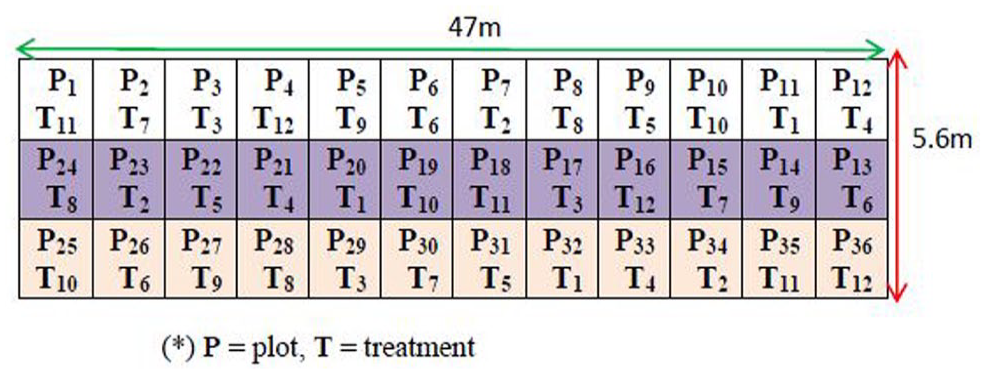
Treatment combinations
T1 = F1-172.5 N and 86.25 P2O5 kg ha−1 + I1-100% ETc by drip irrigation system
T2 = F1-172.5 N and 86.25 P2O5 kg ha−1 + I2-75% ETc by drip irrigation system
T3 = F1-172.5 N and 86.25 P2O5 kg ha−1 + I3-50% ETc by drip irrigation system
T4 = F2-138 N and 69 P2O5 kg ha−1 + I1-100% ETc by drip irrigation system
T5 = F2-138 N and 69 P2O5 kg ha−1 + I2-75% ETc by drip irrigation system
T6 = F2-138 N and 69 P2O5 kg ha−1 + I3-50% ETc by drip irrigation system
T7 = F3-103.5 N and 51.75 P2O5 kg ha−1 + I1-100% ETc by drip irrigation system
T8 = F3-103.5 N and 51.75 P2O5 kg ha−1 + I2-75% ETc by drip irrigation system
T9 = F3-103.5 N and 51.75 P2O5 kg ha−1 + I3-50% ETc with drip irrigation system
T10 = F4-69 N and 34.5 P2O5 kg ha−1 + I1-100% ETc with drip irrigation system
T11 = F4-69 N and 34.5 P2O5 kg ha−1 + I2-75% ETc with drip irrigation system
T12 = F4-69 N and 34.5 P2O5 kg ha−1 + I3-50% ETc with drip irrigation system
Crop water demand
The fixed crop schedule and irrigation water demand were calculated using the CROPWAT computer model version 8.0 following the FAO 56 methodology (Allen et al., 1998). The FAO CROPWAT 8.0 model was used to calculate the experimental site’s reference evapotranspiration (ETo) based on minimum and maximum air temperatures, wind speed, relative humidity, sunlight hours, and solar radiation. Crop coefficients (Kc) were employed as the reference irrigation treatment (100% of crop water demand, CWR). Because there was no site-specific Kc for onion in the study area, the values determined by FAO 56 varied according to the phenological stage of the onion crop 0.5 at growth initiation, 1.15 during bulb development, 0.75 before maturity (Allen et al., 1998). ETc was calculated by multiplying the ETo by the crop coefficient (Kc) at each crop growth stage using the CROPWAT 8.0 model and Microsoft Excel 2010 spreadsheet (Microsoft® Corp., Redmond, Washington, USA) over the growing season Equation 1.

Where ETc is the crop evapotranspiration in mm, Kc is the crop coefficient, and ETo is the evapotranspiration of the reference crop in mm.
Once crop evapotranspiration has been accounted for, net irrigation water demand can be obtained by subtracting the effective rainfall during the study period, as shown in Equation 2.

Where NIR is the net irrigation water demand of the crop (mm) and Pe is the effective rainfall during the growing period of the crop (mm).
Rainfall occurred in the test plots from the beginning to the end of the study (Figure 2). Equation 3 was used to predict total irrigation water demand. The irrigation application efficiency of drip irrigation is assumed to be 90% (Gamni & Sinha, 2024; Zaccaria & Bali, 2024).

Where GIR is the total irrigation water requirement of the crop (mm) and Ea is the application efficiency (%). Irrigation water is applied directly to the plants, and conveyance and distribution losses are not considered (Abdelraouf et al., 2020; Bhalage et al., 2015).
Water productivity (WP) was calculated as the ratio of crop production per unit area of onion bulbs to crop evapotranspiration (mm), expressed in kilograms of onion bulbs per m3 of water used (Kahlon, 2017; Wakchaure et al., 2018).

Data collection
Meteorological data such as rainfall, temperature, humidity, wind speed, and sunshine hours were obtained from the sekota weather station, 17 km from the experimental site. Soil data such as soil texture, bulk density (Bd), pH, organic matter (OM), total nitrogen (TN), available phosphorus (AP), soil electrical conductivity (ECe), field capacity (FC), permanent wilting point (PWP), and moisture content were measured. Data on onion plant growth and yield parameters were measured and recorded in real time from 2.4 m2 net plots via the standard protocols outlined below.
Plant height (cm)
At physiological maturity, the height of five randomly selected plants was measured from the soil surface to the top of the tallest leaf, and the average height was calculated (Nigatu, 2016; Nigatu et al., 2018).
Bulb weight (g)
The weight of five randomly selected bulbs per plot was determined with a sensitive balance, and the mean bulb weight was computed for further analysis (Tekle, 2015).
Bulb diameter (cm)
The average bulb size at harvest for each plot was determined by measuring the diameter of five randomly selected bulbs via calipers (Ketema et al., 2013).
Total bulb yield (t ha−1)
The total onion yield was calculated by adding the marketable and nonmarketable bulb yields (Tekle, 2015). The weight of bulbs obtained from the net field area was measured in kilograms via a sensitive balance and expressed in tons per hectare.
Data analysis
The collected onion growth and yield parameters were subjected to analysis of variance (ANOVA) via R 4.2.2 software. On the basis of the results of the analysis of variance, the means were separated via least significant difference (LSD) tests at the 5% level of significance (Gomez & Gomez, 1984).
Partial budget analysis (PBA)
A partial budget analysis was used to determine the economic benefits of using fertilizer, drip material, and irrigation water for onion production. This can be used to compare the impact of technology changes on farm costs and revenues. This budgeting method is called partial because it does not include all production costs but only those that alter or vary between the farmer’s existing and planned on-farm production methods (CIMMYT, 1988).
The following data were used for the PBA: Variable costs (NP fertilizer and water depth varied among treatments). Onion yield per hectare obtained from each treatment. It was adjusted by a 10% decrement. The farm price of harvested onion is currently approximately 15 Ethiopian birrs per kilogram. Fixed costs included drip material, land preparation, planting, weeding, seed, chemical, and harvesting costs, which were invested equally in each treatment.
The main components of the PBA, total revenue, net income, change in variable costs, change in rate of return, and marginal cost of return were calculated to be at least 100%, and on the basis of net income and the marginal rate of return, it was determined which fertilizer rates and water depths would be more profitable for farmers.
Results and Discussion
Soil properties
The soil moisture contents at field capacity (FC) and the permanent wilting point (PWP) were 26.22% and 14.85%, respectively (Table 1). The volumetric moisture content at field capacity ranged from 26.59% to 25.86%. The average field volumetric moisture content in the top 0 to 30 cm was high at 26.59%, whereas the mean field volumetric moisture content in the 30 to 60 cm subsurface was lower at 25.86%. The soil moisture content at the permanent wilting point varied with depth, with a high value of 16.10% in the upper part (0–30 cm) and a low value of 13.61% in the subsurface soil (30–60 cm).
Soil Properties of the Study Area.

Note. BD = bulk density; OM = organic matter; TN = total nitrogen; AP = available phosphorus; ECe = electrical conductivity of the soil; ECw = electrical conductivity of the water.
The total amount of available soil moisture was 113.7 mm m−1, with a maximum infiltration rate of 40 mm h−1. As a result, topsoil contains the highest concentration of TAW, whereas subsurface soils contain relatively low amounts (Table 1).
ANOVA result
The interaction effect of the amount of irrigation water and the amount of NP fertilizer had significant (p ⩽ 0.05) effects on plant height, bulb diameter, bulb weight, yield, and water productivity when the analysis of variance was combined (Table 2).
Mean square effects of water and fertilizer on onion yield and related indicators.

Note. F = fertilizer; I = irrigation water; PH = plant height; BD = bulb diameter; BW = bulb weight; YL = yield.
A combined analysis of treatment combinations across two growing seasons can offer important information regarding the efficacy and variability of various treatments (Table 3).
Pooled analysis of onion yield and associated parameters across two seasons.

Plant height
The interaction effect of fertilizer and irrigation amount had a significant effect on onion plant height. The plant height varied between 59.68 and 48.16 cm (Figure 3). The treatments with the highest and lowest plant heights received the recommended fertilizer rates of F1 with I1 and F4 with I3, respectively.

Comparison of yield-related components under different irrigation and fertilizer management practices.
The addition of nutrients essential for onion growth and development resulted in increased in plant height (Nigatu et al., 2018). However, the application of the recommended fertilizer rates for F4, F3, and F2, resulted in lower than average plant height in I3.
The increase in plant height with adequate soil moisture application is attributed to the role of water in maintaining the expansion pressure of plant cells, the main factor in growth (Enchalew et al., 2016). On the other hand, the decrease in plant height under reduced soil moisture stress is thought to be due to the closing of stomata to conserve evaporation of soil water, resulting in reduced uptake of CO2 and nutrients.
As a result, photosynthesis and other metabolic responses are inhibited, ultimately inhibiting plant growth (Cao et al., 2022; Pereira et al., 2020). The results of this study are consistent with the findings of El-Noemani et al. (2009), who reported that the soil moisture supply is directly proportional to plant height.
Bulb diameter
Irrigation water and fertilizer application affected the onion bulb diameter, with the I1 and F1 fertilizer treatments having the greatest bulb diameters, which were much greater than those of all the other treatments (Figure 3). Among the required fertilizer treatments, the bulb diameter was the smallest in the I3 and F3 treatments; water deficit up to I3 resulted in a bulb diameter less than the mean value of 6.04 cm.
This finding is in agreement with those of Tolossa (2021); Bhasker et al. (2018), and Enchalew et al. (2016) who reported that higher soil moisture application, resulted in a greater photosynthetic area, greater plant height, greater number of leaves, and larger bulb diameter.
Yield and water productivity
The results of a 2-year combined analysis revealed that F1 application of the recommended nitrogen and phosphorus from among the fertilizer amounts increased onion bulb yield (Figure 4). Onion is a shallow-rooted crop that requires high amounts of nitrogen during the growing season (Halvorson et al., 2008). Nevertheless, as the nitrogen supply decreases, the phosphorus requirements of plants also decrease. Plant water uptake and nutrient absorption are highly related. As plant roots absorb water, dissolved nutrients are transported to onion root surfaces. On the other hand, water uptake decreases, and the nutrient supply to the root system decreases.

Comparison of bulb yield and water productivity under different irrigation and fertilizer management practices.
Irrigation with I1 at 3-day intervals improved yields more than when I2 and I3 were applied, but there were no significant differences between the deficit treatments. Although the soil moisture status was not monitored during irrigation, the difference in moisture between the two depths was not significant. As a result, these two treatments should result in similar soil moisture conditions.
The interaction effect of irrigation and fertilizer had a significant (p ⩽ .05) effect on onion water productivity (Figure 4). However, water productivity decreased with increasing irrigation depth, whereas fertilizer application significantly increased water productivity at all irrigation levels. Thus, onion water productivity decreased when the recommended F1 fertilizer rate was set at I1 compared with when the recommended F1 fertilizer rate was set at I3.
When the recommended microdosing fertilizer rate for F1 was applied at the I3 irrigation rate, water savings of 50% were possible. As a result, compared with full irrigation, 50% deficit irrigation saved a considerable amount of water (2,382.25 m3 ha−1) without significantly reducing yields (Table 4). Therefore, it may be possible to divert this stored water to other irrigable land and increase the irrigated area to compensate for the reduction in crop yields. As a result, 0.99 ha of additional land could be irrigated, yielding 29.85 t ha−1 onion productions.
Shows the relationship between water savings and yield reduction in onion production.

The experimental results of the field trial confirmed that deficit irrigation strategies and appropriate microdosing of fertilizer can increase crop productivity and WUE and conserve irrigation water. This may be especially important for areas facing drought and limited water resources for onion agricultural production. Similar findings have reported that optimizing water and fertilizer application improves photosynthesis (Wang et al., 2014; Zhang et al., 2017) and that increasing biomass yield (Mon et al., 2016) can ultimately increase crop yield and crop water and fertilizer use efficiency (Albrizio et al., 2010; Dar et al., 2017; Li et al., 2010). Mansouri-Far et al. (2010) and Fan et al. (2021) reported that irrigation water can be saved and yields can be maintained under water deficit conditions (as a drought stress-sensitive crop).
Partial budget analysis
A partial budget analysis was conducted on onion bulb yields. The results revealed that the highest net returns were obtained when I1 irrigation water was applied for 3 days at the F1 recommended nitrogen and phosphorus fertilizer application rates, which would be profitable only if the rate of return was greater than 100% (CIMMYT, 1988). However, as Table 5 below shows, its marginal rate of return (MRR) is 42.92%, which is well below 100%. Other rates, such as the (F1:I2), (F1:I3), (F2:I2), (F2:I3), (F3:I2), (F3:I3), (F4:I1), (F4:I2), and (F4:I3) rates, are dominated by the 3-day interval of the microdosing fertilizer rate and irrigation depth. All of these rates were rejected because the recommended fertilizer rate of F3 and irrigation depth of I1 at 3-day intervals increased costs and did not increase net benefits. Thus, the partial budget analysis revealed that the recommended microdosing fertilizer application of F3 and the 3-day interval irrigation depth of I1 provided the greatest benefit to farmers over the other fertilizer application rates (Table 5).
Partial budget analysis of the effects of irrigation and fertilizer on yield (t ha−1).

Conclusions and Recommendations
The effects of nitrogen and phosphorus and the irrigation rate on onion yield and yield components were evaluated. The irrigation water quantity and microdosing fertilizer application rate are the major limiting factors for onion production and productivity. Therefore, the combined interaction of irrigation water and the microdosing fertilizer rate under drip irrigation is a suitable and the most efficient fertilizer application method for sustainable production in water-scarce areas such as Wag-himra, Ethiopia.
The maximum bulb diameter, bulb weight, plant height, and total bulb yield were related to the F1-recommended microdosing fertilizer rate and the I1 irrigation water rate. However, to maximize onion water productivity, F1-dosing fertilizer should be combined with I3 water deficit irrigation.
On the basis of the partial budget analysis, the combination of the F1, F2, and F3 recommended microdosing fertilizer rates and I1 irrigation water rates is economical and can be recommended for onion production in the study area and similar agro ecosystems.
Footnotes
Acknowledgements
The Amhara Agricultural Research Institute and the Sekota Dry-Land Agricultural Research Center are responsible for support, logistics, and advice on research progress.
Author Contributions
AW: gathered, analyzed, and interpreted data, as well as writing and editing the paper. MA, TA, and GB were data collected, monitoring the experiment, data management, and data analysis.
Declaration of Conflicting Interests
The author(s) declared no potential conflicts of interest with respect to the research, authorship, and/or publication of this article.
Funding
The author(s) received no financial support for the research, authorship, and/or publication of this article.

Data Availability
The data will be provided upon request from the corresponding author(s).