




Abstract
Introduction:
The demand for freshwater is increasing around the globe due to population growth and urbanization, exacerbating pressure on available water resources. Consequently, understanding the factors influencing the price per cubic meter of water at a public Ecuadorian university operating in US dollars is crucial for sustainable resource management.
Aim:
To estimate water cost at the Universidad de las Fuerzas Armadas ESPE. Although the university has relevant data, such as maintenance, operation, energy, and water analysis costs.
Results:
This research focused on identifying the various elements contributing to the cost of water, including expenses associated with maintenance ($14,201.60 annually), water quality measurements ($250.00 annually), human resources ($980.00 monthly), chemical inputs ($8.00 monthly), electricity consumption ($464.38), operational and maintenance costs ($30.00 monthly), and the implementation of an ultraviolet (UV) system at the wastewater treatment plant ($186.05 per year). The study concluded that the cost per cubic meter of water at the university was 1.07 USD.
Plain Language Summary
Introduction
Water is one of the main non-renewable resources, indispensable for human survival (Mora-Díaz, 2022; Vicente Chávez-Wilson et al., 2020); therefore, it has an intrinsic value, culturally, socially, and environmentally appreciable, and is not considered a human need, but is configured as a human right (Antúnez Sánchez & Guanoquiza Tello, 2018). Water resources constitute the foundations on which sustainable development is based, at the same time that ecosystems and human sustenance depend on the efficient and rational use of this vital and increasingly scarce fluid (Arellano & Lindao, 2019). As a result, this significance should be reflected in the consumer price.
In a report presented to the Economic Commission on the Economics of Water (Wheeler et al., 2023) specified that price should reflect both the direct and indirect costs, including building a water network, pumping, treatment, and storage facilities as fixed costs, and billing, collection, operation, and maintenance as variable costs. The authors of this report mention that there are several other costs not included, such as environmental costs (conserving water sources) and treatment costs (wastewater treatment). As a result, the total cost of supplying this crucial good and service is only partially covered (Wheeler et al., 2023).
The inclusion of all costs of supplying water should lead to efficient water resource management. In addition, other aspects of water supply should be included in the analysis, such as safe and accessible water, which are also part of the fixed and variable costs, but they play a key role in public health (Alliance for Water Efficiency, 2014). Institutions, organizations, and public services have to meet basic drinking standards as well as supply and demand needs (Almeida et al., 2021; Antão-Geraldes et al., 2024; Asmi et al., 2023; Honey-Rosés & Pareja, 2019; Wichowski et al., 2019).
Cost-benefit analyses and ecosystem services assessments should provide crucial data that can guide institutions such as universities to set up smarter resource management (Lupi et al., 2023). The current study concentrates on determining the cost of water at the Universidad de las Fuerzas Armadas-ESPE. Water cost becomes an essential aspect to understand and optimize water-efficient management. However, the university lacks specific data, and as a result, the study uses the costs associated with the extraction, treatment, and distribution of water at the institution, which becomes fundamental as suggested by (Balingit et al., 2020). Under university conditions, the study obtained direct information from the location where the operations and activities of water management at the University take place. The estimation of water cost was based on (Orozco Mazariegos, 2023) study.
The main objective of this study was to estimate water cost at the Universidad de las Fuerzas Armadas ESPE. Although the university has relevant data, such as maintenance, operation, energy, and water analysis costs, this information is not yet centralized. A field study was conducted to gather this information and calculate the cost per cubic meter of water. This study provided an accurate perspective on the costs associated with the water supply at the university, offering new information and serving as a basis for future research.
Area of Study
The project was developed where the Universidad de las Fuerzas Armadas ESPE is located in the city of Sangolquí, canton of Rumiñahui (GADMUR), −0.314235 latitude, −78.442478 longitude, and 1,238 m elevation. An average height of 2,500 meters above sea level. Figure 1 shows the location of the study area (D. Carrera-Villacrés et al., 2024).
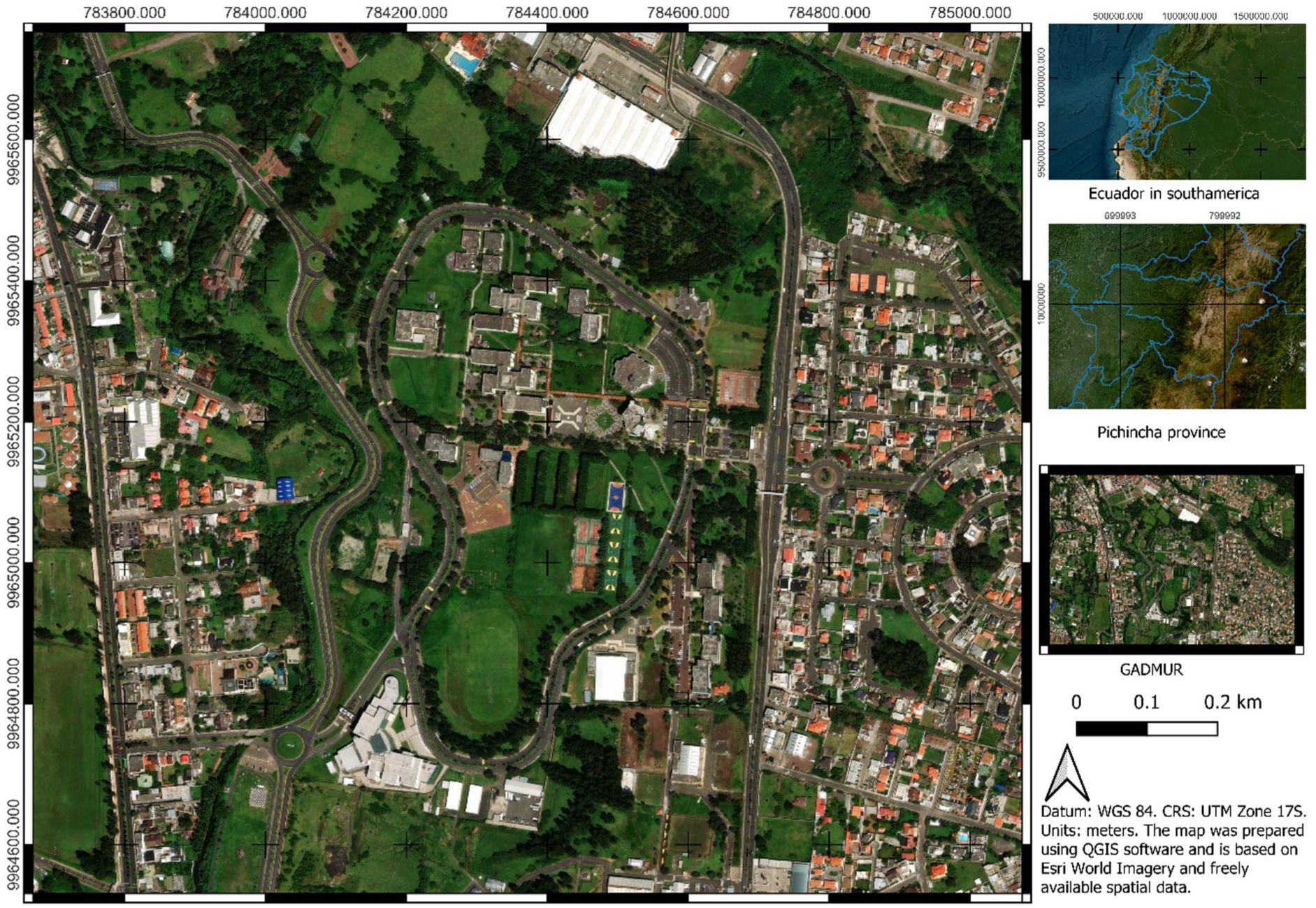
Location of the Universidad de las Fuerzas Armadas “ESPE”-Campus Sangolquí.
Methodology
The study was based on the direct acquisition of essential data from the location where the water activities take place, using direct observation and recording techniques (field visits, dialogue with engineers, operation, and maintenance personnel). A record of all data obtained during the research was made, and a quantitative approach was taken, aimed at analyzing in detail the costs associated with the maintenance service of the water wells and the cistern at the Universidad de las Fuerzas Armadas ESPE.
The analysis included maintenance and cleaning of water pipes, electrical services, care and maintenance of submersible equipment, and also centrifugal pumps operation and replacement. Likewise, costs related to measuring water quality of each borehole, the fees of the technical personnel in charge, expenses for chemical inputs used in water treatment, along with a detailed breakdown of electricity consumption, were included.
Finally, the demand was gathered from the enrolled student population and the administrative staff at the university. By analyzing this data, it was possible to estimate water consumption based on the number of individuals present on campus, considering variables such as the average consumption per person and the specific needs of the university infrastructure (Carrera, 2023).
Costs
According to (Rossiter et al., 2019) costs play a fundamental role in determining the decision-making and the financial viability of an institution (Heberling et al., 2019). Cost management not only involves the recording and tracking of expenses but also the implementation of strategies to optimize performance (Heberling et al., 2019; Montalvo-Cuesta et al., 2020). Based on these studies, cost estimation was obtained from the following expressions:

Where TC is the total cost to be estimated, DC is the direct cost, and IC is the indirect cost. The IC in Ecuador is estimated as a percentage of the direct cost and is expressed as a coefficient ϑ in the expression 2. The coefficient ϑ can also represent the marginal cost of water, MC, as other studies have used to measure water cost (Chukalla et al., 2017; Dearmont et al., 1998; Gonzalez-Alvarez et al., 2006; Nicolaidis Lindqvist et al., 2024; Sjöstrand et al., 2019).

The direct cost DC presented in expression 3 is the sum of all costs, including capital K (equipment), labor L, supplies S, and transport T as defined by (Diaz-Therán, 2023).

In addition, the marginal cost (MC) was estimated to help optimize water production and reach water efficiency. The marginal cost is directly related to the total cost (TC) and water production (Q) and can be summarized with the following expression (Wang et al., 2025):

Results and Discussion
The water demand is summarized in Table 1. The details of the number of water consumers at the university are segmented by population type. The data collected encompasses the total population of the main campus and the specific staff of the university’s administrative buildings.
Water Demand of Regional Universities.
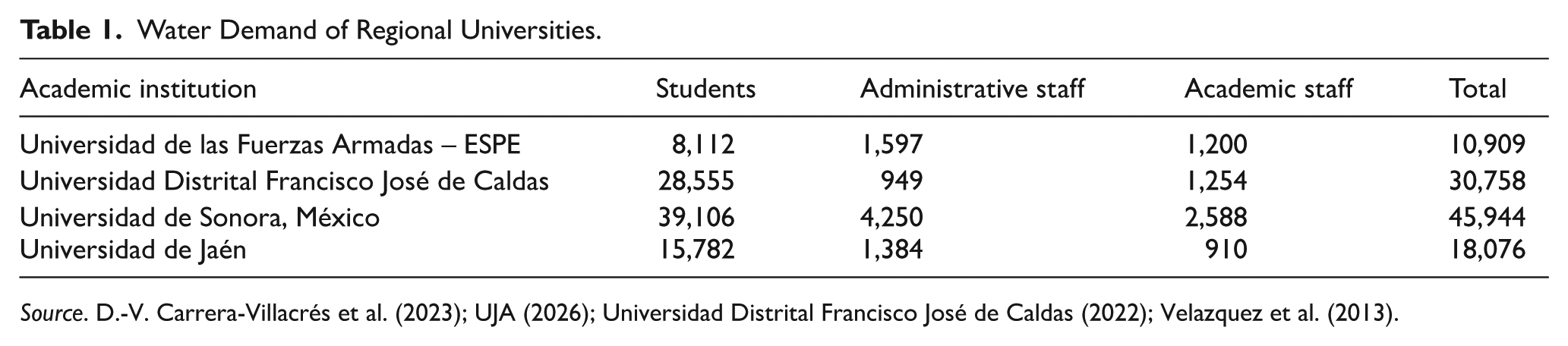
According to (Universidad Distrital Francisco José de Caldas, 2022), the students and university staff of the Universidad de Colombia were 33,294 people. The University of Jaen and the University of Sonora have populations of 18,000 and 46,000, respectively. This clearly shows a huge population difference compared to the Universidad de las Fuerzas Armadas ESPE. This difference in water consumer demand suggests that the cost per cubic meter of water at the ESPE might be lower than the other universities as a result of the lower population. The assumption would be that a lower population lower water consumption.
The study measured water supply in/out of the university water system. Table 2 summarizes water flow in and out of the university system. The results show a consumption flow rate of 1.38 L/s for the university. These results are consistent with other studies made at the university (D. V. Carrera Villacrés et al., 2022; D. Carrera-Villacrés et al., 2022; D. Carrera-Villacrés et al., 2024; D.-V. Carrera-Villacrés et al., 2023). Additionally, at the Universidad de las Fuerzas Armadas ESPE, three discharge points of used potable water into the sewer system were identified (P1, P2, and P3). During studies (Garces-Alarcon, 2022; Narváez & Vaca, 2023), sampling campaigns were carried out over a representative week, and the resulting data are summarized in Table 2.
Water Supply and Discharge at the Universidad de las Fuerzas Armadas ESPE.

The total contribution of the three outlets exceeds 100% as a result of rainwater inflow into the drainage system and groundwater infiltration into the sewer system.
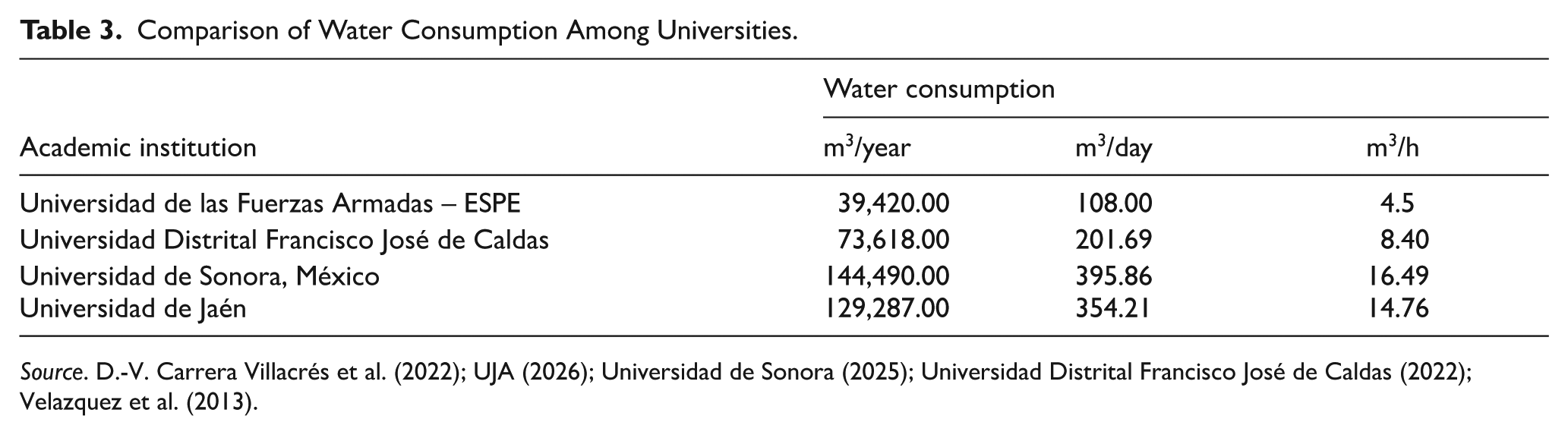
Water consumption of the Universidad de las Fuerzas Armadas – ESPE is exceptionally lower than the other universities (Table 3). The Sonora University has the highest water consumption among universities with 144,000 cubic meters per year, followed by the University of Jaen with 129,000 cubic meters per year. This difference may be related to population, but the University of Sonora has a higher population than the Distrital University of Caldas.
Comparison of Water Consumption Among Universities.
The water cost analysis from the water of contracted services for water wells No. 1 and No. 2 at the Universidad de las Fuerzas Armadas ESPE has a rate of USD 946.00 per day and takes 15 days to maintain wells No. 1 and No. 2 at the university. Water quality analysis is made five times a year at five different checkpoints. The checkpoints include the administrative building, Block A of the central building, the second block of residences, the electronics laboratory, and the research building. The cost of water quality analysis is USD 50.00 per analysis. Finally, the operation has an annual energy expenditure of 72,848.16 kWh (Table 4).
Maintenance and Operation Costs.

Source. Ludicons (2023).
The water quality analysis requires several supplies, which are included in the cost from (Anavanlab, 2023), a lab contractor. The cost of the chemical inputs for water treatment is USD 1.00 per tablet, and 96 tablets (NaOCl at 10%) are required. The cost of the cistern operator is USD 6.23 per hour, and they invest 160 hr per month. Additionally, the university has an operations manager with an operational cost of USD 7.50 per hour, who dedicates 150 hr per year to supervising maintenance and operations. Finally, all operations and maintenance have indirect costs that cover administrative and financial expenses, nursing, and social work, which represent 10% of the maintenance and operation costs (Table 4).
The data presented offers a comprehensive overview of the services and activities covered by the maintenance contract. These details are crucial for effective planning and management of the resources dedicated to ensuring the operational efficiency of the university’s water supply systems. It is important to note that this maintenance is carried out annually. The analysis includes all direct and indirect costs incurred during the research, culminating in the determination of the cost per cubic meter of water.
Regarding labor costs, the cistern operator is responsible for maintaining the treatment plant and supervising the operation of both the system and the cistern. According to the Physical Development Unit of the ESPE, this position has a salary of $980.
The average monthly cost of laboratory analyses for determining water quality in Ecuador is $22.40. In contrast, ESPE reports a monthly cost of only $20.83. This lower cost at ESPE may indicate a reduced scope of analyses compared to the comprehensive requirements outlined in the Ecuadorian Ministry of Environment’s regulations (2024; Ministerio del Ambiente del Ecuador, 2024). The university’s analyses are currently limited to arsenic, cadmium, copper, fecal coliforms, chlorine, color, chromium, chlorides, mercury, lead, nitrates, nitrites, turbidity, and pH.
Regarding the costs of chemical inputs for water treatment, only 10% chlorine is used. This product is available in canisters containing 250 tablets each, with a total cost of $250 according to information provided by the Physical Development Unit.
The analysis of electricity service costs at the university, presented in Table 3, reveals that the pumps and installations consumed a total of 6,070.68 kWh per year, which is 72,848.16 kWh. Given an electricity rate of $0.08 per kWh, the monthly expenditure for this energy consumption was determined to be $485.65. In addition to the previously mentioned costs, an extra $30.00 was allocated.
Paredes-Beltrán and Chafla-Barahona (2016) found that the annual maintenance cost for a drinking water supply system in Río Negro Parish, Baños Canton, Ecuador, was significantly lower at $11,722.68 compared to the $14,201.55 annual cost of the Universidad de las Fuerzas Armadas ESPE.
The marginal cost was estimated using the difference between social discount rates for public programs and the average of the Ecuadorian inflation rate. This makes sense because the capital, labor, and production costs will rise at least at the inflation rate, and the social discount rate is the discount rate used in computing the value of public funds spent on social projects. The marginal cost estimated was 0.11. This marginal cost helps to estimate the annual cost of water per cubic meter. We estimate the cost of water for 5 years based on the lifespan of the capital and use the passive central bank rate as a discount rate. We used the passive central bank rate because central banks can partially insulate domestic short-term interest rates from this increase by expanding domestic assets, and the discount rate is the cost of borrowing from the central bank (Bazot et al., 2024; Corhay et al., 2021; Jaramillo, 1966). The rationality of using marginal cost is the economic efficiency as suggested by (Mann Patrick & Schlenger Donald, 1982).
To provide context for our findings, a comparative analysis of water costs at other universities was undertaken. Data collected from the Distrital Francisco José de Caldas University in Colombia was included in this analysis. The results of this comparison are presented in Table 5, which shows the cost of water consumption for the year 2022. Data from the University of Sonora in Mexico (Velazquez et al., 2013) revealed a water cost of USD 1.55 per cubic meter (Table 5). This institution’s exemplary water conservation practices, characterized by minimal wastage, position it as a model of environmental stewardship.
Total Cost of Water m3 at Other Universities.
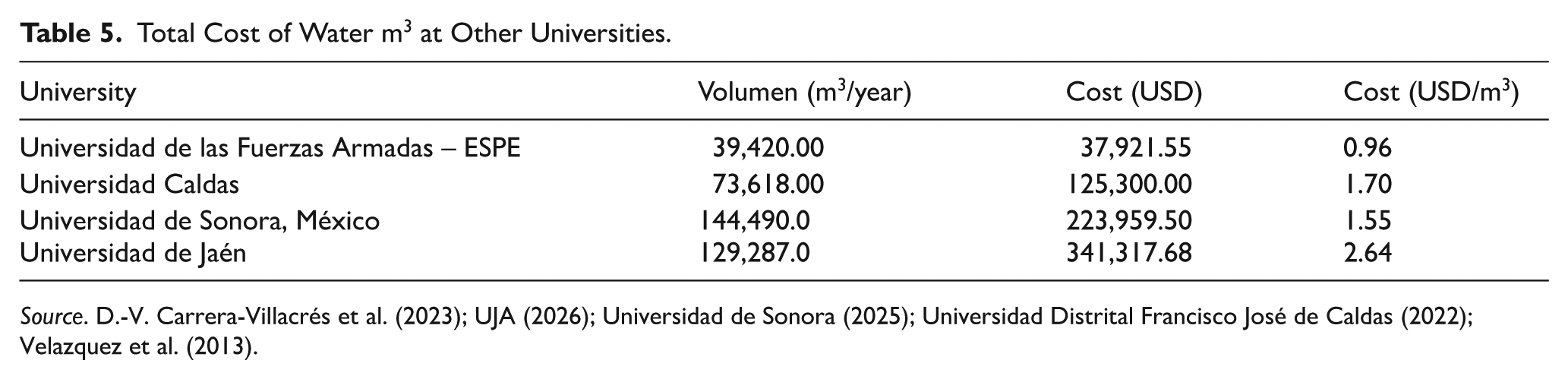
An analysis of water costs at the ESPE University revealed a cost of USD 0.96 per cubic meter. This value establishes a financial framework for the university’s water management initiatives. When compared to the broader context of Rumiñahui canton, where the university is located, the average cost is USD 0.98 per cubic meter (as exemplified by the Armenia II Urbanization), the ESPE’s rate is slightly more economical.
Disinfection is the final stage of a treatment system. Consequently, Table 6 presents the budget required to implement ultraviolet (UV) disinfection at the university water treatment plant.
Costs of a UV Irradiation System.

Source. Herrera and Castillo (2024).
The new disinfection system will incur a maintenance cost, which will be allocated to the cost of water per cubic meter. The UV disinfection unit was treated as a capital expenditure (CAPEX) rather than as an annual operating cost. A useful lifespan of 5 years was assumed, and the capital cost (930.25 USD) was annualized using straight-line amortization. This results in an equivalent annual UV cost of 186.05 USD/year. Consequently, the corrected total annual cost of the system, including indirect costs and the annualized UV CAPEX, is 37,921.55 USD/year. The total drinking water is evacuated through the sewers; there is an annual volume of 39,420.00 m3, and the total cost, including treatment, is 37,921.55 USD. Therefore, the total cost per cubic meter of water is 1.07 USD, which includes the marginal cost.
Conclusions
The cost of water at the Universidad de las Fuerzas Armadas ESPE was calculated to be 1.07 USD per cubic meter, establishing a financial framework for water management on campus. This cost will rise to 1.85 USD when capital renovation is required. Yet, the price per cubic meter is still low compared to other universities, as it is presented in Table 5. In all these universities, there is a higher water demand, and that may reflect their higher price of water price.
The university produces approximately 1.25 liters of potable water per second. From the potable water production per second, 50% is treated at the campus wastewater treatment plant, 3% is discharged untreated, and 70% enters the public sewer system. Compared to other regional universities, the Universidad de las Fuerzas Armadas ESPE has lower water costs per cubic meter due to differences in maintenance expenses and a less comprehensive analysis of environmental parameters as required by Ecuadorian regulations. Implementing a disinfection process would increase the cost per cubic meter of discharged water. This measure is intended to mitigate environmental impacts, enhance water quality, and prevent financial penalties from regulatory authorities.
Footnotes

Funding
The authors received no financial support for the research, authorship, and/or publication of this article.
Declaration of Conflicting Interests
The authors declared no potential conflicts of interest with respect to the research, authorship, and/or publication of this article.